
COA Circular No. 2012-003 October 29, 2012
PM
Published · 53 slides · 0 views
1 / 1









Description
COA Circular No. 2012-003 October 29, 2012 Guidelines for the Prevention and Disallowance of Irregular, Unnecessary, Excessive, Extravagant and Unconscionable Expenditures (For CPAs in Government Sector) As Presented by: Atty. Roland Café
Related Topics
Share
Embed code
Download this presentation From Below
"COA Circular No. 2012-003 October 29, 2012" is the property of its rightful owner. Permission is granted to download and print the materials on this website for personal, non-commercial use only, and to display it on your personal computer provided you do not modify the materials and that you retain all copyright notices contained in the materials. By downloading content from our website, you accept the terms of this agreement.
Presentation Transcript
01
COA Circular No. 2012-003
October 29, 2012 Guidelines for the Prevention and Disallowance of Irregular, Unnecessary, Excessive, Extravagant and Unconscionable Expenditures
(For CPAs in Government Sector)
As Presented by:
Atty. Roland Café Pondoc, CPA, MBA,
REA, REB, Lt. Col. PAF (Res.)
PICPA National President
Former COA Commissioner March 27, 2025
PHALGA Summit
Laoag City<br>
(For CPAs in Government Sector)
As Presented by:
Atty. Roland Café Pondoc, CPA, MBA,
REA, REB, Lt. Col. PAF (Res.)
PICPA National President
Former COA Commissioner March 27, 2025
PHALGA Summit
Laoag City<br>
02
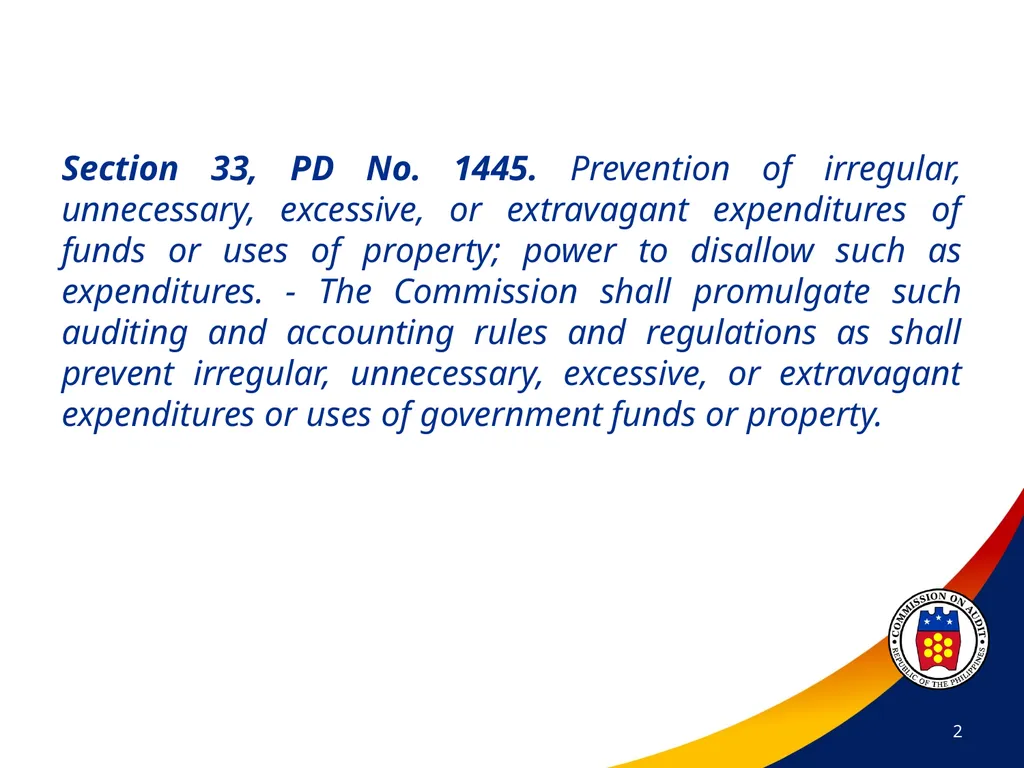
Section 33, PD No. 1445. Prevention of irregular, unnecessary, excessive, or extravagant expenditures of funds or uses of property; power to disallow such as expenditures. - The Commission shall promulgate such auditing and accounting rules and regulations as shall prevent irregular, unnecessary, excessive, or extravagant expenditures or uses of government funds or property. 2<br>
03
I - rregular
I - llegal
U - nnecessary
U - nconscionable
E - xcessive
E - xtravagant 3 IIUUEE stands for:<br>
I - llegal
U - nnecessary
U - nconscionable
E - xcessive
E - xtravagant 3 IIUUEE stands for:<br>
04
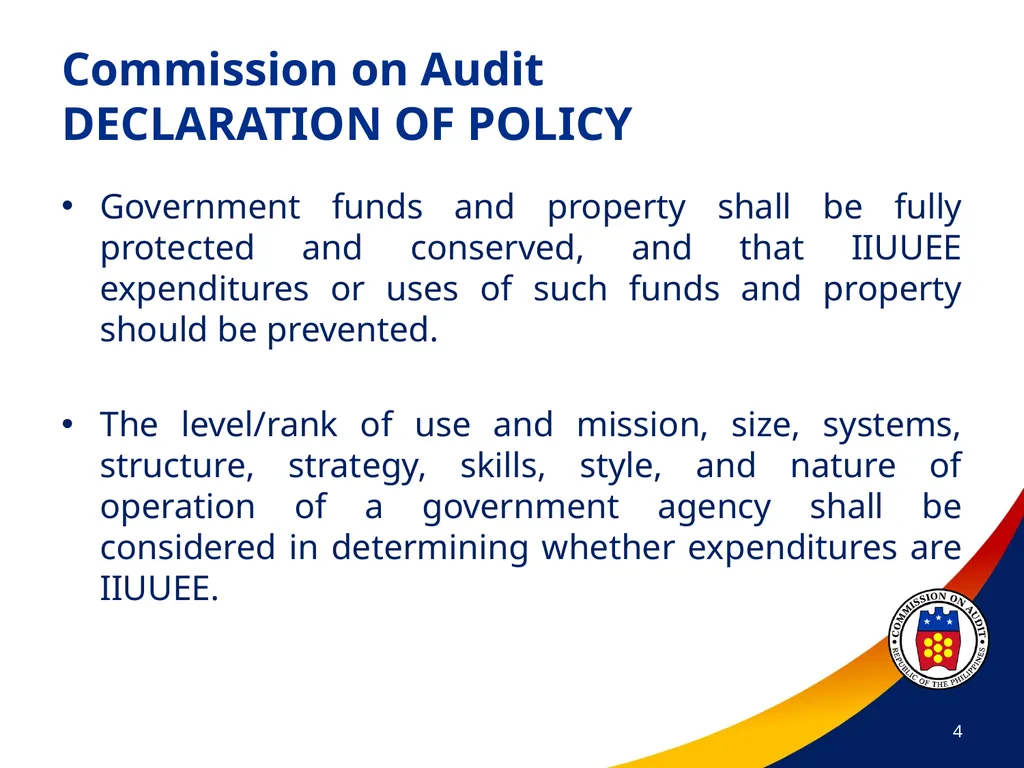
Government funds and property shall be fully protected and conserved, and that IIUUEE expenditures or uses of such funds and property should be prevented.
The level/rank of use and mission, size, systems, structure, strategy, skills, style, and nature of operation of a government agency shall be considered in determining whether expenditures are IIUUEE. 4 Commission on Audit DECLARATION OF POLICY<br>
The level/rank of use and mission, size, systems, structure, strategy, skills, style, and nature of operation of a government agency shall be considered in determining whether expenditures are IIUUEE. 4 Commission on Audit DECLARATION OF POLICY<br>
05
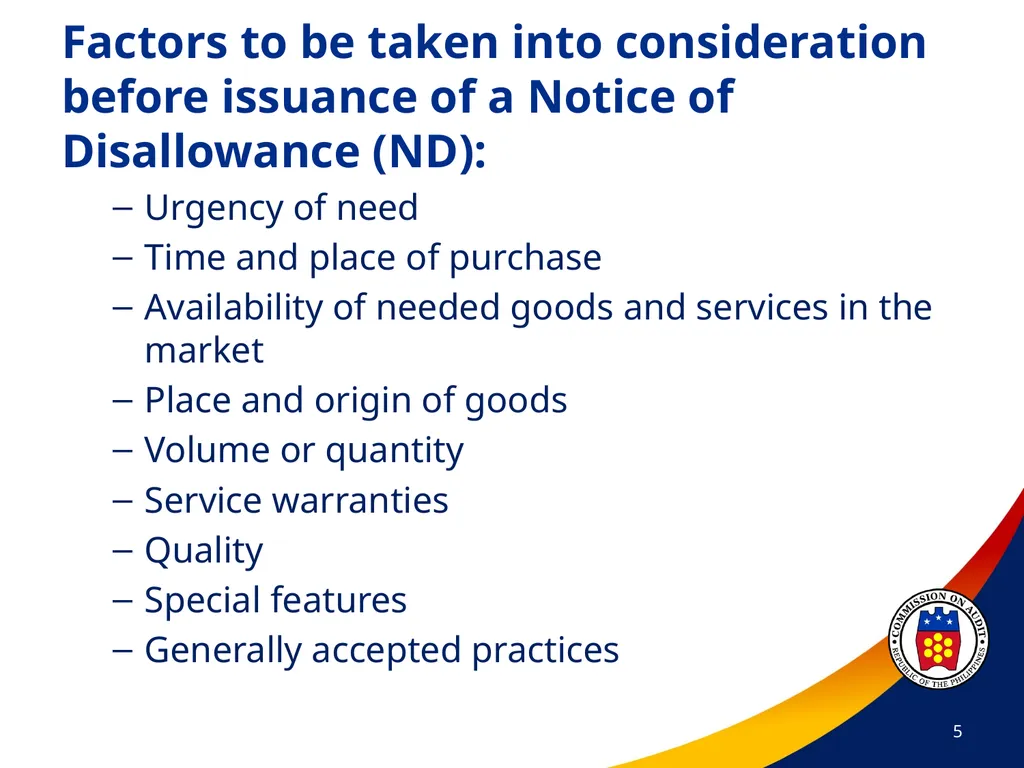
Urgency of need
Time and place of purchase
Availability of needed goods and services in the market
Place and origin of goods
Volume or quantity
Service warranties
Quality
Special features
Generally accepted practices 5 Factors to be taken into consideration before issuance of a Notice of Disallowance (ND):<br>
Time and place of purchase
Availability of needed goods and services in the market
Place and origin of goods
Volume or quantity
Service warranties
Quality
Special features
Generally accepted practices 5 Factors to be taken into consideration before issuance of a Notice of Disallowance (ND):<br>
06
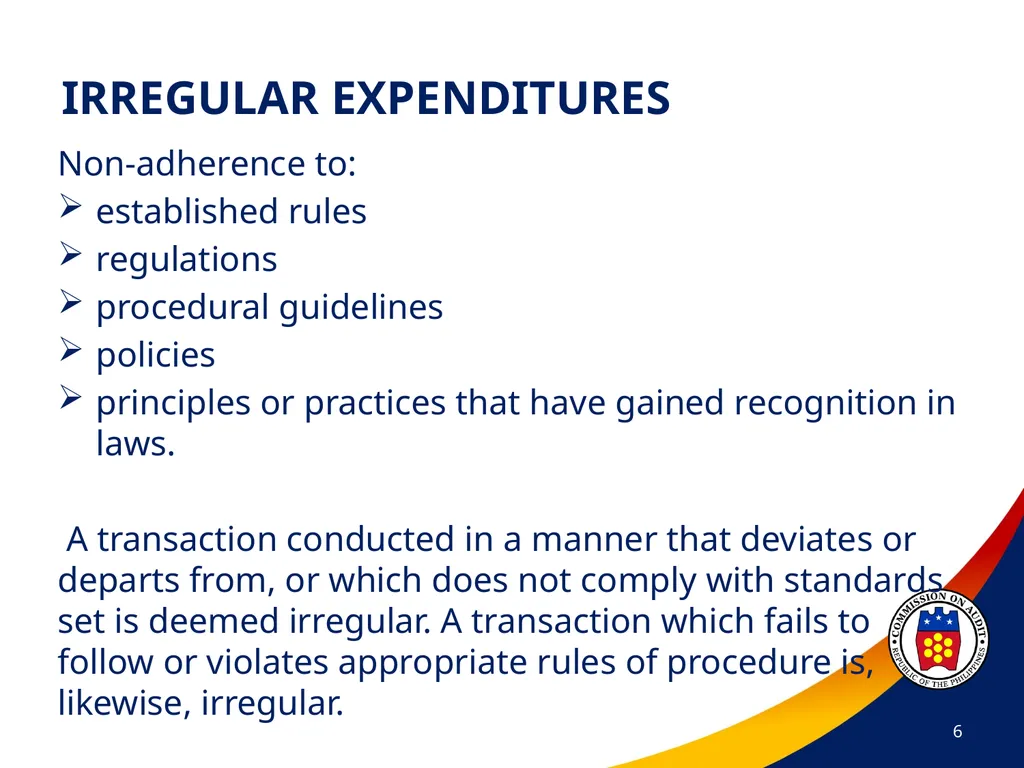
Non-adherence to:
established rules
regulations
procedural guidelines
policies
principles or practices that have gained recognition in laws.
A transaction conducted in a manner that deviates or departs from, or which does not comply with standards set is deemed irregular. A transaction which fails to follow or violates appropriate rules of procedure is, likewise, irregular. 6 IRREGULAR EXPENDITURES<br>
established rules
regulations
procedural guidelines
policies
principles or practices that have gained recognition in laws.
A transaction conducted in a manner that deviates or departs from, or which does not comply with standards set is deemed irregular. A transaction which fails to follow or violates appropriate rules of procedure is, likewise, irregular. 6 IRREGULAR EXPENDITURES<br>
07
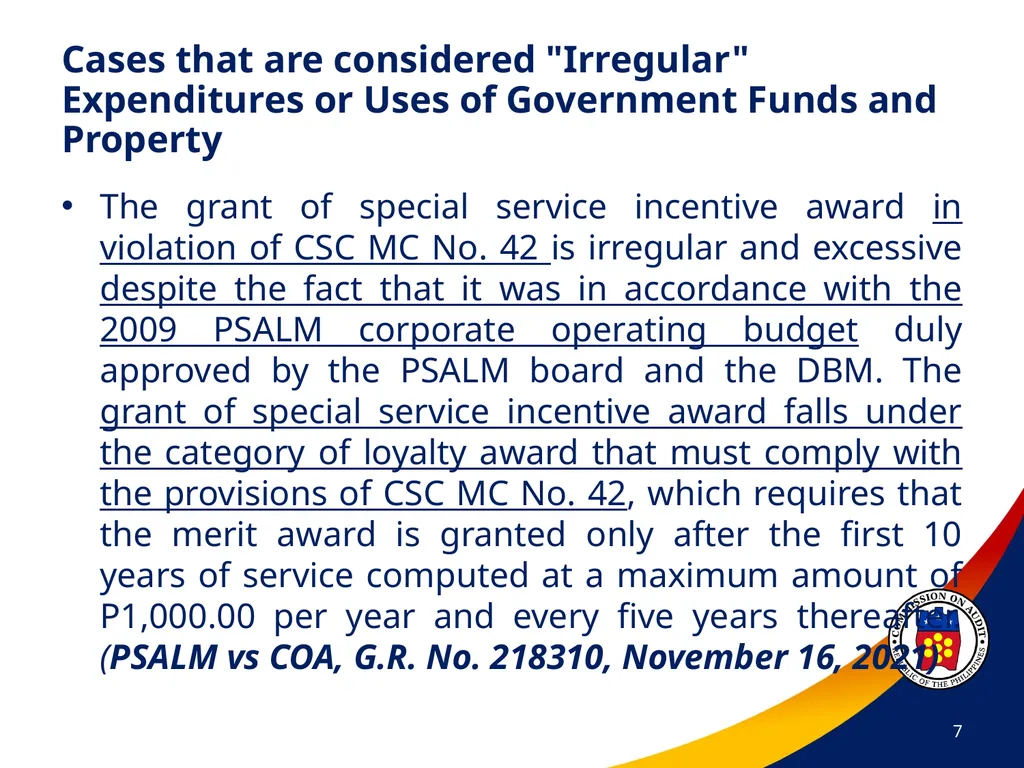
The grant of special service incentive award in violation of CSC MC No. 42 is irregular and excessive despite the fact that it was in accordance with the 2009 PSALM corporate operating budget duly approved by the PSALM board and the DBM. The grant of special service incentive award falls under the category of loyalty award that must comply with the provisions of CSC MC No. 42, which requires that the merit award is granted only after the first 10 years of service computed at a maximum amount of P1,000.00 per year and every five years thereafter. (PSALM vs COA, G.R. No. 218310, November 16, 2021) 7 Cases that are considered "Irregular" Expenditures or Uses of Government Funds and Property<br>
08
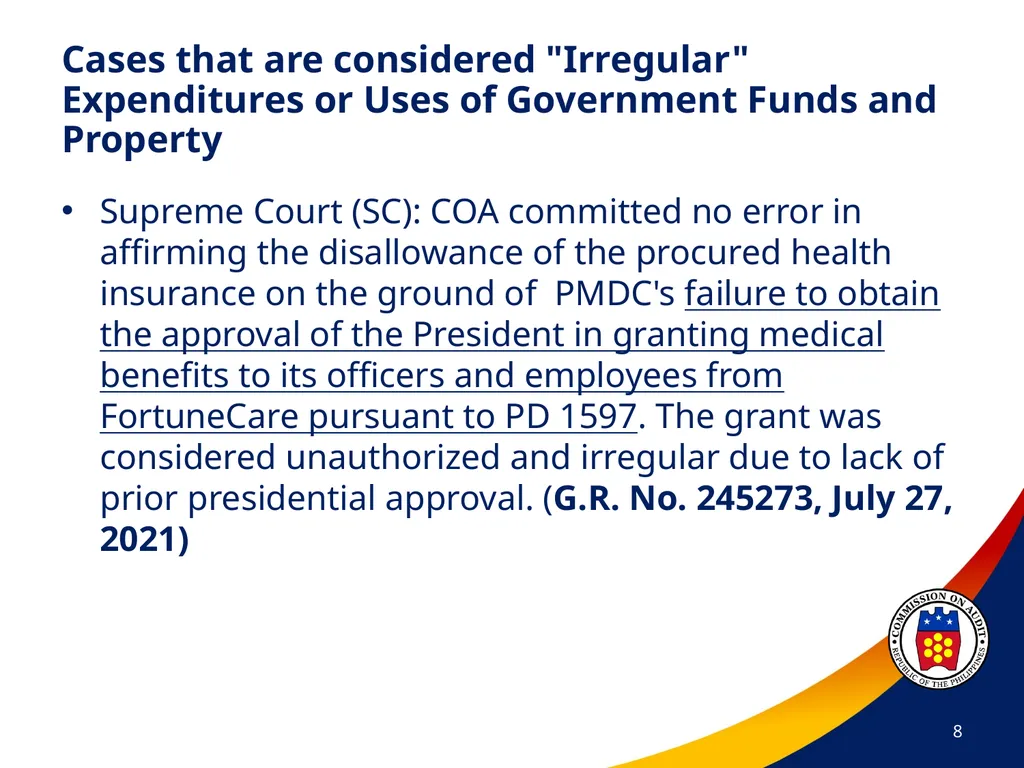
Supreme Court (SC): COA committed no error in affirming the disallowance of the procured health insurance on the ground of PMDC's failure to obtain the approval of the President in granting medical benefits to its officers and employees from FortuneCare pursuant to PD 1597. The grant was considered unauthorized and irregular due to lack of prior presidential approval. (G.R. No. 245273, July 27, 2021) 8 Cases that are considered "Irregular" Expenditures or Uses of Government Funds and Property<br>
09
Failure of the agency to meet the conditions for the grant of honoraria and incentives particularly DBM Circular No. 2007-2 dated October 1, 2007. Also, the wrongful charge of the disallowed incentives to MOOE instead of PS. (Juan B. Ngalob, et al. vs. Commission on Audit, G.R. No. 238882, January 5, 2021)
Non-compliance with the rules and regulations governing the grant of Collective Negotiation Agreement (CNA) incentives. (Ser John Pastrana, et al. vs. Commission on Audit/Mary Jane G. Ysmael vs. Commission on Audit, G.R. No. 242083, June 15, 2021) 9 Cases that are considered "Irregular" Expenditures or Uses of Government Funds and Property<br>
Non-compliance with the rules and regulations governing the grant of Collective Negotiation Agreement (CNA) incentives. (Ser John Pastrana, et al. vs. Commission on Audit/Mary Jane G. Ysmael vs. Commission on Audit, G.R. No. 242083, June 15, 2021) 9 Cases that are considered "Irregular" Expenditures or Uses of Government Funds and Property<br>
10
Grant of amelioration allowance or any similar benefits to private employees of service contractors contrary to Administrative Order (A.O.) No. 365 dated October 10, 1997. (HDMF vs. COA, G.R. No. 157001, October 19, 2004)
Loyalty service award granted to employees that have not yet rendered the minimum service of ten years in the government required under CSC Memorandum Circular No. 42, s. 1992. (BCDA vs. COA, G.R. No. 142760) 10 Cases that are considered "Irregular" Expenditures or Uses of Government Funds and Property<br>
Loyalty service award granted to employees that have not yet rendered the minimum service of ten years in the government required under CSC Memorandum Circular No. 42, s. 1992. (BCDA vs. COA, G.R. No. 142760) 10 Cases that are considered "Irregular" Expenditures or Uses of Government Funds and Property<br>
11
Payment of COLA and other allowances deemed integrated in the salary per DBM-NCC No. 59 and DBM-CCC No. 10 (Victoria C. Gutierrez, et al. vs. DBM, G.R. No. 153266).
Grant of food allowance, rice subsidy and health care allowance as there is no law authorizing the grant of such allowances (BFAR Employees Union, R.O. VII vs. COA, G.R. No. 169815 and Benguet State University vs. COA, G.R. No. 169637). 11 Cases that are considered "Irregular" Expenditures or Uses of Government Funds and Property<br>
Grant of food allowance, rice subsidy and health care allowance as there is no law authorizing the grant of such allowances (BFAR Employees Union, R.O. VII vs. COA, G.R. No. 169815 and Benguet State University vs. COA, G.R. No. 169637). 11 Cases that are considered "Irregular" Expenditures or Uses of Government Funds and Property<br>
12
Payment of CNA cash incentive/benefit to rank-and-file employees where the conditions required in determining "savings" under Public Sector Labor Management Council (PSLMC) Resolution No. 02, s. 2003 dated May 19, 2003 and DBM BC 2006-001 dated Feb. 1, 2006 are not met.
Honoraria granted to members of special committees such as an Executive Committee, Program on Awards and Incentives for Service Excellence and Regional Selection and Promotions Board, which are performing functions inherent in the regular functions of the agency. 12 Cases that are considered "Irregular" Expenditures or Uses of Government Funds and Property<br>
Honoraria granted to members of special committees such as an Executive Committee, Program on Awards and Incentives for Service Excellence and Regional Selection and Promotions Board, which are performing functions inherent in the regular functions of the agency. 12 Cases that are considered "Irregular" Expenditures or Uses of Government Funds and Property<br>
13
Expenditures that are contrary to law.
Irregular expenditures are different from illegal expenditures since illegal expenditures would pertain to expenses incurred in violation of the law whereas, irregular expenditures are incurred in violation of applicable rules and regulations other than the laws. 13 ILLEGAL EXPENDITURES<br>
Irregular expenditures are different from illegal expenditures since illegal expenditures would pertain to expenses incurred in violation of the law whereas, irregular expenditures are incurred in violation of applicable rules and regulations other than the laws. 13 ILLEGAL EXPENDITURES<br>
14
The unauthorized issuance and receipt of [Educational Assistance Allowance (EAA) and Birthday Gift to PhilHealth officials and employees are tantamount to double compensation justifying COA disallowance. The resolutions of the Board of Directors granting the EAA and Birthday Gift sans executive/DBM review and approval as required under the laws are ultra vires acts, which rendered the subsequent disbursements illegal and irregular. (PhilHealth vs. COA, G.R. No. 250787. September 27, 2022) 14 Cases that are considered "Illegal" Expenditures or Uses of Government Funds and Property<br>
15
SC: The payment by the NHA of the benefits and allowances, which amounted to more than P367M to its employees is tantamount to illegal disbursement of public funds and was correctly disallowed.
The benefits and allowances subject of the assailed Notice of Disallowances with the exception of the RATA, were not excluded from the integration into the standardized salary rates under R.A. No. 6758.
Meanwhile, as to the continued grant of meal and rice subsidy and children's allowances under CCC No. 10-99, the same requires that the recipient employee must be an incumbent as of June 30, 1989 and was actually receiving said allowances on or prior to the said date. In effect, incumbent employees as of June 30, 1989 are the only qualified recipients.
RATA is granted only to officers or employees whose positions are enumerated under the GAA or are declared by the DBM as equivalent ranks of the enumerated positions. Thus, the RATA granted to NHA employees whose positions are not within the purview of the pertinent provision under the GAA is disallowable. (NHA vs. COA, G.R. No. 239936. June 21, 2022) 15 Cases that are considered "Illegal" Expenditures or Uses of Government Funds and Property<br>
The benefits and allowances subject of the assailed Notice of Disallowances with the exception of the RATA, were not excluded from the integration into the standardized salary rates under R.A. No. 6758.
Meanwhile, as to the continued grant of meal and rice subsidy and children's allowances under CCC No. 10-99, the same requires that the recipient employee must be an incumbent as of June 30, 1989 and was actually receiving said allowances on or prior to the said date. In effect, incumbent employees as of June 30, 1989 are the only qualified recipients.
RATA is granted only to officers or employees whose positions are enumerated under the GAA or are declared by the DBM as equivalent ranks of the enumerated positions. Thus, the RATA granted to NHA employees whose positions are not within the purview of the pertinent provision under the GAA is disallowable. (NHA vs. COA, G.R. No. 239936. June 21, 2022) 15 Cases that are considered "Illegal" Expenditures or Uses of Government Funds and Property<br>
16
Payment of claims under a contract awarded not strictly in accordance with the procedures prescribed under Republic Act (R.A.) No. 9184 and its Revised Implementing Rules and Regulations (IRR):
Certification of payments to the service contractors as lawful and necessary despite the absence of a public bidding. (Maura Baghari-Regis vs. Commission on Audit, G.R. No. 210900, December 1, 2020)
For contracts awarded under an alternative mode of procurement for items that should have undergone complete public bidding process and eventually resulted in overpricing (Dir. Fredric Villanueva, et.al. vs. COA, G.R. No. 151987, March 18, 2005, and Venancio R. Nava vs. Rodolfo G. Palattao, et al., G.R. 160211, August 28, 2006) 16 Cases that are considered “Illegal" Expenditures or Uses of Government Funds and Property<br>
Certification of payments to the service contractors as lawful and necessary despite the absence of a public bidding. (Maura Baghari-Regis vs. Commission on Audit, G.R. No. 210900, December 1, 2020)
For contracts awarded under an alternative mode of procurement for items that should have undergone complete public bidding process and eventually resulted in overpricing (Dir. Fredric Villanueva, et.al. vs. COA, G.R. No. 151987, March 18, 2005, and Venancio R. Nava vs. Rodolfo G. Palattao, et al., G.R. 160211, August 28, 2006) 16 Cases that are considered “Illegal" Expenditures or Uses of Government Funds and Property<br>
17
Contracts awarded to a bidder who failed to meet the minimum amounts required to be put up at the time the bids were submitted (Demosthenes P. Agan, Jr. et al., MWU-NLU and PALEA vs. PIATCO, lnc., MIAA, DOTC and Sec. L. Mendoza, G.R. No. 155001)
Delivery of equipment that is not brand new and does not conform to the specifications called for in the Invitation to Bid. (Ramon T. Lim vs. COA, G.R. No. 130325) 17 Cases that are considered “Illegal" Expenditures or Uses of Government Funds and Property<br>
Delivery of equipment that is not brand new and does not conform to the specifications called for in the Invitation to Bid. (Ramon T. Lim vs. COA, G.R. No. 130325) 17 Cases that are considered “Illegal" Expenditures or Uses of Government Funds and Property<br>
18
In case of regularly enacted budget
For projects described in appropriation ordinances in generic terms such as infrastructure projects, inter-municipal waterworks, drainage and sewerage, flood control, irrigation systems projects, reclamation projects, roads and bridges.
For purchase of goods and services which are neither specified in the appropriation ordinance nor encompassed within the regular personal services and maintenance operating expenses. 18 Cases that are considered “Illegal" Expenditures or Uses of Government Funds and Property<br>
For projects described in appropriation ordinances in generic terms such as infrastructure projects, inter-municipal waterworks, drainage and sewerage, flood control, irrigation systems projects, reclamation projects, roads and bridges.
For purchase of goods and services which are neither specified in the appropriation ordinance nor encompassed within the regular personal services and maintenance operating expenses. 18 Cases that are considered “Illegal" Expenditures or Uses of Government Funds and Property<br>
19
Charges to accounts payable not founded on valid claims in violation of Section 46 of P.D. No. 1177 (Fe D. Laysa vs. COA, G.R. No. 128134).
Use of funds intended for a specific purpose/project, for other purposes such as administrative and miscellaneous expenses of the implementing agency, and for projects not intended to be implemented under the program.
Grant or cash advance for no specific stated public purpose (Section 89 of PD 1445) 19 Cases that are considered “Illegal" Expenditures or Uses of Government Funds and Property<br>
Use of funds intended for a specific purpose/project, for other purposes such as administrative and miscellaneous expenses of the implementing agency, and for projects not intended to be implemented under the program.
Grant or cash advance for no specific stated public purpose (Section 89 of PD 1445) 19 Cases that are considered “Illegal" Expenditures or Uses of Government Funds and Property<br>
20
In case or re-enacted budget
For new contracts entered into by the local chief executive covering contractual obligations included in the previous year's annual and supplemental budgets. 20 Cases that are considered “Illegal" Expenditures or Uses of Government Funds and Property<br>
For new contracts entered into by the local chief executive covering contractual obligations included in the previous year's annual and supplemental budgets. 20 Cases that are considered “Illegal" Expenditures or Uses of Government Funds and Property<br>
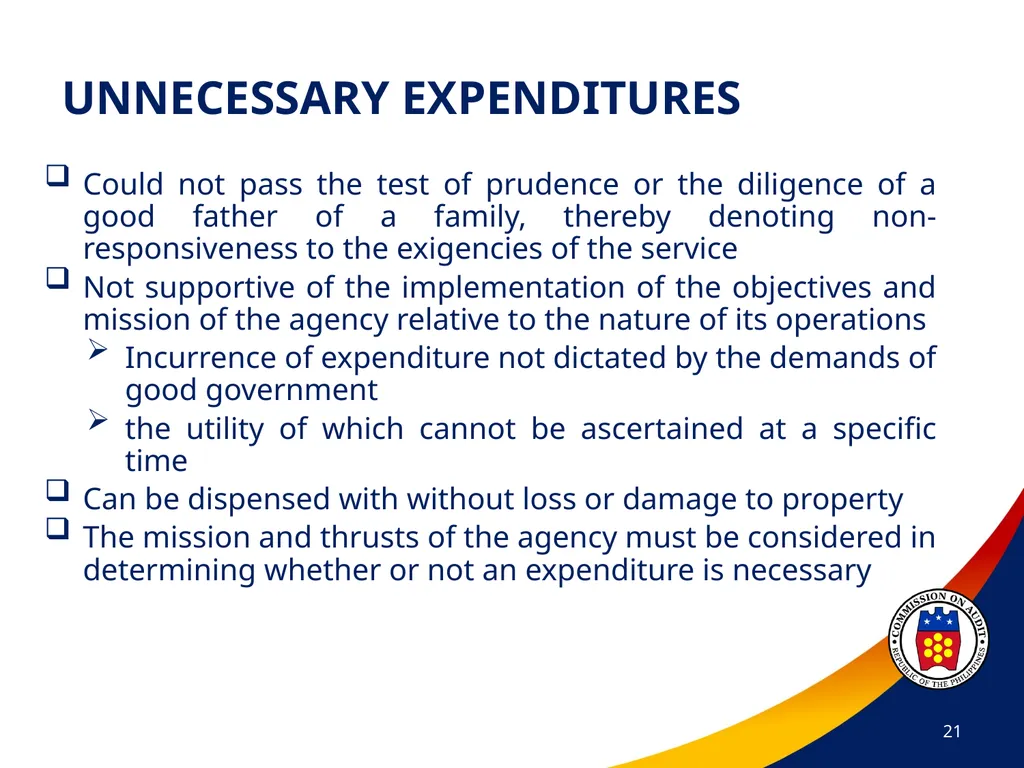
21
Could not pass the test of prudence or the diligence of a good father of a family, thereby denoting non-responsiveness to the exigencies of the service
Not supportive of the implementation of the objectives and mission of the agency relative to the nature of its operations
Incurrence of expenditure not dictated by the demands of good government
the utility of which cannot be ascertained at a specific time
Can be dispensed with without loss or damage to property
The mission and thrusts of the agency must be considered in determining whether or not an expenditure is necessary 21 UNNECESSARY EXPENDITURES<br>
Not supportive of the implementation of the objectives and mission of the agency relative to the nature of its operations
Incurrence of expenditure not dictated by the demands of good government
the utility of which cannot be ascertained at a specific time
Can be dispensed with without loss or damage to property
The mission and thrusts of the agency must be considered in determining whether or not an expenditure is necessary 21 UNNECESSARY EXPENDITURES<br>
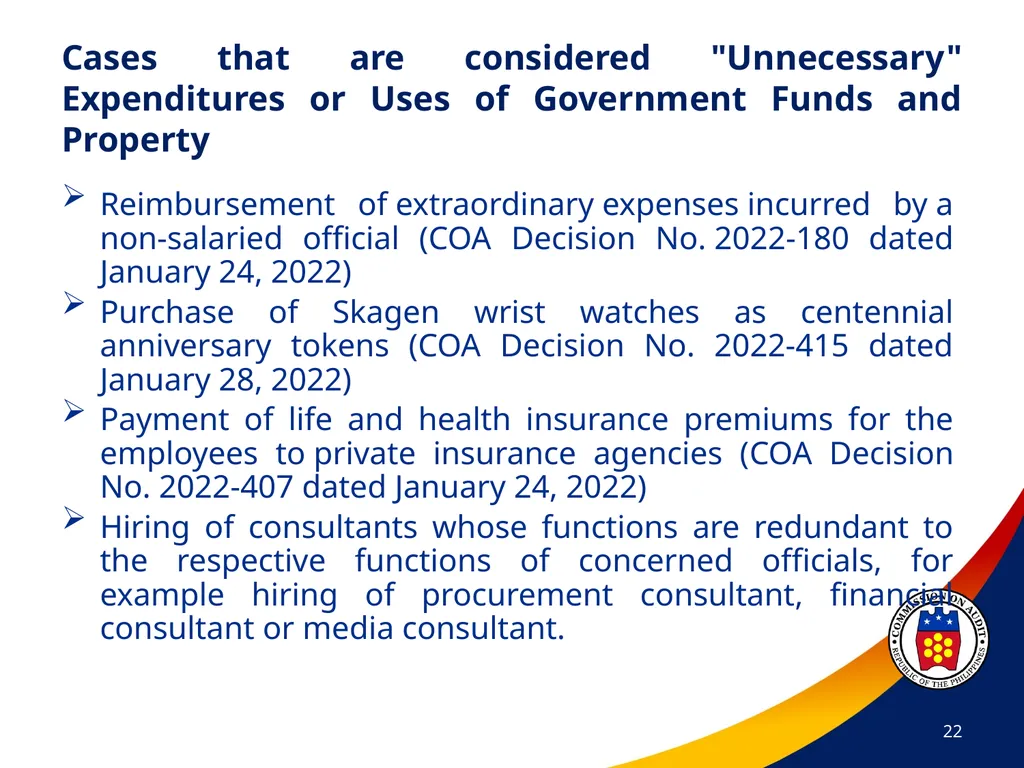
22
Reimbursement of extraordinary expenses incurred by a non-salaried official (COA Decision No. 2022-180 dated January 24, 2022)
Purchase of Skagen wrist watches as centennial anniversary tokens (COA Decision No. 2022-415 dated January 28, 2022)
Payment of life and health insurance premiums for the employees to private insurance agencies (COA Decision No. 2022-407 dated January 24, 2022)
Hiring of consultants whose functions are redundant to the respective functions of concerned officials, for example hiring of procurement consultant, financial consultant or media consultant. 22 Cases that are considered "Unnecessary" Expenditures or Uses of Government Funds and Property<br>
Purchase of Skagen wrist watches as centennial anniversary tokens (COA Decision No. 2022-415 dated January 28, 2022)
Payment of life and health insurance premiums for the employees to private insurance agencies (COA Decision No. 2022-407 dated January 24, 2022)
Hiring of consultants whose functions are redundant to the respective functions of concerned officials, for example hiring of procurement consultant, financial consultant or media consultant. 22 Cases that are considered "Unnecessary" Expenditures or Uses of Government Funds and Property<br>
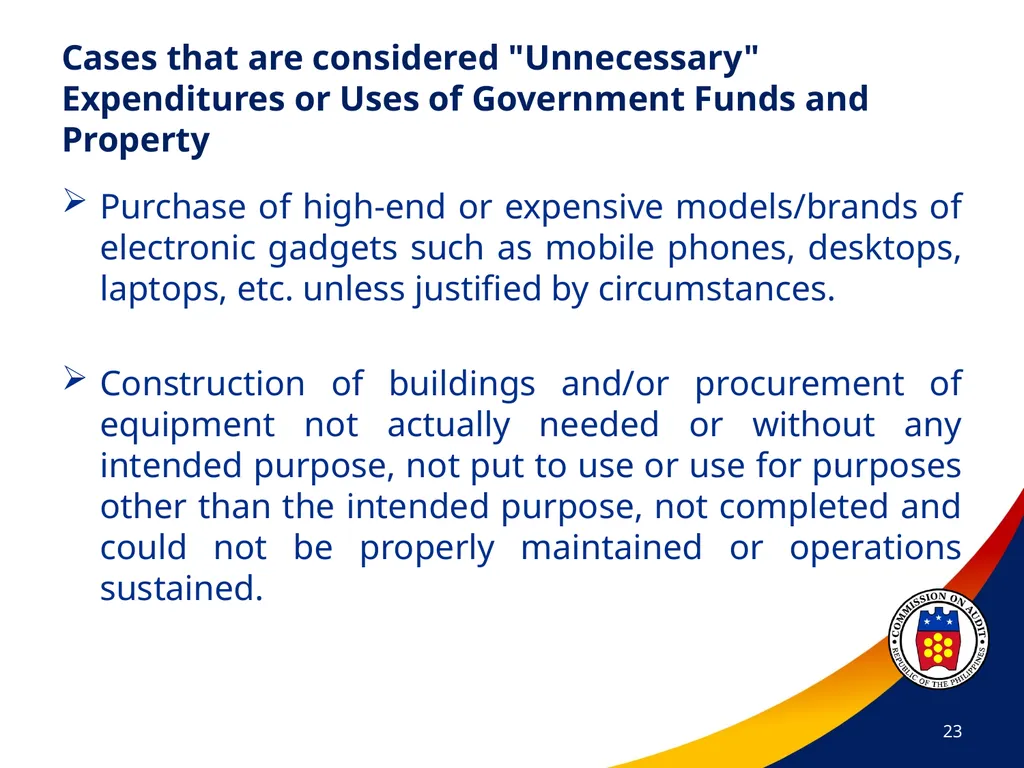
23
Purchase of high-end or expensive models/brands of electronic gadgets such as mobile phones, desktops, laptops, etc. unless justified by circumstances.
Construction of buildings and/or procurement of equipment not actually needed or without any intended purpose, not put to use or use for purposes other than the intended purpose, not completed and could not be properly maintained or operations sustained. 23 Cases that are considered "Unnecessary" Expenditures or Uses of Government Funds and Property<br>
Construction of buildings and/or procurement of equipment not actually needed or without any intended purpose, not put to use or use for purposes other than the intended purpose, not completed and could not be properly maintained or operations sustained. 23 Cases that are considered "Unnecessary" Expenditures or Uses of Government Funds and Property<br>
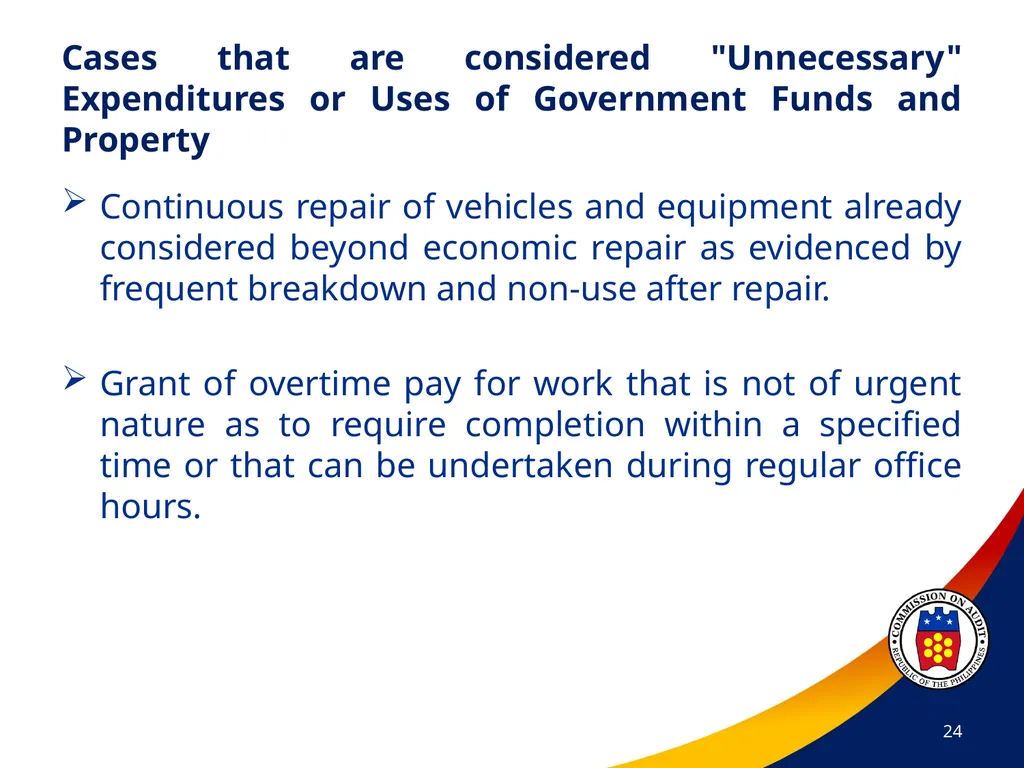
24
Continuous repair of vehicles and equipment already considered beyond economic repair as evidenced by frequent breakdown and non-use after repair.
Grant of overtime pay for work that is not of urgent nature as to require completion within a specified time or that can be undertaken during regular office hours. 24 Cases that are considered "Unnecessary" Expenditures or Uses of Government Funds and Property<br>
Grant of overtime pay for work that is not of urgent nature as to require completion within a specified time or that can be undertaken during regular office hours. 24 Cases that are considered "Unnecessary" Expenditures or Uses of Government Funds and Property<br>
25
unreasonable and immoderate
no man in his right sense would make, nor a fair and honest man would accept as reasonable
those incurred in violation of ethical and moral standards. 25 UNCONSCIONABLE EXPENDITURES<br>
no man in his right sense would make, nor a fair and honest man would accept as reasonable
those incurred in violation of ethical and moral standards. 25 UNCONSCIONABLE EXPENDITURES<br>
26
Payment of transportation and incidental expenses to barangay officials who attended the orientation seminar or Lakbay-Aral on Community-Based Monitoring System (CBMS) and Good Governance in Baguio City, in the total amount of P5,373,000.00. (COA Decision No. 2018-319 dated March 15, 2018)
Grant of exorbitant and unreasonable bonuses, allowances and fringe benefits to public officials and employees and members of governing boards.
Live-in seminars in five-star hotels with significant numbers of participants and unreasonable period of time.
Payment of excessive and unreasonable retirement benefits.
Purchase of supplies and materials including agricultural equipment/machineries and other farm inputs in significant quantities far exceeding the requirements and were not actually needed, thus, left idle and unused. 26 Cases that are considered “Unconscionable" Expenditures of Government Funds<br>
Grant of exorbitant and unreasonable bonuses, allowances and fringe benefits to public officials and employees and members of governing boards.
Live-in seminars in five-star hotels with significant numbers of participants and unreasonable period of time.
Payment of excessive and unreasonable retirement benefits.
Purchase of supplies and materials including agricultural equipment/machineries and other farm inputs in significant quantities far exceeding the requirements and were not actually needed, thus, left idle and unused. 26 Cases that are considered “Unconscionable" Expenditures of Government Funds<br>
27
Extension of loans in significant and unreasonable amount to unqualified borrowers whereby recovery of the loans granted is remote.
Overpricing in significant amounts exceeding 100 percent of the current and prevailing market value.
Payment for repairs of government equipment involving significant amount exceeding 100 percent of the current market value price of the same or similar equipment.
Release of significant amounts to NGOs/POs without evaluating the necessity of the project, the needs of the intended recipients and the reasonableness of the project requirements. 27 Cases that are considered “Unconscionable" Expenditures of Government Funds<br>
Overpricing in significant amounts exceeding 100 percent of the current and prevailing market value.
Payment for repairs of government equipment involving significant amount exceeding 100 percent of the current market value price of the same or similar equipment.
Release of significant amounts to NGOs/POs without evaluating the necessity of the project, the needs of the intended recipients and the reasonableness of the project requirements. 27 Cases that are considered “Unconscionable" Expenditures of Government Funds<br>
28
Unreasonable expenses - immoderate quantity and exorbitant price
Expenses exceeding what is usual or proper
Unreasonably high expenses and beyond just measure or amount
Expenses in excess of reasonable limits 28 EXCESSIVE EXPENDITURES<br>
Expenses exceeding what is usual or proper
Unreasonably high expenses and beyond just measure or amount
Expenses in excess of reasonable limits 28 EXCESSIVE EXPENDITURES<br>
29
The SC held that the COA correctly rendered as excessive the cellular phone expenses which were paid in excess of the Cagayan De Oro Water District Board Resolution that prescribed what is usual or proper, or the reasonable limit of the cellular phone expenses of its own personnel. The COA correctly relied on this basis as comparison and COWD had the burden of proof to justify the excess over its own rates. (G.R. No. 213789, April 27, 2021) 29 Cases that are considered "Excessive" Expenditures of Government Funds<br>
30
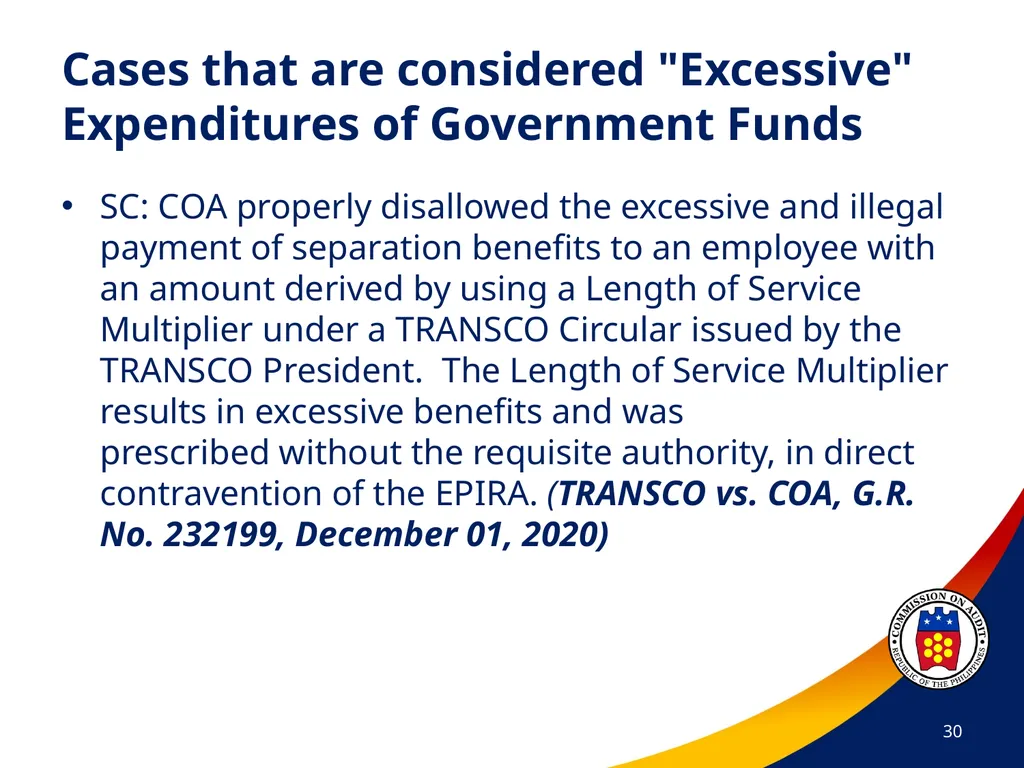
SC: COA properly disallowed the excessive and illegal payment of separation benefits to an employee with an amount derived by using a Length of Service Multiplier under a TRANSCO Circular issued by the TRANSCO President. The Length of Service Multiplier results in excessive benefits and was prescribed without the requisite authority, in direct contravention of the EPIRA. (TRANSCO vs. COA, G.R. No. 232199, December 01, 2020) 30 Cases that are considered "Excessive" Expenditures of Government Funds<br>
31
Payment of RATA and Clothing Allowance in excess of what has been provided for by the General Appropriations Act and the rates prescribed by the Department of Budget and Management. (COA Decision No. 2022-453 dated May 30, 2022)
Payment for repair of government equipment at a cost exceeding 30 percent of the current market price of the same or similar equipment.
Expenditures for supplies and materials including fuel inventory in quantities exceeding the normal three-month requirements, except under the circumstances enumerated under the pertinent provision of the GAA.
Granting of cash advance in excess of estimated budget. 31 Cases that are considered "Excessive" Expenditures of Government Funds<br>
Payment for repair of government equipment at a cost exceeding 30 percent of the current market price of the same or similar equipment.
Expenditures for supplies and materials including fuel inventory in quantities exceeding the normal three-month requirements, except under the circumstances enumerated under the pertinent provision of the GAA.
Granting of cash advance in excess of estimated budget. 31 Cases that are considered "Excessive" Expenditures of Government Funds<br>
32
Honoraria paid to members of the Bids and Awards Committee and Technical Working Group in excess of the rates provided for under DBM Budget Circular No. 2004-5A dated October 7, 2005, and for procurement activities pertaining to a contract which was not yet awarded to the winning bidder (Joseph Peter Sison, et al. vs. Rogelio Tablang, et al., G.R. No. 177011, June 5, 2009)
Grant of year-end benefits to consultants and to members of the Board who are not salaried officials of the government as they are not considered employees of the hiring agency (BCDA vs. COA, G.R. No. 177011 dated June 5, 2009) 32 Cases that are considered "Excessive" Expenditures of Government Funds<br>
Grant of year-end benefits to consultants and to members of the Board who are not salaried officials of the government as they are not considered employees of the hiring agency (BCDA vs. COA, G.R. No. 177011 dated June 5, 2009) 32 Cases that are considered "Excessive" Expenditures of Government Funds<br>
33
Release of funds to NGOs/POs in excess of the project requirements.
Using expensive thermoplastic materials with longer life span on an asphalt overlay with shorter life span.
Procurement of materials/items in excess of the requirements which eventually expires such as vaccines, medicines, seeds, fertilizer, pesticides, among others.
Inclusion in the contract of a specific infrastructure project, special items such as motor vehicles and computers which unnecessarily increased project costs due to the provision of indirect costs.
Procurement and distribution of seeds to farmer in excess of the required number of bags of seeds per hectare. 33 Cases that are considered "Excessive" Expenditures of Government Funds<br>
Using expensive thermoplastic materials with longer life span on an asphalt overlay with shorter life span.
Procurement of materials/items in excess of the requirements which eventually expires such as vaccines, medicines, seeds, fertilizer, pesticides, among others.
Inclusion in the contract of a specific infrastructure project, special items such as motor vehicles and computers which unnecessarily increased project costs due to the provision of indirect costs.
Procurement and distribution of seeds to farmer in excess of the required number of bags of seeds per hectare. 33 Cases that are considered "Excessive" Expenditures of Government Funds<br>
34
Those incurred without restraint, judiciousness, and economy
Exceed the bounds of propriety
Are immoderate, prodigal, lavish, luxurious, grossly excessive, and injudicious 34 EXTRAVAGANT EXPENDITURES<br>
Exceed the bounds of propriety
Are immoderate, prodigal, lavish, luxurious, grossly excessive, and injudicious 34 EXTRAVAGANT EXPENDITURES<br>
35
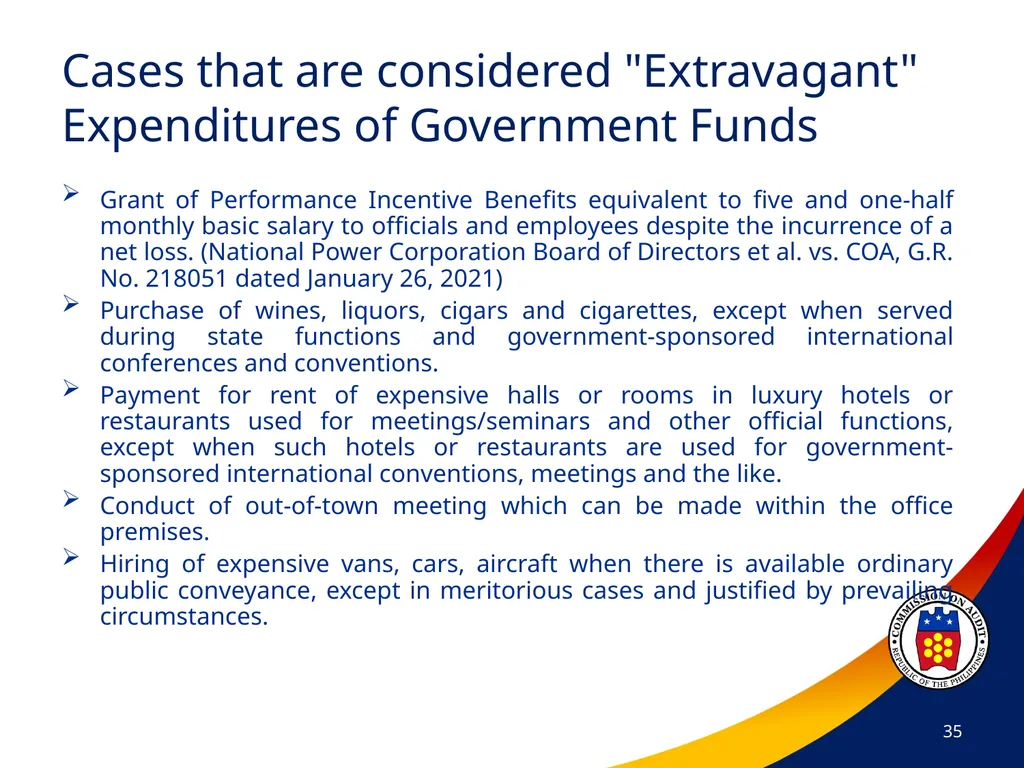
Grant of Performance Incentive Benefits equivalent to five and one-half monthly basic salary to officials and employees despite the incurrence of a net loss. (National Power Corporation Board of Directors et al. vs. COA, G.R. No. 218051 dated January 26, 2021)
Purchase of wines, liquors, cigars and cigarettes, except when served during state functions and government-sponsored international conferences and conventions.
Payment for rent of expensive halls or rooms in luxury hotels or restaurants used for meetings/seminars and other official functions, except when such hotels or restaurants are used for government-sponsored international conventions, meetings and the like.
Conduct of out-of-town meeting which can be made within the office premises.
Hiring of expensive vans, cars, aircraft when there is available ordinary public conveyance, except in meritorious cases and justified by prevailing circumstances. 35 Cases that are considered "Extravagant" Expenditures of Government Funds<br>
Purchase of wines, liquors, cigars and cigarettes, except when served during state functions and government-sponsored international conferences and conventions.
Payment for rent of expensive halls or rooms in luxury hotels or restaurants used for meetings/seminars and other official functions, except when such hotels or restaurants are used for government-sponsored international conventions, meetings and the like.
Conduct of out-of-town meeting which can be made within the office premises.
Hiring of expensive vans, cars, aircraft when there is available ordinary public conveyance, except in meritorious cases and justified by prevailing circumstances. 35 Cases that are considered "Extravagant" Expenditures of Government Funds<br>
36
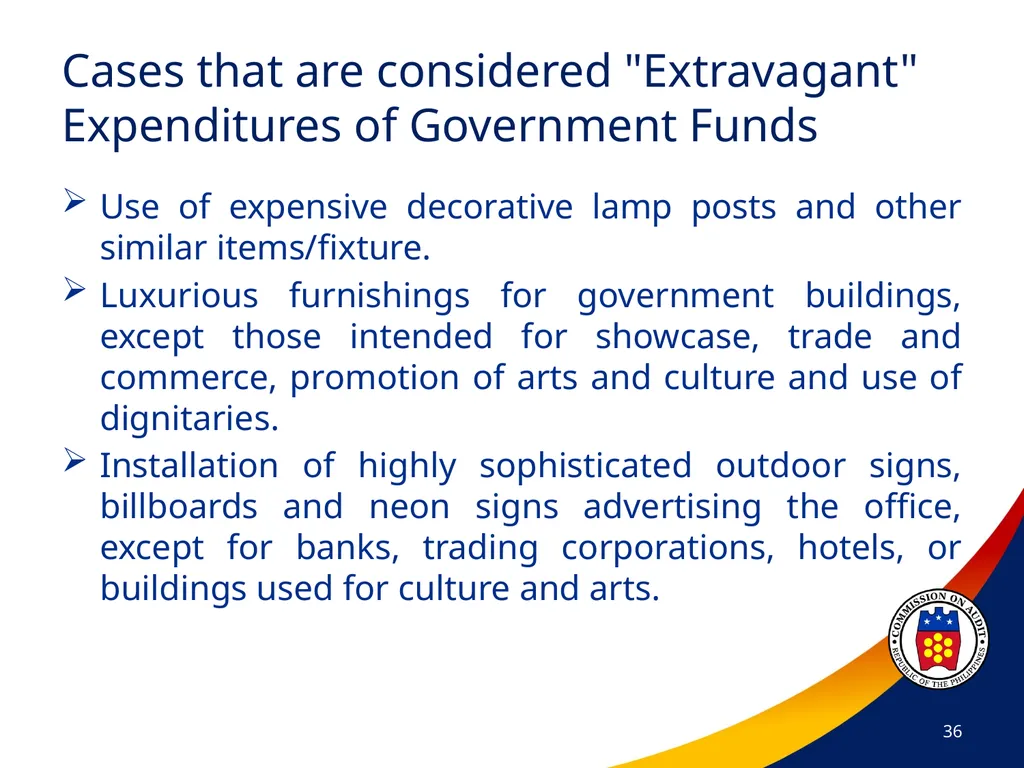
Use of expensive decorative lamp posts and other similar items/fixture.
Luxurious furnishings for government buildings, except those intended for showcase, trade and commerce, promotion of arts and culture and use of dignitaries.
Installation of highly sophisticated outdoor signs, billboards and neon signs advertising the office, except for banks, trading corporations, hotels, or buildings used for culture and arts. 36 Cases that are considered "Extravagant" Expenditures of Government Funds<br>
Luxurious furnishings for government buildings, except those intended for showcase, trade and commerce, promotion of arts and culture and use of dignitaries.
Installation of highly sophisticated outdoor signs, billboards and neon signs advertising the office, except for banks, trading corporations, hotels, or buildings used for culture and arts. 36 Cases that are considered "Extravagant" Expenditures of Government Funds<br>
37
Administrative Issuances/Laws applicable to Common Government Transactions 37<br>
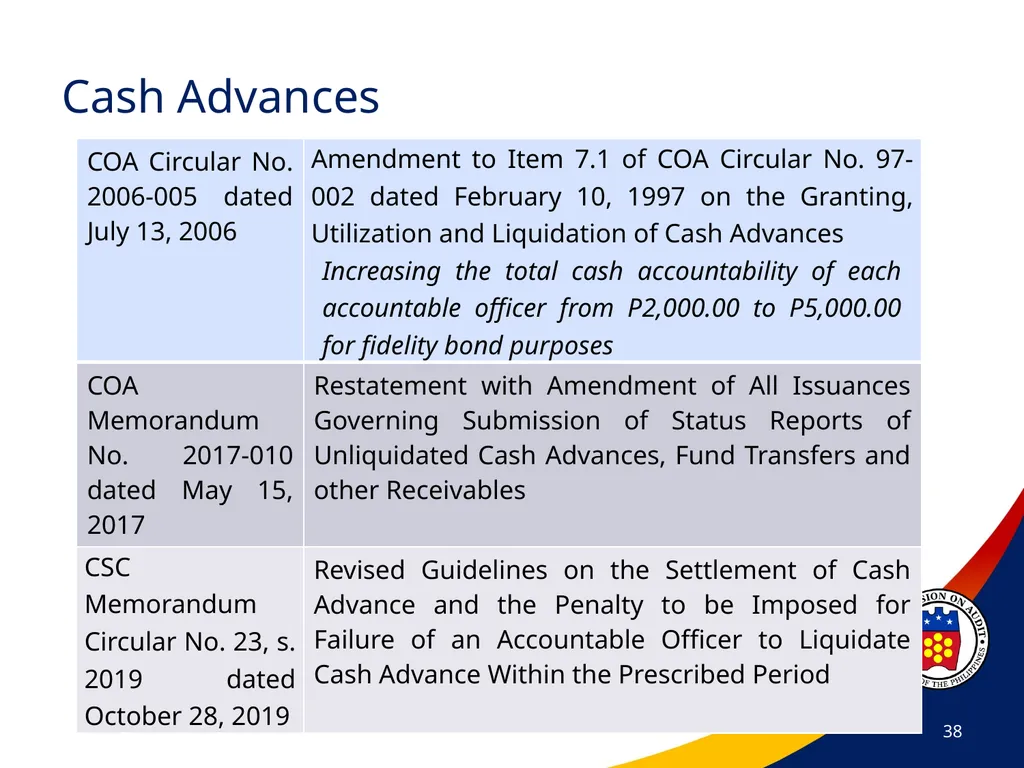
38
38 Cash Advances<br>
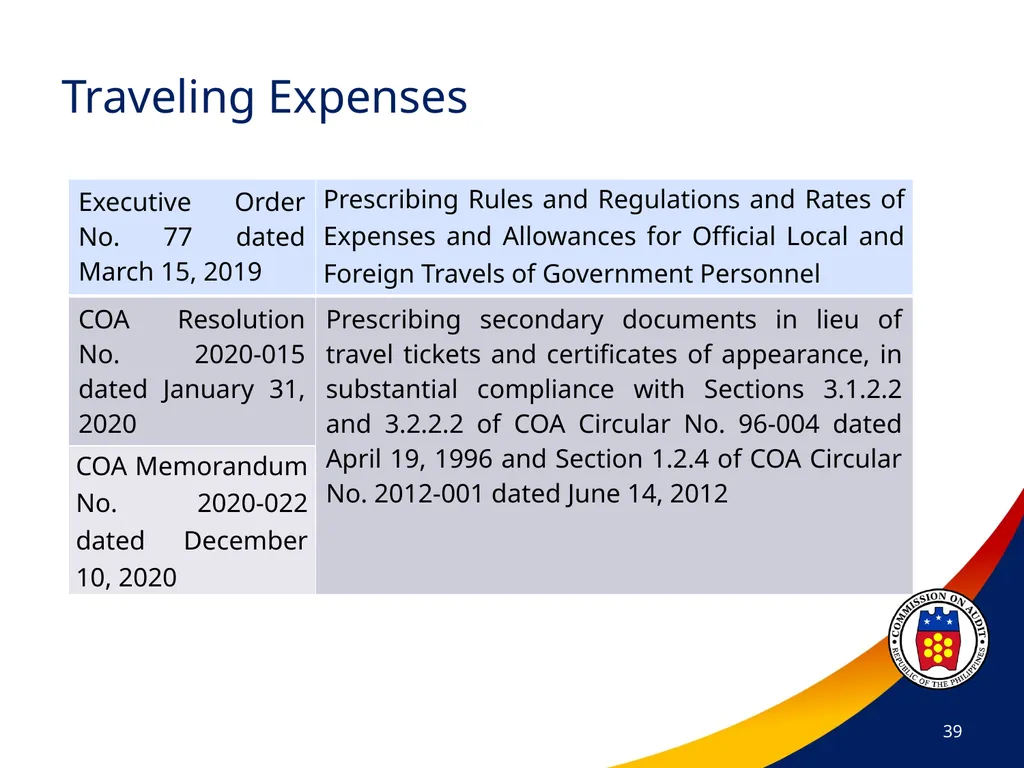
39
39 Traveling Expenses<br>
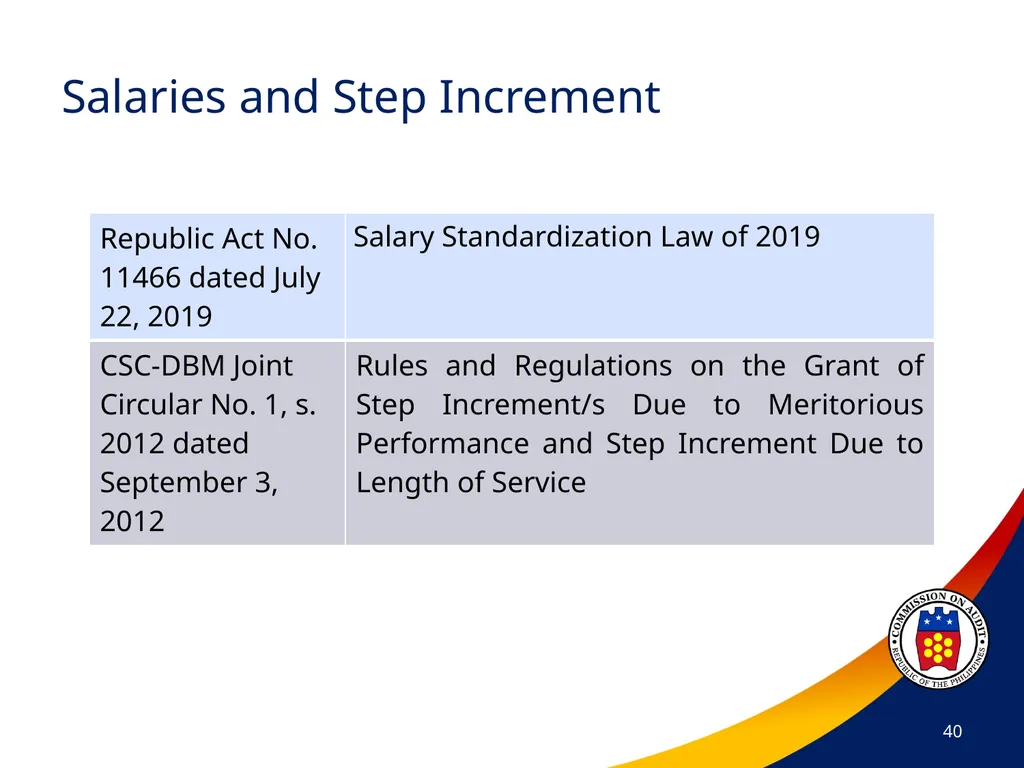
40
40 Salaries and Step Increment<br>
41
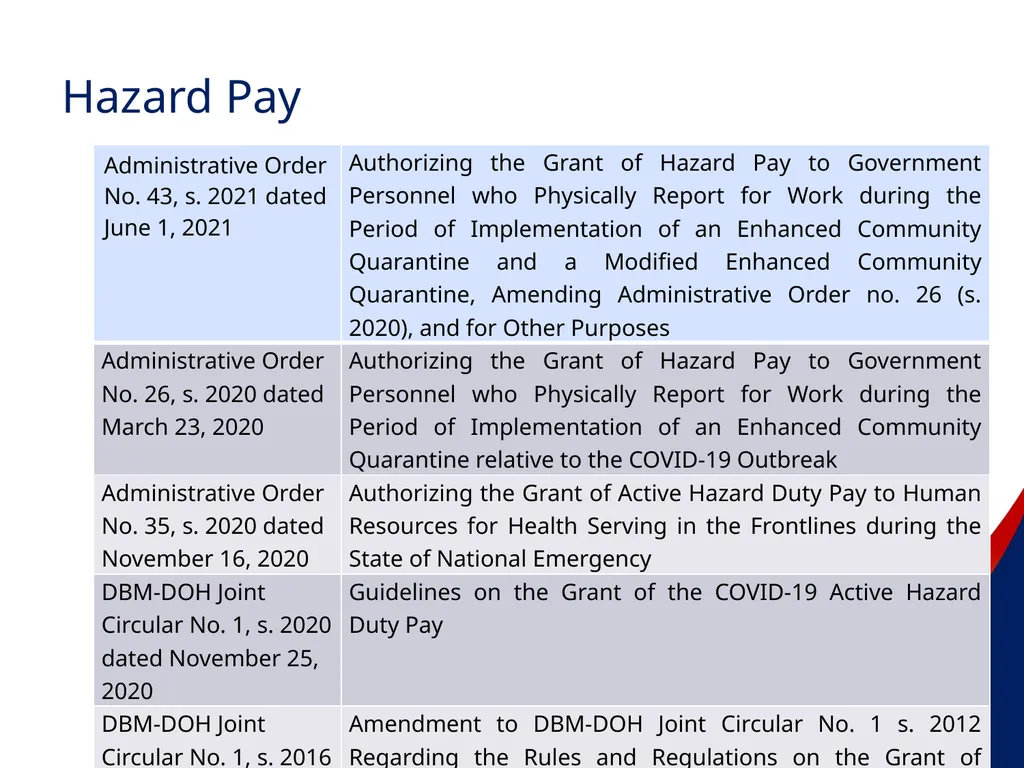
41 Hazard Pay<br>
42
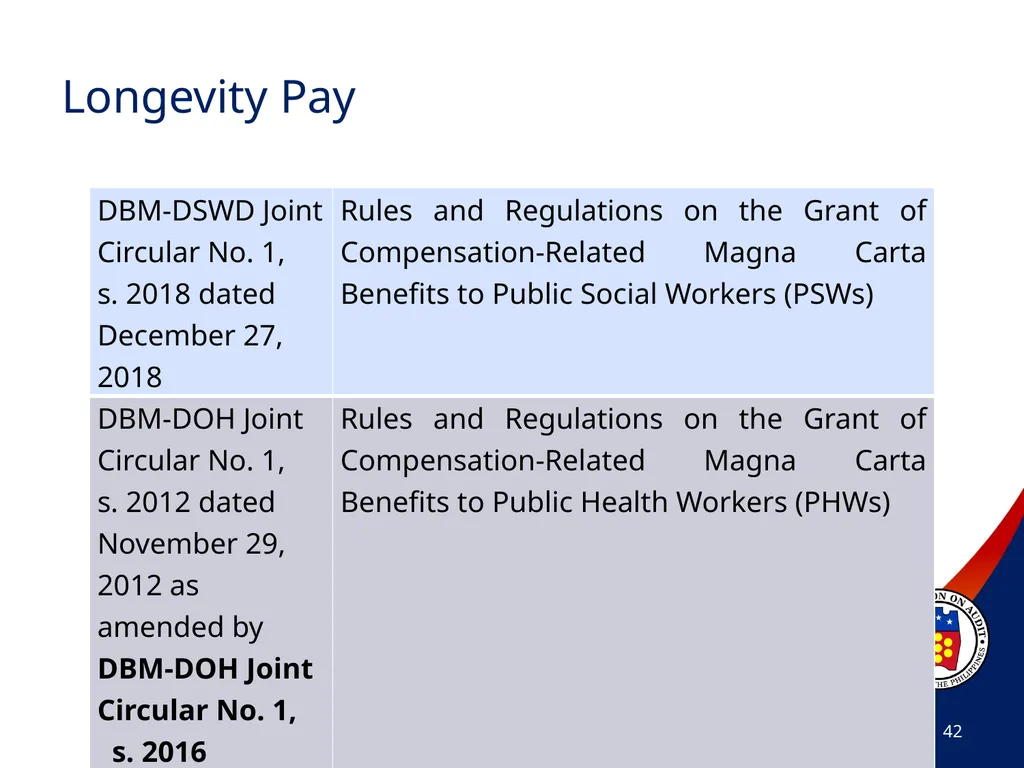
42 Longevity Pay<br>
43
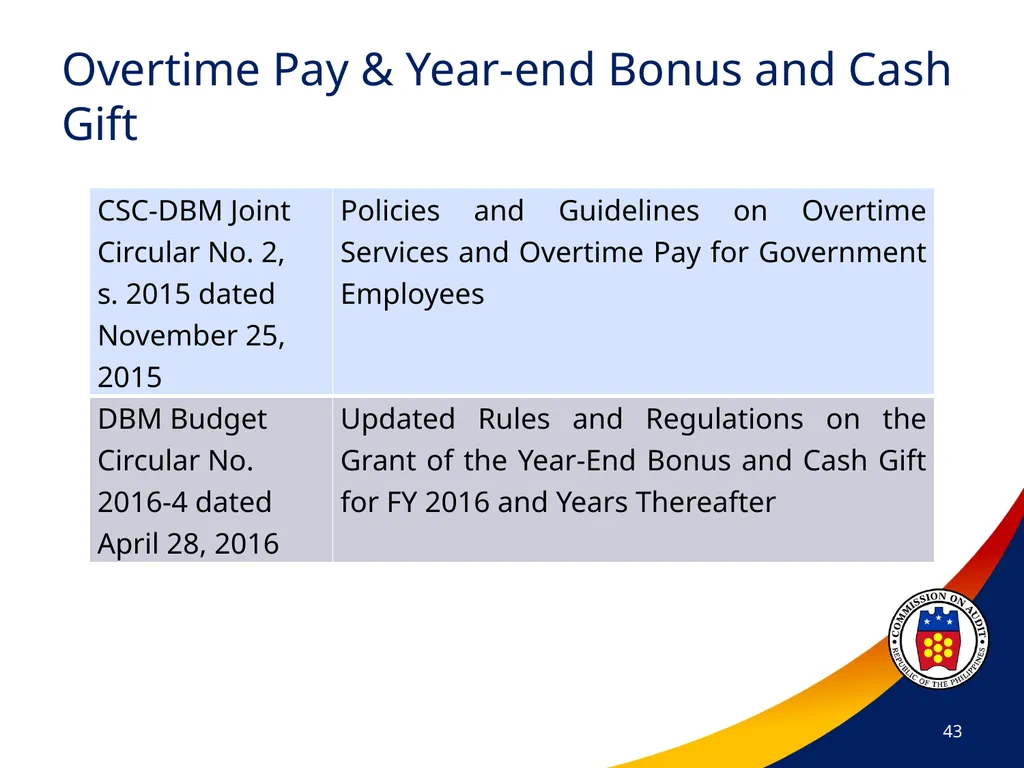
43 Overtime Pay & Year-end Bonus and Cash Gift<br>
44
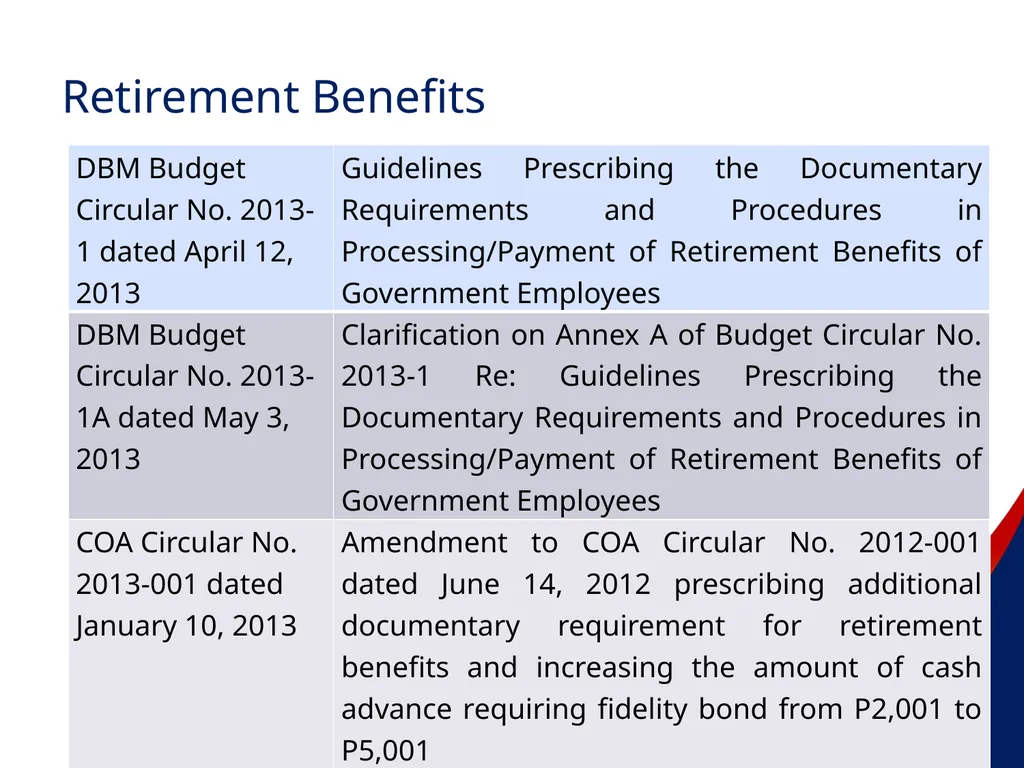
44 Retirement Benefits<br>
45
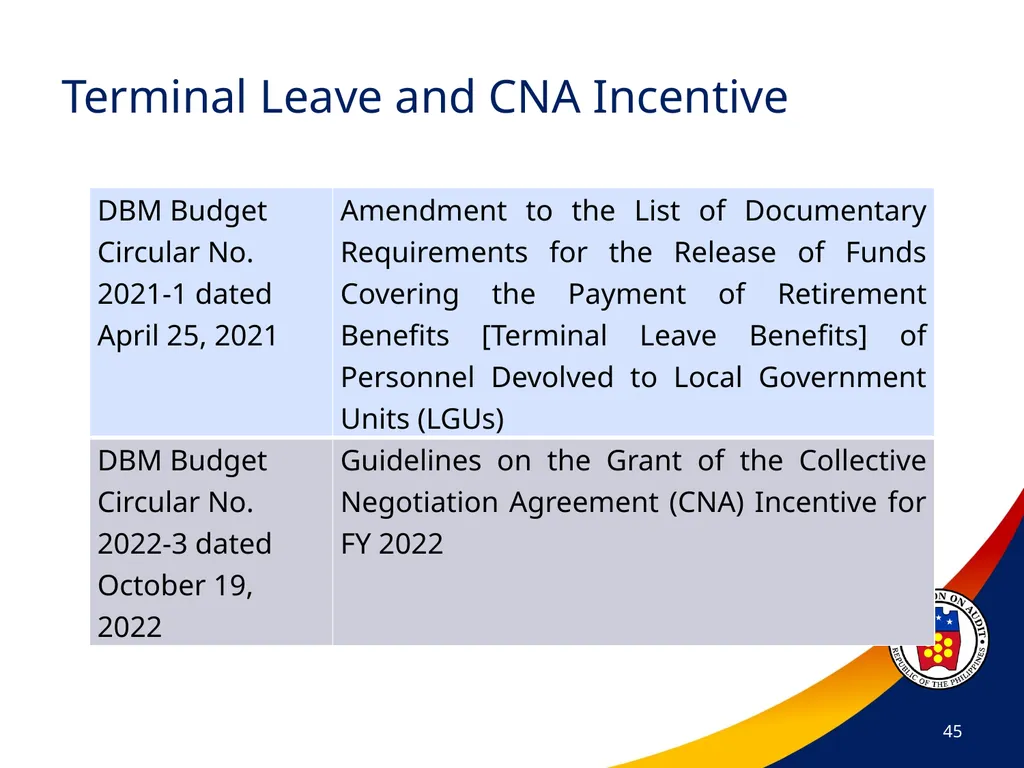
45 Terminal Leave and CNA Incentive<br>
46
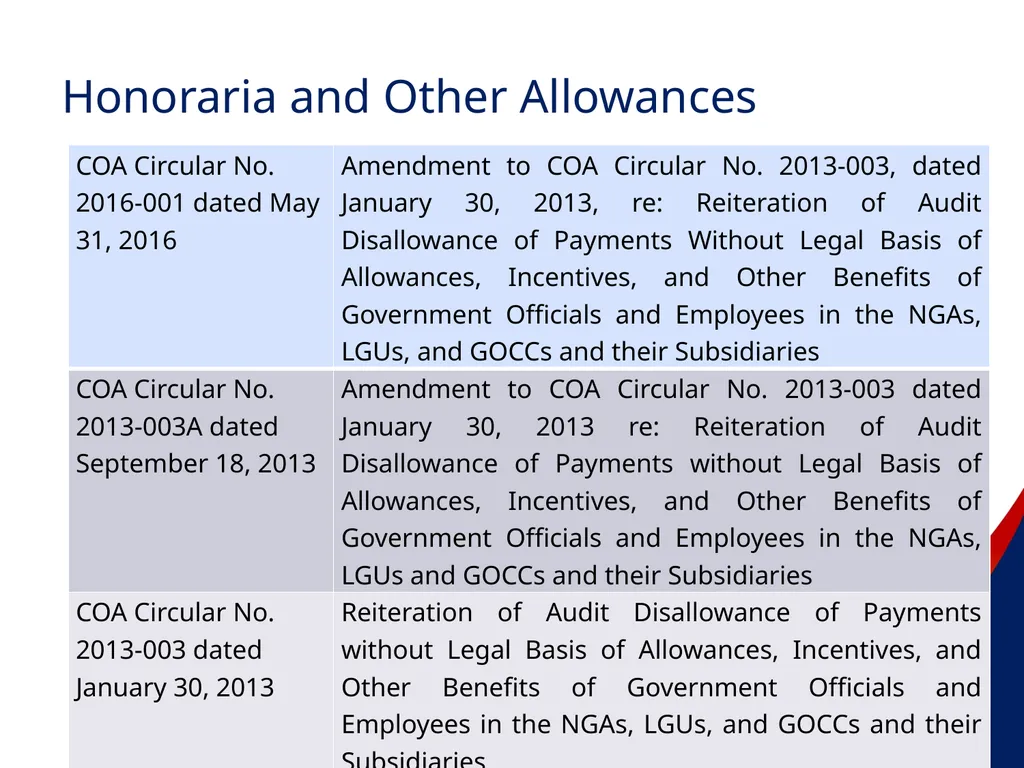
46 Honoraria and Other Allowances<br>
47
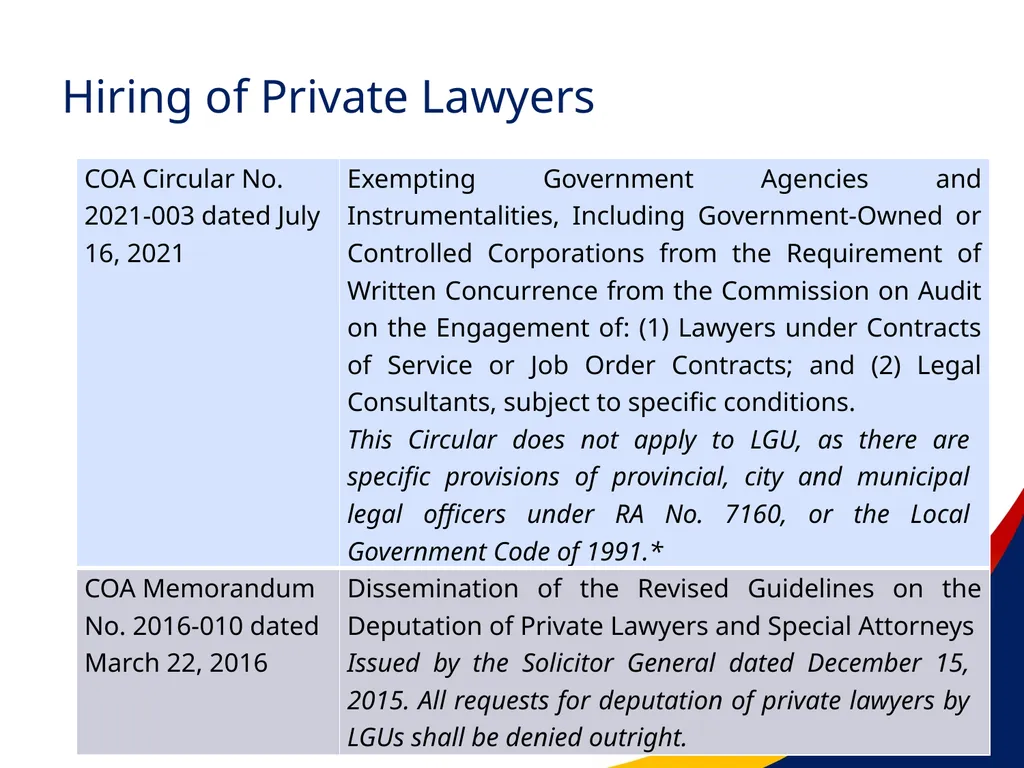
47 Hiring of Private Lawyers<br>
48
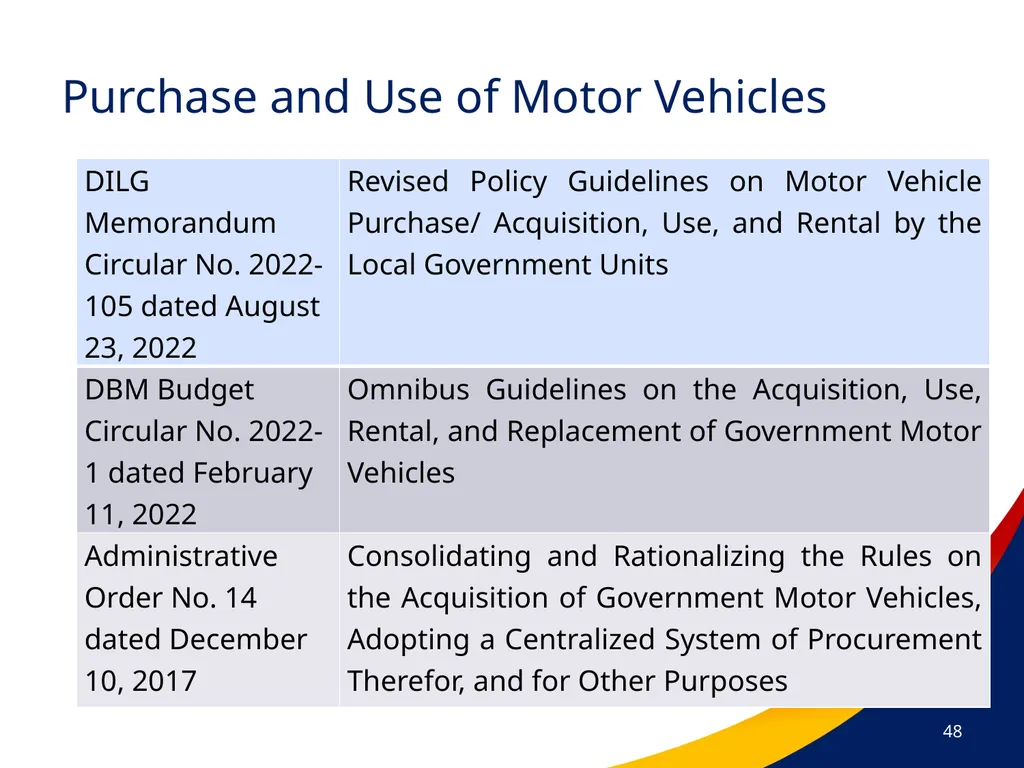
48 Purchase and Use of Motor Vehicles<br>
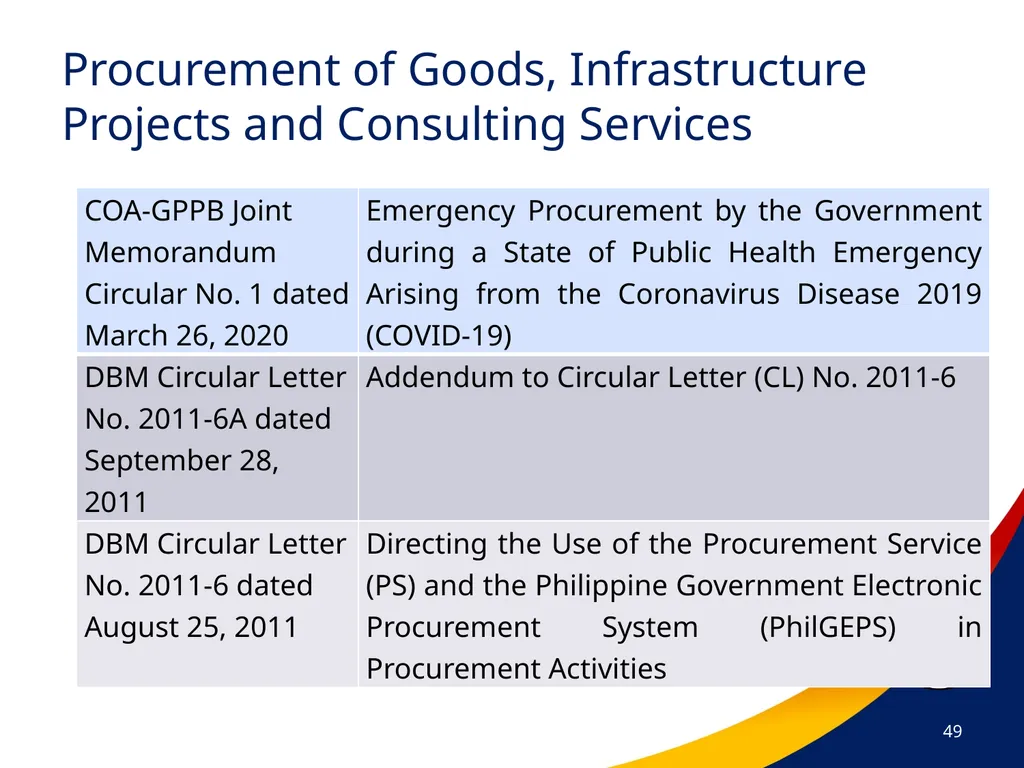
49
49 Procurement of Goods, Infrastructure Projects and Consulting Services<br>
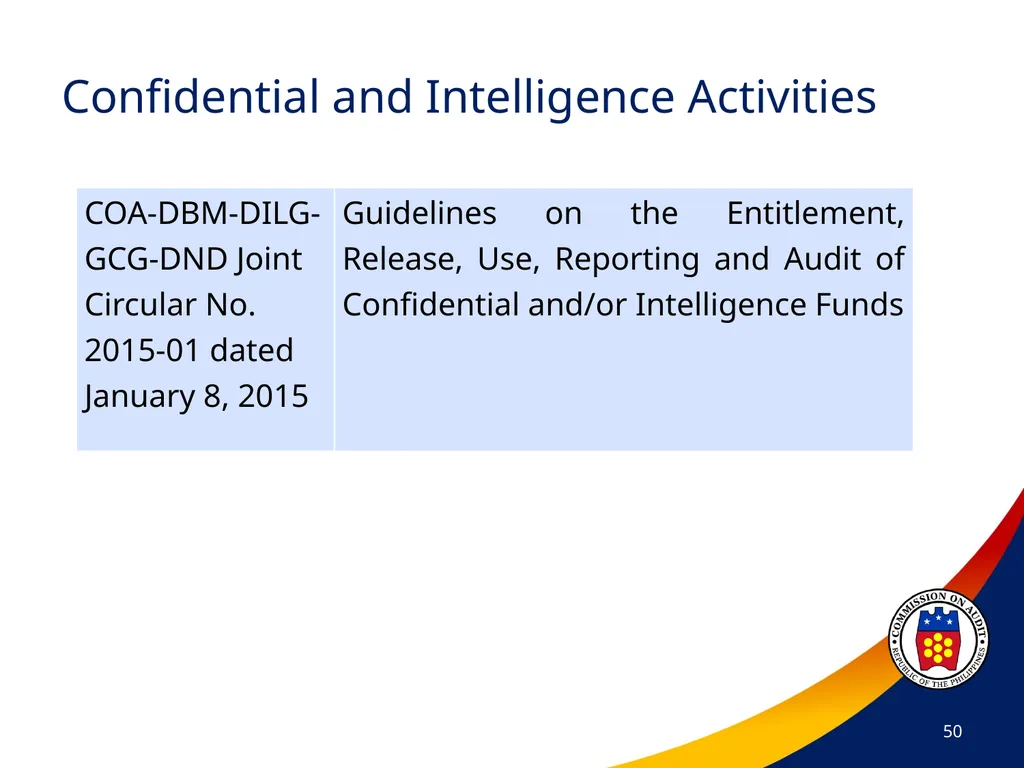
50
50 Confidential and Intelligence Activities<br>
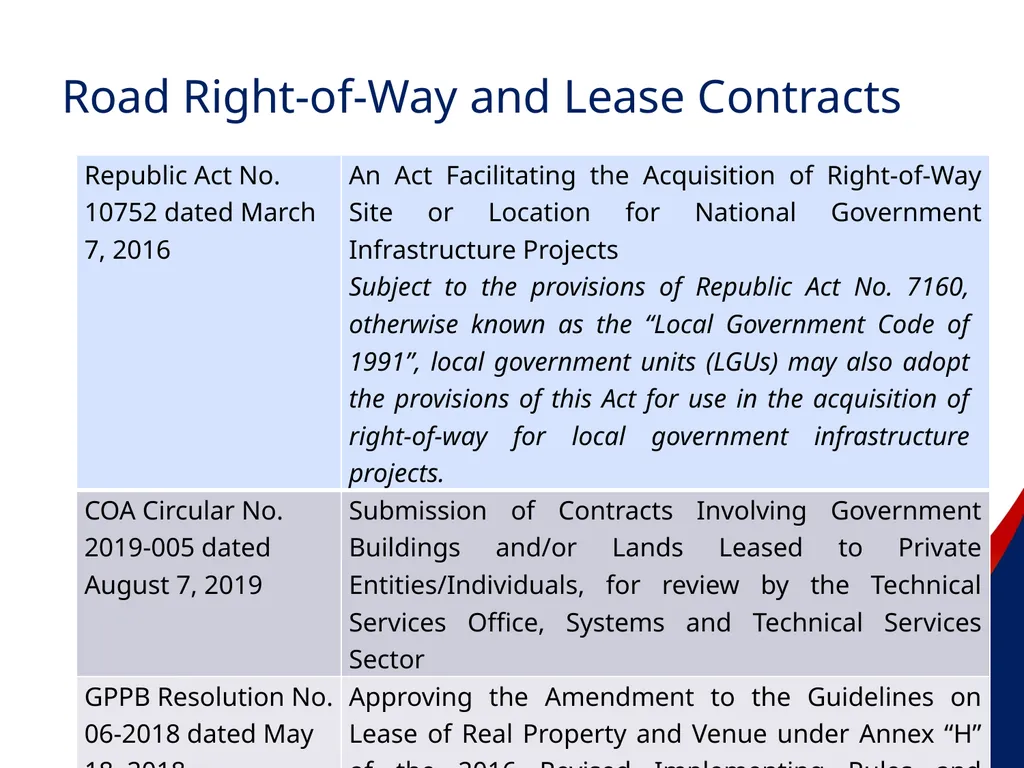
51
51 Road Right-of-Way and Lease Contracts<br>
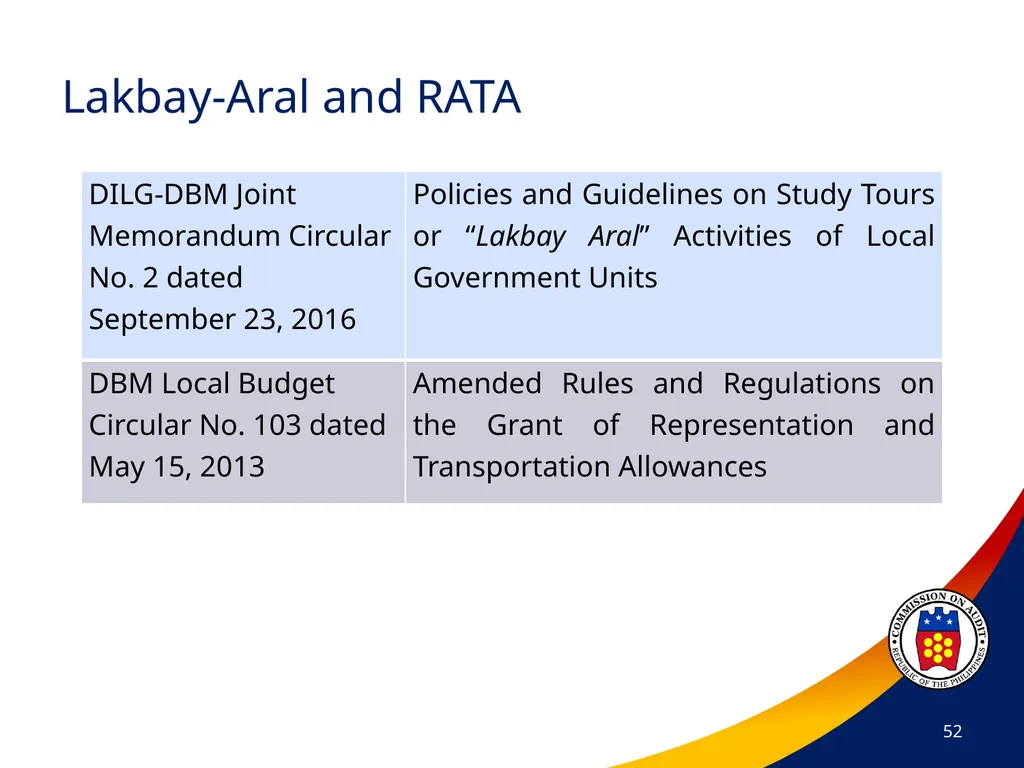
52
52 Lakbay-Aral and RATA<br>
53
53<br>