Coarse Dispersion DEEPTHI KODAM Assistant Professor St. Peters Institute of Pharmaceutical Sciences Introduction Coarse dispersion involves the distribution of particles within a medium, crucial for various applications in chemistry and
"Coarse Dispersion DEEPTHI KODAM Assistant" is the property of its rightful owner. Permission is granted to
download and print the materials on this website for personal, non-commercial use only, and to display it
on your personal computer provided you do not modify the materials and that you retain all copyright
notices contained in the materials. By downloading content from our website, you accept the terms of this
agreement.
Presentation Transcript
01
Coarse Dispersion DEEPTHI KODAM Assistant Professor St. Peter’s Institute of Pharmaceutical Sciences<br>
02
Introduction Coarse dispersion involves the distribution of particles within a medium, crucial for various applications in chemistry and material science.
This include various dosage forms like Suspensions and Emulsions<br>
03
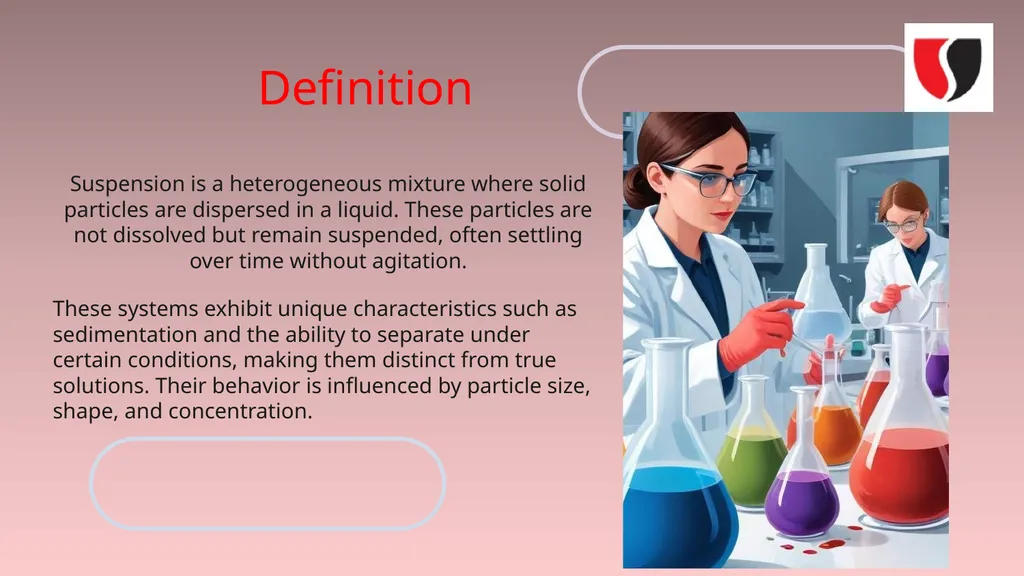
Definition Suspension is a heterogeneous mixture where solid particles are dispersed in a liquid. These particles are not dissolved but remain suspended, often settling over time without agitation.
These systems exhibit unique characteristics such as sedimentation and the ability to separate under certain conditions, making them distinct from true solutions. Their behavior is influenced by particle size, shape, and concentration.<br>
04
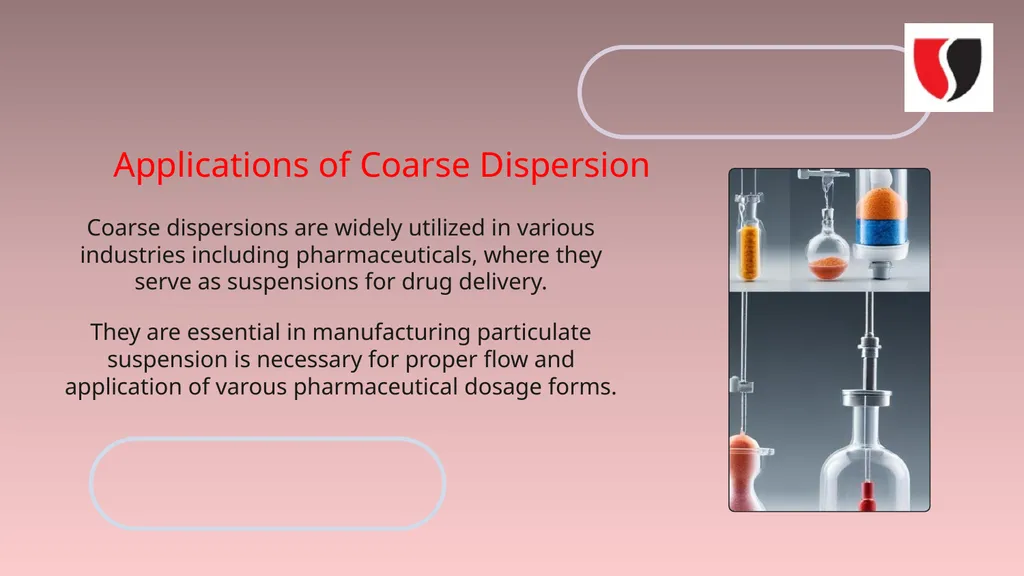
Applications of Coarse Dispersion Coarse dispersions are widely utilized in various industries including pharmaceuticals, where they serve as suspensions for drug delivery.
They are essential in manufacturing particulate suspension is necessary for proper flow and application of varous pharmaceutical dosage forms.<br>
05
Flocculation: It is the process where fine solid particles clump together to form larger
aggregates, known as flocs.
This is often facilitated by adding flocculating agents that promote
particle bonding. Flocculated systems
are more stable and can prevent sedimentation for a longer time. Deflocculation: It is the opposite of flocculation, where particles remain separate and dispersed within a liquid.
This occurs when agents capable of breaking flocs are present, leading to unstable suspensions. Deflocculated suspensions can settle quickly and are generally less stable.<br>
06
Emulsion<br>
07
Types of Emulsions Emulsions can be classified into two main types:
oil-in-water (O/W)
water-in-oil (W/O) emulsions.
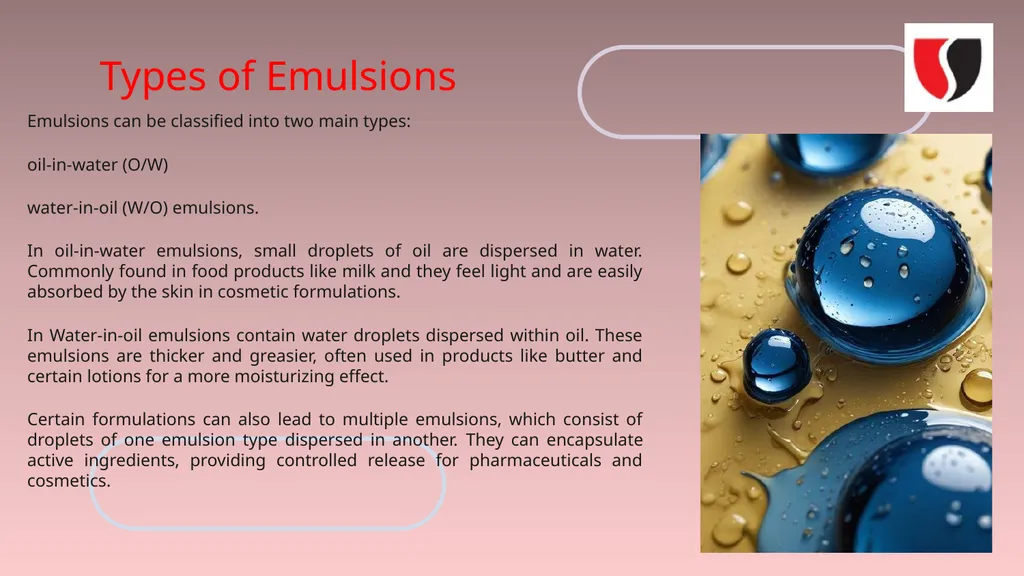
In oil-in-water emulsions, small droplets of oil are dispersed in water. Commonly found in food products like milk and they feel light and are easily absorbed by the skin in cosmetic formulations.
In Water-in-oil emulsions contain water droplets dispersed within oil. These emulsions are thicker and greasier, often used in products like butter and certain lotions for a more moisturizing effect.
Certain formulations can also lead to multiple emulsions, which consist of droplets of one emulsion type dispersed in another. They can encapsulate active ingredients, providing controlled release for pharmaceuticals and cosmetics.<br>
08
Emulsion Stability Factors The stability of emulsions is influenced by several factors, including droplet size, concentration of emulsifiers, ionic strength, and temperature.
Smaller droplets typically contribute to greater stability due to the increased surface area, while adequate emulsifier concentration helps maintain dispersion.
Environmental factors such as pH and salt concentration also play a significant role in the stability of emulsions. By manipulating these factors, formulators can enhance the performance of emulsions in various applications.<br>
09
Conclusions The study of coarse dispersions and emulsions reveals their critical roles in numerous applications across different industries.
Understanding the principles of flocculation, emulsification theories, and By leveraging techniques such as the HLB method and rheological assessments, formulators can enhance product stability and performance, ensuring the desired efficacy in practical applications.<br>