
COGNITION Chapter 8: Language Fundamentals of
MJ
Published · 38 slides · 0 views
1 / 1


Description
COGNITION Chapter 8: Language Fundamentals of Cognitive Psychology (Kellogg) Fall 2013 Mark Van Selst San Jose State University Cognition Van Selst (Kellogg Chapter 8) Conceptual-Propositional Hypothesis (language-based evidence for
Related Topics
Share
Embed code
Download this presentation From Below
"COGNITION Chapter 8: Language Fundamentals of" is the property of its rightful owner. Permission is granted to download and print the materials on this website for personal, non-commercial use only, and to display it on your personal computer provided you do not modify the materials and that you retain all copyright notices contained in the materials. By downloading content from our website, you accept the terms of this agreement.
Presentation Transcript
01
COGNITION
Chapter 8: Language
Fundamentals of Cognitive Psychology (Kellogg) Fall 2013 Mark Van Selst
San Jose State University<br>
San Jose State University<br>
02
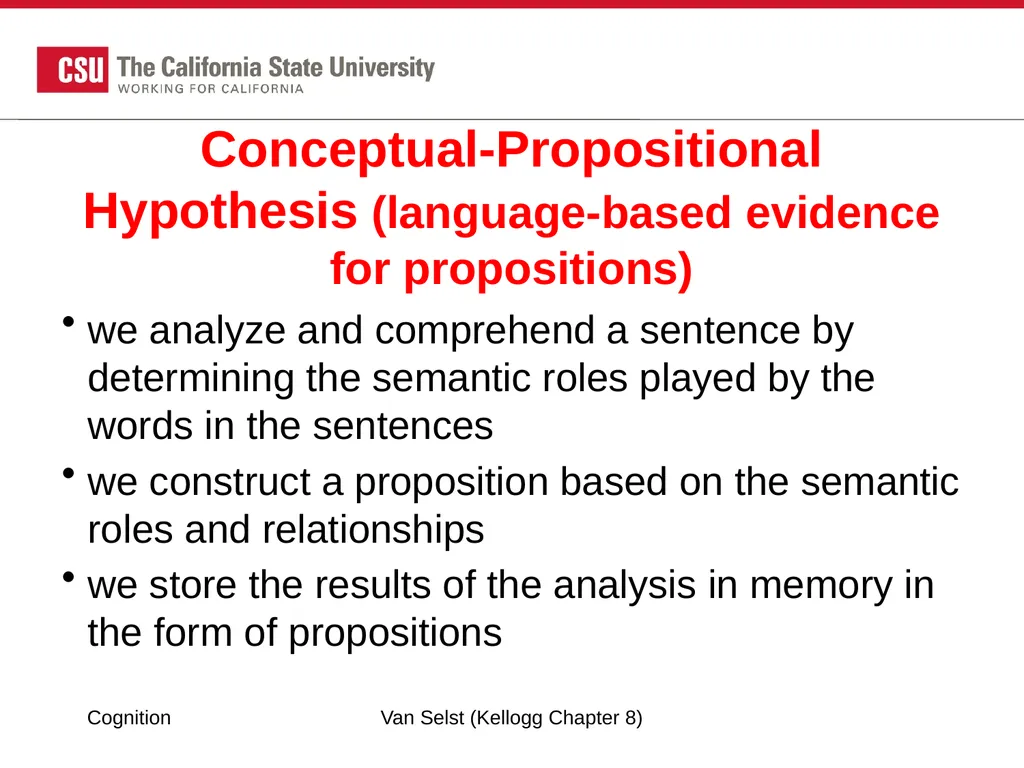
Cognition Van Selst (Kellogg Chapter 8) Conceptual-Propositional Hypothesis (language-based evidence for propositions) we analyze and comprehend a sentence by determining the semantic roles played by the words in the sentences
we construct a proposition based on the semantic roles and relationships
we store the results of the analysis in memory in the form of propositions<br>
we construct a proposition based on the semantic roles and relationships
we store the results of the analysis in memory in the form of propositions<br>
03
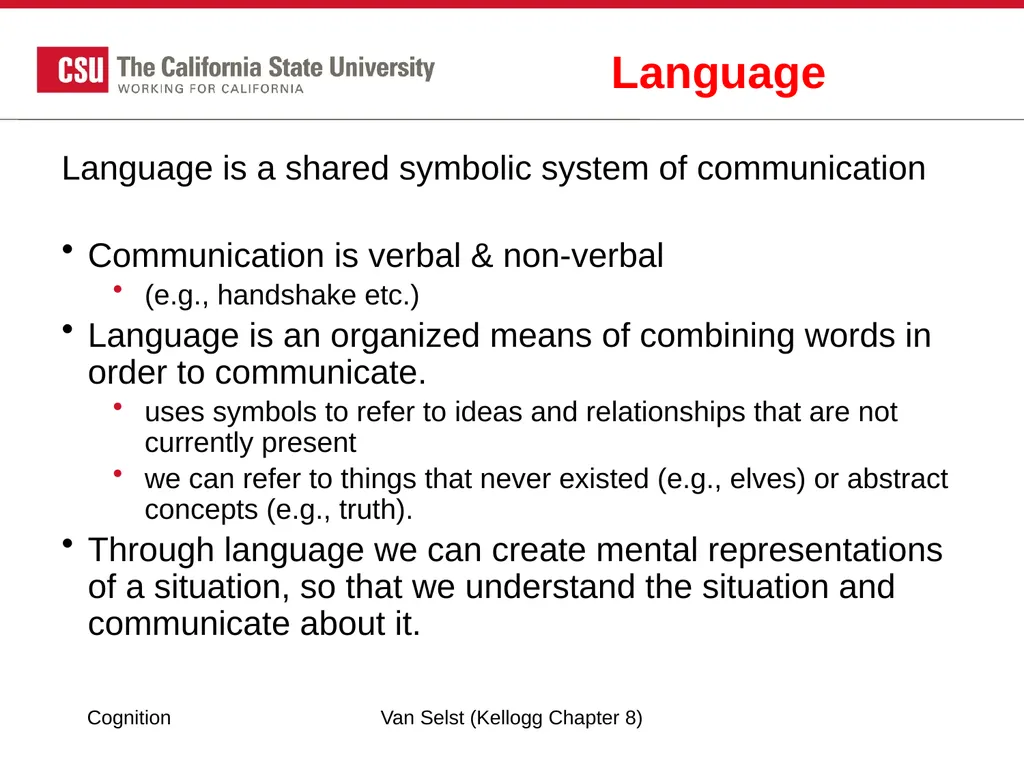
Cognition Van Selst (Kellogg Chapter 8) Language Language is a shared symbolic system of communication
Communication is verbal & non-verbal
(e.g., handshake etc.)
Language is an organized means of combining words in order to communicate.
uses symbols to refer to ideas and relationships that are not currently present
we can refer to things that never existed (e.g., elves) or abstract concepts (e.g., truth).
Through language we can create mental representations of a situation, so that we understand the situation and communicate about it.<br>
Communication is verbal & non-verbal
(e.g., handshake etc.)
Language is an organized means of combining words in order to communicate.
uses symbols to refer to ideas and relationships that are not currently present
we can refer to things that never existed (e.g., elves) or abstract concepts (e.g., truth).
Through language we can create mental representations of a situation, so that we understand the situation and communicate about it.<br>
04
Cognition Van Selst (Kellogg Chapter 8) Value of Language
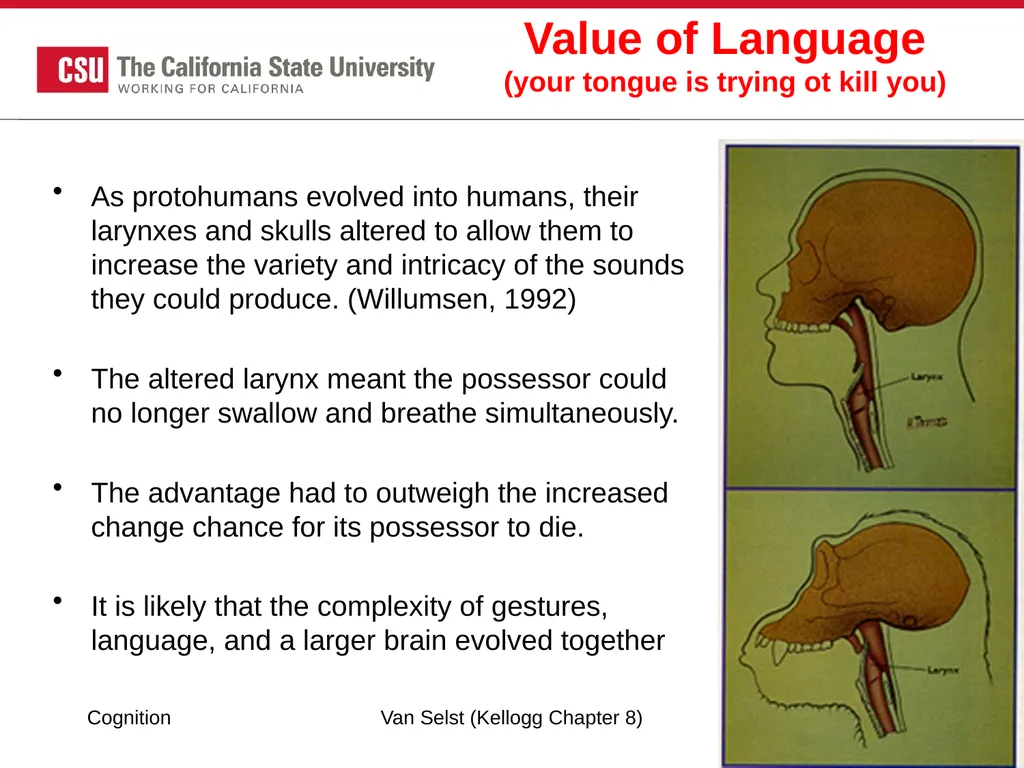
(your tongue is trying ot kill you) As protohumans evolved into humans, their larynxes and skulls altered to allow them to increase the variety and intricacy of the sounds they could produce. (Willumsen, 1992)
The altered larynx meant the possessor could no longer swallow and breathe simultaneously.
The advantage had to outweigh the increased change chance for its possessor to die.
It is likely that the complexity of gestures, language, and a larger brain evolved together<br>
The altered larynx meant the possessor could no longer swallow and breathe simultaneously.
The advantage had to outweigh the increased change chance for its possessor to die.
It is likely that the complexity of gestures, language, and a larger brain evolved together<br>
05
Cognition Van Selst (Kellogg Chapter 8) Properties of Language Receptive: comprehension and decoding of language input.
Expressive: encoding and production of language output.
Encoding is transforming thoughts into a form that can be expressed through speech, writing, signs.
Verbal comprehension and verbal fluency are the abilities needed to produce language output.
Your receptive vocabulary is larger than your expressive vocabulary<br>
Expressive: encoding and production of language output.
Encoding is transforming thoughts into a form that can be expressed through speech, writing, signs.
Verbal comprehension and verbal fluency are the abilities needed to produce language output.
Your receptive vocabulary is larger than your expressive vocabulary<br>
06
Cognition Van Selst (Kellogg Chapter 8) Properties of Language
(Clark & Clark, 1977) A Language must be learnable by children
A Language must be able to be spoken and understood readily by adults
A Language must capture ideas that people normally communicate
A Language must enable communication among groups of people in a social and cultural context<br>
A Language must be able to be spoken and understood readily by adults
A Language must capture ideas that people normally communicate
A Language must enable communication among groups of people in a social and cultural context<br>
07
Cognition Van Selst (Kellogg Chapter 8) Properties of Language
(an earlier view) Hockett (1960, 1961) was interested in what commonalties existed across all spoken human languages.
Linguistic universals are those rules that appear to apply to every human language
Hockett did not focus on written language (evolutionarily too recent).
Hockett listed universal features (linguistic universals) that he thought were present in all spoken language systems.
Four of his original set are still thought to be essential in defining language – many of the others are recognized as "design features" of language rather than basic essentials.<br>
Linguistic universals are those rules that appear to apply to every human language
Hockett did not focus on written language (evolutionarily too recent).
Hockett listed universal features (linguistic universals) that he thought were present in all spoken language systems.
Four of his original set are still thought to be essential in defining language – many of the others are recognized as "design features" of language rather than basic essentials.<br>
08
Cognition Van Selst (Kellogg Chapter 8) Hockett’s Linguistic Universals
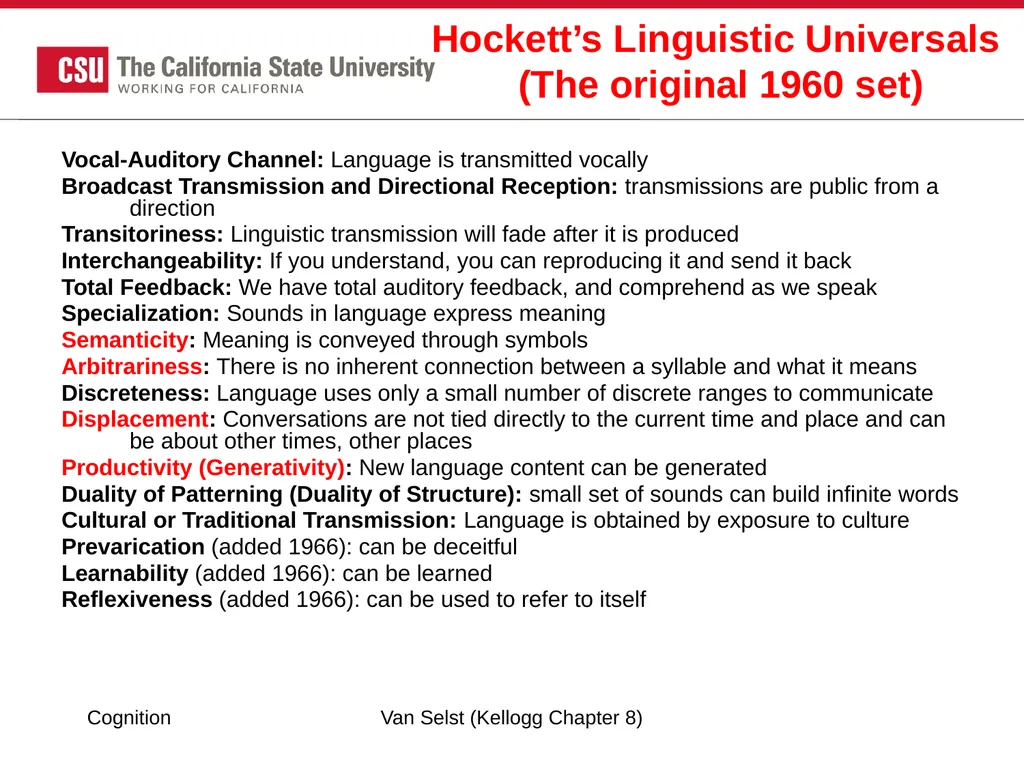
(The original 1960 set) Vocal-Auditory Channel: Language is transmitted vocally
Broadcast Transmission and Directional Reception: transmissions are public from a direction
Transitoriness: Linguistic transmission will fade after it is produced
Interchangeability: If you understand, you can reproducing it and send it back
Total Feedback: We have total auditory feedback, and comprehend as we speak
Specialization: Sounds in language express meaning
Semanticity: Meaning is conveyed through symbols
Arbitrariness: There is no inherent connection between a syllable and what it means
Discreteness: Language uses only a small number of discrete ranges to communicate
Displacement: Conversations are not tied directly to the current time and place and can be about other times, other places
Productivity (Generativity): New language content can be generated
Duality of Patterning (Duality of Structure): small set of sounds can build infinite words
Cultural or Traditional Transmission: Language is obtained by exposure to culture
Prevarication (added 1966): can be deceitful
Learnability (added 1966): can be learned
Reflexiveness (added 1966): can be used to refer to itself<br>
Broadcast Transmission and Directional Reception: transmissions are public from a direction
Transitoriness: Linguistic transmission will fade after it is produced
Interchangeability: If you understand, you can reproducing it and send it back
Total Feedback: We have total auditory feedback, and comprehend as we speak
Specialization: Sounds in language express meaning
Semanticity: Meaning is conveyed through symbols
Arbitrariness: There is no inherent connection between a syllable and what it means
Discreteness: Language uses only a small number of discrete ranges to communicate
Displacement: Conversations are not tied directly to the current time and place and can be about other times, other places
Productivity (Generativity): New language content can be generated
Duality of Patterning (Duality of Structure): small set of sounds can build infinite words
Cultural or Traditional Transmission: Language is obtained by exposure to culture
Prevarication (added 1966): can be deceitful
Learnability (added 1966): can be learned
Reflexiveness (added 1966): can be used to refer to itself<br>
09
Cognition Van Selst (Kellogg Chapter 8) Properties of Language
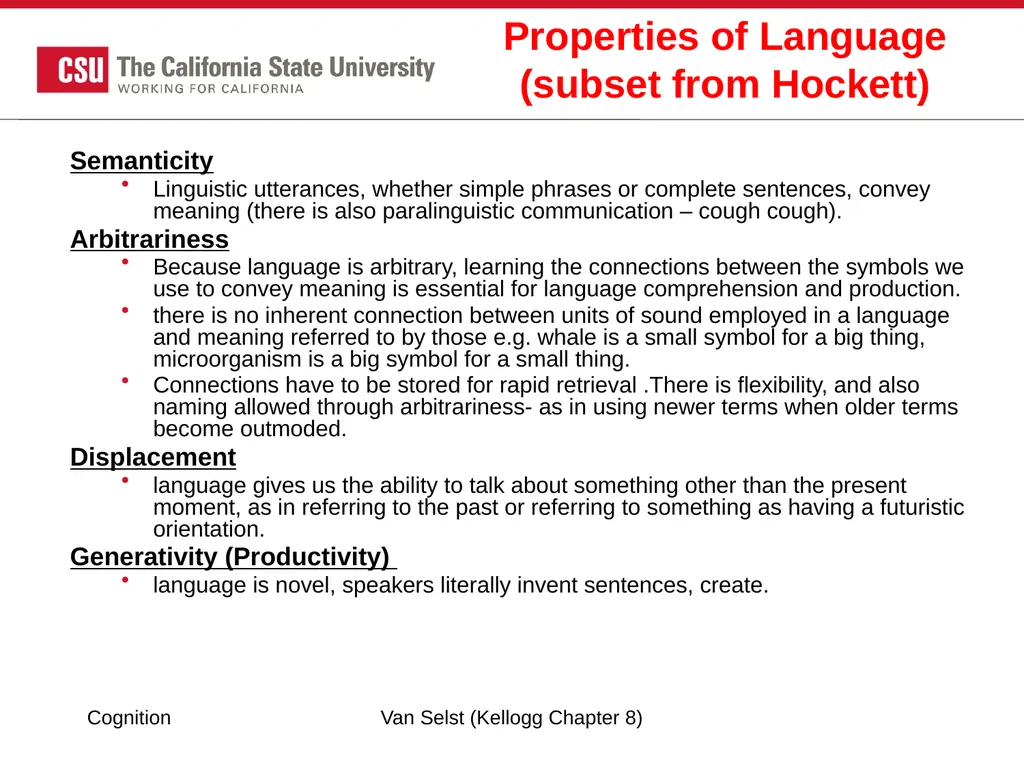
(subset from Hockett) Semanticity
Linguistic utterances, whether simple phrases or complete sentences, convey meaning (there is also paralinguistic communication – cough cough).
Arbitrariness
Because language is arbitrary, learning the connections between the symbols we use to convey meaning is essential for language comprehension and production.
there is no inherent connection between units of sound employed in a language and meaning referred to by those e.g. whale is a small symbol for a big thing, microorganism is a big symbol for a small thing.
Connections have to be stored for rapid retrieval .There is flexibility, and also naming allowed through arbitrariness- as in using newer terms when older terms become outmoded.
Displacement
language gives us the ability to talk about something other than the present moment, as in referring to the past or referring to something as having a futuristic orientation.
Generativity (Productivity)
language is novel, speakers literally invent sentences, create.<br>
Linguistic utterances, whether simple phrases or complete sentences, convey meaning (there is also paralinguistic communication – cough cough).
Arbitrariness
Because language is arbitrary, learning the connections between the symbols we use to convey meaning is essential for language comprehension and production.
there is no inherent connection between units of sound employed in a language and meaning referred to by those e.g. whale is a small symbol for a big thing, microorganism is a big symbol for a small thing.
Connections have to be stored for rapid retrieval .There is flexibility, and also naming allowed through arbitrariness- as in using newer terms when older terms become outmoded.
Displacement
language gives us the ability to talk about something other than the present moment, as in referring to the past or referring to something as having a futuristic orientation.
Generativity (Productivity)
language is novel, speakers literally invent sentences, create.<br>
10
Cognition Van Selst (Kellogg Chapter 8) Properties of Language
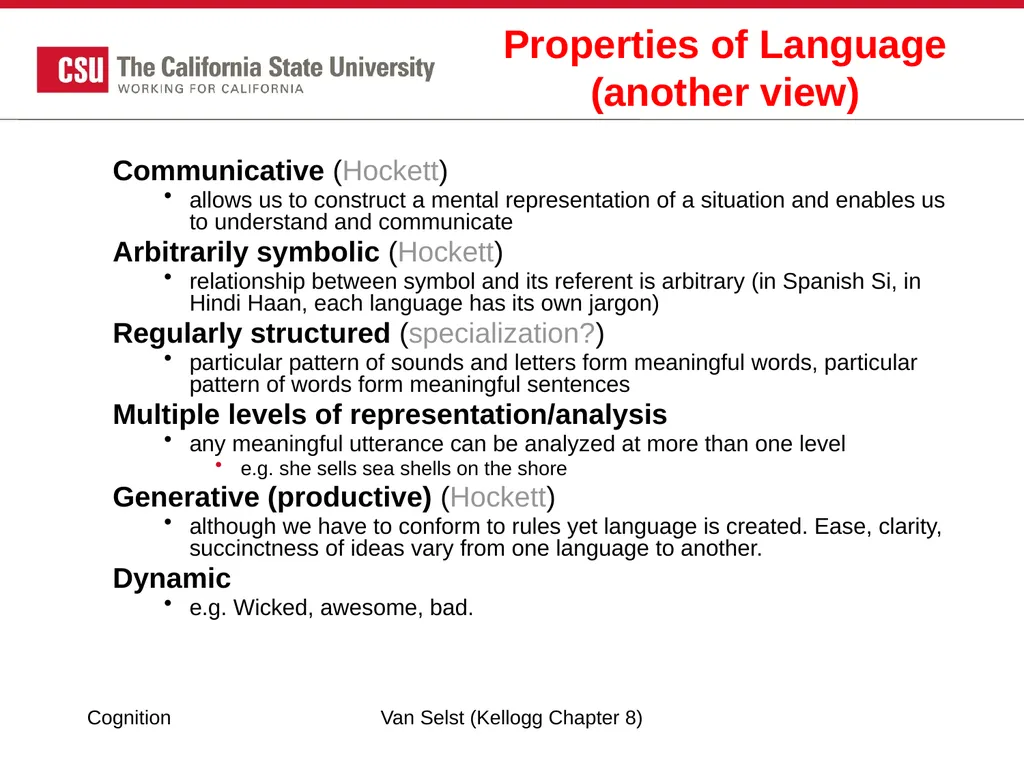
(another view) Communicative (Hockett)
allows us to construct a mental representation of a situation and enables us to understand and communicate
Arbitrarily symbolic (Hockett)
relationship between symbol and its referent is arbitrary (in Spanish Si, in Hindi Haan, each language has its own jargon)
Regularly structured (specialization?)
particular pattern of sounds and letters form meaningful words, particular pattern of words form meaningful sentences
Multiple levels of representation/analysis
any meaningful utterance can be analyzed at more than one level
e.g. she sells sea shells on the shore
Generative (productive) (Hockett)
although we have to conform to rules yet language is created. Ease, clarity, succinctness of ideas vary from one language to another.
Dynamic
e.g. Wicked, awesome, bad.<br>
allows us to construct a mental representation of a situation and enables us to understand and communicate
Arbitrarily symbolic (Hockett)
relationship between symbol and its referent is arbitrary (in Spanish Si, in Hindi Haan, each language has its own jargon)
Regularly structured (specialization?)
particular pattern of sounds and letters form meaningful words, particular pattern of words form meaningful sentences
Multiple levels of representation/analysis
any meaningful utterance can be analyzed at more than one level
e.g. she sells sea shells on the shore
Generative (productive) (Hockett)
although we have to conform to rules yet language is created. Ease, clarity, succinctness of ideas vary from one language to another.
Dynamic
e.g. Wicked, awesome, bad.<br>
11
Cognition Van Selst (Kellogg Chapter 8) Properties of Language Know Hockett’s Linguistic Universals that are still thought to be essential in defining language
Be able to define each<br>
Be able to define each<br>
12
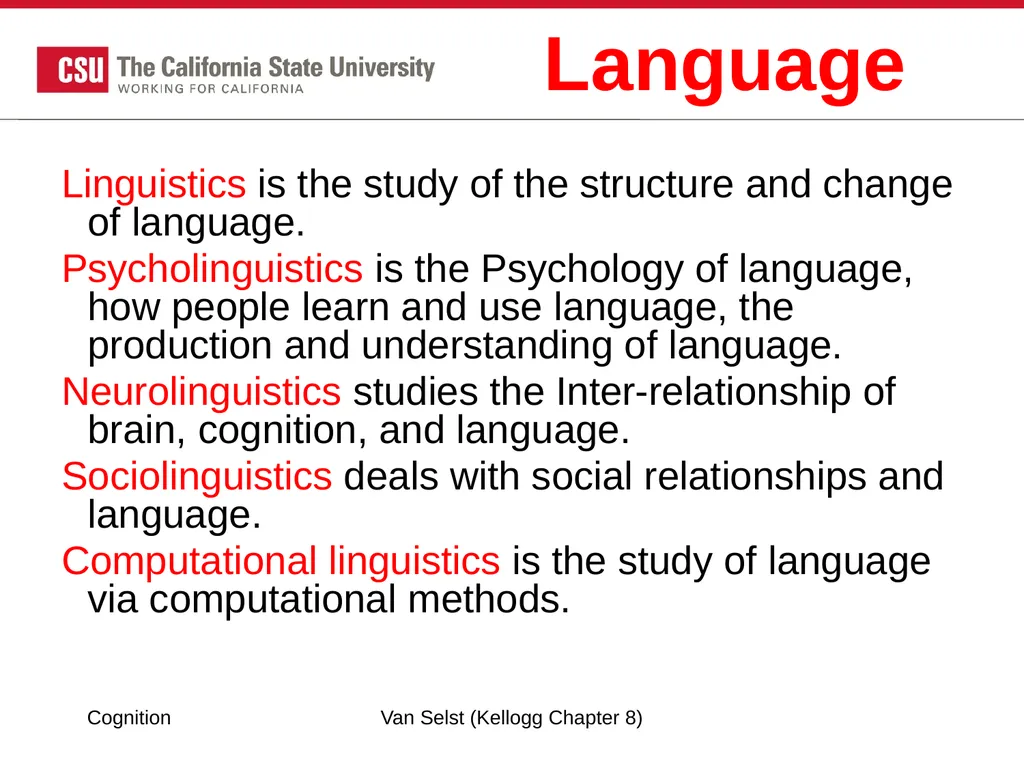
Cognition Van Selst (Kellogg Chapter 8) Language Linguistics is the study of the structure and change of language.
Psycholinguistics is the Psychology of language, how people learn and use language, the production and understanding of language.
Neurolinguistics studies the Inter-relationship of brain, cognition, and language.
Sociolinguistics deals with social relationships and language.
Computational linguistics is the study of language via computational methods.<br>
Psycholinguistics is the Psychology of language, how people learn and use language, the production and understanding of language.
Neurolinguistics studies the Inter-relationship of brain, cognition, and language.
Sociolinguistics deals with social relationships and language.
Computational linguistics is the study of language via computational methods.<br>
13
Cognition Van Selst (Kellogg Chapter 8) Semantics Semantics is the study of meaning. Any theory of Semantic memory must explain how people mentally represent concepts and ideas.
Semantic Memory stores knowledge of concepts and facts.<br>
Semantic Memory stores knowledge of concepts and facts.<br>
14
Cognition Van Selst (Kellogg Chapter 8) ICONICITY
(is not required) ICONICITY: The characteristic of a language in which a language unit has a physical resemblance to its referent
e.g., a map
Onomatopoeia is a word that imitates the sound it represents (a Greek word meaning name-making)
the sounds literally “make the meaning” in such words as: splash, wow, gush, kerplunk, buzz, crash, whirr, clang, hiss, purr, squeak, mumble, hush, boom.<br>
e.g., a map
Onomatopoeia is a word that imitates the sound it represents (a Greek word meaning name-making)
the sounds literally “make the meaning” in such words as: splash, wow, gush, kerplunk, buzz, crash, whirr, clang, hiss, purr, squeak, mumble, hush, boom.<br>
15
Cognition Van Selst (Kellogg Chapter 8) Language Animal Communication - only seems to have arbitrariness and (some) semanticity. Lacks Displacement and Grammar.
e.g. rraup of a monkey—eagle, chutter—snakes, chirp—leopards.
Premack taught the chimp Sarah a vocabulary of more than 100 words. Language facility of humans far exceeds those of any other species. It is unclear if Sarah has language or if it is a case of S-R learning yielding “clever Hans” - type behavior<br>
e.g. rraup of a monkey—eagle, chutter—snakes, chirp—leopards.
Premack taught the chimp Sarah a vocabulary of more than 100 words. Language facility of humans far exceeds those of any other species. It is unclear if Sarah has language or if it is a case of S-R learning yielding “clever Hans” - type behavior<br>
16
Cognition Van Selst (Kellogg Chapter 8) Levels of Analysis of Language Phonological analysis - study of the production and perception of language sounds.
Syntactic analysis - study of structure of sentences, rules determining order of words and phrases in those sentences.
Semantic analysis - study of word meaning e.g. bachelor and his wife went to the movies.
Miller will add “conceptual” and “belief” to the mix<br>
Syntactic analysis - study of structure of sentences, rules determining order of words and phrases in those sentences.
Semantic analysis - study of word meaning e.g. bachelor and his wife went to the movies.
Miller will add “conceptual” and “belief” to the mix<br>
17
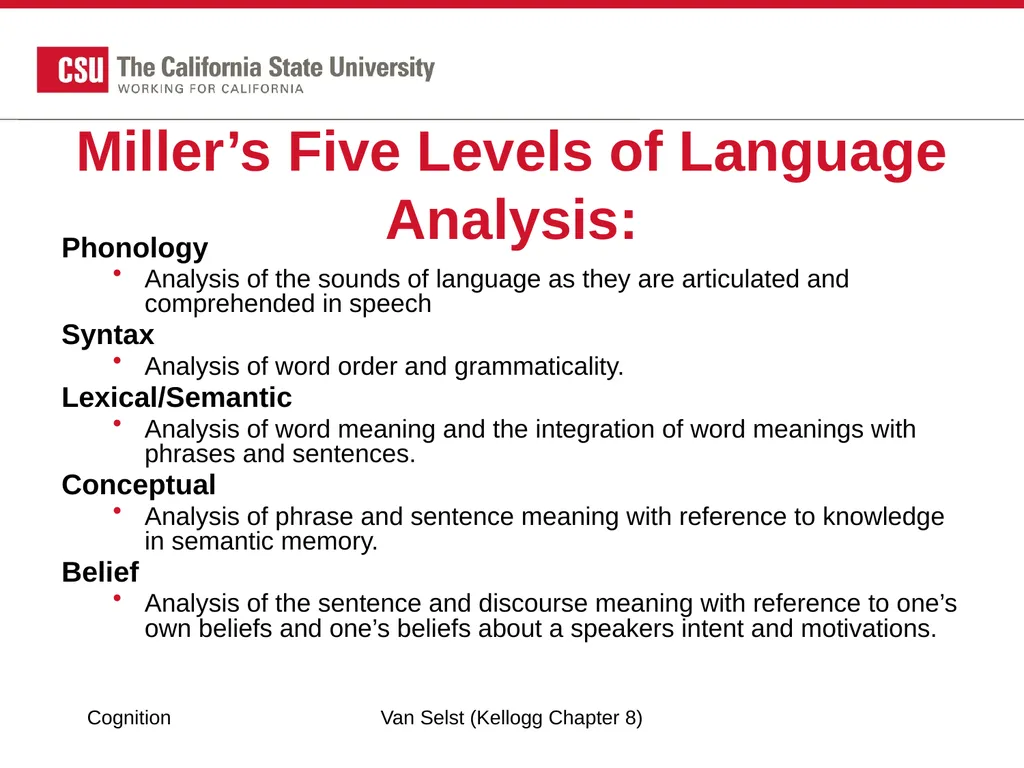
Cognition Van Selst (Kellogg Chapter 8) Miller’s Five Levels of Language Analysis: Phonology
Analysis of the sounds of language as they are articulated and comprehended in speech
Syntax
Analysis of word order and grammaticality.
Lexical/Semantic
Analysis of word meaning and the integration of word meanings with phrases and sentences.
Conceptual
Analysis of phrase and sentence meaning with reference to knowledge in semantic memory.
Belief
Analysis of the sentence and discourse meaning with reference to one’s own beliefs and one’s beliefs about a speakers intent and motivations.<br>
Analysis of the sounds of language as they are articulated and comprehended in speech
Syntax
Analysis of word order and grammaticality.
Lexical/Semantic
Analysis of word meaning and the integration of word meanings with phrases and sentences.
Conceptual
Analysis of phrase and sentence meaning with reference to knowledge in semantic memory.
Belief
Analysis of the sentence and discourse meaning with reference to one’s own beliefs and one’s beliefs about a speakers intent and motivations.<br>
18
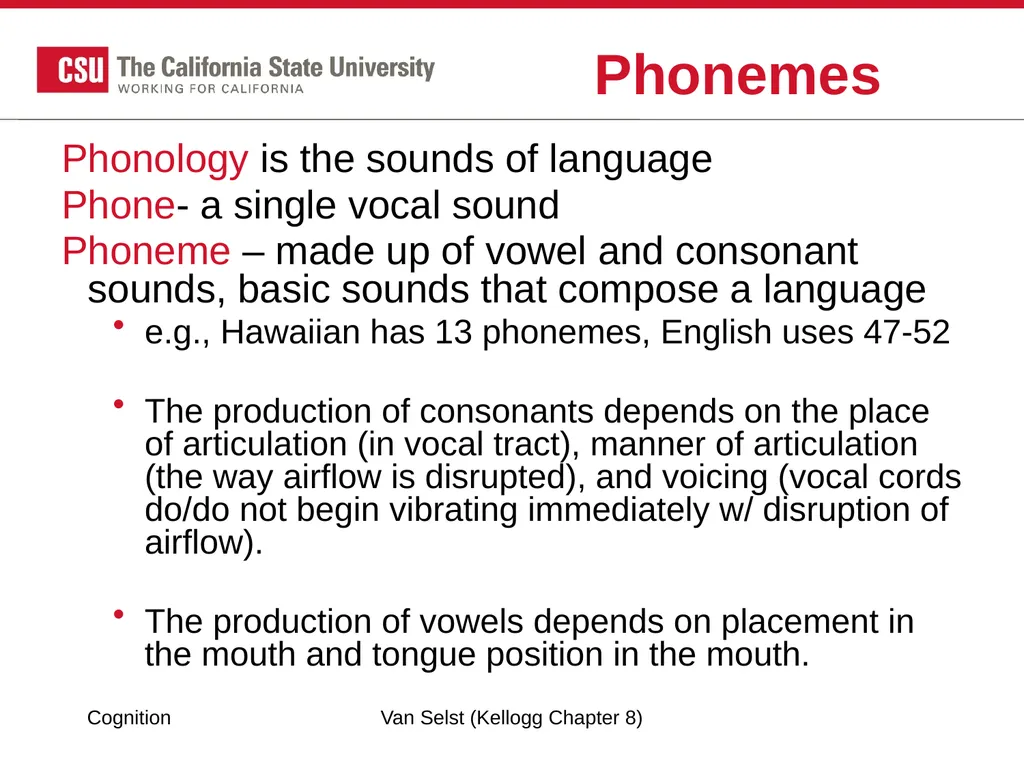
Cognition Van Selst (Kellogg Chapter 8) Phonemes Phonology is the sounds of language
Phone- a single vocal sound
Phoneme – made up of vowel and consonant sounds, basic sounds that compose a language
e.g., Hawaiian has 13 phonemes, English uses 47-52
The production of consonants depends on the place of articulation (in vocal tract), manner of articulation (the way airflow is disrupted), and voicing (vocal cords do/do not begin vibrating immediately w/ disruption of airflow).
The production of vowels depends on placement in the mouth and tongue position in the mouth.<br>
Phone- a single vocal sound
Phoneme – made up of vowel and consonant sounds, basic sounds that compose a language
e.g., Hawaiian has 13 phonemes, English uses 47-52
The production of consonants depends on the place of articulation (in vocal tract), manner of articulation (the way airflow is disrupted), and voicing (vocal cords do/do not begin vibrating immediately w/ disruption of airflow).
The production of vowels depends on placement in the mouth and tongue position in the mouth.<br>
19
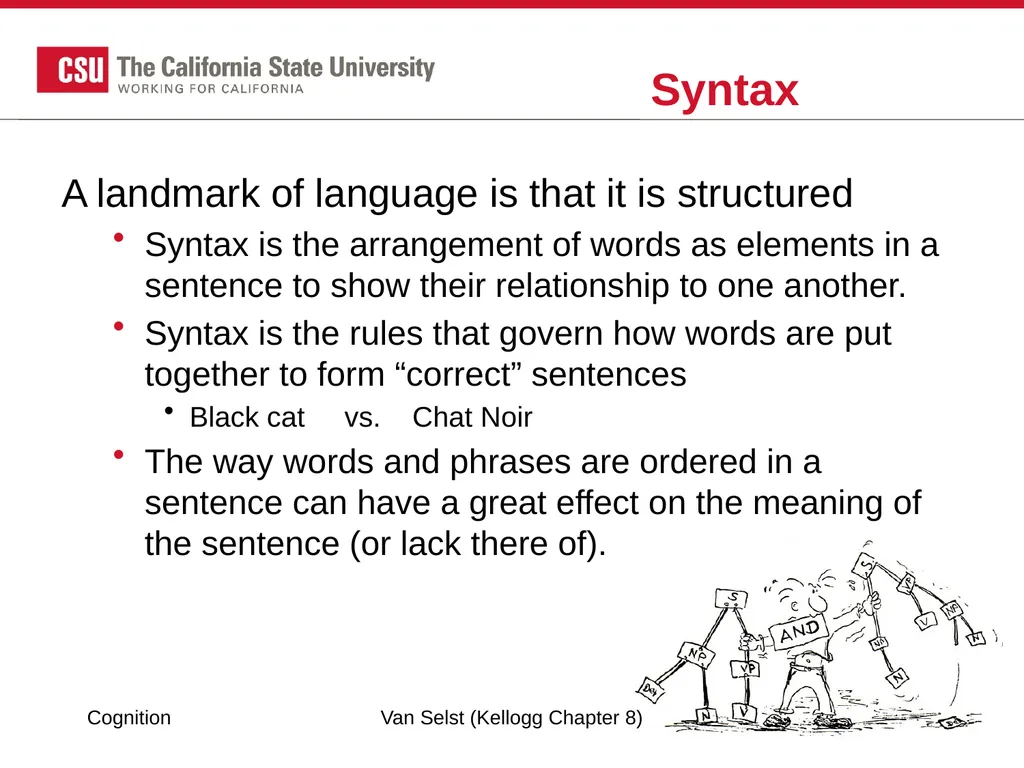
Cognition Van Selst (Kellogg Chapter 8) Syntax A landmark of language is that it is structured
Syntax is the arrangement of words as elements in a sentence to show their relationship to one another.
Syntax is the rules that govern how words are put together to form “correct” sentences
Black cat vs. Chat Noir
The way words and phrases are ordered in a sentence can have a great effect on the meaning of the sentence (or lack there of).<br>
Syntax is the arrangement of words as elements in a sentence to show their relationship to one another.
Syntax is the rules that govern how words are put together to form “correct” sentences
Black cat vs. Chat Noir
The way words and phrases are ordered in a sentence can have a great effect on the meaning of the sentence (or lack there of).<br>
20
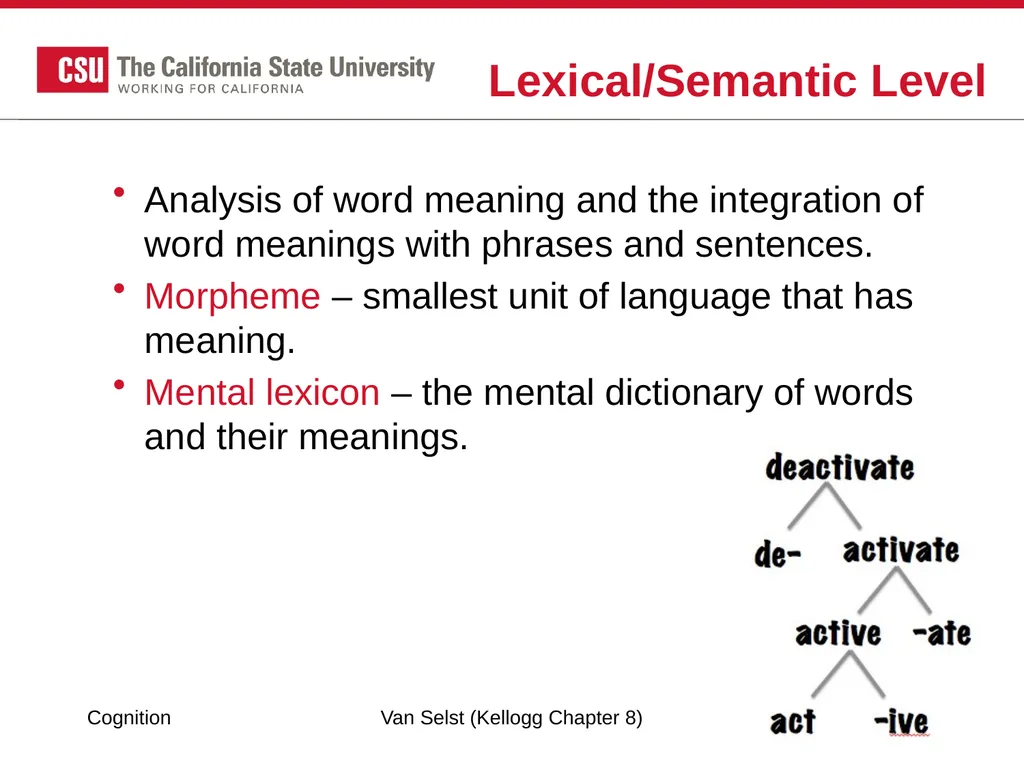
Cognition Van Selst (Kellogg Chapter 8) Lexical/Semantic Level Analysis of word meaning and the integration of word meanings with phrases and sentences.
Morpheme – smallest unit of language that has meaning.
Mental lexicon – the mental dictionary of words and their meanings.<br>
Morpheme – smallest unit of language that has meaning.
Mental lexicon – the mental dictionary of words and their meanings.<br>
21
Cognition Van Selst (Kellogg Chapter 8) Lexical/Semantic
(Morphemes) Morpheme - Smallest unit that denotes meaning within a particular language
e.g. study is the root and its meaning can be changed by removing -y and adding -ent, simply adding -ing.
One is concerned with content words (nouns, verbs) that refer to natural (chair) or formal (marriage) concepts rather than function words (“by, etc.”)
Mental Lexicon - entire set of morphemes in a given language.
Morphological Analysis – working out meaning based on the morphological units.<br>
e.g. study is the root and its meaning can be changed by removing -y and adding -ent, simply adding -ing.
One is concerned with content words (nouns, verbs) that refer to natural (chair) or formal (marriage) concepts rather than function words (“by, etc.”)
Mental Lexicon - entire set of morphemes in a given language.
Morphological Analysis – working out meaning based on the morphological units.<br>
22
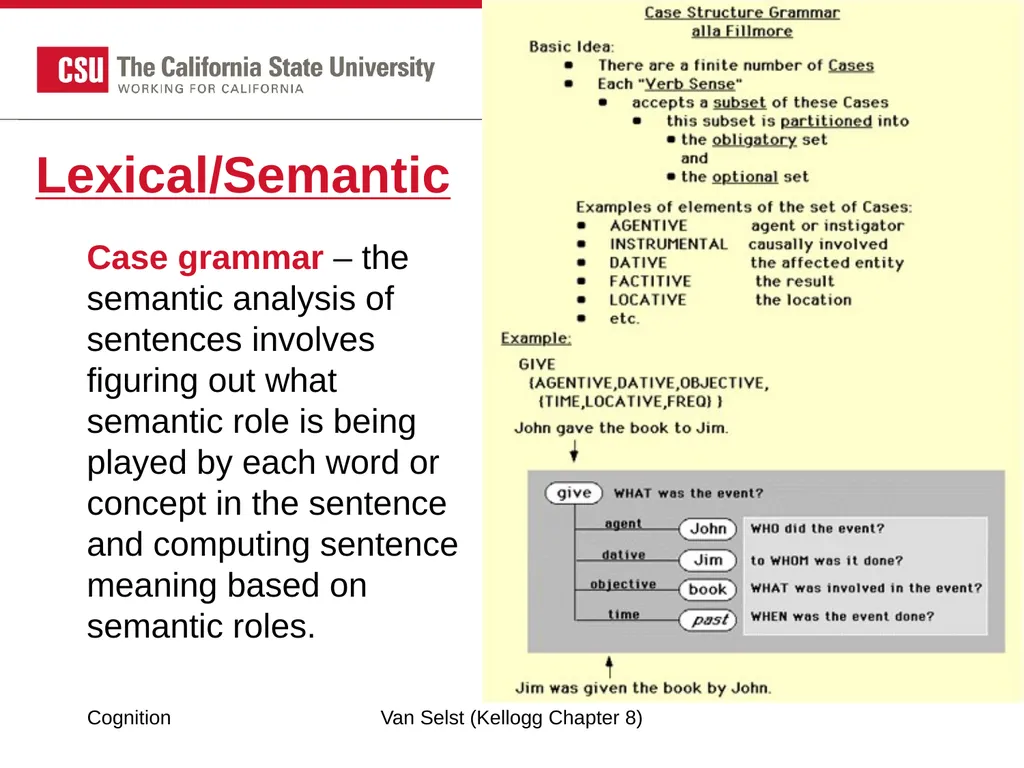
Cognition Van Selst (Kellogg Chapter 8) Case grammar – the semantic analysis of sentences involves figuring out what semantic role is being played by each word or concept in the sentence and computing sentence meaning based on semantic roles. Lexical/Semantic<br>
23
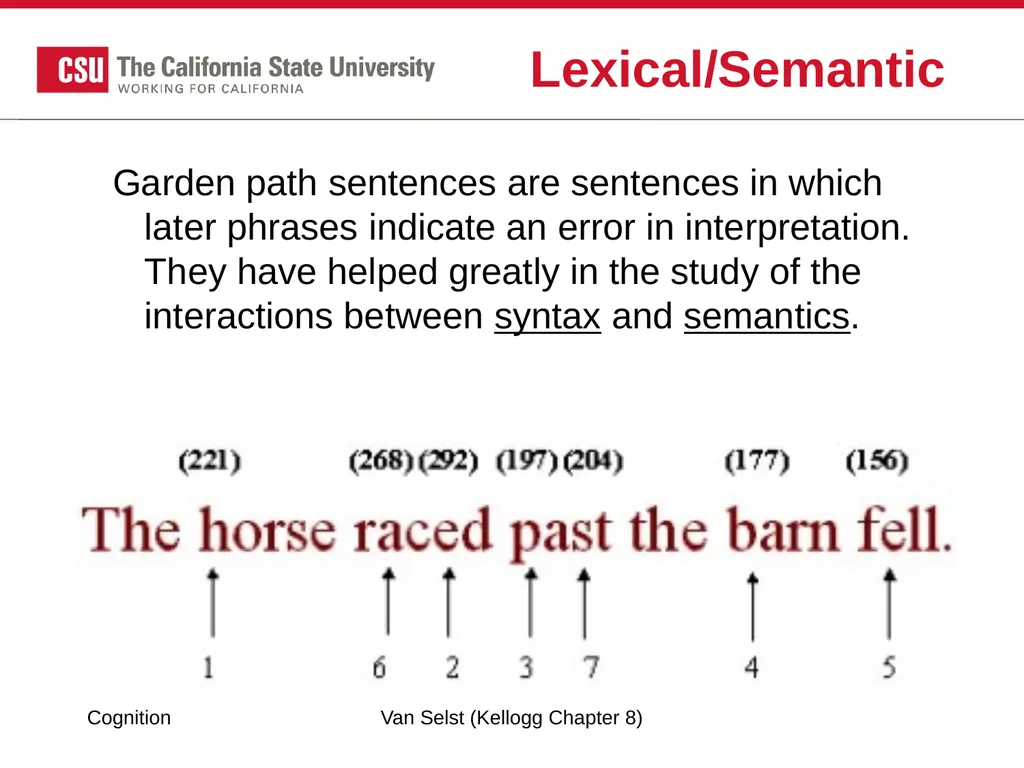
Cognition Van Selst (Kellogg Chapter 8) Lexical/Semantic Garden path sentences are sentences in which later phrases indicate an error in interpretation. They have helped greatly in the study of the interactions between syntax and semantics.<br>
24
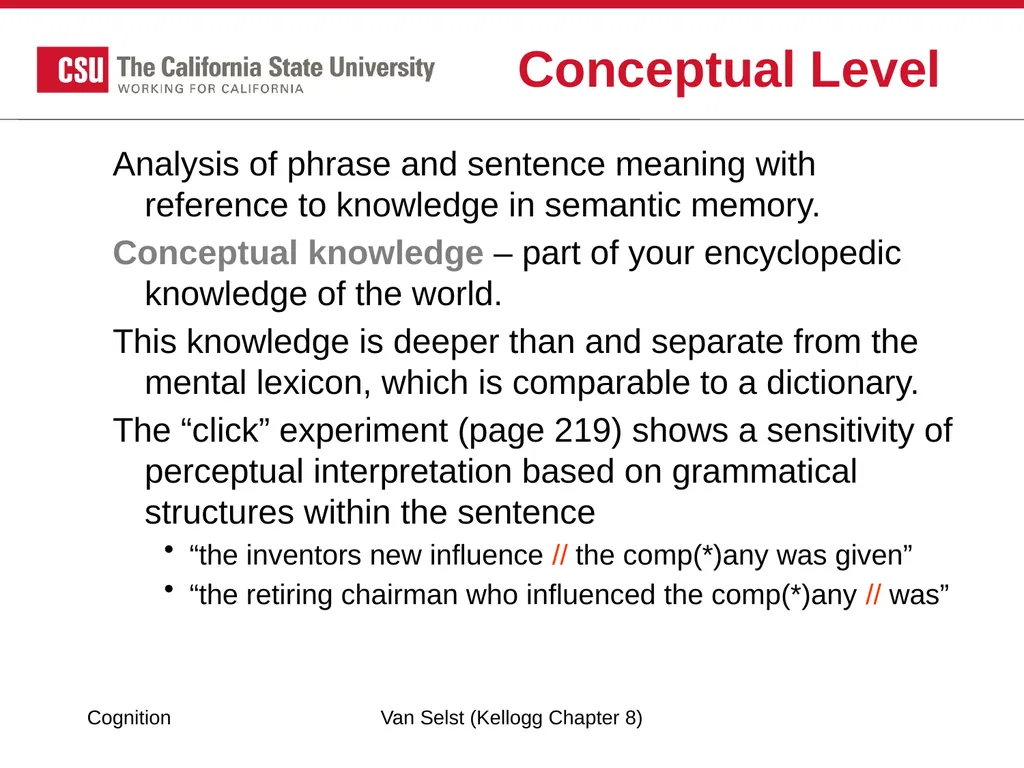
Cognition Van Selst (Kellogg Chapter 8) Conceptual Level Analysis of phrase and sentence meaning with reference to knowledge in semantic memory.
Conceptual knowledge – part of your encyclopedic knowledge of the world.
This knowledge is deeper than and separate from the mental lexicon, which is comparable to a dictionary.
The “click” experiment (page 219) shows a sensitivity of perceptual interpretation based on grammatical structures within the sentence
“the inventors new influence // the comp(*)any was given”
“the retiring chairman who influenced the comp(*)any // was”<br>
Conceptual knowledge – part of your encyclopedic knowledge of the world.
This knowledge is deeper than and separate from the mental lexicon, which is comparable to a dictionary.
The “click” experiment (page 219) shows a sensitivity of perceptual interpretation based on grammatical structures within the sentence
“the inventors new influence // the comp(*)any was given”
“the retiring chairman who influenced the comp(*)any // was”<br>
25
Cognition Van Selst (Kellogg Chapter 8) Belief Level Analysis of the sentence and discourse meaning with reference to one’s own beliefs and one’s beliefs about a speakers intent and motivations.
Beliefs are important for a complete understanding of comprehension because they have a huge effect on how one interprets ambiguous sentences.
Pragmatics – a variety of extralinguisitic factors in a sentence (e.g., social niceties in discourse rather than “command” language)<br>
Beliefs are important for a complete understanding of comprehension because they have a huge effect on how one interprets ambiguous sentences.
Pragmatics – a variety of extralinguisitic factors in a sentence (e.g., social niceties in discourse rather than “command” language)<br>
26
Cognition Van Selst (Kellogg Chapter 8) Grice’s (1975) conversational maxims: Cooperative principle: be sincere
Keep contributions reasonable to the agreed purpose of the conversation
Be relevant
Don’t state the obvious or be superfluous
(do not say too much, do not be overly informative)
Don’t wander – stick to the topic
Be informative – Make your contributions as informative as possible or necessary.
Don’t mislead – don’t say something you believe is false, or don’t have the evidence for; don’t overspecify
Don’t say more or less than you know
Manner and tone
Be clear; be easily understood (avoid obscurity and ambiguity)
Don’t boast
Be brief, orderly, polite
Relations with the conversational partner
Infer and respond to partner’s knowledge and beliefs
Mark intentional violation of conversational rules
Use linguistic or nonverbal (stress, gesture) markers
Use blatant violation as marker
Invite partner’s inference as to your reasons for the violation<br>
Keep contributions reasonable to the agreed purpose of the conversation
Be relevant
Don’t state the obvious or be superfluous
(do not say too much, do not be overly informative)
Don’t wander – stick to the topic
Be informative – Make your contributions as informative as possible or necessary.
Don’t mislead – don’t say something you believe is false, or don’t have the evidence for; don’t overspecify
Don’t say more or less than you know
Manner and tone
Be clear; be easily understood (avoid obscurity and ambiguity)
Don’t boast
Be brief, orderly, polite
Relations with the conversational partner
Infer and respond to partner’s knowledge and beliefs
Mark intentional violation of conversational rules
Use linguistic or nonverbal (stress, gesture) markers
Use blatant violation as marker
Invite partner’s inference as to your reasons for the violation<br>
27
Cognition Van Selst (Kellogg Chapter 8) Universal Grammar
(and the LAD) Linguist Noam Chomsky argues that the human brain contains a limited set of rules for organizing language. In turn, there is an assumption that all languages have a common structural basis. This set of rules is known as universal grammar.
Speakers proficient in a language know what expressions are acceptable in their language and what expressions are unacceptable.
Cat Black Black Cat (this example reflects surface structure)
Chat Noir Noir Chat
How do speakers know the restrictions of their language without exposure to negative evidence? (The poverty of stimulus argument)
(1) *What did John meet a man who sold?
Such expressions are not available to the language learners, because they are, by hypothesis, ungrammatical for speakers of the local language and thus are not uttered.
Universal grammar’s solution to the poverty of the stimulus problem is by making some restrictions universal characteristics of human languages. Thus language learners are never tempted to generalize in an illicit fashion.<br>
Speakers proficient in a language know what expressions are acceptable in their language and what expressions are unacceptable.
Cat Black Black Cat (this example reflects surface structure)
Chat Noir Noir Chat
How do speakers know the restrictions of their language without exposure to negative evidence? (The poverty of stimulus argument)
(1) *What did John meet a man who sold?
Such expressions are not available to the language learners, because they are, by hypothesis, ungrammatical for speakers of the local language and thus are not uttered.
Universal grammar’s solution to the poverty of the stimulus problem is by making some restrictions universal characteristics of human languages. Thus language learners are never tempted to generalize in an illicit fashion.<br>
28
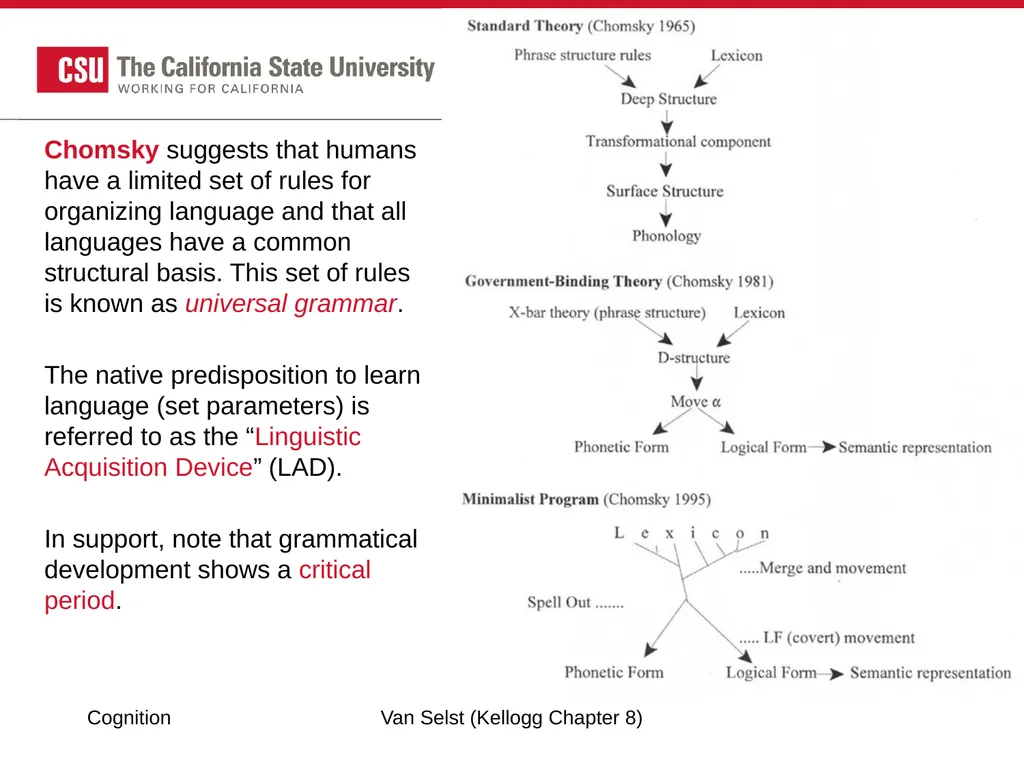
Cognition Van Selst (Kellogg Chapter 8) Chomsky suggests that humans have a limited set of rules for organizing language and that all languages have a common structural basis. This set of rules is known as universal grammar.
The native predisposition to learn language (set parameters) is referred to as the “Linguistic Acquisition Device” (LAD).
In support, note that grammatical development shows a critical period.<br>
The native predisposition to learn language (set parameters) is referred to as the “Linguistic Acquisition Device” (LAD).
In support, note that grammatical development shows a critical period.<br>
29
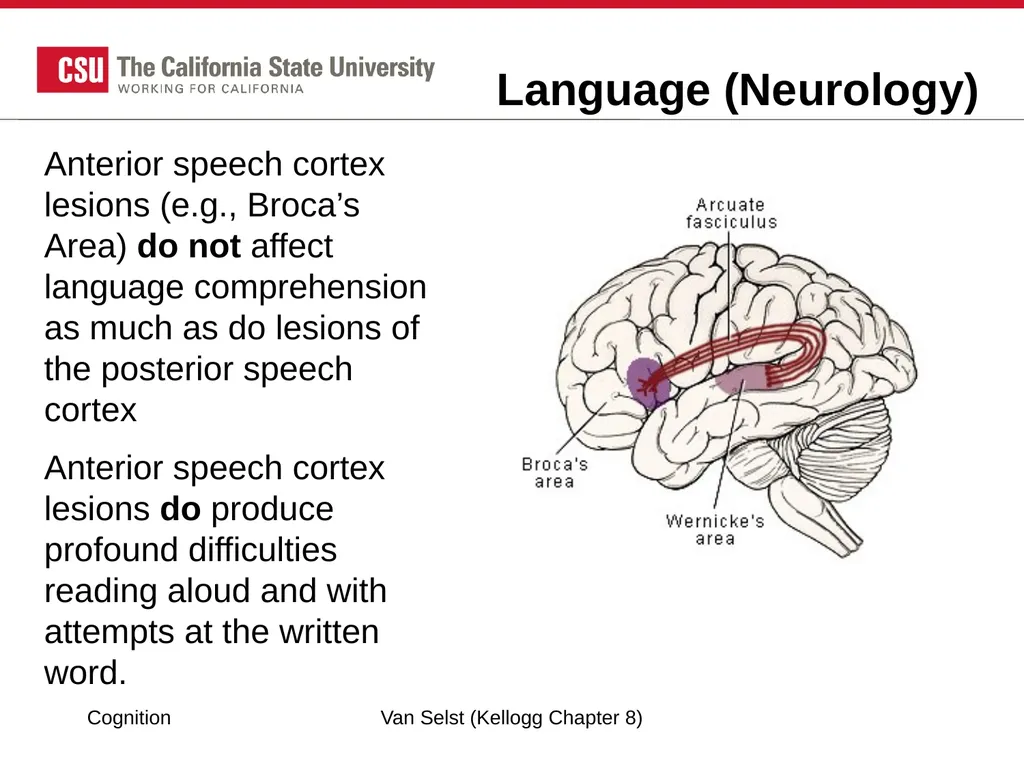
Cognition Van Selst (Kellogg Chapter 8) Language (Neurology) Anterior speech cortex lesions (e.g., Broca’s Area) do not affect language comprehension as much as do lesions of the posterior speech cortex
Anterior speech cortex lesions do produce profound difficulties reading aloud and with attempts at the written word.<br>
Anterior speech cortex lesions do produce profound difficulties reading aloud and with attempts at the written word.<br>
30
Cognition Van Selst (Kellogg Chapter 8) Neurology
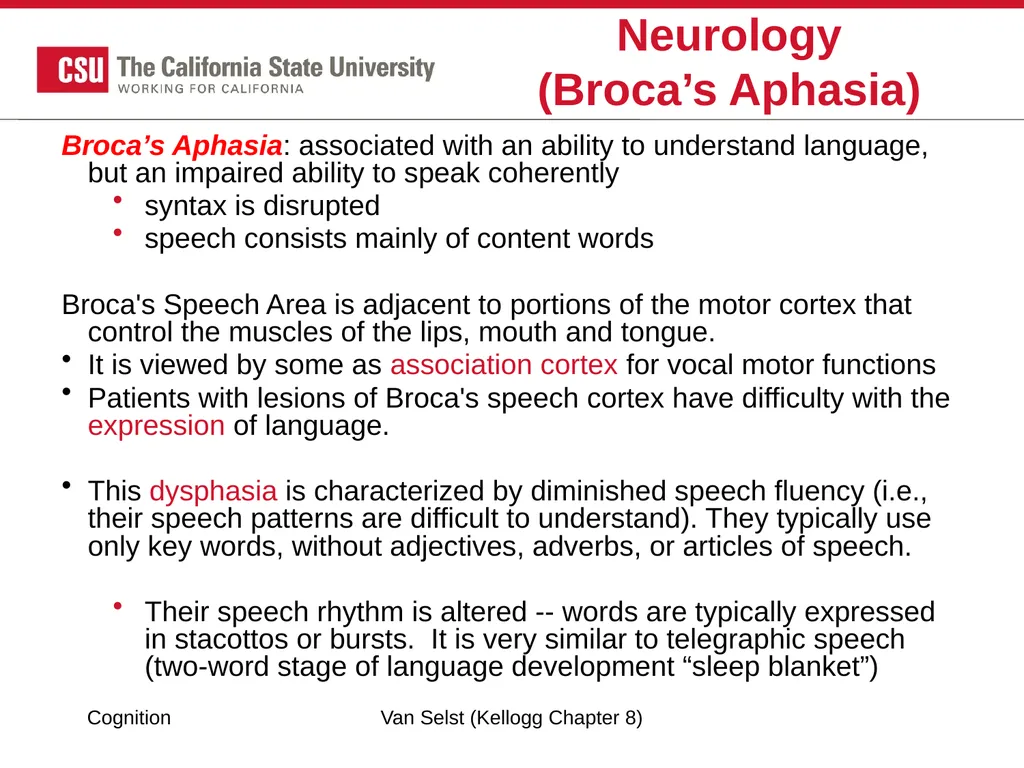
(Broca’s Aphasia) Broca’s Aphasia: associated with an ability to understand language, but an impaired ability to speak coherently
syntax is disrupted
speech consists mainly of content words
Broca's Speech Area is adjacent to portions of the motor cortex that control the muscles of the lips, mouth and tongue.
It is viewed by some as association cortex for vocal motor functions
Patients with lesions of Broca's speech cortex have difficulty with the expression of language.
This dysphasia is characterized by diminished speech fluency (i.e., their speech patterns are difficult to understand). They typically use only key words, without adjectives, adverbs, or articles of speech.
Their speech rhythm is altered -- words are typically expressed in stacottos or bursts. It is very similar to telegraphic speech (two-word stage of language development “sleep blanket”)<br>
syntax is disrupted
speech consists mainly of content words
Broca's Speech Area is adjacent to portions of the motor cortex that control the muscles of the lips, mouth and tongue.
It is viewed by some as association cortex for vocal motor functions
Patients with lesions of Broca's speech cortex have difficulty with the expression of language.
This dysphasia is characterized by diminished speech fluency (i.e., their speech patterns are difficult to understand). They typically use only key words, without adjectives, adverbs, or articles of speech.
Their speech rhythm is altered -- words are typically expressed in stacottos or bursts. It is very similar to telegraphic speech (two-word stage of language development “sleep blanket”)<br>
31
Cognition Van Selst (Kellogg Chapter 8) Neurology
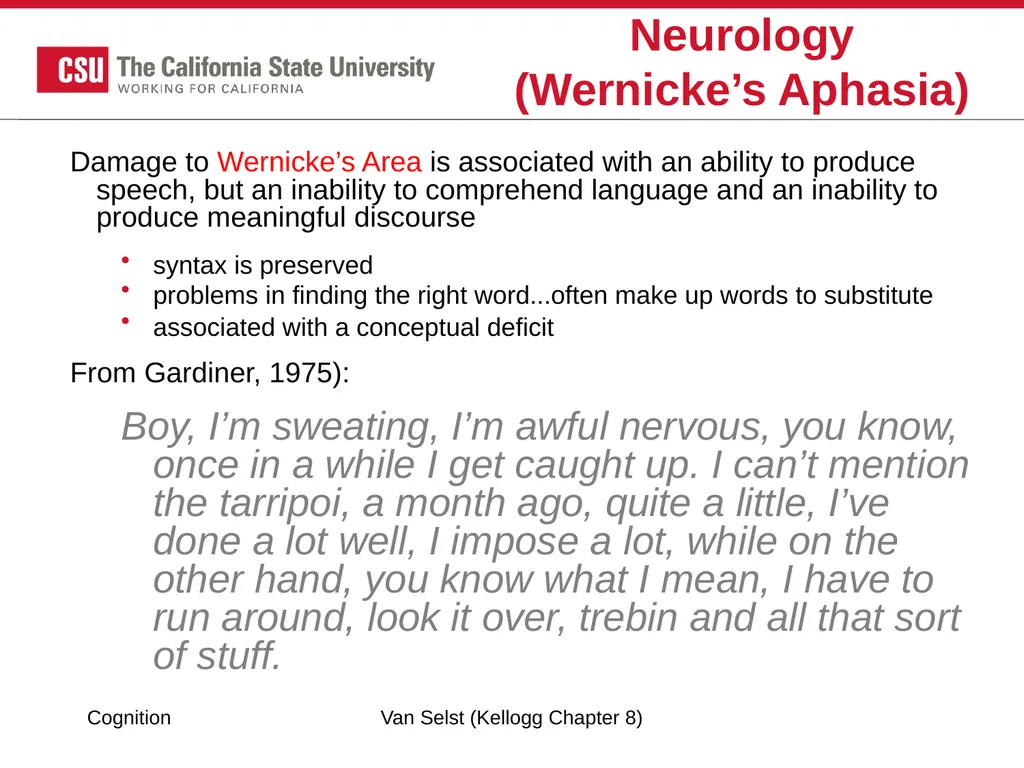
(Wernicke’s Aphasia) Damage to Wernicke’s Area is associated with an ability to produce speech, but an inability to comprehend language and an inability to produce meaningful discourse
syntax is preserved
problems in finding the right word...often make up words to substitute
associated with a conceptual deficit
From Gardiner, 1975):
Boy, I’m sweating, I’m awful nervous, you know, once in a while I get caught up. I can’t mention the tarripoi, a month ago, quite a little, I’ve done a lot well, I impose a lot, while on the other hand, you know what I mean, I have to run around, look it over, trebin and all that sort of stuff.<br>
syntax is preserved
problems in finding the right word...often make up words to substitute
associated with a conceptual deficit
From Gardiner, 1975):
Boy, I’m sweating, I’m awful nervous, you know, once in a while I get caught up. I can’t mention the tarripoi, a month ago, quite a little, I’ve done a lot well, I impose a lot, while on the other hand, you know what I mean, I have to run around, look it over, trebin and all that sort of stuff.<br>
32
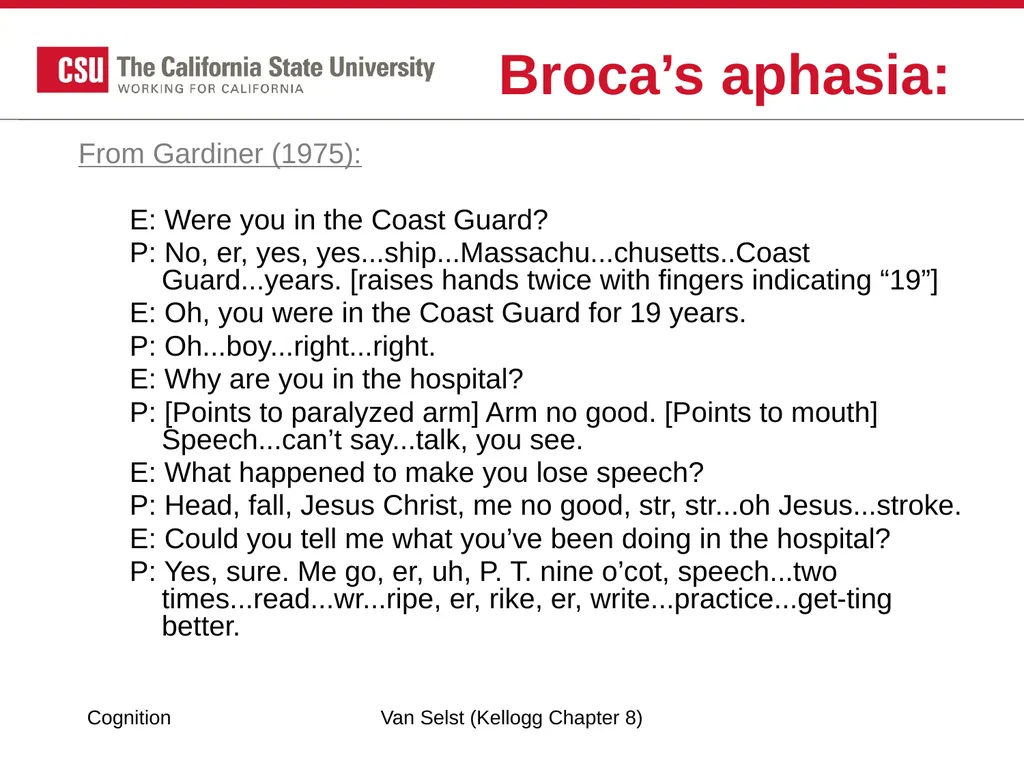
Cognition Van Selst (Kellogg Chapter 8) Broca’s aphasia: From Gardiner (1975):
E: Were you in the Coast Guard?
P: No, er, yes, yes...ship...Massachu...chusetts..Coast Guard...years. [raises hands twice with fingers indicating “19”]
E: Oh, you were in the Coast Guard for 19 years.
P: Oh...boy...right...right.
E: Why are you in the hospital?
P: [Points to paralyzed arm] Arm no good. [Points to mouth] Speech...can’t say...talk, you see.
E: What happened to make you lose speech?
P: Head, fall, Jesus Christ, me no good, str, str...oh Jesus...stroke.
E: Could you tell me what you’ve been doing in the hospital?
P: Yes, sure. Me go, er, uh, P. T. nine o’cot, speech...two times...read...wr...ripe, er, rike, er, write...practice...get-ting better.<br>
E: Were you in the Coast Guard?
P: No, er, yes, yes...ship...Massachu...chusetts..Coast Guard...years. [raises hands twice with fingers indicating “19”]
E: Oh, you were in the Coast Guard for 19 years.
P: Oh...boy...right...right.
E: Why are you in the hospital?
P: [Points to paralyzed arm] Arm no good. [Points to mouth] Speech...can’t say...talk, you see.
E: What happened to make you lose speech?
P: Head, fall, Jesus Christ, me no good, str, str...oh Jesus...stroke.
E: Could you tell me what you’ve been doing in the hospital?
P: Yes, sure. Me go, er, uh, P. T. nine o’cot, speech...two times...read...wr...ripe, er, rike, er, write...practice...get-ting better.<br>
33
Cognition Van Selst (Kellogg Chapter 8) Lateralization of Language For most people the left hemisphere is vital to speech, to well practiced routines and ability to write.
The right hemisphere is involved in auditory comprehension, understanding gestures, jokes, dealing with novel stimuli.
In men there is particularly strong left hemisphere dominance for linguistic functioning, in females it is more bilateral.<br>
The right hemisphere is involved in auditory comprehension, understanding gestures, jokes, dealing with novel stimuli.
In men there is particularly strong left hemisphere dominance for linguistic functioning, in females it is more bilateral.<br>
34
Cognition Van Selst (Kellogg Chapter 8) Eye-Movement Research On-Line Tasks: Gaze Duration and Reading
Immediacy Assumption [you attempt to understand or integrate concepts as you encounter them, you do not wait for the entirety of the sentence or passage] (p.241)
Eye-Mind Assumption (p.241) [you are thinking about the thing that you are looking at]
Longer fixations on "important" words and on "low frequency" words
Return to pronoun referent & garden path<br>
Immediacy Assumption [you attempt to understand or integrate concepts as you encounter them, you do not wait for the entirety of the sentence or passage] (p.241)
Eye-Mind Assumption (p.241) [you are thinking about the thing that you are looking at]
Longer fixations on "important" words and on "low frequency" words
Return to pronoun referent & garden path<br>
35
Cognition Van Selst (Kellogg Chapter 8) Sapir-Whorf Hypothesis The strong version of the Sapir–Whorf hypothesis is that language determines thought. It is incorrect. The most common view is that the language influences thought.
Current work examines how language affects thought. Earlier, the bulk of the research was concentrated on testing the hypothesis; the experimental data have not been able to disprove it. (Lucy 1992; Gumperz & Levinson 1996)
The brain stores associations between semantic concepts (like the idea of a house) and phonetic representation (the sounds that make up the word "house").
The initial sounds are more important for recall purposes than later sounds.
Relationships between semantic concepts are also stored and will produce priming
Indirect relationships between unrelated concepts can be inadvertently triggered by a "bridge" through a phonetic relationship.
For example, the recall of the idea of a house can be sped up by exposure to the word “mouse" because they have a similar phonology.<br>
Current work examines how language affects thought. Earlier, the bulk of the research was concentrated on testing the hypothesis; the experimental data have not been able to disprove it. (Lucy 1992; Gumperz & Levinson 1996)
The brain stores associations between semantic concepts (like the idea of a house) and phonetic representation (the sounds that make up the word "house").
The initial sounds are more important for recall purposes than later sounds.
Relationships between semantic concepts are also stored and will produce priming
Indirect relationships between unrelated concepts can be inadvertently triggered by a "bridge" through a phonetic relationship.
For example, the recall of the idea of a house can be sped up by exposure to the word “mouse" because they have a similar phonology.<br>
36
Cognition Van Selst (Kellogg Chapter 8) Assignment #9
(LANGUAGE) GOAL: To have you demonstrate your grasp of the importance of cognitive psychology in the study of language (e.g., as touched on in the discussion on page 215).
REQUIREMENT: Discuss how language can affect learning. The discussion should focus on the habitual patterns induced by the language of the person and how those thoughts might change as the learners vocabulary expands (e.g., “learns the jargon of the discipline”). An extreme version of what I am hoping you will write would be a student submission on “how the Sapir-Whorf hypothesis applies to new concept learning.” Essentially what I want you to write on is how new language acquisition impacts the learning of new “skills” such as cognitive psychology, mathematics, or research methods.
This essay will NOT be based on your opinions. It is to be based solely on RESEARCH FINDINGS as reported in peer-reviewed PSYCHOLOGY journal articles. As such, be sure to include a summary of what one or more articles suggests regarding this issue. You MUST use the SJSU electronic database “psycinfo” or “psycARTICLES” to aid your search and you must include one or more complete (preferably APA-style) citations to content-appropriate academic journal articles from peer-reviewed journals. It is ok to check your potential articles with me in the days before the assignment is due for either clarification about meaning or to ensure that they are sufficiently scientifically rigorous.
Due Date:
Be sure to include a photocopy of the title page of the journal article (not the psychinfo abstract) with your assignment.
It is highly suggested that you start work on this assignment well before it is due.<br>
REQUIREMENT: Discuss how language can affect learning. The discussion should focus on the habitual patterns induced by the language of the person and how those thoughts might change as the learners vocabulary expands (e.g., “learns the jargon of the discipline”). An extreme version of what I am hoping you will write would be a student submission on “how the Sapir-Whorf hypothesis applies to new concept learning.” Essentially what I want you to write on is how new language acquisition impacts the learning of new “skills” such as cognitive psychology, mathematics, or research methods.
This essay will NOT be based on your opinions. It is to be based solely on RESEARCH FINDINGS as reported in peer-reviewed PSYCHOLOGY journal articles. As such, be sure to include a summary of what one or more articles suggests regarding this issue. You MUST use the SJSU electronic database “psycinfo” or “psycARTICLES” to aid your search and you must include one or more complete (preferably APA-style) citations to content-appropriate academic journal articles from peer-reviewed journals. It is ok to check your potential articles with me in the days before the assignment is due for either clarification about meaning or to ensure that they are sufficiently scientifically rigorous.
Due Date:
Be sure to include a photocopy of the title page of the journal article (not the psychinfo abstract) with your assignment.
It is highly suggested that you start work on this assignment well before it is due.<br>
37
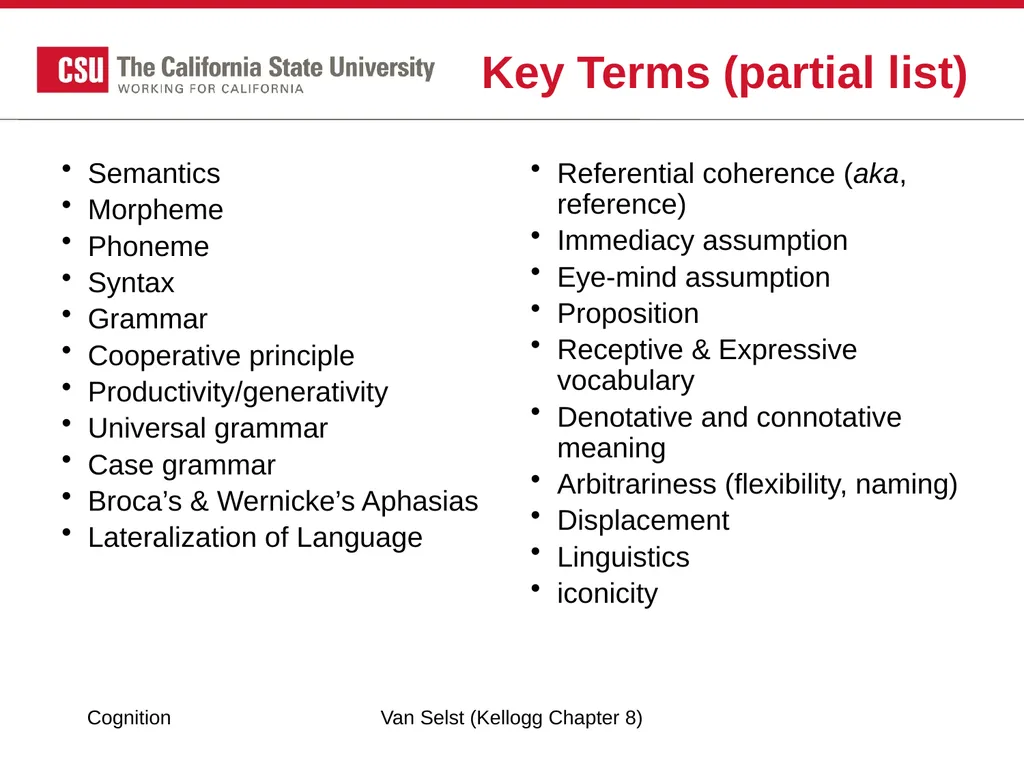
Cognition Van Selst (Kellogg Chapter 8) Key Terms (partial list) Semantics
Morpheme
Phoneme
Syntax
Grammar
Cooperative principle
Productivity/generativity
Universal grammar
Case grammar
Broca’s & Wernicke’s Aphasias
Lateralization of Language Referential coherence (aka, reference)
Immediacy assumption
Eye-mind assumption
Proposition
Receptive & Expressive vocabulary
Denotative and connotative meaning
Arbitrariness (flexibility, naming)
Displacement
Linguistics
iconicity<br>
Morpheme
Phoneme
Syntax
Grammar
Cooperative principle
Productivity/generativity
Universal grammar
Case grammar
Broca’s & Wernicke’s Aphasias
Lateralization of Language Referential coherence (aka, reference)
Immediacy assumption
Eye-mind assumption
Proposition
Receptive & Expressive vocabulary
Denotative and connotative meaning
Arbitrariness (flexibility, naming)
Displacement
Linguistics
iconicity<br>
38
www.calstate.edu
www.sjsu.edu/psych Copyright 2013 / Van Selst<br>
www.sjsu.edu/psych Copyright 2013 / Van Selst<br>