
Cold-Stored Platelets and the Impact on Blood
DP
Published · 50 slides · 0 views

1 / 1




Description
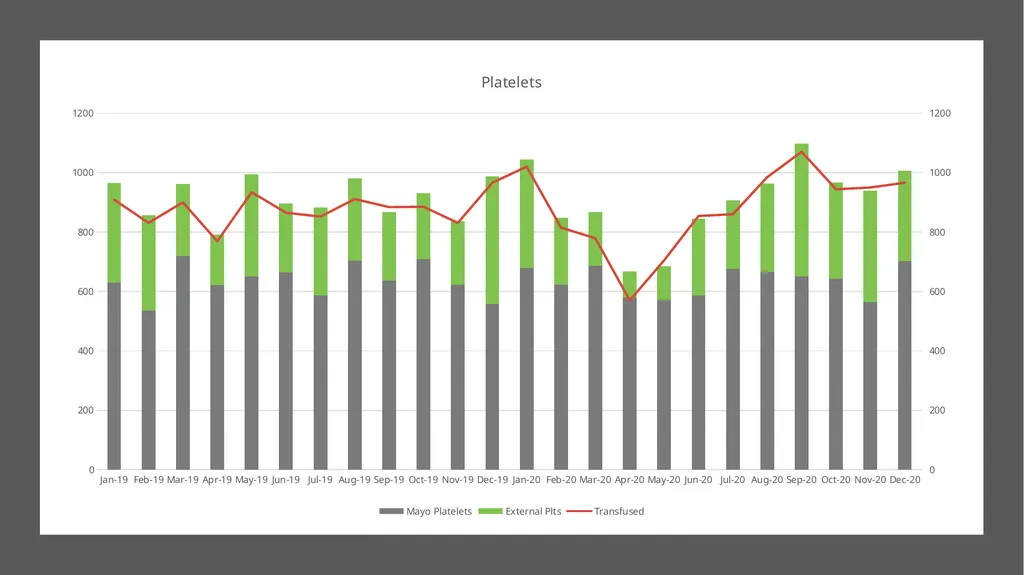
Cold-Stored Platelets and the Impact on Blood Center Operations James R. Stubbs, M.D. Chair, Transfusion Medicine Mayo Clinic Rochester, Minnesota Disclosures None Presentation Outline Mayo Clinic Donor Services: Who we are Mayo Clinic
Related Topics
Share
Embed code
Download this presentation From Below
"Cold-Stored Platelets and the Impact on Blood" is the property of its rightful owner. Permission is granted to download and print the materials on this website for personal, non-commercial use only, and to display it on your personal computer provided you do not modify the materials and that you retain all copyright notices contained in the materials. By downloading content from our website, you accept the terms of this agreement.
Presentation Transcript
01
Cold-Stored Platelets and the Impact on Blood Center Operations James R. Stubbs, M.D.
Chair, Transfusion Medicine
Mayo Clinic
Rochester, Minnesota<br>
Chair, Transfusion Medicine
Mayo Clinic
Rochester, Minnesota<br>
02
Disclosures None<br>
03
Presentation Outline Mayo Clinic Donor Services: Who we are
Mayo Clinic interest in Cold-Stored Platelets (CS-PLTs)
Implementation and experience with 3-day CS-PLTs at Mayo Clinic
Mayo Clinic FDA Variance for Cold Stored Platelets
Covid-19 and use Room Temperature Platelets converted to CS-PLTs at Mayo Clinic
Summary<br>
Mayo Clinic interest in Cold-Stored Platelets (CS-PLTs)
Implementation and experience with 3-day CS-PLTs at Mayo Clinic
Mayo Clinic FDA Variance for Cold Stored Platelets
Covid-19 and use Room Temperature Platelets converted to CS-PLTs at Mayo Clinic
Summary<br>
04
Mayo Clinic Donor Center Who We Are<br>
05
Mayo Clinic Donor Center Transfusion Medicine – Rochester Locations
First two floors of Hilton Building Downtown – Center of Operations
Transfusion Laboratories – Adjacent to operating rooms at Methodist and Saint Marys Hospital
Therapeutic Apheresis Treatment Unit – Charlton Building of Methodist Hospital Complex Downtown
Intraoperative Autotransfusion Services – Both Hospitals
Blood collection facilities – Two fixed sites
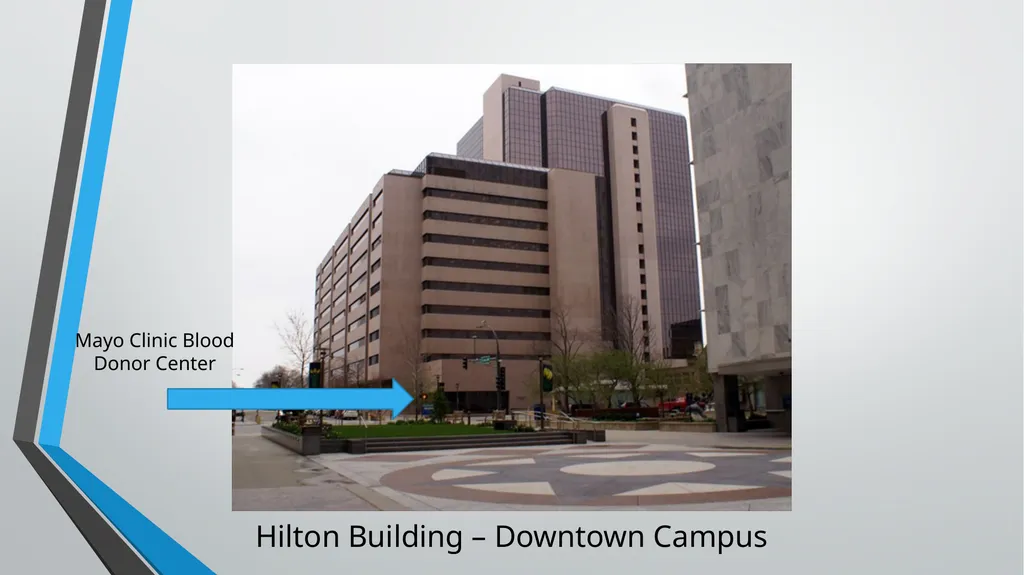
Hilton Building – Larger Collection Facility
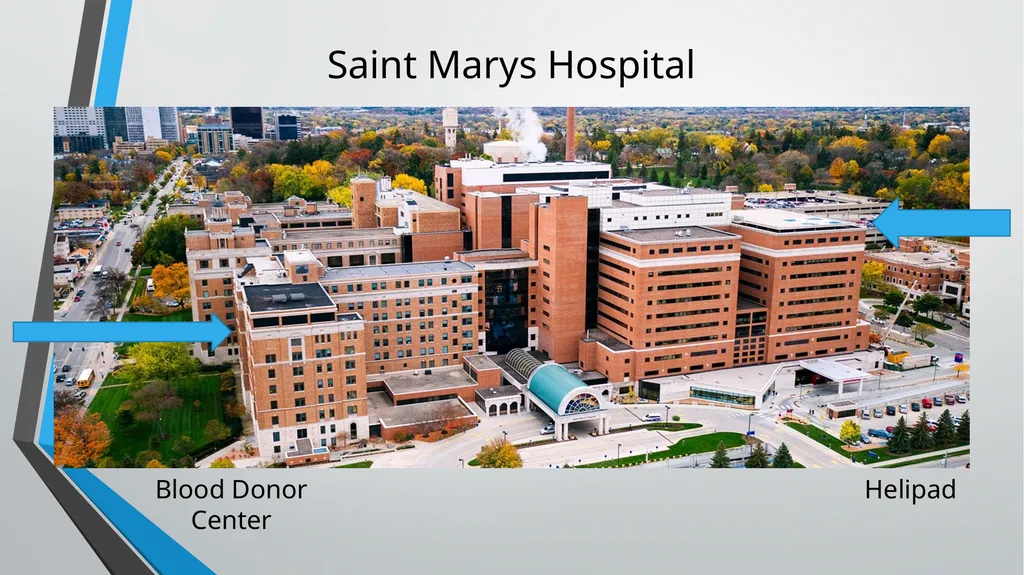
Saint Marys Hospital – Smaller Collection Facility
Mobile blood collections – Businesses and schools (on hiatus during COVID-19)
Collect only within Olmsted County – Residents, employees, visitors<br>
First two floors of Hilton Building Downtown – Center of Operations
Transfusion Laboratories – Adjacent to operating rooms at Methodist and Saint Marys Hospital
Therapeutic Apheresis Treatment Unit – Charlton Building of Methodist Hospital Complex Downtown
Intraoperative Autotransfusion Services – Both Hospitals
Blood collection facilities – Two fixed sites
Hilton Building – Larger Collection Facility
Saint Marys Hospital – Smaller Collection Facility
Mobile blood collections – Businesses and schools (on hiatus during COVID-19)
Collect only within Olmsted County – Residents, employees, visitors<br>
06
Hilton Building – Downtown Campus Mayo Clinic Blood Donor Center<br>
07
Saint Marys Hospital Helipad Blood Donor Center<br>
08
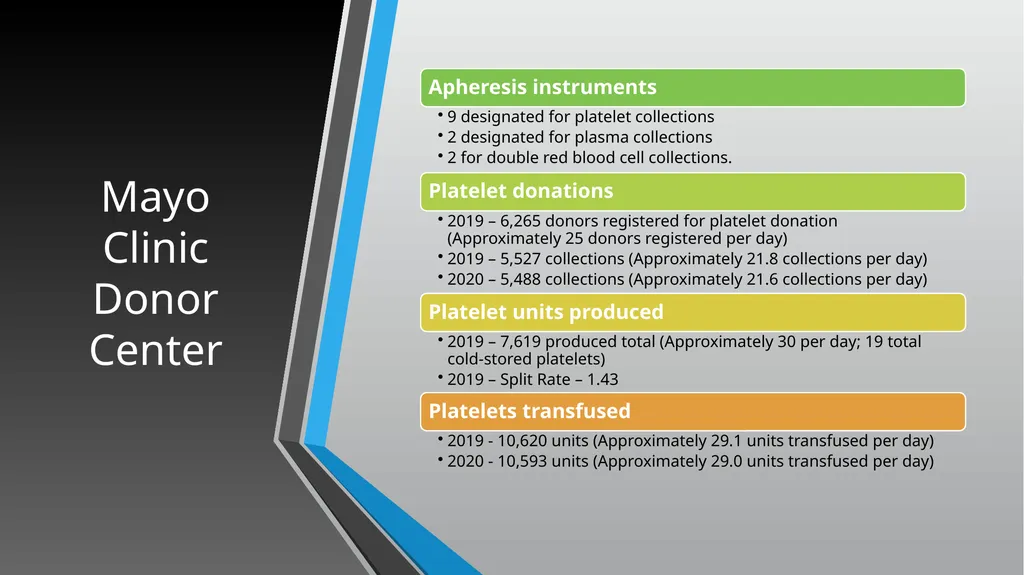
Mayo Clinic Donor Center<br>
09
What About Cold Platelets?<br>
10
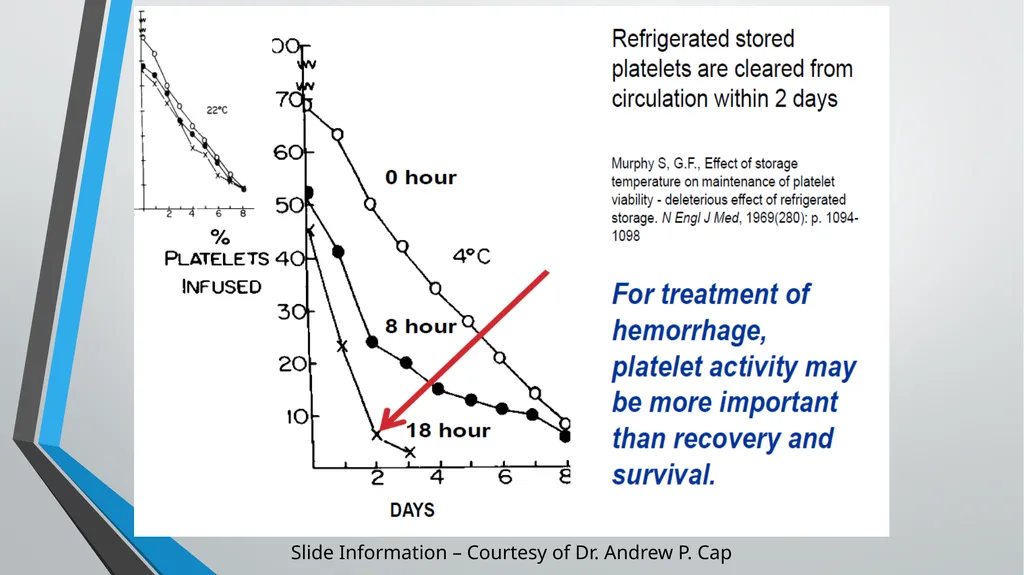
N Engl J Med 1969; 280:1094-1098 This Paper Delivered A “Deadly Blow” to Cold-Stored Platelets Let’s Go Back In Time<br>
11
Slide Information – Courtesy of Dr. Andrew P. Cap<br>
12
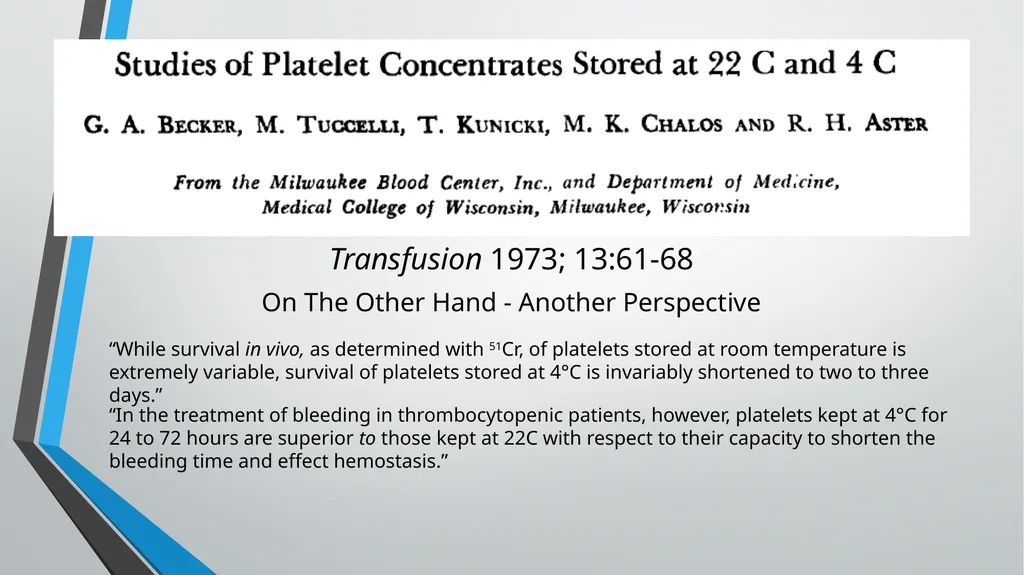
Transfusion 1973; 13:61-68 “While survival in vivo, as determined with 51Cr, of platelets stored at room temperature is extremely variable, survival of platelets stored at 4°C is invariably shortened to two to three days.” “In the treatment of bleeding in thrombocytopenic patients, however, platelets kept at 4°C for 24 to 72 hours are superior to those kept at 22C with respect to their capacity to shorten the bleeding time and effect hemostasis.” On The Other Hand - Another Perspective<br>
13
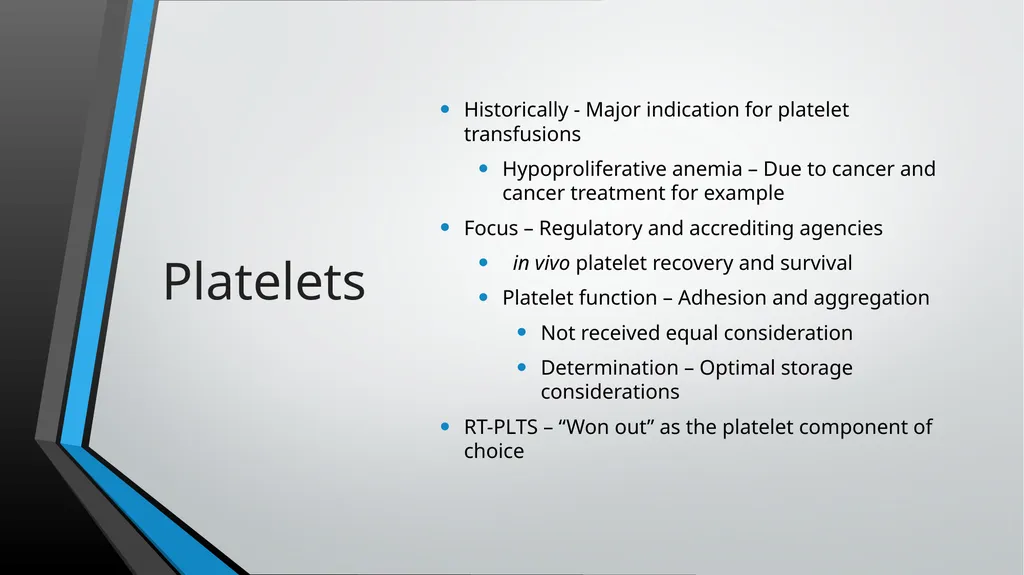
Platelets Historically - Major indication for platelet transfusions
Hypoproliferative anemia – Due to cancer and cancer treatment for example
Focus – Regulatory and accrediting agencies
in vivo platelet recovery and survival
Platelet function – Adhesion and aggregation
Not received equal consideration
Determination – Optimal storage considerations
RT-PLTS – “Won out” as the platelet component of choice<br>
Hypoproliferative anemia – Due to cancer and cancer treatment for example
Focus – Regulatory and accrediting agencies
in vivo platelet recovery and survival
Platelet function – Adhesion and aggregation
Not received equal consideration
Determination – Optimal storage considerations
RT-PLTS – “Won out” as the platelet component of choice<br>
14
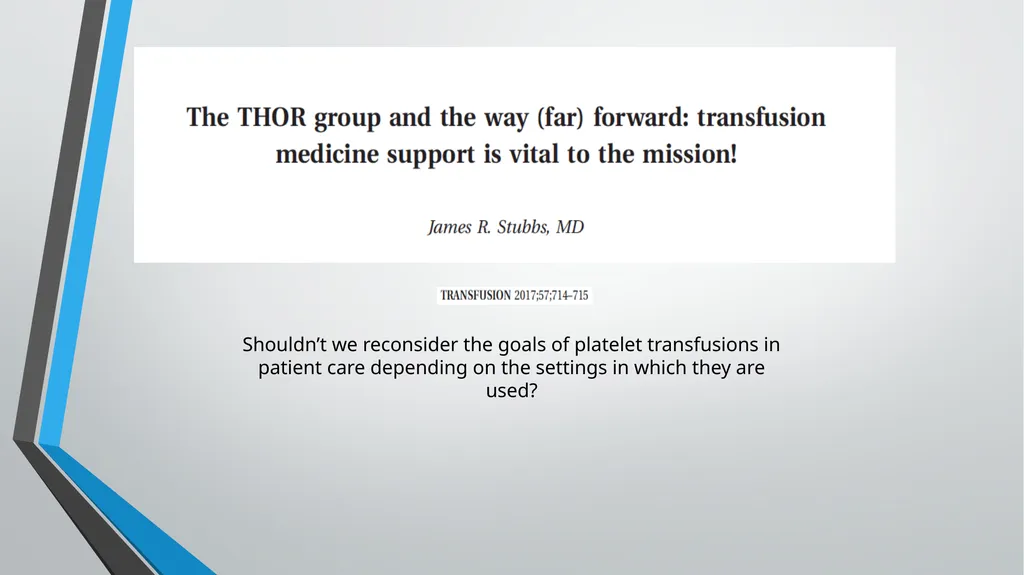
Shouldn’t we reconsider the goals of platelet transfusions in patient care depending on the settings in which they are used?<br>
15
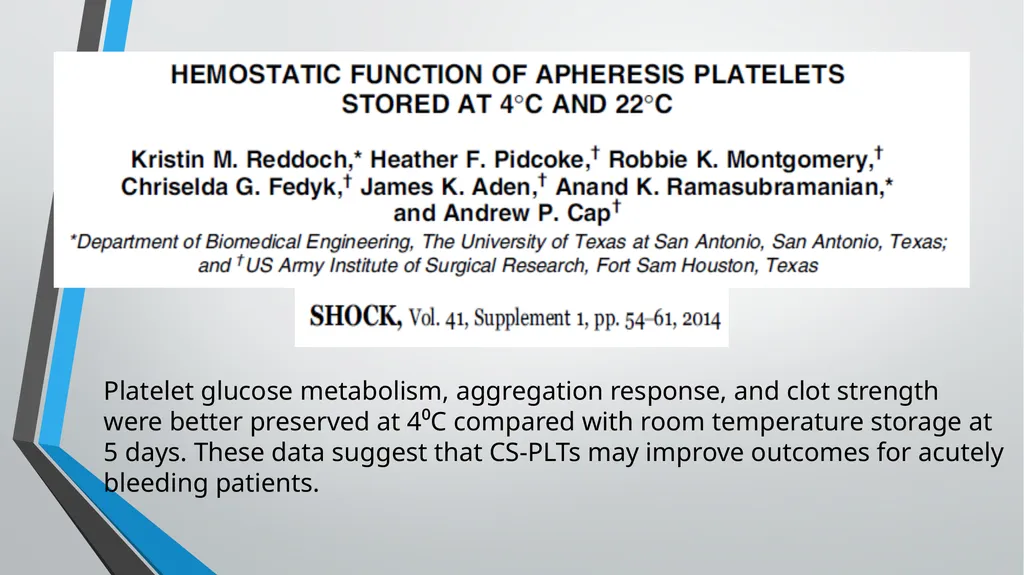
Platelet glucose metabolism, aggregation response, and clot strength were better preserved at 4⁰C compared with room temperature storage at 5 days. These data suggest that CS-PLTs may improve outcomes for acutely bleeding patients.<br>
16
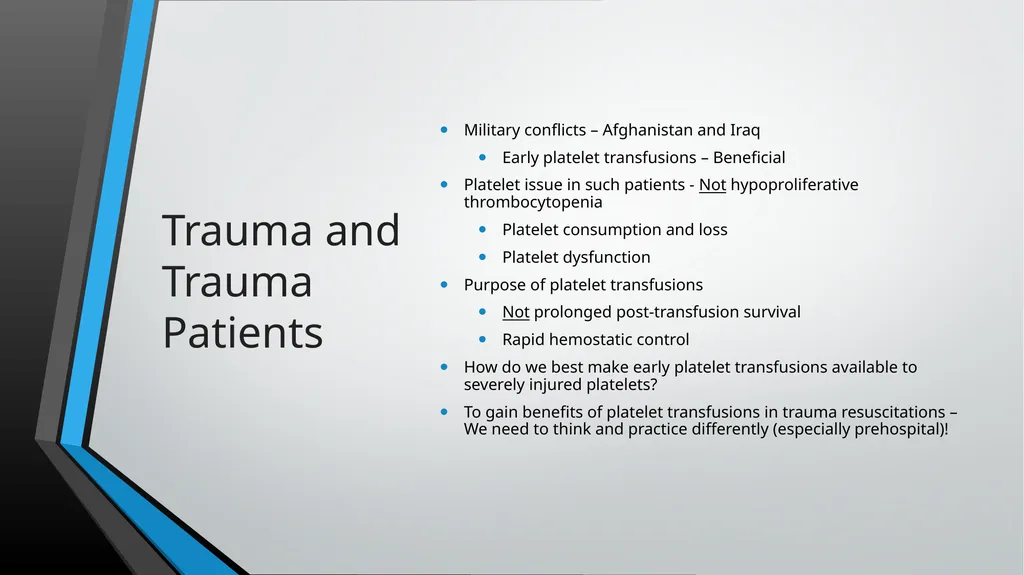
Trauma and Trauma Patients Military conflicts – Afghanistan and Iraq
Early platelet transfusions – Beneficial
Platelet issue in such patients - Not hypoproliferative thrombocytopenia
Platelet consumption and loss
Platelet dysfunction
Purpose of platelet transfusions
Not prolonged post-transfusion survival
Rapid hemostatic control
How do we best make early platelet transfusions available to severely injured platelets?
To gain benefits of platelet transfusions in trauma resuscitations – We need to think and practice differently (especially prehospital)!<br>
Early platelet transfusions – Beneficial
Platelet issue in such patients - Not hypoproliferative thrombocytopenia
Platelet consumption and loss
Platelet dysfunction
Purpose of platelet transfusions
Not prolonged post-transfusion survival
Rapid hemostatic control
How do we best make early platelet transfusions available to severely injured platelets?
To gain benefits of platelet transfusions in trauma resuscitations – We need to think and practice differently (especially prehospital)!<br>
17
Cold-Stored Platelets 2013 – Due to evidence supporting the potential for providing added benefit in severely injured patients with hemorrhage
Joint decision - Trauma and Transfusion Services at Mayo Clinic in Rochester, Minnesota
Pursue and obtain regulatory and accreditation approvals for the use of CS-PLTs (CS-PLTS) for patients cared for by the Trauma Service.<br>
Joint decision - Trauma and Transfusion Services at Mayo Clinic in Rochester, Minnesota
Pursue and obtain regulatory and accreditation approvals for the use of CS-PLTs (CS-PLTS) for patients cared for by the Trauma Service.<br>
18
Mayo Clinic Cold Platelet Program<br>
19
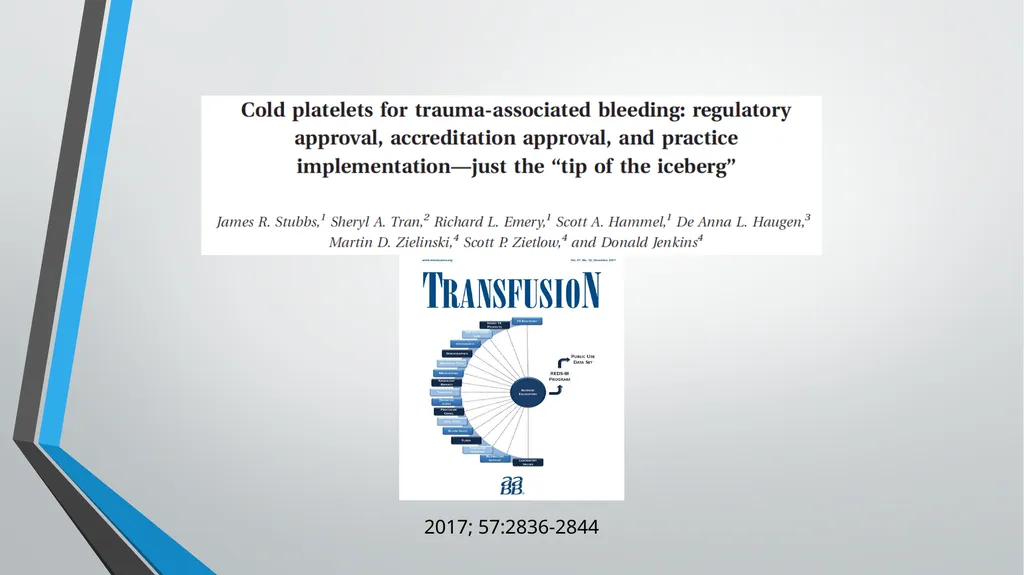
2017; 57:2836-2844<br>
20
Cold-Stored Platelets - Approval March 27, 2015 – FDA response
“We have approved your request to include an alternative procedure from 21 CFR 610.53(c) and 606.65(e) under the provisions of 21 CFR 640.120 to store apheresis platelets at refrigerator temperature without agitation for up to 3 days. You will restrict the use of these cold-stored platelets to use in the resuscitation of actively bleeding patients.”
AABB Letter Approving Variance Request – October 8, 2015<br>
“We have approved your request to include an alternative procedure from 21 CFR 610.53(c) and 606.65(e) under the provisions of 21 CFR 640.120 to store apheresis platelets at refrigerator temperature without agitation for up to 3 days. You will restrict the use of these cold-stored platelets to use in the resuscitation of actively bleeding patients.”
AABB Letter Approving Variance Request – October 8, 2015<br>
21
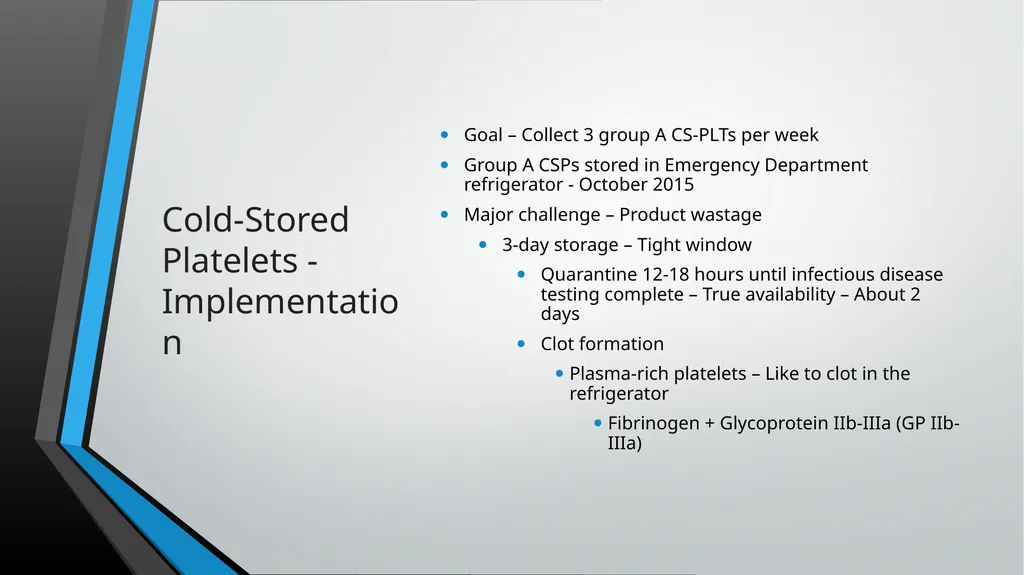
Cold-Stored Platelets - Implementation Goal – Collect 3 group A CS-PLTs per week
Group A CSPs stored in Emergency Department refrigerator - October 2015
Major challenge – Product wastage
3-day storage – Tight window
Quarantine 12-18 hours until infectious disease testing complete – True availability – About 2 days
Clot formation
Plasma-rich platelets – Like to clot in the refrigerator
Fibrinogen + Glycoprotein IIb-IIIa (GP IIb-IIIa)<br>
Group A CSPs stored in Emergency Department refrigerator - October 2015
Major challenge – Product wastage
3-day storage – Tight window
Quarantine 12-18 hours until infectious disease testing complete – True availability – About 2 days
Clot formation
Plasma-rich platelets – Like to clot in the refrigerator
Fibrinogen + Glycoprotein IIb-IIIa (GP IIb-IIIa)<br>
22
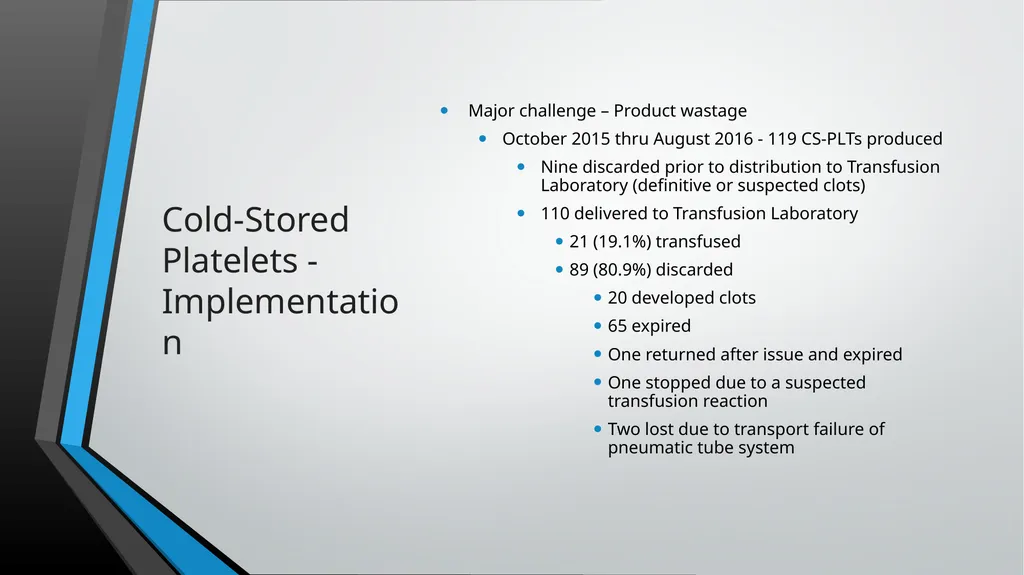
Cold-Stored Platelets - Implementation Major challenge – Product wastage
October 2015 thru August 2016 - 119 CS-PLTs produced
Nine discarded prior to distribution to Transfusion Laboratory (definitive or suspected clots)
110 delivered to Transfusion Laboratory
21 (19.1%) transfused
89 (80.9%) discarded
20 developed clots
65 expired
One returned after issue and expired
One stopped due to a suspected transfusion reaction
Two lost due to transport failure of pneumatic tube system<br>
October 2015 thru August 2016 - 119 CS-PLTs produced
Nine discarded prior to distribution to Transfusion Laboratory (definitive or suspected clots)
110 delivered to Transfusion Laboratory
21 (19.1%) transfused
89 (80.9%) discarded
20 developed clots
65 expired
One returned after issue and expired
One stopped due to a suspected transfusion reaction
Two lost due to transport failure of pneumatic tube system<br>
23
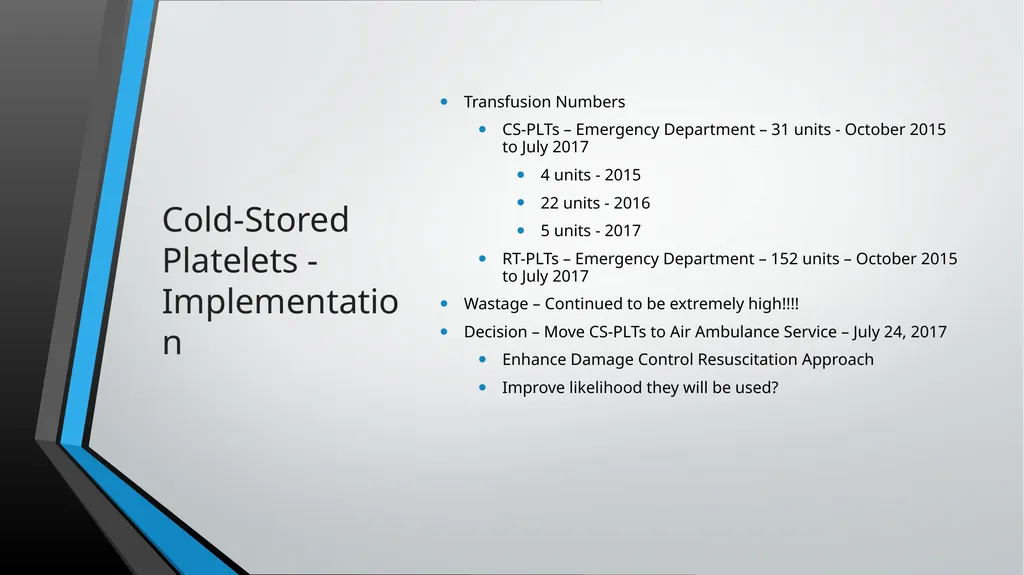
Cold-Stored Platelets - Implementation Transfusion Numbers
CS-PLTs – Emergency Department – 31 units - October 2015 to July 2017
4 units - 2015
22 units - 2016
5 units - 2017
RT-PLTs – Emergency Department – 152 units – October 2015 to July 2017
Wastage – Continued to be extremely high!!!!
Decision – Move CS-PLTs to Air Ambulance Service – July 24, 2017
Enhance Damage Control Resuscitation Approach
Improve likelihood they will be used?<br>
CS-PLTs – Emergency Department – 31 units - October 2015 to July 2017
4 units - 2015
22 units - 2016
5 units - 2017
RT-PLTs – Emergency Department – 152 units – October 2015 to July 2017
Wastage – Continued to be extremely high!!!!
Decision – Move CS-PLTs to Air Ambulance Service – July 24, 2017
Enhance Damage Control Resuscitation Approach
Improve likelihood they will be used?<br>
24
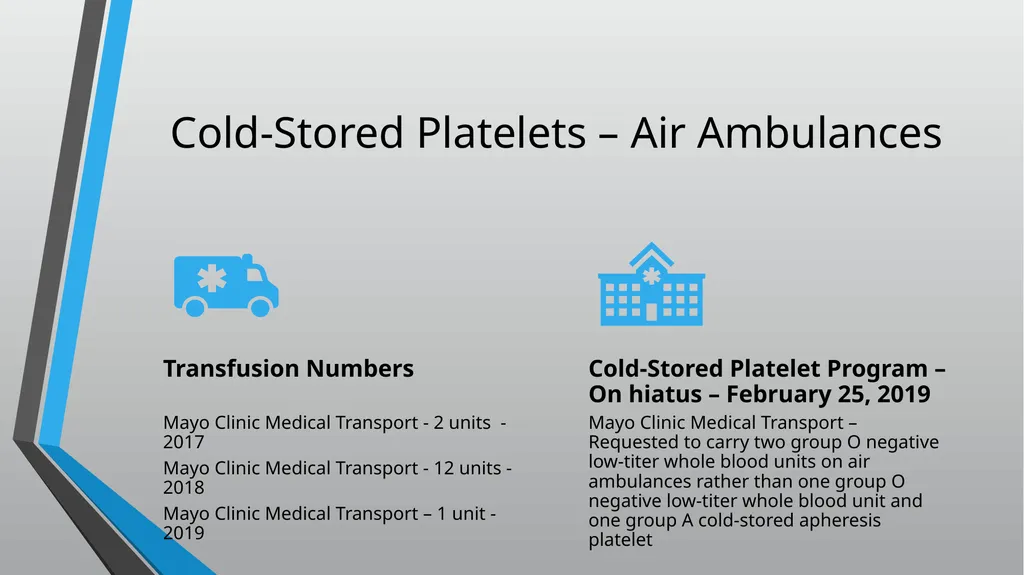
Cold-Stored Platelets – Air Ambulances<br>
25
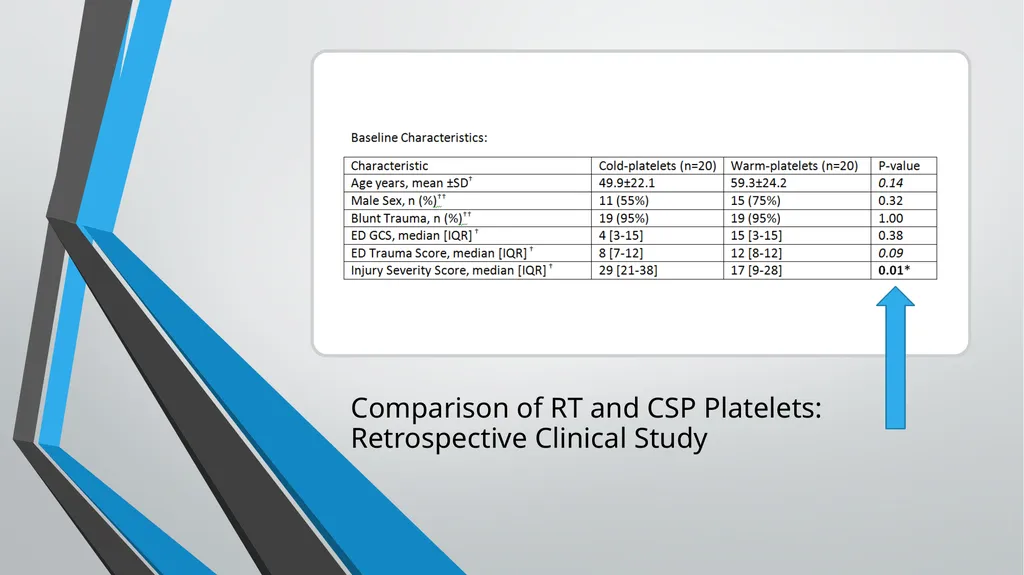
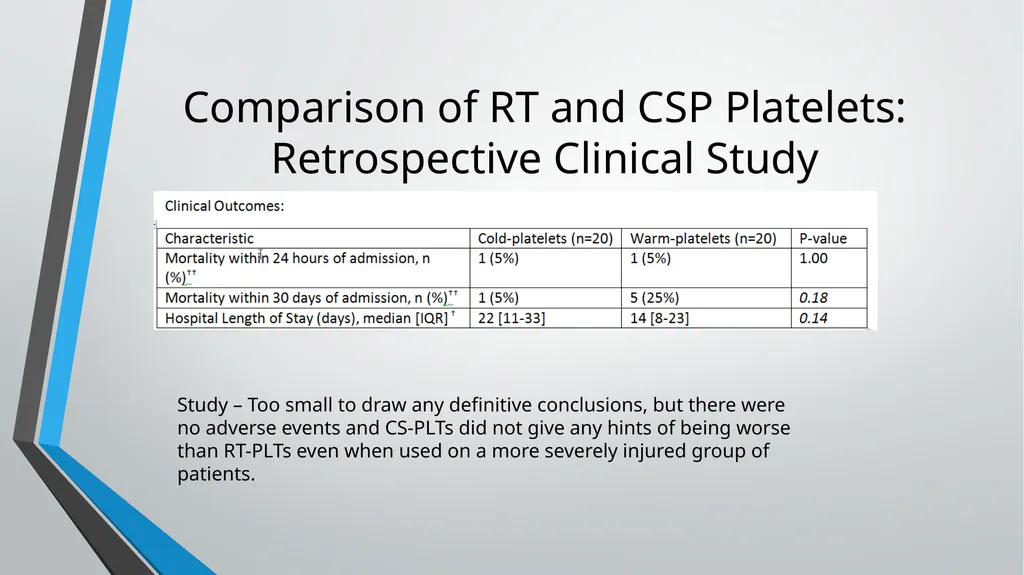
Comparison of RT and CSP Platelets:
Retrospective Clinical Study<br>
26
Comparison of RT and CSP Platelets: Retrospective Clinical Study Study – Too small to draw any definitive conclusions, but there were no adverse events and CS-PLTs did not give any hints of being worse than RT-PLTs even when used on a more severely injured group of patients.<br>
27
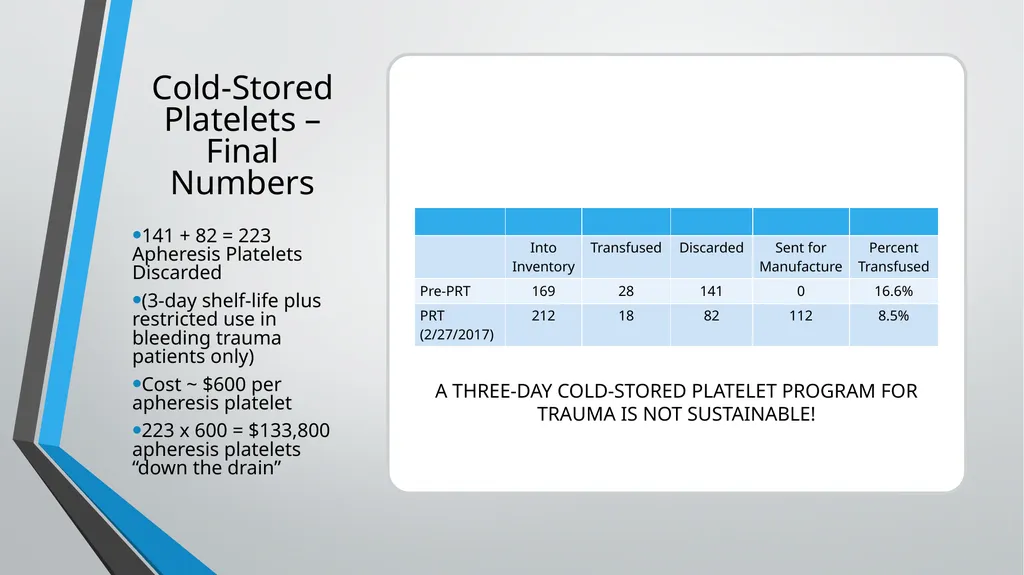
Cold-Stored Platelets – Final Numbers 141 + 82 = 223 Apheresis Platelets Discarded
(3-day shelf-life plus restricted use in bleeding trauma patients only)
Cost ~ $600 per apheresis platelet
223 x 600 = $133,800 apheresis platelets “down the drain” A THREE-DAY COLD-STORED PLATELET PROGRAM FOR TRAUMA IS NOT SUSTAINABLE!<br>
(3-day shelf-life plus restricted use in bleeding trauma patients only)
Cost ~ $600 per apheresis platelet
223 x 600 = $133,800 apheresis platelets “down the drain” A THREE-DAY COLD-STORED PLATELET PROGRAM FOR TRAUMA IS NOT SUSTAINABLE!<br>
28
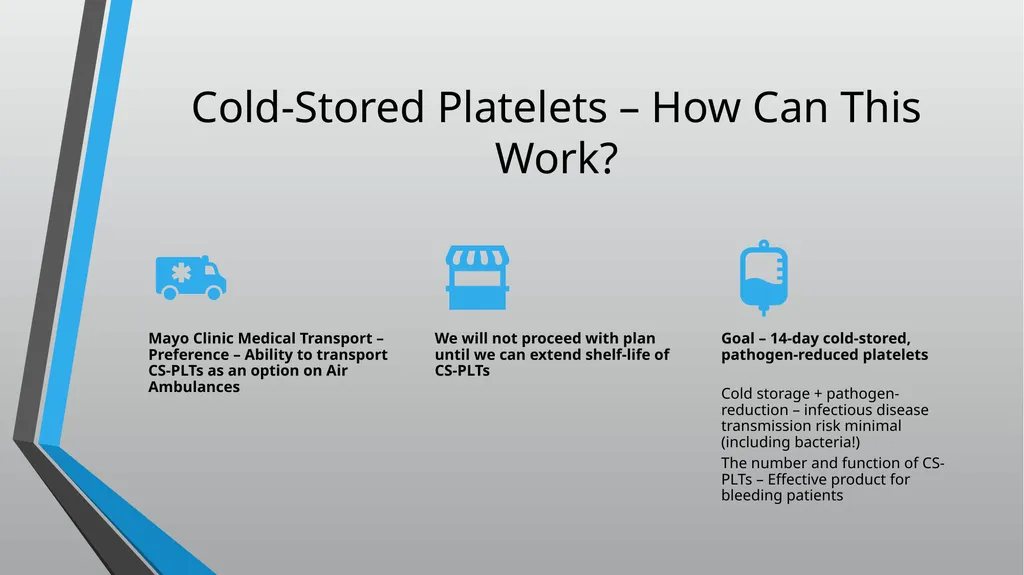
Cold-Stored Platelets – How Can This Work?<br>
29
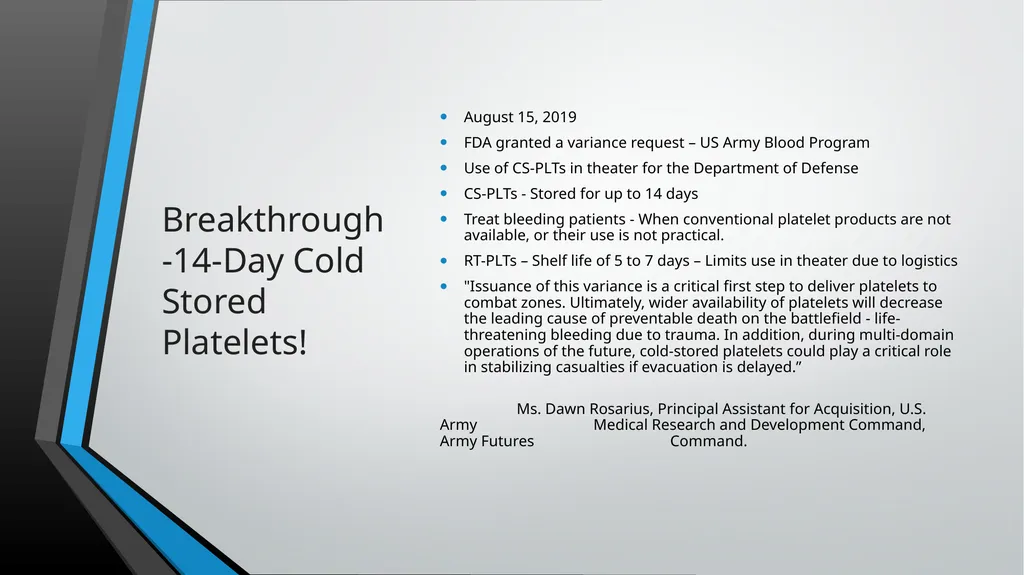
Breakthrough -14-Day Cold Stored Platelets! August 15, 2019
FDA granted a variance request – US Army Blood Program
Use of CS-PLTs in theater for the Department of Defense
CS-PLTs - Stored for up to 14 days
Treat bleeding patients - When conventional platelet products are not available, or their use is not practical.
RT-PLTs – Shelf life of 5 to 7 days – Limits use in theater due to logistics
"Issuance of this variance is a critical first step to deliver platelets to combat zones. Ultimately, wider availability of platelets will decrease the leading cause of preventable death on the battlefield - life-threatening bleeding due to trauma. In addition, during multi-domain operations of the future, cold-stored platelets could play a critical role in stabilizing casualties if evacuation is delayed.”
Ms. Dawn Rosarius, Principal Assistant for Acquisition, U.S. Army Medical Research and Development Command, Army Futures Command.<br>
FDA granted a variance request – US Army Blood Program
Use of CS-PLTs in theater for the Department of Defense
CS-PLTs - Stored for up to 14 days
Treat bleeding patients - When conventional platelet products are not available, or their use is not practical.
RT-PLTs – Shelf life of 5 to 7 days – Limits use in theater due to logistics
"Issuance of this variance is a critical first step to deliver platelets to combat zones. Ultimately, wider availability of platelets will decrease the leading cause of preventable death on the battlefield - life-threatening bleeding due to trauma. In addition, during multi-domain operations of the future, cold-stored platelets could play a critical role in stabilizing casualties if evacuation is delayed.”
Ms. Dawn Rosarius, Principal Assistant for Acquisition, U.S. Army Medical Research and Development Command, Army Futures Command.<br>
30
14-Day Cold-Stored Platelets FDA Variance Request
Mayo Clinic, Rochester Minnesota<br>
Mayo Clinic, Rochester Minnesota<br>
31
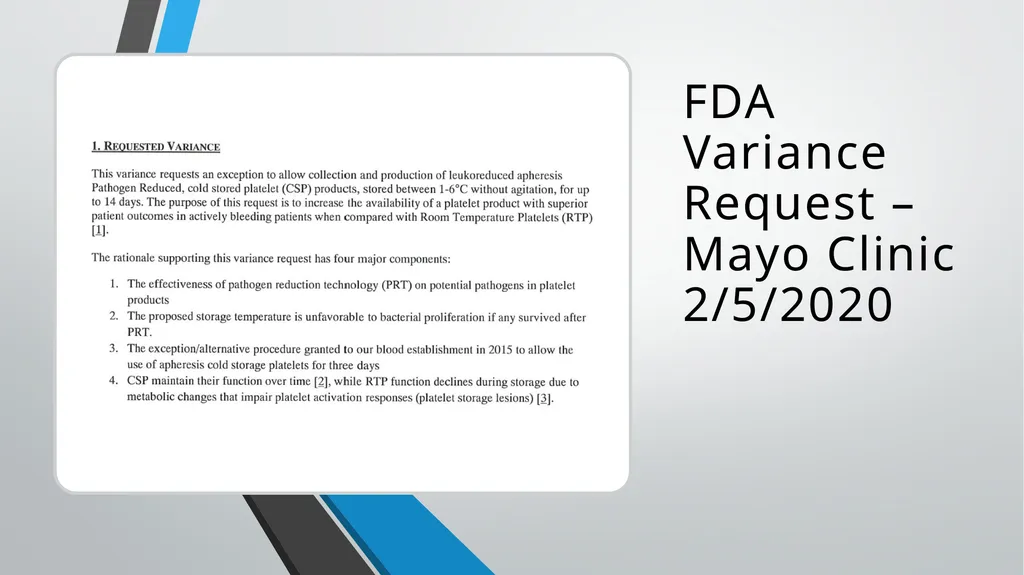
FDA Variance Request – Mayo Clinic 2/5/2020<br>
32
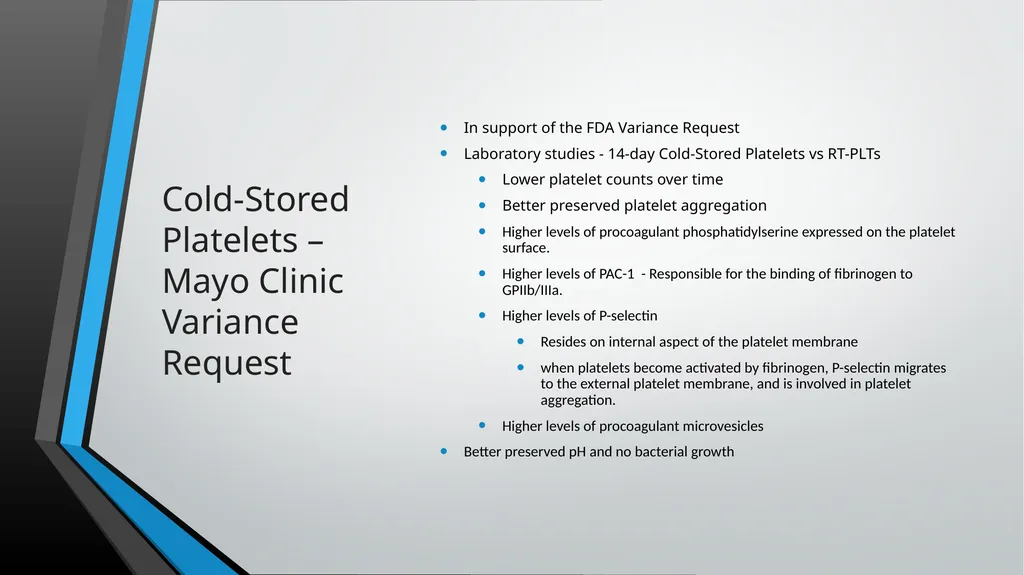
Cold-Stored Platelets – Mayo Clinic Variance Request In support of the FDA Variance Request
Laboratory studies - 14-day Cold-Stored Platelets vs RT-PLTs
Lower platelet counts over time
Better preserved platelet aggregation
Higher levels of procoagulant phosphatidylserine expressed on the platelet surface.
Higher levels of PAC-1 - Responsible for the binding of fibrinogen to GPIIb/IIIa.
Higher levels of P-selectin
Resides on internal aspect of the platelet membrane
when platelets become activated by fibrinogen, P-selectin migrates to the external platelet membrane, and is involved in platelet aggregation.
Higher levels of procoagulant microvesicles
Better preserved pH and no bacterial growth<br>
Laboratory studies - 14-day Cold-Stored Platelets vs RT-PLTs
Lower platelet counts over time
Better preserved platelet aggregation
Higher levels of procoagulant phosphatidylserine expressed on the platelet surface.
Higher levels of PAC-1 - Responsible for the binding of fibrinogen to GPIIb/IIIa.
Higher levels of P-selectin
Resides on internal aspect of the platelet membrane
when platelets become activated by fibrinogen, P-selectin migrates to the external platelet membrane, and is involved in platelet aggregation.
Higher levels of procoagulant microvesicles
Better preserved pH and no bacterial growth<br>
33
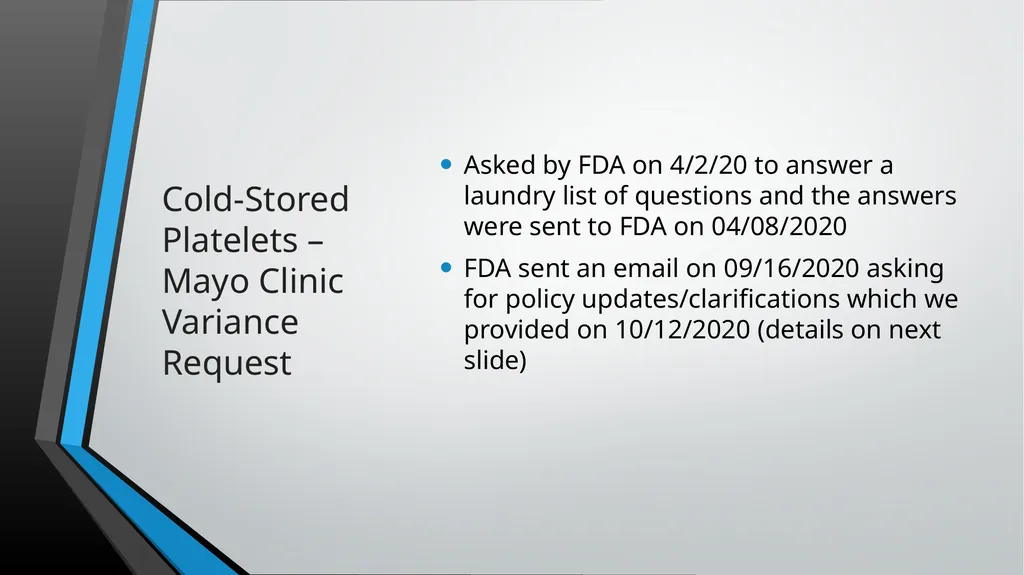
Cold-Stored Platelets – Mayo Clinic Variance Request Asked by FDA on 4/2/20 to answer a laundry list of questions and the answers were sent to FDA on 04/08/2020
FDA sent an email on 09/16/2020 asking for policy updates/clarifications which we provided on 10/12/2020 (details on next slide)<br>
FDA sent an email on 09/16/2020 asking for policy updates/clarifications which we provided on 10/12/2020 (details on next slide)<br>
34
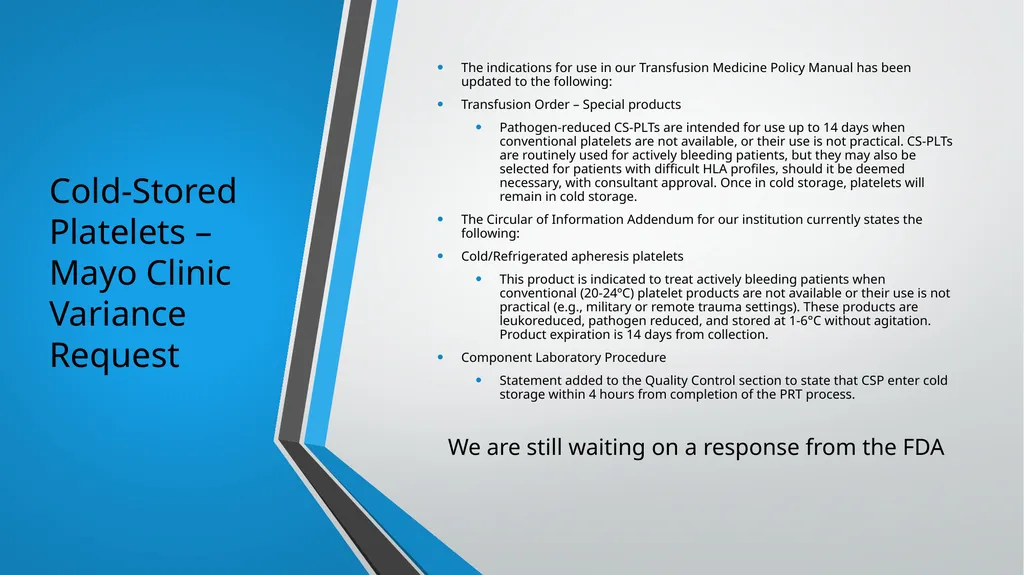
Cold-Stored Platelets – Mayo Clinic Variance Request The indications for use in our Transfusion Medicine Policy Manual has been updated to the following:
Transfusion Order – Special products
Pathogen-reduced CS-PLTs are intended for use up to 14 days when conventional platelets are not available, or their use is not practical. CS-PLTs are routinely used for actively bleeding patients, but they may also be selected for patients with difficult HLA profiles, should it be deemed necessary, with consultant approval. Once in cold storage, platelets will remain in cold storage.
The Circular of Information Addendum for our institution currently states the following:
Cold/Refrigerated apheresis platelets
This product is indicated to treat actively bleeding patients when conventional (20-24ºC) platelet products are not available or their use is not practical (e.g., military or remote trauma settings). These products are leukoreduced, pathogen reduced, and stored at 1-6°C without agitation. Product expiration is 14 days from collection.
Component Laboratory Procedure
Statement added to the Quality Control section to state that CSP enter cold storage within 4 hours from completion of the PRT process.
We are still waiting on a response from the FDA<br>
Transfusion Order – Special products
Pathogen-reduced CS-PLTs are intended for use up to 14 days when conventional platelets are not available, or their use is not practical. CS-PLTs are routinely used for actively bleeding patients, but they may also be selected for patients with difficult HLA profiles, should it be deemed necessary, with consultant approval. Once in cold storage, platelets will remain in cold storage.
The Circular of Information Addendum for our institution currently states the following:
Cold/Refrigerated apheresis platelets
This product is indicated to treat actively bleeding patients when conventional (20-24ºC) platelet products are not available or their use is not practical (e.g., military or remote trauma settings). These products are leukoreduced, pathogen reduced, and stored at 1-6°C without agitation. Product expiration is 14 days from collection.
Component Laboratory Procedure
Statement added to the Quality Control section to state that CSP enter cold storage within 4 hours from completion of the PRT process.
We are still waiting on a response from the FDA<br>
35
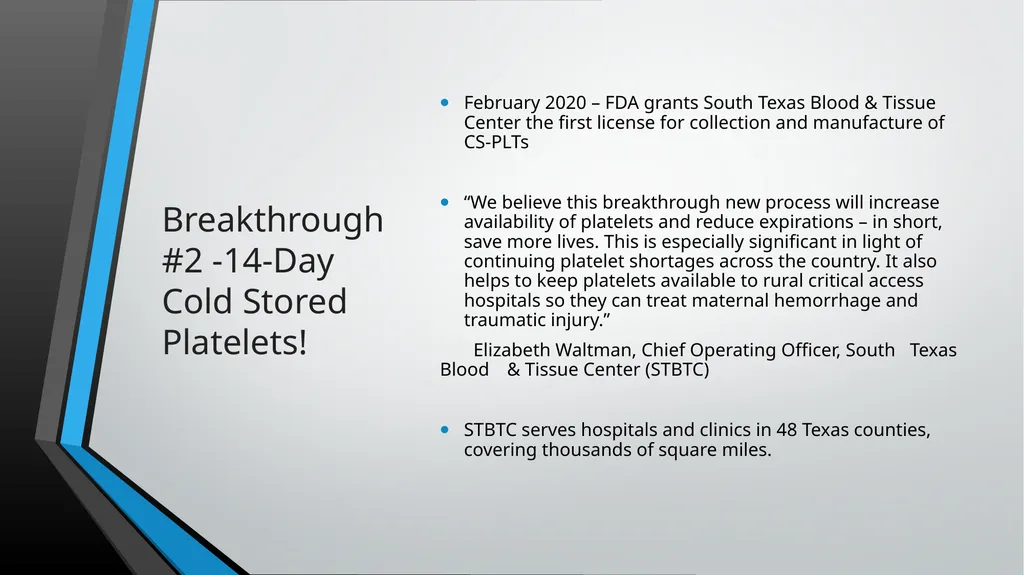
Breakthrough #2 -14-Day Cold Stored Platelets! February 2020 – FDA grants South Texas Blood & Tissue Center the first license for collection and manufacture of CS-PLTs
“We believe this breakthrough new process will increase availability of platelets and reduce expirations – in short, save more lives. This is especially significant in light of continuing platelet shortages across the country. It also helps to keep platelets available to rural critical access hospitals so they can treat maternal hemorrhage and traumatic injury.”
Elizabeth Waltman, Chief Operating Officer, South Texas Blood & Tissue Center (STBTC)
STBTC serves hospitals and clinics in 48 Texas counties, covering thousands of square miles.<br>
“We believe this breakthrough new process will increase availability of platelets and reduce expirations – in short, save more lives. This is especially significant in light of continuing platelet shortages across the country. It also helps to keep platelets available to rural critical access hospitals so they can treat maternal hemorrhage and traumatic injury.”
Elizabeth Waltman, Chief Operating Officer, South Texas Blood & Tissue Center (STBTC)
STBTC serves hospitals and clinics in 48 Texas counties, covering thousands of square miles.<br>
36
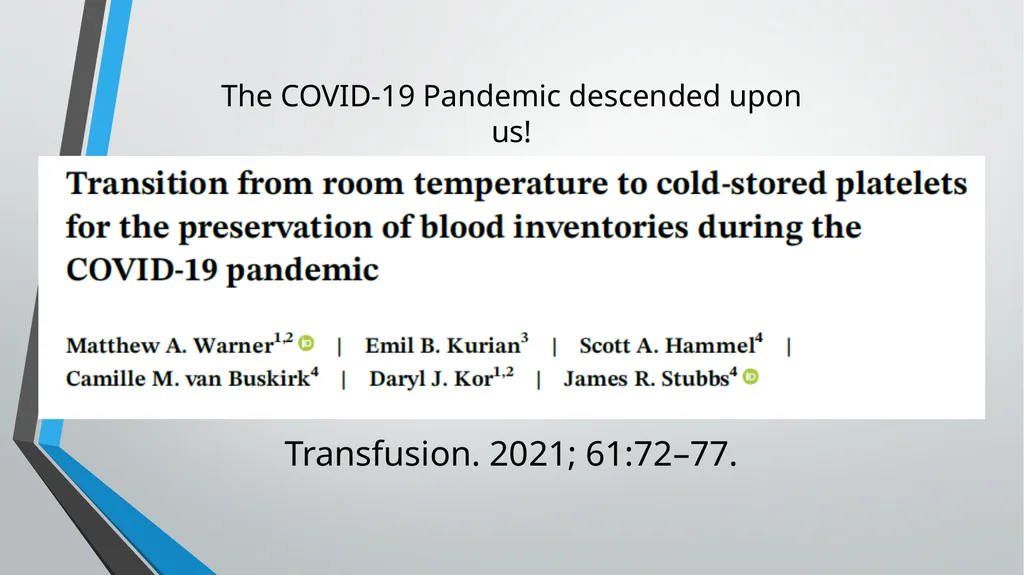
Transfusion. 2021; 61:72–77. The COVID-19 Pandemic descended upon us!<br>
37
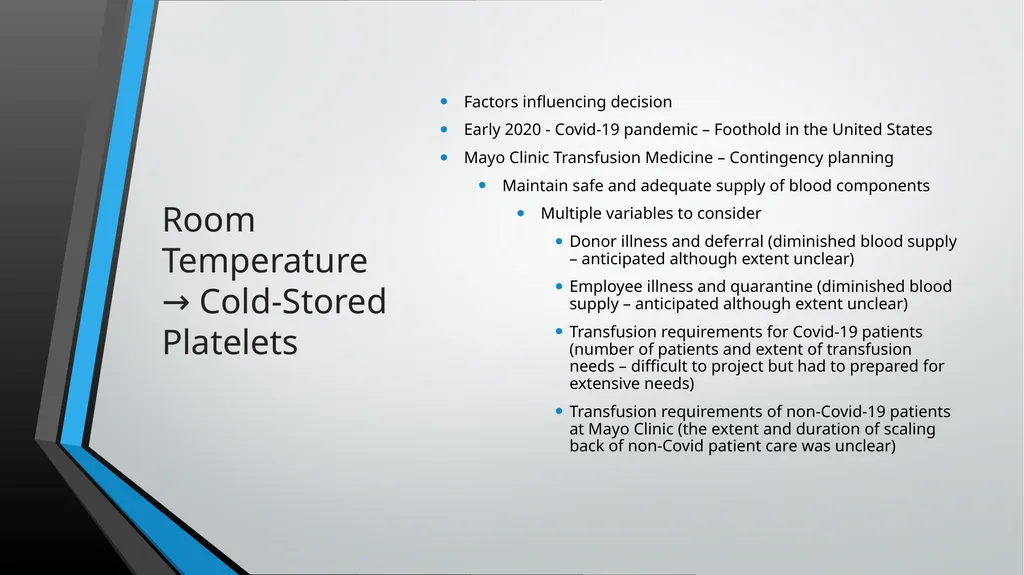
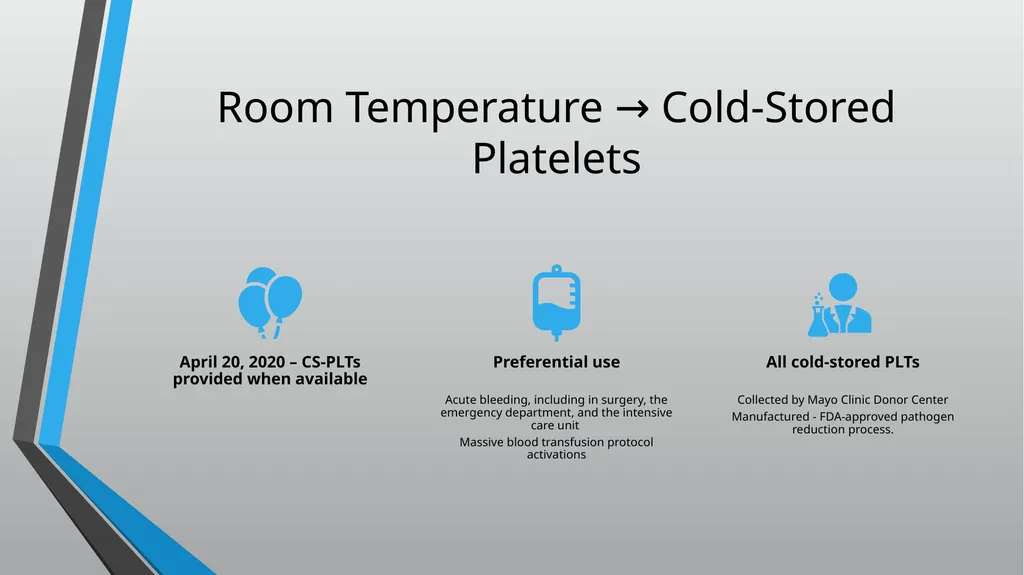
Room Temperature → Cold-Stored Platelets Factors influencing decision
Early 2020 - Covid-19 pandemic – Foothold in the United States
Mayo Clinic Transfusion Medicine – Contingency planning
Maintain safe and adequate supply of blood components
Multiple variables to consider
Donor illness and deferral (diminished blood supply – anticipated although extent unclear)
Employee illness and quarantine (diminished blood supply – anticipated although extent unclear)
Transfusion requirements for Covid-19 patients (number of patients and extent of transfusion needs – difficult to project but had to prepared for extensive needs)
Transfusion requirements of non-Covid-19 patients at Mayo Clinic (the extent and duration of scaling back of non-Covid patient care was unclear)<br>
Early 2020 - Covid-19 pandemic – Foothold in the United States
Mayo Clinic Transfusion Medicine – Contingency planning
Maintain safe and adequate supply of blood components
Multiple variables to consider
Donor illness and deferral (diminished blood supply – anticipated although extent unclear)
Employee illness and quarantine (diminished blood supply – anticipated although extent unclear)
Transfusion requirements for Covid-19 patients (number of patients and extent of transfusion needs – difficult to project but had to prepared for extensive needs)
Transfusion requirements of non-Covid-19 patients at Mayo Clinic (the extent and duration of scaling back of non-Covid patient care was unclear)<br>
38
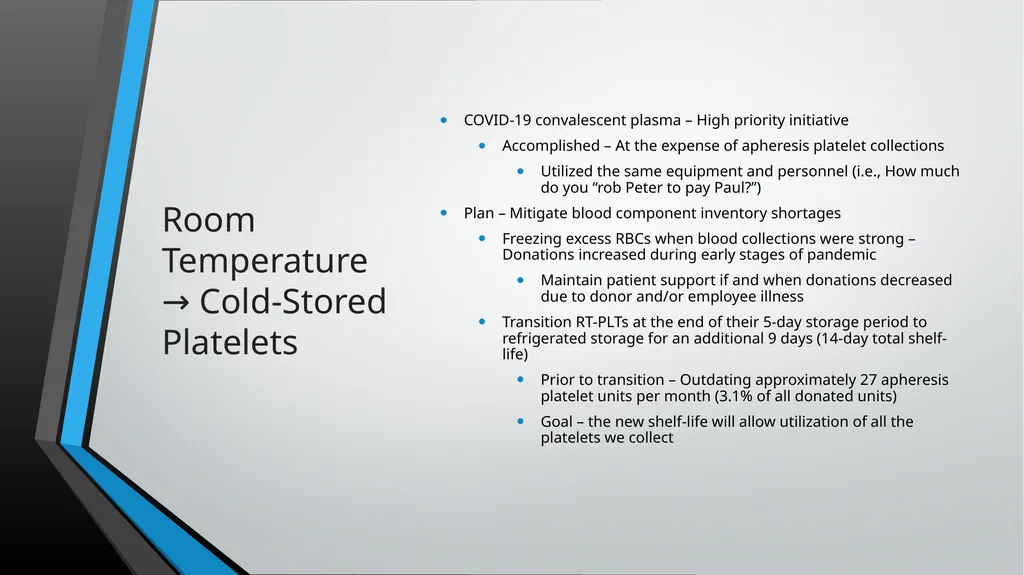
Room Temperature → Cold-Stored Platelets COVID-19 convalescent plasma – High priority initiative
Accomplished – At the expense of apheresis platelet collections
Utilized the same equipment and personnel (i.e., How much do you “rob Peter to pay Paul?”)
Plan – Mitigate blood component inventory shortages
Freezing excess RBCs when blood collections were strong – Donations increased during early stages of pandemic
Maintain patient support if and when donations decreased due to donor and/or employee illness
Transition RT-PLTs at the end of their 5-day storage period to refrigerated storage for an additional 9 days (14-day total shelf-life)
Prior to transition – Outdating approximately 27 apheresis platelet units per month (3.1% of all donated units)
Goal – the new shelf-life will allow utilization of all the platelets we collect<br>
Accomplished – At the expense of apheresis platelet collections
Utilized the same equipment and personnel (i.e., How much do you “rob Peter to pay Paul?”)
Plan – Mitigate blood component inventory shortages
Freezing excess RBCs when blood collections were strong – Donations increased during early stages of pandemic
Maintain patient support if and when donations decreased due to donor and/or employee illness
Transition RT-PLTs at the end of their 5-day storage period to refrigerated storage for an additional 9 days (14-day total shelf-life)
Prior to transition – Outdating approximately 27 apheresis platelet units per month (3.1% of all donated units)
Goal – the new shelf-life will allow utilization of all the platelets we collect<br>
39
Vox Sanguinis (2018) 113, 403–411 My idea was produced by recalling this article from 2018 The metabolic and activation profile of delayed-cold platelets was similar to cold-stored platelets. These data suggest that transferring platelets to refrigerated storage when near expiry may be a viable option for maximising platelet inventories.<br>
40
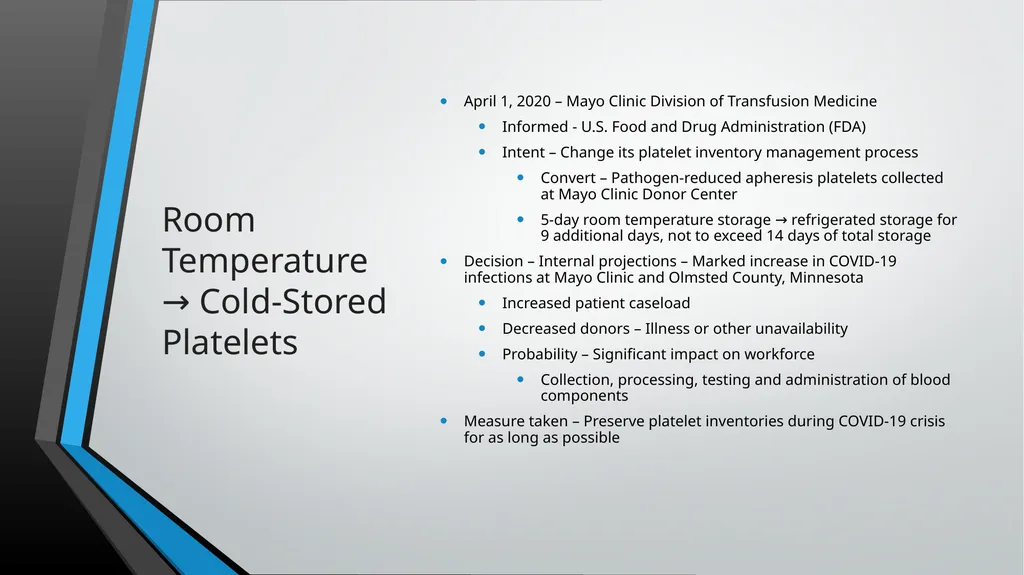
Room Temperature → Cold-Stored Platelets April 1, 2020 – Mayo Clinic Division of Transfusion Medicine
Informed - U.S. Food and Drug Administration (FDA)
Intent – Change its platelet inventory management process
Convert – Pathogen-reduced apheresis platelets collected at Mayo Clinic Donor Center
5-day room temperature storage → refrigerated storage for 9 additional days, not to exceed 14 days of total storage
Decision – Internal projections – Marked increase in COVID-19 infections at Mayo Clinic and Olmsted County, Minnesota
Increased patient caseload
Decreased donors – Illness or other unavailability
Probability – Significant impact on workforce
Collection, processing, testing and administration of blood components
Measure taken – Preserve platelet inventories during COVID-19 crisis for as long as possible<br>
Informed - U.S. Food and Drug Administration (FDA)
Intent – Change its platelet inventory management process
Convert – Pathogen-reduced apheresis platelets collected at Mayo Clinic Donor Center
5-day room temperature storage → refrigerated storage for 9 additional days, not to exceed 14 days of total storage
Decision – Internal projections – Marked increase in COVID-19 infections at Mayo Clinic and Olmsted County, Minnesota
Increased patient caseload
Decreased donors – Illness or other unavailability
Probability – Significant impact on workforce
Collection, processing, testing and administration of blood components
Measure taken – Preserve platelet inventories during COVID-19 crisis for as long as possible<br>
41
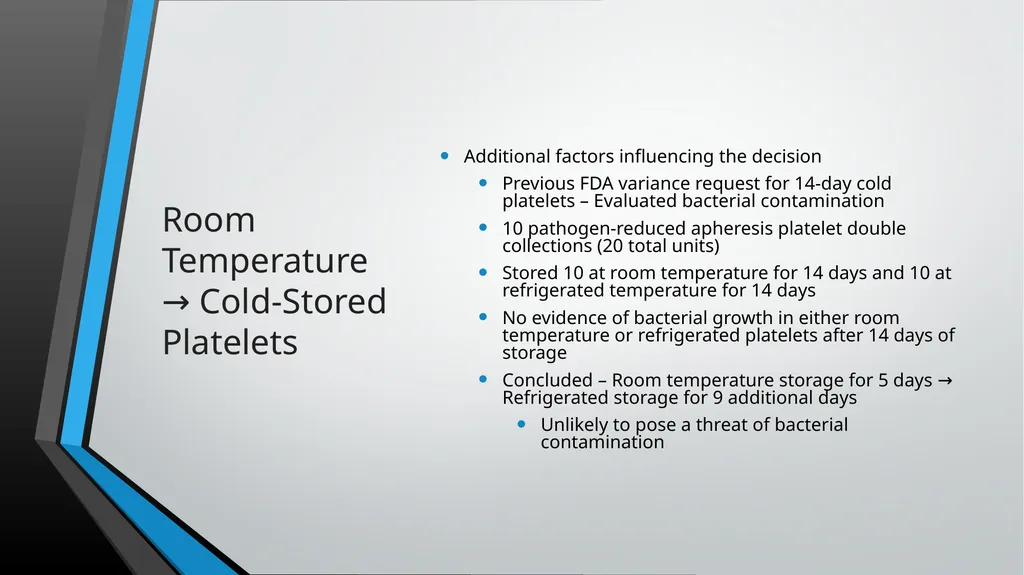
Room Temperature → Cold-Stored Platelets Additional factors influencing the decision
Previous FDA variance request for 14-day cold platelets – Evaluated bacterial contamination
10 pathogen-reduced apheresis platelet double collections (20 total units)
Stored 10 at room temperature for 14 days and 10 at refrigerated temperature for 14 days
No evidence of bacterial growth in either room temperature or refrigerated platelets after 14 days of storage
Concluded – Room temperature storage for 5 days → Refrigerated storage for 9 additional days
Unlikely to pose a threat of bacterial contamination<br>
Previous FDA variance request for 14-day cold platelets – Evaluated bacterial contamination
10 pathogen-reduced apheresis platelet double collections (20 total units)
Stored 10 at room temperature for 14 days and 10 at refrigerated temperature for 14 days
No evidence of bacterial growth in either room temperature or refrigerated platelets after 14 days of storage
Concluded – Room temperature storage for 5 days → Refrigerated storage for 9 additional days
Unlikely to pose a threat of bacterial contamination<br>
42
Room Temperature → Cold-Stored Platelets<br>
43
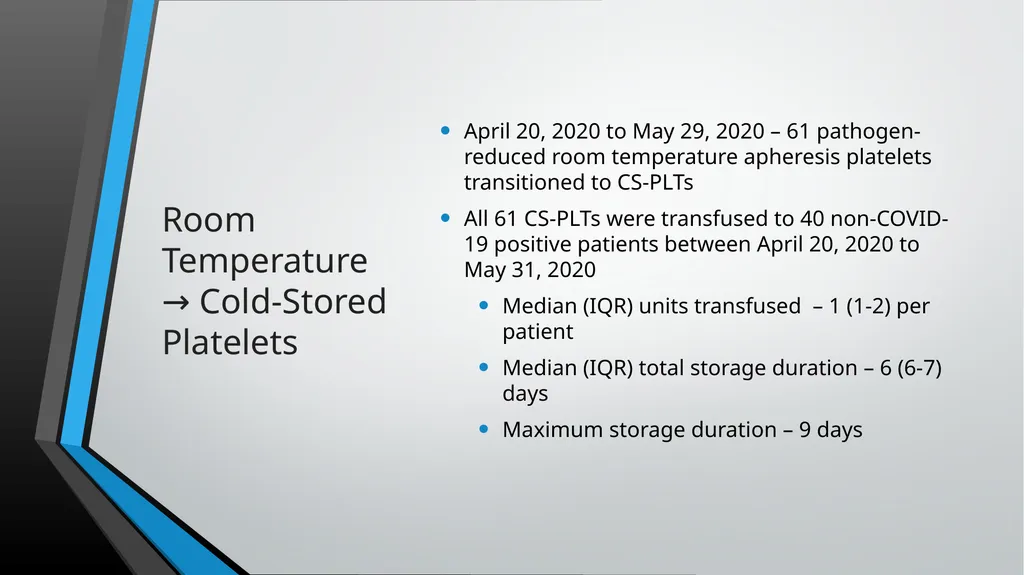
Room Temperature → Cold-Stored Platelets April 20, 2020 to May 29, 2020 – 61 pathogen-reduced room temperature apheresis platelets transitioned to CS-PLTs
All 61 CS-PLTs were transfused to 40 non-COVID-19 positive patients between April 20, 2020 to May 31, 2020
Median (IQR) units transfused – 1 (1-2) per patient
Median (IQR) total storage duration – 6 (6-7) days
Maximum storage duration – 9 days<br>
All 61 CS-PLTs were transfused to 40 non-COVID-19 positive patients between April 20, 2020 to May 31, 2020
Median (IQR) units transfused – 1 (1-2) per patient
Median (IQR) total storage duration – 6 (6-7) days
Maximum storage duration – 9 days<br>
44
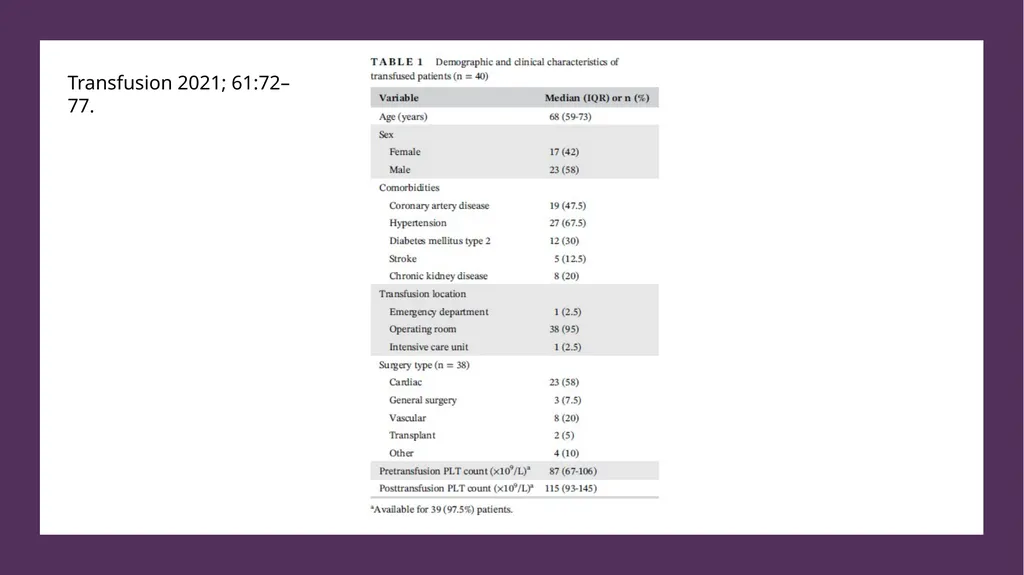
Transfusion 2021; 61:72–77.<br>
45
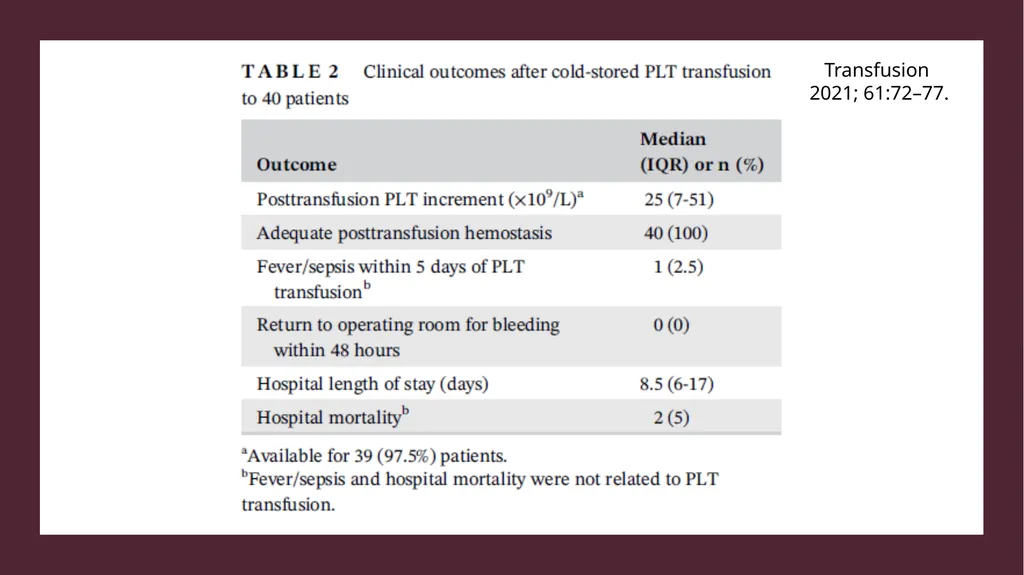
Transfusion
2021; 61:72–77.<br>
2021; 61:72–77.<br>
46
Room Temperature → Cold-Stored Platelets Summary
Transition – RT-PLTs (5-day shelf-life) → CS-PLTS (14-day shelf-life)
Prevented wastage - 61 units in the first month of implementation
CS-PLTs – Administered to acutely bleeding patients – Varying clinical profiles
Hemostasis – Deemed adequate after transfusion and hemorrhage control was achieved in all cases
No transfusion-related adverse events
No platelet-related bacterial infections
Transition to CS-PLTs (delayed cold storage)
Reduce platelet outdating
Maintain adequate platelet inventories – Patients with acute bleeding<br>
Transition – RT-PLTs (5-day shelf-life) → CS-PLTS (14-day shelf-life)
Prevented wastage - 61 units in the first month of implementation
CS-PLTs – Administered to acutely bleeding patients – Varying clinical profiles
Hemostasis – Deemed adequate after transfusion and hemorrhage control was achieved in all cases
No transfusion-related adverse events
No platelet-related bacterial infections
Transition to CS-PLTs (delayed cold storage)
Reduce platelet outdating
Maintain adequate platelet inventories – Patients with acute bleeding<br>
47
What Have I Tried To Convey Today?<br>
48
Cold Platelets – Final Summary Small hospital-based Blood Donor Center – Supports patients who require platelet transfusions in circumstances ranging from acute blood loss to long-term prophylaxis
Ongoing challenge to “keep up with demand”
RT-PLTs – Likely to remain the standard for hypoproliferative thrombocytopenia due to longer post-transfusion circulatory half-life
CS-PLTs – Appear to be an option for certain patient populations where hemostasis is the major priority rather that post-transfusion circulation time
Current state – CS-PLTs with 3-day shelf-life not viable from an adequacy of supply and economic perspective
14-day (or longer) CS-PLTS – Hold promise for more widespread platelet availability, bacterial safety, and more economically advantageous (Inventory management – decreased outdates)
We need to think differently and practice differently about platelet transfusions
Adjust to “acute stresses” such as COVID-19
Achieve more widespread access to platelets where the maintenance of platelet inventories not feasible in the past (small hospitals that receive extensively bleeding patients)
Different platelets for different patient populations – RT-PLTs for prophylaxis and CS-PLTs for bleeding<br>
Ongoing challenge to “keep up with demand”
RT-PLTs – Likely to remain the standard for hypoproliferative thrombocytopenia due to longer post-transfusion circulatory half-life
CS-PLTs – Appear to be an option for certain patient populations where hemostasis is the major priority rather that post-transfusion circulation time
Current state – CS-PLTs with 3-day shelf-life not viable from an adequacy of supply and economic perspective
14-day (or longer) CS-PLTS – Hold promise for more widespread platelet availability, bacterial safety, and more economically advantageous (Inventory management – decreased outdates)
We need to think differently and practice differently about platelet transfusions
Adjust to “acute stresses” such as COVID-19
Achieve more widespread access to platelets where the maintenance of platelet inventories not feasible in the past (small hospitals that receive extensively bleeding patients)
Different platelets for different patient populations – RT-PLTs for prophylaxis and CS-PLTs for bleeding<br>