
Collaboration for Effective Educator Development,
LD
Published · 63 slides · 0 views
1 / 1
Description
Collaboration for Effective Educator Development, Accountability and Reform H325A120003 Disciplinary Literacy Every teacher a reading teacher? Shift away from every teacher a reading teacher Explore the overlay of generic content and
Related Topics
Share
Embed code
Download this presentation From Below
"Collaboration for Effective Educator Development," is the property of its rightful owner. Permission is granted to download and print the materials on this website for personal, non-commercial use only, and to display it on your personal computer provided you do not modify the materials and that you retain all copyright notices contained in the materials. By downloading content from our website, you accept the terms of this agreement.
Presentation Transcript
01
Collaboration for Effective Educator Development, Accountability and Reform H325A120003 Disciplinary Literacy<br>
02
Every teacher a reading teacher? Shift away from every teacher a reading teacher
Explore the overlay of generic content and discipline-dependent literacy practices
GOAL: Every teacher teaches literacy skills essential to their discipline<br>
Explore the overlay of generic content and discipline-dependent literacy practices
GOAL: Every teacher teaches literacy skills essential to their discipline<br>
03
Objectives:
After studying this module, you will be able to: Define disciplinary literacy
Note how the CCSS address disciplinary literacy
Explain why disciplinary literacy is important for all students
Articulate what teachers and students need to know and be able to do
Apply the components of close reading<br>
Note how the CCSS address disciplinary literacy
Explain why disciplinary literacy is important for all students
Articulate what teachers and students need to know and be able to do
Apply the components of close reading<br>
04
Objectives (continued) Discern unique literacy skills utilized in:
History
Mathematics
Science & Technical Subjects
Literary Genres
Model how to think aloud to teach close reading of disciplinary literacy
Plan effective, evidence-based scaffolds for students with learning difficulties<br>
History
Mathematics
Science & Technical Subjects
Literary Genres
Model how to think aloud to teach close reading of disciplinary literacy
Plan effective, evidence-based scaffolds for students with learning difficulties<br>
05
Common Core State Standards
Instructional Shifts Emphasis on increased
reading of complex informational text
knowledge of disciplines
reliance on evidence from text
critical & analytical writing
academic vocabulary
Source: Adapted from www.engageNY.org, Instructional Shifts for the Common Core<br>
reading of complex informational text
knowledge of disciplines
reliance on evidence from text
critical & analytical writing
academic vocabulary
Source: Adapted from www.engageNY.org, Instructional Shifts for the Common Core<br>
06
Why Are Disciplinary Texts Difficult for Students? Students may lack:
Experience reading lengthy expository text
Content-specific vocabulary
3. Decoding skills
4. Comprehension strategies
5. Background knowledge and
interest in the content<br>
Experience reading lengthy expository text
Content-specific vocabulary
3. Decoding skills
4. Comprehension strategies
5. Background knowledge and
interest in the content<br>
07
Disciplinary Literacy Standards
Activity Form pairs of partners A & B
A’s move to the right and partner with another A
B’s move to the left and partner with another B
Materials Needed:
The Common Core State Standards
for your discipline
(or your state standards)<br>
A’s move to the right and partner with another A
B’s move to the left and partner with another B
Materials Needed:
The Common Core State Standards
for your discipline
(or your state standards)<br>
08
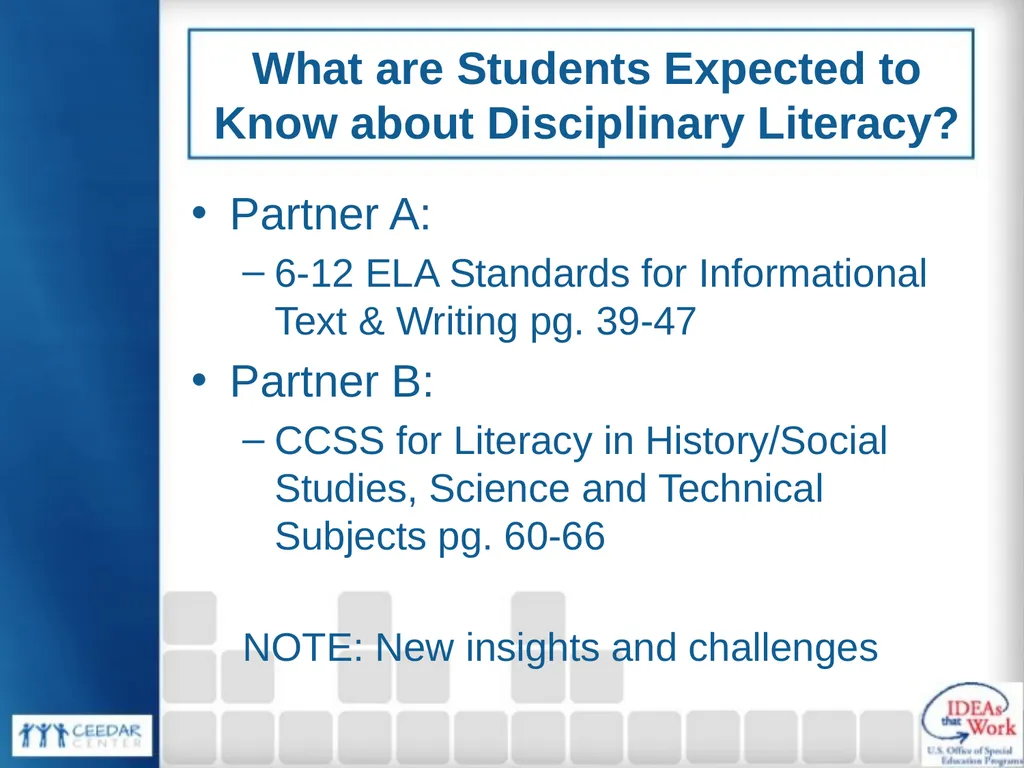
What are Students Expected to Know about Disciplinary Literacy? Partner A:
6-12 ELA Standards for Informational Text & Writing pg. 39-47
Partner B:
CCSS for Literacy in History/Social Studies, Science and Technical Subjects pg. 60-66
NOTE: New insights and challenges<br>
6-12 ELA Standards for Informational Text & Writing pg. 39-47
Partner B:
CCSS for Literacy in History/Social Studies, Science and Technical Subjects pg. 60-66
NOTE: New insights and challenges<br>
09
Partner Insights On chart paper, write 2-3 insights
Post
You have 3 minutes<br>
Post
You have 3 minutes<br>
10
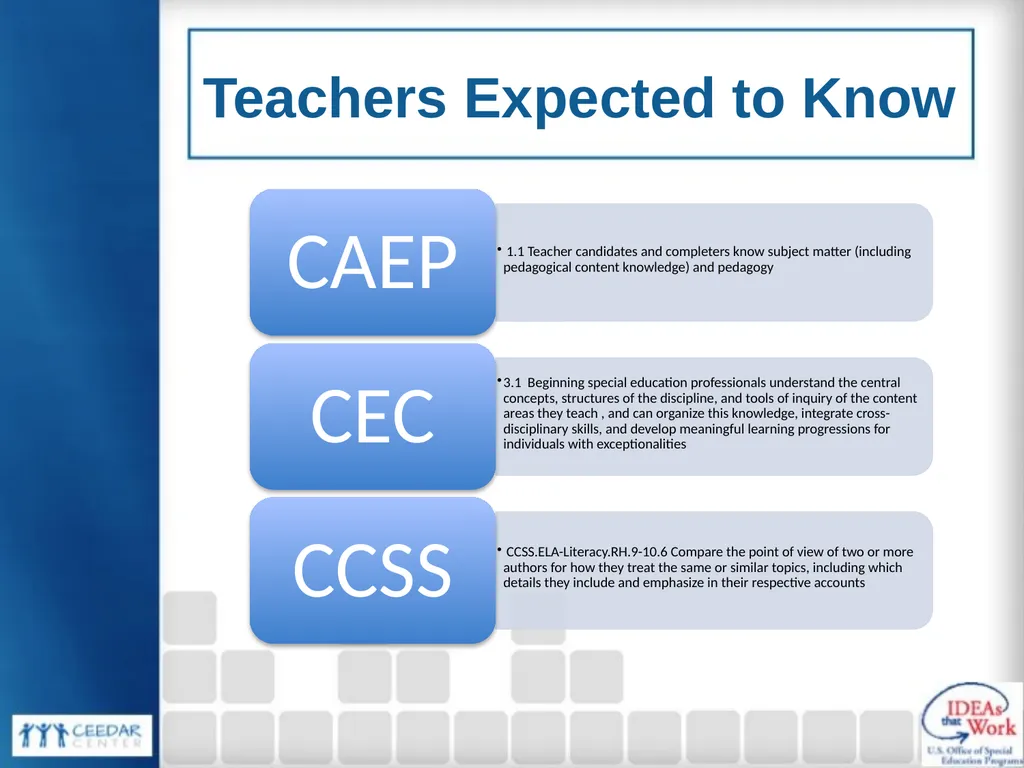
Teachers Expected to Know<br>
11
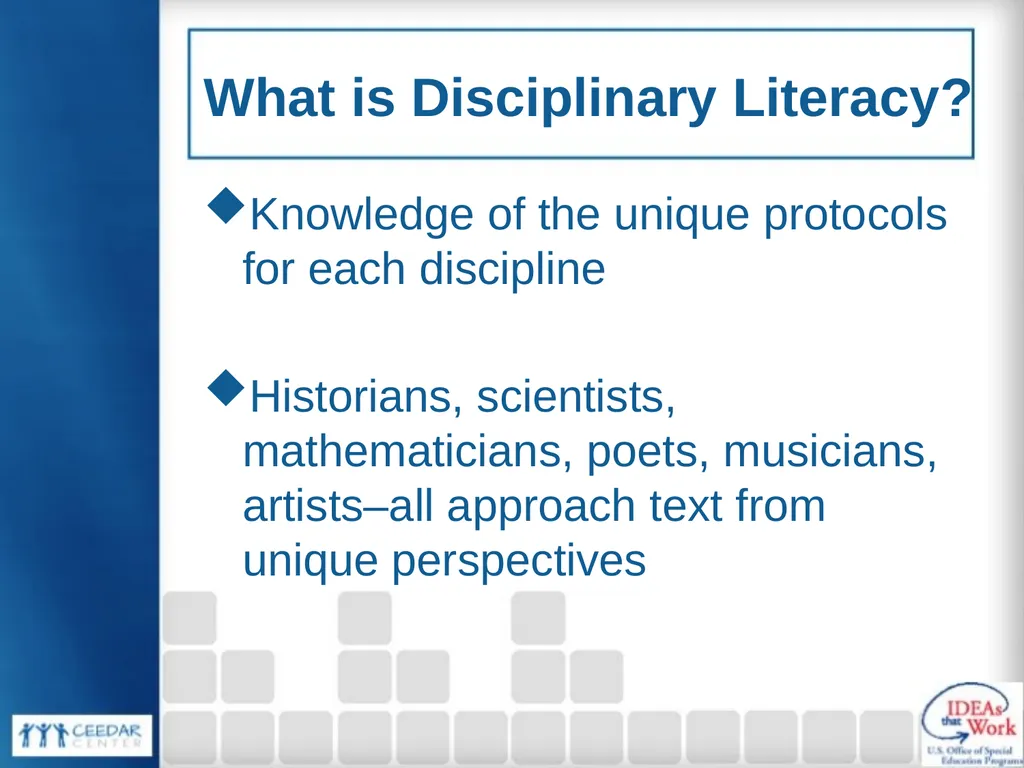
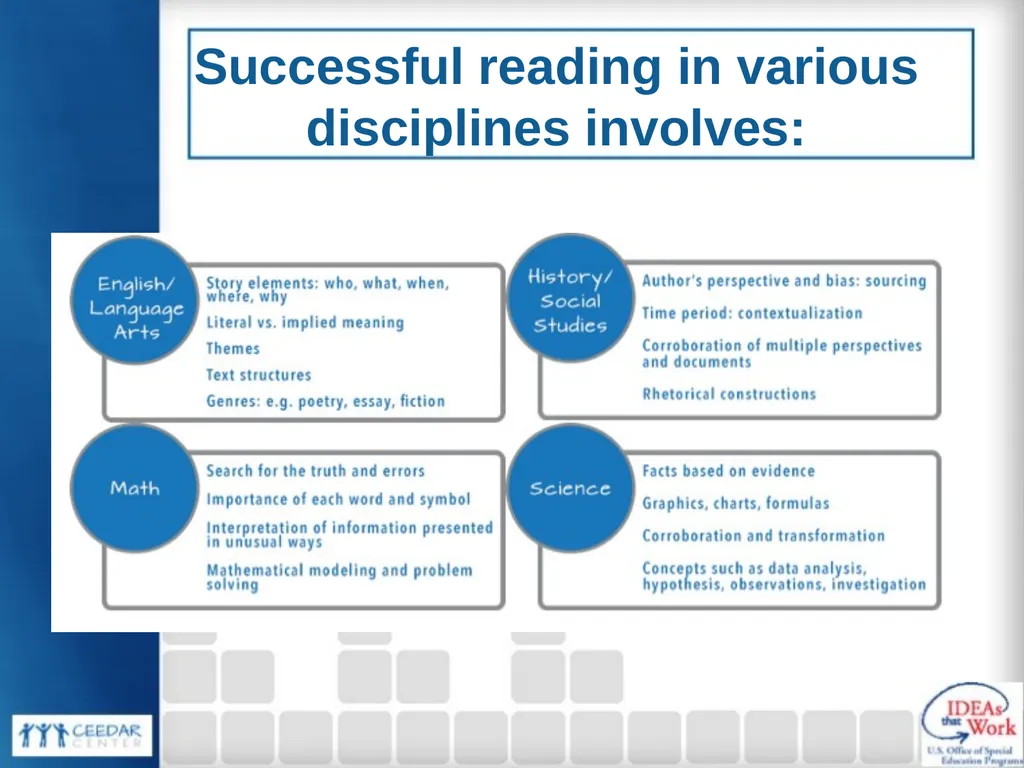
What is Disciplinary Literacy? Knowledge of the unique protocols for each discipline
Historians, scientists, mathematicians, poets, musicians, artists–all approach text from unique perspectives<br>
Historians, scientists, mathematicians, poets, musicians, artists–all approach text from unique perspectives<br>
12
Successful reading in various disciplines involves:<br>
13
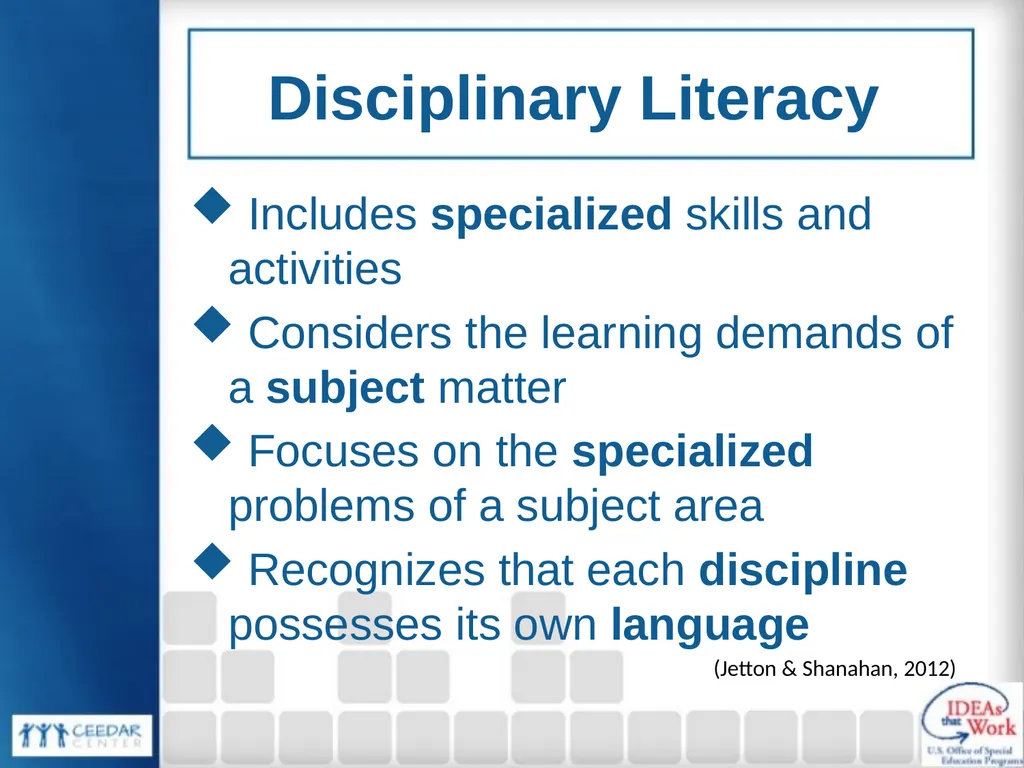
Disciplinary Literacy Includes specialized skills and activities
Considers the learning demands of a subject matter
Focuses on the specialized problems of a subject area
Recognizes that each discipline possesses its own language
(Jetton & Shanahan, 2012)<br>
Considers the learning demands of a subject matter
Focuses on the specialized problems of a subject area
Recognizes that each discipline possesses its own language
(Jetton & Shanahan, 2012)<br>
14
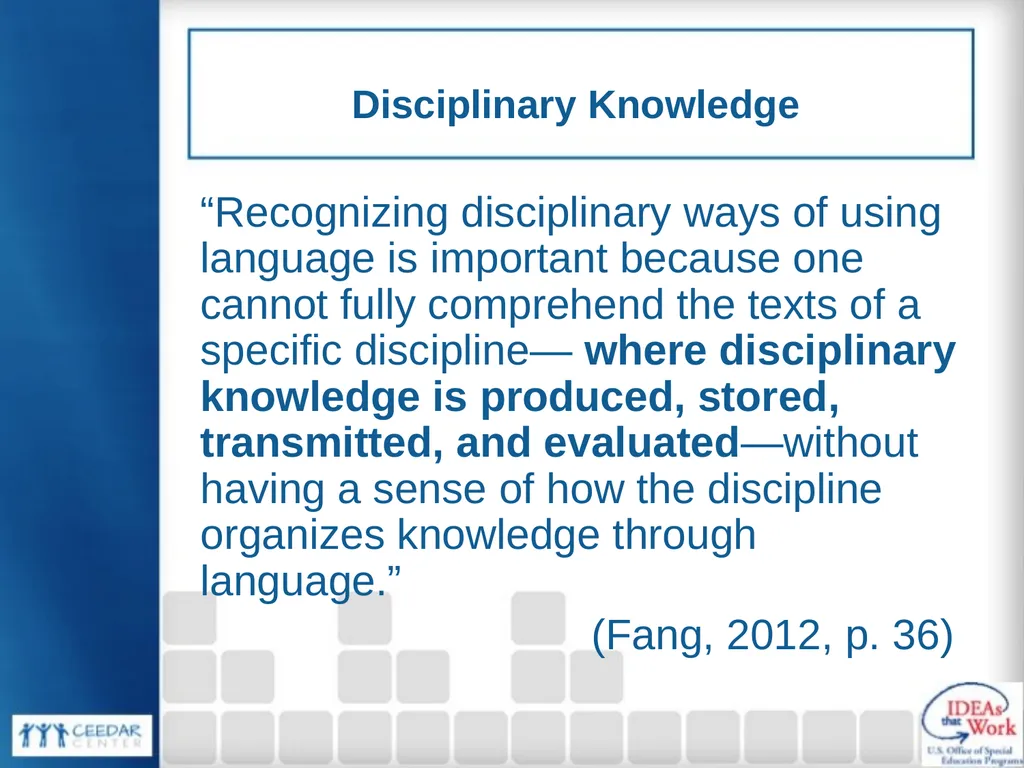
Disciplinary Knowledge “Recognizing disciplinary ways of using language is important because one cannot fully comprehend the texts of a specific discipline— where disciplinary knowledge is produced, stored, transmitted, and evaluated—without having a sense of how the discipline organizes knowledge through language.”
(Fang, 2012, p. 36)<br>
(Fang, 2012, p. 36)<br>
15
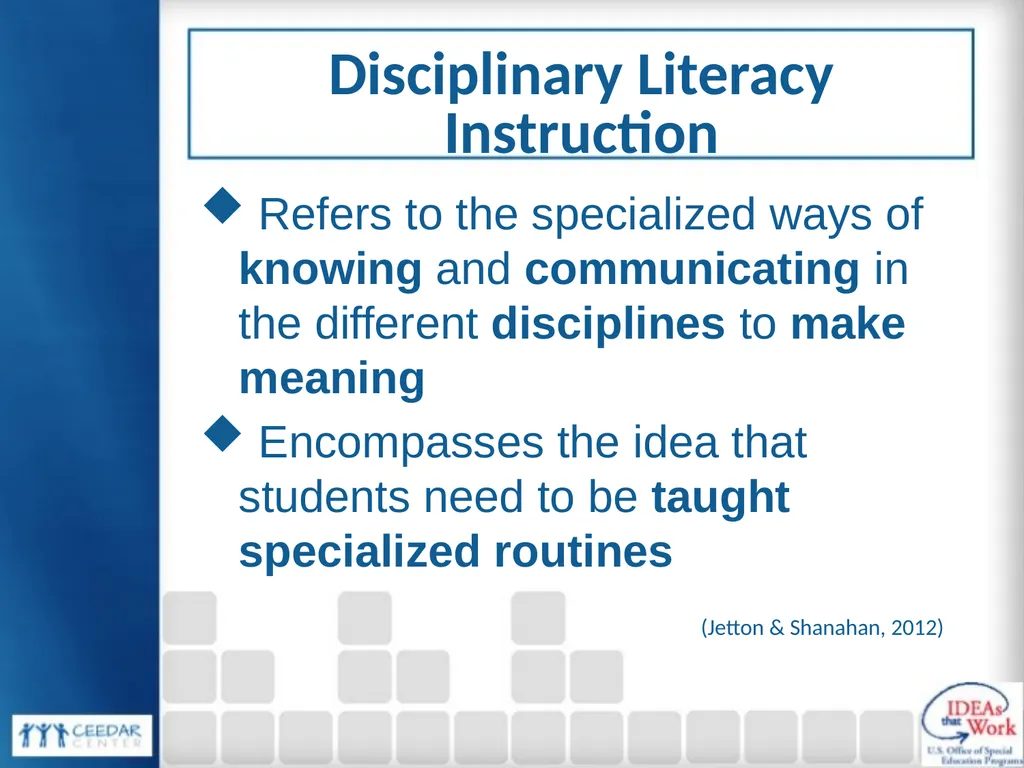
Disciplinary Literacy Instruction Refers to the specialized ways of knowing and communicating in the different disciplines to make meaning
Encompasses the idea that students need to be taught specialized routines
(Jetton & Shanahan, 2012)<br>
Encompasses the idea that students need to be taught specialized routines
(Jetton & Shanahan, 2012)<br>
16
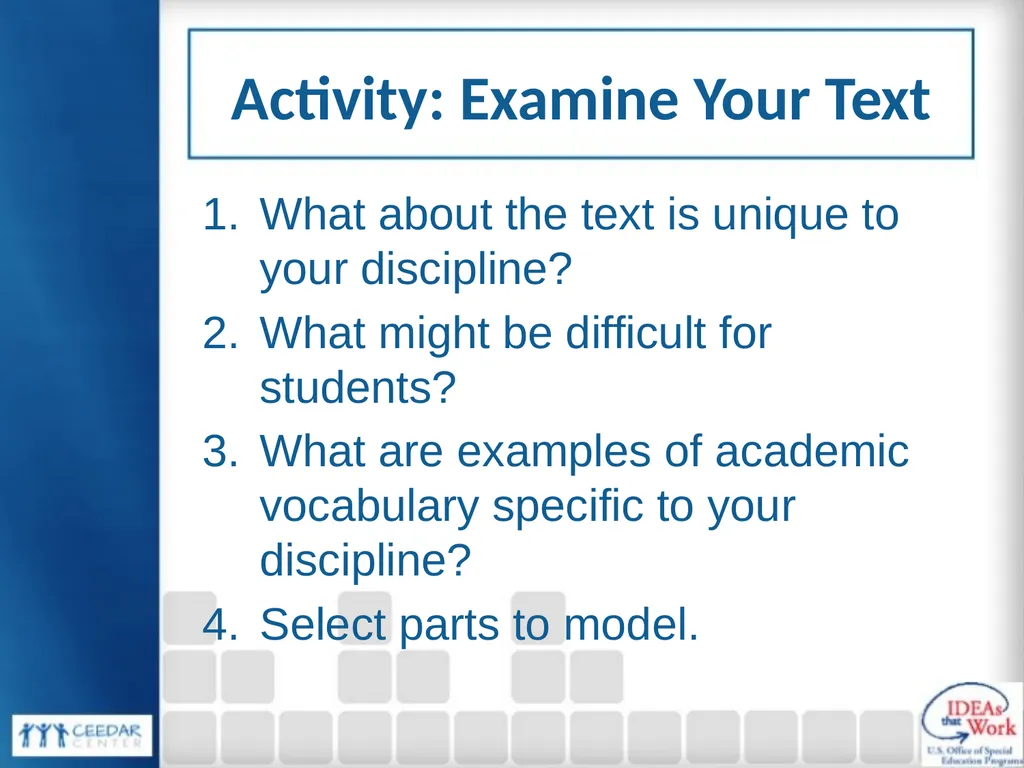
Activity: Examine Your Text What about the text is unique to your discipline?
What might be difficult for students?
What are examples of academic vocabulary specific to your discipline?
Select parts to model.<br>
What might be difficult for students?
What are examples of academic vocabulary specific to your discipline?
Select parts to model.<br>
17
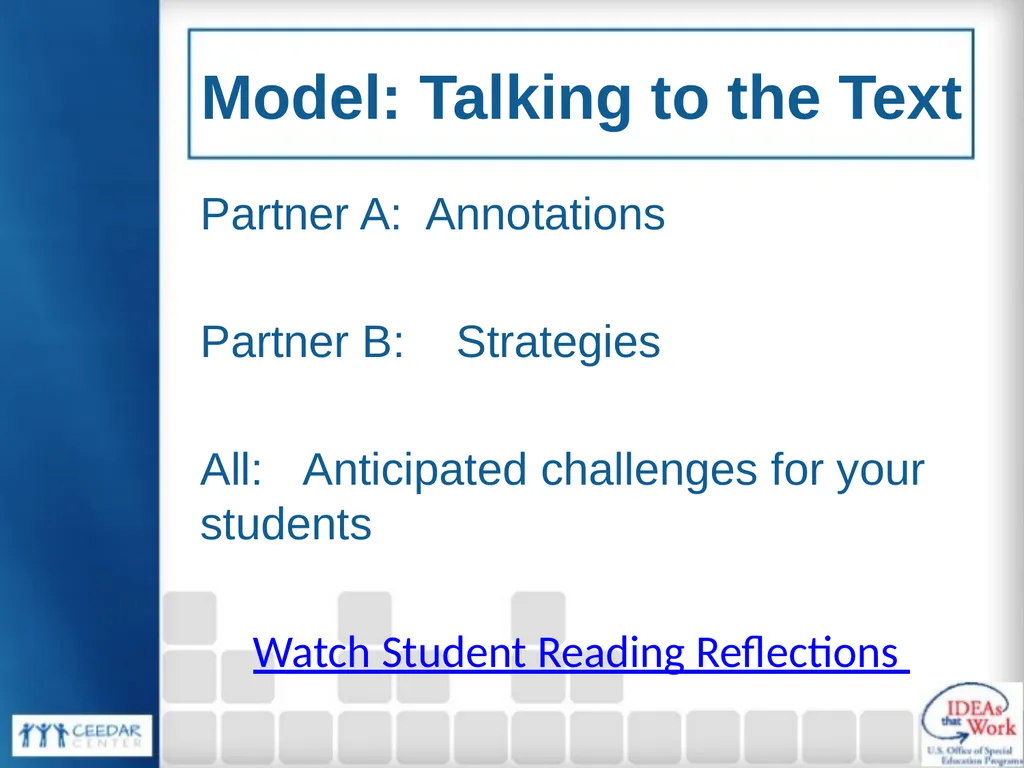
Model: Talking to the Text Partner A: Annotations
Partner B: Strategies
All: Anticipated challenges for your students
Watch Student Reading Reflections<br>
Partner B: Strategies
All: Anticipated challenges for your students
Watch Student Reading Reflections<br>
18
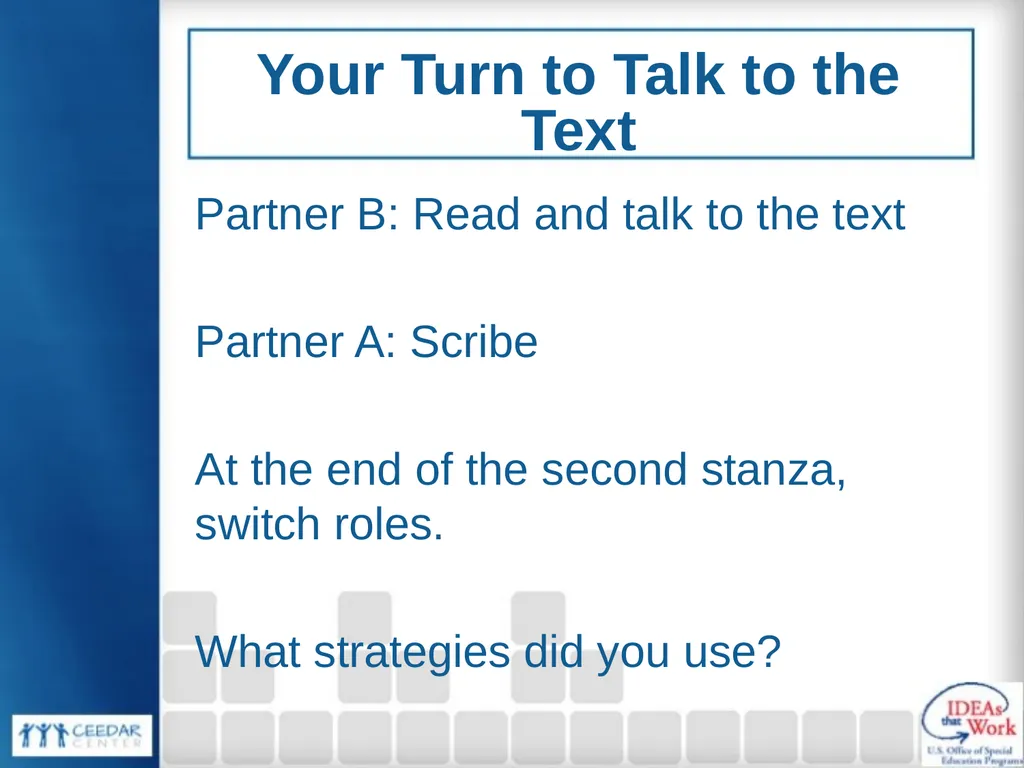
Your Turn to Talk to the Text Partner B: Read and talk to the text
Partner A: Scribe
At the end of the second stanza, switch roles.
What strategies did you use?<br>
Partner A: Scribe
At the end of the second stanza, switch roles.
What strategies did you use?<br>
19
Teacher thinking about thinking Watch the Teacher Reflection video<br>
20
Disciplinary Literacy is NOT: Another term for content area reading
A method to work with poor readers
A generalized approach to literacy
across disciplines
Limited to study skills<br>
A method to work with poor readers
A generalized approach to literacy
across disciplines
Limited to study skills<br>
21
What About These Strategies? 1. KWL and KWHL
2. Anticipation guides
3. Semantic feature analysis
4. Text structure analysis
5. Graphic organizers
6. Other<br>
2. Anticipation guides
3. Semantic feature analysis
4. Text structure analysis
5. Graphic organizers
6. Other<br>
22
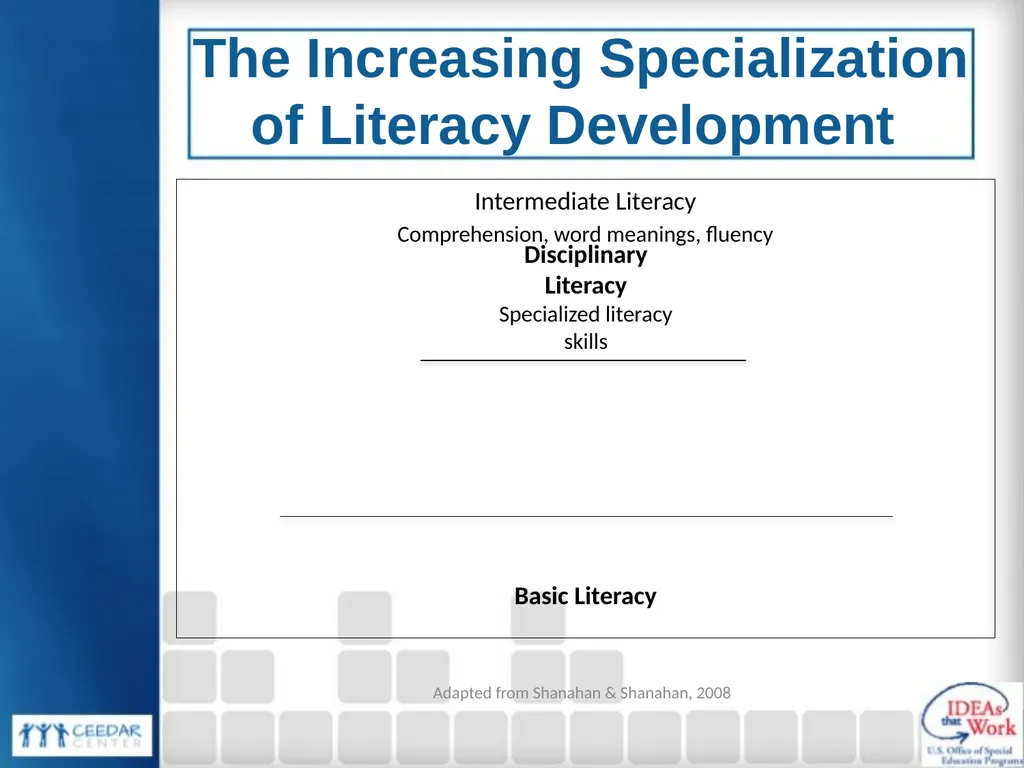
The Increasing Specialization of Literacy Development Intermediate Literacy
Comprehension, word meanings, fluency Basic Literacy Disciplinary Literacy
Specialized literacy skills Adapted from Shanahan & Shanahan, 2008<br>
Comprehension, word meanings, fluency Basic Literacy Disciplinary Literacy
Specialized literacy skills Adapted from Shanahan & Shanahan, 2008<br>
23
Reflections of a Researcher Let’s listen to Tim Shanahan, a researcher in this field from the University of Illinois at Chicago.
Listen to Dr. Shanahan's comments<br>
Listen to Dr. Shanahan's comments<br>
24
Dr. Shanahan’s Comments …disciplinary literacy is engaging students “in not just learning about the discipline, but actually in using reading and writing in the same way the historian or scientist does.”<br>
25
10 Strategies to Read Complex
Texts in the Disciplines Start with easier texts; build complexity
Start with small chunks of text & increase
Celebrate when students read longer text
Model struggling with text; honor the struggle
Teach students to pay attention to important parts of the text (graphic organizers, annotation)<br>
Start with small chunks of text & increase
Celebrate when students read longer text
Model struggling with text; honor the struggle
Teach students to pay attention to important parts of the text (graphic organizers, annotation)<br>
26
Strategies (continued) Set authentic purposes for reading
Model working carefully through text
Before teaching, determine the key ideas & significant details; plan supports
Teach students to collaborate with peers
Talk less; listen more. Allow students to figure out the text & answer their own questions<br>
Model working carefully through text
Before teaching, determine the key ideas & significant details; plan supports
Teach students to collaborate with peers
Talk less; listen more. Allow students to figure out the text & answer their own questions<br>
27
To be continued… 3 questions you have
2 things you learned
1 thing you’ll use
Remember, I am modeling activities you can use with your students! This is an exit card activity.<br>
2 things you learned
1 thing you’ll use
Remember, I am modeling activities you can use with your students! This is an exit card activity.<br>
28
Part 2: Refresh Activity What new information did you learn that is beneficial to you?
What do you want to remember to use with your students?
What other skills might struggling readers need to learn?<br>
What do you want to remember to use with your students?
What other skills might struggling readers need to learn?<br>
29
Close Reading The standards focus on students reading closely to draw evidence and knowledge from the text.
Close reading and gathering knowledge from specific texts should be at the heart of classroom activities.
Coleman & Pimentel (2012) p. 1 & 9.<br>
Close reading and gathering knowledge from specific texts should be at the heart of classroom activities.
Coleman & Pimentel (2012) p. 1 & 9.<br>
30
Components of Close Reading Read and reread for different purposes
Be an active reader—annotate
Summarize
Self-explain, ask and answer questions
Determine the significance of ideas and information
Hinchman & Moore (2013), adapted<br>
Be an active reader—annotate
Summarize
Self-explain, ask and answer questions
Determine the significance of ideas and information
Hinchman & Moore (2013), adapted<br>
31
Why Reread? 1st reading: What are the main ideas of this text? (basic comprehension)
2nd reading: How does this text work? (devices used by the author, word choice, quality of evidence, how data was presented)<br>
2nd reading: How does this text work? (devices used by the author, word choice, quality of evidence, how data was presented)<br>
32
Leading to Deep Comprehension 3rd reading: What does this text mean? (critical analysis, connect to other texts and to me)
After reading, students engage in high-level discourse to further analyze the text
Shanahan, T. (June, 2013). Shanahan on Literacy.<br>
After reading, students engage in high-level discourse to further analyze the text
Shanahan, T. (June, 2013). Shanahan on Literacy.<br>
33
Close Reading Takes time
May mean reading less text
Increases comprehension
Increases learning the discipline<br>
May mean reading less text
Increases comprehension
Increases learning the discipline<br>
34
Discipline-Specific Strategies for Previewing Text Model previewing literature:
What is the significance of the title?
Who is the author?
What is the genre?<br>
What is the significance of the title?
Who is the author?
What is the genre?<br>
35
Discipline-Specific Strategies for Previewing Text With a partner teaching the same subject, list what students should attend to when previewing a piece of text (pre-reading strategies).
Write the critical points on chart paper.<br>
Write the critical points on chart paper.<br>
36
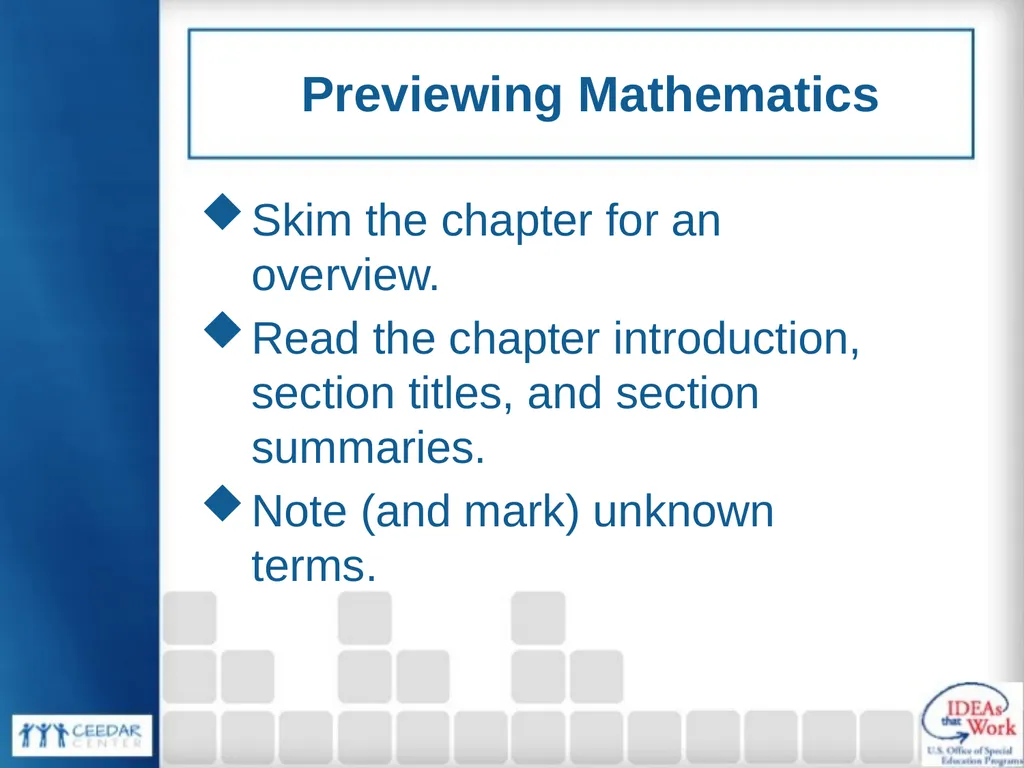
Previewing Mathematics Skim the chapter for an overview.
Read the chapter introduction, section titles, and section summaries.
Note (and mark) unknown terms.<br>
Read the chapter introduction, section titles, and section summaries.
Note (and mark) unknown terms.<br>
37
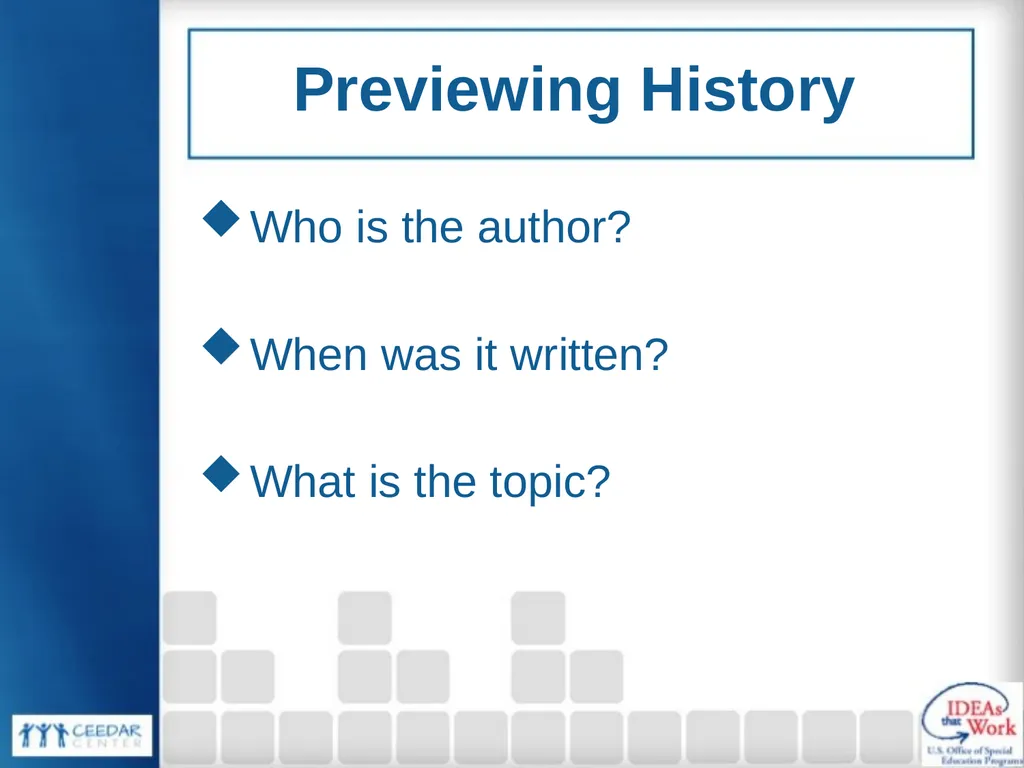
Previewing History Who is the author?
When was it written?
What is the topic?<br>
When was it written?
What is the topic?<br>
38
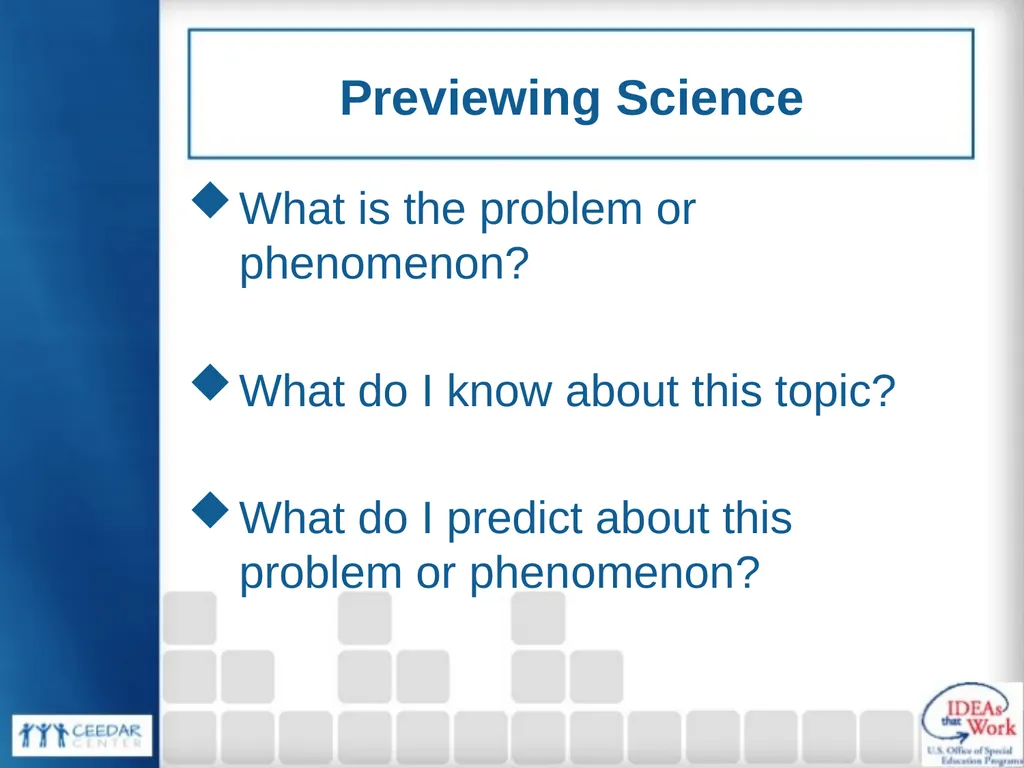
Previewing Science What is the problem or phenomenon?
What do I know about this topic?
What do I predict about this problem or phenomenon?<br>
What do I know about this topic?
What do I predict about this problem or phenomenon?<br>
39
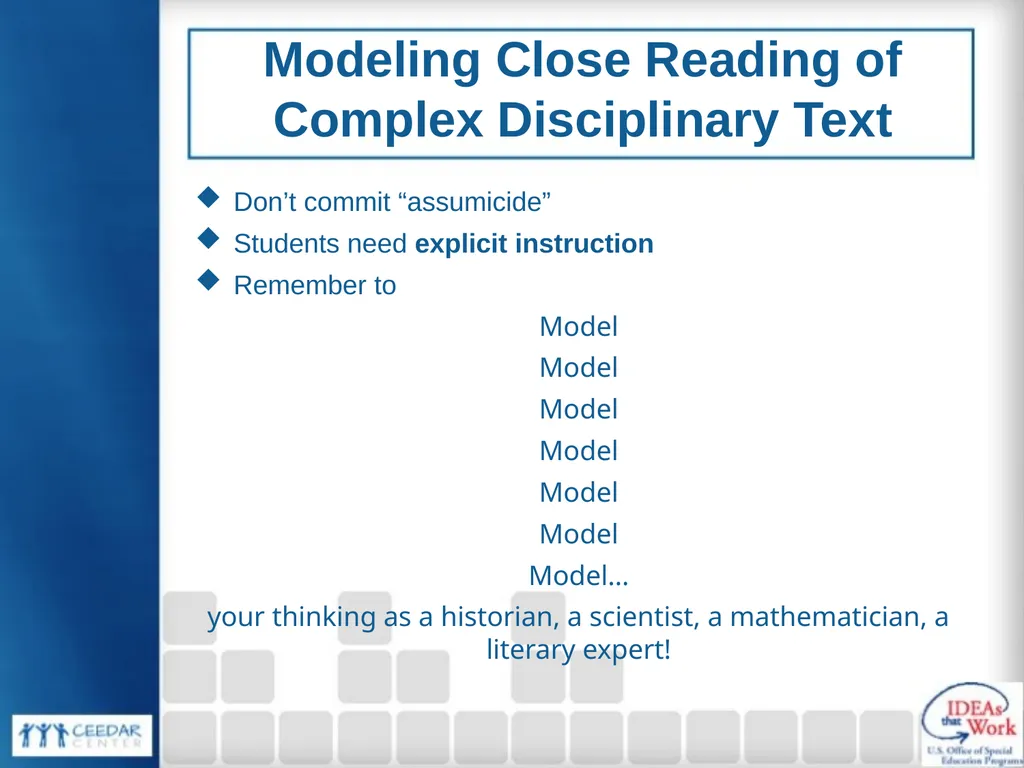
Modeling Close Reading of Complex Disciplinary Text Don’t commit “assumicide”
Students need explicit instruction
Remember to
Model
Model
Model
Model
Model
Model
Model…
your thinking as a historian, a scientist, a mathematician, a literary expert!<br>
Students need explicit instruction
Remember to
Model
Model
Model
Model
Model
Model
Model…
your thinking as a historian, a scientist, a mathematician, a literary expert!<br>
40
Let’s Try It! Read an article by Thomas Paine.
Be prepared to tell me the main idea.<br>
Be prepared to tell me the main idea.<br>
41
POP QUIZ! Who was Thomas Paine?
To whom did he write?
Why did he write this?
What is the main idea?
Write a five-paragraph essay explaining why you agree or disagree with the author.
THIS IS A NONEXAMPLE! THIS IS NOT BEST PRACTICE! DO NOT DO THIS!<br>
To whom did he write?
Why did he write this?
What is the main idea?
Write a five-paragraph essay explaining why you agree or disagree with the author.
THIS IS A NONEXAMPLE! THIS IS NOT BEST PRACTICE! DO NOT DO THIS!<br>
42
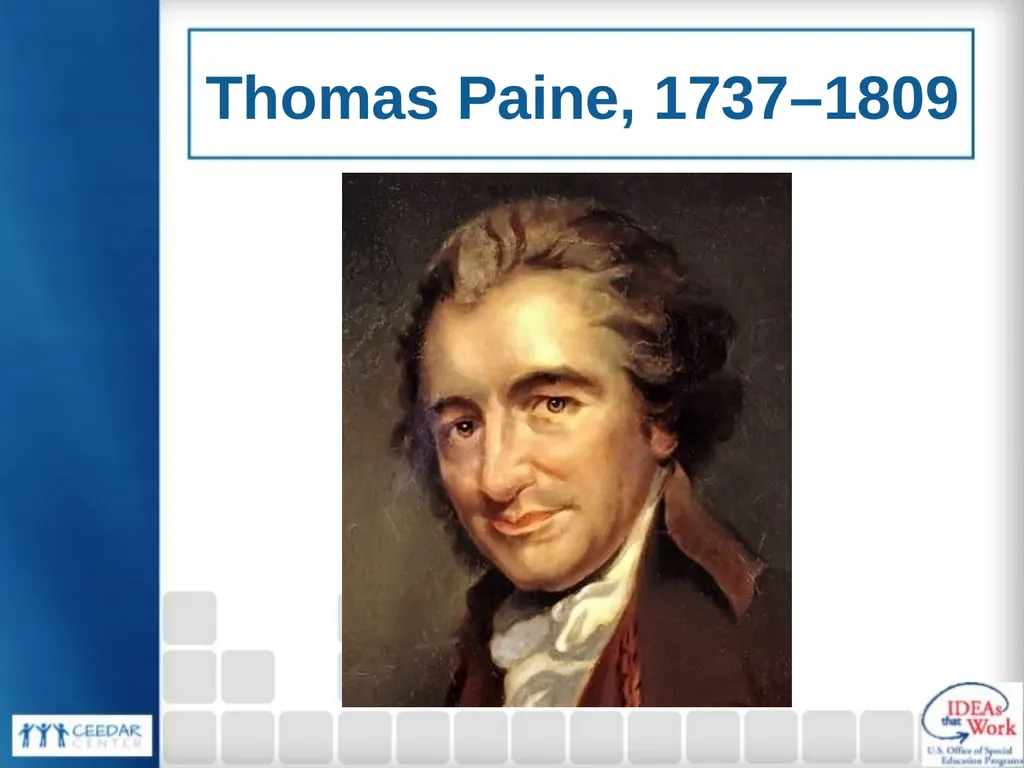
Thomas Paine, 1737–1809<br>
43
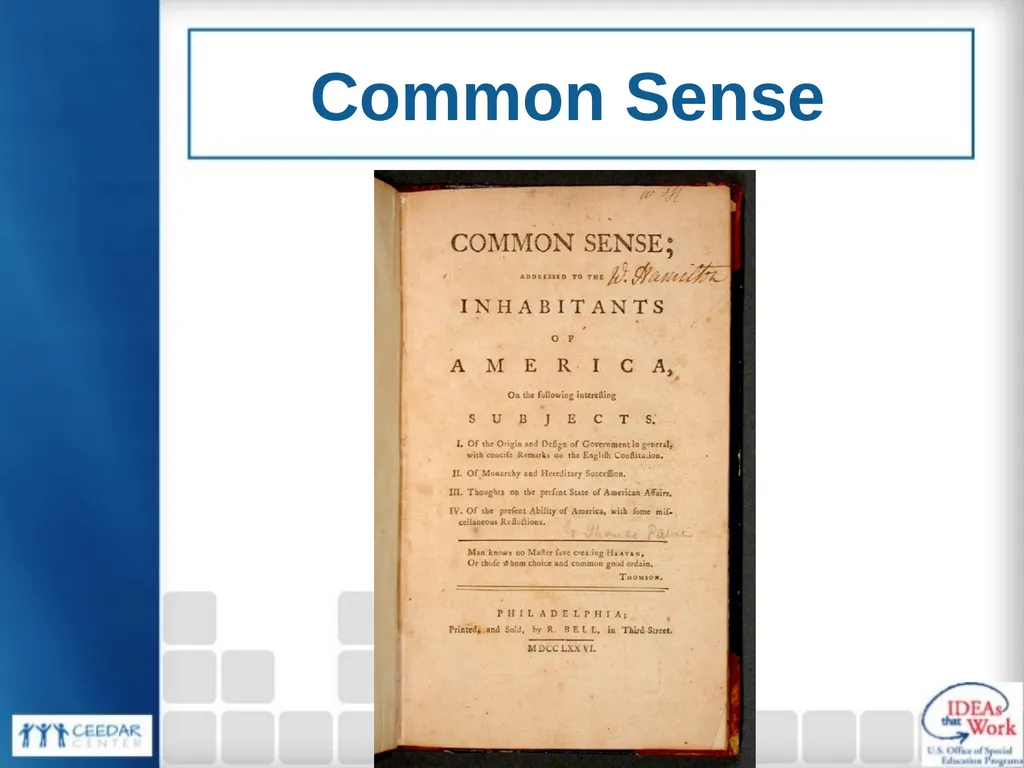
Common Sense<br>
44
Model: Think Aloud What strategies does this teacher model that help solve comprehension problems?
Watch “A Better Example”<br>
Watch “A Better Example”<br>
45
Practice Think Alouds Partner A reads and thinks aloud while solving comprehension problems
Partner B scribes A’s think alouds
Switch roles
Compare strategies used<br>
Partner B scribes A’s think alouds
Switch roles
Compare strategies used<br>
46
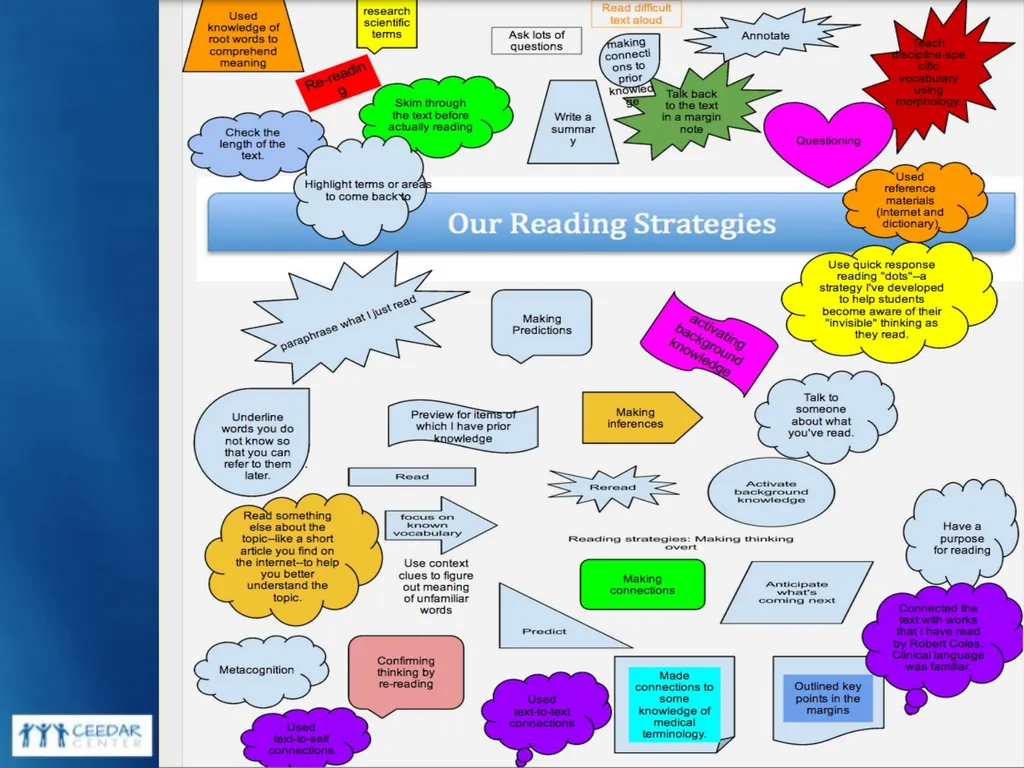
Strategies Good Readers Use With your partner, list the strategies you used
Add to the class poster of effective strategies
Circle the strategies that pertain to the discipline
Underline generic strategies<br>
Add to the class poster of effective strategies
Circle the strategies that pertain to the discipline
Underline generic strategies<br>
47
Metacognitive Thoughts Illustrate… Accessing of prior knowledge
Awareness of rhetorical devices
Use of imagery and visualization
Linking of information with prior knowledge (also text to text)
Use of context clues to find word meaning<br>
Awareness of rhetorical devices
Use of imagery and visualization
Linking of information with prior knowledge (also text to text)
Use of context clues to find word meaning<br>
48
Metacognitive Thoughts Illustrate
continued… Accessing vocabulary knowledge
Monitoring understanding (infer text and fix-up)
Identifying unknown vocabulary<br>
Monitoring understanding (infer text and fix-up)
Identifying unknown vocabulary<br>
49
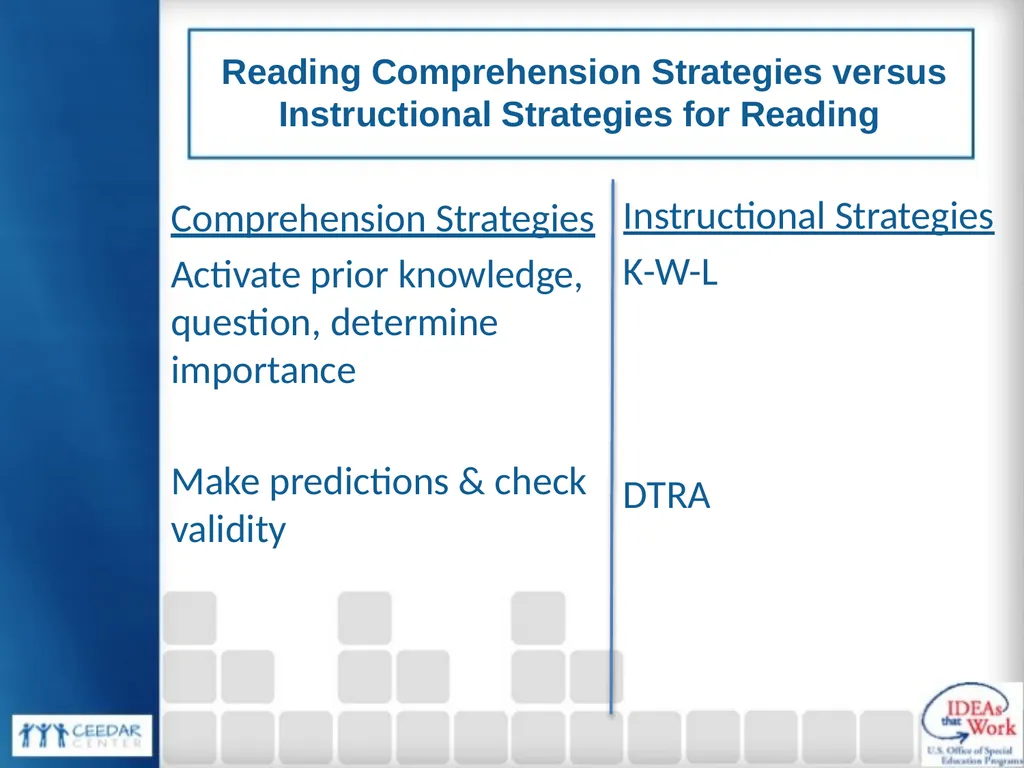
Reading Comprehension Strategies versus Instructional Strategies for Reading Comprehension Strategies
Activate prior knowledge, question, determine importance
Make predictions & check validity Instructional Strategies
K-W-L
DTRA<br>
Activate prior knowledge, question, determine importance
Make predictions & check validity Instructional Strategies
K-W-L
DTRA<br>
50
CCSS & Students with Disabilities “The Standards allow for the widest possible range of students to participate fully from the outset and with appropriate accommodations to ensure maximum participation of students with special education needs.”
Source: Common Core State Standards, p 9.<br>
Source: Common Core State Standards, p 9.<br>
51
Differentiation of Instruction Students who struggle are heterogeneous & require individualized planning
Students with reading difficulties or disabilities
English Language Learners
Others
Consider:
Access to learn the material
Opportunities to practice
Multiple ways to demonstrate new knowledge<br>
Students with reading difficulties or disabilities
English Language Learners
Others
Consider:
Access to learn the material
Opportunities to practice
Multiple ways to demonstrate new knowledge<br>
52
Universal Design for Learning Provide multiple means of representation
Provide multiple means of action and expression
Provide multiple means of engagement
http://www.udlcenter.org/
Brainstorm!!<br>
Provide multiple means of action and expression
Provide multiple means of engagement
http://www.udlcenter.org/
Brainstorm!!<br>
53
Access Audio recordings of material
Partner reads
Modified or different text on same theme
Assistive Technology
Preteach text
Preteach decoding & meaning of difficult vocabulary
Explicit modeling of expected skills
Systematic instruction with scaffolding<br>
Partner reads
Modified or different text on same theme
Assistive Technology
Preteach text
Preteach decoding & meaning of difficult vocabulary
Explicit modeling of expected skills
Systematic instruction with scaffolding<br>
54
Demonstration of Knowledge Presentations integrating technology
Visual arts
Music
Performance
Debate
Role play
Project based<br>
Visual arts
Music
Performance
Debate
Role play
Project based<br>
55
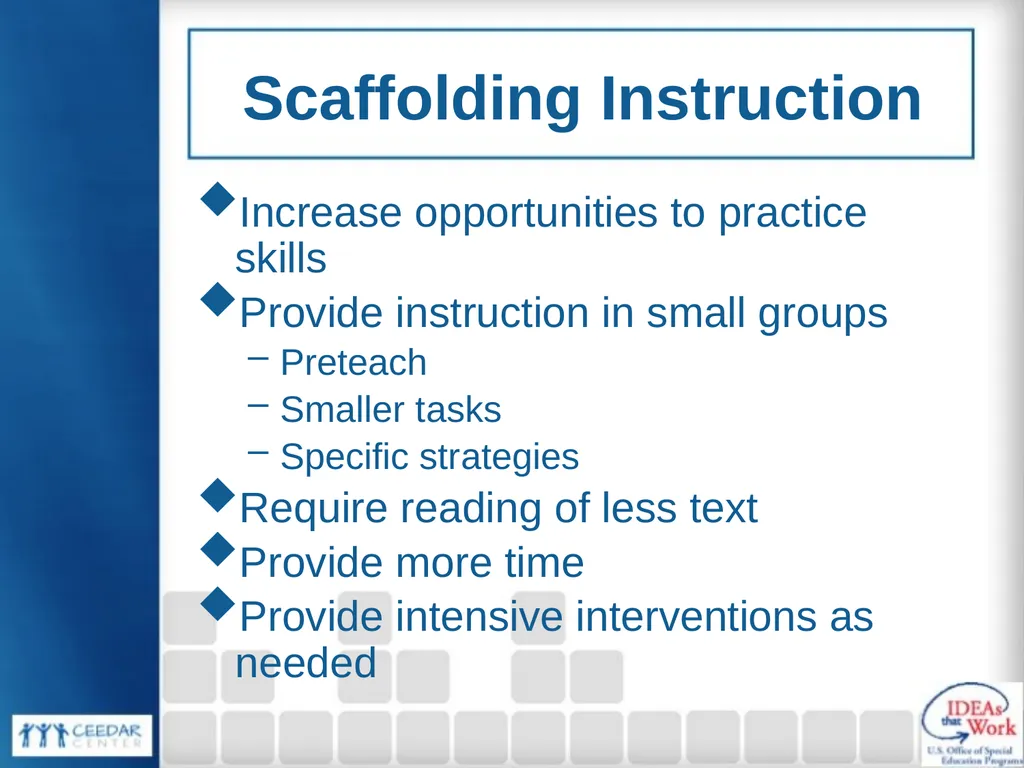
Scaffolding Instruction Increase opportunities to practice skills
Provide instruction in small groups
Preteach
Smaller tasks
Specific strategies
Require reading of less text
Provide more time
Provide intensive interventions as needed<br>
Provide instruction in small groups
Preteach
Smaller tasks
Specific strategies
Require reading of less text
Provide more time
Provide intensive interventions as needed<br>
56
Scaffolding Struggling Students
Researcher’s Reflections Don Deshler, Ph.D.
The University of Kansas
Center for Research on Learning
Listen to Dr. Deshler on teacher balance
What do we need to do on the instructional front to enable students to engage in and respond to expectations required by the readings in their classes?<br>
The University of Kansas
Center for Research on Learning
Listen to Dr. Deshler on teacher balance
What do we need to do on the instructional front to enable students to engage in and respond to expectations required by the readings in their classes?<br>
57
Returning to Paine… With your partner, consider how you would modify this lesson to ensure ALL students have access to the learning.
Consider students who:
Are struggling readers
Have a learning disability
Are English Language Learners<br>
Consider students who:
Are struggling readers
Have a learning disability
Are English Language Learners<br>
58
The Reading IC Documents evidence based practices in disciplinary literacy
Indicates level of implementation from awareness to application with students
Supports curriculum alignment throughout program<br>
Indicates level of implementation from awareness to application with students
Supports curriculum alignment throughout program<br>
59
Application Activity!! Review the Paine lesson plan
Create a lesson including
2 or more metacognitive reading strategies
Teach the lesson
Reflect: How would you teach it differently next time?
Be prepared to discuss<br>
Create a lesson including
2 or more metacognitive reading strategies
Teach the lesson
Reflect: How would you teach it differently next time?
Be prepared to discuss<br>
60
What is Disciplinary Literacy? EXIT CARD
Write a definition of disciplinary literacy, as you interpret it now.
Provide an example from your field.<br>
Write a definition of disciplinary literacy, as you interpret it now.
Provide an example from your field.<br>
61
Course Enhancement Modules<br>
62
Disclaimer The contents of this webinar were developed under a cooperative agreement from the U.S. Department of Education, H325A120003. However, those contents do not necessarily
represent the policy of the U.S. Department of Education, and you should not assume endorsement by the Federal government.<br>
represent the policy of the U.S. Department of Education, and you should not assume endorsement by the Federal government.<br>