Coma and Brain Death Objectives Define Coma and altered consciousness Understand the brain death exam Altered Level of Consciousness Coma: unconscious state Does not respond to stimuli appropriately Eyes closed, no purposeful motor
"Coma and Brain Death Objectives Define Coma and" is the property of its rightful owner. Permission is granted to
download and print the materials on this website for personal, non-commercial use only, and to display it
on your personal computer provided you do not modify the materials and that you retain all copyright
notices contained in the materials. By downloading content from our website, you accept the terms of this
agreement.
Presentation Transcript
01
Coma and Brain Death<br>
02
Objectives Define Coma and altered consciousness
Understand the brain death exam<br>
03
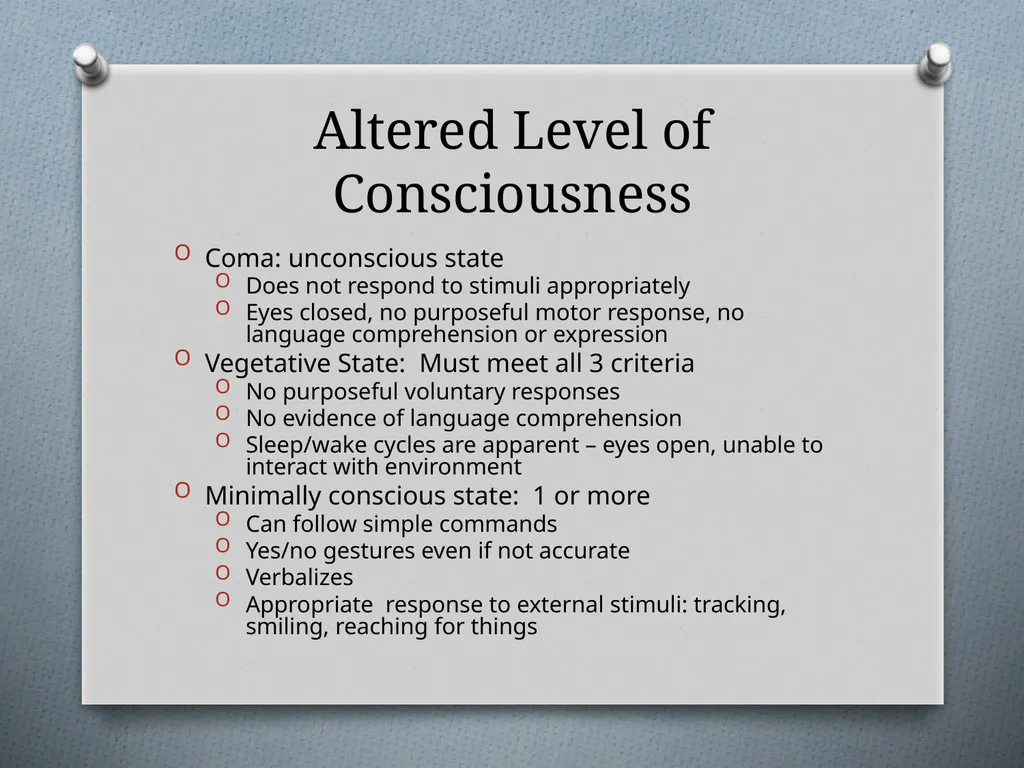
Altered Level of Consciousness Coma: unconscious state
Does not respond to stimuli appropriately
Eyes closed, no purposeful motor response, no language comprehension or expression
Vegetative State: Must meet all 3 criteria
No purposeful voluntary responses
No evidence of language comprehension
Sleep/wake cycles are apparent – eyes open, unable to interact with environment
Minimally conscious state: 1 or more
Can follow simple commands
Yes/no gestures even if not accurate
Verbalizes
Appropriate response to external stimuli: tracking, smiling, reaching for things<br>
04
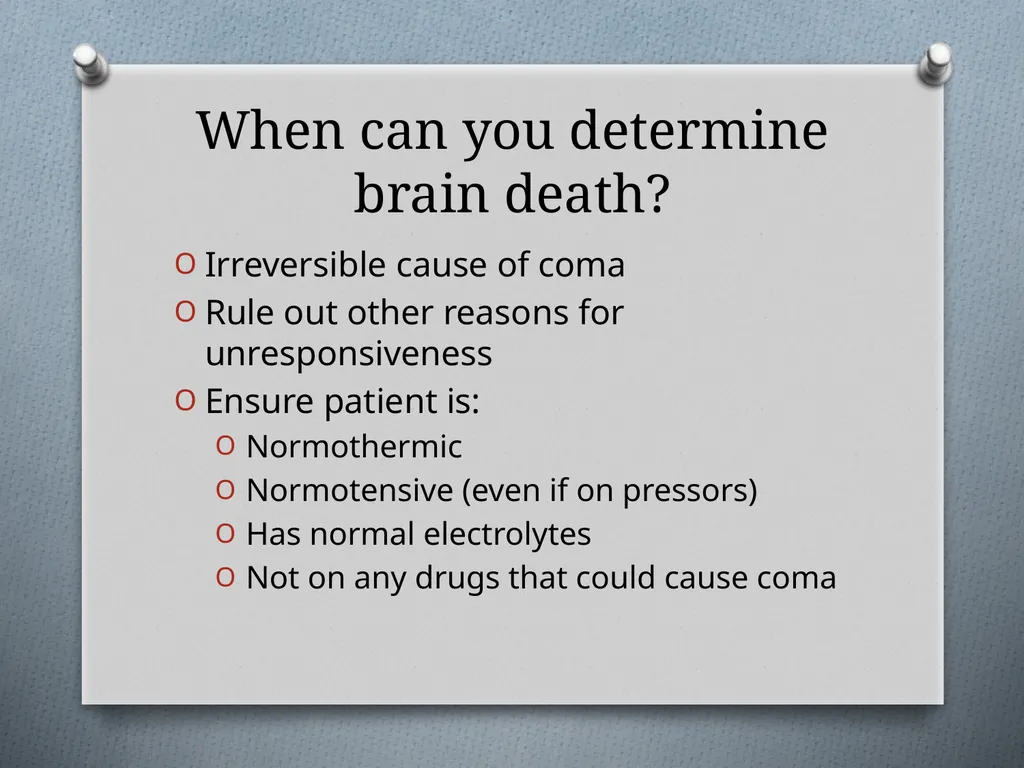
When can you determine brain death? Irreversible cause of coma
Rule out other reasons for unresponsiveness
Ensure patient is:
Normothermic
Normotensive (even if on pressors)
Has normal electrolytes
Not on any drugs that could cause coma<br>
05
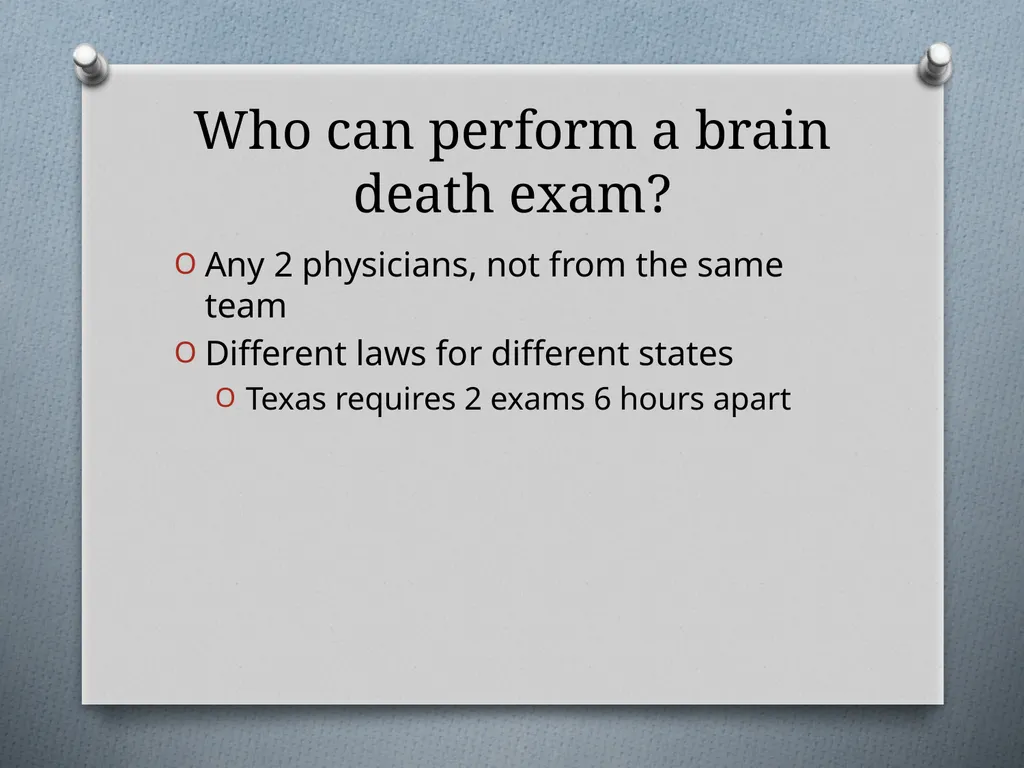
Who can perform a brain death exam? Any 2 physicians, not from the same team
Different laws for different states
Texas requires 2 exams 6 hours apart<br>
06
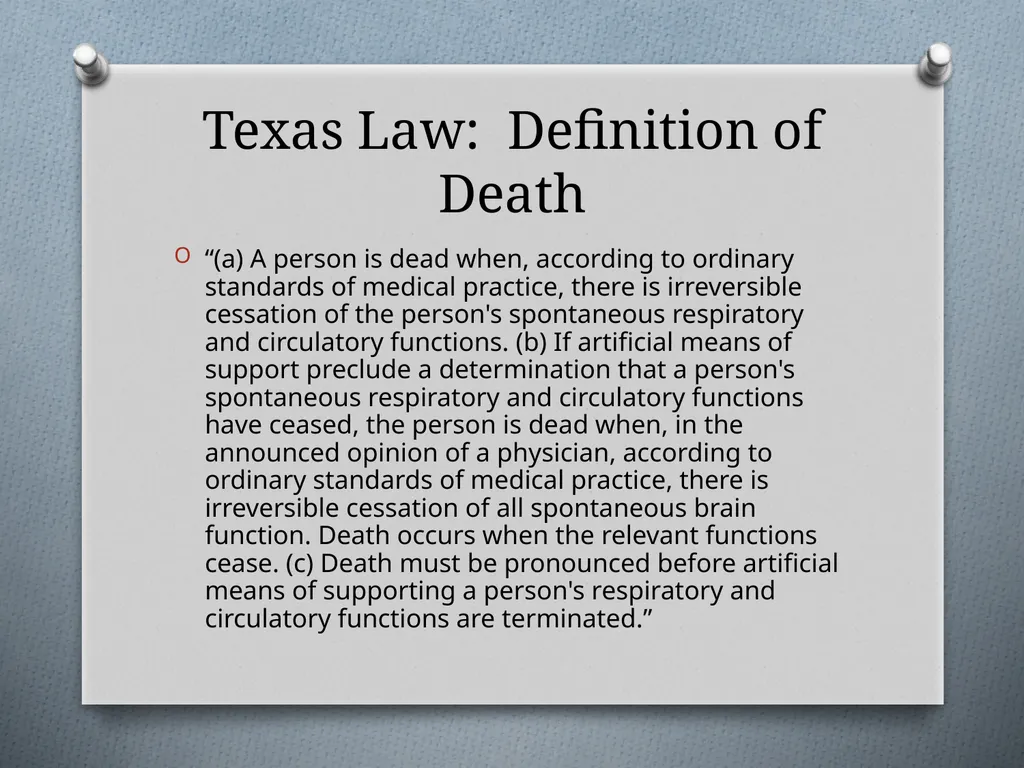
Texas Law: Definition of Death “(a) A person is dead when, according to ordinary standards of medical practice, there is irreversible cessation of the person's spontaneous respiratory and circulatory functions. (b) If artificial means of support preclude a determination that a person's spontaneous respiratory and circulatory functions have ceased, the person is dead when, in the announced opinion of a physician, according to ordinary standards of medical practice, there is irreversible cessation of all spontaneous brain function. Death occurs when the relevant functions cease. (c) Death must be pronounced before artificial means of supporting a person's respiratory and circulatory functions are terminated.”<br>
07
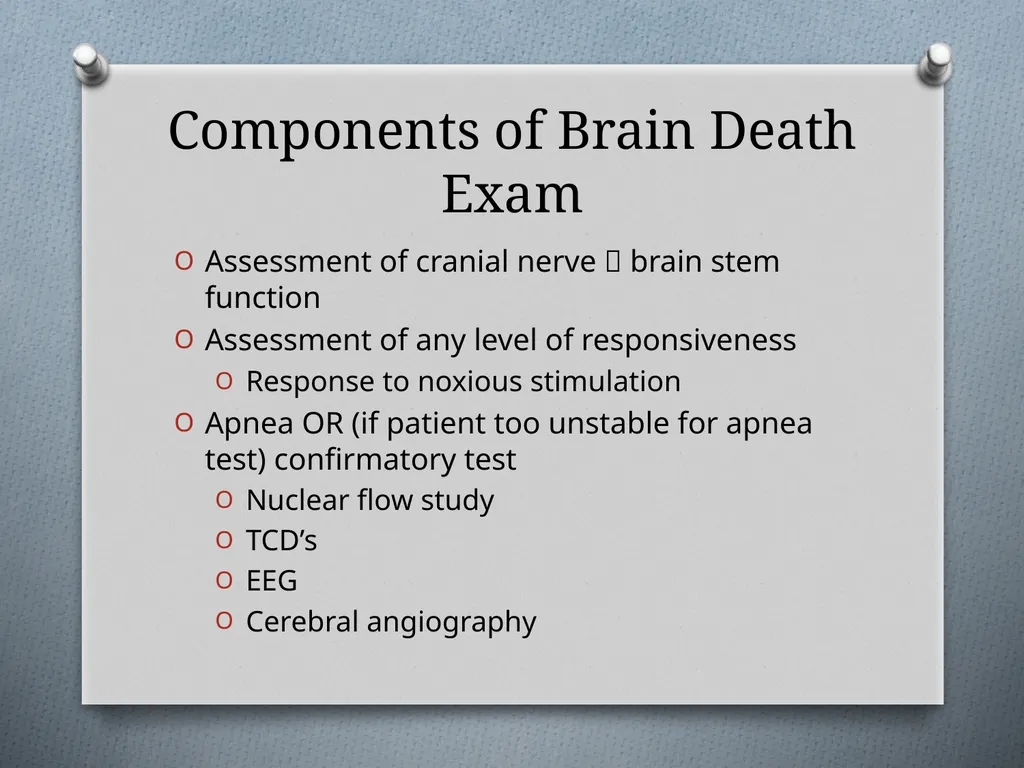
Components of Brain Death Exam Assessment of cranial nerve brain stem function
Assessment of any level of responsiveness
Response to noxious stimulation
Apnea OR (if patient too unstable for apnea test) confirmatory test
Nuclear flow study
TCD’s
EEG
Cerebral angiography<br>
08
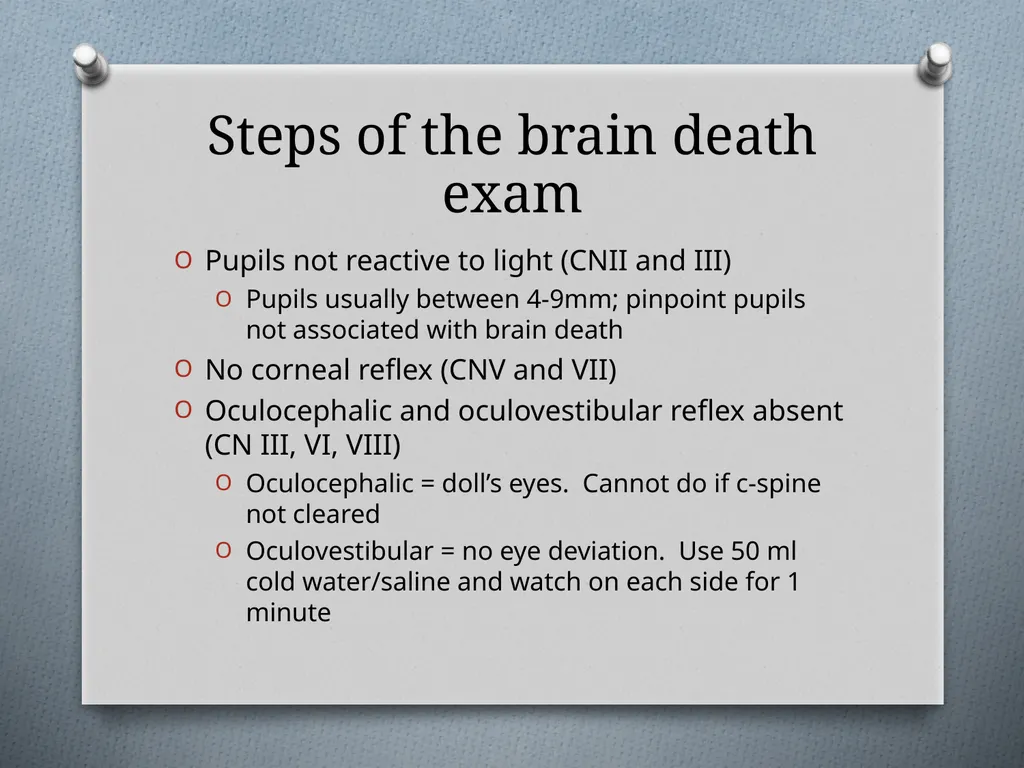
Steps of the brain death exam Pupils not reactive to light (CNII and III)
Pupils usually between 4-9mm; pinpoint pupils not associated with brain death
No corneal reflex (CNV and VII)
Oculocephalic and oculovestibular reflex absent (CN III, VI, VIII)
Oculocephalic = doll’s eyes. Cannot do if c-spine not cleared
Oculovestibular = no eye deviation. Use 50 ml cold water/saline and watch on each side for 1 minute<br>
09
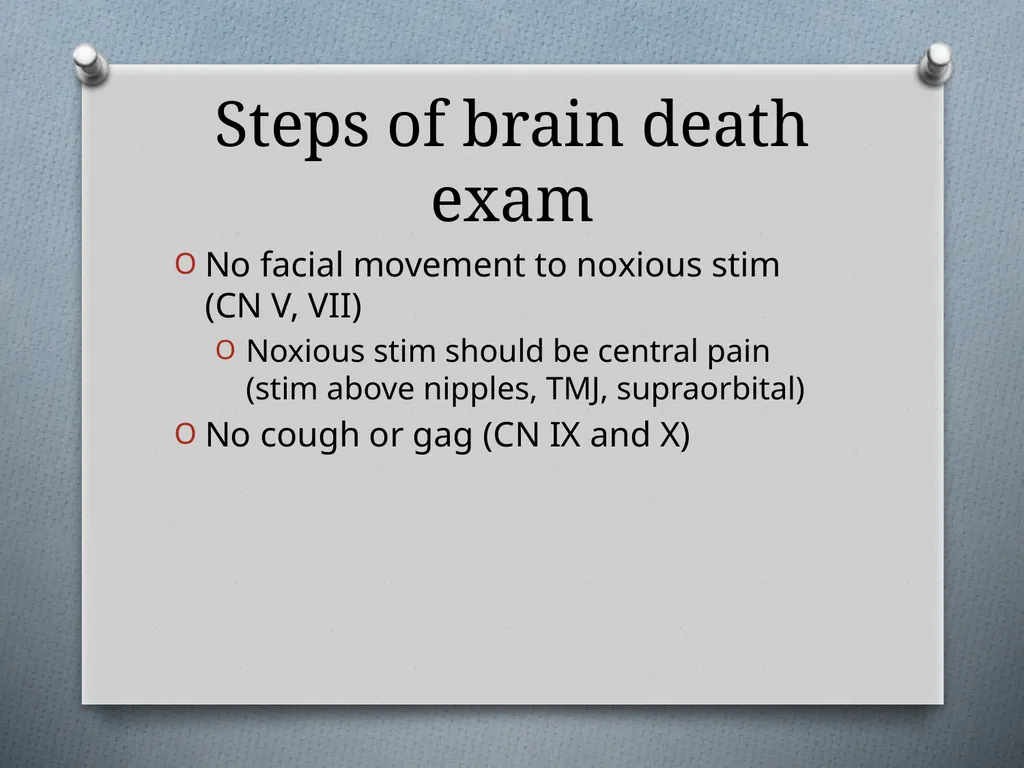
Steps of brain death exam No facial movement to noxious stim (CN V, VII)
Noxious stim should be central pain (stim above nipples, TMJ, supraorbital)
No cough or gag (CN IX and X)<br>
10
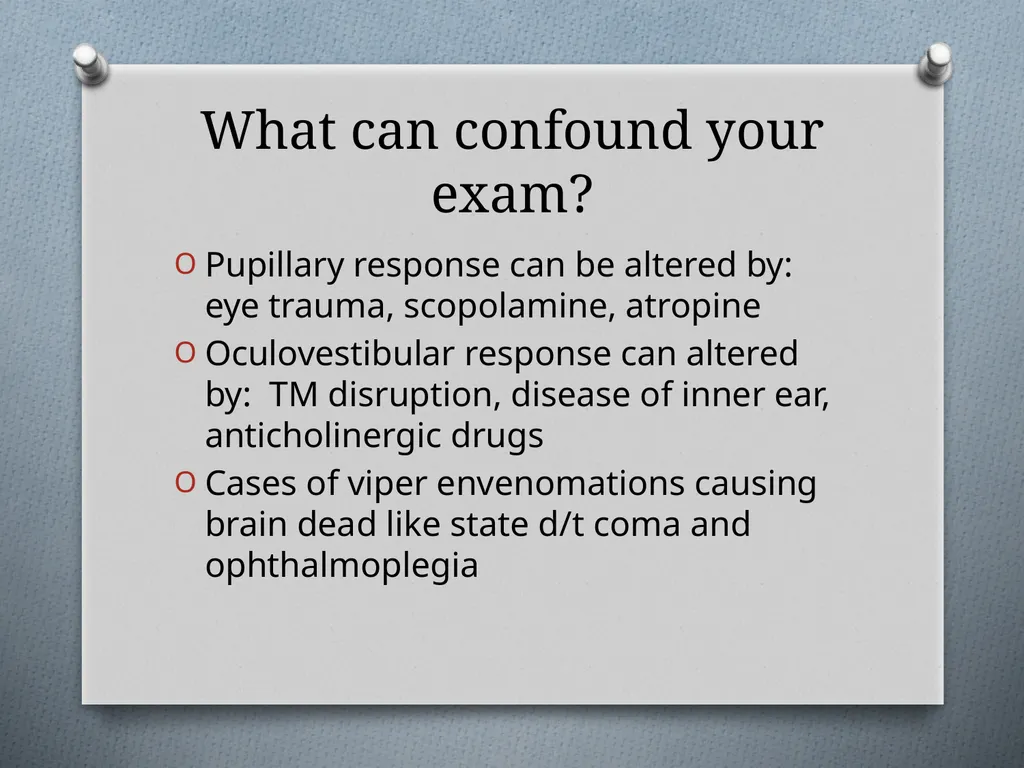
What can confound your exam? Pupillary response can be altered by: eye trauma, scopolamine, atropine
Oculovestibular response can altered by: TM disruption, disease of inner ear, anticholinergic drugs
Cases of viper envenomations causing brain dead like state d/t coma and ophthalmoplegia<br>
11
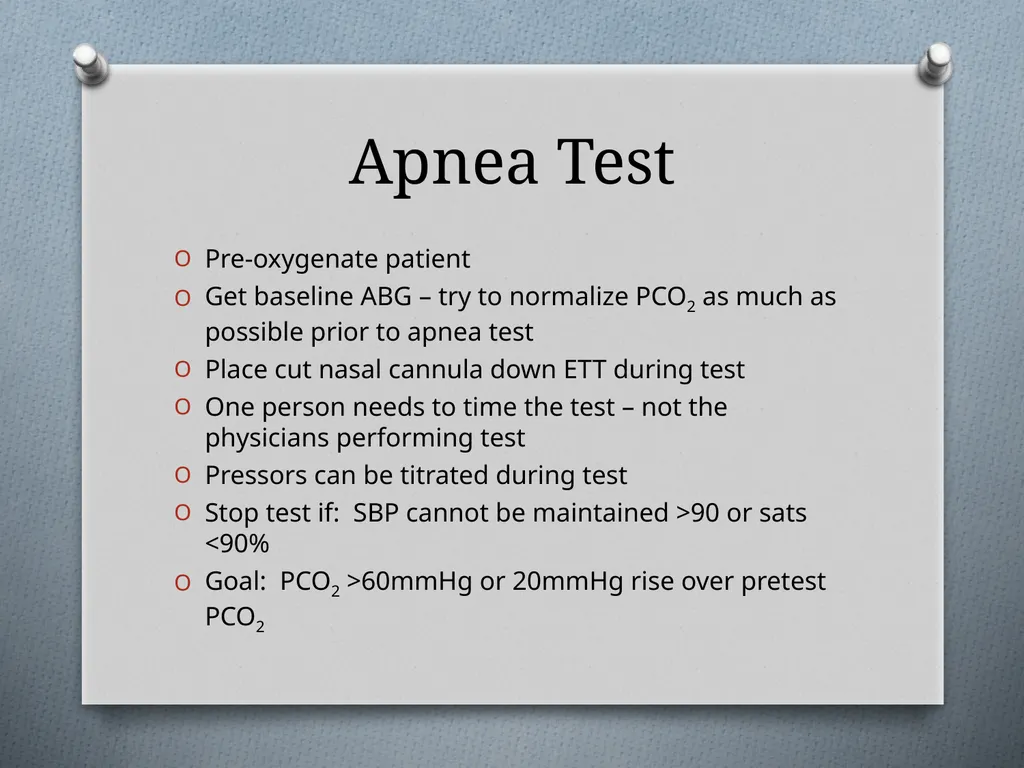
Apnea Test Pre-oxygenate patient
Get baseline ABG – try to normalize PCO2 as much as possible prior to apnea test
Place cut nasal cannula down ETT during test
One person needs to time the test – not the physicians performing test
Pressors can be titrated during test
Stop test if: SBP cannot be maintained >90 or sats <90%
Goal: PCO2 >60mmHg or 20mmHg rise over pretest PCO2<br>
12
Neurologic Exam Apnea test:
Prerequisites: normotensive, normothermia, eucapnia, normoxia
Patient should be preoxygenated for at least 10 minutes
Check PCO2 prior to test
Remove patient from ventilator, supply O2 and watch for breathing for 8-10 minutes
Stop test if sats <85% or SBP <90
Can use a t-piece with CPAP
PCO2 >60 or 20mmHg above starting point
Inconclusive tests can be repeated<br>
13
Brain Death Ancillary Tests: EEG, angio, nuclear scan, TCD, CTA, MRA
Not necessary
Used if apnea test unable to be done
In lieu of repeat exam
Documentation: time of death
Time when POC2 reached target level
Time when ancillary test results reported
TOSA required to be contacted once brain death confirmed<br>
14
Can patients move when thy are brain dead? One study showed up to 55% of patients have movements when brain dead
Movements such as:
Spinal reflexes causing movement of limbs other then posturing
Sweating, flushing
DTR’s
Breathing-like movements<br>