Commercialisation Alternative Models of Service Delivery CIPFA in the North East Professional Update Day Gavin Barker, Senior Manager Wednesday 16 March 2016, Rivergreen, Durham What well consider today What is commercialisation and do
"Commercialisation – Alternative Models of Service" is the property of its rightful owner. Permission is granted to
download and print the materials on this website for personal, non-commercial use only, and to display it
on your personal computer provided you do not modify the materials and that you retain all copyright
notices contained in the materials. By downloading content from our website, you accept the terms of this
agreement.
Presentation Transcript
01
Commercialisation – Alternative Models of Service Delivery CIPFA in the North East Professional Update Day Gavin Barker, Senior Manager
Wednesday 16 March 2016, Rivergreen, Durham<br>
02
What we’ll consider today What is commercialisation / and do we have commercial skills?
The drivers for commercialisation in local government
Some of the alternative models of service delivery that have emerged
Governance and risks
The role of the public finance professional<br>
03
Do we have the commercial skills we need? Does the public finance professional have commercial skills (compared to the private sector)?
Less than
About the same
More than<br>
04
What is commercialisation / what are commercial skills? Commercialisation /commercial skills;
What do these terms mean for you?<br>
05
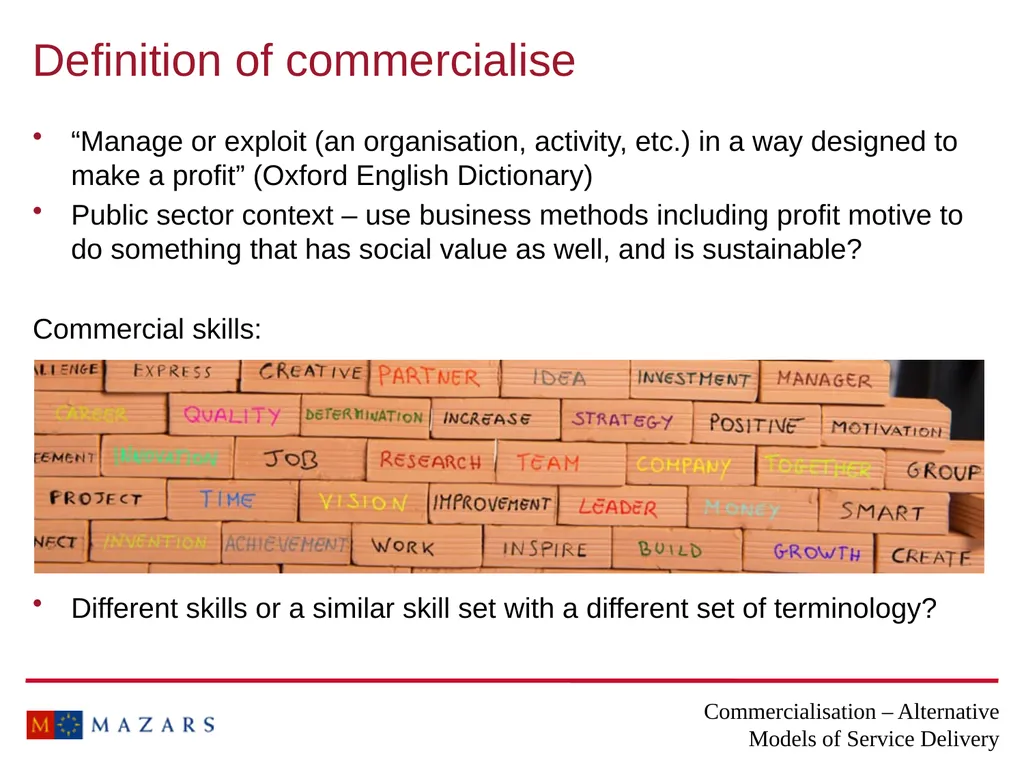
Definition of commercialise “Manage or exploit (an organisation, activity, etc.) in a way designed to make a profit” (Oxford English Dictionary)
Public sector context – use business methods including profit motive to do something that has social value as well, and is sustainable?
Commercial skills:
Different skills or a similar skill set with a different set of terminology?<br>
06
What will commercialisation be like? More business planning
Financial forecasting with many assumptions and unknowns
Focus on keeping costs low / generating more income
More timely management accounts / monthly balance sheets - cash flow becomes critical
Profit and loss v income and expenditure
Producing / considering company accounts
Needing to be more responsive, innovative and seize new opportunities
Constant change
Is it really that different to what we do anyway?<br>
07
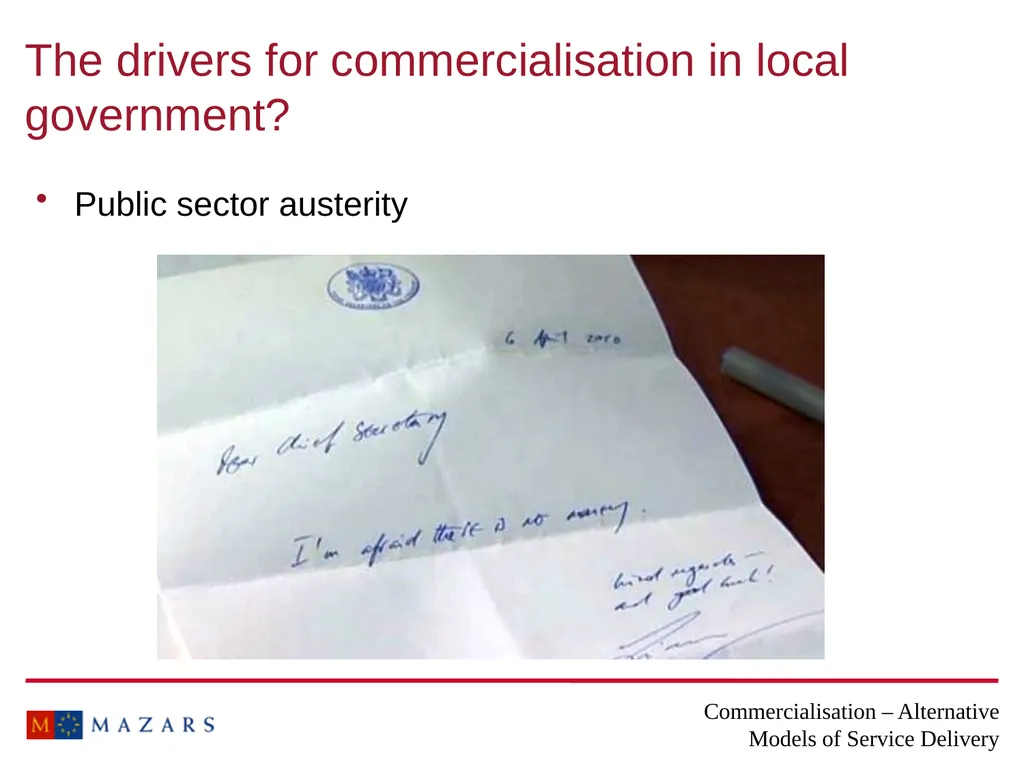
The drivers for commercialisation in local government? Public sector austerity<br>
08
“Local government and the wider public sector is facing greater change and transformation than ever before, driven by austerity, significant cuts in public spending and a sharper focus on improving services and achieving better outcomes for local people.”
Self financing – council tax and business rates
Less central support for areas of deprivation
Devolution<br>
09
Significant changes are likely to include:
new and innovative models of service delivery
commissioning services rather than directly providing them
making services more self financing and sustainable
managing demand and reducing reliance on the public sector
working more closely with partners and the voluntary sector
building community capacity and resilience<br>
10
Some of the alternative models of service delivery that have emerged<br>
11
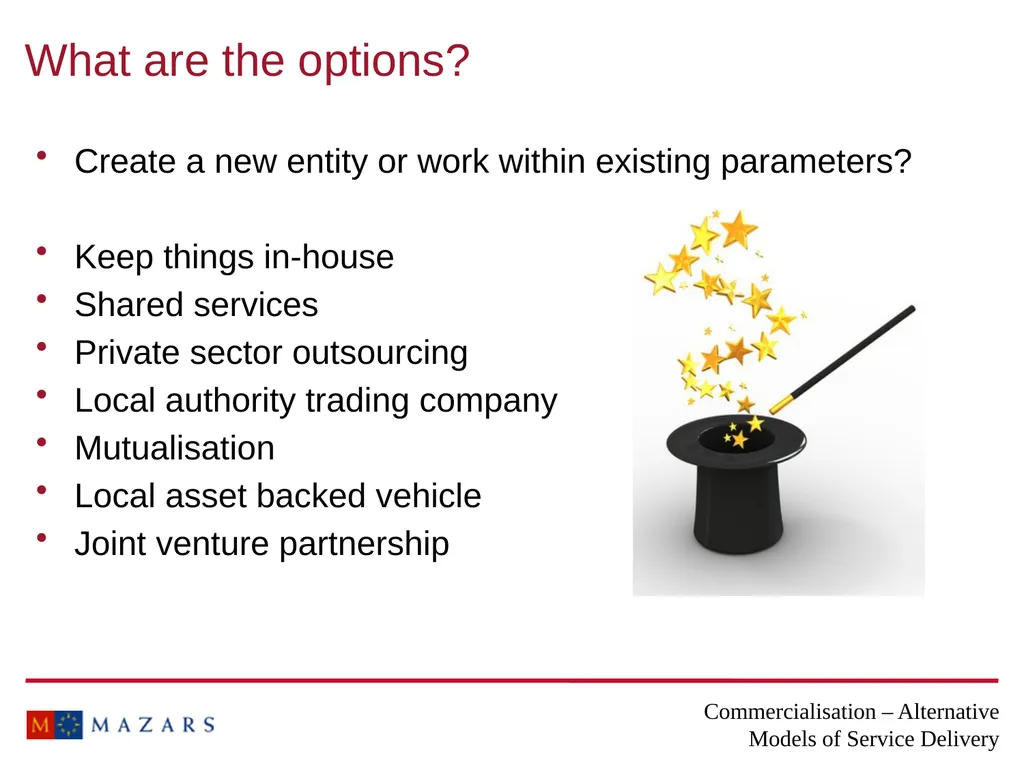
What are the options? Create a new entity or work within existing parameters?
Keep things in-house
Shared services
Private sector outsourcing
Local authority trading company
Mutualisation
Local asset backed vehicle
Joint venture partnership<br>
12
Governance and risks Governance and risk management starts with the public body
Option appraisal and developing the business case
Consider appropriate models and structures
If creating a new entity, align its objectives with what the public body is seeking to achieve
Although a new entity may bring benefits, its likely to create more complicated governance arrangements
When choosing a preferred option, ensure the governance framework is fit for purpose … from the outset<br>
13
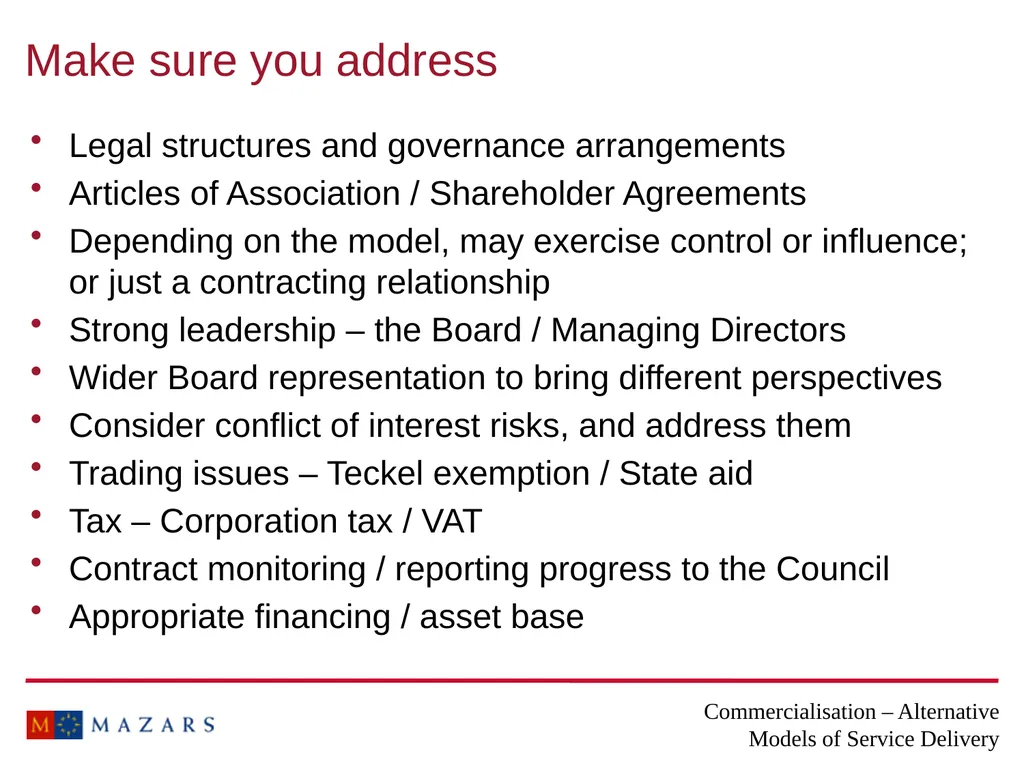
Make sure you address Legal structures and governance arrangements
Articles of Association / Shareholder Agreements
Depending on the model, may exercise control or influence; or just a contracting relationship
Strong leadership – the Board / Managing Directors
Wider Board representation to bring different perspectives
Consider conflict of interest risks, and address them
Trading issues – Teckel exemption / State aid
Tax – Corporation tax / VAT
Contract monitoring / reporting progress to the Council
Appropriate financing / asset base<br>
14
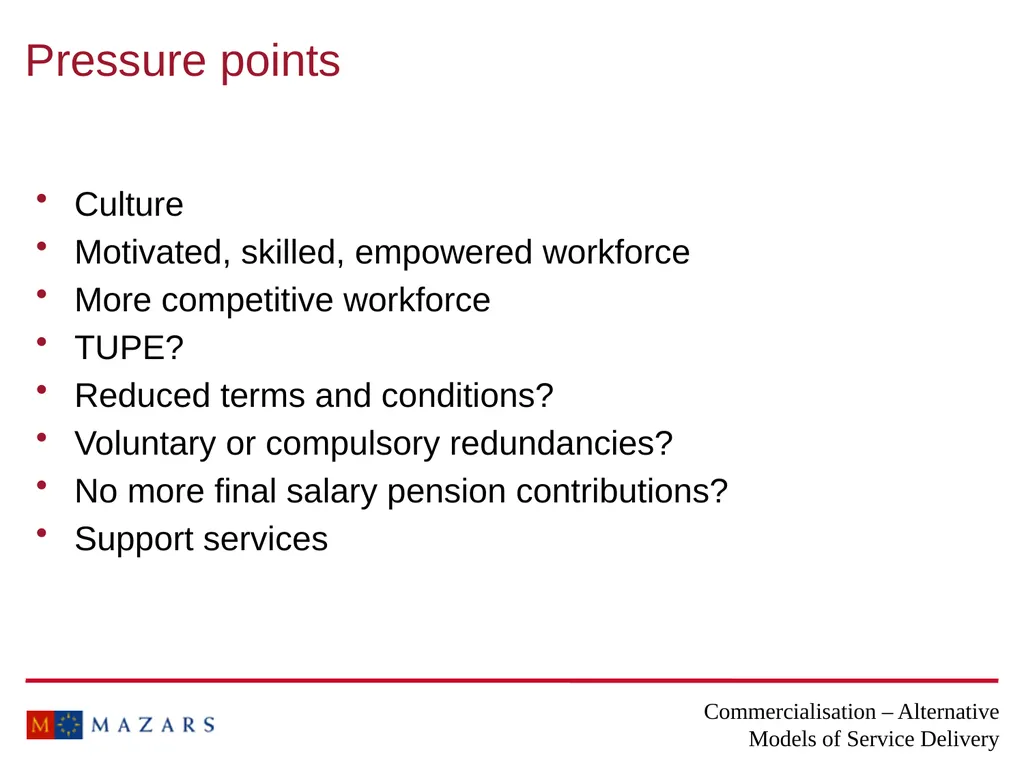
Pressure points Culture
Motivated, skilled, empowered workforce
More competitive workforce
TUPE?
Reduced terms and conditions?
Voluntary or compulsory redundancies?
No more final salary pension contributions?
Support services<br>
15
Do we have the commercial skills we need? Having discussed this further, have your views changed of the public finance professional’s commercial skills (compared to the private sector)?
Less than
About the same
More than<br>