
Common Course Numbering Curriculum

Description: Common Course Numbering Curriculum RegionalMerritt College November 16, 2024 Presenters Cheryl Aschenbach, ASCCC President Erik D. Reese, ASCCC Area C Representative 2 Outline Common Course Numbering (CCN) History Vision Progress to
Related Topics
Download Presentation
"Common Course Numbering Curriculum" is the property of its rightful owner. Permission is granted to download and print the materials on this website for personal, non-commercial use only, and to display it on your personal computer provided you do not modify the materials and that you retain all copyright notices contained in the materials. By downloading content from our website, you accept the terms of this agreement.
Presentation Transcript
slide1. Common Course Numbering Curriculum Regional—Merritt College
November 16, 2024<br>
slide2. Presenters Cheryl Aschenbach, ASCCC President
Erik D. Reese, ASCCC Area C Representative 2<br>
slide3. Outline Common Course Numbering (CCN) History & Vision
Progress to Date: Phase 1
CCN Course Template Development: Phase II
Resources 3<br>
slide4. Common Course Numbering (CCN) History & Vision<br>
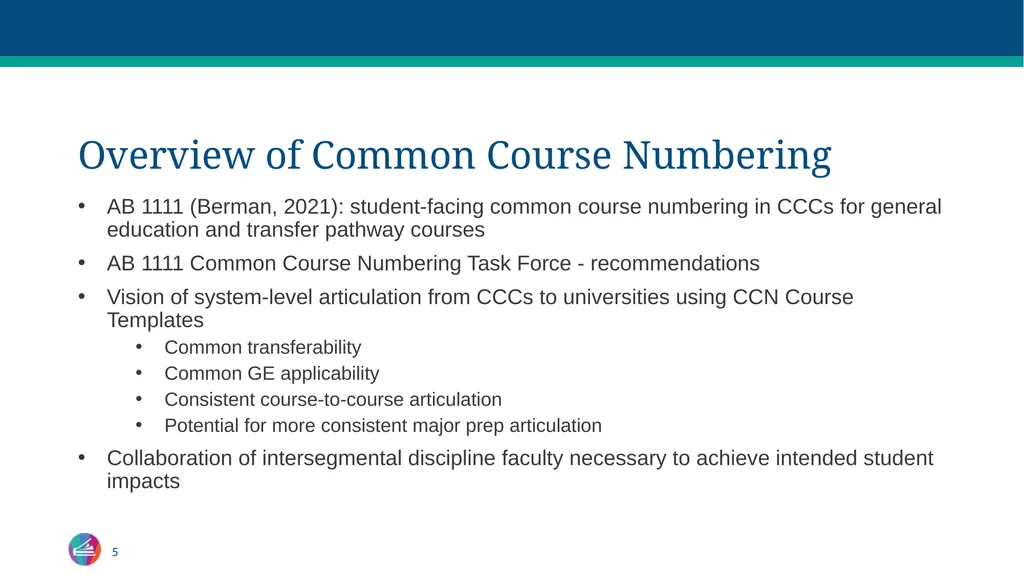
slide5. Overview of Common Course Numbering AB 1111 (Berman, 2021): student-facing common course numbering in CCCs for general education and transfer pathway courses
AB 1111 Common Course Numbering Task Force - recommendations
Vision of system-level articulation from CCCs to universities using CCN Course Templates
Common transferability
Common GE applicability
Consistent course-to-course articulation
Potential for more consistent major prep articulation
Collaboration of intersegmental discipline faculty necessary to achieve intended student impacts 5<br>
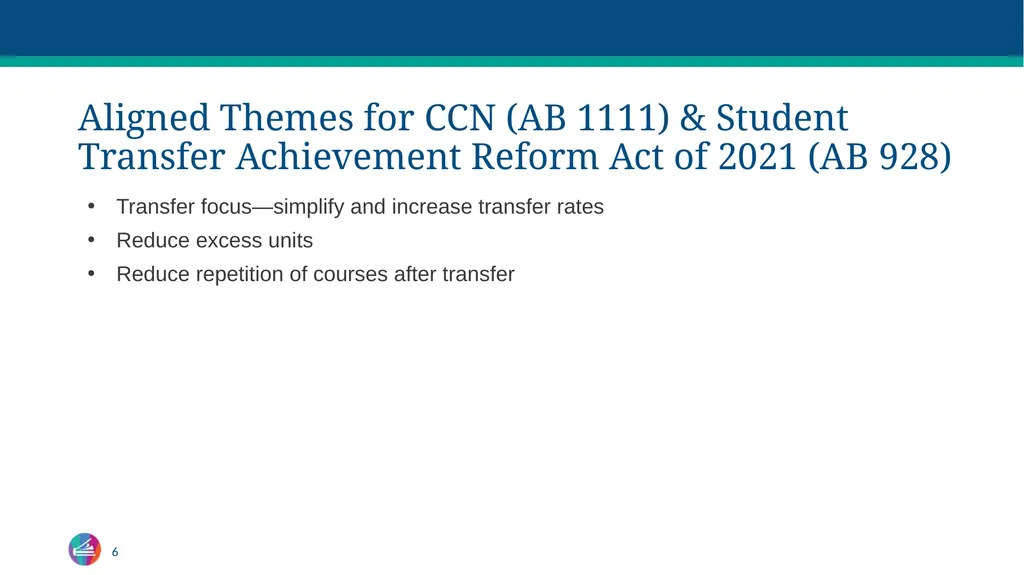
slide6. Aligned Themes for CCN (AB 1111) & Student Transfer Achievement Reform Act of 2021 (AB 928) Transfer focus—simplify and increase transfer rates
Reduce excess units
Reduce repetition of courses after transfer 6<br>
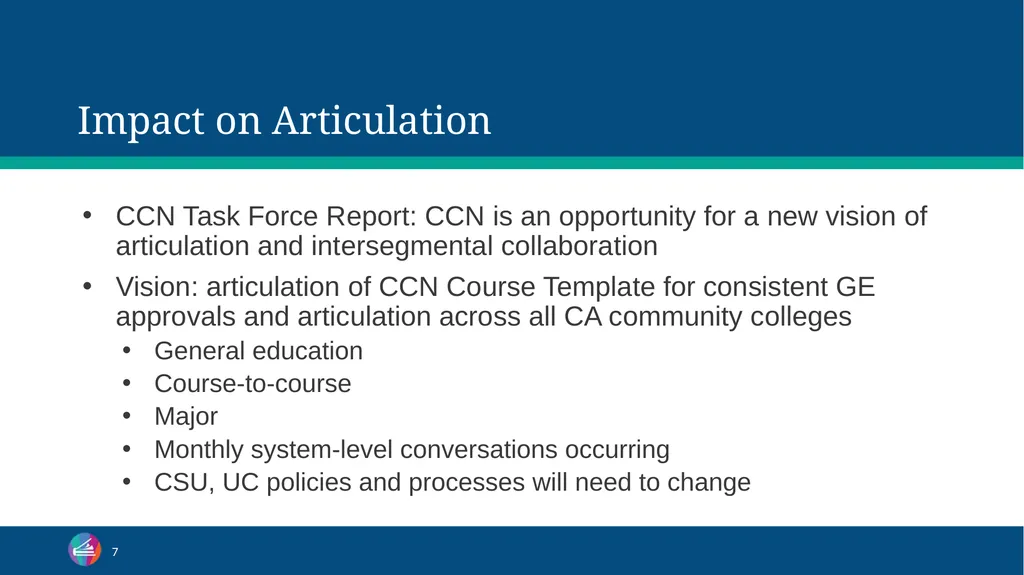
slide7. Impact on Articulation CCN Task Force Report: CCN is an opportunity for a new vision of articulation and intersegmental collaboration
Vision: articulation of CCN Course Template for consistent GE approvals and articulation across all CA community colleges
General education
Course-to-course
Major
Monthly system-level conversations occurring
CSU, UC policies and processes will need to change 7<br>
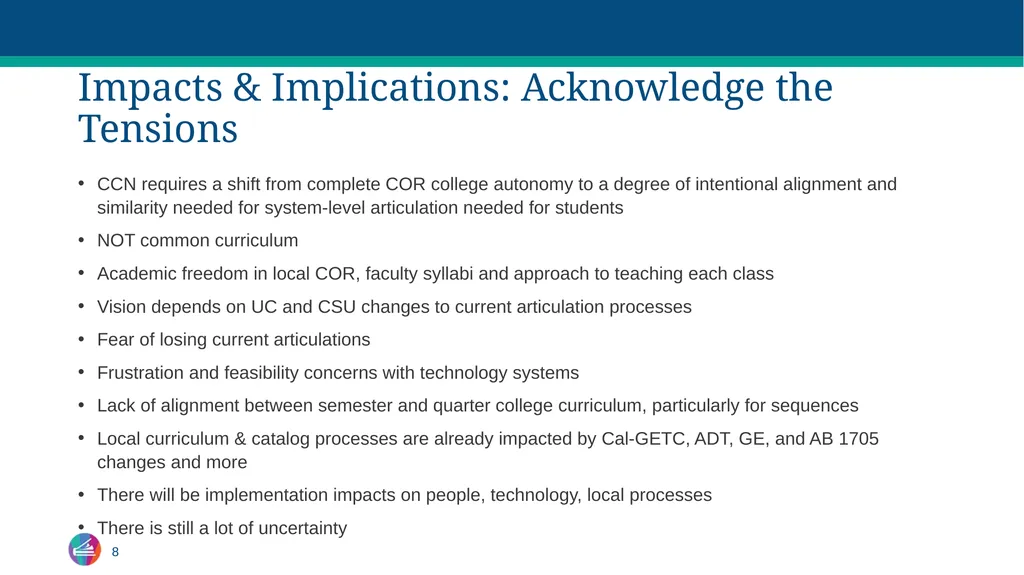
slide8. Impacts & Implications: Acknowledge the Tensions CCN requires a shift from complete COR college autonomy to a degree of intentional alignment and similarity needed for system-level articulation needed for students
NOT common curriculum
Academic freedom in local COR, faculty syllabi and approach to teaching each class
Vision depends on UC and CSU changes to current articulation processes
Fear of losing current articulations
Frustration and feasibility concerns with technology systems
Lack of alignment between semester and quarter college curriculum, particularly for sequences
Local curriculum & catalog processes are already impacted by Cal-GETC, ADT, GE, and AB 1705 changes and more
There will be implementation impacts on people, technology, local processes
There is still a lot of uncertainty 8<br>
slide9. Progress to Date: Phase I<br>
slide10. Phased Implementation Goals The CCN Task Force published their final report and proposed a phased approach to meet the mandates of AB 1111.
Phase I (2024-2025):
Faculty work in collaboration with intersegmental leadership teams to develop CCN Templates for Fall 2025 implementation
Templates for an initial set of high-enrollment courses to generate an initial set of CCN-aligned courses for fall 2025
Phase II (2024-2025)
Second cluster of courses
Evaluate and refine the development processes and templates
Test technology-based implementation
Validate intersegmental collaboration
Phase III (2026-2027)
Implement potential technology solutions and roll out the remaining transfer courses. 10<br>
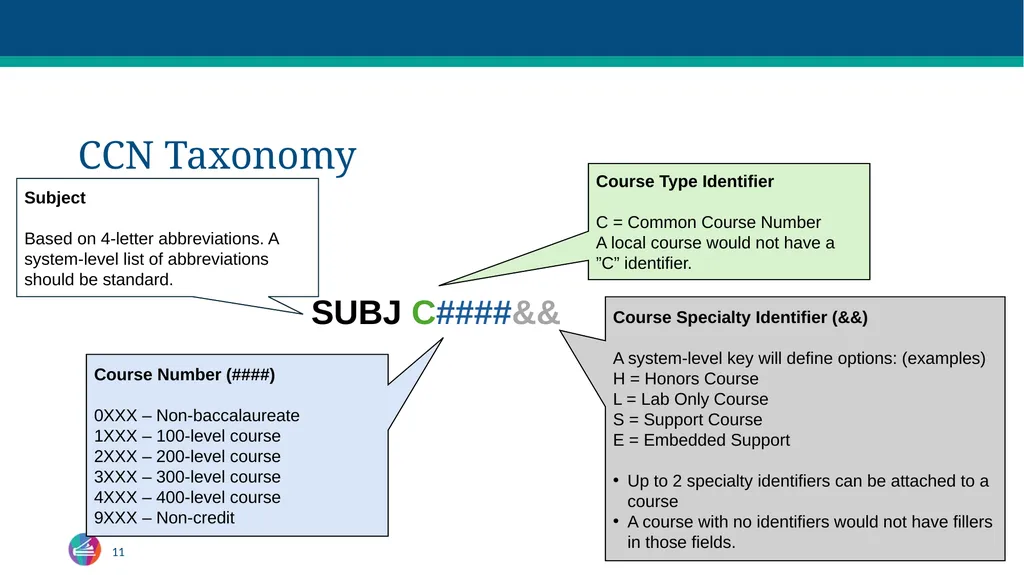
slide11. CCN Taxonomy Subject
Based on 4-letter abbreviations. A system-level list of abbreviations should be standard. Course Number (####)
0XXX – Non-baccalaureate
1XXX – 100-level course
2XXX – 200-level course
3XXX – 300-level course
4XXX – 400-level course
9XXX – Non-credit 11 Course Type Identifier
C = Common Course Number
A local course would not have a ”C” identifier. SUBJ C####&& Course Specialty Identifier (&&)
A system-level key will define options: (examples)
H = Honors Course
L = Lab Only Course
S = Support Course
E = Embedded Support
Up to 2 specialty identifiers can be attached to a course
A course with no identifiers would not have fillers in those fields.<br>
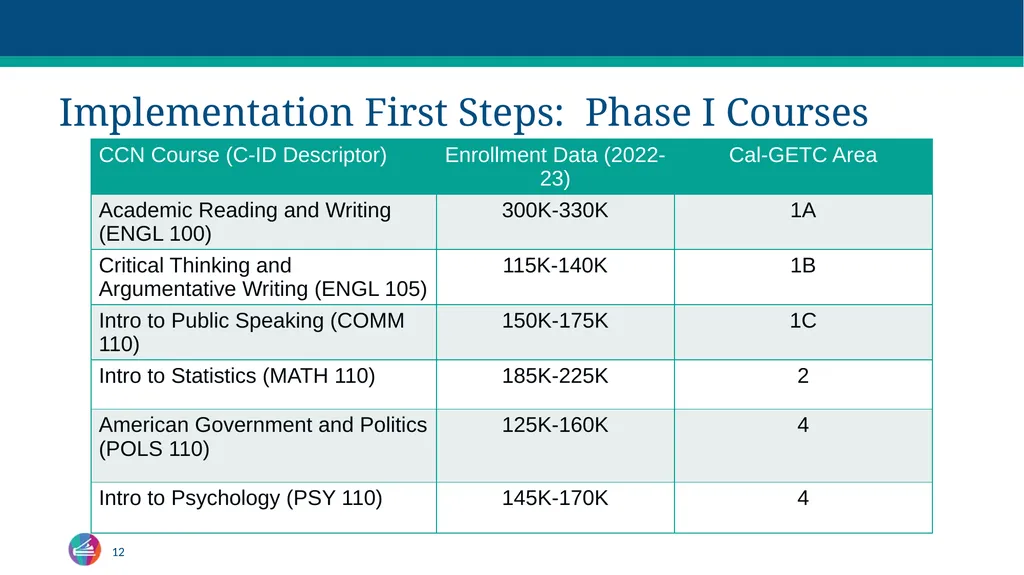
slide12. Implementation First Steps: Phase I Courses 12<br>
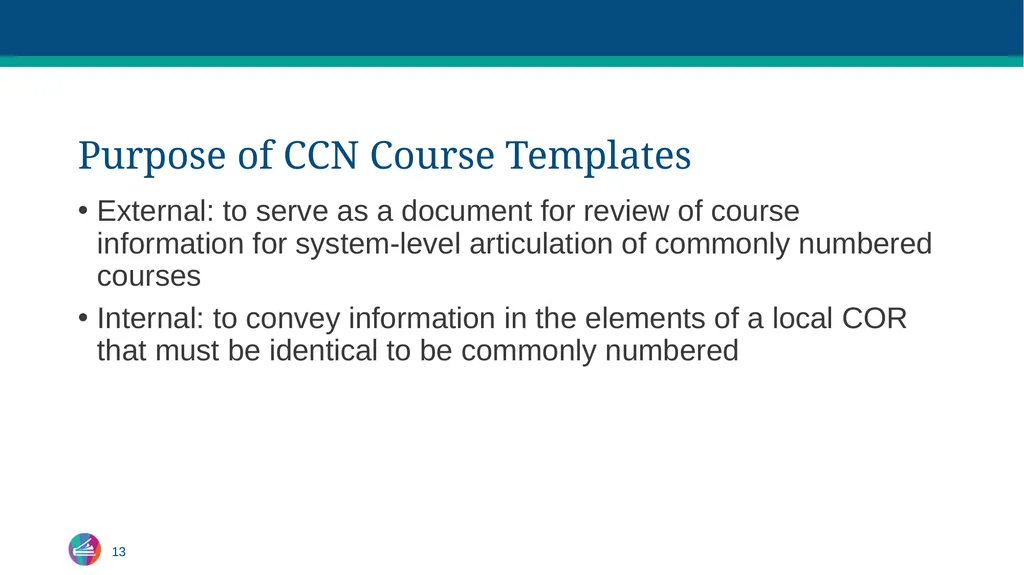
slide13. Purpose of CCN Course Templates External: to serve as a document for review of course information for system-level articulation of commonly numbered courses
Internal: to convey information in the elements of a local COR that must be identical to be commonly numbered 13<br>
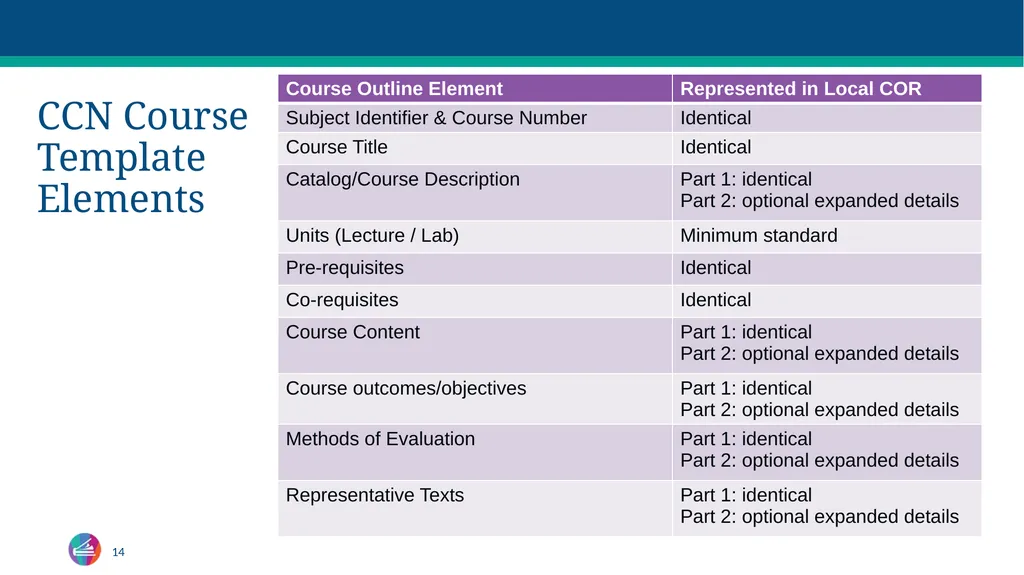
slide14. CCN Course Template Elements 14<br>
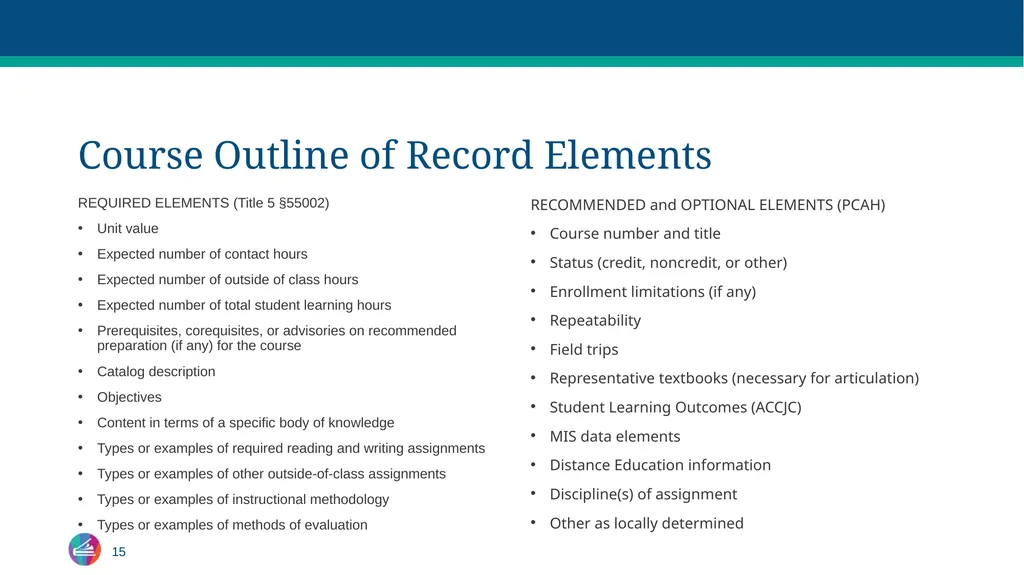
slide15. Course Outline of Record Elements REQUIRED ELEMENTS (Title 5 §55002)
Unit value
Expected number of contact hours
Expected number of outside of class hours
Expected number of total student learning hours
Prerequisites, corequisites, or advisories on recommended preparation (if any) for the course
Catalog description
Objectives
Content in terms of a specific body of knowledge
Types or examples of required reading and writing assignments
Types or examples of other outside-of-class assignments
Types or examples of instructional methodology
Types or examples of methods of evaluation 15 RECOMMENDED and OPTIONAL ELEMENTS (PCAH)
Course number and title
Status (credit, noncredit, or other)
Enrollment limitations (if any)
Repeatability
Field trips
Representative textbooks (necessary for articulation)
Student Learning Outcomes (ACCJC)
MIS data elements
Distance Education information
Discipline(s) of assignment
Other as locally determined<br>
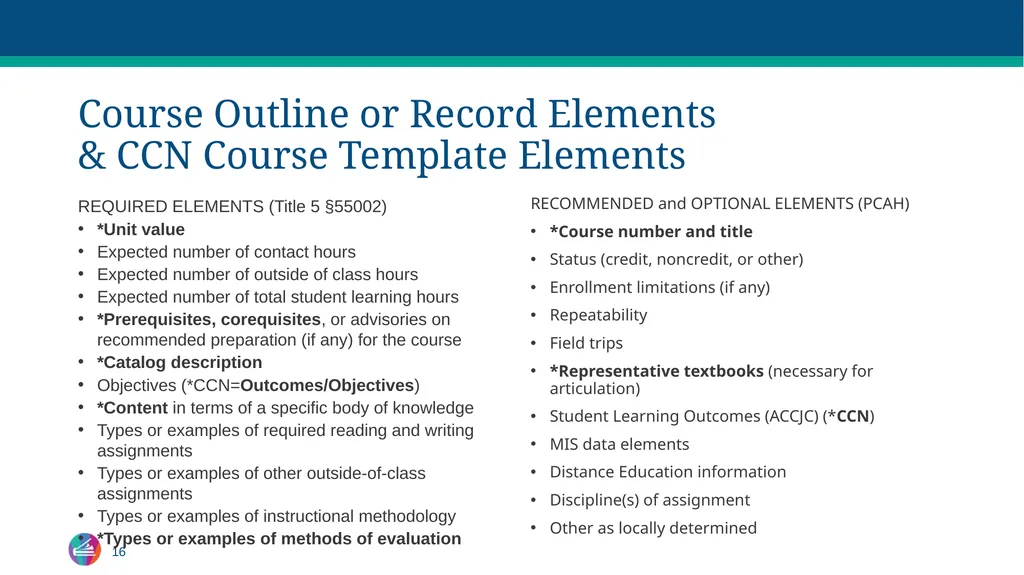
slide16. Course Outline or Record Elements & CCN Course Template Elements REQUIRED ELEMENTS (Title 5 §55002)
*Unit value
Expected number of contact hours
Expected number of outside of class hours
Expected number of total student learning hours
*Prerequisites, corequisites, or advisories on recommended preparation (if any) for the course
*Catalog description
Objectives (*CCN=Outcomes/Objectives)
*Content in terms of a specific body of knowledge
Types or examples of required reading and writing assignments
Types or examples of other outside-of-class assignments
Types or examples of instructional methodology
*Types or examples of methods of evaluation 16 RECOMMENDED and OPTIONAL ELEMENTS (PCAH)
*Course number and title
Status (credit, noncredit, or other)
Enrollment limitations (if any)
Repeatability
Field trips
*Representative textbooks (necessary for articulation)
Student Learning Outcomes (ACCJC) (*CCN)
MIS data elements
Distance Education information
Discipline(s) of assignment
Other as locally determined<br>
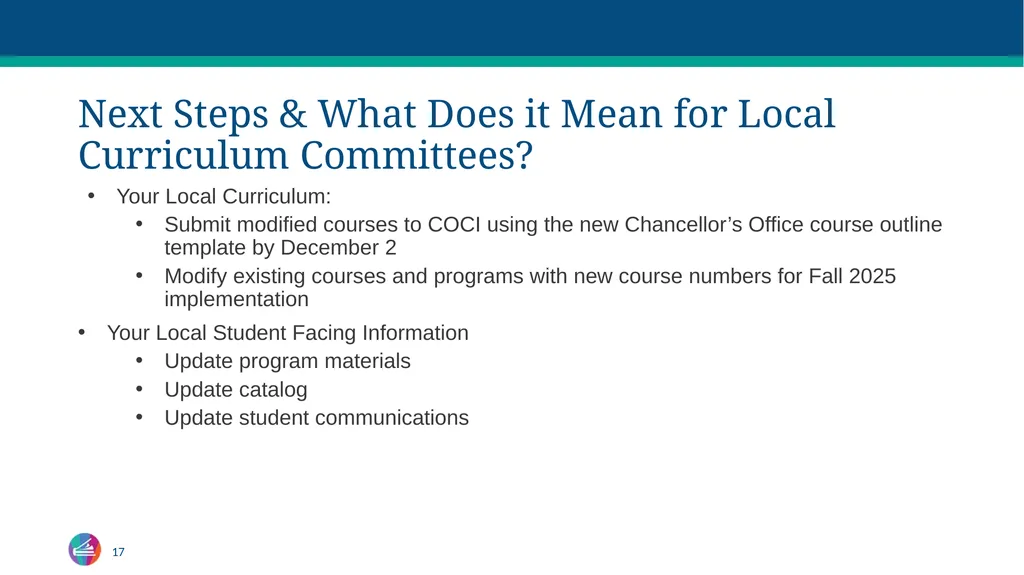
slide17. Next Steps & What Does it Mean for Local Curriculum Committees? Your Local Curriculum:
Submit modified courses to COCI using the new Chancellor’s Office course outline template by December 2
Modify existing courses and programs with new course numbers for Fall 2025 implementation
Your Local Student Facing Information
Update program materials
Update catalog
Update student communications 17<br>
slide18. CCN Template Development—Phase II 18<br>
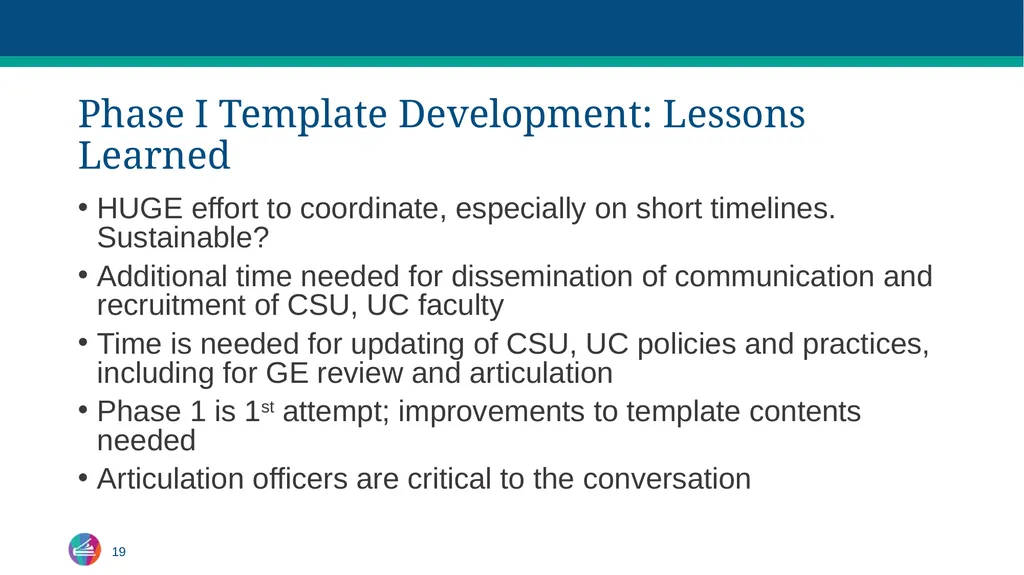
slide19. Phase I Template Development: Lessons Learned HUGE effort to coordinate, especially on short timelines. Sustainable?
Additional time needed for dissemination of communication and recruitment of CSU, UC faculty
Time is needed for updating of CSU, UC policies and practices, including for GE review and articulation
Phase 1 is 1st attempt; improvements to template contents needed
Articulation officers are critical to the conversation 19<br>
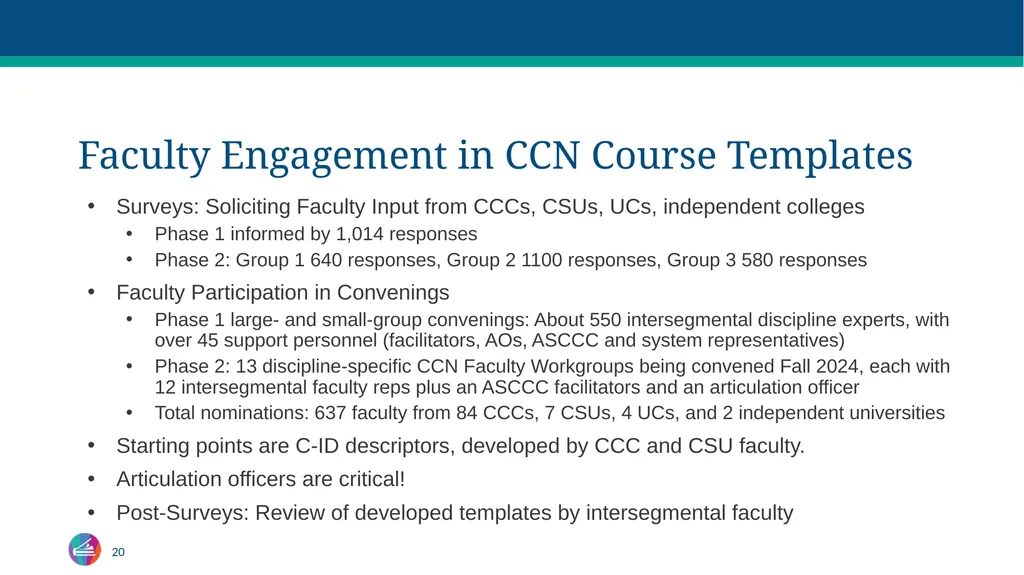
slide20. Faculty Engagement in CCN Course Templates Surveys: Soliciting Faculty Input from CCCs, CSUs, UCs, independent colleges
Phase 1 informed by 1,014 responses
Phase 2: Group 1 640 responses, Group 2 1100 responses, Group 3 580 responses
Faculty Participation in Convenings
Phase 1 large- and small-group convenings: About 550 intersegmental discipline experts, with over 45 support personnel (facilitators, AOs, ASCCC and system representatives)
Phase 2: 13 discipline-specific CCN Faculty Workgroups being convened Fall 2024, each with 12 intersegmental faculty reps plus an ASCCC facilitators and an articulation officer
Total nominations: 637 faculty from 84 CCCs, 7 CSUs, 4 UCs, and 2 independent universities
Starting points are C-ID descriptors, developed by CCC and CSU faculty.
Articulation officers are critical!
Post-Surveys: Review of developed templates by intersegmental faculty 20<br>
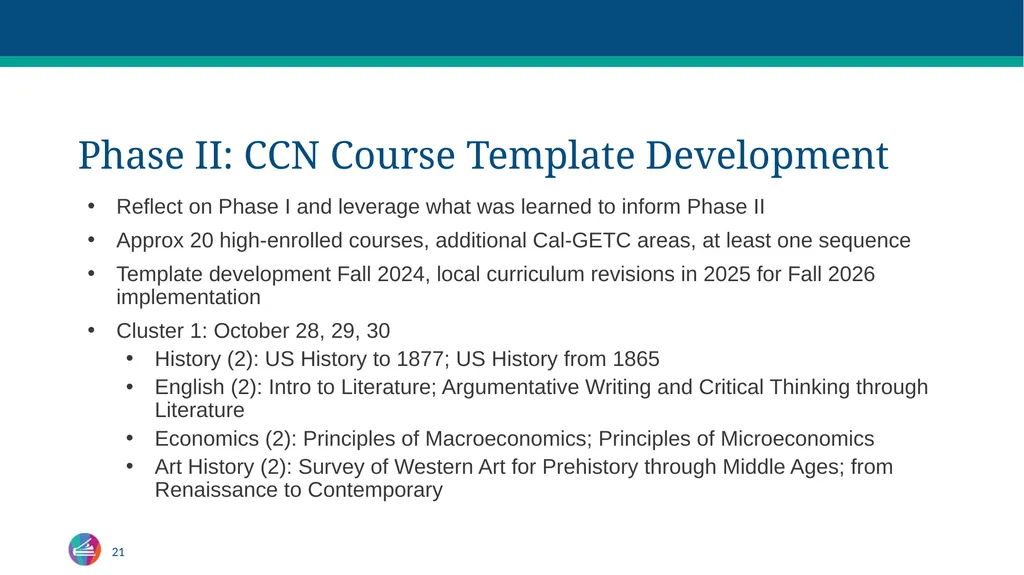
slide21. Phase II: CCN Course Template Development Reflect on Phase I and leverage what was learned to inform Phase II
Approx 20 high-enrolled courses, additional Cal-GETC areas, at least one sequence
Template development Fall 2024, local curriculum revisions in 2025 for Fall 2026 implementation
Cluster 1: October 28, 29, 30
History (2): US History to 1877; US History from 1865
English (2): Intro to Literature; Argumentative Writing and Critical Thinking through Literature
Economics (2): Principles of Macroeconomics; Principles of Microeconomics
Art History (2): Survey of Western Art for Prehistory through Middle Ages; from Renaissance to Contemporary 21<br>
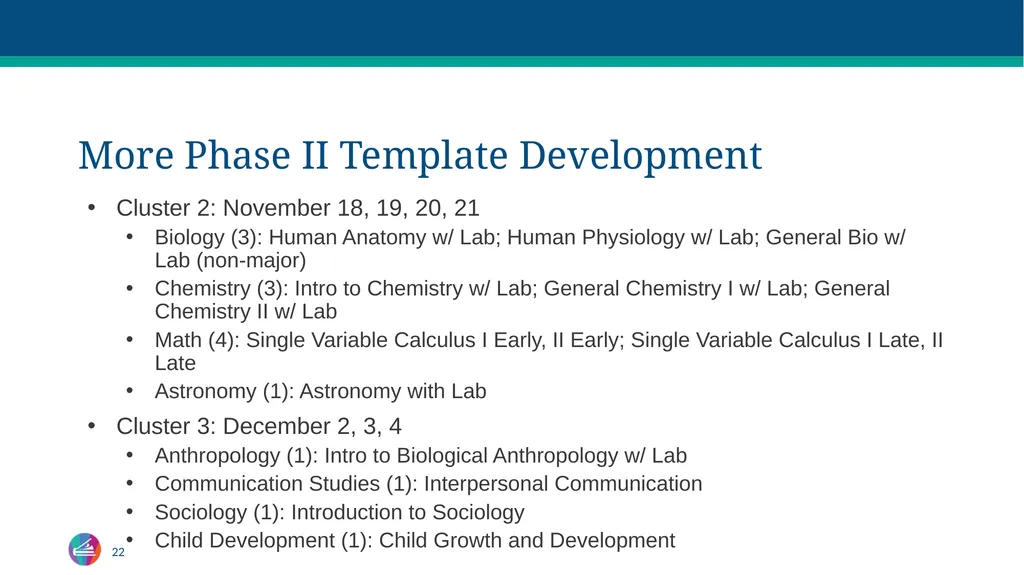
slide22. More Phase II Template Development Cluster 2: November 18, 19, 20, 21
Biology (3): Human Anatomy w/ Lab; Human Physiology w/ Lab; General Bio w/ Lab (non-major)
Chemistry (3): Intro to Chemistry w/ Lab; General Chemistry I w/ Lab; General Chemistry II w/ Lab
Math (4): Single Variable Calculus I Early, II Early; Single Variable Calculus I Late, II Late
Astronomy (1): Astronomy with Lab
Cluster 3: December 2, 3, 4
Anthropology (1): Intro to Biological Anthropology w/ Lab
Communication Studies (1): Interpersonal Communication
Sociology (1): Introduction to Sociology
Child Development (1): Child Growth and Development 22<br>
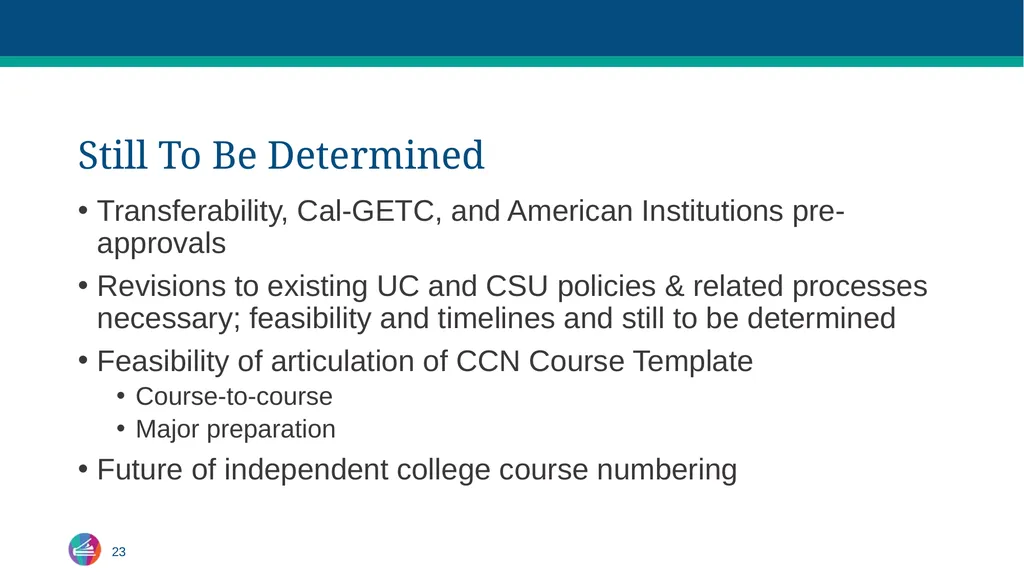
slide23. Still To Be Determined Transferability, Cal-GETC, and American Institutions pre-approvals
Revisions to existing UC and CSU policies & related processes necessary; feasibility and timelines and still to be determined
Feasibility of articulation of CCN Course Template
Course-to-course
Major preparation
Future of independent college course numbering 23<br>
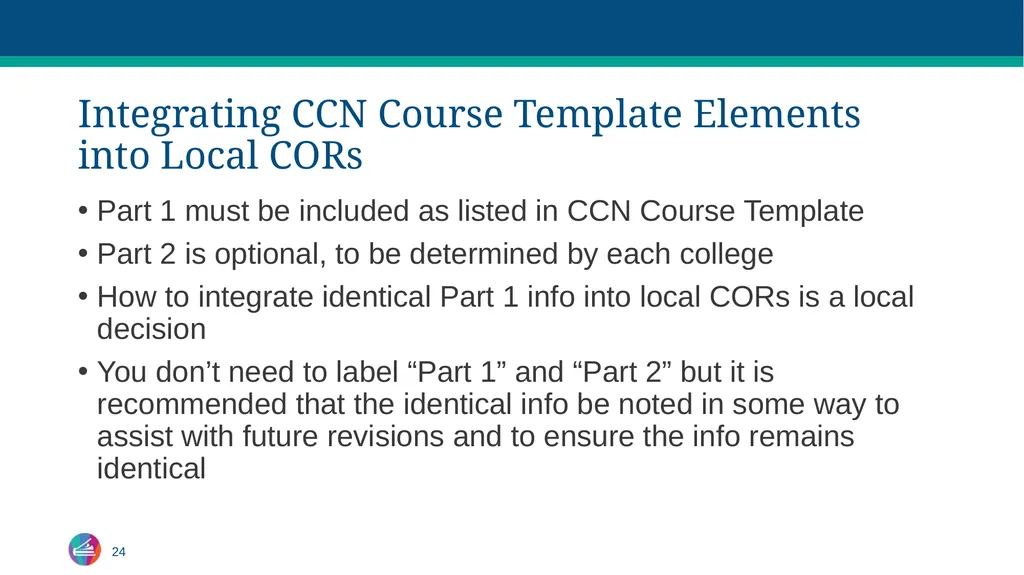
slide24. Integrating CCN Course Template Elements into Local CORs Part 1 must be included as listed in CCN Course Template
Part 2 is optional, to be determined by each college
How to integrate identical Part 1 info into local CORs is a local decision
You don’t need to label “Part 1” and “Part 2” but it is recommended that the identical info be noted in some way to assist with future revisions and to ensure the info remains identical 24<br>
slide25. WAIT… You do not need to add or revise existing fields in your curriculum management system to incorporate Part 1 and Part 2!
Use what you have for now
Wait until we have more information from Phase 1 and future phase implementations before updating systems 25<br>
slide26. Deep Breaths 26<br>
slide27. Resources<br>
slide28. ASCCC Resources Questions: info@asccc.org
ASCCC website
Request a local senate visit or other visit
Join a listserv to be updated on ASCCC information and opportunities
For example, area, senate president, curriculum, President’s update
Program and Course Approval Handbook
The Course Outline of Record: A Curriculum Reference Guide Revisited (2017) 28<br>
slide29. Chancellor’s Office Resources Common Course Numbering Project – Chancellor’s Office webpage
Templates
Webinar recordings and slides
Common Course Numbering Task Force Report (December 2023)
Memo: ESLEI 24-22 Common Course Numbering Update (April 15, 2024)
Memo: ESLEI 24-53 Curricular Guidance and Information for Common Course Numbering (CCN) System Implementation (Phase I) (Sep 6, 2024)
Memo: ESLEI 24-55 Common Course Numbering Implementation Allocations (Sep 23, 2024) 29<br>
slide30. Thank You! Sign up for ASCCC listservs: https://www.asccc.org/sign-our-newsletters
Sign up for unofficial curriculum listserv: CCCCurriculumChairs+subscribe@groups.io
Email info@asccc.org 30 listserv<br>
slide31. Funding and Guidance Each college will receive $913,043 through Advance Apportionment
September webinars
Funding expectations
Implementation of curricula
Taxonomy and technology implementation processes
Student-facing communications 31<br>
November 16, 2024<br>
slide2. Presenters Cheryl Aschenbach, ASCCC President
Erik D. Reese, ASCCC Area C Representative 2<br>
slide3. Outline Common Course Numbering (CCN) History & Vision
Progress to Date: Phase 1
CCN Course Template Development: Phase II
Resources 3<br>
slide4. Common Course Numbering (CCN) History & Vision<br>
slide5. Overview of Common Course Numbering AB 1111 (Berman, 2021): student-facing common course numbering in CCCs for general education and transfer pathway courses
AB 1111 Common Course Numbering Task Force - recommendations
Vision of system-level articulation from CCCs to universities using CCN Course Templates
Common transferability
Common GE applicability
Consistent course-to-course articulation
Potential for more consistent major prep articulation
Collaboration of intersegmental discipline faculty necessary to achieve intended student impacts 5<br>
slide6. Aligned Themes for CCN (AB 1111) & Student Transfer Achievement Reform Act of 2021 (AB 928) Transfer focus—simplify and increase transfer rates
Reduce excess units
Reduce repetition of courses after transfer 6<br>
slide7. Impact on Articulation CCN Task Force Report: CCN is an opportunity for a new vision of articulation and intersegmental collaboration
Vision: articulation of CCN Course Template for consistent GE approvals and articulation across all CA community colleges
General education
Course-to-course
Major
Monthly system-level conversations occurring
CSU, UC policies and processes will need to change 7<br>
slide8. Impacts & Implications: Acknowledge the Tensions CCN requires a shift from complete COR college autonomy to a degree of intentional alignment and similarity needed for system-level articulation needed for students
NOT common curriculum
Academic freedom in local COR, faculty syllabi and approach to teaching each class
Vision depends on UC and CSU changes to current articulation processes
Fear of losing current articulations
Frustration and feasibility concerns with technology systems
Lack of alignment between semester and quarter college curriculum, particularly for sequences
Local curriculum & catalog processes are already impacted by Cal-GETC, ADT, GE, and AB 1705 changes and more
There will be implementation impacts on people, technology, local processes
There is still a lot of uncertainty 8<br>
slide9. Progress to Date: Phase I<br>
slide10. Phased Implementation Goals The CCN Task Force published their final report and proposed a phased approach to meet the mandates of AB 1111.
Phase I (2024-2025):
Faculty work in collaboration with intersegmental leadership teams to develop CCN Templates for Fall 2025 implementation
Templates for an initial set of high-enrollment courses to generate an initial set of CCN-aligned courses for fall 2025
Phase II (2024-2025)
Second cluster of courses
Evaluate and refine the development processes and templates
Test technology-based implementation
Validate intersegmental collaboration
Phase III (2026-2027)
Implement potential technology solutions and roll out the remaining transfer courses. 10<br>
slide11. CCN Taxonomy Subject
Based on 4-letter abbreviations. A system-level list of abbreviations should be standard. Course Number (####)
0XXX – Non-baccalaureate
1XXX – 100-level course
2XXX – 200-level course
3XXX – 300-level course
4XXX – 400-level course
9XXX – Non-credit 11 Course Type Identifier
C = Common Course Number
A local course would not have a ”C” identifier. SUBJ C####&& Course Specialty Identifier (&&)
A system-level key will define options: (examples)
H = Honors Course
L = Lab Only Course
S = Support Course
E = Embedded Support
Up to 2 specialty identifiers can be attached to a course
A course with no identifiers would not have fillers in those fields.<br>
slide12. Implementation First Steps: Phase I Courses 12<br>
slide13. Purpose of CCN Course Templates External: to serve as a document for review of course information for system-level articulation of commonly numbered courses
Internal: to convey information in the elements of a local COR that must be identical to be commonly numbered 13<br>
slide14. CCN Course Template Elements 14<br>
slide15. Course Outline of Record Elements REQUIRED ELEMENTS (Title 5 §55002)
Unit value
Expected number of contact hours
Expected number of outside of class hours
Expected number of total student learning hours
Prerequisites, corequisites, or advisories on recommended preparation (if any) for the course
Catalog description
Objectives
Content in terms of a specific body of knowledge
Types or examples of required reading and writing assignments
Types or examples of other outside-of-class assignments
Types or examples of instructional methodology
Types or examples of methods of evaluation 15 RECOMMENDED and OPTIONAL ELEMENTS (PCAH)
Course number and title
Status (credit, noncredit, or other)
Enrollment limitations (if any)
Repeatability
Field trips
Representative textbooks (necessary for articulation)
Student Learning Outcomes (ACCJC)
MIS data elements
Distance Education information
Discipline(s) of assignment
Other as locally determined<br>
slide16. Course Outline or Record Elements & CCN Course Template Elements REQUIRED ELEMENTS (Title 5 §55002)
*Unit value
Expected number of contact hours
Expected number of outside of class hours
Expected number of total student learning hours
*Prerequisites, corequisites, or advisories on recommended preparation (if any) for the course
*Catalog description
Objectives (*CCN=Outcomes/Objectives)
*Content in terms of a specific body of knowledge
Types or examples of required reading and writing assignments
Types or examples of other outside-of-class assignments
Types or examples of instructional methodology
*Types or examples of methods of evaluation 16 RECOMMENDED and OPTIONAL ELEMENTS (PCAH)
*Course number and title
Status (credit, noncredit, or other)
Enrollment limitations (if any)
Repeatability
Field trips
*Representative textbooks (necessary for articulation)
Student Learning Outcomes (ACCJC) (*CCN)
MIS data elements
Distance Education information
Discipline(s) of assignment
Other as locally determined<br>
slide17. Next Steps & What Does it Mean for Local Curriculum Committees? Your Local Curriculum:
Submit modified courses to COCI using the new Chancellor’s Office course outline template by December 2
Modify existing courses and programs with new course numbers for Fall 2025 implementation
Your Local Student Facing Information
Update program materials
Update catalog
Update student communications 17<br>
slide18. CCN Template Development—Phase II 18<br>
slide19. Phase I Template Development: Lessons Learned HUGE effort to coordinate, especially on short timelines. Sustainable?
Additional time needed for dissemination of communication and recruitment of CSU, UC faculty
Time is needed for updating of CSU, UC policies and practices, including for GE review and articulation
Phase 1 is 1st attempt; improvements to template contents needed
Articulation officers are critical to the conversation 19<br>
slide20. Faculty Engagement in CCN Course Templates Surveys: Soliciting Faculty Input from CCCs, CSUs, UCs, independent colleges
Phase 1 informed by 1,014 responses
Phase 2: Group 1 640 responses, Group 2 1100 responses, Group 3 580 responses
Faculty Participation in Convenings
Phase 1 large- and small-group convenings: About 550 intersegmental discipline experts, with over 45 support personnel (facilitators, AOs, ASCCC and system representatives)
Phase 2: 13 discipline-specific CCN Faculty Workgroups being convened Fall 2024, each with 12 intersegmental faculty reps plus an ASCCC facilitators and an articulation officer
Total nominations: 637 faculty from 84 CCCs, 7 CSUs, 4 UCs, and 2 independent universities
Starting points are C-ID descriptors, developed by CCC and CSU faculty.
Articulation officers are critical!
Post-Surveys: Review of developed templates by intersegmental faculty 20<br>
slide21. Phase II: CCN Course Template Development Reflect on Phase I and leverage what was learned to inform Phase II
Approx 20 high-enrolled courses, additional Cal-GETC areas, at least one sequence
Template development Fall 2024, local curriculum revisions in 2025 for Fall 2026 implementation
Cluster 1: October 28, 29, 30
History (2): US History to 1877; US History from 1865
English (2): Intro to Literature; Argumentative Writing and Critical Thinking through Literature
Economics (2): Principles of Macroeconomics; Principles of Microeconomics
Art History (2): Survey of Western Art for Prehistory through Middle Ages; from Renaissance to Contemporary 21<br>
slide22. More Phase II Template Development Cluster 2: November 18, 19, 20, 21
Biology (3): Human Anatomy w/ Lab; Human Physiology w/ Lab; General Bio w/ Lab (non-major)
Chemistry (3): Intro to Chemistry w/ Lab; General Chemistry I w/ Lab; General Chemistry II w/ Lab
Math (4): Single Variable Calculus I Early, II Early; Single Variable Calculus I Late, II Late
Astronomy (1): Astronomy with Lab
Cluster 3: December 2, 3, 4
Anthropology (1): Intro to Biological Anthropology w/ Lab
Communication Studies (1): Interpersonal Communication
Sociology (1): Introduction to Sociology
Child Development (1): Child Growth and Development 22<br>
slide23. Still To Be Determined Transferability, Cal-GETC, and American Institutions pre-approvals
Revisions to existing UC and CSU policies & related processes necessary; feasibility and timelines and still to be determined
Feasibility of articulation of CCN Course Template
Course-to-course
Major preparation
Future of independent college course numbering 23<br>
slide24. Integrating CCN Course Template Elements into Local CORs Part 1 must be included as listed in CCN Course Template
Part 2 is optional, to be determined by each college
How to integrate identical Part 1 info into local CORs is a local decision
You don’t need to label “Part 1” and “Part 2” but it is recommended that the identical info be noted in some way to assist with future revisions and to ensure the info remains identical 24<br>
slide25. WAIT… You do not need to add or revise existing fields in your curriculum management system to incorporate Part 1 and Part 2!
Use what you have for now
Wait until we have more information from Phase 1 and future phase implementations before updating systems 25<br>
slide26. Deep Breaths 26<br>
slide27. Resources<br>
slide28. ASCCC Resources Questions: info@asccc.org
ASCCC website
Request a local senate visit or other visit
Join a listserv to be updated on ASCCC information and opportunities
For example, area, senate president, curriculum, President’s update
Program and Course Approval Handbook
The Course Outline of Record: A Curriculum Reference Guide Revisited (2017) 28<br>
slide29. Chancellor’s Office Resources Common Course Numbering Project – Chancellor’s Office webpage
Templates
Webinar recordings and slides
Common Course Numbering Task Force Report (December 2023)
Memo: ESLEI 24-22 Common Course Numbering Update (April 15, 2024)
Memo: ESLEI 24-53 Curricular Guidance and Information for Common Course Numbering (CCN) System Implementation (Phase I) (Sep 6, 2024)
Memo: ESLEI 24-55 Common Course Numbering Implementation Allocations (Sep 23, 2024) 29<br>
slide30. Thank You! Sign up for ASCCC listservs: https://www.asccc.org/sign-our-newsletters
Sign up for unofficial curriculum listserv: CCCCurriculumChairs+subscribe@groups.io
Email info@asccc.org 30 listserv<br>
slide31. Funding and Guidance Each college will receive $913,043 through Advance Apportionment
September webinars
Funding expectations
Implementation of curricula
Taxonomy and technology implementation processes
Student-facing communications 31<br>