Common Course Numbering Update Curriculum Regionals 2025 Overview Why CCN? Phase I Update Phase II Update, including Articulation Phase III Update CCN Templates: IDEAA and CORs CCN Templates: What are OutcomesObjectives? CCN Templates:
"Common Course Numbering Update Curriculum" is the property of its rightful owner. Permission is granted to
download and print the materials on this website for personal, non-commercial use only, and to display it
on your personal computer provided you do not modify the materials and that you retain all copyright
notices contained in the materials. By downloading content from our website, you accept the terms of this
agreement.
Presentation Transcript
01
Common Course Numbering Update Curriculum Regionals 2025<br>
02
Overview Why CCN?
Phase I Update
Phase II Update, including Articulation
Phase III Update
CCN Templates: IDEAA and CORs
CCN Templates: What are Outcomes/Objectives?
CCN Templates: Prerequisites
What’s Next?
Questions 2<br>
03
CCN Update: The Basics – The Why Why CCN?
Transfer mobility without credit loss: consistent transfer and articulation of CCC courses to CSU, UC, and AICCU institutions
Accomplish this by having CCC system-level transferability and articulation to 4-yrs using CCN course templates
We can’t lose sight of the importance of this work for students 3<br>
04
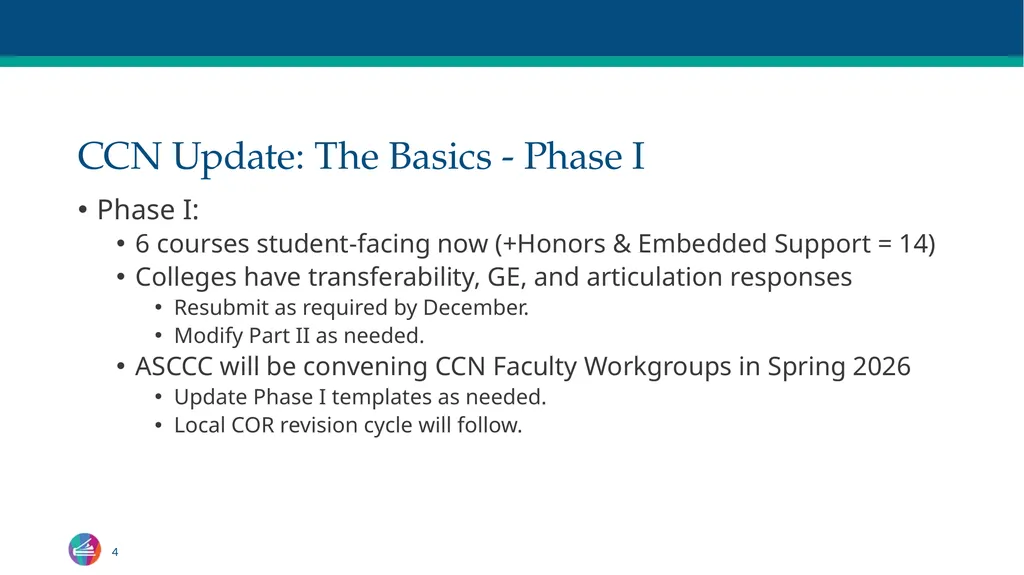
CCN Update: The Basics - Phase I Phase I:
6 courses student-facing now (+Honors & Embedded Support = 14)
Colleges have transferability, GE, and articulation responses
Resubmit as required by December.
Modify Part II as needed.
ASCCC will be convening CCN Faculty Workgroups in Spring 2026
Update Phase I templates as needed.
Local COR revision cycle will follow. 4<br>
05
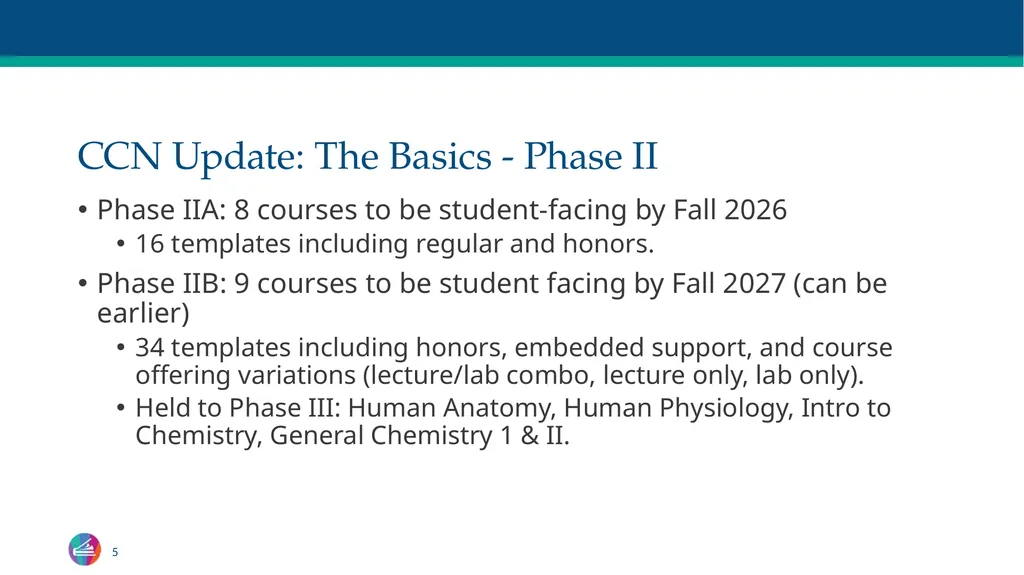
CCN Update: The Basics - Phase II Phase IIA: 8 courses to be student-facing by Fall 2026
16 templates including regular and honors.
Phase IIB: 9 courses to be student facing by Fall 2027 (can be earlier)
34 templates including honors, embedded support, and course offering variations (lecture/lab combo, lecture only, lab only).
Held to Phase III: Human Anatomy, Human Physiology, Intro to Chemistry, General Chemistry 1 & II. 5<br>
06
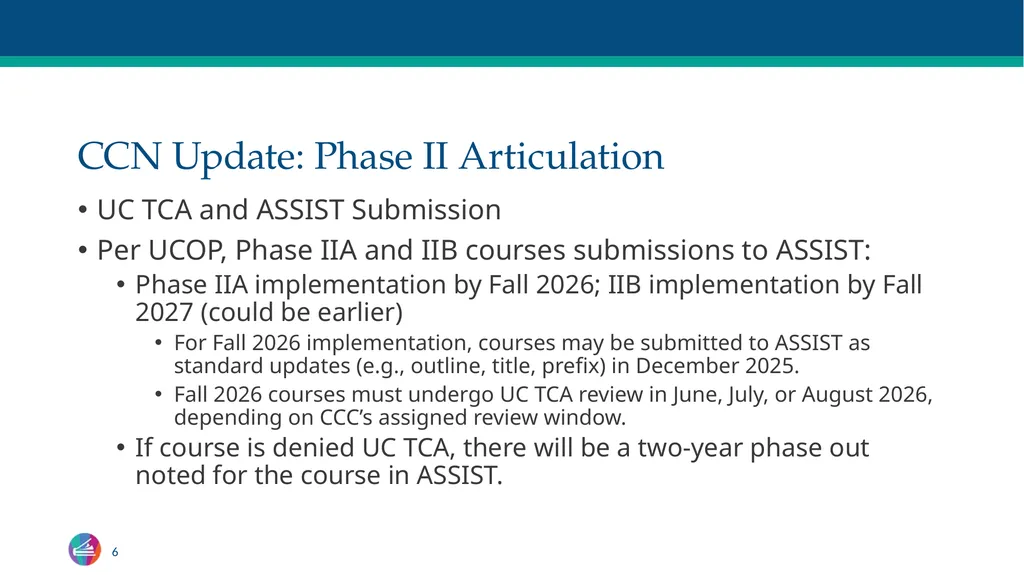
CCN Update: Phase II Articulation UC TCA and ASSIST Submission
Per UCOP, Phase IIA and IIB courses submissions to ASSIST:
Phase IIA implementation by Fall 2026; IIB implementation by Fall 2027 (could be earlier)
For Fall 2026 implementation, courses may be submitted to ASSIST as standard updates (e.g., outline, title, prefix) in December 2025.
Fall 2026 courses must undergo UC TCA review in June, July, or August 2026, depending on CCC’s assigned review window.
If course is denied UC TCA, there will be a two-year phase out noted for the course in ASSIST. 6<br>
07
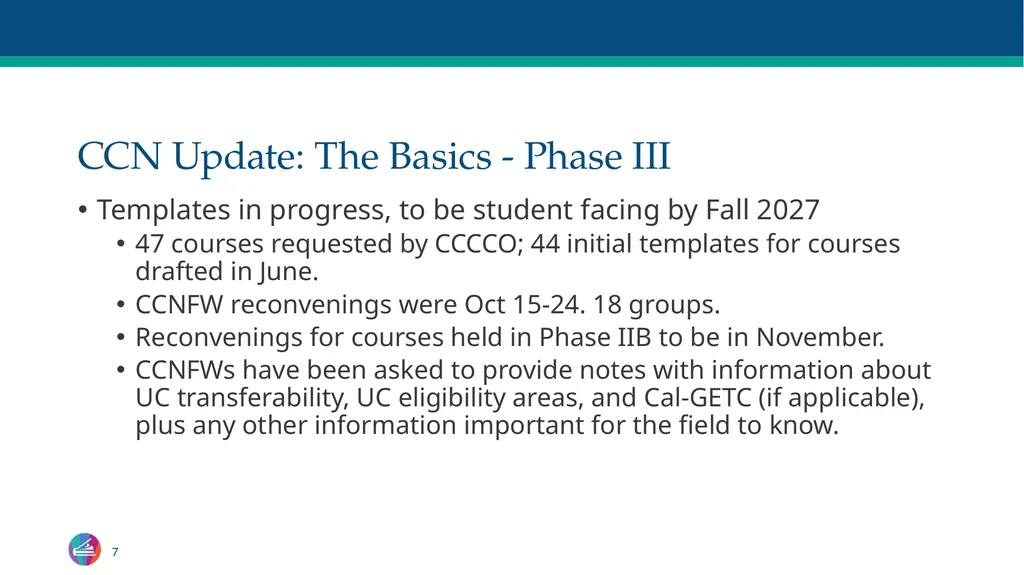
CCN Update: The Basics - Phase III Templates in progress, to be student facing by Fall 2027
47 courses requested by CCCCO; 44 initial templates for courses drafted in June.
CCNFW reconvenings were Oct 15-24. 18 groups.
Reconvenings for courses held in Phase IIB to be in November.
CCNFWs have been asked to provide notes with information about UC transferability, UC eligibility areas, and Cal-GETC (if applicable), plus any other information important for the field to know. 7<br>
08
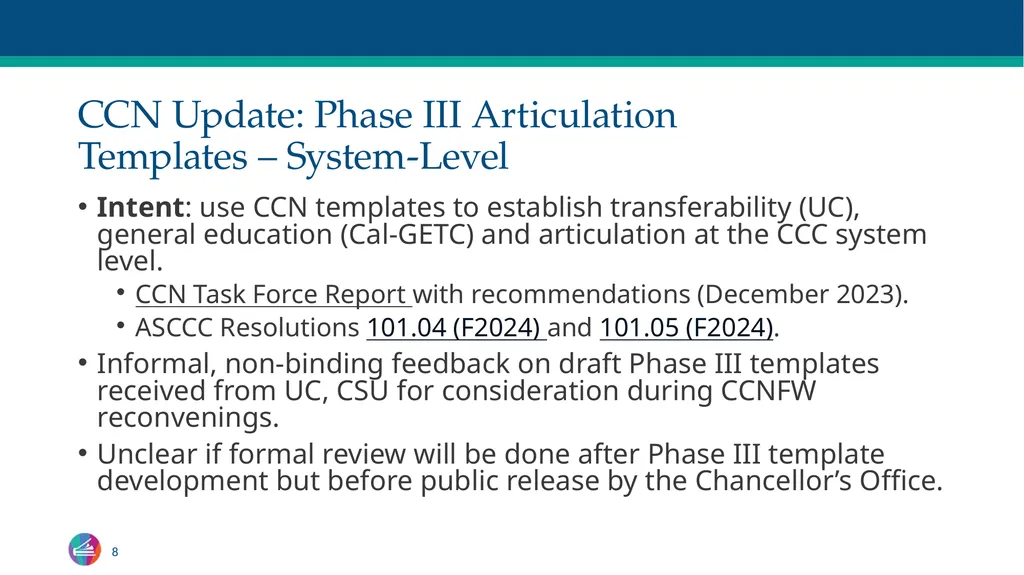
CCN Update: Phase III Articulation Templates – System-Level Intent: use CCN templates to establish transferability (UC), general education (Cal-GETC) and articulation at the CCC system level.
CCN Task Force Report with recommendations (December 2023).
ASCCC Resolutions 101.04 (F2024) and 101.05 (F2024).
Informal, non-binding feedback on draft Phase III templates received from UC, CSU for consideration during CCNFW reconvenings.
Unclear if formal review will be done after Phase III template development but before public release by the Chancellor’s Office. 8<br>
09
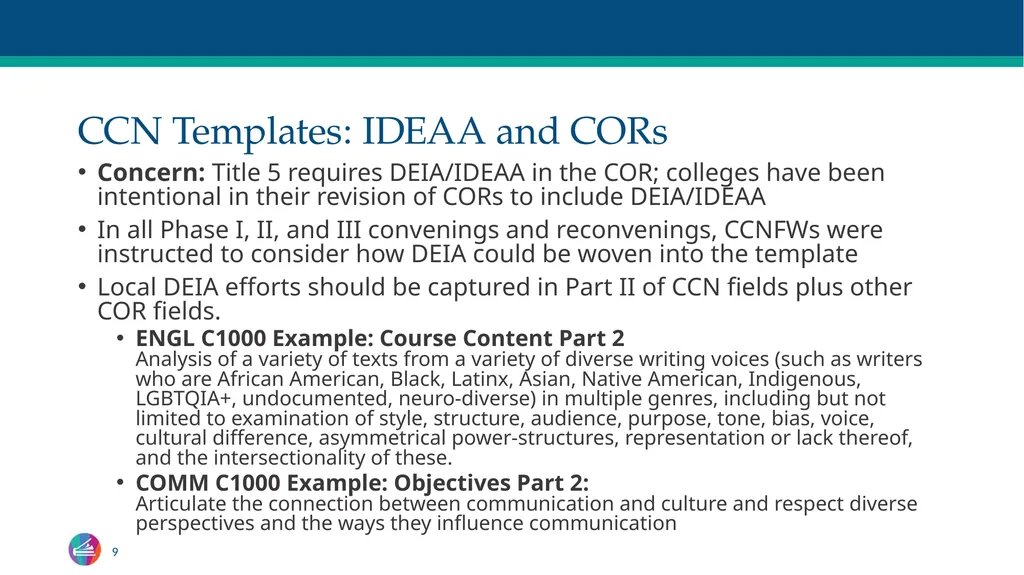
CCN Templates: IDEAA and CORs Concern: Title 5 requires DEIA/IDEAA in the COR; colleges have been intentional in their revision of CORs to include DEIA/IDEAA
In all Phase I, II, and III convenings and reconvenings, CCNFWs were instructed to consider how DEIA could be woven into the template
Local DEIA efforts should be captured in Part II of CCN fields plus other COR fields.
ENGL C1000 Example: Course Content Part 2 Analysis of a variety of texts from a variety of diverse writing voices (such as writers who are African American, Black, Latinx, Asian, Native American, Indigenous, LGBTQIA+, undocumented, neuro-diverse) in multiple genres, including but not limited to examination of style, structure, audience, purpose, tone, bias, voice, cultural difference, asymmetrical power-structures, representation or lack thereof, and the intersectionality of these.
COMM C1000 Example: Objectives Part 2: Articulate the connection between communication and culture and respect diverse perspectives and the ways they influence communication 9<br>
10
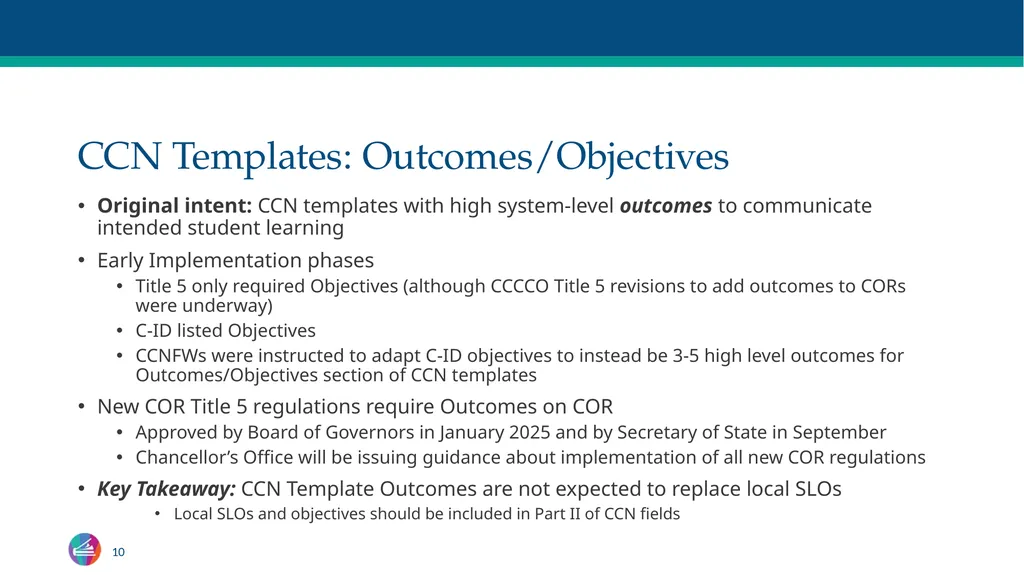
CCN Templates: Outcomes/Objectives Original intent: CCN templates with high system-level outcomes to communicate intended student learning
Early Implementation phases
Title 5 only required Objectives (although CCCCO Title 5 revisions to add outcomes to CORs were underway)
C-ID listed Objectives
CCNFWs were instructed to adapt C-ID objectives to instead be 3-5 high level outcomes for Outcomes/Objectives section of CCN templates
New COR Title 5 regulations require Outcomes on COR
Approved by Board of Governors in January 2025 and by Secretary of State in September
Chancellor’s Office will be issuing guidance about implementation of all new COR regulations
Key Takeaway: CCN Template Outcomes are not expected to replace local SLOs
Local SLOs and objectives should be included in Part II of CCN fields 10<br>
11
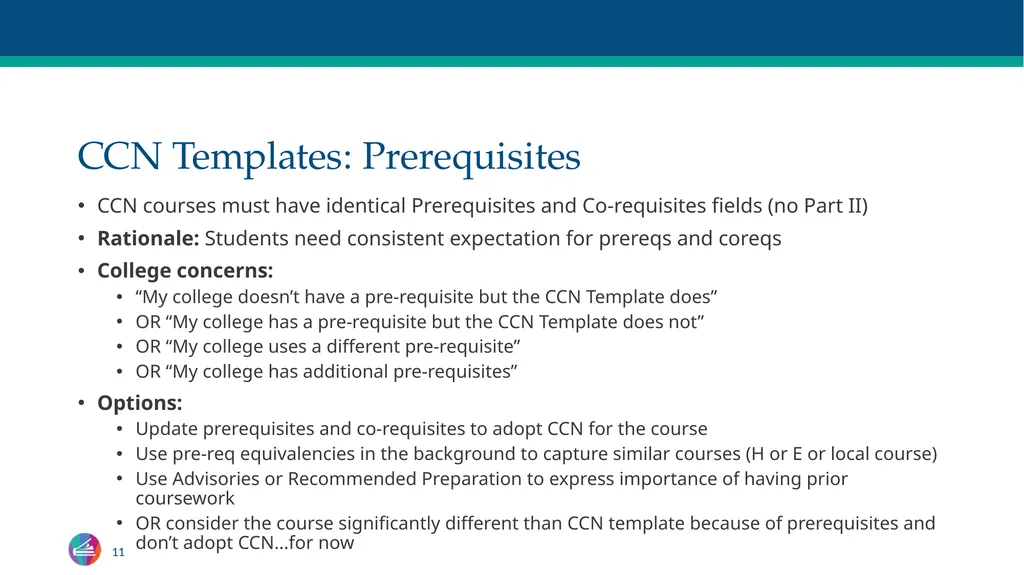
CCN Templates: Prerequisites CCN courses must have identical Prerequisites and Co-requisites fields (no Part II)
Rationale: Students need consistent expectation for prereqs and coreqs
College concerns:
“My college doesn’t have a pre-requisite but the CCN Template does”
OR “My college has a pre-requisite but the CCN Template does not”
OR “My college uses a different pre-requisite”
OR “My college has additional pre-requisites”
Options:
Update prerequisites and co-requisites to adopt CCN for the course
Use pre-req equivalencies in the background to capture similar courses (H or E or local course)
Use Advisories or Recommended Preparation to express importance of having prior coursework
OR consider the course significantly different than CCN template because of prerequisites and don’t adopt CCN…for now 11<br>
12
What’s Next? System Level
Future Courses – yet to be determined by the Chancellor’s Office. Goal: Spring 2026
Future Phases – yes, there will be more.
Local Considerations
Subject Identifier Prefixes
Colleges should start discussing changing subject identifiers; some colleges are already making changes to be consistent with CCN
Local Numbering Taxonomy
Colleges should be discussing local numbering taxonomy, but the Chancellor’s Office doesn’t recommend changing non-CCN course numbers yet
Keep Chancellor’s Office numbering bands in mind (see memo ESS 25-56, 8/2025)
Funding
Colleges received funds to implement CCN (see memo ESS 24-55, 9/2024), including to update technology infrastructure.
Build infrastructure now; there is no guarantee of additional future funding 12<br>
13
Resources ASCCC CCN Support Office Hours – visit asccc.org
ASCCC CCN Information Webpage
Course info for each phase, survey links (when open)
CCCCO CCN Information Webpage
General information, templates, memos, CCN logos and assets 13<br>