04
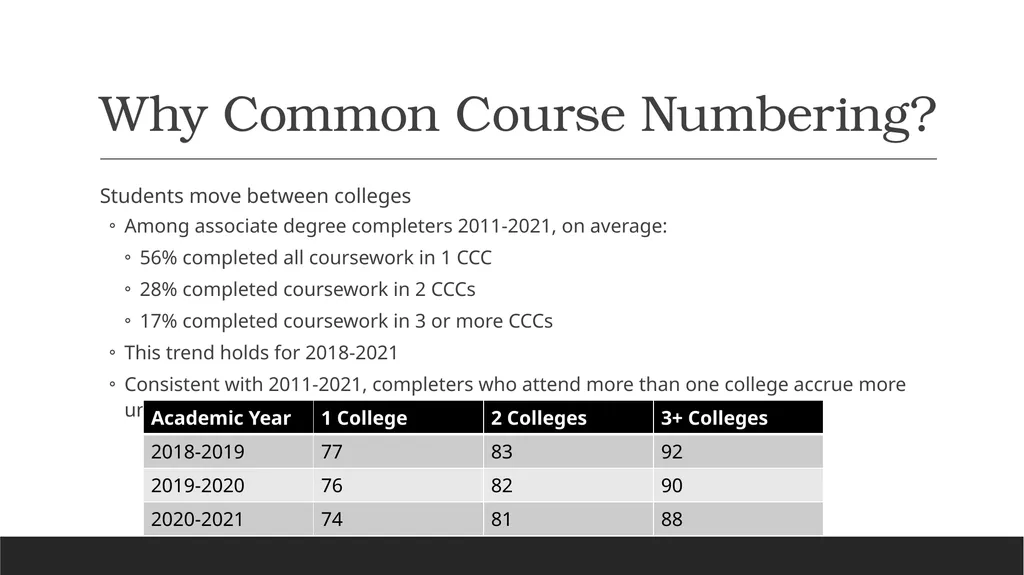
Why Common Course Numbering? Students move between colleges
Among associate degree completers 2011-2021, on average:
56% completed all coursework in 1 CCC
28% completed coursework in 2 CCCs
17% completed coursework in 3 or more CCCs
This trend holds for 2018-2021
Consistent with 2011-2021, completers who attend more than one college accrue more units:<br>
05
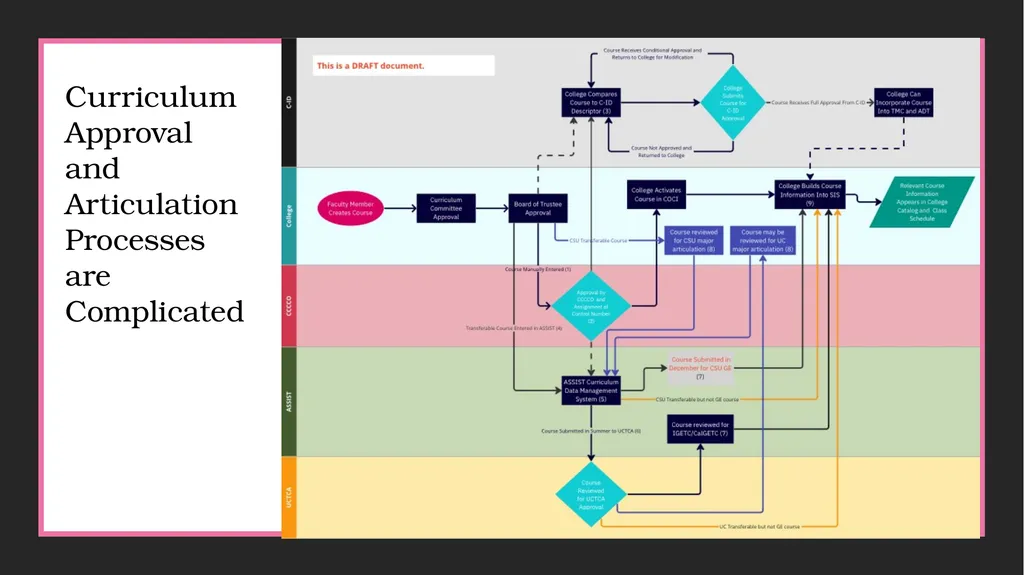
Curriculum Approval and Articulation Processes are Complicated<br>
06
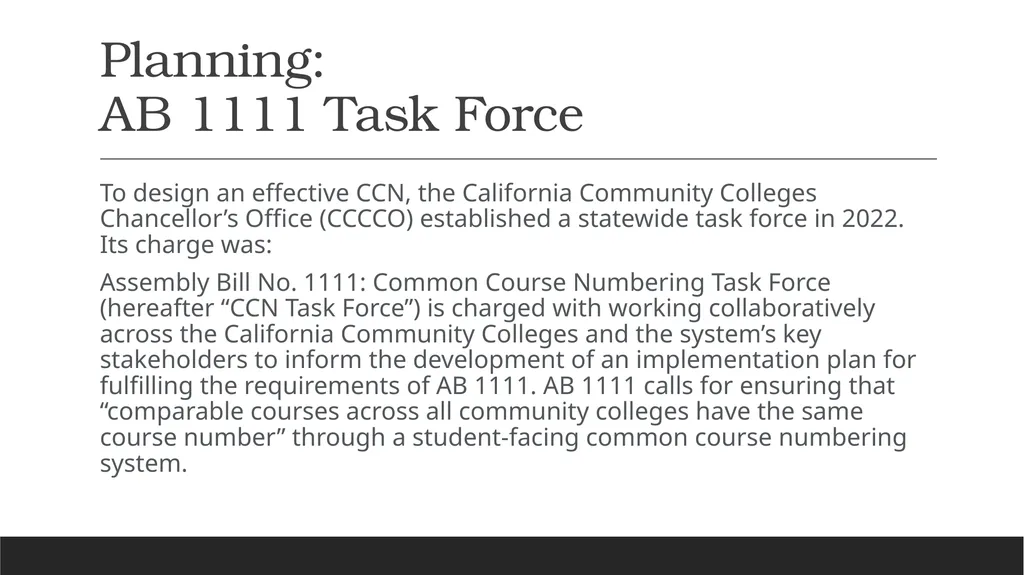
Planning:�AB 1111 Task Force To design an effective CCN, the California Community Colleges Chancellor’s Office (CCCCO) established a statewide task force in 2022. Its charge was:
Assembly Bill No. 1111: Common Course Numbering Task Force (hereafter “CCN Task Force”) is charged with working collaboratively across the California Community Colleges and the system’s key stakeholders to inform the development of an implementation plan for fulfilling the requirements of AB 1111. AB 1111 calls for ensuring that “comparable courses across all community colleges have the same course number” through a student-facing common course numbering system.<br>
07
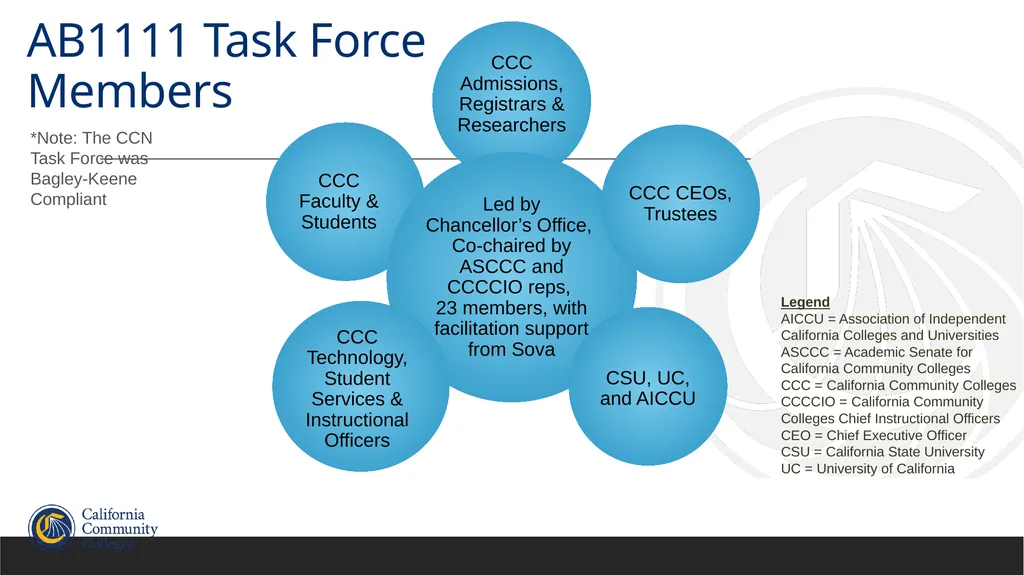
AB1111 Task Force �Members *Note: The CCN Task Force was Bagley-Keene Compliant CCC Faculty & Students CCC Admissions, Registrars & Researchers Led by�Chancellor’s Office, �Co-chaired by ASCCC and CCCCIO reps, �23 members, with facilitation support from Sova CCC CEOs, Trustees CCC Technology, Student Services & Instructional Officers CSU, UC, and AICCU Legend
AICCU = Association of Independent California Colleges and Universities
ASCCC = Academic Senate for California Community Colleges
CCC = California Community Colleges
CCCCIO = California Community Colleges Chief Instructional Officers
CEO = Chief Executive Officer
CSU = California State University
UC = University of California<br>
08
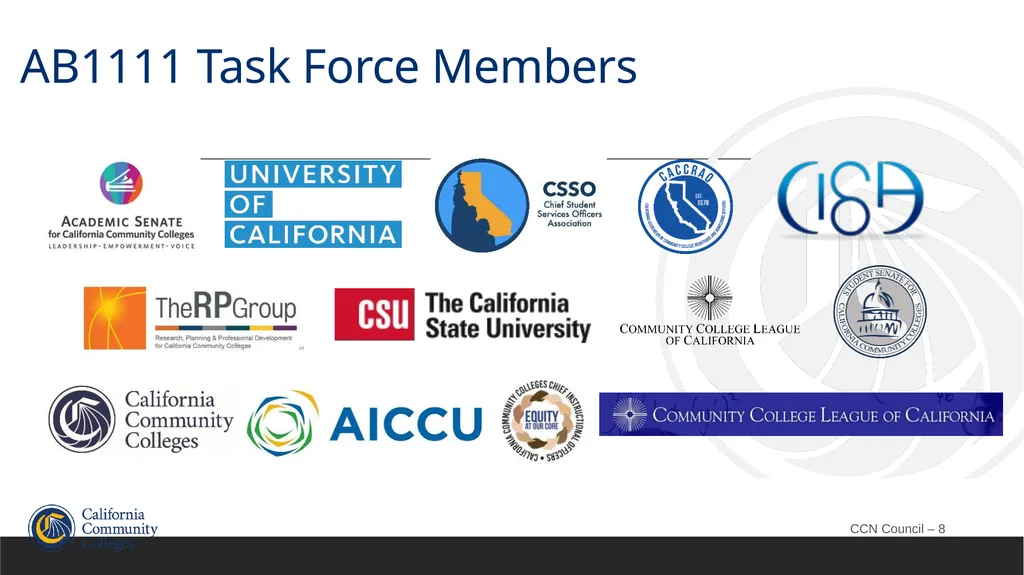
AB1111 Task Force Members CCN Council – 8<br>
09
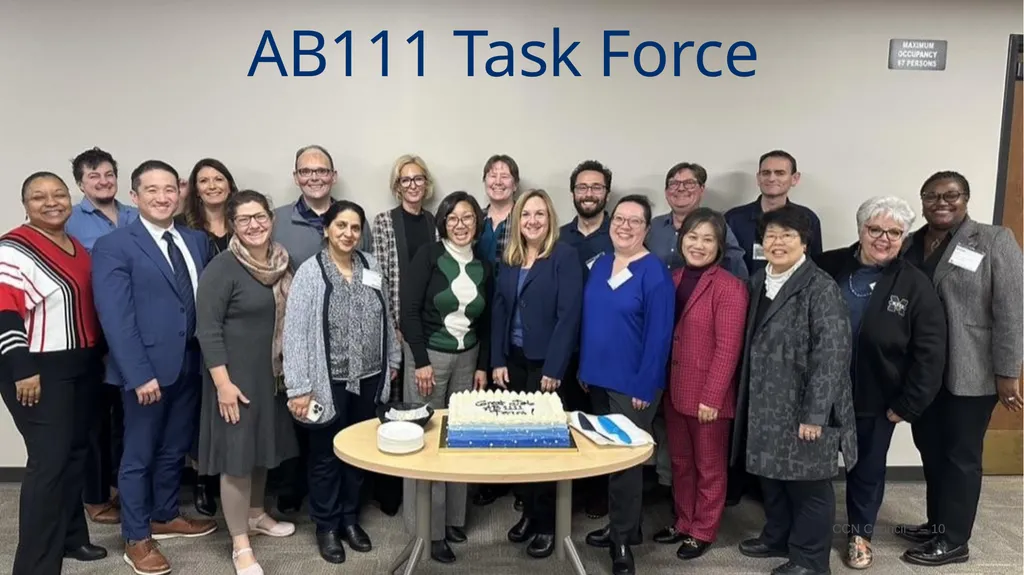
AB111 Task Force Members Co-Chairs:
Ginni May, Past President, ASCCC, Sacramento City College
Tram Vo-Kumamoto, Past President, CCCCIO; VP, Instruction, Saddleback College
Members:
Robert Alexander, Vice President, Regional Affairs, Student Senate for California Community Colleges
Cheryl Aschenbach, President, ASCCC, Lassen College
Rupinder Bhatia, Executive Director, IT, San Jose-Evergreen Community College District (CCD)
Jeremy Brown, Dean of Student Success and Institutional Effectiveness, Yuba College
Kellie Butler, VP, Student Services, Folsom Lake College
Victor DeVore, Dean, Student Services, San Diego CCD
Chase Fischerhall, Associate Director, A-G and Transfer Articulation Policy, UC Office of the President Members (cont.)
Marilyn Flores, Superintendent/President, Rio Hondo College
John Freitas, Articulation Officer, Los Angeles City College
Deborah Ikeda, Trustee, State Center CCD
Aisha Lowe, Executive Vice Chancellor,
California Community Colleges
Meredith Marasco, Evaluator, Butte College
Isabel O’Connor, VP, Instruction, San Diego Mesa College
John Stanskas, Vice Chancellor, California Community Colleges
Marci Sanchez, Assistant Director of Undergraduate Transfer
Programs, California State University, Office of the Chancellor
Rachel Stamm, Curriculum Systems, Consultant, CCC Tech Center
Tiffany Tran, Articulation Officer, Irvine Valley College
Kristin Van Gaasbeck, Director, Liberal Studies and Social Science
Programs; Faculty, California State University, Sacramento
Tyler Vaughan-Gomez, Assistant Registrar for Transfer & Articulation,
University of Redlands CCN Council – 9<br>
10
AB111 Task Force CCN Council – – 10<br>
11
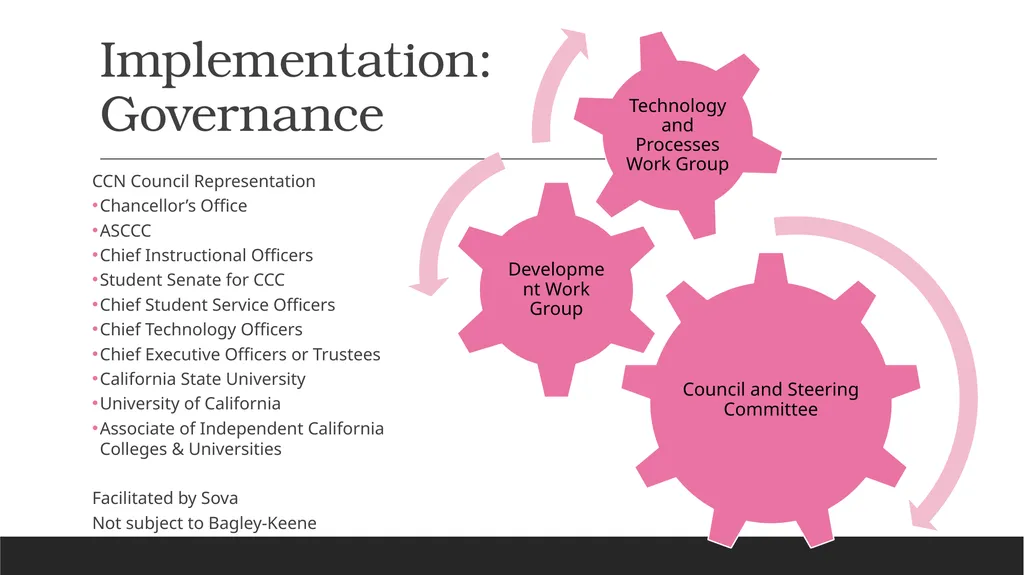
Implementation: �Governance CCN Council Representation
Chancellor’s Office
ASCCC
Chief Instructional Officers
Student Senate for CCC
Chief Student Service Officers
Chief Technology Officers
Chief Executive Officers or Trustees
California State University
University of California
Associate of Independent California Colleges & Universities
Facilitated by Sova
Not subject to Bagley-Keene<br>
12
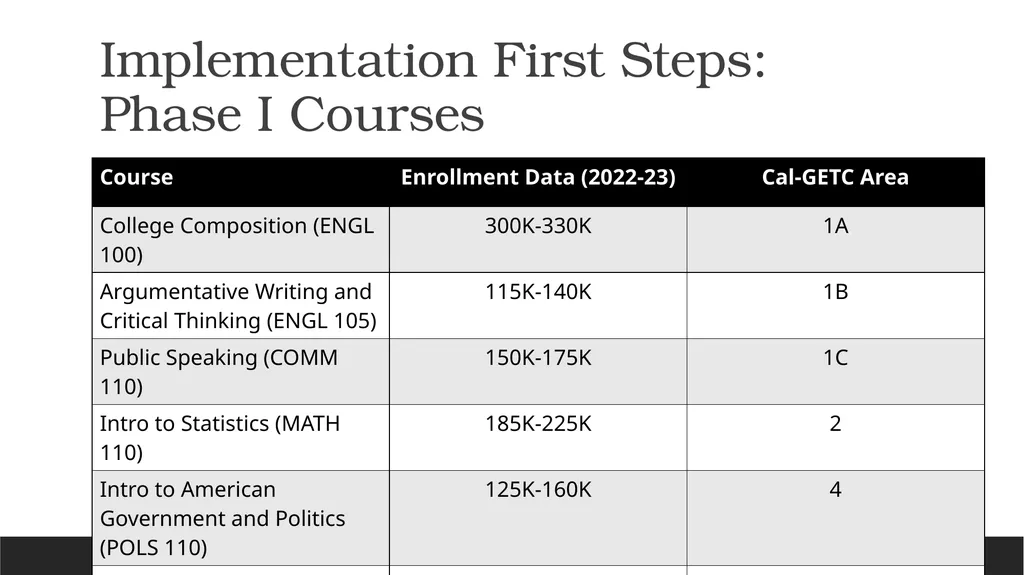
Implementation First Steps: �Phase I Courses<br>
13
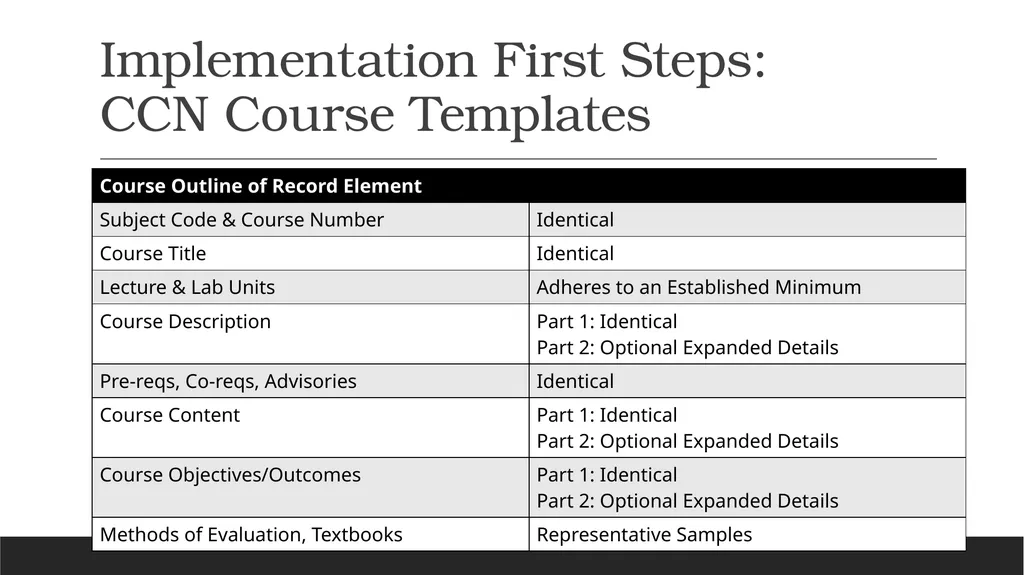
Implementation First Steps:�CCN Course Templates<br>
14
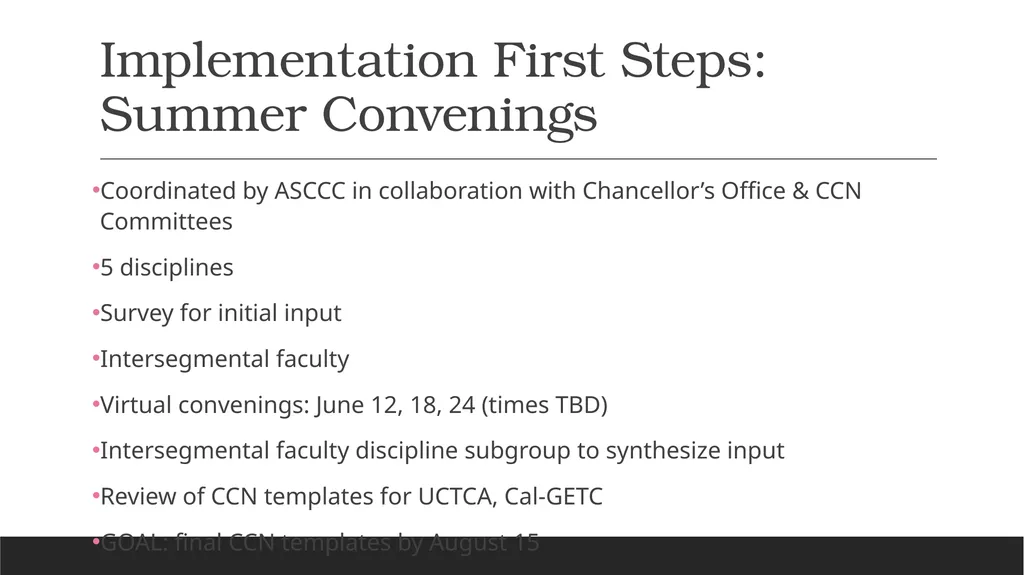
Implementation First Steps:�Summer Convenings Coordinated by ASCCC in collaboration with Chancellor’s Office & CCN Committees
5 disciplines
Survey for initial input
Intersegmental faculty
Virtual convenings: June 12, 18, 24 (times TBD)
Intersegmental faculty discipline subgroup to synthesize input
Review of CCN templates for UCTCA, Cal-GETC
GOAL: final CCN templates by August 15<br>
15
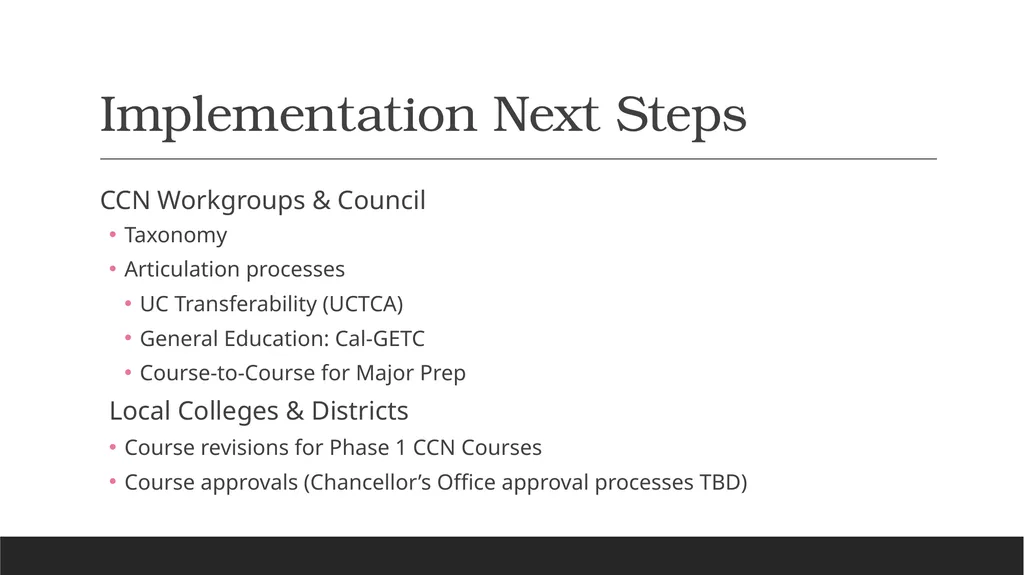
Implementation Next Steps CCN Workgroups & Council
Taxonomy
Articulation processes
UC Transferability (UCTCA)
General Education: Cal-GETC
Course-to-Course for Major Prep
Local Colleges & Districts
Course revisions for Phase 1 CCN Courses
Course approvals (Chancellor’s Office approval processes TBD)<br>
16
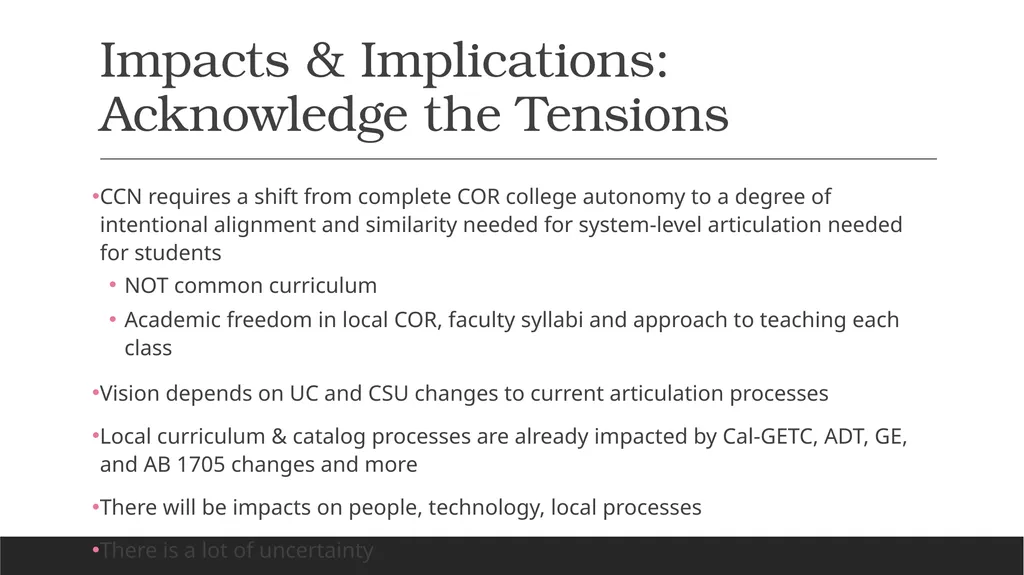
Impacts & Implications:�Acknowledge the Tensions CCN requires a shift from complete COR college autonomy to a degree of intentional alignment and similarity needed for system-level articulation needed for students
NOT common curriculum
Academic freedom in local COR, faculty syllabi and approach to teaching each class
Vision depends on UC and CSU changes to current articulation processes
Local curriculum & catalog processes are already impacted by Cal-GETC, ADT, GE, and AB 1705 changes and more
There will be impacts on people, technology, local processes
There is a lot of uncertainty<br>
17
Resources Common Course Numbering Task Force Report (December 2023)
Memo: ESLEI 24-22 Common Course Numbering Update (April 15, 2024)
Common Course Numbering Project – Chancellor’s Office webpage<br>
18
Questions?���Thank you! Michelle Grimes-Hillman�Cheryl Aschenbach<br>