
Common Non-Compliances on Accounting Standards
LO
Published · 48 slides · 0 views

1 / 1






Description
Common Non-Compliances on Accounting Standards (AS) in the General Purpose Financial Statements as observed by Financial Reporting Review Board (FRRB) The Institute of Chartered Accountants of India AS 1 Disclosure of Accounting Policies
Related Topics
Share
Embed code
Download this presentation From Below
"Common Non-Compliances on Accounting Standards" is the property of its rightful owner. Permission is granted to download and print the materials on this website for personal, non-commercial use only, and to display it on your personal computer provided you do not modify the materials and that you retain all copyright notices contained in the materials. By downloading content from our website, you accept the terms of this agreement.
Presentation Transcript
01
Common Non-Compliances on
Accounting Standards (AS) in the General Purpose Financial Statements as observed by
Financial Reporting Review Board (FRRB) The Institute of Chartered Accountants of India<br>
Accounting Standards (AS) in the General Purpose Financial Statements as observed by
Financial Reporting Review Board (FRRB) The Institute of Chartered Accountants of India<br>
02
AS 1 – Disclosure of Accounting Policies Case:
Accounting policy was stated as follows:
The unrealised loss on outstanding derivative contracts had not been recognised in the books, considering the principles of prudence as enunciated in AS 1.
Requirements:
Paragraph 17 of AS 1
Observation:
Prudence prohibits recognizing future expected profits but mandates for recognizing future expected losses. Therefore, the policy incorrectly interprets the prudence principles of AS 1. Non-Compliance related to AS<br>
Accounting policy was stated as follows:
The unrealised loss on outstanding derivative contracts had not been recognised in the books, considering the principles of prudence as enunciated in AS 1.
Requirements:
Paragraph 17 of AS 1
Observation:
Prudence prohibits recognizing future expected profits but mandates for recognizing future expected losses. Therefore, the policy incorrectly interprets the prudence principles of AS 1. Non-Compliance related to AS<br>
03
AS 1 – Disclosure of Accounting Policies Non-Compliance related to AS Case:
Subsidies granted by the government for providing telecom services in rural areas are recognized as other operating income, in accordance with the relevant terms and conditions of the scheme and arrangements.
Requirements:
Paragraph 24 of AS 1
Observation:
The timing of recognition of such grant is not clear from the stated policy. Such policy only provides a means to understand the accounting policy adopted for recognition of government grant, rather than explicitly disclosing the principles adopted for the same.<br>
Subsidies granted by the government for providing telecom services in rural areas are recognized as other operating income, in accordance with the relevant terms and conditions of the scheme and arrangements.
Requirements:
Paragraph 24 of AS 1
Observation:
The timing of recognition of such grant is not clear from the stated policy. Such policy only provides a means to understand the accounting policy adopted for recognition of government grant, rather than explicitly disclosing the principles adopted for the same.<br>
04
AS 1 – Disclosure of Accounting Policies Non-Compliance related to AS Case:
Certain companies omit to disclose significant accounting policies with regard to the following:
Borrowing Costs
Valuation of Inventories
Accounting for Investments
Employee Benefits
Accounting for taxes on income
Impairment of Assets
Provisions, Contingent liabilities and Contingent Assets
Requirements:
Paragraph 24 of AS 1
Observation:
All significant accounting policies adopted in the preparation and presentation of financial statements should be disclosed.<br>
Certain companies omit to disclose significant accounting policies with regard to the following:
Borrowing Costs
Valuation of Inventories
Accounting for Investments
Employee Benefits
Accounting for taxes on income
Impairment of Assets
Provisions, Contingent liabilities and Contingent Assets
Requirements:
Paragraph 24 of AS 1
Observation:
All significant accounting policies adopted in the preparation and presentation of financial statements should be disclosed.<br>
05
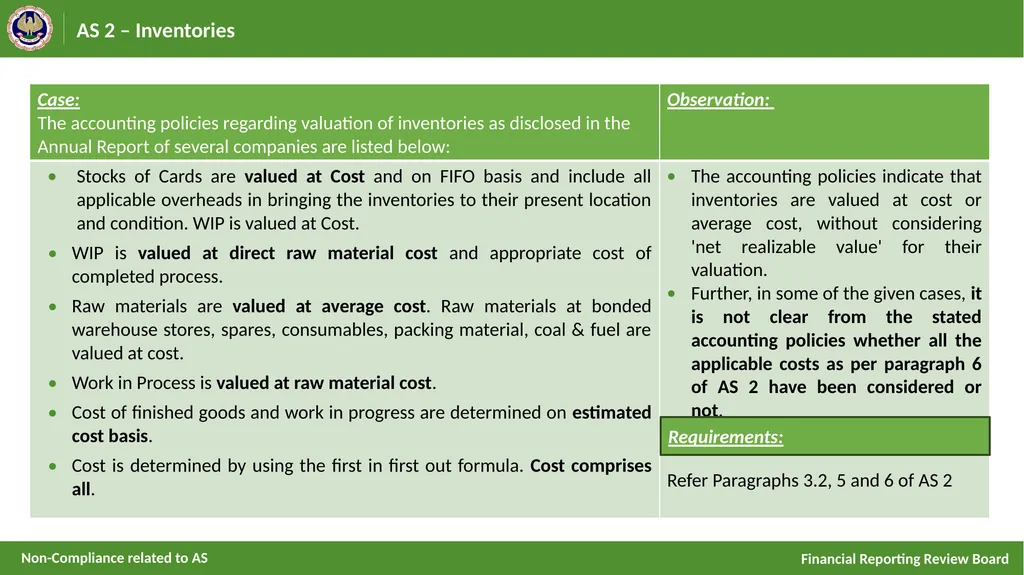
Non-Compliance related to AS AS 2 – Inventories Requirements:<br>
06
AS 3 – Cash Flow Statements Non-Compliance related to AS Case:
In the note on Administrative and Other Expenses, there is an item Unrealised Exchange Fluctuation (net), however, the same has not been adjusted to determine ‘Cash Flow from Operating Activities’ in Cash Flow Statement.
Requirements:
Paragraph 27 of AS 3
Observation:
The unrealised foreign exchange loss should have been adjusted to determine Cash Flow from Operating Activities<br>
In the note on Administrative and Other Expenses, there is an item Unrealised Exchange Fluctuation (net), however, the same has not been adjusted to determine ‘Cash Flow from Operating Activities’ in Cash Flow Statement.
Requirements:
Paragraph 27 of AS 3
Observation:
The unrealised foreign exchange loss should have been adjusted to determine Cash Flow from Operating Activities<br>
07
AS 3 – Cash Flow Statements Non-Compliance related to AS Case:
The Cash and Bank balance included balances in foreign currencies. However, there was no adjustment/reconciliation shown in the Cash and Cash Equivalent for exchange rate difference thereon.
Requirements:
Paragraph 25 of AS 3
Observation:
The effect of changes in exchange rates related to bank balances held in foreign currency, has not been reported as part of reconciliation of changes in cash and cash equivalents while reporting cash flows in Cash Flow Statement.<br>
The Cash and Bank balance included balances in foreign currencies. However, there was no adjustment/reconciliation shown in the Cash and Cash Equivalent for exchange rate difference thereon.
Requirements:
Paragraph 25 of AS 3
Observation:
The effect of changes in exchange rates related to bank balances held in foreign currency, has not been reported as part of reconciliation of changes in cash and cash equivalents while reporting cash flows in Cash Flow Statement.<br>
08
AS 3 – Cash Flow Statements Non-Compliance related to AS Case:
An item interest (net) has been reported under ‘Cash Flow from Financing Activities’ of a non - financial enterprise.
Requirements:
Paragraph 30 of AS 3
Observation:
Cash flows from interest received and paid should each be disclosed separately under ‘Cash Flow from Investing Activities’ and ‘Cash Flow from Financing Activities’ respectively.<br>
An item interest (net) has been reported under ‘Cash Flow from Financing Activities’ of a non - financial enterprise.
Requirements:
Paragraph 30 of AS 3
Observation:
Cash flows from interest received and paid should each be disclosed separately under ‘Cash Flow from Investing Activities’ and ‘Cash Flow from Financing Activities’ respectively.<br>
09
AS 3 – Cash Flow Statements Non-Compliance related to AS Case:
The components of cash and cash equivalents as reported in the Balance Sheet include Cash in Hand, Cash at Bank, Earmarked Balance against LC, Gratuity & Superannuation etc., Unpaid Dividend Account, Interest accrued on Fixed Deposits and the total of these components matches with the closing cash & cash equivalents as reported in the Cash Flow Statement.
Requirements:
Paragraph 5.2 of AS 3
Observation:
The components of cash and cash equivalents include balances of unpaid dividend, accrued interest on FDs and earmarked balances against LC, gratuity & superannuation etc. which are not readily available with the enterprise for its use, thus, the same cannot be included in ‘Cash and Cash Equivalents’.<br>
The components of cash and cash equivalents as reported in the Balance Sheet include Cash in Hand, Cash at Bank, Earmarked Balance against LC, Gratuity & Superannuation etc., Unpaid Dividend Account, Interest accrued on Fixed Deposits and the total of these components matches with the closing cash & cash equivalents as reported in the Cash Flow Statement.
Requirements:
Paragraph 5.2 of AS 3
Observation:
The components of cash and cash equivalents include balances of unpaid dividend, accrued interest on FDs and earmarked balances against LC, gratuity & superannuation etc. which are not readily available with the enterprise for its use, thus, the same cannot be included in ‘Cash and Cash Equivalents’.<br>
10
AS 3 – Cash Flow Statements Non-Compliance related to AS Case:
The changes in outstanding balances of borrowings (including debt raised for Tier II Capital) were disclosed under ’Cash Flow from Operating Activities’.
Requirements:
Paragraph 17 of AS 3
Observation:
The cash flow on account of borrowings in case of all enterprises, whether financial or non-financial enterprises, should be presented as ‘Cash Flow from Financing Activities’, as the definition of ‘Financing Activities’ in AS 3 does not make any distinction between financial and non-financial enterprises.<br>
The changes in outstanding balances of borrowings (including debt raised for Tier II Capital) were disclosed under ’Cash Flow from Operating Activities’.
Requirements:
Paragraph 17 of AS 3
Observation:
The cash flow on account of borrowings in case of all enterprises, whether financial or non-financial enterprises, should be presented as ‘Cash Flow from Financing Activities’, as the definition of ‘Financing Activities’ in AS 3 does not make any distinction between financial and non-financial enterprises.<br>
11
AS 3 – Cash Flow Statements Non-Compliance related to AS Case:
The provision for doubtful debts, advances written off and unrealised foreign exchange gain has been reported in the Statement of Profit and Loss.
Requirements:
Paragraph 20 (b) of AS 3
Observation:
Although non-cash items such as provision for doubtful debts, advances written off and unrealised foreign exchange gain have been reported in the Statement of Profit and Loss, however, they have not been adjusted against ‘Net Profit before tax & extraordinary items’ in the Cash Flow Statement while deriving the Cash Flow from Operating Activities.<br>
The provision for doubtful debts, advances written off and unrealised foreign exchange gain has been reported in the Statement of Profit and Loss.
Requirements:
Paragraph 20 (b) of AS 3
Observation:
Although non-cash items such as provision for doubtful debts, advances written off and unrealised foreign exchange gain have been reported in the Statement of Profit and Loss, however, they have not been adjusted against ‘Net Profit before tax & extraordinary items’ in the Cash Flow Statement while deriving the Cash Flow from Operating Activities.<br>
12
AS 7 - Construction Contracts Non-Compliance related to AS Case:
The significant accounting policy relating to construction contracts states as below:
Job work revenue is accounted on the basis of running bills raised and approved by the clients. Revenue Expenditure is accounted on accrual basis as and when it is incurred.
Requirements:
Paragraph 21 of AS 7
Observation:
The revenue has been recognised based on bills raised and cost has been accounted, as and when incurred, whereas paragraph 21 of AS 7 requires to recognise revenue and costs based on the stage of completion of the contract activity as on the reporting date. Thus, the policy regarding construction contracts is not in line with the requirement of AS 7, Construction Contracts.<br>
The significant accounting policy relating to construction contracts states as below:
Job work revenue is accounted on the basis of running bills raised and approved by the clients. Revenue Expenditure is accounted on accrual basis as and when it is incurred.
Requirements:
Paragraph 21 of AS 7
Observation:
The revenue has been recognised based on bills raised and cost has been accounted, as and when incurred, whereas paragraph 21 of AS 7 requires to recognise revenue and costs based on the stage of completion of the contract activity as on the reporting date. Thus, the policy regarding construction contracts is not in line with the requirement of AS 7, Construction Contracts.<br>
13
AS 7 - Construction Contracts Non-Compliance related to AS Case:
The company engaged in the construction business includes "Job in Progress" under Note on Inventory, but has not made required disclosures in the financial statements.
Requirements:
Paragraph 39 of AS 7
Observation:
Following disclosures are required to be made:
the aggregate amount of costs incurred and recognised profits (less recognised losses) up to the reporting date;
the amount of advances received ; and
the amount of retentions.<br>
The company engaged in the construction business includes "Job in Progress" under Note on Inventory, but has not made required disclosures in the financial statements.
Requirements:
Paragraph 39 of AS 7
Observation:
Following disclosures are required to be made:
the aggregate amount of costs incurred and recognised profits (less recognised losses) up to the reporting date;
the amount of advances received ; and
the amount of retentions.<br>
14
AS 9 - Revenue Recognition Non-Compliance related to AS Case:
The accounting policy regarding revenue recognition stated as follows:
Revenue from online educational services is recognised upon receipt of subscription fee (in case of non-refundable) otherwise apportioned over the subscription period.
Requirements:
Paragraph 7.1 of AS 9
Observation:
The subscription fee for online educational services should be recognized on a pro-rata basis over the service period.<br>
The accounting policy regarding revenue recognition stated as follows:
Revenue from online educational services is recognised upon receipt of subscription fee (in case of non-refundable) otherwise apportioned over the subscription period.
Requirements:
Paragraph 7.1 of AS 9
Observation:
The subscription fee for online educational services should be recognized on a pro-rata basis over the service period.<br>
15
AS 9 - Revenue Recognition Non-Compliance related to AS Case:
The accounting policy regarding recognition of dividend income stated as follows:
Dividend is accounted as and when received.
Requirements:
Paragraph 13 of AS 9
Observation:
The dividend income should be recognised when the right to receive payment is established instead of receipt basis.<br>
The accounting policy regarding recognition of dividend income stated as follows:
Dividend is accounted as and when received.
Requirements:
Paragraph 13 of AS 9
Observation:
The dividend income should be recognised when the right to receive payment is established instead of receipt basis.<br>
16
AS 9 - Revenue Recognition Non-Compliance related to AS Case:
The following are instances of accounting policies on Revenue Recognition as adopted by different companies:
Revenue (income) is recognised when no significant uncertainty as to measurability or collectability exists.
Revenue/Income and Cost/Expenditure are accounted for on accrual basis.
Sales are accounted for on dispatch of products.
Requirements:
Paragraph 11 of AS 9
Observation:
In none of these cases, the timing of recognition of revenue has been disclosed i.e. when the enterprise has transferred significant risk and reward to the buyer. In the last case also, it was not clear as to whether significant risk and rewards associated with the ownership of goods stands transferred when the products are dispatched.<br>
The following are instances of accounting policies on Revenue Recognition as adopted by different companies:
Revenue (income) is recognised when no significant uncertainty as to measurability or collectability exists.
Revenue/Income and Cost/Expenditure are accounted for on accrual basis.
Sales are accounted for on dispatch of products.
Requirements:
Paragraph 11 of AS 9
Observation:
In none of these cases, the timing of recognition of revenue has been disclosed i.e. when the enterprise has transferred significant risk and reward to the buyer. In the last case also, it was not clear as to whether significant risk and rewards associated with the ownership of goods stands transferred when the products are dispatched.<br>
17
AS 11 - The Effects of Changes in Foreign Exchange Rates Non-Compliance related to AS Case:
Certain foreign exchange transactions have been entered during the year.
Requirements:
Paragraph 40(a) of AS 11
Observation:
The enterprise has entered into various foreign exchange transactions during the year, however, there is no disclosure regarding exchange gain or loss arising on account of foreign exchange fluctuation.<br>
Certain foreign exchange transactions have been entered during the year.
Requirements:
Paragraph 40(a) of AS 11
Observation:
The enterprise has entered into various foreign exchange transactions during the year, however, there is no disclosure regarding exchange gain or loss arising on account of foreign exchange fluctuation.<br>
18
AS 11 - The Effects of Changes in Foreign Exchange Rates Non-Compliance related to AS Case:
The accounting policy states that current assets and liabilities as at year-end are translated at the exchange rate prevailing on the Balance Sheet date.
Requirements:
Paragraph 11(a) of AS 11
Observation:
Only monetary items need to be translated at the closing exchange rate, not all foreign currency assets and liabilities, which may include non-monetary items as well.<br>
The accounting policy states that current assets and liabilities as at year-end are translated at the exchange rate prevailing on the Balance Sheet date.
Requirements:
Paragraph 11(a) of AS 11
Observation:
Only monetary items need to be translated at the closing exchange rate, not all foreign currency assets and liabilities, which may include non-monetary items as well.<br>
19
AS 11 - The Effects of Changes in Foreign Exchange Rates Non-Compliance related to AS Case:
The accounting policy of foreign currency transactions, interalia, states that foreign currency monetary items have been recognised at contracted rates, as those are covered by forward contracts.
Requirements:
Paragraph 11(a) of AS 11
Observation:
The hedging contracts (i.e. forward contracts) are independent of underlying contracts, and therefore, both these contracts should be recognised independent of each other.
Accordingly, monetary items should have been recognised at the closing exchange rate, irrespective of the fact whether risk against such items have been hedged by forward contracts. Hence, recognising monetary item at contract rates is against the principles of AS 11.<br>
The accounting policy of foreign currency transactions, interalia, states that foreign currency monetary items have been recognised at contracted rates, as those are covered by forward contracts.
Requirements:
Paragraph 11(a) of AS 11
Observation:
The hedging contracts (i.e. forward contracts) are independent of underlying contracts, and therefore, both these contracts should be recognised independent of each other.
Accordingly, monetary items should have been recognised at the closing exchange rate, irrespective of the fact whether risk against such items have been hedged by forward contracts. Hence, recognising monetary item at contract rates is against the principles of AS 11.<br>
20
AS 13 – Accounting for Investments Non-Compliance related to AS Case:
The company has made long-term investments in the equity share capital of its subsidiary, representing 77.45% of the subsidiary's total share capital. The director's report of the subsidiary indicates that its net worth has been fully eroded, and there is no scope for any business. However, no provision for diminution in the investment has been made.
Requirements:
Paragraph 32 of AS 13
Observation:
Erosion of net worth of subsidiary company coupled with the fact that there is no scope of its business, substantial losses, clearly indicates that there is diminution in the value of investments, other than temporary. Accordingly, the provision for diminution in value of investments in subsidiary should be appropriately provided for in the financial statements.<br>
The company has made long-term investments in the equity share capital of its subsidiary, representing 77.45% of the subsidiary's total share capital. The director's report of the subsidiary indicates that its net worth has been fully eroded, and there is no scope for any business. However, no provision for diminution in the investment has been made.
Requirements:
Paragraph 32 of AS 13
Observation:
Erosion of net worth of subsidiary company coupled with the fact that there is no scope of its business, substantial losses, clearly indicates that there is diminution in the value of investments, other than temporary. Accordingly, the provision for diminution in value of investments in subsidiary should be appropriately provided for in the financial statements.<br>
21
AS 13 – Accounting for Investments Non-Compliance related to AS Case:
Current investments have been classified as quoted investments; however, market value of the same has not been disclosed.
Requirements:
Paragraph 35(e) of AS 13
Observation:
The market value of quoted investments should be disclosed in the financial statements.<br>
Current investments have been classified as quoted investments; however, market value of the same has not been disclosed.
Requirements:
Paragraph 35(e) of AS 13
Observation:
The market value of quoted investments should be disclosed in the financial statements.<br>
22
AS 15 - Employee Benefit Non-Compliance related to AS Case:
In some of the cases, the amount of expense for defined contribution were not disclosed by the enterprises.
Requirements:
Paragraph 47 of AS 15
Observation:
The amount recognized as an expense for the defined contribution plan should be disclosed in the notes to the accounts.<br>
In some of the cases, the amount of expense for defined contribution were not disclosed by the enterprises.
Requirements:
Paragraph 47 of AS 15
Observation:
The amount recognized as an expense for the defined contribution plan should be disclosed in the notes to the accounts.<br>
23
AS 15 - Employee Benefit Non-Compliance related to AS Case:
The accounting policy on employee benefits states that defined benefit obligations are determined using the services of a qualified actuary. However, there was no disclosure as to whether the projected unit credit method was used in determining the defined benefit obligations.
Requirements:
Paragraph 65 of AS 15
Observation:
The projected unit credit method should be followed for determination of defined benefit obligations, and accordingly, should be explicitly mentioned in the accounting policy on employee benefits<br>
The accounting policy on employee benefits states that defined benefit obligations are determined using the services of a qualified actuary. However, there was no disclosure as to whether the projected unit credit method was used in determining the defined benefit obligations.
Requirements:
Paragraph 65 of AS 15
Observation:
The projected unit credit method should be followed for determination of defined benefit obligations, and accordingly, should be explicitly mentioned in the accounting policy on employee benefits<br>
24
AS 15 - Employee Benefit Non-Compliance related to AS Case:
Accounting policy on termination benefits of a company states that payments under Voluntary Retirement Scheme are recognized in the Statement of Profit and Loss of the year in which such payment are affected.
Requirements:
Paragraph 134 of AS 15
Observation:
An enterprise is required to provide for termination benefits on an accrual basis, not on a payment basis.<br>
Accounting policy on termination benefits of a company states that payments under Voluntary Retirement Scheme are recognized in the Statement of Profit and Loss of the year in which such payment are affected.
Requirements:
Paragraph 134 of AS 15
Observation:
An enterprise is required to provide for termination benefits on an accrual basis, not on a payment basis.<br>
25
AS 16 – Borrowing Cost Non-Compliance related to AS Case:
Note on secured loans as well as related information given in the notes to accounts, reflects that certain borrowing cost has been incurred during the year and a portion of which was capitalised to the value of fixed assets and rest of portion was expensed.
Requirements:
Paragraph 23(a) of AS 16
Observation:
Although, the company had capitalized a signification portion of financial charges to the value of fixed assets but the accounting policy as adopted by it for borrowing cost has not been disclosed.<br>
Note on secured loans as well as related information given in the notes to accounts, reflects that certain borrowing cost has been incurred during the year and a portion of which was capitalised to the value of fixed assets and rest of portion was expensed.
Requirements:
Paragraph 23(a) of AS 16
Observation:
Although, the company had capitalized a signification portion of financial charges to the value of fixed assets but the accounting policy as adopted by it for borrowing cost has not been disclosed.<br>
26
AS 16 – Borrowing Cost Non-Compliance related to AS Case:
Different companies are found to be treating debt restructuring charges/ external commercial borrowings upfront fees as follows:
Restructuring charges which had been paid to extinguish high-cost debts, were written-off over the tenure of fresh loans taken for refinancing such high - cost debts.
Requirements:
Paragraphs 3, 4 (c) and 6 of AS 16
Observation:
Debt restructuring charges paid to extinguish high-cost debts were not incurred for the acquisition, construction or production of qualifying assets. In fact, it involves revision in the terms of borrowings. Therefore, such costs are not eligible for capitalisation with the cost of asset.
Further, AS 16 does not prescribe amortisation of such costs. Thus, the treatment followed by the company to defer such expenses is not in accordance with the requirements of AS 16.<br>
Different companies are found to be treating debt restructuring charges/ external commercial borrowings upfront fees as follows:
Restructuring charges which had been paid to extinguish high-cost debts, were written-off over the tenure of fresh loans taken for refinancing such high - cost debts.
Requirements:
Paragraphs 3, 4 (c) and 6 of AS 16
Observation:
Debt restructuring charges paid to extinguish high-cost debts were not incurred for the acquisition, construction or production of qualifying assets. In fact, it involves revision in the terms of borrowings. Therefore, such costs are not eligible for capitalisation with the cost of asset.
Further, AS 16 does not prescribe amortisation of such costs. Thus, the treatment followed by the company to defer such expenses is not in accordance with the requirements of AS 16.<br>
27
AS 17 – Segment Reporting Non-Compliance related to AS Case:
At times, financial statements neither contained any accounting policy on Segment Reporting nor any segmental information.
Requirements:
Paragraph 38 of AS 17
Observation:
Where the company has neither more than one business segment nor more than one geographical segment, then, the fact that there is only one ‘business segment’ and ‘geographical segment’ should be disclosed by way of the note. Thus, there is non-compliance of AS 17.<br>
At times, financial statements neither contained any accounting policy on Segment Reporting nor any segmental information.
Requirements:
Paragraph 38 of AS 17
Observation:
Where the company has neither more than one business segment nor more than one geographical segment, then, the fact that there is only one ‘business segment’ and ‘geographical segment’ should be disclosed by way of the note. Thus, there is non-compliance of AS 17.<br>
28
AS 17 – Segment Reporting Non-Compliance related to AS Case:
There were significant differences in the figures of net profit after tax, total assets and total liabilities, as reported in the financial statement as against those reported in the segment report of the enterprise.
Requirements:
Paragraph 46 of AS 17
Observation:
An enterprise should present reconciliation between the information disclosed for reportable segments and the aggregated information in the enterprise financial statements.<br>
There were significant differences in the figures of net profit after tax, total assets and total liabilities, as reported in the financial statement as against those reported in the segment report of the enterprise.
Requirements:
Paragraph 46 of AS 17
Observation:
An enterprise should present reconciliation between the information disclosed for reportable segments and the aggregated information in the enterprise financial statements.<br>
29
AS 18 - Related Party Disclosures Non-Compliance related to AS Case:
Certain transactions have been reported with X Ltd. but there is no disclosure of the description of the relationship with X Ltd.
Requirements:
Paragraph 23 (ii) of AS 18
Observation :
The nature of relationship with X Ltd. Is required to be disclosed.<br>
Certain transactions have been reported with X Ltd. but there is no disclosure of the description of the relationship with X Ltd.
Requirements:
Paragraph 23 (ii) of AS 18
Observation :
The nature of relationship with X Ltd. Is required to be disclosed.<br>
30
AS 18 - Related Party Disclosures Non-Compliance related to AS Case:
Non compliances relating to Key Management Personnel (KMP).
Requirements:
Paragraph 14 of AS 18
Observation:
The following non-compliances were observed with respect to disclosure of KMPs:
The managing director or the whole-time directors or the manager have not been identified as Key Management Personnel, and consequently, the remuneration paid to them or any other transactions with them have not been disclosed under ‘Related Party Disclosure’.
The Chief Operating Officer (COO) has been reported as KMP, however, the Chief Executive Officer (CEO) who appears to have the authority and responsibility for planning, directing and controlling the activities of the company has not been identified as KMP.
The transactions (i.e. remuneration) with the KMP have not been disclosed under Related Party Disclosures, instead only a reference to the note on managerial remuneration has been given.<br>
Non compliances relating to Key Management Personnel (KMP).
Requirements:
Paragraph 14 of AS 18
Observation:
The following non-compliances were observed with respect to disclosure of KMPs:
The managing director or the whole-time directors or the manager have not been identified as Key Management Personnel, and consequently, the remuneration paid to them or any other transactions with them have not been disclosed under ‘Related Party Disclosure’.
The Chief Operating Officer (COO) has been reported as KMP, however, the Chief Executive Officer (CEO) who appears to have the authority and responsibility for planning, directing and controlling the activities of the company has not been identified as KMP.
The transactions (i.e. remuneration) with the KMP have not been disclosed under Related Party Disclosures, instead only a reference to the note on managerial remuneration has been given.<br>
31
AS 18 - Related Party Disclosures Non-Compliance related to AS Case:
Under the ‘Related Party Disclosures’ transactions of similar nature along with the values thereof have been disclosed on an aggregate basis against each type of related party.
Requirements:
Paragraph 27 of AS 18 read with explanation thereon
Observation:
If any transaction with an individual party constitutes 10% or more of the total related party transactions of same nature, then it is a material transaction with that party, accordingly, the names of the related parties with whom such transactions have been taken place and the volume of each such material transaction need to be disclosed separately.<br>
Under the ‘Related Party Disclosures’ transactions of similar nature along with the values thereof have been disclosed on an aggregate basis against each type of related party.
Requirements:
Paragraph 27 of AS 18 read with explanation thereon
Observation:
If any transaction with an individual party constitutes 10% or more of the total related party transactions of same nature, then it is a material transaction with that party, accordingly, the names of the related parties with whom such transactions have been taken place and the volume of each such material transaction need to be disclosed separately.<br>
32
AS 18 - Related Party Disclosures Non-Compliance related to AS Case:
Incorrect disclosure of nature of Related Parties.
Requirements:
Paragraph 3 of AS 18
Observation:
Under the ‘Related Party Disclosures’, following nature of relationships were provided:
Common Director;
Affiliates
Lessor
Other Related Parties
The relationship with the related parties is not clear from such descriptions.<br>
Incorrect disclosure of nature of Related Parties.
Requirements:
Paragraph 3 of AS 18
Observation:
Under the ‘Related Party Disclosures’, following nature of relationships were provided:
Common Director;
Affiliates
Lessor
Other Related Parties
The relationship with the related parties is not clear from such descriptions.<br>
33
AS 19 - Leases Non-Compliance related to AS Case:
No disclosures were provided regarding leases.
Requirements:
Paragraph 25, 46 of AS 19 and 24 of AS 1
Observation:
Under note on Other Income and Other Expenses, the receipt and payment of lease rental has been disclosed. However, neither the accounting policy has been disclosed with regard to leases nor the disclosures as required under paragraph 25 and 46 of AS 19 have been made in the financial statements.<br>
No disclosures were provided regarding leases.
Requirements:
Paragraph 25, 46 of AS 19 and 24 of AS 1
Observation:
Under note on Other Income and Other Expenses, the receipt and payment of lease rental has been disclosed. However, neither the accounting policy has been disclosed with regard to leases nor the disclosures as required under paragraph 25 and 46 of AS 19 have been made in the financial statements.<br>
34
AS 20 - Earnings Per Share Non-Compliance related to AS Case:
On the face of Statement of Profit and Loss as well as under Notes to Accounts, only ‘earning per share’ has been disclosed, without stating whether it is basic EPS or diluted EPS.
Requirements:
Paragraph 8 and Paragraph 48 (ii) (c) of AS 20
Observation:
Even if there is no difference in the basic and diluted EPS, to comply with the requirement of AS 20, the basic as well as diluted EPS should be explicitly disclosed. Merely stating ‘earning per share’ is not in compliance with the requirements of AS 20.
Further, in many cases the nominal value of shares was not disclosed in the financial statements.<br>
On the face of Statement of Profit and Loss as well as under Notes to Accounts, only ‘earning per share’ has been disclosed, without stating whether it is basic EPS or diluted EPS.
Requirements:
Paragraph 8 and Paragraph 48 (ii) (c) of AS 20
Observation:
Even if there is no difference in the basic and diluted EPS, to comply with the requirement of AS 20, the basic as well as diluted EPS should be explicitly disclosed. Merely stating ‘earning per share’ is not in compliance with the requirements of AS 20.
Further, in many cases the nominal value of shares was not disclosed in the financial statements.<br>
35
AS 20 - Earnings Per Share Non-Compliance related to AS Case:
Share application money received (pending allotment) was disclosed in the Balance Sheet. Additionally, Diluted EPS was same as the Basic EPS.
Requirements:
Paragraph 28 and 32 of AS 20
Observation:
The share application money was received during the year, indicating potential equity shares as of the reporting date. However, the disclosure of both basic and diluted earnings per share at the same value suggests that potential equity shares from pending share application money were not considered for calculating diluted EPS, contrary to AS 20 requirements.<br>
Share application money received (pending allotment) was disclosed in the Balance Sheet. Additionally, Diluted EPS was same as the Basic EPS.
Requirements:
Paragraph 28 and 32 of AS 20
Observation:
The share application money was received during the year, indicating potential equity shares as of the reporting date. However, the disclosure of both basic and diluted earnings per share at the same value suggests that potential equity shares from pending share application money were not considered for calculating diluted EPS, contrary to AS 20 requirements.<br>
36
AS 20 - Earnings Per Share Non-Compliance related to AS Case:
In the Annual Report of a Company, both basic and diluted EPS has been reported as NIL. Additionally, the Statement of Profit & Loss reflects that company has incurred losses during the year.
Requirements:
Paragraph 9 of AS 20
Observation:
This Standard (AS 20) requires an enterprise to present basic and diluted earnings per share, even if the amounts disclosed are negative (a loss per share). Accordingly, instead of disclosing EPS at Nil value, negative EPS should have been disclosed.<br>
In the Annual Report of a Company, both basic and diluted EPS has been reported as NIL. Additionally, the Statement of Profit & Loss reflects that company has incurred losses during the year.
Requirements:
Paragraph 9 of AS 20
Observation:
This Standard (AS 20) requires an enterprise to present basic and diluted earnings per share, even if the amounts disclosed are negative (a loss per share). Accordingly, instead of disclosing EPS at Nil value, negative EPS should have been disclosed.<br>
37
AS 20 - Earnings Per Share Non-Compliance related to AS Case:
The computation of basic and diluted earnings per share was made with the Profit after Tax inclusive of the Extraordinary Items.
Requirements:
Paragraph 48 (i) of AS 20
Observation:
In addition, the Basic and Diluted EPS should be disclosed on the basis of earnings excluding extraordinary items as per the requirement of paragraph 48 (i) of AS 20 .<br>
The computation of basic and diluted earnings per share was made with the Profit after Tax inclusive of the Extraordinary Items.
Requirements:
Paragraph 48 (i) of AS 20
Observation:
In addition, the Basic and Diluted EPS should be disclosed on the basis of earnings excluding extraordinary items as per the requirement of paragraph 48 (i) of AS 20 .<br>
38
AS 22 - Accounting for Taxes on Income Non-Compliance related to AS Case:
Certain companies do not disclose the break-up of the Deferred Tax Liability/ Deferred Tax Asset in the financial statements.
Requirements:
Paragraph 31 of AS 22
Observation:
Non – disclosure of break-up of deferred tax assets or deferred tax liability into major components of the respective balances is in contravention of AS 22.<br>
Certain companies do not disclose the break-up of the Deferred Tax Liability/ Deferred Tax Asset in the financial statements.
Requirements:
Paragraph 31 of AS 22
Observation:
Non – disclosure of break-up of deferred tax assets or deferred tax liability into major components of the respective balances is in contravention of AS 22.<br>
39
AS 22 - Accounting for Taxes on Income Non-Compliance related to AS Case:
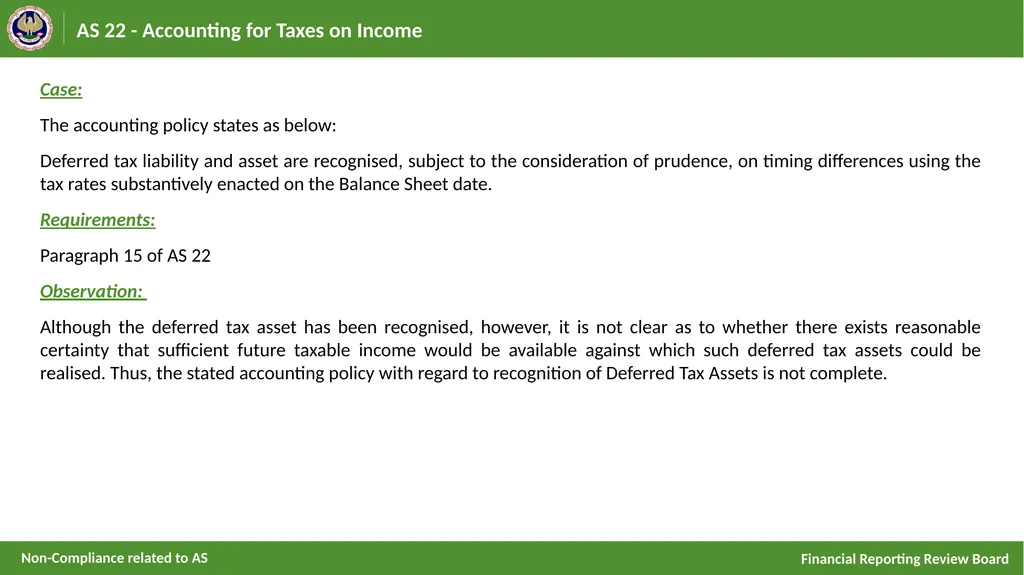
The accounting policy states as below:
Deferred tax liability and asset are recognised, subject to the consideration of prudence, on timing differences using the tax rates substantively enacted on the Balance Sheet date.
Requirements:
Paragraph 15 of AS 22
Observation:
Although the deferred tax asset has been recognised, however, it is not clear as to whether there exists reasonable certainty that sufficient future taxable income would be available against which such deferred tax assets could be realised. Thus, the stated accounting policy with regard to recognition of Deferred Tax Assets is not complete.<br>
The accounting policy states as below:
Deferred tax liability and asset are recognised, subject to the consideration of prudence, on timing differences using the tax rates substantively enacted on the Balance Sheet date.
Requirements:
Paragraph 15 of AS 22
Observation:
Although the deferred tax asset has been recognised, however, it is not clear as to whether there exists reasonable certainty that sufficient future taxable income would be available against which such deferred tax assets could be realised. Thus, the stated accounting policy with regard to recognition of Deferred Tax Assets is not complete.<br>
40
AS 22 - Accounting for Taxes on Income Non-Compliance related to AS Case:
A company had the carry forward of losses and its accounting policy with regard to Deferred tax, inter alia, states that:
“….The management is of the opinion that sufficient future taxable income will be available against which, such deferred tax assets will be realised…….”
Requirements:
Paragraph 17 of AS 22
Observation:
The company had carried forward unabsorbed losses, making Paragraph 17 applicable. While the management believes sufficient future taxable income will be available to realize the deferred tax assets, it has not been stated as to whether there is virtual certainty, supported by convincing evidence, that such income will be available. Therefore, the stated accounting policy does not comply with AS 22.<br>
A company had the carry forward of losses and its accounting policy with regard to Deferred tax, inter alia, states that:
“….The management is of the opinion that sufficient future taxable income will be available against which, such deferred tax assets will be realised…….”
Requirements:
Paragraph 17 of AS 22
Observation:
The company had carried forward unabsorbed losses, making Paragraph 17 applicable. While the management believes sufficient future taxable income will be available to realize the deferred tax assets, it has not been stated as to whether there is virtual certainty, supported by convincing evidence, that such income will be available. Therefore, the stated accounting policy does not comply with AS 22.<br>
41
AS 22 - Accounting for Taxes on Income Non-Compliance related to AS Case:
Following are the instances of presentation of Deferred tax Assets and Liabilities as adopted by different companies:
Deferred tax Liability shown as a part of ‘Loan Funds’.
Deferred tax (net) shown after the head ‘Net Current Assets’.
Deferred tax Liability is shown as a deduction from the ‘Application of Funds’.
Deferred tax Liability is shown as a part of ‘Shareholders Funds’.
Deferred tax Liabilities is shown as distinct sub-head under the Note on Provisions.
Requirements:
Paragraph 30 of AS 22
Observation:
Explanation to Paragraph 30 of AS 22 requires that deferred tax liabilities should be disclosed on the face of the balance sheet separately after the head ‘Unsecured Loans’ and deferred tax assets should be disclosed on the face of the balance sheet separately after the head ‘Investments’.
Accordingly, the aforesaid presentation of DTA/ DTL is not in line with AS 22.<br>
Following are the instances of presentation of Deferred tax Assets and Liabilities as adopted by different companies:
Deferred tax Liability shown as a part of ‘Loan Funds’.
Deferred tax (net) shown after the head ‘Net Current Assets’.
Deferred tax Liability is shown as a deduction from the ‘Application of Funds’.
Deferred tax Liability is shown as a part of ‘Shareholders Funds’.
Deferred tax Liabilities is shown as distinct sub-head under the Note on Provisions.
Requirements:
Paragraph 30 of AS 22
Observation:
Explanation to Paragraph 30 of AS 22 requires that deferred tax liabilities should be disclosed on the face of the balance sheet separately after the head ‘Unsecured Loans’ and deferred tax assets should be disclosed on the face of the balance sheet separately after the head ‘Investments’.
Accordingly, the aforesaid presentation of DTA/ DTL is not in line with AS 22.<br>
42
AS 26 – Intangible Assets Non-Compliance related to AS Case:
The accounting policy on ‘Deferred Revenue Expenditure’ states as follows:
The expenditure incurred on factory license fees, trademark fee, seed marketing expenses, public/capital issue expenses, preliminary expenses and rental paid for pre-commencement of retail stores/ factories, has been treated as deferred revenue expenditure which are being amortised over the life of the concerned items.
Requirements:
Paragraph 6.2 of AS 26
Observation:
The expenditure incurred on rental paid for pre-commencement of retail stores/ factories, seed marketing expenses, public/ capital issue expenses, preliminary expenses cannot be considered to be a ‘resource’ being controlled by the enterprise, and hence, such expenses do not meet the criteria of the term ‘asset’, and therefore, they cannot be treated as asset and defer.<br>
The accounting policy on ‘Deferred Revenue Expenditure’ states as follows:
The expenditure incurred on factory license fees, trademark fee, seed marketing expenses, public/capital issue expenses, preliminary expenses and rental paid for pre-commencement of retail stores/ factories, has been treated as deferred revenue expenditure which are being amortised over the life of the concerned items.
Requirements:
Paragraph 6.2 of AS 26
Observation:
The expenditure incurred on rental paid for pre-commencement of retail stores/ factories, seed marketing expenses, public/ capital issue expenses, preliminary expenses cannot be considered to be a ‘resource’ being controlled by the enterprise, and hence, such expenses do not meet the criteria of the term ‘asset’, and therefore, they cannot be treated as asset and defer.<br>
43
AS 26 – Intangible Assets Non-Compliance related to AS Case:
The accounting policy on ‘Intangible Assets ’ states as follows:
Technical know-how is amortised over the useful life of the underlying plant and amortisation is done on straight line basis.
Requirements:
Paragraph 94 of AS 26
Observation:
Here the Technical know-how is amortized over the useful life of the underlying plant and the useful life of technical know-how has not been considered for determination of its amortisation period, which is an important element to determine its amortisation policy as explained in paragraph 69 of AS 26. The intangible assets should be amortised over its useful life or the life of underlying assets or over the period of 10 years, whichever is earlier. In case, if it is more than 10 years, then the reason should be disclosed for determining the useful life higher than 10 years as per paragraph 94 of AS 26.<br>
The accounting policy on ‘Intangible Assets ’ states as follows:
Technical know-how is amortised over the useful life of the underlying plant and amortisation is done on straight line basis.
Requirements:
Paragraph 94 of AS 26
Observation:
Here the Technical know-how is amortized over the useful life of the underlying plant and the useful life of technical know-how has not been considered for determination of its amortisation period, which is an important element to determine its amortisation policy as explained in paragraph 69 of AS 26. The intangible assets should be amortised over its useful life or the life of underlying assets or over the period of 10 years, whichever is earlier. In case, if it is more than 10 years, then the reason should be disclosed for determining the useful life higher than 10 years as per paragraph 94 of AS 26.<br>
44
AS 26 – Intangible Assets Non-Compliance related to AS Case:
The accounting policy on Research & Development states that the expenditure on proposed projects has been accumulated, and it is amortized over a period of 5 years.
Requirements:
Paragraph 44 of AS 26
Observation:
AS 26 requires classification of expenses into ‘Research Expenditure’ and ‘Development Expenditure’. Further, expenditure incurred during the research phase should be recognised as an expense in the Statement of Profit & Loss immediately, and expenditure which have been incurred during the development phase should be recognised as an Intangible Asset, if the recognition criteria given in paragraph 44 of AS 26 are satisfied.
However, in the given case, Research and Development expenditures have not been classified between research phase and development phase as required by AS 26. Further, the stated policy indicates that R&D expenditures have been treated as ‘deferred revenue expenditure’ which is again contrary to AS 26 .<br>
The accounting policy on Research & Development states that the expenditure on proposed projects has been accumulated, and it is amortized over a period of 5 years.
Requirements:
Paragraph 44 of AS 26
Observation:
AS 26 requires classification of expenses into ‘Research Expenditure’ and ‘Development Expenditure’. Further, expenditure incurred during the research phase should be recognised as an expense in the Statement of Profit & Loss immediately, and expenditure which have been incurred during the development phase should be recognised as an Intangible Asset, if the recognition criteria given in paragraph 44 of AS 26 are satisfied.
However, in the given case, Research and Development expenditures have not been classified between research phase and development phase as required by AS 26. Further, the stated policy indicates that R&D expenditures have been treated as ‘deferred revenue expenditure’ which is again contrary to AS 26 .<br>
45
AS 27 – Financial Reporting of Interests in Joint Ventures Non-Compliance related to AS Case:
From the financial statement, it was noted that the company has a joint control with A Ltd.
Requirements:
Paragraph 53 of AS 27
Observation:
The aggregate amounts of the assets, liabilities, income and expenses related to its interests in the jointly controlled entities are required to be disclosed. Accordingly, the requirement of AS 27 has not been complied with.<br>
From the financial statement, it was noted that the company has a joint control with A Ltd.
Requirements:
Paragraph 53 of AS 27
Observation:
The aggregate amounts of the assets, liabilities, income and expenses related to its interests in the jointly controlled entities are required to be disclosed. Accordingly, the requirement of AS 27 has not been complied with.<br>
46
AS 29 – Provisions, Contingent Liabilities and Contingent Assets Non-Compliance related to AS Case:
The amount of contingent liabilities have been disclosed under the Note on Contingent Liabilities and Capital Commitments, as follows:
Requirements:
Paragraph 68 of AS 29
Observation:
A brief description of the nature of that contingent liability should have been mentioned in line with the requirement of paragraph 68 of AS 29.<br>
The amount of contingent liabilities have been disclosed under the Note on Contingent Liabilities and Capital Commitments, as follows:
Requirements:
Paragraph 68 of AS 29
Observation:
A brief description of the nature of that contingent liability should have been mentioned in line with the requirement of paragraph 68 of AS 29.<br>
47
AS 29 – Provisions, Contingent Liabilities and Contingent Assets Non-Compliance related to AS Case:
The Company has not provided for interest on the ground that they are anticipating favorable outcome in respect of ongoing negotiations with consortium bankers for one time settlement of their respective dues.
Requirements:
AS 1 and AS 29 and Section 128 of Companies Act, 2013
Observation:
Any loan, even if under negotiation with consortium bankers for one time settlement, does not exempt the company from its obligation to pay related charges. Hence, provision should have been made by the company for interest obligation in compliance of Section 128 of the Companies Act, 2013 read with AS 1 and AS 29 .<br>
The Company has not provided for interest on the ground that they are anticipating favorable outcome in respect of ongoing negotiations with consortium bankers for one time settlement of their respective dues.
Requirements:
AS 1 and AS 29 and Section 128 of Companies Act, 2013
Observation:
Any loan, even if under negotiation with consortium bankers for one time settlement, does not exempt the company from its obligation to pay related charges. Hence, provision should have been made by the company for interest obligation in compliance of Section 128 of the Companies Act, 2013 read with AS 1 and AS 29 .<br>
48
THANK YOU Financial Reporting Review Board
The Institute of Chartered Accountants of India
A- 29, Sector 62, Noida, Uttar Pradesh 201309
Office Phone: +91-0120-3045882/962/982
Email: frrb@icai.in
Website : https://frrb.icai.org/
X Handle: @https://twitter.com/frrbicai<br>
The Institute of Chartered Accountants of India
A- 29, Sector 62, Noida, Uttar Pradesh 201309
Office Phone: +91-0120-3045882/962/982
Email: frrb@icai.in
Website : https://frrb.icai.org/
X Handle: @https://twitter.com/frrbicai<br>