
Communications Plan VHA Reduce Employee Burnout
TD
Published · 18 slides · 0 views

1 / 1







Description
Communications Plan VHA Reduce Employee Burnout and Optimize Organizational Thriving (REBOOT) Initiative Informational Name Title Session Date Burnout In Health Care: What Do We Know? 2 What is Burnout? An occupational syndrome
Related Topics
Share
Embed code
Download this presentation From Below
"Communications Plan VHA Reduce Employee Burnout" is the property of its rightful owner. Permission is granted to download and print the materials on this website for personal, non-commercial use only, and to display it on your personal computer provided you do not modify the materials and that you retain all copyright notices contained in the materials. By downloading content from our website, you accept the terms of this agreement.
Presentation Transcript
01
Communications Plan VHA Reduce Employee Burnout and Optimize Organizational Thriving (REBOOT) Initiative Informational Name
Title
Session
Date<br>
Title
Session
Date<br>
02
Burnout In Health Care: What Do We Know? 2 What is Burnout?
An occupational syndrome characterized by:
Emotional exhaustion
Depersonalization
Low sense of personal accomplishment at work
Burnout in health care was near ‘crisis’ levels before the COVID-19 pandemic
An estimated 35-54% of nurses and physicians and 45-60% of medical students and residents reported burnout
The cost of physician burnout is estimated at $2.6B to $6.3B annually
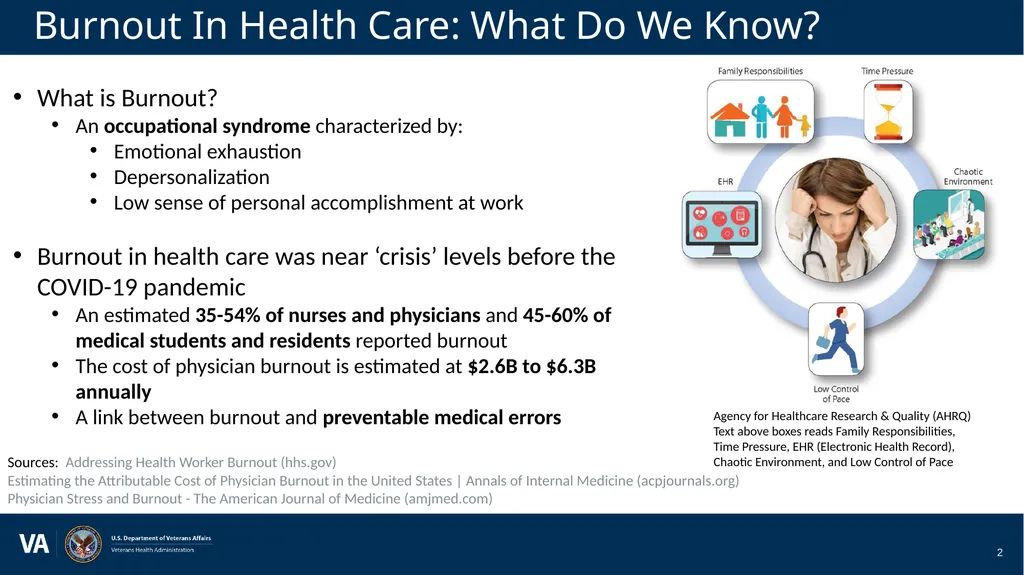
A link between burnout and preventable medical errors Agency for Healthcare Research & Quality (AHRQ)
Text above boxes reads Family Responsibilities, Time Pressure, EHR (Electronic Health Record), Chaotic Environment, and Low Control of Pace Sources: Addressing Health Worker Burnout (hhs.gov)
Estimating the Attributable Cost of Physician Burnout in the United States | Annals of Internal Medicine (acpjournals.org)
Physician Stress and Burnout - The American Journal of Medicine (amjmed.com)<br>
An occupational syndrome characterized by:
Emotional exhaustion
Depersonalization
Low sense of personal accomplishment at work
Burnout in health care was near ‘crisis’ levels before the COVID-19 pandemic
An estimated 35-54% of nurses and physicians and 45-60% of medical students and residents reported burnout
The cost of physician burnout is estimated at $2.6B to $6.3B annually
A link between burnout and preventable medical errors Agency for Healthcare Research & Quality (AHRQ)
Text above boxes reads Family Responsibilities, Time Pressure, EHR (Electronic Health Record), Chaotic Environment, and Low Control of Pace Sources: Addressing Health Worker Burnout (hhs.gov)
Estimating the Attributable Cost of Physician Burnout in the United States | Annals of Internal Medicine (acpjournals.org)
Physician Stress and Burnout - The American Journal of Medicine (amjmed.com)<br>
03
Burnout Originates in Systems 3 "While burnout manifests in individuals, it originates in systems. It’s important to move the focus toward fixing the workplace rather than fixing the worker.”
Christine Sinsky, MD
AMA Vice President of Professional Satisfaction<br>
Christine Sinsky, MD
AMA Vice President of Professional Satisfaction<br>
04
Beginning of Our Journey in VHA 4 The COVID-19 pandemic exacerbated burnout in health. It also created new ones.
In 2021, VHA leadership made a priority of addressing burnout with a well-coordinated, health care system-wide approach.
Where to start?
Began with acknowledgement of burnout, its impacts, and a national conversation with VHA’s workforce<br>
In 2021, VHA leadership made a priority of addressing burnout with a well-coordinated, health care system-wide approach.
Where to start?
Began with acknowledgement of burnout, its impacts, and a national conversation with VHA’s workforce<br>
05
Building a Coalition – Establishing a Taskforce 5 This graphic shows the six factors that impact feelings of burnout. REBOOT addresses these by improving the work environment and support for employee well-being. These factors are workload, fairness, harmony, job control, values, and recognition. The Reduce Employee Burnout and Optimize Organizational Thriving (REBOOT) Task Force was instituted in August 2021.
Direct partnership between VHA leaders and frontline employees and union partners
Goal is to foster a work environment where every VHA employee can thrive and find purpose, fulfillment, and joy in their work
This, in turn, supports VHA’s ability to best serve our nation’s Veterans, families, caregivers, and survivors.<br>
Direct partnership between VHA leaders and frontline employees and union partners
Goal is to foster a work environment where every VHA employee can thrive and find purpose, fulfillment, and joy in their work
This, in turn, supports VHA’s ability to best serve our nation’s Veterans, families, caregivers, and survivors.<br>
06
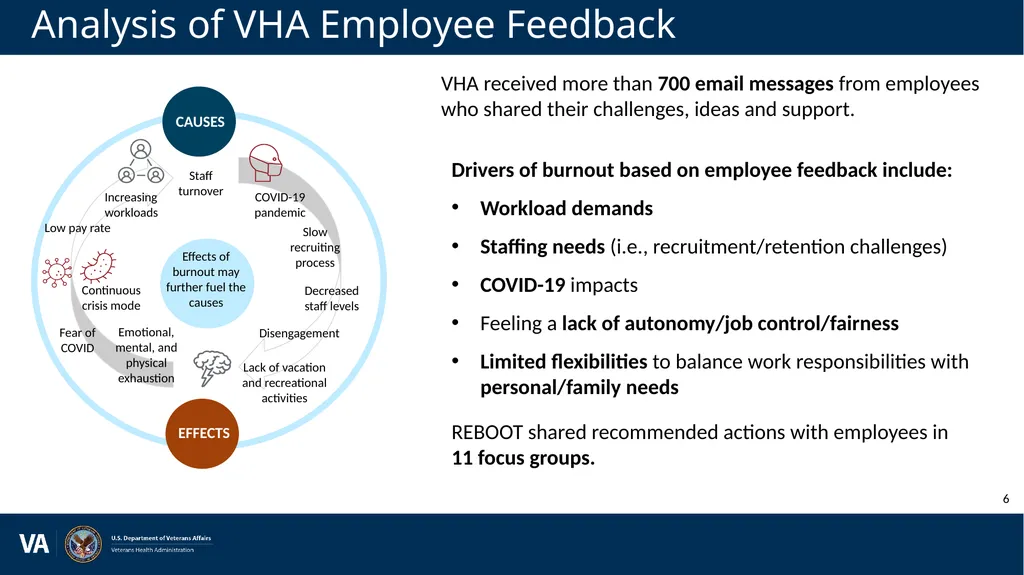
Analysis of VHA Employee Feedback 6 VHA received more than 700 email messages from employees who shared their challenges, ideas and support. Drivers of burnout based on employee feedback include:
Workload demands
Staffing needs (i.e., recruitment/retention challenges)
COVID-19 impacts
Feeling a lack of autonomy/job control/fairness
Limited flexibilities to balance work responsibilities with personal/family needs
REBOOT shared recommended actions with employees in 11 focus groups.<br>
Workload demands
Staffing needs (i.e., recruitment/retention challenges)
COVID-19 impacts
Feeling a lack of autonomy/job control/fairness
Limited flexibilities to balance work responsibilities with personal/family needs
REBOOT shared recommended actions with employees in 11 focus groups.<br>
07
Overview: Moving Forward 7 The VHA Governance Board and the VHA Under Secretary for Health approved 7 focus areas in August 2022. In September 2022, VHA disbanded the REBOOOT Task Force and formed the REBOOT Implementation Team (RIT). Can’t forget about what each one of us can do for ourselves and each other<br>
08
Prioritizing Actions to Combat Burnout – Key Considerations 8 Operational Constraints Administrative Burden Build on Existing Efforts Team Approach Begin a Journey<br>
09
Where We Are 9 Launched Operation Exhale in March 2023 across VHA to shorten meetings and encourage best practices to make meetings more effective.
Developed a tool kit to support the Operation Exhale initiative locally.
Worked with VA Illiana Health Care System to develop an implementation tool kit for their promising practice, Focus Fridays (no meetings Friday); over 7k SP views. All 18 facilities have hired a CWO through the original national executive memo.
16 Early Adopter sites have hired a CWO.
CWO Fundamentals Conferences are hosted to train and support CWOs.
4 Senior Leadership Engagement Sessions completed (Feb. & March 2024).
CWO Experience Pilot underway (launched on March 25, 2024).
Funding has been secured for LEARN FY24 Evaluation efforts. Optimize Meeting Practices Chief Wellbeing Officer (CWO) Local Assignment Reduction and Management Plan (LARMP) and Local Assignment Dashboard (LAD) entering pilot phase with more than 30 sites participating.
Knowledge Validation TIGER Team currently redesigning a 90-minute course “Own the Moment” and will impact ALL VHA staff.
Removal of Optional Evaluation Survey job-aid being produced for mass distribution.
Evaluation of MT Moratorium Implementation during pandemic led by SALIENT. Optimize TMS Training<br>
Developed a tool kit to support the Operation Exhale initiative locally.
Worked with VA Illiana Health Care System to develop an implementation tool kit for their promising practice, Focus Fridays (no meetings Friday); over 7k SP views. All 18 facilities have hired a CWO through the original national executive memo.
16 Early Adopter sites have hired a CWO.
CWO Fundamentals Conferences are hosted to train and support CWOs.
4 Senior Leadership Engagement Sessions completed (Feb. & March 2024).
CWO Experience Pilot underway (launched on March 25, 2024).
Funding has been secured for LEARN FY24 Evaluation efforts. Optimize Meeting Practices Chief Wellbeing Officer (CWO) Local Assignment Reduction and Management Plan (LARMP) and Local Assignment Dashboard (LAD) entering pilot phase with more than 30 sites participating.
Knowledge Validation TIGER Team currently redesigning a 90-minute course “Own the Moment” and will impact ALL VHA staff.
Removal of Optional Evaluation Survey job-aid being produced for mass distribution.
Evaluation of MT Moratorium Implementation during pandemic led by SALIENT. Optimize TMS Training<br>
10
Where We Are 10 Formed an Order Entry for Community Providers Workgroup.
Recommending that IVC reduce the required minimum mental health scheduling efforts for Veterans who are not high-risk after clinic cancellations or no-shows.
Additional meetings with the Veterans Transportation Program Member Services – discussing the Beneficiary Travel Consult proposal with option for 3-year duration. Address Clinical Team Inefficiencies Good success since VHA Governance Board voted (Sept. 2023) to recommend implementation of the 72/80 schedule for Registered Nurses (RNs) in bedded units.
March 2024 increase for 72/80 was 283, a 145% increase since February 2023.
Developed a 72/80 blueprint and training for implementation; comms plan and evaluation proposal in process.
Established an email group to answer HR policy questions from the field. Maximize Use of HR Policies/Flexibilities<br>
Recommending that IVC reduce the required minimum mental health scheduling efforts for Veterans who are not high-risk after clinic cancellations or no-shows.
Additional meetings with the Veterans Transportation Program Member Services – discussing the Beneficiary Travel Consult proposal with option for 3-year duration. Address Clinical Team Inefficiencies Good success since VHA Governance Board voted (Sept. 2023) to recommend implementation of the 72/80 schedule for Registered Nurses (RNs) in bedded units.
March 2024 increase for 72/80 was 283, a 145% increase since February 2023.
Developed a 72/80 blueprint and training for implementation; comms plan and evaluation proposal in process.
Established an email group to answer HR policy questions from the field. Maximize Use of HR Policies/Flexibilities<br>
11
Where We Are 11 Generated a menu of NCOD Servant Leadership offerings (under review by NCOD Senior Leadership)
Organizational Assessment Committee developed new, behaviorally-oriented items for SL Index on AES; will be included in 2024 AES Administration.
SL definition has been updated.
In the process of refining SL-focused performance plan elements based on feedback. Developing an executive decision memo proposal that will include recommendations for EAP, Modernization, Scaling Peer Support and Acute Crisis Support.
Finalizing Standard Operating Procedure (SOP) Peer Support template for the field.
Compilation of acute crisis resources completed and added to the Mental Health tool kit that has 6,150 views on SP.
Looking into the possibility of a national desktop icon to link to employee MH resources. Strengthen Mental Health Support Strengthen Culture of Servant Leadership<br>
Organizational Assessment Committee developed new, behaviorally-oriented items for SL Index on AES; will be included in 2024 AES Administration.
SL definition has been updated.
In the process of refining SL-focused performance plan elements based on feedback. Developing an executive decision memo proposal that will include recommendations for EAP, Modernization, Scaling Peer Support and Acute Crisis Support.
Finalizing Standard Operating Procedure (SOP) Peer Support template for the field.
Compilation of acute crisis resources completed and added to the Mental Health tool kit that has 6,150 views on SP.
Looking into the possibility of a national desktop icon to link to employee MH resources. Strengthen Mental Health Support Strengthen Culture of Servant Leadership<br>
12
Where We’re Going 12 To support long-term efforts, REBOOT is considering:
An internal sustainability plan.
Reassessing its structure.
Engaging with program offices, front line staff, and leadership at all levels of organization.
Actions Completed:
Developed a charter for the REBOOT Collaborative, which includes roles and responsibilities.
Met with Strength and Organizational Management (SOM) office to discuss org chart and staffing.
Current Status: On Pause
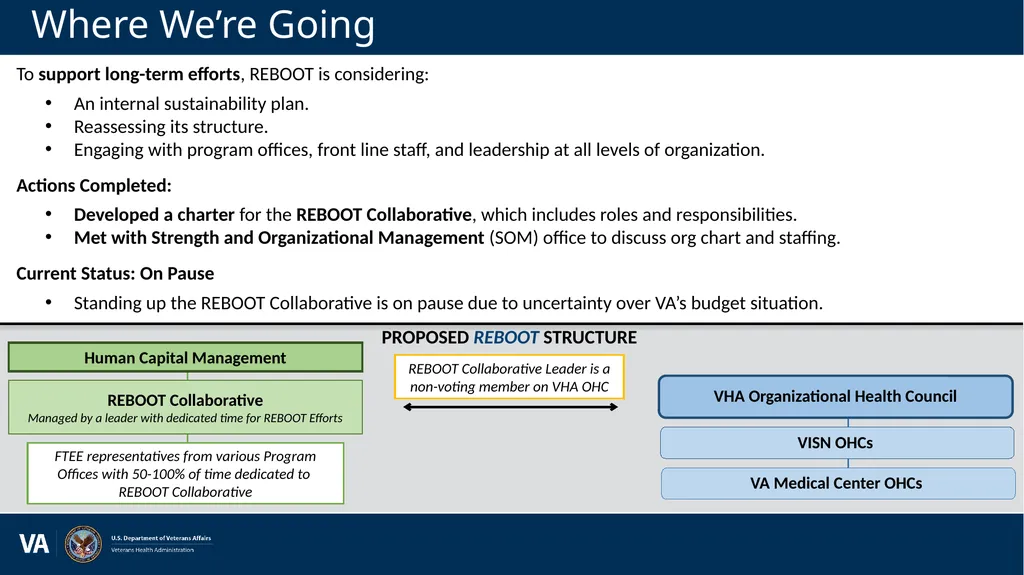
Standing up the REBOOT Collaborative is on pause due to uncertainty over VA’s budget situation. PROPOSED REBOOT STRUCTURE Human Capital Management REBOOT Collaborative
Managed by a leader with dedicated time for REBOOT Efforts FTEE representatives from various Program Offices with 50-100% of time dedicated to
REBOOT Collaborative VHA Organizational Health Council VISN OHCs VA Medical Center OHCs REBOOT Collaborative Leader is a non-voting member on VHA OHC<br>
An internal sustainability plan.
Reassessing its structure.
Engaging with program offices, front line staff, and leadership at all levels of organization.
Actions Completed:
Developed a charter for the REBOOT Collaborative, which includes roles and responsibilities.
Met with Strength and Organizational Management (SOM) office to discuss org chart and staffing.
Current Status: On Pause
Standing up the REBOOT Collaborative is on pause due to uncertainty over VA’s budget situation. PROPOSED REBOOT STRUCTURE Human Capital Management REBOOT Collaborative
Managed by a leader with dedicated time for REBOOT Efforts FTEE representatives from various Program Offices with 50-100% of time dedicated to
REBOOT Collaborative VHA Organizational Health Council VISN OHCs VA Medical Center OHCs REBOOT Collaborative Leader is a non-voting member on VHA OHC<br>
13
What LEADERS Can Do Now Discuss “hassle factors” in Daily Huddles and Leadership Rounding. Close the loop and celebrate when actions remove or address them.
Talk about drivers of burnout and how to address them during 1:1 discussions with employees or discussions with various teams and workgroups.
Model and promote efficient meeting techniques and adopt shortened meeting times. Use this tool kit to learn about “Operation Exhale.” Check out the "Focus Friday" tool kit to help give you more control over the end of your week.
Use existing communication methods (e.g., email, town halls) to show your employees you care about their well-being and value their feedback. Highlight how you and your team are taking action and promoting REBOOT efforts.
Use the Stay in VA resources to focus on employee retention, engagement, and experience.<br>
Talk about drivers of burnout and how to address them during 1:1 discussions with employees or discussions with various teams and workgroups.
Model and promote efficient meeting techniques and adopt shortened meeting times. Use this tool kit to learn about “Operation Exhale.” Check out the "Focus Friday" tool kit to help give you more control over the end of your week.
Use existing communication methods (e.g., email, town halls) to show your employees you care about their well-being and value their feedback. Highlight how you and your team are taking action and promoting REBOOT efforts.
Use the Stay in VA resources to focus on employee retention, engagement, and experience.<br>
14
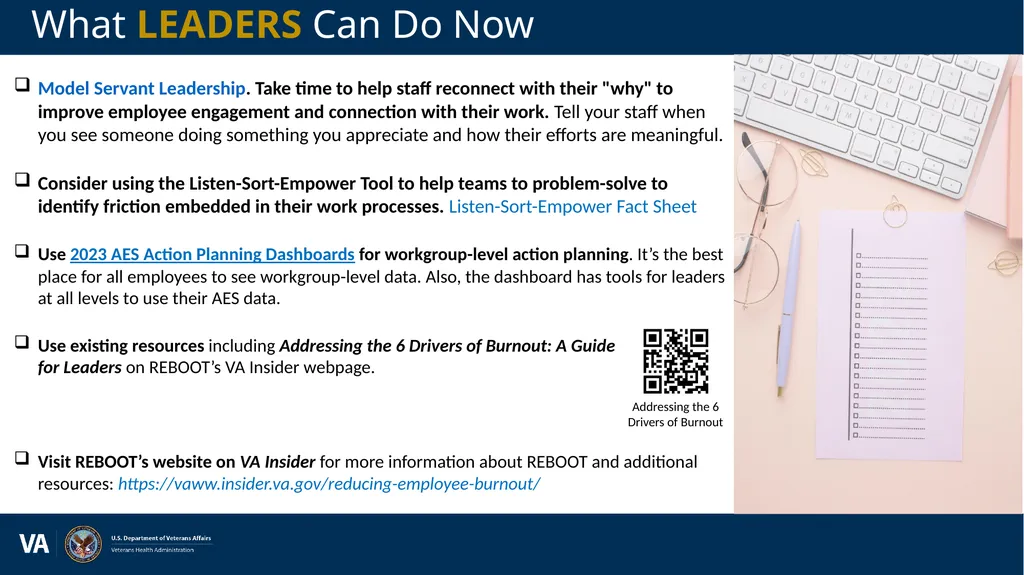
What LEADERS Can Do Now Model Servant Leadership. Take time to help staff reconnect with their "why" to improve employee engagement and connection with their work. Tell your staff when you see someone doing something you appreciate and how their efforts are meaningful.
Consider using the Listen-Sort-Empower Tool to help teams to problem-solve to identify friction embedded in their work processes. Listen-Sort-Empower Fact Sheet
Use 2023 AES Action Planning Dashboards for workgroup-level action planning. It’s the best place for all employees to see workgroup-level data. Also, the dashboard has tools for leaders at all levels to use their AES data.
Use existing resources including Addressing the 6 Drivers of Burnout: A Guide for Leaders on REBOOT’s VA Insider webpage.
Visit REBOOT’s website on VA Insider for more information about REBOOT and additional resources: https://vaww.insider.va.gov/reducing-employee-burnout/ Addressing the 6 Drivers of Burnout<br>
Consider using the Listen-Sort-Empower Tool to help teams to problem-solve to identify friction embedded in their work processes. Listen-Sort-Empower Fact Sheet
Use 2023 AES Action Planning Dashboards for workgroup-level action planning. It’s the best place for all employees to see workgroup-level data. Also, the dashboard has tools for leaders at all levels to use their AES data.
Use existing resources including Addressing the 6 Drivers of Burnout: A Guide for Leaders on REBOOT’s VA Insider webpage.
Visit REBOOT’s website on VA Insider for more information about REBOOT and additional resources: https://vaww.insider.va.gov/reducing-employee-burnout/ Addressing the 6 Drivers of Burnout<br>
15
What EMPLOYEES Can Do Now Share your ideas to improve your work environment. Give feedback on employee surveys.
Encourage forums for camaraderie and peer support. Reducing social isolation and loneliness can contribute to longevity and quality of life. National Institutes of Health Social Wellness Toolkit
Reach out for help when you feel you need more support or mental health treatment.
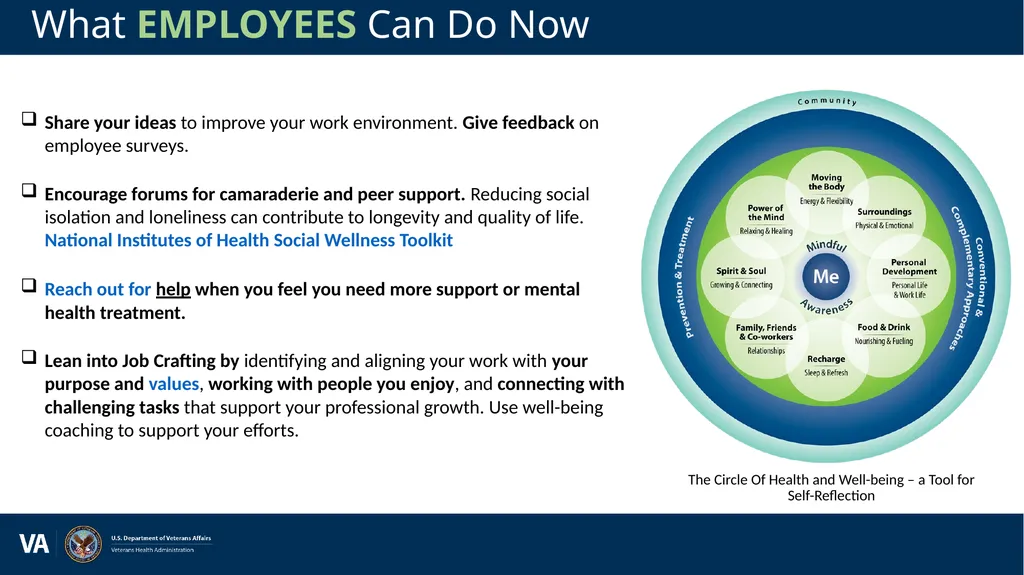
Lean into Job Crafting by identifying and aligning your work with your purpose and values, working with people you enjoy, and connecting with challenging tasks that support your professional growth. Use well-being coaching to support your efforts. The Circle Of Health and Well-being – a Tool for Self-Reflection<br>
Encourage forums for camaraderie and peer support. Reducing social isolation and loneliness can contribute to longevity and quality of life. National Institutes of Health Social Wellness Toolkit
Reach out for help when you feel you need more support or mental health treatment.
Lean into Job Crafting by identifying and aligning your work with your purpose and values, working with people you enjoy, and connecting with challenging tasks that support your professional growth. Use well-being coaching to support your efforts. The Circle Of Health and Well-being – a Tool for Self-Reflection<br>
16
What EMPLOYEES Can Do Now Practice Self-Compassion. As an example, you can take this short self-compassion assessment from Stanford University. This can improve attention and decision making.
Incorporate mindfulness into your workday, as an employee and a leader. Participate in a free Mindful Fed session. This can contribute to improved immunity and resilience.
Offer Gratitude to your colleagues and yourself. It can improve emotional exhaustion and thriving.
Take your breaks and use short experiences for an attention break during the day through #LiveWholeHealth Blog Series.
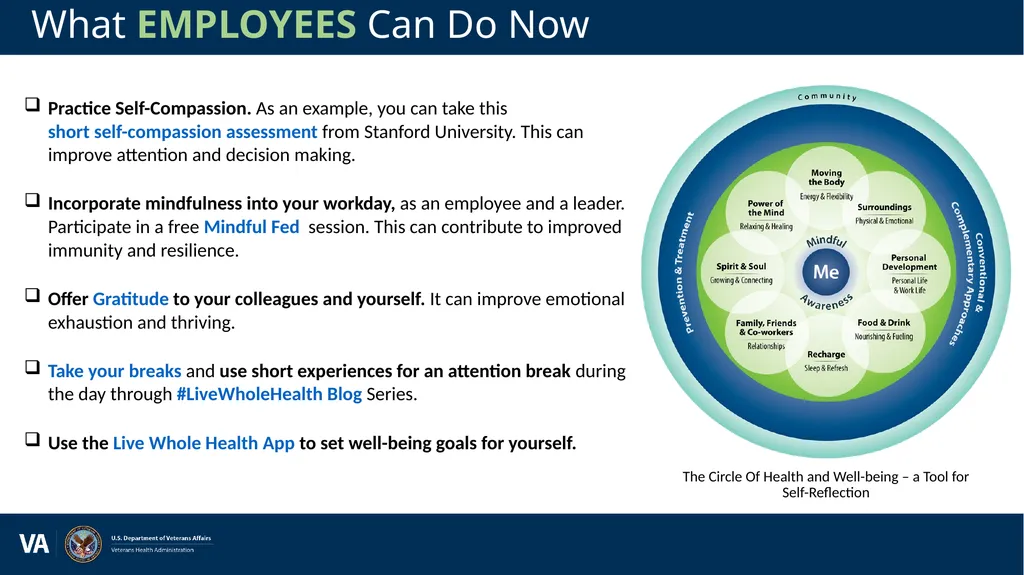
Use the Live Whole Health App to set well-being goals for yourself. The Circle Of Health and Well-being – a Tool for Self-Reflection<br>
Incorporate mindfulness into your workday, as an employee and a leader. Participate in a free Mindful Fed session. This can contribute to improved immunity and resilience.
Offer Gratitude to your colleagues and yourself. It can improve emotional exhaustion and thriving.
Take your breaks and use short experiences for an attention break during the day through #LiveWholeHealth Blog Series.
Use the Live Whole Health App to set well-being goals for yourself. The Circle Of Health and Well-being – a Tool for Self-Reflection<br>
17
Discussion and Questions 17<br>
18
Additional Resources 18 VHA REBOOT Initiative
REBOOT Webpage (VA Insider)
Supporting Resources
Scheduling Flexibilities FAQS
Telework for Primary Care Employees Memo
Employee Whole Health
Send gratitude to a colleague through the #VAGratitude app. USH Updates on REBOOT (2022-Present)
What REBOOT Has for You in 2024 (Feb. 2024)
All that Jazz (Nov. 2023)
VHA REBOOT: Making a Difference (November 2023)
Reduce meeting fatigue by scheduling shorter, more effective meetings (March 2023)
REBOOT Implementation Status Update (December 2022)
Announcing REBOOT priority focus areas (Sep. 2022)
Preparing for REBOOT implementation (Jun. 2022)
Staffing challenges and contribution to burnout (May 2022)
Focus groups, supporting employee Whole Health (Apr. 2022)
Possible recommended actions, focus groups (Mar. 2022)
Flexible schedules, TMS training moratorium (Feb. 2022)
Talking with staff about scheduling flexibilities (Feb. 2022) USH Updates on REBOOT (2021)
Simplifying your work environment (Dec. 2021)
Video intro to REBOOT from Dr. Marcia Lysaght (Nov. 2021)
Addressing employee burnout: REBOOT task force (Nov. 2021)<br>
REBOOT Webpage (VA Insider)
Supporting Resources
Scheduling Flexibilities FAQS
Telework for Primary Care Employees Memo
Employee Whole Health
Send gratitude to a colleague through the #VAGratitude app. USH Updates on REBOOT (2022-Present)
What REBOOT Has for You in 2024 (Feb. 2024)
All that Jazz (Nov. 2023)
VHA REBOOT: Making a Difference (November 2023)
Reduce meeting fatigue by scheduling shorter, more effective meetings (March 2023)
REBOOT Implementation Status Update (December 2022)
Announcing REBOOT priority focus areas (Sep. 2022)
Preparing for REBOOT implementation (Jun. 2022)
Staffing challenges and contribution to burnout (May 2022)
Focus groups, supporting employee Whole Health (Apr. 2022)
Possible recommended actions, focus groups (Mar. 2022)
Flexible schedules, TMS training moratorium (Feb. 2022)
Talking with staff about scheduling flexibilities (Feb. 2022) USH Updates on REBOOT (2021)
Simplifying your work environment (Dec. 2021)
Video intro to REBOOT from Dr. Marcia Lysaght (Nov. 2021)
Addressing employee burnout: REBOOT task force (Nov. 2021)<br>