Comparative Overview: Domestic Violence Act 2020 vs Domestic Intimate Partner Violence (Prohibition) Bill 2024 Prepared by: Jared Coleman National Womens Commission For Consultation and Stakeholder Review Part I Terminology
"Comparative Overview: Domestic Violence Act 2020" is the property of its rightful owner. Permission is granted to
download and print the materials on this website for personal, non-commercial use only, and to display it
on your personal computer provided you do not modify the materials and that you retain all copyright
notices contained in the materials. By downloading content from our website, you accept the terms of this
agreement.
Presentation Transcript
01
Comparative Overview: Domestic Violence Act 2020 vs Domestic & Intimate Partner Violence (Prohibition) Bill 2024 Prepared by: Jared Coleman – National Women’s Commission
For Consultation and Stakeholder Review<br>
02
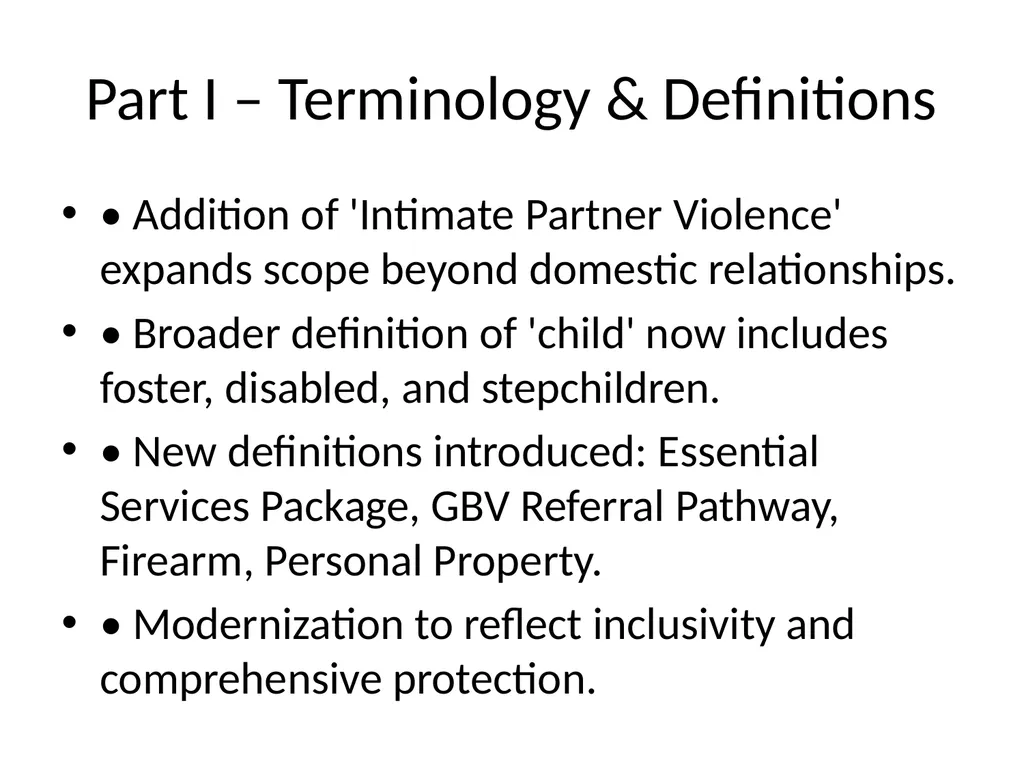
Part I – Terminology & Definitions • Addition of 'Intimate Partner Violence' expands scope beyond domestic relationships.
• Broader definition of 'child' now includes foster, disabled, and stepchildren.
• New definitions introduced: Essential Services Package, GBV Referral Pathway, Firearm, Personal Property.
• Modernization to reflect inclusivity and comprehensive protection.<br>
03
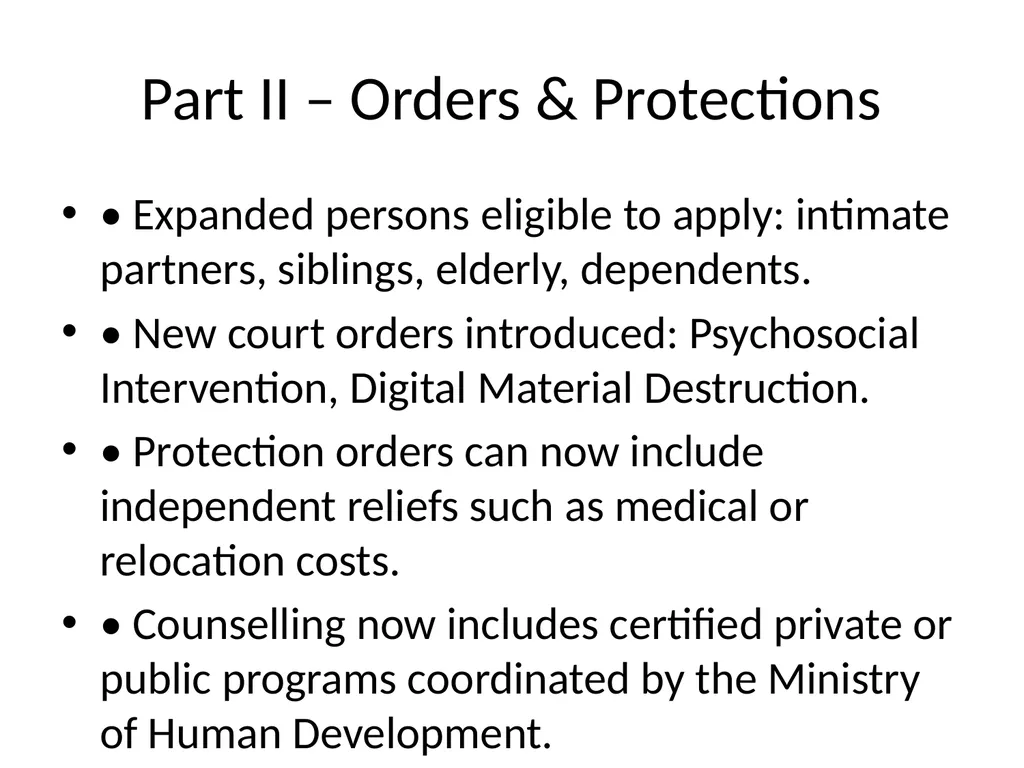
Part II – Orders & Protections • Expanded persons eligible to apply: intimate partners, siblings, elderly, dependents.
• New court orders introduced: Psychosocial Intervention, Digital Material Destruction.
• Protection orders can now include independent reliefs such as medical or relocation costs.
• Counselling now includes certified private or public programs coordinated by the Ministry of Human Development.<br>
04
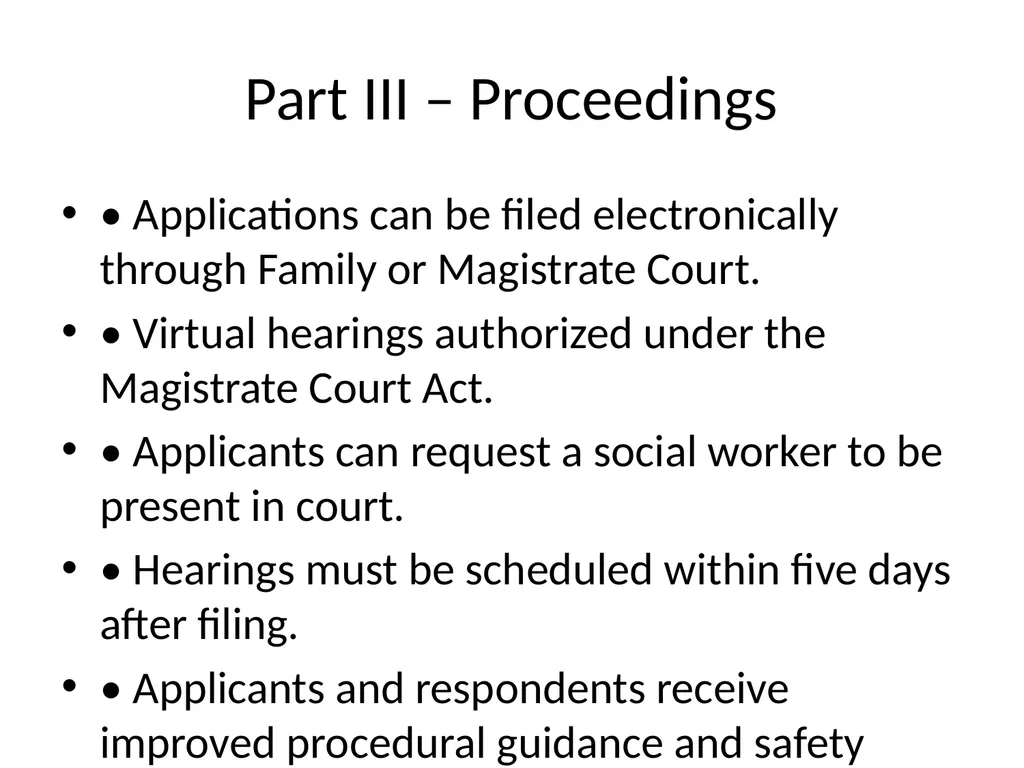
Part III – Proceedings • Applications can be filed electronically through Family or Magistrate Court.
• Virtual hearings authorized under the Magistrate Court Act.
• Applicants can request a social worker to be present in court.
• Hearings must be scheduled within five days after filing.
• Applicants and respondents receive improved procedural guidance and safety measures.<br>
05
Part IV – Enforcement & Police Duties • Police now mandated to act on reports of domestic and intimate partner violence.
• Officers must document reports, follow up, and enter data into the National Register.
• Neglect of duty results in fines or imprisonment.
• Police must provide victims with referral information and safety planning.
• Expanded powers for entry without warrant in imminent danger cases.<br>
06
Part V – Data, Prevention & Education • Ministry of Human Development responsible for national prevention and awareness programs.
• New mandate for public education, data collection, and collaboration with police, judiciary, and health sector.
• Creation of evidence-based educational campaigns on domestic and intimate partner violence.
• Integration of rehabilitation and counselling services for offenders.<br>
07
Schedule I – Offences • Expanded offences include cyber crimes, trafficking in persons, and commercial sexual exploitation of children.
• 'Sexual assault' replaces 'indecent assault', and 'unlawful carnal knowledge' is now 'unlawful sexual intercourse.'
• Removal of 'sexual intercourse by persons of the same sex' reflects human rights alignment.<br>
08
Key Takeaways ✅ Broader and more inclusive protection framework.
✅ Recognition of intimate partner violence as distinct yet related to domestic violence.
✅ Digital modernization of legal processes and evidence protection.
✅ Stronger enforcement mechanisms and accountability for police response.
✅ Victim-centered and trauma-informed approach to protection and justice.<br>