Comparison Example Question: Compare the presentation of the soldiers experiences of war. Introduction Both Charge of the Light Brigade (COTLB) by Tennyson and Bayonet Charge (BC) by Hughes are poems about the experience of soldiers in
"Comparison Example Question: Compare the" is the property of its rightful owner. Permission is granted to
download and print the materials on this website for personal, non-commercial use only, and to display it
on your personal computer provided you do not modify the materials and that you retain all copyright
notices contained in the materials. By downloading content from our website, you accept the terms of this
agreement.
Presentation Transcript
01
Comparison Example Question: Compare the presentation of the soldiers’ experiences of war.
Introduction
Both Charge of the Light Brigade (COTLB) by Tennyson and Bayonet Charge (BC) by Hughes are poems about the experience of soldiers’ in war: ‘COTLB’ is from the collective experience of the 600 men who charged in the Crimean War, while BC is about a singular soldiers’ experience of charging the enemy across no man’s land in World War One. COTLB almost glorifies the soldiers experience turning them into heroic figures who deserve to be remembered for the great sacrifice they made with vivid imagery of the battlefield and an overall impressed tone relating to the soldiers determination and stoicism. Whereas, BC does not glorify the actions of the soldier, instead we see one soldiers struggle with his duty as he realises through the visual imagery of his troubled movements and the questioning tone that he isn’t sure why he is charging towards the enemy anymore.<br>
02
Imagery Focused Ideas Select 2 more pairs of quotations that show vivid imagery related to the battlefield in COTLB and Bayonet Charge
Decide if these are similar or different
Identify the method/imagery in the quotations you have selected and briefly explain this
Explain how these compare.
Example 1 relating to imagery:
‘Charge for the guns!’ he said’ (COTLB) (3) imperative, visual imagery of order being given by someone in charge - unknown as the pronoun ‘he’ used.
Different
(1) ‘Suddenly, he awoke and was running…’ (BC) (3) adverb, visual imagery of urgency as the soldier realises where he is and what he is doing
(4) COTLB - No choice, told, commanding and no impression of how the soldiers felt VERSUS BC dreamlike state with the realisation of panic and urgency and a sense of the unknown.<br>
03
Tone Comparison Select 2 more pairs of quotations that show the different tones (impressed COTLB and questioning BC) related to the soldiers’ experiences in COTLB and Bayonet Charge
Decide if these are similar or different
Identify the specific tone in the quotations you have selected and briefly explain this
Explain how these compare.
Example 2 relating to tone:
‘Flash’d’ and ‘Sabring’ and ‘Charging’ (COTLB) uses verbs to create an impressed tone relating to their bravery and willingness to fight against a large, well armed force
Similar and different
(1) ‘In bewilderment he almost stopped…’ (BC) also uses verbs and the metaphorical rhetorical question to create a questioning tone about the soldiers’ purpose charging the enemy.
(4) COTLB soldiers fight relentlessly with quick movements making them seem strong and well-trained VERSUS BC the soldiers actions stop to show his confusion and unwillingness to be there despite knowing this could kill him as he is questioning his existence in no man’s land at that point in time - bravery compared to confusion.<br>
04
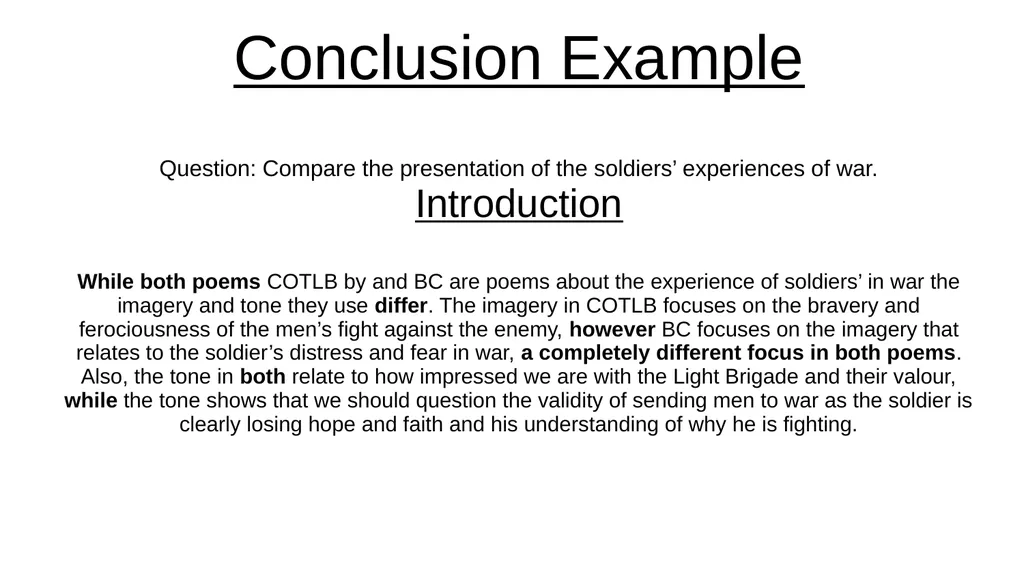
Conclusion Example Question: Compare the presentation of the soldiers’ experiences of war.
Introduction
While both poems COTLB by and BC are poems about the experience of soldiers’ in war the imagery and tone they use differ. The imagery in COTLB focuses on the bravery and ferociousness of the men’s fight against the enemy, however BC focuses on the imagery that relates to the soldier’s distress and fear in war, a completely different focus in both poems. Also, the tone in both relate to how impressed we are with the Light Brigade and their valour, while the tone shows that we should question the validity of sending men to war as the soldier is clearly losing hope and faith and his understanding of why he is fighting.<br>
05
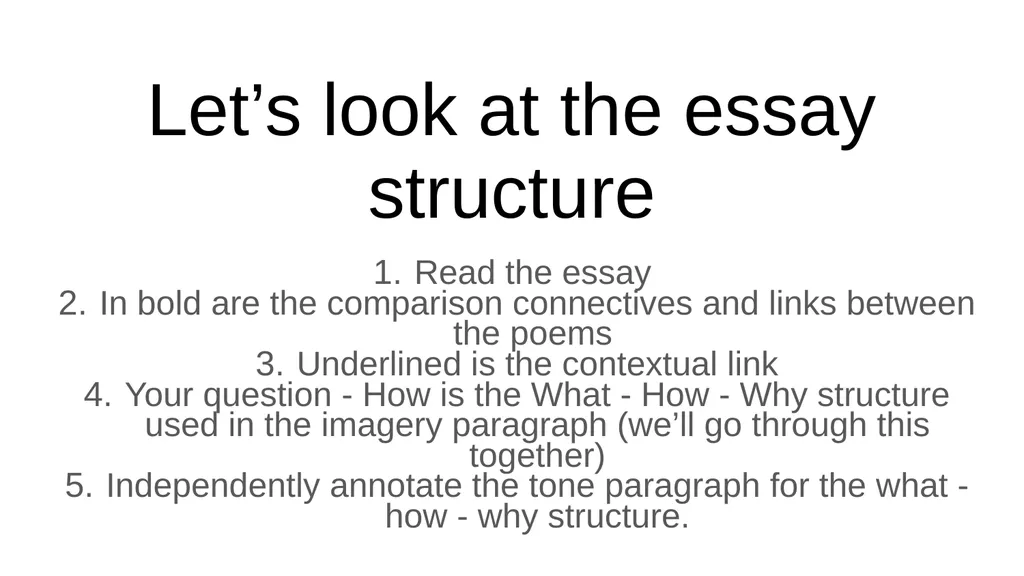
Let’s look at the essay structure Read the essay
In bold are the comparison connectives and links between the poems
Underlined is the contextual link
Your question - How is the What - How - Why structure used in the imagery paragraph (we’ll go through this together)
Independently annotate the tone paragraph for the what - how - why structure.<br>
06
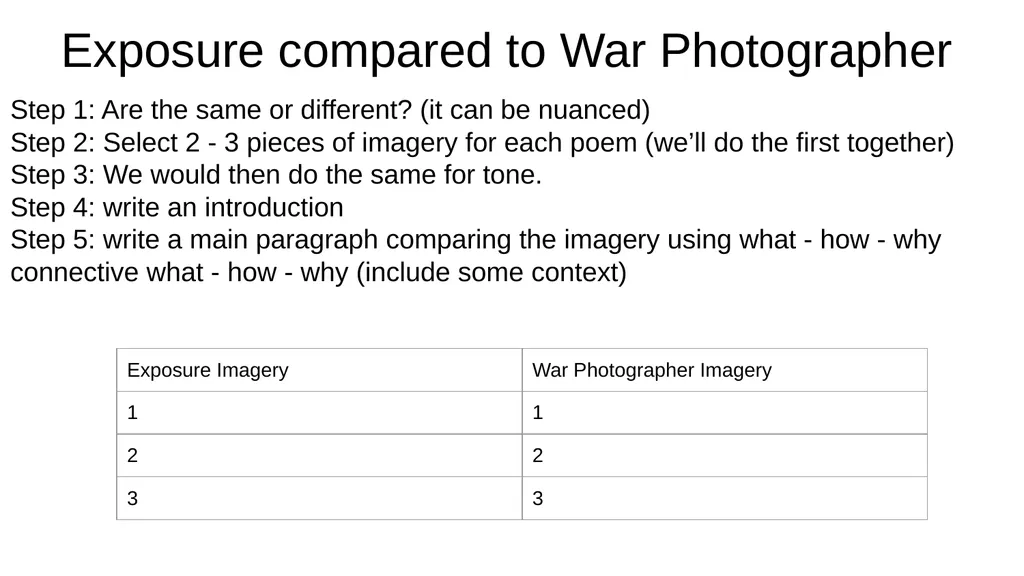
Exposure compared to War Photographer Step 1: Are the same or different? (it can be nuanced)
Step 2: Select 2 - 3 pieces of imagery for each poem (we’ll do the first together)
Step 3: We would then do the same for tone.
Step 4: write an introduction Step 5: write a main paragraph comparing the imagery using what - how - why connective what - how - why (include some context)<br>