COMPETITION CONSUMER PROTECTION COMMISSION Competition Consumer Protection Commission Barriers to Entry and exclusionary strategies in the Forestry Sector in Zambia Annual Competition and Economic Regulation Week held from 8th to 12th
"COMPETITION & CONSUMER PROTECTION COMMISSION" is the property of its rightful owner. Permission is granted to
download and print the materials on this website for personal, non-commercial use only, and to display it
on your personal computer provided you do not modify the materials and that you retain all copyright
notices contained in the materials. By downloading content from our website, you accept the terms of this
agreement.
Presentation Transcript
01
COMPETITION & CONSUMER PROTECTION COMMISSION Competition & Consumer Protection Commission Barriers to Entry and exclusionary strategies in the Forestry Sector in Zambia
Annual Competition and Economic Regulation Week held from 8th to 12th March, 2016 at Avani Hotel in Livingstone<br>
02
Outline of the Presentation Introduction
Problem statement
Market Structure and Players
Regulations and Regulators in the Forestry Sector
Competition issues in Sector
Competition Reforms in the Industry
Impact of Competition Reforms
Conclusion Competition and Consumer Protection Commission 2<br>
03
Introduction Approximately 67% (49,468,000 ha) of Zambia’s land surface is covered by forest (FAO, 2011).
The forestry and wood sector has contributed up to 5.2% of GDP to the national economy in the past.
Actual value could be higher than what is currently being accounted for (FAO, 2012 a&b) due to the inadequate accountability of the contribution of illegal or unregulated activities such as charcoal production. (Kokwe and Mickels-Kokwe, 2012). 3<br>
04
Introduction The types of forests in Zambia include Forest Reserves, Plantations, National Parks, Game Management Area Forests, and Woodlands.
Plantation forests in Zambia occupy approximately 55,000 hectares mainly pine, eucalyptus and gmelina.
50,000 hectares of these plantations are managed by ZAFFICO
The remaining 5,000 hectares is managed by the Forestry Department also managing 7.4 million hectares in forest reserves. 4<br>
05
The Forestry and wood products industry offers Zambia potential for economic growth and development of a viable export based economy.
The major challenge is that the forest reserves and plantations are finite resources and there has not been any active replanting.
Excessive lobbying by associations in the saw milling industry and uncompetitive agreements have tended to foreclose the market especially for new entrants who are often SMEs Competition and Consumer Protection Commission 5 Problem Statement<br>
06
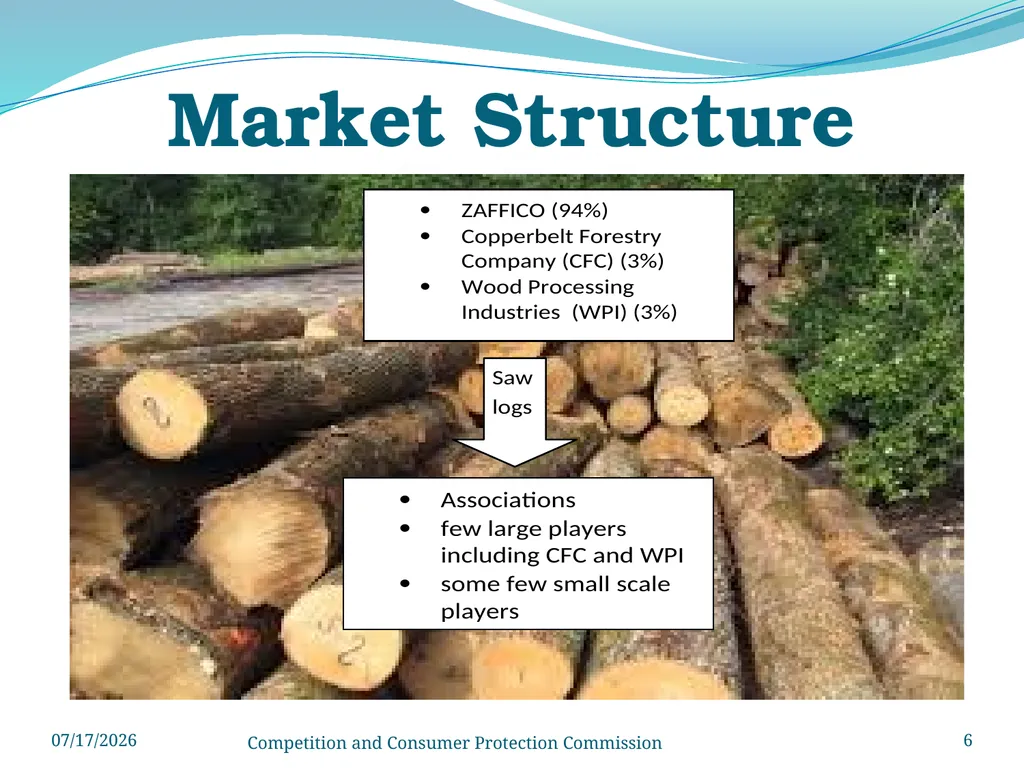
Market Structure 12/03/2016 Competition and Consumer Protection Commission 6<br>
07
Regulations and Regulators in the Forestry and Wood Sector The operations of the sector are guided by the Forest Act is enforced by the Forestry department under the Ministry of Tourism, Environment and Natural Resources (MTENR).
ZAFFICO a Government Parastatal tasked with the management plantations.
CCPC also regulates the sector to ensure fair competition. Competition and Consumer Protection Commission 7<br>
08
Competition Issues in the Market The existing structural barrier to entry in this sector is the number of years it takes for forest trees to mature which is about 20 to 25 years and the acquisition of large tracks of land suitable for tree plantation.
There is only one source of raw materials for with plantations with limited stock.
The number of saw millers continues to rise. Competition and Consumer Protection Commission 8<br>
09
Market Foreclosure In 2013, the increased demand for the raw materials for saw millers led to exclusionary conduct by saw millers for softwood. New entrants could not enter the saw milling market due to;
The agreement that ZAFFICO and the associations entered into where it was decided that no new saw milling companies would be awarded licences until one of the existing members of the saw millers associations exited the market.
The concession agreements between ZAFFICO and two major saw millers giving them priority in accessing plantations. Competition and Consumer Protection Commission 9<br>
10
Market Foreclosure The Commission ruled that the agreements by the Associations and the other big players was abusive and foreclosed the market for saw milling.
The Commission directed that ZAFFICO come up with and implement a competitive process starting in the 2015 financial year of allocating the soft and hard wood licences for both existing and potential saw mill applicants.
The Commission further directed that all companies in the market be given licences using this process.
The Commission advised Government to come up with a deliberate policy for saw millers to be engaged in replanting trees in order to promote sustainable forest management. Competition and Consumer Protection Commission 10<br>
11
Conclusion The new Forest Act of 2015 has dealt with concerns of private sector participation in forests.
ZAFFICO has since come up with a competitive bidding process where saw millers have been allocated to different bands and are allocated licences following the bands.
This has further increased the number of small scale saw millers by 450 (new entrants) with a trickle-down effect of increasing employment levels by 5,000 directly employed and 5 000 indirect jobs. Competition and Consumer Protection Commission 11<br>
12
THANK YOU FOR YOUR ATTENTION
AND
GOD BLESS YOU Competition and Consumer Protection Commission 12<br>