
Competitive Proposal Writing 2011 CAREER Award
BR
Published · 94 slides · 0 views

1 / 1

Description
Competitive Proposal Writing 2011 CAREER Award Regional Forum Louisiana State University November 7-9, 2011 Contents The Larger Context Getting a Topic Finding a Home Writing the Summary Intellectual Merit and Broader Impact Statements
Related Topics
Share
Embed code
Download this presentation From Below
"Competitive Proposal Writing 2011 CAREER Award" is the property of its rightful owner. Permission is granted to download and print the materials on this website for personal, non-commercial use only, and to display it on your personal computer provided you do not modify the materials and that you retain all copyright notices contained in the materials. By downloading content from our website, you accept the terms of this agreement.
Presentation Transcript
01
Competitive Proposal Writing 2011 CAREER Award Regional Forum
Louisiana State University
November 7-9, 2011<br>
Louisiana State University
November 7-9, 2011<br>
02
Contents The Larger Context
Getting a Topic
Finding a Home
Writing the Summary
Intellectual Merit and Broader Impact Statements
Ethics
Supplements
Progress/Final reports
Highlights
Getting Involved<br>
Getting a Topic
Finding a Home
Writing the Summary
Intellectual Merit and Broader Impact Statements
Ethics
Supplements
Progress/Final reports
Highlights
Getting Involved<br>
03
The Larger Context<br>
04
Rule 1<br>
05
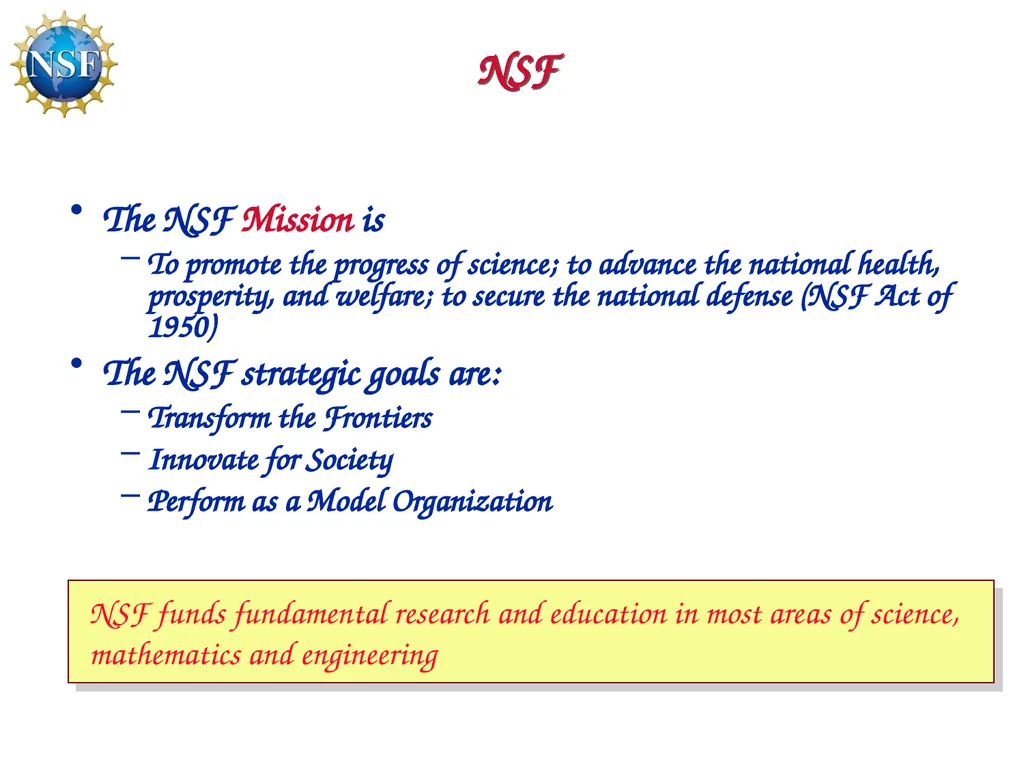
NSF The NSF Mission is
To promote the progress of science; to advance the national health, prosperity, and welfare; to secure the national defense (NSF Act of 1950)
The NSF strategic goals are:
Transform the Frontiers
Innovate for Society
Perform as a Model Organization<br>
To promote the progress of science; to advance the national health, prosperity, and welfare; to secure the national defense (NSF Act of 1950)
The NSF strategic goals are:
Transform the Frontiers
Innovate for Society
Perform as a Model Organization<br>
06
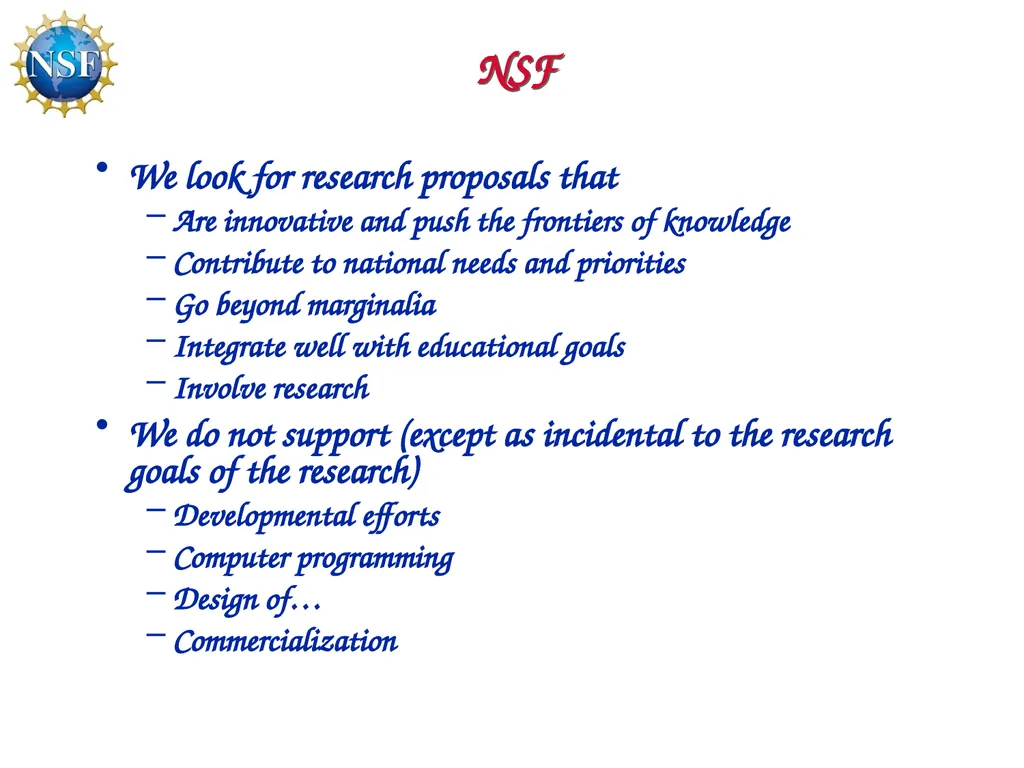
NSF We look for research proposals that
Are innovative and push the frontiers of knowledge
Contribute to national needs and priorities
Go beyond marginalia
Integrate well with educational goals
Involve research
We do not support (except as incidental to the research goals of the research)
Developmental efforts
Computer programming
Design of…
Commercialization<br>
Are innovative and push the frontiers of knowledge
Contribute to national needs and priorities
Go beyond marginalia
Integrate well with educational goals
Involve research
We do not support (except as incidental to the research goals of the research)
Developmental efforts
Computer programming
Design of…
Commercialization<br>
07
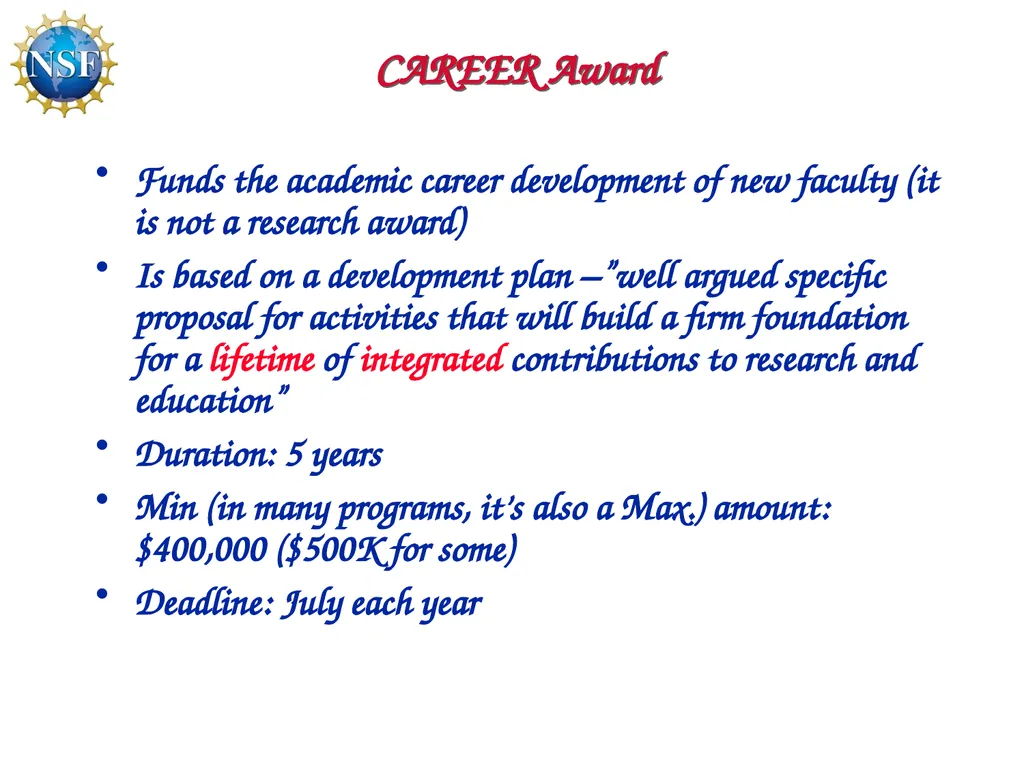
CAREER Award Funds the academic career development of new faculty (it is not a research award)
Is based on a development plan –”well argued specific proposal for activities that will build a firm foundation for a lifetime of integrated contributions to research and education”
Duration: 5 years
Min (in many programs, it’s also a Max.) amount: $400,000 ($500K for some)
Deadline: July each year<br>
Is based on a development plan –”well argued specific proposal for activities that will build a firm foundation for a lifetime of integrated contributions to research and education”
Duration: 5 years
Min (in many programs, it’s also a Max.) amount: $400,000 ($500K for some)
Deadline: July each year<br>
08
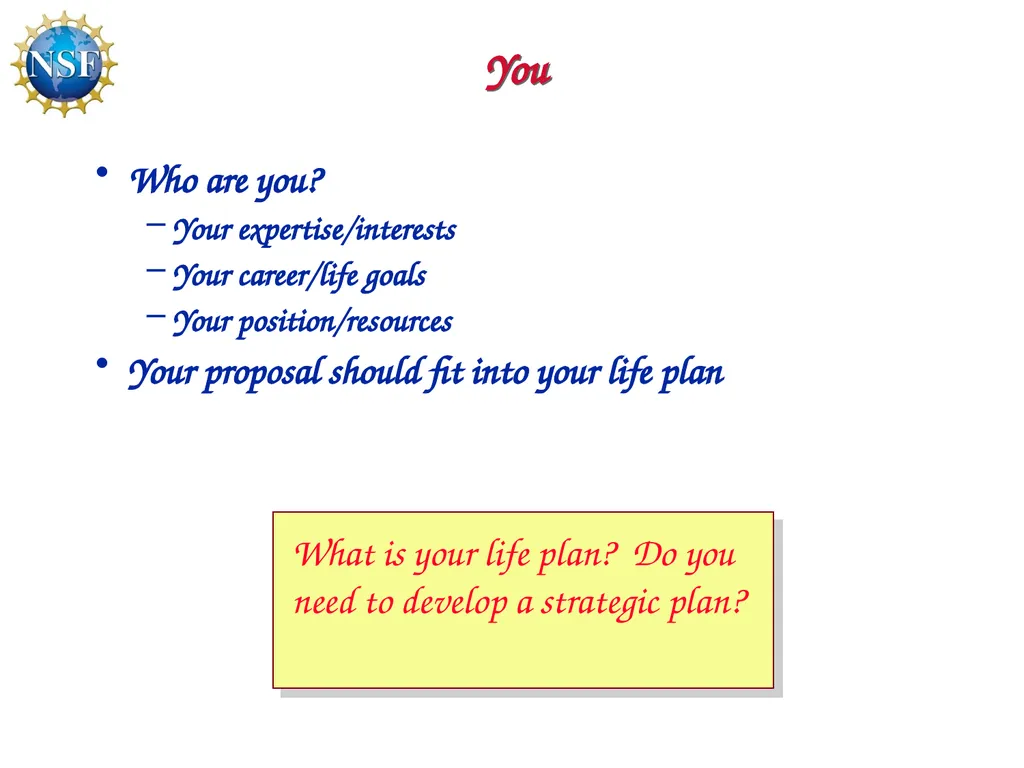
You Who are you?
Your expertise/interests
Your career/life goals
Your position/resources
Your proposal should fit into your life plan<br>
Your expertise/interests
Your career/life goals
Your position/resources
Your proposal should fit into your life plan<br>
09
Your Strategic Plan A strategic plan has three parts:
Where are you today?
Where do you want to be in the future (5, 10, 20 years from now)?
How do you get from here to there?<br>
Where are you today?
Where do you want to be in the future (5, 10, 20 years from now)?
How do you get from here to there?<br>
10
Your Proposal Should advance you toward your life goals
Should be a stepping stone to the next thing
Should be compatible with your institution’s goals
Should represent a contribution to society at large<br>
Should be a stepping stone to the next thing
Should be compatible with your institution’s goals
Should represent a contribution to society at large<br>
11
Initiatives An initiative is right for you if:
It’s your topic
You are already working in the field
It fits with your strategic plan
You contribute through your collaboration<br>
It’s your topic
You are already working in the field
It fits with your strategic plan
You contribute through your collaboration<br>
12
Your Funding Base NSF should not be the sole source of funding for your research
Internal support
State support
Industry support
Other Federal agency support<br>
Internal support
State support
Industry support
Other Federal agency support<br>
13
DOs Have a strategic plan
Build on your strengths
Differentiate your proposed research from your Ph.D. thesis work and other sponsored work
Perform thorough literature search and exploratory research before writing the proposal
Journal articles (update with personal contact)
Read the NSF Grant Proposal Guide (GPG)
Establish and keep your contacts<br>
Build on your strengths
Differentiate your proposed research from your Ph.D. thesis work and other sponsored work
Perform thorough literature search and exploratory research before writing the proposal
Journal articles (update with personal contact)
Read the NSF Grant Proposal Guide (GPG)
Establish and keep your contacts<br>
14
DON’Ts Rush
Wait until last minute (1 month) to contact program directors
Make the proposed work (research and education) too broad
Make the proposed work too narrow
Ask for too much (or too little) money
Ignore rules (Grant Proposal Guide) and misc. items<br>
Wait until last minute (1 month) to contact program directors
Make the proposed work (research and education) too broad
Make the proposed work too narrow
Ask for too much (or too little) money
Ignore rules (Grant Proposal Guide) and misc. items<br>
15
Write to the reviewers (not to me and not to yourself)
Your proposal will be judged by the reviewers
Reviewers want to know four things:
What is it about (the research objective)?
How will you do it (the technical approach)?
Can you do it (you and your facilities)?
Is it worth doing (intellectual merit and broader impact)?
This is, basically, all the proposal needs to convey – but it needs to convey this Proposal Basics<br>
Your proposal will be judged by the reviewers
Reviewers want to know four things:
What is it about (the research objective)?
How will you do it (the technical approach)?
Can you do it (you and your facilities)?
Is it worth doing (intellectual merit and broader impact)?
This is, basically, all the proposal needs to convey – but it needs to convey this Proposal Basics<br>
16
Grants for Rapid Response Research
(RAPID) RAPID is for proposals having a severe urgency with regard to availability of, or access to data, facilities or specialized equipment, including quick-response research on natural or anthropogenic disasters, or similar unanticipated events.
Budget consistent with project scope and existing programmatic activities (up to $200K)
Require internal review with optional external input<br>
Budget consistent with project scope and existing programmatic activities (up to $200K)
Require internal review with optional external input<br>
17
EArly-concept Grants for Exploratory
Research (EAGER) Exploratory work in its early stages on untested, but potentially transformative, research ideas or approaches.
Work may be considered “high-risk, high payoff” in the sense that it, for example, involves radically different approaches, applies new expertise or engages in novel disciplinary or interdisciplinary perspectives
Budget consistent with project scope and existing programmatic activities (up to $300K for 2 years)
Program Officer approval needed
PI needs to make convincing argument for the appropriateness of an EAGER submission vs “regular” NSF proposals
Requires internal review with optional external input<br>
Work may be considered “high-risk, high payoff” in the sense that it, for example, involves radically different approaches, applies new expertise or engages in novel disciplinary or interdisciplinary perspectives
Budget consistent with project scope and existing programmatic activities (up to $300K for 2 years)
Program Officer approval needed
PI needs to make convincing argument for the appropriateness of an EAGER submission vs “regular” NSF proposals
Requires internal review with optional external input<br>
18
Mentoring for Postdoctoral Researchers All proposals submitted after April 6, 2009, that include funding to support postdoctoral researchers must include as a supplementary document a 1-page description of the mentoring activities that will be provided for such individuals.
Mentoring activities may include:
Career counseling;
Training in preparation of grant proposals;
Publications and presentations;
Guidance on ways to improve teaching and mentoring skills;
Guidance on how to effectively collaborate with researchers from diverse backgrounds and disciplinary areas; and
Training in responsible professional practices.<br>
Mentoring activities may include:
Career counseling;
Training in preparation of grant proposals;
Publications and presentations;
Guidance on ways to improve teaching and mentoring skills;
Guidance on how to effectively collaborate with researchers from diverse backgrounds and disciplinary areas; and
Training in responsible professional practices.<br>
19
Mentoring for Postdoctoral Researchers (Cont’d) Proposed mentoring activities will be evaluated as part of the merit review process under the Foundation's broader impacts merit review criterion.
Proposals that do not include a mentoring plan will be returned without review.<br>
Proposals that do not include a mentoring plan will be returned without review.<br>
20
New!<br>
21
Follow the NSF Guidelines Proposal & Award Policies & Procedures Guide (PAPPG)
Grant Proposal Guide (GPG)
Grants.gov Application Guide
Program Solicitation
Budget guidelines<br>
Grant Proposal Guide (GPG)
Grants.gov Application Guide
Program Solicitation
Budget guidelines<br>
22
Grant Proposal Guide (GPG) Provides guidance for preparation and submission of proposals to NSF;
Allowable fonts, margins, page limits, bio format, etc.
Process for deviations from the GPG
Process and criteria by which proposals will be reviewed
Reasons why a proposal may be returned without review
Reconsideration process
Process for withdrawals, returns & declinations
Award process and procedures for requesting continued support
Budget line item definitions
Process for submission of collaborative proposals (subawards and multiple proposals)<br>
Allowable fonts, margins, page limits, bio format, etc.
Process for deviations from the GPG
Process and criteria by which proposals will be reviewed
Reasons why a proposal may be returned without review
Reconsideration process
Process for withdrawals, returns & declinations
Award process and procedures for requesting continued support
Budget line item definitions
Process for submission of collaborative proposals (subawards and multiple proposals)<br>
23
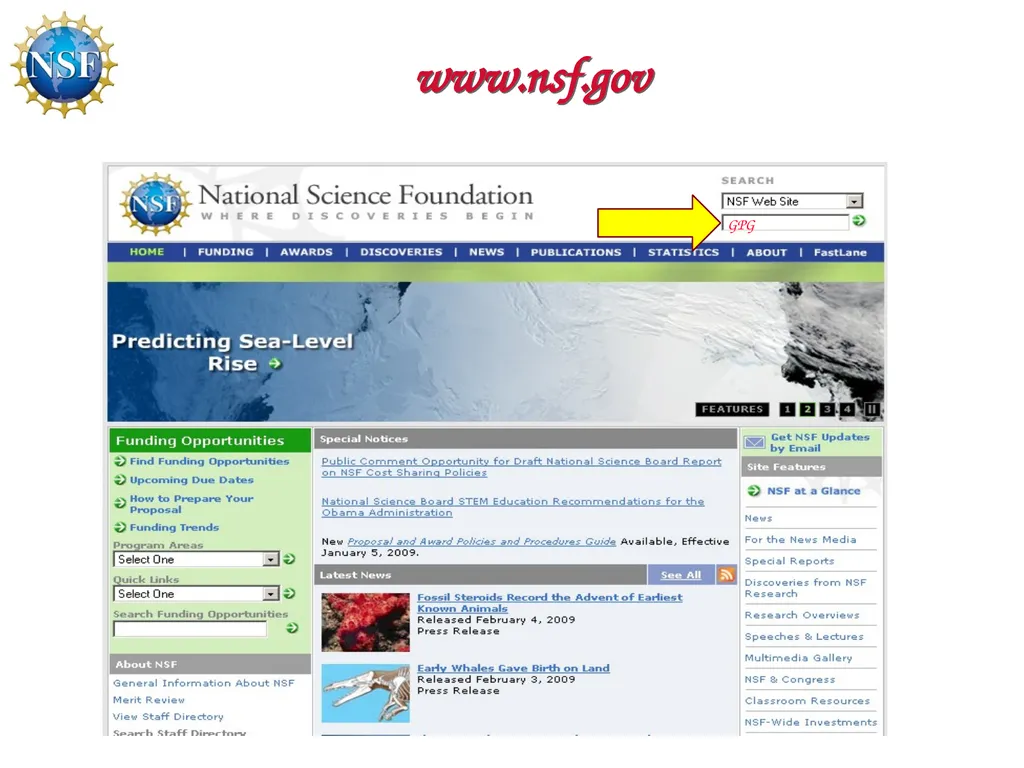
www.nsf.gov<br>
24
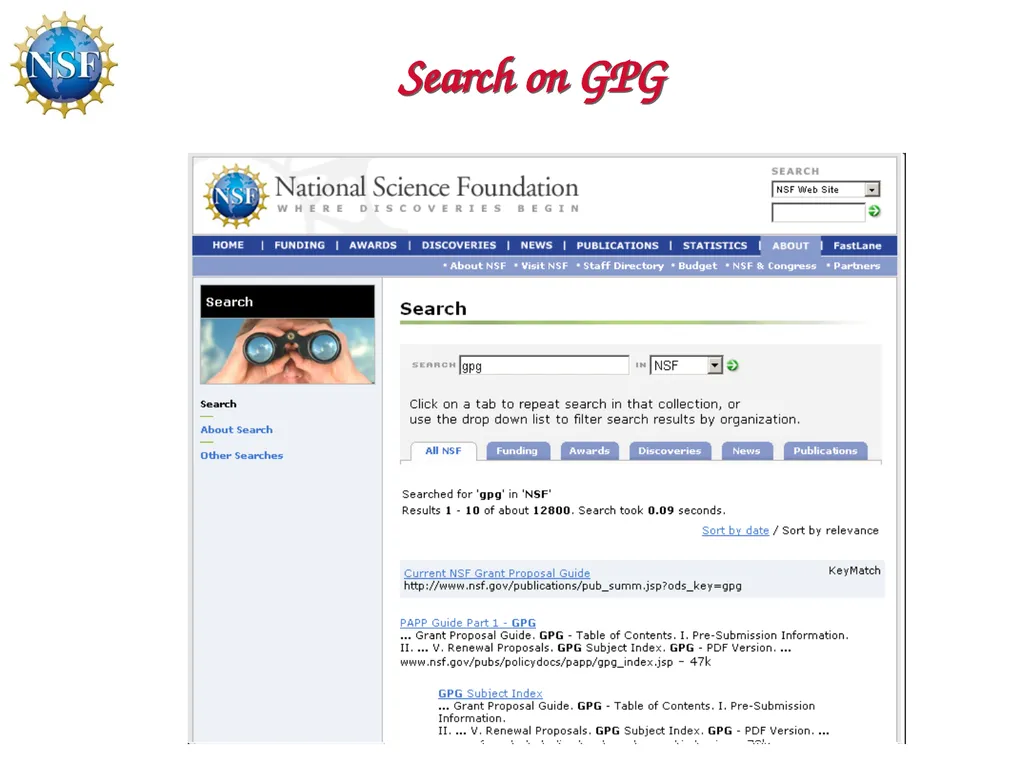
Search on GPG<br>
25
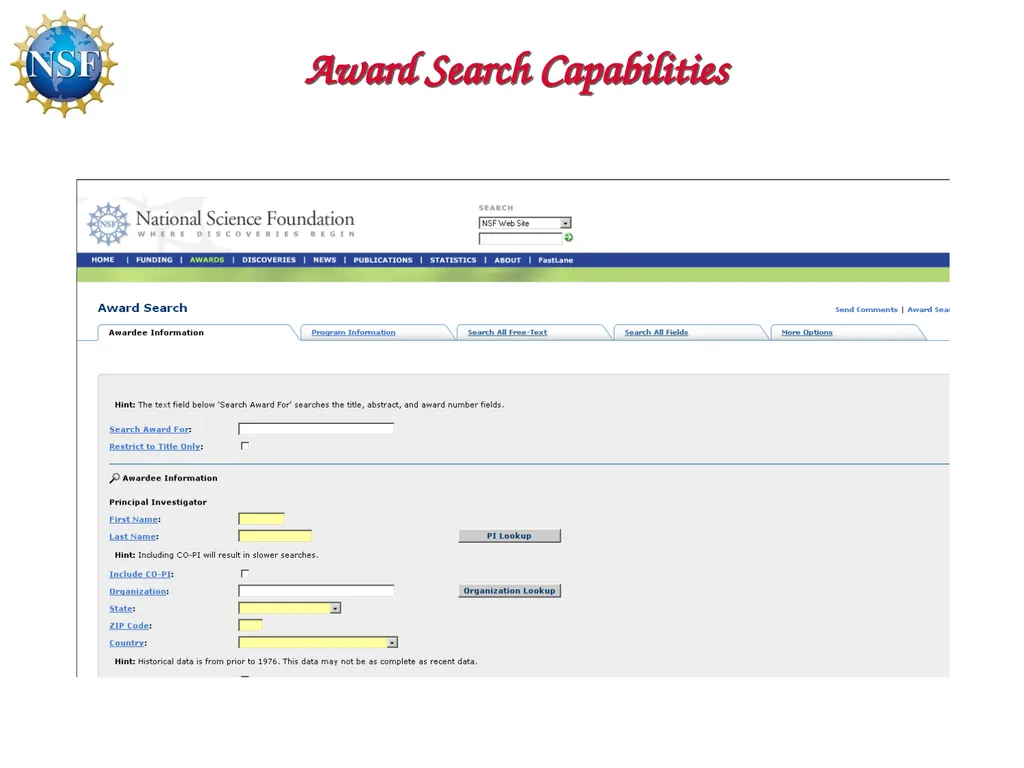
Award Search Capabilities<br>
26
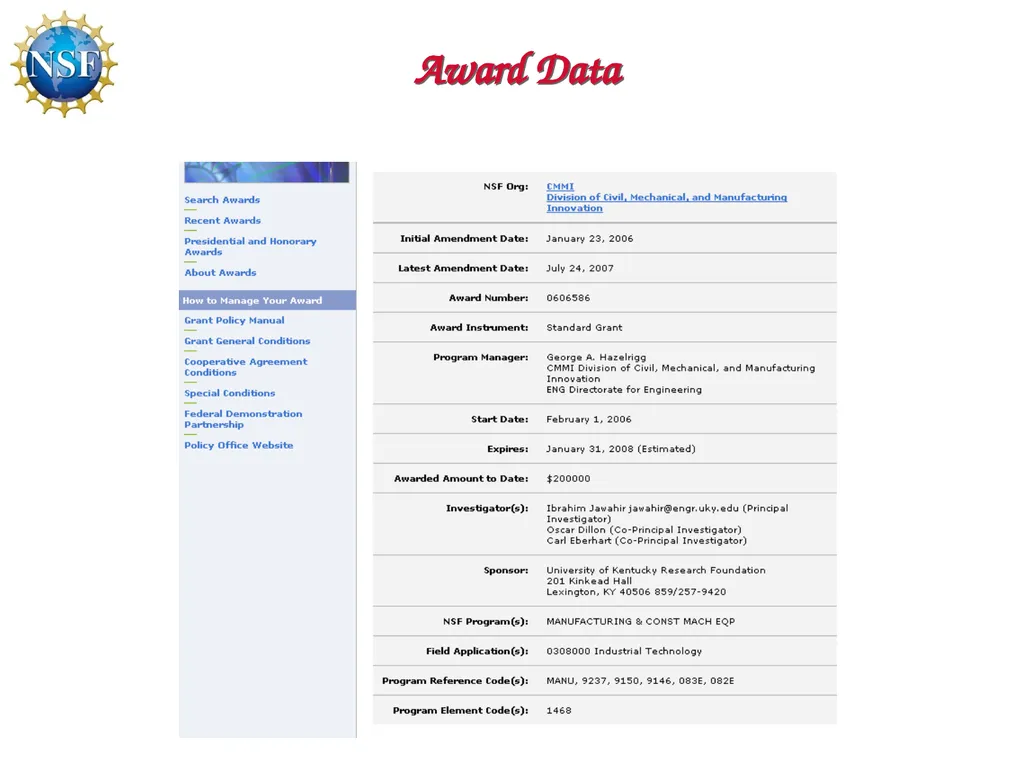
Award Data<br>
27
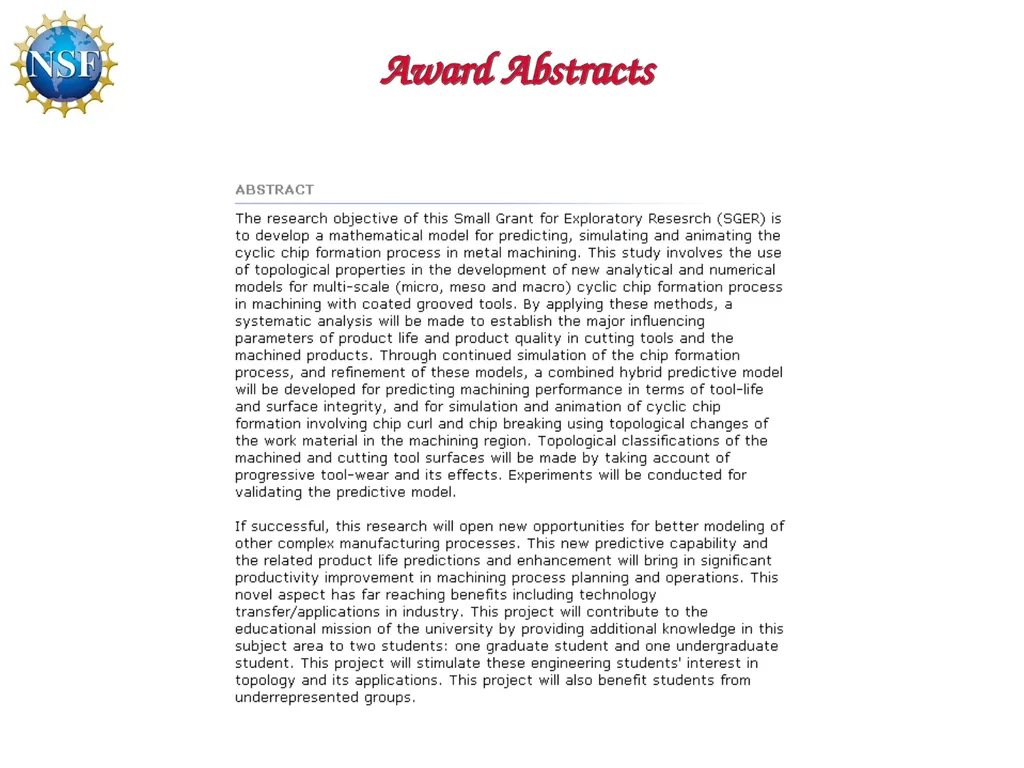
Award Abstracts<br>
28
Getting a Research Topic<br>
29
The Research Topic It must be research
It must not have been done before
It must be significant
There must be higher than probability zero that you can do it
It must lend itself to a viable research plan
You must have the facilities to accomplish the research
It should fit into your strategic plan<br>
It must not have been done before
It must be significant
There must be higher than probability zero that you can do it
It must lend itself to a viable research plan
You must have the facilities to accomplish the research
It should fit into your strategic plan<br>
30
Groundwork Do you know in your field:
What is the current state-of-the-art
Who are the top ten researchers
What they are doing right now
Where they get their funding
What they consider to be the key research issues
Who would likely review your proposal
How much money is available for a grant/what the grant opportunities are<br>
What is the current state-of-the-art
Who are the top ten researchers
What they are doing right now
Where they get their funding
What they consider to be the key research issues
Who would likely review your proposal
How much money is available for a grant/what the grant opportunities are<br>
31
The CAREER Research Topic The CAREER proposal is not a research proposal
The CAREER proposal is a proposal detailing how you will spend $400,000 to enhance your career development
Your career involves a research path, not a research project
Determine your research path—your lifelong research goals—and then identify milestones toward your goals
Detail the first one or two as the research projects for your CAREER proposal<br>
The CAREER proposal is a proposal detailing how you will spend $400,000 to enhance your career development
Your career involves a research path, not a research project
Determine your research path—your lifelong research goals—and then identify milestones toward your goals
Detail the first one or two as the research projects for your CAREER proposal<br>
32
What is Research? Research is the process of finding out something that we (everyone) don’t already know
Scientific research builds upon the extant knowledge base and it is methodical, repeatable and verifiable
Methodical means that you can specify, in advance, a procedure to accomplish your stated objective<br>
Scientific research builds upon the extant knowledge base and it is methodical, repeatable and verifiable
Methodical means that you can specify, in advance, a procedure to accomplish your stated objective<br>
33
The Research Objective<br>
34
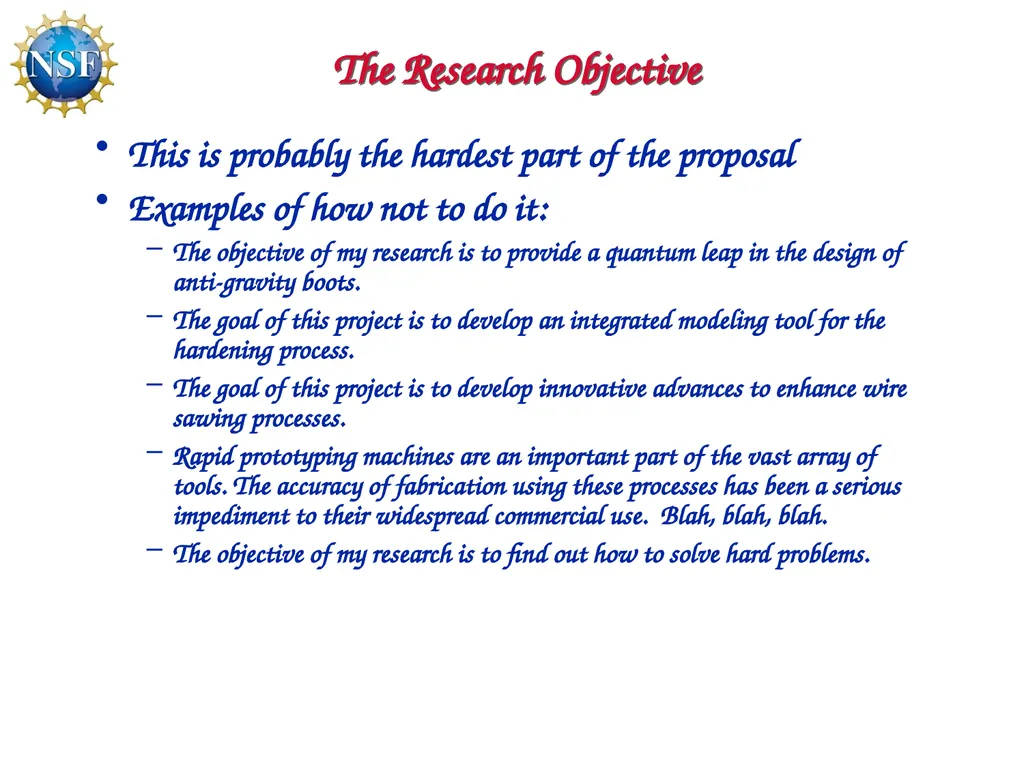
The Research Objective This is probably the hardest part of the proposal
Examples of how not to do it:
The objective of my research is to provide a quantum leap in the design of anti-gravity boots.
The goal of this project is to develop an integrated modeling tool for the hardening process.
The goal of this project is to develop innovative advances to enhance wire sawing processes.
Rapid prototyping machines are an important part of the vast array of tools. The accuracy of fabrication using these processes has been a serious impediment to their widespread commercial use. Blah, blah, blah.
The objective of my research is to find out how to solve hard problems.<br>
Examples of how not to do it:
The objective of my research is to provide a quantum leap in the design of anti-gravity boots.
The goal of this project is to develop an integrated modeling tool for the hardening process.
The goal of this project is to develop innovative advances to enhance wire sawing processes.
Rapid prototyping machines are an important part of the vast array of tools. The accuracy of fabrication using these processes has been a serious impediment to their widespread commercial use. Blah, blah, blah.
The objective of my research is to find out how to solve hard problems.<br>
35
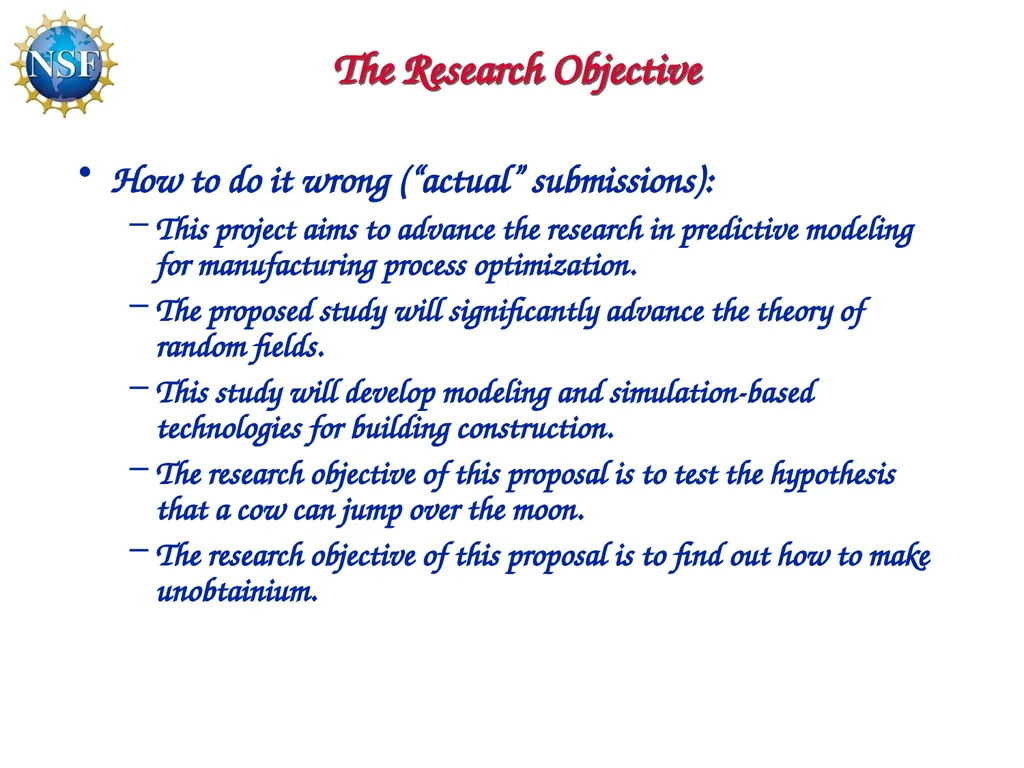
The Research Objective How to do it wrong (“actual” submissions):
This project aims to advance the research in predictive modeling for manufacturing process optimization.
The proposed study will significantly advance the theory of random fields.
This study will develop modeling and simulation-based technologies for building construction.
The research objective of this proposal is to test the hypothesis that a cow can jump over the moon.
The research objective of this proposal is to find out how to make unobtainium.<br>
This project aims to advance the research in predictive modeling for manufacturing process optimization.
The proposed study will significantly advance the theory of random fields.
This study will develop modeling and simulation-based technologies for building construction.
The research objective of this proposal is to test the hypothesis that a cow can jump over the moon.
The research objective of this proposal is to find out how to make unobtainium.<br>
36
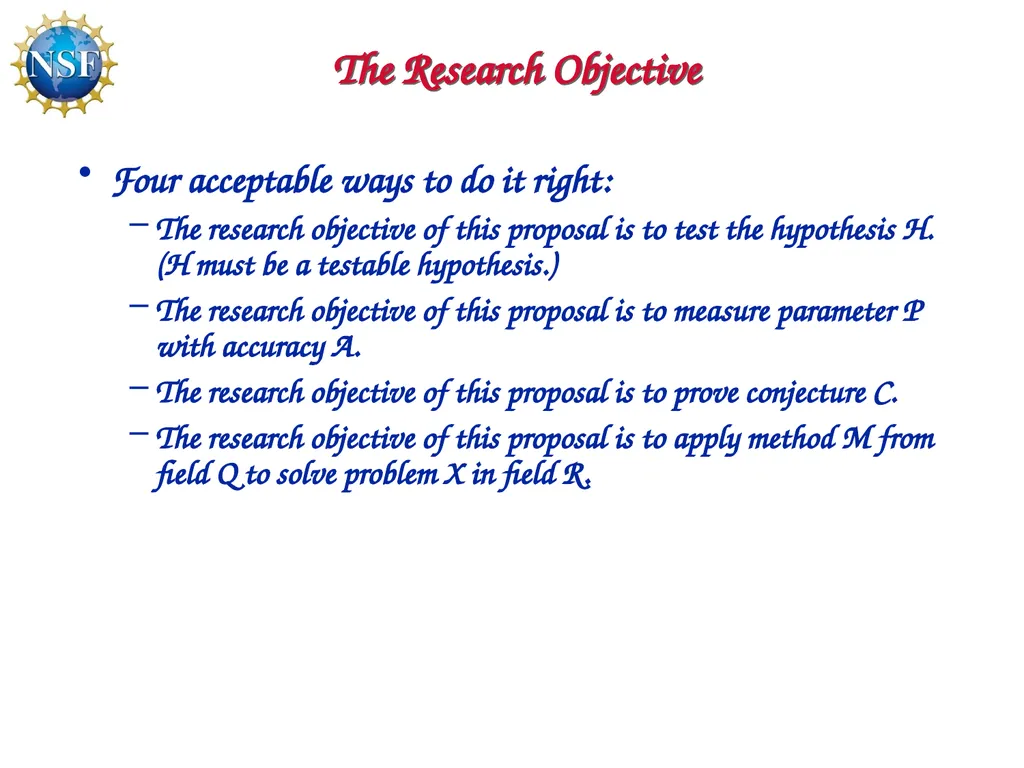
The Research Objective Four acceptable ways to do it right:
The research objective of this proposal is to test the hypothesis H. (H must be a testable hypothesis.)
The research objective of this proposal is to measure parameter P with accuracy A.
The research objective of this proposal is to prove conjecture C.
The research objective of this proposal is to apply method M from field Q to solve problem X in field R.<br>
The research objective of this proposal is to test the hypothesis H. (H must be a testable hypothesis.)
The research objective of this proposal is to measure parameter P with accuracy A.
The research objective of this proposal is to prove conjecture C.
The research objective of this proposal is to apply method M from field Q to solve problem X in field R.<br>
37
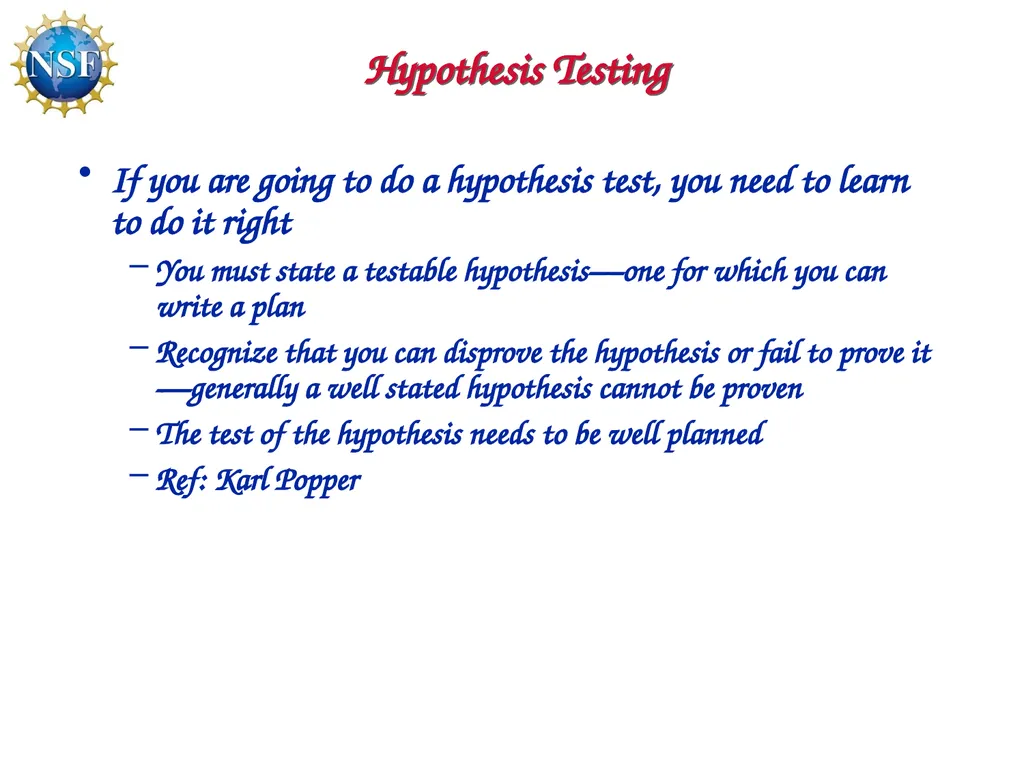
Hypothesis Testing If you are going to do a hypothesis test, you need to learn to do it right
You must state a testable hypothesis—one for which you can write a plan
Recognize that you can disprove the hypothesis or fail to prove it—generally a well stated hypothesis cannot be proven
The test of the hypothesis needs to be well planned
Ref: Karl Popper<br>
You must state a testable hypothesis—one for which you can write a plan
Recognize that you can disprove the hypothesis or fail to prove it—generally a well stated hypothesis cannot be proven
The test of the hypothesis needs to be well planned
Ref: Karl Popper<br>
38
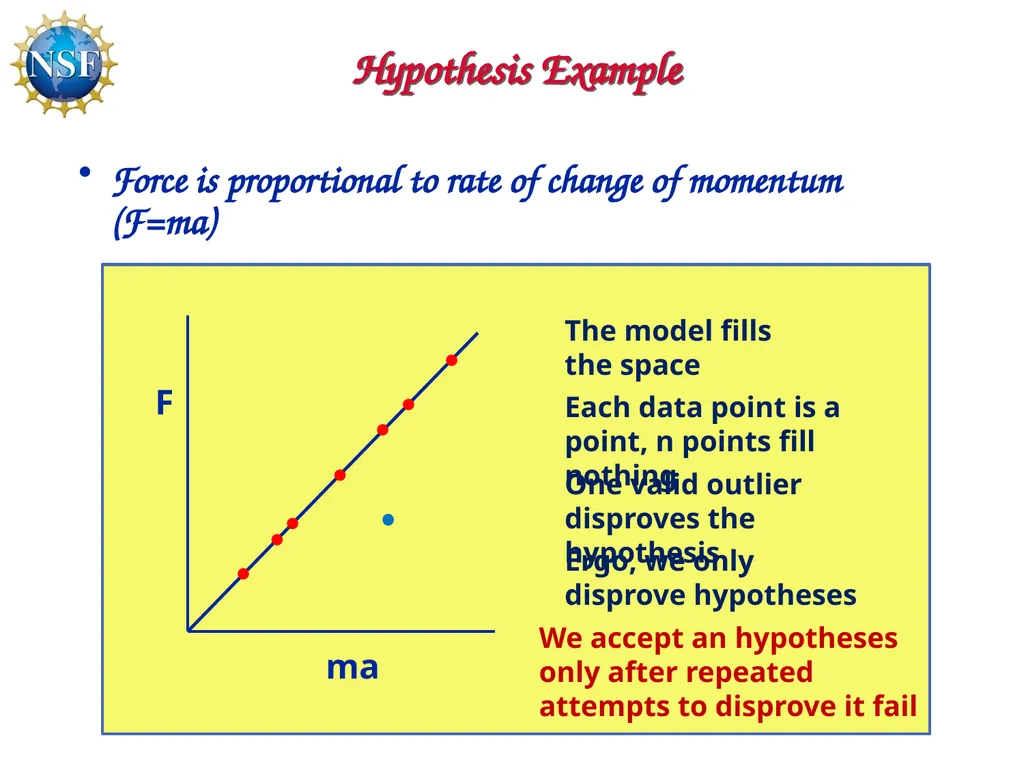
Hypothesis Example Force is proportional to rate of change of momentum (F=ma) The model fills the space Each data point is a point, n points fill nothing Ergo, we only disprove hypotheses We accept an hypotheses only after repeated attempts to disprove it fail<br>
39
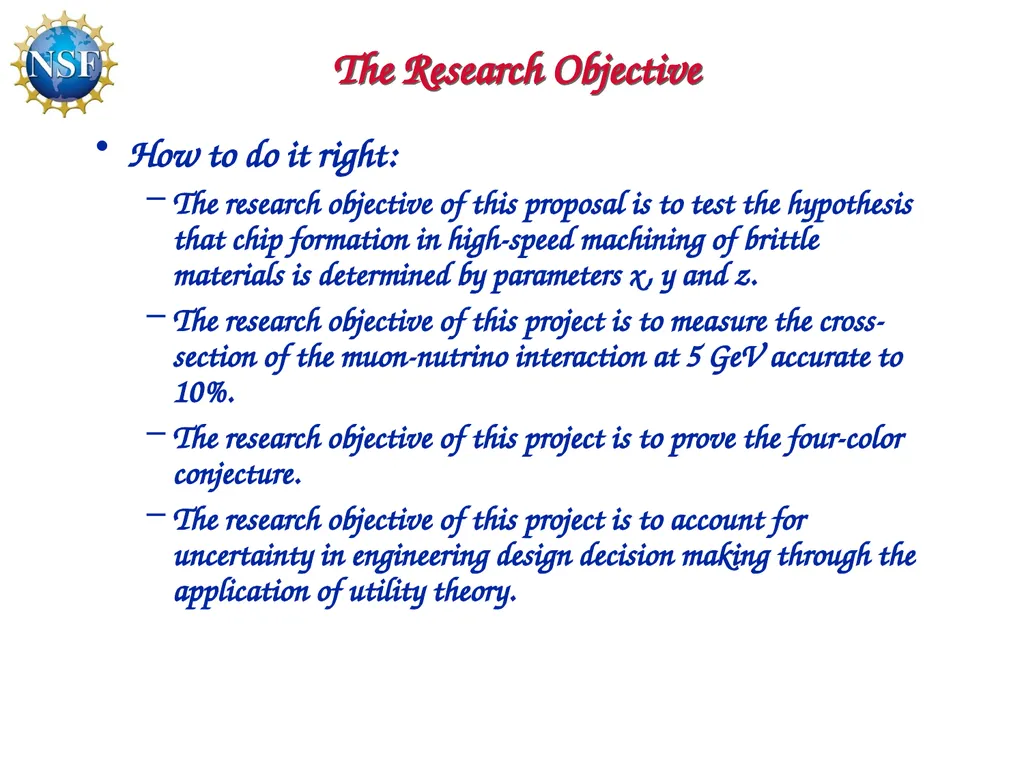
The Research Objective How to do it right:
The research objective of this proposal is to test the hypothesis that chip formation in high-speed machining of brittle materials is determined by parameters x, y and z.
The research objective of this project is to measure the cross-section of the muon-nutrino interaction at 5 GeV accurate to 10%.
The research objective of this project is to prove the four-color conjecture.
The research objective of this project is to account for uncertainty in engineering design decision making through the application of utility theory.<br>
The research objective of this proposal is to test the hypothesis that chip formation in high-speed machining of brittle materials is determined by parameters x, y and z.
The research objective of this project is to measure the cross-section of the muon-nutrino interaction at 5 GeV accurate to 10%.
The research objective of this project is to prove the four-color conjecture.
The research objective of this project is to account for uncertainty in engineering design decision making through the application of utility theory.<br>
40
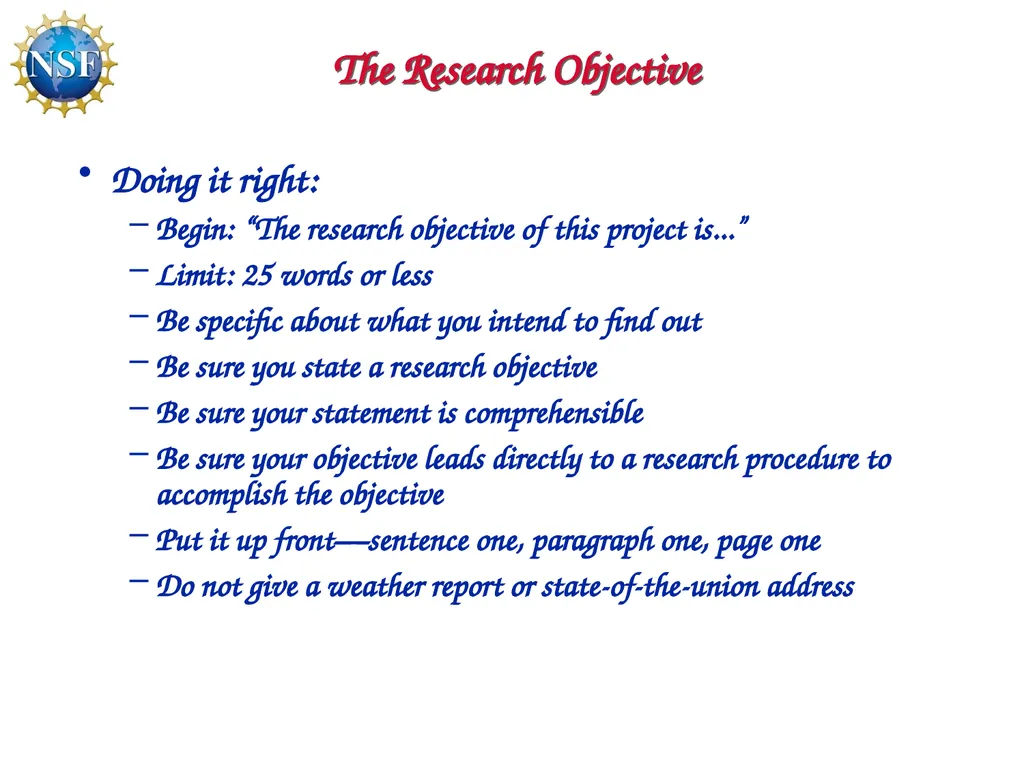
The Research Objective Doing it right:
Begin: “The research objective of this project is...”
Limit: 25 words or less
Be specific about what you intend to find out
Be sure you state a research objective
Be sure your statement is comprehensible
Be sure your objective leads directly to a research procedure to accomplish the objective
Put it up front—sentence one, paragraph one, page one
Do not give a weather report or state-of-the-union address<br>
Begin: “The research objective of this project is...”
Limit: 25 words or less
Be specific about what you intend to find out
Be sure you state a research objective
Be sure your statement is comprehensible
Be sure your objective leads directly to a research procedure to accomplish the objective
Put it up front—sentence one, paragraph one, page one
Do not give a weather report or state-of-the-union address<br>
41
The Research Objective Do not use words that mean “not research”
Develop
Design
Optimize
Control
Manage
Use of words such as these gives the reviewers the impression that you are not doing research, there is no innovation, nothing is new, etc. – your ratings will be lower
Do not use other words that mean the same thing<br>
Develop
Design
Optimize
Control
Manage
Use of words such as these gives the reviewers the impression that you are not doing research, there is no innovation, nothing is new, etc. – your ratings will be lower
Do not use other words that mean the same thing<br>
42
Finding a Home<br>
43
Questions Is your “research” research?
If it isn’t, it doesn’t belong at NSF
If the answer is “no,” skip to the end, look for support from other sources
If the answer is “yes,” what is your research objective?
The right NSF home for your research depends on your research objective, not on the application of your research<br>
If it isn’t, it doesn’t belong at NSF
If the answer is “no,” skip to the end, look for support from other sources
If the answer is “yes,” what is your research objective?
The right NSF home for your research depends on your research objective, not on the application of your research<br>
44
Step Two Look up NSF’s web site: www.nsf.gov
Read the current Grant Proposal Guide
Check out research programs, read what research topics they support
Look up new initiatives, read the current announcements
Then call the appropriate program officers
Be prepared to answer the question: “What is your research objective?” (25 words or less)<br>
Read the current Grant Proposal Guide
Check out research programs, read what research topics they support
Look up new initiatives, read the current announcements
Then call the appropriate program officers
Be prepared to answer the question: “What is your research objective?” (25 words or less)<br>
45
Important Questions Does my research topic fit well with your program?
Does your program have funds to support my research if my proposal reviews well?
What size grant is pushing the limits of your funding ability?
What are your proposal submission deadlines?
How are proposals submitted to your program reviewed?<br>
Does your program have funds to support my research if my proposal reviews well?
What size grant is pushing the limits of your funding ability?
What are your proposal submission deadlines?
How are proposals submitted to your program reviewed?<br>
46
Questions You Shouldn’t Ask So, will you fund my research?
Is this a good research topic?
What research topic do you think I should work on?
What are my odds?
If I send a copy of my proposal to you, will you help me edit it? Will you tell me what you think of it?
My proposal wasn’t funded, so can I resubmit it as an EAGER?<br>
Is this a good research topic?
What research topic do you think I should work on?
What are my odds?
If I send a copy of my proposal to you, will you help me edit it? Will you tell me what you think of it?
My proposal wasn’t funded, so can I resubmit it as an EAGER?<br>
47
Catch 22 My research doesn’t fit in any single NSF program, how about joint submission/review?
Did you formulate a clear research objective?
Is your research objective too broad?
Do you want to consider focusing your scope?
Suppose my research really does span multiple programs?
Contact all relevant program directors<br>
Did you formulate a clear research objective?
Is your research objective too broad?
Do you want to consider focusing your scope?
Suppose my research really does span multiple programs?
Contact all relevant program directors<br>
48
Should I Meet My Program Officer? Why? What do you intend to gain?
Or is your goal to schmooze? (It doesn’t help)
Don’t even think about taking your program officer to lunch
If you decide to meet:
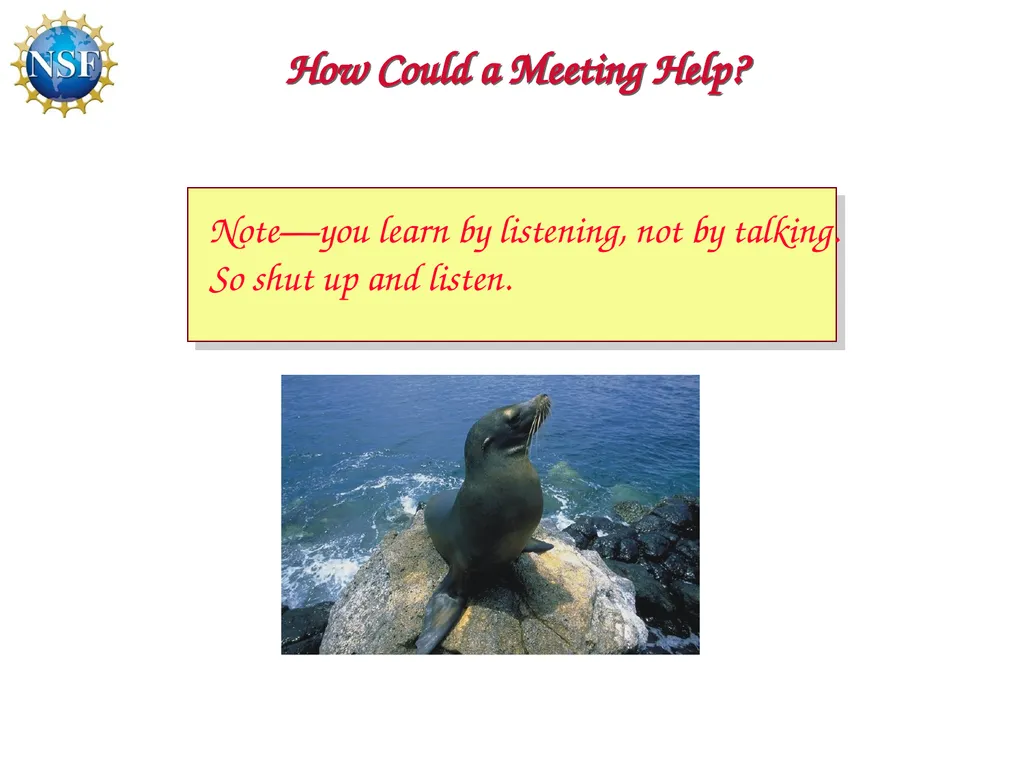
Be prepared to listen (you don’t learn by talking)
Be prepared with questions
Remember, the program officer is not the panel
You can get a free trip to NSF (more later)<br>
Or is your goal to schmooze? (It doesn’t help)
Don’t even think about taking your program officer to lunch
If you decide to meet:
Be prepared to listen (you don’t learn by talking)
Be prepared with questions
Remember, the program officer is not the panel
You can get a free trip to NSF (more later)<br>
49
How Could a Meeting Help? Your program director can:
Give advice on proposal submission
Help you understand a review of a previous proposal
Point you to resources you can use to help write a better proposal next time
Give general guidance on good proposal writing
Give you ideas for collaborations<br>
Give advice on proposal submission
Help you understand a review of a previous proposal
Point you to resources you can use to help write a better proposal next time
Give general guidance on good proposal writing
Give you ideas for collaborations<br>
50
How Could a Meeting Help?<br>
51
Writing the Summary<br>
52
Writing the Summary The most important statement is your statement of the research objective
It should be sentence 1 of paragraph 1
Do not begin with a weather report: “The sky is falling. Tools are breaking. Designs are failing…”
Do not begin with a state-of-the-union address: “Business is moving off shore. Manufacturing is going to the …”
Remember, this is not a tech paper, it is not a murder mystery (where we find out what the objective is on page 15)
Don’t forget the Intellectual Merit and Broader Impact statements<br>
It should be sentence 1 of paragraph 1
Do not begin with a weather report: “The sky is falling. Tools are breaking. Designs are failing…”
Do not begin with a state-of-the-union address: “Business is moving off shore. Manufacturing is going to the …”
Remember, this is not a tech paper, it is not a murder mystery (where we find out what the objective is on page 15)
Don’t forget the Intellectual Merit and Broader Impact statements<br>
53
What We Want to Know What is your research objective?
This is what directs your proposal to the appropriate program
What is your approach?
Outline — just two or three sentences
Why is your contribution important to your research community (the intellectual merit)?
If successful, what will be the benefit to society (the broader impact)? Why is your project important to society?<br>
This is what directs your proposal to the appropriate program
What is your approach?
Outline — just two or three sentences
Why is your contribution important to your research community (the intellectual merit)?
If successful, what will be the benefit to society (the broader impact)? Why is your project important to society?<br>
54
Summary Template The objective of this research project is to test the hypothesis that the number of monkeys a tree will hold is proportional to the height of the tree raised to the 3/2 power. The approach will be to take a sample of twenty trees and load them with monkeys until they break…
Intellectual Merit – It is important that we know how many monkeys can climb a tree before it breaks because this affects our perceptions of monkey procreation and… The Snerd Theory holds that tree size limits monkey procreation. This study challenges that theory with the notion that… If the objective hypothesis is correct therefore, it will transform our approach to…
Broader Impact – Monkeys are used in medical research. By knowing how many monkeys can fit in a tree, we will be able to provide more monkeys for such research thereby advancing medical science more quickly and improving the quality of life. Also, by watching the monkeys get hurt when the tree breaks, graduate students will be less likely to climb trees, thereby increasing their probability of graduating.<br>
Intellectual Merit – It is important that we know how many monkeys can climb a tree before it breaks because this affects our perceptions of monkey procreation and… The Snerd Theory holds that tree size limits monkey procreation. This study challenges that theory with the notion that… If the objective hypothesis is correct therefore, it will transform our approach to…
Broader Impact – Monkeys are used in medical research. By knowing how many monkeys can fit in a tree, we will be able to provide more monkeys for such research thereby advancing medical science more quickly and improving the quality of life. Also, by watching the monkeys get hurt when the tree breaks, graduate students will be less likely to climb trees, thereby increasing their probability of graduating.<br>
55
Remember Your proposal may (will) be returned without review if:
You fail to include explicit statements of intellectual merit and broader impact (entitle them Intellectual Merit, Broader Impact)
You use the wrong font or it is too small
The margins are too narrow
Your bio is incorrectly formatted
You have an unauthorized attachment
We have been lenient in the past, we will not be permitted such lenience in the future, and you anger the reviewers anyway<br>
You fail to include explicit statements of intellectual merit and broader impact (entitle them Intellectual Merit, Broader Impact)
You use the wrong font or it is too small
The margins are too narrow
Your bio is incorrectly formatted
You have an unauthorized attachment
We have been lenient in the past, we will not be permitted such lenience in the future, and you anger the reviewers anyway<br>
56
The Rest of Your Proposal The next 15 pages of your proposal give backup and detail to your summary
Start with a restatement of your research objective, clarify it, and provide a research plan to accomplish it
Provide a convincing argument that you can carry out your proposed plan
Restate and provide detail on your intellectual merit and broader impact<br>
Start with a restatement of your research objective, clarify it, and provide a research plan to accomplish it
Provide a convincing argument that you can carry out your proposed plan
Restate and provide detail on your intellectual merit and broader impact<br>
57
Tips on Proposal Writing Use only 12 point type
Do not use figures or tables as filler—everything should contribute
Everything should be legible—do not use 2 point type on figures or tables
Be sure to include a clearly stated research objective
Use only the required format
Be sure to include intellectual merit and broader impact statements in the body of the proposal<br>
Do not use figures or tables as filler—everything should contribute
Everything should be legible—do not use 2 point type on figures or tables
Be sure to include a clearly stated research objective
Use only the required format
Be sure to include intellectual merit and broader impact statements in the body of the proposal<br>
58
Tips on Proposal Writing Don’t include letters of support from industry if
They aren’t very supportive
Letters from several companies are identical
They are letters from previous proposals
You don’t have them before the submission deadline
Don’t cut and paste together new proposals from old declined proposals
Proofread your proposal before you submit it (and after you submit it)<br>
They aren’t very supportive
Letters from several companies are identical
They are letters from previous proposals
You don’t have them before the submission deadline
Don’t cut and paste together new proposals from old declined proposals
Proofread your proposal before you submit it (and after you submit it)<br>
59
Stupid Things PIs do to Ruin Their Chances for an Award Don’t follow GPG guidelines (RWR)
Don’t state a research objective
Don’t include a plan to accomplish the research objective
Include inane tables and figures (boxes and arrows, 2pt fonts, gray fuzz,…)
Use small fonts, obnoxious formatting
Poor grammar and lots of typos
Fail to know the literature and what has already been done
Get greedy (or don’t ask for enough)
Don’t proofread the submission<br>
Don’t state a research objective
Don’t include a plan to accomplish the research objective
Include inane tables and figures (boxes and arrows, 2pt fonts, gray fuzz,…)
Use small fonts, obnoxious formatting
Poor grammar and lots of typos
Fail to know the literature and what has already been done
Get greedy (or don’t ask for enough)
Don’t proofread the submission<br>
60
Intellectual Merit and Broader Impact Statements<br>
61
IM and BI Statements They are required
Your proposal will be rated based on them
But:
What are they?
What should you include?
How should they shape your proposal?<br>
Your proposal will be rated based on them
But:
What are they?
What should you include?
How should they shape your proposal?<br>
62
Intellectual Merit The Intellectual Merit is the contribution that your research makes to the knowledge base and how that impacts the field
Questions:
What is already known?
What will your research add?
What will this do to enhance or enable research in your or other fields?
Why is your contribution important to your research community?
How will your results be “transformative”?<br>
Questions:
What is already known?
What will your research add?
What will this do to enhance or enable research in your or other fields?
Why is your contribution important to your research community?
How will your results be “transformative”?<br>
63
Broader Impact The Broader Impact focuses on the benefit to society at large as a result of your research result
Means to benefit society include:
Economic/environment/energy/health/safety
Education and training
Providing opportunities for underrepresented groups
Improving research and education infrastructure<br>
Means to benefit society include:
Economic/environment/energy/health/safety
Education and training
Providing opportunities for underrepresented groups
Improving research and education infrastructure<br>
64
Caution<br>
65
Ethics<br>
66
Breech of Ethics People who submit proposals to the Federal Government (e.g., to NSF) are held to high standards
A breech of ethics can lead to
Being barred from submitting proposals
Fines
Jail time
Really being on the outs with your institution – getting fired, losing tenure
Violation of some ethics laws is a felony
OIG estimates 3% of proposals submitted have a breech of ethics<br>
A breech of ethics can lead to
Being barred from submitting proposals
Fines
Jail time
Really being on the outs with your institution – getting fired, losing tenure
Violation of some ethics laws is a felony
OIG estimates 3% of proposals submitted have a breech of ethics<br>
67
Forms of Misconduct Plagiarism—material copied without citation and quotation—if you copy it, cite it and off-set it; if you accept an award based on a proposal that includes plagiarism, you may have committed a felony
Charge for work already done—can be a felony, do not charge twice for the same work
Falsification of data and reports—changing data or results—be honest in all your annual and final reports and papers
Fabrication—making stuff up—report only what is real<br>
Charge for work already done—can be a felony, do not charge twice for the same work
Falsification of data and reports—changing data or results—be honest in all your annual and final reports and papers
Fabrication—making stuff up—report only what is real<br>
68
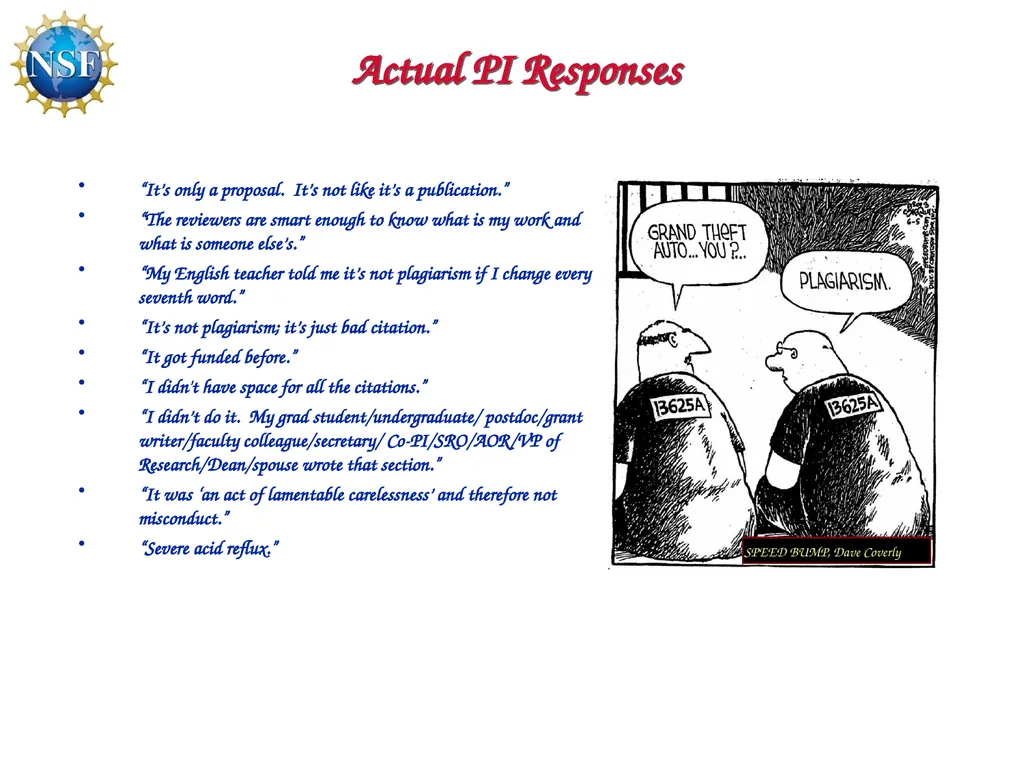
“It’s only a proposal. It’s not like it’s a publication.”
“The reviewers are smart enough to know what is my work and what is someone else’s.”
“My English teacher told me it’s not plagiarism if I change every seventh word.”
“It’s not plagiarism; it’s just bad citation.”
“It got funded before.”
“I didn't have space for all the citations.”
“I didn’t do it. My grad student/undergraduate/ postdoc/grant writer/faculty colleague/secretary/ Co-PI/SRO/AOR/VP of Research/Dean/spouse wrote that section.”
“It was ‘an act of lamentable carelessness’ and therefore not misconduct.”
“Severe acid reflux.” Actual PI Responses<br>
“The reviewers are smart enough to know what is my work and what is someone else’s.”
“My English teacher told me it’s not plagiarism if I change every seventh word.”
“It’s not plagiarism; it’s just bad citation.”
“It got funded before.”
“I didn't have space for all the citations.”
“I didn’t do it. My grad student/undergraduate/ postdoc/grant writer/faculty colleague/secretary/ Co-PI/SRO/AOR/VP of Research/Dean/spouse wrote that section.”
“It was ‘an act of lamentable carelessness’ and therefore not misconduct.”
“Severe acid reflux.” Actual PI Responses<br>
69
Examples False charges
Never pad travel
Never commingle funds
Don’t mix business and pleasure expenses
Don’t mix grant funds and personal business expenses
Never charge for time not spent on a grant
Never bill items to your grant that shouldn’t be billed to the grant
Never bill alcohol or entertainment to a grant
Never charge give-aways to a grant<br>
Never pad travel
Never commingle funds
Don’t mix business and pleasure expenses
Don’t mix grant funds and personal business expenses
Never charge for time not spent on a grant
Never bill items to your grant that shouldn’t be billed to the grant
Never bill alcohol or entertainment to a grant
Never charge give-aways to a grant<br>
70
Examples, continued Breech of confidentiality—never divulge confidential information
Ideas conveyed in proposals
Names of panelists
Names of PIs
Never use information that you received in confidence<br>
Ideas conveyed in proposals
Names of panelists
Names of PIs
Never use information that you received in confidence<br>
71
Recommendation Letters It is against the law for an employee of the Federal Government to represent a third party to the Government
That means it is illegal for a Government employee to write a letter of recommendation for you
Don’t ask – many Government employees don’t know this law, you can get them into a lot of trouble<br>
That means it is illegal for a Government employee to write a letter of recommendation for you
Don’t ask – many Government employees don’t know this law, you can get them into a lot of trouble<br>
72
Multiple Proposal Submissions It is permissible to submit multiple proposals to do the same thing
But it is not permissible to submit the same proposal to multiple NSF units
It is not legal to accept more than one
If you submit multiple proposals for the same or similar work, be careful to distinguish the uniqueness of each and, if appropriate, note that you will only accept one (or possibly turn one back if you get a better one)<br>
But it is not permissible to submit the same proposal to multiple NSF units
It is not legal to accept more than one
If you submit multiple proposals for the same or similar work, be careful to distinguish the uniqueness of each and, if appropriate, note that you will only accept one (or possibly turn one back if you get a better one)<br>
73
Ethics Training It is highly recommended that you give your student researchers training in ethics—this protects you in an event of their indiscretion
Do it with all your students
Do it before they have a chance to do something bad
Ask them to sign a letter of recognition that you have provided ethics training, that it covers specific elements of ethics, and that they know that you expect appropriate behavior<br>
Do it with all your students
Do it before they have a chance to do something bad
Ask them to sign a letter of recognition that you have provided ethics training, that it covers specific elements of ethics, and that they know that you expect appropriate behavior<br>
74
Ethics Training As of January 4, 2010, all institutions receiving funds from NSF are required to provide ethics training for all students and post docs involved in research
Certification Regarding Responsible Conduct of Research (RCR): The AOR is required to complete a certification that the institution has a plan to provide appropriate training and oversight in the responsible and ethical conduct of research to undergraduates, graduate students, and postdoctoral researchers who will be supported by NSF to conduct research.
Ask me (via e-mail: ghazelri@nsf.gov) and I will send you an ethics briefing that you may plagiarize as you wish<br>
Certification Regarding Responsible Conduct of Research (RCR): The AOR is required to complete a certification that the institution has a plan to provide appropriate training and oversight in the responsible and ethical conduct of research to undergraduates, graduate students, and postdoctoral researchers who will be supported by NSF to conduct research.
Ask me (via e-mail: ghazelri@nsf.gov) and I will send you an ethics briefing that you may plagiarize as you wish<br>
75
Sticky Issues You collaborate with a senior faculty person to write a proposal
You get an award
You later find that your collaborator plagiarized materials that are in the proposal
You should
Consult with your institutional ethics person
Report the matter to the NSF Inspector General
Continue to work on the grant
You will not be held accountable for another faculty member’s bad behavior<br>
You get an award
You later find that your collaborator plagiarized materials that are in the proposal
You should
Consult with your institutional ethics person
Report the matter to the NSF Inspector General
Continue to work on the grant
You will not be held accountable for another faculty member’s bad behavior<br>
76
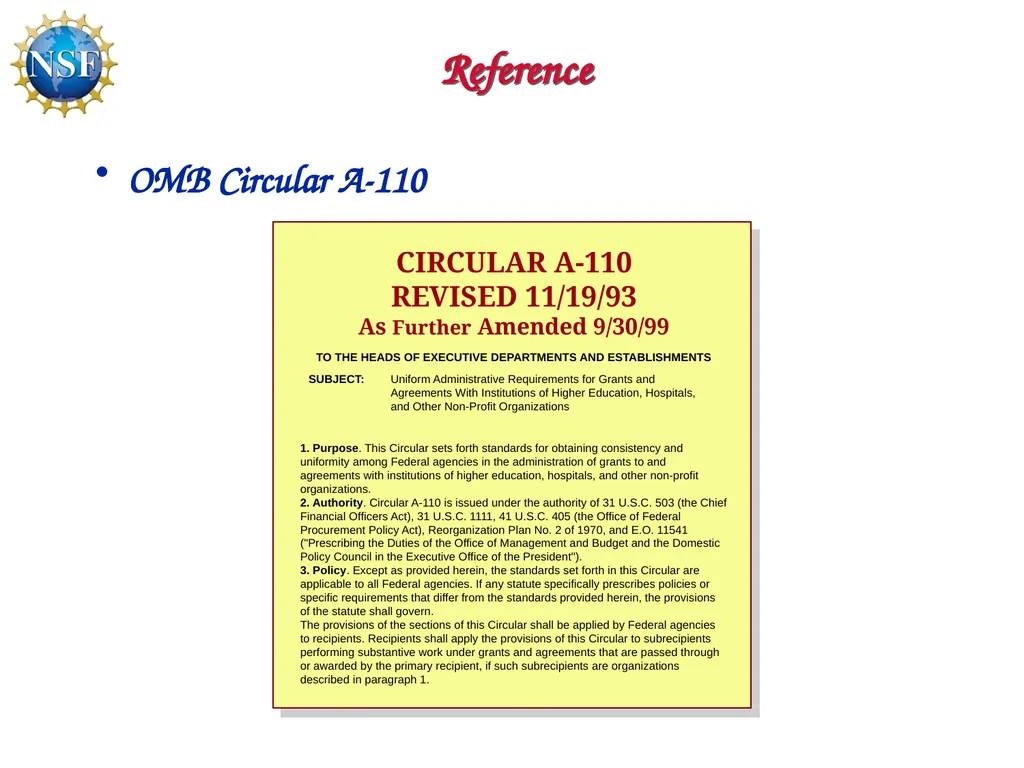
Reference OMB Circular A-110<br>
77
Parting Thoughts<br>
78
Supplements<br>
79
Beyond the Award Beyond the award there are supplements
REU (Research Experience for Undergraduates): $6,000 per year per student, nominally one student per award (two, provided one is from an under-represented group), does NOT include equipment
RET (Research Experience for Teachers): $10,000 to involve a K-12 teacher in your research
Initiating international collaborations (Office of International Science and Eng.)
Informal education (EHR)<br>
REU (Research Experience for Undergraduates): $6,000 per year per student, nominally one student per award (two, provided one is from an under-represented group), does NOT include equipment
RET (Research Experience for Teachers): $10,000 to involve a K-12 teacher in your research
Initiating international collaborations (Office of International Science and Eng.)
Informal education (EHR)<br>
80
Supplemental Requests Contact your program director first!
Must be submitted via FastLane
Must include a budget
Should be submitted early in the fiscal year (while we still have money) or to meet announcement deadlines<br>
Must be submitted via FastLane
Must include a budget
Should be submitted early in the fiscal year (while we still have money) or to meet announcement deadlines<br>
81
Progress/Final Reports<br>
82
Annual Reports Annual reports are required for ALL grants (standard or continuing)
This includes: unsolicited, CAREER, MRI, special initiatives, …
This includes grants that are beyond their initial active period, i.e., grants that are in a no-cost extension period
Annual reports must be submitted via FastLane 90 days PRIOR to anniversary (or by May 1st, whichever is sooner, for continuing grants)
Annual reports MUST be submitted in the order in which they are due as they build upon previous report(s)<br>
This includes: unsolicited, CAREER, MRI, special initiatives, …
This includes grants that are beyond their initial active period, i.e., grants that are in a no-cost extension period
Annual reports must be submitted via FastLane 90 days PRIOR to anniversary (or by May 1st, whichever is sooner, for continuing grants)
Annual reports MUST be submitted in the order in which they are due as they build upon previous report(s)<br>
83
Annual Reports No annual report = no increments, no supplements, no no-cost extensions
Be sure to use FastLane format — pdf attachments are ok, but address each topic area
REU supplement during reporting period - make sure to report activity under role of Research Experience for Undergraduates in PARTICIPANT section (this is different than role of undergraduate student)<br>
Be sure to use FastLane format — pdf attachments are ok, but address each topic area
REU supplement during reporting period - make sure to report activity under role of Research Experience for Undergraduates in PARTICIPANT section (this is different than role of undergraduate student)<br>
84
Final Reports All grants require a final report
All final reports must be filed using FastLane
Final reports are due not later than 90 days after the expiration date of the grant
You must use the FastLane format
PENALTY!!! You cannot get another grant or a supplement if you or a co-PI have an overdue final report
Warning – the grant is over when the final report is approved<br>
All final reports must be filed using FastLane
Final reports are due not later than 90 days after the expiration date of the grant
You must use the FastLane format
PENALTY!!! You cannot get another grant or a supplement if you or a co-PI have an overdue final report
Warning – the grant is over when the final report is approved<br>
85
Warning!!!<br>
86
Highlights<br>
87
Talk to Us We need to know about your progress, especially about the great things you do
Bragging rights
Demonstrates progress in the field
Justifies our budget
Helps make the case for increased budgets
Needed to fulfill our GPRA reporting requirements
Report your significant progress as highlights
Submit highlights any time of year<br>
Bragging rights
Demonstrates progress in the field
Justifies our budget
Helps make the case for increased budgets
Needed to fulfill our GPRA reporting requirements
Report your significant progress as highlights
Submit highlights any time of year<br>
88
Highlights Highlights are for public consumption
Readable at the 8th grade level
Convey the excitement of discovery
Instill a sense of purpose — why this stuff was funded — and what does it mean to the general public (the broader impact)<br>
Readable at the 8th grade level
Convey the excitement of discovery
Instill a sense of purpose — why this stuff was funded — and what does it mean to the general public (the broader impact)<br>
89
Highlight Contents Grant number(s)
PI name(s), institution(s)
Discussion of objectives, approach and results
Discussion of intellectual merit
Discussion of broader impact
High-impact, high-quality graphic or picture<br>
PI name(s), institution(s)
Discussion of objectives, approach and results
Discussion of intellectual merit
Discussion of broader impact
High-impact, high-quality graphic or picture<br>
90
Getting Involved<br>
91
Be A Reviewer Proposal review is an important service to your community
There’s no better way to see how the system works
There’s no better way to understand what makes a winning proposal
If you think the system is unfair, try being part of it<br>
There’s no better way to see how the system works
There’s no better way to understand what makes a winning proposal
If you think the system is unfair, try being part of it<br>
92
How to Volunteer Contact your program director
E-mail a brief (1-page) bio to your program director
Be sure to include your contact information
Indicate your areas of expertise<br>
E-mail a brief (1-page) bio to your program director
Be sure to include your contact information
Indicate your areas of expertise<br>
93
Other Forms of Involvement Participation in NSF-sponsored workshops
Service on advisory committees
Service to your research community
Journal paper review/editing/etc.
Committee work<br>
Service on advisory committees
Service to your research community
Journal paper review/editing/etc.
Committee work<br>
94
Questions It’s always better to ask before you submit a proposal than after you get the reviews
Remember, we’re from the government, and we’re here to help<br>
Remember, we’re from the government, and we’re here to help<br>