COMPLEX NUMBERS Students will be able to identify
Description: COMPLEX NUMBERS Students will be able to identify the complex number . They will be able to apply the algebra of complex number They will remember the properties of conjugate and modulus of complex numbers They will be able to find out the
Related Topics
Download Presentation
"COMPLEX NUMBERS Students will be able to identify" is the property of its rightful owner. Permission is granted to download and print the materials on this website for personal, non-commercial use only, and to display it on your personal computer provided you do not modify the materials and that you retain all copyright notices contained in the materials. By downloading content from our website, you accept the terms of this agreement.
Presentation Transcript
slide1. COMPLEX NUMBERS<br>
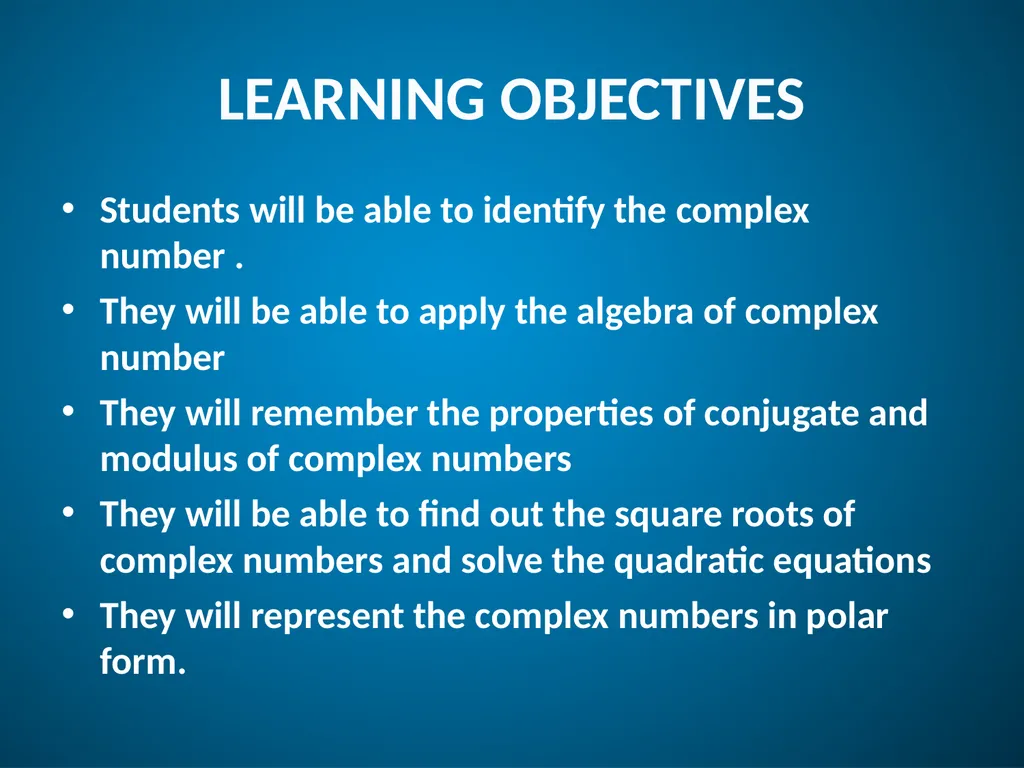
slide2. Students will be able to identify the complex number .
They will be able to apply the algebra of complex number
They will remember the properties of conjugate and modulus of complex numbers
They will be able to find out the square roots of complex numbers and solve the quadratic equations
They will represent the complex numbers in polar form. LEARNING OBJECTIVES<br>
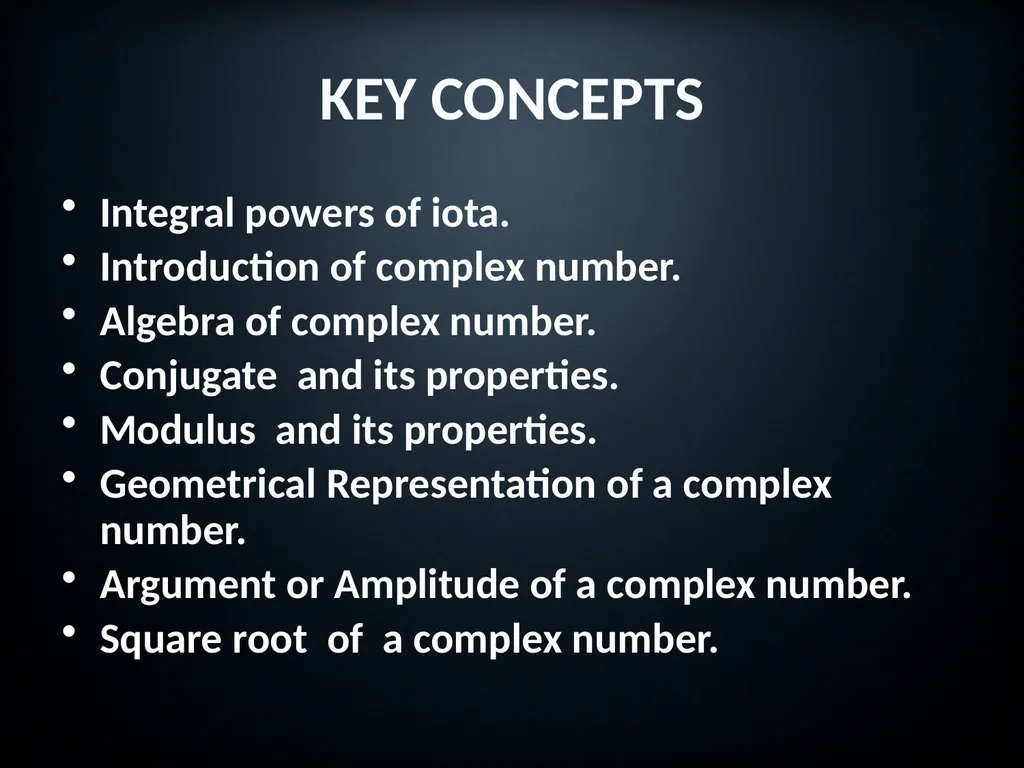
slide3. KEY CONCEPTS Integral powers of iota.
Introduction of complex number.
Algebra of complex number.
Conjugate and its properties.
Modulus and its properties.
Geometrical Representation of a complex number.
Argument or Amplitude of a complex number.
Square root of a complex number.<br>
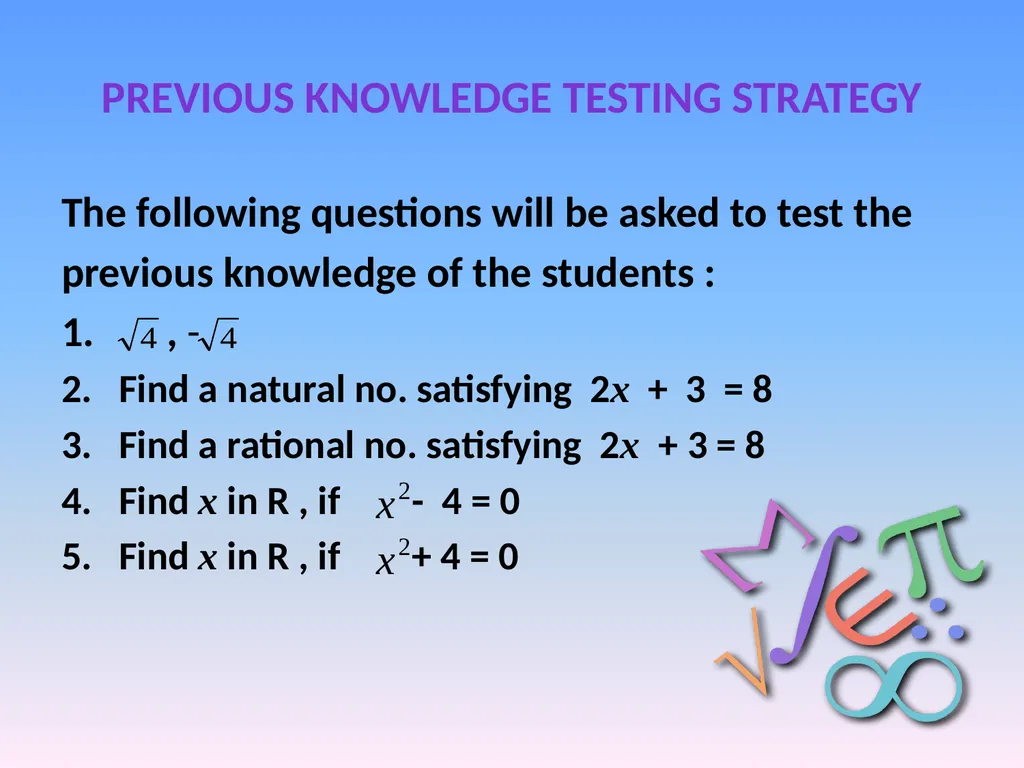
slide4. Previous Knowledge Testing Strategy The following questions will be asked to test the
previous knowledge of the students :
, -
Find a natural no. satisfying 2x + 3 = 8
Find a rational no. satisfying 2x + 3 = 8
Find x in R , if - 4 = 0
Find x in R , if + 4 = 0<br>
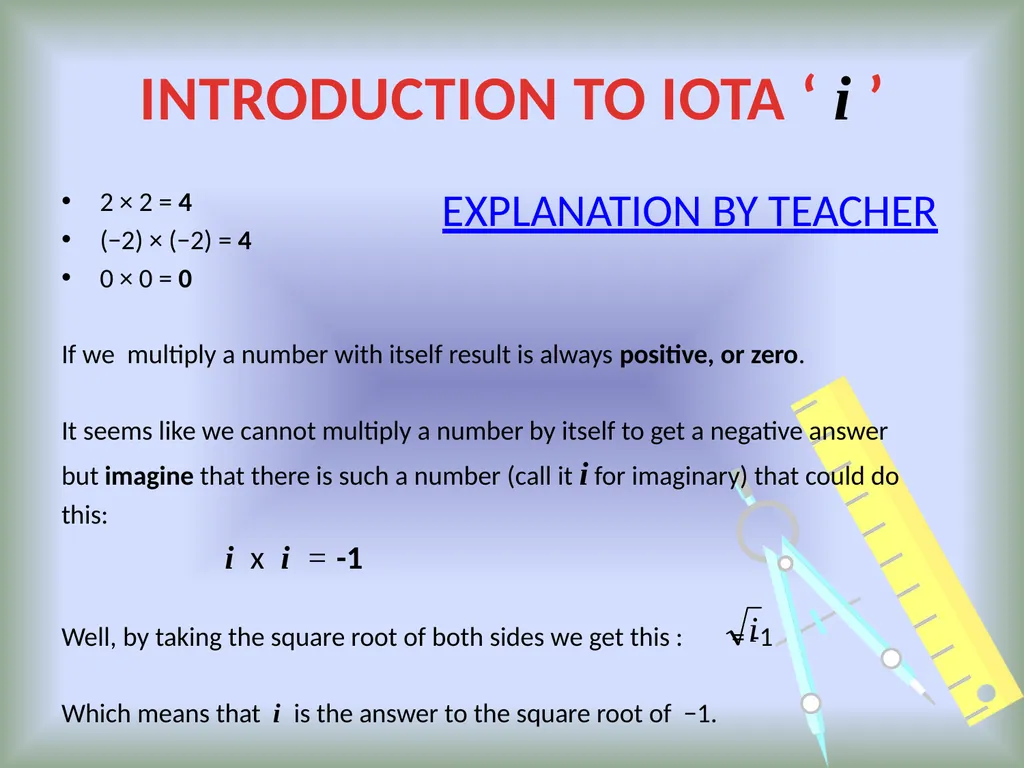
slide5. INTRODUCTION TO IOTA ‘ i ’ 2 × 2 = 4
(−2) × (−2) = 4
0 × 0 = 0
If we multiply a number with itself result is always positive, or zero.
It seems like we cannot multiply a number by itself to get a negative answer
but imagine that there is such a number (call it i for imaginary) that could do
this:
i x i = -1
Well, by taking the square root of both sides we get this : = -1
Which means that i is the answer to the square root of −1. EXPLANATION BY TEACHER<br>
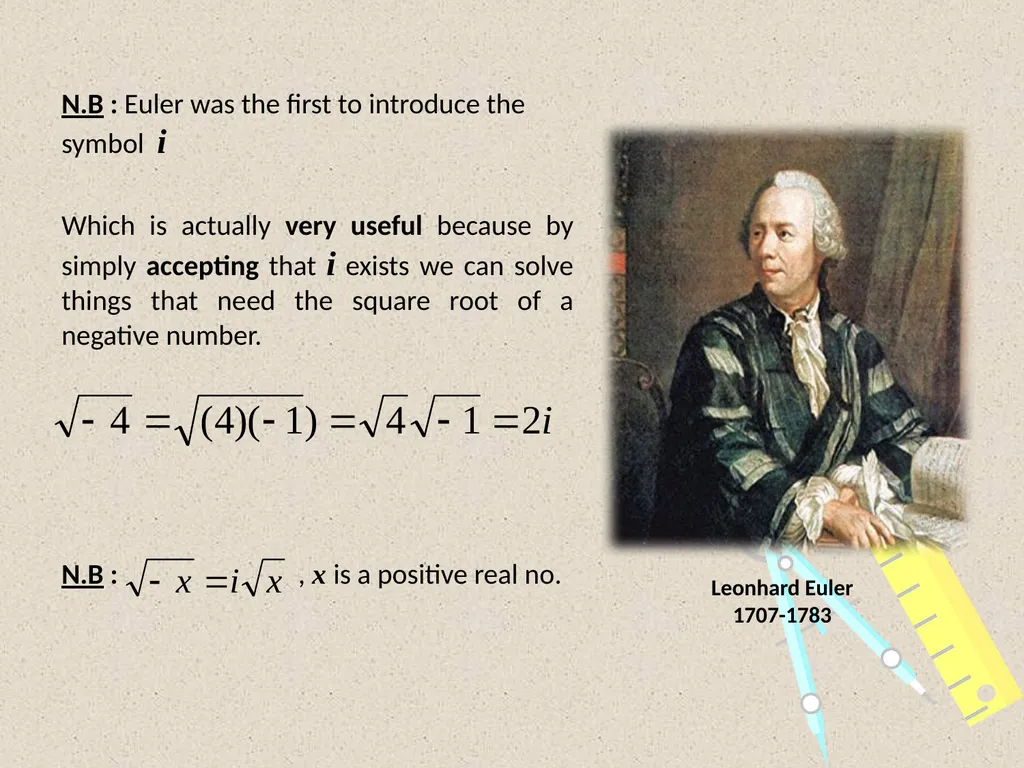
slide6. Leonhard Euler1707-1783 N.B : Euler was the first to introduce the symbol i
Which is actually very useful because by simply accepting that i exists we can solve things that need the square root of a negative number.
N.B : , x is a positive real no.<br>
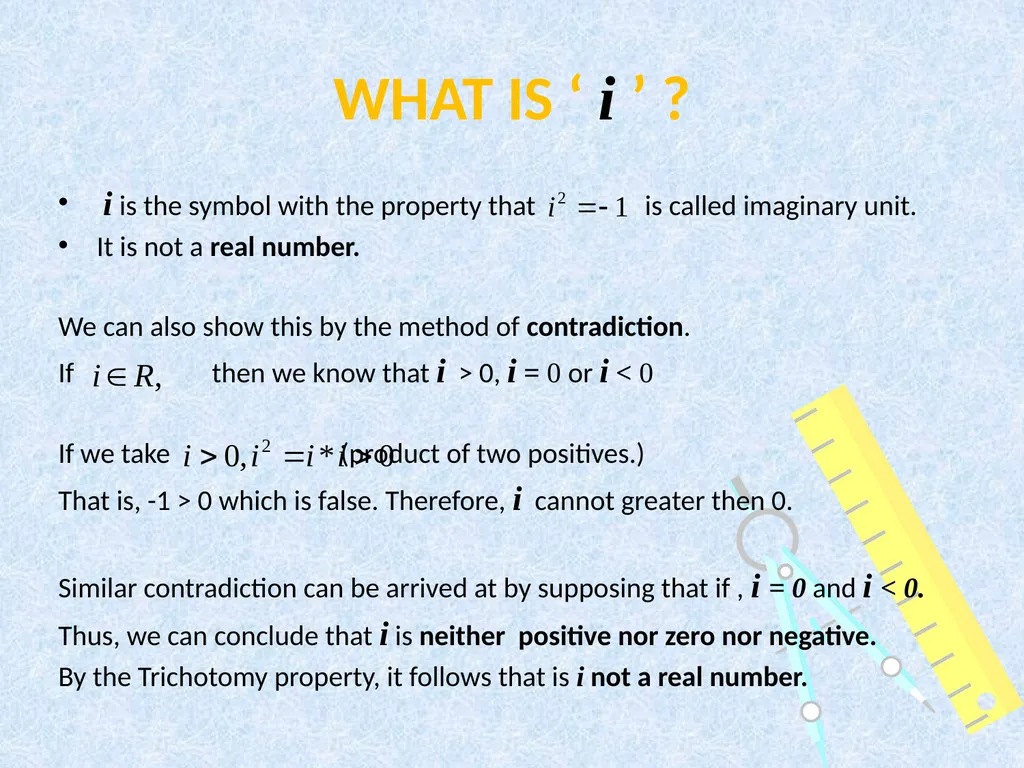
slide7. WHAT IS ‘ i ’ ? i is the symbol with the property that is called imaginary unit.
It is not a real number.
We can also show this by the method of contradiction.
If then we know that i > 0, i = 0 or i < 0
If we take (product of two positives.)
That is, -1 > 0 which is false. Therefore, i cannot greater then 0.
Similar contradiction can be arrived at by supposing that if , i = 0 and i < 0.
Thus, we can conclude that i is neither positive nor zero nor negative.
By the Trichotomy property, it follows that is i not a real number.<br>
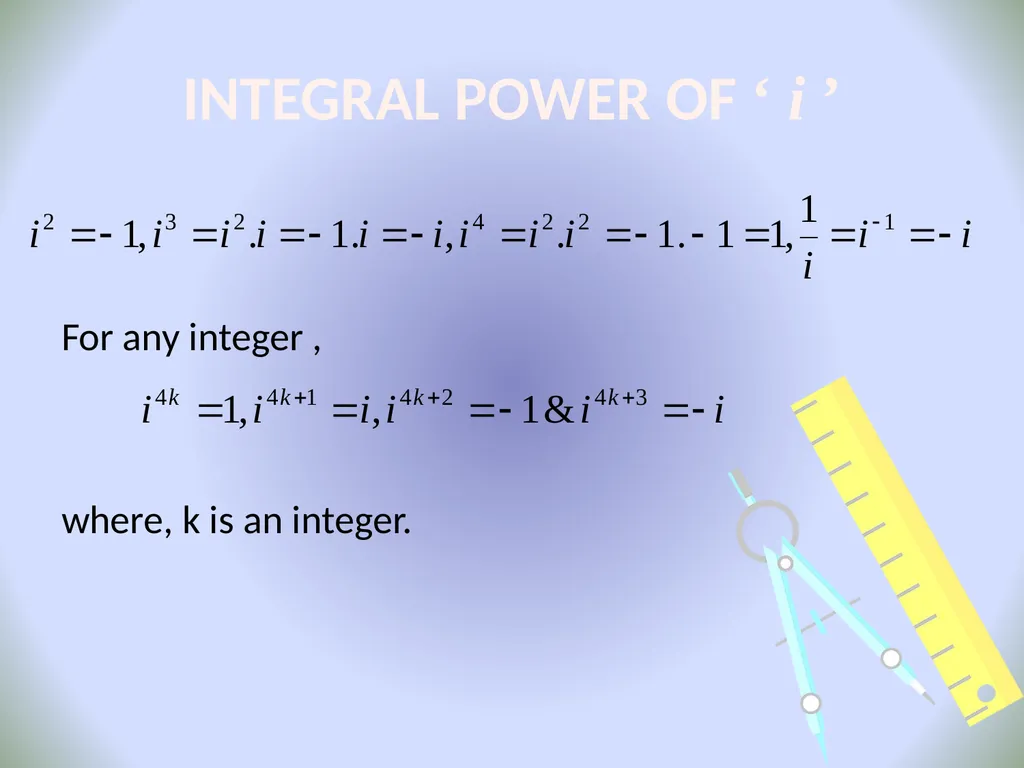
slide8. INTEGRAL POWER OF ‘ i ’ For any integer ,
where, k is an integer.<br>
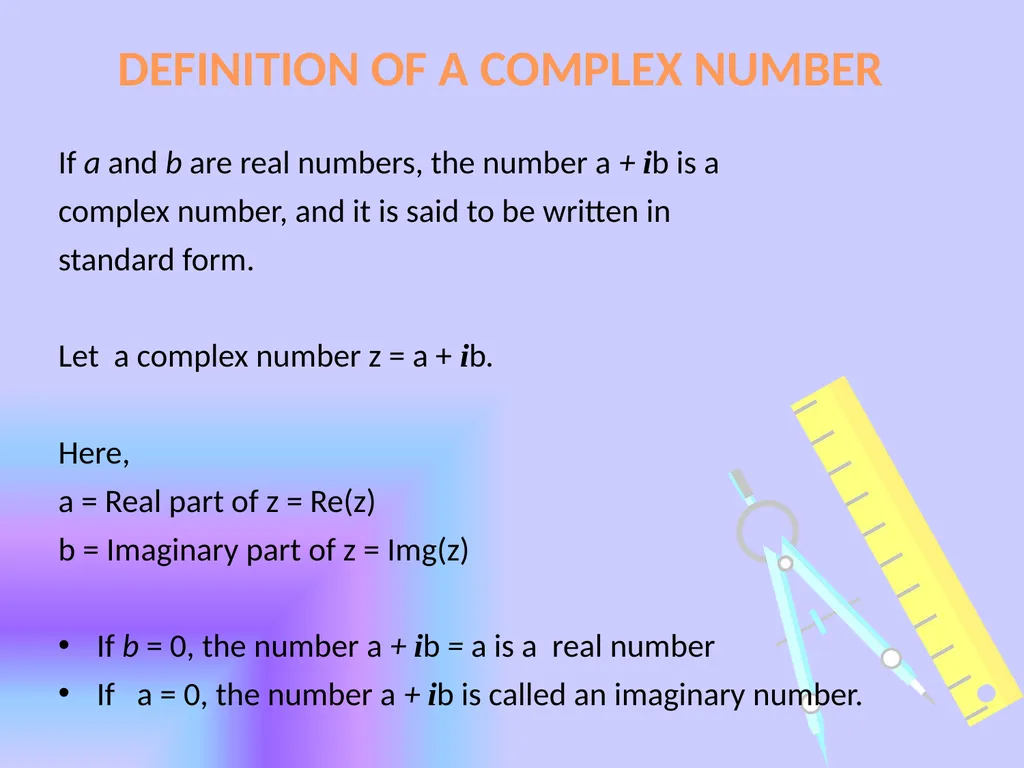
slide9. DEFINITION OF A COMPLEX NUMBER If a and b are real numbers, the number a + ib is a
complex number, and it is said to be written in
standard form.
Let a complex number z = a + ib.
Here,
a = Real part of z = Re(z)
b = Imaginary part of z = Img(z)
If b = 0, the number a + ib = a is a real number
If a = 0, the number a + ib is called an imaginary number.<br>
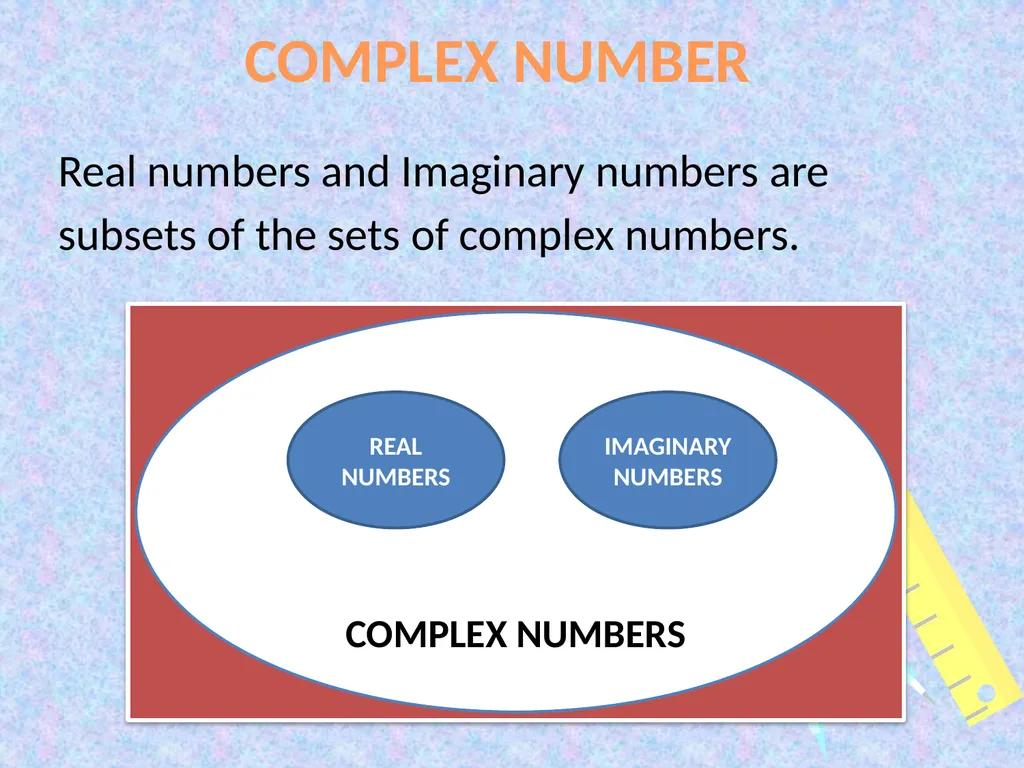
slide10. COMPLEX NUMBER Real numbers and Imaginary numbers are
subsets of the sets of complex numbers. COMPLEX NUMBERS REAL NUMBERS IMAGINARY NUMBERS<br>
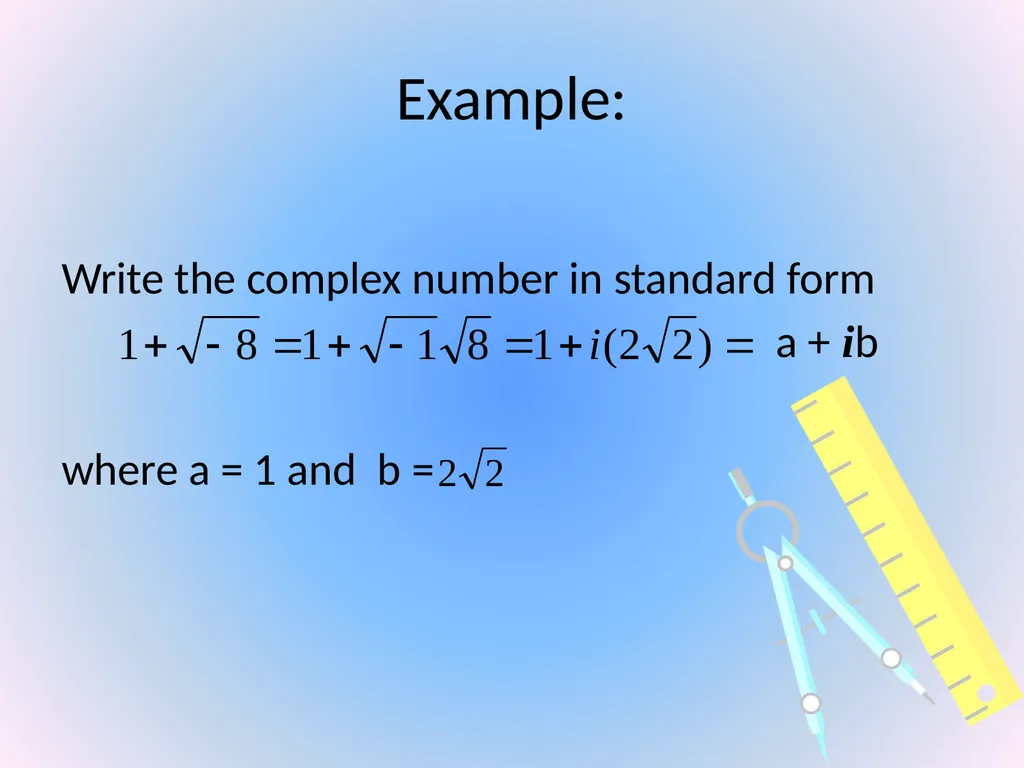
slide11. Example: Write the complex number in standard form
a + ib
where a = 1 and b =<br>
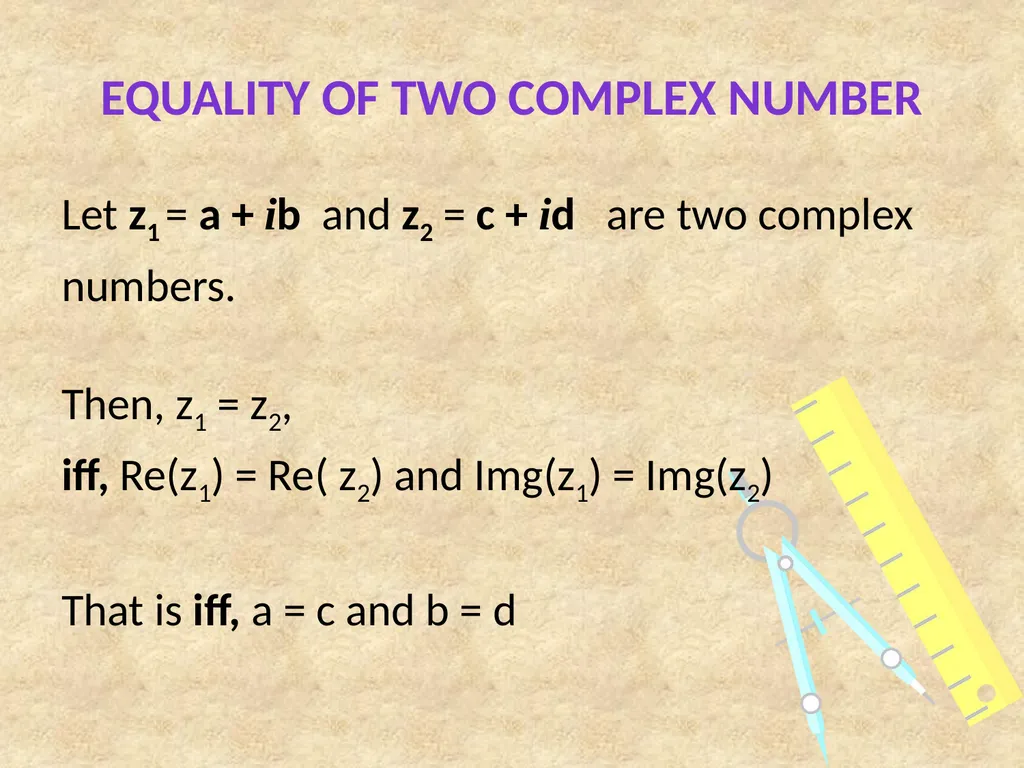
slide12. EQUALITY OF TWO COMPLEX NUMBER Let z1 = a + ib and z2 = c + id are two complex
numbers.
Then, z1 = z2,
iff, Re(z1) = Re( z2) and Img(z1) = Img(z2)
That is iff, a = c and b = d<br>
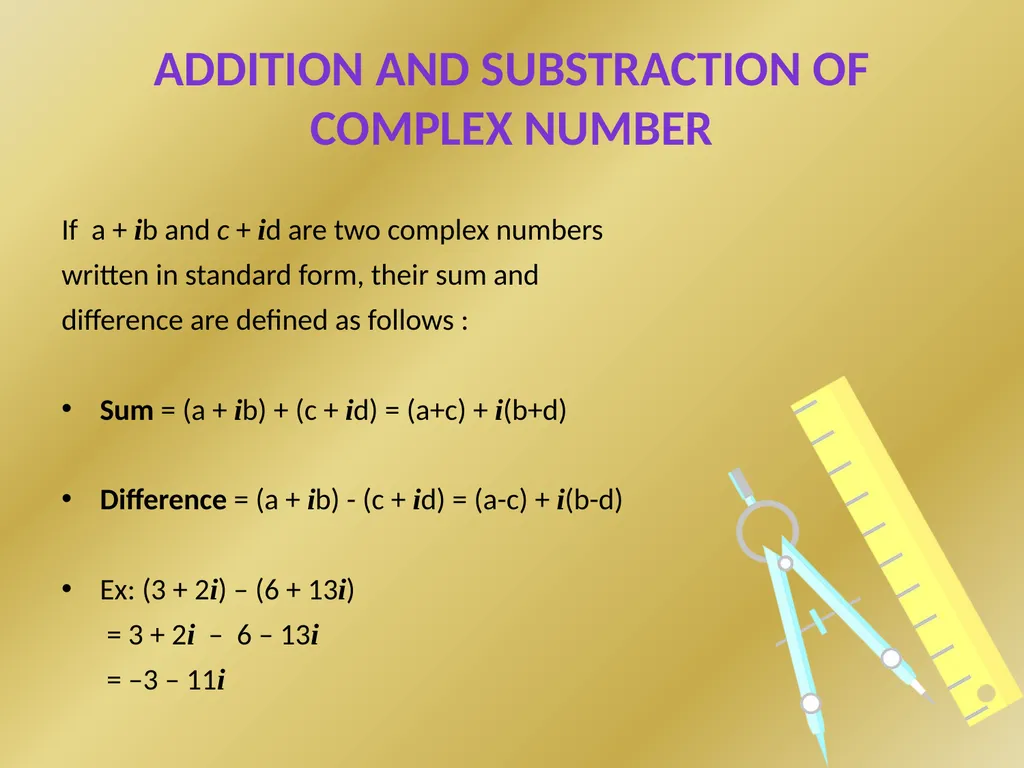
slide13. ADDITION AND SUBSTRACTION OF COMPLEX NUMBER If a + ib and c + id are two complex numbers
written in standard form, their sum and
difference are defined as follows :
Sum = (a + ib) + (c + id) = (a+c) + i(b+d)
Difference = (a + ib) - (c + id) = (a-c) + i(b-d)
Ex: (3 + 2i) – (6 + 13i)
= 3 + 2i – 6 – 13i
= –3 – 11i<br>
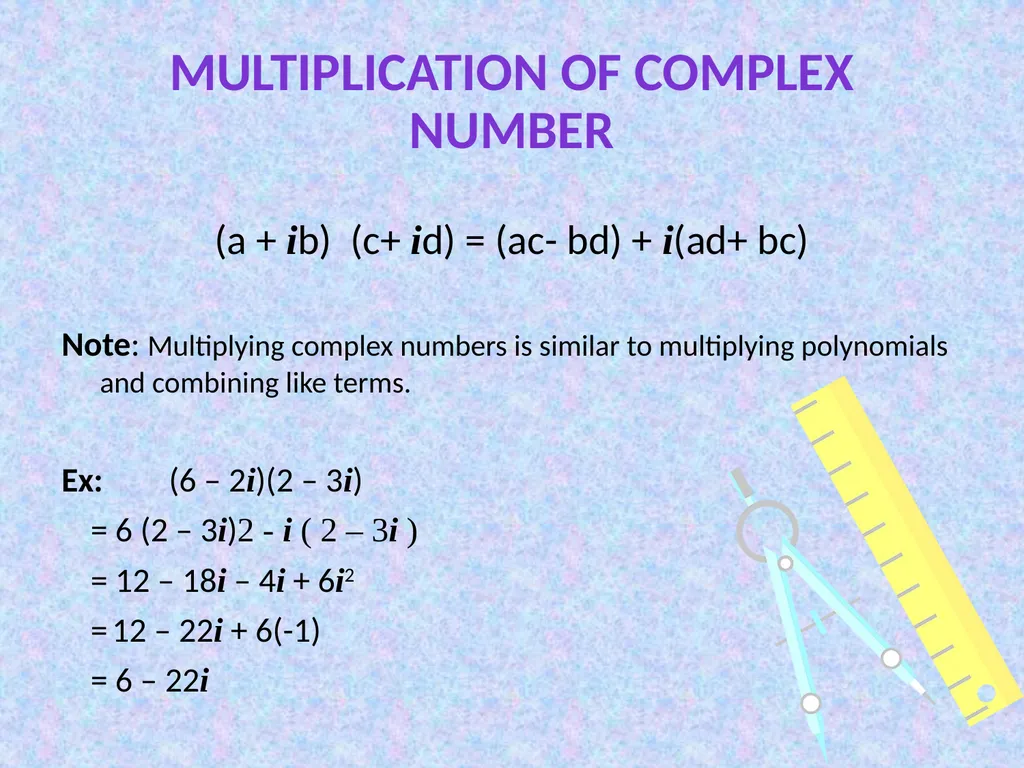
slide14. MULTIPLICATION OF COMPLEX NUMBER (a + ib) (c+ id) = (ac- bd) + i(ad+ bc)
Note: Multiplying complex numbers is similar to multiplying polynomials and combining like terms.
Ex: (6 – 2i)(2 – 3i)
= 6 (2 – 3i) - 2i ( 2 – 3i )
= 12 – 18i – 4i + 6i2
= 12 – 22i + 6(-1)
= 6 – 22i<br>
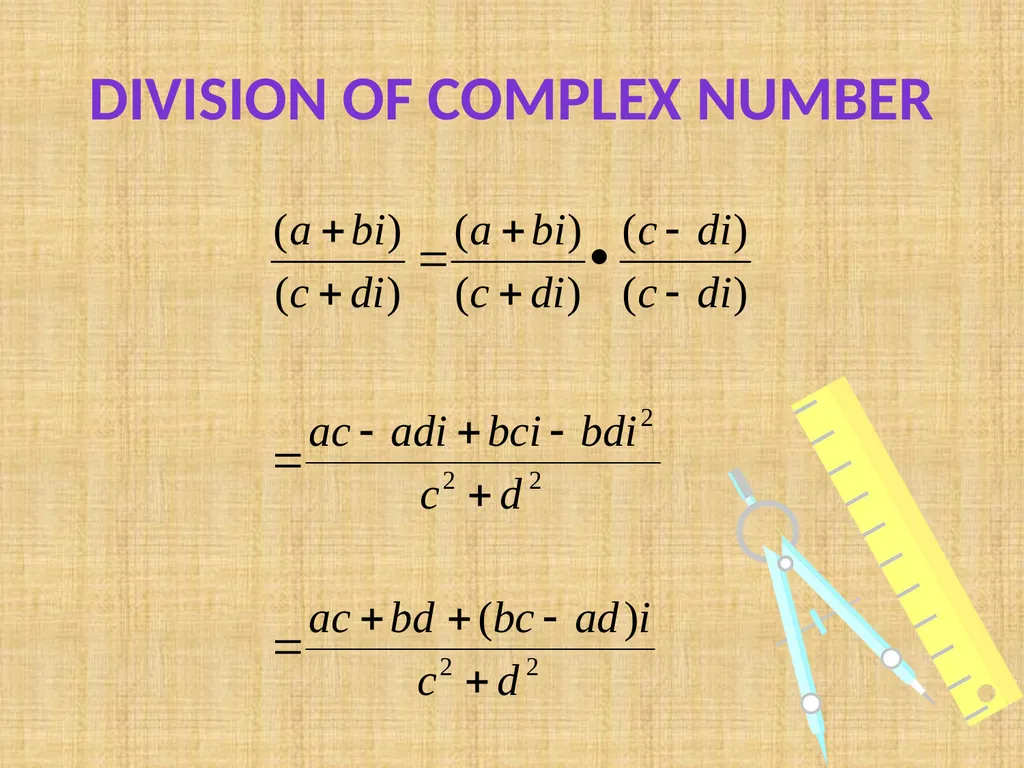
slide15. DIVISION OF COMPLEX NUMBER<br>
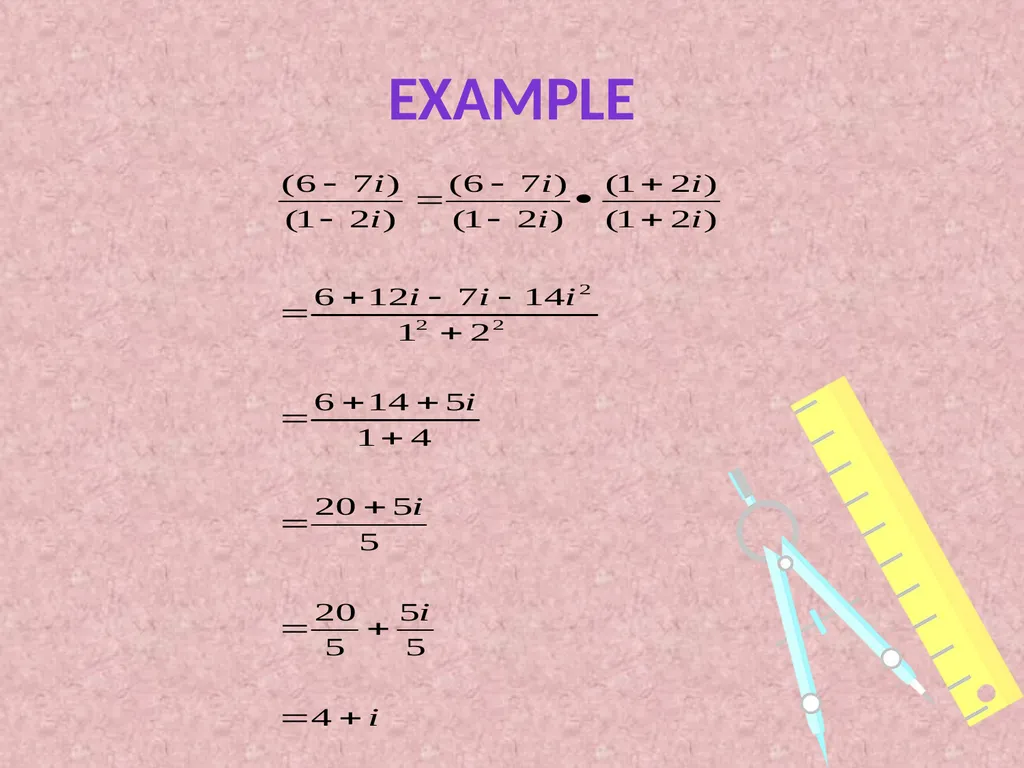
slide16. EXAMPLE<br>
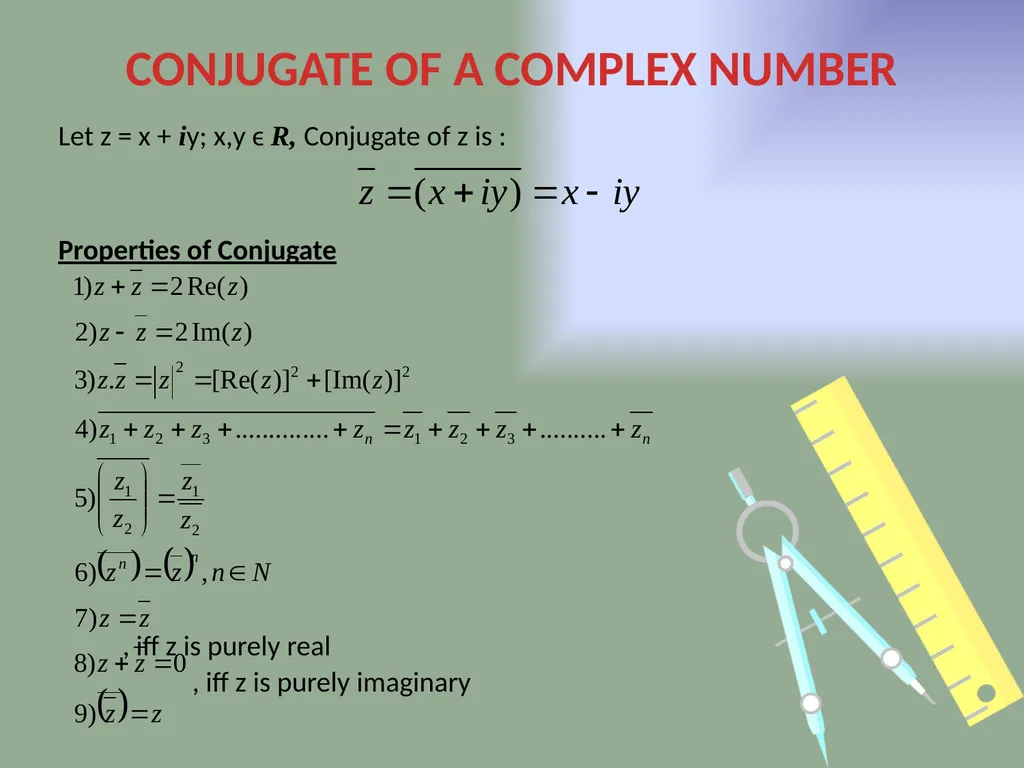
slide17. CONJUGATE OF A COMPLEX NUMBER Let z = x + iy; x,y ϵ R, Conjugate of z is :
Properties of Conjugate
, iff z is purely real
, iff z is purely imaginary<br>
slide18. MULTIPLICATIVE INVERSE OF A COMPLEX NUMBER : If z ≠ 0 , then multiplicative inverse of z is :<br>
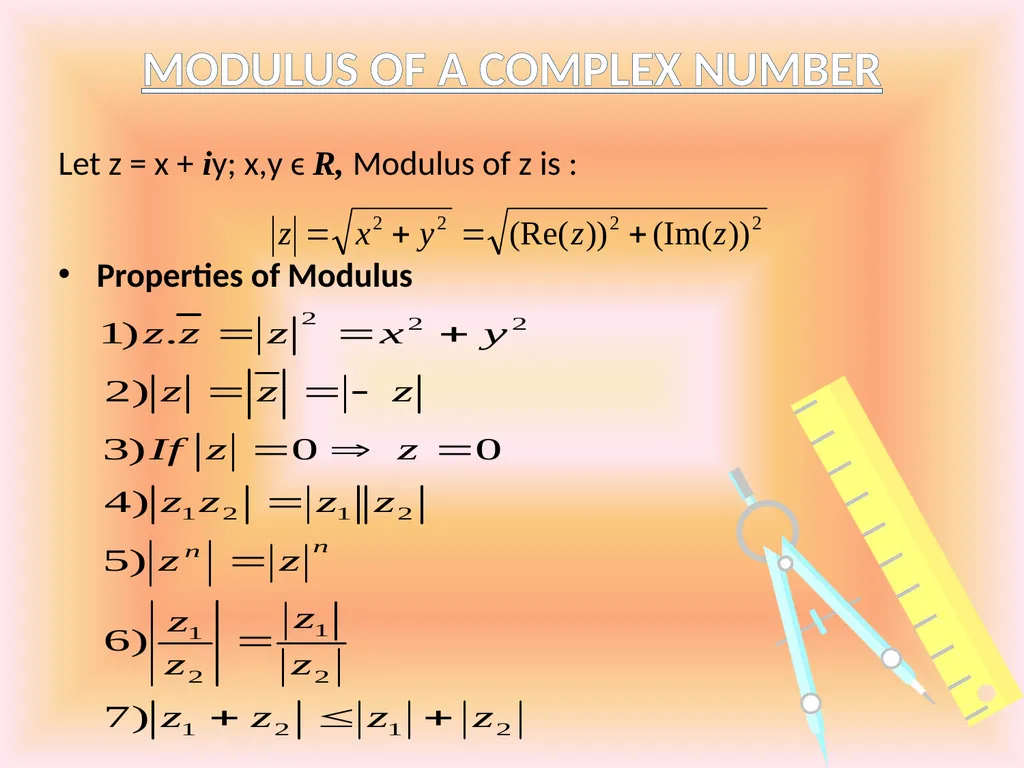
slide19. MODULUS OF A COMPLEX NUMBER Let z = x + iy; x,y ϵ R, Modulus of z is :
Properties of Modulus<br>
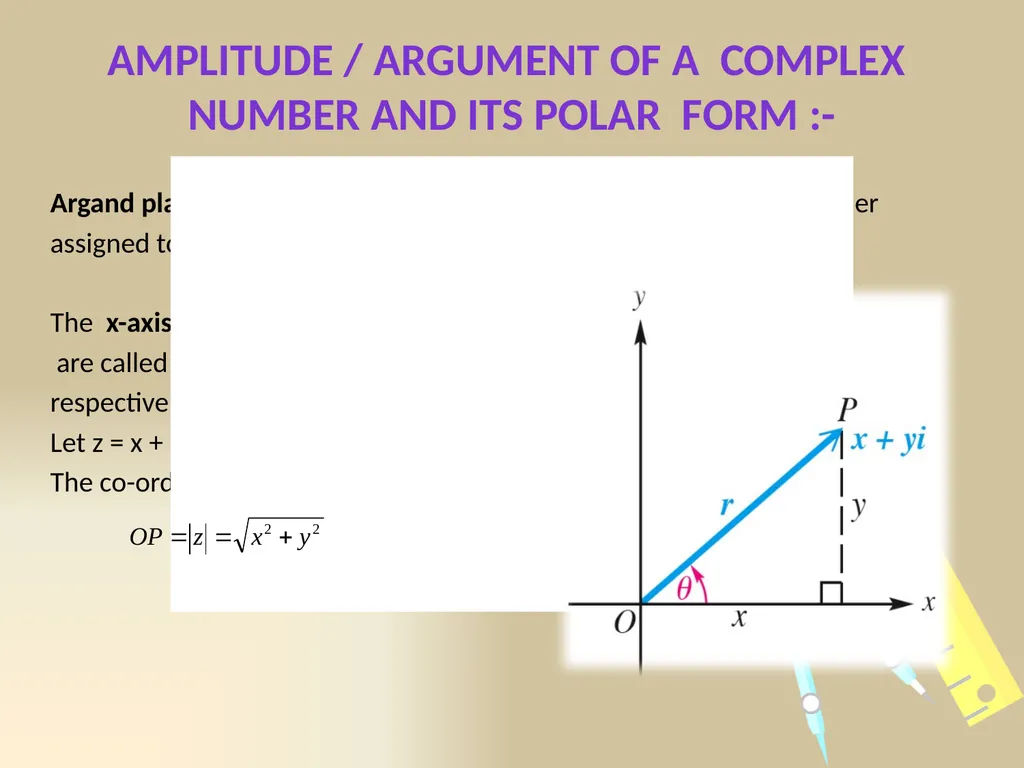
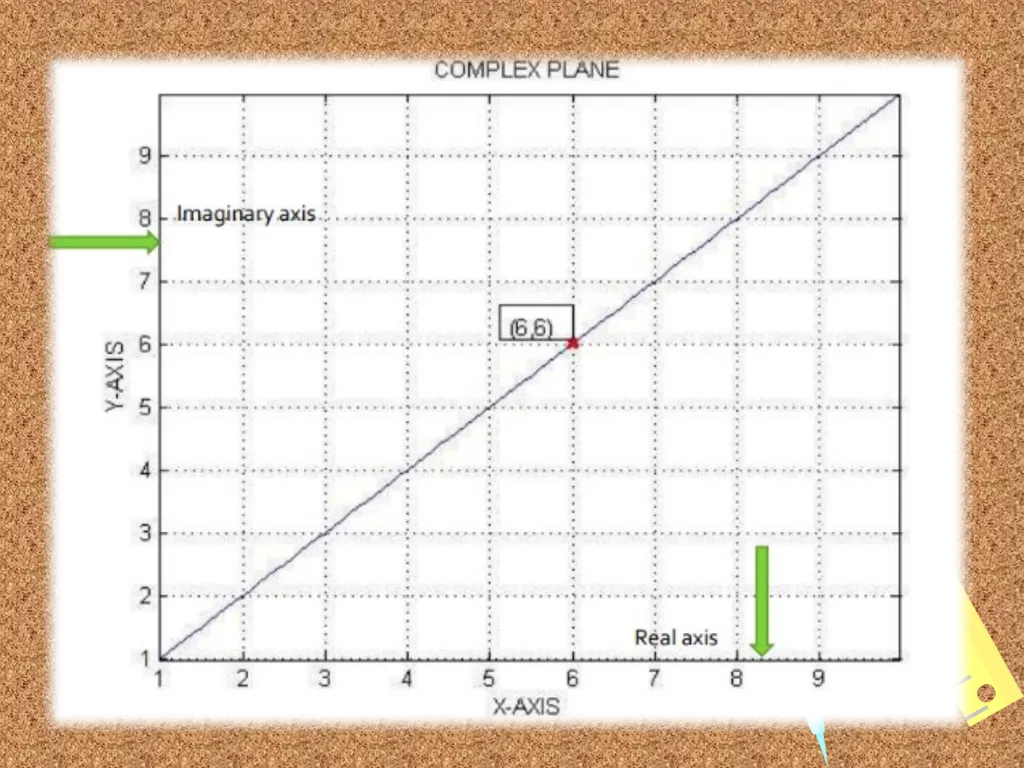
slide20. Amplitude / Argument of a complex number and its polar form :- Argand plane or Complex plane : The plane having a complex number
assigned to each of its point is called complex plane or Argand plane .
The x-axis and y-axis in the Argand plane
are called real axis and imaginary axis
respectively.
Let z = x + iy is a complex number.
The co-ordinates of P(x,y) and<br>
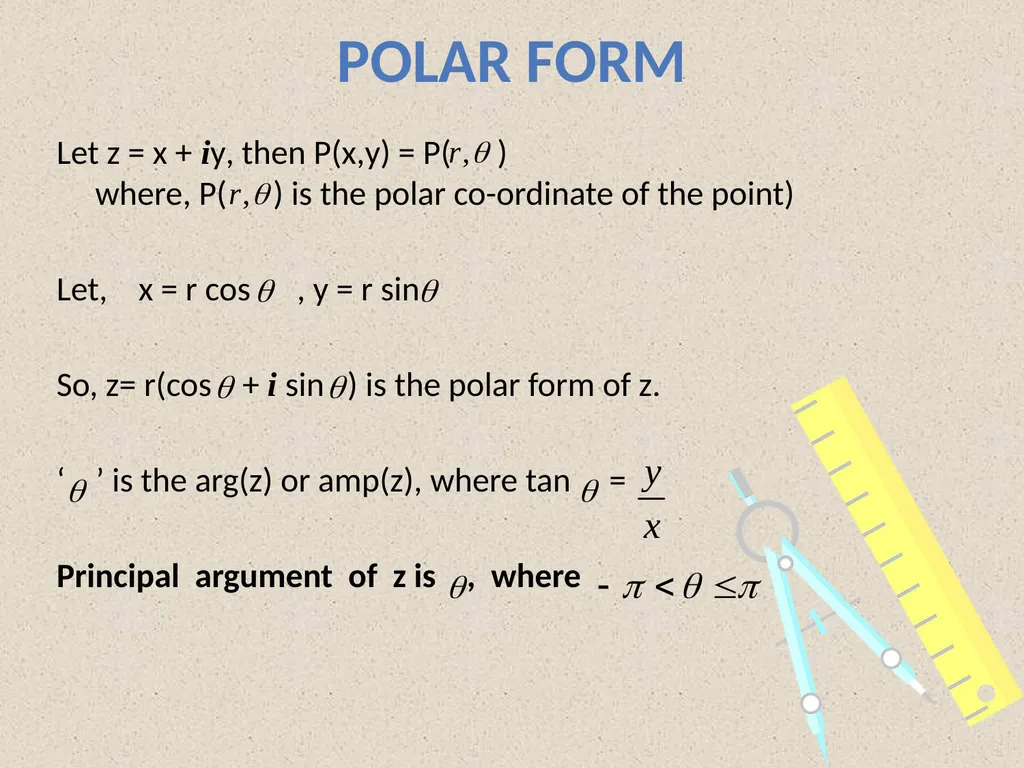
slide22. Polar Form Let z = x + iy, then P(x,y) = P( ) where, P( ) is the polar co-ordinate of the point)
Let, x = r cos , y = r sin
So, z= r(cos + i sin ) is the polar form of z.
‘ ’ is the arg(z) or amp(z), where tan =
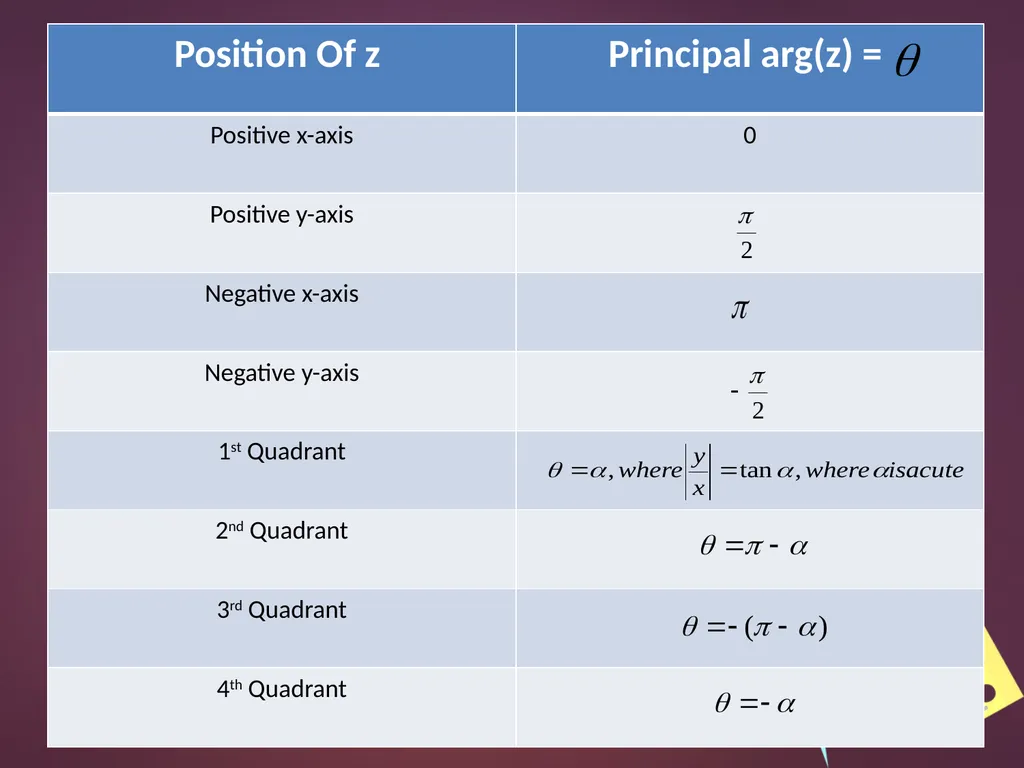
Principal argument of z is , where<br>
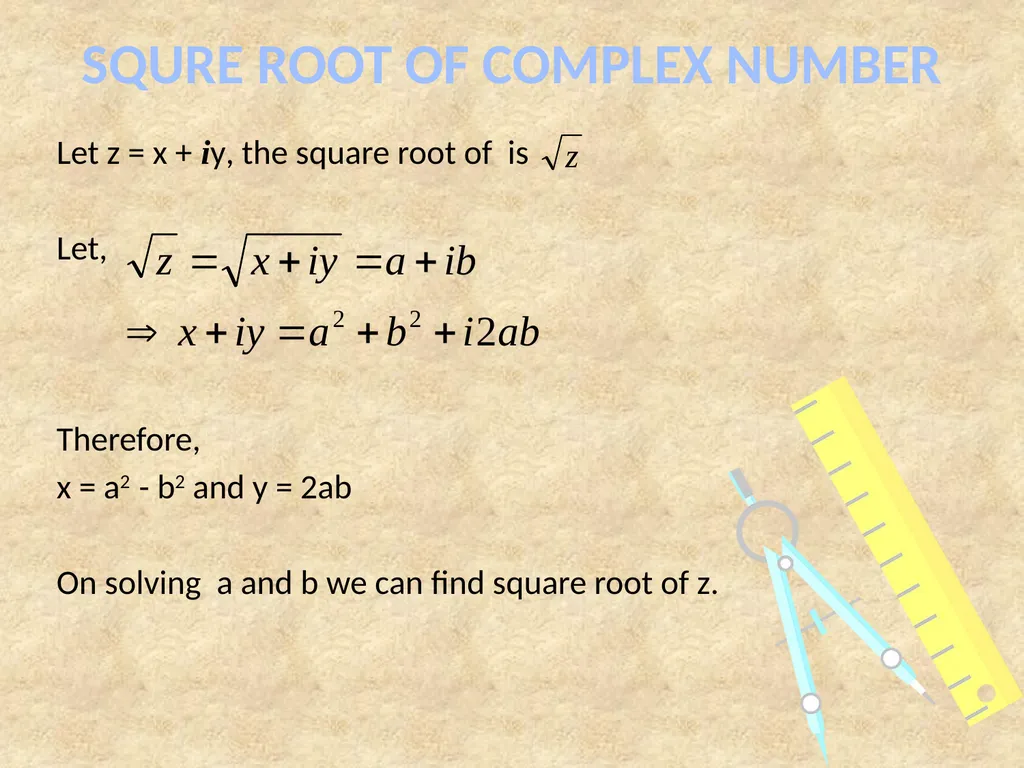
slide24. SQURE ROOT OF COMPLEX NUMBER Let z = x + iy, the square root of is
Let,
Therefore,
x = a2 - b2 and y = 2ab
On solving a and b we can find square root of z.<br>
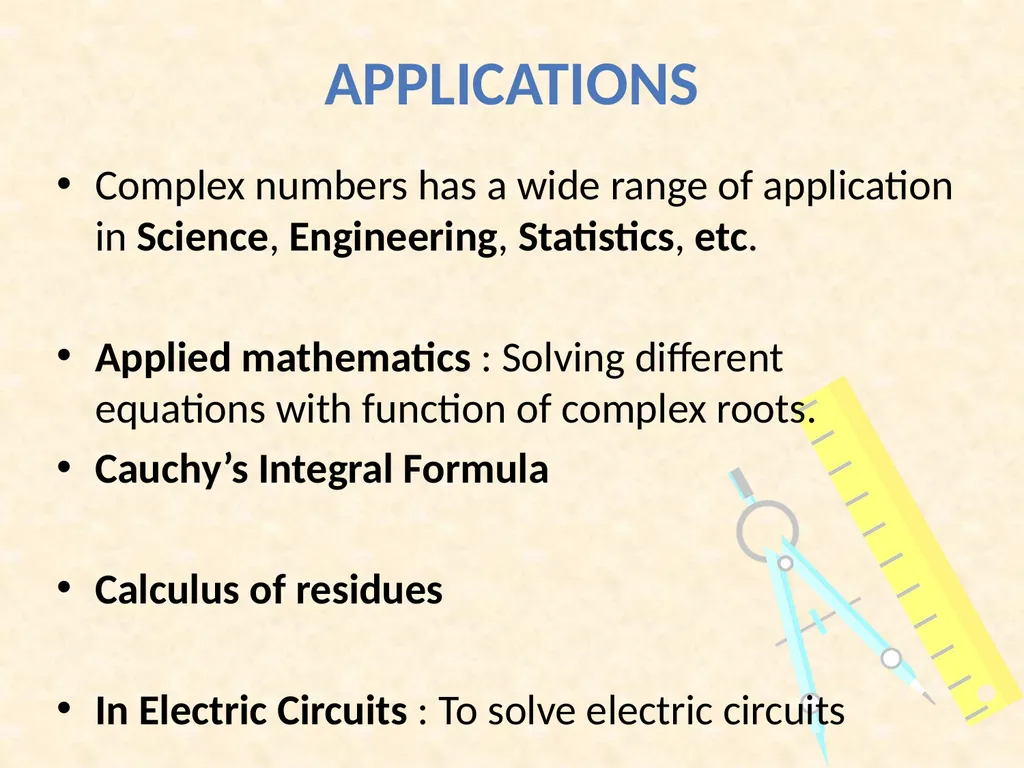
slide25. APPLICATIONS Complex numbers has a wide range of application in Science, Engineering, Statistics, etc.
Applied mathematics : Solving different equations with function of complex roots.
Cauchy’s Integral Formula
Calculus of residues
In Electric Circuits : To solve electric circuits<br>
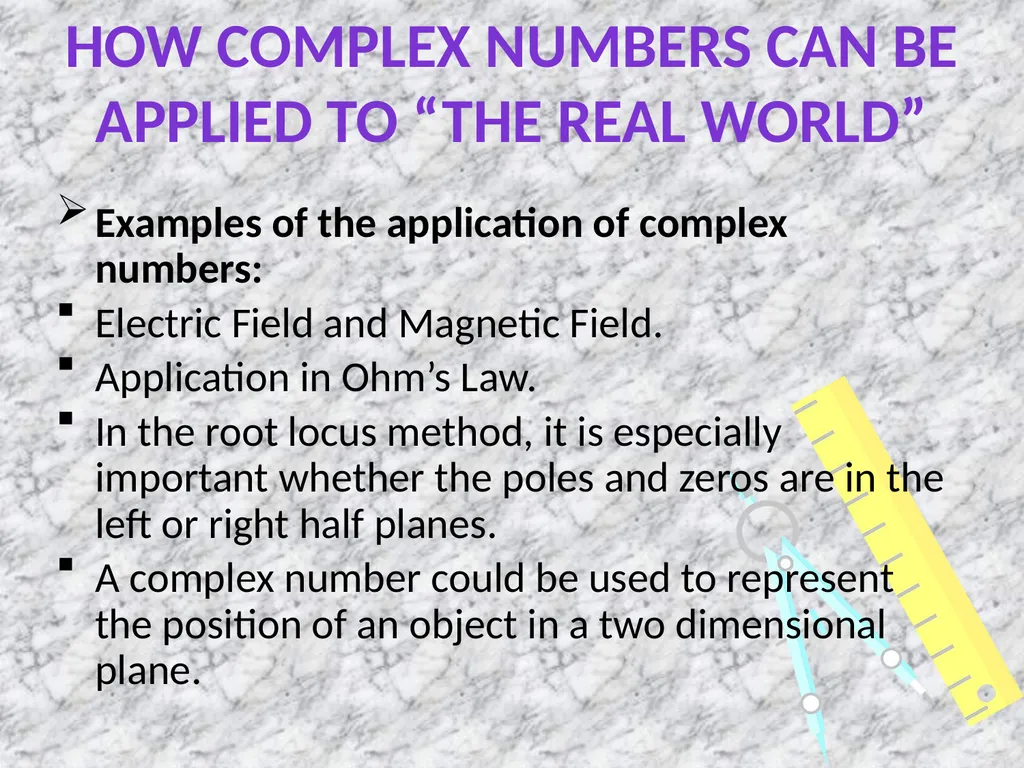
slide26. HOW COMPLEX NUMBERS CAN BE APPLIED TO “The real world” Examples of the application of complex numbers:
Electric Field and Magnetic Field.
Application in Ohm’s Law.
In the root locus method, it is especially important whether the poles and zeros are in the left or right half planes.
A complex number could be used to represent the position of an object in a two dimensional plane.<br>
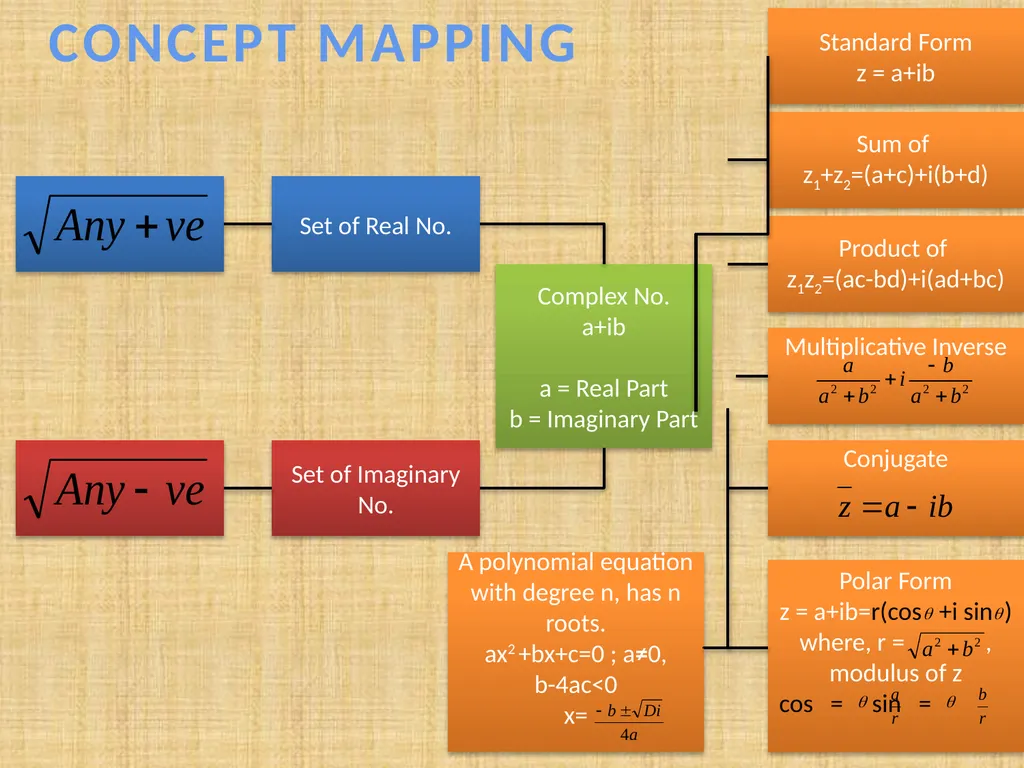
slide27. CONCEPT MAPPING Set of Imaginary No. Set of Real No. Complex No.
a+ib
a = Real Part
b = Imaginary Part Standard Form
z = a+ib Sum of z1+z2=(a+c)+i(b+d) Product of
z1z2=(ac-bd)+i(ad+bc) Multiplicative Inverse Conjugate Polar Form
z = a+ib=r(cos +i sin )
where, r = ,
modulus of z
cos = sin = A polynomial equation with degree n, has n roots.
ax2 +bx+c=0 ; a≠0,b-4ac<0
x=<br>
slide2. Students will be able to identify the complex number .
They will be able to apply the algebra of complex number
They will remember the properties of conjugate and modulus of complex numbers
They will be able to find out the square roots of complex numbers and solve the quadratic equations
They will represent the complex numbers in polar form. LEARNING OBJECTIVES<br>
slide3. KEY CONCEPTS Integral powers of iota.
Introduction of complex number.
Algebra of complex number.
Conjugate and its properties.
Modulus and its properties.
Geometrical Representation of a complex number.
Argument or Amplitude of a complex number.
Square root of a complex number.<br>
slide4. Previous Knowledge Testing Strategy The following questions will be asked to test the
previous knowledge of the students :
, -
Find a natural no. satisfying 2x + 3 = 8
Find a rational no. satisfying 2x + 3 = 8
Find x in R , if - 4 = 0
Find x in R , if + 4 = 0<br>
slide5. INTRODUCTION TO IOTA ‘ i ’ 2 × 2 = 4
(−2) × (−2) = 4
0 × 0 = 0
If we multiply a number with itself result is always positive, or zero.
It seems like we cannot multiply a number by itself to get a negative answer
but imagine that there is such a number (call it i for imaginary) that could do
this:
i x i = -1
Well, by taking the square root of both sides we get this : = -1
Which means that i is the answer to the square root of −1. EXPLANATION BY TEACHER<br>
slide6. Leonhard Euler1707-1783 N.B : Euler was the first to introduce the symbol i
Which is actually very useful because by simply accepting that i exists we can solve things that need the square root of a negative number.
N.B : , x is a positive real no.<br>
slide7. WHAT IS ‘ i ’ ? i is the symbol with the property that is called imaginary unit.
It is not a real number.
We can also show this by the method of contradiction.
If then we know that i > 0, i = 0 or i < 0
If we take (product of two positives.)
That is, -1 > 0 which is false. Therefore, i cannot greater then 0.
Similar contradiction can be arrived at by supposing that if , i = 0 and i < 0.
Thus, we can conclude that i is neither positive nor zero nor negative.
By the Trichotomy property, it follows that is i not a real number.<br>
slide8. INTEGRAL POWER OF ‘ i ’ For any integer ,
where, k is an integer.<br>
slide9. DEFINITION OF A COMPLEX NUMBER If a and b are real numbers, the number a + ib is a
complex number, and it is said to be written in
standard form.
Let a complex number z = a + ib.
Here,
a = Real part of z = Re(z)
b = Imaginary part of z = Img(z)
If b = 0, the number a + ib = a is a real number
If a = 0, the number a + ib is called an imaginary number.<br>
slide10. COMPLEX NUMBER Real numbers and Imaginary numbers are
subsets of the sets of complex numbers. COMPLEX NUMBERS REAL NUMBERS IMAGINARY NUMBERS<br>
slide11. Example: Write the complex number in standard form
a + ib
where a = 1 and b =<br>
slide12. EQUALITY OF TWO COMPLEX NUMBER Let z1 = a + ib and z2 = c + id are two complex
numbers.
Then, z1 = z2,
iff, Re(z1) = Re( z2) and Img(z1) = Img(z2)
That is iff, a = c and b = d<br>
slide13. ADDITION AND SUBSTRACTION OF COMPLEX NUMBER If a + ib and c + id are two complex numbers
written in standard form, their sum and
difference are defined as follows :
Sum = (a + ib) + (c + id) = (a+c) + i(b+d)
Difference = (a + ib) - (c + id) = (a-c) + i(b-d)
Ex: (3 + 2i) – (6 + 13i)
= 3 + 2i – 6 – 13i
= –3 – 11i<br>
slide14. MULTIPLICATION OF COMPLEX NUMBER (a + ib) (c+ id) = (ac- bd) + i(ad+ bc)
Note: Multiplying complex numbers is similar to multiplying polynomials and combining like terms.
Ex: (6 – 2i)(2 – 3i)
= 6 (2 – 3i) - 2i ( 2 – 3i )
= 12 – 18i – 4i + 6i2
= 12 – 22i + 6(-1)
= 6 – 22i<br>
slide15. DIVISION OF COMPLEX NUMBER<br>
slide16. EXAMPLE<br>
slide17. CONJUGATE OF A COMPLEX NUMBER Let z = x + iy; x,y ϵ R, Conjugate of z is :
Properties of Conjugate
, iff z is purely real
, iff z is purely imaginary<br>
slide18. MULTIPLICATIVE INVERSE OF A COMPLEX NUMBER : If z ≠ 0 , then multiplicative inverse of z is :<br>
slide19. MODULUS OF A COMPLEX NUMBER Let z = x + iy; x,y ϵ R, Modulus of z is :
Properties of Modulus<br>
slide20. Amplitude / Argument of a complex number and its polar form :- Argand plane or Complex plane : The plane having a complex number
assigned to each of its point is called complex plane or Argand plane .
The x-axis and y-axis in the Argand plane
are called real axis and imaginary axis
respectively.
Let z = x + iy is a complex number.
The co-ordinates of P(x,y) and<br>
slide22. Polar Form Let z = x + iy, then P(x,y) = P( ) where, P( ) is the polar co-ordinate of the point)
Let, x = r cos , y = r sin
So, z= r(cos + i sin ) is the polar form of z.
‘ ’ is the arg(z) or amp(z), where tan =
Principal argument of z is , where<br>
slide24. SQURE ROOT OF COMPLEX NUMBER Let z = x + iy, the square root of is
Let,
Therefore,
x = a2 - b2 and y = 2ab
On solving a and b we can find square root of z.<br>
slide25. APPLICATIONS Complex numbers has a wide range of application in Science, Engineering, Statistics, etc.
Applied mathematics : Solving different equations with function of complex roots.
Cauchy’s Integral Formula
Calculus of residues
In Electric Circuits : To solve electric circuits<br>
slide26. HOW COMPLEX NUMBERS CAN BE APPLIED TO “The real world” Examples of the application of complex numbers:
Electric Field and Magnetic Field.
Application in Ohm’s Law.
In the root locus method, it is especially important whether the poles and zeros are in the left or right half planes.
A complex number could be used to represent the position of an object in a two dimensional plane.<br>
slide27. CONCEPT MAPPING Set of Imaginary No. Set of Real No. Complex No.
a+ib
a = Real Part
b = Imaginary Part Standard Form
z = a+ib Sum of z1+z2=(a+c)+i(b+d) Product of
z1z2=(ac-bd)+i(ad+bc) Multiplicative Inverse Conjugate Polar Form
z = a+ib=r(cos +i sin )
where, r = ,
modulus of z
cos = sin = A polynomial equation with degree n, has n roots.
ax2 +bx+c=0 ; a≠0,b-4ac<0
x=<br>