
CompSci 230 Introduction to Java Lecture Slides
FD
Published · 18 slides · 0 views
1 / 1

Description
CompSci 230 Introduction to Java Lecture Slides 1: S1 2016 Version 1.1 of 2016-02-18 Introducing myself Ulrich Speidel COMPSCI 230: IntroJava1 2 Im a physicst by training and didnt become a computer scientist until my PhD Have taught
Related Topics
Share
Embed code
Download this presentation From Below
"CompSci 230 Introduction to Java Lecture Slides" is the property of its rightful owner. Permission is granted to download and print the materials on this website for personal, non-commercial use only, and to display it on your personal computer provided you do not modify the materials and that you retain all copyright notices contained in the materials. By downloading content from our website, you accept the terms of this agreement.
Presentation Transcript
01
CompSci 230
Introduction to Java Lecture Slides #1: S1 2016
Version 1.1 of 2016-02-18<br>
Version 1.1 of 2016-02-18<br>
02
Introducing myself – Ulrich Speidel COMPSCI 230: IntroJava1 2 I'm a physicst by training and didn't "become" a computer scientist until my PhD
Have taught in this department since 2000
Have been involved in a wide variety of courses ranging from application development, data communication, Internet programming and introductory programming to computer architecture
I'm quite an approachable person & just because I happen to have my door closed in 303S.594, it doesn't mean I'm trying to hide from you <br>
Have taught in this department since 2000
Have been involved in a wide variety of courses ranging from application development, data communication, Internet programming and introductory programming to computer architecture
I'm quite an approachable person & just because I happen to have my door closed in 303S.594, it doesn't mean I'm trying to hide from you <br>
03
Why I teach this course COMPSCI 230: IntroJava1 3 Programming is at the heart of computer science – I’ve programmed computers on and off since the 1980’s
Programming larger pieces of software is challenging. I’ve come across a lot of the problems first hand, and have seen how much difference the solutions make
Many of the challenges are the same, no matter what programming languages we use. I’ve used BASIC, Pascal, Perl, Matlab, Borland Delphi, C/C++, PHP, Java and others – and have seen them pop up all over the place.
Last but not least: I enjoy passing my insights on to you, and gaining new insights from you!<br>
Programming larger pieces of software is challenging. I’ve come across a lot of the problems first hand, and have seen how much difference the solutions make
Many of the challenges are the same, no matter what programming languages we use. I’ve used BASIC, Pascal, Perl, Matlab, Borland Delphi, C/C++, PHP, Java and others – and have seen them pop up all over the place.
Last but not least: I enjoy passing my insights on to you, and gaining new insights from you!<br>
04
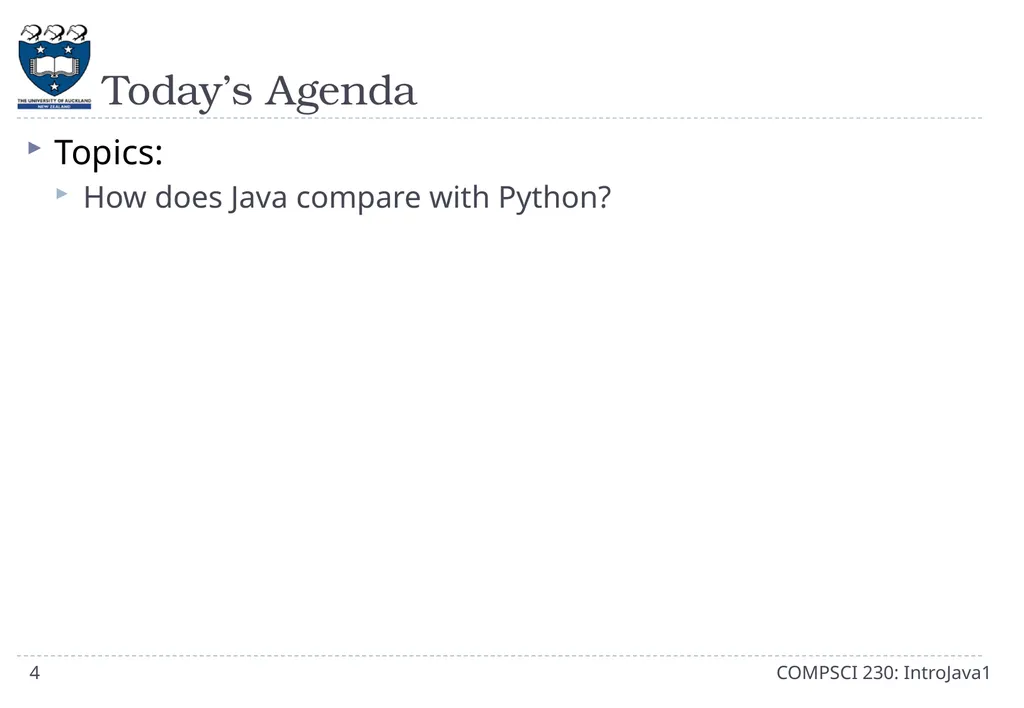
Today’s Agenda COMPSCI 230: IntroJava1 4 Topics:
How does Java compare with Python?<br>
How does Java compare with Python?<br>
05
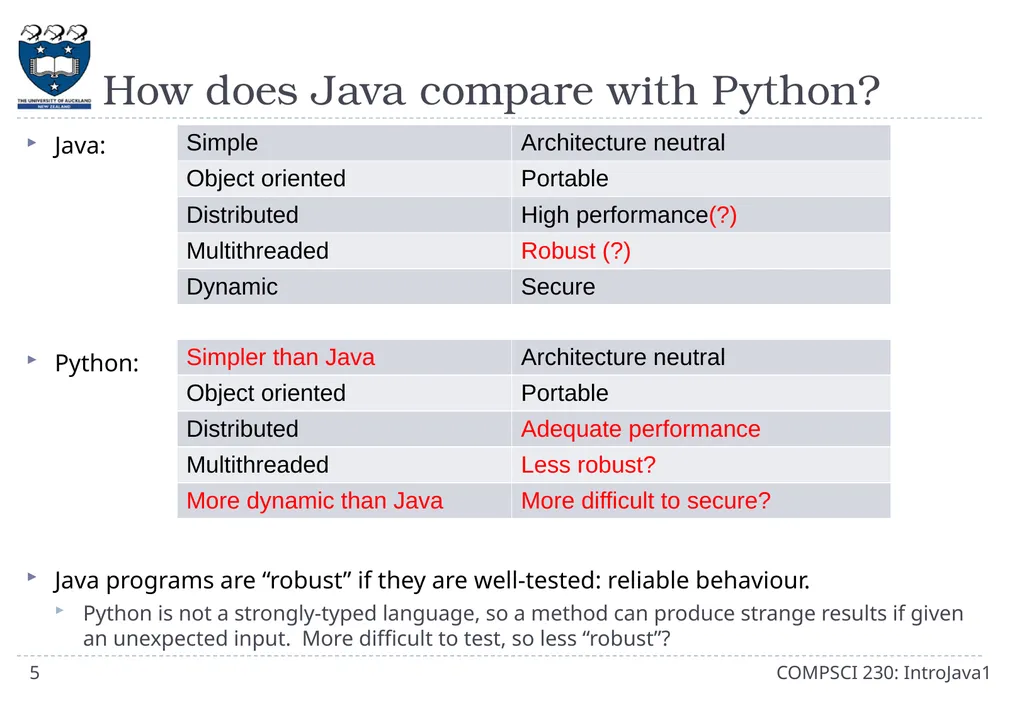
How does Java compare with Python? COMPSCI 230: IntroJava1 5 Java:
Python:
Java programs are “robust” if they are well-tested: reliable behaviour.
Python is not a strongly-typed language, so a method can produce strange results if given an unexpected input. More difficult to test, so less “robust”?<br>
Python:
Java programs are “robust” if they are well-tested: reliable behaviour.
Python is not a strongly-typed language, so a method can produce strange results if given an unexpected input. More difficult to test, so less “robust”?<br>
06
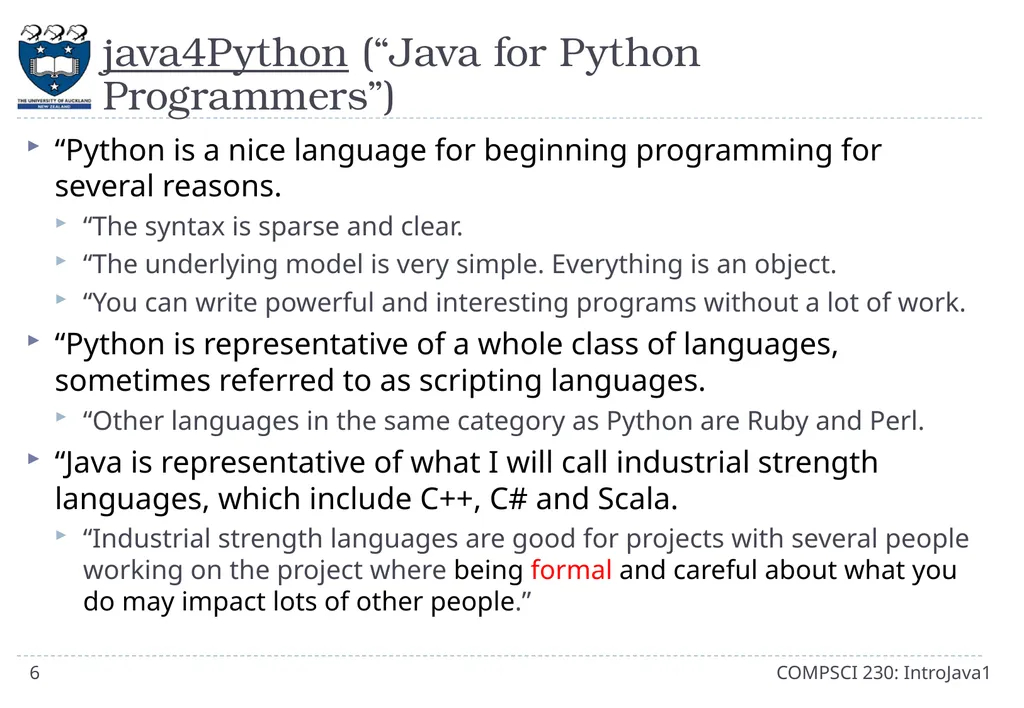
java4Python (“Java for Python Programmers”) COMPSCI 230: IntroJava1 6 “Python is a nice language for beginning programming for several reasons.
“The syntax is sparse and clear.
“The underlying model is very simple. Everything is an object.
“You can write powerful and interesting programs without a lot of work.
“Python is representative of a whole class of languages, sometimes referred to as scripting languages.
“Other languages in the same category as Python are Ruby and Perl.
“Java is representative of what I will call industrial strength languages, which include C++, C# and Scala.
“Industrial strength languages are good for projects with several people working on the project where being formal and careful about what you do may impact lots of other people.”<br>
“The syntax is sparse and clear.
“The underlying model is very simple. Everything is an object.
“You can write powerful and interesting programs without a lot of work.
“Python is representative of a whole class of languages, sometimes referred to as scripting languages.
“Other languages in the same category as Python are Ruby and Perl.
“Java is representative of what I will call industrial strength languages, which include C++, C# and Scala.
“Industrial strength languages are good for projects with several people working on the project where being formal and careful about what you do may impact lots of other people.”<br>
07
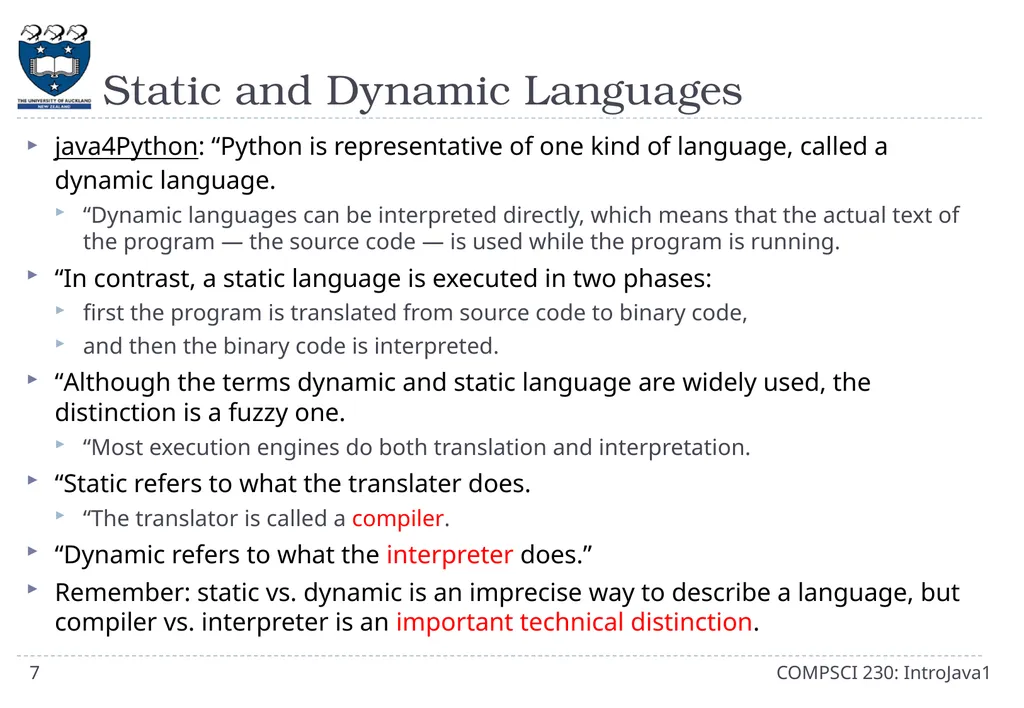
Static and Dynamic Languages COMPSCI 230: IntroJava1 7 java4Python: “Python is representative of one kind of language, called a dynamic language.
“Dynamic languages can be interpreted directly, which means that the actual text of the program — the source code — is used while the program is running.
“In contrast, a static language is executed in two phases:
first the program is translated from source code to binary code,
and then the binary code is interpreted.
“Although the terms dynamic and static language are widely used, the distinction is a fuzzy one.
“Most execution engines do both translation and interpretation.
“Static refers to what the translater does.
“The translator is called a compiler.
“Dynamic refers to what the interpreter does.”
Remember: static vs. dynamic is an imprecise way to describe a language, but compiler vs. interpreter is an important technical distinction.<br>
“Dynamic languages can be interpreted directly, which means that the actual text of the program — the source code — is used while the program is running.
“In contrast, a static language is executed in two phases:
first the program is translated from source code to binary code,
and then the binary code is interpreted.
“Although the terms dynamic and static language are widely used, the distinction is a fuzzy one.
“Most execution engines do both translation and interpretation.
“Static refers to what the translater does.
“The translator is called a compiler.
“Dynamic refers to what the interpreter does.”
Remember: static vs. dynamic is an imprecise way to describe a language, but compiler vs. interpreter is an important technical distinction.<br>
08
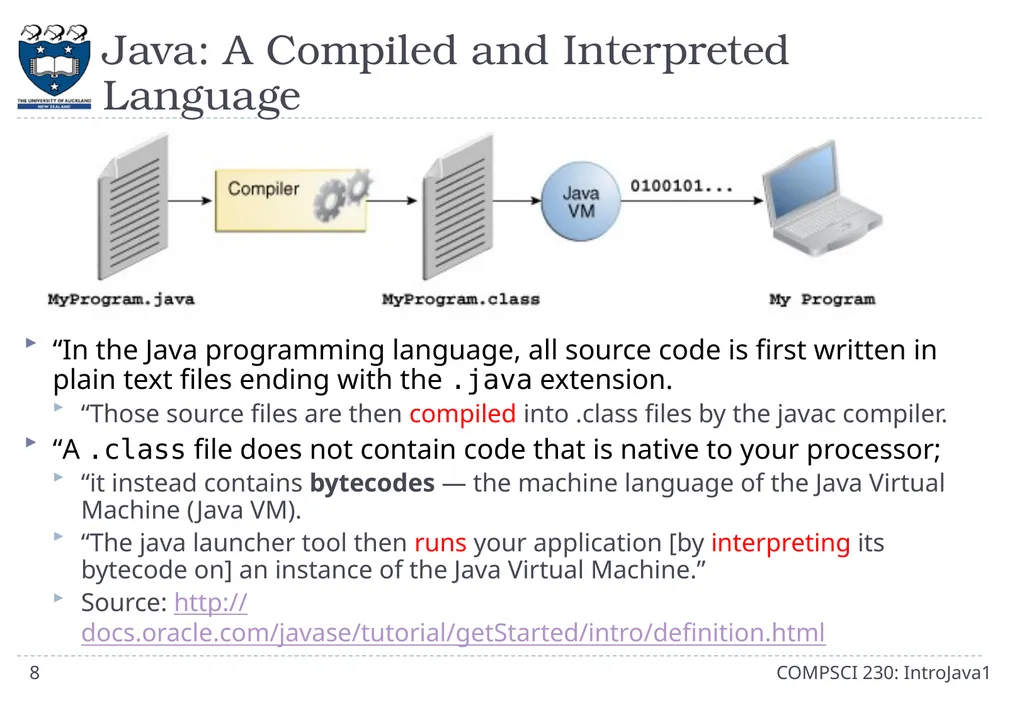
Java: A Compiled and Interpreted Language COMPSCI 230: IntroJava1 8 “In the Java programming language, all source code is first written in plain text files ending with the .java extension.
“Those source files are then compiled into .class files by the javac compiler.
“A .class file does not contain code that is native to your processor;
“it instead contains bytecodes — the machine language of the Java Virtual Machine (Java VM).
“The java launcher tool then runs your application [by interpreting its bytecode on] an instance of the Java Virtual Machine.”
Source: http://docs.oracle.com/javase/tutorial/getStarted/intro/definition.html<br>
“Those source files are then compiled into .class files by the javac compiler.
“A .class file does not contain code that is native to your processor;
“it instead contains bytecodes — the machine language of the Java Virtual Machine (Java VM).
“The java launcher tool then runs your application [by interpreting its bytecode on] an instance of the Java Virtual Machine.”
Source: http://docs.oracle.com/javase/tutorial/getStarted/intro/definition.html<br>
09
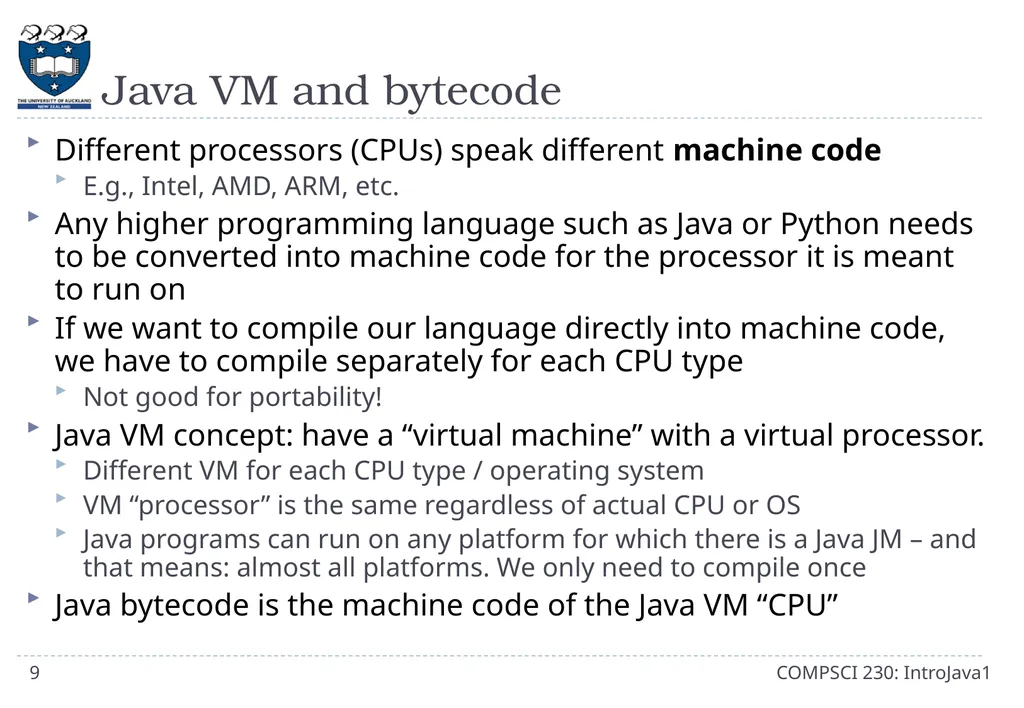
Java VM and bytecode COMPSCI 230: IntroJava1 9 Different processors (CPUs) speak different machine code
E.g., Intel, AMD, ARM, etc.
Any higher programming language such as Java or Python needs to be converted into machine code for the processor it is meant to run on
If we want to compile our language directly into machine code, we have to compile separately for each CPU type
Not good for portability!
Java VM concept: have a “virtual machine” with a virtual processor.
Different VM for each CPU type / operating system
VM “processor” is the same regardless of actual CPU or OS
Java programs can run on any platform for which there is a Java JM – and that means: almost all platforms. We only need to compile once
Java bytecode is the machine code of the Java VM “CPU”<br>
E.g., Intel, AMD, ARM, etc.
Any higher programming language such as Java or Python needs to be converted into machine code for the processor it is meant to run on
If we want to compile our language directly into machine code, we have to compile separately for each CPU type
Not good for portability!
Java VM concept: have a “virtual machine” with a virtual processor.
Different VM for each CPU type / operating system
VM “processor” is the same regardless of actual CPU or OS
Java programs can run on any platform for which there is a Java JM – and that means: almost all platforms. We only need to compile once
Java bytecode is the machine code of the Java VM “CPU”<br>
10
Is Java a Static or Dynamic Language? COMPSCI 230: IntroJava1 10 Dynamic, because Java bytecode (in a .class file) is interpreted by a JVM.
Static, because Java source code (in a .java file) is compiled into another language (Java bytecode) before it is executed – it is not directly executable.
So… we might say that Java bytecode is dynamic, and that Java source code is static.<br>
Static, because Java source code (in a .java file) is compiled into another language (Java bytecode) before it is executed – it is not directly executable.
So… we might say that Java bytecode is dynamic, and that Java source code is static.<br>
11
Is Python Static or Dynamic? COMPSCI 230: IntroJava1 11 Python bytecode (in a .pyc file) is dynamic, because it is interpreted by the Python runtime system.
Note: Python bytecode is not portable across versions of Python.
The semantics of Java bytecode is very stable.
“Old” Java bytecode runs on newer JVMs. (However libraries are versioned, and there are some incompatibilities across major releases of Java; so a recompilation is advisable every year or two.)
Python source code (in a .py file) is static, because it is compiled into bytecode before the bytecode is interpreted.
However: a Java compilation is more complicated than a Python compilation, and a Python interpretation is more complicated than a Java interpretation.
Python source code is often interpreted and executed on a line-by-line basis, in a shell.
It is possible to compile Python source into an .exe, see Cython v0.22.
So… Python (but not Cython!) is “more dynamic” than Java.<br>
Note: Python bytecode is not portable across versions of Python.
The semantics of Java bytecode is very stable.
“Old” Java bytecode runs on newer JVMs. (However libraries are versioned, and there are some incompatibilities across major releases of Java; so a recompilation is advisable every year or two.)
Python source code (in a .py file) is static, because it is compiled into bytecode before the bytecode is interpreted.
However: a Java compilation is more complicated than a Python compilation, and a Python interpretation is more complicated than a Java interpretation.
Python source code is often interpreted and executed on a line-by-line basis, in a shell.
It is possible to compile Python source into an .exe, see Cython v0.22.
So… Python (but not Cython!) is “more dynamic” than Java.<br>
12
Performance: Python vs. Java COMPSCI 230: IntroJava1 12 Advocates for each language use different ways to measure performance, and (unsurprisingly ;-) get different results.
In many applications, performance is unimportant.
If performance is very important, you should use a fully-static language such as C or Fortran.
Python runtime performance is hampered by the limited amount of analysis done by the Python compiler.
The Java compiler performs optimisations which are infeasible in Python (because Python variables have no static type – we’ll discuss typing in future lectures, but we will not discuss optimisations).
Java performance is hampered if the source code isn’t pre-compiled.
Java compilation is much slower than Python compilation.
Most JVMs (and some PVMs, e.g. PyPy) compile bytecode into machine code, to avoid the overheads of interpretation on tight loops.
This is called “just-in-time” compilation, or jitting.
A jitting VM may run a bytecoded program 10x faster than a non-jitting VM, because machine-coded loops run much faster than interpreted loops.<br>
In many applications, performance is unimportant.
If performance is very important, you should use a fully-static language such as C or Fortran.
Python runtime performance is hampered by the limited amount of analysis done by the Python compiler.
The Java compiler performs optimisations which are infeasible in Python (because Python variables have no static type – we’ll discuss typing in future lectures, but we will not discuss optimisations).
Java performance is hampered if the source code isn’t pre-compiled.
Java compilation is much slower than Python compilation.
Most JVMs (and some PVMs, e.g. PyPy) compile bytecode into machine code, to avoid the overheads of interpretation on tight loops.
This is called “just-in-time” compilation, or jitting.
A jitting VM may run a bytecoded program 10x faster than a non-jitting VM, because machine-coded loops run much faster than interpreted loops.<br>
13
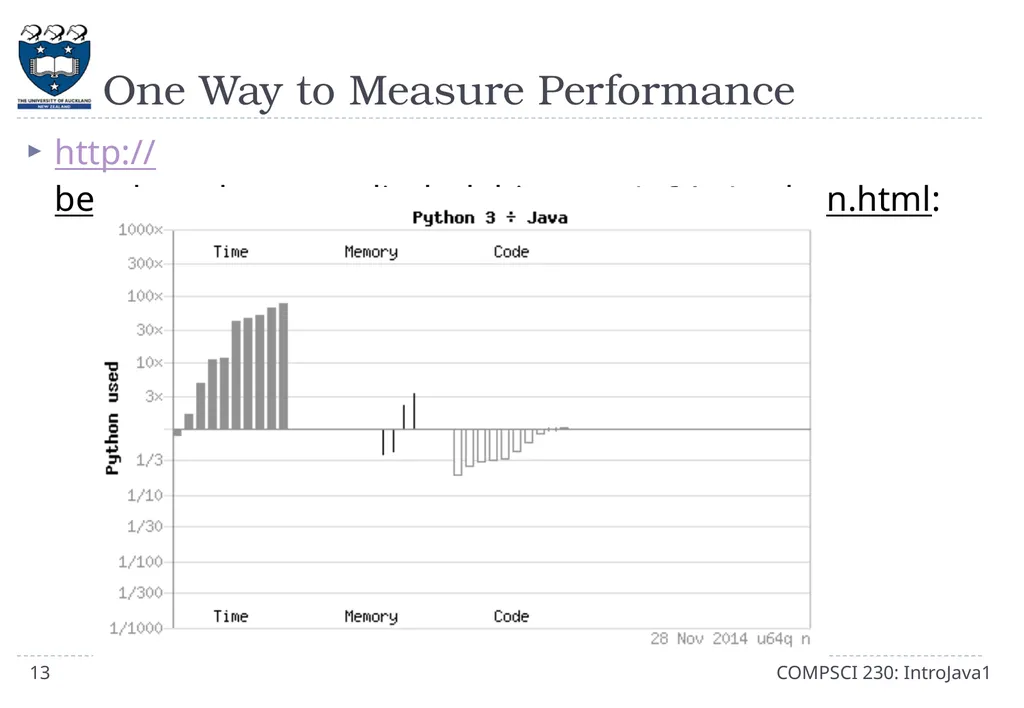
One Way to Measure Performance COMPSCI 230: IntroJava1 13 http://benchmarksgame.alioth.debian.org/u64q/python.html:<br>
14
Horses for courses? COMPSCI 230: IntroJava1 14 Ted Samson, “Why Netflix is embracing Python over Java”, Mar 11, 2013:
“Netflix is increasingly turning to Python over Java to power certain aspects of its video-streaming service, such as generating and processing alerts, boosting resilience, securing transactions, producing deployable AMIs (Amazon Machine Images), and for managing and automatic Cassandra clusters.
“Python is giving Java a run for its money among developers at Netflix, [due to Python’s] ‘rich batteries-included standard library, succinct and clean yet expressive syntax, large developer community, and wealth of third-party libraries.’”
Sean Kelly’s Recovery from [a Java] Addiction, 10-minute video, 2006.
I recommend you watch this video after you learn Java.
Sean argues, persuasively, that Python is much better than Java for web development. (He doesn’t consider Javascript or compatibility. Nor will we! ;-)
Sean doesn’t discuss testing and quality assurance. (Maybe watch this video again, after you have completed the software-quality unit in this course?)<br>
“Netflix is increasingly turning to Python over Java to power certain aspects of its video-streaming service, such as generating and processing alerts, boosting resilience, securing transactions, producing deployable AMIs (Amazon Machine Images), and for managing and automatic Cassandra clusters.
“Python is giving Java a run for its money among developers at Netflix, [due to Python’s] ‘rich batteries-included standard library, succinct and clean yet expressive syntax, large developer community, and wealth of third-party libraries.’”
Sean Kelly’s Recovery from [a Java] Addiction, 10-minute video, 2006.
I recommend you watch this video after you learn Java.
Sean argues, persuasively, that Python is much better than Java for web development. (He doesn’t consider Javascript or compatibility. Nor will we! ;-)
Sean doesn’t discuss testing and quality assurance. (Maybe watch this video again, after you have completed the software-quality unit in this course?)<br>
15
Dice.com (a job-search agency in the US) COMPSCI 230: IntroJava1 15<br>
16
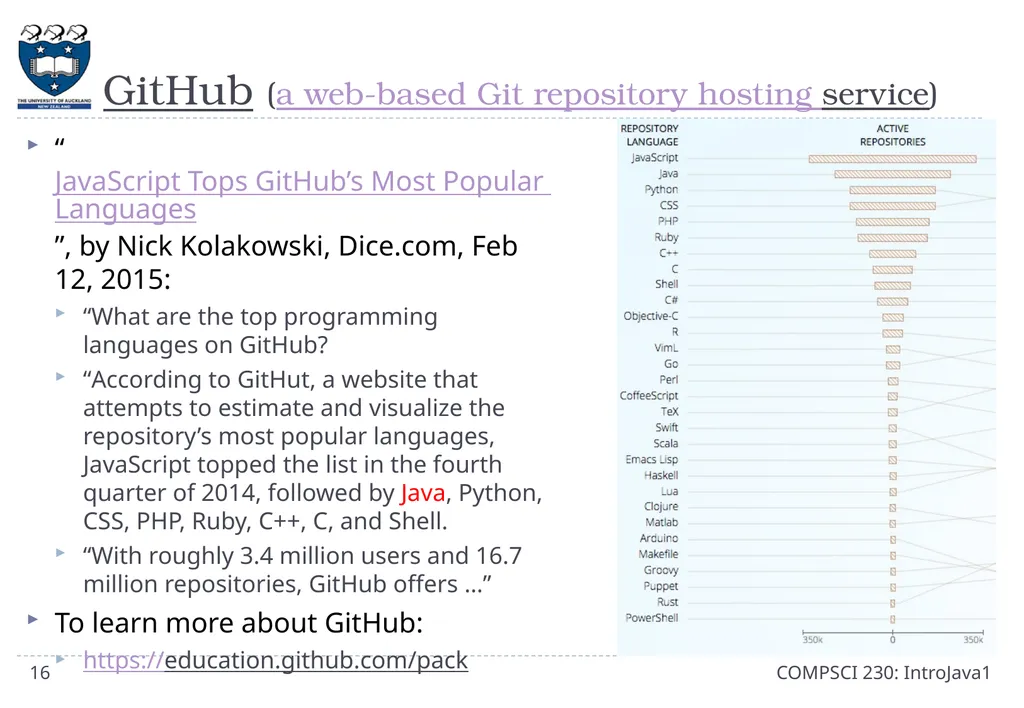
GitHub (a web-based Git repository hosting service) COMPSCI 230: IntroJava1 16 “JavaScript Tops GitHub’s Most Popular Languages”, by Nick Kolakowski, Dice.com, Feb 12, 2015:
“What are the top programming languages on GitHub?
“According to GitHut, a website that attempts to estimate and visualize the repository’s most popular languages, JavaScript topped the list in the fourth quarter of 2014, followed by Java, Python, CSS, PHP, Ruby, C++, C, and Shell.
“With roughly 3.4 million users and 16.7 million repositories, GitHub offers …”
To learn more about GitHub:
https://education.github.com/pack<br>
“What are the top programming languages on GitHub?
“According to GitHut, a website that attempts to estimate and visualize the repository’s most popular languages, JavaScript topped the list in the fourth quarter of 2014, followed by Java, Python, CSS, PHP, Ruby, C++, C, and Shell.
“With roughly 3.4 million users and 16.7 million repositories, GitHub offers …”
To learn more about GitHub:
https://education.github.com/pack<br>
17
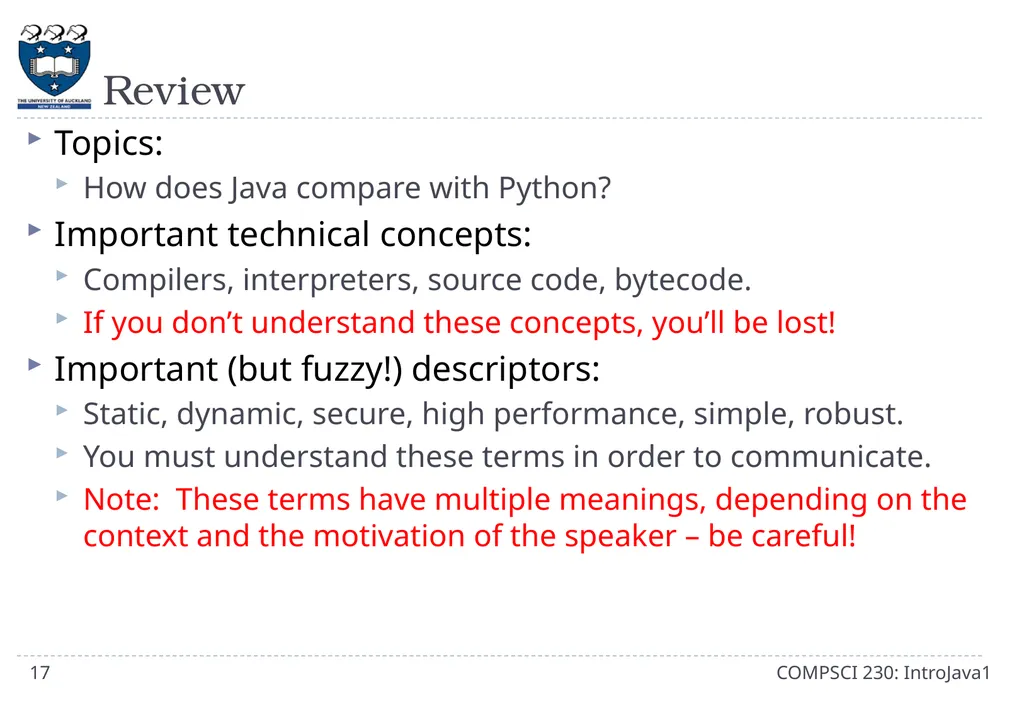
Review COMPSCI 230: IntroJava1 17 Topics:
How does Java compare with Python?
Important technical concepts:
Compilers, interpreters, source code, bytecode.
If you don’t understand these concepts, you’ll be lost!
Important (but fuzzy!) descriptors:
Static, dynamic, secure, high performance, simple, robust.
You must understand these terms in order to communicate.
Note: These terms have multiple meanings, depending on the context and the motivation of the speaker – be careful!<br>
How does Java compare with Python?
Important technical concepts:
Compilers, interpreters, source code, bytecode.
If you don’t understand these concepts, you’ll be lost!
Important (but fuzzy!) descriptors:
Static, dynamic, secure, high performance, simple, robust.
You must understand these terms in order to communicate.
Note: These terms have multiple meanings, depending on the context and the motivation of the speaker – be careful!<br>
18
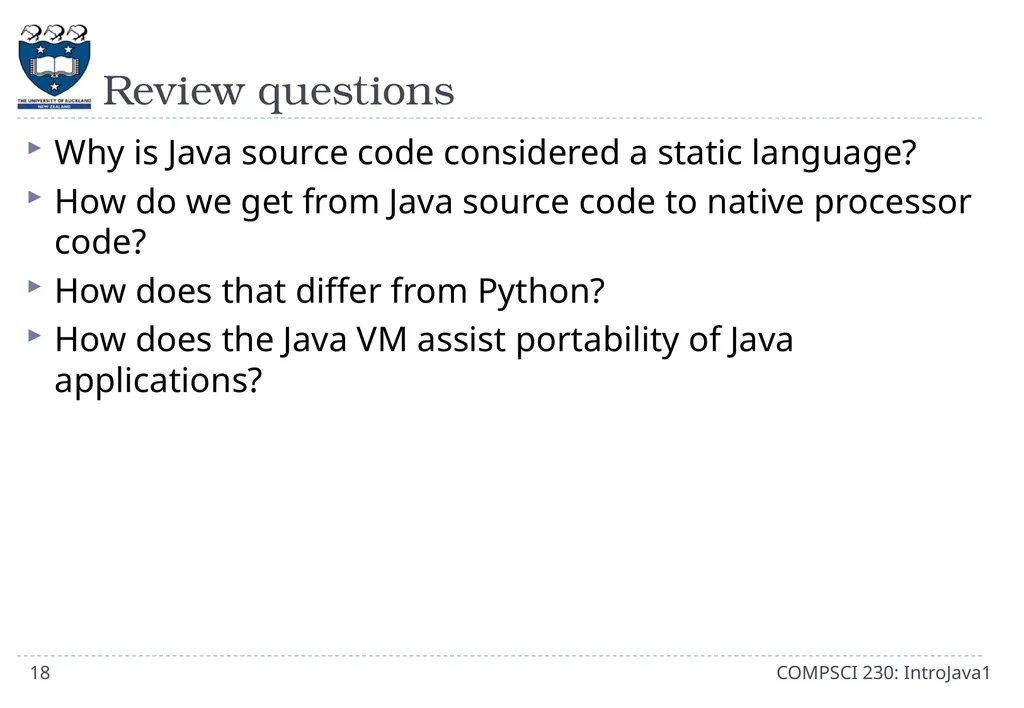
Review questions COMPSCI 230: IntroJava1 18 Why is Java source code considered a static language?
How do we get from Java source code to native processor code?
How does that differ from Python?
How does the Java VM assist portability of Java applications?<br>
How do we get from Java source code to native processor code?
How does that differ from Python?
How does the Java VM assist portability of Java applications?<br>