Computer Science Department Title: Thesis Template by Candidate: Jane Doe Masters Thesis Presentation (591) Computer Science Department Advisor : Jane DaProf, Ph.D. 2nd Reader : John DaRead, Ph.D. ChairPerson : Jane LaProf, Ph.D. Title:
"Computer Science Department Title: Thesis Template" is the property of its rightful owner. Permission is granted to
download and print the materials on this website for personal, non-commercial use only, and to display it
on your personal computer provided you do not modify the materials and that you retain all copyright
notices contained in the materials. By downloading content from our website, you accept the terms of this
agreement.
Presentation Transcript
01
Computer Science
Department Title: Thesis Template
by
Candidate: Jane Doe Master’s Thesis Presentation (591)<br>
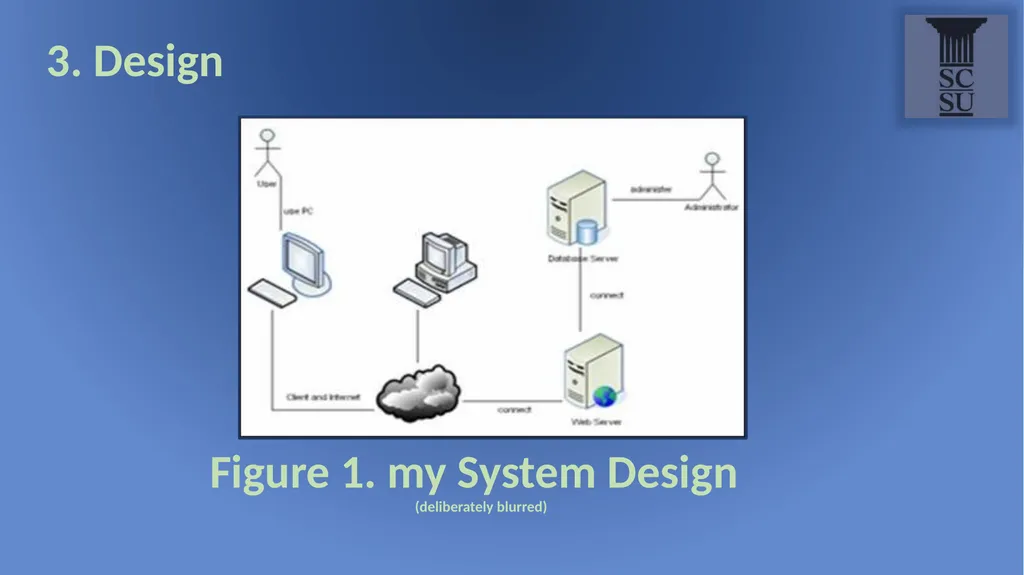
02
Computer Science
Department Advisor : Jane DaProf, Ph.D.
2nd Reader : John DaRead, Ph.D.
ChairPerson : Jane LaProf, Ph.D. Title: Thesis Template<br>
03
Introduction
Literature Review
Design
Methodology
Implementation
Results and Conclusions
Contributions
Future Work
References Contents:<br>
04
The Section titles (on the previous slide) are tentative
This Section could be also called Problem Definition or Problem Specification 1. Introduction<br>
05
In this Section you would gently introduce the issue you are planning to address.
Start with the Background of the Problem
Describe the Problem is some detail 1. Introduction<br>
06
Provide some current solutions.
End this Section with the paragraph stating that your project addresses (solves) this introduced problem in some efficient manner 1. Introduction<br>
07
While writing make sure that the Thesis is ‘readable;’ having a smooth segue from one paragraph to another 1. Introduction<br>
08
You are writing a scientific paper in IEEE format
Each statement must be either:
A common knowledge
A fact presented in another paper (reference to that paper needed [1])
A fact that is proven by your narrative 1. Introduction<br>
09
This Section can be called ‘State of the Art’.
In this section review each paper/document that you think is related to your problem and/or solution.
Present only papers that are relevant and if possible very recent. 2. Literature Review<br>
10
Google Scholar is a good source [2].
Ask your advisor to obtain copies of papers that you need.
Reviewing Web online content is also desirable. (Especially software libraries and tools). 2. Literature Review<br>
11
In this Section you would address the idea/concept of the solution for your research problem
Typically you would develop a system with underlying modules. 3. Design<br>
12
Describe the system specifications
Describe the modules’ functionalities.
Do use graphics to depict the system. 3. Design<br>
13
3. Design Figure 1. my System Design
(deliberately blurred)<br>
14
3. Design Describe each module from the graphics.
Create additional diagrams: UML, Visio….<br>
15
In this section you would discuss the methods on how you would proceed with developing your system as a solution to your problem.
How do you plan to develop the system and its modules? 4. Methodology<br>
16
For each module (from 3. Design) explain how you plan to develop it so it satisfies all the requirement specifications.
Any specific Platform, Hardware, API used. 4. Methodology<br>
17
In this section you would discuss the technical details of your implementation
List your implementation platform details
Discuss pieces of your code. There is no need to discuss all the code: Select only important and interesting code snippets to discuss 5. Implementation<br>
18
Did you encounter any difficulties: list and discuss those. Also describe how did you overcome the technical obstacles.
Describe code runs and types of code tests.
Code manual/usage pages would be useful 5. Implementation<br>
19
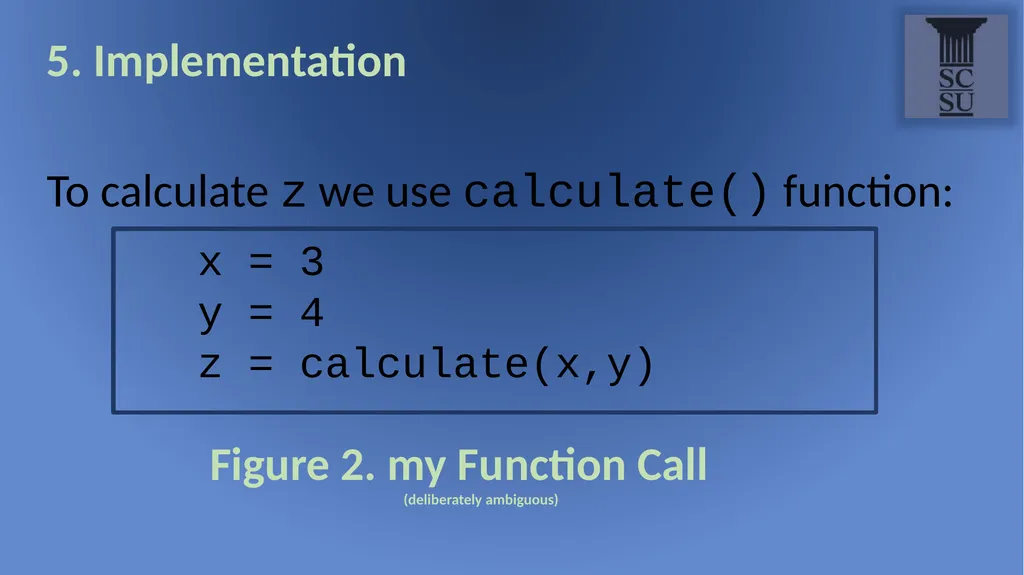
Figure 2. my Function Call
(deliberately ambiguous) 5. Implementation x = 3
y = 4
z = calculate(x,y) To calculate z we use calculate() function:<br>
20
Start with describing your data collection process.
Why this specific data?
How much data?
The quality of raw data (if any) and the quality of collected data. 6. Results and Conclusion<br>
21
6. Results and Conclusion The details of the results collection process. (How did you generate/collect your resulting data?)
Did you automate the testing process, how
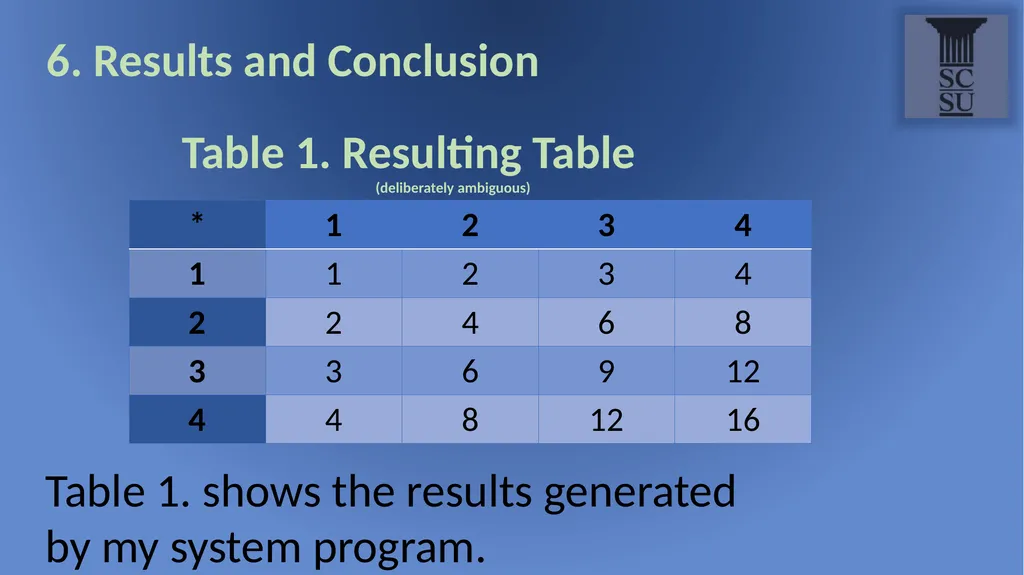
Summarize your results in a tabular format<br>
22
6. Results and Conclusion Table 1. Resulting Table
(deliberately ambiguous) Table 1. shows the results generated by my system program.<br>
23
6. Results and Conclusion Each table needs to be discussed, and the conclusions about the presented results drawn.
If not sure, you can say “we believe that there is a correlation between the results as shown….”<br>
24
6. Results and Conclusion End the Chapter with the final conclusions; the conclusions about all the resulting data and tables.<br>
25
Summarize who (or what) do you think would be the beneficiary of your provided solution.
Summarize how would that entity benefit from provided solution 7. Contributions<br>
26
Here you would provide possible improvements to your solution.
Include topics that you wanted to try but did not have time to try it out 8. Future Work<br>
27
[1] E.D. DaMaster, Systems and Others, in Journal of Knowledge, p120-122, 2018.
[2] Google Scholar, retrieved from https://scholar.google.com on April 1st 2018. 9. References<br>
28
Computer Science
Department Titled ‘Thesis Template’ by Jane Doe This was a Master’s Thesis Presentation Thank You Questions?<br>