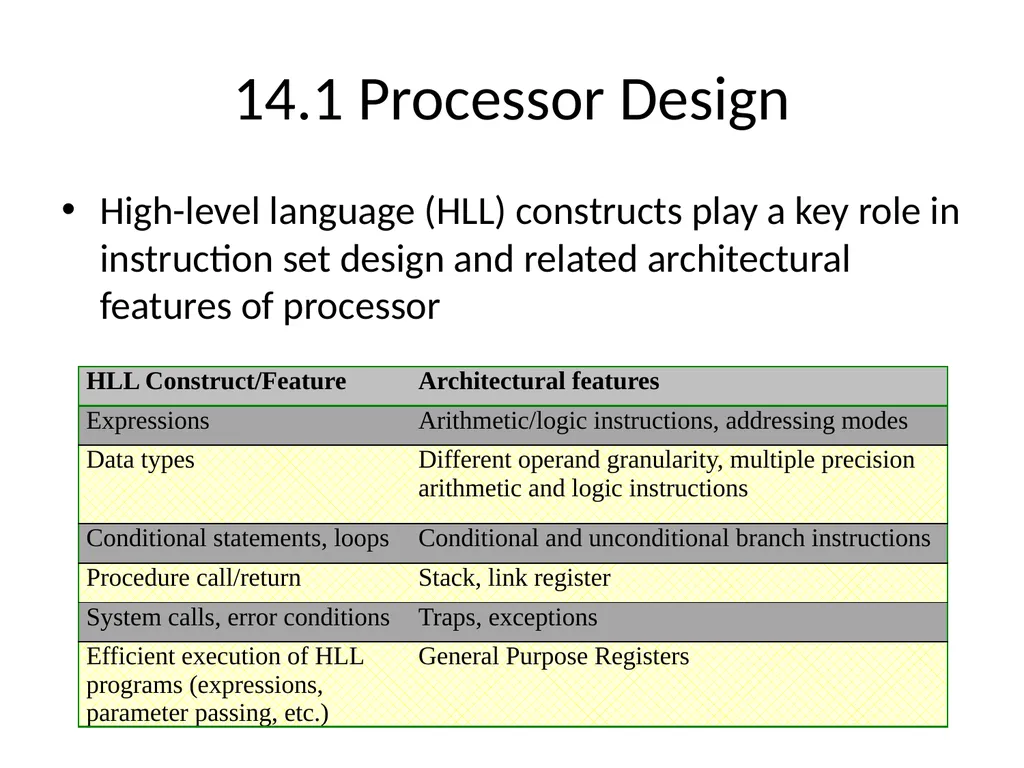
Computer Systems An Integrated Approach to Architecture and Operating Systems Chapter 14 Epilogue: A Look Back at the Journey Copyright 2008 Umakishore Ramachandran and William D. Leahy Jr. 14.1 Processor Design High-level language (HLL)
"Computer Systems An Integrated Approach to" is the property of its rightful owner. Permission is granted to
download and print the materials on this website for personal, non-commercial use only, and to display it
on your personal computer provided you do not modify the materials and that you retain all copyright
notices contained in the materials. By downloading content from our website, you accept the terms of this
agreement.
14.1 Processor Design High-level language (HLL) constructs play a key role in instruction set design and related architectural features of processor<br>
03
14.1 Processor Design For a given instruction set architecture there are still choices to be made for implementation
Pipelining and other design features for speed
Low cost designs where performance is less important than speed<br>
04
14.2 Process The process is a convenient abstraction for remembering all relevant details of a running program
A uniprocessor can run only one program at a time
The OS gives the illusion of each process having its own processor to run on
The architecture provides mechanisms, namely, trap and interrupt, for taking control back from the currently running program to make a scheduling decision using one of several algorithms
Reviewed data structures needed by OS for implementing such algorithms.
Trap mechanism also allows a user level program to avail itself of system provided utilities (such as file systems and print capability) to enhance functionality of the program, via system calls.
The models we provided are more simplistic than those used in real OS's.<br>
05
14.3 Virtual Memory System and Memory Management Memory system is crucial to performance of processor and provides memory allocation, protection and isolation, sharing, and efficient memory utilization using items such as
Fence register
Bounds registers
Base and limit registers
Paging<br>
06
14.3 Virtual Memory System and Memory Management Need kernel mode to allow OS to setup areas in memory for processes to use
Need item such as page replacement policies and working set maintenance for effficency
Operating system must be quick…provide resources and then get out of the way
Sophisticated memory management schemes require little additional hardware<br>
07
14.4 Memory Hierarchy Related to memory systems is memory hierarchy.
Caching systems are designed to take advantage of temporal and spatial locality.
Caching is used everywhere.
Registers
TLB
Multilevel memory caches
Web caches
etc<br>
08
14.5 Parallel Systems Parallelism is fundamental to human thinking and therefore to algorithms and programs
Exploiting parallelism has been a goal since the early days of computing
Currently multicore processors are a major are of interest
Key to a computer scientist is understanding the principles involved. Some examples
Atomic read-modify-write primitive
Cache coherence in a multiprocessor<br>
09
14.6 Input/Output Systems A computer system is useless unless it can interact with the outside world. Key concepts
Programmed I/O
DMA
Interrupts
Memory mapped I/O
Device drivers
Disk
Network<br>
10
14.7 Persistent Storage Key topics include
File systems
Allocation strategies
Naming and aliasing schemes
Attributes
Scheduling<br>
11
14.8 Network Key hardware concepts
NIC
Repeater/Hub
Bridge/Switch
Router
Key software concepts
Protocol stacks
Checksums
Windowing
Sequence numbers
Scatter/gather of packets
End to end acknowledgement<br>
12
14.9 Concluding Remarks Overall, the field of system architecture, the meeting point between hardware and software is an intriguing and fascinating area.
This area is unlikely to dry up for a long time since the application of computing in everyday life is growing by leaps and bounds.
To keep pace with this growth in demand, the system architect has to continuously innovate and produce new computing machines that are faster, cheaper, consume less power, and offer more services.
We hope this textbook serves as a launching pad for future system architects.<br>