
Conducting disciplinary & grievance investigations


Description: Conducting disciplinary grievance investigations Innes Clark and Alan Delaney MFMac Employment Law Team Investigation - general Employer has a duty to ensure as much investigation as is reasonable in the circumstances Extent of enquiries
Related Topics
Download Presentation
"Conducting disciplinary & grievance investigations" is the property of its rightful owner. Permission is granted to download and print the materials on this website for personal, non-commercial use only, and to display it on your personal computer provided you do not modify the materials and that you retain all copyright notices contained in the materials. By downloading content from our website, you accept the terms of this agreement.
Presentation Transcript
slide1. Conducting disciplinary & grievance investigations Innes Clark and Alan Delaney
MFMac Employment Law Team<br>
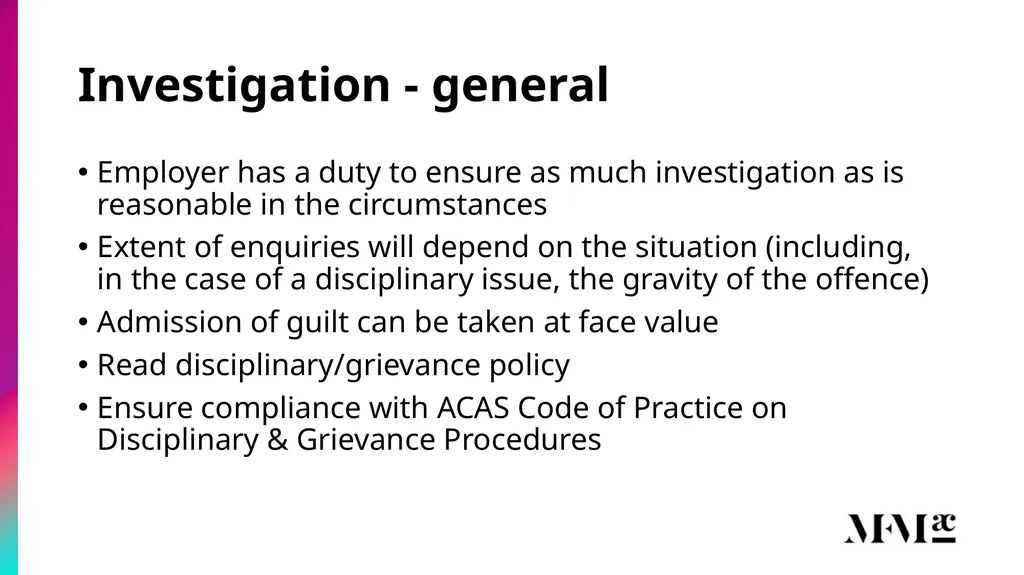
slide2. Investigation - general Employer has a duty to ensure as much investigation as is reasonable in the circumstances
Extent of enquiries will depend on the situation (including, in the case of a disciplinary issue, the gravity of the offence)
Admission of guilt can be taken at face value
Read disciplinary/grievance policy
Ensure compliance with ACAS Code of Practice on Disciplinary & Grievance Procedures<br>
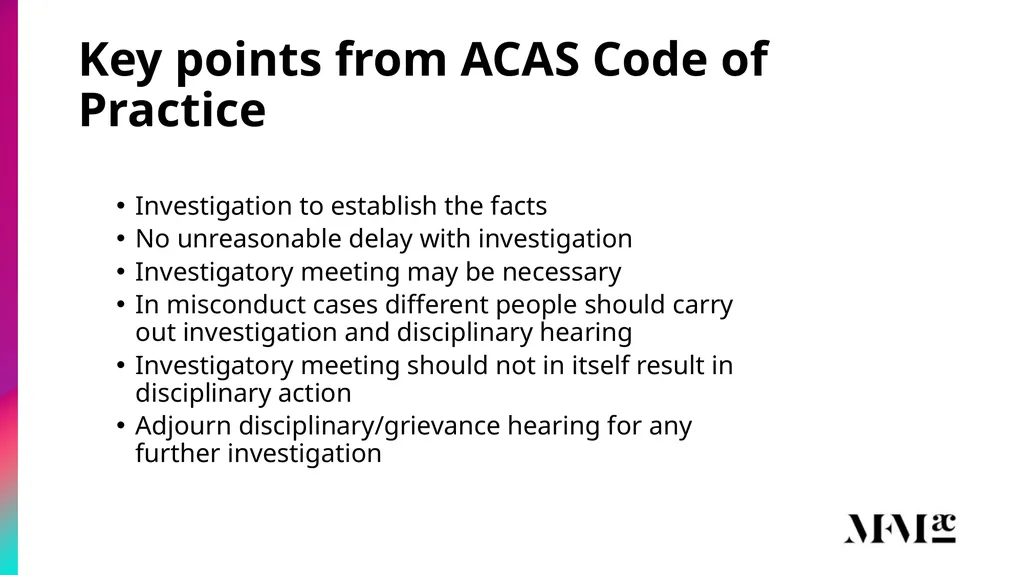
slide3. Key points from ACAS Code of Practice Investigation to establish the facts
No unreasonable delay with investigation
Investigatory meeting may be necessary
In misconduct cases different people should carry out investigation and disciplinary hearing
Investigatory meeting should not in itself result in disciplinary action
Adjourn disciplinary/grievance hearing for any further investigation<br>
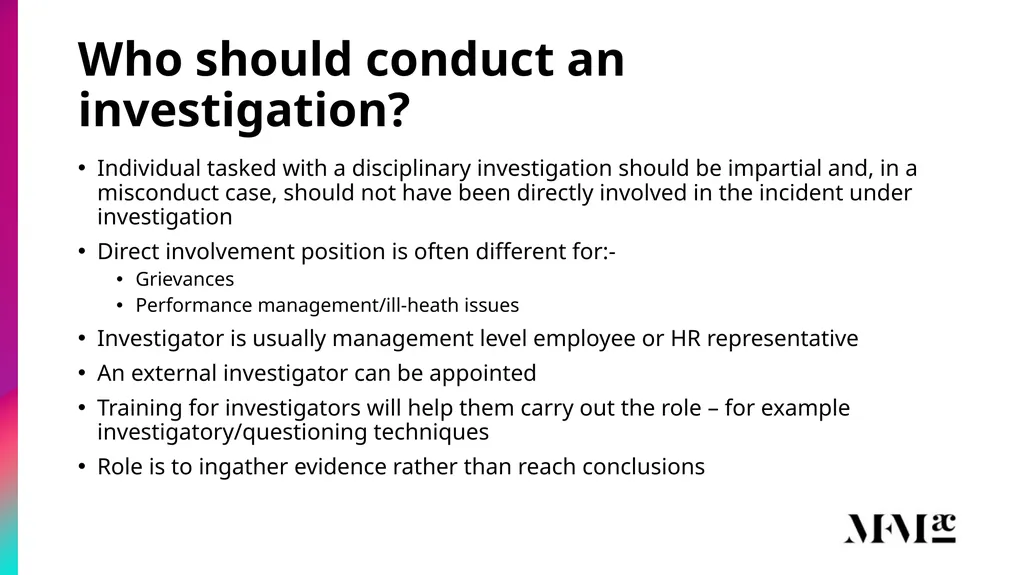
slide4. Who should conduct an investigation? Individual tasked with a disciplinary investigation should be impartial and, in a misconduct case, should not have been directly involved in the incident under investigation
Direct involvement position is often different for:-
Grievances
Performance management/ill-heath issues
Investigator is usually management level employee or HR representative
An external investigator can be appointed
Training for investigators will help them carry out the role – for example investigatory/questioning techniques
Role is to ingather evidence rather than reach conclusions<br>
slide5. At the outset Clear terms of reference of investigation – important that this is agreed with employee in a grievance situation
Draft a plan – terms of reference, key issues, relevant policies, likely evidence to be considered, witnesses to be spoken to, likely timescales
Set aside sufficient time to investigate
Indicate likely timescales to key parties and keep them updated<br>
slide6. Ingathering the evidence Important that investigation is impartial and does not just look for evidence that supports employers position
Ingather relevant documentation
Documents, emails
Texts, Teams messages/What’s App messages
Investigation of mobile telephone/laptop
CCTV or call recordings<br>
slide7. Ingathering the evidence - witnesses Speak to relevant witnesses - internal and external
No statutory right to any particular period of notice in advance of investigatory meeting
Usually done via a meeting or telephone call but could be done by way of witness responding in writing to written questions
Witnesses should be given sight of their own statement, and ideally, sign it confirming its accuracy
Explain to witnesses how their statement will be used and who might see it
Questioning techniques/body language – see ACAS Guide on Conducting Workplace Investigations<br>
slide8. Investigation – right of accompaniment No statutory right to be accompanied to disciplinary investigatory meeting
Employee who raises a grievance has a statutory right to be accompanied at any investigation meeting
Witnesses spoken to as part of disciplinary or grievance process do not have statutory right to be accompanied
But… in all cases check internal policy<br>
slide9. Presentation of findings Usually an investigator should provide their findings in a written report
Report should cover all the relevant facts - may lead to accusations of bias/unfairness if information is excluded
Cover facts not in dispute and in dispute
Any mitigating factors should also be included
An investigator may seek advice from HR but the report must reflect their own conclusions
Investigator should be careful regarding discussions with disciplinary chair/appeal chair<br>
slide10. Presentation of findings An investigation report should include:-
An introduction identifying the people involved and the circumstances leading to the investigation
An explanation of how the investigation has been carried out
A summary of the key evidence and the facts not in dispute and in dispute
Copies of all relevant supporting documents including any evidence and witness statements
Any recommendations should be limited to whether there is a case to answer – i.e. whether it should proceed to a disciplinary hearing
Role of investigator is not to make findings on actual disciplinary allegations/issues of culpability<br>
slide11. Practical tips Consider who will hear each stage of the disciplinary or grievance at the outset
Set aside adequate time to deal with the investigation
Communicate with relevant parties regarding timescales
If you need more time than policy allows then agree this with parties involved
Consider carefully what you will say to witnesses in relation to how their evidence will be used
Approach investigation in logical manner, keeping contemporaneous notes of discussions
Prepare in advance – e.g. questions to be asked of witnesses<br>
slide12. Practical tips Speak to witnesses as soon as possible – memories fade
Remain neutral and objective throughout investigation
Keep in mind the health and well-being of all staff involved
Always consider whether informal or alternative dispute resolution process could be used
Follow any internal policies/guidelines
Follow the ACAS Code of Practice on Disciplinary and Grievance Procedures
Where an investigation report contains data about individuals it should be securely stored and access restricted only to those who need to see it
Documentation should be securely disposed of once it becomes irrelevant or out of date<br>
slide13. When is disciplinary suspension necessary? Must be proper basis for suspension – knee jerk reaction risks constructive dismissal
Suspension may be required to protect the investigation, the business, other staff or the person under investigation
Always consider possible alternatives
Should be paid and kept as short as possible
Consider employee wellbeing
As long as suspension is a reasonable and proper response to allegations it will not be a breach of contract<br>
slide14. Employee refusal to progress an allegation or grievance What if an employee makes an allegation but does not want to take it any further?
Try to find out the reason for the refusal
Ensure the employee fully understands the process and offer support
Consider alternative solutions such as mediation (if the employee will engage)
Consider if the matter can be progressed without the employee who raised it being involved, weighing up issues such as fairness and maintenance of a safe working environment
Does matter need to be progressed anyway, irrespective of views of employee?<br>
slide15. Dealing with anonymous witnesses Anonymity of witnesses - only in exceptional circumstances
The employee being investigated is likely to be disadvantaged if anonymous evidence is used
Investigator should explore why the witness is reluctant to give evidence, and this may include making tactful enquiries as to the character and background of the witness seeking anonymity to assess credibility<br>
slide16. Dealing with anonymous witnesses Where it is decided circumstances do warrant anonymity, employer should consider how that impacts on the fairness of the procedure
Any statement should be taken without regard for the need for anonymity and then consider what needs to be omitted/redacted
Witness should be made aware that if the matter proceeds to an employment tribunal hearing their identity may have to be revealed<br>
slide17. Who can see the information? Usually both the fact an investigation is taking place and the content of it should be kept confidential
Disciplinary hearing - the employee being investigated should see the evidence compiled during the investigation, as should the individual accompanying them
Grievance hearing – the employee who has raised the grievance would usually have sight of any written evidence but potentially more flexibility
The individuals hearing the disciplinary and appeal (if required) should also have sight of all of the evidence<br>
slide18. Who can see the information? People spoken to as part of the process would be entitled to have sight of their own statements
People spoken to as part of process could make Subject Access Request to retrieve additional information (eg references to them in other statements)
In some sectors, regulatory authorities may need to be notified/provided with relevant information<br>
slide19. Protected conversations Statutory construct enabling employer and employees to have a confidential discussion, potentially about dismissal
Employee cannot be dismissed as part of the discussion
Employer must act properly, and cannot threaten or apply excessive pressure to the employee to accept terms
Both employer and employee can request a protected conversation
Next webinar on 9 May looks at protected conversations and settlement agreements in more detail<br>
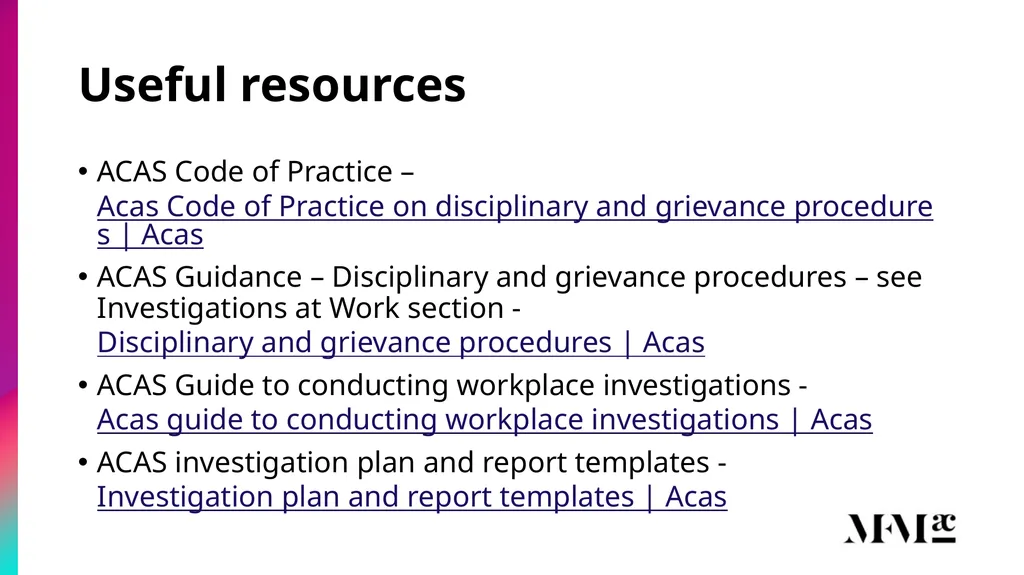
slide20. Useful resources ACAS Code of Practice – Acas Code of Practice on disciplinary and grievance procedures | Acas
ACAS Guidance – Disciplinary and grievance procedures – see Investigations at Work section - Disciplinary and grievance procedures | Acas
ACAS Guide to conducting workplace investigations - Acas guide to conducting workplace investigations | Acas
ACAS investigation plan and report templates - Investigation plan and report templates | Acas<br>
slide21. Questions<br>
MFMac Employment Law Team<br>
slide2. Investigation - general Employer has a duty to ensure as much investigation as is reasonable in the circumstances
Extent of enquiries will depend on the situation (including, in the case of a disciplinary issue, the gravity of the offence)
Admission of guilt can be taken at face value
Read disciplinary/grievance policy
Ensure compliance with ACAS Code of Practice on Disciplinary & Grievance Procedures<br>
slide3. Key points from ACAS Code of Practice Investigation to establish the facts
No unreasonable delay with investigation
Investigatory meeting may be necessary
In misconduct cases different people should carry out investigation and disciplinary hearing
Investigatory meeting should not in itself result in disciplinary action
Adjourn disciplinary/grievance hearing for any further investigation<br>
slide4. Who should conduct an investigation? Individual tasked with a disciplinary investigation should be impartial and, in a misconduct case, should not have been directly involved in the incident under investigation
Direct involvement position is often different for:-
Grievances
Performance management/ill-heath issues
Investigator is usually management level employee or HR representative
An external investigator can be appointed
Training for investigators will help them carry out the role – for example investigatory/questioning techniques
Role is to ingather evidence rather than reach conclusions<br>
slide5. At the outset Clear terms of reference of investigation – important that this is agreed with employee in a grievance situation
Draft a plan – terms of reference, key issues, relevant policies, likely evidence to be considered, witnesses to be spoken to, likely timescales
Set aside sufficient time to investigate
Indicate likely timescales to key parties and keep them updated<br>
slide6. Ingathering the evidence Important that investigation is impartial and does not just look for evidence that supports employers position
Ingather relevant documentation
Documents, emails
Texts, Teams messages/What’s App messages
Investigation of mobile telephone/laptop
CCTV or call recordings<br>
slide7. Ingathering the evidence - witnesses Speak to relevant witnesses - internal and external
No statutory right to any particular period of notice in advance of investigatory meeting
Usually done via a meeting or telephone call but could be done by way of witness responding in writing to written questions
Witnesses should be given sight of their own statement, and ideally, sign it confirming its accuracy
Explain to witnesses how their statement will be used and who might see it
Questioning techniques/body language – see ACAS Guide on Conducting Workplace Investigations<br>
slide8. Investigation – right of accompaniment No statutory right to be accompanied to disciplinary investigatory meeting
Employee who raises a grievance has a statutory right to be accompanied at any investigation meeting
Witnesses spoken to as part of disciplinary or grievance process do not have statutory right to be accompanied
But… in all cases check internal policy<br>
slide9. Presentation of findings Usually an investigator should provide their findings in a written report
Report should cover all the relevant facts - may lead to accusations of bias/unfairness if information is excluded
Cover facts not in dispute and in dispute
Any mitigating factors should also be included
An investigator may seek advice from HR but the report must reflect their own conclusions
Investigator should be careful regarding discussions with disciplinary chair/appeal chair<br>
slide10. Presentation of findings An investigation report should include:-
An introduction identifying the people involved and the circumstances leading to the investigation
An explanation of how the investigation has been carried out
A summary of the key evidence and the facts not in dispute and in dispute
Copies of all relevant supporting documents including any evidence and witness statements
Any recommendations should be limited to whether there is a case to answer – i.e. whether it should proceed to a disciplinary hearing
Role of investigator is not to make findings on actual disciplinary allegations/issues of culpability<br>
slide11. Practical tips Consider who will hear each stage of the disciplinary or grievance at the outset
Set aside adequate time to deal with the investigation
Communicate with relevant parties regarding timescales
If you need more time than policy allows then agree this with parties involved
Consider carefully what you will say to witnesses in relation to how their evidence will be used
Approach investigation in logical manner, keeping contemporaneous notes of discussions
Prepare in advance – e.g. questions to be asked of witnesses<br>
slide12. Practical tips Speak to witnesses as soon as possible – memories fade
Remain neutral and objective throughout investigation
Keep in mind the health and well-being of all staff involved
Always consider whether informal or alternative dispute resolution process could be used
Follow any internal policies/guidelines
Follow the ACAS Code of Practice on Disciplinary and Grievance Procedures
Where an investigation report contains data about individuals it should be securely stored and access restricted only to those who need to see it
Documentation should be securely disposed of once it becomes irrelevant or out of date<br>
slide13. When is disciplinary suspension necessary? Must be proper basis for suspension – knee jerk reaction risks constructive dismissal
Suspension may be required to protect the investigation, the business, other staff or the person under investigation
Always consider possible alternatives
Should be paid and kept as short as possible
Consider employee wellbeing
As long as suspension is a reasonable and proper response to allegations it will not be a breach of contract<br>
slide14. Employee refusal to progress an allegation or grievance What if an employee makes an allegation but does not want to take it any further?
Try to find out the reason for the refusal
Ensure the employee fully understands the process and offer support
Consider alternative solutions such as mediation (if the employee will engage)
Consider if the matter can be progressed without the employee who raised it being involved, weighing up issues such as fairness and maintenance of a safe working environment
Does matter need to be progressed anyway, irrespective of views of employee?<br>
slide15. Dealing with anonymous witnesses Anonymity of witnesses - only in exceptional circumstances
The employee being investigated is likely to be disadvantaged if anonymous evidence is used
Investigator should explore why the witness is reluctant to give evidence, and this may include making tactful enquiries as to the character and background of the witness seeking anonymity to assess credibility<br>
slide16. Dealing with anonymous witnesses Where it is decided circumstances do warrant anonymity, employer should consider how that impacts on the fairness of the procedure
Any statement should be taken without regard for the need for anonymity and then consider what needs to be omitted/redacted
Witness should be made aware that if the matter proceeds to an employment tribunal hearing their identity may have to be revealed<br>
slide17. Who can see the information? Usually both the fact an investigation is taking place and the content of it should be kept confidential
Disciplinary hearing - the employee being investigated should see the evidence compiled during the investigation, as should the individual accompanying them
Grievance hearing – the employee who has raised the grievance would usually have sight of any written evidence but potentially more flexibility
The individuals hearing the disciplinary and appeal (if required) should also have sight of all of the evidence<br>
slide18. Who can see the information? People spoken to as part of the process would be entitled to have sight of their own statements
People spoken to as part of process could make Subject Access Request to retrieve additional information (eg references to them in other statements)
In some sectors, regulatory authorities may need to be notified/provided with relevant information<br>
slide19. Protected conversations Statutory construct enabling employer and employees to have a confidential discussion, potentially about dismissal
Employee cannot be dismissed as part of the discussion
Employer must act properly, and cannot threaten or apply excessive pressure to the employee to accept terms
Both employer and employee can request a protected conversation
Next webinar on 9 May looks at protected conversations and settlement agreements in more detail<br>
slide20. Useful resources ACAS Code of Practice – Acas Code of Practice on disciplinary and grievance procedures | Acas
ACAS Guidance – Disciplinary and grievance procedures – see Investigations at Work section - Disciplinary and grievance procedures | Acas
ACAS Guide to conducting workplace investigations - Acas guide to conducting workplace investigations | Acas
ACAS investigation plan and report templates - Investigation plan and report templates | Acas<br>
slide21. Questions<br>