
Confidentiality and Consent Issues Involving



Description: Confidentiality and Consent Issues Involving Minors in Rhode Island Therese Eckford, Esq. Associate General Counsel May 30, 2019 Legal Landscape The law struggles to balance traditional view that minors cant understand treatment options
Related Topics
Download Presentation
"Confidentiality and Consent Issues Involving" is the property of its rightful owner. Permission is granted to download and print the materials on this website for personal, non-commercial use only, and to display it on your personal computer provided you do not modify the materials and that you retain all copyright notices contained in the materials. By downloading content from our website, you accept the terms of this agreement.
Presentation Transcript
slide1. Confidentiality and Consent Issues Involving Minors in Rhode Island
Therese Eckford, Esq.
Associate General Counsel
May 30, 2019<br>
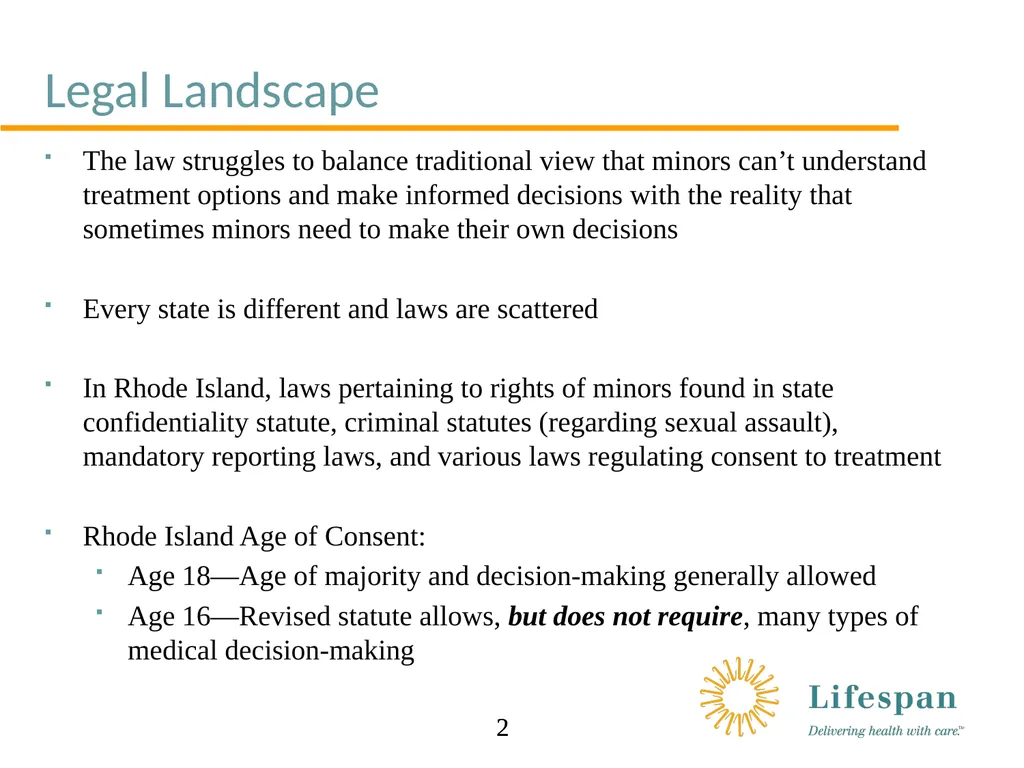
slide2. Legal Landscape The law struggles to balance traditional view that minors can’t understand treatment options and make informed decisions with the reality that sometimes minors need to make their own decisions
Every state is different and laws are scattered
In Rhode Island, laws pertaining to rights of minors found in state confidentiality statute, criminal statutes (regarding sexual assault), mandatory reporting laws, and various laws regulating consent to treatment
Rhode Island Age of Consent:
Age 18—Age of majority and decision-making generally allowed
Age 16—Revised statute allows, but does not require, many types of medical decision-making<br>
slide3. Consent to Medical and Surgical Care<br>
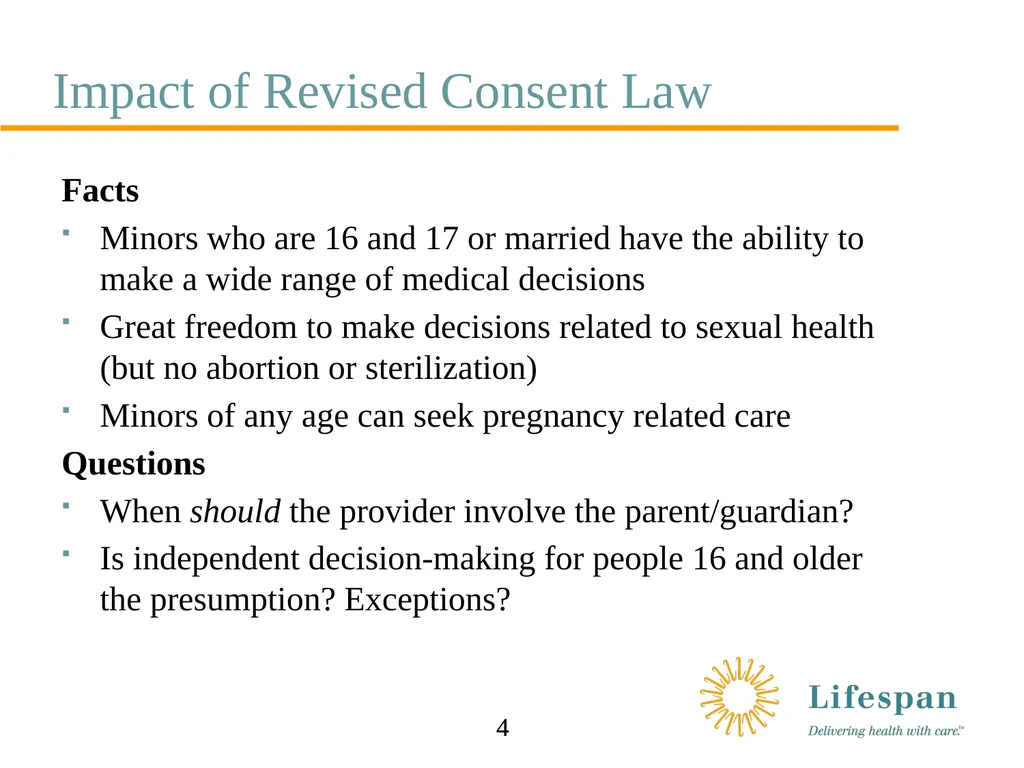
slide4. Impact of Revised Consent Law Facts
Minors who are 16 and 17 or married have the ability to make a wide range of medical decisions
Great freedom to make decisions related to sexual health (but no abortion or sterilization)
Minors of any age can seek pregnancy related care
Questions
When should the provider involve the parent/guardian?
Is independent decision-making for people 16 and older the presumption? Exceptions?<br>
slide5. Dilemmas Posed by New Law Do providers have discretion to involve parent/guardian? A fact sensitive analysis involving clinical judgement is required.
When is the minor guaranteed confidentiality?
What is in the minor’s best interest?
Does the minor want to make an independent decision? How adamant?
How mature is the minor?
OK repeatedly to ask minor to involve parent/guardian?
How do you preserve the healthiest treatment relationship?
Does the condition require the ongoing support of an adult?
Risk analysis: danger to self or others?
What if one party provides consent and the other disagrees?<br>
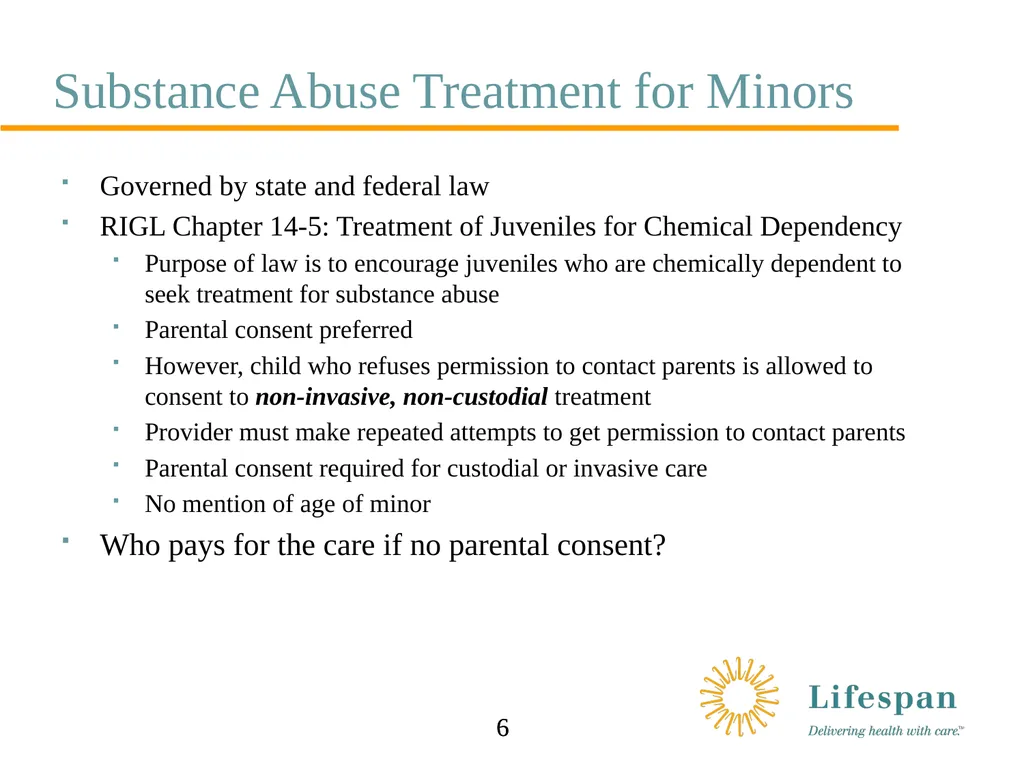
slide6. Substance Abuse Treatment for Minors Governed by state and federal law
RIGL Chapter 14-5: Treatment of Juveniles for Chemical Dependency
Purpose of law is to encourage juveniles who are chemically dependent to seek treatment for substance abuse
Parental consent preferred
However, child who refuses permission to contact parents is allowed to consent to non-invasive, non-custodial treatment
Provider must make repeated attempts to get permission to contact parents
Parental consent required for custodial or invasive care
No mention of age of minor
Who pays for the care if no parental consent?<br>
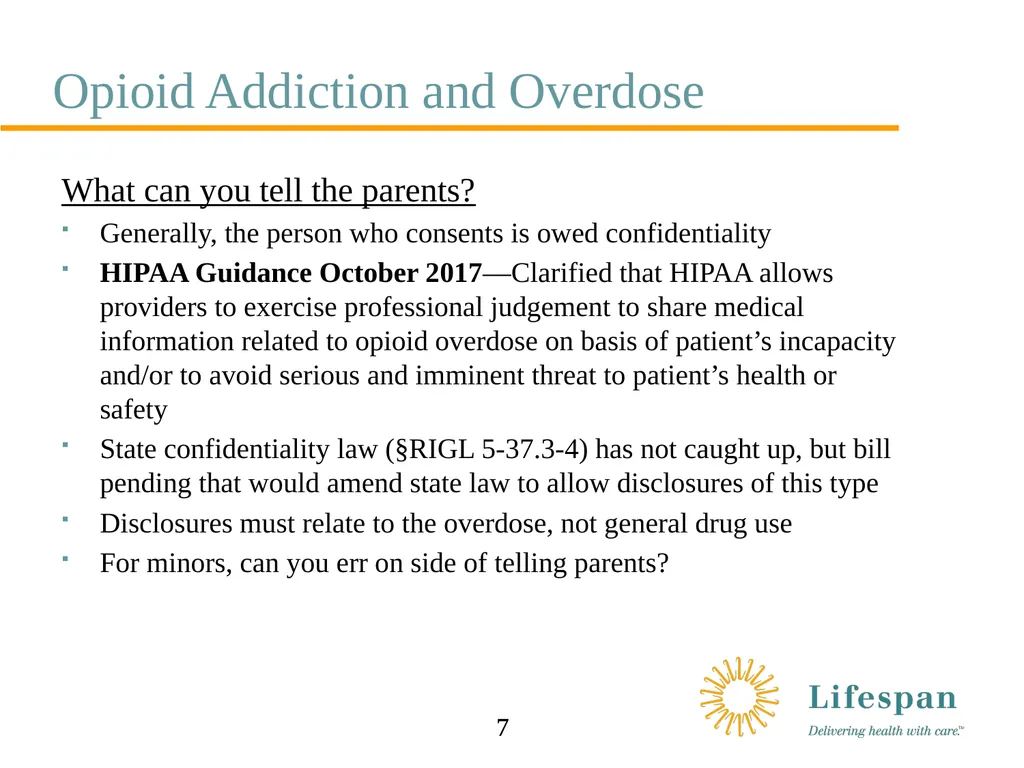
slide7. Opioid Addiction and Overdose What can you tell the parents?
Generally, the person who consents is owed confidentiality
HIPAA Guidance October 2017—Clarified that HIPAA allows providers to exercise professional judgement to share medical information related to opioid overdose on basis of patient’s incapacity and/or to avoid serious and imminent threat to patient’s health or safety
State confidentiality law (§RIGL 5-37.3-4) has not caught up, but bill pending that would amend state law to allow disclosures of this type
Disclosures must relate to the overdose, not general drug use
For minors, can you err on side of telling parents?<br>
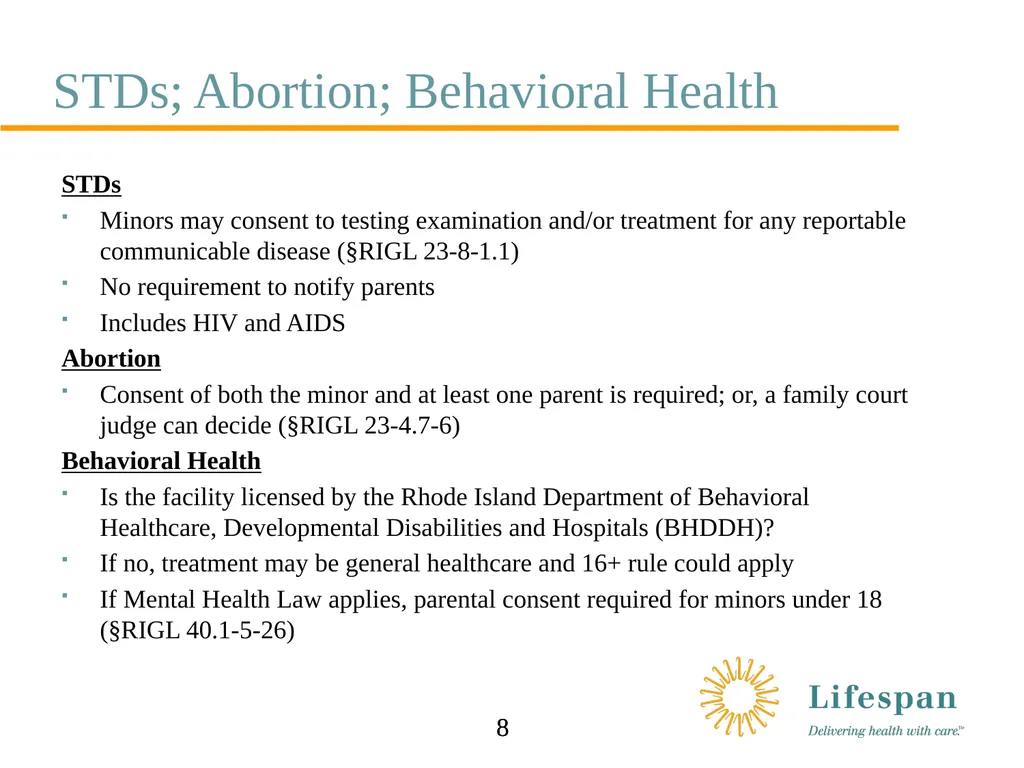
slide8. STDs; Abortion; Behavioral Health STDs
Minors may consent to testing examination and/or treatment for any reportable communicable disease (§RIGL 23-8-1.1)
No requirement to notify parents
Includes HIV and AIDS
Abortion
Consent of both the minor and at least one parent is required; or, a family court judge can decide (§RIGL 23-4.7-6)
Behavioral Health
Is the facility licensed by the Rhode Island Department of Behavioral Healthcare, Developmental Disabilities and Hospitals (BHDDH)?
If no, treatment may be general healthcare and 16+ rule could apply
If Mental Health Law applies, parental consent required for minors under 18 (§RIGL 40.1-5-26)<br>
Therese Eckford, Esq.
Associate General Counsel
May 30, 2019<br>
slide2. Legal Landscape The law struggles to balance traditional view that minors can’t understand treatment options and make informed decisions with the reality that sometimes minors need to make their own decisions
Every state is different and laws are scattered
In Rhode Island, laws pertaining to rights of minors found in state confidentiality statute, criminal statutes (regarding sexual assault), mandatory reporting laws, and various laws regulating consent to treatment
Rhode Island Age of Consent:
Age 18—Age of majority and decision-making generally allowed
Age 16—Revised statute allows, but does not require, many types of medical decision-making<br>
slide3. Consent to Medical and Surgical Care<br>
slide4. Impact of Revised Consent Law Facts
Minors who are 16 and 17 or married have the ability to make a wide range of medical decisions
Great freedom to make decisions related to sexual health (but no abortion or sterilization)
Minors of any age can seek pregnancy related care
Questions
When should the provider involve the parent/guardian?
Is independent decision-making for people 16 and older the presumption? Exceptions?<br>
slide5. Dilemmas Posed by New Law Do providers have discretion to involve parent/guardian? A fact sensitive analysis involving clinical judgement is required.
When is the minor guaranteed confidentiality?
What is in the minor’s best interest?
Does the minor want to make an independent decision? How adamant?
How mature is the minor?
OK repeatedly to ask minor to involve parent/guardian?
How do you preserve the healthiest treatment relationship?
Does the condition require the ongoing support of an adult?
Risk analysis: danger to self or others?
What if one party provides consent and the other disagrees?<br>
slide6. Substance Abuse Treatment for Minors Governed by state and federal law
RIGL Chapter 14-5: Treatment of Juveniles for Chemical Dependency
Purpose of law is to encourage juveniles who are chemically dependent to seek treatment for substance abuse
Parental consent preferred
However, child who refuses permission to contact parents is allowed to consent to non-invasive, non-custodial treatment
Provider must make repeated attempts to get permission to contact parents
Parental consent required for custodial or invasive care
No mention of age of minor
Who pays for the care if no parental consent?<br>
slide7. Opioid Addiction and Overdose What can you tell the parents?
Generally, the person who consents is owed confidentiality
HIPAA Guidance October 2017—Clarified that HIPAA allows providers to exercise professional judgement to share medical information related to opioid overdose on basis of patient’s incapacity and/or to avoid serious and imminent threat to patient’s health or safety
State confidentiality law (§RIGL 5-37.3-4) has not caught up, but bill pending that would amend state law to allow disclosures of this type
Disclosures must relate to the overdose, not general drug use
For minors, can you err on side of telling parents?<br>
slide8. STDs; Abortion; Behavioral Health STDs
Minors may consent to testing examination and/or treatment for any reportable communicable disease (§RIGL 23-8-1.1)
No requirement to notify parents
Includes HIV and AIDS
Abortion
Consent of both the minor and at least one parent is required; or, a family court judge can decide (§RIGL 23-4.7-6)
Behavioral Health
Is the facility licensed by the Rhode Island Department of Behavioral Healthcare, Developmental Disabilities and Hospitals (BHDDH)?
If no, treatment may be general healthcare and 16+ rule could apply
If Mental Health Law applies, parental consent required for minors under 18 (§RIGL 40.1-5-26)<br>