
Connectives That Express Cause and Effect,
MY
Published · 45 slides · 0 views
1 / 1


Description
Connectives That Express Cause and Effect, Contrast, and Condition Using Because Of and Due To (a) Because the weather was cold, we stayed home. Because introduces an adverb clause; it is followed by a subject and a verb, as in (a). (b)
Related Topics
Share
Embed code
Download this presentation From Below
"Connectives That Express Cause and Effect," is the property of its rightful owner. Permission is granted to download and print the materials on this website for personal, non-commercial use only, and to display it on your personal computer provided you do not modify the materials and that you retain all copyright notices contained in the materials. By downloading content from our website, you accept the terms of this agreement.
Presentation Transcript
01
Connectives That Express Cause and Effect, Contrast, and Condition<br>
02
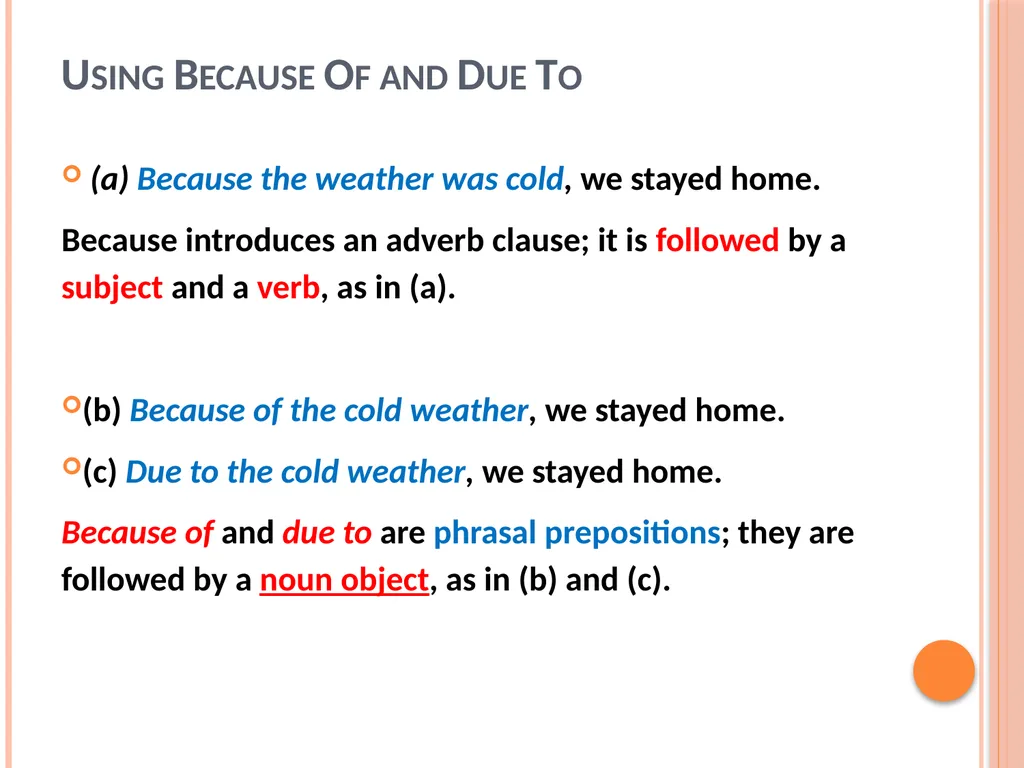
Using Because Of and Due To (a) Because the weather was cold, we stayed home.
Because introduces an adverb clause; it is followed by a subject and a verb, as in (a).
(b) Because of the cold weather, we stayed home.
(c) Due to the cold weather, we stayed home.
Because of and due to are phrasal prepositions; they are followed by a noun object, as in (b) and (c).<br>
Because introduces an adverb clause; it is followed by a subject and a verb, as in (a).
(b) Because of the cold weather, we stayed home.
(c) Due to the cold weather, we stayed home.
Because of and due to are phrasal prepositions; they are followed by a noun object, as in (b) and (c).<br>
03
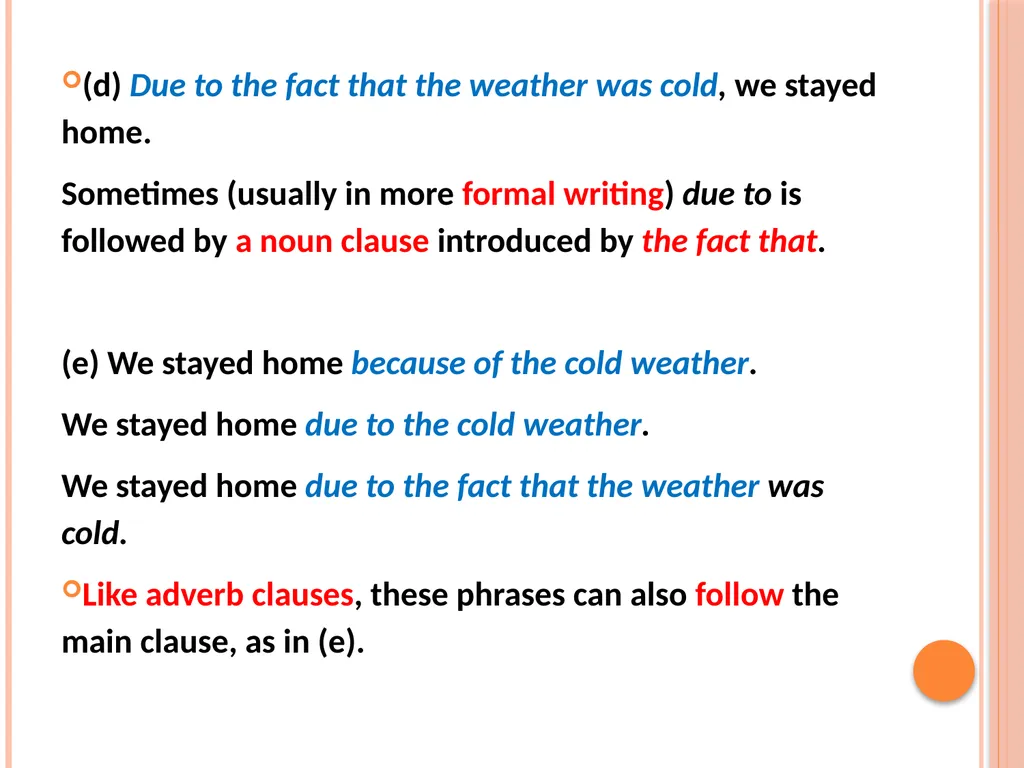
(d) Due to the fact that the weather was cold, we stayed home.
Sometimes (usually in more formal writing) due to is followed by a noun clause introduced by the fact that.
(e) We stayed home because of the cold weather.
We stayed home due to the cold weather.
We stayed home due to the fact that the weather was cold.
Like adverb clauses, these phrases can also follow the main clause, as in (e).<br>
04
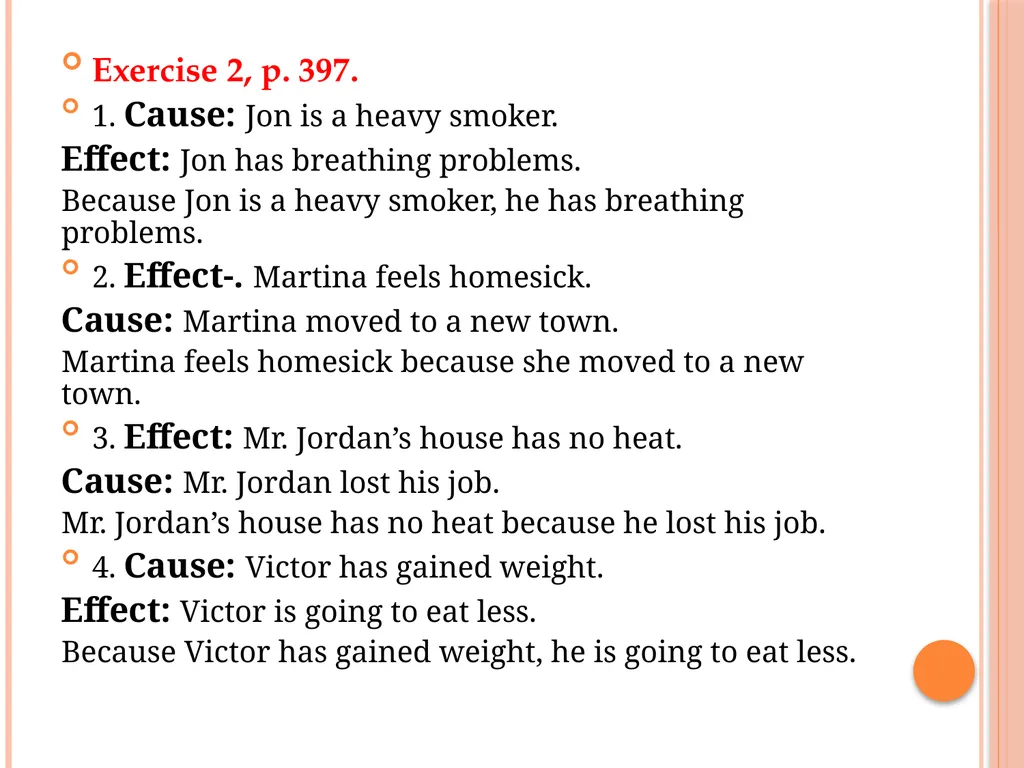
Exercise 2, p. 397.
1. Cause: Jon is a heavy smoker.
Effect: Jon has breathing problems.
Because Jon is a heavy smoker, he has breathing problems.
2. Effect-. Martina feels homesick.
Cause: Martina moved to a new town.
Martina feels homesick because she moved to a new town.
3. Effect: Mr. Jordan’s house has no heat.
Cause: Mr. Jordan lost his job.
Mr. Jordan’s house has no heat because he lost his job.
4. Cause: Victor has gained weight.
Effect: Victor is going to eat less.
Because Victor has gained weight, he is going to eat less.<br>
05
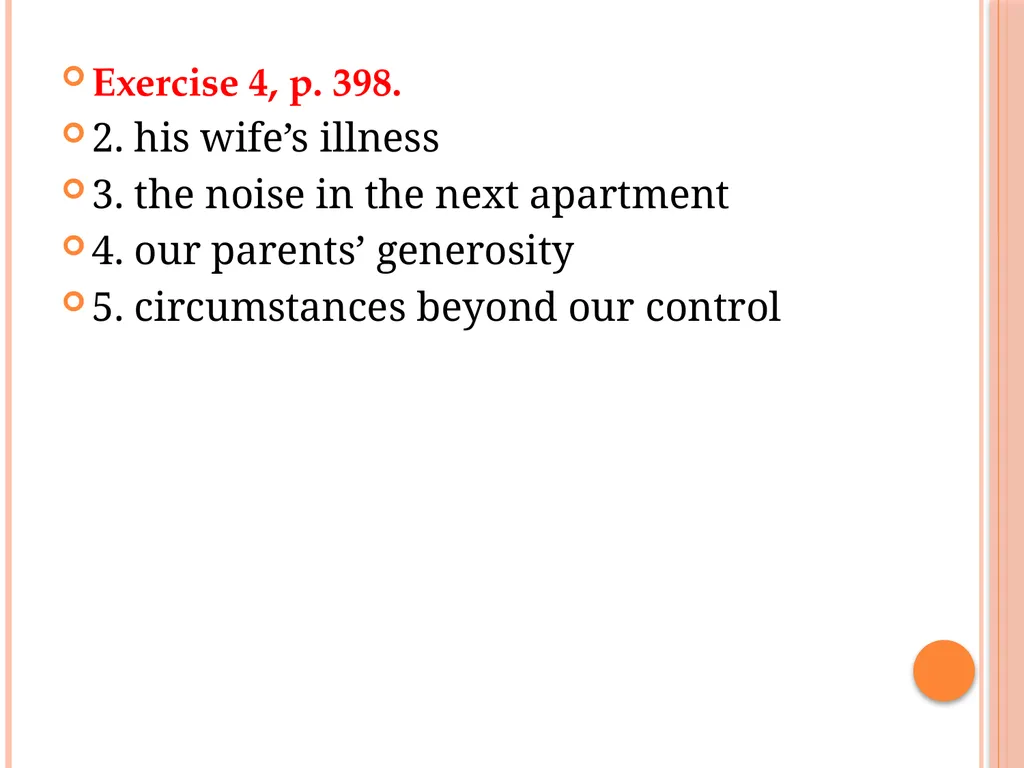
Exercise 4, p. 398.
2. his wife’s illness
3. the noise in the next apartment
4. our parents’ generosity
5. circumstances beyond our control<br>
2. his wife’s illness
3. the noise in the next apartment
4. our parents’ generosity
5. circumstances beyond our control<br>
06
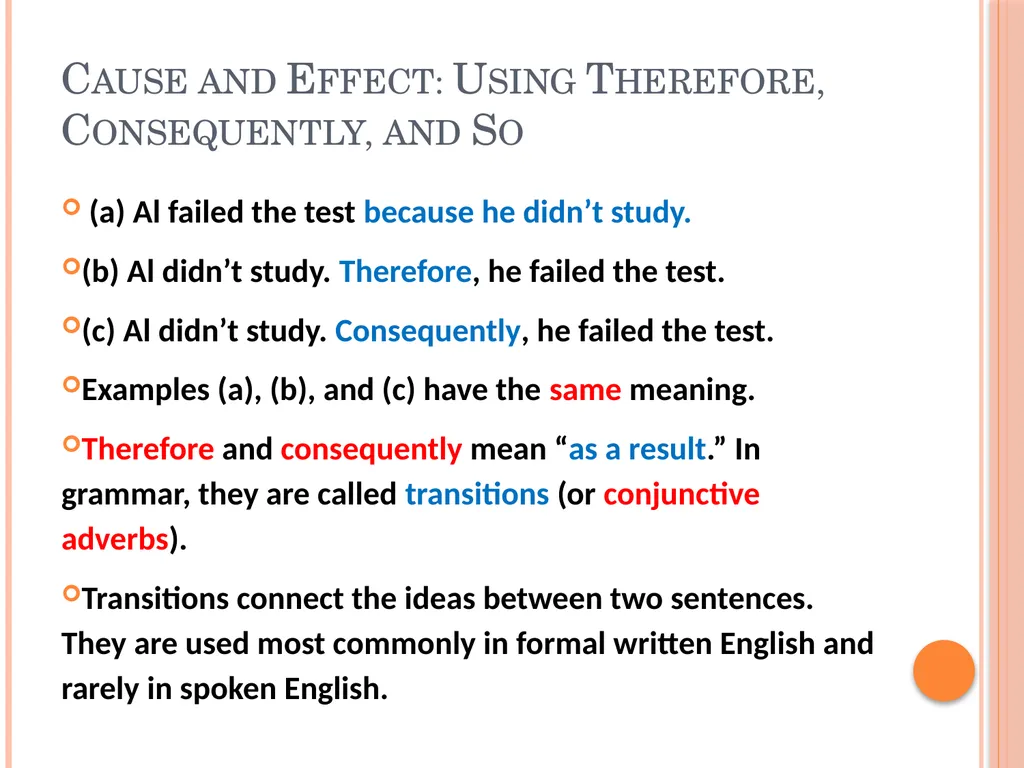
Cause and Effect: Using Therefore, Consequently, and So (a) Al failed the test because he didn’t study.
(b) Al didn’t study. Therefore, he failed the test.
(c) Al didn’t study. Consequently, he failed the test.
Examples (a), (b), and (c) have the same meaning.
Therefore and consequently mean “as a result.” In grammar, they are called transitions (or conjunctive adverbs).
Transitions connect the ideas between two sentences. They are used most commonly in formal written English and rarely in spoken English.<br>
07
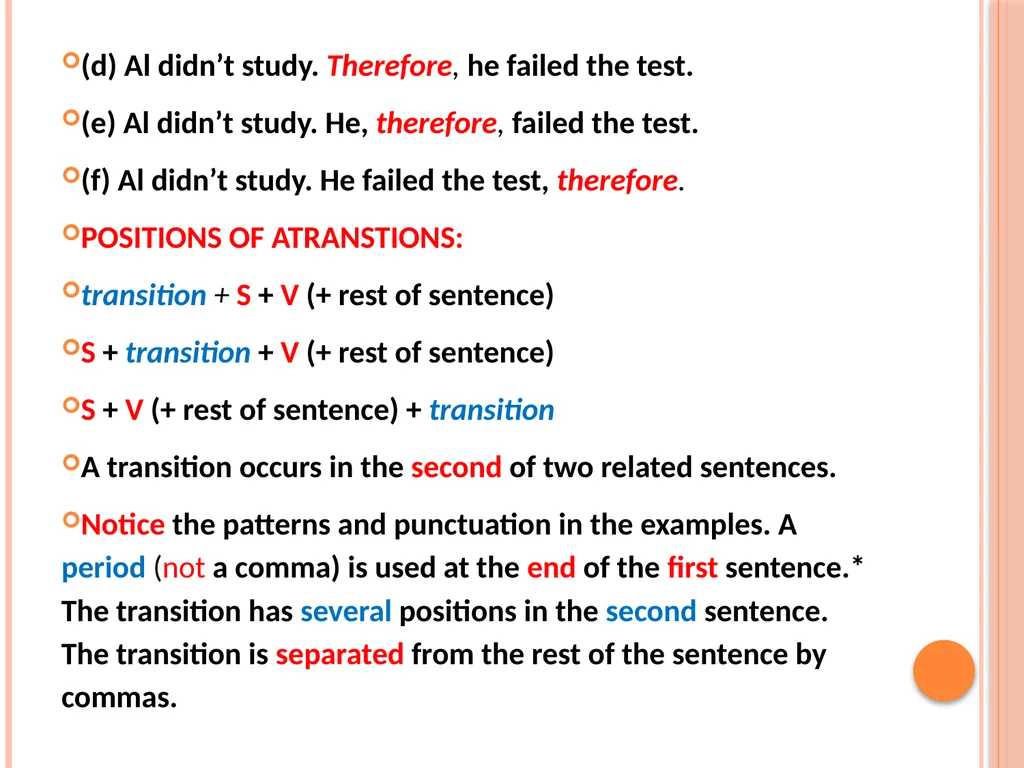
(d) Al didn’t study. Therefore, he failed the test.
(e) Al didn’t study. He, therefore, failed the test.
(f) Al didn’t study. He failed the test, therefore.
POSITIONS OF ATRANSTIONS:
transition + S + V (+ rest of sentence)
S + transition + V (+ rest of sentence)
S + V (+ rest of sentence) + transition
A transition occurs in the second of two related sentences.
Notice the patterns and punctuation in the examples. A period (not a comma) is used at the end of the first sentence.* The transition has several positions in the second sentence. The transition is separated from the rest of the sentence by commas.<br>
08
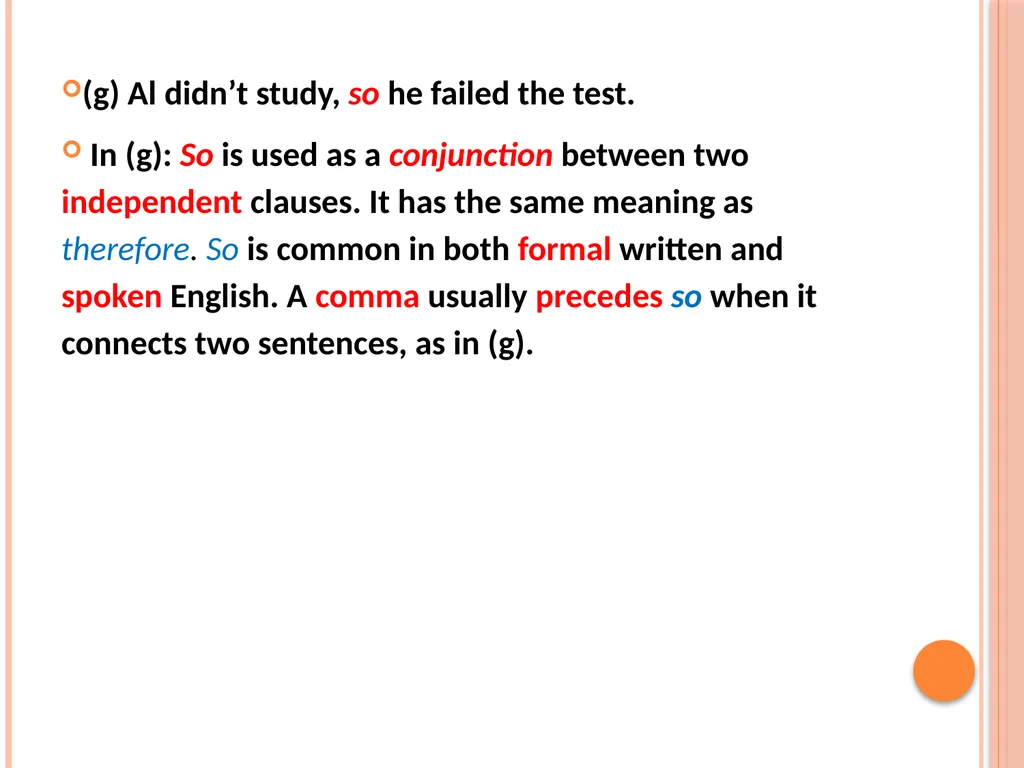
(g) Al didn’t study, so he failed the test.
In (g): So is used as a conjunction between two independent clauses. It has the same meaning as therefore. So is common in both formal written and spoken English. A comma usually precedes so when it connects two sentences, as in (g).<br>
In (g): So is used as a conjunction between two independent clauses. It has the same meaning as therefore. So is common in both formal written and spoken English. A comma usually precedes so when it connects two sentences, as in (g).<br>
09
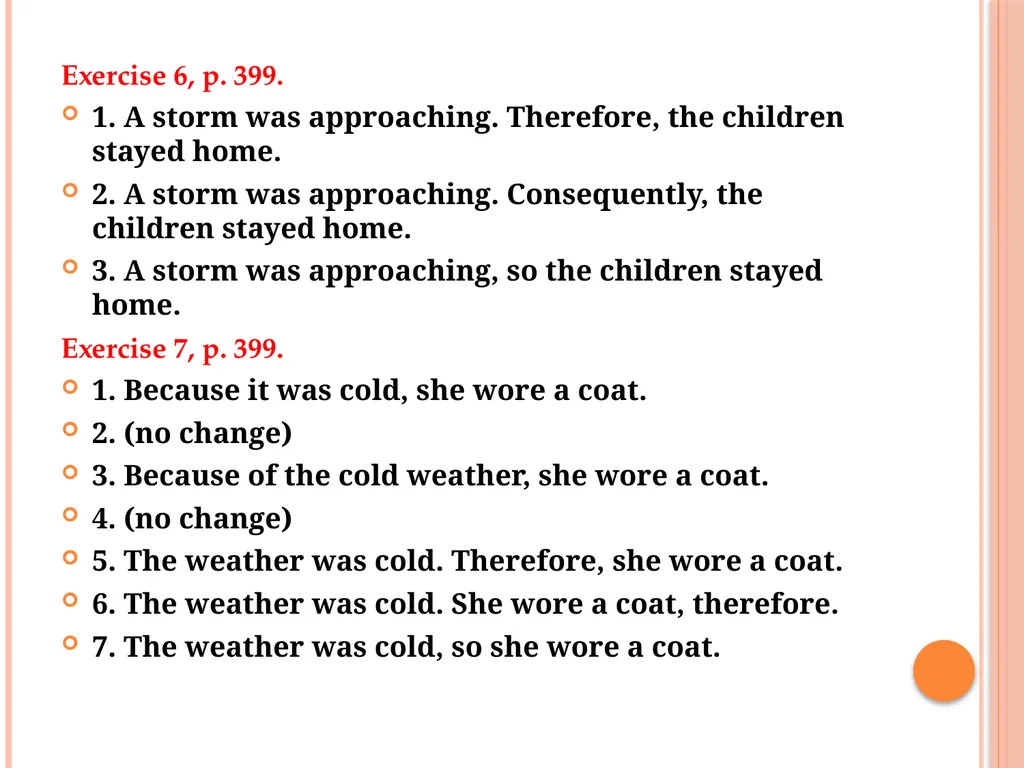
Exercise 6, p. 399.
1. A storm was approaching. Therefore, the children stayed home.
2. A storm was approaching. Consequently, the children stayed home.
3. A storm was approaching, so the children stayed home.
Exercise 7, p. 399.
1. Because it was cold, she wore a coat.
2. (no change)
3. Because of the cold weather, she wore a coat.
4. (no change)
5. The weather was cold. Therefore, she wore a coat.
6. The weather was cold. She wore a coat, therefore.
7. The weather was cold, so she wore a coat.<br>
10
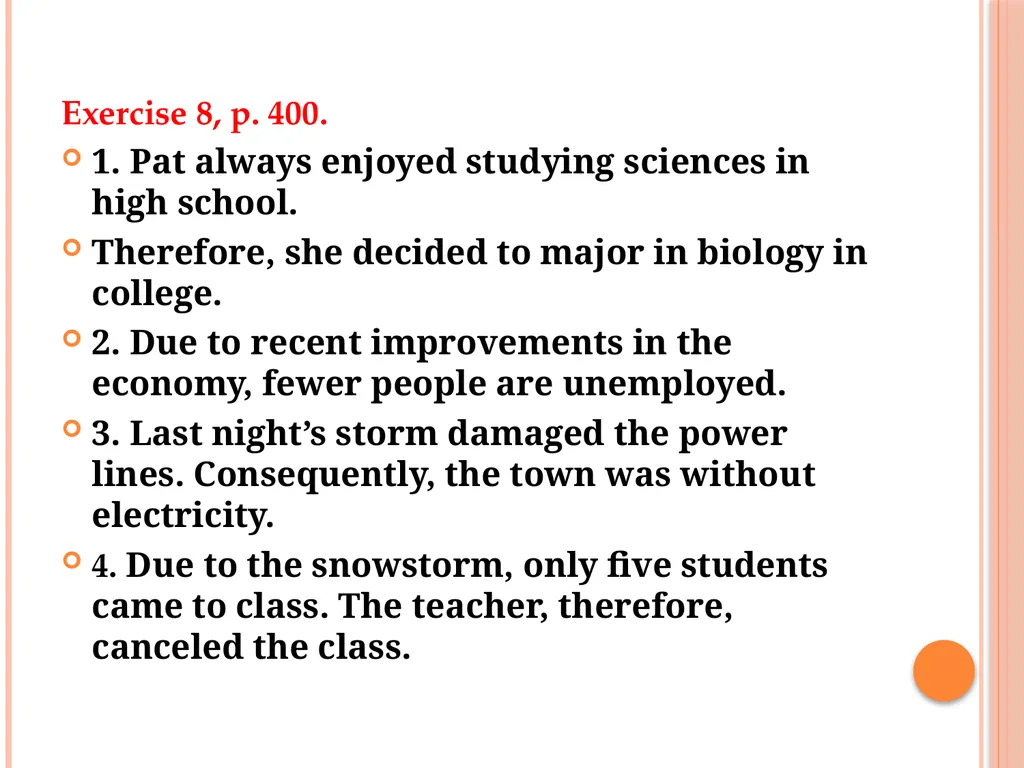
Exercise 8, p. 400.
1. Pat always enjoyed studying sciences in high school.
Therefore, she decided to major in biology in college.
2. Due to recent improvements in the economy, fewer people are unemployed.
3. Last night’s storm damaged the power lines. Consequently, the town was without electricity.
4. Due to the snowstorm, only five students came to class. The teacher, therefore, canceled the class.<br>
11
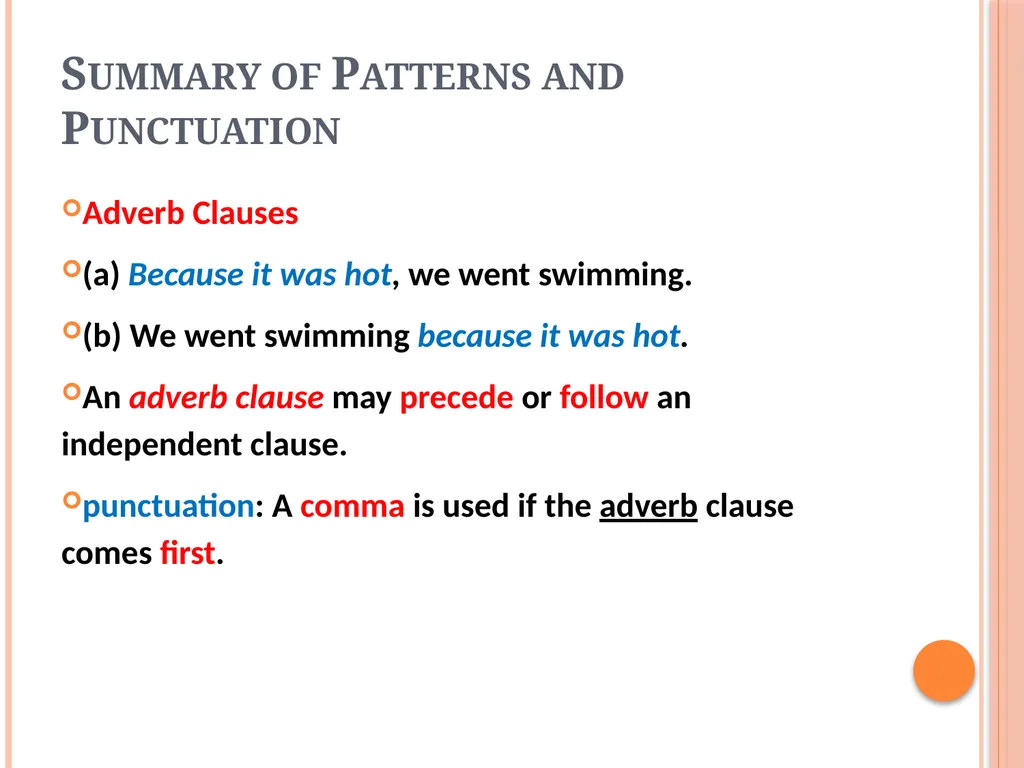
Summary of Patterns and Punctuation Adverb Clauses
(a) Because it was hot, we went swimming.
(b) We went swimming because it was hot.
An adverb clause may precede or follow an independent clause.
punctuation: A comma is used if the adverb clause comes first.<br>
(a) Because it was hot, we went swimming.
(b) We went swimming because it was hot.
An adverb clause may precede or follow an independent clause.
punctuation: A comma is used if the adverb clause comes first.<br>
12
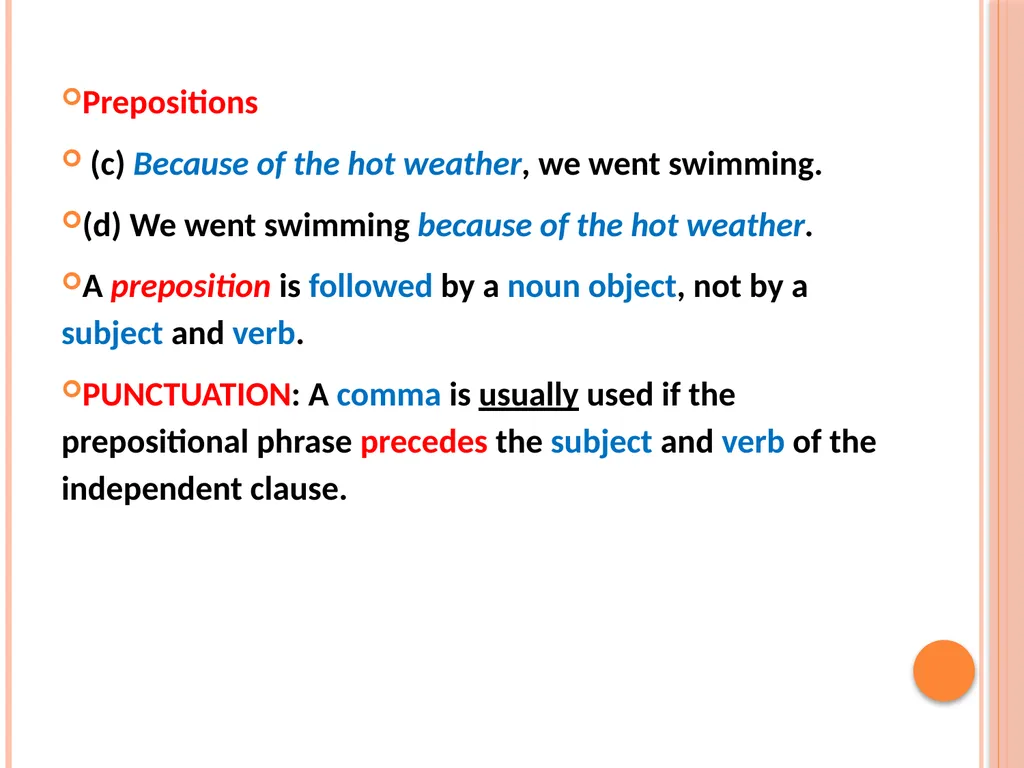
Prepositions
(c) Because of the hot weather, we went swimming.
(d) We went swimming because of the hot weather.
A preposition is followed by a noun object, not by a subject and verb.
PUNCTUATION: A comma is usually used if the prepositional phrase precedes the subject and verb of the independent clause.<br>
(c) Because of the hot weather, we went swimming.
(d) We went swimming because of the hot weather.
A preposition is followed by a noun object, not by a subject and verb.
PUNCTUATION: A comma is usually used if the prepositional phrase precedes the subject and verb of the independent clause.<br>
13
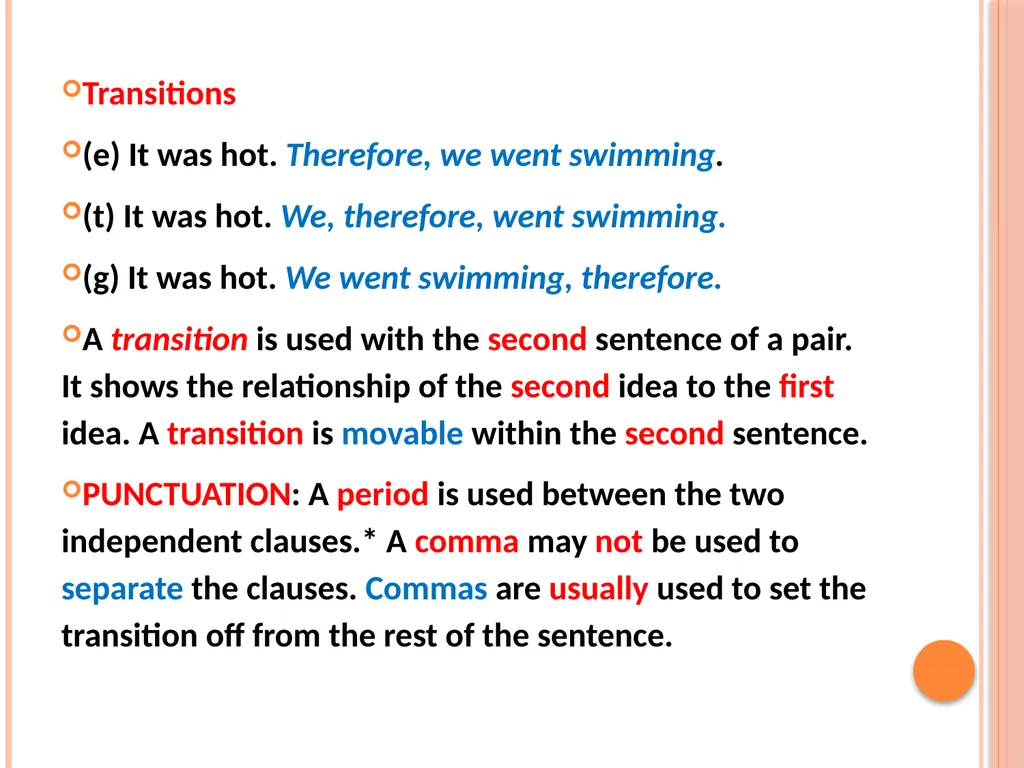
Transitions
(e) It was hot. Therefore, we went swimming.
(t) It was hot. We, therefore, went swimming.
(g) It was hot. We went swimming, therefore.
A transition is used with the second sentence of a pair. It shows the relationship of the second idea to the first idea. A transition is movable within the second sentence.
PUNCTUATION: A period is used between the two independent clauses.* A comma may not be used to separate the clauses. Commas are usually used to set the transition off from the rest of the sentence.<br>
14
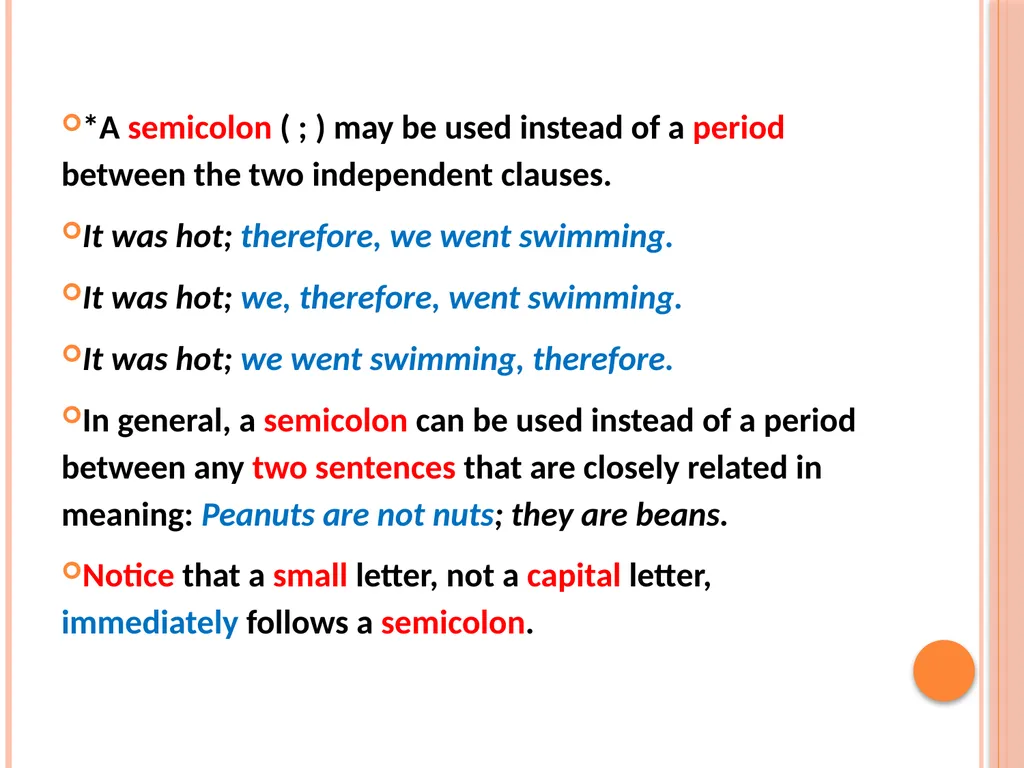
*A semicolon ( ; ) may be used instead of a period between the two independent clauses.
It was hot; therefore, we went swimming.
It was hot; we, therefore, went swimming.
It was hot; we went swimming, therefore.
In general, a semicolon can be used instead of a period between any two sentences that are closely related in meaning: Peanuts are not nuts; they are beans.
Notice that a small letter, not a capital letter, immediately follows a semicolon.<br>
15
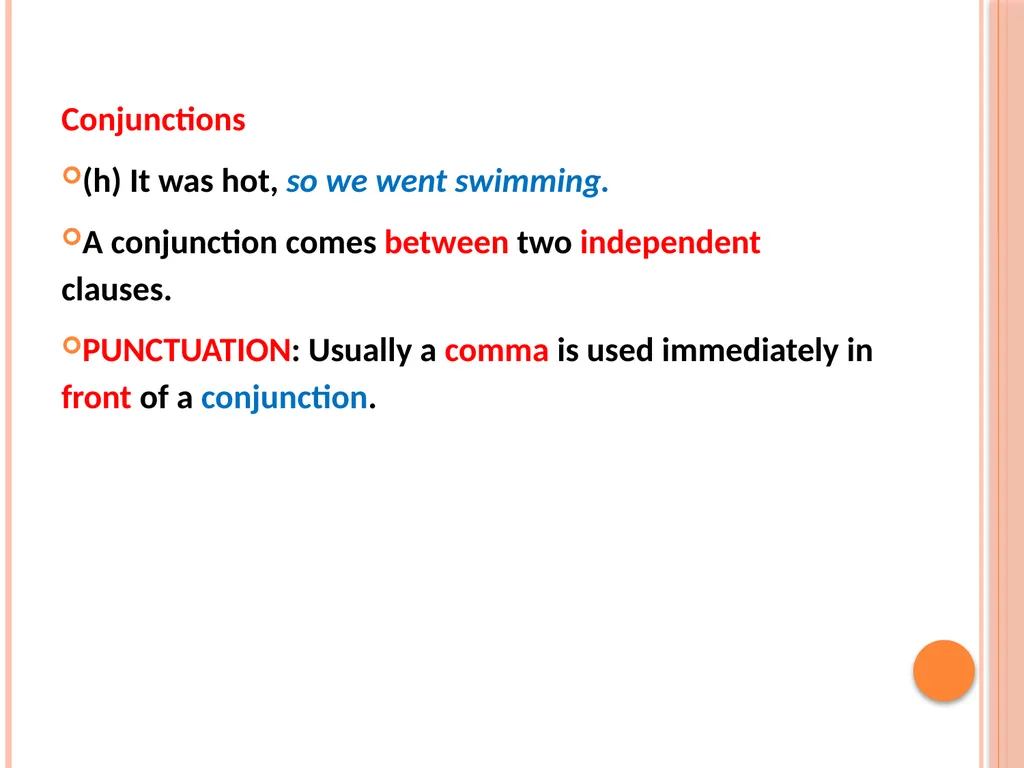
Conjunctions
(h) It was hot, so we went swimming.
A conjunction comes between two independent clauses.
PUNCTUATION: Usually a comma is used immediately in front of a conjunction.<br>
(h) It was hot, so we went swimming.
A conjunction comes between two independent clauses.
PUNCTUATION: Usually a comma is used immediately in front of a conjunction.<br>
16
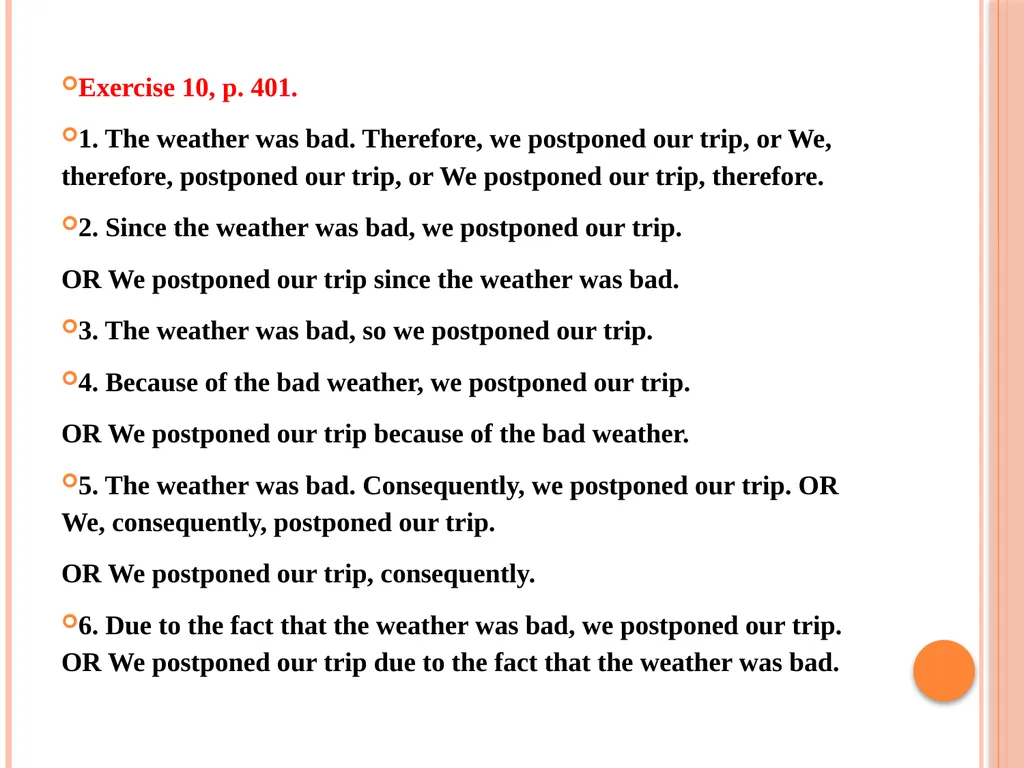
Exercise 10, p. 401.
1. The weather was bad. Therefore, we postponed our trip, or We, therefore, postponed our trip, or We postponed our trip, therefore.
2. Since the weather was bad, we postponed our trip.
OR We postponed our trip since the weather was bad.
3. The weather was bad, so we postponed our trip.
4. Because of the bad weather, we postponed our trip.
OR We postponed our trip because of the bad weather.
5. The weather was bad. Consequently, we postponed our trip. OR We, consequently, postponed our trip.
OR We postponed our trip, consequently.
6. Due to the fact that the weather was bad, we postponed our trip. OR We postponed our trip due to the fact that the weather was bad.<br>
17
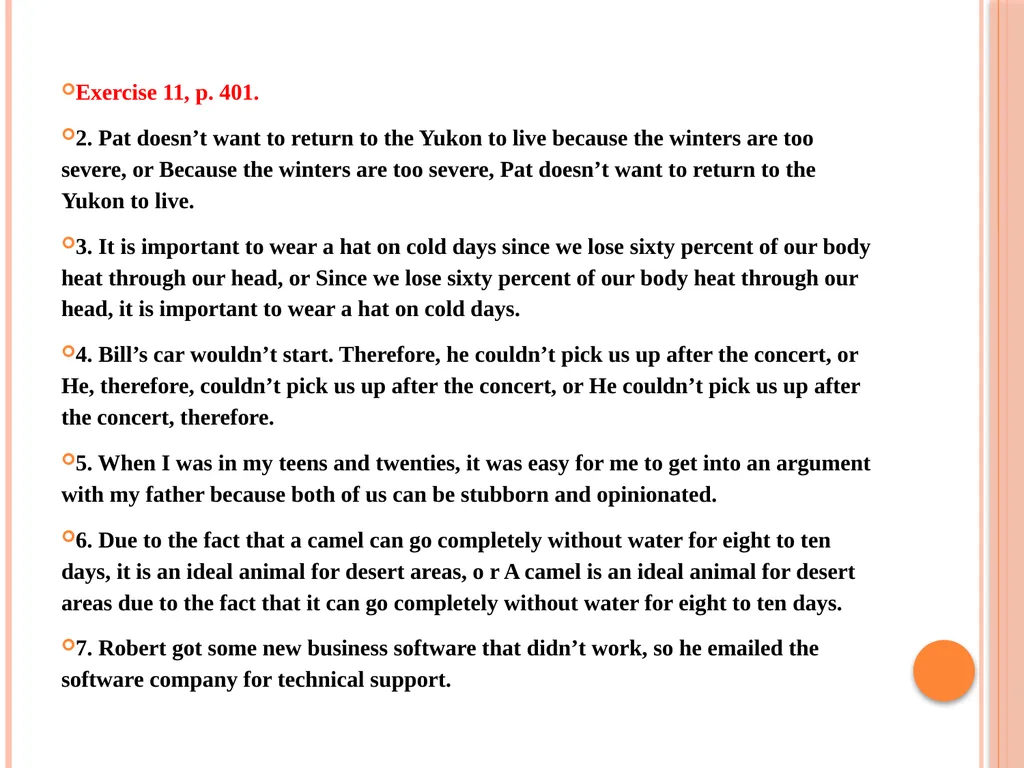
Exercise 11, p. 401.
2. Pat doesn’t want to return to the Yukon to live because the winters are too severe, or Because the winters are too severe, Pat doesn’t want to return to the Yukon to live.
3. It is important to wear a hat on cold days since we lose sixty percent of our body heat through our head, or Since we lose sixty percent of our body heat through our head, it is important to wear a hat on cold days.
4. Bill’s car wouldn’t start. Therefore, he couldn’t pick us up after the concert, or He, therefore, couldn’t pick us up after the concert, or He couldn’t pick us up after the concert, therefore.
5. When I was in my teens and twenties, it was easy for me to get into an argument with my father because both of us can be stubborn and opinionated.
6. Due to the fact that a camel can go completely without water for eight to ten days, it is an ideal animal for desert areas, o r A camel is an ideal animal for desert areas due to the fact that it can go completely without water for eight to ten days.
7. Robert got some new business software that didn’t work, so he emailed the software company for technical support.<br>
18
8. A tomato is classified as a fruit, but most people consider it a vegetable since it is often eaten in salads along with lettuce, onions, cucumbers, and other vegetables, or Since it is often eaten in salads along with lettuce, onions, cucumbers, and other vegetables, a tomato is considered a vegetable.
9. Due to consumer demand for ivory, many African elephants are being slaughtered ruthlessly.
Consequently, many people who care about saving these animals from extinction refuse to buy any item made from ivory, or Many people who care about saving these animals from extinction, consequently, refuse to buy any item made from ivory. OR Many people who care about saving these animals from extinction refuse to buy any item made from ivory, consequently.
10. Because most 15th-century Europeans believed the world was flat and that a ship could conceivably sail off the end of the earth, many sailors of the time refused to venture forth with explorers into unknown waters. OR Many sailors of the 15th century refused to venture forth with explorers into unknown waters because most Europeans of the time believed the world was flat and that a ship could conceivably sail off the end of the earth.<br>
19
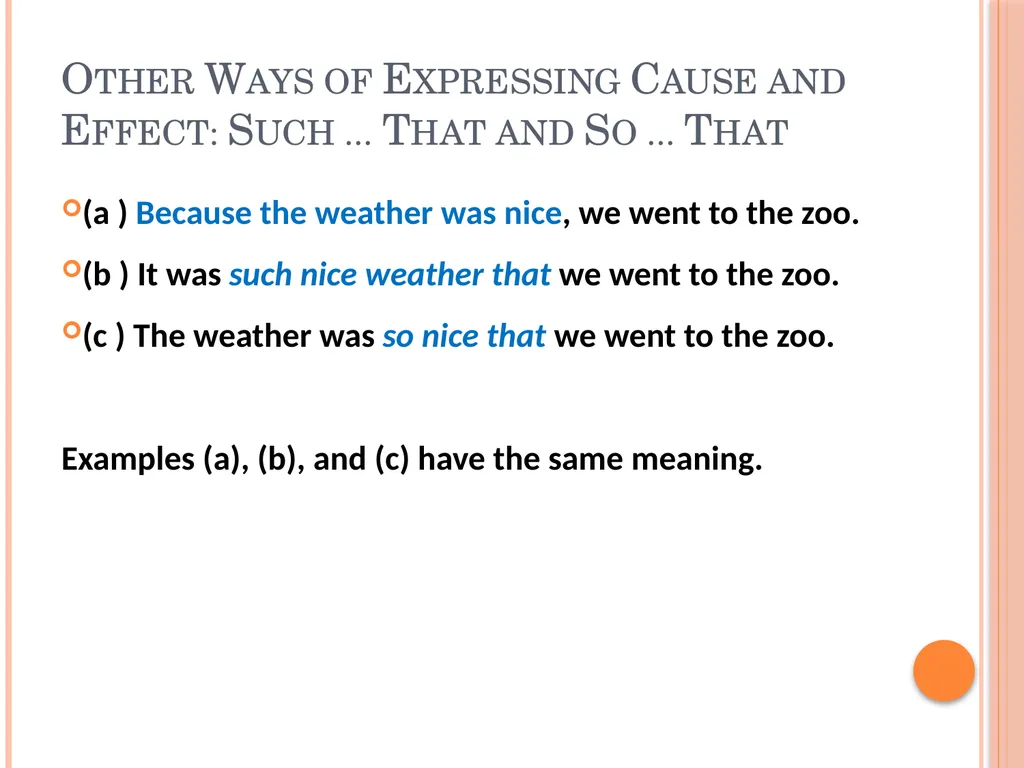
Other Ways of Expressing Cause and Effect: Such ... That and So ... That (a ) Because the weather was nice, we went to the zoo.
(b ) It was such nice weather that we went to the zoo.
(c ) The weather was so nice that we went to the zoo.
Examples (a), (b), and (c) have the same meaning.<br>
(b ) It was such nice weather that we went to the zoo.
(c ) The weather was so nice that we went to the zoo.
Examples (a), (b), and (c) have the same meaning.<br>
20
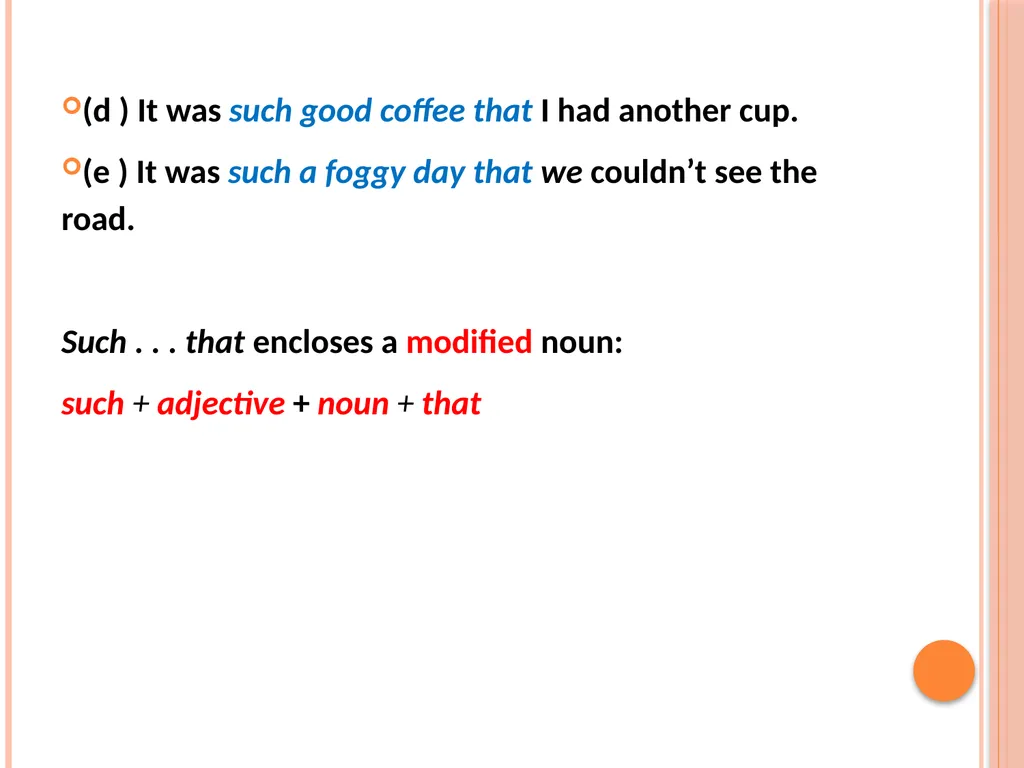
(d ) It was such good coffee that I had another cup.
(e ) It was such a foggy day that we couldn’t see the road.
Such . . . that encloses a modified noun:
such + adjective + noun + that<br>
(e ) It was such a foggy day that we couldn’t see the road.
Such . . . that encloses a modified noun:
such + adjective + noun + that<br>
21
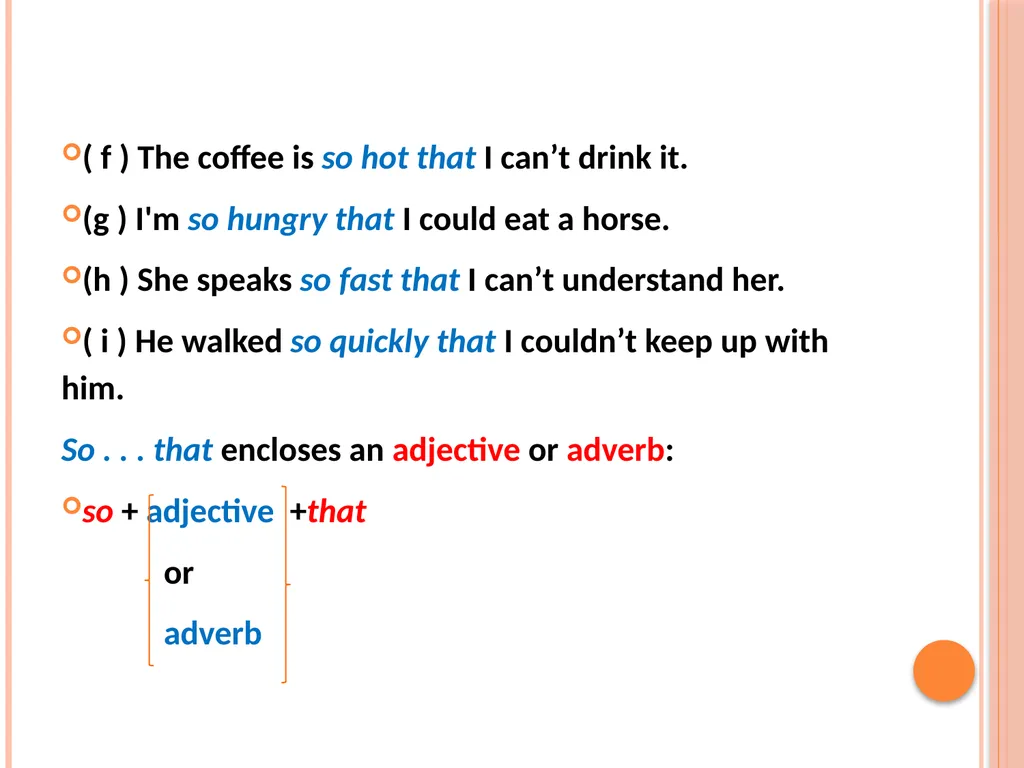
( f ) The coffee is so hot that I can’t drink it.
(g ) I'm so hungry that I could eat a horse.
(h ) She speaks so fast that I can’t understand her.
( i ) He walked so quickly that I couldn’t keep up with him.
So . . . that encloses an adjective or adverb:
so + adjective +that
or
adverb<br>
(g ) I'm so hungry that I could eat a horse.
(h ) She speaks so fast that I can’t understand her.
( i ) He walked so quickly that I couldn’t keep up with him.
So . . . that encloses an adjective or adverb:
so + adjective +that
or
adverb<br>
22
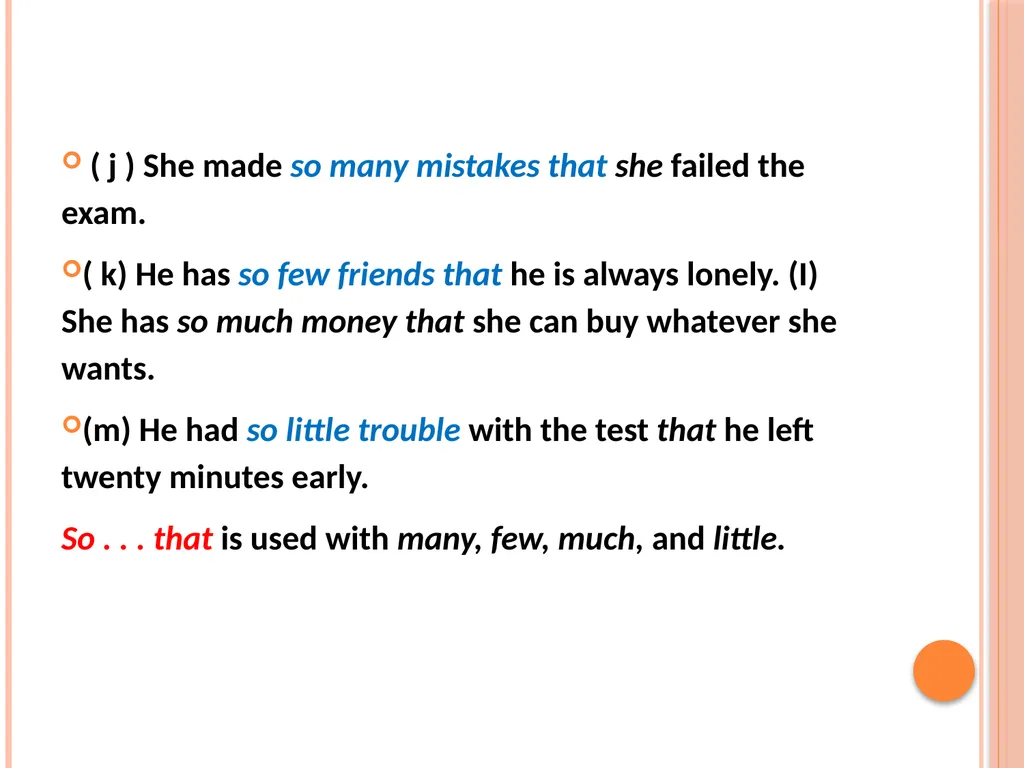
( j ) She made so many mistakes that she failed the exam.
( k) He has so few friends that he is always lonely. (I) She has so much money that she can buy whatever she wants.
(m) He had so little trouble with the test that he left twenty minutes early.
So . . . that is used with many, few, much, and little.<br>
( k) He has so few friends that he is always lonely. (I) She has so much money that she can buy whatever she wants.
(m) He had so little trouble with the test that he left twenty minutes early.
So . . . that is used with many, few, much, and little.<br>
23
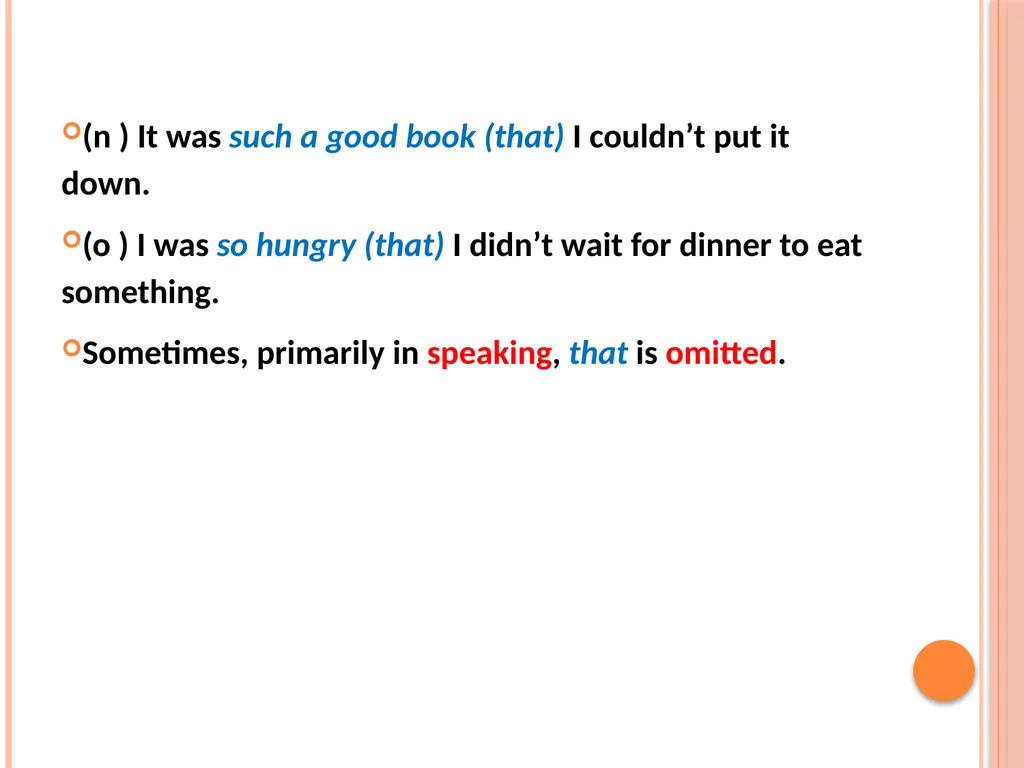
(n ) It was such a good book (that) I couldn’t put it down.
(o ) I was so hungry (that) I didn’t wait for dinner to eat something.
Sometimes, primarily in speaking, that is omitted.<br>
(o ) I was so hungry (that) I didn’t wait for dinner to eat something.
Sometimes, primarily in speaking, that is omitted.<br>
24
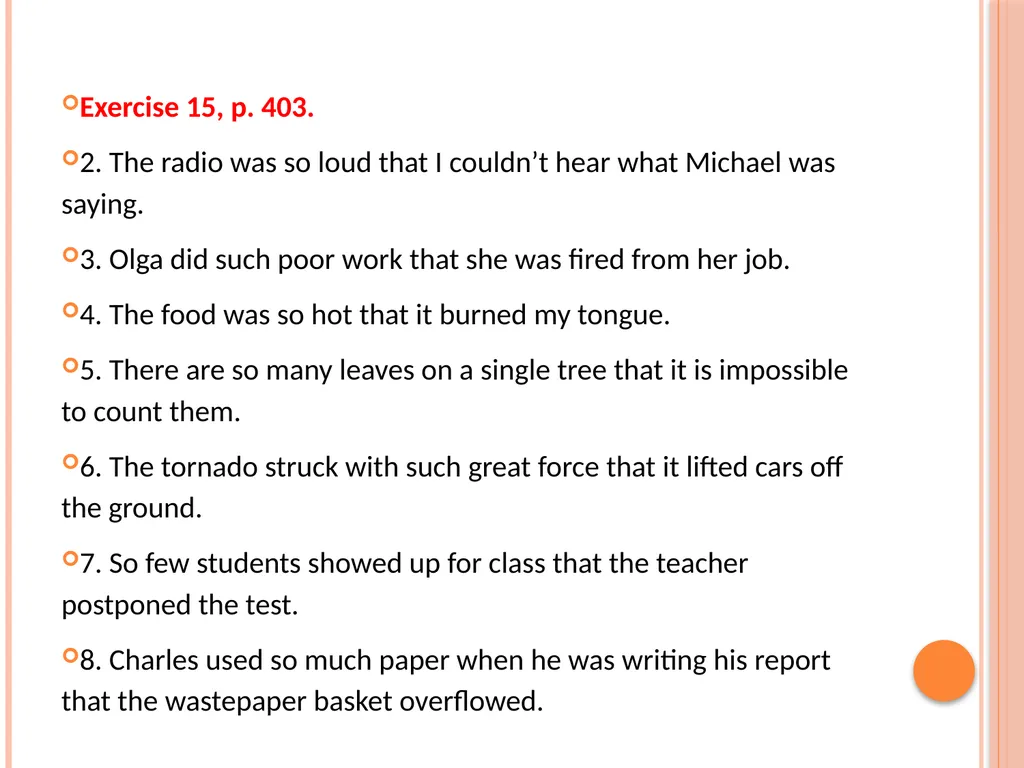
Exercise 15, p. 403.
2. The radio was so loud that I couldn’t hear what Michael was saying.
3. Olga did such poor work that she was fired from her job.
4. The food was so hot that it burned my tongue.
5. There are so many leaves on a single tree that it is impossible to count them.
6. The tornado struck with such great force that it lifted cars off the ground.
7. So few students showed up for class that the teacher postponed the test.
8. Charles used so much paper when he was writing his report that the wastepaper basket overflowed.<br>
25
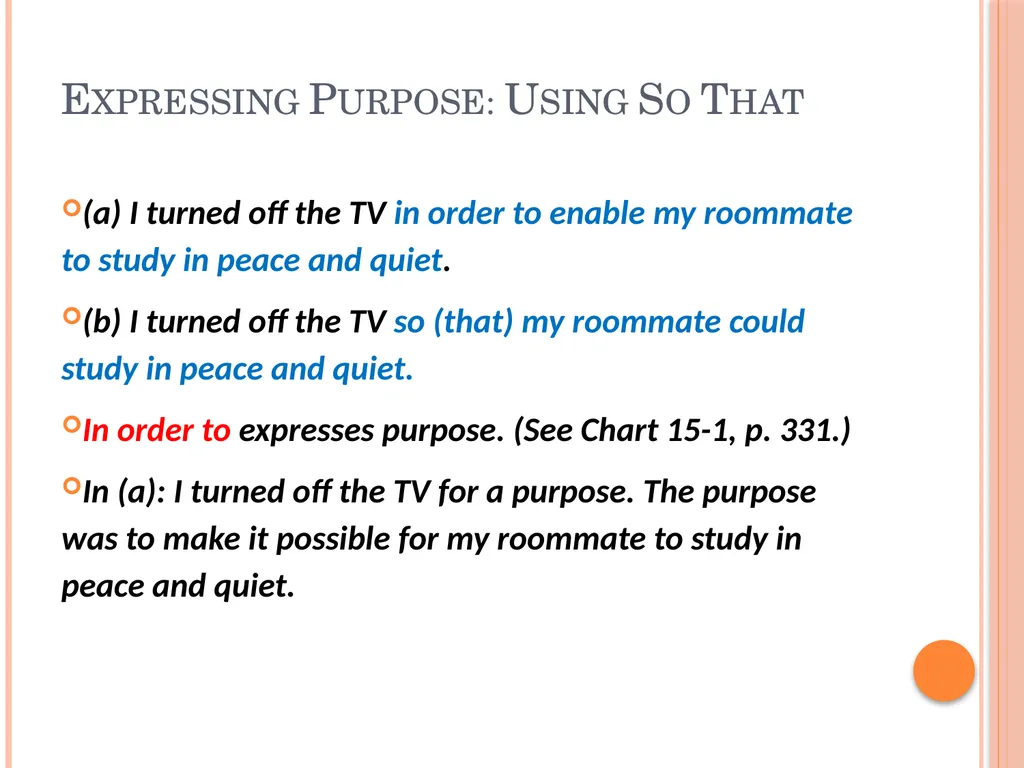
Expressing Purpose: Using So That (a) I turned off the TV in order to enable my roommate to study in peace and quiet.
(b) I turned off the TV so (that) my roommate could study in peace and quiet.
In order to expresses purpose. (See Chart 15-1, p. 331.)
In (a): I turned off the TV for a purpose. The purpose was to make it possible for my roommate to study in peace and quiet.<br>
(b) I turned off the TV so (that) my roommate could study in peace and quiet.
In order to expresses purpose. (See Chart 15-1, p. 331.)
In (a): I turned off the TV for a purpose. The purpose was to make it possible for my roommate to study in peace and quiet.<br>
26
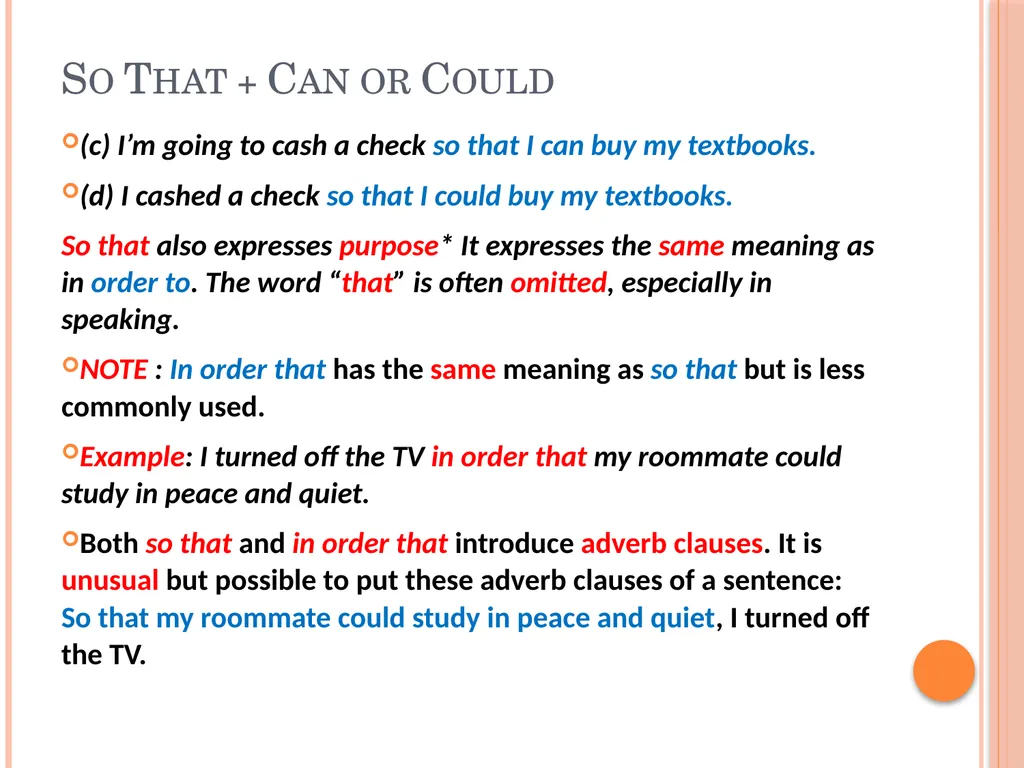
So That + Can or Could (c) I’m going to cash a check so that I can buy my textbooks.
(d) I cashed a check so that I could buy my textbooks.
So that also expresses purpose* It expresses the same meaning as in order to. The word “that” is often omitted, especially in speaking.
NOTE : In order that has the same meaning as so that but is less commonly used.
Example: I turned off the TV in order that my roommate could study in peace and quiet.
Both so that and in order that introduce adverb clauses. It is unusual but possible to put these adverb clauses of a sentence: So that my roommate could study in peace and quiet, I turned off the TV.<br>
27
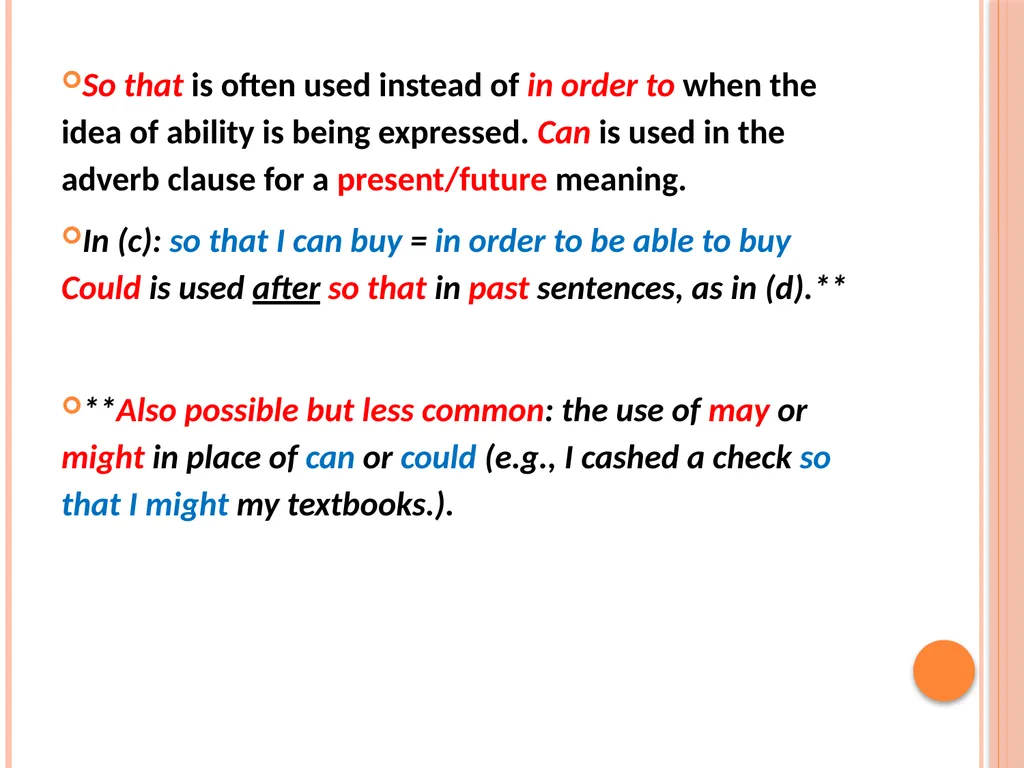
So that is often used instead of in order to when the idea of ability is being expressed. Can is used in the adverb clause for a present/future meaning.
In (c): so that I can buy = in order to be able to buy Could is used after so that in past sentences, as in (d).**
**Also possible but less common: the use of may or might in place of can or could (e.g., I cashed a check so that I might my textbooks.).<br>
In (c): so that I can buy = in order to be able to buy Could is used after so that in past sentences, as in (d).**
**Also possible but less common: the use of may or might in place of can or could (e.g., I cashed a check so that I might my textbooks.).<br>
28
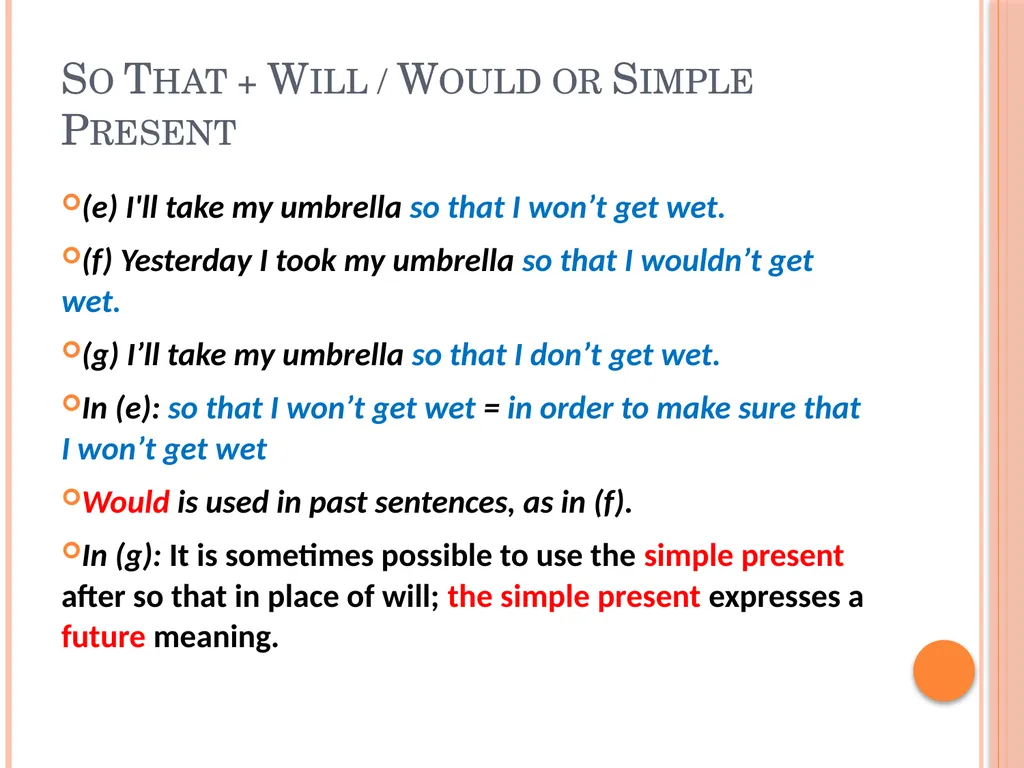
So That + Will / Would or Simple Present (e) I'll take my umbrella so that I won’t get wet.
(f) Yesterday I took my umbrella so that I wouldn’t get wet.
(g) I’ll take my umbrella so that I don’t get wet.
In (e): so that I won’t get wet = in order to make sure that I won’t get wet
Would is used in past sentences, as in (f).
In (g): It is sometimes possible to use the simple present after so that in place of will; the simple present expresses a future meaning.<br>
29
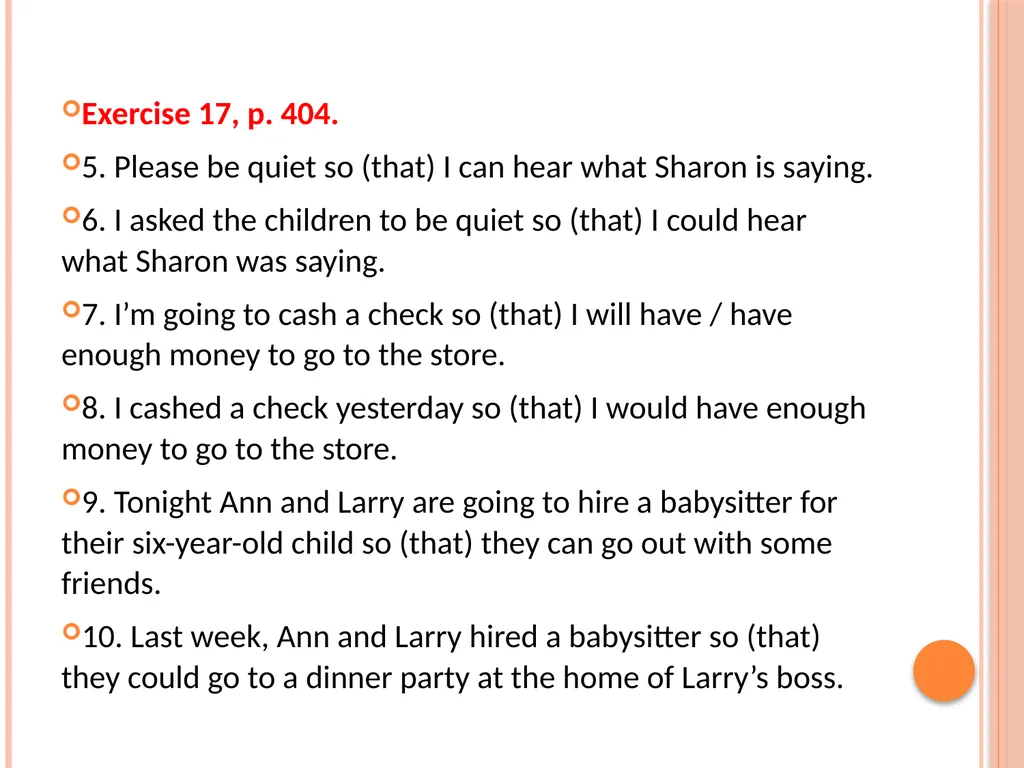
Exercise 17, p. 404.
5. Please be quiet so (that) I can hear what Sharon is saying.
6. I asked the children to be quiet so (that) I could hear what Sharon was saying.
7. I’m going to cash a check so (that) I will have / have enough money to go to the store.
8. I cashed a check yesterday so (that) I would have enough money to go to the store.
9. Tonight Ann and Larry are going to hire a babysitter for their six-year-old child so (that) they can go out with some friends.
10. Last week, Ann and Larry hired a babysitter so (that) they could go to a dinner party at the home of Larry’s boss.<br>
30
11. Be sure to put the meat in the oven at 5:00 so (that) it will be/is ready to eat by 6:30.
12. Yesterday, I put the meat in the oven at 5:00 so (that) it would be ready to eat by 6:30.
13. I’m going to leave the party early so (that) I can get a good night’s sleep tonight.
14. When it started to rain, Harry opened his umbrella so (that) he wouldn’t get wet.
15. The little boy pretended to be sick so (that) he could stay home from school.<br>
31
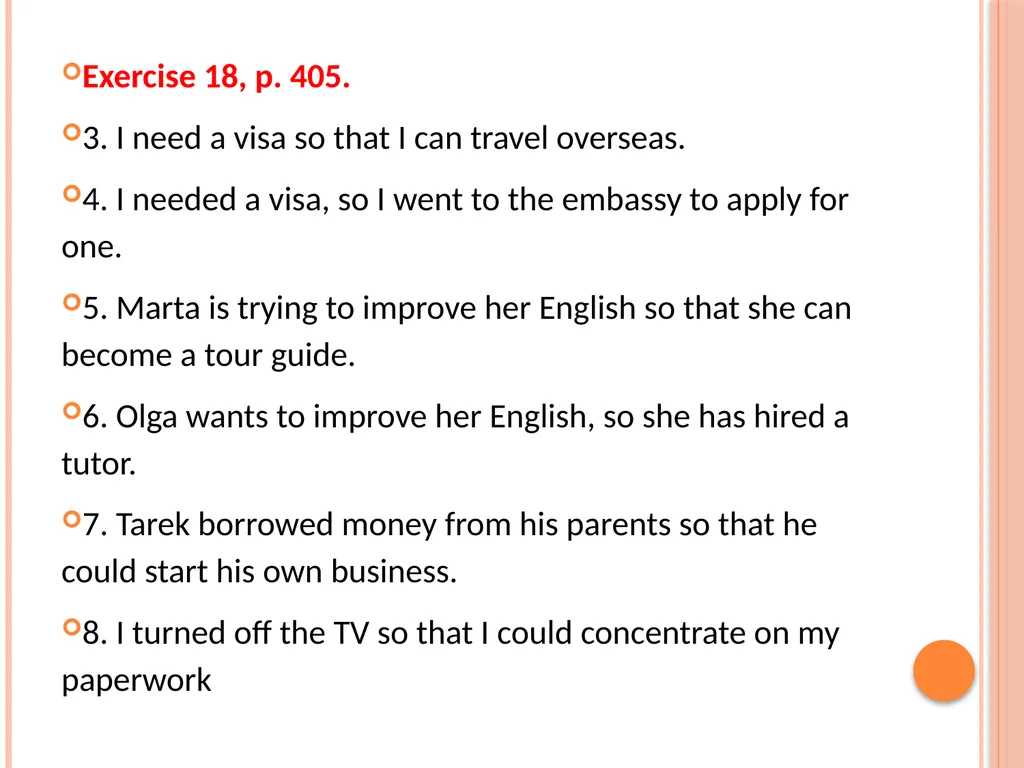
Exercise 18, p. 405.
3. I need a visa so that I can travel overseas.
4. I needed a visa, so I went to the embassy to apply for one.
5. Marta is trying to improve her English so that she can become a tour guide.
6. Olga wants to improve her English, so she has hired a tutor.
7. Tarek borrowed money from his parents so that he could start his own business.
8. I turned off the TV so that I could concentrate on my paperwork<br>
32
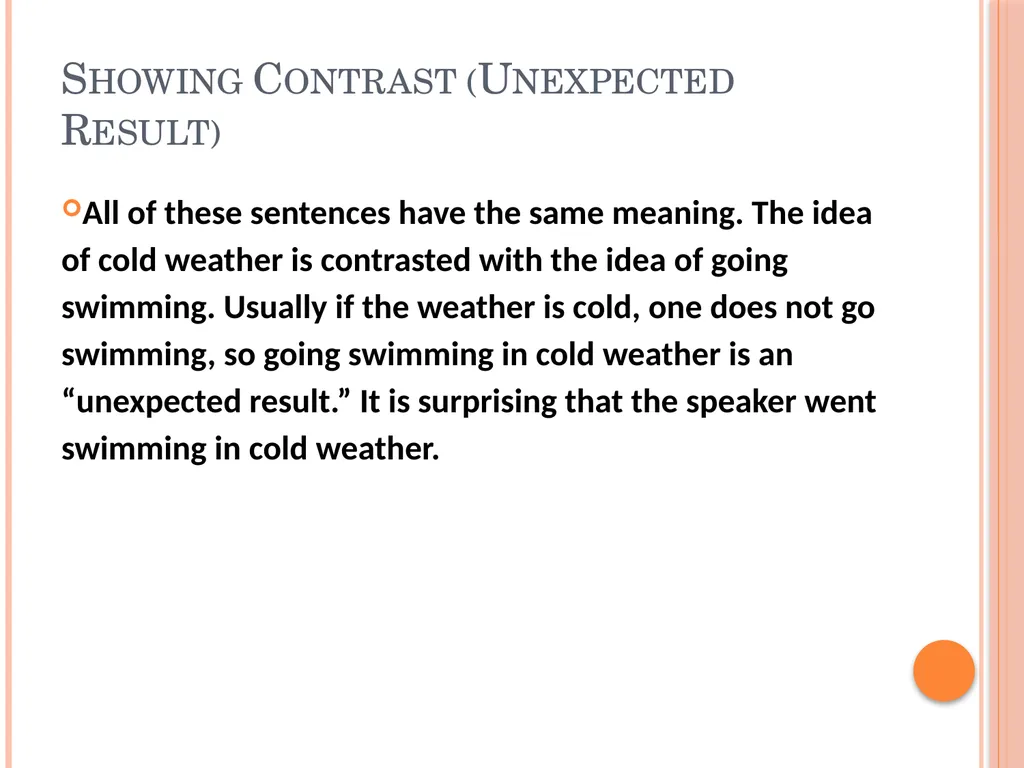
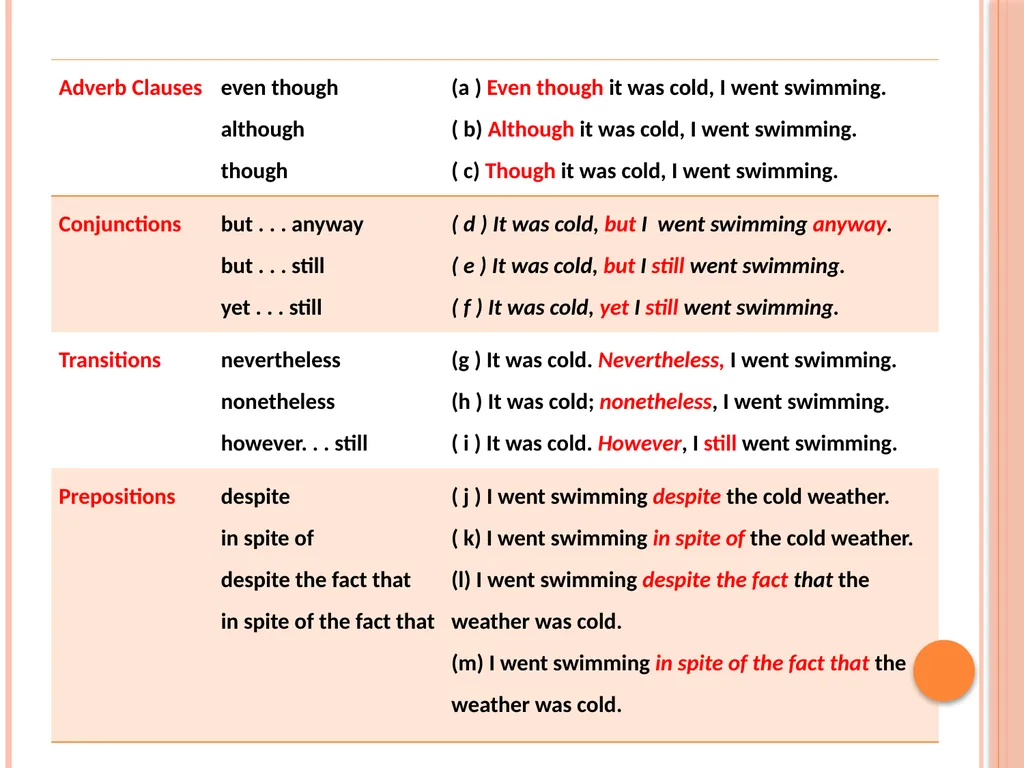
Showing Contrast (Unexpected Result) All of these sentences have the same meaning. The idea of cold weather is contrasted with the idea of going swimming. Usually if the weather is cold, one does not go swimming, so going swimming in cold weather is an “unexpected result.” It is surprising that the speaker went swimming in cold weather.<br>
33
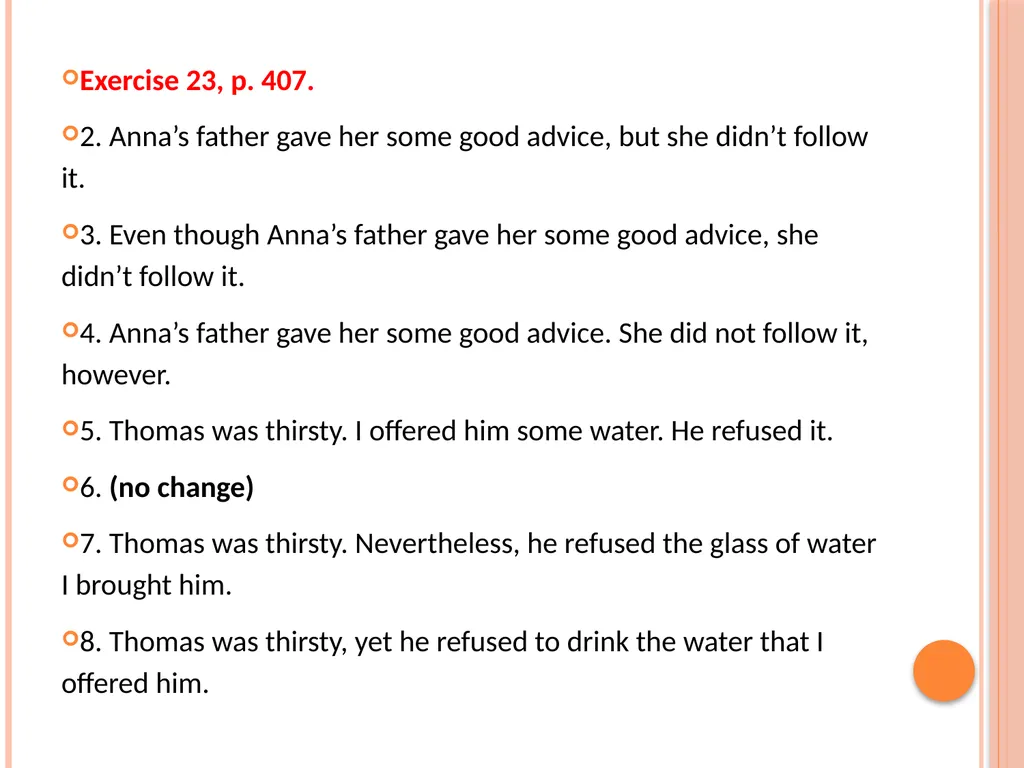
Exercise 23, p. 407.
2. Anna’s father gave her some good advice, but she didn’t follow it.
3. Even though Anna’s father gave her some good advice, she didn’t follow it.
4. Anna’s father gave her some good advice. She did not follow it, however.
5. Thomas was thirsty. I offered him some water. He refused it.
6. (no change)
7. Thomas was thirsty. Nevertheless, he refused the glass of water I brought him.
8. Thomas was thirsty, yet he refused to drink the water that I offered him.<br>
34
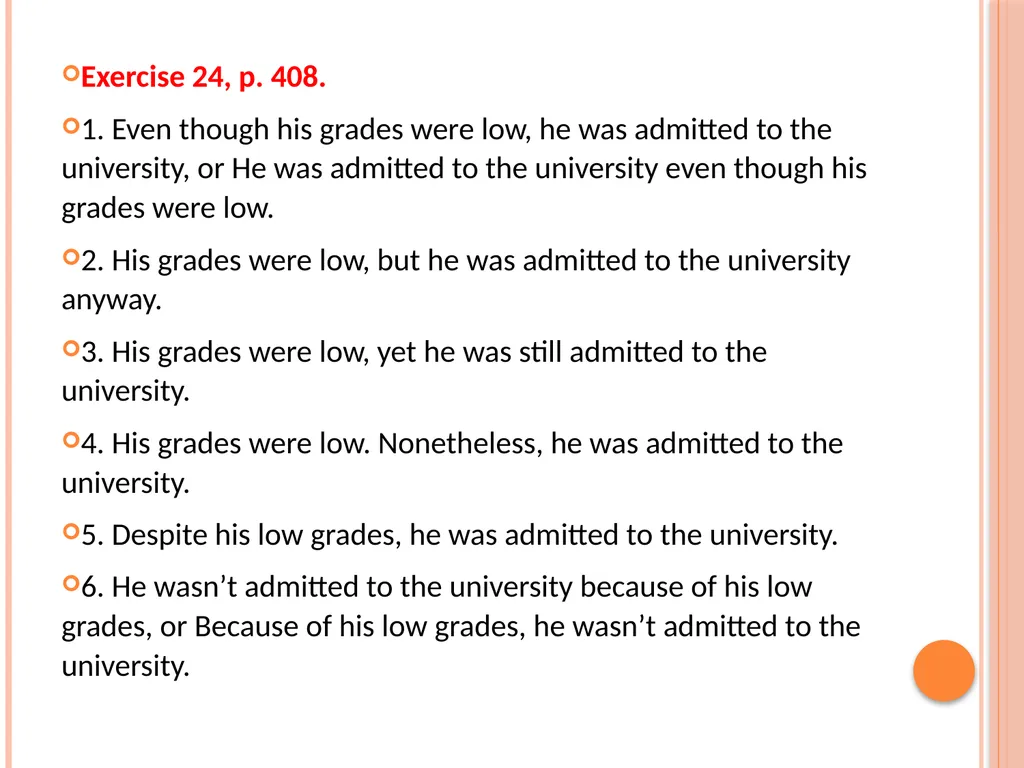
Exercise 24, p. 408.
1. Even though his grades were low, he was admitted to the university, or He was admitted to the university even though his grades were low.
2. His grades were low, but he was admitted to the university anyway.
3. His grades were low, yet he was still admitted to the university.
4. His grades were low. Nonetheless, he was admitted to the university.
5. Despite his low grades, he was admitted to the university.
6. He wasn’t admitted to the university because of his low grades, or Because of his low grades, he wasn’t admitted to the university.<br>
35
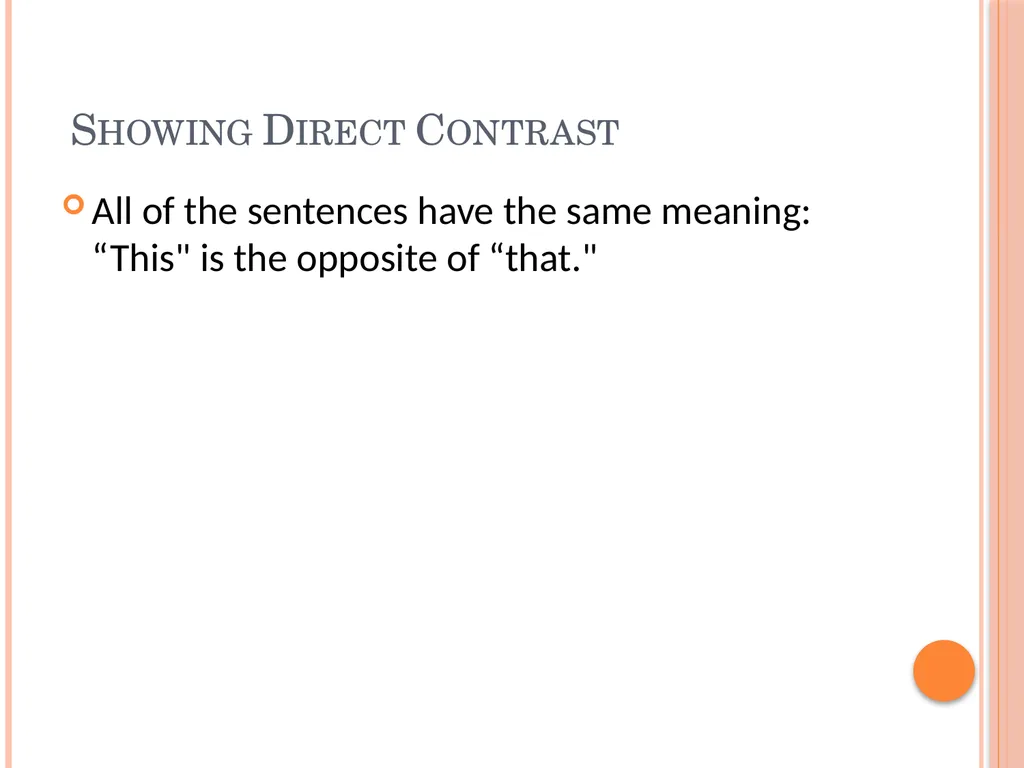
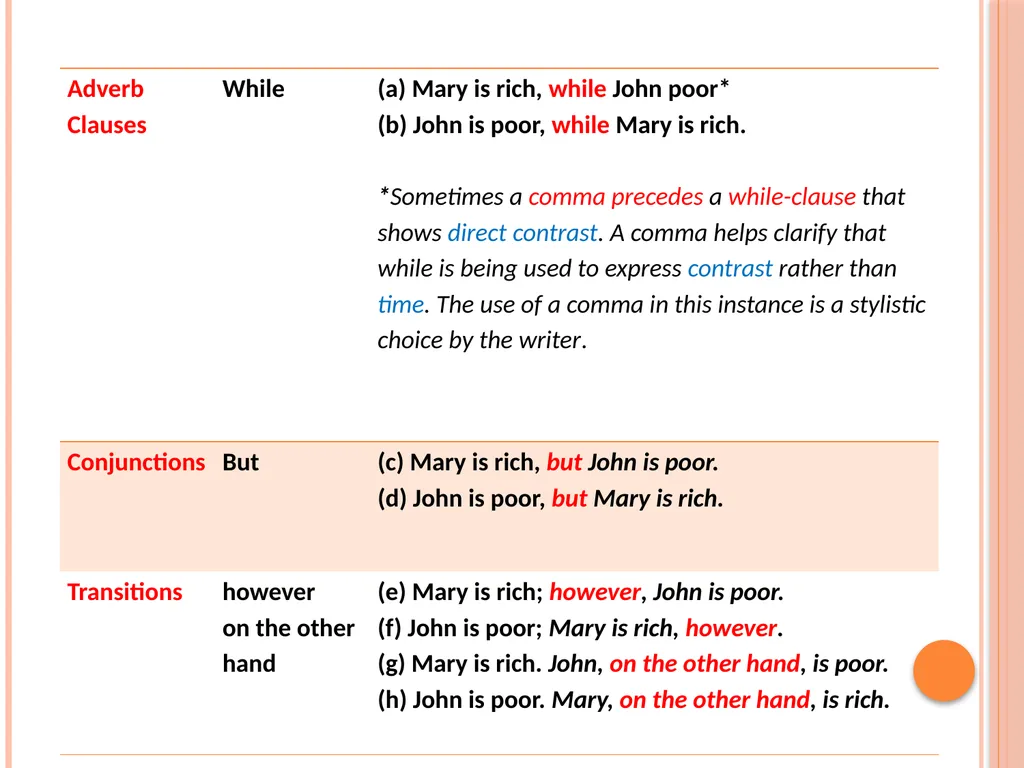
Showing Direct Contrast All of the sentences have the same meaning: “This" is the opposite of “that."<br>
36
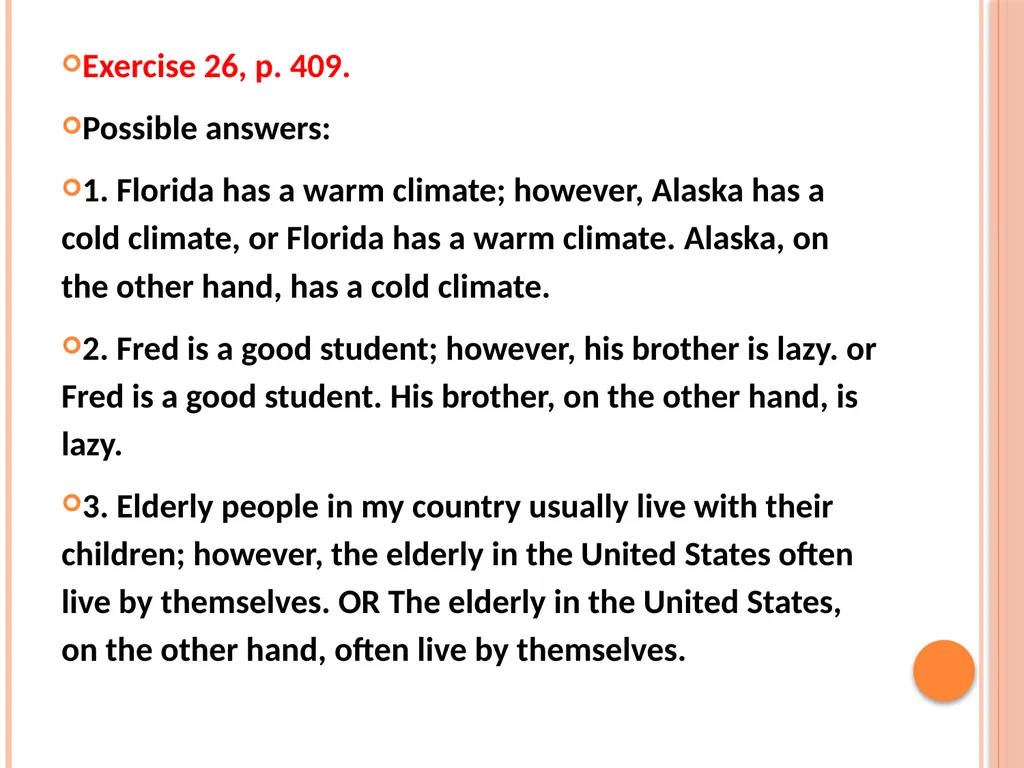
Exercise 26, p. 409.
Possible answers:
1. Florida has a warm climate; however, Alaska has a cold climate, or Florida has a warm climate. Alaska, on the other hand, has a cold climate.
2. Fred is a good student; however, his brother is lazy. or Fred is a good student. His brother, on the other hand, is lazy.
3. Elderly people in my country usually live with their children; however, the elderly in the United States often live by themselves. OR The elderly in the United States, on the other hand, often live by themselves.<br>
37
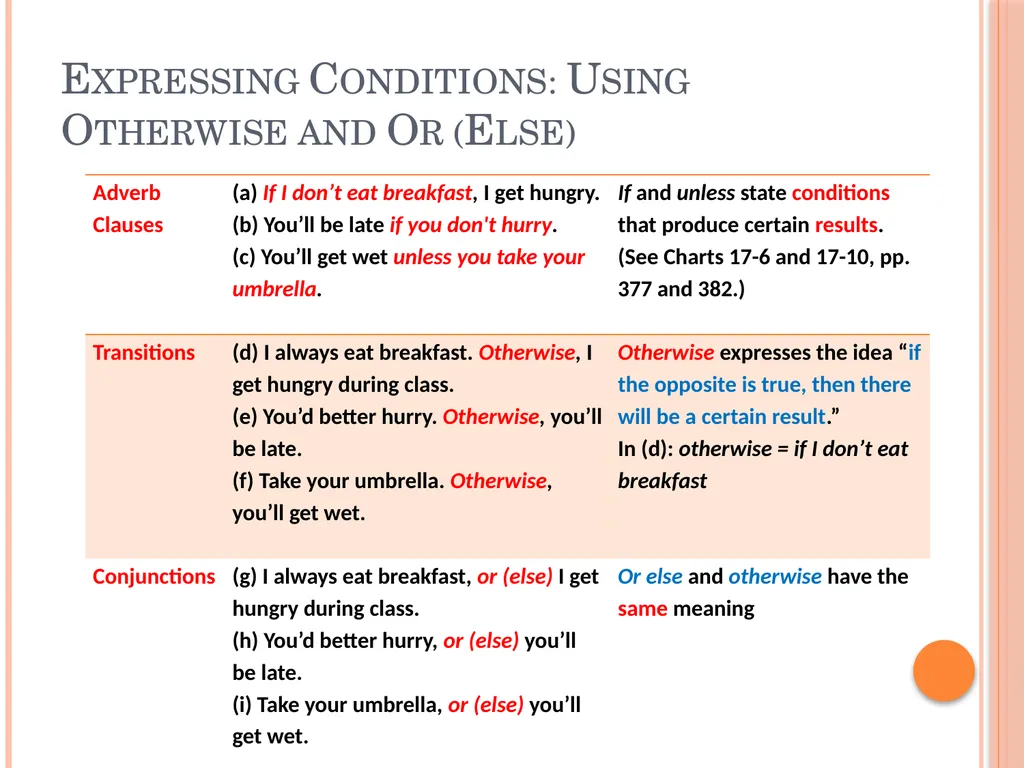
Expressing Conditions: Using Otherwise and Or (Else)<br>
38
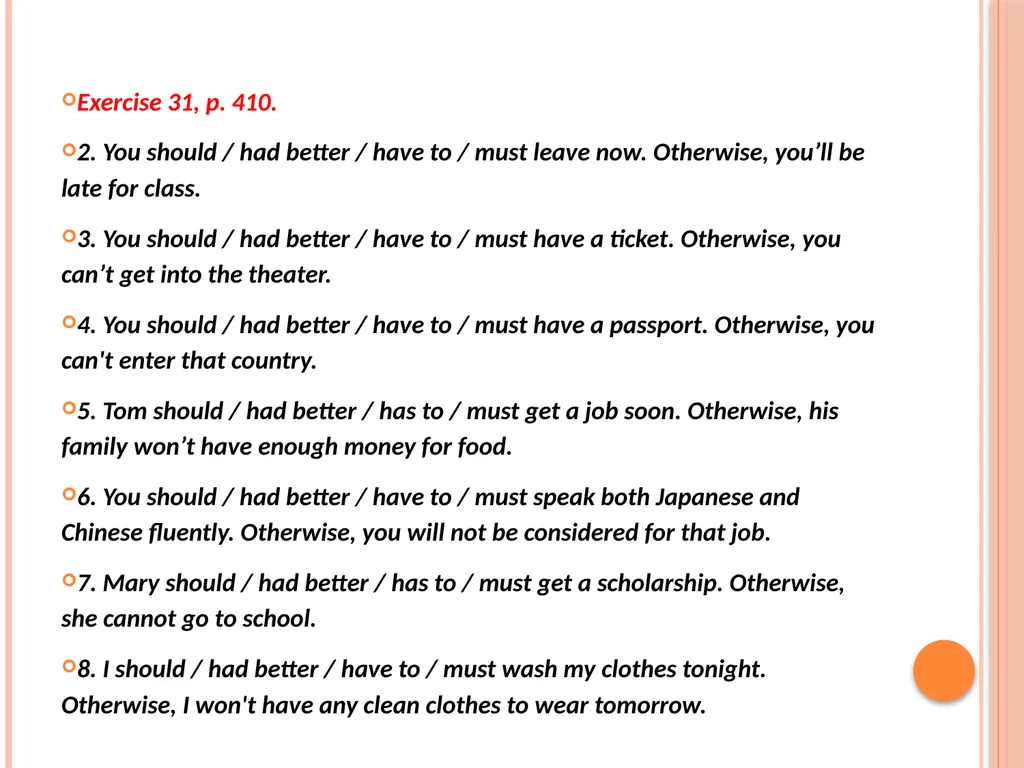
Exercise 31, p. 410.
2. You should / had better / have to / must leave now. Otherwise, you’ll be late for class.
3. You should / had better / have to / must have a ticket. Otherwise, you can’t get into the theater.
4. You should / had better / have to / must have a passport. Otherwise, you can't enter that country.
5. Tom should / had better / has to / must get a job soon. Otherwise, his family won’t have enough money for food.
6. You should / had better / have to / must speak both Japanese and Chinese fluently. Otherwise, you will not be considered for that job.
7. Mary should / had better / has to / must get a scholarship. Otherwise, she cannot go to school.
8. I should / had better / have to / must wash my clothes tonight. Otherwise, I won't have any clean clothes to wear tomorrow.<br>
39
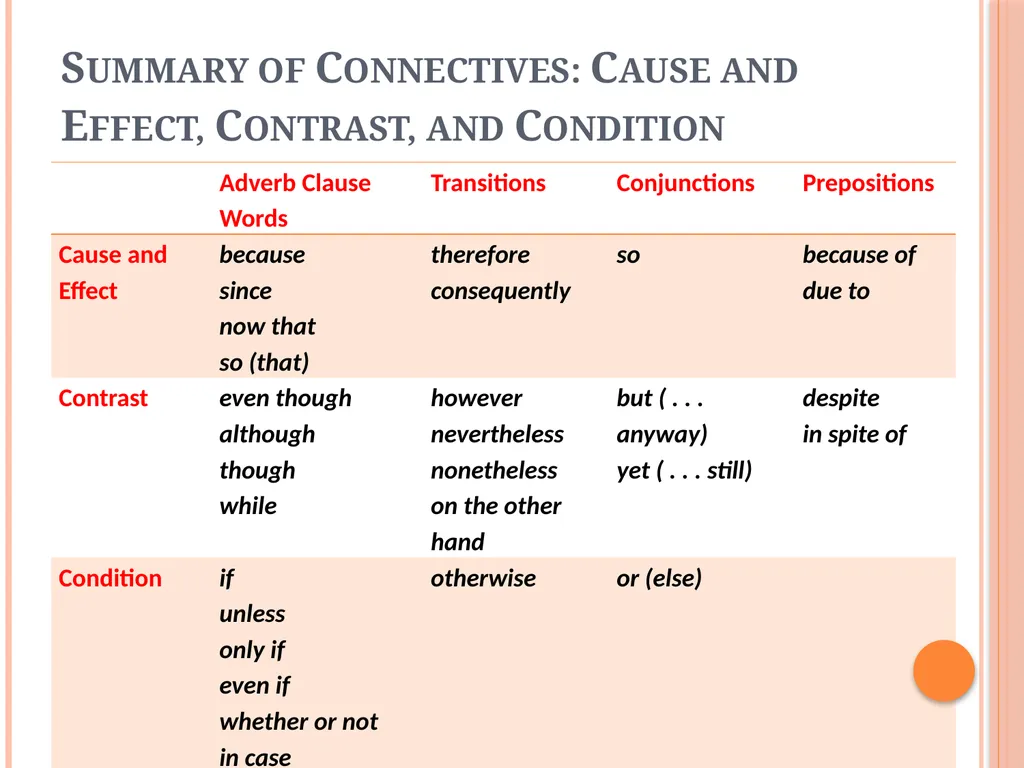
Summary of Connectives: Cause and Effect, Contrast, and Condition<br>
40
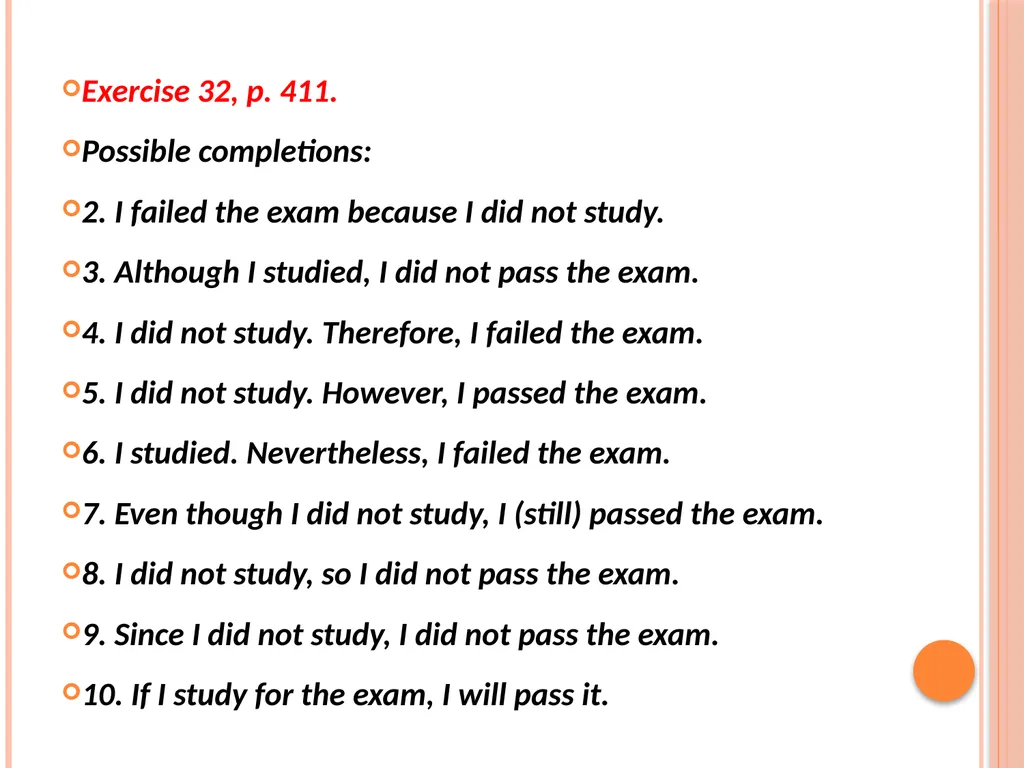
Exercise 32, p. 411.
Possible completions:
2. I failed the exam because I did not study.
3. Although I studied, I did not pass the exam.
4. I did not study. Therefore, I failed the exam.
5. I did not study. However, I passed the exam.
6. I studied. Nevertheless, I failed the exam.
7. Even though I did not study, I (still) passed the exam.
8. I did not study, so I did not pass the exam.
9. Since I did not study, I did not pass the exam.
10. If I study for the exam, I will pass it.<br>
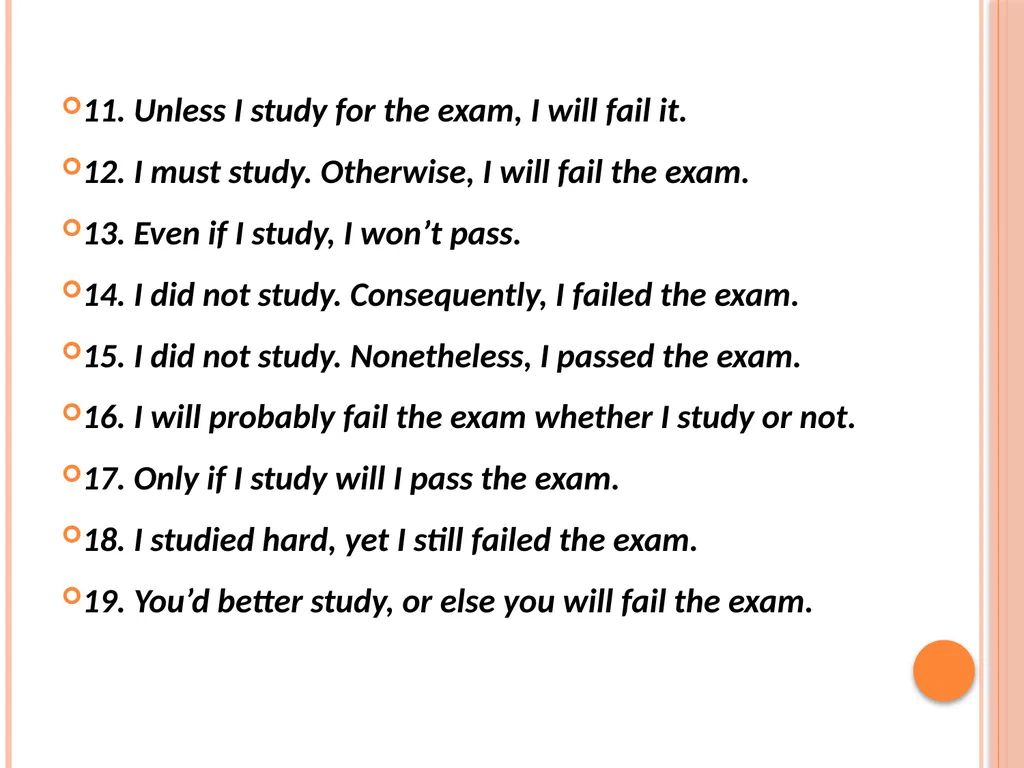
41
11. Unless I study for the exam, I will fail it.
12. I must study. Otherwise, I will fail the exam.
13. Even if I study, I won’t pass.
14. I did not study. Consequently, I failed the exam.
15. I did not study. Nonetheless, I passed the exam.
16. I will probably fail the exam whether I study or not.
17. Only if I study will I pass the exam.
18. I studied hard, yet I still failed the exam.
19. You’d better study, or else you will fail the exam.<br>
42
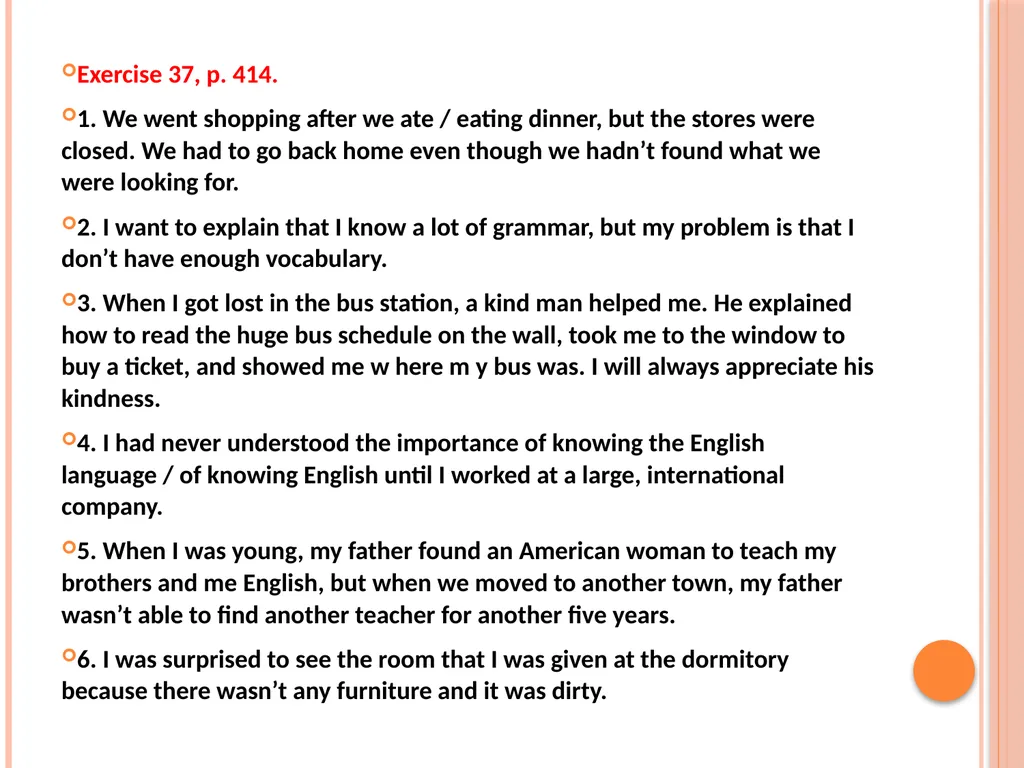
Exercise 37, p. 414.
1. We went shopping after we ate / eating dinner, but the stores were closed. We had to go back home even though we hadn’t found what we were looking for.
2. I want to explain that I know a lot of grammar, but my problem is that I don’t have enough vocabulary.
3. When I got lost in the bus station, a kind man helped me. He explained how to read the huge bus schedule on the wall, took me to the window to buy a ticket, and showed me w here m y bus was. I will always appreciate his kindness.
4. I had never understood the importance of knowing the English language / of knowing English until I worked at a large, international company.
5. When I was young, my father found an American woman to teach my brothers and me English, but when we moved to another town, my father wasn’t able to find another teacher for another five years.
6. I was surprised to see the room that I was given at the dormitory because there wasn’t any furniture and it was dirty.<br>
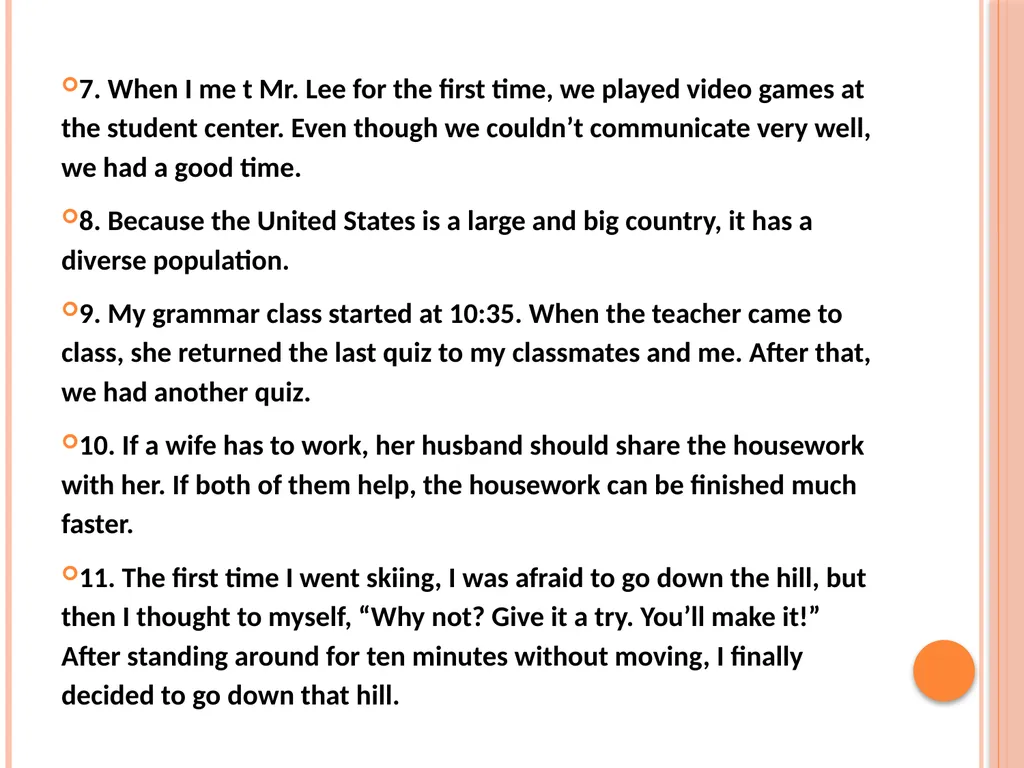
43
7. When I me t Mr. Lee for the first time, we played video games at the student center. Even though we couldn’t communicate very well, we had a good time.
8. Because the United States is a large and big country, it has a diverse population.
9. My grammar class started at 10:35. When the teacher came to class, she returned the last quiz to my classmates and me. After that, we had another quiz.
10. If a wife has to work, her husband should share the housework with her. If both of them help, the housework can be finished much faster.
11. The first time I went skiing, I was afraid to go down the hill, but then I thought to myself, “Why not? Give it a try. You’ll make it!” After standing around for ten minutes without moving, I finally decided to go down that hill.<br>