
Conservation Practice Benefit-Cost Templates 1
Description: Conservation Practice Benefit-Cost Templates 1 Conservation Practice Benefit-Cost Templates Agricultural producers, landowners, NRCS conservation planners, NRCS leadership, the public and congress are always asking for the benefits, costs
Related Topics
Download Presentation
"Conservation Practice Benefit-Cost Templates 1" is the property of its rightful owner. Permission is granted to download and print the materials on this website for personal, non-commercial use only, and to display it on your personal computer provided you do not modify the materials and that you retain all copyright notices contained in the materials. By downloading content from our website, you accept the terms of this agreement.
Presentation Transcript
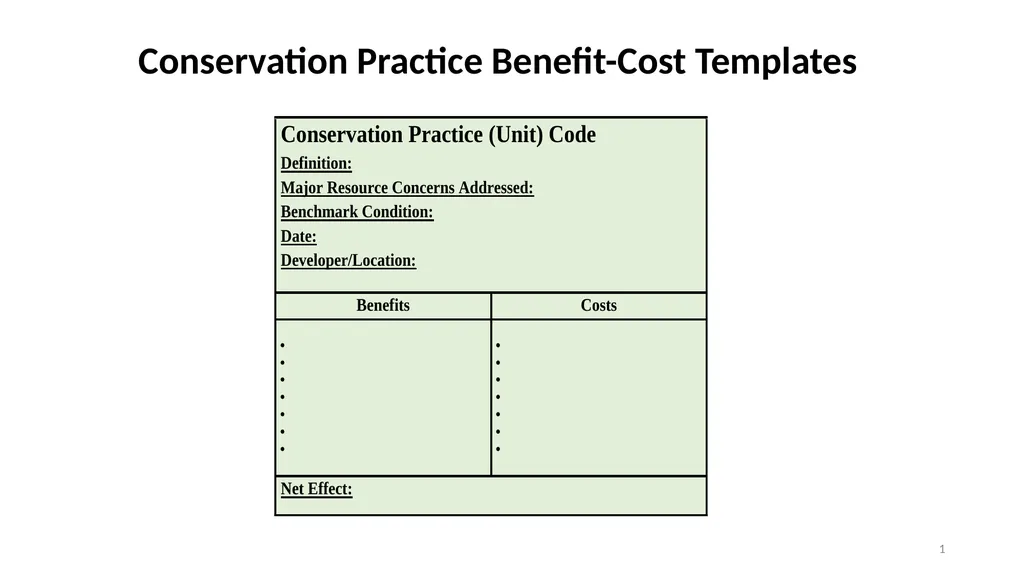
slide1. Conservation Practice Benefit-Cost Templates 1<br>
slide2. Conservation Practice Benefit-Cost Templates
Agricultural producers, landowners, NRCS conservation planners, NRCS leadership, the public and congress are always asking for the benefits, costs and economic analysis of NRCS’s activities – specifically about NRCS Conservation Practices and Conservation Systems. They want to know that NRCS’s practices are cost-effective. Economists have struggled to provide this information, often citing individual producer case studies that are site specific and only locally relevant.
For the first time, basic benefit-cost information has been identified for all 175 NRCS Conservation Practices in the form of one-page documents. Each document has the same format and data categories, making it is easy to compare practices. Each document contains general talking points about the conservation practice.
The conservation planner can easily review the document and discuss the benefits and costs of each conservation practice with the client. Each document contains qualitative information and does not contain units, numbers or dollar estimates. Quantitative data is added later when the planning site, resource concerns and goals and objectives of the client are identified.
Use of the templates in conservation planning is voluntary, they are not required documentation in the landowners case file. 2<br>
slide3. Conservation Practice Benefit-Cost Templates
The templates are used in the NRCS nine-step planning process as described in the National Planning Procedures Handbook and in Economics Technical Note: TN 200-ECN-1, Basic Economic Analysis Using T-Charts (August 2013).
The initial benefit-cost information came from the NRCS Conservation Practice Standard and the Conservation Practice Physical Effects Matrix. Additional quantitative data would come from the land user, conservation planner, technical specialist and local agricultural supply vendors and contractors.
NRCS can not guarantee every benefit and cost in the template will occur on every project, but we can say there is a high likelihood they will occur. Ultimately the conservation planner will determine the actual benefits, costs, probability and magnitude of occurrence.
The goal is to get approval for each practice template from the national discipline lead, then make the templates available to each NRCS State Office for editing and posting the templates to FOTG Section V, and using the templates in all conservation planning activities.
The templates are currently stored at the WNTSC Economics SharePoint, in the future they will be stored at the NRCS Economics Website. 3<br>
slide4. Conservation Practice Benefit-Cost Templates
The worksheets contain general talking points about conservation practices for the conservation planner to discuss with the land user and focus on the benefits and costs of each conservation practice.
Using this template is the first step towards an economic or financial analysis.
The second step would include identifying a specific site for analysis (farm, field or regional level), editing the template for local conditions, adding or deleting effects in the template relevant to the site, adding units and quantities of farm inputs and outputs.
The third step in the economic analysis is to place a dollar value on as many variables as possible, put all units in the same time frame (using amortization ($/Acres/Year) or net present value ($/Acre)) so benefits and costs can be compared. Data comes from the land user, conservation planner, technical specialist and local vendors.
The fourth and final step would be to combine several conservation practices into a conservation system, which is how most conservation practices are applied at the field level. 4<br>
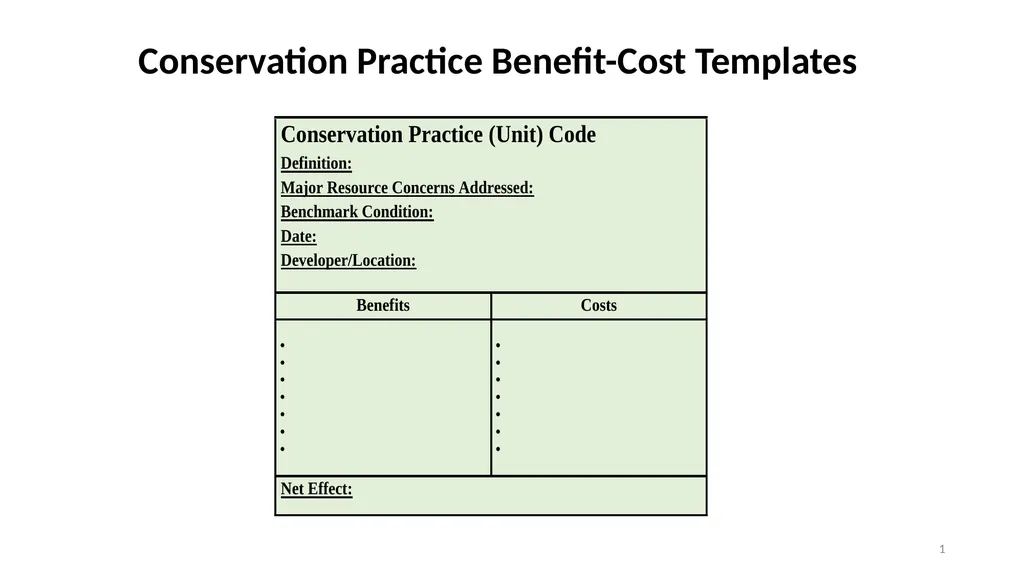
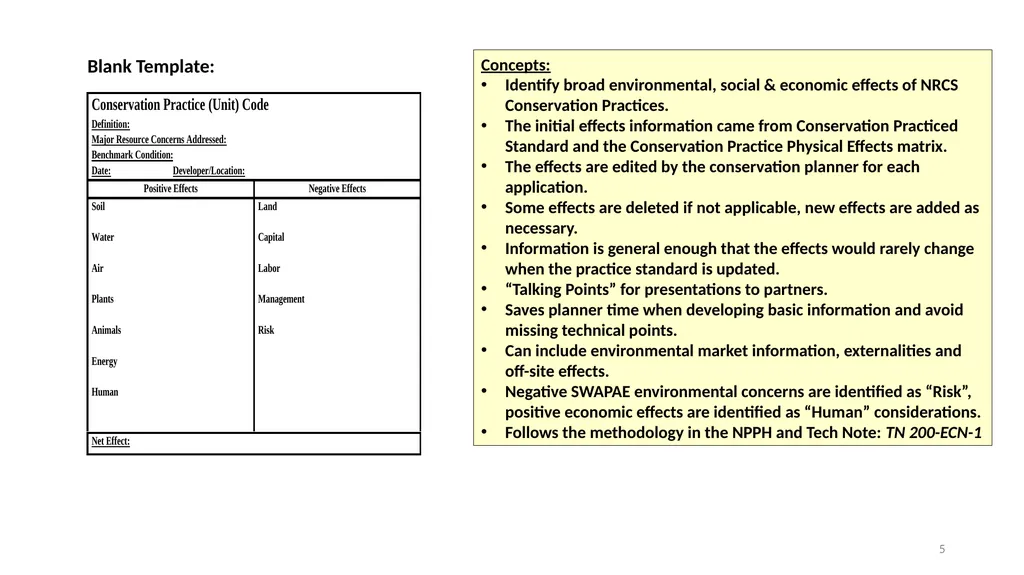
slide5. Blank Template: Concepts:
Identify broad environmental, social & economic effects of NRCS Conservation Practices.
The initial effects information came from Conservation Practiced Standard and the Conservation Practice Physical Effects matrix.
The effects are edited by the conservation planner for each application.
Some effects are deleted if not applicable, new effects are added as necessary.
Information is general enough that the effects would rarely change when the practice standard is updated.
“Talking Points” for presentations to partners.
Saves planner time when developing basic information and avoid missing technical points.
Can include environmental market information, externalities and off-site effects.
Negative SWAPAE environmental concerns are identified as “Risk”, positive economic effects are identified as “Human” considerations.
Follows the methodology in the NPPH and Tech Note: TN 200-ECN-1 5<br>
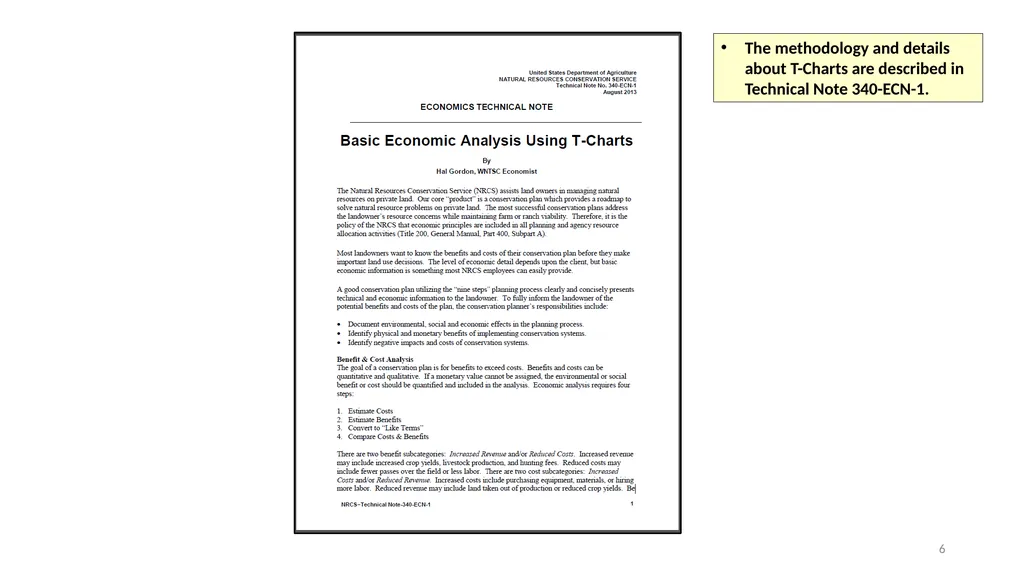
slide6. The methodology and details about T-Charts are described in Technical Note 340-ECN-1. 6<br>
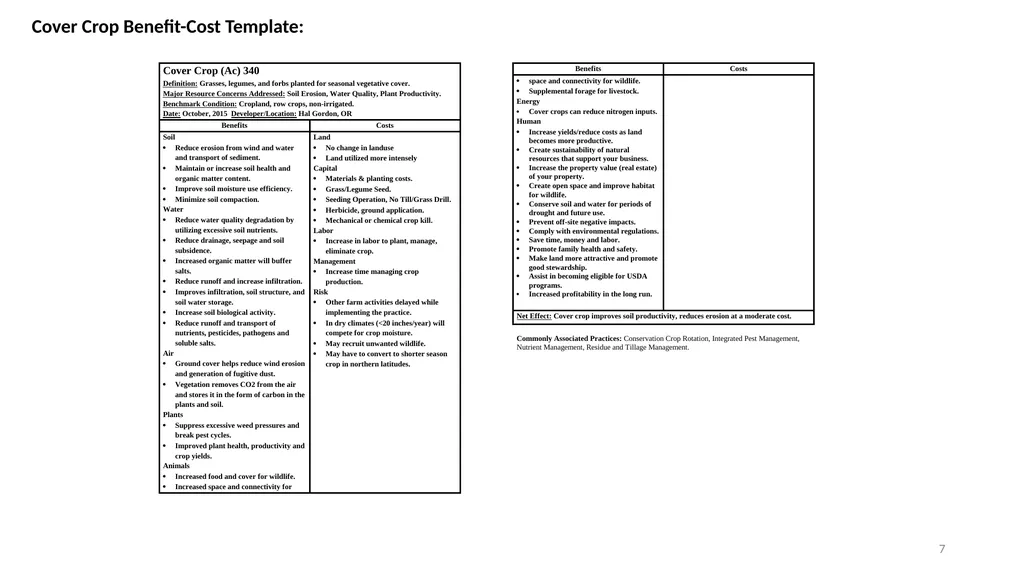
slide7. Cover Crop Benefit-Cost Template: 7<br>
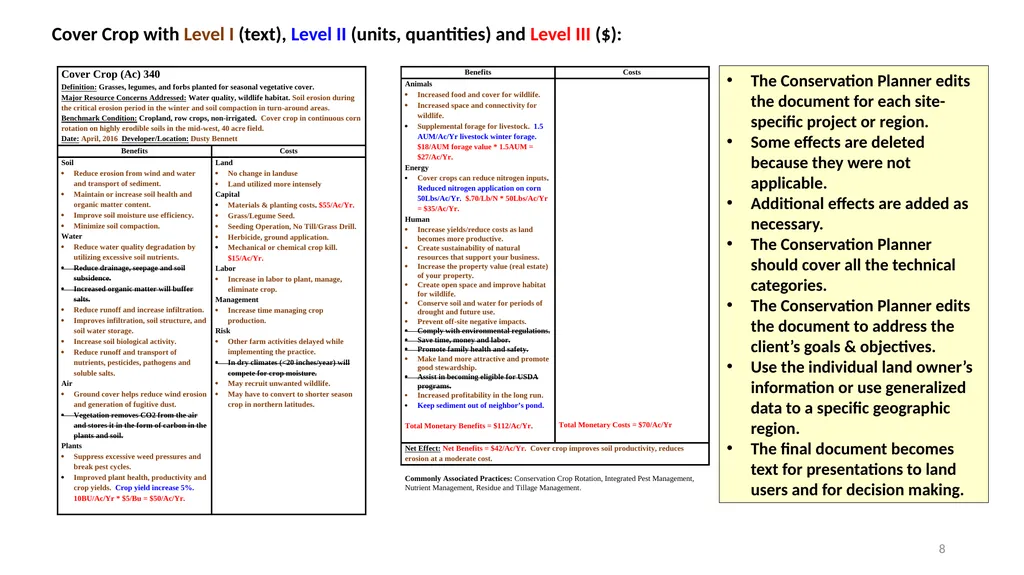
slide8. Cover Crop with Level I (text), Level II (units, quantities) and Level III ($): The Conservation Planner edits the document for each site-specific project or region.
Some effects are deleted because they were not applicable.
Additional effects are added as necessary.
The Conservation Planner should cover all the technical categories.
The Conservation Planner edits the document to address the client’s goals & objectives.
Use the individual land owner’s information or use generalized data to a specific geographic region.
The final document becomes text for presentations to land users and for decision making. 8<br>
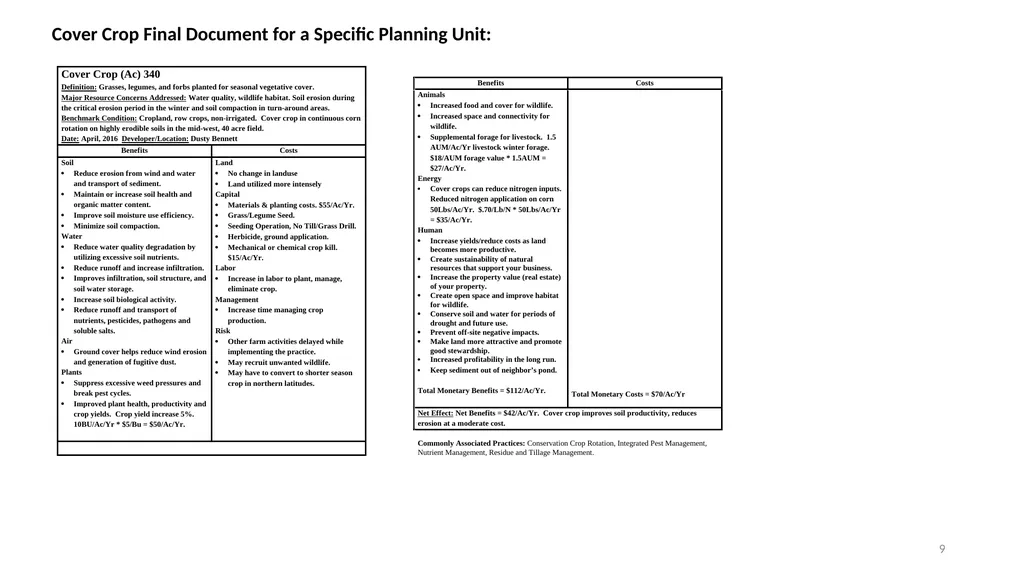
slide9. Cover Crop Final Document for a Specific Planning Unit: 9<br>
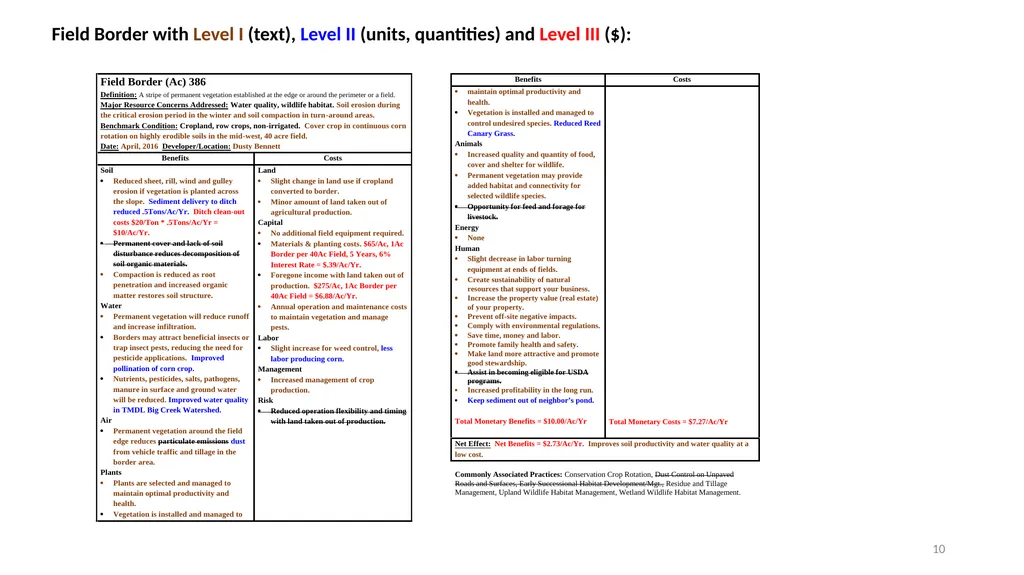
slide10. Field Border with Level I (text), Level II (units, quantities) and Level III ($): 10<br>
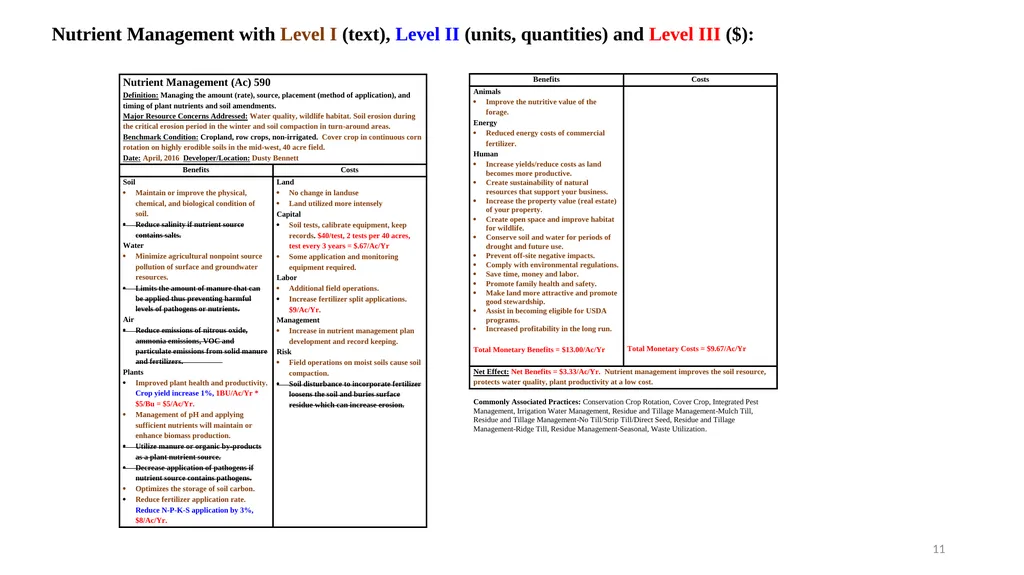
slide11. Nutrient Management with Level I (text), Level II (units, quantities) and Level III ($): 11<br>
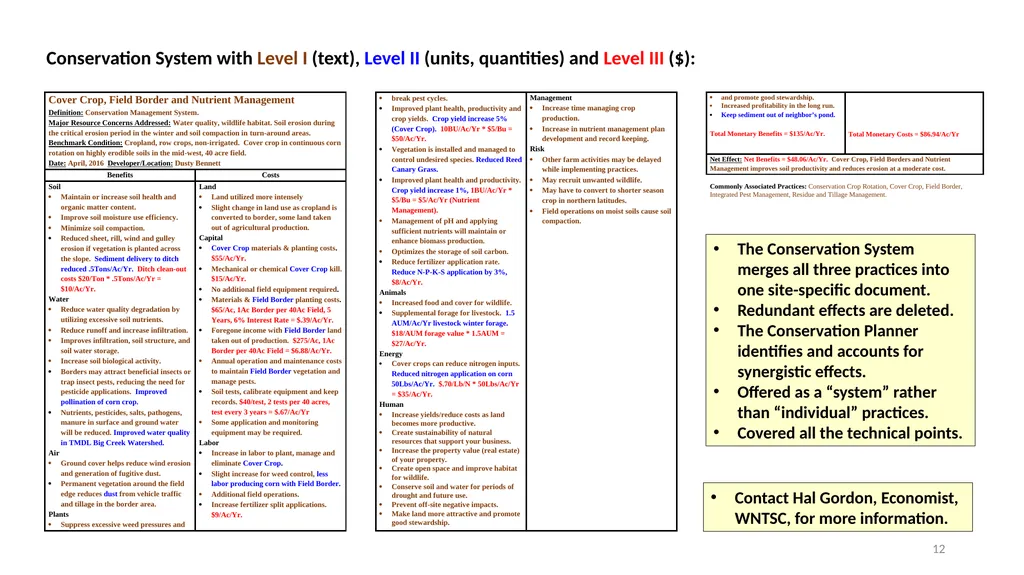
slide12. Conservation System with Level I (text), Level II (units, quantities) and Level III ($): The Conservation System merges all three practices into one site-specific document.
Redundant effects are deleted.
The Conservation Planner identifies and accounts for synergistic effects.
Offered as a “system” rather than “individual” practices.
Covered all the technical points. Contact Hal Gordon, Economist, WNTSC, for more information. 12<br>
slide13. T-Charts for All Conservation Practices:
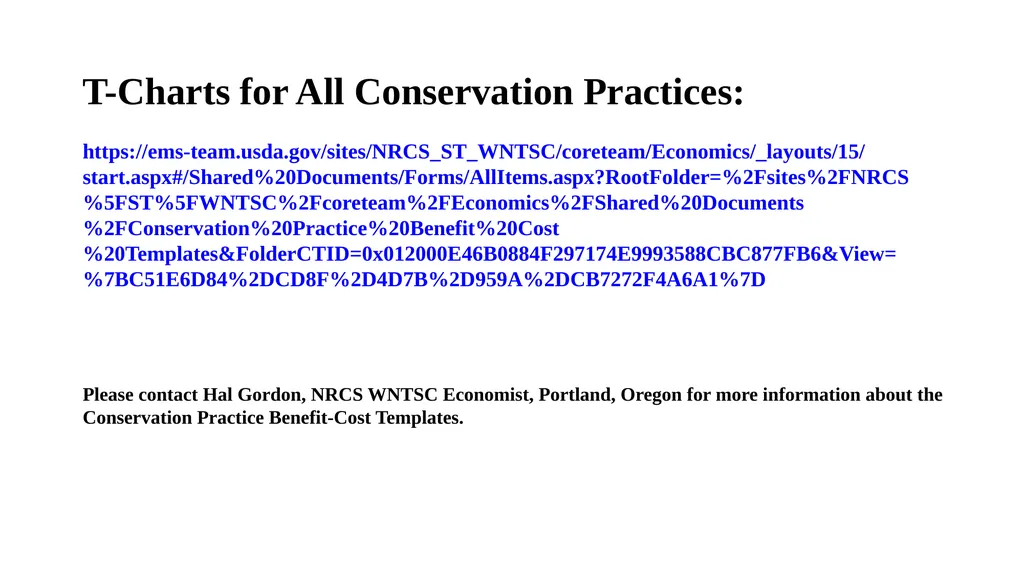
https://ems-team.usda.gov/sites/NRCS_ST_WNTSC/coreteam/Economics/_layouts/15/start.aspx#/Shared%20Documents/Forms/AllItems.aspx?RootFolder=%2Fsites%2FNRCS%5FST%5FWNTSC%2Fcoreteam%2FEconomics%2FShared%20Documents%2FConservation%20Practice%20Benefit%20Cost%20Templates&FolderCTID=0x012000E46B0884F297174E9993588CBC877FB6&View=%7BC51E6D84%2DCD8F%2D4D7B%2D959A%2DCB7272F4A6A1%7D Please contact Hal Gordon, NRCS WNTSC Economist, Portland, Oregon for more information about the Conservation Practice Benefit-Cost Templates.<br>
slide2. Conservation Practice Benefit-Cost Templates
Agricultural producers, landowners, NRCS conservation planners, NRCS leadership, the public and congress are always asking for the benefits, costs and economic analysis of NRCS’s activities – specifically about NRCS Conservation Practices and Conservation Systems. They want to know that NRCS’s practices are cost-effective. Economists have struggled to provide this information, often citing individual producer case studies that are site specific and only locally relevant.
For the first time, basic benefit-cost information has been identified for all 175 NRCS Conservation Practices in the form of one-page documents. Each document has the same format and data categories, making it is easy to compare practices. Each document contains general talking points about the conservation practice.
The conservation planner can easily review the document and discuss the benefits and costs of each conservation practice with the client. Each document contains qualitative information and does not contain units, numbers or dollar estimates. Quantitative data is added later when the planning site, resource concerns and goals and objectives of the client are identified.
Use of the templates in conservation planning is voluntary, they are not required documentation in the landowners case file. 2<br>
slide3. Conservation Practice Benefit-Cost Templates
The templates are used in the NRCS nine-step planning process as described in the National Planning Procedures Handbook and in Economics Technical Note: TN 200-ECN-1, Basic Economic Analysis Using T-Charts (August 2013).
The initial benefit-cost information came from the NRCS Conservation Practice Standard and the Conservation Practice Physical Effects Matrix. Additional quantitative data would come from the land user, conservation planner, technical specialist and local agricultural supply vendors and contractors.
NRCS can not guarantee every benefit and cost in the template will occur on every project, but we can say there is a high likelihood they will occur. Ultimately the conservation planner will determine the actual benefits, costs, probability and magnitude of occurrence.
The goal is to get approval for each practice template from the national discipline lead, then make the templates available to each NRCS State Office for editing and posting the templates to FOTG Section V, and using the templates in all conservation planning activities.
The templates are currently stored at the WNTSC Economics SharePoint, in the future they will be stored at the NRCS Economics Website. 3<br>
slide4. Conservation Practice Benefit-Cost Templates
The worksheets contain general talking points about conservation practices for the conservation planner to discuss with the land user and focus on the benefits and costs of each conservation practice.
Using this template is the first step towards an economic or financial analysis.
The second step would include identifying a specific site for analysis (farm, field or regional level), editing the template for local conditions, adding or deleting effects in the template relevant to the site, adding units and quantities of farm inputs and outputs.
The third step in the economic analysis is to place a dollar value on as many variables as possible, put all units in the same time frame (using amortization ($/Acres/Year) or net present value ($/Acre)) so benefits and costs can be compared. Data comes from the land user, conservation planner, technical specialist and local vendors.
The fourth and final step would be to combine several conservation practices into a conservation system, which is how most conservation practices are applied at the field level. 4<br>
slide5. Blank Template: Concepts:
Identify broad environmental, social & economic effects of NRCS Conservation Practices.
The initial effects information came from Conservation Practiced Standard and the Conservation Practice Physical Effects matrix.
The effects are edited by the conservation planner for each application.
Some effects are deleted if not applicable, new effects are added as necessary.
Information is general enough that the effects would rarely change when the practice standard is updated.
“Talking Points” for presentations to partners.
Saves planner time when developing basic information and avoid missing technical points.
Can include environmental market information, externalities and off-site effects.
Negative SWAPAE environmental concerns are identified as “Risk”, positive economic effects are identified as “Human” considerations.
Follows the methodology in the NPPH and Tech Note: TN 200-ECN-1 5<br>
slide6. The methodology and details about T-Charts are described in Technical Note 340-ECN-1. 6<br>
slide7. Cover Crop Benefit-Cost Template: 7<br>
slide8. Cover Crop with Level I (text), Level II (units, quantities) and Level III ($): The Conservation Planner edits the document for each site-specific project or region.
Some effects are deleted because they were not applicable.
Additional effects are added as necessary.
The Conservation Planner should cover all the technical categories.
The Conservation Planner edits the document to address the client’s goals & objectives.
Use the individual land owner’s information or use generalized data to a specific geographic region.
The final document becomes text for presentations to land users and for decision making. 8<br>
slide9. Cover Crop Final Document for a Specific Planning Unit: 9<br>
slide10. Field Border with Level I (text), Level II (units, quantities) and Level III ($): 10<br>
slide11. Nutrient Management with Level I (text), Level II (units, quantities) and Level III ($): 11<br>
slide12. Conservation System with Level I (text), Level II (units, quantities) and Level III ($): The Conservation System merges all three practices into one site-specific document.
Redundant effects are deleted.
The Conservation Planner identifies and accounts for synergistic effects.
Offered as a “system” rather than “individual” practices.
Covered all the technical points. Contact Hal Gordon, Economist, WNTSC, for more information. 12<br>
slide13. T-Charts for All Conservation Practices:
https://ems-team.usda.gov/sites/NRCS_ST_WNTSC/coreteam/Economics/_layouts/15/start.aspx#/Shared%20Documents/Forms/AllItems.aspx?RootFolder=%2Fsites%2FNRCS%5FST%5FWNTSC%2Fcoreteam%2FEconomics%2FShared%20Documents%2FConservation%20Practice%20Benefit%20Cost%20Templates&FolderCTID=0x012000E46B0884F297174E9993588CBC877FB6&View=%7BC51E6D84%2DCD8F%2D4D7B%2D959A%2DCB7272F4A6A1%7D Please contact Hal Gordon, NRCS WNTSC Economist, Portland, Oregon for more information about the Conservation Practice Benefit-Cost Templates.<br>