04
Struggle against Apartheid During 18th and 19th century,
Europe occupied South Africa,
Settled there
Applied system of apartheid, which divided country into three groups:
White, Black and Coloured (one migrated from india)<br>
05
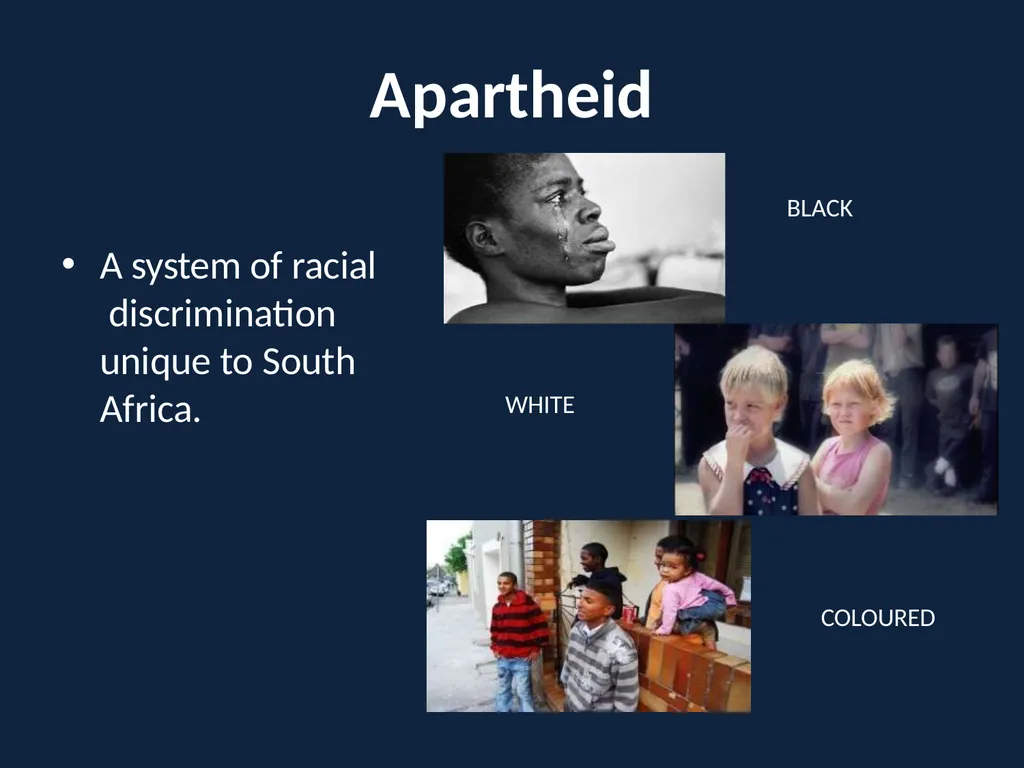
Apartheid A system of racial discrimination unique to South Africa. BLACK WHITE COLOURED<br>
06
Oppressive system for the Black Black were segregated(separated) by:
Forbidden from living in white areas
Could work in white areas if had permit
Discriminated while using public properties
Black could not visit church where white worshipped, form association and protest.<br>
07
African National Congress(ANC) Since 1950, blacks, coloured and Indians fought against this system
Including workers union, communist and sensitive whites joined them
In 1964, Nelson Mandela and seven other leaders were sentenced to life imprisonment.
But the white racist government continued to rule by torturing and killing thousands of black and colored.<br>
08
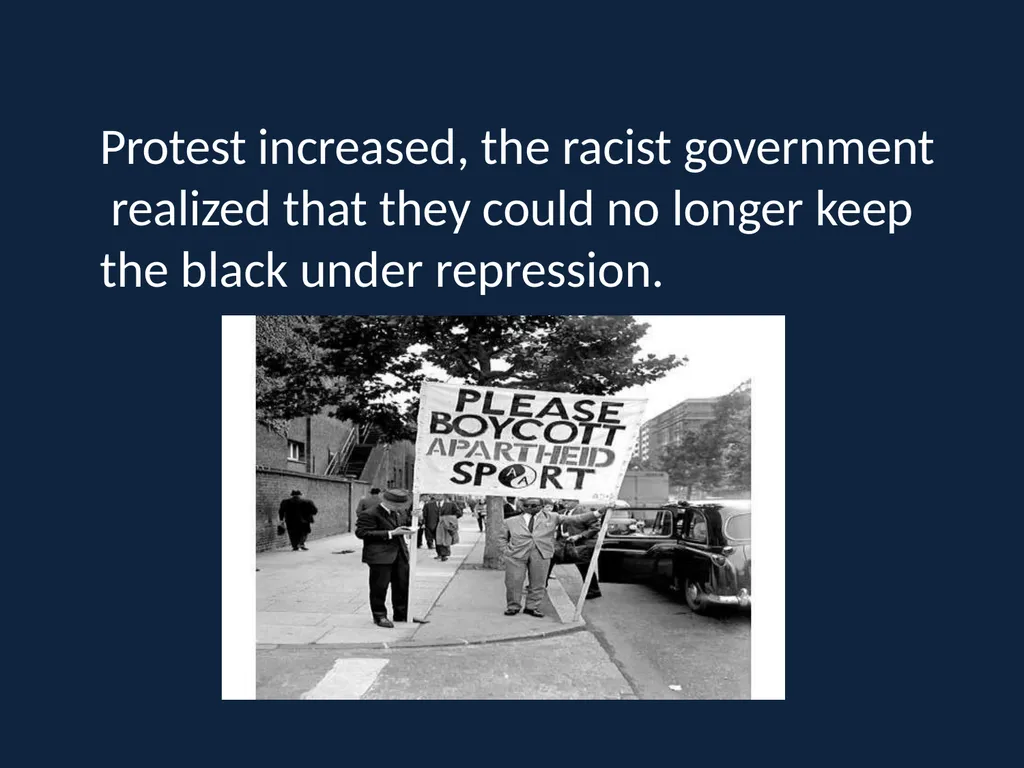
Protest increased, the racist government realized that they could no longer keep the black under repression.<br>
09
Racist government changed their policies: Discriminatory laws were repealed,
Ban on political parties and restriction on the media were lifted,
Nelson Mandela, was released from jail after 28 years of imprisonment.<br>
10
Towards a new constitution At the midnight of 26 April 1994, the Republic of South Africa ( a multi-racial gov.t )was born.
The black forgave the whites, both the blacks and whites decided to build a new S.A. based on equality of all races on democratic values, social justice and human rights.
After two years discussion and debates they draw a common constitution and gave to its citizen the most extensive rights available in any country.<br>
11
PREAMBLE (SOUTH AFRICA) We the people of South Africa Recognise the injustice of our past
Honour those who suffered for justice and freedom in our land;
Respect those who have worked to build and develop our country: and believe that South Africa belongs to all who live in it, united in our diversity
We therefore, through our freely elected representatives adopt this constitution as supreme law of the republic so as to-<br>
12
HEAL THE PAST AND ESTABLISH THE SOCIETY BASED ON DEMOCRATIC VALUES, SOCIAL JUSTICE AND FUNDAMENTAL HUMAN RIGHTS<br>
13
Together they decided Nobody should excluded
No one should be treated as a demon
Agreed that everybody should become part of solution
It inspired democrats all over the world.<br>
14
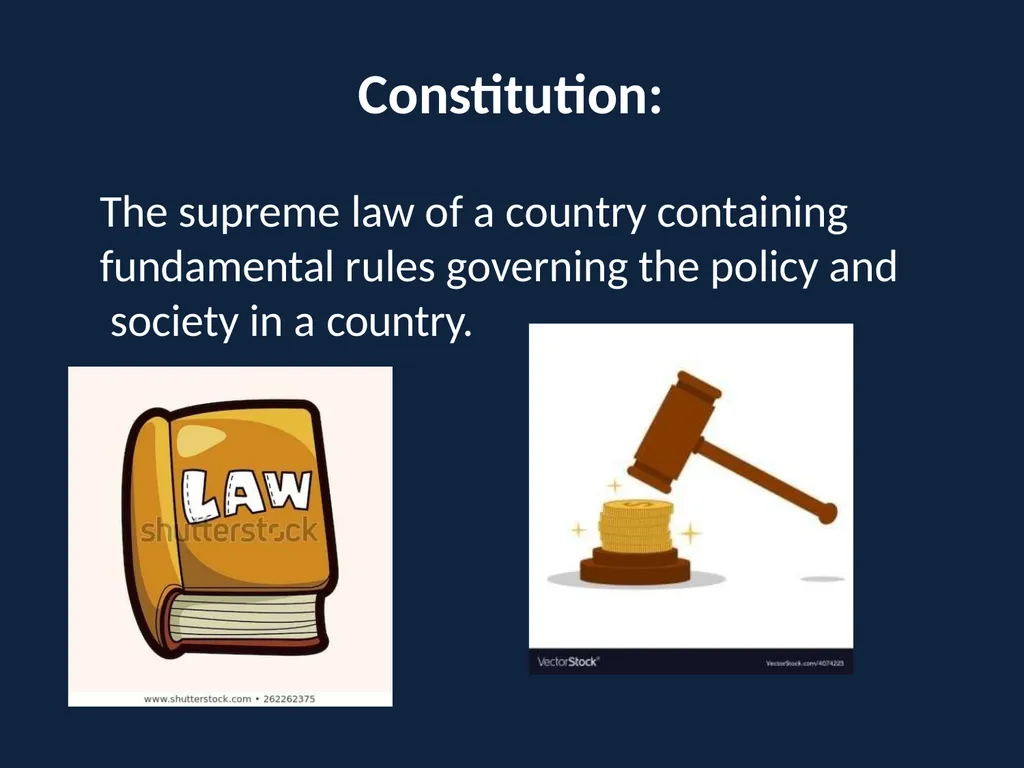
Constitution: The supreme law of a country containing fundamental rules governing the policy and society in a country.<br>
15
Importance of Constitution Trust and co-ordination
Specification: specifies how the government will be constituted. Who will have power to which decision
Right and duties: limits the power of government and tell rights of the citizens
Good Society: expressing the aspiration of the people about creating good society.<br>
17
Making of the Indian constitution difficult and certain task<br>
18
Problem faced while making Indian constitution India was huge and diverse country
The country was divided on the basis of religions differences
The merger of princely states with India or Pakistan or remain independent was difficult to decide.
The future of the country was seen not much secure to make constitution<br>
19
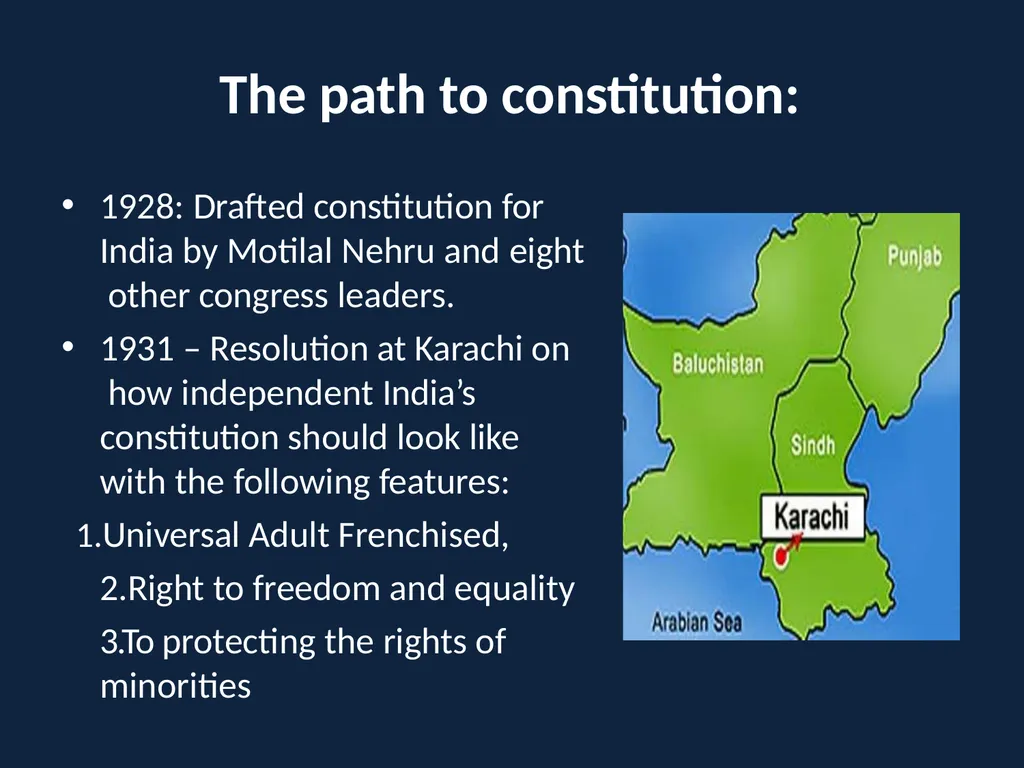
The path to constitution: 1928: Drafted constitution for India by Motilal Nehru and eight other congress leaders.
1931 – Resolution at Karachi on how independent India’s constitution should look like with the following features:
Universal Adult Frenchised, 2.Right to freedom and equality
3.To protecting the rights of minorities<br>
20
Many educated Indians were familiarized with the political and legislative institution during the colonial(British) rule.
Years of thinking and deliberation on the framework of the constitution had another benefit.<br>
21
Many of the leaders were inspired by the ideals of the French Revolution,
the Socialist Revolution in Russia etc.
the practice of parliamentary democracy of Britain
the bill of rights in US
but they didn’t simply imitate these principles.<br>
22
The Constituent Assembly (1946) The drafting of the constitution was done by an assembly of elected representatives
(299 members) called the constituent assembly keeping the following points in mind.
1.Universal adult franchise 2.Right ot freedom
3.Equality and to protecting the rights of minorities.<br>
23
The assembly was dominated by the Indian Nationalist Congress(I.N.C.) It has many non- congress members.
The constitution doesn’t reflect the views of its members alone, it expresses the aspiration of all people.<br>
24
Elections to the constitution Elections to the constituent assembly were held in July 1946 and its first meeting in December 1946.
After wards the country was divided into India and Pakistan.
The constituent Assembly that wrote the Indian constitution had 299 members.
A drafting committee chaired by Dr. B.R.Ambedkar prepared a draft constitution for discussion.
It was discussed clause by clause through several rounds of discussions.
The assembly adopted the constitution on 26th November 1949 and came into effect on 26th January 1950.<br>
25
Why should we accept this constitution? Over the last 64 years, no large social group or political party has ever questioned the legitimacy of the constitution.
Constituent assembly represented the people of India, no universal adult franchise but fair geographical share of members from all the regions of the country.
Assembly represented members from different language groups, castes, classes, religion and occupation.
Finally, the constituent assembly worked in a systematic, open and consensual manner.<br>
26
Indian constitution More than two thousand amendments were considered
The members deliberated for 114 days spread over three years.
Every document and word spoken in constituent assembly has been recorded and preserved which is called ‘CONSTITUENT
ASSEMBLY DEBATE’. These debates provide are
12 bulky volumes!<br>
27
Guiding Values of the Indian Constitution: We can understand the constitution of India through two ways :
By reading the views of some of major leaders on constitution
By understanding what the constitution says about its own philosophy.<br>
28
The dreams and the promises: Mahatma Gandhi in his magazine Young India in 1931, spelt out what he wanted the Constitution to do
B.R.Ambedkar criticized Mahatma Gandhi and his vision
Jawaharlal Nehru gave speech on midnight of august 15 1947: he stated when the world sleep, India will awake to life and freedom. Freedom and power brings responsibilities, Service of India means service of the millions who suffer, the ambition of the greatest man of our generation has been to wipe every tear from every eye.<br>
29
Preamble: The constitution begins with the short statement of its basic values. This is called the Preamble to the constitution.<br>
30
Constitution of India: Very long and detailed document
Amended quite regularly to keep updated
It lays down a procedure for choosing person to govern the country
Defines who will have how much power to take decisions
Put limits to what the government can do by providing some rights to the citizen that cannot be violated.
•<br>
31
ANY ADDITION…….. Thank you!<br>