
CONSTRUCTION OF AN ACHIEVEMENT TEST Dr.


Description: CONSTRUCTION OF AN ACHIEVEMENT TEST Dr. P.SUBRAMANIAN Assistant Professor Department of Educational Planning and Administration Tamil Nadu Teachers Education University Chennai 600 097. INTRODUCTION Evaluation is a comprehensive process.
Related Topics
Download Presentation
"CONSTRUCTION OF AN ACHIEVEMENT TEST Dr." is the property of its rightful owner. Permission is granted to download and print the materials on this website for personal, non-commercial use only, and to display it on your personal computer provided you do not modify the materials and that you retain all copyright notices contained in the materials. By downloading content from our website, you accept the terms of this agreement.
Presentation Transcript
slide1. CONSTRUCTION OF AN ACHIEVEMENT TEST Dr. P.SUBRAMANIAN
Assistant Professor
Department of Educational Planning and Administration
Tamil Nadu Teachers Education University
Chennai – 600 097.<br>
slide2. INTRODUCTION Evaluation is a comprehensive process. For evaluating the total personality of the student, we need to employ a wide variety of psychological tools. As classroom teachers, we are interested only in the achievement of students in the subject taught to them. For finding the achievement of students, different types of tools are employed.<br>
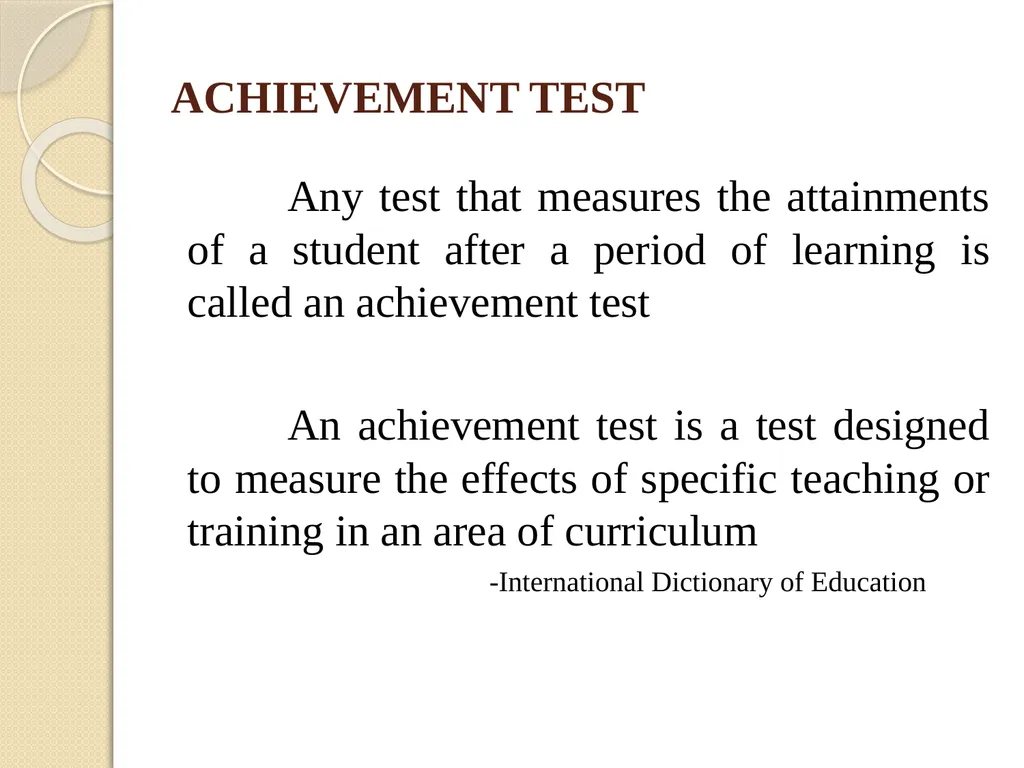
slide3. ACHIEVEMENT TEST Any test that measures the attainments of a student after a period of learning is called an achievement test
An achievement test is a test designed to measure the effects of specific teaching or training in an area of curriculum
-International Dictionary of Education<br>
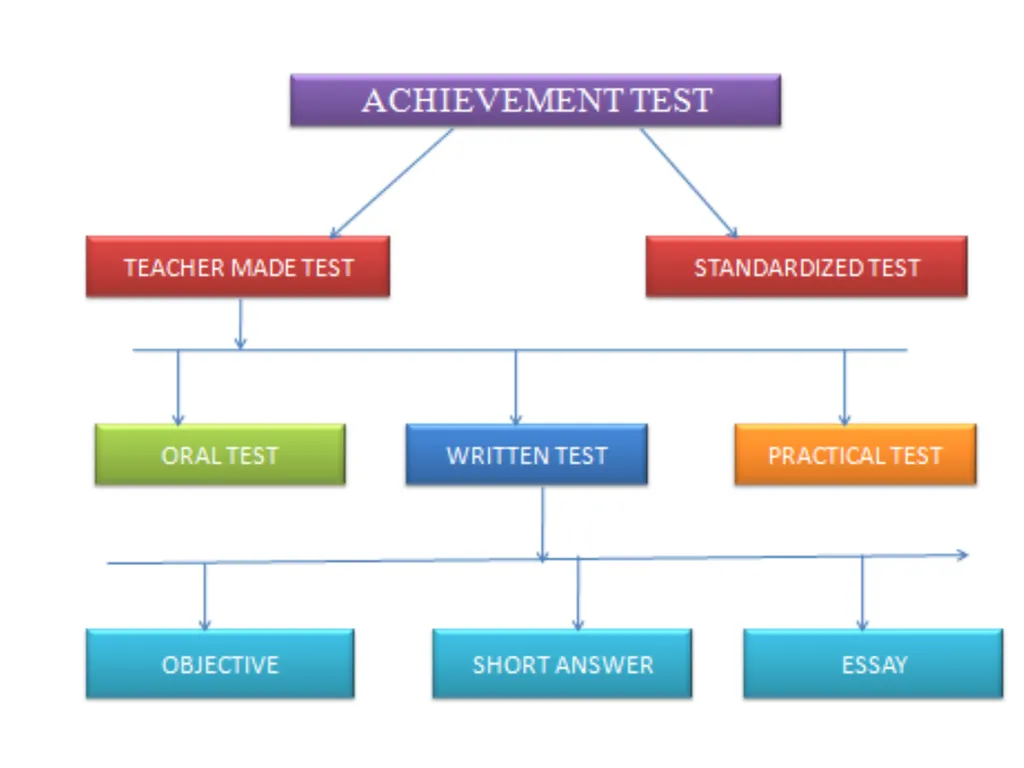
slide5. STANDARDIZED TEST A standardized test is a test consisting of carefully selected test items after having been given to a number of samples under standard conditions.<br>
slide6. ORAL TEST Extensively used in lower classes.
In higher classes, Oral test can be used in science practical examination.
Viva-voce examination.
To get immediate feedback from the students on the information provided to them.<br>
slide7. ESSAY TEST Essay tests demand long answers.
Students has to organise and express ideas in writing clearly and concisely.
Lot of subjectivity is involved in evaluation of the answer script.
Extraneous factors like neatness in presentation and good hand writing play a part.<br>
slide8. SHORT ANSWER TYPE QUESTIONS Questions demand answer in a paragraph or few sentences are asked in this category.
Students select the relevant information or facts which explain a particular situation for answering the questions.
e.g. State the Faraday’s law or electrolysis.<br>
slide9. OBJECTIVE TYPE TEST An objective test is so named because the system of scoring is objective rather than subjective as in the case of an essay test.
It require specific answers in one or two words.
In fact a lot of thought and care is involved in the framing of objective type items.<br>
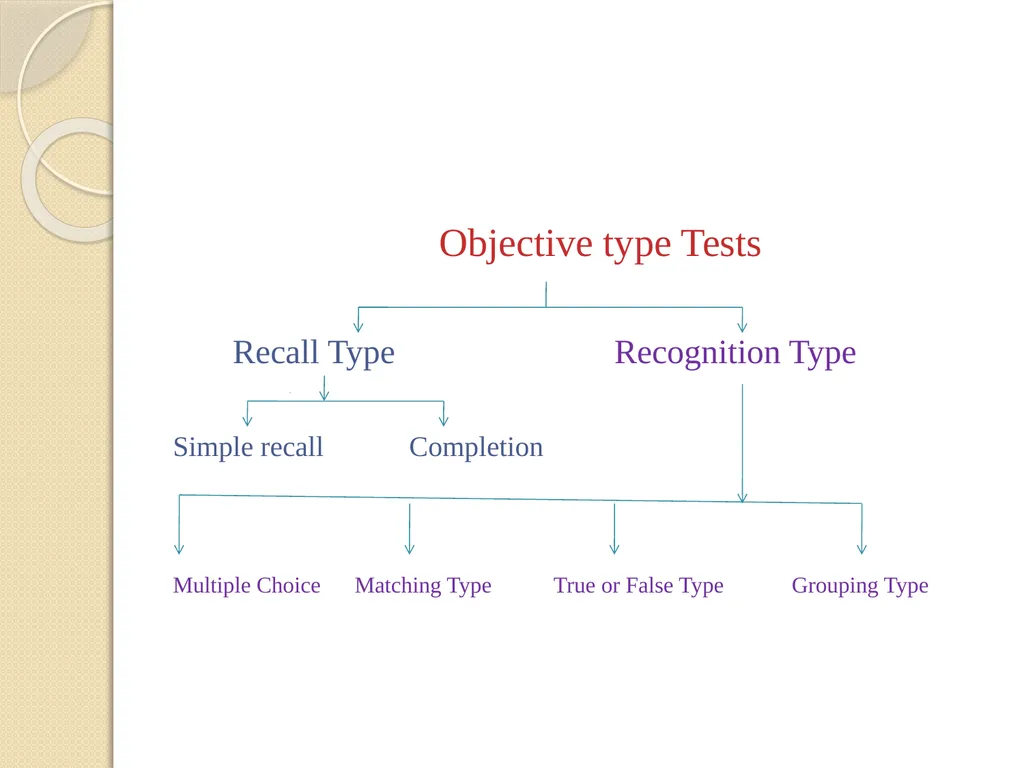
slide10. Objective type Tests
Recall Type Recognition Type
Simple recall Completion
Multiple Choice Matching Type True or False Type Grouping Type<br>
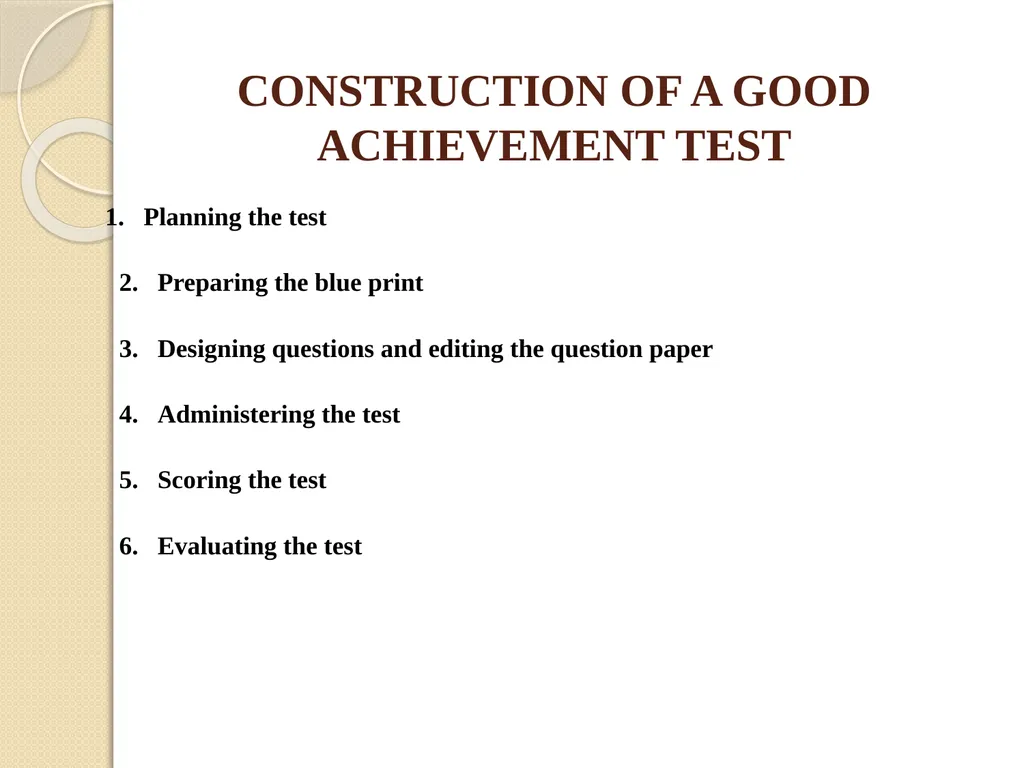
slide11. CONSTRUCTION OF A GOOD ACHIEVEMENT TEST 1. Planning the test
2. Preparing the blue print
3. Designing questions and editing the question paper
4. Administering the test
5. Scoring the test
6. Evaluating the test<br>
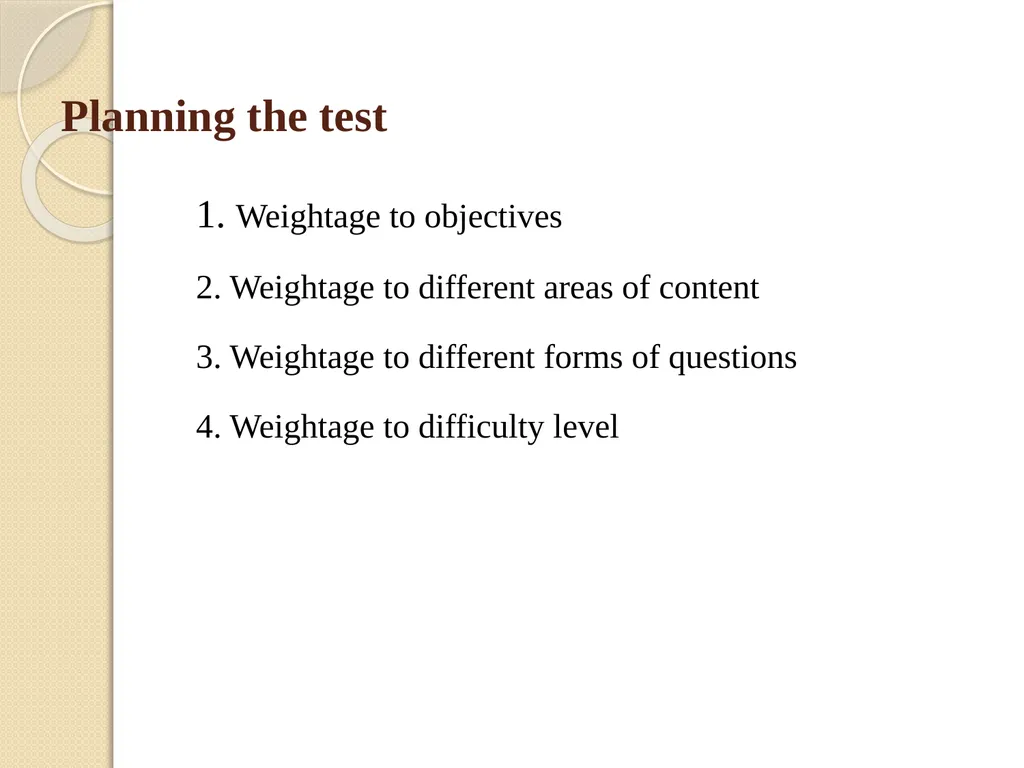
slide12. Planning the test 1. Weightage to objectives 2. Weightage to different areas of content 3. Weightage to different forms of questions 4. Weightage to difficulty level<br>
slide13. Weightage to objectives The main task is to decide the weightage to be given to the different objectives formulated while teaching the unit. Out of total marks for which the question paper is set, what is the weightage given to various objectives must be decided.<br>
slide14. Weightage to different areas of content Having decided the number of topics to be tested, the teacher has to distribute the total marks to every topic, giving due weightage to the topics based on its importance.<br>
slide15. Weightage to different forms of questions Although different forms of tests are available, every type of test has got advantages and limitations. Hence in testing the learning outcomes, essay type, short-answer type and objective type questions may be used.
How much weightage to be given for different types of questions should be decided.<br>
slide16. Weightage to difficulty level Easy
Average
Difficult<br>
slide17. Preparing the blue print The three dimensional chart covers the following
a. Objectives to be tested
b. Subject matter to be covered
c. The form of questions<br>
slide18. Blue print The blue print is a three dimensional chart showing the weightages given for objectives, content and form of questions.
Blue print is a document which gives a complete functional picture of the test.<br>
slide19. Designing questions The next step is to design questions on the basis of the blueprint. It necessitates the following
a. Defining the objectives
b. Changing the objectives to specifications
c. Complete knowledge of the subject matter<br>
slide20. Editing the question paper This step consists of the following measures 1. Assembling the questions on the basis of their form e.g. Section A-Objective type
Section B-Short Answer
Section C-Essay Type<br>
slide21. 2. Instructions to the students: General instructions may be given at the beginning of a question paper.
3. Implications to teachers: This facilitates objective testing and scoring.<br>
slide22. Administering the test This involves predetermining among other things, time of testing, place of testing and giving of instructions.<br>
slide23. Scoring key and marking scheme A scoring key is prepared for the objective questions, and a marking scheme is made for the essay and short questions. A marking scheme is essential as it indicates
The number of points or steps expected in the answer
The outline of each point or step expected in the answer
The weightage to each of these points or steps<br>
slide24. Standardizing the test In evaluating a test, a few questions need to be asked. If the scores are extremely high, it may assume that the test was too easy for the class. If the scores seem very low, the test was probably too difficult. A review of the question paper necessitates three steps:<br>
slide25. a. Question wise analysis (before the test)
b. Critical evaluation of the test (before the test)
c. Item analysis (after the test)<br>
slide26. Question wise analysis
Each question is analyzed according to objective, specification, topic, question type and form, estimated difficulty level, time needed, and marks allotted.<br>
slide27. Critical evaluation
It is used to avoid any duplication, spelling mistakes, ambiguities that may exist in the paper. A qualitative and quantitative assessment of the test should be done.<br>
slide28. REFERENCES Mohan Radha, (2002). Innovative Science Teaching for Physical Science Teachers. New Delhi:Prentice Hall of India Private Limited.
Sharma, R.A.(2007). Essential of Educational Technology and Management. Meerut:R.Lall Book Depot.
http://gsamutha.blogspot.in/2013/11/constructionof-good-achievement-test.html<br>
slide29. THANK YOU<br>
Assistant Professor
Department of Educational Planning and Administration
Tamil Nadu Teachers Education University
Chennai – 600 097.<br>
slide2. INTRODUCTION Evaluation is a comprehensive process. For evaluating the total personality of the student, we need to employ a wide variety of psychological tools. As classroom teachers, we are interested only in the achievement of students in the subject taught to them. For finding the achievement of students, different types of tools are employed.<br>
slide3. ACHIEVEMENT TEST Any test that measures the attainments of a student after a period of learning is called an achievement test
An achievement test is a test designed to measure the effects of specific teaching or training in an area of curriculum
-International Dictionary of Education<br>
slide5. STANDARDIZED TEST A standardized test is a test consisting of carefully selected test items after having been given to a number of samples under standard conditions.<br>
slide6. ORAL TEST Extensively used in lower classes.
In higher classes, Oral test can be used in science practical examination.
Viva-voce examination.
To get immediate feedback from the students on the information provided to them.<br>
slide7. ESSAY TEST Essay tests demand long answers.
Students has to organise and express ideas in writing clearly and concisely.
Lot of subjectivity is involved in evaluation of the answer script.
Extraneous factors like neatness in presentation and good hand writing play a part.<br>
slide8. SHORT ANSWER TYPE QUESTIONS Questions demand answer in a paragraph or few sentences are asked in this category.
Students select the relevant information or facts which explain a particular situation for answering the questions.
e.g. State the Faraday’s law or electrolysis.<br>
slide9. OBJECTIVE TYPE TEST An objective test is so named because the system of scoring is objective rather than subjective as in the case of an essay test.
It require specific answers in one or two words.
In fact a lot of thought and care is involved in the framing of objective type items.<br>
slide10. Objective type Tests
Recall Type Recognition Type
Simple recall Completion
Multiple Choice Matching Type True or False Type Grouping Type<br>
slide11. CONSTRUCTION OF A GOOD ACHIEVEMENT TEST 1. Planning the test
2. Preparing the blue print
3. Designing questions and editing the question paper
4. Administering the test
5. Scoring the test
6. Evaluating the test<br>
slide12. Planning the test 1. Weightage to objectives 2. Weightage to different areas of content 3. Weightage to different forms of questions 4. Weightage to difficulty level<br>
slide13. Weightage to objectives The main task is to decide the weightage to be given to the different objectives formulated while teaching the unit. Out of total marks for which the question paper is set, what is the weightage given to various objectives must be decided.<br>
slide14. Weightage to different areas of content Having decided the number of topics to be tested, the teacher has to distribute the total marks to every topic, giving due weightage to the topics based on its importance.<br>
slide15. Weightage to different forms of questions Although different forms of tests are available, every type of test has got advantages and limitations. Hence in testing the learning outcomes, essay type, short-answer type and objective type questions may be used.
How much weightage to be given for different types of questions should be decided.<br>
slide16. Weightage to difficulty level Easy
Average
Difficult<br>
slide17. Preparing the blue print The three dimensional chart covers the following
a. Objectives to be tested
b. Subject matter to be covered
c. The form of questions<br>
slide18. Blue print The blue print is a three dimensional chart showing the weightages given for objectives, content and form of questions.
Blue print is a document which gives a complete functional picture of the test.<br>
slide19. Designing questions The next step is to design questions on the basis of the blueprint. It necessitates the following
a. Defining the objectives
b. Changing the objectives to specifications
c. Complete knowledge of the subject matter<br>
slide20. Editing the question paper This step consists of the following measures 1. Assembling the questions on the basis of their form e.g. Section A-Objective type
Section B-Short Answer
Section C-Essay Type<br>
slide21. 2. Instructions to the students: General instructions may be given at the beginning of a question paper.
3. Implications to teachers: This facilitates objective testing and scoring.<br>
slide22. Administering the test This involves predetermining among other things, time of testing, place of testing and giving of instructions.<br>
slide23. Scoring key and marking scheme A scoring key is prepared for the objective questions, and a marking scheme is made for the essay and short questions. A marking scheme is essential as it indicates
The number of points or steps expected in the answer
The outline of each point or step expected in the answer
The weightage to each of these points or steps<br>
slide24. Standardizing the test In evaluating a test, a few questions need to be asked. If the scores are extremely high, it may assume that the test was too easy for the class. If the scores seem very low, the test was probably too difficult. A review of the question paper necessitates three steps:<br>
slide25. a. Question wise analysis (before the test)
b. Critical evaluation of the test (before the test)
c. Item analysis (after the test)<br>
slide26. Question wise analysis
Each question is analyzed according to objective, specification, topic, question type and form, estimated difficulty level, time needed, and marks allotted.<br>
slide27. Critical evaluation
It is used to avoid any duplication, spelling mistakes, ambiguities that may exist in the paper. A qualitative and quantitative assessment of the test should be done.<br>
slide28. REFERENCES Mohan Radha, (2002). Innovative Science Teaching for Physical Science Teachers. New Delhi:Prentice Hall of India Private Limited.
Sharma, R.A.(2007). Essential of Educational Technology and Management. Meerut:R.Lall Book Depot.
http://gsamutha.blogspot.in/2013/11/constructionof-good-achievement-test.html<br>
slide29. THANK YOU<br>