
CONSULAR PROTECTION FOR MIGRANT WORKERS WORKSHOP
AM
Published · 29 slides · 0 views
1 / 1
Description
CONSULAR PROTECTION FOR MIGRANT WORKERS WORKSHOP Panama City, Panama 2526 April 2018 Session 9 Conflict Dynamics and Management: Negotiation and Mediation What is conflict? Conflict Conflict can be defined as: A process produced by a real
Related Topics
Share
Embed code
Download this presentation From Below
"CONSULAR PROTECTION FOR MIGRANT WORKERS WORKSHOP" is the property of its rightful owner. Permission is granted to download and print the materials on this website for personal, non-commercial use only, and to display it on your personal computer provided you do not modify the materials and that you retain all copyright notices contained in the materials. By downloading content from our website, you accept the terms of this agreement.
Presentation Transcript
01
CONSULAR PROTECTION
FOR MIGRANT WORKERS WORKSHOP Panama City, Panama
25–26 April 2018<br>
FOR MIGRANT WORKERS WORKSHOP Panama City, Panama
25–26 April 2018<br>
02
Session 9
Conflict Dynamics and Management:
Negotiation and Mediation<br>
Conflict Dynamics and Management:
Negotiation and Mediation<br>
03
What is conflict?<br>
04
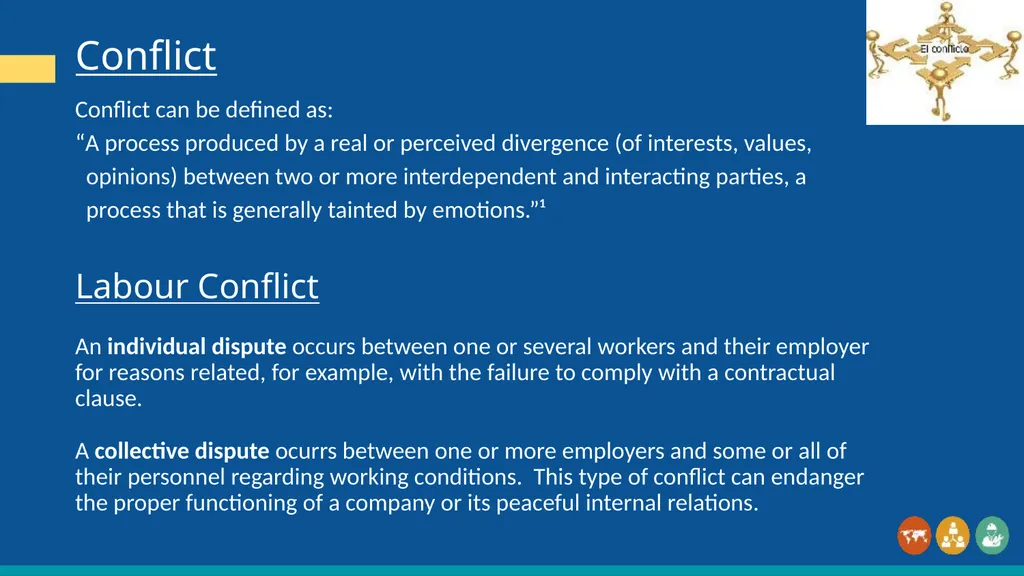
Conflict Conflict can be defined as:
“A process produced by a real or perceived divergence (of interests, values, opinions) between two or more interdependent and interacting parties, a process that is generally tainted by emotions.”¹ Labour Conflict
An individual dispute occurs between one or several workers and their employer for reasons related, for example, with the failure to comply with a contractual clause. A collective dispute ocurrs between one or more employers and some or all of their personnel regarding working conditions. This type of conflict can endanger the proper functioning of a company or its peaceful internal relations.<br>
“A process produced by a real or perceived divergence (of interests, values, opinions) between two or more interdependent and interacting parties, a process that is generally tainted by emotions.”¹ Labour Conflict
An individual dispute occurs between one or several workers and their employer for reasons related, for example, with the failure to comply with a contractual clause. A collective dispute ocurrs between one or more employers and some or all of their personnel regarding working conditions. This type of conflict can endanger the proper functioning of a company or its peaceful internal relations.<br>
05
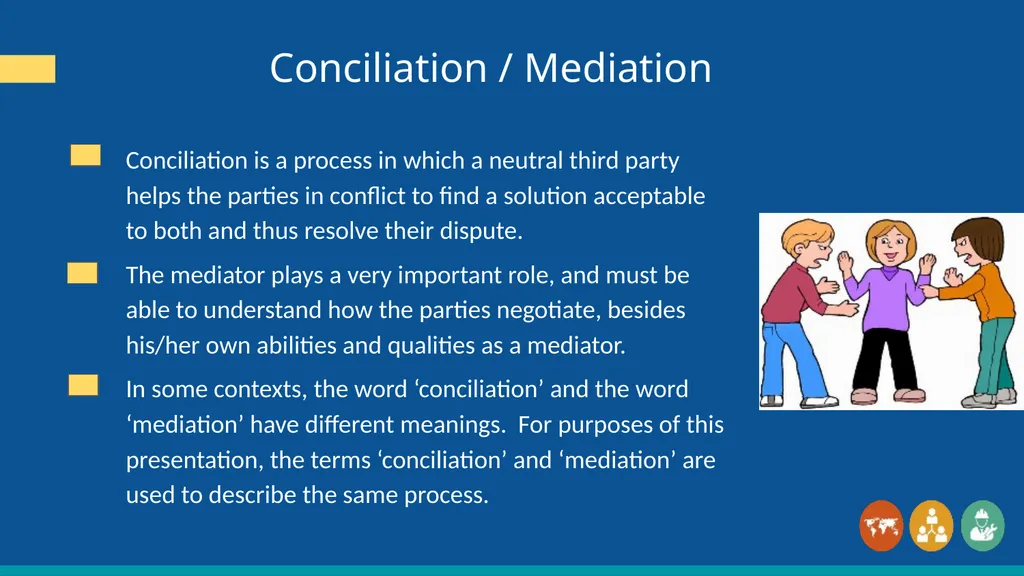
Conciliation / Mediation Conciliation is a process in which a neutral third party helps the parties in conflict to find a solution acceptable to both and thus resolve their dispute.
The mediator plays a very important role, and must be able to understand how the parties negotiate, besides his/her own abilities and qualities as a mediator.
In some contexts, the word ‘conciliation’ and the word ‘mediation’ have different meanings. For purposes of this presentation, the terms ‘conciliation’ and ‘mediation’ are used to describe the same process.<br>
The mediator plays a very important role, and must be able to understand how the parties negotiate, besides his/her own abilities and qualities as a mediator.
In some contexts, the word ‘conciliation’ and the word ‘mediation’ have different meanings. For purposes of this presentation, the terms ‘conciliation’ and ‘mediation’ are used to describe the same process.<br>
06
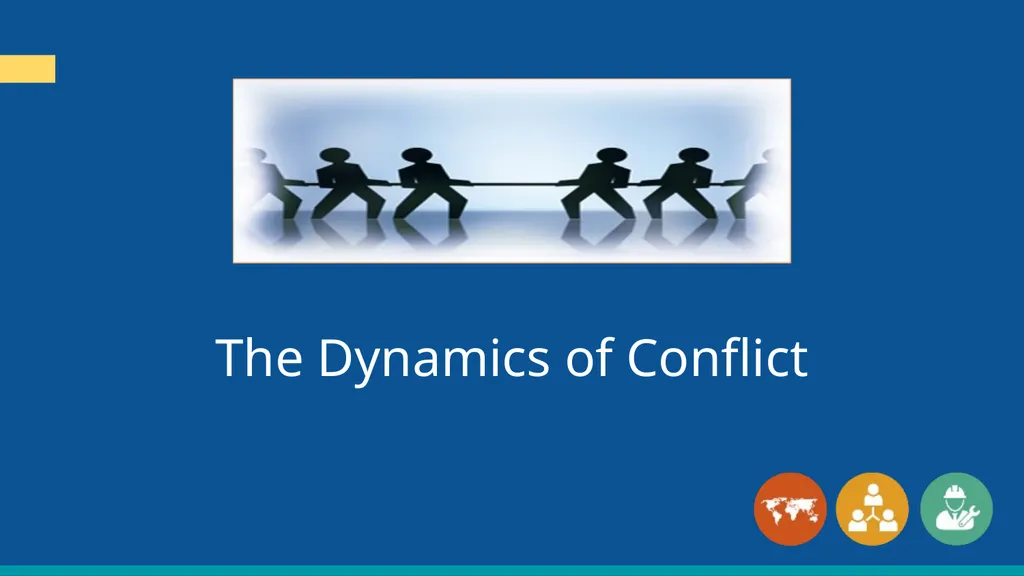
The Dynamics of Conflict<br>
07
A conflict can be:
- Real or imaginary.
- Manifest (open) or hidden (latent).
- A real and open conflict can be eradicated.
- Handled by preventing the development of discrepancies between the parties in conflict. How to identify the moment whan a conflict arises?
How can it be avoided?
What are the causes and the nature of the conflict?
How to prevent it and how to resolve it?<br>
- Real or imaginary.
- Manifest (open) or hidden (latent).
- A real and open conflict can be eradicated.
- Handled by preventing the development of discrepancies between the parties in conflict. How to identify the moment whan a conflict arises?
How can it be avoided?
What are the causes and the nature of the conflict?
How to prevent it and how to resolve it?<br>
08
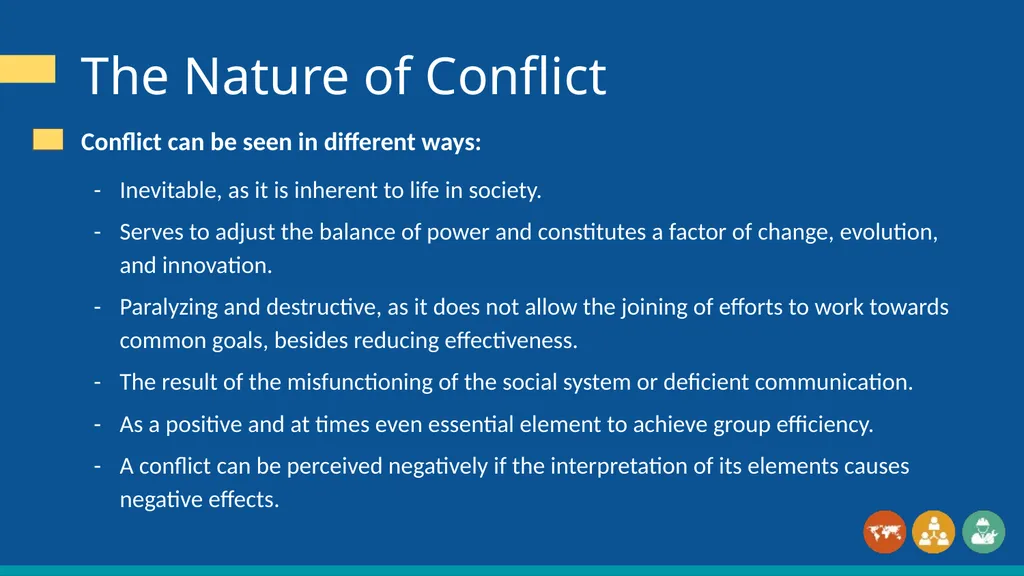
The Nature of Conflict Conflict can be seen in different ways:
- Inevitable, as it is inherent to life in society.
- Serves to adjust the balance of power and constitutes a factor of change, evolution, and innovation.
- Paralyzing and destructive, as it does not allow the joining of efforts to work towards common goals, besides reducing effectiveness.
- The result of the misfunctioning of the social system or deficient communication.
- As a positive and at times even essential element to achieve group efficiency.
- A conflict can be perceived negatively if the interpretation of its elements causes negative effects.<br>
- Inevitable, as it is inherent to life in society.
- Serves to adjust the balance of power and constitutes a factor of change, evolution, and innovation.
- Paralyzing and destructive, as it does not allow the joining of efforts to work towards common goals, besides reducing effectiveness.
- The result of the misfunctioning of the social system or deficient communication.
- As a positive and at times even essential element to achieve group efficiency.
- A conflict can be perceived negatively if the interpretation of its elements causes negative effects.<br>
09
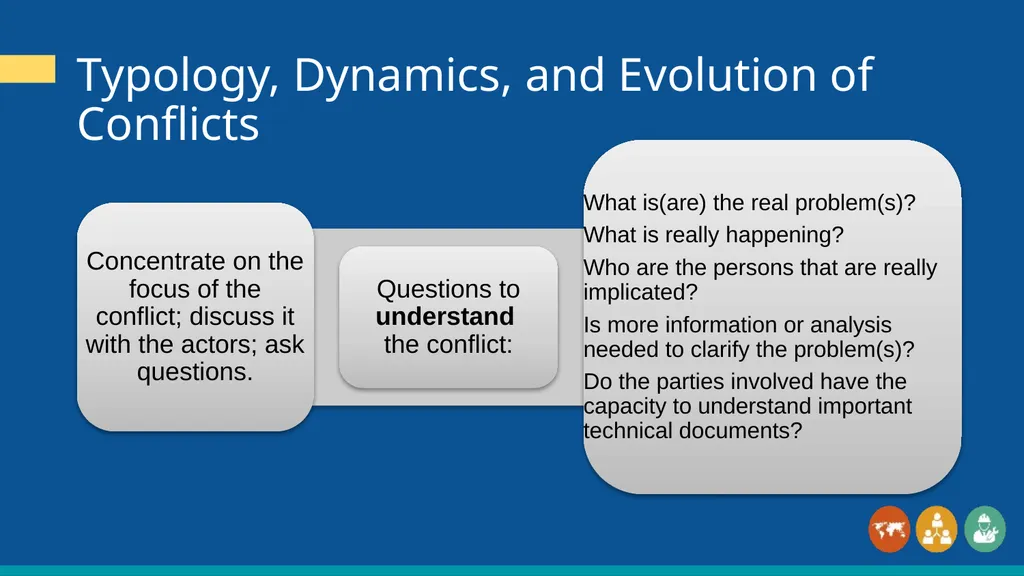
Typology, Dynamics, and Evolution of Conflicts<br>
10
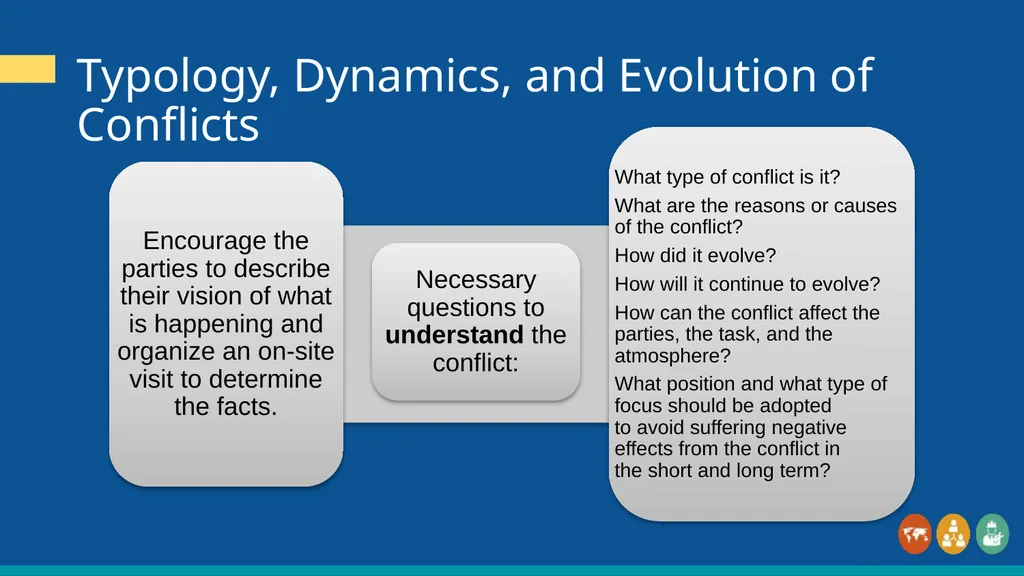
Typology, Dynamics, and Evolution of Conflicts<br>
11
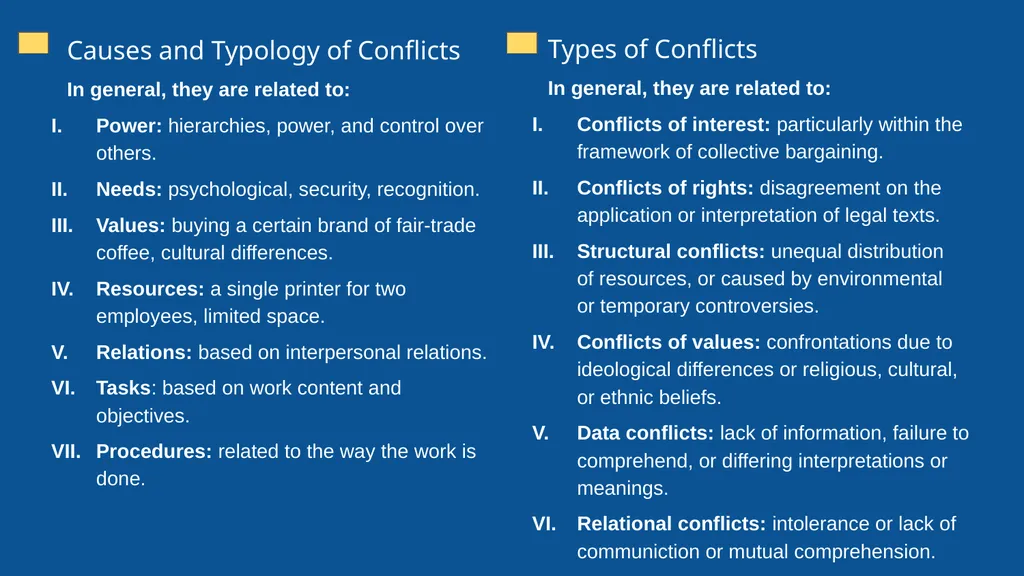
Causes and Typology of Conflicts
In general, they are related to:
Power: hierarchies, power, and control over others.
Needs: psychological, security, recognition.
Values: buying a certain brand of fair-trade coffee, cultural differences.
Resources: a single printer for two employees, limited space.
Relations: based on interpersonal relations.
Tasks: based on work content and objectives.
Procedures: related to the way the work is done. Types of Conflicts
In general, they are related to:
Conflicts of interest: particularly within the framework of collective bargaining.
Conflicts of rights: disagreement on the application or interpretation of legal texts.
Structural conflicts: unequal distribution of resources, or caused by environmental or temporary controversies.
Conflicts of values: confrontations due to ideological differences or religious, cultural, or ethnic beliefs.
Data conflicts: lack of information, failure to comprehend, or differing interpretations or meanings.
Relational conflicts: intolerance or lack of communiction or mutual comprehension.<br>
In general, they are related to:
Power: hierarchies, power, and control over others.
Needs: psychological, security, recognition.
Values: buying a certain brand of fair-trade coffee, cultural differences.
Resources: a single printer for two employees, limited space.
Relations: based on interpersonal relations.
Tasks: based on work content and objectives.
Procedures: related to the way the work is done. Types of Conflicts
In general, they are related to:
Conflicts of interest: particularly within the framework of collective bargaining.
Conflicts of rights: disagreement on the application or interpretation of legal texts.
Structural conflicts: unequal distribution of resources, or caused by environmental or temporary controversies.
Conflicts of values: confrontations due to ideological differences or religious, cultural, or ethnic beliefs.
Data conflicts: lack of information, failure to comprehend, or differing interpretations or meanings.
Relational conflicts: intolerance or lack of communiction or mutual comprehension.<br>
12
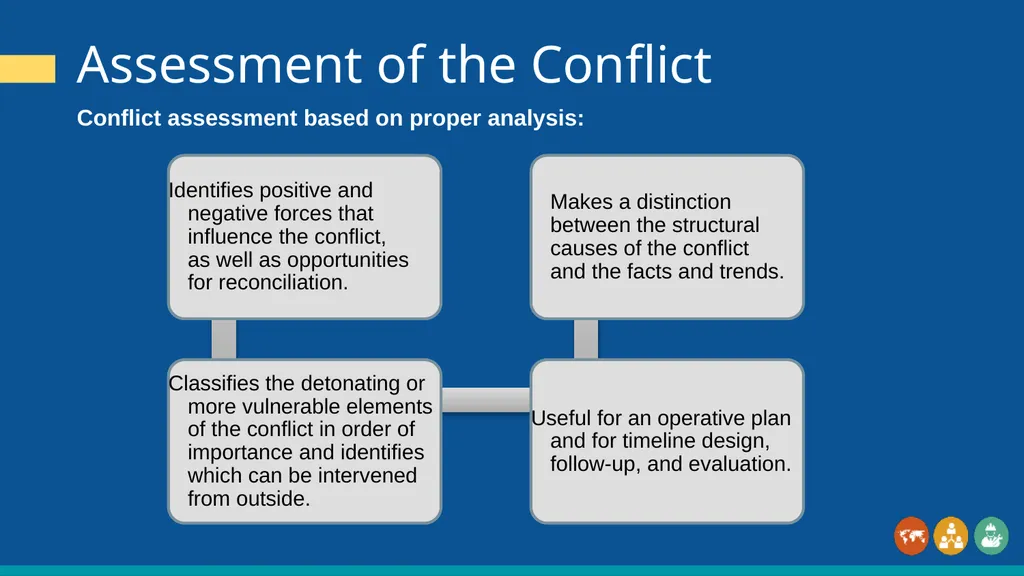
Assessment of the Conflict Conflict assessment based on proper analysis:<br>
13
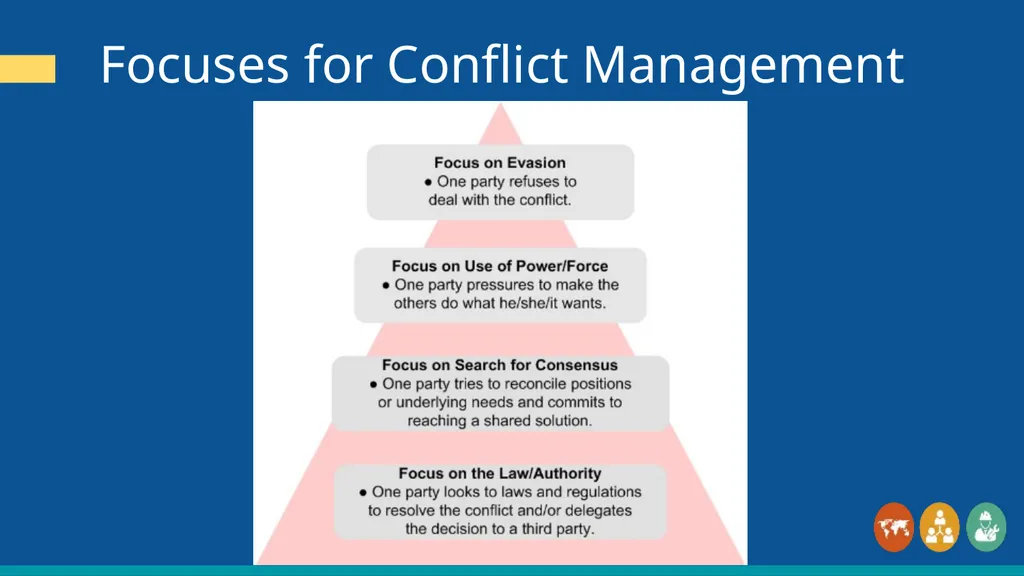
Focuses for Conflict Management<br>
14
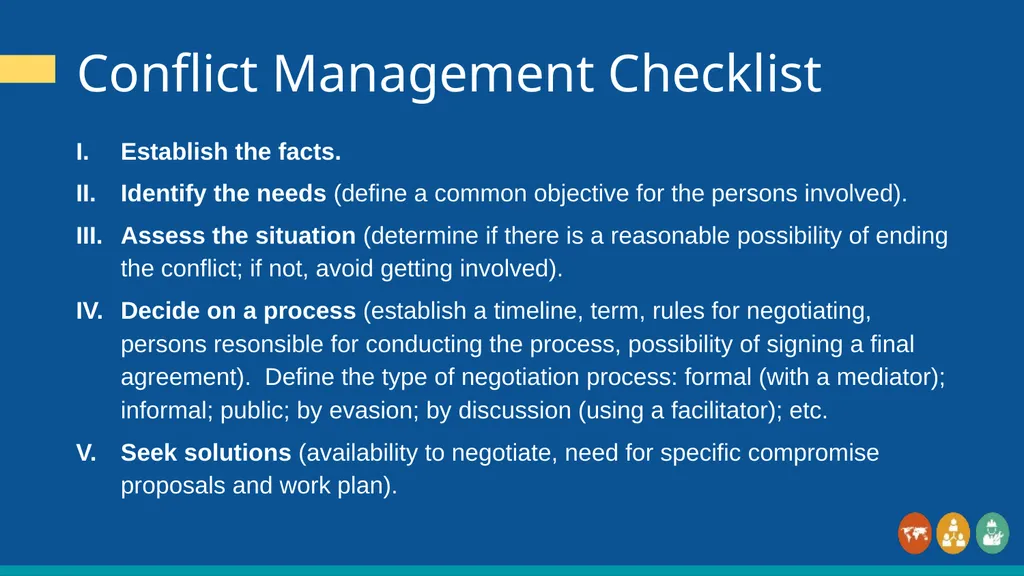
Conflict Management Checklist Establish the facts.
Identify the needs (define a common objective for the persons involved).
Assess the situation (determine if there is a reasonable possibility of ending the conflict; if not, avoid getting involved).
Decide on a process (establish a timeline, term, rules for negotiating, persons resonsible for conducting the process, possibility of signing a final agreement). Define the type of negotiation process: formal (with a mediator); informal; public; by evasion; by discussion (using a facilitator); etc.
Seek solutions (availability to negotiate, need for specific compromise proposals and work plan).<br>
Identify the needs (define a common objective for the persons involved).
Assess the situation (determine if there is a reasonable possibility of ending the conflict; if not, avoid getting involved).
Decide on a process (establish a timeline, term, rules for negotiating, persons resonsible for conducting the process, possibility of signing a final agreement). Define the type of negotiation process: formal (with a mediator); informal; public; by evasion; by discussion (using a facilitator); etc.
Seek solutions (availability to negotiate, need for specific compromise proposals and work plan).<br>
15
Negotiating Techniques<br>
16
Negotiation Process Methods Win-Win
In this situation both parties obtain what they want.
Win-Lose
This is the classic situation: if there is a winner, then by definition there must be a loser.
Lose-Lose
Both parties lose, often because they have a ‘win-lose’ focus or because both are determined not to yield.<br>
In this situation both parties obtain what they want.
Win-Lose
This is the classic situation: if there is a winner, then by definition there must be a loser.
Lose-Lose
Both parties lose, often because they have a ‘win-lose’ focus or because both are determined not to yield.<br>
17
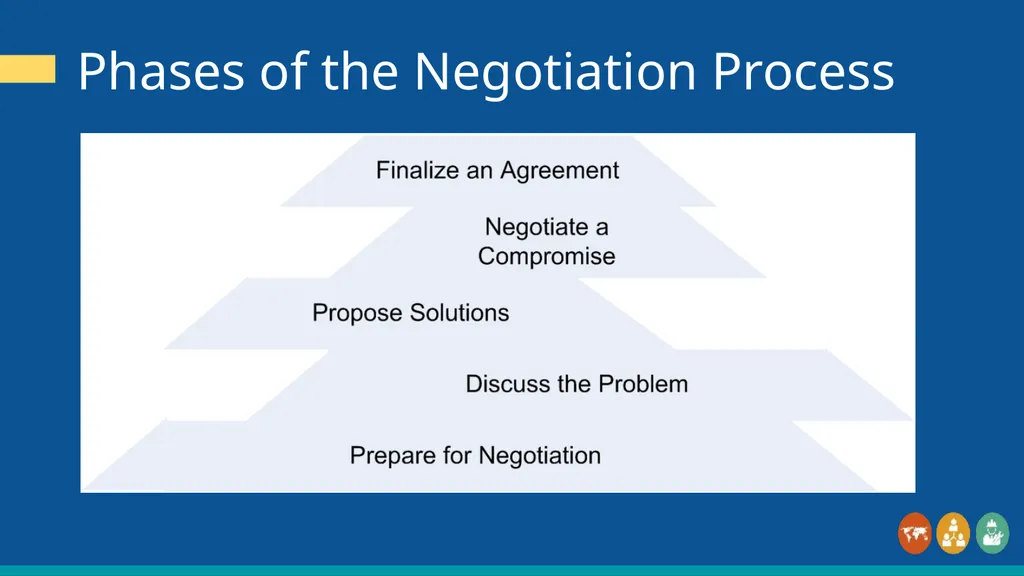
Phases of the Negotiation Process<br>
18
First Phase: Prepare for Negotiation This phase is essential when negotiating with a win-win focus. Establish clear, measurable, and attainable goals.
Propose each objective with arguments.
Establish the rules for negotiating: understand the parties’ positions; solutions to discard; the setting and its socio-cultural characteristics; their obligations; identify and evaluate the interests at stake (for both parties).
Think in strategic terms (division of tasks; starting with the most vulnerable issues; leaving the thorny issues for the end; establishing basic agreement criteria).
Organize the negotiation session (date, time, place, attendees, equipment, etc.).<br>
Propose each objective with arguments.
Establish the rules for negotiating: understand the parties’ positions; solutions to discard; the setting and its socio-cultural characteristics; their obligations; identify and evaluate the interests at stake (for both parties).
Think in strategic terms (division of tasks; starting with the most vulnerable issues; leaving the thorny issues for the end; establishing basic agreement criteria).
Organize the negotiation session (date, time, place, attendees, equipment, etc.).<br>
19
Second Phase: Discuss the Problem Suggest solutions with arguments.
Reformulate the problem(s) to ensure that it(they) have been assimilated.
Interpret the attitudes and be aware of the emotional context that is not clearly expressed.
Be fair and impartial. Keep the discussion focused on the issues at hand.
State the different issues in a manner that allows each party to understand the other point(s) of view.
Verify that they are in agreement.
Use humor (in moderation) to reconcile and avoid tense situations.<br>
Reformulate the problem(s) to ensure that it(they) have been assimilated.
Interpret the attitudes and be aware of the emotional context that is not clearly expressed.
Be fair and impartial. Keep the discussion focused on the issues at hand.
State the different issues in a manner that allows each party to understand the other point(s) of view.
Verify that they are in agreement.
Use humor (in moderation) to reconcile and avoid tense situations.<br>
20
Third Phase: Propose Solutions As the meeting progresses, it will be necessary to:
Make note of the important points in order to summarize them before proposing solutions.
Be able to propose innovative suggestions or solutioins based on an analysis of the situation.
Build the dialogue around the proposed solutions, keeping in mind the common interests and motivations of both parties.<br>
Make note of the important points in order to summarize them before proposing solutions.
Be able to propose innovative suggestions or solutioins based on an analysis of the situation.
Build the dialogue around the proposed solutions, keeping in mind the common interests and motivations of both parties.<br>
21
Fourth Phase: Negotiate a Compromise The negotiated proposals must be in harmony with the objectives set.
Take time to debate with the team or upon request from one of the parties.
Try to avoid tension as much as possible.
Identify the best solution that most nearly satisfies the interests of both parties.
Verify its implementation.<br>
Take time to debate with the team or upon request from one of the parties.
Try to avoid tension as much as possible.
Identify the best solution that most nearly satisfies the interests of both parties.
Verify its implementation.<br>
22
Fifth Phase: Finalize the Agreement The negotiated proposals must be in harmony with the objectives set.
Formulation of an Agreement
- Verify dates, review, and definition of terms.
Draw up a comprehensive implementation timeline that sets forth the points accepted, the discrepancies, the interpretations, and the clarifications (where needed).
- It is important to do this as soon as possible after the meeting.
Prepare for Implementation
- Prepare an implementation plan: what, when, and who.
Analyze the Negotiation Experience
- After the negotiation concludes, identify the lessons learned.<br>
Formulation of an Agreement
- Verify dates, review, and definition of terms.
Draw up a comprehensive implementation timeline that sets forth the points accepted, the discrepancies, the interpretations, and the clarifications (where needed).
- It is important to do this as soon as possible after the meeting.
Prepare for Implementation
- Prepare an implementation plan: what, when, and who.
Analyze the Negotiation Experience
- After the negotiation concludes, identify the lessons learned.<br>
23
Conflict Resolution Process and
Conciliation / Mediation Services Systems based on the search for consensus between the parties: Conciliation / Mediation. System by which a neutral third party helps the disputing parties to reach an agreement.
Negotiation. Interactive system in which two or more parties participate in search of an agreement through the exchange of information and the search for positions and points of view in common, while preserving their interests as much as possible.
Joint problem-solving. Interactive system in which two or more partes participate in search of an agreement to solve problems between them, identifying the causes of their differences, determining options, and jointly agreeing on viable solutions to said differences.<br>
Negotiation. Interactive system in which two or more parties participate in search of an agreement through the exchange of information and the search for positions and points of view in common, while preserving their interests as much as possible.
Joint problem-solving. Interactive system in which two or more partes participate in search of an agreement to solve problems between them, identifying the causes of their differences, determining options, and jointly agreeing on viable solutions to said differences.<br>
24
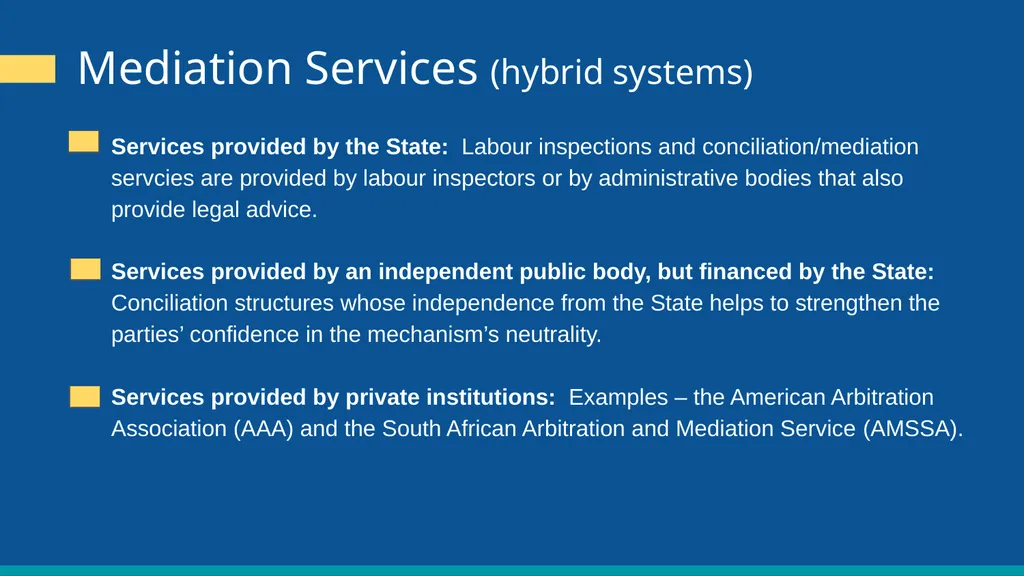
Mediation Services (hybrid systems) Services provided by the State: Labour inspections and conciliation/mediation servcies are provided by labour inspectors or by administrative bodies that also provide legal advice.
Services provided by an independent public body, but financed by the State: Conciliation structures whose independence from the State helps to strengthen the parties’ confidence in the mechanism’s neutrality.
Services provided by private institutions: Examples – the American Arbitration Association (AAA) and the South African Arbitration and Mediation Service (AMSSA).<br>
Services provided by an independent public body, but financed by the State: Conciliation structures whose independence from the State helps to strengthen the parties’ confidence in the mechanism’s neutrality.
Services provided by private institutions: Examples – the American Arbitration Association (AAA) and the South African Arbitration and Mediation Service (AMSSA).<br>
25
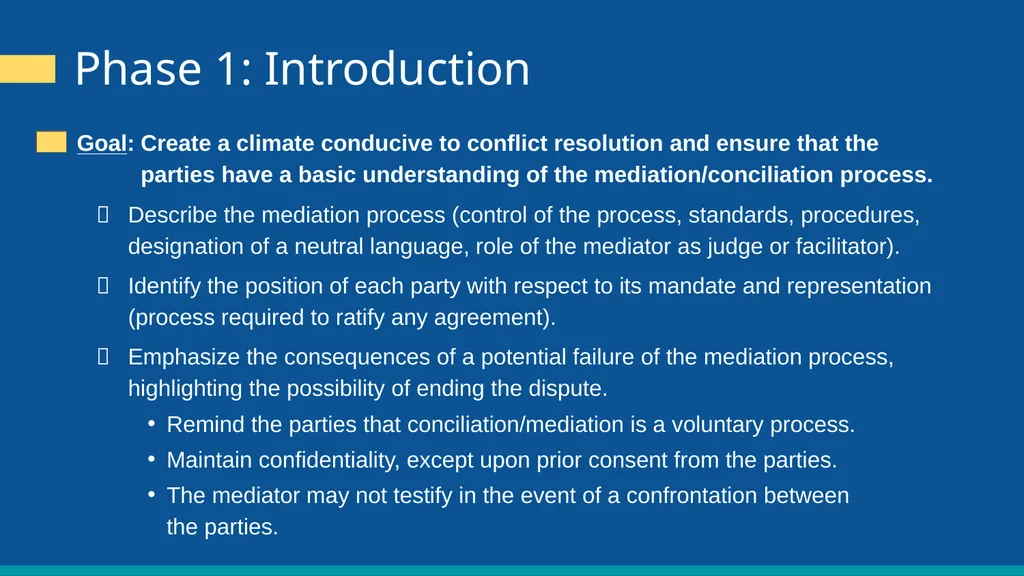
Phase 1: Introduction Goal: Create a climate conducive to conflict resolution and ensure that the
parties have a basic understanding of the mediation/conciliation process.
Describe the mediation process (control of the process, standards, procedures, designation of a neutral language, role of the mediator as judge or facilitator).
Identify the position of each party with respect to its mandate and representation (process required to ratify any agreement).
Emphasize the consequences of a potential failure of the mediation process, highlighting the possibility of ending the dispute.
Remind the parties that conciliation/mediation is a voluntary process.
Maintain confidentiality, except upon prior consent from the parties.
The mediator may not testify in the event of a confrontation between the parties.<br>
Describe the mediation process (control of the process, standards, procedures, designation of a neutral language, role of the mediator as judge or facilitator).
Identify the position of each party with respect to its mandate and representation (process required to ratify any agreement).
Emphasize the consequences of a potential failure of the mediation process, highlighting the possibility of ending the dispute.
Remind the parties that conciliation/mediation is a voluntary process.
Maintain confidentiality, except upon prior consent from the parties.
The mediator may not testify in the event of a confrontation between the parties.<br>
26
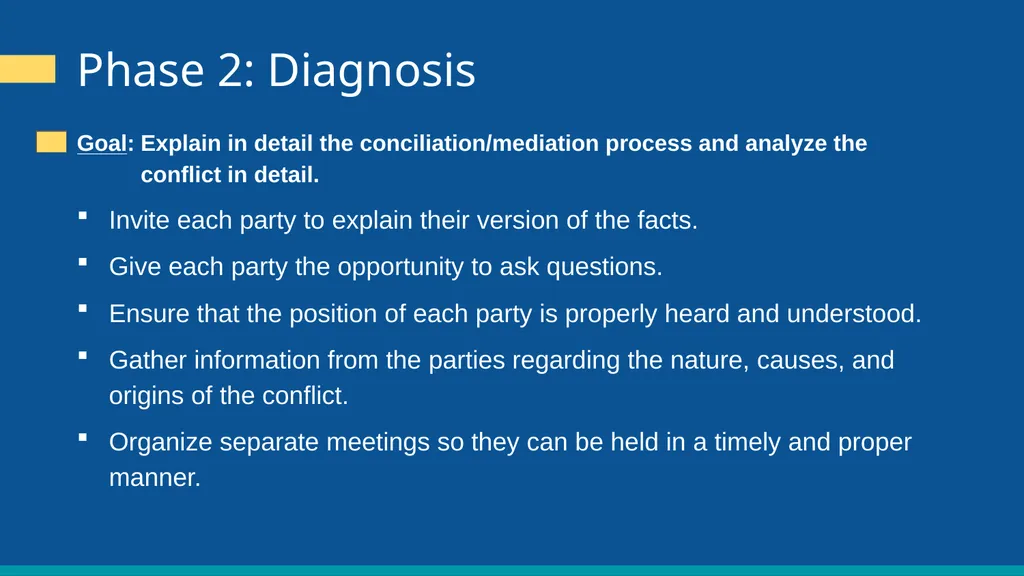
Phase 2: Diagnosis Goal: Explain in detail the conciliation/mediation process and analyze the
conflict in detail.
Invite each party to explain their version of the facts.
Give each party the opportunity to ask questions.
Ensure that the position of each party is properly heard and understood.
Gather information from the parties regarding the nature, causes, and origins of the conflict.
Organize separate meetings so they can be held in a timely and proper manner.<br>
Invite each party to explain their version of the facts.
Give each party the opportunity to ask questions.
Ensure that the position of each party is properly heard and understood.
Gather information from the parties regarding the nature, causes, and origins of the conflict.
Organize separate meetings so they can be held in a timely and proper manner.<br>
27
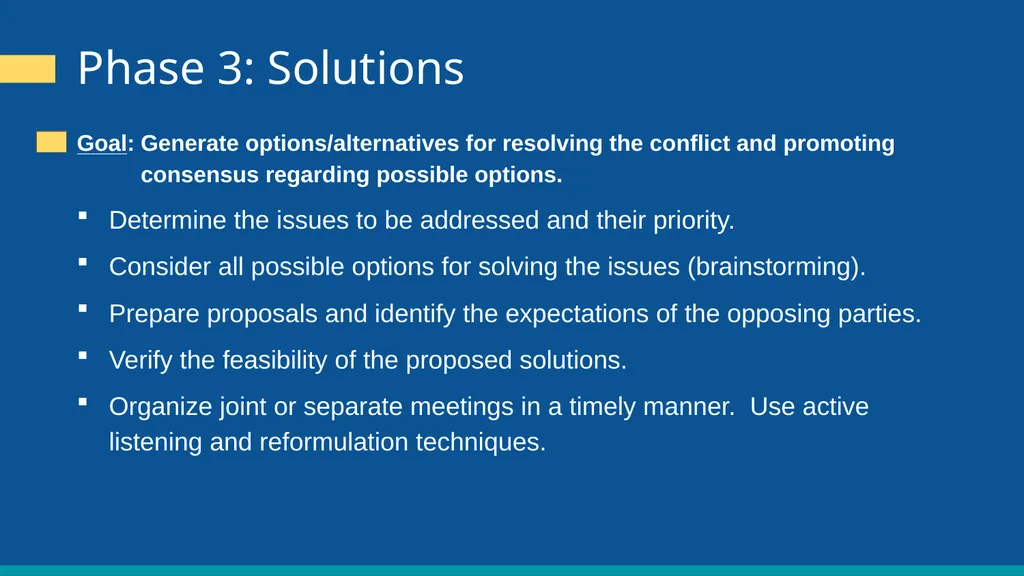
Phase 3: Solutions Goal: Generate options/alternatives for resolving the conflict and promoting
consensus regarding possible options.
Determine the issues to be addressed and their priority.
Consider all possible options for solving the issues (brainstorming).
Prepare proposals and identify the expectations of the opposing parties.
Verify the feasibility of the proposed solutions.
Organize joint or separate meetings in a timely manner. Use active listening and reformulation techniques.<br>
Determine the issues to be addressed and their priority.
Consider all possible options for solving the issues (brainstorming).
Prepare proposals and identify the expectations of the opposing parties.
Verify the feasibility of the proposed solutions.
Organize joint or separate meetings in a timely manner. Use active listening and reformulation techniques.<br>
28
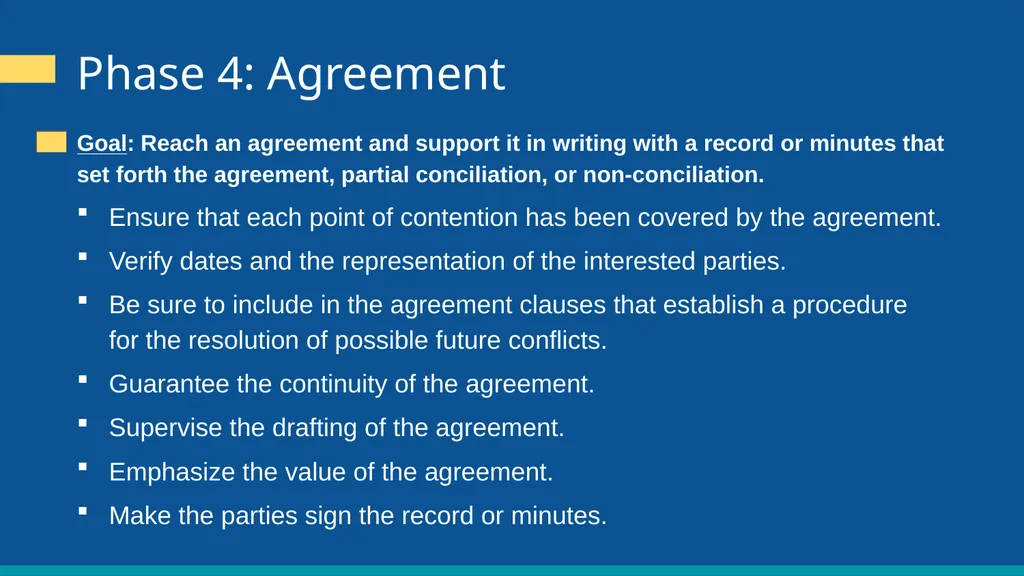
Phase 4: Agreement Goal: Reach an agreement and support it in writing with a record or minutes that
set forth the agreement, partial conciliation, or non-conciliation.
Ensure that each point of contention has been covered by the agreement.
Verify dates and the representation of the interested parties.
Be sure to include in the agreement clauses that establish a procedure for the resolution of possible future conflicts.
Guarantee the continuity of the agreement.
Supervise the drafting of the agreement.
Emphasize the value of the agreement.
Make the parties sign the record or minutes.<br>
Ensure that each point of contention has been covered by the agreement.
Verify dates and the representation of the interested parties.
Be sure to include in the agreement clauses that establish a procedure for the resolution of possible future conflicts.
Guarantee the continuity of the agreement.
Supervise the drafting of the agreement.
Emphasize the value of the agreement.
Make the parties sign the record or minutes.<br>
29
Thank you for your attention.<br>