Consulting 101 Session 2: THE CONSULTING
Description: Consulting 101 Session 2: THE CONSULTING RECRUITING CYCLE Session 3: Intro to Case Interviews Agenda: Recruiting Overview of the recruiting timeline Informational interview advice Resumes Cover Letters Firm-specific information 2nd year
Related Topics
Download Presentation
"Consulting 101 Session 2: THE CONSULTING" is the property of its rightful owner. Permission is granted to download and print the materials on this website for personal, non-commercial use only, and to display it on your personal computer provided you do not modify the materials and that you retain all copyright notices contained in the materials. By downloading content from our website, you accept the terms of this agreement.
Presentation Transcript
slide1. Consulting 101 Session 2: THE CONSULTING RECRUITING CYCLE
Session 3: Intro to Case Interviews<br>
slide2. Agenda: Recruiting Overview of the recruiting timeline
Informational interview advice
Resumes & Cover Letters
Firm-specific information – 2nd year experiences<br>
slide3. We are here for you<br>
slide4. Recruiting Timeline This year things are moving fast. Be aware of deadlines and check owl-careers weekly for events an d resume drops. Don’t wait till the last moment!<br>
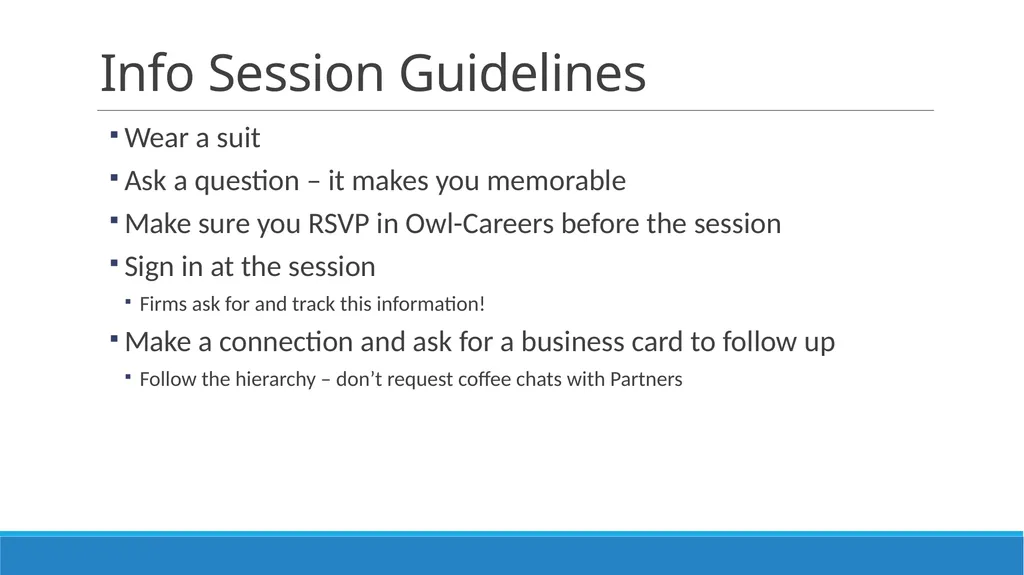
slide5. Info Session Guidelines Wear a suit
Ask a question – it makes you memorable
Make sure you RSVP in Owl-Careers before the session
Sign in at the session
Firms ask for and track this information!
Make a connection and ask for a business card to follow up
Follow the hierarchy – don’t request coffee chats with Partners<br>
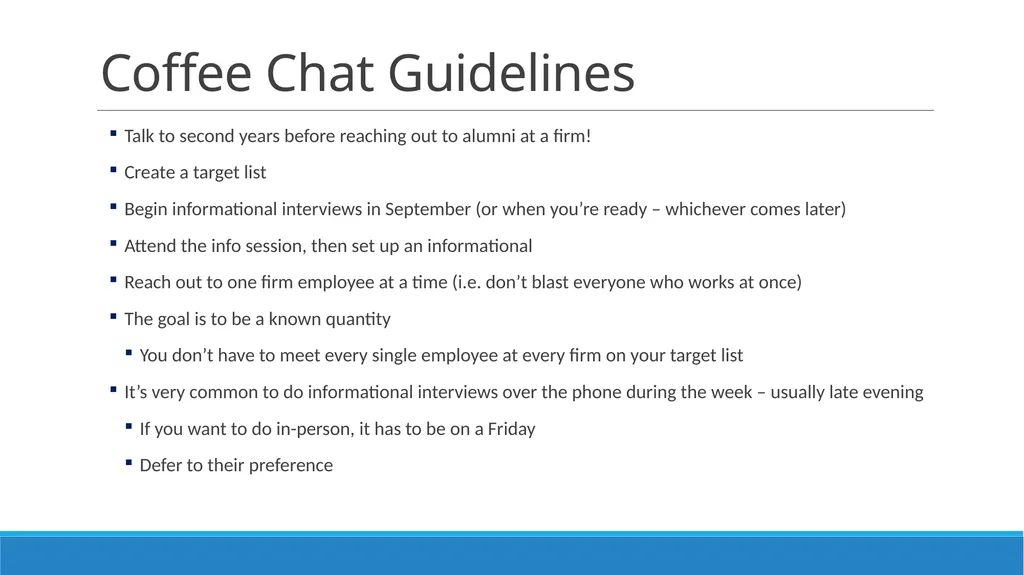
slide6. Coffee Chat Guidelines Talk to second years before reaching out to alumni at a firm!
Create a target list
Begin informational interviews in September (or when you’re ready – whichever comes later)
Attend the info session, then set up an informational
Reach out to one firm employee at a time (i.e. don’t blast everyone who works at once)
The goal is to be a known quantity
You don’t have to meet every single employee at every firm on your target list
It’s very common to do informational interviews over the phone during the week – usually late evening
If you want to do in-person, it has to be on a Friday
Defer to their preference<br>
slide7. Resume tips Write your resume for the job you want, not the job you have
Think about important skills: Communication, project management, problem solving, analysis, leadership, initiative, process improvement, change management, teamwork
Focus on results and impact
Quantify whenever possible
Show progression of roles/responsibilities
GPA and GMAT are important<br>
slide8. Cover Letters Use it as an opportunity to sell yourself
What’s in it for them?
Include details on interactions you’ve had with the firm “I spoke with so-and-so about blah, blah, blah”
Proofread
Make sure you remove other firm’s names
Utilize the CDO<br>
slide9. Consulting keyword list Advised
Analyzed, Analysis
Assessed, Assessment
Client Engagement
Client Facing
Collaborated
Communicated
Competitive Intelligence, Competitive Landscape
Cost Containment
Cross-functional
Data
Designed, Redesigned
Developed
Directed
Due Diligence
Evaluated, Evaluation
Executed, Execution
Forecast, Projected
Identified, Identification
Implemented, Implementation
Initiated, Led, Created
Measured
Model, Modeling
Optimized
Planned, Planning
Presented, Presentation
Problem Solving
Process Improvement
Project Management
Recommended, Proposed, Proposal
Researched, Investigated
Strategy, Strategic
Streamlined<br>
slide10. Second Year Experiences Talk about the type of consulting work you did and what your recruiting experience was like<br>
slide11. Consulting 101 Session 3: Intro to Case Interviews<br>
slide12. Agenda Why Firms Use Case Interviews
Case Interview Structure
Common Case Interview Questions
Case Prep Timeline and Strategy
Resources
Questions<br>
slide13. Why firms use case interviews Assess how you think
Can you develop and communicate a clear structure for solving a problem?
Can you to the problem you are trying to solve?
Findings, recommendations, adapt your structure, etcidentify what data will be needed to solve the problem?
Can you analyze data (basic calculations without a calculator)?
Can you recover from mistakes?
Can you connect the findings from data analysis?
Assess your ability to interact with clients
Do you communicate in a calm and clear manner?
How do you respond to challenging questions and roadblocks?
How do you deal with ambiguity?
Do you involve the interviewer in the problem solving process?
Are your recommendations clear and are they supported by the data?<br>
slide14. Case Interview Structure<br>
slide15. Two types of business cases PROFITABILITY Our client has declining revenues. How would you advise them?
Our client’s margins are shrinking. How would you advise them?
Profit = Revenue – Costs
R = Price * Quantity
C = FC + VC*(Q)
Internal/External BUSINESS SITUATION Should our client enter market X?
Should our client commercialize this product?
Should our client outsource maintenance? Key takeaway: the ultimate goal of any case question is to be able to make a recommendation to the client that will help them make money.
Thinking about it this way will help you zero in on how to structure the problem and what data to ask for.<br>
slide16. Business Drivers<br>
slide17. Case starts<br>
slide18. What’s next? (Case prep timeline) Continued…<br>
slide19. Case prep timeline (continued)<br>
slide20. Case Coaches<br>
slide21. Case Coaches: Schedule For the next 5 weeks, case coaches will dedicate time every week for case interviews
We will send out communication soon for you to sign up
First come, first serve. Please limit to 3 sessions!
We will communicate a casing marathon on 2 Fridays – sign up for that too!<br>
slide22. Additional tips Do not ignore behavioral interviews; these are a critical part of your preparation
The goal is to get comfortable with cases – some people need more practice, others need less. The numbers on this slide are suggestions only (and trend towards high prep levels)
No need to read all available books; maximize your time by reading the case examples and pages that summarize frameworks
Make sure your resume is consulting-ready and up to date through OWL Careers; consulting employers do check these out (do really soon)
Track application deadlines on Owl-Careers and on company websites
Pay attention in Economics (Term II) – very useful class for case interviews (profitability, marginal cost, price elasticity, etc). Pay attention in your other classes, too.
Consider alternative paths<br>
slide23. RESOURCES Consulting club CampusGroups site – case starts & full cases
Books
Case in Point, Marc Cosentino
Case Interview Secrets, Victor Cheng
Crack the Case, David Ohrvall
Victor Cheng online resources:
www.caseinterview.com (good math practice)
https://www.youtube.com/watch?v=fBwUxnTpTBo&list=PLL1jLM18SWP1uF1ReVpWY9MSpFXWdmEfW&index=1
Other websites:
Firm-specific information: www.managementconsulted.com
Bain sample case interview: https://www.youtube.com/watch?v=Nib4_5_4afA<br>

slide24. Questions?<br>
Session 3: Intro to Case Interviews<br>
slide2. Agenda: Recruiting Overview of the recruiting timeline
Informational interview advice
Resumes & Cover Letters
Firm-specific information – 2nd year experiences<br>
slide3. We are here for you<br>
slide4. Recruiting Timeline This year things are moving fast. Be aware of deadlines and check owl-careers weekly for events an d resume drops. Don’t wait till the last moment!<br>
slide5. Info Session Guidelines Wear a suit
Ask a question – it makes you memorable
Make sure you RSVP in Owl-Careers before the session
Sign in at the session
Firms ask for and track this information!
Make a connection and ask for a business card to follow up
Follow the hierarchy – don’t request coffee chats with Partners<br>
slide6. Coffee Chat Guidelines Talk to second years before reaching out to alumni at a firm!
Create a target list
Begin informational interviews in September (or when you’re ready – whichever comes later)
Attend the info session, then set up an informational
Reach out to one firm employee at a time (i.e. don’t blast everyone who works at once)
The goal is to be a known quantity
You don’t have to meet every single employee at every firm on your target list
It’s very common to do informational interviews over the phone during the week – usually late evening
If you want to do in-person, it has to be on a Friday
Defer to their preference<br>
slide7. Resume tips Write your resume for the job you want, not the job you have
Think about important skills: Communication, project management, problem solving, analysis, leadership, initiative, process improvement, change management, teamwork
Focus on results and impact
Quantify whenever possible
Show progression of roles/responsibilities
GPA and GMAT are important<br>
slide8. Cover Letters Use it as an opportunity to sell yourself
What’s in it for them?
Include details on interactions you’ve had with the firm “I spoke with so-and-so about blah, blah, blah”
Proofread
Make sure you remove other firm’s names
Utilize the CDO<br>
slide9. Consulting keyword list Advised
Analyzed, Analysis
Assessed, Assessment
Client Engagement
Client Facing
Collaborated
Communicated
Competitive Intelligence, Competitive Landscape
Cost Containment
Cross-functional
Data
Designed, Redesigned
Developed
Directed
Due Diligence
Evaluated, Evaluation
Executed, Execution
Forecast, Projected
Identified, Identification
Implemented, Implementation
Initiated, Led, Created
Measured
Model, Modeling
Optimized
Planned, Planning
Presented, Presentation
Problem Solving
Process Improvement
Project Management
Recommended, Proposed, Proposal
Researched, Investigated
Strategy, Strategic
Streamlined<br>
slide10. Second Year Experiences Talk about the type of consulting work you did and what your recruiting experience was like<br>
slide11. Consulting 101 Session 3: Intro to Case Interviews<br>
slide12. Agenda Why Firms Use Case Interviews
Case Interview Structure
Common Case Interview Questions
Case Prep Timeline and Strategy
Resources
Questions<br>
slide13. Why firms use case interviews Assess how you think
Can you develop and communicate a clear structure for solving a problem?
Can you to the problem you are trying to solve?
Findings, recommendations, adapt your structure, etcidentify what data will be needed to solve the problem?
Can you analyze data (basic calculations without a calculator)?
Can you recover from mistakes?
Can you connect the findings from data analysis?
Assess your ability to interact with clients
Do you communicate in a calm and clear manner?
How do you respond to challenging questions and roadblocks?
How do you deal with ambiguity?
Do you involve the interviewer in the problem solving process?
Are your recommendations clear and are they supported by the data?<br>
slide14. Case Interview Structure<br>
slide15. Two types of business cases PROFITABILITY Our client has declining revenues. How would you advise them?
Our client’s margins are shrinking. How would you advise them?
Profit = Revenue – Costs
R = Price * Quantity
C = FC + VC*(Q)
Internal/External BUSINESS SITUATION Should our client enter market X?
Should our client commercialize this product?
Should our client outsource maintenance? Key takeaway: the ultimate goal of any case question is to be able to make a recommendation to the client that will help them make money.
Thinking about it this way will help you zero in on how to structure the problem and what data to ask for.<br>
slide16. Business Drivers<br>
slide17. Case starts<br>
slide18. What’s next? (Case prep timeline) Continued…<br>
slide19. Case prep timeline (continued)<br>
slide20. Case Coaches<br>
slide21. Case Coaches: Schedule For the next 5 weeks, case coaches will dedicate time every week for case interviews
We will send out communication soon for you to sign up
First come, first serve. Please limit to 3 sessions!
We will communicate a casing marathon on 2 Fridays – sign up for that too!<br>
slide22. Additional tips Do not ignore behavioral interviews; these are a critical part of your preparation
The goal is to get comfortable with cases – some people need more practice, others need less. The numbers on this slide are suggestions only (and trend towards high prep levels)
No need to read all available books; maximize your time by reading the case examples and pages that summarize frameworks
Make sure your resume is consulting-ready and up to date through OWL Careers; consulting employers do check these out (do really soon)
Track application deadlines on Owl-Careers and on company websites
Pay attention in Economics (Term II) – very useful class for case interviews (profitability, marginal cost, price elasticity, etc). Pay attention in your other classes, too.
Consider alternative paths<br>
slide23. RESOURCES Consulting club CampusGroups site – case starts & full cases
Books
Case in Point, Marc Cosentino
Case Interview Secrets, Victor Cheng
Crack the Case, David Ohrvall
Victor Cheng online resources:
www.caseinterview.com (good math practice)
https://www.youtube.com/watch?v=fBwUxnTpTBo&list=PLL1jLM18SWP1uF1ReVpWY9MSpFXWdmEfW&index=1
Other websites:
Firm-specific information: www.managementconsulted.com
Bain sample case interview: https://www.youtube.com/watch?v=Nib4_5_4afA<br>
slide24. Questions?<br>