Contacting a Program Officer: Best Practices for
Description: Contacting a Program Officer: Best Practices for Faculty Research Innovation 1 Introduction Overcoming the Hesitation Why We Hesitate Common thoughts: What if I mess up? or Will they judge my project? Youre not alone many
Related Topics
Download Presentation
"Contacting a Program Officer: Best Practices for" is the property of its rightful owner. Permission is granted to download and print the materials on this website for personal, non-commercial use only, and to display it on your personal computer provided you do not modify the materials and that you retain all copyright notices contained in the materials. By downloading content from our website, you accept the terms of this agreement.
Presentation Transcript
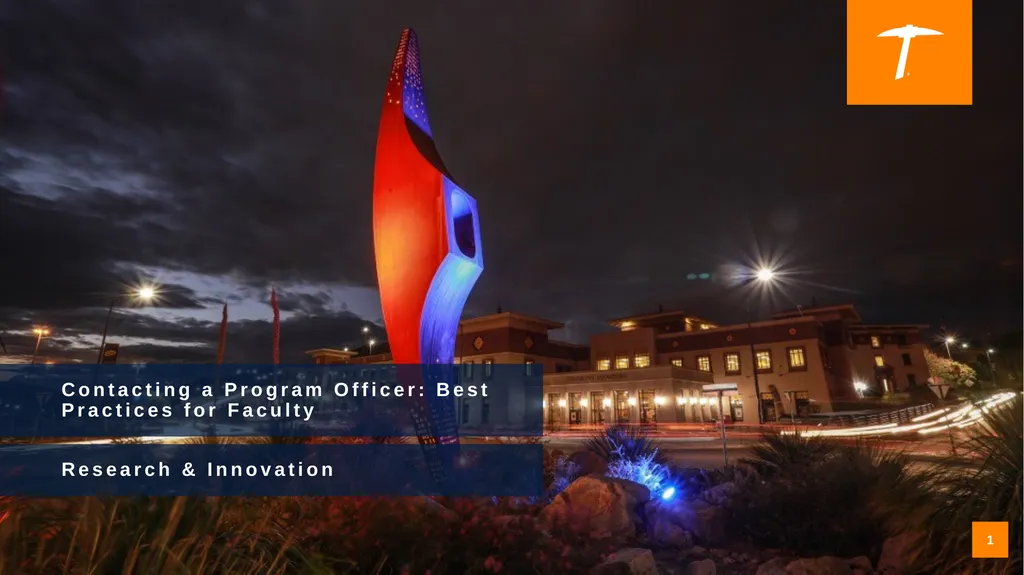
slide1. Contacting a Program Officer: Best Practices for Faculty Research & Innovation 1<br>
slide2. Introduction – Overcoming the Hesitation Why We Hesitate
Common thoughts: "What if I mess up?" or "Will they judge my project?"
You're not alone – many researchers hesitate at first.
Good news: POs want to hear from you (and they’re probably not as scary as you think). 2<br>
slide3. The Role of Program Officers What Do POs Do?
Think of POs as guides – they help keep your research on track and aligned with funding opportunities.
They manage grants and ensure research aligns with their program’s goals.
They can provide scientific guidance pre- and post-award and monitor your project’s scientific aspects.
They partner with grants management staff on post-award administration and help review progress reports. 3<br>
slide4. Why Contact a Program Officer? Key Reasons to Reach Out
Avoid guessing blindly– confirm if your project fits the program.
Get feedback to fine-tune your proposal (before the reviewers get to it).
Clarify tricky budget or eligibility questions.
POs can also help you understand if your project aligns with specific initiatives. 4<br>
slide5. When to Contact a Program Officer? Optimal Timing
Before submission: When your project is still in draft mode.
After submission: For feedback on improving (if things didn’t go as planned).
Anytime when in doubt: If you need clarification on eligibility or advice on large budgets, clinical trials, or compliance issues. 5<br>
slide6. Preparing to Contact a Program Officer Essential Steps Before Reaching Out
Do your homework: Review the program guidelines, funded projects, and the PO’s interests .
Draft a concise 1–2-page summary, pre-abstract—keep it brief but informative. This is your “elevator pitch .”
Be specific. Include critical details like your grant number, funding opportunity number, and specific aims/goals/objectives.
Begin with an email. No cold calls! 6<br>
slide7. What Program Officers Cannot Do Limitations of Program Officers
POs cannot co-write or edit your application.
They cannot provide specific experimental design advice or copy-edit your proposal.
POs cannot share unpublished information about future funding opportunities.
They cannot discuss the review process until the summary statement is available. 7<br>
slide8. Sample Email: A Good Approach Effective Email Example
Subject: Inquiry on Project Alignment with [Program Name]
Quick intro of yourself and your institution.
Provide a clear, focused project summary and ask for feedback. 8<br>
slide9. Sample Email: A Bad Approach Ineffective Email Example
Subject: Funding Inquiry
Casual greeting like "Hey" or "Hi."
Rambling explanation with no clear purpose.
No clear questions or next steps. 9<br>
slide10. Communicating with Program Officers: Dos and Don’ts Best Practices
Do: Respect their time—concise, clear questions work best.
Don’t: Send multiple follow-ups if you don’t get a response right away.
Do: Email first and give them time to reply (~1 week). 10<br>
slide11. Engaging with Different Agencies: NSF, DoD, DoE, NEH, NIH, and More Tailoring Your Approach by Agency
NSF (National Science Foundation): Loves innovation, interdisciplinary projects, and transformative research. Be bold with new ideas.
DoD (Department of Defense): Prioritize applied research that addresses national security challenges or defense technology needs.
DoE (Department of Energy): Focus on energy efficiency, sustainability, and environmental solutions.
NEH (National Endowment for the Humanities): Emphasize your project's cultural, historical, or societal impact. They want research that advances the humanities.
NIH (National Institutes of Health): Prioritize research that advances human health. Tailor your approach to specific institutes (e.g., NIA for aging research).
NASA: Focus on research related to space exploration, aeronautics, and Earth sciences. Think big and futuristic.
USDA (U.S. Department of Agriculture): Projects should address agriculture, food safety, rural development, or environmental conservation. Tie your research to tangible outcomes.
EPA (Environmental Protection Agency): Emphasize environmental protection, sustainability, and health impacts of environmental changes. 11<br>
slide12. Reaching Out to Foundation POs The Foundation Approach
Do Your Research: Thoroughly review the foundation’s mission, funding priorities, and recently funded projects.
Tailor Your Proposal: Show how your project aligns with their values. Foundations look for projects that resonate with their core goals.
Ask Specific Questions:
What is the typical grant range?
Is multi-year funding available for this type of project?
Are site visits involved, or is the application review process remote?
Avoid "Grant Chasing": Don’t shape your project to fit their interests if it doesn’t naturally align. This can weaken your proposal.
Build Relationships: Foundations often value long-term partnerships, so cultivate relationships over time and stay in touch even when not applying for funding. 12<br>
slide13. Preparing for the Call: Best Practices What to Have Ready
A short, easy-to-understand project summary (no jargon).
Be ready to discuss your project’s alignment with program goals.
Have questions ready—clarifying budget, timelines, etc. 13<br>
slide14. Key Questions to Ask a Program Officer What to Focus On
Does my project fit within your program’s goals?
Are there upcoming changes in priorities I should know about?
Can you provide advice on whether my specific objectives align with the mission of your Directorate/Institute/Center?
Any tips on how to improve the competitiveness of my proposal?
What is the expected success ratio for proposals?
Do you expect the award amount from last year to change this year? 14<br>
slide15. Follow-Up: Maintaining the Relationship What Happens After Initial Contact
Always send a thank-you email summarizing the discussion.
Keep them updated with significant progress or changes.
Stay in touch—but don’t overdo it. 15<br>
slide16. Q&A and Wrap-Up Final Thoughts
Program Officers are there to help you succeed, so don’t hesitate to reach out.
Tailor your communication to the agency and be clear in your requests.
A well-maintained relationship with a PO can benefit your entire research career. 16<br>
slide17. References Blackburn, T. R. (2003). Getting science grants. Wiley.
National Institutes of Health. (2023). Understand staff roles. https://grants.nih.gov/help/ic-staff-roles
Porter, R. (2009). Can we talk? Contacting grant program officers. Research Management Review, 17(1), 1-8.
Spires, M. J. (2012). What to say—and not say—to program officers. The Chronicle of Higher Education. https://www.chronicle.com/article/what-to-say-and-not-say-to-program-officers/
Zatz, M. (2011). A view from the NIH bridge: Perspectives of a program officer. Molecular Biology of the Cell, 22(15), 2661–2663. https://doi.org/10.1091/mbc.E11-04-0346 17<br>
slide18. RESOURCES Propsal Development
PropDev@utep.edu 18<br>

slide19. THANK YOU 19<br>
slide2. Introduction – Overcoming the Hesitation Why We Hesitate
Common thoughts: "What if I mess up?" or "Will they judge my project?"
You're not alone – many researchers hesitate at first.
Good news: POs want to hear from you (and they’re probably not as scary as you think). 2<br>
slide3. The Role of Program Officers What Do POs Do?
Think of POs as guides – they help keep your research on track and aligned with funding opportunities.
They manage grants and ensure research aligns with their program’s goals.
They can provide scientific guidance pre- and post-award and monitor your project’s scientific aspects.
They partner with grants management staff on post-award administration and help review progress reports. 3<br>
slide4. Why Contact a Program Officer? Key Reasons to Reach Out
Avoid guessing blindly– confirm if your project fits the program.
Get feedback to fine-tune your proposal (before the reviewers get to it).
Clarify tricky budget or eligibility questions.
POs can also help you understand if your project aligns with specific initiatives. 4<br>
slide5. When to Contact a Program Officer? Optimal Timing
Before submission: When your project is still in draft mode.
After submission: For feedback on improving (if things didn’t go as planned).
Anytime when in doubt: If you need clarification on eligibility or advice on large budgets, clinical trials, or compliance issues. 5<br>
slide6. Preparing to Contact a Program Officer Essential Steps Before Reaching Out
Do your homework: Review the program guidelines, funded projects, and the PO’s interests .
Draft a concise 1–2-page summary, pre-abstract—keep it brief but informative. This is your “elevator pitch .”
Be specific. Include critical details like your grant number, funding opportunity number, and specific aims/goals/objectives.
Begin with an email. No cold calls! 6<br>
slide7. What Program Officers Cannot Do Limitations of Program Officers
POs cannot co-write or edit your application.
They cannot provide specific experimental design advice or copy-edit your proposal.
POs cannot share unpublished information about future funding opportunities.
They cannot discuss the review process until the summary statement is available. 7<br>
slide8. Sample Email: A Good Approach Effective Email Example
Subject: Inquiry on Project Alignment with [Program Name]
Quick intro of yourself and your institution.
Provide a clear, focused project summary and ask for feedback. 8<br>
slide9. Sample Email: A Bad Approach Ineffective Email Example
Subject: Funding Inquiry
Casual greeting like "Hey" or "Hi."
Rambling explanation with no clear purpose.
No clear questions or next steps. 9<br>
slide10. Communicating with Program Officers: Dos and Don’ts Best Practices
Do: Respect their time—concise, clear questions work best.
Don’t: Send multiple follow-ups if you don’t get a response right away.
Do: Email first and give them time to reply (~1 week). 10<br>
slide11. Engaging with Different Agencies: NSF, DoD, DoE, NEH, NIH, and More Tailoring Your Approach by Agency
NSF (National Science Foundation): Loves innovation, interdisciplinary projects, and transformative research. Be bold with new ideas.
DoD (Department of Defense): Prioritize applied research that addresses national security challenges or defense technology needs.
DoE (Department of Energy): Focus on energy efficiency, sustainability, and environmental solutions.
NEH (National Endowment for the Humanities): Emphasize your project's cultural, historical, or societal impact. They want research that advances the humanities.
NIH (National Institutes of Health): Prioritize research that advances human health. Tailor your approach to specific institutes (e.g., NIA for aging research).
NASA: Focus on research related to space exploration, aeronautics, and Earth sciences. Think big and futuristic.
USDA (U.S. Department of Agriculture): Projects should address agriculture, food safety, rural development, or environmental conservation. Tie your research to tangible outcomes.
EPA (Environmental Protection Agency): Emphasize environmental protection, sustainability, and health impacts of environmental changes. 11<br>
slide12. Reaching Out to Foundation POs The Foundation Approach
Do Your Research: Thoroughly review the foundation’s mission, funding priorities, and recently funded projects.
Tailor Your Proposal: Show how your project aligns with their values. Foundations look for projects that resonate with their core goals.
Ask Specific Questions:
What is the typical grant range?
Is multi-year funding available for this type of project?
Are site visits involved, or is the application review process remote?
Avoid "Grant Chasing": Don’t shape your project to fit their interests if it doesn’t naturally align. This can weaken your proposal.
Build Relationships: Foundations often value long-term partnerships, so cultivate relationships over time and stay in touch even when not applying for funding. 12<br>
slide13. Preparing for the Call: Best Practices What to Have Ready
A short, easy-to-understand project summary (no jargon).
Be ready to discuss your project’s alignment with program goals.
Have questions ready—clarifying budget, timelines, etc. 13<br>
slide14. Key Questions to Ask a Program Officer What to Focus On
Does my project fit within your program’s goals?
Are there upcoming changes in priorities I should know about?
Can you provide advice on whether my specific objectives align with the mission of your Directorate/Institute/Center?
Any tips on how to improve the competitiveness of my proposal?
What is the expected success ratio for proposals?
Do you expect the award amount from last year to change this year? 14<br>
slide15. Follow-Up: Maintaining the Relationship What Happens After Initial Contact
Always send a thank-you email summarizing the discussion.
Keep them updated with significant progress or changes.
Stay in touch—but don’t overdo it. 15<br>
slide16. Q&A and Wrap-Up Final Thoughts
Program Officers are there to help you succeed, so don’t hesitate to reach out.
Tailor your communication to the agency and be clear in your requests.
A well-maintained relationship with a PO can benefit your entire research career. 16<br>
slide17. References Blackburn, T. R. (2003). Getting science grants. Wiley.
National Institutes of Health. (2023). Understand staff roles. https://grants.nih.gov/help/ic-staff-roles
Porter, R. (2009). Can we talk? Contacting grant program officers. Research Management Review, 17(1), 1-8.
Spires, M. J. (2012). What to say—and not say—to program officers. The Chronicle of Higher Education. https://www.chronicle.com/article/what-to-say-and-not-say-to-program-officers/
Zatz, M. (2011). A view from the NIH bridge: Perspectives of a program officer. Molecular Biology of the Cell, 22(15), 2661–2663. https://doi.org/10.1091/mbc.E11-04-0346 17<br>
slide18. RESOURCES Propsal Development
PropDev@utep.edu 18<br>
slide19. THANK YOU 19<br>