
Content Analysis Content Analysis Study of a




Description: Content Analysis Content Analysis Study of a recorded human communication Typically, the coding of communication for the presence of certain traits, categories, or meanings Analysis can relate the occurrence of coded content with other
Related Topics
Download Presentation
"Content Analysis Content Analysis Study of a" is the property of its rightful owner. Permission is granted to download and print the materials on this website for personal, non-commercial use only, and to display it on your personal computer provided you do not modify the materials and that you retain all copyright notices contained in the materials. By downloading content from our website, you accept the terms of this agreement.
Presentation Transcript
slide1. Content
Analysis<br>
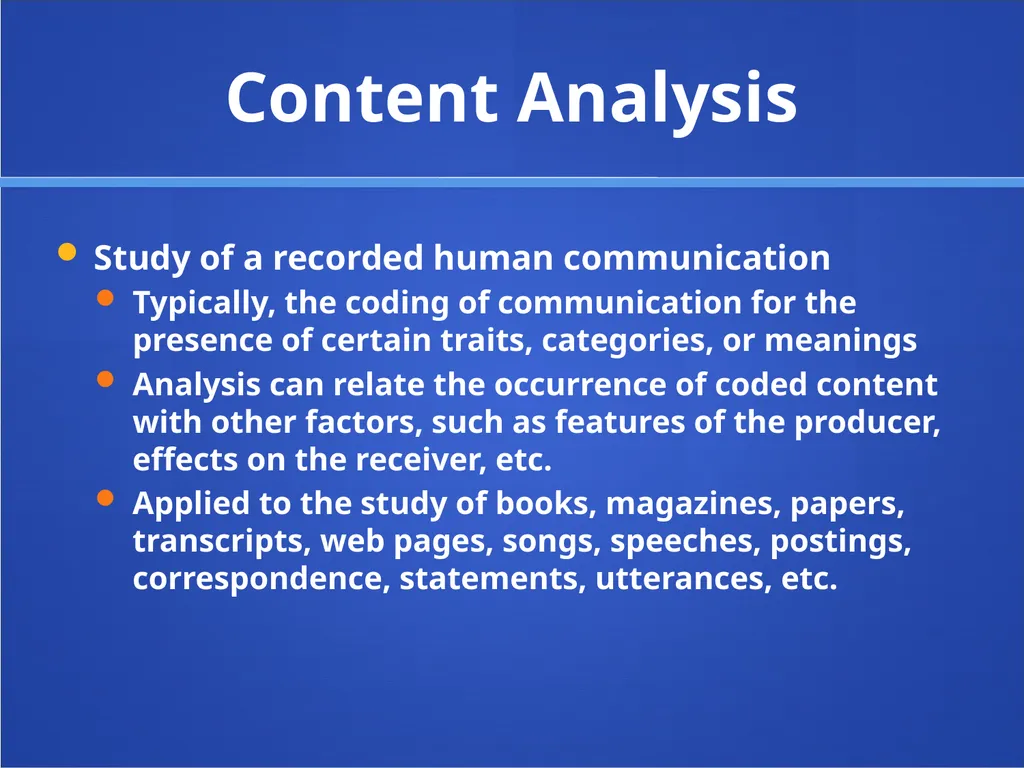
slide2. Content Analysis Study of a recorded human communication
Typically, the coding of communication for the presence of certain traits, categories, or meanings
Analysis can relate the occurrence of coded content with other factors, such as features of the producer, effects on the receiver, etc.
Applied to the study of books, magazines, papers, transcripts, web pages, songs, speeches, postings, correspondence, statements, utterances, etc.<br>
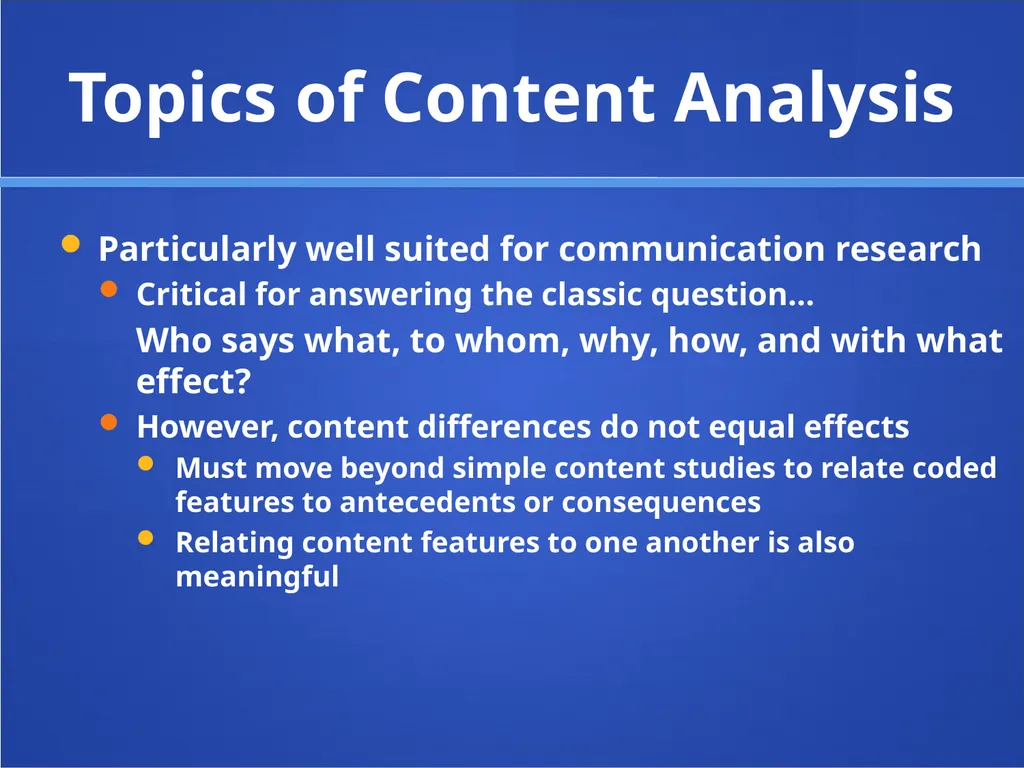
slide3. Topics of Content Analysis Particularly well suited for communication research
Critical for answering the classic question…
Who says what, to whom, why, how, and with what effect?
However, content differences do not equal effects
Must move beyond simple content studies to relate coded features to antecedents or consequences
Relating content features to one another is also meaningful<br>
slide4. Sampling in Content Analysis Since you can rarely observe all content, must sample from available content for coding pool
Units of analysis may differ from units of observation
Observe story content to analyze newspaper differences
Sample selection depends largely on unit of analysis
Example, if studying differences between authors, the unit of observation may be books, pages, paragraphs, or sentences
Need to be clear about unit of analysis before planning sampling strategy to avoid problems later<br>
slide5. Questions in Sample Generation Must establish the universe to be sampled from
Ex - Content analysis of television violence by network
Which TV stations should you observe?
How many days will you observe them?
During which hours will you observe television?
You always make assumptions; be upfront about them
We will code the six major networks — ABC, CBS, NBC, FOX, UPN, WB — for a “random week” during the month of December from 7 PM to 10 PM, each day selected.
May be Random, Systematic, Stratified, etc.<br>
slide6. Coding in Content Analysis Coding is the heart of content analysis
Process of converting raw data into a standardized form
Classify content in relation to a conceptual framework
Ex. Emotionality, Partisan Bias, Source Attribution, etc.
Must carefully conceptualize coding categories
Relevant concepts and relevant categories within concepts
Manifest (visible surface) / Latent (underlying meaning)
How big a leap between observation and inference
The more manifest, the more reliable - ex. counting words
The more latent, the more interesting - ex. assessing meaning<br>
slide7. Quantitative Data Management End product of coding in numerical
Distinguish units of analysis and observation
Establish the base for coding, (i.e., proportion)
Understand the coding system
Nominal, ordinal, interval, ratio…
Use appropriate statistics in analysis<br>
slide8. Strengths and Weaknesses Easy to undertake - no staff, no special equipment
Easy to correct errors - go back and recode
Allows for the study of dynamic processes - time
Unobtrusive - no effects on subject of study
Yet….
Limited to recorded communication - much is lost
Limited in terms of claims you can make<br>
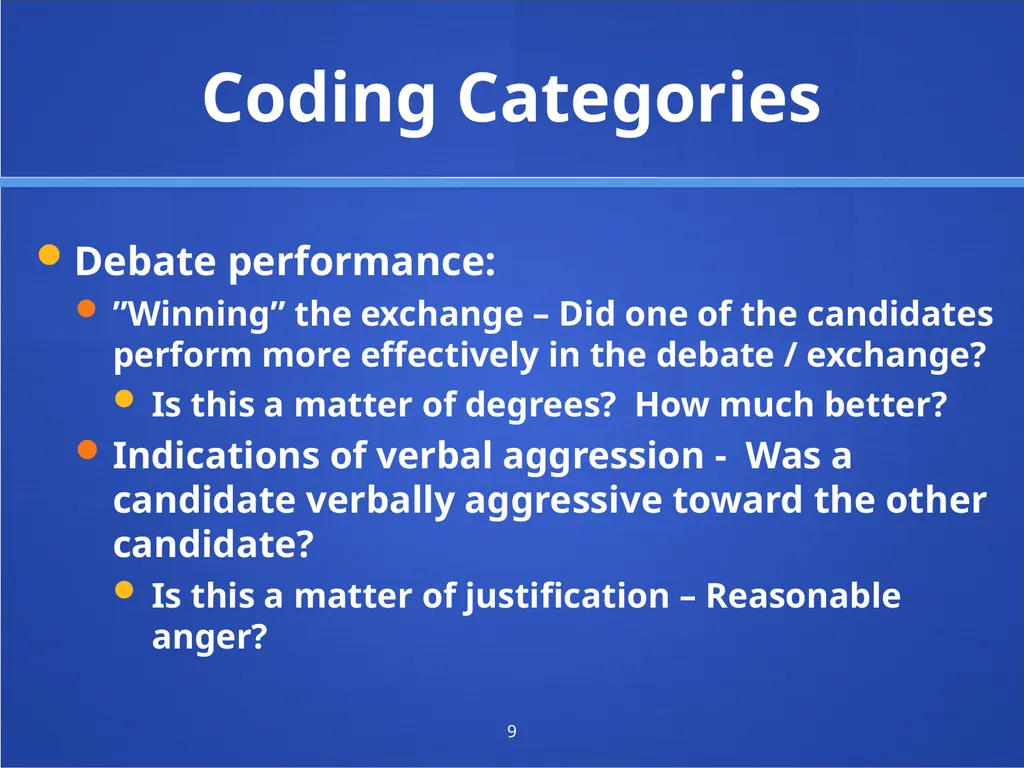
slide9. Coding Categories Debate performance:
”Winning” the exchange – Did one of the candidates perform more effectively in the debate / exchange?
Is this a matter of degrees? How much better?
Indications of verbal aggression - Was a candidate verbally aggressive toward the other candidate?
Is this a matter of justification – Reasonable anger? 9<br>
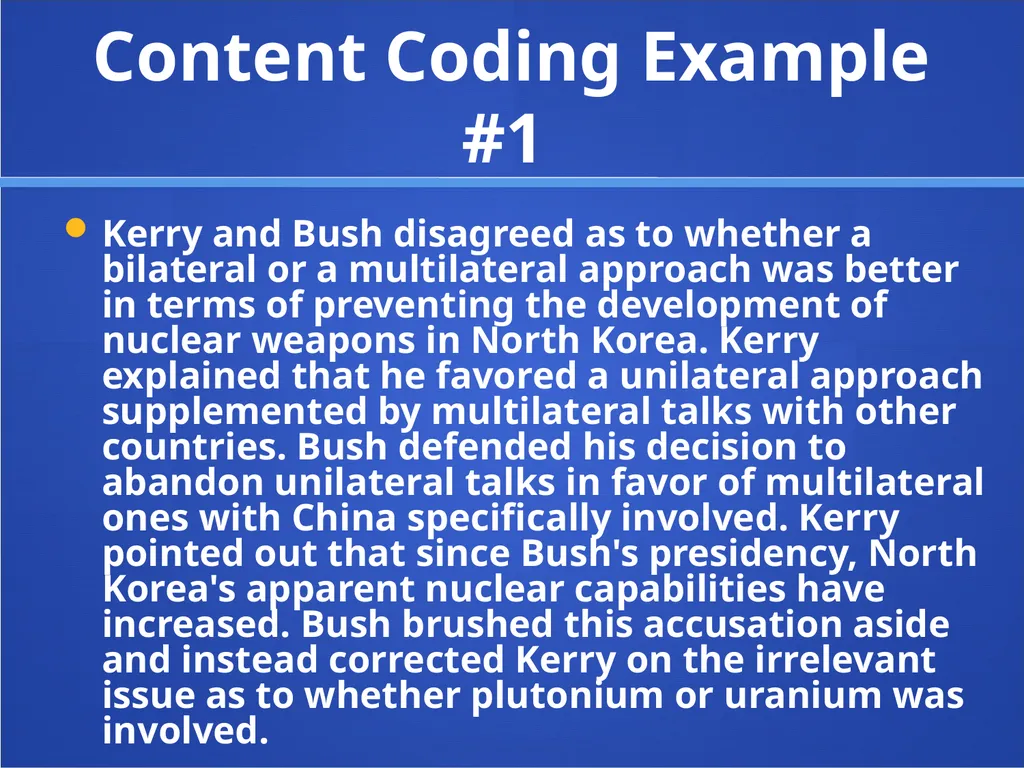
slide10. Content Coding Example #1 Kerry and Bush disagreed as to whether a bilateral or a multilateral approach was better in terms of preventing the development of nuclear weapons in North Korea. Kerry explained that he favored a unilateral approach supplemented by multilateral talks with other countries. Bush defended his decision to abandon unilateral talks in favor of multilateral ones with China specifically involved. Kerry pointed out that since Bush's presidency, North Korea's apparent nuclear capabilities have increased. Bush brushed this accusation aside and instead corrected Kerry on the irrelevant issue as to whether plutonium or uranium was involved.<br>
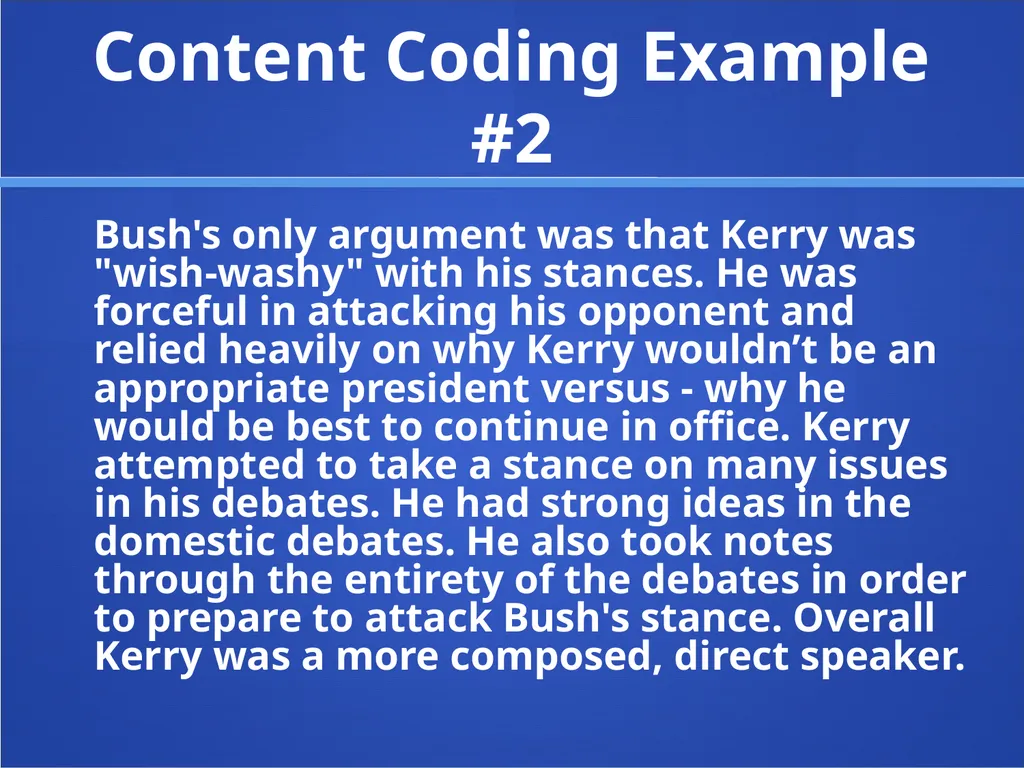
slide11. Content Coding Example #2 Bush's only argument was that Kerry was "wish-washy" with his stances. He was forceful in attacking his opponent and relied heavily on why Kerry wouldn’t be an appropriate president versus - why he would be best to continue in office. Kerry attempted to take a stance on many issues in his debates. He had strong ideas in the domestic debates. He also took notes through the entirety of the debates in order to prepare to attack Bush's stance. Overall Kerry was a more composed, direct speaker.<br>
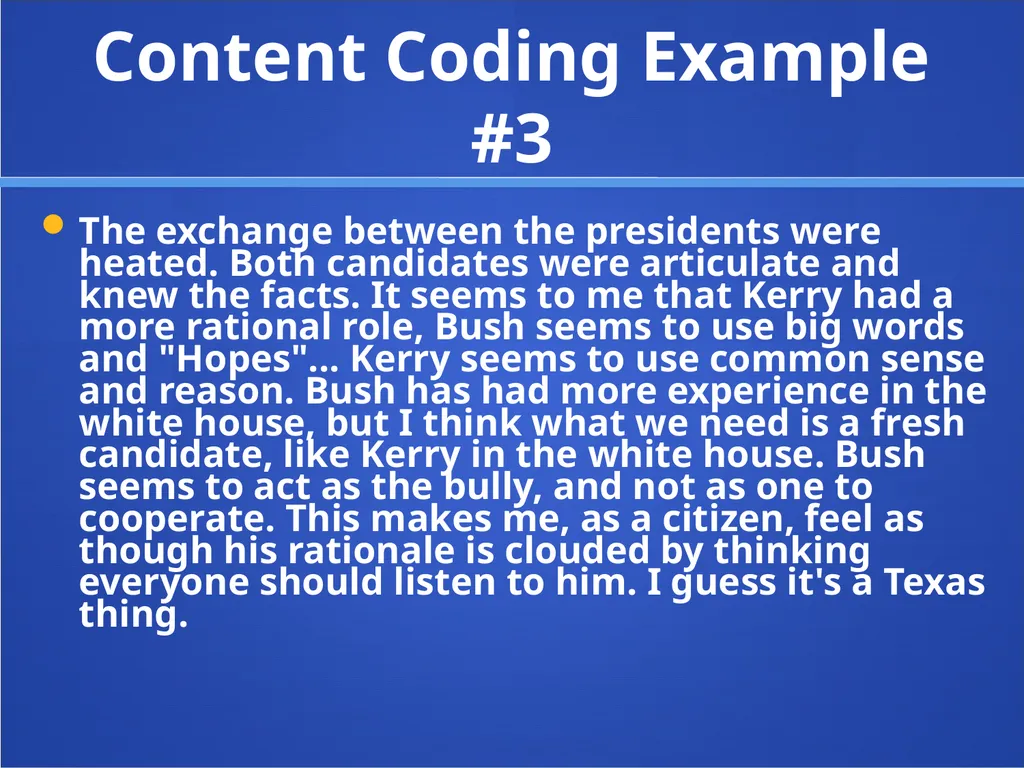
slide12. Content Coding Example #3 The exchange between the presidents were heated. Both candidates were articulate and knew the facts. It seems to me that Kerry had a more rational role, Bush seems to use big words and "Hopes"... Kerry seems to use common sense and reason. Bush has had more experience in the white house, but I think what we need is a fresh candidate, like Kerry in the white house. Bush seems to act as the bully, and not as one to cooperate. This makes me, as a citizen, feel as though his rationale is clouded by thinking everyone should listen to him. I guess it's a Texas thing.<br>
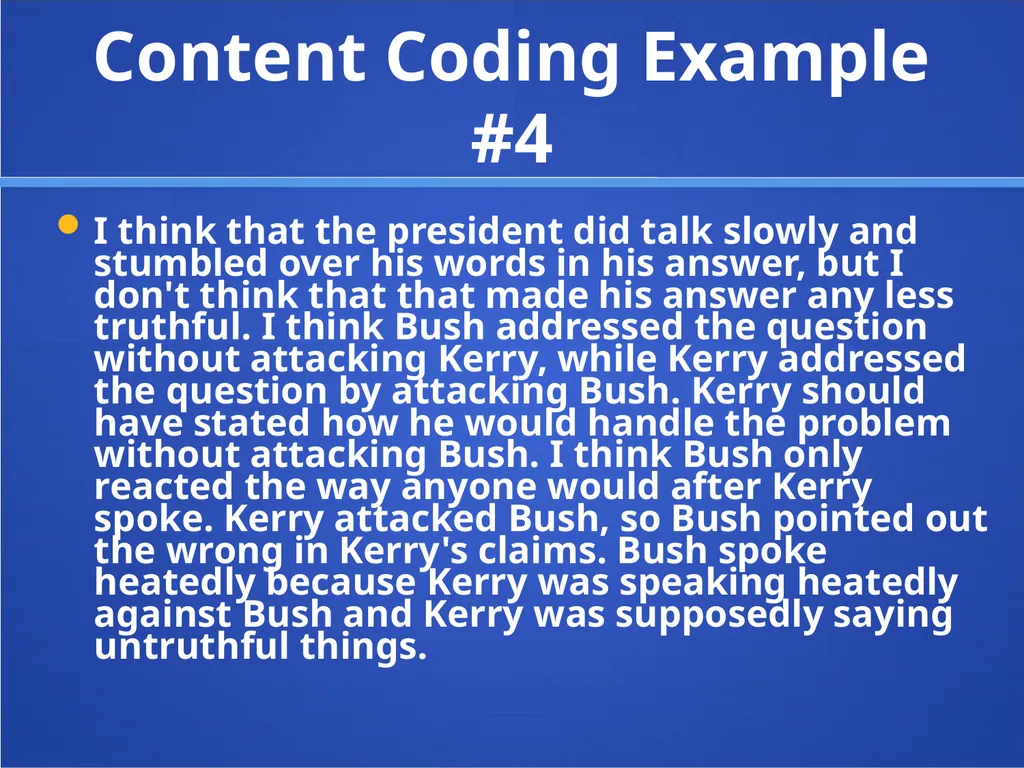
slide13. Content Coding Example #4 I think that the president did talk slowly and stumbled over his words in his answer, but I don't think that that made his answer any less truthful. I think Bush addressed the question without attacking Kerry, while Kerry addressed the question by attacking Bush. Kerry should have stated how he would handle the problem without attacking Bush. I think Bush only reacted the way anyone would after Kerry spoke. Kerry attacked Bush, so Bush pointed out the wrong in Kerry's claims. Bush spoke heatedly because Kerry was speaking heatedly against Bush and Kerry was supposedly saying untruthful things.<br>
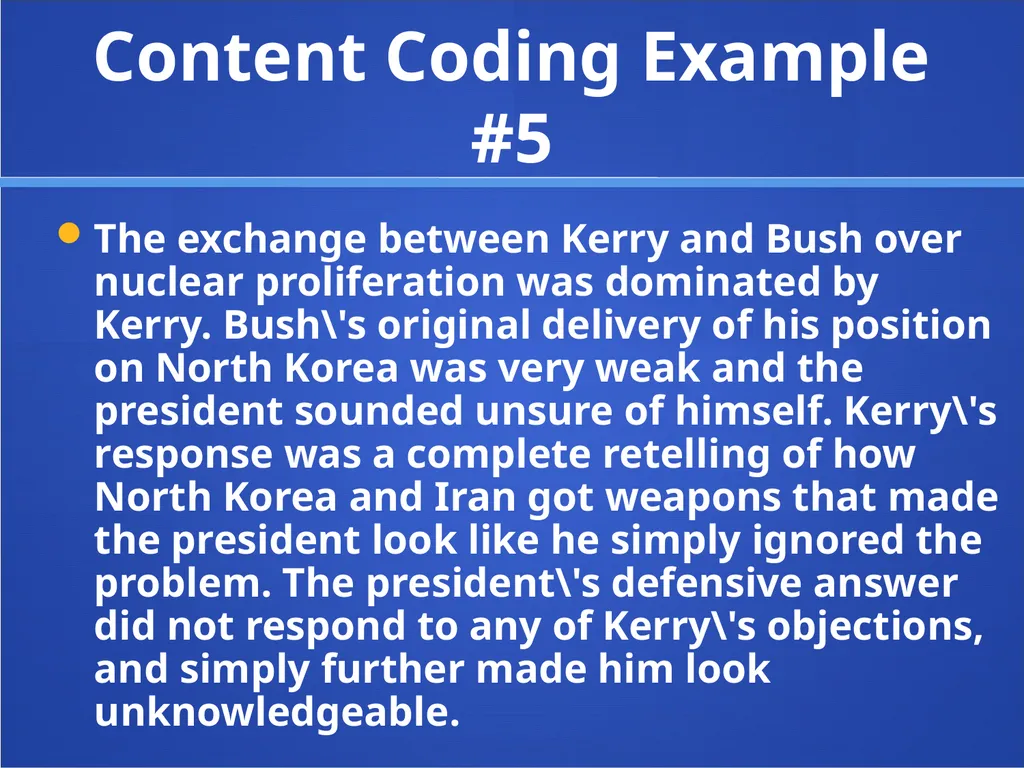
slide14. Content Coding Example #5 The exchange between Kerry and Bush over nuclear proliferation was dominated by Kerry. Bush\'s original delivery of his position on North Korea was very weak and the president sounded unsure of himself. Kerry\'s response was a complete retelling of how North Korea and Iran got weapons that made the president look like he simply ignored the problem. The president\'s defensive answer did not respond to any of Kerry\'s objections, and simply further made him look unknowledgeable.<br>
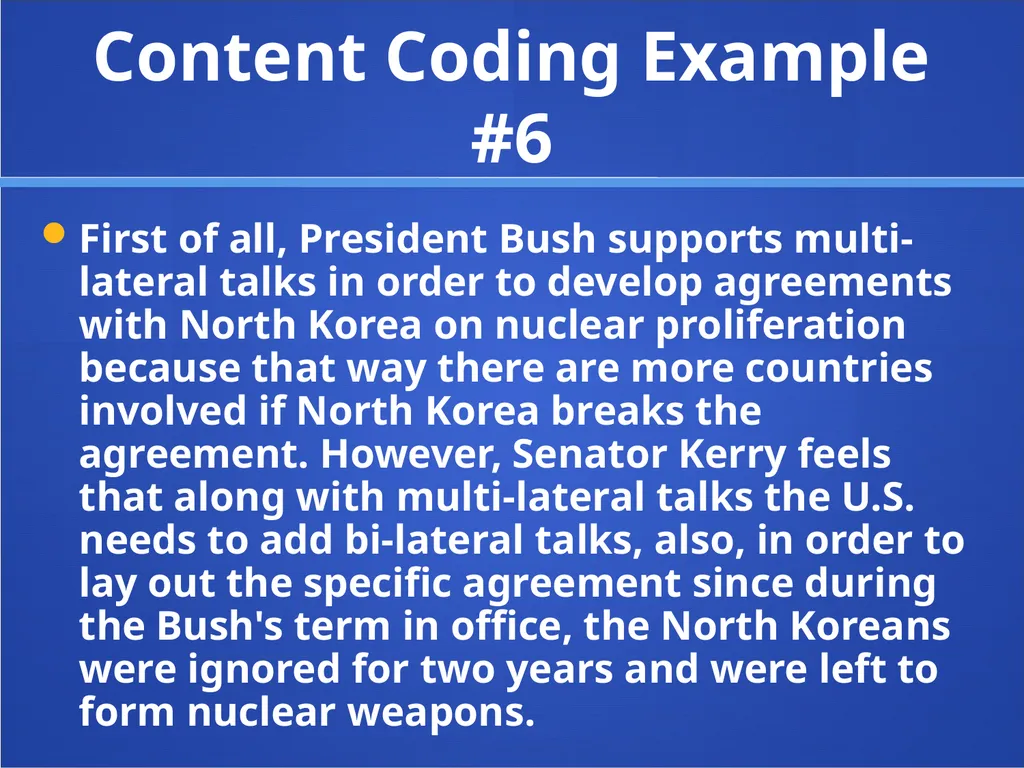
slide15. Content Coding Example #6 First of all, President Bush supports multi-lateral talks in order to develop agreements with North Korea on nuclear proliferation because that way there are more countries involved if North Korea breaks the agreement. However, Senator Kerry feels that along with multi-lateral talks the U.S. needs to add bi-lateral talks, also, in order to lay out the specific agreement since during the Bush's term in office, the North Koreans were ignored for two years and were left to form nuclear weapons.<br>
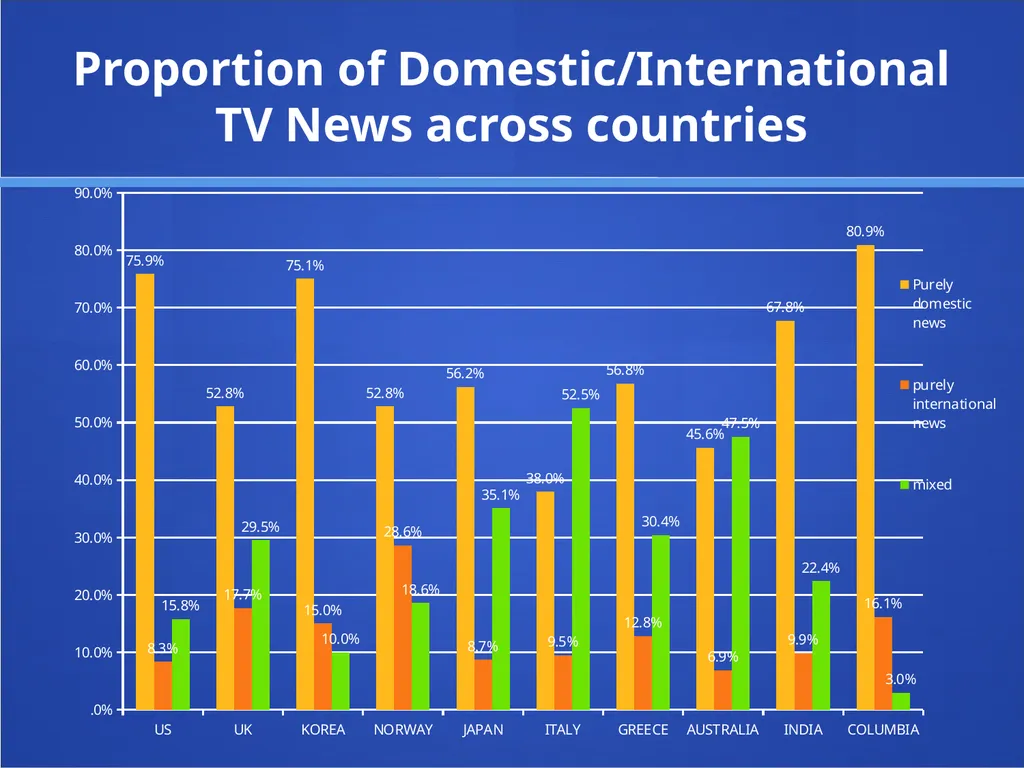
slide16. Proportion of Domestic/International TV News across countries<br>
slide17. Average N of sources cited TV News<br>
slide18. % of Women cited as sources – TV News<br>
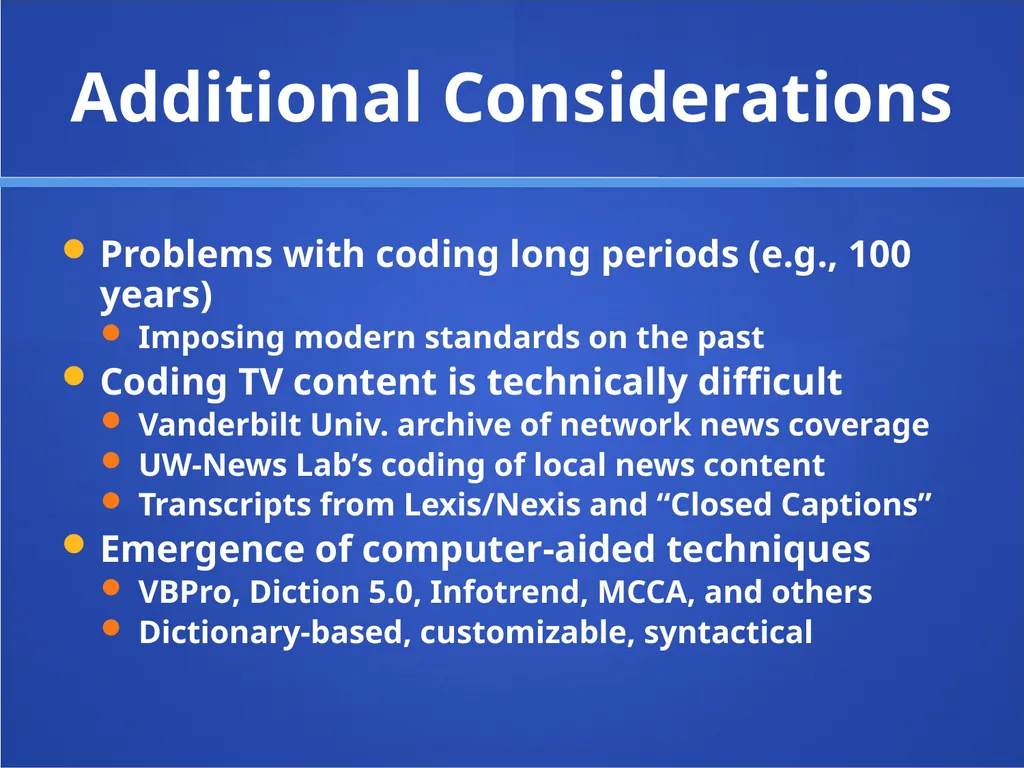
slide19. Additional Considerations Problems with coding long periods (e.g., 100 years)
Imposing modern standards on the past
Coding TV content is technically difficult
Vanderbilt Univ. archive of network news coverage
UW-News Lab’s coding of local news content
Transcripts from Lexis/Nexis and “Closed Captions”
Emergence of computer-aided techniques
VBPro, Diction 5.0, Infotrend, MCCA, and others
Dictionary-based, customizable, syntactical<br>
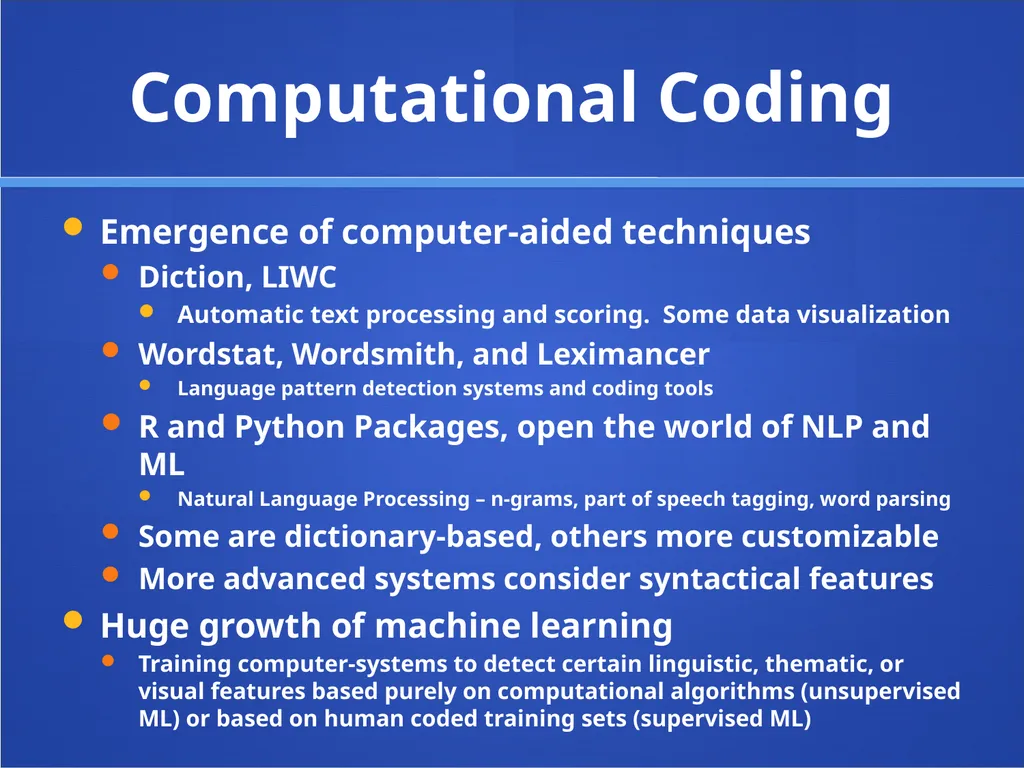
slide20. Computational Coding Emergence of computer-aided techniques
Diction, LIWC
Automatic text processing and scoring. Some data visualization
Wordstat, Wordsmith, and Leximancer
Language pattern detection systems and coding tools
R and Python Packages, open the world of NLP and ML
Natural Language Processing – n-grams, part of speech tagging, word parsing
Some are dictionary-based, others more customizable
More advanced systems consider syntactical features
Huge growth of machine learning
Training computer-systems to detect certain linguistic, thematic, or visual features based purely on computational algorithms (unsupervised ML) or based on human coded training sets (supervised ML)<br>
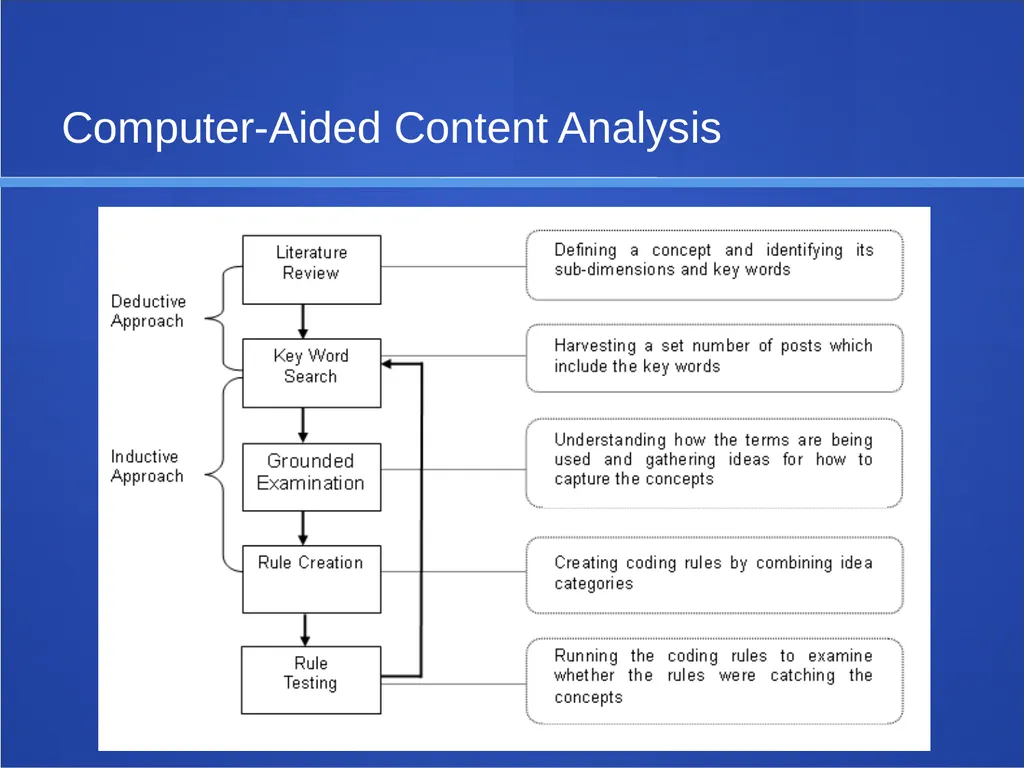
slide21. Computer-Aided Content Analysis<br>
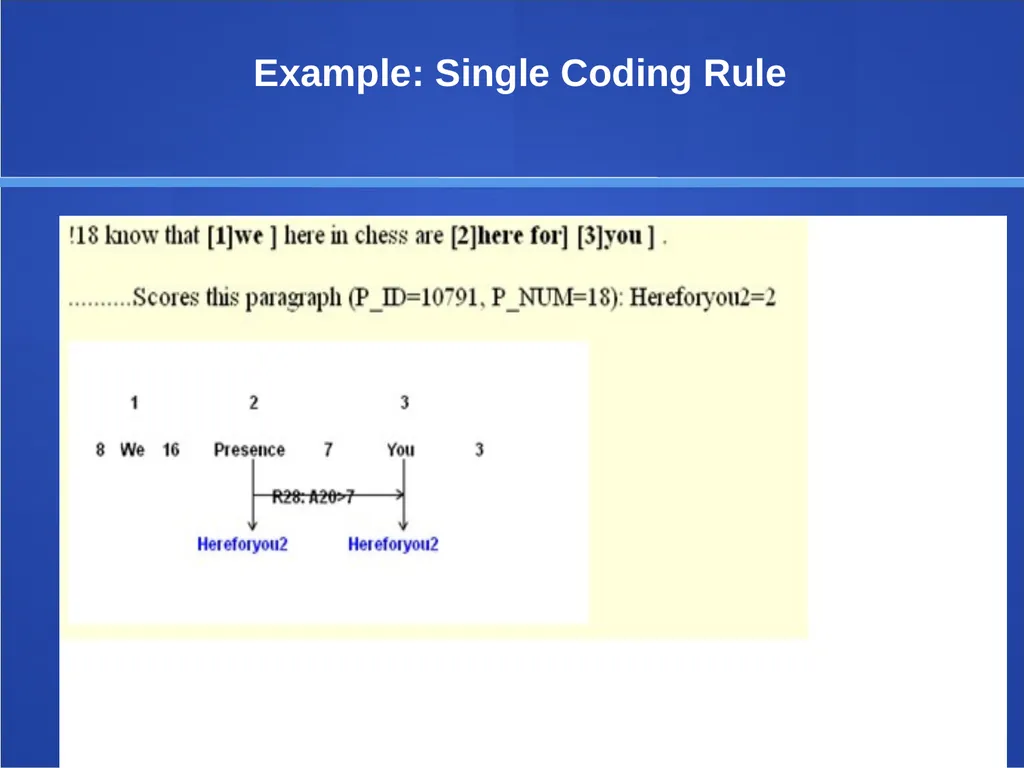
slide22. Example: Single Coding Rule<br>
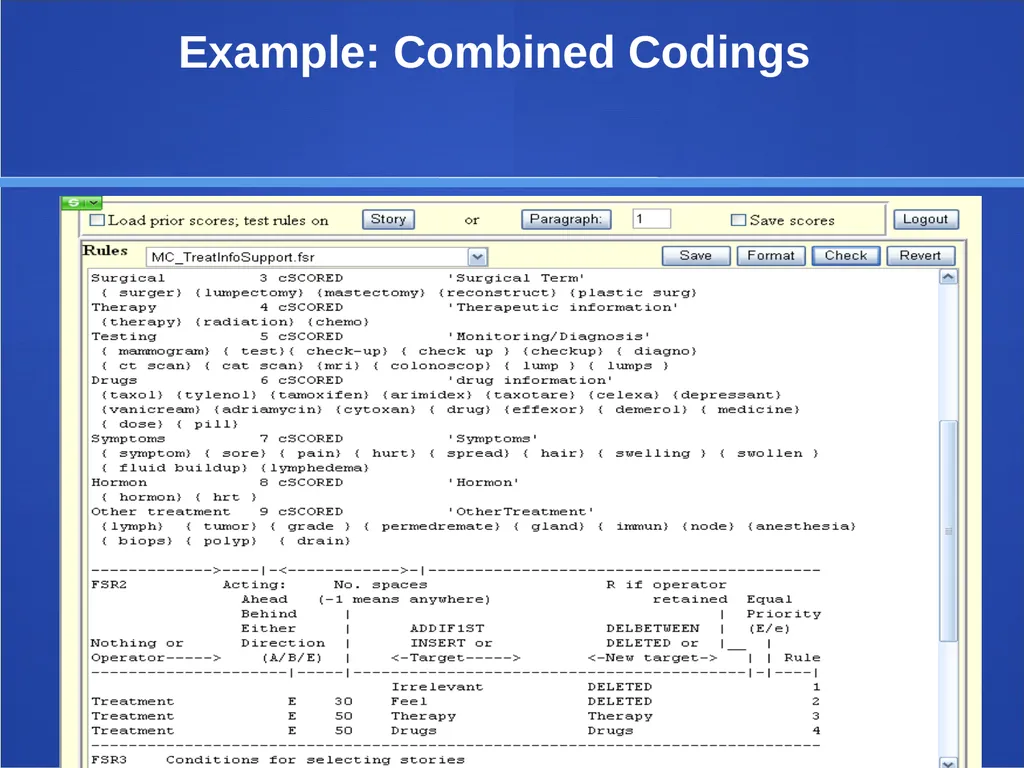
slide23. Example: Combined Codings<br>
slide24. Strengths and Weaknesses Easy to undertake - no special equipment (unless you are looking at big data and even then very accessible)
“Easy” to correct errors - go back and recode
Allows for the study of dynamic processes -overtime
Unobtrusive - no effects on subject of study
Yet….
Limited to recorded communication - much is lost
Limited in terms of claims you can make<br>
slide2. Content Analysis Study of a recorded human communication
Typically, the coding of communication for the presence of certain traits, categories, or meanings
Analysis can relate the occurrence of coded content with other factors, such as features of the producer, effects on the receiver, etc.
Applied to the study of books, magazines, papers, transcripts, web pages, songs, speeches, postings, correspondence, statements, utterances, etc.<br>
slide3. Topics of Content Analysis Particularly well suited for communication research
Critical for answering the classic question…
Who says what, to whom, why, how, and with what effect?
However, content differences do not equal effects
Must move beyond simple content studies to relate coded features to antecedents or consequences
Relating content features to one another is also meaningful<br>
slide4. Sampling in Content Analysis Since you can rarely observe all content, must sample from available content for coding pool
Units of analysis may differ from units of observation
Observe story content to analyze newspaper differences
Sample selection depends largely on unit of analysis
Example, if studying differences between authors, the unit of observation may be books, pages, paragraphs, or sentences
Need to be clear about unit of analysis before planning sampling strategy to avoid problems later<br>
slide5. Questions in Sample Generation Must establish the universe to be sampled from
Ex - Content analysis of television violence by network
Which TV stations should you observe?
How many days will you observe them?
During which hours will you observe television?
You always make assumptions; be upfront about them
We will code the six major networks — ABC, CBS, NBC, FOX, UPN, WB — for a “random week” during the month of December from 7 PM to 10 PM, each day selected.
May be Random, Systematic, Stratified, etc.<br>
slide6. Coding in Content Analysis Coding is the heart of content analysis
Process of converting raw data into a standardized form
Classify content in relation to a conceptual framework
Ex. Emotionality, Partisan Bias, Source Attribution, etc.
Must carefully conceptualize coding categories
Relevant concepts and relevant categories within concepts
Manifest (visible surface) / Latent (underlying meaning)
How big a leap between observation and inference
The more manifest, the more reliable - ex. counting words
The more latent, the more interesting - ex. assessing meaning<br>
slide7. Quantitative Data Management End product of coding in numerical
Distinguish units of analysis and observation
Establish the base for coding, (i.e., proportion)
Understand the coding system
Nominal, ordinal, interval, ratio…
Use appropriate statistics in analysis<br>
slide8. Strengths and Weaknesses Easy to undertake - no staff, no special equipment
Easy to correct errors - go back and recode
Allows for the study of dynamic processes - time
Unobtrusive - no effects on subject of study
Yet….
Limited to recorded communication - much is lost
Limited in terms of claims you can make<br>
slide9. Coding Categories Debate performance:
”Winning” the exchange – Did one of the candidates perform more effectively in the debate / exchange?
Is this a matter of degrees? How much better?
Indications of verbal aggression - Was a candidate verbally aggressive toward the other candidate?
Is this a matter of justification – Reasonable anger? 9<br>
slide10. Content Coding Example #1 Kerry and Bush disagreed as to whether a bilateral or a multilateral approach was better in terms of preventing the development of nuclear weapons in North Korea. Kerry explained that he favored a unilateral approach supplemented by multilateral talks with other countries. Bush defended his decision to abandon unilateral talks in favor of multilateral ones with China specifically involved. Kerry pointed out that since Bush's presidency, North Korea's apparent nuclear capabilities have increased. Bush brushed this accusation aside and instead corrected Kerry on the irrelevant issue as to whether plutonium or uranium was involved.<br>
slide11. Content Coding Example #2 Bush's only argument was that Kerry was "wish-washy" with his stances. He was forceful in attacking his opponent and relied heavily on why Kerry wouldn’t be an appropriate president versus - why he would be best to continue in office. Kerry attempted to take a stance on many issues in his debates. He had strong ideas in the domestic debates. He also took notes through the entirety of the debates in order to prepare to attack Bush's stance. Overall Kerry was a more composed, direct speaker.<br>
slide12. Content Coding Example #3 The exchange between the presidents were heated. Both candidates were articulate and knew the facts. It seems to me that Kerry had a more rational role, Bush seems to use big words and "Hopes"... Kerry seems to use common sense and reason. Bush has had more experience in the white house, but I think what we need is a fresh candidate, like Kerry in the white house. Bush seems to act as the bully, and not as one to cooperate. This makes me, as a citizen, feel as though his rationale is clouded by thinking everyone should listen to him. I guess it's a Texas thing.<br>
slide13. Content Coding Example #4 I think that the president did talk slowly and stumbled over his words in his answer, but I don't think that that made his answer any less truthful. I think Bush addressed the question without attacking Kerry, while Kerry addressed the question by attacking Bush. Kerry should have stated how he would handle the problem without attacking Bush. I think Bush only reacted the way anyone would after Kerry spoke. Kerry attacked Bush, so Bush pointed out the wrong in Kerry's claims. Bush spoke heatedly because Kerry was speaking heatedly against Bush and Kerry was supposedly saying untruthful things.<br>
slide14. Content Coding Example #5 The exchange between Kerry and Bush over nuclear proliferation was dominated by Kerry. Bush\'s original delivery of his position on North Korea was very weak and the president sounded unsure of himself. Kerry\'s response was a complete retelling of how North Korea and Iran got weapons that made the president look like he simply ignored the problem. The president\'s defensive answer did not respond to any of Kerry\'s objections, and simply further made him look unknowledgeable.<br>
slide15. Content Coding Example #6 First of all, President Bush supports multi-lateral talks in order to develop agreements with North Korea on nuclear proliferation because that way there are more countries involved if North Korea breaks the agreement. However, Senator Kerry feels that along with multi-lateral talks the U.S. needs to add bi-lateral talks, also, in order to lay out the specific agreement since during the Bush's term in office, the North Koreans were ignored for two years and were left to form nuclear weapons.<br>
slide16. Proportion of Domestic/International TV News across countries<br>
slide17. Average N of sources cited TV News<br>
slide18. % of Women cited as sources – TV News<br>
slide19. Additional Considerations Problems with coding long periods (e.g., 100 years)
Imposing modern standards on the past
Coding TV content is technically difficult
Vanderbilt Univ. archive of network news coverage
UW-News Lab’s coding of local news content
Transcripts from Lexis/Nexis and “Closed Captions”
Emergence of computer-aided techniques
VBPro, Diction 5.0, Infotrend, MCCA, and others
Dictionary-based, customizable, syntactical<br>
slide20. Computational Coding Emergence of computer-aided techniques
Diction, LIWC
Automatic text processing and scoring. Some data visualization
Wordstat, Wordsmith, and Leximancer
Language pattern detection systems and coding tools
R and Python Packages, open the world of NLP and ML
Natural Language Processing – n-grams, part of speech tagging, word parsing
Some are dictionary-based, others more customizable
More advanced systems consider syntactical features
Huge growth of machine learning
Training computer-systems to detect certain linguistic, thematic, or visual features based purely on computational algorithms (unsupervised ML) or based on human coded training sets (supervised ML)<br>
slide21. Computer-Aided Content Analysis<br>
slide22. Example: Single Coding Rule<br>
slide23. Example: Combined Codings<br>
slide24. Strengths and Weaknesses Easy to undertake - no special equipment (unless you are looking at big data and even then very accessible)
“Easy” to correct errors - go back and recode
Allows for the study of dynamic processes -overtime
Unobtrusive - no effects on subject of study
Yet….
Limited to recorded communication - much is lost
Limited in terms of claims you can make<br>