
CONTENT INTRODUCTION The workshops are organized


Description: CONTENT INTRODUCTION The workshops are organized to develop the psychomotor aspects (skill development) of the learner regarding practical of new innovations in area of education. Under this technique participants have do some practical
Related Topics
Download Presentation
"CONTENT INTRODUCTION The workshops are organized" is the property of its rightful owner. Permission is granted to download and print the materials on this website for personal, non-commercial use only, and to display it on your personal computer provided you do not modify the materials and that you retain all copyright notices contained in the materials. By downloading content from our website, you accept the terms of this agreement.
Presentation Transcript
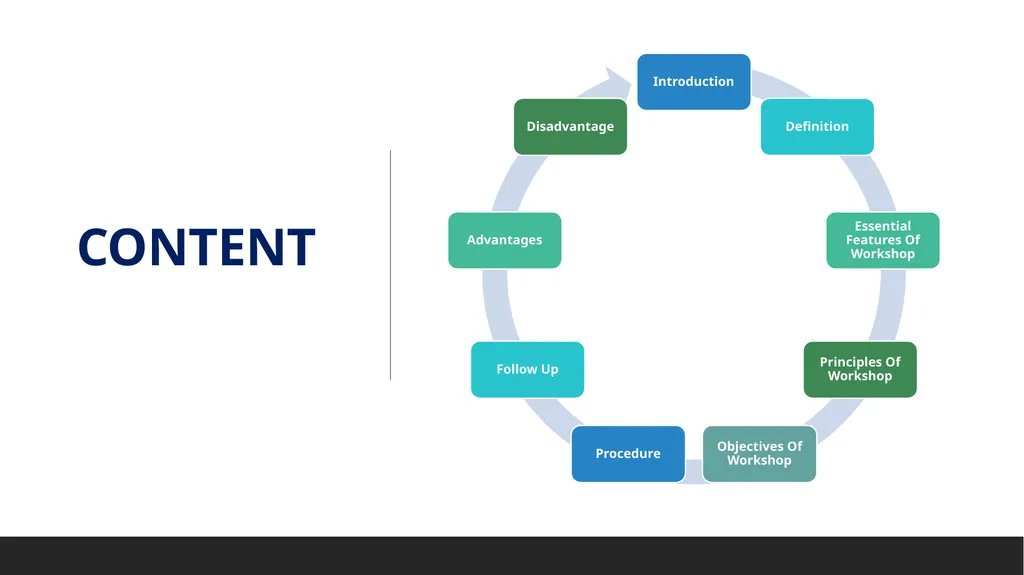
slide2. CONTENT<br>
slide3. INTRODUCTION The workshops are organized to develop the psychomotor aspects (skill development) of the learner regarding practical of new innovations in area of education. Under this technique participants have do some practical work to produce instructional teaching and testing material.<br>
slide4. DEFINITION Workshop is defined as assembled group of 10 to 25 persons who share a common interest or problem. They meet together to improve their individual and skill of a subject through intensive study, research, practice and discussion
Workshop is a meeting during which experienced people in responsible positions come together with experts and consultants to find solutions for the problem that cropped up in the course of their work and they have had difficulty in dealing with on their own. It is large group discussion method.<br>
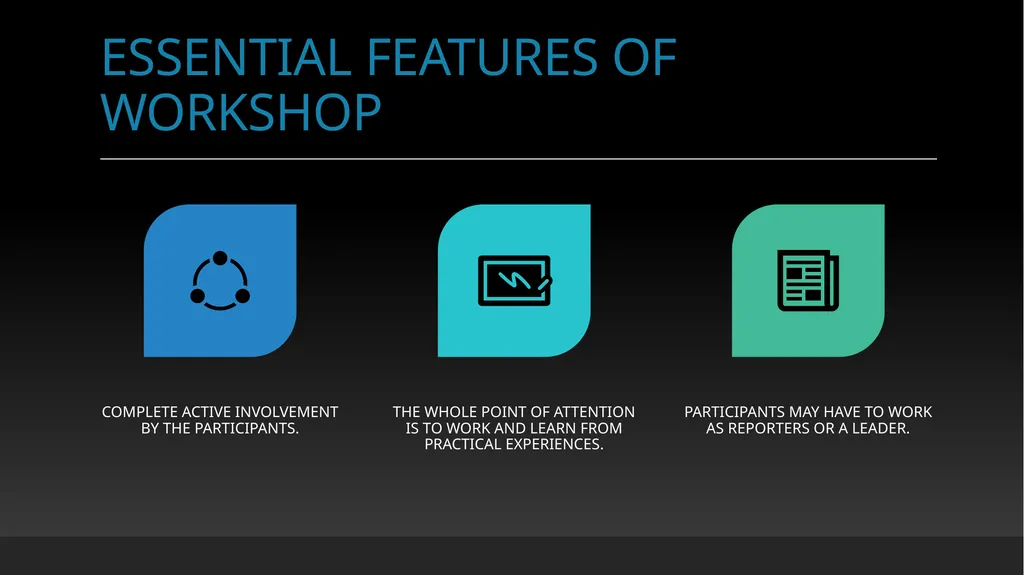
slide5. ESSENTIAL FEATURES OF WORKSHOP<br>
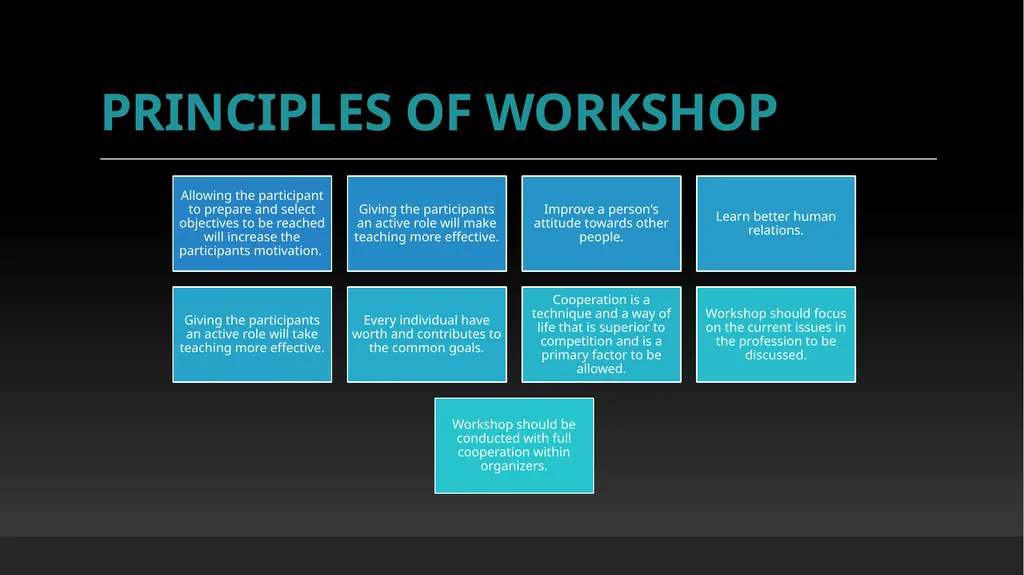
slide6. PRINCIPLES OF WORKSHOP<br>
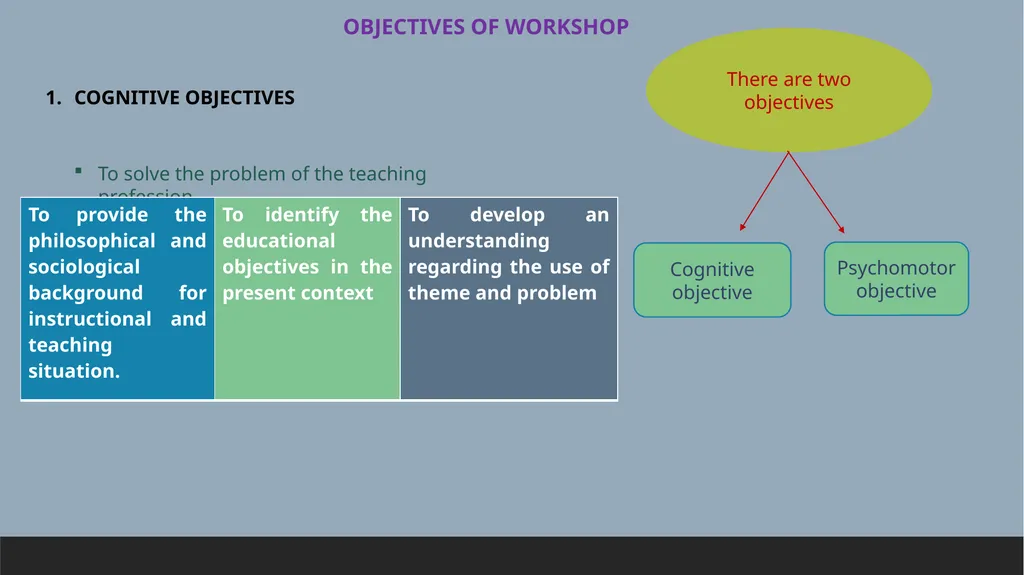
slide7. OBJECTIVES OF WORKSHOP There are two objectives Cognitive objective Psychomotor objective To solve the problem of the teaching profession COGNITIVE OBJECTIVES<br>
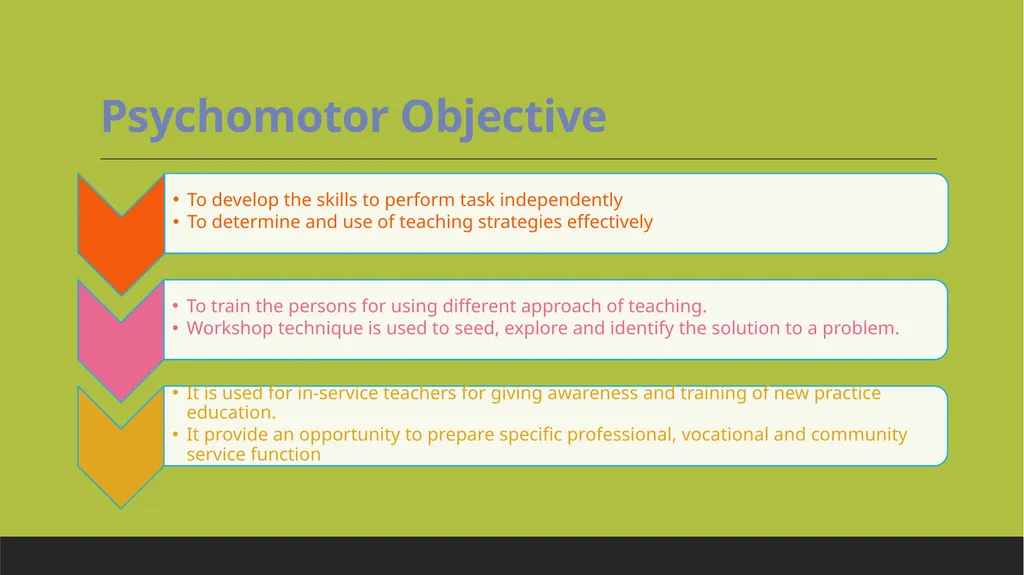
slide8. Psychomotor Objective<br>
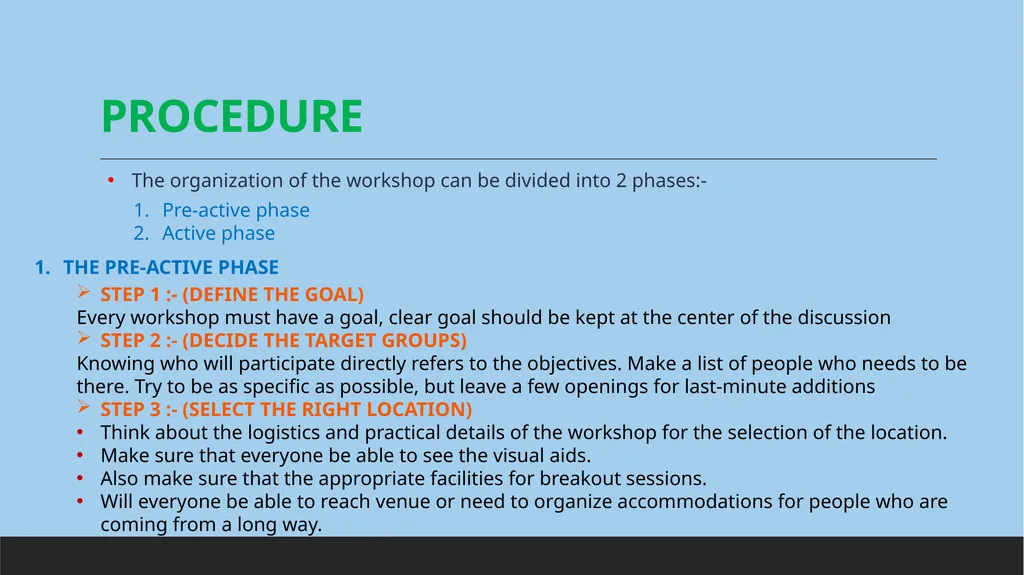
slide9. PROCEDURE The organization of the workshop can be divided into 2 phases:- Pre-active phase
Active phase THE PRE-ACTIVE PHASE STEP 1 :- (DEFINE THE GOAL)
Every workshop must have a goal, clear goal should be kept at the center of the discussion
STEP 2 :- (DECIDE THE TARGET GROUPS)
Knowing who will participate directly refers to the objectives. Make a list of people who needs to be there. Try to be as specific as possible, but leave a few openings for last-minute additions
STEP 3 :- (SELECT THE RIGHT LOCATION)
Think about the logistics and practical details of the workshop for the selection of the location.
Make sure that everyone be able to see the visual aids.
Also make sure that the appropriate facilities for breakout sessions.
Will everyone be able to reach venue or need to organize accommodations for people who are coming from a long way.<br>
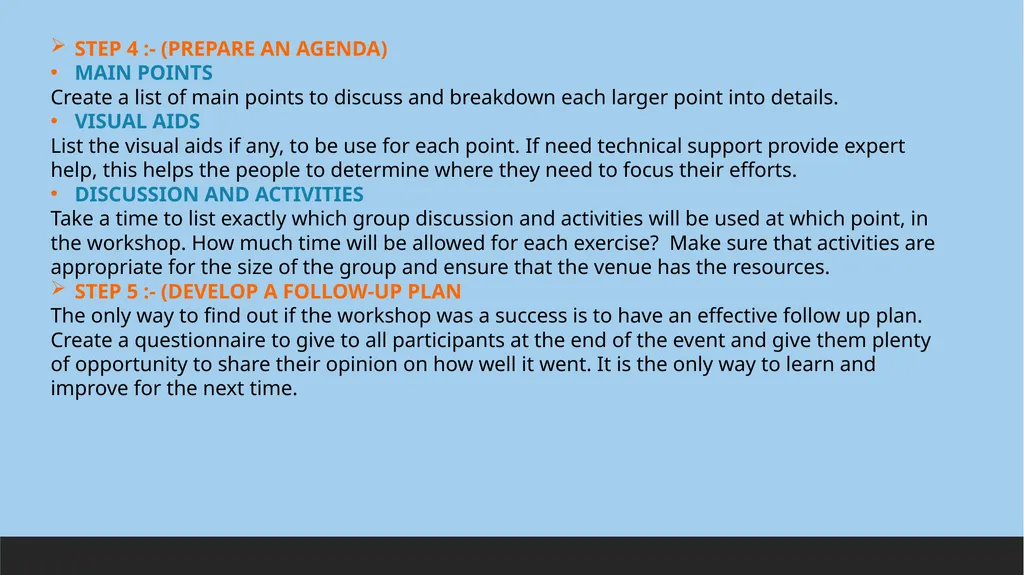
slide10. STEP 4 :- (PREPARE AN AGENDA)
MAIN POINTS
Create a list of main points to discuss and breakdown each larger point into details.
VISUAL AIDS
List the visual aids if any, to be use for each point. If need technical support provide expert help, this helps the people to determine where they need to focus their efforts.
DISCUSSION AND ACTIVITIES
Take a time to list exactly which group discussion and activities will be used at which point, in the workshop. How much time will be allowed for each exercise? Make sure that activities are appropriate for the size of the group and ensure that the venue has the resources.
STEP 5 :- (DEVELOP A FOLLOW-UP PLAN
The only way to find out if the workshop was a success is to have an effective follow up plan. Create a questionnaire to give to all participants at the end of the event and give them plenty of opportunity to share their opinion on how well it went. It is the only way to learn and improve for the next time.<br>
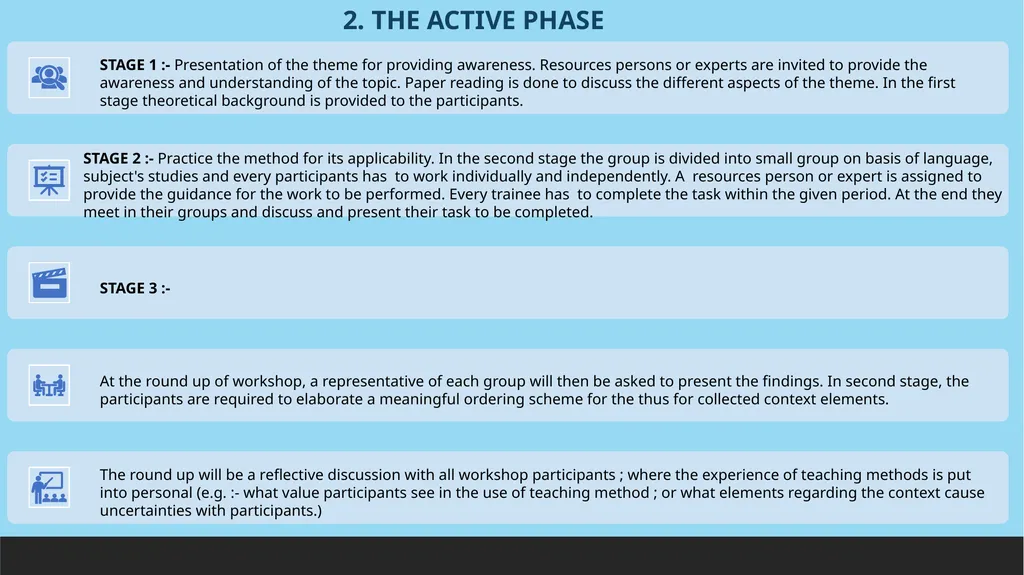
slide11. 2. THE ACTIVE PHASE<br>
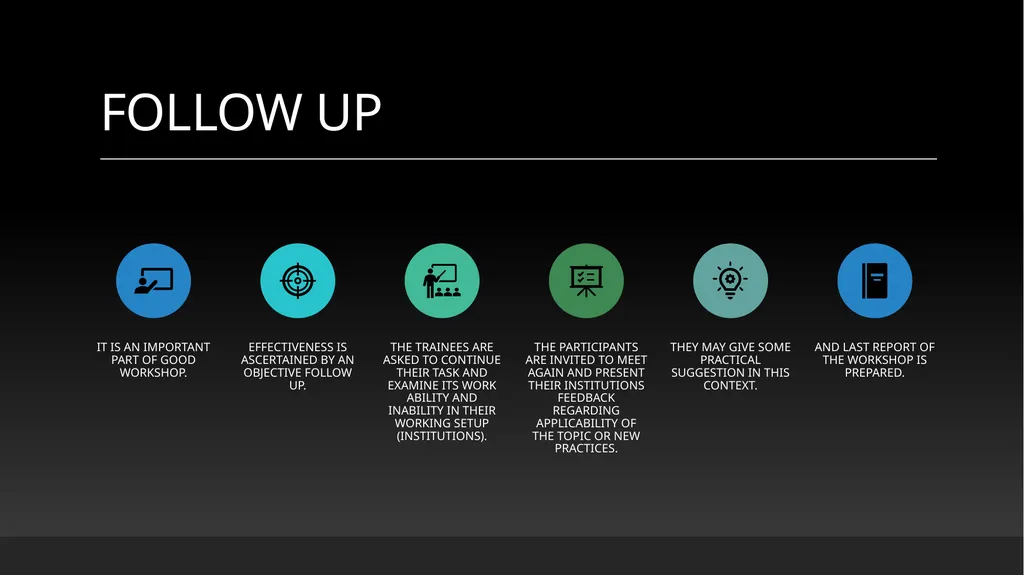
slide12. FOLLOW UP<br>
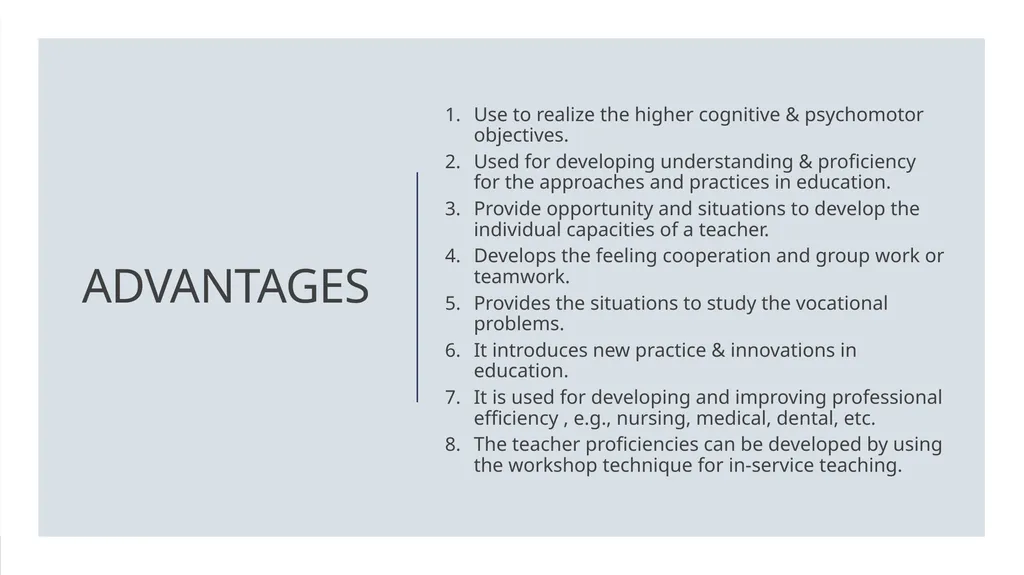
slide13. ADVANTAGES Use to realize the higher cognitive & psychomotor objectives.
Used for developing understanding & proficiency for the approaches and practices in education.
Provide opportunity and situations to develop the individual capacities of a teacher.
Develops the feeling cooperation and group work or teamwork.
Provides the situations to study the vocational problems.
It introduces new practice & innovations in education.
It is used for developing and improving professional efficiency , e.g., nursing, medical, dental, etc.
The teacher proficiencies can be developed by using the workshop technique for in-service teaching.<br>
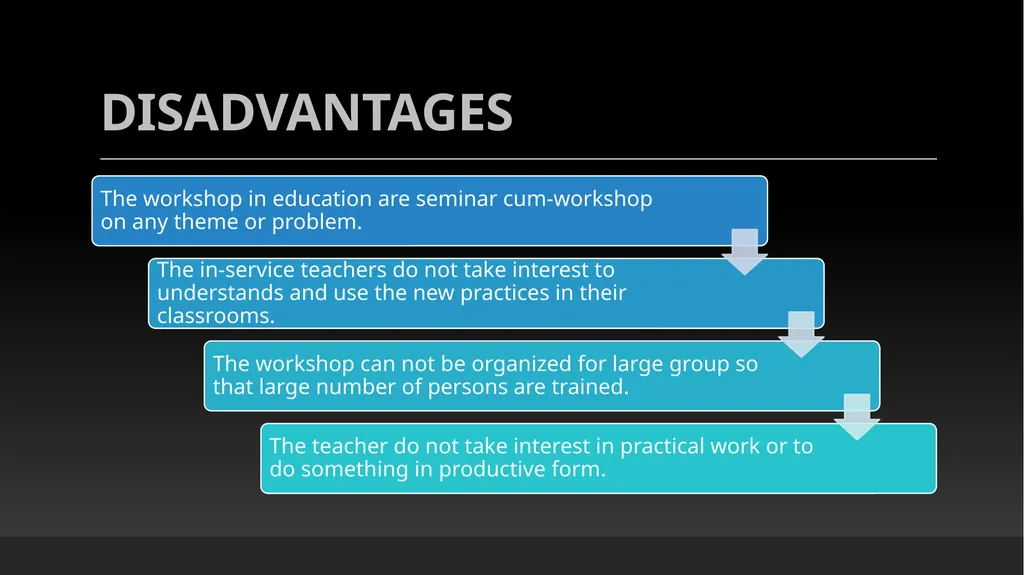
slide14. DISADVANTAGES<br>
slide15. CONCLUSION Workshop may be a room or building which provides both the area and tools ( machinery ) that may be required for the manufacture of repair manufactured goods. Workshop were the only places of production until the advent of industrialization and factory.<br>
slide3. INTRODUCTION The workshops are organized to develop the psychomotor aspects (skill development) of the learner regarding practical of new innovations in area of education. Under this technique participants have do some practical work to produce instructional teaching and testing material.<br>
slide4. DEFINITION Workshop is defined as assembled group of 10 to 25 persons who share a common interest or problem. They meet together to improve their individual and skill of a subject through intensive study, research, practice and discussion
Workshop is a meeting during which experienced people in responsible positions come together with experts and consultants to find solutions for the problem that cropped up in the course of their work and they have had difficulty in dealing with on their own. It is large group discussion method.<br>
slide5. ESSENTIAL FEATURES OF WORKSHOP<br>
slide6. PRINCIPLES OF WORKSHOP<br>
slide7. OBJECTIVES OF WORKSHOP There are two objectives Cognitive objective Psychomotor objective To solve the problem of the teaching profession COGNITIVE OBJECTIVES<br>
slide8. Psychomotor Objective<br>
slide9. PROCEDURE The organization of the workshop can be divided into 2 phases:- Pre-active phase
Active phase THE PRE-ACTIVE PHASE STEP 1 :- (DEFINE THE GOAL)
Every workshop must have a goal, clear goal should be kept at the center of the discussion
STEP 2 :- (DECIDE THE TARGET GROUPS)
Knowing who will participate directly refers to the objectives. Make a list of people who needs to be there. Try to be as specific as possible, but leave a few openings for last-minute additions
STEP 3 :- (SELECT THE RIGHT LOCATION)
Think about the logistics and practical details of the workshop for the selection of the location.
Make sure that everyone be able to see the visual aids.
Also make sure that the appropriate facilities for breakout sessions.
Will everyone be able to reach venue or need to organize accommodations for people who are coming from a long way.<br>
slide10. STEP 4 :- (PREPARE AN AGENDA)
MAIN POINTS
Create a list of main points to discuss and breakdown each larger point into details.
VISUAL AIDS
List the visual aids if any, to be use for each point. If need technical support provide expert help, this helps the people to determine where they need to focus their efforts.
DISCUSSION AND ACTIVITIES
Take a time to list exactly which group discussion and activities will be used at which point, in the workshop. How much time will be allowed for each exercise? Make sure that activities are appropriate for the size of the group and ensure that the venue has the resources.
STEP 5 :- (DEVELOP A FOLLOW-UP PLAN
The only way to find out if the workshop was a success is to have an effective follow up plan. Create a questionnaire to give to all participants at the end of the event and give them plenty of opportunity to share their opinion on how well it went. It is the only way to learn and improve for the next time.<br>
slide11. 2. THE ACTIVE PHASE<br>
slide12. FOLLOW UP<br>
slide13. ADVANTAGES Use to realize the higher cognitive & psychomotor objectives.
Used for developing understanding & proficiency for the approaches and practices in education.
Provide opportunity and situations to develop the individual capacities of a teacher.
Develops the feeling cooperation and group work or teamwork.
Provides the situations to study the vocational problems.
It introduces new practice & innovations in education.
It is used for developing and improving professional efficiency , e.g., nursing, medical, dental, etc.
The teacher proficiencies can be developed by using the workshop technique for in-service teaching.<br>
slide14. DISADVANTAGES<br>
slide15. CONCLUSION Workshop may be a room or building which provides both the area and tools ( machinery ) that may be required for the manufacture of repair manufactured goods. Workshop were the only places of production until the advent of industrialization and factory.<br>