
Contents Aims Learning outcome1 – know the
CB
Published · 56 slides · 0 views
1 / 1

Description
Contents Aims Learning outcome1 know the principles of training in a sporting context Learning outcome 2 know how training methods target different fitness components Learning outcome 3 be able to conduct fitness tests Learning
Related Topics
Share
Embed code
Download this presentation From Below
"Contents Aims Learning outcome1 – know the" is the property of its rightful owner. Permission is granted to download and print the materials on this website for personal, non-commercial use only, and to display it on your personal computer provided you do not modify the materials and that you retain all copyright notices contained in the materials. By downloading content from our website, you accept the terms of this agreement.
Presentation Transcript
01
Contents Aims
Learning outcome1 – know the principles of training in a sporting context
Learning outcome 2 – know how training methods target different fitness components
Learning outcome 3 – be able to conduct fitness tests
Learning outcome 4 – be able to develop fitness training programmes<br>
Learning outcome1 – know the principles of training in a sporting context
Learning outcome 2 – know how training methods target different fitness components
Learning outcome 3 – be able to conduct fitness tests
Learning outcome 4 – be able to develop fitness training programmes<br>
02
Aims In the world of team and individual sport, it is vital that coaches keep their performers in peak condition. They do this by regularly monitoring them through fitness tests and by designing bespoke training programmes to suit the type of sport, performance schedule and the individual themselves. High quality training programmes apply principles of training to the requirements of the individual in their development and implementation.
By completing this unit, learners will develop knowledge and understanding of the principles and methods of training and the application of these in the design of training programmes along with practical skills in fitness testing.<br>
By completing this unit, learners will develop knowledge and understanding of the principles and methods of training and the application of these in the design of training programmes along with practical skills in fitness testing.<br>
03
Learning outcome 1 – know the principles of training in a sporting context Learners must be taught:
The principles of training in a sporting context
Progression
Specificity
Reversibility/regression
Moderation
Variance<br>
The principles of training in a sporting context
Progression
Specificity
Reversibility/regression
Moderation
Variance<br>
04
Learning outcome 1 – know the principles of training in a sporting context The principles of training in a sporting context
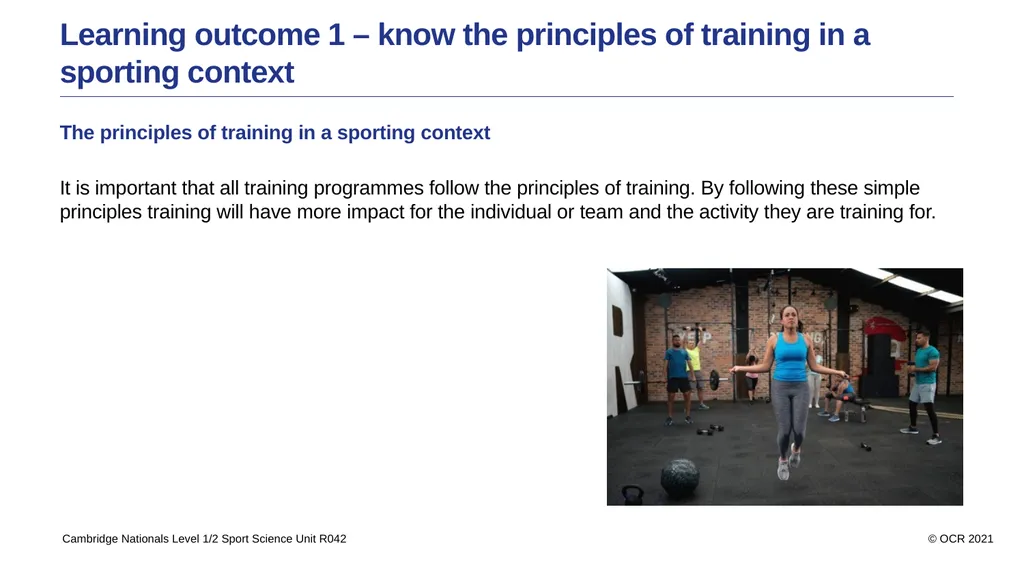
It is important that all training programmes follow the principles of training. By following these simple principles training will have more impact for the individual or team and the activity they are training for.<br>
It is important that all training programmes follow the principles of training. By following these simple principles training will have more impact for the individual or team and the activity they are training for.<br>
05
Learning outcome 1 – know the principles of training in a sporting context Progression
Progressive overload can be achieved when a performer works harder than normal. For example, a weightlifter that completes more repetitions from one session to another is gradually making their training programme harder.
Overload can be achieved by applying progressive overload through changing aspects of the FITTA acronym:
F = Frequency – increasing how often a performer trains
I = Intensity – making the training harder
T = Time – increasing the length of time in a training session
T = Type – the type of training being followed
A = Adherence – sticking to the plan of the training programme.
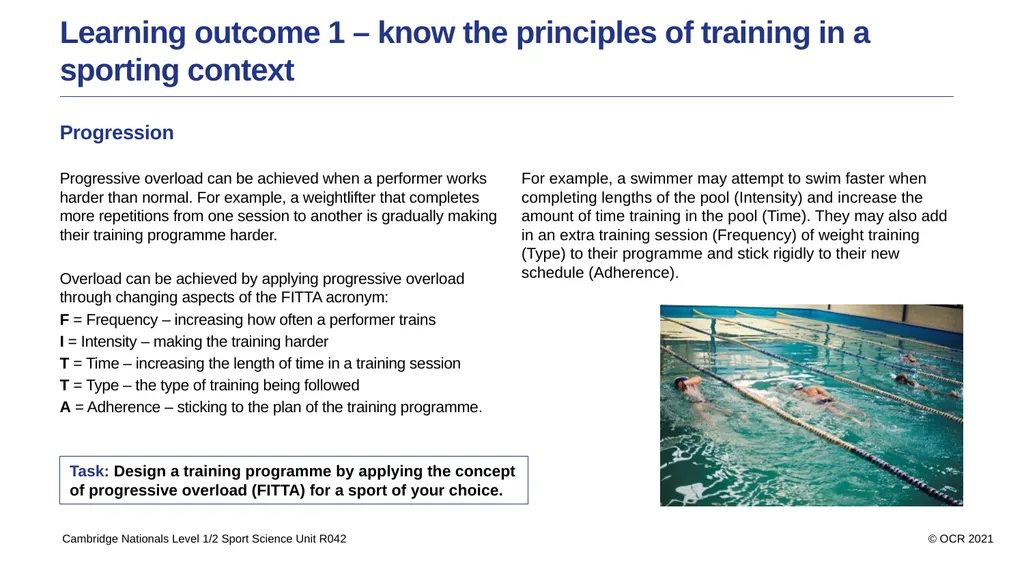
For example, a swimmer may attempt to swim faster when completing lengths of the pool (Intensity) and increase the amount of time training in the pool (Time). They may also add in an extra training session (Frequency) of weight training (Type) to their programme and stick rigidly to their new schedule (Adherence). Task: Design a training programme by applying the concept of progressive overload (FITTA) for a sport of your choice.<br>
Progressive overload can be achieved when a performer works harder than normal. For example, a weightlifter that completes more repetitions from one session to another is gradually making their training programme harder.
Overload can be achieved by applying progressive overload through changing aspects of the FITTA acronym:
F = Frequency – increasing how often a performer trains
I = Intensity – making the training harder
T = Time – increasing the length of time in a training session
T = Type – the type of training being followed
A = Adherence – sticking to the plan of the training programme.
For example, a swimmer may attempt to swim faster when completing lengths of the pool (Intensity) and increase the amount of time training in the pool (Time). They may also add in an extra training session (Frequency) of weight training (Type) to their programme and stick rigidly to their new schedule (Adherence). Task: Design a training programme by applying the concept of progressive overload (FITTA) for a sport of your choice.<br>
06
Learning outcome 1 – know the principles of training in a sporting context Specificity
This means that training should be matched to the sport or activity being trained for. This can be achieved by ensuring:
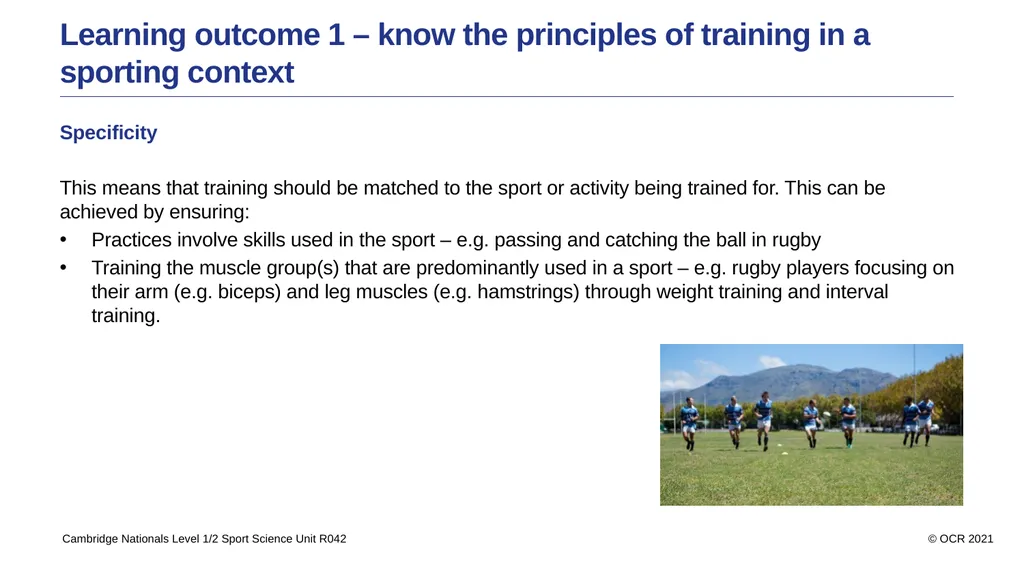
Practices involve skills used in the sport – e.g. passing and catching the ball in rugby
Training the muscle group(s) that are predominantly used in a sport – e.g. rugby players focusing on their arm (e.g. biceps) and leg muscles (e.g. hamstrings) through weight training and interval training.<br>
This means that training should be matched to the sport or activity being trained for. This can be achieved by ensuring:
Practices involve skills used in the sport – e.g. passing and catching the ball in rugby
Training the muscle group(s) that are predominantly used in a sport – e.g. rugby players focusing on their arm (e.g. biceps) and leg muscles (e.g. hamstrings) through weight training and interval training.<br>
07
Learning outcome 1 – know the principles of training in a sporting context Reversibility/regression
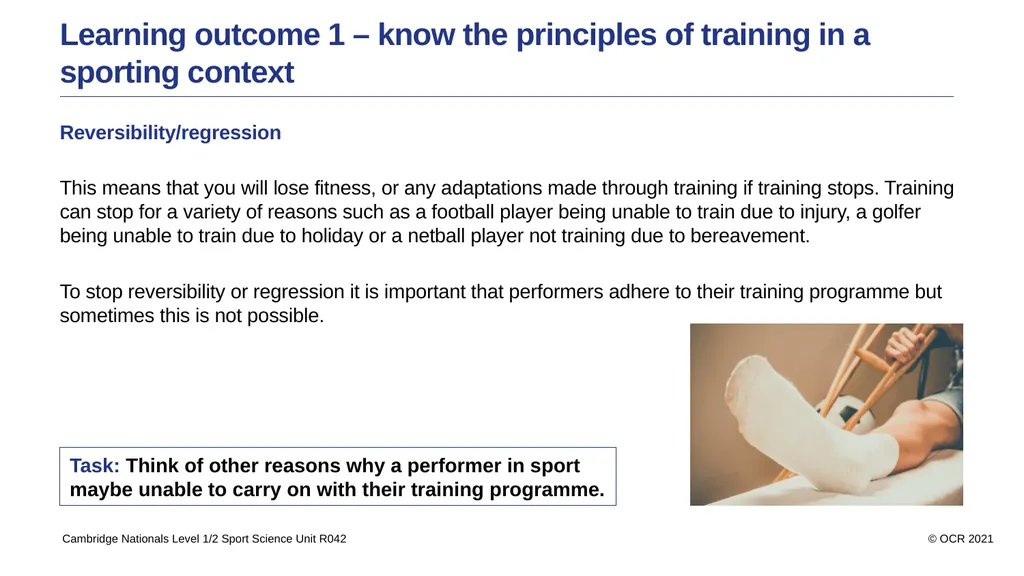
This means that you will lose fitness, or any adaptations made through training if training stops. Training can stop for a variety of reasons such as a football player being unable to train due to injury, a golfer being unable to train due to holiday or a netball player not training due to bereavement.
To stop reversibility or regression it is important that performers adhere to their training programme but sometimes this is not possible. Task: Think of other reasons why a performer in sport maybe unable to carry on with their training programme.<br>
This means that you will lose fitness, or any adaptations made through training if training stops. Training can stop for a variety of reasons such as a football player being unable to train due to injury, a golfer being unable to train due to holiday or a netball player not training due to bereavement.
To stop reversibility or regression it is important that performers adhere to their training programme but sometimes this is not possible. Task: Think of other reasons why a performer in sport maybe unable to carry on with their training programme.<br>
08
Learning outcome 1 – know the principles of training in a sporting context Moderation
It is important that a training programme takes into account different characteristics of an individual. There are a number of factors that need to be considered when designing an individual training programme. These factors include:
Age
Gender
Environment
Experience.
How can the above factors influence a training programme?
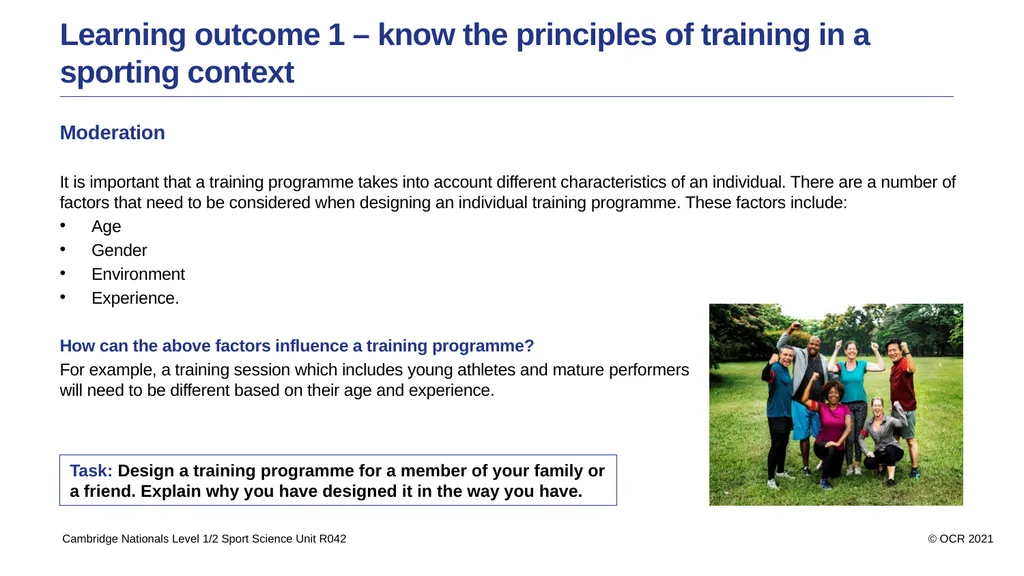
For example, a training session which includes young athletes and mature performers will need to be different based on their age and experience. Task: Design a training programme for a member of your family or a friend. Explain why you have designed it in the way you have.<br>
It is important that a training programme takes into account different characteristics of an individual. There are a number of factors that need to be considered when designing an individual training programme. These factors include:
Age
Gender
Environment
Experience.
How can the above factors influence a training programme?
For example, a training session which includes young athletes and mature performers will need to be different based on their age and experience. Task: Design a training programme for a member of your family or a friend. Explain why you have designed it in the way you have.<br>
09
Learning outcome 1 – know the principles of training in a sporting context Variance
It is important that performers do not become bored with their training programme and remain motivated to continue to adhere to it. There are different ways that boredom can be avoided and include:
Giving the body a different challenge
Including a mixture of fitness and skill. Task: What other ways can boredom be avoided when applying variance to a training programme?<br>
It is important that performers do not become bored with their training programme and remain motivated to continue to adhere to it. There are different ways that boredom can be avoided and include:
Giving the body a different challenge
Including a mixture of fitness and skill. Task: What other ways can boredom be avoided when applying variance to a training programme?<br>
10
Learning outcome 2 – know how training methods target different fitness components Learners must be taught:
Aerobic and anaerobic exercise
Difference between aerobic and anaerobic exercise
Methods of training aerobically and anaerobically.
The components of fitness
Strength
Power
Agility
Balance
Flexibility
Muscular endurance
Cardiovascular endurance.
Specific training methods for each of the fitness components
Cardiovascular training
Resistance training
Power training
Flexibility training
Agility training
Balance training.<br>
Aerobic and anaerobic exercise
Difference between aerobic and anaerobic exercise
Methods of training aerobically and anaerobically.
The components of fitness
Strength
Power
Agility
Balance
Flexibility
Muscular endurance
Cardiovascular endurance.
Specific training methods for each of the fitness components
Cardiovascular training
Resistance training
Power training
Flexibility training
Agility training
Balance training.<br>
11
Learning outcome 2 – know how training methods target different fitness components Aerobic and anaerobic exercise
Aerobic – using oxygen to fuel the body during exercise.
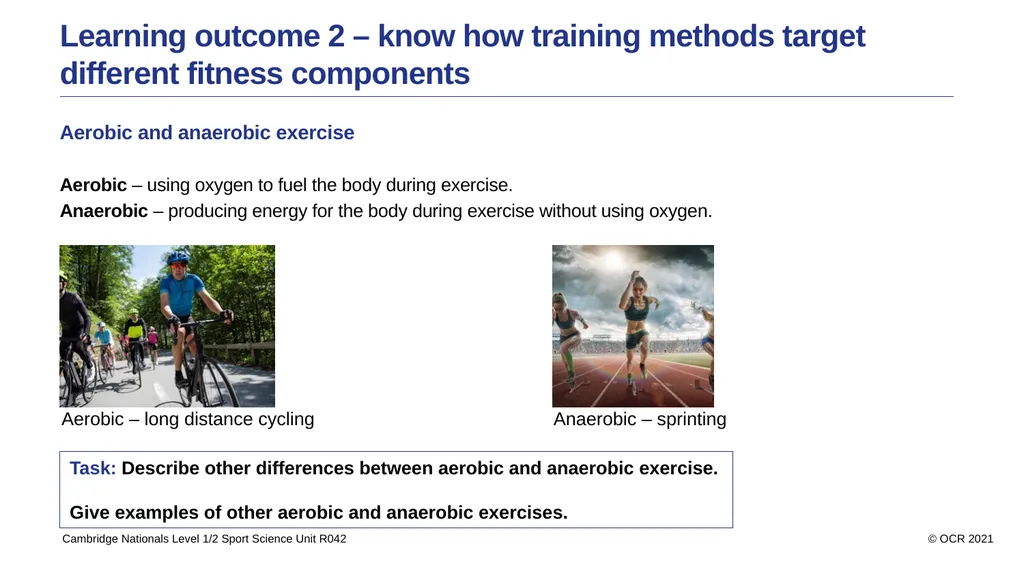
Anaerobic – producing energy for the body during exercise without using oxygen. Aerobic – long distance cycling Anaerobic – sprinting Task: Describe other differences between aerobic and anaerobic exercise. Give examples of other aerobic and anaerobic exercises.<br>
Aerobic – using oxygen to fuel the body during exercise.
Anaerobic – producing energy for the body during exercise without using oxygen. Aerobic – long distance cycling Anaerobic – sprinting Task: Describe other differences between aerobic and anaerobic exercise. Give examples of other aerobic and anaerobic exercises.<br>
12
Learning outcome 2 – know how training methods target different fitness components Methods of training aerobically and anaerobically
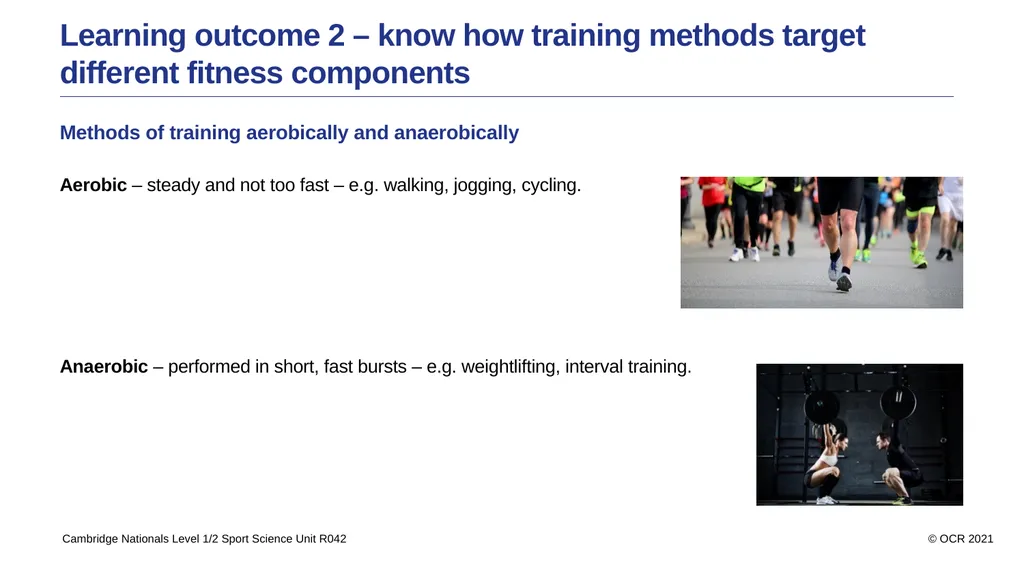
Aerobic – steady and not too fast – e.g. walking, jogging, cycling.
Anaerobic – performed in short, fast bursts – e.g. weightlifting, interval training.<br>
Aerobic – steady and not too fast – e.g. walking, jogging, cycling.
Anaerobic – performed in short, fast bursts – e.g. weightlifting, interval training.<br>
13
Learning outcome 2 – know how training methods target different fitness components The components of fitness
Fitness can be broken down into different components. Depending on the activity and position you are playing will determine what components of fitness you should focus on.
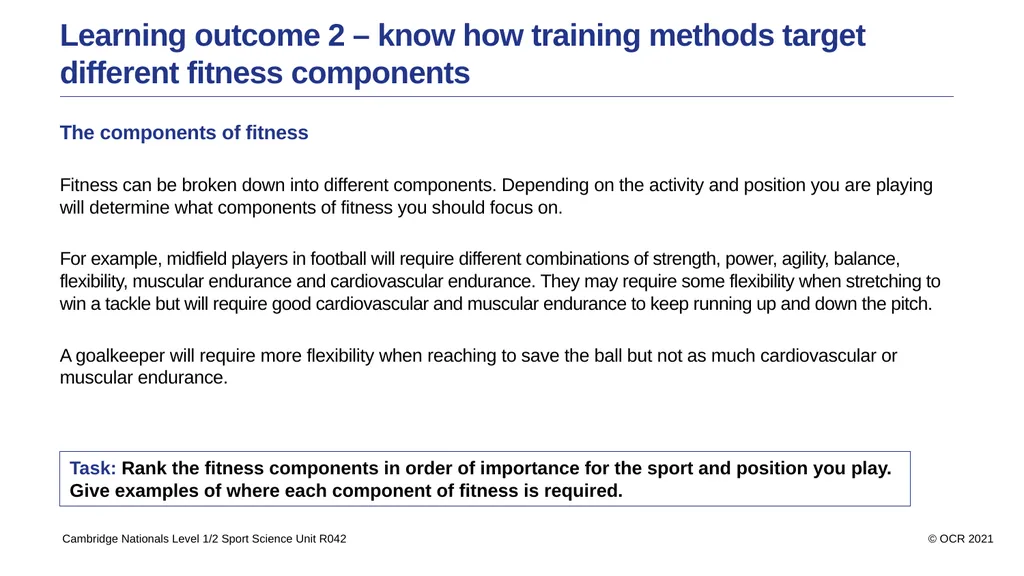
For example, midfield players in football will require different combinations of strength, power, agility, balance, flexibility, muscular endurance and cardiovascular endurance. They may require some flexibility when stretching to win a tackle but will require good cardiovascular and muscular endurance to keep running up and down the pitch.
A goalkeeper will require more flexibility when reaching to save the ball but not as much cardiovascular or muscular endurance. Task: Rank the fitness components in order of importance for the sport and position you play.
Give examples of where each component of fitness is required.<br>
Fitness can be broken down into different components. Depending on the activity and position you are playing will determine what components of fitness you should focus on.
For example, midfield players in football will require different combinations of strength, power, agility, balance, flexibility, muscular endurance and cardiovascular endurance. They may require some flexibility when stretching to win a tackle but will require good cardiovascular and muscular endurance to keep running up and down the pitch.
A goalkeeper will require more flexibility when reaching to save the ball but not as much cardiovascular or muscular endurance. Task: Rank the fitness components in order of importance for the sport and position you play.
Give examples of where each component of fitness is required.<br>
14
Learning outcome 2 – know how training methods target different fitness components Strength
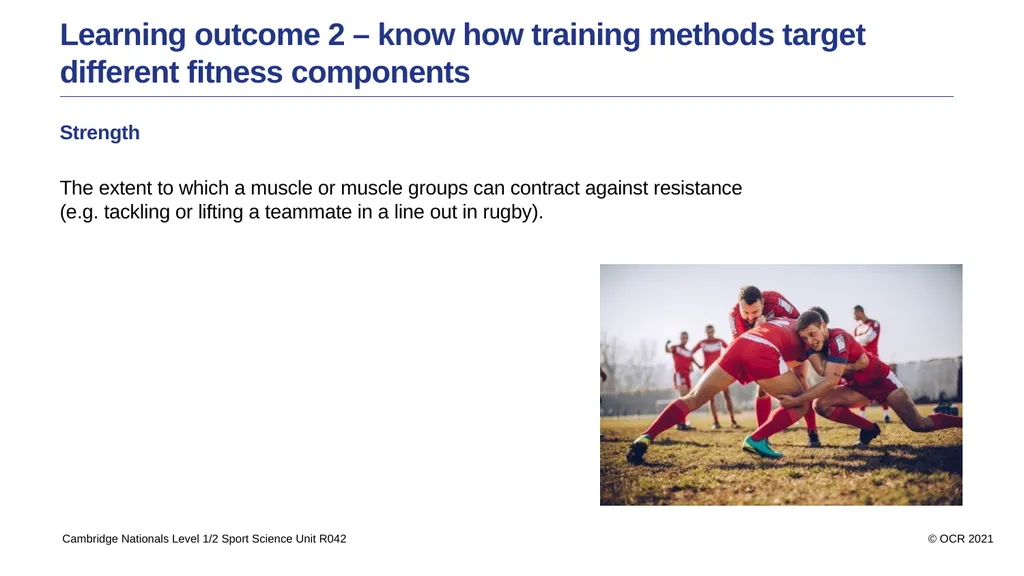
The extent to which a muscle or muscle groups can contract against resistance (e.g. tackling or lifting a teammate in a line out in rugby).<br>
The extent to which a muscle or muscle groups can contract against resistance (e.g. tackling or lifting a teammate in a line out in rugby).<br>
15
Learning outcome 2 – know how training methods target different fitness components Power
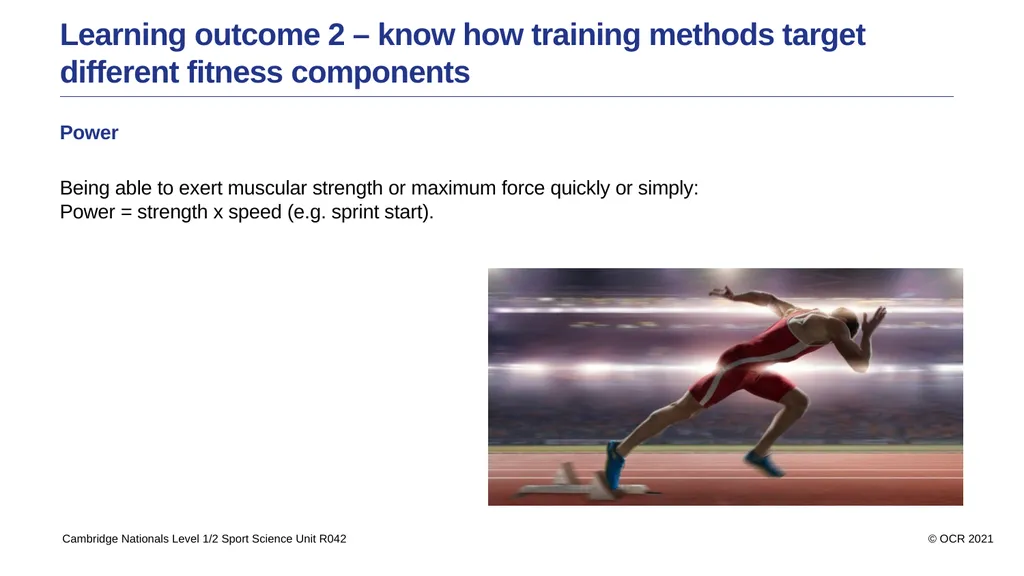
Being able to exert muscular strength or maximum force quickly or simply: Power = strength x speed (e.g. sprint start).<br>
Being able to exert muscular strength or maximum force quickly or simply: Power = strength x speed (e.g. sprint start).<br>
16
Learning outcome 2 – know how training methods target different fitness components Agility
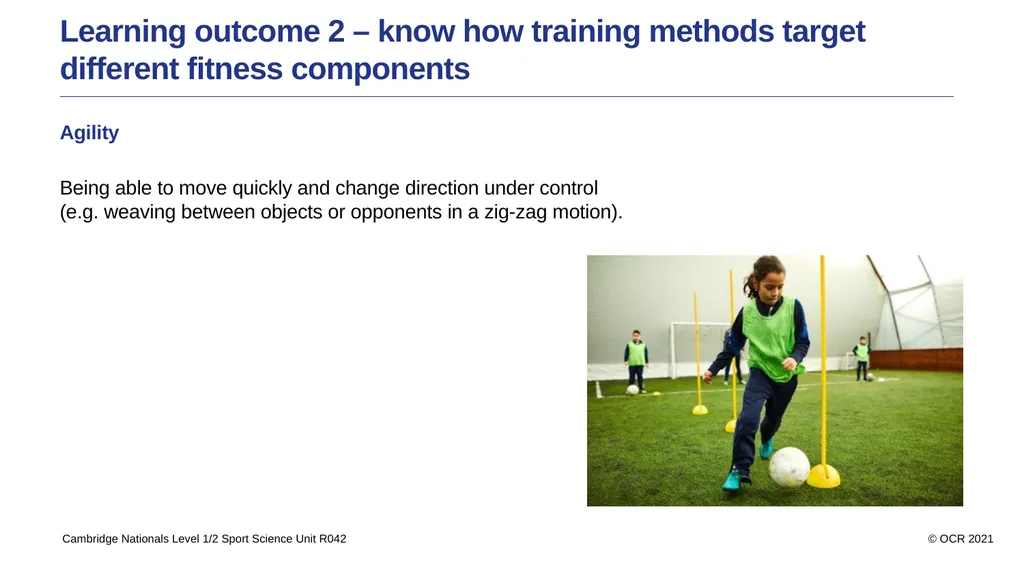
Being able to move quickly and change direction under control (e.g. weaving between objects or opponents in a zig-zag motion).<br>
Being able to move quickly and change direction under control (e.g. weaving between objects or opponents in a zig-zag motion).<br>
17
Learning outcome 2 – know how training methods target different fitness components Balance
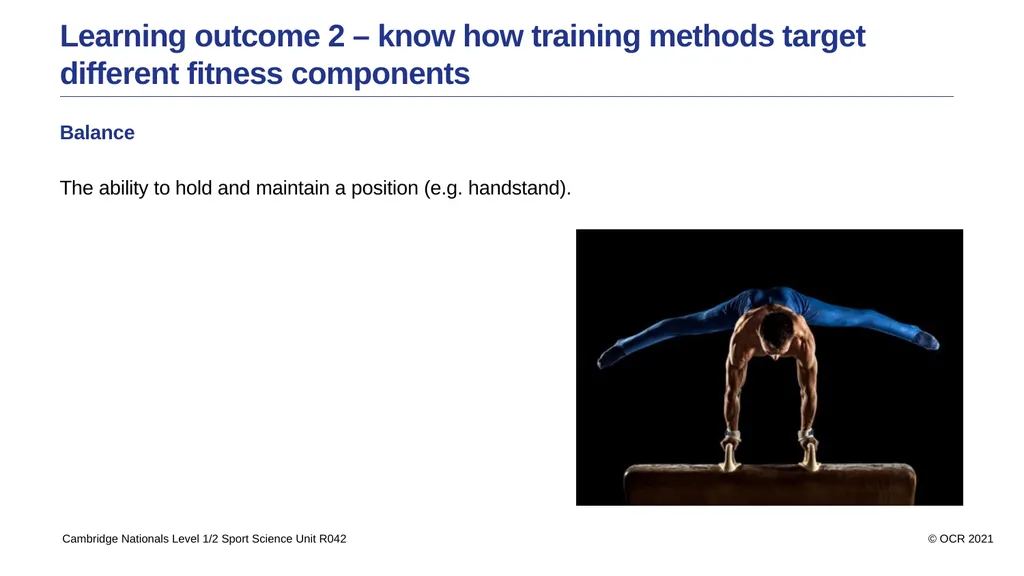
The ability to hold and maintain a position (e.g. handstand).<br>
The ability to hold and maintain a position (e.g. handstand).<br>
18
Learning outcome 2 – know how training methods target different fitness components Flexibility
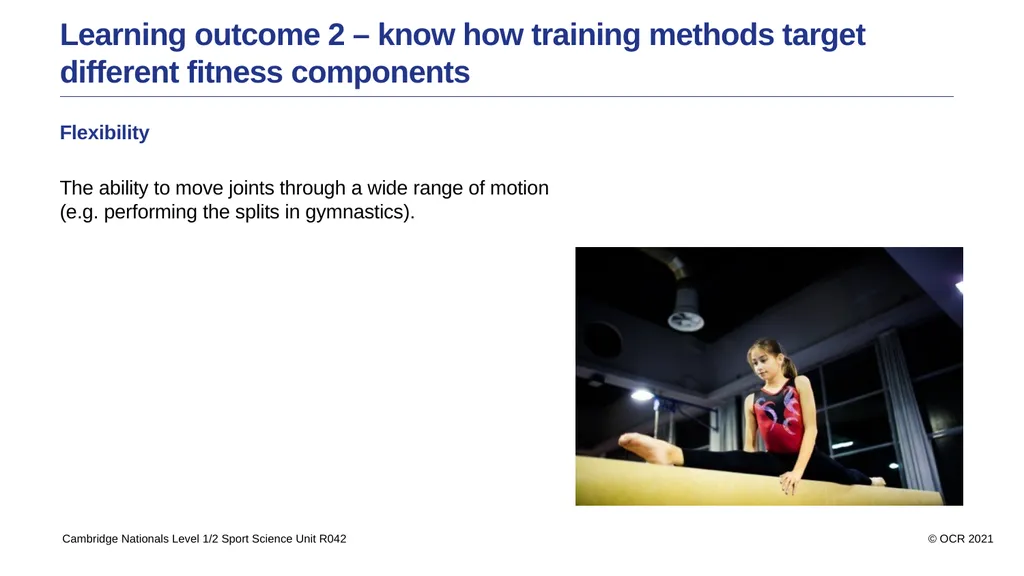
The ability to move joints through a wide range of motion (e.g. performing the splits in gymnastics).<br>
The ability to move joints through a wide range of motion (e.g. performing the splits in gymnastics).<br>
19
Learning outcome 2 – know how training methods target different fitness components Muscular endurance
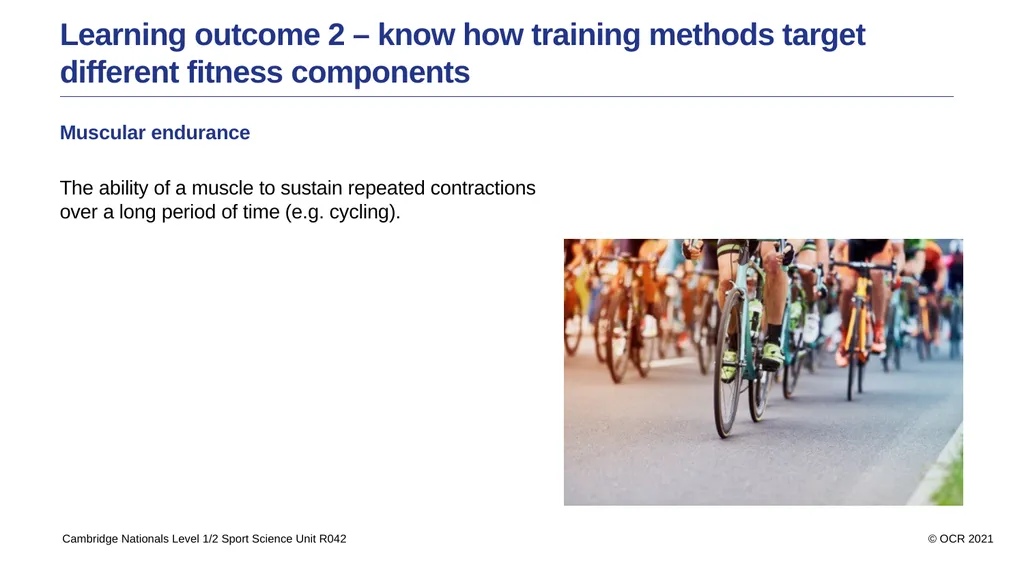
The ability of a muscle to sustain repeated contractions over a long period of time (e.g. cycling).<br>
The ability of a muscle to sustain repeated contractions over a long period of time (e.g. cycling).<br>
20
Learning outcome 2 – know how training methods target different fitness components Cardiovascular endurance
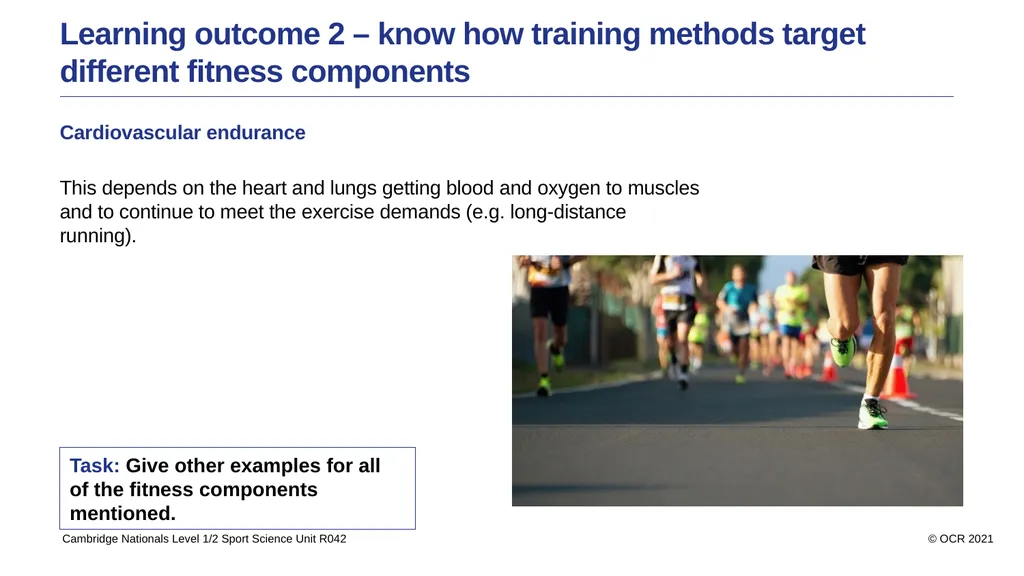
This depends on the heart and lungs getting blood and oxygen to muscles and to continue to meet the exercise demands (e.g. long-distance running). Task: Give other examples for all of the fitness components mentioned.<br>
This depends on the heart and lungs getting blood and oxygen to muscles and to continue to meet the exercise demands (e.g. long-distance running). Task: Give other examples for all of the fitness components mentioned.<br>
21
Learning outcome 2 – know how training methods target different fitness components Specific training methods for each of the fitness components
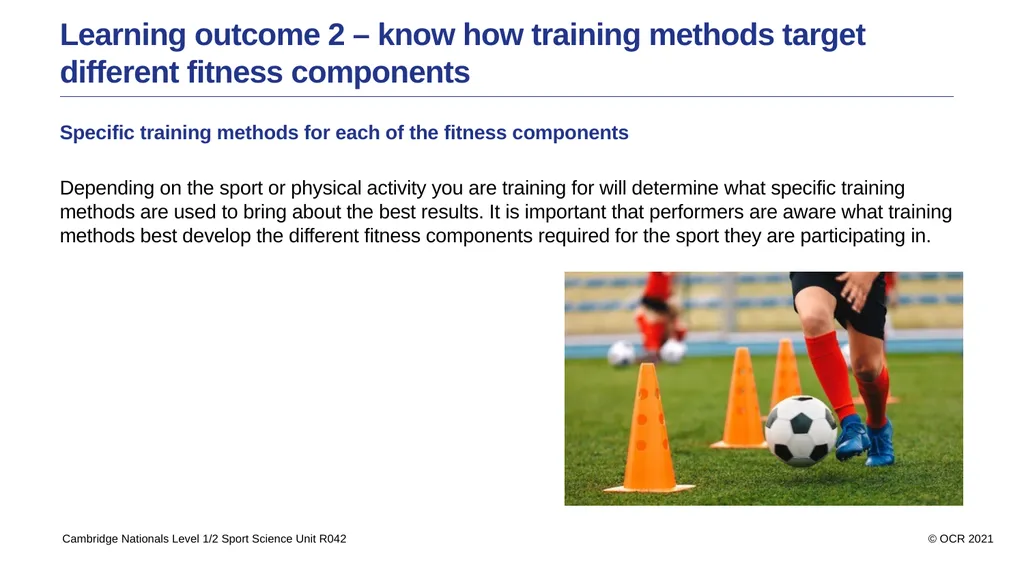
Depending on the sport or physical activity you are training for will determine what specific training methods are used to bring about the best results. It is important that performers are aware what training methods best develop the different fitness components required for the sport they are participating in.<br>
Depending on the sport or physical activity you are training for will determine what specific training methods are used to bring about the best results. It is important that performers are aware what training methods best develop the different fitness components required for the sport they are participating in.<br>
22
Learning outcome 2 – know how training methods target different fitness components Cardiovascular training
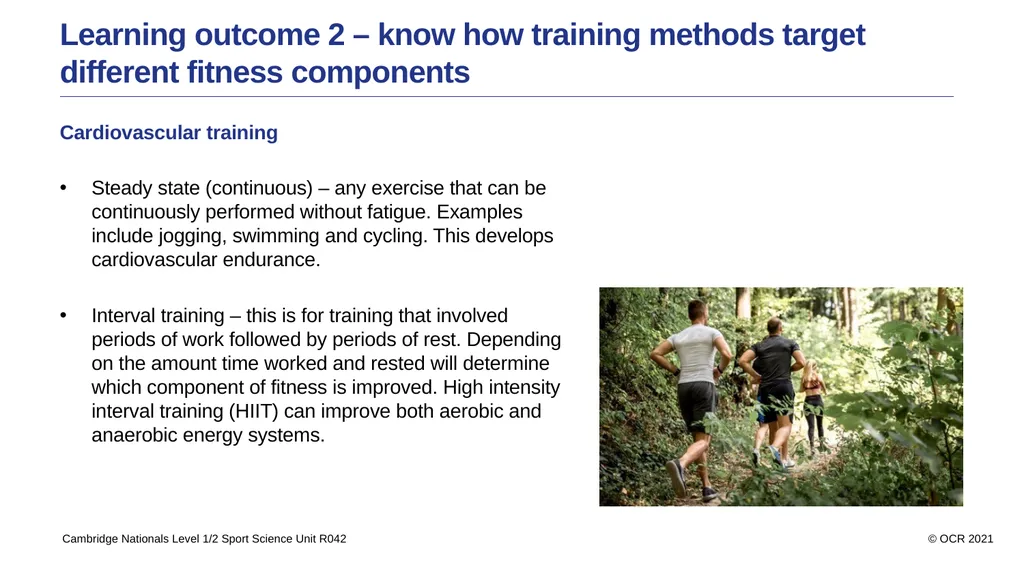
Steady state (continuous) – any exercise that can be continuously performed without fatigue. Examples include jogging, swimming and cycling. This develops cardiovascular endurance.
Interval training – this is for training that involved periods of work followed by periods of rest. Depending on the amount time worked and rested will determine which component of fitness is improved. High intensity interval training (HIIT) can improve both aerobic and anaerobic energy systems.<br>
Steady state (continuous) – any exercise that can be continuously performed without fatigue. Examples include jogging, swimming and cycling. This develops cardiovascular endurance.
Interval training – this is for training that involved periods of work followed by periods of rest. Depending on the amount time worked and rested will determine which component of fitness is improved. High intensity interval training (HIIT) can improve both aerobic and anaerobic energy systems.<br>
23
Learning outcome 2 – know how training methods target different fitness components Fartlek training
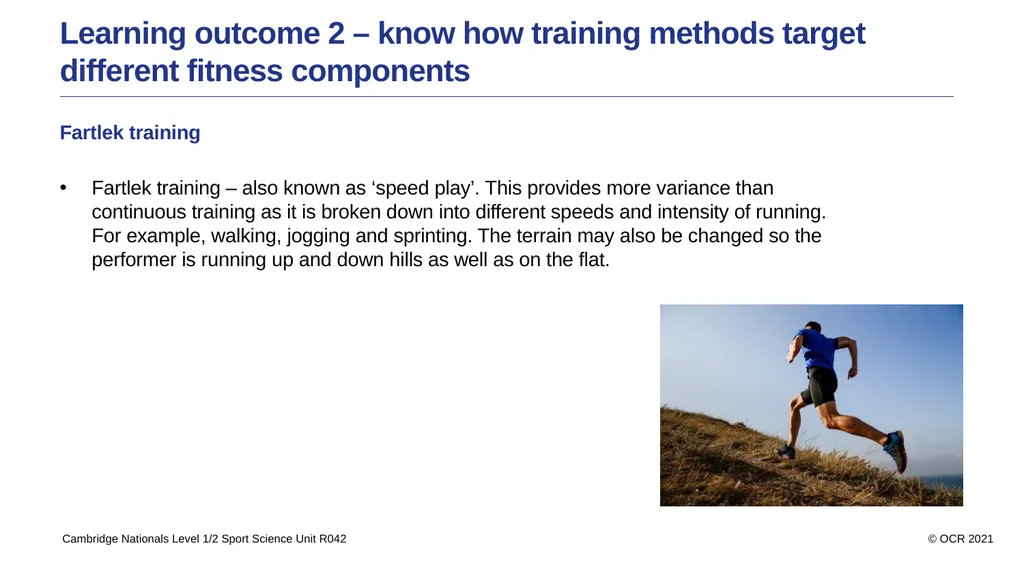
Fartlek training – also known as ‘speed play’. This provides more variance than continuous training as it is broken down into different speeds and intensity of running. For example, walking, jogging and sprinting. The terrain may also be changed so the performer is running up and down hills as well as on the flat.<br>
Fartlek training – also known as ‘speed play’. This provides more variance than continuous training as it is broken down into different speeds and intensity of running. For example, walking, jogging and sprinting. The terrain may also be changed so the performer is running up and down hills as well as on the flat.<br>
24
Learning outcome 2 – know how training methods target different fitness components Resistance training
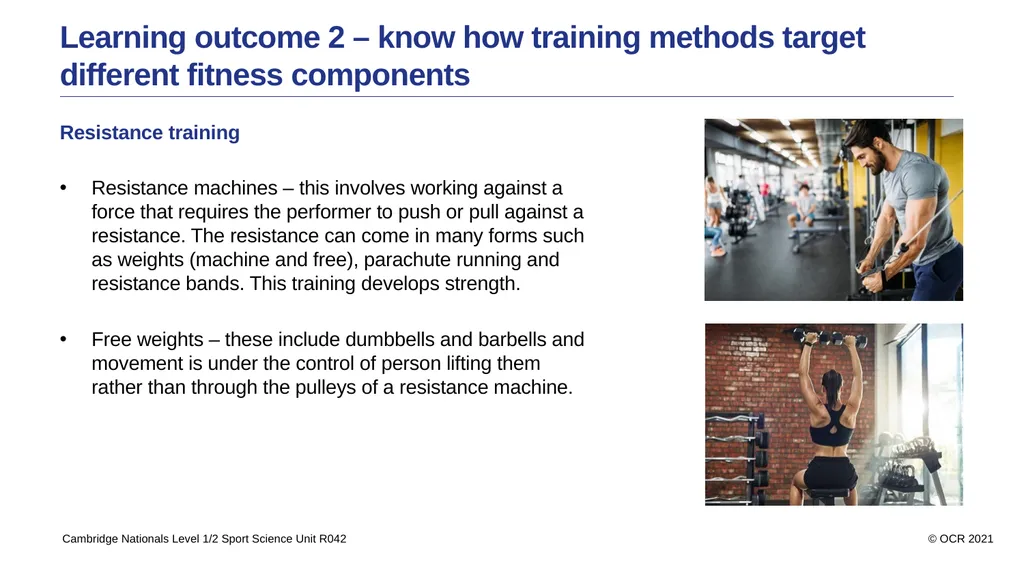
Resistance machines – this involves working against a force that requires the performer to push or pull against a resistance. The resistance can come in many forms such as weights (machine and free), parachute running and resistance bands. This training develops strength.
Free weights – these include dumbbells and barbells and movement is under the control of person lifting them rather than through the pulleys of a resistance machine.<br>
Resistance machines – this involves working against a force that requires the performer to push or pull against a resistance. The resistance can come in many forms such as weights (machine and free), parachute running and resistance bands. This training develops strength.
Free weights – these include dumbbells and barbells and movement is under the control of person lifting them rather than through the pulleys of a resistance machine.<br>
25
Learning outcome 2 – know how training methods target different fitness components Circuits
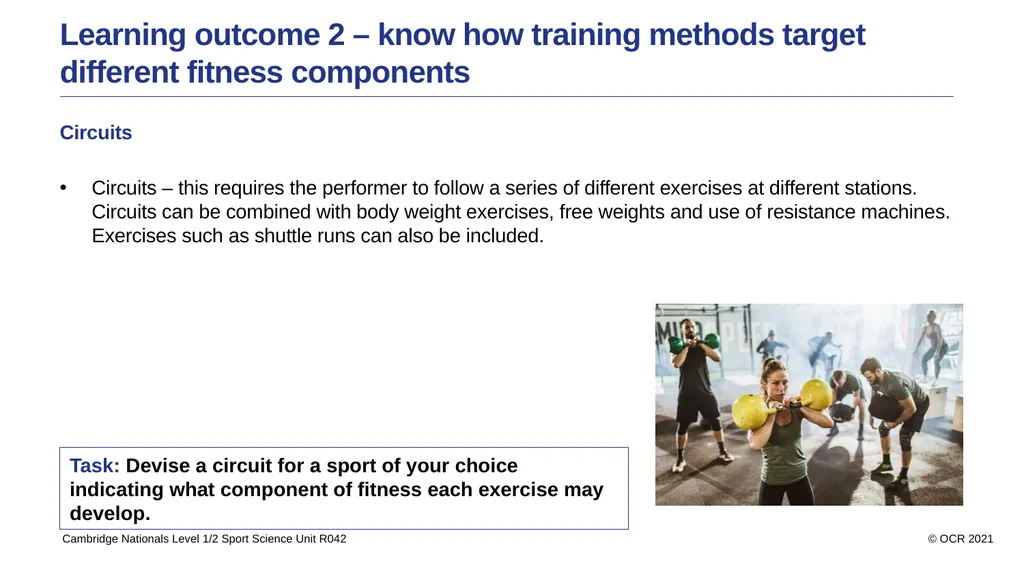
Circuits – this requires the performer to follow a series of different exercises at different stations. Circuits can be combined with body weight exercises, free weights and use of resistance machines. Exercises such as shuttle runs can also be included. Task: Devise a circuit for a sport of your choice indicating what component of fitness each exercise may develop.<br>
Circuits – this requires the performer to follow a series of different exercises at different stations. Circuits can be combined with body weight exercises, free weights and use of resistance machines. Exercises such as shuttle runs can also be included. Task: Devise a circuit for a sport of your choice indicating what component of fitness each exercise may develop.<br>
26
Learning outcome 2 – know how training methods target different fitness components Power training
Interval training – this involves short periods of work followed by periods of rest. It can be performed across many different exercises such as sprinting and weights.
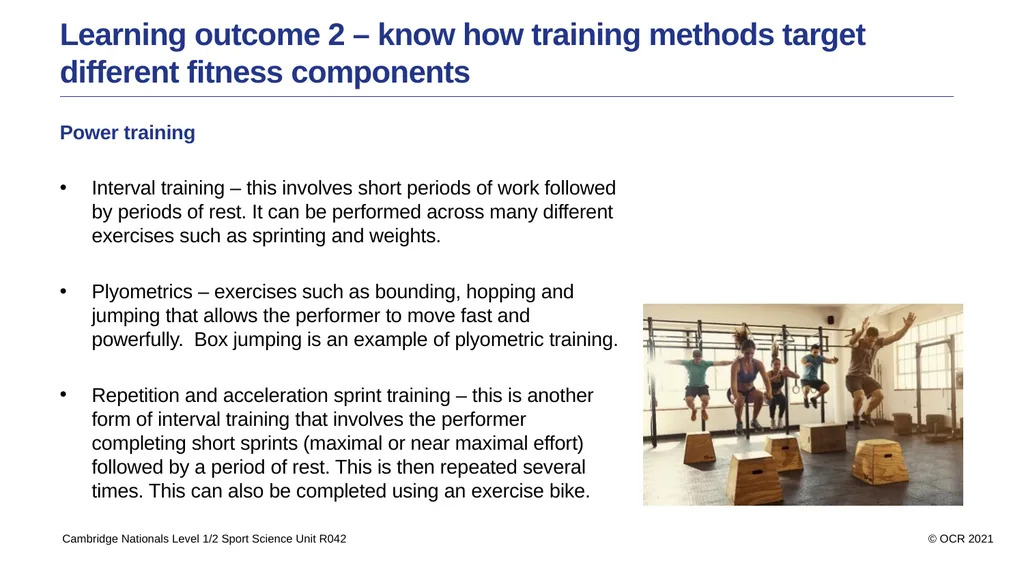
Plyometrics – exercises such as bounding, hopping and jumping that allows the performer to move fast and powerfully. Box jumping is an example of plyometric training.
Repetition and acceleration sprint training – this is another form of interval training that involves the performer completing short sprints (maximal or near maximal effort) followed by a period of rest. This is then repeated several times. This can also be completed using an exercise bike.<br>
Interval training – this involves short periods of work followed by periods of rest. It can be performed across many different exercises such as sprinting and weights.
Plyometrics – exercises such as bounding, hopping and jumping that allows the performer to move fast and powerfully. Box jumping is an example of plyometric training.
Repetition and acceleration sprint training – this is another form of interval training that involves the performer completing short sprints (maximal or near maximal effort) followed by a period of rest. This is then repeated several times. This can also be completed using an exercise bike.<br>
27
Learning outcome 2 – know how training methods target different fitness components Flexibility training
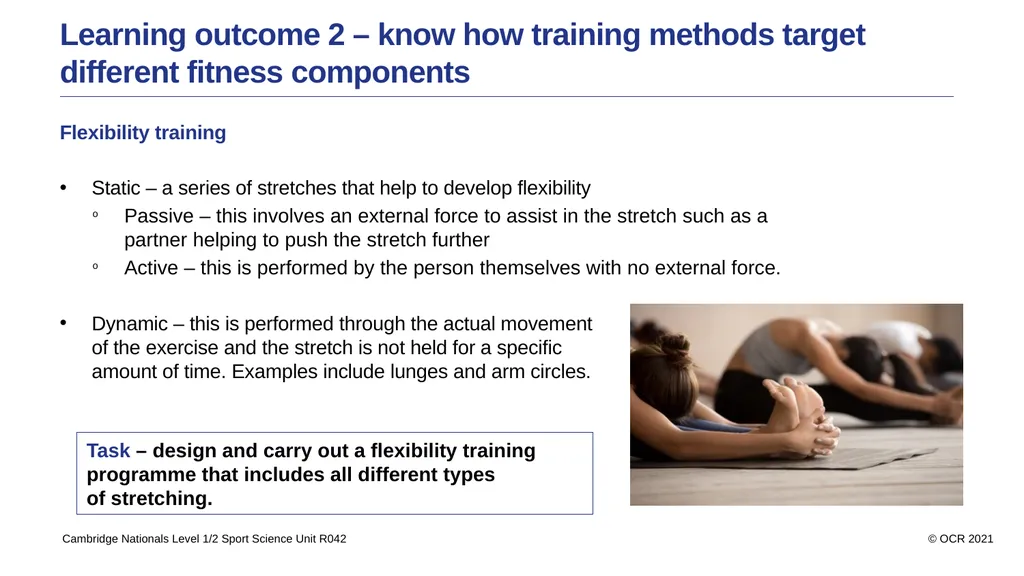
Static – a series of stretches that help to develop flexibility
Passive – this involves an external force to assist in the stretch such as a partner helping to push the stretch further
Active – this is performed by the person themselves with no external force.
Dynamic – this is performed through the actual movement of the exercise and the stretch is not held for a specific amount of time. Examples include lunges and arm circles. Task – design and carry out a flexibility training programme that includes all different types
of stretching.<br>
Static – a series of stretches that help to develop flexibility
Passive – this involves an external force to assist in the stretch such as a partner helping to push the stretch further
Active – this is performed by the person themselves with no external force.
Dynamic – this is performed through the actual movement of the exercise and the stretch is not held for a specific amount of time. Examples include lunges and arm circles. Task – design and carry out a flexibility training programme that includes all different types
of stretching.<br>
28
Learning outcome 2 – know how training methods target different fitness components Agility training
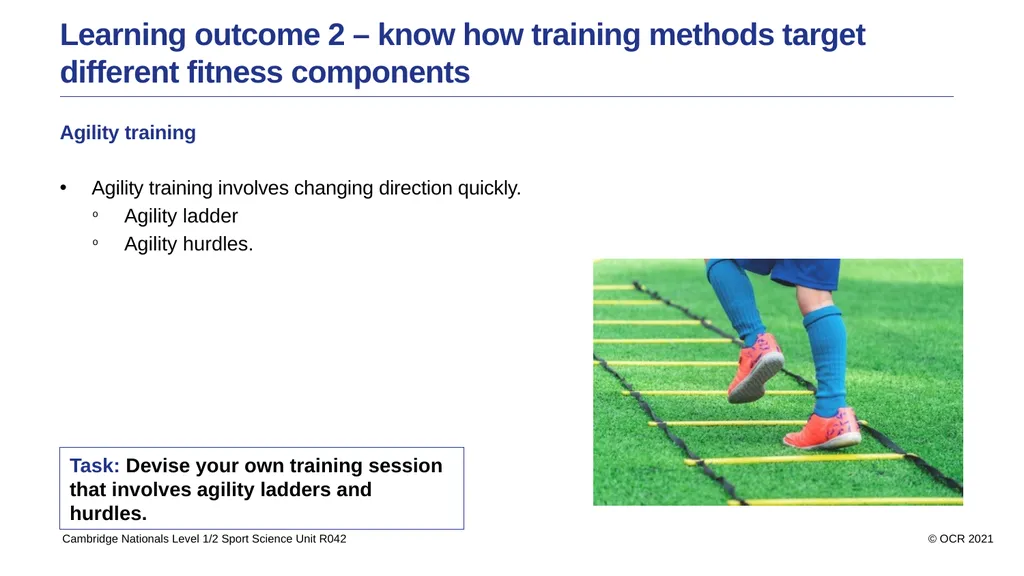
Agility training involves changing direction quickly.
Agility ladder
Agility hurdles. Task: Devise your own training session that involves agility ladders and hurdles.<br>
Agility training involves changing direction quickly.
Agility ladder
Agility hurdles. Task: Devise your own training session that involves agility ladders and hurdles.<br>
29
Learning outcome 2 – know how training methods target different fitness components Balance training
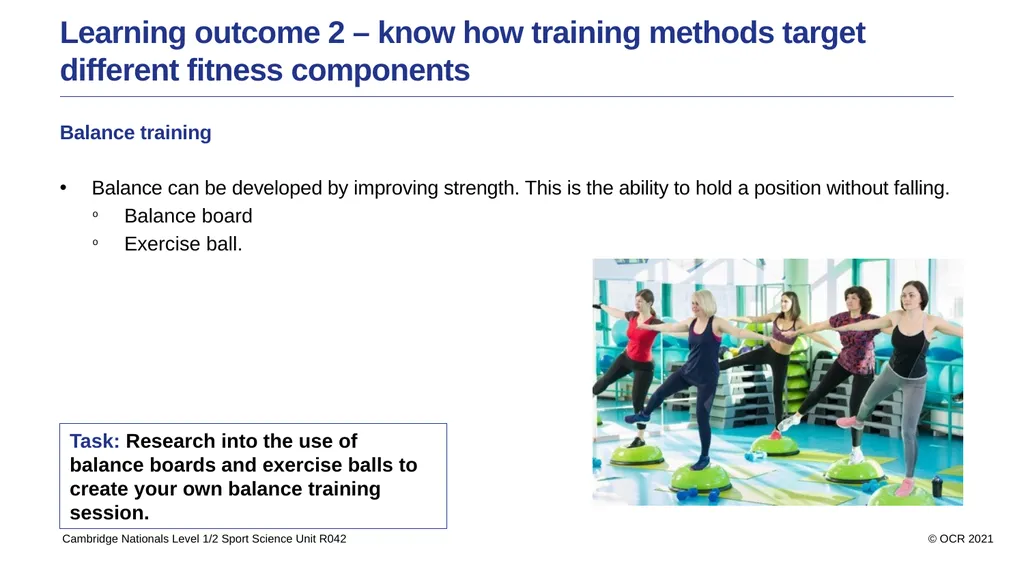
Balance can be developed by improving strength. This is the ability to hold a position without falling.
Balance board
Exercise ball. Task: Research into the use of balance boards and exercise balls to create your own balance training session.<br>
Balance can be developed by improving strength. This is the ability to hold a position without falling.
Balance board
Exercise ball. Task: Research into the use of balance boards and exercise balls to create your own balance training session.<br>
30
Learning outcome 3 – be able to conduct fitness tests Learners must be taught:
Tests for each component of fitness
Strength – e.g. burpee test, squat test
Power – e.g. vertical jump test, standing long jump test
Agility – e.g. shuttle run test, Illinois agility run test
Balance – e.g. standing stork test
Flexibility – e.g. sit and reach test, trunk flexion test
Muscular endurance – e.g. number of sit-ups/press-ups in a defined time period
Cardiovascular endurance – e.g. Cooper run, Harvard step test.
Maximal or sub-maximal
Test sequence
How to interpret the results of fitness tests
Against normative data
Validity
Reliability.<br>
Tests for each component of fitness
Strength – e.g. burpee test, squat test
Power – e.g. vertical jump test, standing long jump test
Agility – e.g. shuttle run test, Illinois agility run test
Balance – e.g. standing stork test
Flexibility – e.g. sit and reach test, trunk flexion test
Muscular endurance – e.g. number of sit-ups/press-ups in a defined time period
Cardiovascular endurance – e.g. Cooper run, Harvard step test.
Maximal or sub-maximal
Test sequence
How to interpret the results of fitness tests
Against normative data
Validity
Reliability.<br>
31
Learning outcome 3 – be able to conduct fitness tests Tests for each component of fitness
There are many different tests available that are designed to assess different levels of fitness. These fitness tests can then be used to:
Highlight strengths and weaknesses of the individual
Design a training programme based on the results
Compare individual scores to normative data
Monitor progress of the training programme. Task: For each of the following fitness tests use Brianmac sports coach and write a short protocol including equipment required for each test.<br>
There are many different tests available that are designed to assess different levels of fitness. These fitness tests can then be used to:
Highlight strengths and weaknesses of the individual
Design a training programme based on the results
Compare individual scores to normative data
Monitor progress of the training programme. Task: For each of the following fitness tests use Brianmac sports coach and write a short protocol including equipment required for each test.<br>
32
Learning outcome 3 – be able to conduct fitness tests Strength Burpee test Squat test Task: Click on the images to find out more about each type of exercise/test.<br>
33
Learning outcome 3 – be able to conduct fitness tests Power Vertical jump test Standing long jump test Task: Click on the images to find out more about each type of exercise/test.<br>
34
Learning outcome 3 – be able to conduct fitness tests Agility Shuttle run test Illinois agility run test Task: Click on the images to find out more about each type of exercise/test.<br>
35
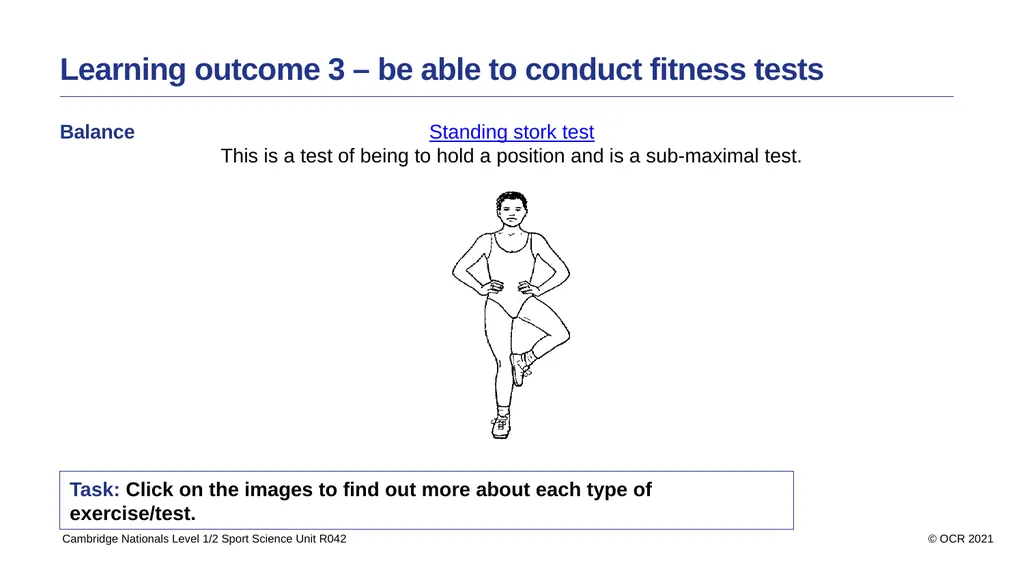
Learning outcome 3 – be able to conduct fitness tests Balance Standing stork test
This is a test of being to hold a position and is a sub-maximal test. Task: Click on the images to find out more about each type of exercise/test.<br>
This is a test of being to hold a position and is a sub-maximal test. Task: Click on the images to find out more about each type of exercise/test.<br>
36
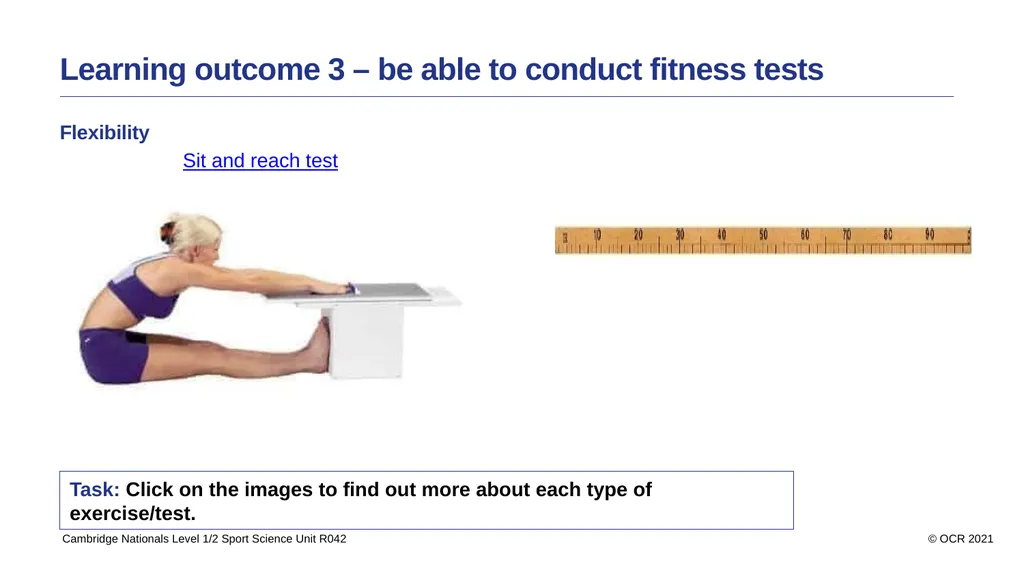
Learning outcome 3 – be able to conduct fitness tests Flexibility Sit and reach test Trunk flexion test Task: Click on the images to find out more about each type of exercise/test.<br>
37
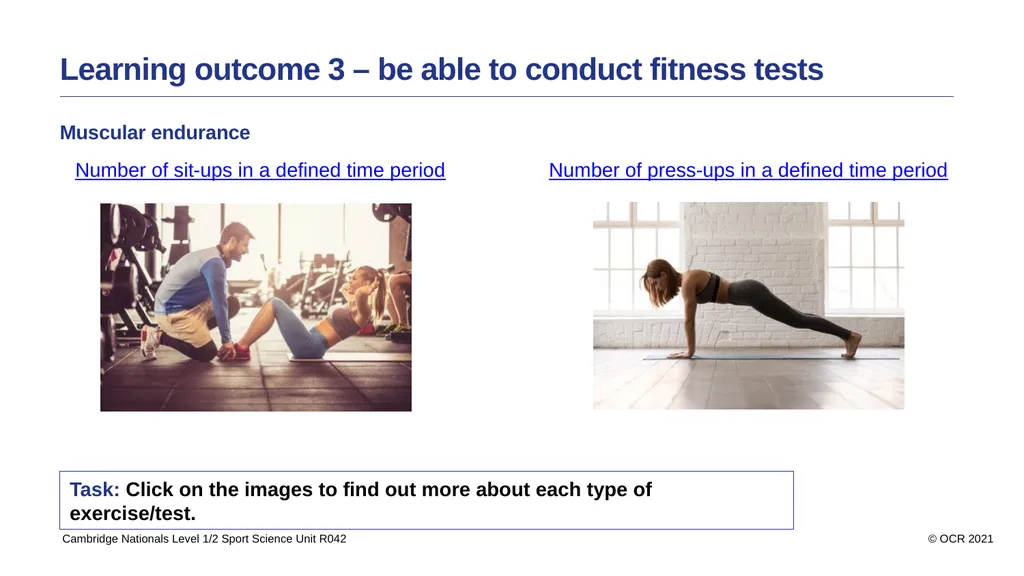
Learning outcome 3 – be able to conduct fitness tests Muscular endurance Number of sit-ups in a defined time period Number of press-ups in a defined time period Task: Click on the images to find out more about each type of exercise/test.<br>
38
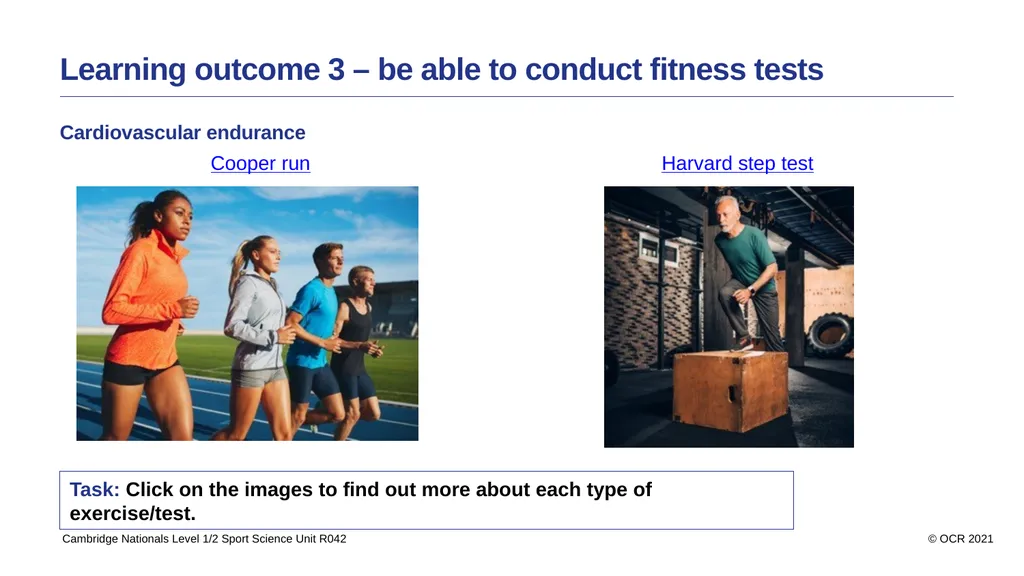
Learning outcome 3 – be able to conduct fitness tests Cardiovascular endurance Cooper run Harvard step test Task: Click on the images to find out more about each type of exercise/test.<br>
39
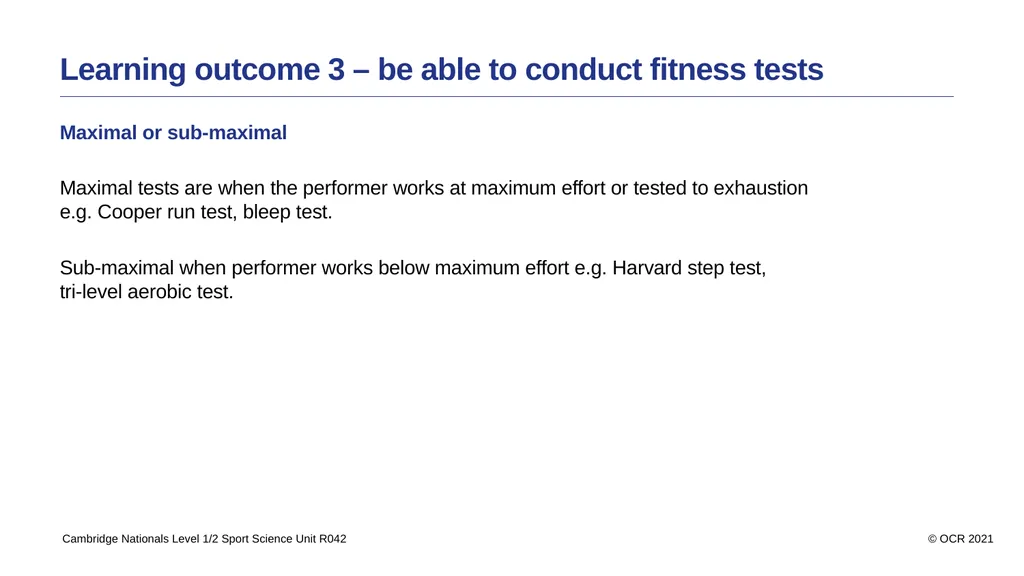
Learning outcome 3 – be able to conduct fitness tests Maximal or sub-maximal
Maximal tests are when the performer works at maximum effort or tested to exhaustion e.g. Cooper run test, bleep test.
Sub-maximal when performer works below maximum effort e.g. Harvard step test, tri-level aerobic test.<br>
Maximal tests are when the performer works at maximum effort or tested to exhaustion e.g. Cooper run test, bleep test.
Sub-maximal when performer works below maximum effort e.g. Harvard step test, tri-level aerobic test.<br>
40
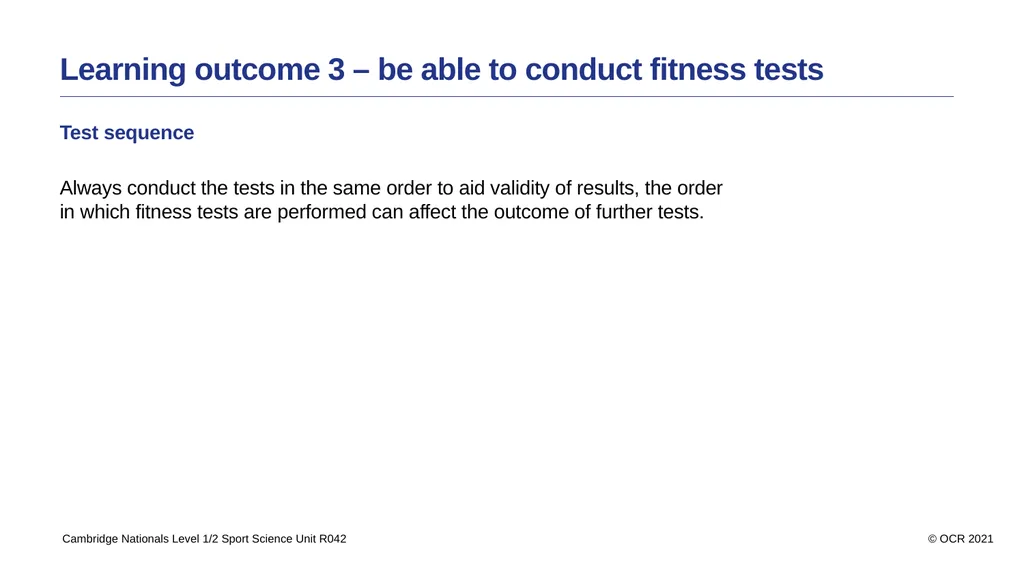
Learning outcome 3 – be able to conduct fitness tests Test sequence
Always conduct the tests in the same order to aid validity of results, the order in which fitness tests are performed can affect the outcome of further tests.<br>
Always conduct the tests in the same order to aid validity of results, the order in which fitness tests are performed can affect the outcome of further tests.<br>
41
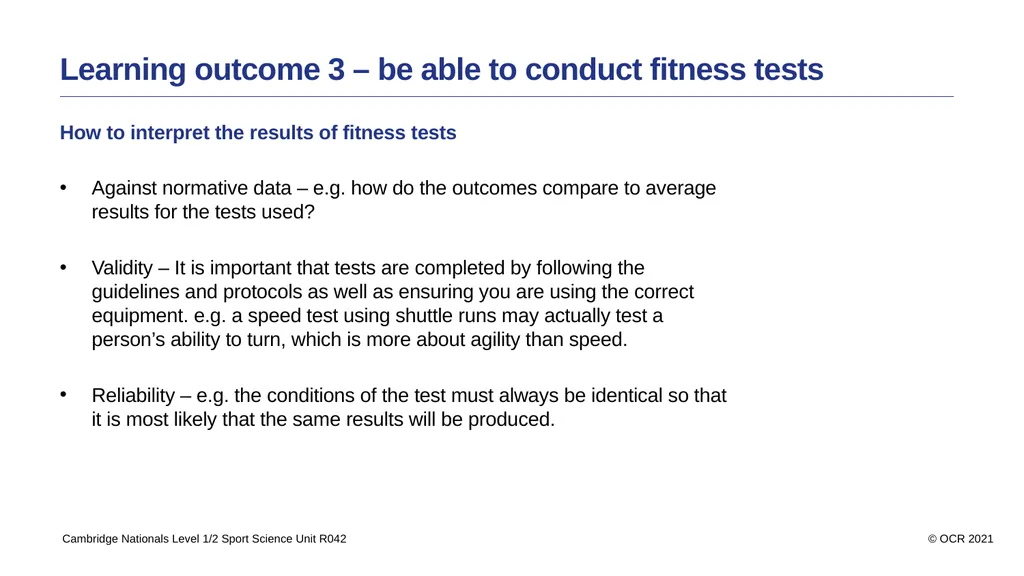
Learning outcome 3 – be able to conduct fitness tests How to interpret the results of fitness tests
Against normative data – e.g. how do the outcomes compare to average results for the tests used?
Validity – It is important that tests are completed by following the guidelines and protocols as well as ensuring you are using the correct equipment. e.g. a speed test using shuttle runs may actually test a person’s ability to turn, which is more about agility than speed.
Reliability – e.g. the conditions of the test must always be identical so that it is most likely that the same results will be produced.<br>
Against normative data – e.g. how do the outcomes compare to average results for the tests used?
Validity – It is important that tests are completed by following the guidelines and protocols as well as ensuring you are using the correct equipment. e.g. a speed test using shuttle runs may actually test a person’s ability to turn, which is more about agility than speed.
Reliability – e.g. the conditions of the test must always be identical so that it is most likely that the same results will be produced.<br>
42
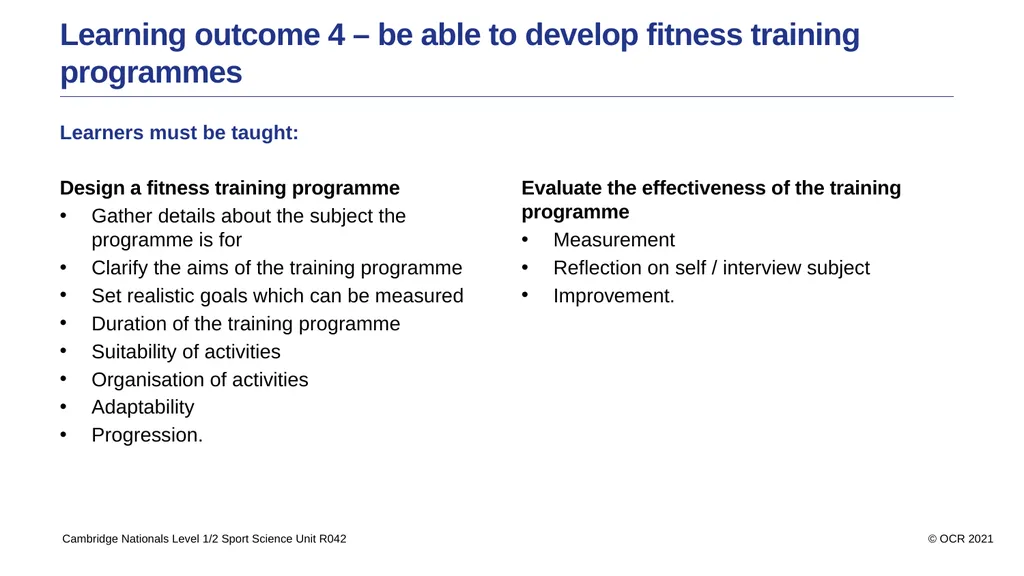
Learning outcome 4 – be able to develop fitness training programmes Learners must be taught:
Design a fitness training programme
Gather details about the subject the programme is for
Clarify the aims of the training programme
Set realistic goals which can be measured
Duration of the training programme
Suitability of activities
Organisation of activities
Adaptability
Progression.
Evaluate the effectiveness of the training programme
Measurement
Reflection on self / interview subject
Improvement.<br>
Design a fitness training programme
Gather details about the subject the programme is for
Clarify the aims of the training programme
Set realistic goals which can be measured
Duration of the training programme
Suitability of activities
Organisation of activities
Adaptability
Progression.
Evaluate the effectiveness of the training programme
Measurement
Reflection on self / interview subject
Improvement.<br>
43
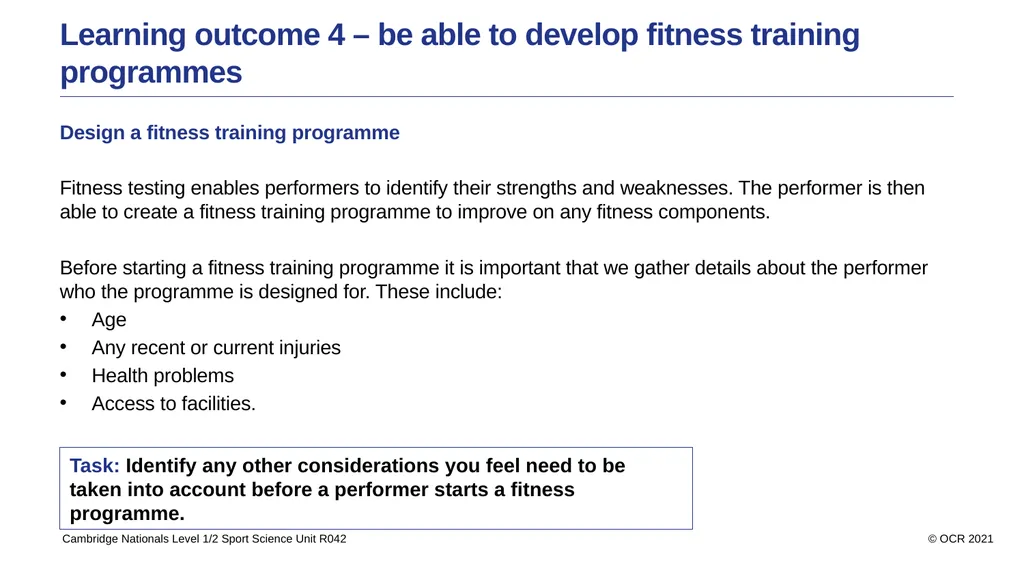
Learning outcome 4 – be able to develop fitness training programmes Design a fitness training programme
Fitness testing enables performers to identify their strengths and weaknesses. The performer is then able to create a fitness training programme to improve on any fitness components.
Before starting a fitness training programme it is important that we gather details about the performer who the programme is designed for. These include:
Age
Any recent or current injuries
Health problems
Access to facilities. Task: Identify any other considerations you feel need to be taken into account before a performer starts a fitness programme.<br>
Fitness testing enables performers to identify their strengths and weaknesses. The performer is then able to create a fitness training programme to improve on any fitness components.
Before starting a fitness training programme it is important that we gather details about the performer who the programme is designed for. These include:
Age
Any recent or current injuries
Health problems
Access to facilities. Task: Identify any other considerations you feel need to be taken into account before a performer starts a fitness programme.<br>
44
Learning outcome 4 – be able to develop fitness training programmes Clarify the aims of the training programme
When designing the fitness programme it is important to consider which components of fitness need to be improved and by how much. This can be achieved with the performer and coach establishing what the priorities are. They should also refer to any data gathered from the fitness tests completed.<br>
When designing the fitness programme it is important to consider which components of fitness need to be improved and by how much. This can be achieved with the performer and coach establishing what the priorities are. They should also refer to any data gathered from the fitness tests completed.<br>
45
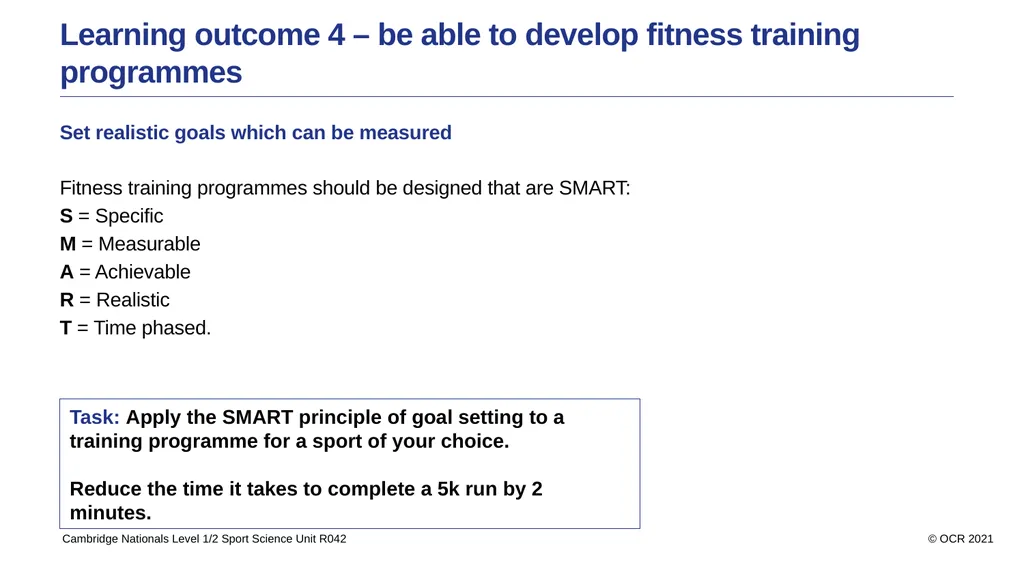
Learning outcome 4 – be able to develop fitness training programmes Set realistic goals which can be measured
Fitness training programmes should be designed that are SMART:
S = Specific
M = Measurable
A = Achievable
R = Realistic
T = Time phased. Task: Apply the SMART principle of goal setting to a training programme for a sport of your choice.
Reduce the time it takes to complete a 5k run by 2 minutes.<br>
Fitness training programmes should be designed that are SMART:
S = Specific
M = Measurable
A = Achievable
R = Realistic
T = Time phased. Task: Apply the SMART principle of goal setting to a training programme for a sport of your choice.
Reduce the time it takes to complete a 5k run by 2 minutes.<br>
46
Learning outcome 4 – be able to develop fitness training programmes Duration of the training programme
Training programmes need to have a suitable length of time to achieve goals.
Goals can be split up into short, medium and long-term. Task: What could be the short, medium and long-term goals for your training programme?<br>
Training programmes need to have a suitable length of time to achieve goals.
Goals can be split up into short, medium and long-term. Task: What could be the short, medium and long-term goals for your training programme?<br>
47
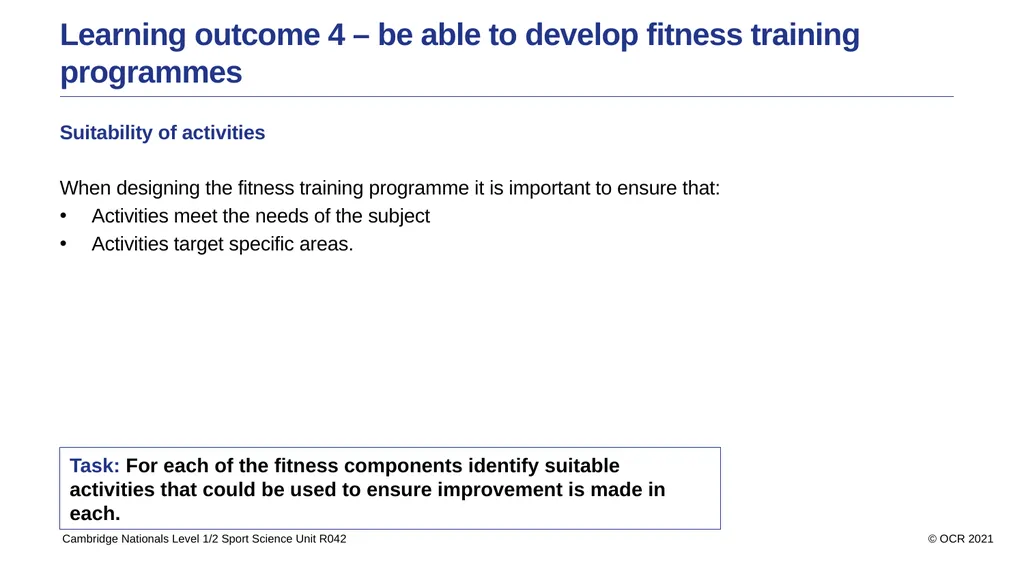
Learning outcome 4 – be able to develop fitness training programmes Suitability of activities
When designing the fitness training programme it is important to ensure that:
Activities meet the needs of the subject
Activities target specific areas. Task: For each of the fitness components identify suitable activities that could be used to ensure improvement is made in each.<br>
When designing the fitness training programme it is important to ensure that:
Activities meet the needs of the subject
Activities target specific areas. Task: For each of the fitness components identify suitable activities that could be used to ensure improvement is made in each.<br>
48
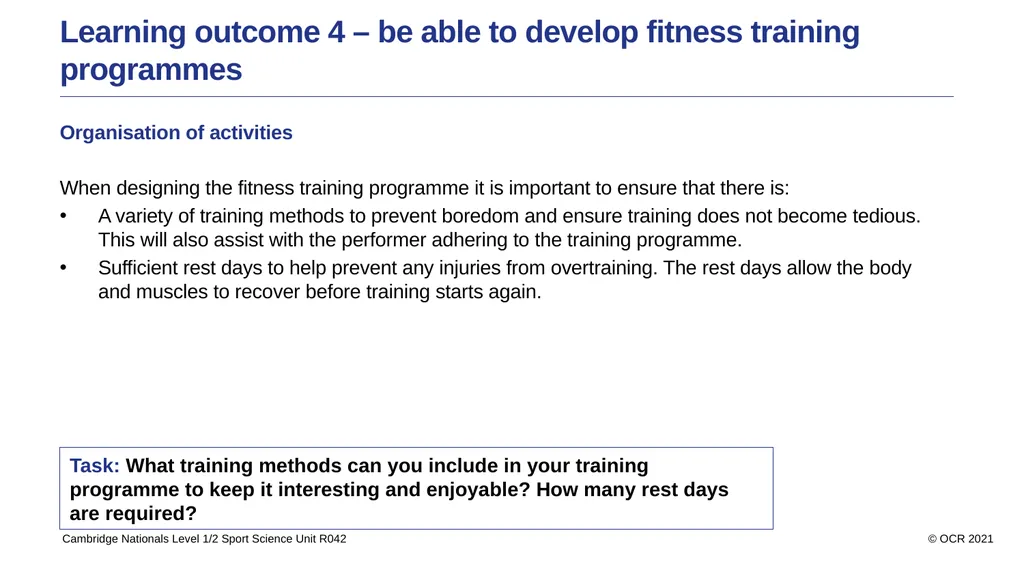
Learning outcome 4 – be able to develop fitness training programmes Organisation of activities
When designing the fitness training programme it is important to ensure that there is:
A variety of training methods to prevent boredom and ensure training does not become tedious. This will also assist with the performer adhering to the training programme.
Sufficient rest days to help prevent any injuries from overtraining. The rest days allow the body and muscles to recover before training starts again. Task: What training methods can you include in your training programme to keep it interesting and enjoyable? How many rest days are required?<br>
When designing the fitness training programme it is important to ensure that there is:
A variety of training methods to prevent boredom and ensure training does not become tedious. This will also assist with the performer adhering to the training programme.
Sufficient rest days to help prevent any injuries from overtraining. The rest days allow the body and muscles to recover before training starts again. Task: What training methods can you include in your training programme to keep it interesting and enjoyable? How many rest days are required?<br>
49
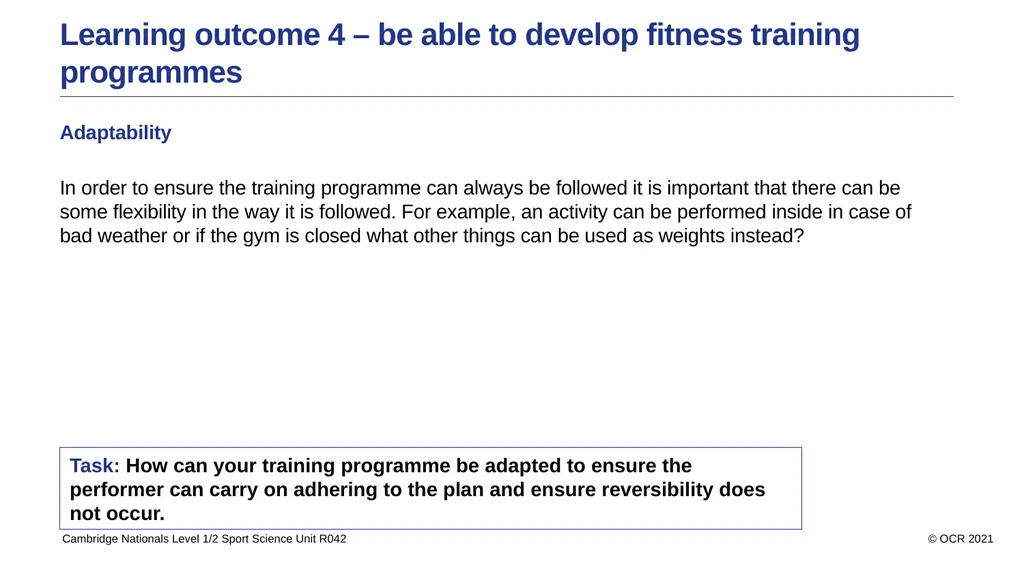
Learning outcome 4 – be able to develop fitness training programmes Adaptability
In order to ensure the training programme can always be followed it is important that there can be some flexibility in the way it is followed. For example, an activity can be performed inside in case of bad weather or if the gym is closed what other things can be used as weights instead? Task: How can your training programme be adapted to ensure the performer can carry on adhering to the plan and ensure reversibility does not occur.<br>
In order to ensure the training programme can always be followed it is important that there can be some flexibility in the way it is followed. For example, an activity can be performed inside in case of bad weather or if the gym is closed what other things can be used as weights instead? Task: How can your training programme be adapted to ensure the performer can carry on adhering to the plan and ensure reversibility does not occur.<br>
50
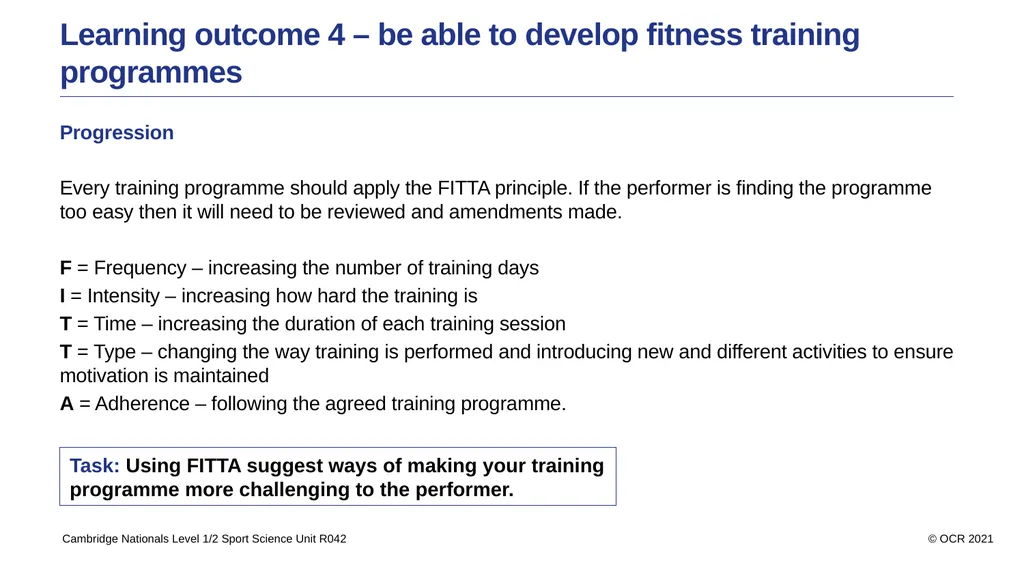
Learning outcome 4 – be able to develop fitness training programmes Progression
Every training programme should apply the FITTA principle. If the performer is finding the programme too easy then it will need to be reviewed and amendments made.
F = Frequency – increasing the number of training days
I = Intensity – increasing how hard the training is
T = Time – increasing the duration of each training session
T = Type – changing the way training is performed and introducing new and different activities to ensure motivation is maintained
A = Adherence – following the agreed training programme. Task: Using FITTA suggest ways of making your training programme more challenging to the performer.<br>
Every training programme should apply the FITTA principle. If the performer is finding the programme too easy then it will need to be reviewed and amendments made.
F = Frequency – increasing the number of training days
I = Intensity – increasing how hard the training is
T = Time – increasing the duration of each training session
T = Type – changing the way training is performed and introducing new and different activities to ensure motivation is maintained
A = Adherence – following the agreed training programme. Task: Using FITTA suggest ways of making your training programme more challenging to the performer.<br>
51
Learning outcome 4 – be able to develop fitness training programmes Evaluate the effectiveness of the training programme
At the end of a training programme it is important that the actual effectiveness of the training programme is assessed. In other words, how successful was the programme in delivering improvements and did the performer achieve the goals set out at the start of the programme.
The effectiveness can be measured by completing the following:
Measurement
Reflection on self / interview subject
Improvement.<br>
At the end of a training programme it is important that the actual effectiveness of the training programme is assessed. In other words, how successful was the programme in delivering improvements and did the performer achieve the goals set out at the start of the programme.
The effectiveness can be measured by completing the following:
Measurement
Reflection on self / interview subject
Improvement.<br>
52
Learning outcome 4 – be able to develop fitness training programmes Measurement
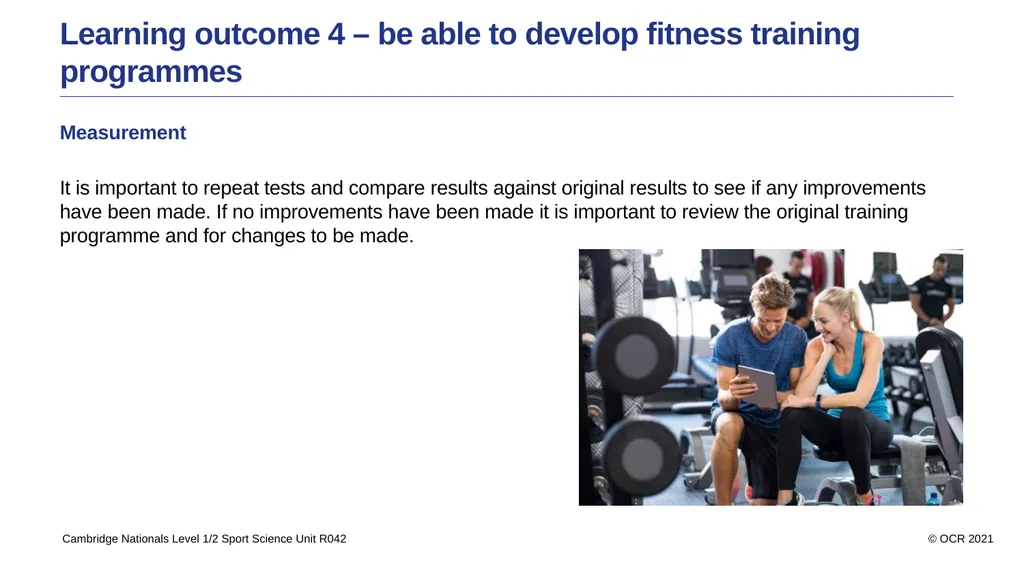
It is important to repeat tests and compare results against original results to see if any improvements have been made. If no improvements have been made it is important to review the original training programme and for changes to be made.<br>
It is important to repeat tests and compare results against original results to see if any improvements have been made. If no improvements have been made it is important to review the original training programme and for changes to be made.<br>
53
Learning outcome 4 – be able to develop fitness training programmes Reflection on self/interview subject
Some questions that maybe asked at the end of a training programme include:
Were the goals met?
Did I include an appropriate range of training methods?
Did the training methods used target my needs/the needs of the subject?
Did I/you stick to the training programme?<br>
Some questions that maybe asked at the end of a training programme include:
Were the goals met?
Did I include an appropriate range of training methods?
Did the training methods used target my needs/the needs of the subject?
Did I/you stick to the training programme?<br>
54
Learning outcome 4 – be able to develop fitness training programmes Improvement
After the results have been analyzed the performer and coach need to review and amend the training programme so it is relevant for future training. The data at the end of the programme may suggest that:
More results are required or more accuracy in results
The duration of the training programme needs adjusting
The type of activities need changing to make the programme more enjoyable
The intensity of the exercises were too hard at the start and the performer’s motivation decreased. Task: Suggest reasons why a fitness training programme may not have made an improvement?<br>
After the results have been analyzed the performer and coach need to review and amend the training programme so it is relevant for future training. The data at the end of the programme may suggest that:
More results are required or more accuracy in results
The duration of the training programme needs adjusting
The type of activities need changing to make the programme more enjoyable
The intensity of the exercises were too hard at the start and the performer’s motivation decreased. Task: Suggest reasons why a fitness training programme may not have made an improvement?<br>
55
We’d like to know your view on the resources we produce. Click ‘Like’ or ‘Dislike’ to send us an auto generated email about this resource. Add comments if you want to. Let us know how we can improve this resource or what else you need. Your email will not be used or shared for any marketing purposes.
Looking for another resource? There is now a quick and easy search tool to help find free resources for your qualification.
OCR is part of Cambridge Assessment, a department of the University of Cambridge. For staff training purposes and as part of our quality assurance programme your call may be recorded or monitored. Oxford Cambridge and RSA Examinations is a Company Limited by Guarantee. Registered in England. Registered office The Triangle Building, Shaftesbury Road, Cambridge, CB2 8EA. Registered company number 3484466. OCR is an exempt charity.
OCR operates academic and vocational qualifications regulated by Ofqual, Qualifications Wales and CCEA as listed in their qualifications registers including A Levels, GCSEs, Cambridge Technicals and Cambridge Nationals.
OCR provides resources to help you deliver our qualifications. These resources do not represent any particular teaching method we expect you to use. We update our resources regularly and aim to make sure content is accurate but please check the OCR website so that you have the most up to date version. OCR cannot be held responsible for any errors or omissions in these resources.
Though we make every effort to check our resources, there may be contradictions between published support and the specification, so it is important that you always use information in the latest specification. We indicate any specification changes within the document itself, change the version number and provide a summary of the changes. If you do notice a discrepancy between the specification and a resource, please contact us.
© OCR 2021 You can copy and distribute this resource freely if you keep the OCR logo and this small print intact and you acknowledge OCR as the originator of the resource.
OCR acknowledges the use of the following content: Slide 5: Gym exercise, Hispanolistic/Getty Images; Slide 6: Swimming pool, Giselleflissak/Getty Images: Slide 7: Rugby training, Wavebreakmedia/Getty Images; Slide 8: Sports Injury, BravissimoS/Getty Images; Slide 9: Diverse exercise group, Rawpixel/Getty Images; Slide 12: Woman sprinting, peepo/Getty Images: Cycling, simonkr/Getty Images; Slide 13: Walking race, ChiccoDodi/Getty Images: Weightlifting, shironosov/Getty Images; Slide 16: Rugby tackle, South agency/Getty Images; Slide 17: Sprinter, peepo/Getty Images; Slide 18: Football training, vgajic/Getty Images; Slide 19: Gymnast on pommel horse, sanjeri/Getty Images; Slide 20: Gymnast girl, M_a_y_a/Getty Images; Slide 21: Cycle race, BartekSzewczyk/Getty Images; Slide 22: Long distance runners, Pavel1964/Getty Images; Slide 23: Football training with cones, matmix/Getty Images; Slide 24: Running in woods, Pavle Bugarski/Getty Images; Slide 25: Running uphill, sportpoint/Getty Images; Slide 26: Using bar bells, LuminiNola/Getty Images: Resistance training, nd3000/Getty Images; Slide 27: Gym cross training, skynesher/Getty Images; Slide 28: Box jumping in a gym, pideluze/Getty Images; Slide 29: Yoga stretches, fizkes/Getty Images; Slide 30: Agility ladder, junce/Getty Images; Slide 31: Balance ball, Artpilot/Getty Images; Slide 34: Burpee test, blanaru/Getty Images; Squat test, dusanpetkovic/Getty Images; Slide 35: Standing long jump, Wittayayut/Getty Images; Slide 36: Shuttle run test, piranka/Getty Images; Illinois agility test, FluxFactory/Getty Images; Slide 38: 1 metre ruler, malerapso/Getty Images; Slide 39: Sit up, Mladen Zivkovic/Getty Images; Press ups, fizkes/Getty Images; Slide 40: Runners, jacoblund/Getty Images; Step test, EXTREME-PHOTOGRAPHER/Getty Images; Slide 54: Woman with gym coach, Ridofranz/Getty Images.
Whether you already offer OCR qualifications, are new to OCR or are thinking about switching, you can request more information using our Expression of Interest form.
Please get in touch if you want to discuss the accessibility of resources we offer to support you in delivering our qualifications.<br>
Looking for another resource? There is now a quick and easy search tool to help find free resources for your qualification.
OCR is part of Cambridge Assessment, a department of the University of Cambridge. For staff training purposes and as part of our quality assurance programme your call may be recorded or monitored. Oxford Cambridge and RSA Examinations is a Company Limited by Guarantee. Registered in England. Registered office The Triangle Building, Shaftesbury Road, Cambridge, CB2 8EA. Registered company number 3484466. OCR is an exempt charity.
OCR operates academic and vocational qualifications regulated by Ofqual, Qualifications Wales and CCEA as listed in their qualifications registers including A Levels, GCSEs, Cambridge Technicals and Cambridge Nationals.
OCR provides resources to help you deliver our qualifications. These resources do not represent any particular teaching method we expect you to use. We update our resources regularly and aim to make sure content is accurate but please check the OCR website so that you have the most up to date version. OCR cannot be held responsible for any errors or omissions in these resources.
Though we make every effort to check our resources, there may be contradictions between published support and the specification, so it is important that you always use information in the latest specification. We indicate any specification changes within the document itself, change the version number and provide a summary of the changes. If you do notice a discrepancy between the specification and a resource, please contact us.
© OCR 2021 You can copy and distribute this resource freely if you keep the OCR logo and this small print intact and you acknowledge OCR as the originator of the resource.
OCR acknowledges the use of the following content: Slide 5: Gym exercise, Hispanolistic/Getty Images; Slide 6: Swimming pool, Giselleflissak/Getty Images: Slide 7: Rugby training, Wavebreakmedia/Getty Images; Slide 8: Sports Injury, BravissimoS/Getty Images; Slide 9: Diverse exercise group, Rawpixel/Getty Images; Slide 12: Woman sprinting, peepo/Getty Images: Cycling, simonkr/Getty Images; Slide 13: Walking race, ChiccoDodi/Getty Images: Weightlifting, shironosov/Getty Images; Slide 16: Rugby tackle, South agency/Getty Images; Slide 17: Sprinter, peepo/Getty Images; Slide 18: Football training, vgajic/Getty Images; Slide 19: Gymnast on pommel horse, sanjeri/Getty Images; Slide 20: Gymnast girl, M_a_y_a/Getty Images; Slide 21: Cycle race, BartekSzewczyk/Getty Images; Slide 22: Long distance runners, Pavel1964/Getty Images; Slide 23: Football training with cones, matmix/Getty Images; Slide 24: Running in woods, Pavle Bugarski/Getty Images; Slide 25: Running uphill, sportpoint/Getty Images; Slide 26: Using bar bells, LuminiNola/Getty Images: Resistance training, nd3000/Getty Images; Slide 27: Gym cross training, skynesher/Getty Images; Slide 28: Box jumping in a gym, pideluze/Getty Images; Slide 29: Yoga stretches, fizkes/Getty Images; Slide 30: Agility ladder, junce/Getty Images; Slide 31: Balance ball, Artpilot/Getty Images; Slide 34: Burpee test, blanaru/Getty Images; Squat test, dusanpetkovic/Getty Images; Slide 35: Standing long jump, Wittayayut/Getty Images; Slide 36: Shuttle run test, piranka/Getty Images; Illinois agility test, FluxFactory/Getty Images; Slide 38: 1 metre ruler, malerapso/Getty Images; Slide 39: Sit up, Mladen Zivkovic/Getty Images; Press ups, fizkes/Getty Images; Slide 40: Runners, jacoblund/Getty Images; Step test, EXTREME-PHOTOGRAPHER/Getty Images; Slide 54: Woman with gym coach, Ridofranz/Getty Images.
Whether you already offer OCR qualifications, are new to OCR or are thinking about switching, you can request more information using our Expression of Interest form.
Please get in touch if you want to discuss the accessibility of resources we offer to support you in delivering our qualifications.<br>