
Continuing Professional Teacher Development (CPTD)
MS
Published · 56 slides · 0 views

1 / 1



















Description
Continuing Professional Teacher Development (CPTD) Management System Overview CPTD System Orientation For Teachers 1 Content Overview Section 1: Background (Policy and Legislation Context) Section 2: Continuing Professional Teacher
Related Topics
Share
Embed code
Download this presentation From Below
"Continuing Professional Teacher Development (CPTD)" is the property of its rightful owner. Permission is granted to download and print the materials on this website for personal, non-commercial use only, and to display it on your personal computer provided you do not modify the materials and that you retain all copyright notices contained in the materials. By downloading content from our website, you accept the terms of this agreement.
Presentation Transcript
01
Continuing Professional Teacher Development (CPTD) Management System Overview CPTD System Orientation For Teachers 1<br>
02
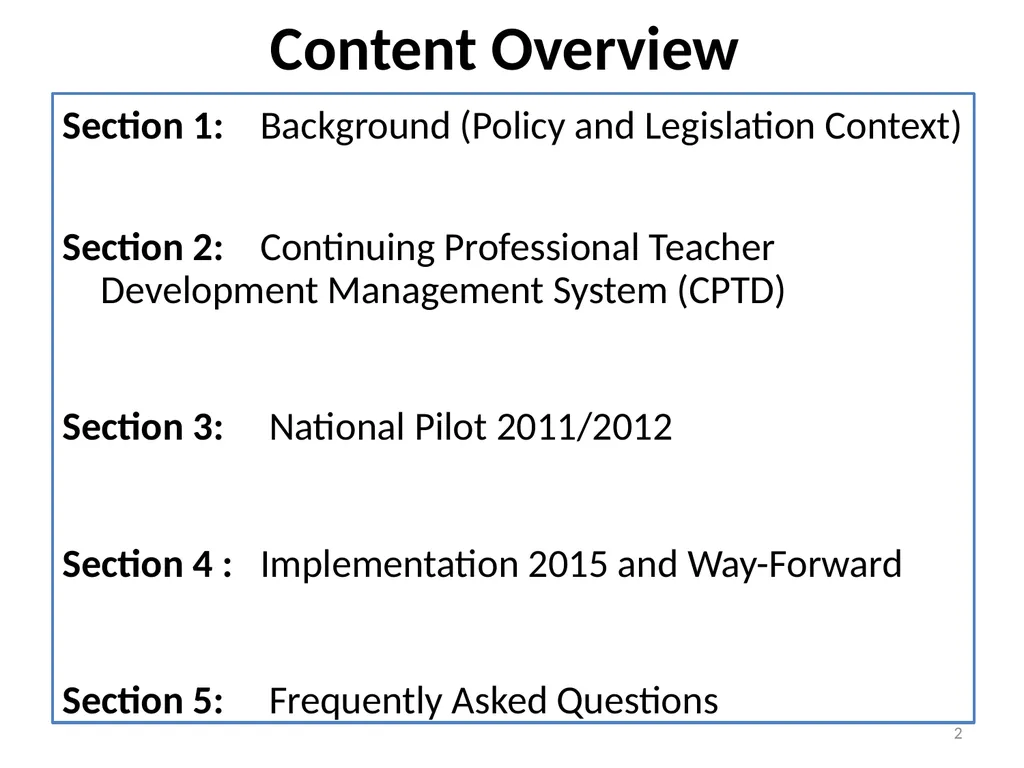
Content Overview Section 1: Background (Policy and Legislation Context)
Section 2: Continuing Professional Teacher Development Management System (CPTD)
Section 3: National Pilot 2011/2012
Section 4 : Implementation 2015 and Way-Forward
Section 5: Frequently Asked Questions 2<br>
Section 2: Continuing Professional Teacher Development Management System (CPTD)
Section 3: National Pilot 2011/2012
Section 4 : Implementation 2015 and Way-Forward
Section 5: Frequently Asked Questions 2<br>
03
NATIONAL LEGISLATION AND POLICY 3<br>
04
SACE: Legal Framework Core mandate (SACE Act no 31(2000) as amended by Basic Education Laws Amendment Act (BELA) no 15 of 2011: Registration of all educators;
Manage a system for Continuing Professional Development for all educators (as part of the Basic Education Laws Amendment Act);
Ensuring that all educators adhere to the code of professional ethics (SACE code of professional ethics and the disciplinary procedure) Professional Development of Educators CPTD MS – Mandate has its origin in the National Policy Framework on Teacher Education and Development (NPFTED) in South Africa, April 2007, Section 53…
“the South African Council for Educators (SACE), as the professional body for professional educators, will have the overall responsibility for the implementation, management and quality assurance of the CPTD System. SACE will be provided with the necessary resources and support to undertake that role “ 4 South African Council for Educators (SACE)<br>
Manage a system for Continuing Professional Development for all educators (as part of the Basic Education Laws Amendment Act);
Ensuring that all educators adhere to the code of professional ethics (SACE code of professional ethics and the disciplinary procedure) Professional Development of Educators CPTD MS – Mandate has its origin in the National Policy Framework on Teacher Education and Development (NPFTED) in South Africa, April 2007, Section 53…
“the South African Council for Educators (SACE), as the professional body for professional educators, will have the overall responsibility for the implementation, management and quality assurance of the CPTD System. SACE will be provided with the necessary resources and support to undertake that role “ 4 South African Council for Educators (SACE)<br>
05
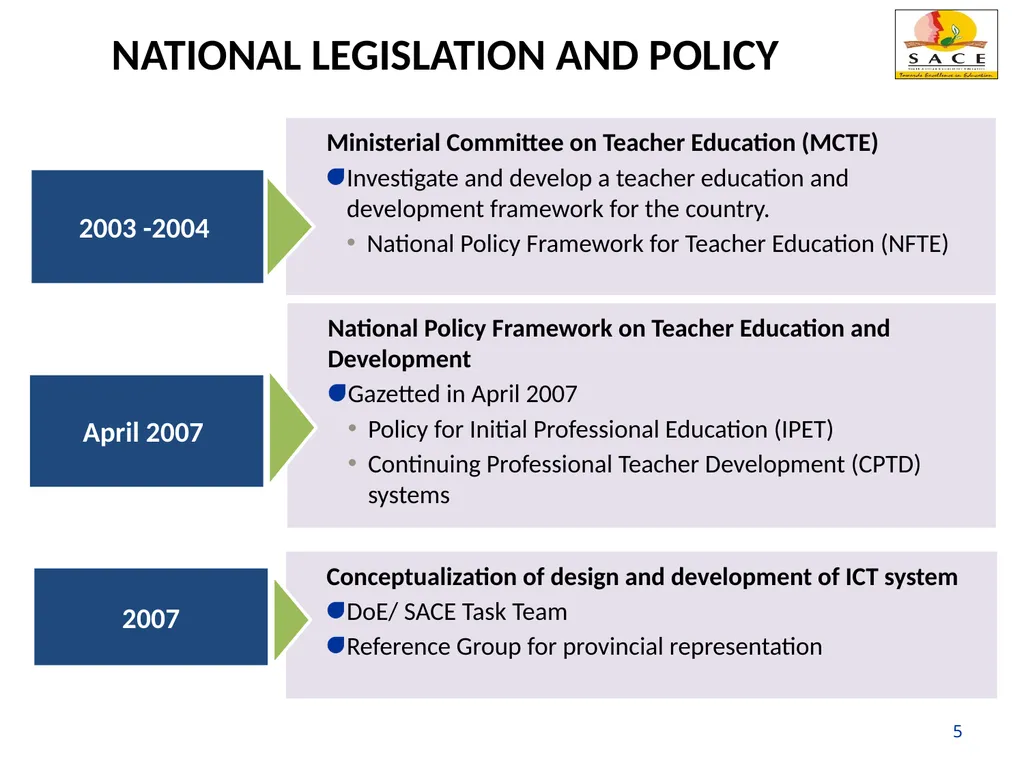
NATIONAL LEGISLATION AND POLICY Ministerial Committee on Teacher Education (MCTE)
Investigate and develop a teacher education and development framework for the country.
National Policy Framework for Teacher Education (NFTE) 2003 -2004 National Policy Framework on Teacher Education and Development
Gazetted in April 2007
Policy for Initial Professional Education (IPET)
Continuing Professional Teacher Development (CPTD) systems April 2007 Conceptualization of design and development of ICT system
DoE/ SACE Task Team
Reference Group for provincial representation 2007 5<br>
Investigate and develop a teacher education and development framework for the country.
National Policy Framework for Teacher Education (NFTE) 2003 -2004 National Policy Framework on Teacher Education and Development
Gazetted in April 2007
Policy for Initial Professional Education (IPET)
Continuing Professional Teacher Development (CPTD) systems April 2007 Conceptualization of design and development of ICT system
DoE/ SACE Task Team
Reference Group for provincial representation 2007 5<br>
06
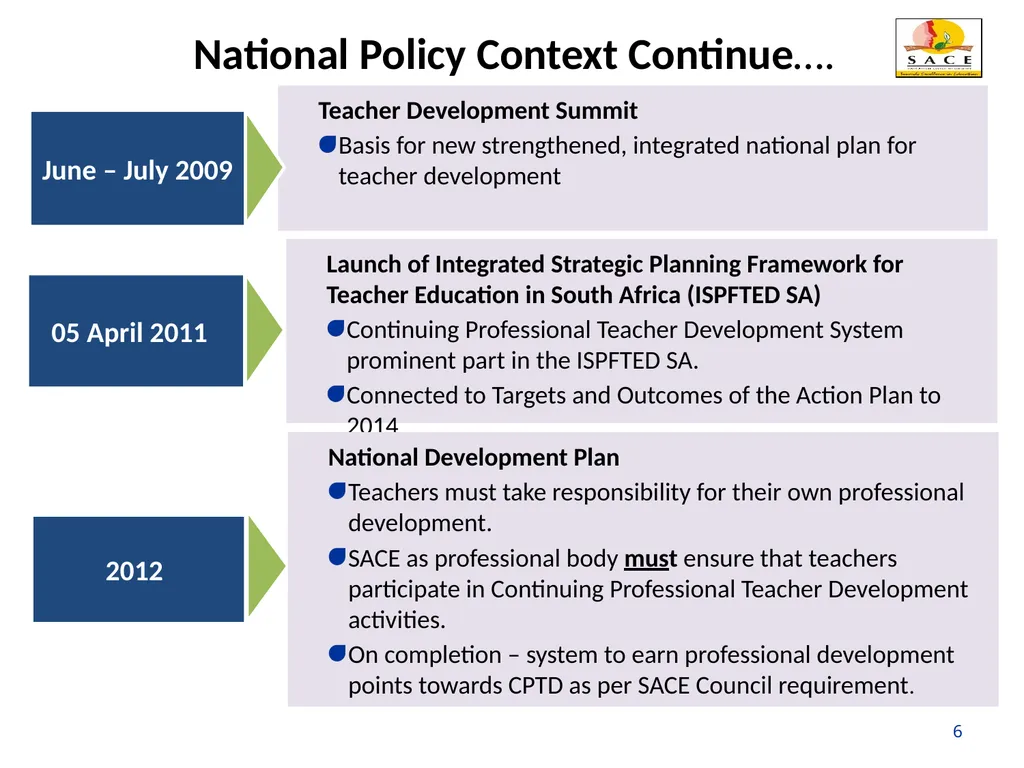
National Policy Context Continue…. Launch of Integrated Strategic Planning Framework for Teacher Education in South Africa (ISPFTED SA)
Continuing Professional Teacher Development System prominent part in the ISPFTED SA.
Connected to Targets and Outcomes of the Action Plan to 2014 05 April 2011 6 2012 National Development Plan
Teachers must take responsibility for their own professional development.
SACE as professional body must ensure that teachers participate in Continuing Professional Teacher Development activities.
On completion – system to earn professional development points towards CPTD as per SACE Council requirement. June – July 2009 Teacher Development Summit
Basis for new strengthened, integrated national plan for teacher development<br>
Continuing Professional Teacher Development System prominent part in the ISPFTED SA.
Connected to Targets and Outcomes of the Action Plan to 2014 05 April 2011 6 2012 National Development Plan
Teachers must take responsibility for their own professional development.
SACE as professional body must ensure that teachers participate in Continuing Professional Teacher Development activities.
On completion – system to earn professional development points towards CPTD as per SACE Council requirement. June – July 2009 Teacher Development Summit
Basis for new strengthened, integrated national plan for teacher development<br>
07
WHAT IS THE CPTD MANAGEMENT SYSTEM? 7<br>
08
Why Professional/ Teacher Development? 8 All workers, including professionals , e.g. teachers, doctors, etc. must engage in lifelong learning to improve:
their knowledge;
Skills;
Stay current (keep up to date with new research)
Continuing Professional Development of Teachers Professional Development (Reasoning) Better equipped teachers will impact on learner performance<br>
their knowledge;
Skills;
Stay current (keep up to date with new research)
Continuing Professional Development of Teachers Professional Development (Reasoning) Better equipped teachers will impact on learner performance<br>
09
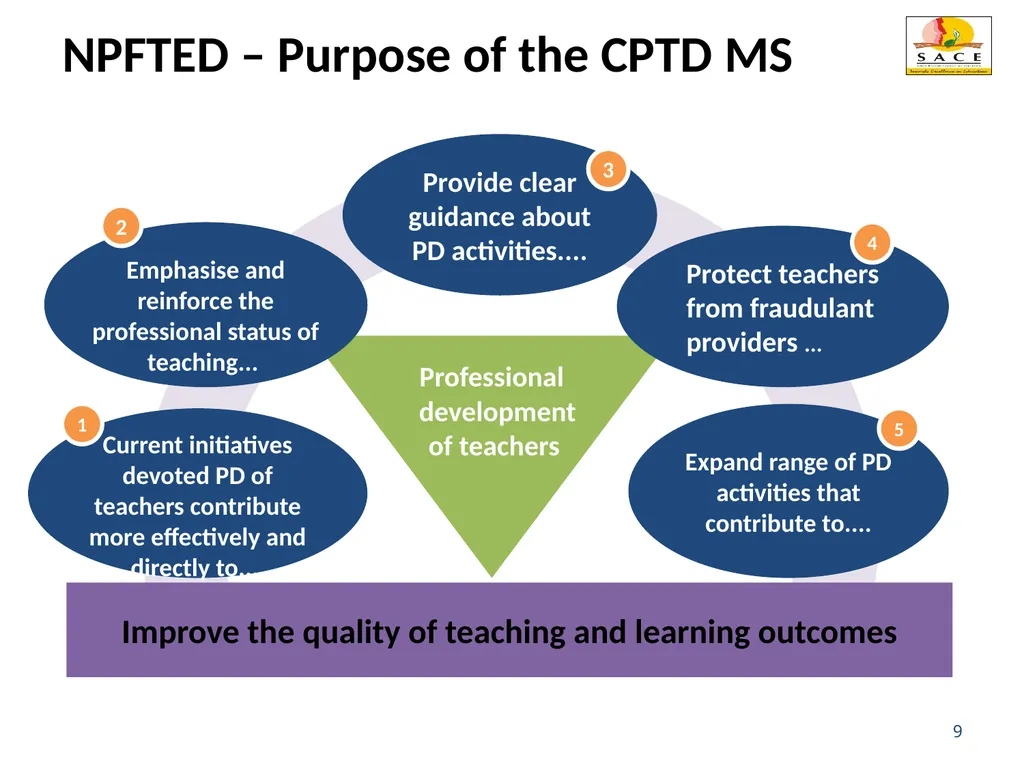
NPFTED – Purpose of the CPTD MS Improve the quality of teaching and learning outcomes Professional developmentof teachers Current initiatives devoted PD of teachers contribute more effectively and directly to... Protect teachers from fraudulant providers ... Provide clear guidance about PD activities.... Emphasise and reinforce the professional status of teaching... 1 2 3 4 9 Expand range of PD activities that contribute to.... 5<br>
10
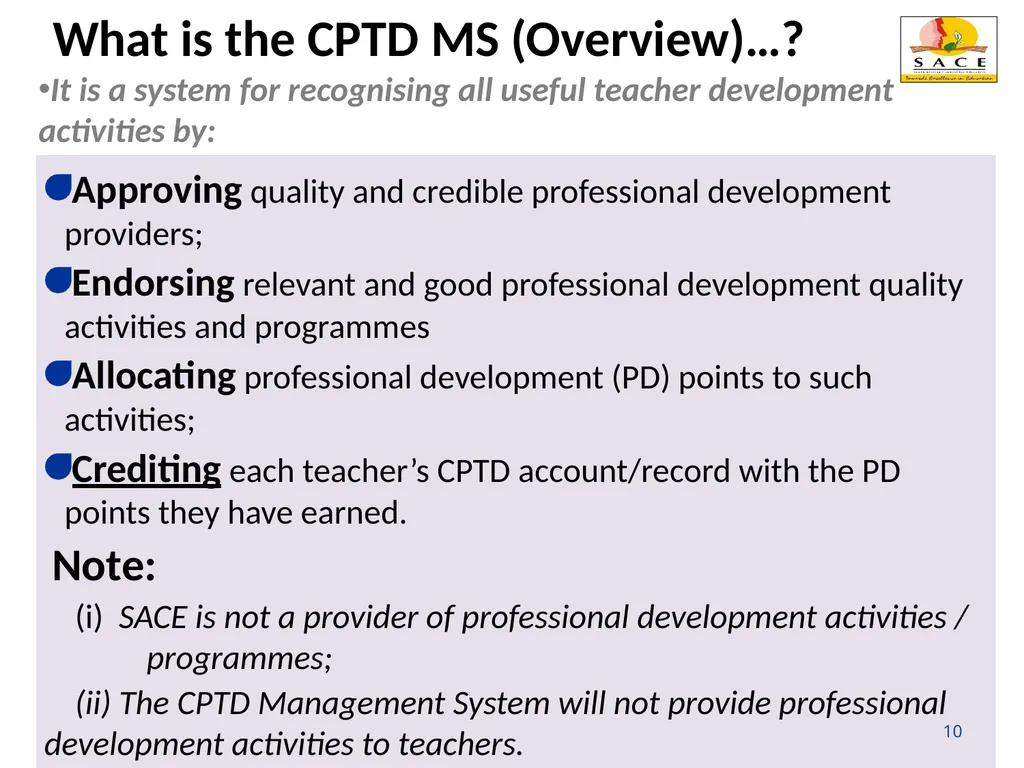
What is the CPTD MS (Overview)…? Approving quality and credible professional development providers;
Endorsing relevant and good professional development quality activities and programmes
Allocating professional development (PD) points to such activities;
Crediting each teacher’s CPTD account/record with the PD points they have earned.
Note:
(i) SACE is not a provider of professional development activities / programmes;
(ii) The CPTD Management System will not provide professional development activities to teachers. It is a system for recognising all useful teacher development activities by: 10<br>
Endorsing relevant and good professional development quality activities and programmes
Allocating professional development (PD) points to such activities;
Crediting each teacher’s CPTD account/record with the PD points they have earned.
Note:
(i) SACE is not a provider of professional development activities / programmes;
(ii) The CPTD Management System will not provide professional development activities to teachers. It is a system for recognising all useful teacher development activities by: 10<br>
11
What will SACE Do? SACE will, through the CPTD Management System, encourage and recognise:
what educators do on their own to develop themselves and improve learning,
what educators do as part of the school collective to develop themselves and improve teaching, learning, assessment and service to the community and
what educators do to develop themselves and improve teaching, learning, assessment and service to the community by taking advantage of good quality services provided by employers, unions, professional associations, HEIs and others 11<br>
what educators do on their own to develop themselves and improve learning,
what educators do as part of the school collective to develop themselves and improve teaching, learning, assessment and service to the community and
what educators do to develop themselves and improve teaching, learning, assessment and service to the community by taking advantage of good quality services provided by employers, unions, professional associations, HEIs and others 11<br>
12
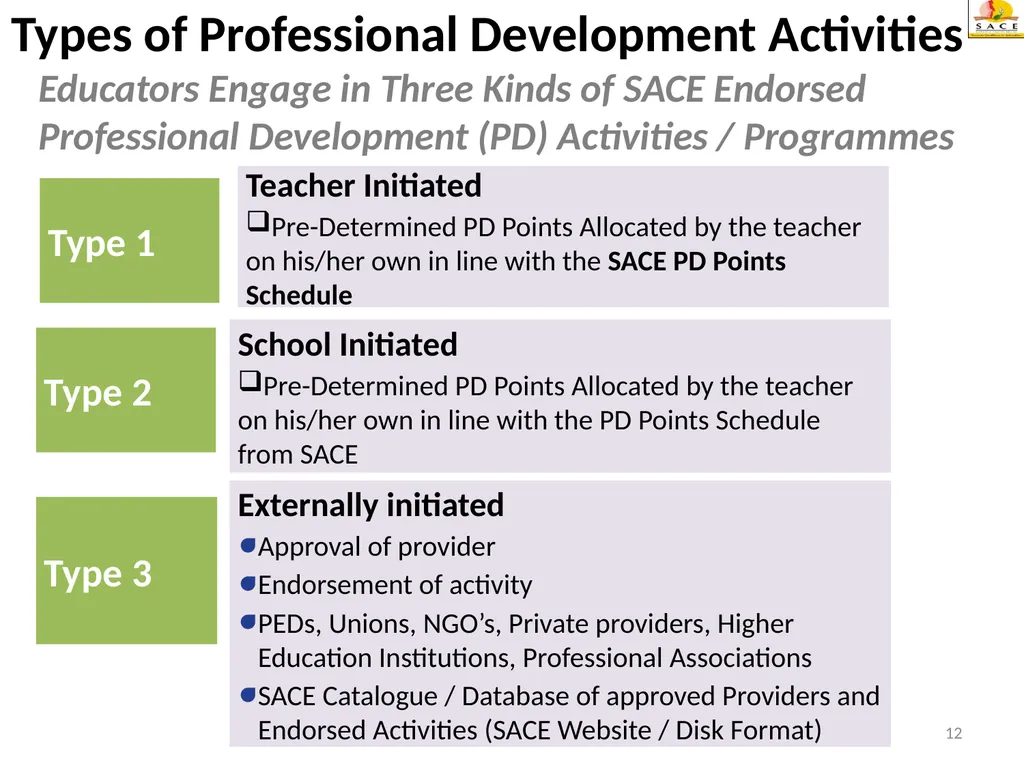
Types of Professional Development Activities Header Header Type 1 Type 2 Type 3 Teacher Initiated
Pre-Determined PD Points Allocated by the teacher on his/her own in line with the SACE PD Points Schedule School Initiated
Pre-Determined PD Points Allocated by the teacher on his/her own in line with the PD Points Schedule from SACE Externally initiated
Approval of provider
Endorsement of activity
PEDs, Unions, NGO’s, Private providers, Higher Education Institutions, Professional Associations
SACE Catalogue / Database of approved Providers and Endorsed Activities (SACE Website / Disk Format) Educators Engage in Three Kinds of SACE Endorsed Professional Development (PD) Activities / Programmes 12<br>
Pre-Determined PD Points Allocated by the teacher on his/her own in line with the SACE PD Points Schedule School Initiated
Pre-Determined PD Points Allocated by the teacher on his/her own in line with the PD Points Schedule from SACE Externally initiated
Approval of provider
Endorsement of activity
PEDs, Unions, NGO’s, Private providers, Higher Education Institutions, Professional Associations
SACE Catalogue / Database of approved Providers and Endorsed Activities (SACE Website / Disk Format) Educators Engage in Three Kinds of SACE Endorsed Professional Development (PD) Activities / Programmes 12<br>
13
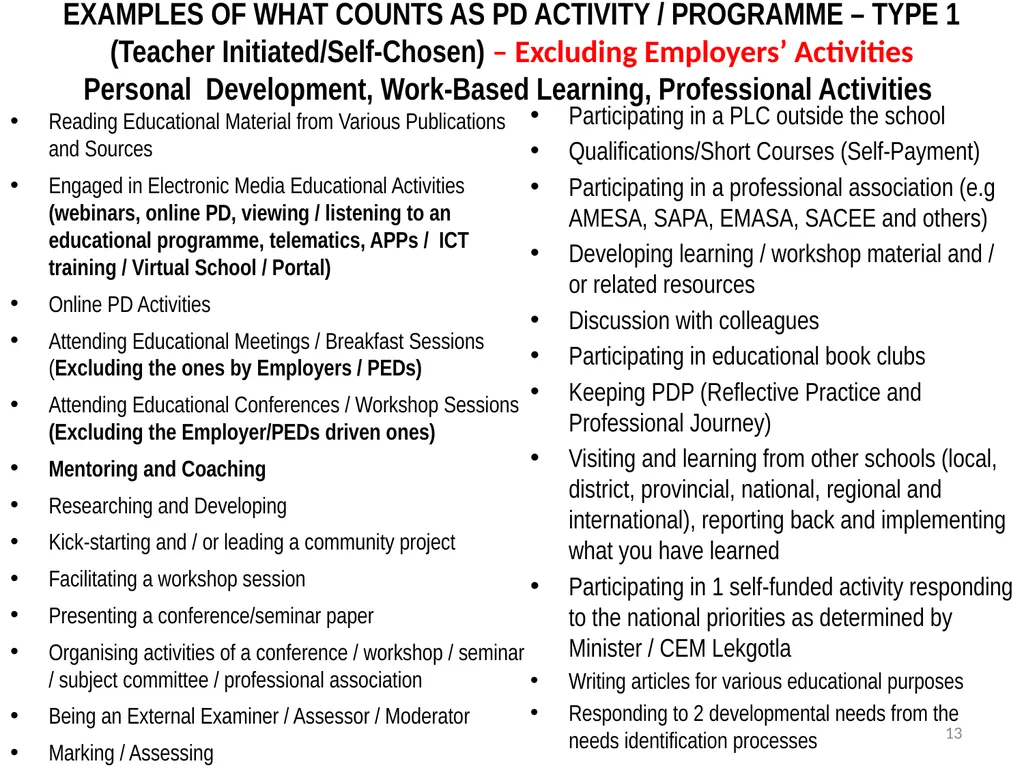
EXAMPLES OF WHAT COUNTS AS PD ACTIVITY / PROGRAMME – TYPE 1 (Teacher Initiated/Self-Chosen) – Excluding Employers’ Activities
Personal Development, Work-Based Learning, Professional Activities Reading Educational Material from Various Publications and Sources
Engaged in Electronic Media Educational Activities (webinars, online PD, viewing / listening to an educational programme, telematics, APPs / ICT training / Virtual School / Portal)
Online PD Activities
Attending Educational Meetings / Breakfast Sessions (Excluding the ones by Employers / PEDs)
Attending Educational Conferences / Workshop Sessions (Excluding the Employer/PEDs driven ones)
Mentoring and Coaching
Researching and Developing
Kick-starting and / or leading a community project
Facilitating a workshop session
Presenting a conference/seminar paper
Organising activities of a conference / workshop / seminar / subject committee / professional association
Being an External Examiner / Assessor / Moderator
Marking / Assessing Participating in a PLC outside the school
Qualifications/Short Courses (Self-Payment)
Participating in a professional association (e.g AMESA, SAPA, EMASA, SACEE and others)
Developing learning / workshop material and / or related resources
Discussion with colleagues
Participating in educational book clubs
Keeping PDP (Reflective Practice and Professional Journey)
Visiting and learning from other schools (local, district, provincial, national, regional and international), reporting back and implementing what you have learned
Participating in 1 self-funded activity responding to the national priorities as determined by Minister / CEM Lekgotla
Writing articles for various educational purposes
Responding to 2 developmental needs from the needs identification processes 13<br>
Engaged in Electronic Media Educational Activities (webinars, online PD, viewing / listening to an educational programme, telematics, APPs / ICT training / Virtual School / Portal)
Online PD Activities
Attending Educational Meetings / Breakfast Sessions (Excluding the ones by Employers / PEDs)
Attending Educational Conferences / Workshop Sessions (Excluding the Employer/PEDs driven ones)
Mentoring and Coaching
Researching and Developing
Kick-starting and / or leading a community project
Facilitating a workshop session
Presenting a conference/seminar paper
Organising activities of a conference / workshop / seminar / subject committee / professional association
Being an External Examiner / Assessor / Moderator
Marking / Assessing Participating in a PLC outside the school
Qualifications/Short Courses (Self-Payment)
Participating in a professional association (e.g AMESA, SAPA, EMASA, SACEE and others)
Developing learning / workshop material and / or related resources
Discussion with colleagues
Participating in educational book clubs
Keeping PDP (Reflective Practice and Professional Journey)
Visiting and learning from other schools (local, district, provincial, national, regional and international), reporting back and implementing what you have learned
Participating in 1 self-funded activity responding to the national priorities as determined by Minister / CEM Lekgotla
Writing articles for various educational purposes
Responding to 2 developmental needs from the needs identification processes 13<br>
14
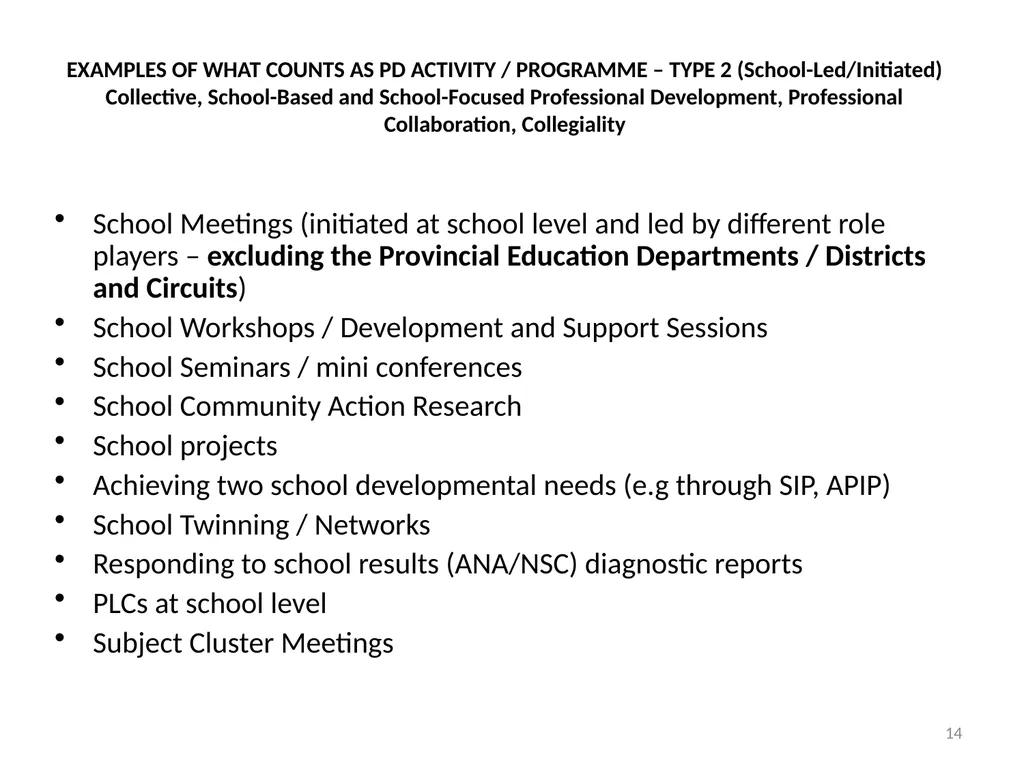
EXAMPLES OF WHAT COUNTS AS PD ACTIVITY / PROGRAMME – TYPE 2 (School-Led/Initiated)
Collective, School-Based and School-Focused Professional Development, Professional Collaboration, Collegiality School Meetings (initiated at school level and led by different role players – excluding the Provincial Education Departments / Districts and Circuits)
School Workshops / Development and Support Sessions
School Seminars / mini conferences
School Community Action Research
School projects
Achieving two school developmental needs (e.g through SIP, APIP)
School Twinning / Networks
Responding to school results (ANA/NSC) diagnostic reports
PLCs at school level
Subject Cluster Meetings 14<br>
School Workshops / Development and Support Sessions
School Seminars / mini conferences
School Community Action Research
School projects
Achieving two school developmental needs (e.g through SIP, APIP)
School Twinning / Networks
Responding to school results (ANA/NSC) diagnostic reports
PLCs at school level
Subject Cluster Meetings 14<br>
15
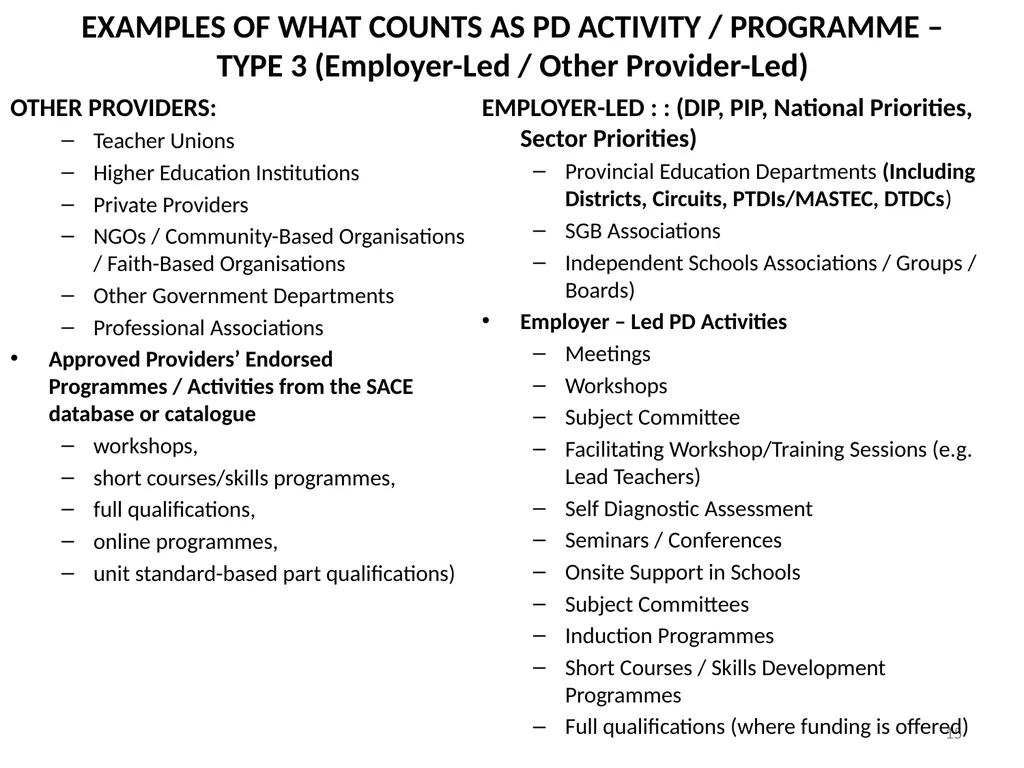
EXAMPLES OF WHAT COUNTS AS PD ACTIVITY / PROGRAMME – TYPE 3 (Employer-Led / Other Provider-Led) OTHER PROVIDERS:
Teacher Unions
Higher Education Institutions
Private Providers
NGOs / Community-Based Organisations / Faith-Based Organisations
Other Government Departments
Professional Associations
Approved Providers’ Endorsed Programmes / Activities from the SACE database or catalogue
workshops,
short courses/skills programmes,
full qualifications,
online programmes,
unit standard-based part qualifications) EMPLOYER-LED : : (DIP, PIP, National Priorities, Sector Priorities)
Provincial Education Departments (Including Districts, Circuits, PTDIs/MASTEC, DTDCs)
SGB Associations
Independent Schools Associations / Groups / Boards)
Employer – Led PD Activities
Meetings
Workshops
Subject Committee
Facilitating Workshop/Training Sessions (e.g. Lead Teachers)
Self Diagnostic Assessment
Seminars / Conferences
Onsite Support in Schools
Subject Committees
Induction Programmes
Short Courses / Skills Development Programmes
Full qualifications (where funding is offered) 15<br>
Teacher Unions
Higher Education Institutions
Private Providers
NGOs / Community-Based Organisations / Faith-Based Organisations
Other Government Departments
Professional Associations
Approved Providers’ Endorsed Programmes / Activities from the SACE database or catalogue
workshops,
short courses/skills programmes,
full qualifications,
online programmes,
unit standard-based part qualifications) EMPLOYER-LED : : (DIP, PIP, National Priorities, Sector Priorities)
Provincial Education Departments (Including Districts, Circuits, PTDIs/MASTEC, DTDCs)
SGB Associations
Independent Schools Associations / Groups / Boards)
Employer – Led PD Activities
Meetings
Workshops
Subject Committee
Facilitating Workshop/Training Sessions (e.g. Lead Teachers)
Self Diagnostic Assessment
Seminars / Conferences
Onsite Support in Schools
Subject Committees
Induction Programmes
Short Courses / Skills Development Programmes
Full qualifications (where funding is offered) 15<br>
16
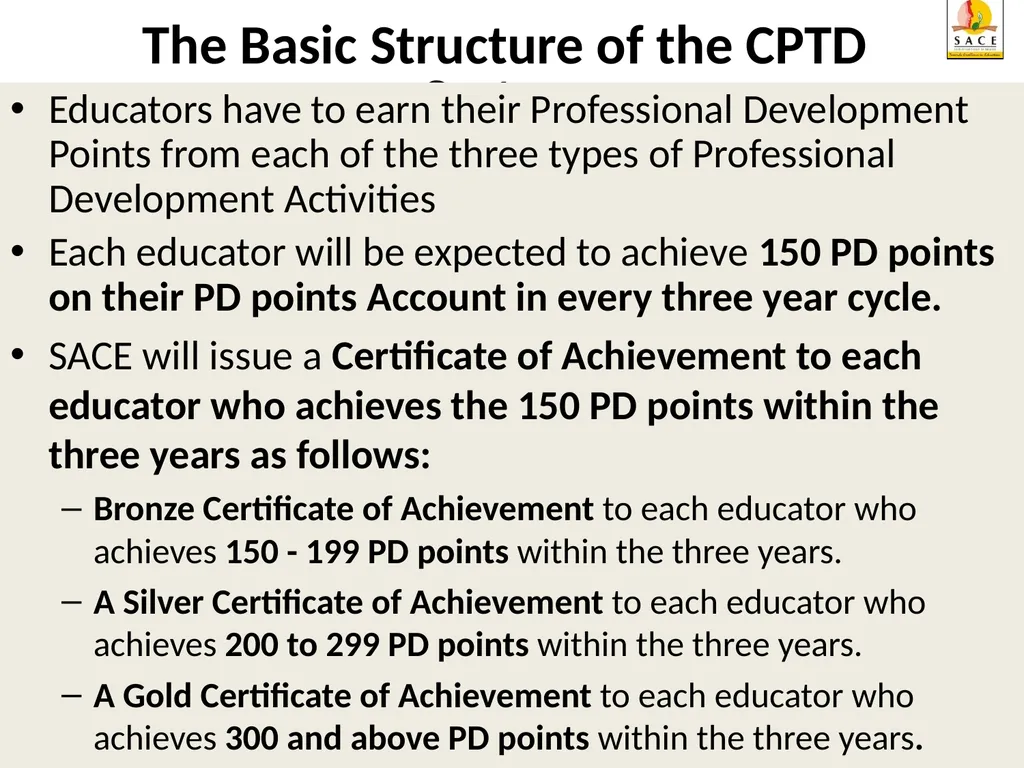
16 The Basic Structure of the CPTD System Educators have to earn their Professional Development Points from each of the three types of Professional Development Activities
Each educator will be expected to achieve 150 PD points on their PD points Account in every three year cycle.
SACE will issue a Certificate of Achievement to each educator who achieves the 150 PD points within the three years as follows:
Bronze Certificate of Achievement to each educator who achieves 150 - 199 PD points within the three years.
A Silver Certificate of Achievement to each educator who achieves 200 to 299 PD points within the three years.
A Gold Certificate of Achievement to each educator who achieves 300 and above PD points within the three years.<br>
Each educator will be expected to achieve 150 PD points on their PD points Account in every three year cycle.
SACE will issue a Certificate of Achievement to each educator who achieves the 150 PD points within the three years as follows:
Bronze Certificate of Achievement to each educator who achieves 150 - 199 PD points within the three years.
A Silver Certificate of Achievement to each educator who achieves 200 to 299 PD points within the three years.
A Gold Certificate of Achievement to each educator who achieves 300 and above PD points within the three years.<br>
17
CPTD SYSTEM TARGET AUDIENCE 17<br>
18
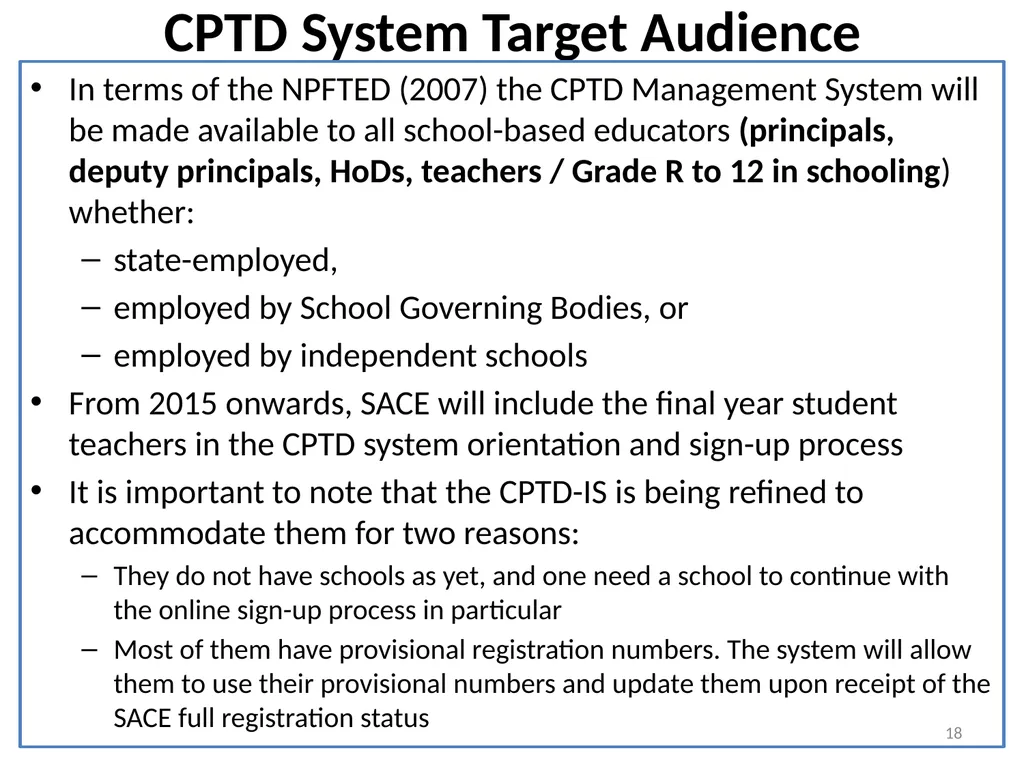
CPTD System Target Audience In terms of the NPFTED (2007) the CPTD Management System will be made available to all school-based educators (principals, deputy principals, HoDs, teachers / Grade R to 12 in schooling) whether:
state-employed,
employed by School Governing Bodies, or
employed by independent schools
From 2015 onwards, SACE will include the final year student teachers in the CPTD system orientation and sign-up process
It is important to note that the CPTD-IS is being refined to accommodate them for two reasons:
They do not have schools as yet, and one need a school to continue with the online sign-up process in particular
Most of them have provisional registration numbers. The system will allow them to use their provisional numbers and update them upon receipt of the SACE full registration status 18<br>
state-employed,
employed by School Governing Bodies, or
employed by independent schools
From 2015 onwards, SACE will include the final year student teachers in the CPTD system orientation and sign-up process
It is important to note that the CPTD-IS is being refined to accommodate them for two reasons:
They do not have schools as yet, and one need a school to continue with the online sign-up process in particular
Most of them have provisional registration numbers. The system will allow them to use their provisional numbers and update them upon receipt of the SACE full registration status 18<br>
19
CPTD System Target Audience.. The CPTD system is not applicable to the
ECD Practitioners
AET Practitioners,
FET College Lectures
Teachers relieving others or occupying a position for less than 12 months
What about the Therapists and Psychologists in Schools?
The Therapists and Psychologists belong to the Health Professions Council of South Africa as professionals
They also register with SACE by virtue of them working in schools with our children
They have their own CPD system with 1 year cycle and have to earn 60 points in that cycle
SACE started a process of engaging the HPCSA on this matter for purposes of collaboration and minimising duplication in terms of reporting. The discussions are at early stages.
In the light of this, SACE requires that Therapists and Psychologists in schools sign-up for participation in the CPTD Management System from 2015 onwards
SACE will continue its engagements and provide the therapists with direction on recording and reporting their participation in PD activities and points earned at a later stage 19<br>
ECD Practitioners
AET Practitioners,
FET College Lectures
Teachers relieving others or occupying a position for less than 12 months
What about the Therapists and Psychologists in Schools?
The Therapists and Psychologists belong to the Health Professions Council of South Africa as professionals
They also register with SACE by virtue of them working in schools with our children
They have their own CPD system with 1 year cycle and have to earn 60 points in that cycle
SACE started a process of engaging the HPCSA on this matter for purposes of collaboration and minimising duplication in terms of reporting. The discussions are at early stages.
In the light of this, SACE requires that Therapists and Psychologists in schools sign-up for participation in the CPTD Management System from 2015 onwards
SACE will continue its engagements and provide the therapists with direction on recording and reporting their participation in PD activities and points earned at a later stage 19<br>
20
WHAT HAPPENS BEFORE YOU START WITH YOUR THREE YEAR CPTD SYSTEM CYCLE? 20<br>
21
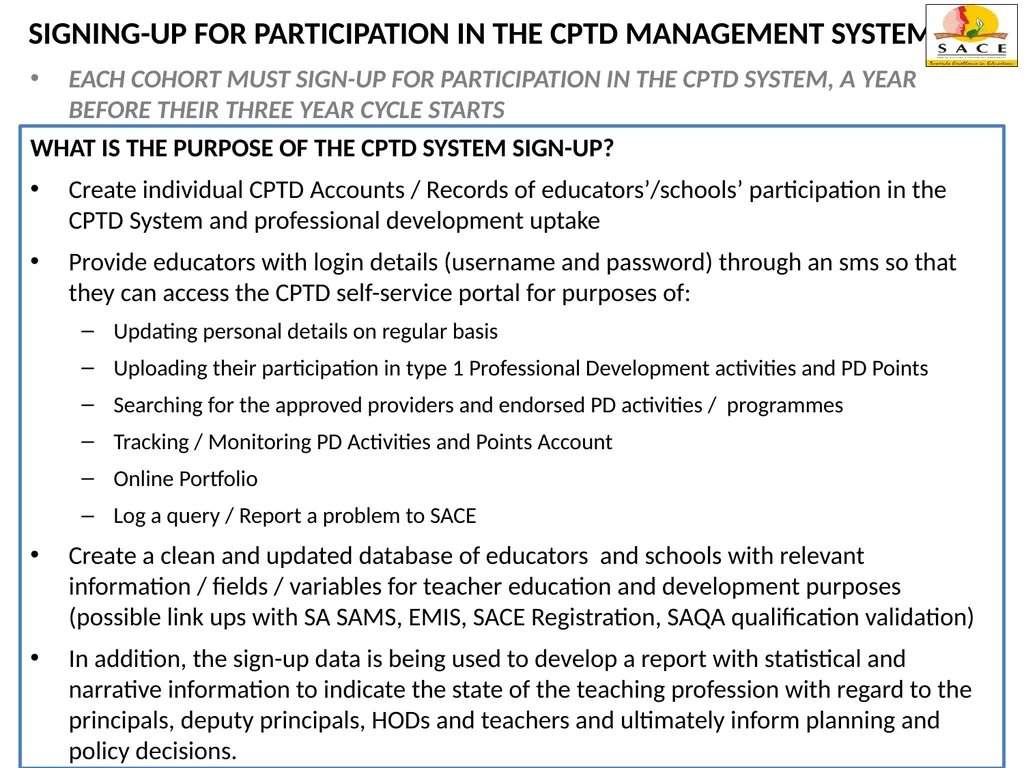
SIGNING-UP FOR PARTICIPATION IN THE CPTD MANAGEMENT SYSTEM EACH COHORT MUST SIGN-UP FOR PARTICIPATION IN THE CPTD SYSTEM, A YEAR BEFORE THEIR THREE YEAR CYCLE STARTS WHAT IS THE PURPOSE OF THE CPTD SYSTEM SIGN-UP?
Create individual CPTD Accounts / Records of educators’/schools’ participation in the CPTD System and professional development uptake
Provide educators with login details (username and password) through an sms so that they can access the CPTD self-service portal for purposes of:
Updating personal details on regular basis
Uploading their participation in type 1 Professional Development activities and PD Points
Searching for the approved providers and endorsed PD activities / programmes
Tracking / Monitoring PD Activities and Points Account
Online Portfolio
Log a query / Report a problem to SACE
Create a clean and updated database of educators and schools with relevant information / fields / variables for teacher education and development purposes (possible link ups with SA SAMS, EMIS, SACE Registration, SAQA qualification validation)
In addition, the sign-up data is being used to develop a report with statistical and narrative information to indicate the state of the teaching profession with regard to the principals, deputy principals, HODs and teachers and ultimately inform planning and policy decisions. 21<br>
Create individual CPTD Accounts / Records of educators’/schools’ participation in the CPTD System and professional development uptake
Provide educators with login details (username and password) through an sms so that they can access the CPTD self-service portal for purposes of:
Updating personal details on regular basis
Uploading their participation in type 1 Professional Development activities and PD Points
Searching for the approved providers and endorsed PD activities / programmes
Tracking / Monitoring PD Activities and Points Account
Online Portfolio
Log a query / Report a problem to SACE
Create a clean and updated database of educators and schools with relevant information / fields / variables for teacher education and development purposes (possible link ups with SA SAMS, EMIS, SACE Registration, SAQA qualification validation)
In addition, the sign-up data is being used to develop a report with statistical and narrative information to indicate the state of the teaching profession with regard to the principals, deputy principals, HODs and teachers and ultimately inform planning and policy decisions. 21<br>
22
SIGNING-UP FOR THE CPTD MANAGEMENT SYSTEM HOW DO I SIGN-UP?
You can sign-up as follows:
Manually
By filling-in the teacher profile form obtainable from the:
SACE website/offices,
CPTD system orientation workshop sessions,
Provincial Education Departments’ teacher development units / District Teacher Development Centres, Provincial Teacher Development Institutes,
SACE Provincial Offices in KZN and Free State
The completed form should be:
handed over to the workshop facilitators (if sign-up took place during the workshop session)]
faxed to SACE (086 571 5260)
Posted to SACE, PD and Research Division (Private Bag x127, CENTURION, 0046)
E-mailed to member@sace.org.za 22<br>
You can sign-up as follows:
Manually
By filling-in the teacher profile form obtainable from the:
SACE website/offices,
CPTD system orientation workshop sessions,
Provincial Education Departments’ teacher development units / District Teacher Development Centres, Provincial Teacher Development Institutes,
SACE Provincial Offices in KZN and Free State
The completed form should be:
handed over to the workshop facilitators (if sign-up took place during the workshop session)]
faxed to SACE (086 571 5260)
Posted to SACE, PD and Research Division (Private Bag x127, CENTURION, 0046)
E-mailed to member@sace.org.za 22<br>
23
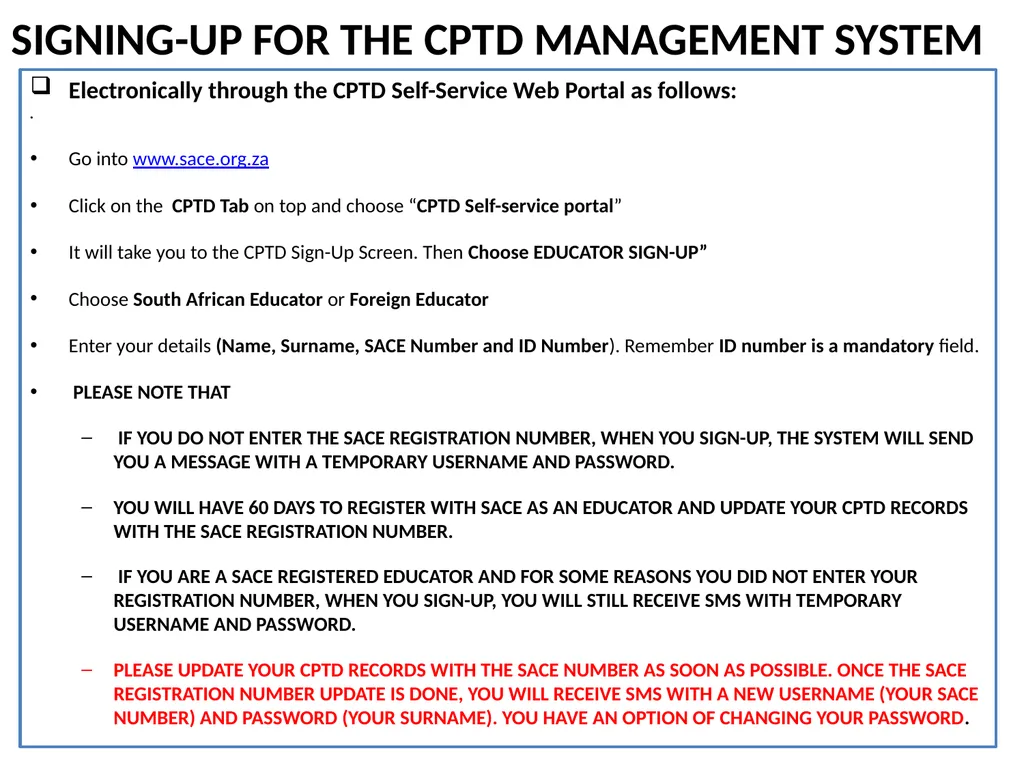
SIGNING-UP FOR THE CPTD MANAGEMENT SYSTEM Electronically through the CPTD Self-Service Web Portal as follows:
Go into www.sace.org.za
Click on the CPTD Tab on top and choose “CPTD Self-service portal”
It will take you to the CPTD Sign-Up Screen. Then Choose EDUCATOR SIGN-UP”
Choose South African Educator or Foreign Educator
Enter your details (Name, Surname, SACE Number and ID Number). Remember ID number is a mandatory field.
PLEASE NOTE THAT
IF YOU DO NOT ENTER THE SACE REGISTRATION NUMBER, WHEN YOU SIGN-UP, THE SYSTEM WILL SEND YOU A MESSAGE WITH A TEMPORARY USERNAME AND PASSWORD.
YOU WILL HAVE 60 DAYS TO REGISTER WITH SACE AS AN EDUCATOR AND UPDATE YOUR CPTD RECORDS WITH THE SACE REGISTRATION NUMBER.
IF YOU ARE A SACE REGISTERED EDUCATOR AND FOR SOME REASONS YOU DID NOT ENTER YOUR REGISTRATION NUMBER, WHEN YOU SIGN-UP, YOU WILL STILL RECEIVE SMS WITH TEMPORARY USERNAME AND PASSWORD.
PLEASE UPDATE YOUR CPTD RECORDS WITH THE SACE NUMBER AS SOON AS POSSIBLE. ONCE THE SACE REGISTRATION NUMBER UPDATE IS DONE, YOU WILL RECEIVE SMS WITH A NEW USERNAME (YOUR SACE NUMBER) AND PASSWORD (YOUR SURNAME). YOU HAVE AN OPTION OF CHANGING YOUR PASSWORD. 23<br>
Go into www.sace.org.za
Click on the CPTD Tab on top and choose “CPTD Self-service portal”
It will take you to the CPTD Sign-Up Screen. Then Choose EDUCATOR SIGN-UP”
Choose South African Educator or Foreign Educator
Enter your details (Name, Surname, SACE Number and ID Number). Remember ID number is a mandatory field.
PLEASE NOTE THAT
IF YOU DO NOT ENTER THE SACE REGISTRATION NUMBER, WHEN YOU SIGN-UP, THE SYSTEM WILL SEND YOU A MESSAGE WITH A TEMPORARY USERNAME AND PASSWORD.
YOU WILL HAVE 60 DAYS TO REGISTER WITH SACE AS AN EDUCATOR AND UPDATE YOUR CPTD RECORDS WITH THE SACE REGISTRATION NUMBER.
IF YOU ARE A SACE REGISTERED EDUCATOR AND FOR SOME REASONS YOU DID NOT ENTER YOUR REGISTRATION NUMBER, WHEN YOU SIGN-UP, YOU WILL STILL RECEIVE SMS WITH TEMPORARY USERNAME AND PASSWORD.
PLEASE UPDATE YOUR CPTD RECORDS WITH THE SACE NUMBER AS SOON AS POSSIBLE. ONCE THE SACE REGISTRATION NUMBER UPDATE IS DONE, YOU WILL RECEIVE SMS WITH A NEW USERNAME (YOUR SACE NUMBER) AND PASSWORD (YOUR SURNAME). YOU HAVE AN OPTION OF CHANGING YOUR PASSWORD. 23<br>
24
WHAT HAPPENS AFTER SIGNING-UP?
PARTICIPATION IN THE THREE-YEAR CPTD SYSTEM CYCLE BEGINS 24<br>
25
THE THREE COHORTS AND THE CPTD SYSTEM CYCLES AT GLANCE 25<br>
26
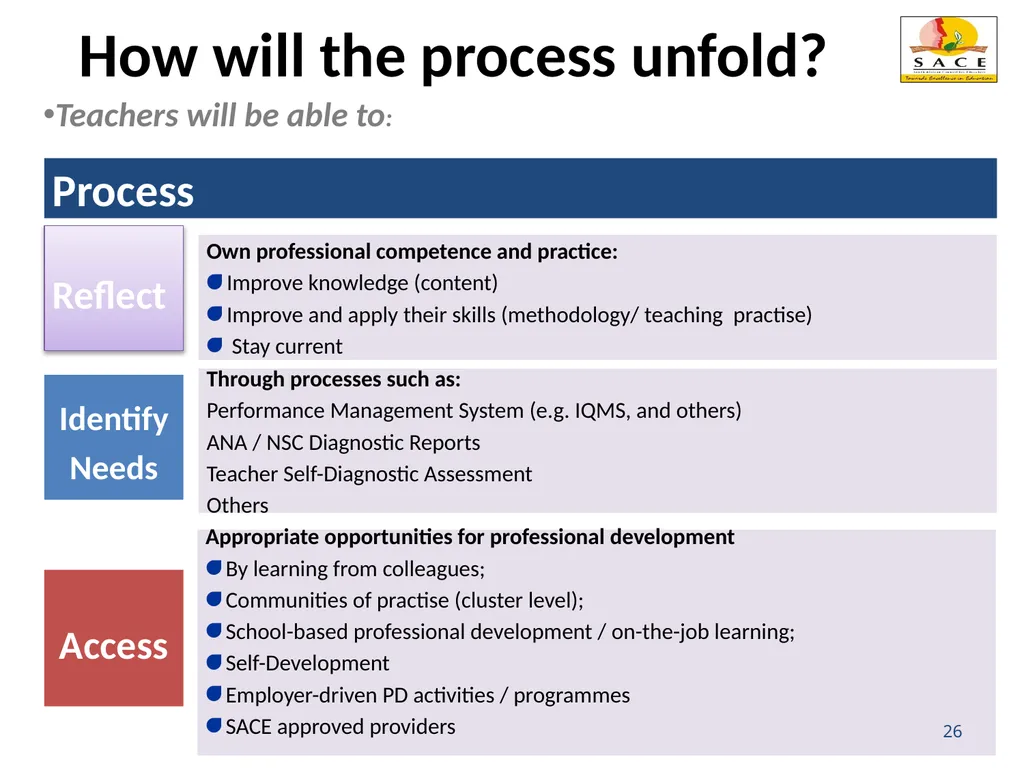
How will the process unfold? Appropriate opportunities for professional development
By learning from colleagues;
Communities of practise (cluster level);
School-based professional development / on-the-job learning;
Self-Development
Employer-driven PD activities / programmes
SACE approved providers Access Process Through processes such as:
Performance Management System (e.g. IQMS, and others)
ANA / NSC Diagnostic Reports
Teacher Self-Diagnostic Assessment
Others Identify
Needs Own professional competence and practice:
Improve knowledge (content)
Improve and apply their skills (methodology/ teaching practise)
Stay current Reflect Teachers will be able to: 26<br>
By learning from colleagues;
Communities of practise (cluster level);
School-based professional development / on-the-job learning;
Self-Development
Employer-driven PD activities / programmes
SACE approved providers Access Process Through processes such as:
Performance Management System (e.g. IQMS, and others)
ANA / NSC Diagnostic Reports
Teacher Self-Diagnostic Assessment
Others Identify
Needs Own professional competence and practice:
Improve knowledge (content)
Improve and apply their skills (methodology/ teaching practise)
Stay current Reflect Teachers will be able to: 26<br>
27
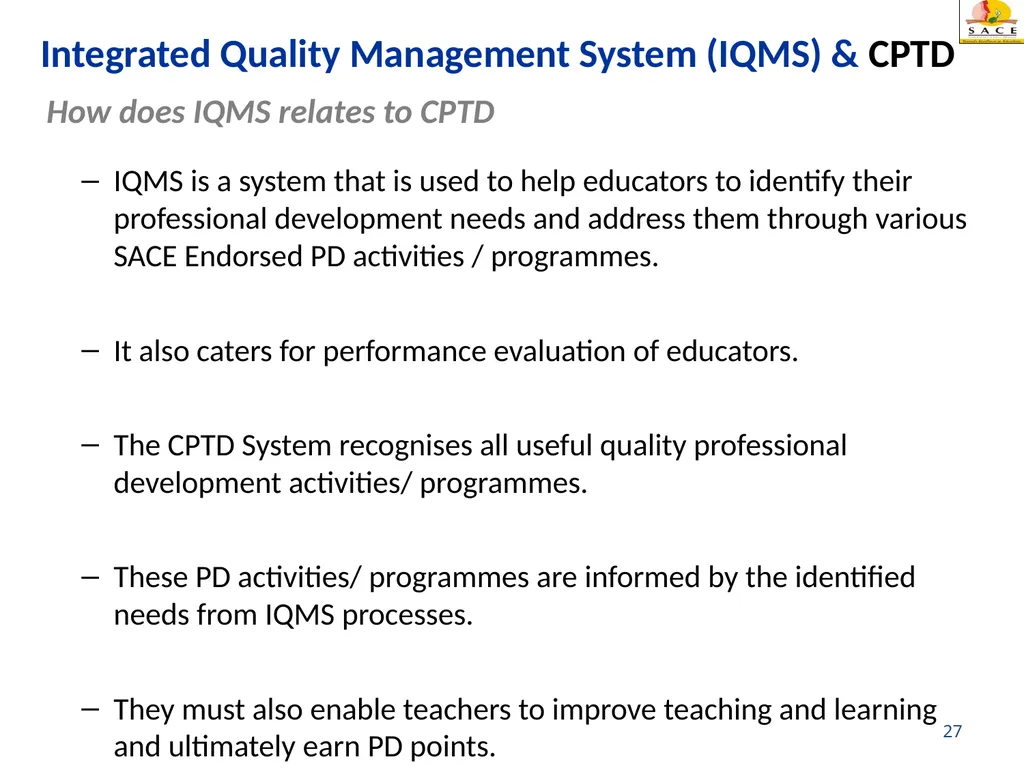
Integrated Quality Management System (IQMS) & CPTD How does IQMS relates to CPTD IQMS is a system that is used to help educators to identify their professional development needs and address them through various SACE Endorsed PD activities / programmes.
It also caters for performance evaluation of educators.
The CPTD System recognises all useful quality professional development activities/ programmes.
These PD activities/ programmes are informed by the identified needs from IQMS processes.
They must also enable teachers to improve teaching and learning and ultimately earn PD points. 27<br>
It also caters for performance evaluation of educators.
The CPTD System recognises all useful quality professional development activities/ programmes.
These PD activities/ programmes are informed by the identified needs from IQMS processes.
They must also enable teachers to improve teaching and learning and ultimately earn PD points. 27<br>
28
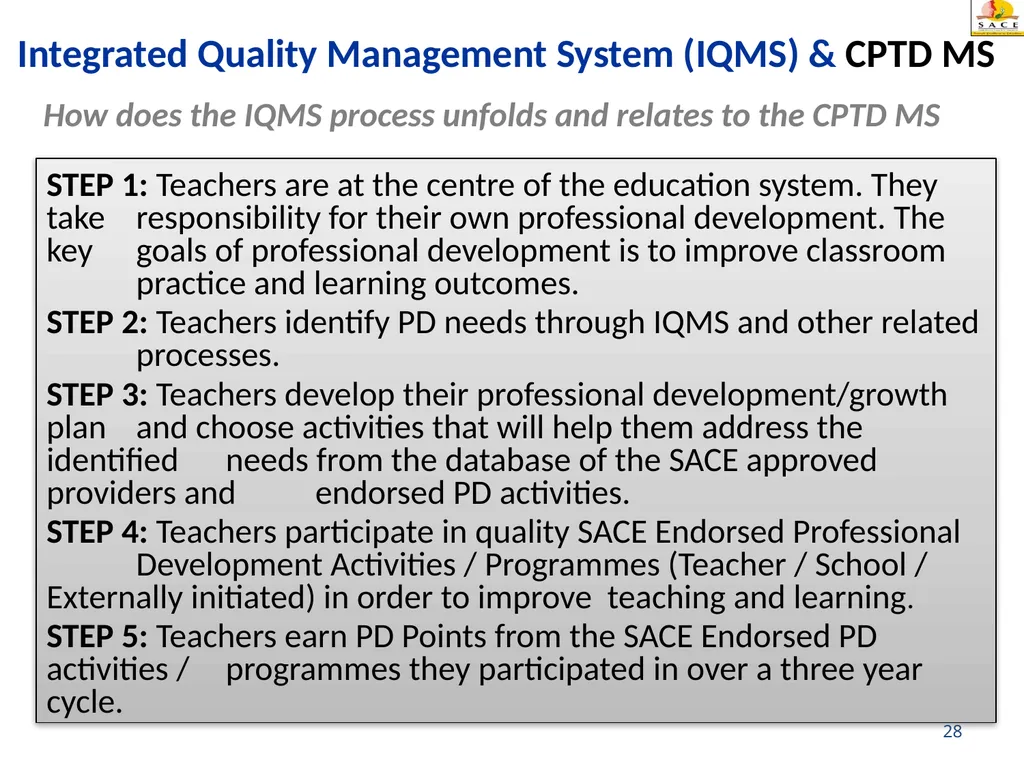
Integrated Quality Management System (IQMS) & CPTD MS How does the IQMS process unfolds and relates to the CPTD MS STEP 1: Teachers are at the centre of the education system. They take responsibility for their own professional development. The key goals of professional development is to improve classroom practice and learning outcomes.
STEP 2: Teachers identify PD needs through IQMS and other related processes.
STEP 3: Teachers develop their professional development/growth plan and choose activities that will help them address the identified needs from the database of the SACE approved providers and endorsed PD activities.
STEP 4: Teachers participate in quality SACE Endorsed Professional Development Activities / Programmes (Teacher / School / Externally initiated) in order to improve teaching and learning.
STEP 5: Teachers earn PD Points from the SACE Endorsed PD activities / programmes they participated in over a three year cycle. 28<br>
STEP 2: Teachers identify PD needs through IQMS and other related processes.
STEP 3: Teachers develop their professional development/growth plan and choose activities that will help them address the identified needs from the database of the SACE approved providers and endorsed PD activities.
STEP 4: Teachers participate in quality SACE Endorsed Professional Development Activities / Programmes (Teacher / School / Externally initiated) in order to improve teaching and learning.
STEP 5: Teachers earn PD Points from the SACE Endorsed PD activities / programmes they participated in over a three year cycle. 28<br>
29
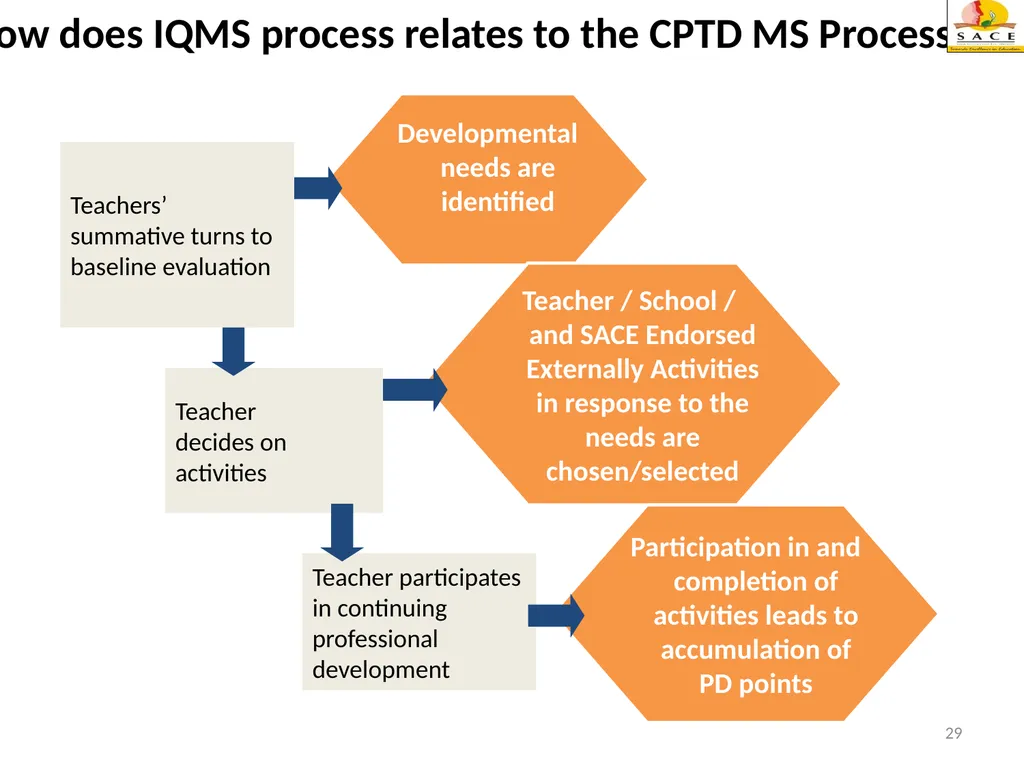
How does IQMS process relates to the CPTD MS Process? 29 Teachers’
summative turns to
baseline evaluation Teacher
decides on
activities Teacher participates
in continuing
professional
development Developmental needs are identified Teacher / School / and SACE Endorsed Externally Activities in response to the needs are chosen/selected Participation in and completion of activities leads to accumulation of PD points<br>
summative turns to
baseline evaluation Teacher
decides on
activities Teacher participates
in continuing
professional
development Developmental needs are identified Teacher / School / and SACE Endorsed Externally Activities in response to the needs are chosen/selected Participation in and completion of activities leads to accumulation of PD points<br>
30
HOW DO I EARN THE PD POINTS FROM THE THREE TYPES OF PD ACTIVITIES / PROGRAMMES? 30<br>
31
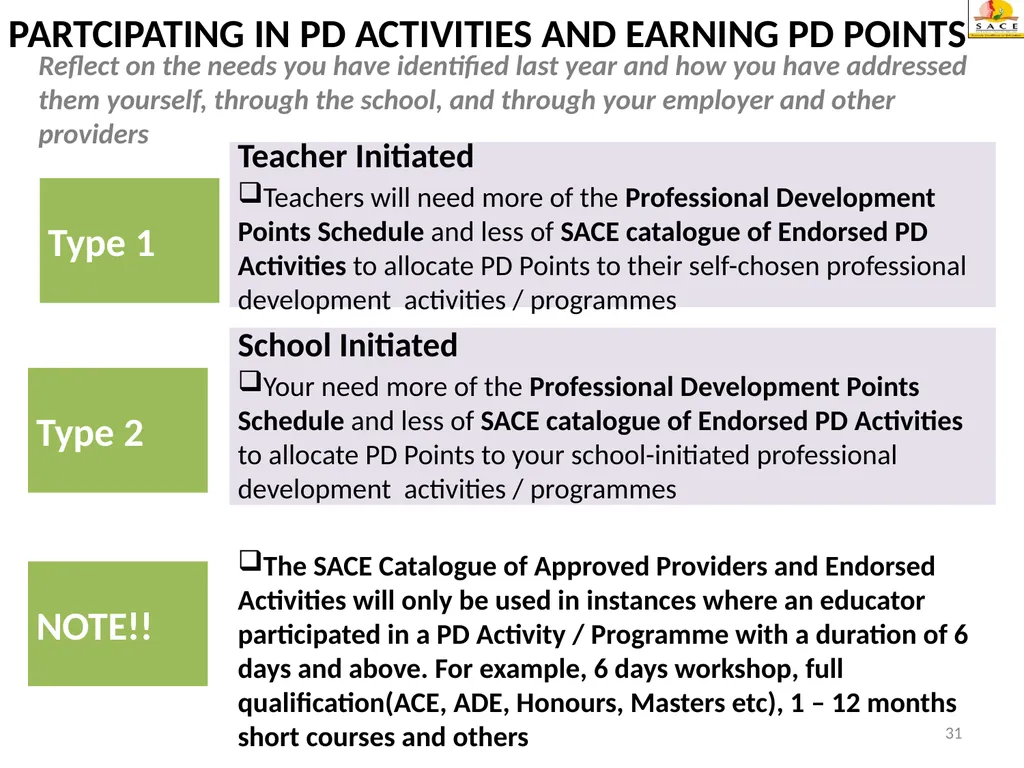
PARTCIPATING IN PD ACTIVITIES AND EARNING PD POINTS Header Type 1 Type 2 Teacher Initiated
Teachers will need more of the Professional Development Points Schedule and less of SACE catalogue of Endorsed PD Activities to allocate PD Points to their self-chosen professional development activities / programmes School Initiated
Your need more of the Professional Development Points Schedule and less of SACE catalogue of Endorsed PD Activities to allocate PD Points to your school-initiated professional development activities / programmes
The SACE Catalogue of Approved Providers and Endorsed Activities will only be used in instances where an educator participated in a PD Activity / Programme with a duration of 6 days and above. For example, 6 days workshop, full qualification(ACE, ADE, Honours, Masters etc), 1 – 12 months short courses and others Reflect on the needs you have identified last year and how you have addressed them yourself, through the school, and through your employer and other providers 31 NOTE!!<br>
Teachers will need more of the Professional Development Points Schedule and less of SACE catalogue of Endorsed PD Activities to allocate PD Points to their self-chosen professional development activities / programmes School Initiated
Your need more of the Professional Development Points Schedule and less of SACE catalogue of Endorsed PD Activities to allocate PD Points to your school-initiated professional development activities / programmes
The SACE Catalogue of Approved Providers and Endorsed Activities will only be used in instances where an educator participated in a PD Activity / Programme with a duration of 6 days and above. For example, 6 days workshop, full qualification(ACE, ADE, Honours, Masters etc), 1 – 12 months short courses and others Reflect on the needs you have identified last year and how you have addressed them yourself, through the school, and through your employer and other providers 31 NOTE!!<br>
32
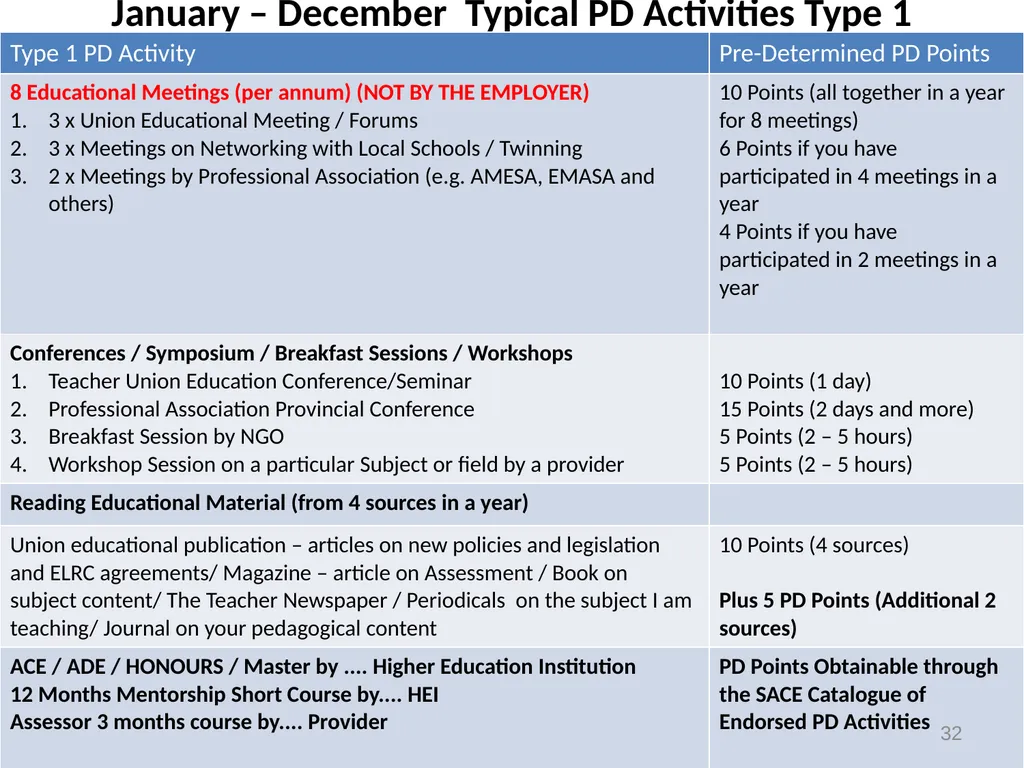
January – December Typical PD Activities Type 1 32<br>
33
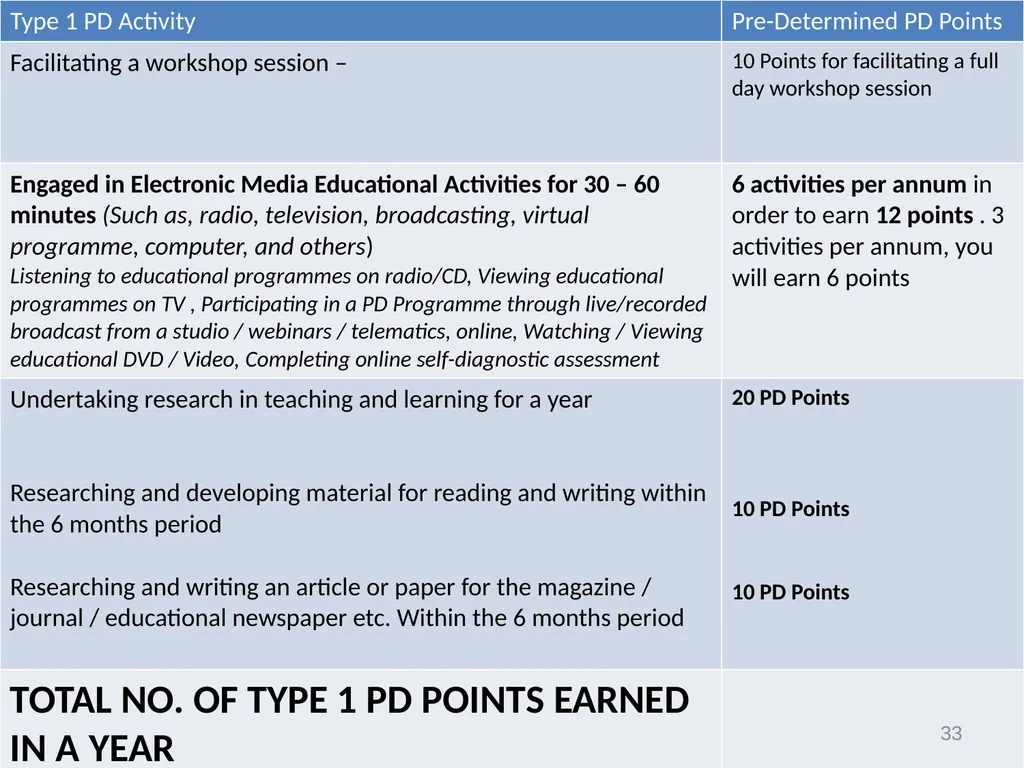
January – December Typical PD Activities Type 1...... 33<br>
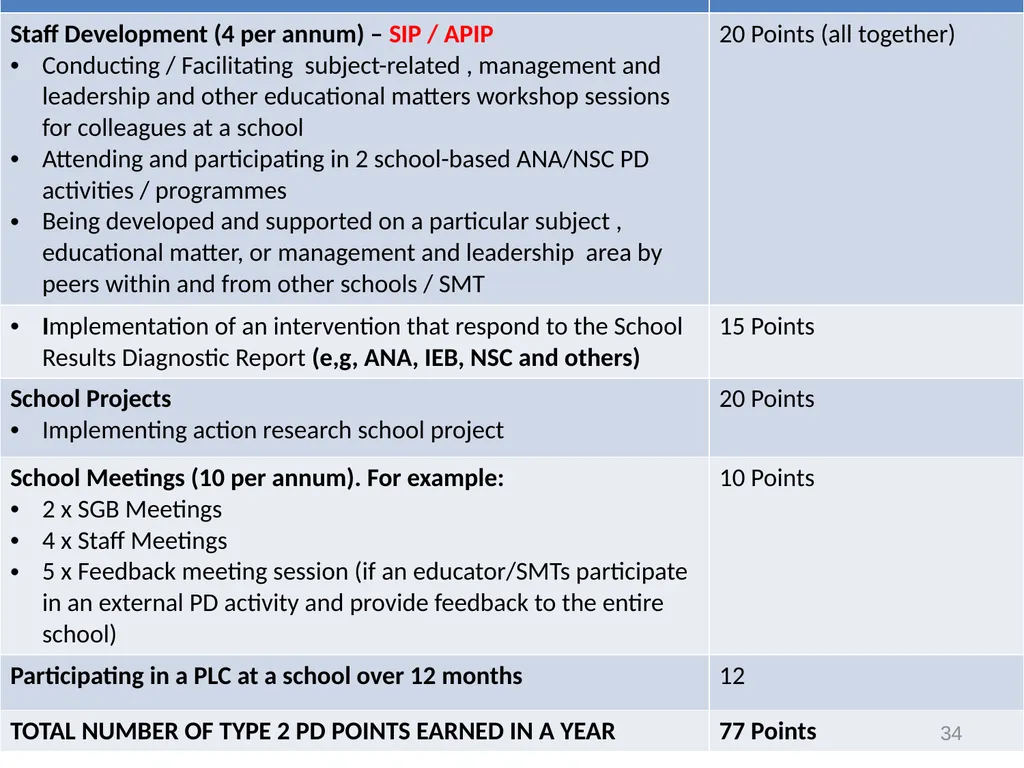
34
January – December Typical PD Activities Type 2 34<br>
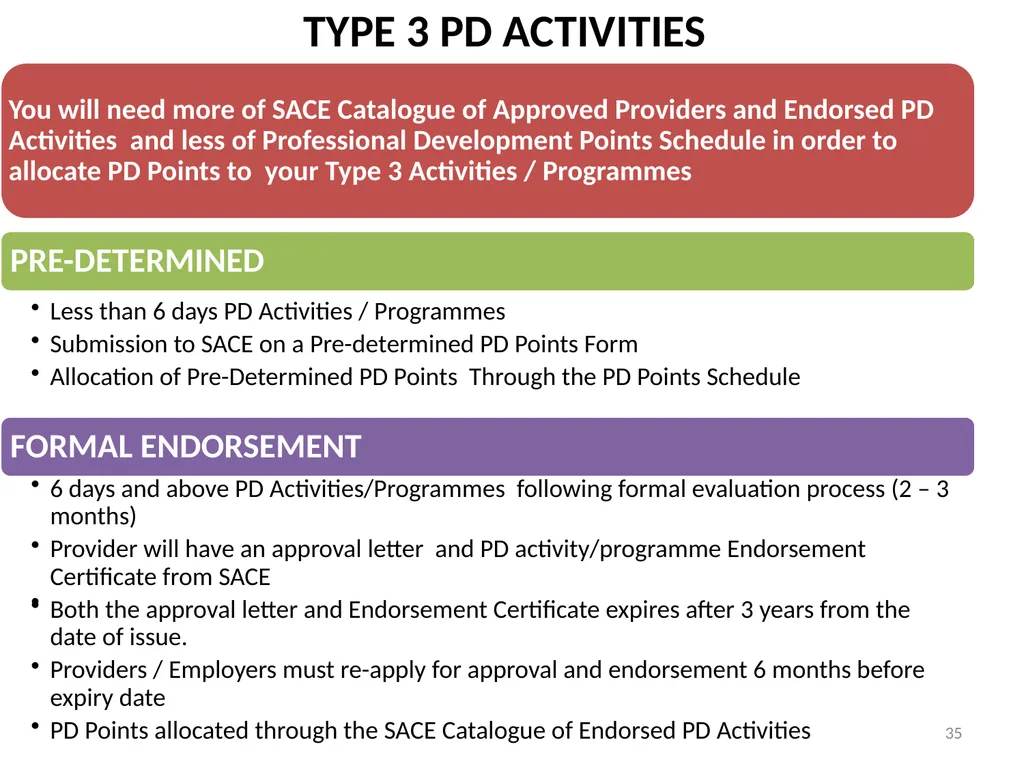
35
TYPE 3 PD ACTIVITIES 35<br>
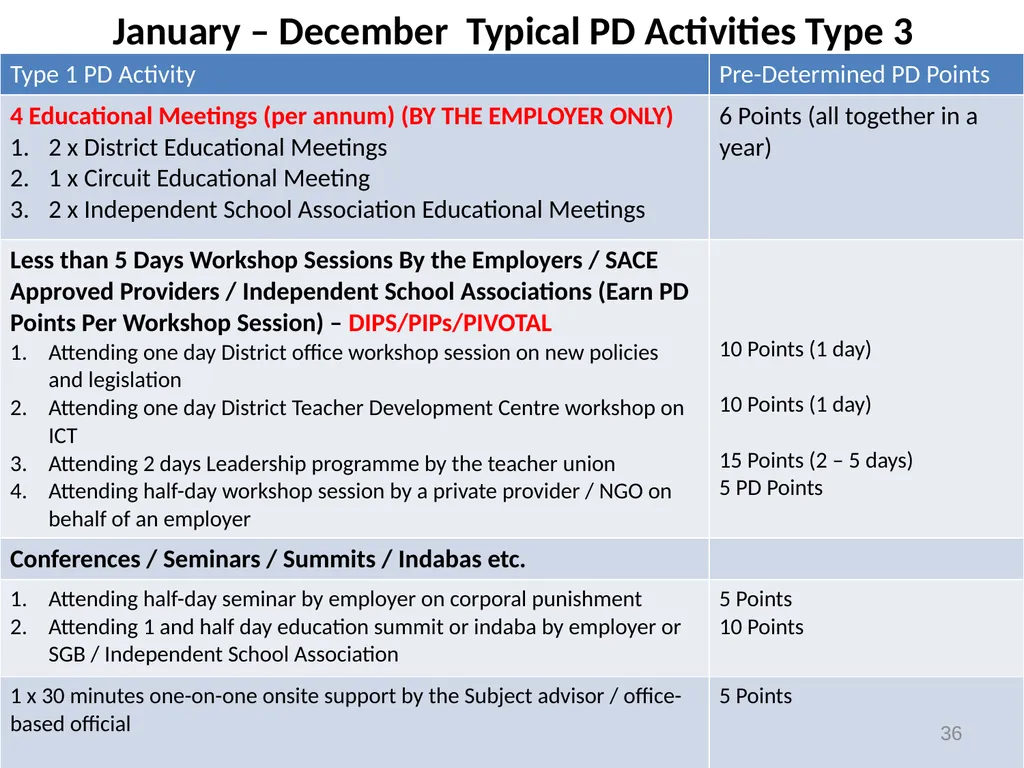
36
January – December Typical PD Activities Type 3 36<br>
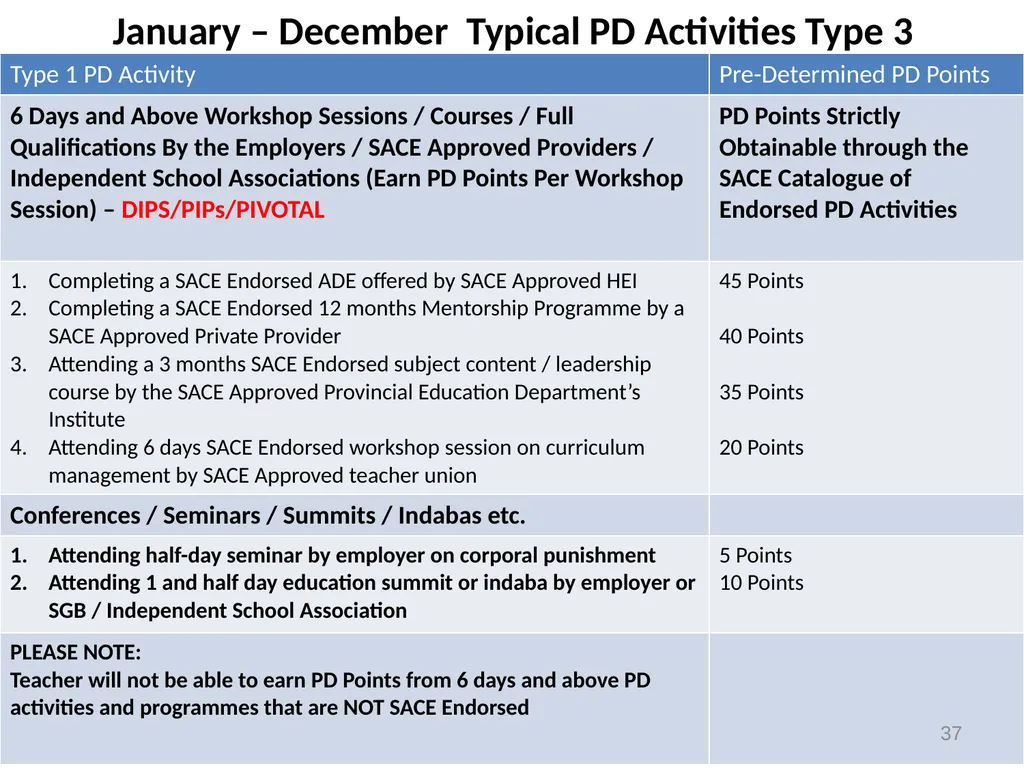
37
January – December Typical PD Activities Type 3 37<br>
38
HOW DO I RECORD AND REPORT MY PARTICIPATION IN TYPE 1 – 3 PD ACTIVITIES / PROGRAMMES AND PD POINTS EARNED? 38<br>
39
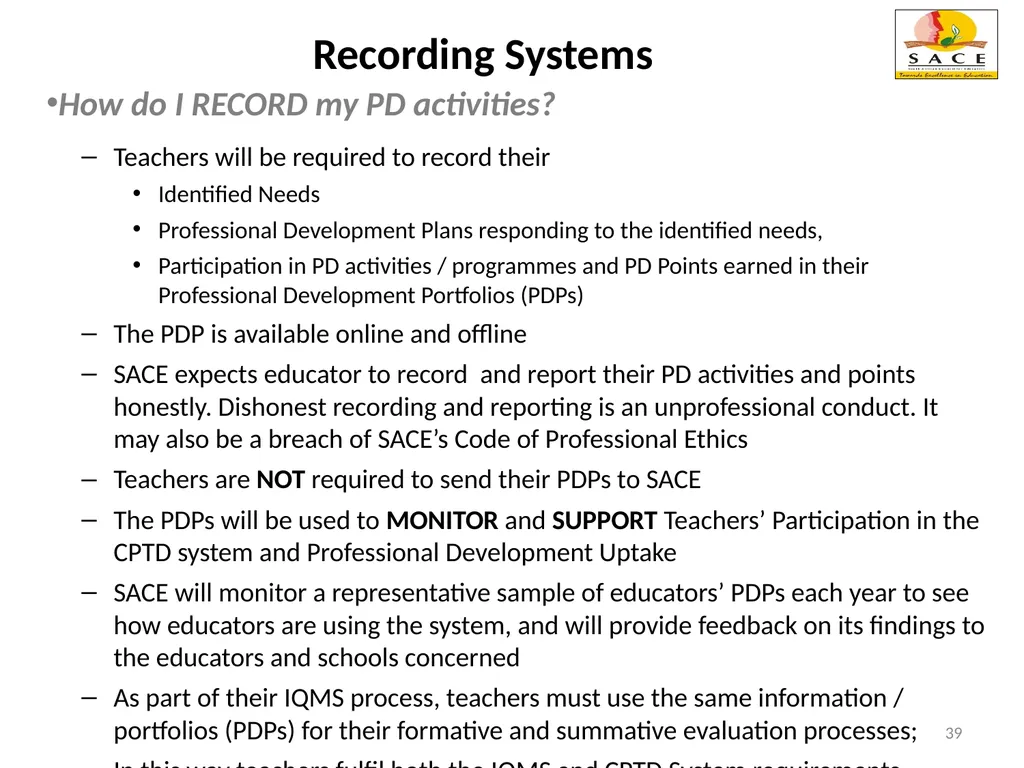
Recording Systems How do I RECORD my PD activities? Teachers will be required to record their
Identified Needs
Professional Development Plans responding to the identified needs,
Participation in PD activities / programmes and PD Points earned in their Professional Development Portfolios (PDPs)
The PDP is available online and offline
SACE expects educator to record and report their PD activities and points honestly. Dishonest recording and reporting is an unprofessional conduct. It may also be a breach of SACE’s Code of Professional Ethics
Teachers are NOT required to send their PDPs to SACE
The PDPs will be used to MONITOR and SUPPORT Teachers’ Participation in the CPTD system and Professional Development Uptake
SACE will monitor a representative sample of educators’ PDPs each year to see how educators are using the system, and will provide feedback on its findings to the educators and schools concerned
As part of their IQMS process, teachers must use the same information / portfolios (PDPs) for their formative and summative evaluation processes;
In this way teachers fulfil both the IQMS and CPTD System requirements. 39<br>
Identified Needs
Professional Development Plans responding to the identified needs,
Participation in PD activities / programmes and PD Points earned in their Professional Development Portfolios (PDPs)
The PDP is available online and offline
SACE expects educator to record and report their PD activities and points honestly. Dishonest recording and reporting is an unprofessional conduct. It may also be a breach of SACE’s Code of Professional Ethics
Teachers are NOT required to send their PDPs to SACE
The PDPs will be used to MONITOR and SUPPORT Teachers’ Participation in the CPTD system and Professional Development Uptake
SACE will monitor a representative sample of educators’ PDPs each year to see how educators are using the system, and will provide feedback on its findings to the educators and schools concerned
As part of their IQMS process, teachers must use the same information / portfolios (PDPs) for their formative and summative evaluation processes;
In this way teachers fulfil both the IQMS and CPTD System requirements. 39<br>
40
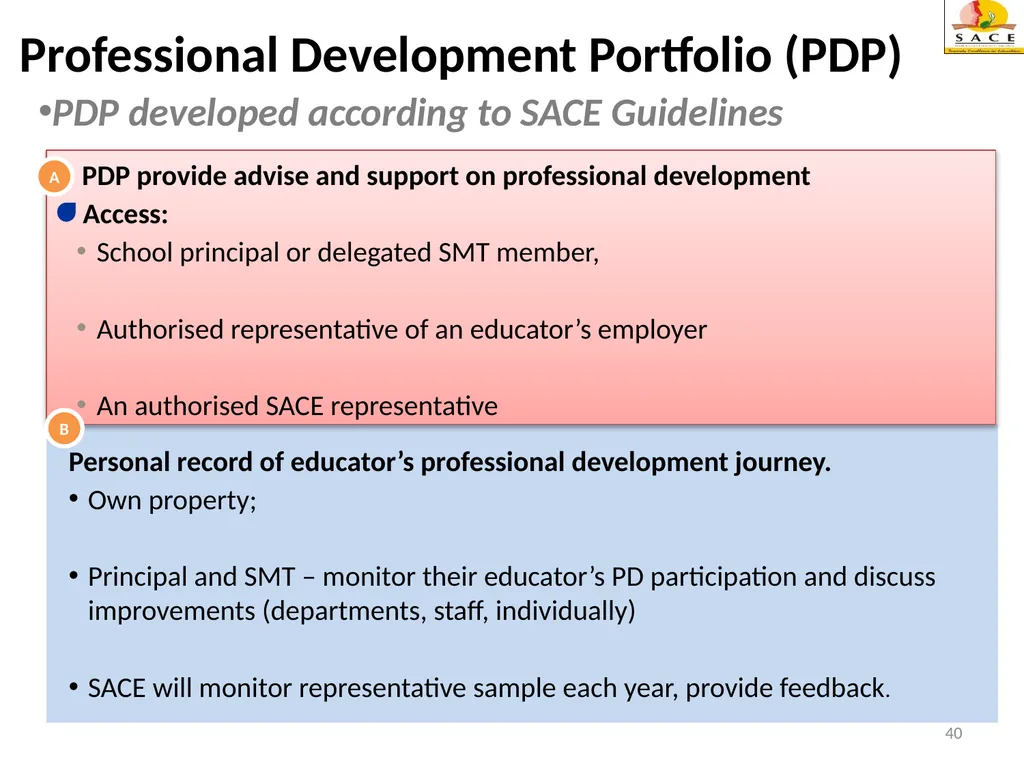
Professional Development Portfolio (PDP) PDP developed according to SACE Guidelines Personal record of educator’s professional development journey.
Own property;
Principal and SMT – monitor their educator’s PD participation and discuss improvements (departments, staff, individually)
SACE will monitor representative sample each year, provide feedback. PDP provide advise and support on professional development
Access:
School principal or delegated SMT member,
Authorised representative of an educator’s employer
An authorised SACE representative A B 40<br>
Own property;
Principal and SMT – monitor their educator’s PD participation and discuss improvements (departments, staff, individually)
SACE will monitor representative sample each year, provide feedback. PDP provide advise and support on professional development
Access:
School principal or delegated SMT member,
Authorised representative of an educator’s employer
An authorised SACE representative A B 40<br>
41
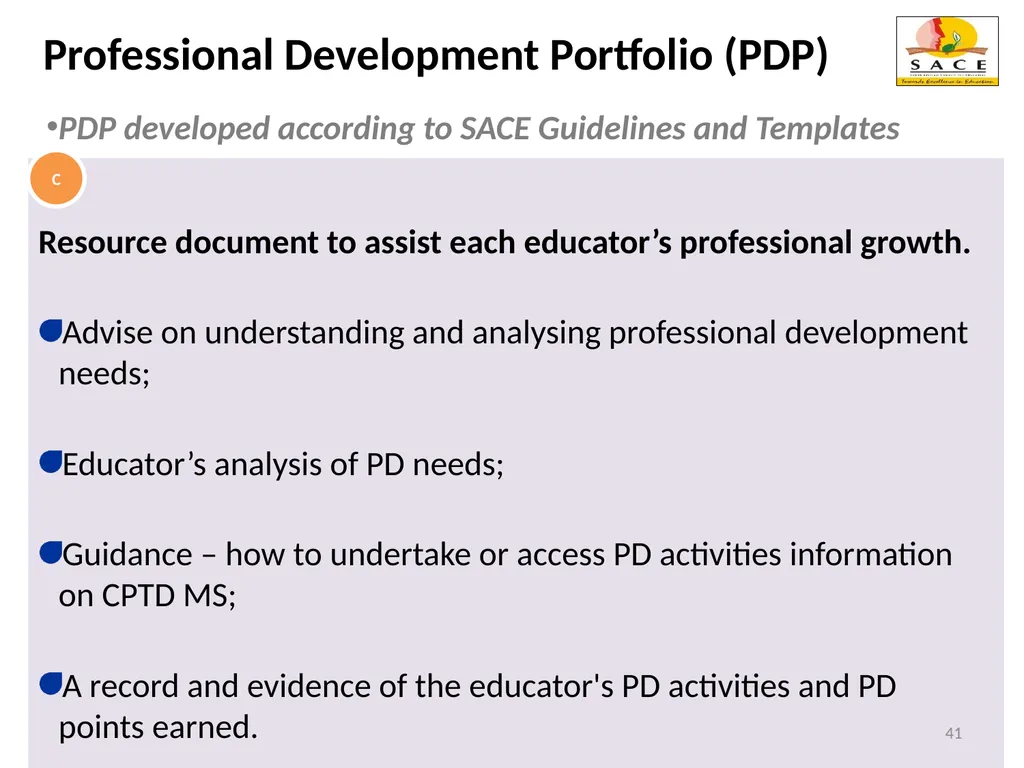
Professional Development Portfolio (PDP) PDP developed according to SACE Guidelines and Templates Resource document to assist each educator’s professional growth.
Advise on understanding and analysing professional development needs;
Educator’s analysis of PD needs;
Guidance – how to undertake or access PD activities information on CPTD MS;
A record and evidence of the educator's PD activities and PD points earned. C 41<br>
Advise on understanding and analysing professional development needs;
Educator’s analysis of PD needs;
Guidance – how to undertake or access PD activities information on CPTD MS;
A record and evidence of the educator's PD activities and PD points earned. C 41<br>
42
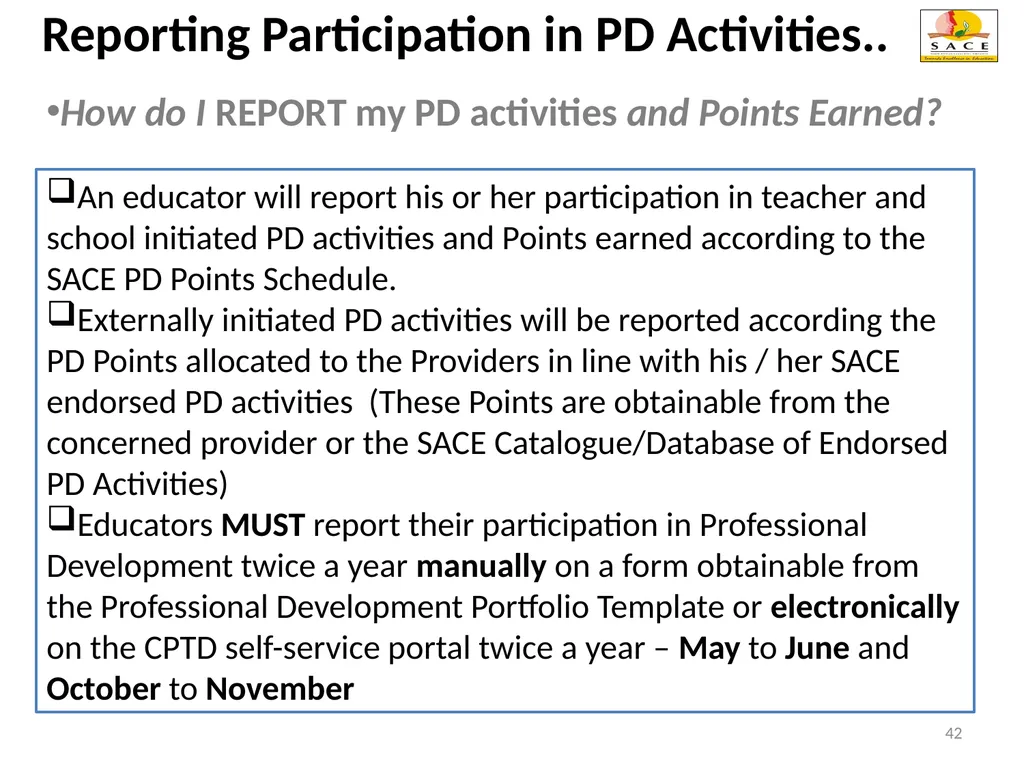
Reporting Participation in PD Activities.. How do I REPORT my PD activities and Points Earned? 42 An educator will report his or her participation in teacher and school initiated PD activities and Points earned according to the SACE PD Points Schedule.
Externally initiated PD activities will be reported according the PD Points allocated to the Providers in line with his / her SACE endorsed PD activities (These Points are obtainable from the concerned provider or the SACE Catalogue/Database of Endorsed PD Activities)
Educators MUST report their participation in Professional Development twice a year manually on a form obtainable from the Professional Development Portfolio Template or electronically on the CPTD self-service portal twice a year – May to June and October to November<br>
Externally initiated PD activities will be reported according the PD Points allocated to the Providers in line with his / her SACE endorsed PD activities (These Points are obtainable from the concerned provider or the SACE Catalogue/Database of Endorsed PD Activities)
Educators MUST report their participation in Professional Development twice a year manually on a form obtainable from the Professional Development Portfolio Template or electronically on the CPTD self-service portal twice a year – May to June and October to November<br>
43
Reporting Participation in PD Activities How do I REPORT my PD Activities and Points Earned Manually / OFFLINE? The manual reporting templates are obtainable from the Professional Development Portfolio which is available on the
SACE Website
CPTD System Self Service Web Portal
Offices and CPTD system orientation workshop sessions in provinces
The completed templates should be
Faxed to: 086 571 5260
Posted to: SACE, Private Bag x127, CENTURION, 0046
E-mailed to: member@sace.org.za 43<br>
SACE Website
CPTD System Self Service Web Portal
Offices and CPTD system orientation workshop sessions in provinces
The completed templates should be
Faxed to: 086 571 5260
Posted to: SACE, Private Bag x127, CENTURION, 0046
E-mailed to: member@sace.org.za 43<br>
44
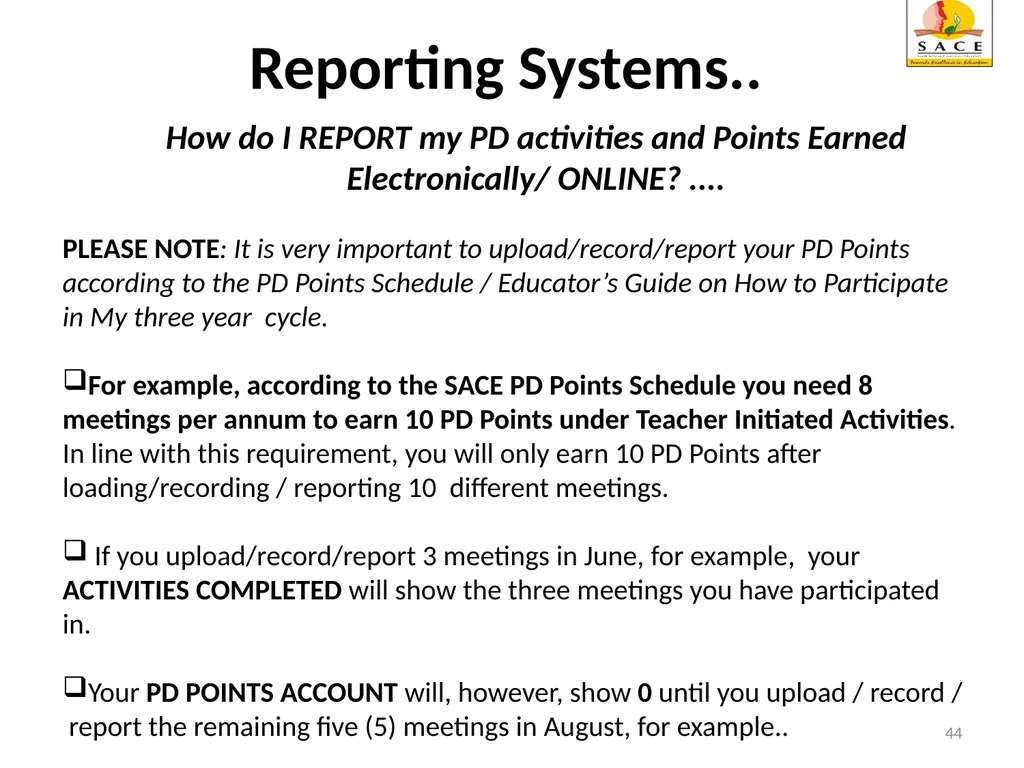
Reporting Systems.. PLEASE NOTE: It is very important to upload/record/report your PD Points according to the PD Points Schedule / Educator’s Guide on How to Participate in My three year cycle.
For example, according to the SACE PD Points Schedule you need 8 meetings per annum to earn 10 PD Points under Teacher Initiated Activities. In line with this requirement, you will only earn 10 PD Points after loading/recording / reporting 10 different meetings.
If you upload/record/report 3 meetings in June, for example, your ACTIVITIES COMPLETED will show the three meetings you have participated in.
Your PD POINTS ACCOUNT will, however, show 0 until you upload / record /
report the remaining five (5) meetings in August, for example.. 44 How do I REPORT my PD activities and Points Earned Electronically/ ONLINE? ....<br>
For example, according to the SACE PD Points Schedule you need 8 meetings per annum to earn 10 PD Points under Teacher Initiated Activities. In line with this requirement, you will only earn 10 PD Points after loading/recording / reporting 10 different meetings.
If you upload/record/report 3 meetings in June, for example, your ACTIVITIES COMPLETED will show the three meetings you have participated in.
Your PD POINTS ACCOUNT will, however, show 0 until you upload / record /
report the remaining five (5) meetings in August, for example.. 44 How do I REPORT my PD activities and Points Earned Electronically/ ONLINE? ....<br>
45
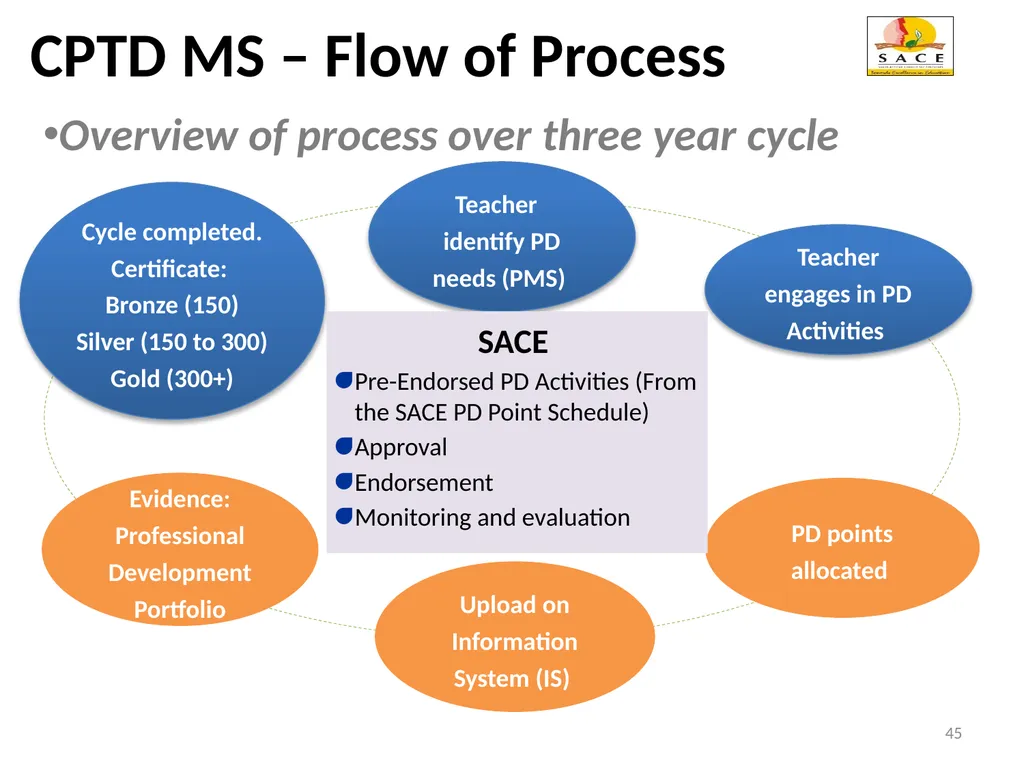
CPTD MS – Flow of Process Overview of process over three year cycle 45<br>
46
NATIONAL CPTD SYSTEM PILOT
2010 - 2012 46<br>
47
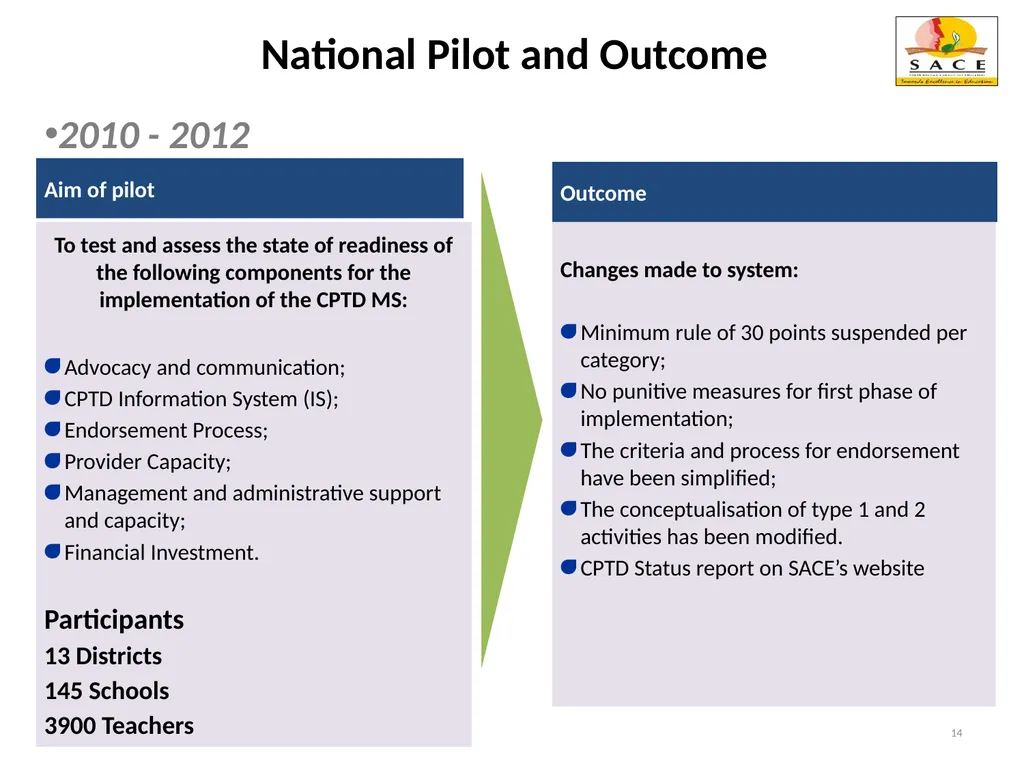
National Pilot and Outcome Aim of pilot To test and assess the state of readiness of the following components for the implementation of the CPTD MS:
Advocacy and communication;
CPTD Information System (IS);
Endorsement Process;
Provider Capacity;
Management and administrative support and capacity;
Financial Investment.
Participants
13 Districts
145 Schools
3900 Teachers 2010 - 2012 Changes made to system:
Minimum rule of 30 points suspended per category;
No punitive measures for first phase of implementation;
The criteria and process for endorsement have been simplified;
The conceptualisation of type 1 and 2 activities has been modified.
CPTD Status report on SACE’s website 14 Outcome<br>
Advocacy and communication;
CPTD Information System (IS);
Endorsement Process;
Provider Capacity;
Management and administrative support and capacity;
Financial Investment.
Participants
13 Districts
145 Schools
3900 Teachers 2010 - 2012 Changes made to system:
Minimum rule of 30 points suspended per category;
No punitive measures for first phase of implementation;
The criteria and process for endorsement have been simplified;
The conceptualisation of type 1 and 2 activities has been modified.
CPTD Status report on SACE’s website 14 Outcome<br>
48
Implementation and Way-Forward 48<br>
49
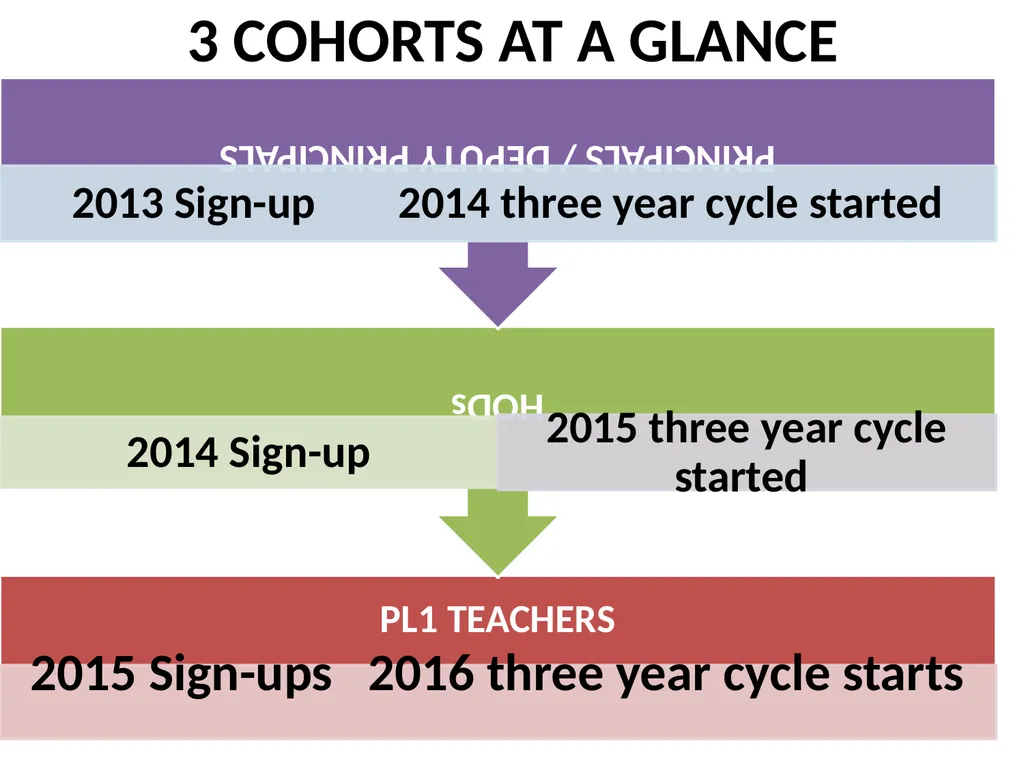
3 COHORTS AT A GLANCE 49<br>
50
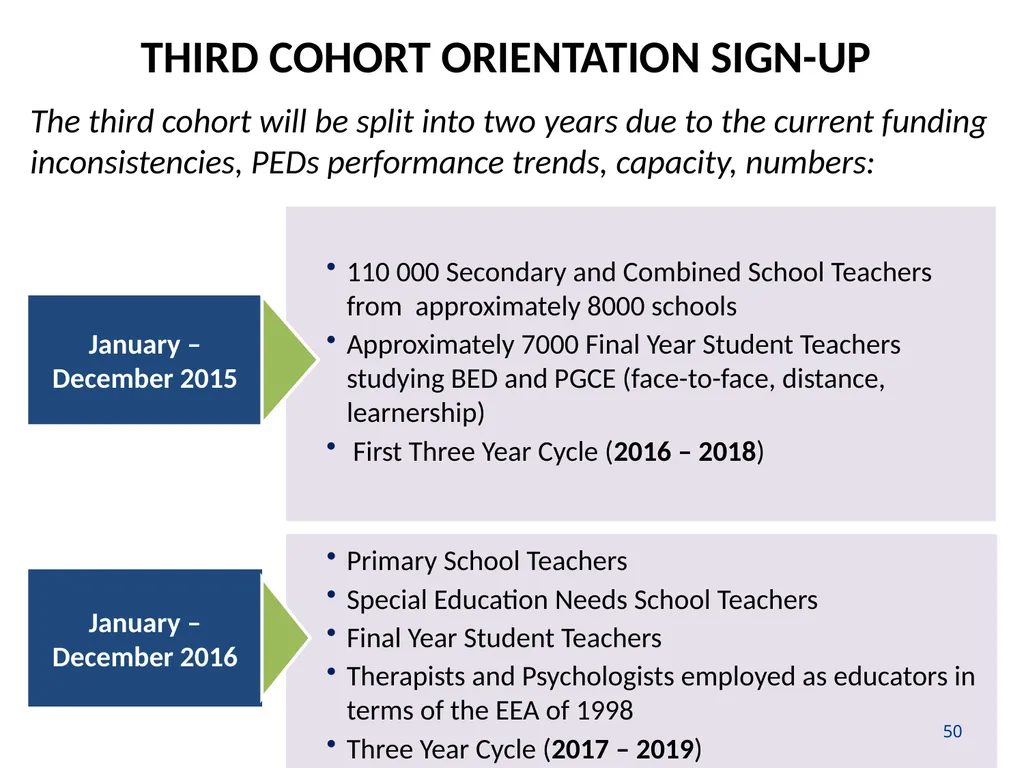
THIRD COHORT ORIENTATION SIGN-UP 110 000 Secondary and Combined School Teachers from approximately 8000 schools
Approximately 7000 Final Year Student Teachers studying BED and PGCE (face-to-face, distance, learnership)
First Three Year Cycle (2016 – 2018) January – December 2015 Primary School Teachers
Special Education Needs School Teachers
Final Year Student Teachers
Therapists and Psychologists employed as educators in terms of the EEA of 1998
Three Year Cycle (2017 – 2019) January – December 2016 50 The third cohort will be split into two years due to the current funding inconsistencies, PEDs performance trends, capacity, numbers:<br>
Approximately 7000 Final Year Student Teachers studying BED and PGCE (face-to-face, distance, learnership)
First Three Year Cycle (2016 – 2018) January – December 2015 Primary School Teachers
Special Education Needs School Teachers
Final Year Student Teachers
Therapists and Psychologists employed as educators in terms of the EEA of 1998
Three Year Cycle (2017 – 2019) January – December 2016 50 The third cohort will be split into two years due to the current funding inconsistencies, PEDs performance trends, capacity, numbers:<br>
51
WAY-FORWARD Ongoing Collaboration with Stakeholders
Ongoing CPTD System Advocacy and Communication
Electronic / Manual Sign-ups by PL1 Teachers and Final Year Student Teachers
Orientation of Secondary and Combined School PL1 Teachers and Final Year Student Teachers
Familiarising yourselves with the CPTD system material, processes and CPTD Information System
Principals, Deputy Principals and HODs report to SACE, their participation in Type 1 PD activities and PD Points earned twice a year
Principals, Deputy Principals and HODs record their participation in PD activities in their Professional Development Portfolio 51<br>
Ongoing CPTD System Advocacy and Communication
Electronic / Manual Sign-ups by PL1 Teachers and Final Year Student Teachers
Orientation of Secondary and Combined School PL1 Teachers and Final Year Student Teachers
Familiarising yourselves with the CPTD system material, processes and CPTD Information System
Principals, Deputy Principals and HODs report to SACE, their participation in Type 1 PD activities and PD Points earned twice a year
Principals, Deputy Principals and HODs record their participation in PD activities in their Professional Development Portfolio 51<br>
52
FREQUENTLY ASKED QUESTIONS 52<br>
53
Frequently Asked Questions Yes…
Participation in professional development / CPTD System is mandatory for all teachers.
Professional development is part of SACE’s Code of Professional Ethics for educators.
All teachers commit themselves to observe the Code.
Section 7 of SACE Code of Professional Ethics states that an educator:
“must keep abreast of educational developments”
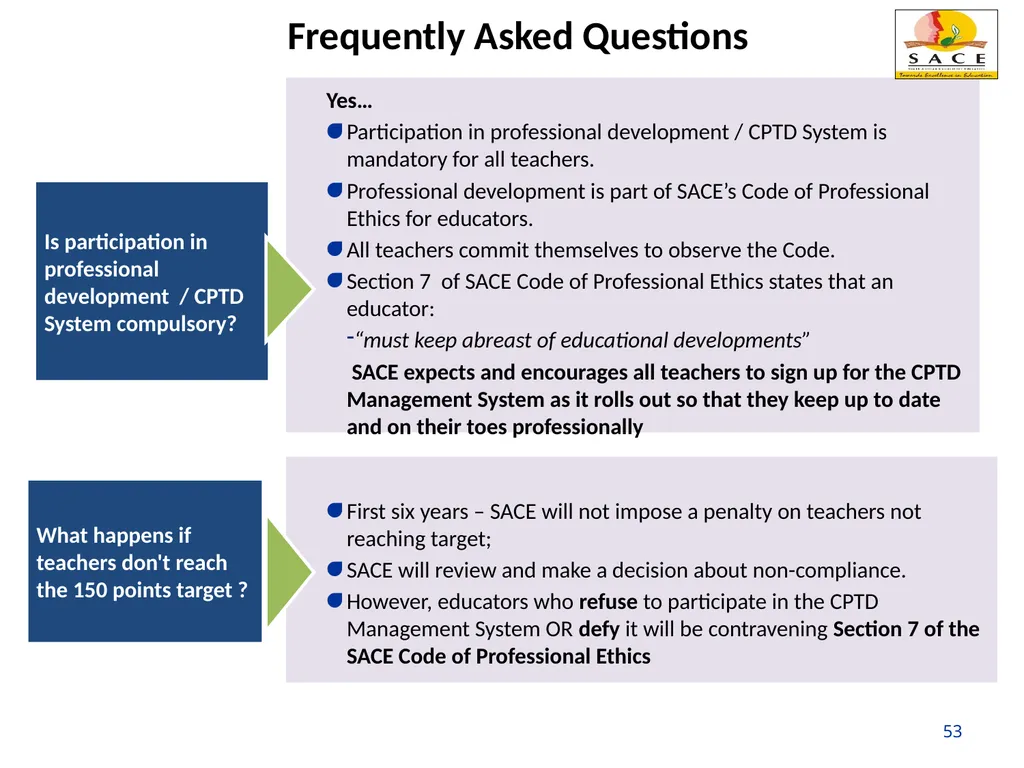
SACE expects and encourages all teachers to sign up for the CPTD Management System as it rolls out so that they keep up to date and on their toes professionally Is participation in professional development / CPTD System compulsory? First six years – SACE will not impose a penalty on teachers not reaching target;
SACE will review and make a decision about non-compliance.
However, educators who refuse to participate in the CPTD Management System OR defy it will be contravening Section 7 of the SACE Code of Professional Ethics What happens if teachers don't reach the 150 points target ? 53<br>
Participation in professional development / CPTD System is mandatory for all teachers.
Professional development is part of SACE’s Code of Professional Ethics for educators.
All teachers commit themselves to observe the Code.
Section 7 of SACE Code of Professional Ethics states that an educator:
“must keep abreast of educational developments”
SACE expects and encourages all teachers to sign up for the CPTD Management System as it rolls out so that they keep up to date and on their toes professionally Is participation in professional development / CPTD System compulsory? First six years – SACE will not impose a penalty on teachers not reaching target;
SACE will review and make a decision about non-compliance.
However, educators who refuse to participate in the CPTD Management System OR defy it will be contravening Section 7 of the SACE Code of Professional Ethics What happens if teachers don't reach the 150 points target ? 53<br>
54
Frequently Asked Questions Start participating in the CPTD 3 year cycle from 2016 onwards by:
Updating your information regularly on the CPTD Self-Service web portal
Start developing your PDP in terms of Planning, Recording Evidence of Participation in three types of PD Activities and REPORTING Your Participation and PD Points to SACE by May/June and October November
PL1 Teachers will only start earning PD points from the beginning of 2016.
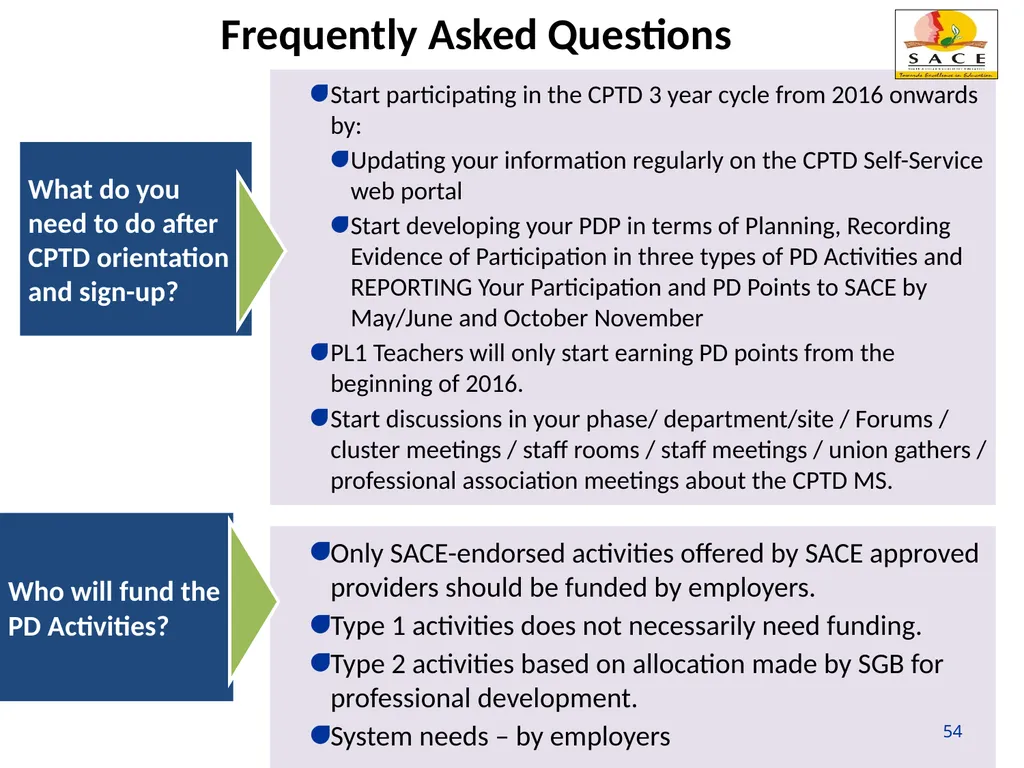
Start discussions in your phase/ department/site / Forums / cluster meetings / staff rooms / staff meetings / union gathers / professional association meetings about the CPTD MS. What do you need to do after CPTD orientation and sign-up? Only SACE-endorsed activities offered by SACE approved providers should be funded by employers.
Type 1 activities does not necessarily need funding.
Type 2 activities based on allocation made by SGB for professional development.
System needs – by employers Who will fund the PD Activities? 54<br>
Updating your information regularly on the CPTD Self-Service web portal
Start developing your PDP in terms of Planning, Recording Evidence of Participation in three types of PD Activities and REPORTING Your Participation and PD Points to SACE by May/June and October November
PL1 Teachers will only start earning PD points from the beginning of 2016.
Start discussions in your phase/ department/site / Forums / cluster meetings / staff rooms / staff meetings / union gathers / professional association meetings about the CPTD MS. What do you need to do after CPTD orientation and sign-up? Only SACE-endorsed activities offered by SACE approved providers should be funded by employers.
Type 1 activities does not necessarily need funding.
Type 2 activities based on allocation made by SGB for professional development.
System needs – by employers Who will fund the PD Activities? 54<br>
55
Frequently Asked Questions You should:
Go to FORGOT MY PASSWORD on the Educator Login Screen
Enter the cell number you used when you signed-up OR the last updated cell phone number
Receive sms with username and password
Alternatively, contact SACE’s PD and Research Division (012 663 9517/ member@sace.org.za / 086 571 5260) to re-issue your username and password.
NB: Please provide SACE with your Surname, Full names, ID or SACE number to be able to search for your forgotten username and password when you call or send an email/fax. NOTE:
IF YOU DO NOT HAVE ACCESS TO THE INTERNET, SACE WILL MAKE THE INFORMATION ON THE CPTD SELF-SERVICE PORTAL AVAILABLE TO YOU MANUALLY. WHAT HAPPENS IF I LOOSE MY USERNAME AND/OR PASSWORD? TEACHERS promoted to HOD, OR Deputy Principal OR Principal Positions, throughout the year, continue with their 2016-2018 cycle (will have a different cycle as compared to the rest of the 1st and second cohort) WHAT HAPPENS IF I AM PROMOTED IN 2015? 55<br>
Go to FORGOT MY PASSWORD on the Educator Login Screen
Enter the cell number you used when you signed-up OR the last updated cell phone number
Receive sms with username and password
Alternatively, contact SACE’s PD and Research Division (012 663 9517/ member@sace.org.za / 086 571 5260) to re-issue your username and password.
NB: Please provide SACE with your Surname, Full names, ID or SACE number to be able to search for your forgotten username and password when you call or send an email/fax. NOTE:
IF YOU DO NOT HAVE ACCESS TO THE INTERNET, SACE WILL MAKE THE INFORMATION ON THE CPTD SELF-SERVICE PORTAL AVAILABLE TO YOU MANUALLY. WHAT HAPPENS IF I LOOSE MY USERNAME AND/OR PASSWORD? TEACHERS promoted to HOD, OR Deputy Principal OR Principal Positions, throughout the year, continue with their 2016-2018 cycle (will have a different cycle as compared to the rest of the 1st and second cohort) WHAT HAPPENS IF I AM PROMOTED IN 2015? 55<br>
56
THANK YOU
SACE
PRIVATE BAG X 127
CENTURION
0046
012 663 9517
member@sace.org.za
086 571 5260 (Fax to Email)
www.sace.org.za 56<br>