Continuum of Care Program (CoC) Training Requirements Related to Housing Assistance Rent Reasonableness, Fair Market Rent (FMR) and Housing Quality Standards September 25, 2018 Rent Reasonableness 24 CFR 578.49 and 24 CFR 578.51 What is
"Continuum of Care Program (CoC) Training" is the property of its rightful owner. Permission is granted to
download and print the materials on this website for personal, non-commercial use only, and to display it
on your personal computer provided you do not modify the materials and that you retain all copyright
notices contained in the materials. By downloading content from our website, you accept the terms of this
agreement.
Presentation Transcript
01
Continuum of Care Program (CoC) Training Requirements Related to Housing Assistance Rent Reasonableness, Fair Market Rent (FMR) and Housing Quality Standards September 25, 2018<br>
02
Rent Reasonableness 24 CFR 578.49 and 24 CFR 578.51 What is Rent Reasonableness Requirement?
HUD’s rent reasonableness standard is designed to ensure that rents being paid are reasonable in relation to rents being charged for comparable unassisted units in the same market. Recipients should have a procedure in place to ensure that compliance with rent reasonableness standards is documented prior to executing the lease for an assisted unit.
Must be reviewed annually, even if program participant has not moved.<br>
03
Determining and Documenting Rent Reasonableness
Recipients and subrecipients are responsible for determining what documentation is required in order to ensure the rent reasonableness standard is met for a particular unit. Recipients and subrecipients should determine rent reasonableness by considering the gross rent of the unit and the location, quality, size, type and age of the unit, and amenities, maintenance, and utilities to be provided by the owner. Rent Reasonableness<br>
04
Determining and Documenting Rent Reasonableness
Calculating Gross Rent for Determining Rent Reasonableness:
Entire housing cost: rent plus cost of utilities ( gas, electric, water, sewer, trash, etc.) that must, according to the lease be the responsibility of the tenant.
Exclude telephone, cable, satellite television service and internet. Gross rent does not include pet fees or late fees. Rent Reasonableness<br>
05
Methods of Checking Comparable Rents:
Use of a market study of rents charged for units of different sizes in different locations or reviewing advertisements for comparable rental units.
Case File Documentation:
Unit’s rent and description, printout of three comparable units’ rents, and evidence that these comparison units share same features (location, size, amenities, quality, etc. Rent Reasonableness Methods for Checking Comparable Rents<br>
06
Methods of Checking Comparable Rents:
2) Written verification signed by the property owner or management company, on letterhead, affirming that the rent for a unit assisted with CoC Program funds is comparable to current rents charged for similar unassisted units managed by the same owner.
Case File Documentation:
Copy of written verification from property owner must be maintained in program participant file. Rent Reasonableness Methods for Checking Comparable Rents<br>
07
Components of an Effective Rent Reasonableness Policy:
Establish Written Policies and Procedures
Must be transparent and consistently applied across all projects and comply with HUD requirements. Contain methodology for documenting
comparable rents, case file checklists and forms,
standards for certifying comparable rents as
reasonable, staffing assignments and strategies for
addressing special circumstances.
2) Establish Staff Roles and Responsibilities Rent Reasonableness Key Components<br>
08
What is the Fair Market Rent Requirement?
FMR is the second key standard in determining the level of CoC Program funds that can be used to pay rent for an eligible program participant is the Fair Market Rent (FMR) amount for the geography in which the unit is located.
FMR standard is applied to ensure reasonable supply of adequate but modest rental housing is accessible to program participants.
FMR’s updated annually and apply to Leasing and Rental Assistance projects. Fair Market Rent (FMR) 24 CFR 578.49 and 24 CFR 578.51<br>
09
Fair Market Rent (FMR) Determining and Documenting FMR
For the geographic area being served, recipient or subrecipient should place a copy of the applicable FMR data in the program participant’s case file to document the FMR for that program participant’s unit size and geographic area.<br>
10
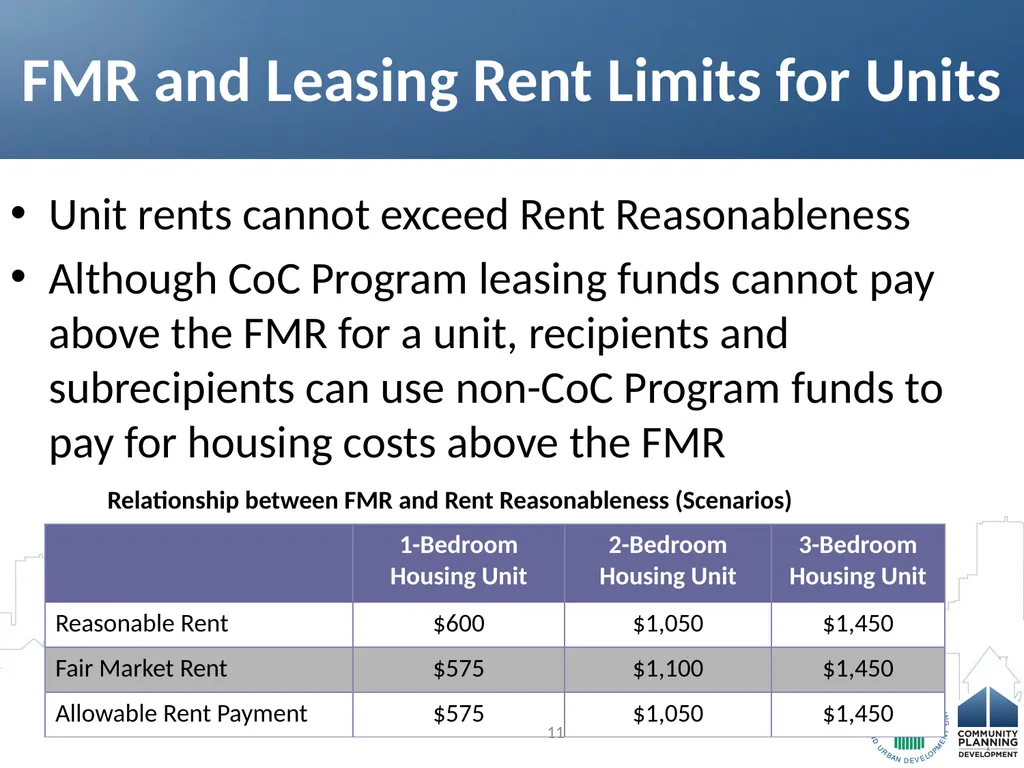
FMR and Rental Assistance Rent Limits Unit rents can exceed FMR but must meet Rent Reasonableness Relationship between FMR and Rent Reasonableness (Scenarios) 10<br>
11
FMR and Leasing Rent Limits for Units Unit rents cannot exceed Rent Reasonableness
Although CoC Program leasing funds cannot pay above the FMR for a unit, recipients and subrecipients can use non-CoC Program funds to pay for housing costs above the FMR 11<br>
12
Housing Quality Standards 24 CFR 578.75(b) and 24 CFR 578.103(a)(8) All housing units assisted with leasing and rental assistance must meet HQS
Each unit must be physically inspected
Owner has 30 days to correct any deficiencies
Inspect units at least annually
HQS inspectors do not need to be certified
Properties must also meet state and local codes 12<br>
13
Compliance Issue
Failure to comply with HQS requirements:
Inspections completed after the participant moves into the unit
Proper inspections not performed at all, or completed poorly (important problems missed)
Inspection forms incomplete
Forms not signed or dated Common Monitoring Findings<br>