
Control Hijacking Basic Control Hijacking Attacks
BR
Published · 39 slides · 0 views
1 / 1

Description
Control Hijacking Basic Control Hijacking Attacks Announcements: Project 1 is out: part I due Apr. 10. Please come to section on Friday at 11:30am at 160-B40. Control hijacking attacks Attackers goal: Take over target machine (e.g. web
Related Topics
Share
Embed code
Download this presentation From Below
"Control Hijacking Basic Control Hijacking Attacks" is the property of its rightful owner. Permission is granted to download and print the materials on this website for personal, non-commercial use only, and to display it on your personal computer provided you do not modify the materials and that you retain all copyright notices contained in the materials. By downloading content from our website, you accept the terms of this agreement.
Presentation Transcript
01
Control Hijacking Basic Control Hijacking Attacks Announcements:
Project 1 is out: part I due Apr. 10.
Please come to section on Friday at 11:30am at 160-B40.<br>
Project 1 is out: part I due Apr. 10.
Please come to section on Friday at 11:30am at 160-B40.<br>
02
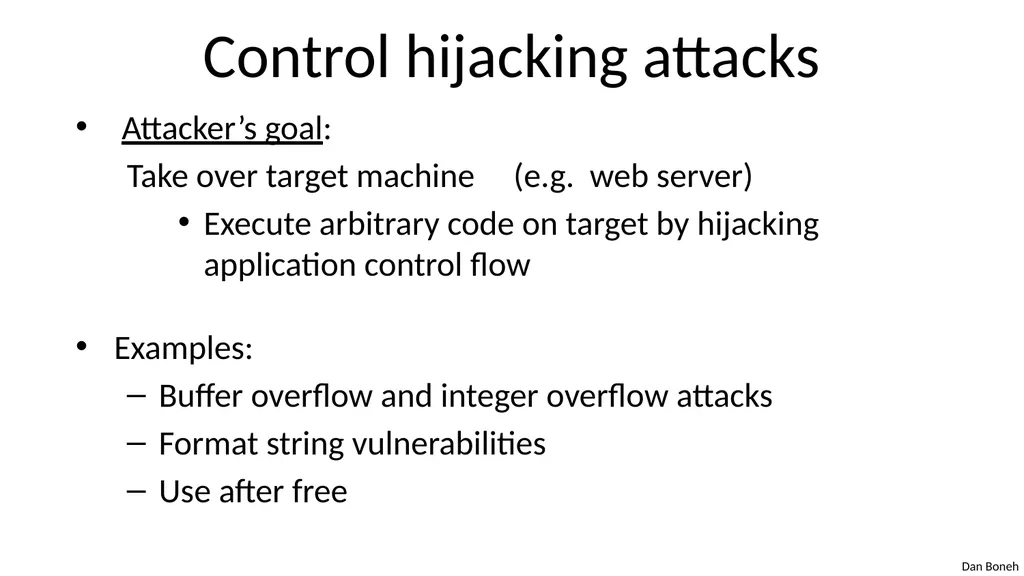
Control hijacking attacks Attacker’s goal:
Take over target machine (e.g. web server)
Execute arbitrary code on target by hijacking application control flow
Examples:
Buffer overflow and integer overflow attacks
Format string vulnerabilities
Use after free<br>
Take over target machine (e.g. web server)
Execute arbitrary code on target by hijacking application control flow
Examples:
Buffer overflow and integer overflow attacks
Format string vulnerabilities
Use after free<br>
03
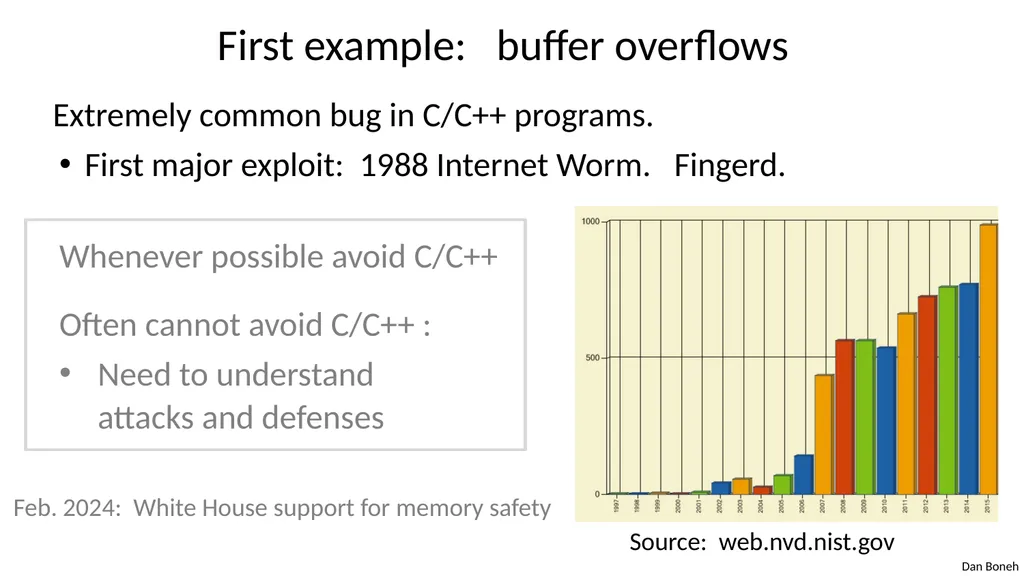
First example: buffer overflows Extremely common bug in C/C++ programs.
First major exploit: 1988 Internet Worm. Fingerd.
Whenever possible avoid C/C++
Often cannot avoid C/C++ :
Need to understand attacks and defenses Source: web.nvd.nist.gov Feb. 2024: White House support for memory safety<br>
First major exploit: 1988 Internet Worm. Fingerd.
Whenever possible avoid C/C++
Often cannot avoid C/C++ :
Need to understand attacks and defenses Source: web.nvd.nist.gov Feb. 2024: White House support for memory safety<br>
04
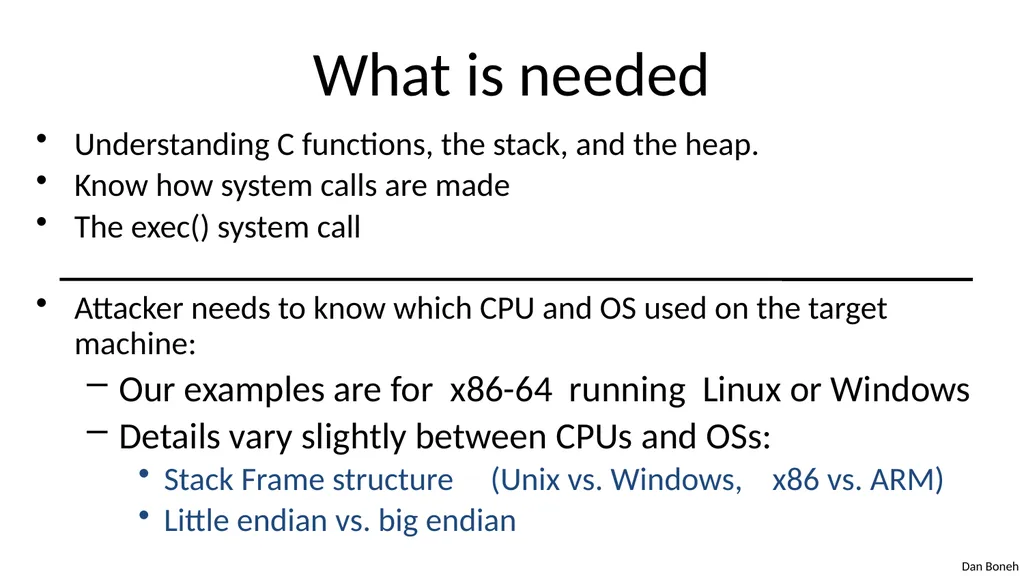
What is needed Understanding C functions, the stack, and the heap.
Know how system calls are made
The exec() system call
Attacker needs to know which CPU and OS used on the target machine:
Our examples are for x86-64 running Linux or Windows
Details vary slightly between CPUs and OSs:
Stack Frame structure (Unix vs. Windows, x86 vs. ARM)
Little endian vs. big endian<br>
Know how system calls are made
The exec() system call
Attacker needs to know which CPU and OS used on the target machine:
Our examples are for x86-64 running Linux or Windows
Details vary slightly between CPUs and OSs:
Stack Frame structure (Unix vs. Windows, x86 vs. ARM)
Little endian vs. big endian<br>
05
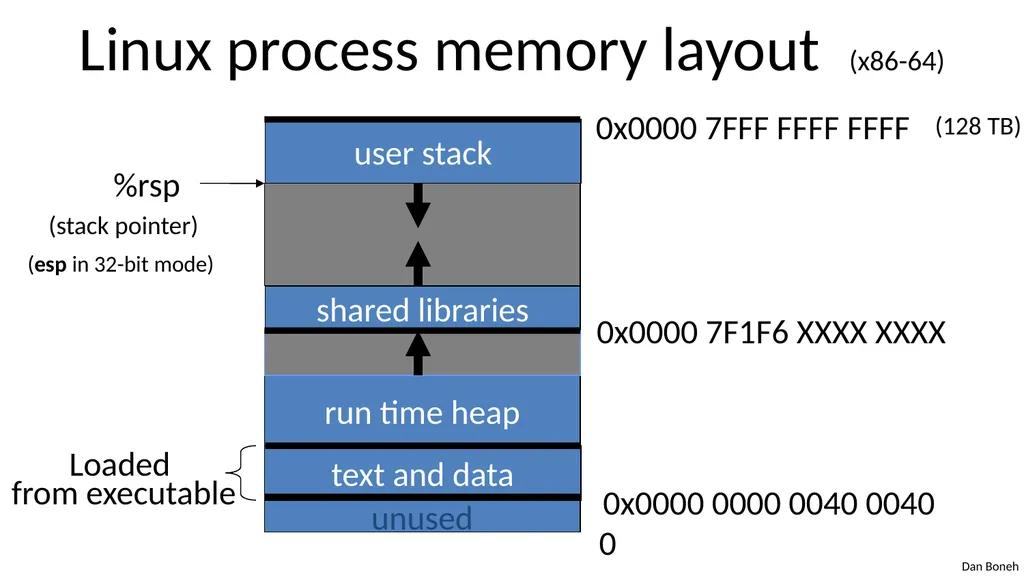
Linux process memory layout (x86-64) unused 0x0000 0000 0040 0040 text and data run time heap shared libraries user stack 0x0000 7F1F6 XXXX XXXX 0x0000 7FFF FFFF FFFF %rsp Loaded
from executable 0 (stack pointer) (128 TB) (esp in 32-bit mode)<br>
06
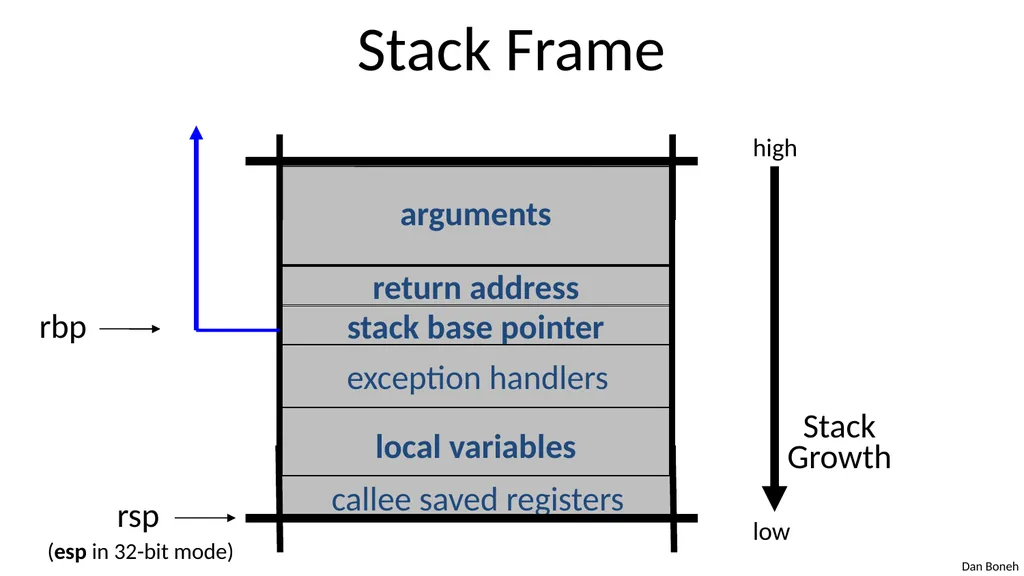
exception handlers Stack Frame arguments return address stack base pointer local variables rsp Stack
Growth high low callee saved registers rbp (esp in 32-bit mode)<br>
Growth high low callee saved registers rbp (esp in 32-bit mode)<br>
07
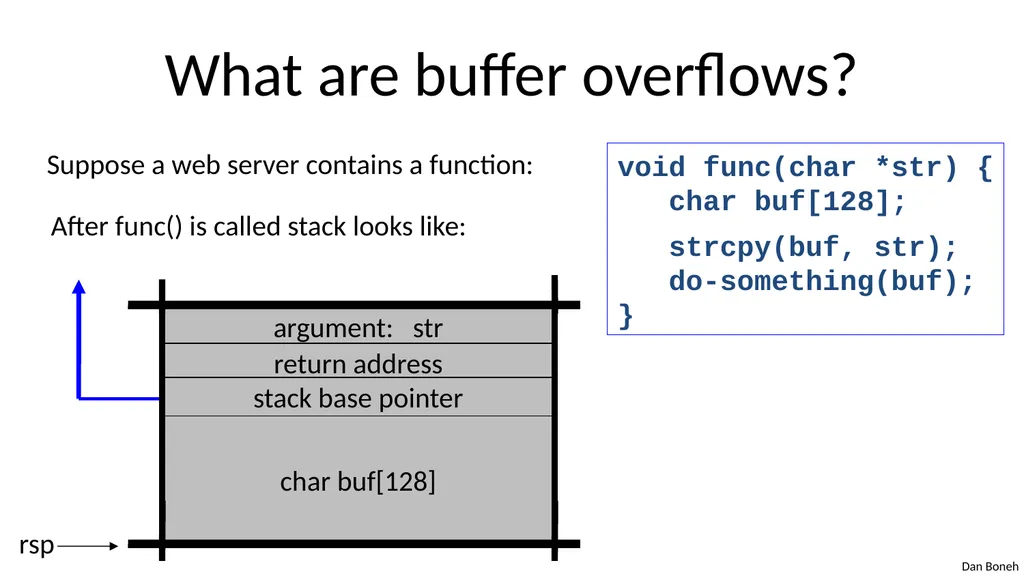
What are buffer overflows? void func(char *str) {
char buf[128];
strcpy(buf, str); do-something(buf); } Suppose a web server contains a function: After func() is called stack looks like: argument: str return address stack base pointer char buf[128] rsp<br>
strcpy(buf, str); do-something(buf); } Suppose a web server contains a function: After func() is called stack looks like: argument: str return address stack base pointer char buf[128] rsp<br>
08
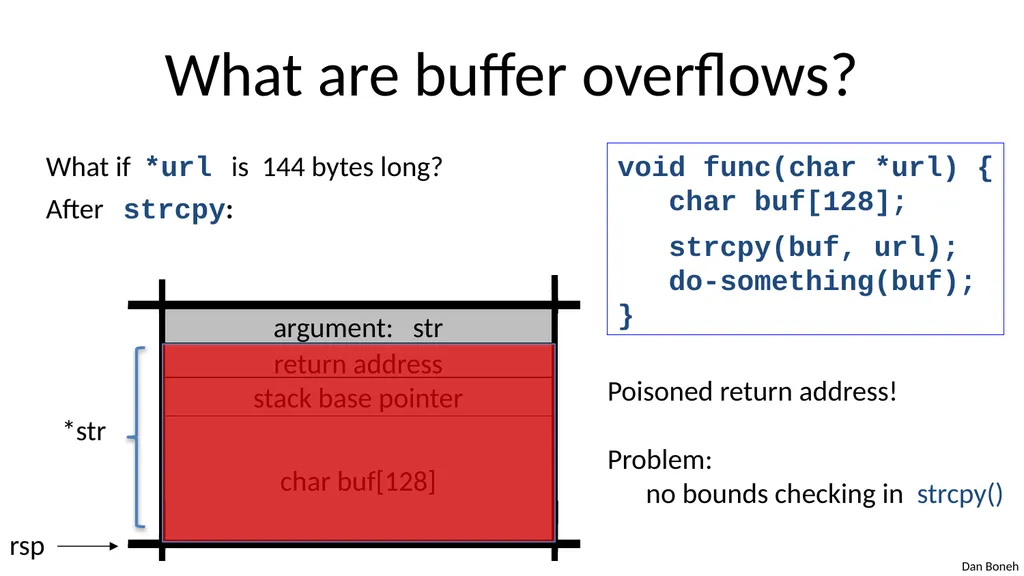
What are buffer overflows? void func(char *url) {
char buf[128];
strcpy(buf, url); do-something(buf); } What if *url is 144 bytes long?
After strcpy: argument: str return address stack base pointer char buf[128] rsp Poisoned return address!
Problem: no bounds checking in strcpy()<br>
strcpy(buf, url); do-something(buf); } What if *url is 144 bytes long?
After strcpy: argument: str return address stack base pointer char buf[128] rsp Poisoned return address!
Problem: no bounds checking in strcpy()<br>
09
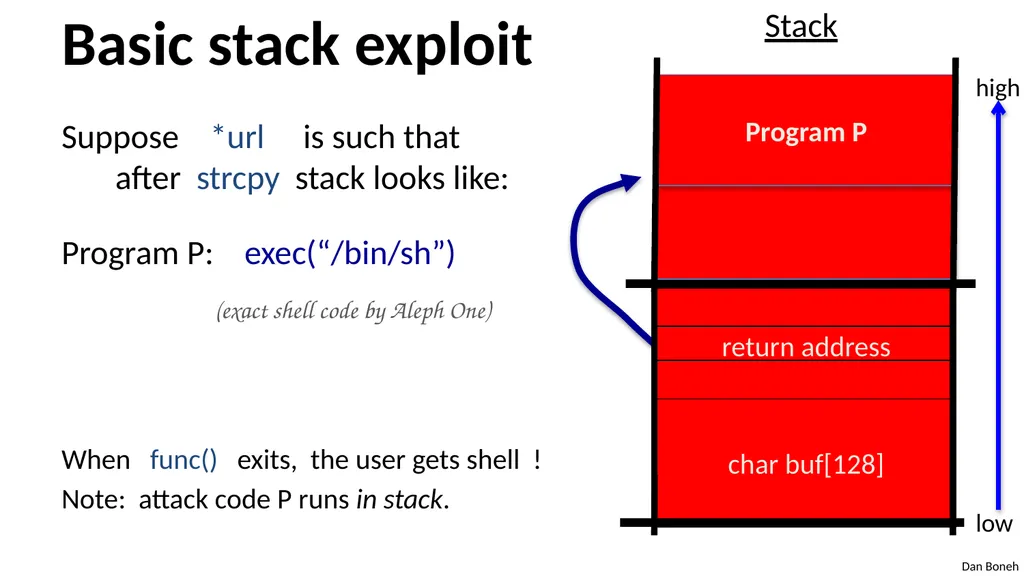
char buf[128] return address Basic stack exploit Suppose *url is such that
after strcpy stack looks like:
Program P: exec(“/bin/sh”)
When func() exits, the user gets shell !
Note: attack code P runs in stack. (exact shell code by Aleph One) Program P low high Stack<br>
Program P: exec(“/bin/sh”)
When func() exits, the user gets shell !
Note: attack code P runs in stack. (exact shell code by Aleph One) Program P low high Stack<br>
10
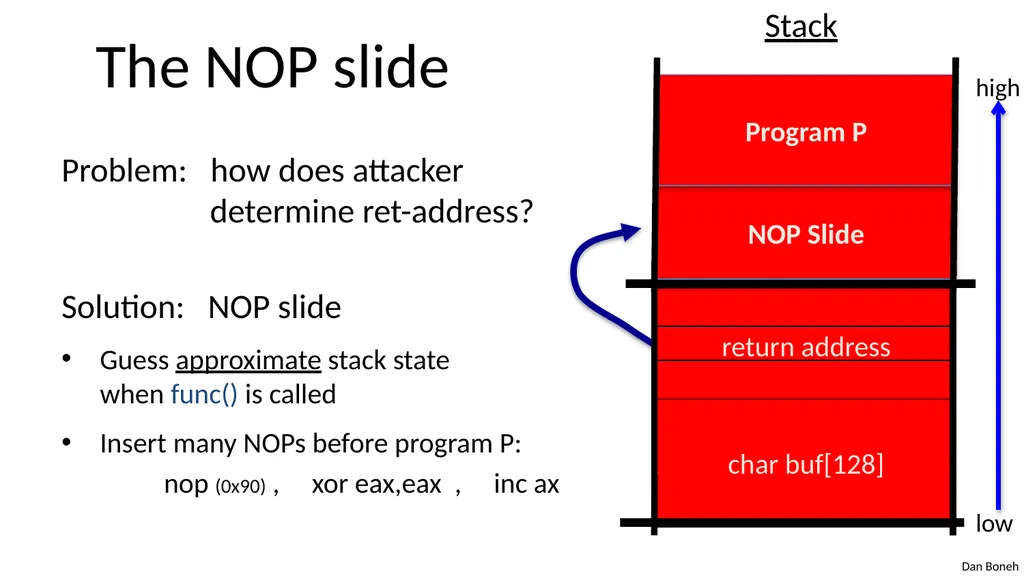
The NOP slide Problem: how does attacker
determine ret-address?
Solution: NOP slide
Guess approximate stack state when func() is called
Insert many NOPs before program P:
nop (0x90) , xor eax,eax , inc ax char buf[128] return address NOP Slide Program P low high Stack<br>
Solution: NOP slide
Guess approximate stack state when func() is called
Insert many NOPs before program P:
nop (0x90) , xor eax,eax , inc ax char buf[128] return address NOP Slide Program P low high Stack<br>
11
Details and examples Some complications:
Program P should not contain the ‘\0’ character.
Overflow should not crash program before func() exits.
(in)Famous remote stack smashing overflows:
Overflow in Windows animated cursors (ANI). LoadAniIcon()
Buffer overflow in Symantec virus detection (May 2016)
overflow when parsing PE headers … kernel vuln.<br>
Program P should not contain the ‘\0’ character.
Overflow should not crash program before func() exits.
(in)Famous remote stack smashing overflows:
Overflow in Windows animated cursors (ANI). LoadAniIcon()
Buffer overflow in Symantec virus detection (May 2016)
overflow when parsing PE headers … kernel vuln.<br>
12
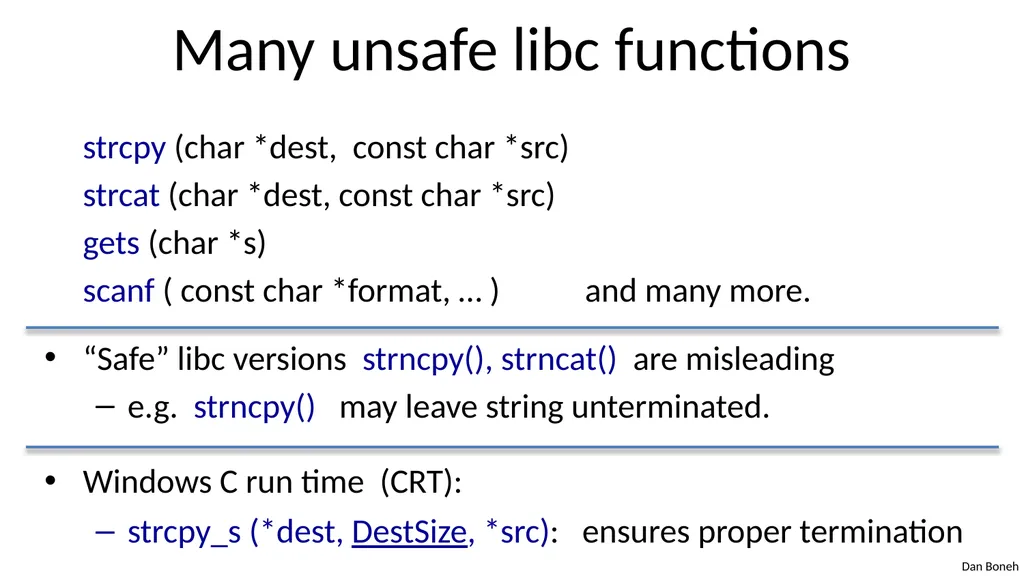
Many unsafe libc functions strcpy (char *dest, const char *src)
strcat (char *dest, const char *src)
gets (char *s)
scanf ( const char *format, … ) and many more.
“Safe” libc versions strncpy(), strncat() are misleading
e.g. strncpy() may leave string unterminated.
Windows C run time (CRT):
strcpy_s (*dest, DestSize, *src): ensures proper termination<br>
strcat (char *dest, const char *src)
gets (char *s)
scanf ( const char *format, … ) and many more.
“Safe” libc versions strncpy(), strncat() are misleading
e.g. strncpy() may leave string unterminated.
Windows C run time (CRT):
strcpy_s (*dest, DestSize, *src): ensures proper termination<br>
13
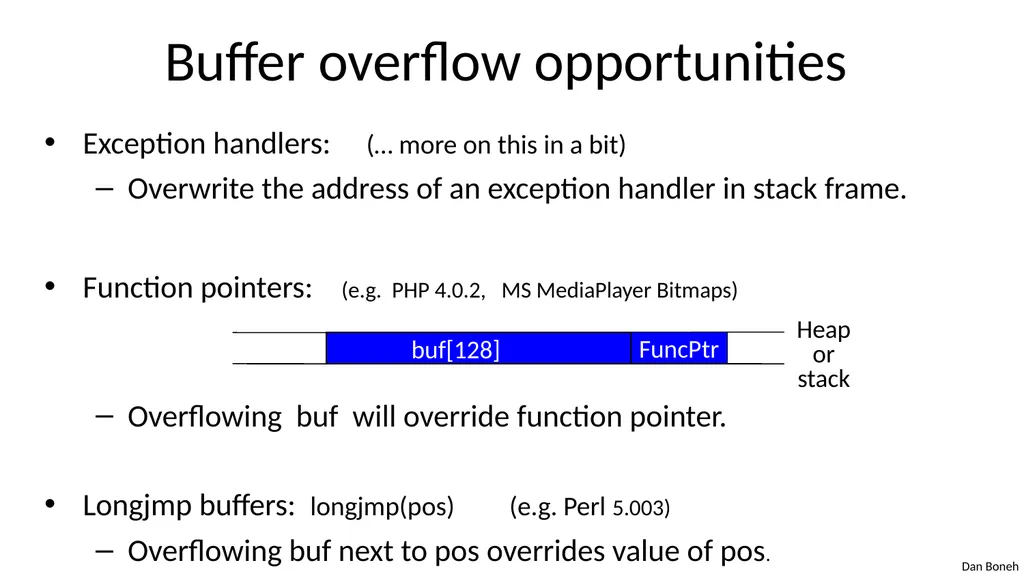
Buffer overflow opportunities Exception handlers: (… more on this in a bit)
Overwrite the address of an exception handler in stack frame.
Function pointers: (e.g. PHP 4.0.2, MS MediaPlayer Bitmaps)
Overflowing buf will override function pointer.
Longjmp buffers: longjmp(pos) (e.g. Perl 5.003)
Overflowing buf next to pos overrides value of pos.<br>
Overwrite the address of an exception handler in stack frame.
Function pointers: (e.g. PHP 4.0.2, MS MediaPlayer Bitmaps)
Overflowing buf will override function pointer.
Longjmp buffers: longjmp(pos) (e.g. Perl 5.003)
Overflowing buf next to pos overrides value of pos.<br>
14
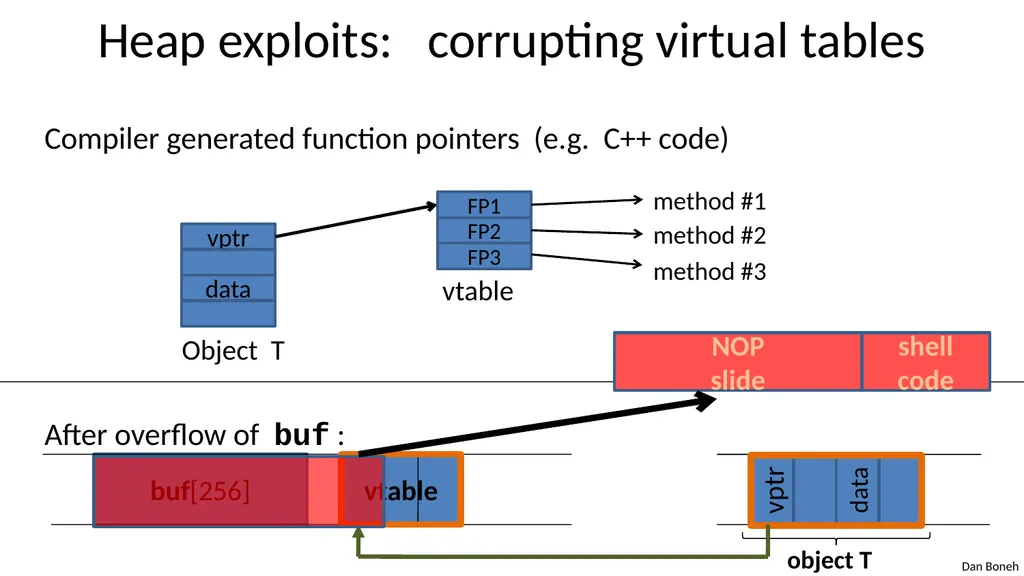
Heap exploits: corrupting virtual tables Compiler generated function pointers (e.g. C++ code)
After overflow of buf : vptr data Object T FP1 FP2 FP3 vtable method #1 method #2 method #3 vptr buf[256] data vtable<br>
After overflow of buf : vptr data Object T FP1 FP2 FP3 vtable method #1 method #2 method #3 vptr buf[256] data vtable<br>
15
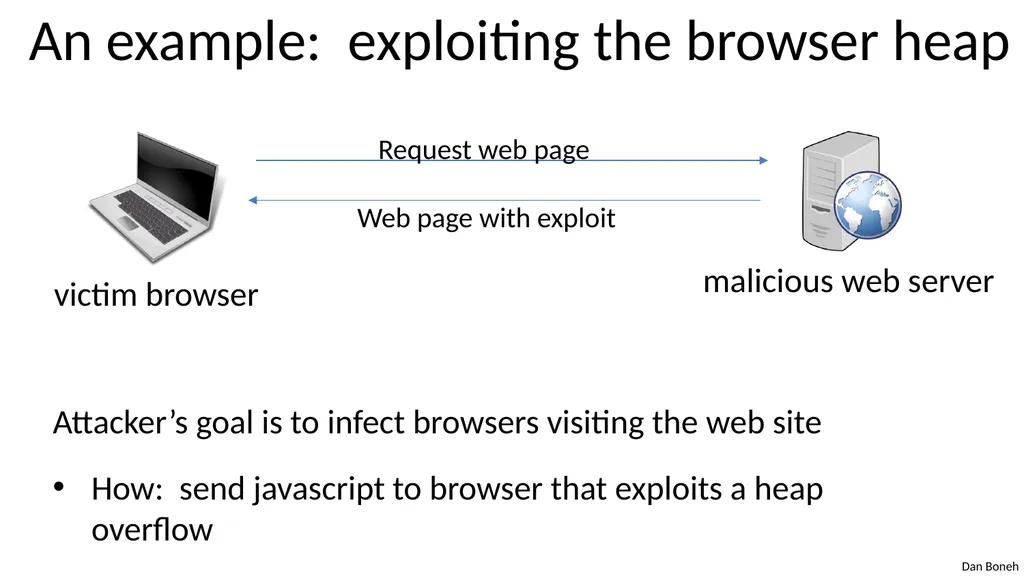
An example: exploiting the browser heap Attacker’s goal is to infect browsers visiting the web site
How: send javascript to browser that exploits a heap overflow malicious web server victim browser<br>
How: send javascript to browser that exploits a heap overflow malicious web server victim browser<br>
16
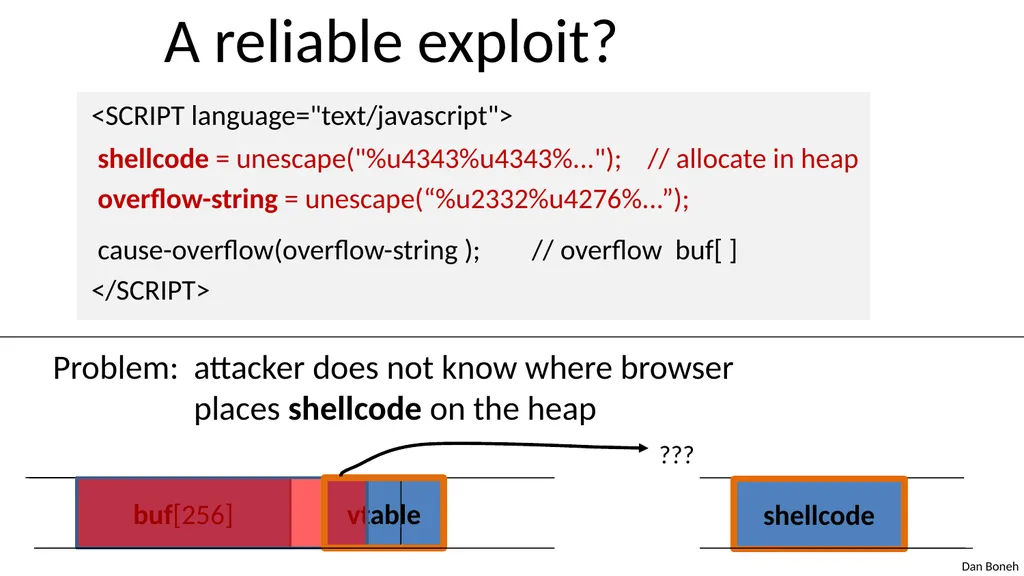
A reliable exploit? <SCRIPT language="text/javascript">
shellcode = unescape("%u4343%u4343%..."); // allocate in heap
overflow-string = unescape(“%u2332%u4276%...”);
cause-overflow(overflow-string ); // overflow buf[ ]
</SCRIPT>
Problem: attacker does not know where browser places shellcode on the heap ptr buf[256] data shellcode vtable ???<br>
shellcode = unescape("%u4343%u4343%..."); // allocate in heap
overflow-string = unescape(“%u2332%u4276%...”);
cause-overflow(overflow-string ); // overflow buf[ ]
</SCRIPT>
Problem: attacker does not know where browser places shellcode on the heap ptr buf[256] data shellcode vtable ???<br>
17
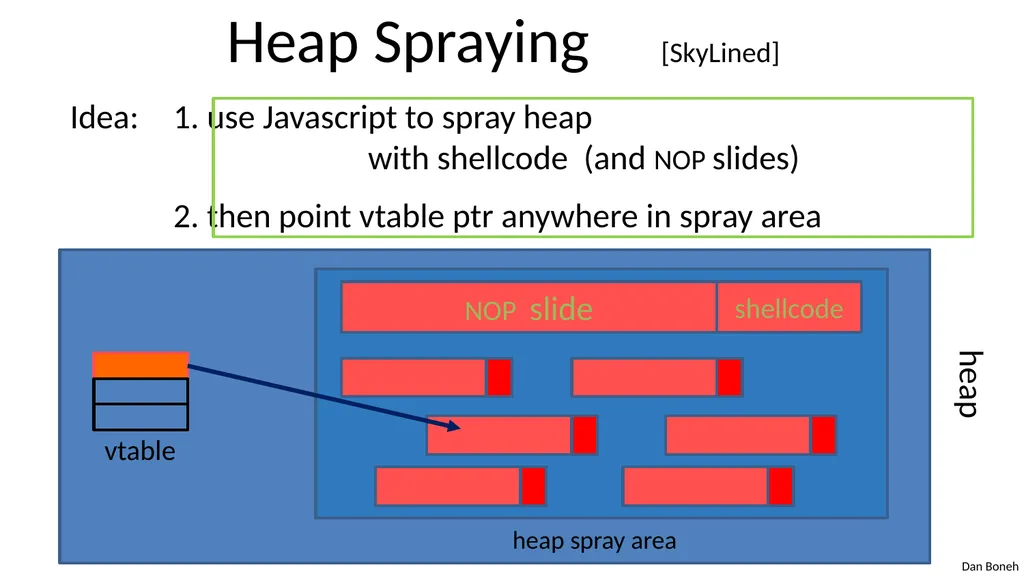
Heap Spraying [SkyLined] Idea: 1. use Javascript to spray heap
with shellcode (and NOP slides)
2. then point vtable ptr anywhere in spray area heap vtable heap spray area<br>
2. then point vtable ptr anywhere in spray area heap vtable heap spray area<br>
18
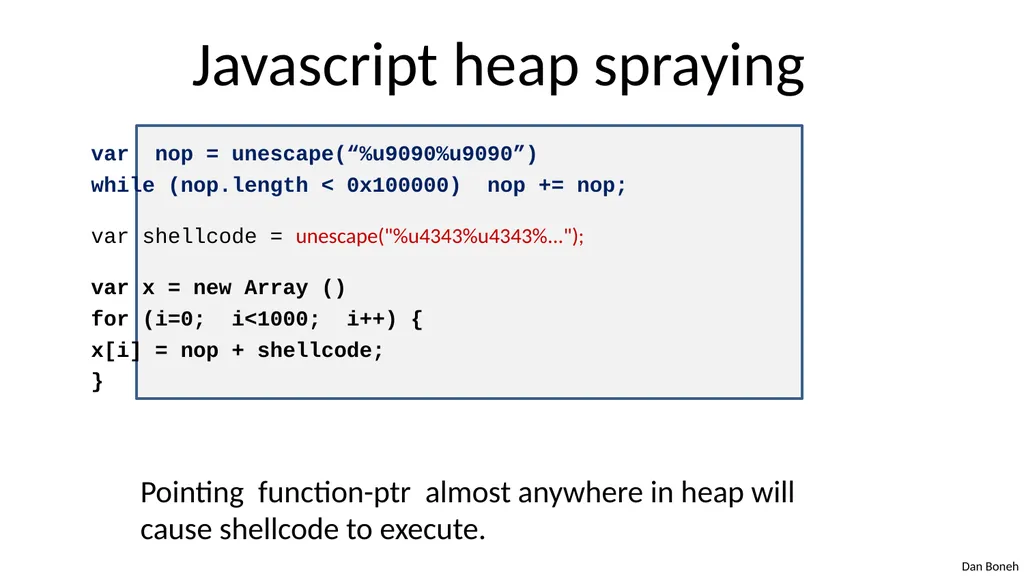
Javascript heap spraying var nop = unescape(“%u9090%u9090”)
while (nop.length < 0x100000) nop += nop;
var shellcode = unescape("%u4343%u4343%...");
var x = new Array ()
for (i=0; i<1000; i++) {
x[i] = nop + shellcode;
}
Pointing function-ptr almost anywhere in heap will cause shellcode to execute.<br>
while (nop.length < 0x100000) nop += nop;
var shellcode = unescape("%u4343%u4343%...");
var x = new Array ()
for (i=0; i<1000; i++) {
x[i] = nop + shellcode;
}
Pointing function-ptr almost anywhere in heap will cause shellcode to execute.<br>
19
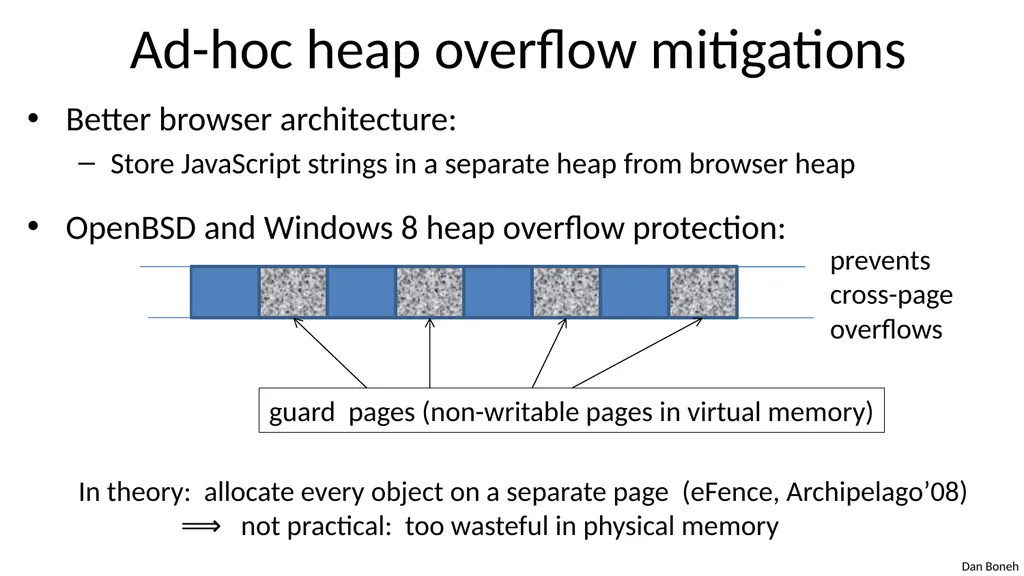
Ad-hoc heap overflow mitigations Better browser architecture:
Store JavaScript strings in a separate heap from browser heap
OpenBSD and Windows 8 heap overflow protection:
In theory: allocate every object on a separate page (eFence, Archipelago’08) ⟹ not practical: too wasteful in physical memory<br>
Store JavaScript strings in a separate heap from browser heap
OpenBSD and Windows 8 heap overflow protection:
In theory: allocate every object on a separate page (eFence, Archipelago’08) ⟹ not practical: too wasteful in physical memory<br>
20
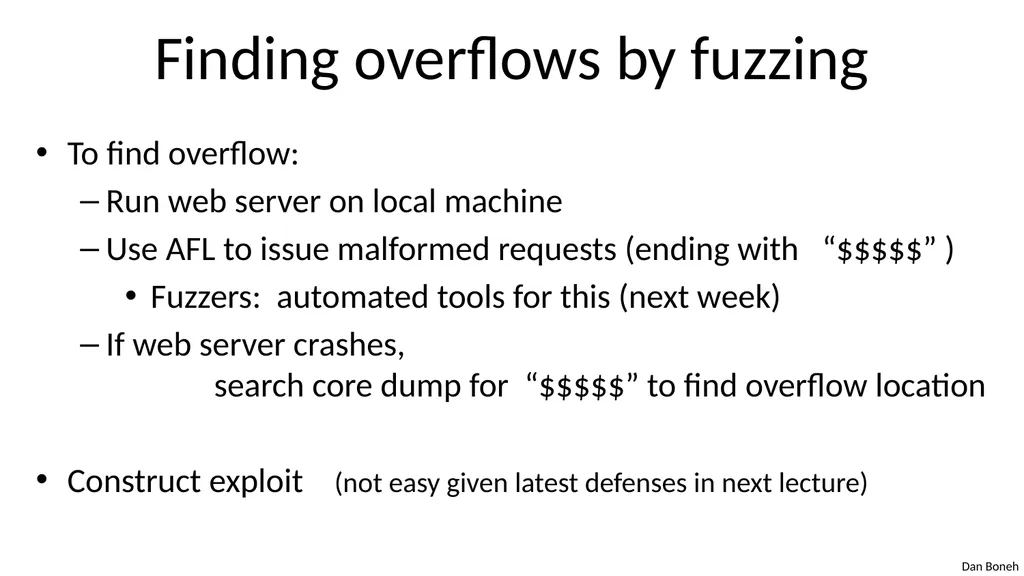
Finding overflows by fuzzing To find overflow:
Run web server on local machine
Use AFL to issue malformed requests (ending with “$$$$$” )
Fuzzers: automated tools for this (next week)
If web server crashes, search core dump for “$$$$$” to find overflow location
Construct exploit (not easy given latest defenses in next lecture)<br>
Run web server on local machine
Use AFL to issue malformed requests (ending with “$$$$$” )
Fuzzers: automated tools for this (next week)
If web server crashes, search core dump for “$$$$$” to find overflow location
Construct exploit (not easy given latest defenses in next lecture)<br>
21
Control Hijacking More Control Hijacking Attacks<br>
22
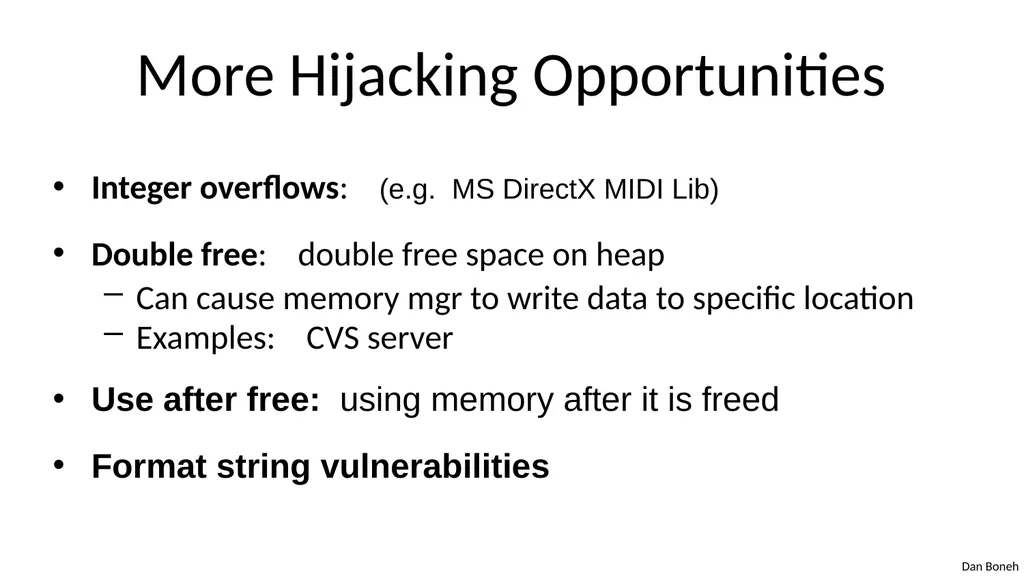
More Hijacking Opportunities Integer overflows: (e.g. MS DirectX MIDI Lib)
Double free: double free space on heap
Can cause memory mgr to write data to specific location
Examples: CVS server
Use after free: using memory after it is freed
Format string vulnerabilities<br>
Double free: double free space on heap
Can cause memory mgr to write data to specific location
Examples: CVS server
Use after free: using memory after it is freed
Format string vulnerabilities<br>
23
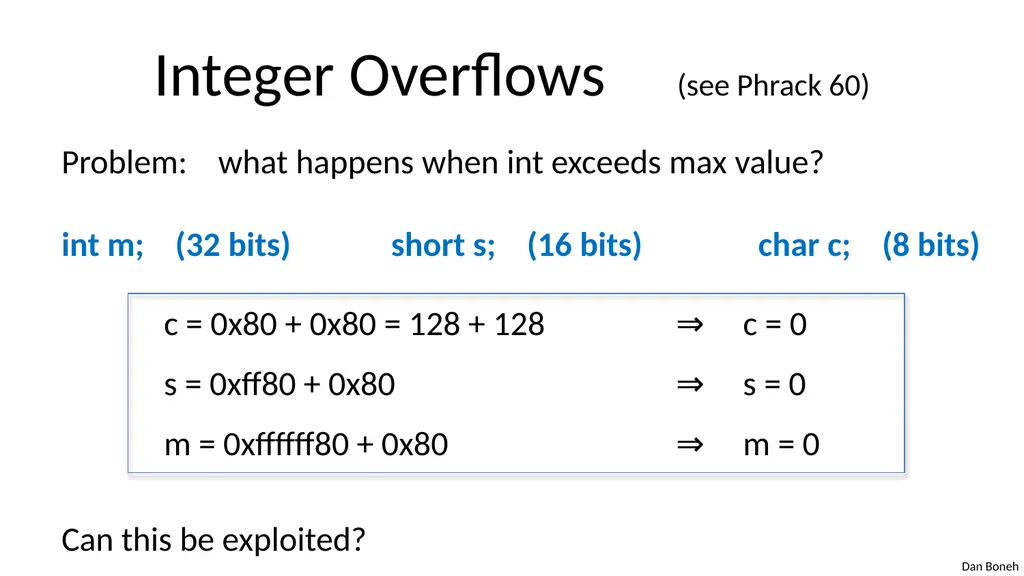
Integer Overflows (see Phrack 60) Problem: what happens when int exceeds max value?
int m; (32 bits) short s; (16 bits) char c; (8 bits)
c = 0x80 + 0x80 = 128 + 128 ⇒ c = 0
s = 0xff80 + 0x80 ⇒ s = 0
m = 0xffffff80 + 0x80 ⇒ m = 0
Can this be exploited?<br>
int m; (32 bits) short s; (16 bits) char c; (8 bits)
c = 0x80 + 0x80 = 128 + 128 ⇒ c = 0
s = 0xff80 + 0x80 ⇒ s = 0
m = 0xffffff80 + 0x80 ⇒ m = 0
Can this be exploited?<br>
24
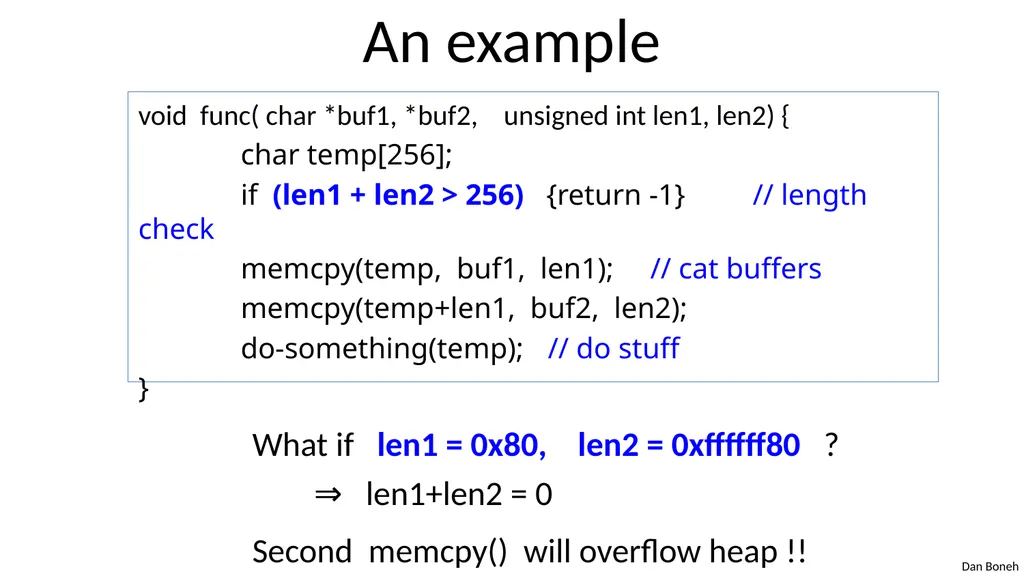
An example void func( char *buf1, *buf2, unsigned int len1, len2) {
char temp[256];
if (len1 + len2 > 256) {return -1} // length check
memcpy(temp, buf1, len1); // cat buffers
memcpy(temp+len1, buf2, len2);
do-something(temp); // do stuff
} What if len1 = 0x80, len2 = 0xffffff80 ?
⇒ len1+len2 = 0
Second memcpy() will overflow heap !!<br>
char temp[256];
if (len1 + len2 > 256) {return -1} // length check
memcpy(temp, buf1, len1); // cat buffers
memcpy(temp+len1, buf2, len2);
do-something(temp); // do stuff
} What if len1 = 0x80, len2 = 0xffffff80 ?
⇒ len1+len2 = 0
Second memcpy() will overflow heap !!<br>
25
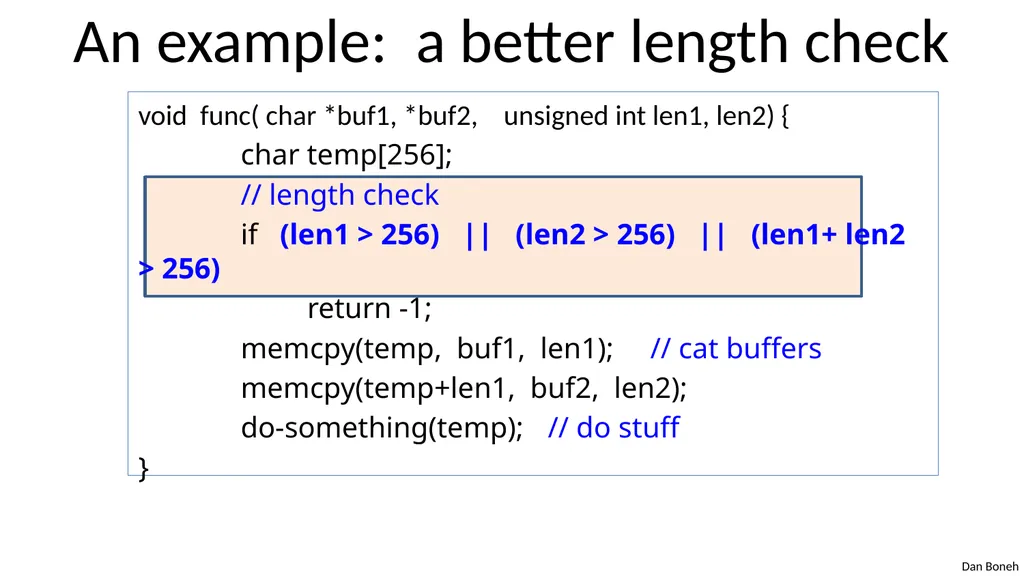
An example: a better length check void func( char *buf1, *buf2, unsigned int len1, len2) {
char temp[256];
// length check
if (len1 > 256) || (len2 > 256) || (len1+ len2 > 256)
return -1;
memcpy(temp, buf1, len1); // cat buffers
memcpy(temp+len1, buf2, len2);
do-something(temp); // do stuff
}<br>
char temp[256];
// length check
if (len1 > 256) || (len2 > 256) || (len1+ len2 > 256)
return -1;
memcpy(temp, buf1, len1); // cat buffers
memcpy(temp+len1, buf2, len2);
do-something(temp); // do stuff
}<br>
26
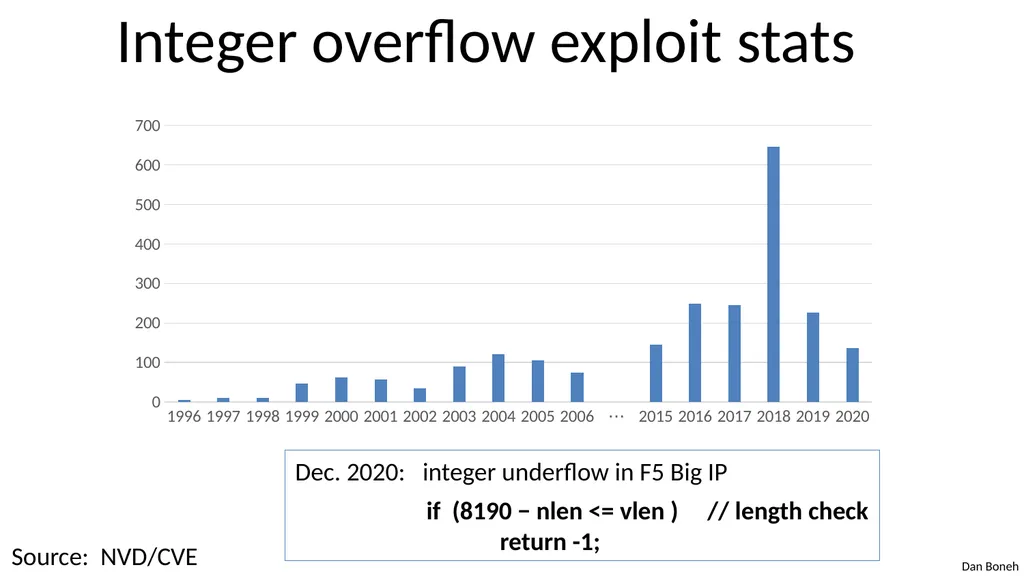
Source: NVD/CVE Integer overflow exploit stats Dec. 2020: integer underflow in F5 Big IP
if (8190 − nlen <= vlen ) // length check
return -1;<br>
if (8190 − nlen <= vlen ) // length check
return -1;<br>
27
Format string bugs<br>
28
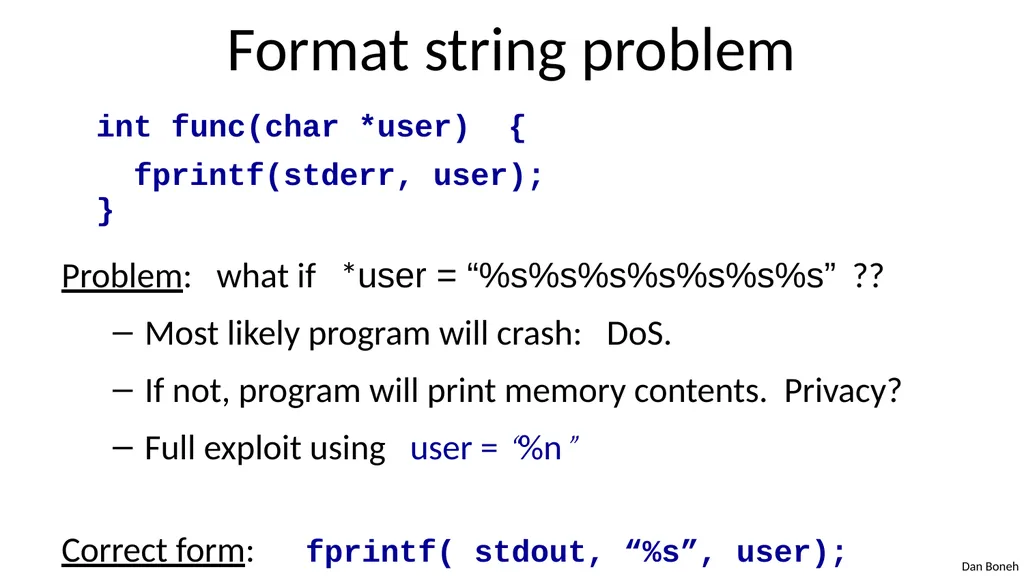
Format string problem int func(char *user) {
fprintf(stderr, user);
}
Problem: what if *user = “%s%s%s%s%s%s%s” ??
Most likely program will crash: DoS.
If not, program will print memory contents. Privacy?
Full exploit using user = “%n”
Correct form: fprintf( stdout, “%s”, user);<br>
fprintf(stderr, user);
}
Problem: what if *user = “%s%s%s%s%s%s%s” ??
Most likely program will crash: DoS.
If not, program will print memory contents. Privacy?
Full exploit using user = “%n”
Correct form: fprintf( stdout, “%s”, user);<br>
29
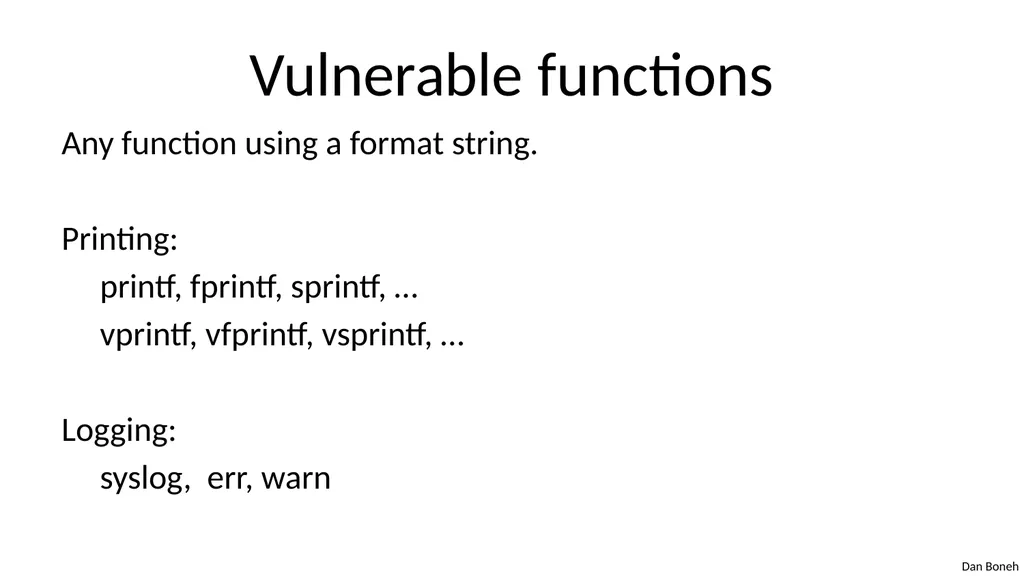
Vulnerable functions Any function using a format string.
Printing:
printf, fprintf, sprintf, …
vprintf, vfprintf, vsprintf, …
Logging:
syslog, err, warn<br>
Printing:
printf, fprintf, sprintf, …
vprintf, vfprintf, vsprintf, …
Logging:
syslog, err, warn<br>
30
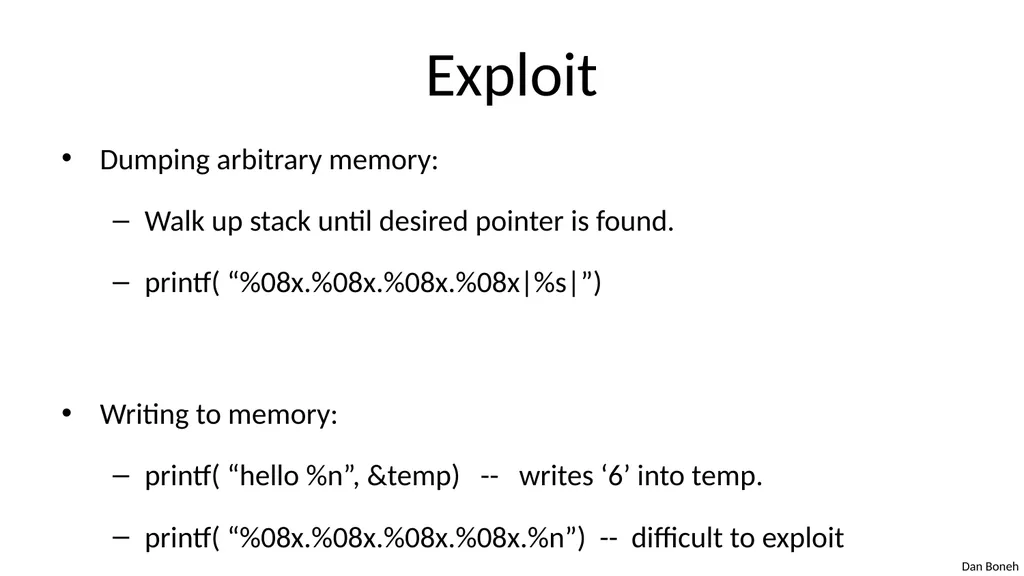
Exploit Dumping arbitrary memory:
Walk up stack until desired pointer is found.
printf( “%08x.%08x.%08x.%08x|%s|”)
Writing to memory:
printf( “hello %n”, &temp) -- writes ‘6’ into temp.
printf( “%08x.%08x.%08x.%08x.%n”) -- difficult to exploit<br>
Walk up stack until desired pointer is found.
printf( “%08x.%08x.%08x.%08x|%s|”)
Writing to memory:
printf( “hello %n”, &temp) -- writes ‘6’ into temp.
printf( “%08x.%08x.%08x.%08x.%n”) -- difficult to exploit<br>
31
Use after free exploits<br>
32
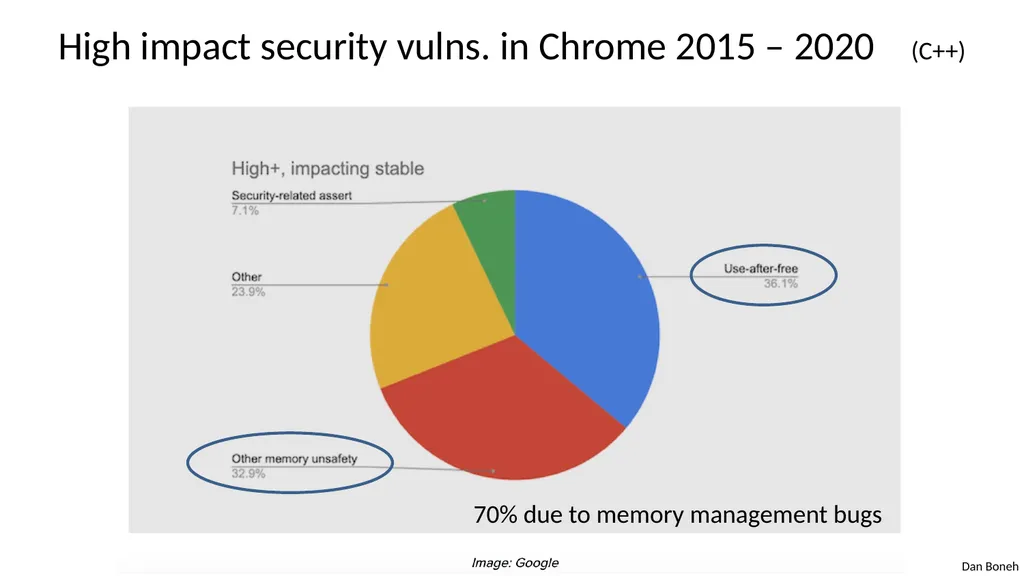
High impact security vulns. in Chrome 2015 – 2020 (C++) 70% due to memory management bugs<br>
33
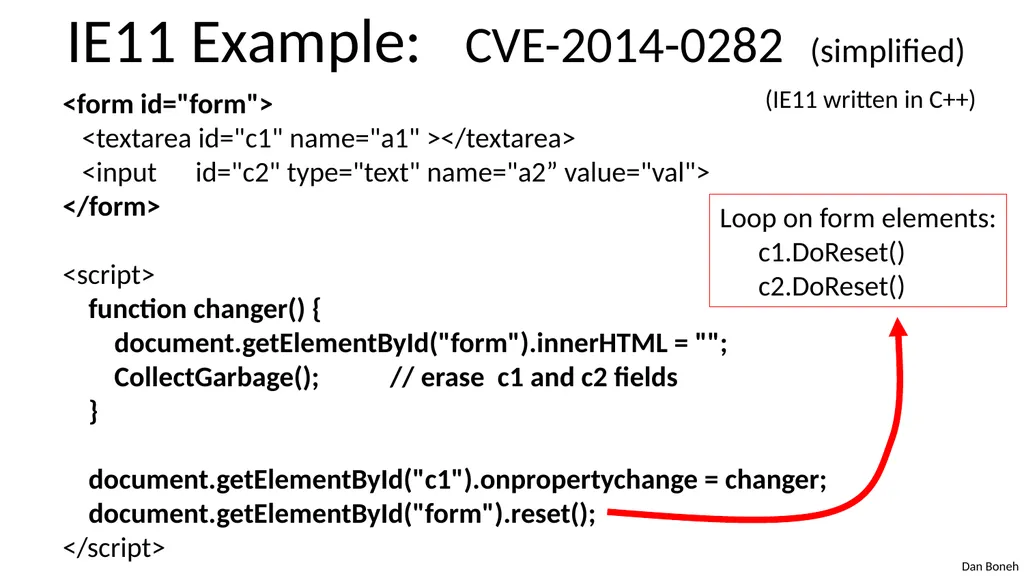
IE11 Example: CVE-2014-0282 (simplified) <form id="form">
<textarea id="c1" name="a1" ></textarea>
<input id="c2" type="text" name="a2” value="val">
</form>
<script>
function changer() {
document.getElementById("form").innerHTML = "";
CollectGarbage(); // erase c1 and c2 fields
}
document.getElementById("c1").onpropertychange = changer;
document.getElementById("form").reset();
</script> (IE11 written in C++)<br>
</form>
<script>
function changer() {
document.getElementById("form").innerHTML = "";
CollectGarbage(); // erase c1 and c2 fields
}
document.getElementById("c1").onpropertychange = changer;
document.getElementById("form").reset();
</script> (IE11 written in C++)<br>
34
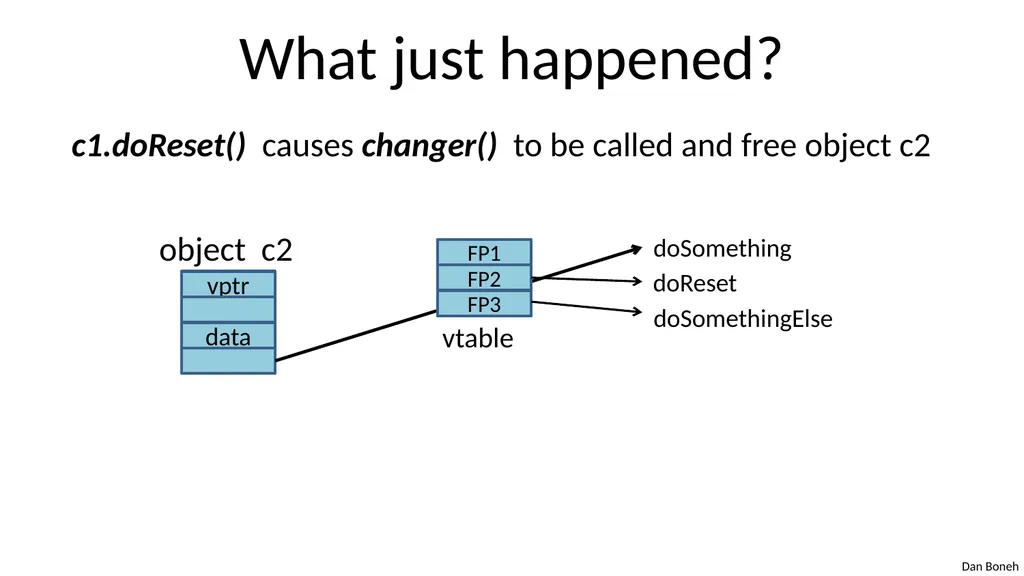
What just happened? c1.doReset() causes changer() to be called and free object c2<br>
35
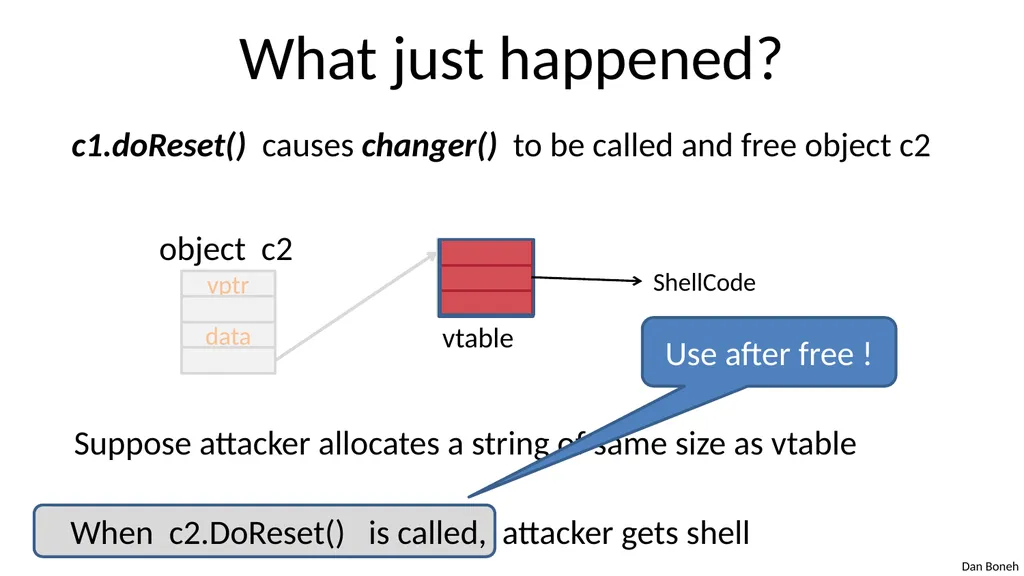
What just happened? c1.doReset() causes changer() to be called and free object c2 Suppose attacker allocates a string of same size as vtable When c2.DoReset() is called, attacker gets shell Use after free !<br>
36
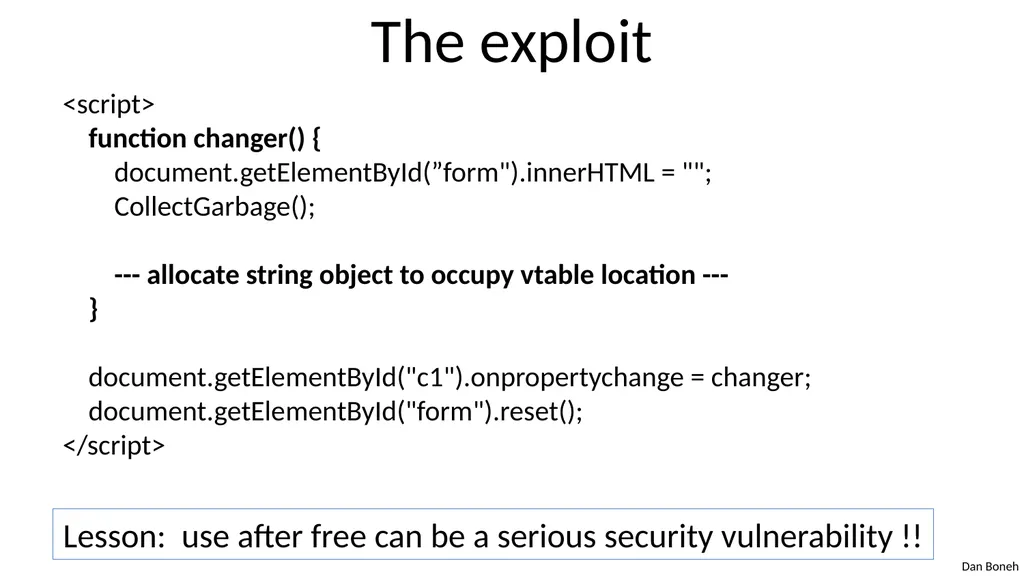
The exploit <script>
function changer() {
document.getElementById(”form").innerHTML = "";
CollectGarbage();
--- allocate string object to occupy vtable location ---
}
document.getElementById("c1").onpropertychange = changer;
document.getElementById("form").reset();
</script> Lesson: use after free can be a serious security vulnerability !!<br>
function changer() {
document.getElementById(”form").innerHTML = "";
CollectGarbage();
--- allocate string object to occupy vtable location ---
}
document.getElementById("c1").onpropertychange = changer;
document.getElementById("form").reset();
</script> Lesson: use after free can be a serious security vulnerability !!<br>
37
Next lecture … DEFENSES<br>
38
THE END<br>
39
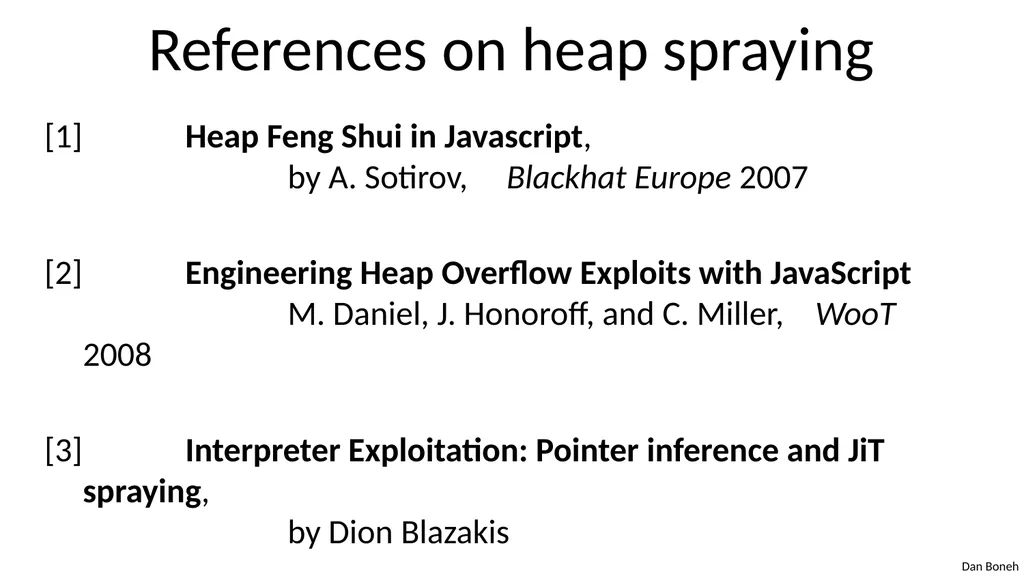
References on heap spraying [1] Heap Feng Shui in Javascript,
by A. Sotirov, Blackhat Europe 2007
[2] Engineering Heap Overflow Exploits with JavaScript M. Daniel, J. Honoroff, and C. Miller, WooT 2008
[3] Interpreter Exploitation: Pointer inference and JiT spraying, by Dion Blazakis<br>
[2] Engineering Heap Overflow Exploits with JavaScript M. Daniel, J. Honoroff, and C. Miller, WooT 2008
[3] Interpreter Exploitation: Pointer inference and JiT spraying, by Dion Blazakis<br>