
Coordinators’ Day Grant Agreement Preparation
CP
Published · 30 slides · 0 views
1 / 1





Description
Coordinators Day Grant Agreement Preparation SELENE GONZALEZ DIAZ 2 February 2023 OVERVIEW OF the presentation The Model Grant Agreement Horizon europe What is the grant agreement and why do I need it? Contractual document signed with a
Related Topics
Share
Embed code
Download this presentation From Below
"Coordinators’ Day Grant Agreement Preparation" is the property of its rightful owner. Permission is granted to download and print the materials on this website for personal, non-commercial use only, and to display it on your personal computer provided you do not modify the materials and that you retain all copyright notices contained in the materials. By downloading content from our website, you accept the terms of this agreement.
Presentation Transcript
01
Coordinators’ Day
Grant Agreement Preparation SELENE GONZALEZ DIAZ 2 February 2023<br>
Grant Agreement Preparation SELENE GONZALEZ DIAZ 2 February 2023<br>
02
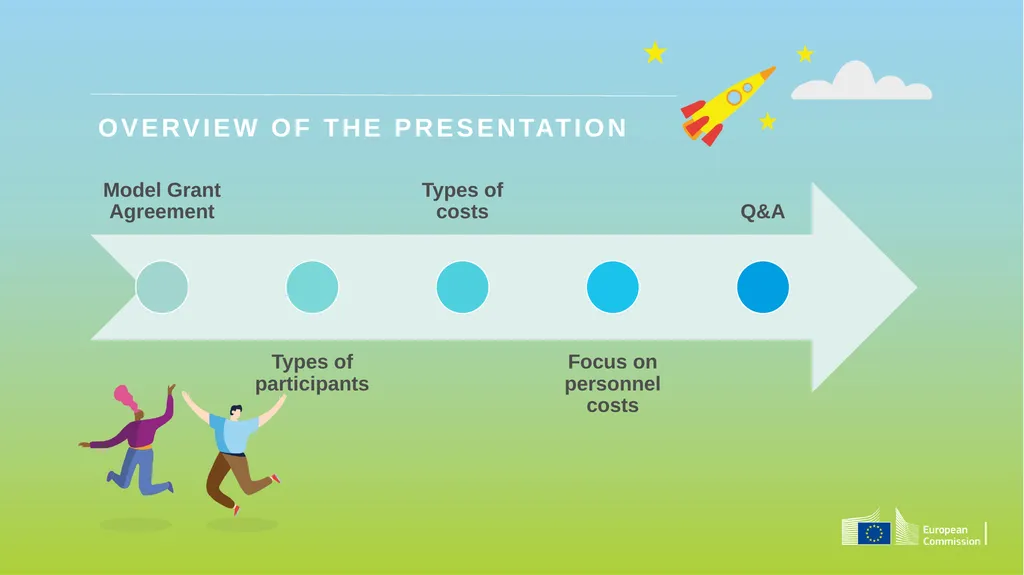
OVERVIEW OF the presentation<br>
03
The Model Grant Agreement Horizon europe<br>
04
What is the grant agreement and why do I need it? Contractual document signed with a ‘granting authority’ (e.g. the Commission or
one of its executive agencies) that defines: Your rights
To receive EU funding, under the terms and conditions defined in the GA, to help you to accomplish your project
To own the results of the project that you have generated
To ask for amendments if something needs to be changed YOUR OBLIGATIONS
To implement the project as planned in the description of the action (Annex 1 to the grant agreement)
To submit reports at the time and for the periods defined in the grant agreement
To display the EU emblem and reference to Horizon Europe funding How much money you can get
Maximum grant amount
Overall, the granting authority can never pay more than the maximum grant amount fixed in the grant agreement<br>
one of its executive agencies) that defines: Your rights
To receive EU funding, under the terms and conditions defined in the GA, to help you to accomplish your project
To own the results of the project that you have generated
To ask for amendments if something needs to be changed YOUR OBLIGATIONS
To implement the project as planned in the description of the action (Annex 1 to the grant agreement)
To submit reports at the time and for the periods defined in the grant agreement
To display the EU emblem and reference to Horizon Europe funding How much money you can get
Maximum grant amount
Overall, the granting authority can never pay more than the maximum grant amount fixed in the grant agreement<br>
05
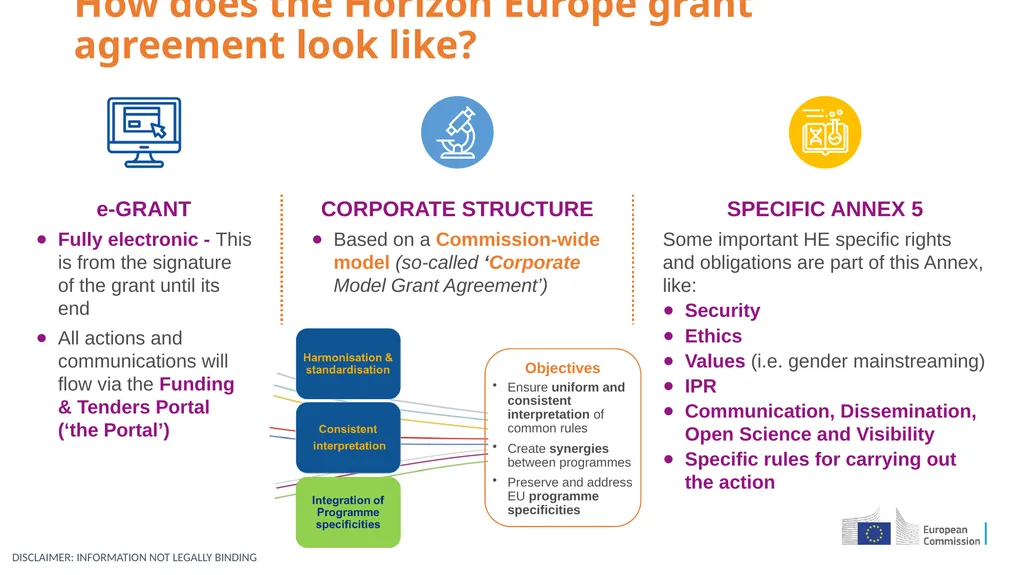
e-grant
Fully electronic - This is from the signature of the grant until its end
All actions and communications will flow via the Funding & Tenders Portal (‘the Portal’) CORPORATE STRUCTURE
Based on a Commission-wide model (so-called ‘Corporate Model Grant Agreement’) specific annex 5
Some important HE specific rights and obligations are part of this Annex, like:
Security
Ethics
Values (i.e. gender mainstreaming)
IPR
Communication, Dissemination, Open Science and Visibility
Specific rules for carrying out the action How does the Horizon Europe grant agreement look like? Objectives
Ensure uniform and consistent interpretation of common rules
Create synergies between programmes
Preserve and address EU programme specificities DISCLAIMER: INFORMATION NOT LEGALLY BINDING<br>
Fully electronic - This is from the signature of the grant until its end
All actions and communications will flow via the Funding & Tenders Portal (‘the Portal’) CORPORATE STRUCTURE
Based on a Commission-wide model (so-called ‘Corporate Model Grant Agreement’) specific annex 5
Some important HE specific rights and obligations are part of this Annex, like:
Security
Ethics
Values (i.e. gender mainstreaming)
IPR
Communication, Dissemination, Open Science and Visibility
Specific rules for carrying out the action How does the Horizon Europe grant agreement look like? Objectives
Ensure uniform and consistent interpretation of common rules
Create synergies between programmes
Preserve and address EU programme specificities DISCLAIMER: INFORMATION NOT LEGALLY BINDING<br>
06
Types of grant agreements<br>
07
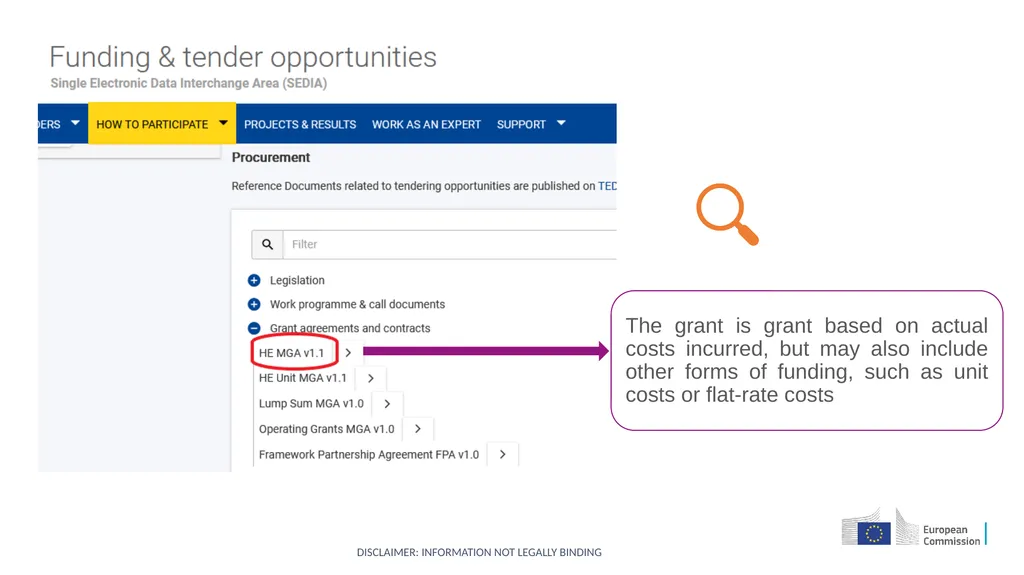
DISCLAIMER: INFORMATION NOT LEGALLY BINDING The grant is grant based on actual costs incurred, but may also include other forms of funding, such as unit costs or flat-rate costs<br>
08
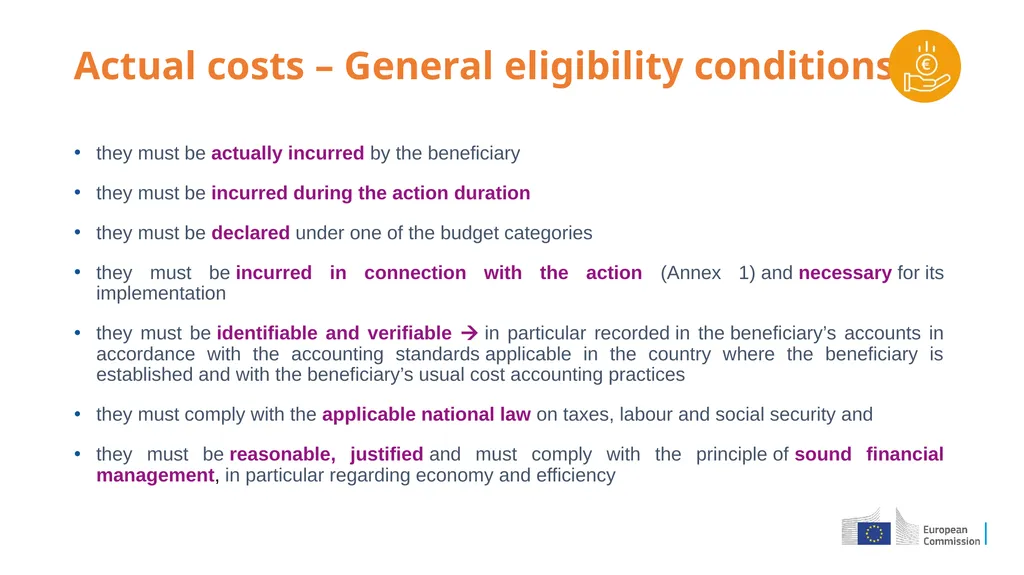
Actual costs – General eligibility conditions they must be actually incurred by the beneficiary
they must be incurred during the action duration
they must be declared under one of the budget categories
they must be incurred in connection with the action (Annex 1) and necessary for its implementation
they must be identifiable and verifiable in particular recorded in the beneficiary’s accounts in accordance with the accounting standards applicable in the country where the beneficiary is established and with the beneficiary’s usual cost accounting practices
they must comply with the applicable national law on taxes, labour and social security and
they must be reasonable, justified and must comply with the principle of sound financial management, in particular regarding economy and efficiency<br>
they must be incurred during the action duration
they must be declared under one of the budget categories
they must be incurred in connection with the action (Annex 1) and necessary for its implementation
they must be identifiable and verifiable in particular recorded in the beneficiary’s accounts in accordance with the accounting standards applicable in the country where the beneficiary is established and with the beneficiary’s usual cost accounting practices
they must comply with the applicable national law on taxes, labour and social security and
they must be reasonable, justified and must comply with the principle of sound financial management, in particular regarding economy and efficiency<br>
09
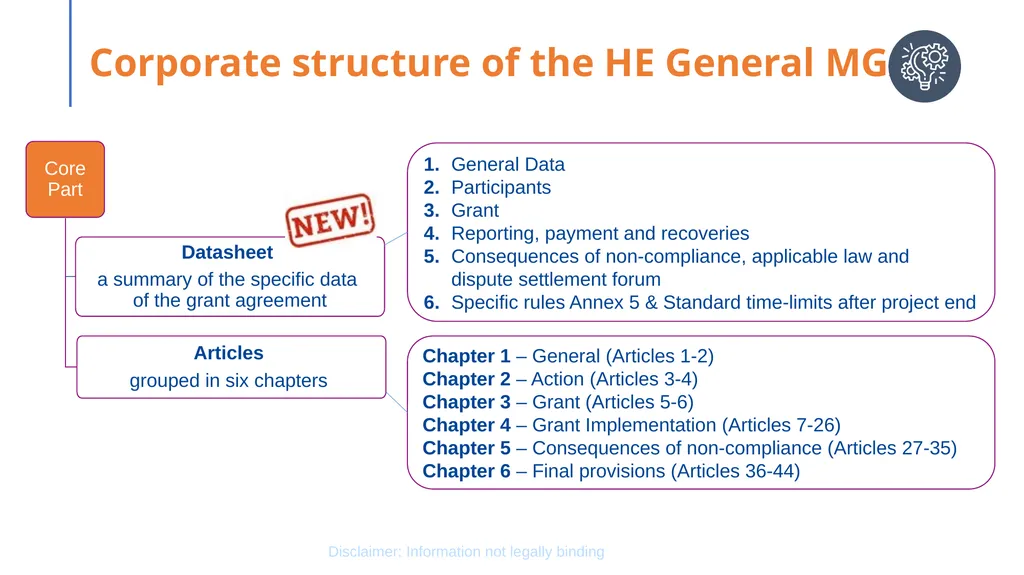
Corporate structure of the HE General MGA Core Part Datasheet
a summary of the specific data of the grant agreement Articles
grouped in six chapters Chapter 1 – General (Articles 1-2)
Chapter 2 – Action (Articles 3-4)
Chapter 3 – Grant (Articles 5-6)
Chapter 4 – Grant Implementation (Articles 7-26)
Chapter 5 – Consequences of non-compliance (Articles 27-35)
Chapter 6 – Final provisions (Articles 36-44) Disclaimer: Information not legally binding General Data
Participants
Grant
Reporting, payment and recoveries
Consequences of non-compliance, applicable law and dispute settlement forum
Specific rules Annex 5 & Standard time-limits after project end<br>
a summary of the specific data of the grant agreement Articles
grouped in six chapters Chapter 1 – General (Articles 1-2)
Chapter 2 – Action (Articles 3-4)
Chapter 3 – Grant (Articles 5-6)
Chapter 4 – Grant Implementation (Articles 7-26)
Chapter 5 – Consequences of non-compliance (Articles 27-35)
Chapter 6 – Final provisions (Articles 36-44) Disclaimer: Information not legally binding General Data
Participants
Grant
Reporting, payment and recoveries
Consequences of non-compliance, applicable law and dispute settlement forum
Specific rules Annex 5 & Standard time-limits after project end<br>
10
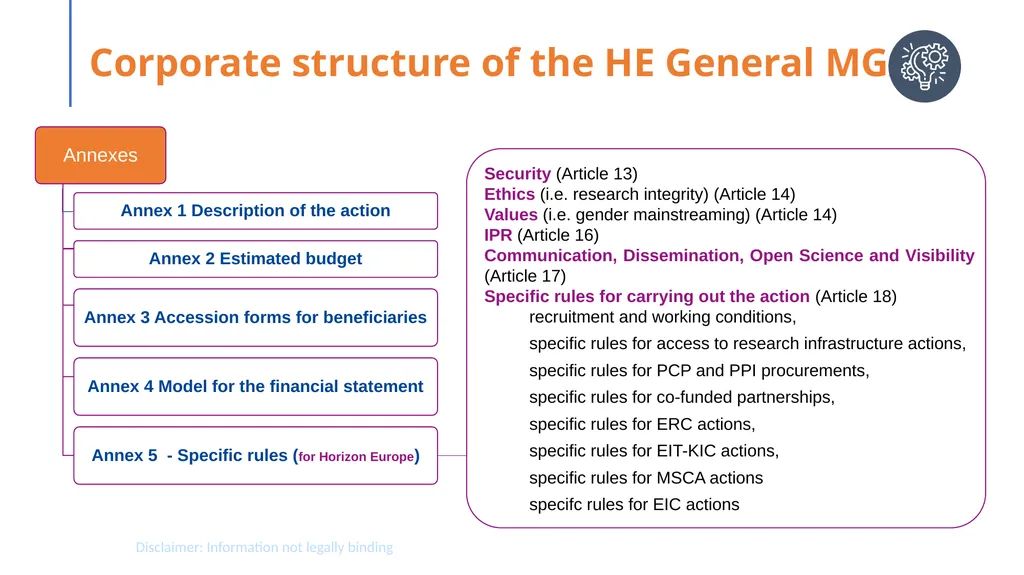
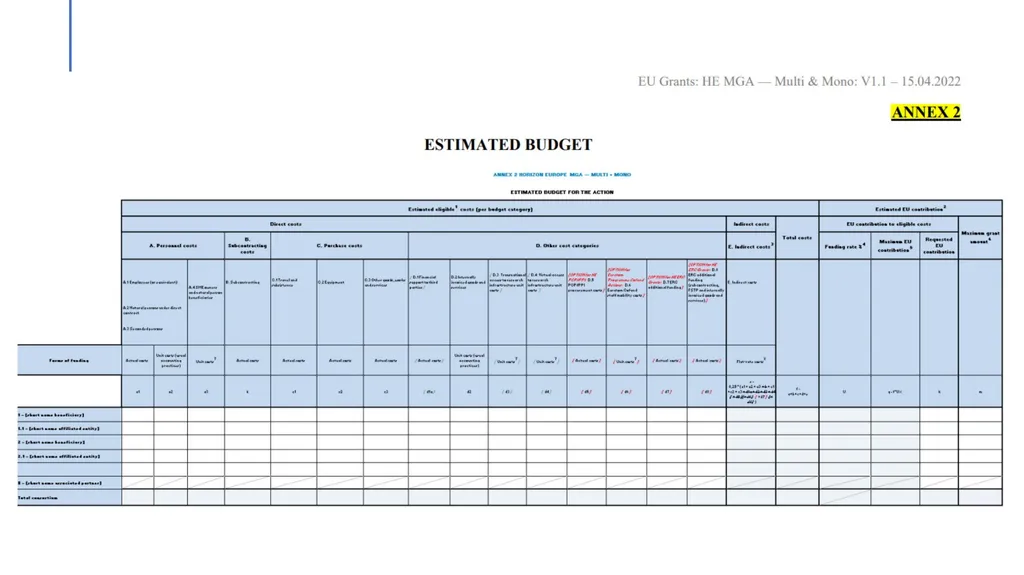
Corporate structure of the HE General MGA Annexes Annex 1 Description of the action Annex 2 Estimated budget Annex 3 Accession forms for beneficiaries Annex 4 Model for the financial statement Annex 5 - Specific rules (for Horizon Europe) Disclaimer: Information not legally binding Security (Article 13)
Ethics (i.e. research integrity) (Article 14)
Values (i.e. gender mainstreaming) (Article 14)
IPR (Article 16)
Communication, Dissemination, Open Science and Visibility (Article 17)
Specific rules for carrying out the action (Article 18)
recruitment and working conditions,
specific rules for access to research infrastructure actions,
specific rules for PCP and PPI procurements,
specific rules for co-funded partnerships,
specific rules for ERC actions,
specific rules for EIT-KIC actions,
specific rules for MSCA actions
specifc rules for EIC actions<br>
Ethics (i.e. research integrity) (Article 14)
Values (i.e. gender mainstreaming) (Article 14)
IPR (Article 16)
Communication, Dissemination, Open Science and Visibility (Article 17)
Specific rules for carrying out the action (Article 18)
recruitment and working conditions,
specific rules for access to research infrastructure actions,
specific rules for PCP and PPI procurements,
specific rules for co-funded partnerships,
specific rules for ERC actions,
specific rules for EIT-KIC actions,
specific rules for MSCA actions
specifc rules for EIC actions<br>
11
Participants in the action Horizon Europe<br>
12
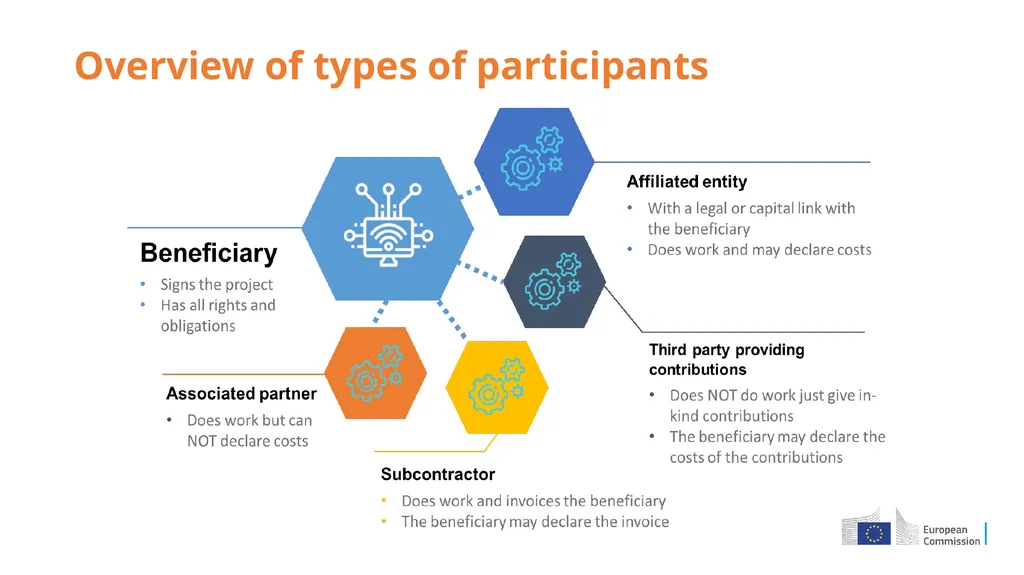
Overview of types of participants<br>
13
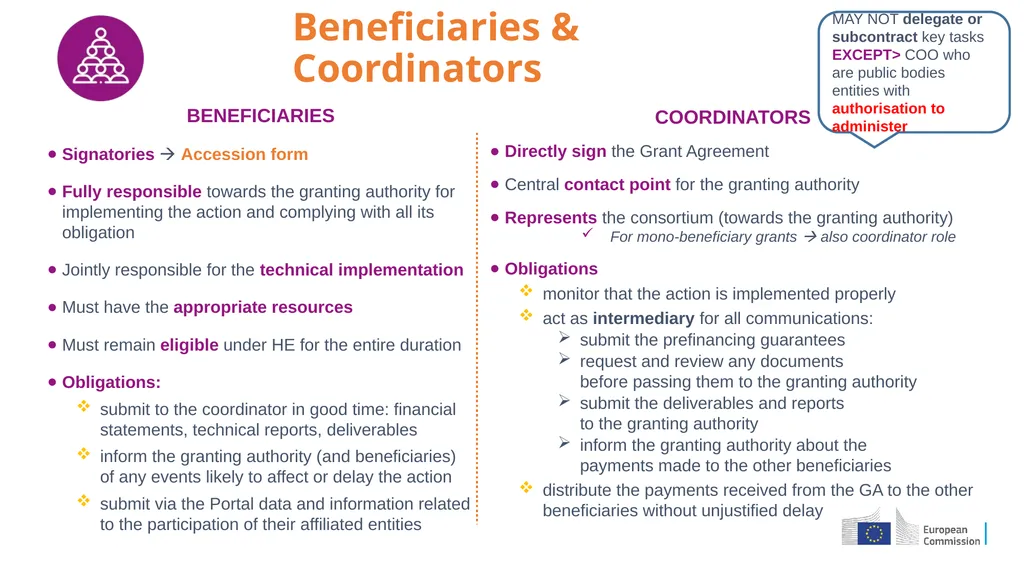
Beneficiaries & Coordinators BENEFICIARIES
Signatories Accession form
Fully responsible towards the granting authority for implementing the action and complying with all its obligation
Jointly responsible for the technical implementation
Must have the appropriate resources
Must remain eligible under HE for the entire duration
Obligations:
submit to the coordinator in good time: financial statements, technical reports, deliverables
inform the granting authority (and beneficiaries) of any events likely to affect or delay the action
submit via the Portal data and information related to the participation of their affiliated entities COORDINATORS
Directly sign the Grant Agreement
Central contact point for the granting authority
Represents the consortium (towards the granting authority)
For mono-beneficiary grants also coordinator role
Obligations
monitor that the action is implemented properly
act as intermediary for all communications:
submit the prefinancing guarantees
request and review any documents before passing them to the granting authority
submit the deliverables and reports to the granting authority
inform the granting authority about the payments made to the other beneficiaries
distribute the payments received from the GA to the other beneficiaries without unjustified delay MAY NOT delegate or
subcontract key tasks
EXCEPT> COO who are public bodies entities with authorisation to
administer<br>
Signatories Accession form
Fully responsible towards the granting authority for implementing the action and complying with all its obligation
Jointly responsible for the technical implementation
Must have the appropriate resources
Must remain eligible under HE for the entire duration
Obligations:
submit to the coordinator in good time: financial statements, technical reports, deliverables
inform the granting authority (and beneficiaries) of any events likely to affect or delay the action
submit via the Portal data and information related to the participation of their affiliated entities COORDINATORS
Directly sign the Grant Agreement
Central contact point for the granting authority
Represents the consortium (towards the granting authority)
For mono-beneficiary grants also coordinator role
Obligations
monitor that the action is implemented properly
act as intermediary for all communications:
submit the prefinancing guarantees
request and review any documents before passing them to the granting authority
submit the deliverables and reports to the granting authority
inform the granting authority about the payments made to the other beneficiaries
distribute the payments received from the GA to the other beneficiaries without unjustified delay MAY NOT delegate or
subcontract key tasks
EXCEPT> COO who are public bodies entities with authorisation to
administer<br>
14
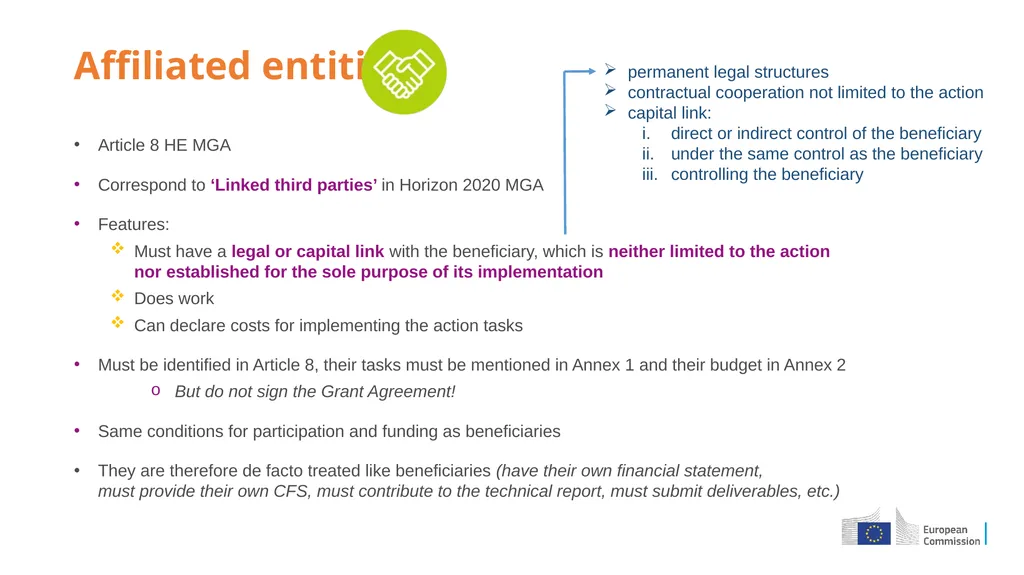
Affiliated entities Article 8 HE MGA
Correspond to ‘Linked third parties’ in Horizon 2020 MGA
Features:
Must have a legal or capital link with the beneficiary, which is neither limited to the action nor established for the sole purpose of its implementation
Does work
Can declare costs for implementing the action tasks
Must be identified in Article 8, their tasks must be mentioned in Annex 1 and their budget in Annex 2
But do not sign the Grant Agreement!
Same conditions for participation and funding as beneficiaries
They are therefore de facto treated like beneficiaries (have their own financial statement, must provide their own CFS, must contribute to the technical report, must submit deliverables, etc.) permanent legal structures
contractual cooperation not limited to the action
capital link:
direct or indirect control of the beneficiary
under the same control as the beneficiary
controlling the beneficiary<br>
Correspond to ‘Linked third parties’ in Horizon 2020 MGA
Features:
Must have a legal or capital link with the beneficiary, which is neither limited to the action nor established for the sole purpose of its implementation
Does work
Can declare costs for implementing the action tasks
Must be identified in Article 8, their tasks must be mentioned in Annex 1 and their budget in Annex 2
But do not sign the Grant Agreement!
Same conditions for participation and funding as beneficiaries
They are therefore de facto treated like beneficiaries (have their own financial statement, must provide their own CFS, must contribute to the technical report, must submit deliverables, etc.) permanent legal structures
contractual cooperation not limited to the action
capital link:
direct or indirect control of the beneficiary
under the same control as the beneficiary
controlling the beneficiary<br>
15
Other participants Associated partners Article 9.1 HE MGA
Inherited from the ‘International partner’ status in Horizon 2020 MGA
Must be identified in Article 9.1, their tasks must be mentioned in Annex 1 BUT do not sign the grant agreement
Features:
Does work but cannot declare costs
Participate at its own costs
It can be linked:
either to one beneficiary
or with the whole consortium
Do NOT have to comply with eligibility conditions for funding
The beneficiaries must ensure that some of MGA obligations also apply to AP (i.e. Articles 11 (proper implementation), 12 (conflict of interests), 13 (confidentiality and security), 14 (ethics), 17.2 (visibility), 18 (specific rules for carrying out action), 19 (information) and 20 (record-keeping)
Including the relevant conditions in the call or Annex 5 Beneficiaries are responsible for the proper implementation of the tasks implemented by associated partners Consortium
agreement<br>
Inherited from the ‘International partner’ status in Horizon 2020 MGA
Must be identified in Article 9.1, their tasks must be mentioned in Annex 1 BUT do not sign the grant agreement
Features:
Does work but cannot declare costs
Participate at its own costs
It can be linked:
either to one beneficiary
or with the whole consortium
Do NOT have to comply with eligibility conditions for funding
The beneficiaries must ensure that some of MGA obligations also apply to AP (i.e. Articles 11 (proper implementation), 12 (conflict of interests), 13 (confidentiality and security), 14 (ethics), 17.2 (visibility), 18 (specific rules for carrying out action), 19 (information) and 20 (record-keeping)
Including the relevant conditions in the call or Annex 5 Beneficiaries are responsible for the proper implementation of the tasks implemented by associated partners Consortium
agreement<br>
16
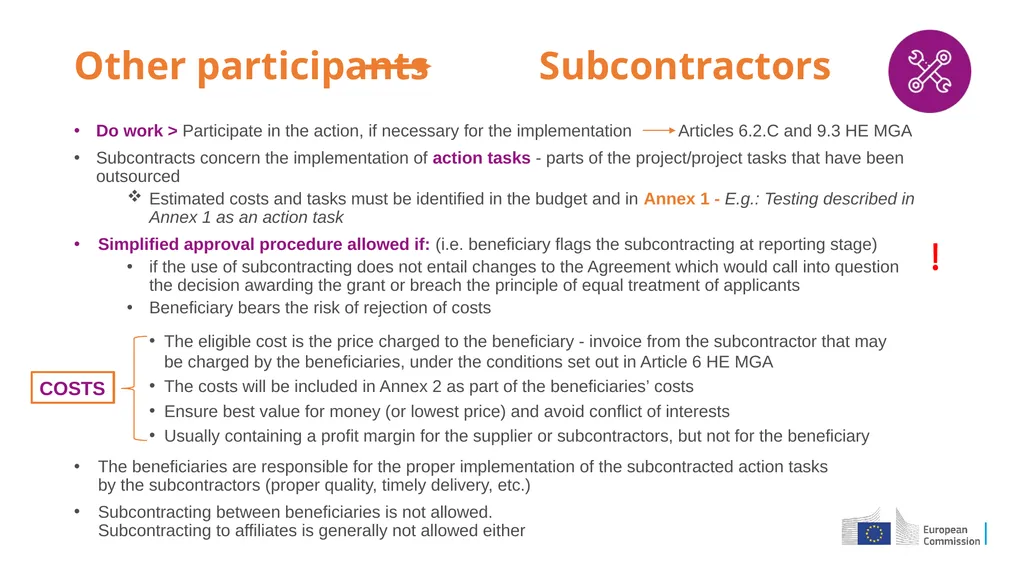
Do work > Participate in the action, if necessary for the implementation Articles 6.2.C and 9.3 HE MGA
Subcontracts concern the implementation of action tasks - parts of the project/project tasks that have been outsourced
Estimated costs and tasks must be identified in the budget and in Annex 1 - E.g.: Testing described in Annex 1 as an action task
Simplified approval procedure allowed if: (i.e. beneficiary flags the subcontracting at reporting stage)
if the use of subcontracting does not entail changes to the Agreement which would call into question the decision awarding the grant or breach the principle of equal treatment of applicants
Beneficiary bears the risk of rejection of costs
The eligible cost is the price charged to the beneficiary - invoice from the subcontractor that may be charged by the beneficiaries, under the conditions set out in Article 6 HE MGA
The costs will be included in Annex 2 as part of the beneficiaries’ costs
Ensure best value for money (or lowest price) and avoid conflict of interests
Usually containing a profit margin for the supplier or subcontractors, but not for the beneficiary
The beneficiaries are responsible for the proper implementation of the subcontracted action tasks by the subcontractors (proper quality, timely delivery, etc.)
Subcontracting between beneficiaries is not allowed. Subcontracting to affiliates is generally not allowed either Other participants Subcontractors COSTS<br>
Subcontracts concern the implementation of action tasks - parts of the project/project tasks that have been outsourced
Estimated costs and tasks must be identified in the budget and in Annex 1 - E.g.: Testing described in Annex 1 as an action task
Simplified approval procedure allowed if: (i.e. beneficiary flags the subcontracting at reporting stage)
if the use of subcontracting does not entail changes to the Agreement which would call into question the decision awarding the grant or breach the principle of equal treatment of applicants
Beneficiary bears the risk of rejection of costs
The eligible cost is the price charged to the beneficiary - invoice from the subcontractor that may be charged by the beneficiaries, under the conditions set out in Article 6 HE MGA
The costs will be included in Annex 2 as part of the beneficiaries’ costs
Ensure best value for money (or lowest price) and avoid conflict of interests
Usually containing a profit margin for the supplier or subcontractors, but not for the beneficiary
The beneficiaries are responsible for the proper implementation of the subcontracted action tasks by the subcontractors (proper quality, timely delivery, etc.)
Subcontracting between beneficiaries is not allowed. Subcontracting to affiliates is generally not allowed either Other participants Subcontractors COSTS<br>
17
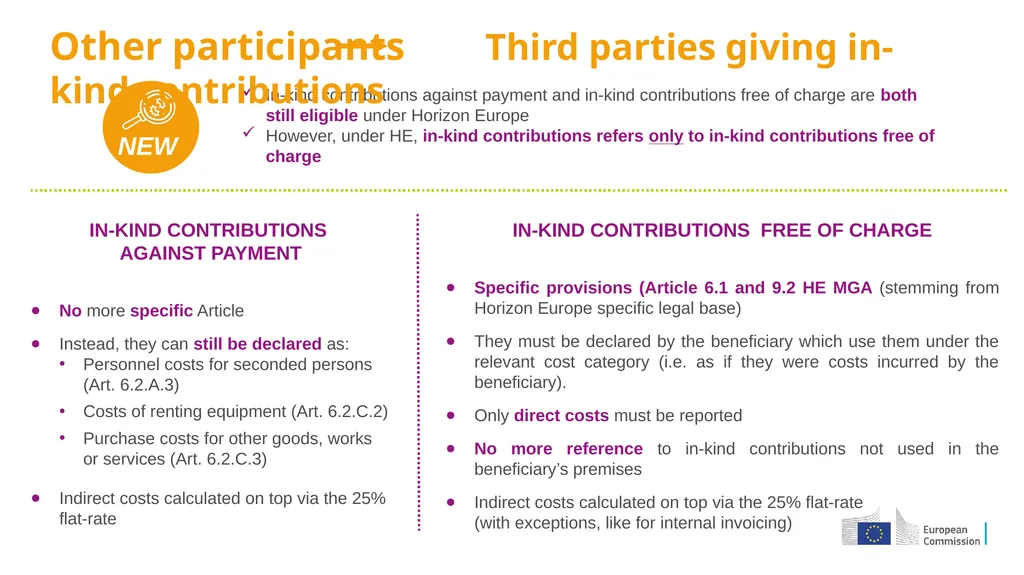
In-kind contributions against payment and in-kind contributions free of charge are both still eligible under Horizon Europe
However, under HE, in-kind contributions refers only to in-kind contributions free of charge NEW in-kind contributions against payment
No more specific Article
Instead, they can still be declared as:
Personnel costs for seconded persons (Art. 6.2.A.3)
Costs of renting equipment (Art. 6.2.C.2)
Purchase costs for other goods, works or services (Art. 6.2.C.3)
Indirect costs calculated on top via the 25% flat-rate in-kind contributions free of charge
Specific provisions (Article 6.1 and 9.2 HE MGA (stemming from Horizon Europe specific legal base)
They must be declared by the beneficiary which use them under the relevant cost category (i.e. as if they were costs incurred by the beneficiary).
Only direct costs must be reported
No more reference to in-kind contributions not used in the beneficiary’s premises
Indirect costs calculated on top via the 25% flat-rate (with exceptions, like for internal invoicing) Other participants Third parties giving in-kind contributions<br>
However, under HE, in-kind contributions refers only to in-kind contributions free of charge NEW in-kind contributions against payment
No more specific Article
Instead, they can still be declared as:
Personnel costs for seconded persons (Art. 6.2.A.3)
Costs of renting equipment (Art. 6.2.C.2)
Purchase costs for other goods, works or services (Art. 6.2.C.3)
Indirect costs calculated on top via the 25% flat-rate in-kind contributions free of charge
Specific provisions (Article 6.1 and 9.2 HE MGA (stemming from Horizon Europe specific legal base)
They must be declared by the beneficiary which use them under the relevant cost category (i.e. as if they were costs incurred by the beneficiary).
Only direct costs must be reported
No more reference to in-kind contributions not used in the beneficiary’s premises
Indirect costs calculated on top via the 25% flat-rate (with exceptions, like for internal invoicing) Other participants Third parties giving in-kind contributions<br>
18
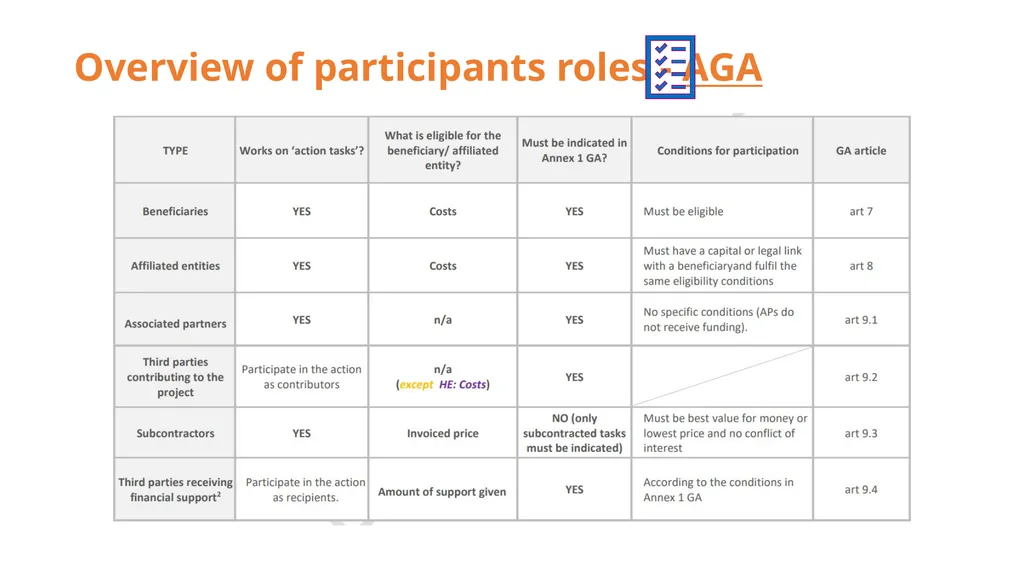
Overview of participants roles - AGA<br>
19
Types of costs Horizon Europe<br>
20
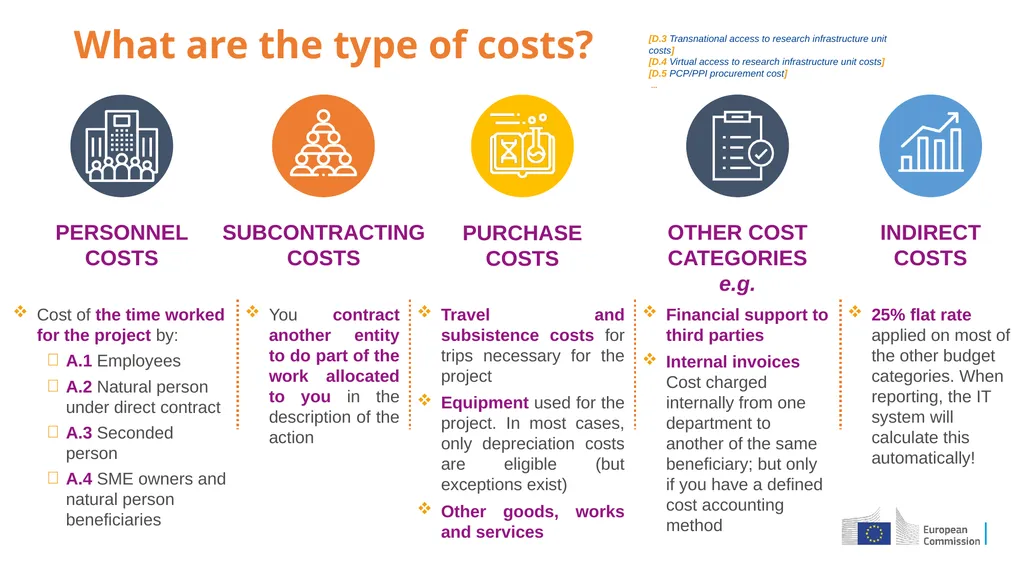
What are the type of costs? Cost of the time worked for the project by:
A.1 Employees
A.2 Natural person under direct contract
A.3 Seconded person
A.4 SME owners and natural person beneficiaries PERSONNEL COSTS SUBCONTRACTING
COSTS You contract another entity to do part of the work allocated to you in the description of the action PURCHASE
COSTS OTHER COST
CATEGORIES
e.g. Travel and subsistence costs for trips necessary for the project
Equipment used for the project. In most cases, only depreciation costs are eligible (but exceptions exist)
Other goods, works and services INDIRECT
COSTS Financial support to third parties
Internal invoices Cost charged internally from one department to another of the same beneficiary; but only if you have a defined cost accounting method 25% flat rate applied on most of the other budget categories. When reporting, the IT system will calculate this automatically! [D.3 Transnational access to research infrastructure unit costs]
[D.4 Virtual access to research infrastructure unit costs]
[D.5 PCP/PPI procurement cost]
...<br>
A.1 Employees
A.2 Natural person under direct contract
A.3 Seconded person
A.4 SME owners and natural person beneficiaries PERSONNEL COSTS SUBCONTRACTING
COSTS You contract another entity to do part of the work allocated to you in the description of the action PURCHASE
COSTS OTHER COST
CATEGORIES
e.g. Travel and subsistence costs for trips necessary for the project
Equipment used for the project. In most cases, only depreciation costs are eligible (but exceptions exist)
Other goods, works and services INDIRECT
COSTS Financial support to third parties
Internal invoices Cost charged internally from one department to another of the same beneficiary; but only if you have a defined cost accounting method 25% flat rate applied on most of the other budget categories. When reporting, the IT system will calculate this automatically! [D.3 Transnational access to research infrastructure unit costs]
[D.4 Virtual access to research infrastructure unit costs]
[D.5 PCP/PPI procurement cost]
...<br>
21
Personnel costs Horizon Europe<br>
22
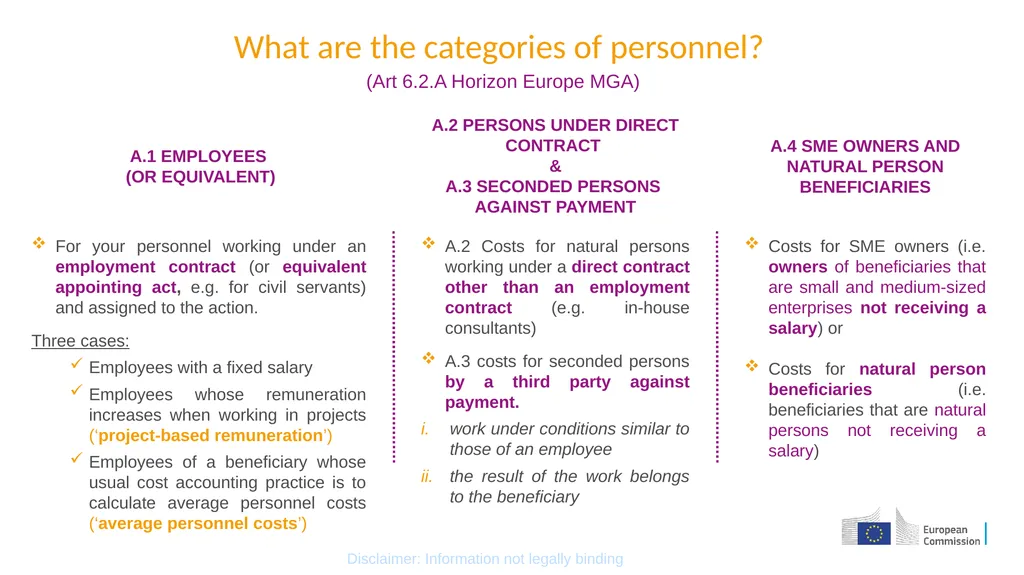
What are the categories of personnel? For your personnel working under an employment contract (or equivalent appointing act, e.g. for civil servants) and assigned to the action.
Three cases:
Employees with a fixed salary
Employees whose remuneration increases when working in projects (‘project-based remuneration’)
Employees of a beneficiary whose usual cost accounting practice is to calculate average personnel costs (‘average personnel costs’) A.1 EMPLOYEES
(OR EQUIVALENT) A.2 Costs for natural persons working under a direct contract other than an employment contract (e.g. in-house consultants)
A.3 costs for seconded persons by a third party against payment.
work under conditions similar to those of an employee
the result of the work belongs to the beneficiary A.4 SME OWNERS AND NATURAL PERSON BENEFICIARIES Costs for SME owners (i.e. owners of beneficiaries that are small and medium-sized enterprises not receiving a salary) or
Costs for natural person beneficiaries (i.e. beneficiaries that are natural persons not receiving a salary) A.2 PERSONS UNDER DIRECT CONTRACT
&
A.3 SECONDED PERSONS AGAINST PAYMENT (Art 6.2.A Horizon Europe MGA) Disclaimer: Information not legally binding<br>
Three cases:
Employees with a fixed salary
Employees whose remuneration increases when working in projects (‘project-based remuneration’)
Employees of a beneficiary whose usual cost accounting practice is to calculate average personnel costs (‘average personnel costs’) A.1 EMPLOYEES
(OR EQUIVALENT) A.2 Costs for natural persons working under a direct contract other than an employment contract (e.g. in-house consultants)
A.3 costs for seconded persons by a third party against payment.
work under conditions similar to those of an employee
the result of the work belongs to the beneficiary A.4 SME OWNERS AND NATURAL PERSON BENEFICIARIES Costs for SME owners (i.e. owners of beneficiaries that are small and medium-sized enterprises not receiving a salary) or
Costs for natural person beneficiaries (i.e. beneficiaries that are natural persons not receiving a salary) A.2 PERSONS UNDER DIRECT CONTRACT
&
A.3 SECONDED PERSONS AGAINST PAYMENT (Art 6.2.A Horizon Europe MGA) Disclaimer: Information not legally binding<br>
23
How to calculate your personnel costs? Category A.1 – case 1 Employees with a fixed salary Daily rate Day-equivalents
worked on the action
(up to a maximum declarable) Simplification Commission-wide formula (valid across EU programmes)
Single calculation for the reporting period
Per person who worked in the action
Single formula to cover most situations encountered by beneficiaries
Maximum decalarable days: pro-rata of 215 days Corporate formula Basic principles<br>
worked on the action
(up to a maximum declarable) Simplification Commission-wide formula (valid across EU programmes)
Single calculation for the reporting period
Per person who worked in the action
Single formula to cover most situations encountered by beneficiaries
Maximum decalarable days: pro-rata of 215 days Corporate formula Basic principles<br>
24
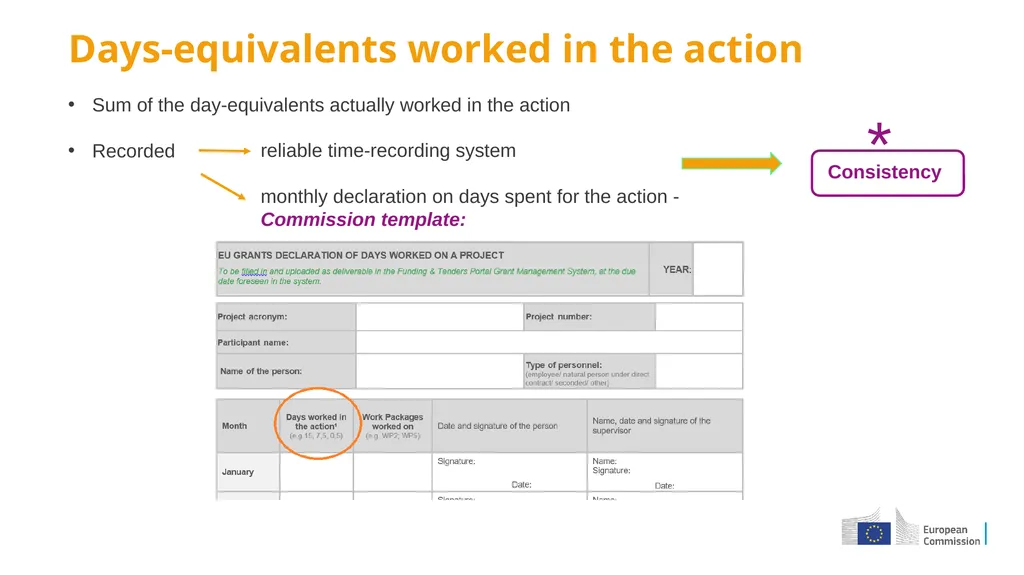
Days-equivalents worked in the action reliable time-recording system
monthly declaration on days spent for the action -
Commission template: Sum of the day-equivalents actually worked in the action
Recorded Consistency *<br>
monthly declaration on days spent for the action -
Commission template: Sum of the day-equivalents actually worked in the action
Recorded Consistency *<br>
25
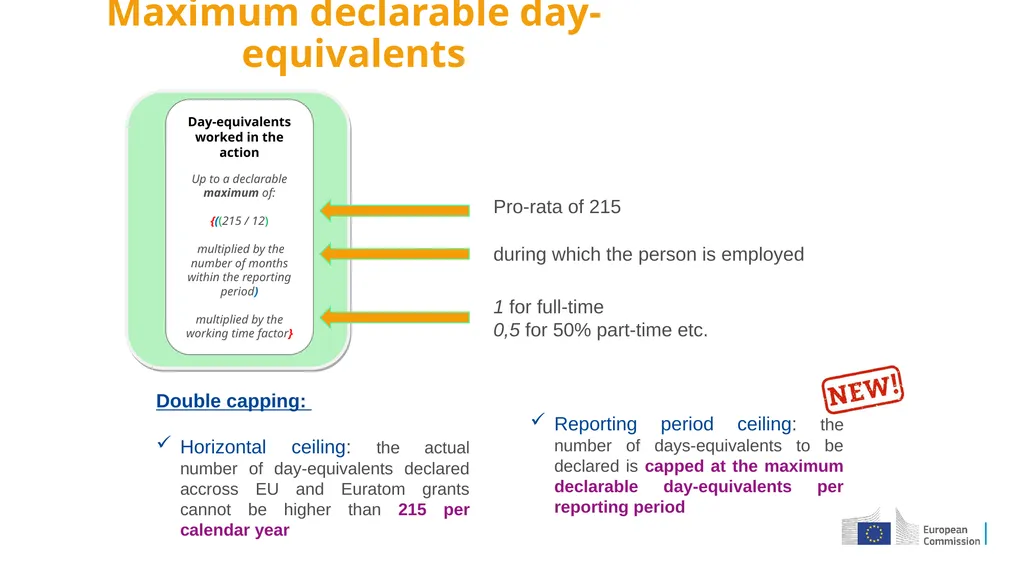
Maximum declarable day-equivalents Day-equivalents worked in the action
Up to a declarable maximum of:
{((215 / 12)
multiplied by the number of months within the reporting period)
multiplied by the working time factor} Pro-rata of 215 during which the person is employed 1 for full-time
0,5 for 50% part-time etc. Double capping:
Horizontal ceiling: the actual number of day-equivalents declared accross EU and Euratom grants cannot be higher than 215 per calendar year
Reporting period ceiling: the number of days-equivalents to be declared is capped at the maximum declarable day-equivalents per reporting period<br>
Up to a declarable maximum of:
{((215 / 12)
multiplied by the number of months within the reporting period)
multiplied by the working time factor} Pro-rata of 215 during which the person is employed 1 for full-time
0,5 for 50% part-time etc. Double capping:
Horizontal ceiling: the actual number of day-equivalents declared accross EU and Euratom grants cannot be higher than 215 per calendar year
Reporting period ceiling: the number of days-equivalents to be declared is capped at the maximum declarable day-equivalents per reporting period<br>
26
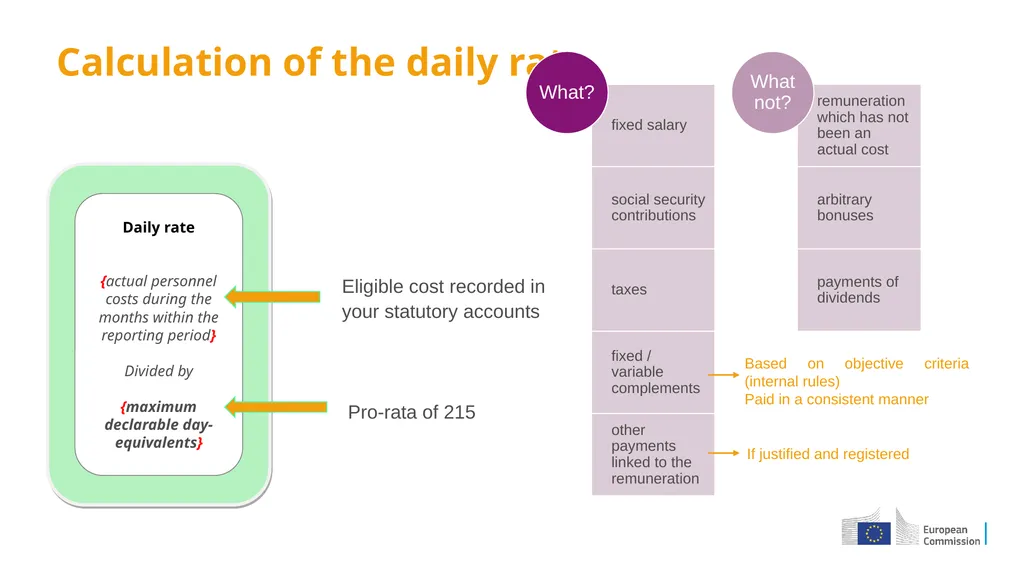
Calculation of the daily rate Daily rate
{actual personnel costs during the months within the reporting period}
Divided by
{maximum declarable day-equivalents} Eligible cost recorded in your statutory accounts Pro-rata of 215 Based on objective criteria (internal rules)
Paid in a consistent manner If justified and registered<br>
{actual personnel costs during the months within the reporting period}
Divided by
{maximum declarable day-equivalents} Eligible cost recorded in your statutory accounts Pro-rata of 215 Based on objective criteria (internal rules)
Paid in a consistent manner If justified and registered<br>
27
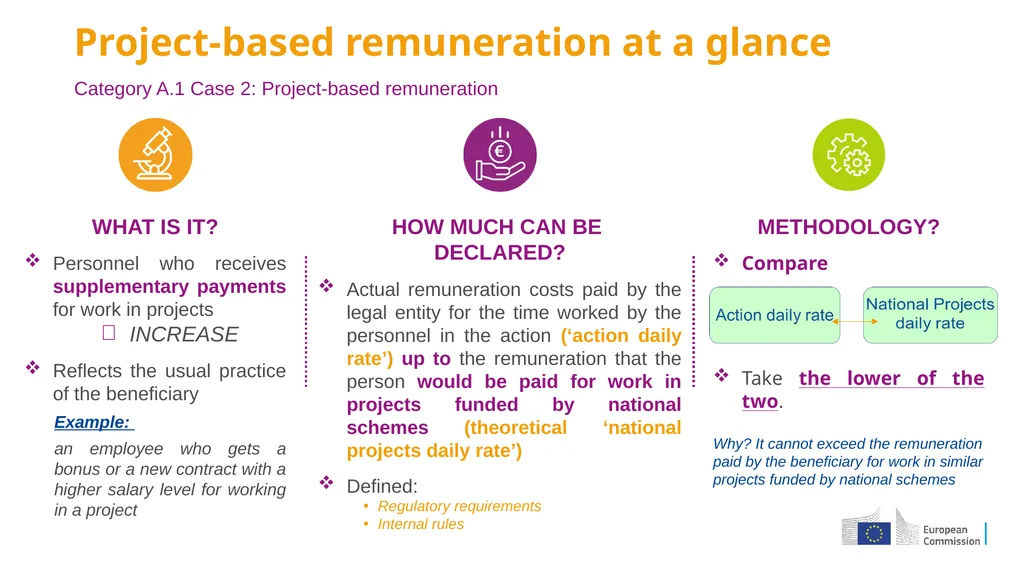
METHODOLOGY?
Compare
Take the lower of the two. Project-based remuneration at a glance How MUCH CAN BE DECLARED?
Actual remuneration costs paid by the legal entity for the time worked by the personnel in the action (‘action daily rate’) up to the remuneration that the person would be paid for work in projects funded by national schemes (theoretical ‘national projects daily rate’)
Defined:
Regulatory requirements
Internal rules What is it?
Personnel who receives supplementary payments for work in projects
INCREASE
Reflects the usual practice of the beneficiary
Example:
an employee who gets a bonus or a new contract with a higher salary level for working in a project Category A.1 Case 2: Project-based remuneration Why? It cannot exceed the remuneration paid by the beneficiary for work in similar projects funded by national schemes<br>
Compare
Take the lower of the two. Project-based remuneration at a glance How MUCH CAN BE DECLARED?
Actual remuneration costs paid by the legal entity for the time worked by the personnel in the action (‘action daily rate’) up to the remuneration that the person would be paid for work in projects funded by national schemes (theoretical ‘national projects daily rate’)
Defined:
Regulatory requirements
Internal rules What is it?
Personnel who receives supplementary payments for work in projects
INCREASE
Reflects the usual practice of the beneficiary
Example:
an employee who gets a bonus or a new contract with a higher salary level for working in a project Category A.1 Case 2: Project-based remuneration Why? It cannot exceed the remuneration paid by the beneficiary for work in similar projects funded by national schemes<br>
28
Looking for more information? Disclaimer: Information not legally binding Horizon Europe reference documents page
https://ec.europa.eu/info/funding-tenders/opportunities/portal/screen/how-to-participate/reference-documents;programCode=HORIZON
Model Grant Agreement
Annotated Model Grant Agreement
Templates
Guidance
National Contact Points
https://ec.europa.eu/info/funding-tenders/opportunities/portal/screen/support/ncp
Research Enquiry Service
https://research-and-innovation.ec.europa.eu/contact-us/research-enquiry-service_en<br>
https://ec.europa.eu/info/funding-tenders/opportunities/portal/screen/how-to-participate/reference-documents;programCode=HORIZON
Model Grant Agreement
Annotated Model Grant Agreement
Templates
Guidance
National Contact Points
https://ec.europa.eu/info/funding-tenders/opportunities/portal/screen/support/ncp
Research Enquiry Service
https://research-and-innovation.ec.europa.eu/contact-us/research-enquiry-service_en<br>
29
Thank you! # HorizonEU http://ec.europa.eu/horizon-europe<br>