Core Purpose To empower blind and low vision
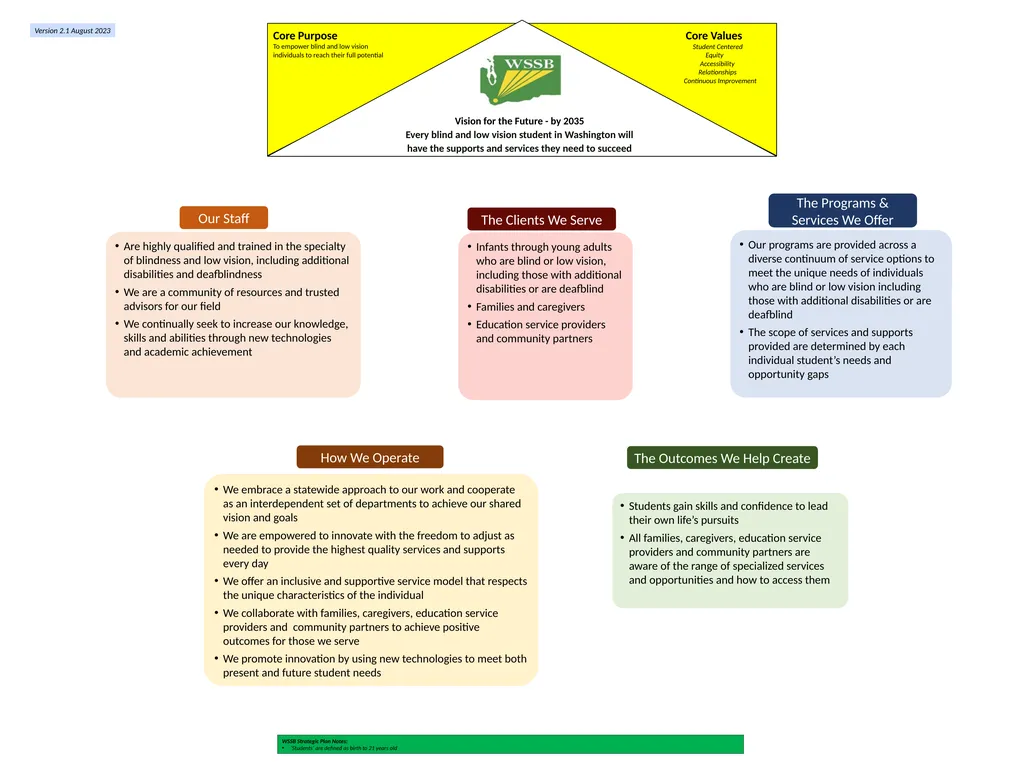
Description: Core Purpose To empower blind and low vision individuals to reach their full potential Core Values Student Centered Equity Accessibility Relationships Continuous Improvement Vision for the Future - by 2035 Every blind and low vision student
Related Topics
Download Presentation
"Core Purpose To empower blind and low vision" is the property of its rightful owner. Permission is granted to download and print the materials on this website for personal, non-commercial use only, and to display it on your personal computer provided you do not modify the materials and that you retain all copyright notices contained in the materials. By downloading content from our website, you accept the terms of this agreement.
Presentation Transcript
slide1. Core PurposeTo empower blind and low vision individuals to reach their full potential Core Values Student Centered
Equity
Accessibility
Relationships
Continuous Improvement Vision for the Future - by 2035
Every blind and low vision student in Washington will have the supports and services they need to succeed Our Staff Are highly qualified and trained in the specialty of blindness and low vision, including additional disabilities and deafblindness
We are a community of resources and trusted advisors for our field
We continually seek to increase our knowledge, skills and abilities through new technologies and academic achievement The Clients We Serve Infants through young adults who are blind or low vision, including those with additional disabilities or are deafblind
Families and caregivers
Education service providers and community partners The Programs & Services We Offer Our programs are provided across a diverse continuum of service options to meet the unique needs of individuals who are blind or low vision including those with additional disabilities or are deafblind
The scope of services and supports provided are determined by each individual student’s needs and opportunity gaps How We Operate We embrace a statewide approach to our work and cooperate as an interdependent set of departments to achieve our shared vision and goals
We are empowered to innovate with the freedom to adjust as needed to provide the highest quality services and supports every day
We offer an inclusive and supportive service model that respects the unique characteristics of the individual
We collaborate with families, caregivers, education service providers and community partners to achieve positive outcomes for those we serve
We promote innovation by using new technologies to meet both present and future student needs The Outcomes We Help Create Students gain skills and confidence to lead their own life’s pursuits
All families, caregivers, education service providers and community partners are aware of the range of specialized services and opportunities and how to access them Version 2.1 August 2023 WSSB Strategic Plan Notes:
‘Students’ are defined as birth to 21 years old WSSB Strategic Plan<br>
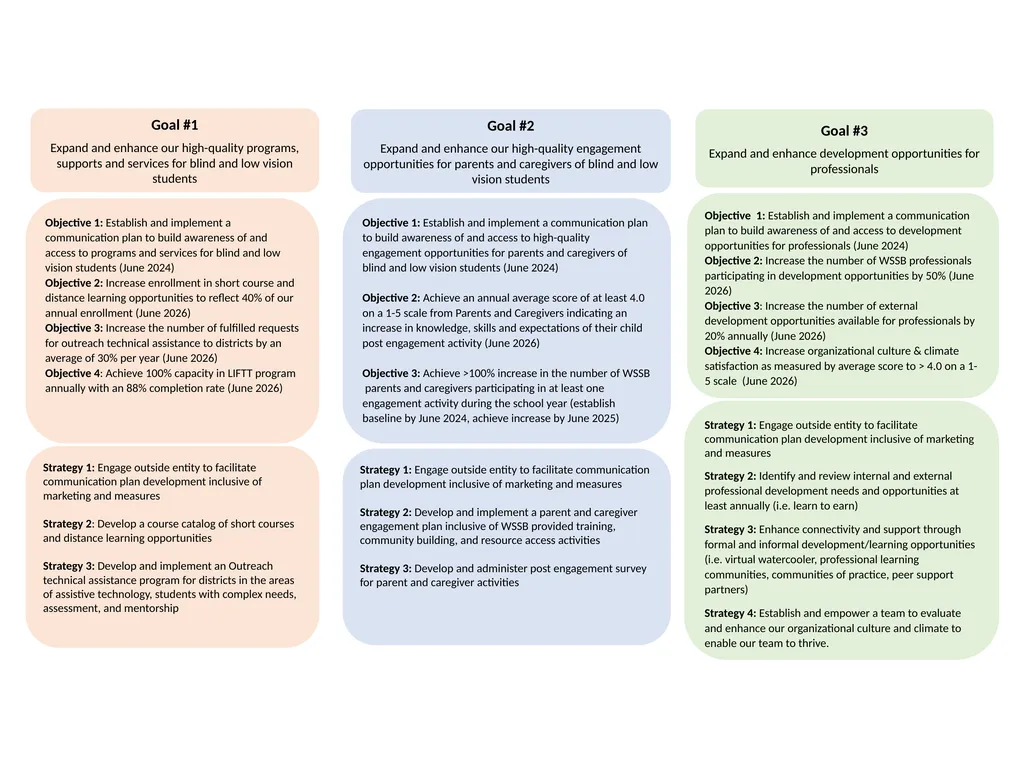
slide2. Goal #1
Expand and enhance our high-quality programs, supports and services for blind and low vision students Objective 1: Establish and implement a communication plan to build awareness of and access to programs and services for blind and low vision students (June 2024)
Objective 2: Increase enrollment in short course and distance learning opportunities to reflect 40% of our annual enrollment (June 2026)
Objective 3: Increase the number of fulfilled requests for outreach technical assistance to districts by an average of 30% per year (June 2026)
Objective 4: Achieve 100% capacity in LIFTT program annually with an 88% completion rate (June 2026) Strategy 1: Engage outside entity to facilitate communication plan development inclusive of marketing and measures
Strategy 2: Develop a course catalog of short courses and distance learning opportunities
Strategy 3: Develop and implement an Outreach technical assistance program for districts in the areas of assistive technology, students with complex needs, assessment, and mentorship Goal #2
Expand and enhance our high-quality engagement opportunities for parents and caregivers of blind and low vision students Objective 1: Establish and implement a communication plan to build awareness of and access to high-quality engagement opportunities for parents and caregivers of blind and low vision students (June 2024)
Objective 2: Achieve an annual average score of at least 4.0 on a 1-5 scale from Parents and Caregivers indicating an increase in knowledge, skills and expectations of their child post engagement activity (June 2026)
Objective 3: Achieve >100% increase in the number of WSSB parents and caregivers participating in at least one engagement activity during the school year (establish baseline by June 2024, achieve increase by June 2025) Strategy 1: Engage outside entity to facilitate communication plan development inclusive of marketing and measures
Strategy 2: Develop and implement a parent and caregiver engagement plan inclusive of WSSB provided training, community building, and resource access activities
Strategy 3: Develop and administer post engagement survey for parent and caregiver activities Goal #3
Expand and enhance development opportunities for professionals Objective 1: Establish and implement a communication plan to build awareness of and access to development opportunities for professionals (June 2024)
Objective 2: Increase the number of WSSB professionals participating in development opportunities by 50% (June 2026)
Objective 3: Increase the number of external development opportunities available for professionals by 20% annually (June 2026)
Objective 4: Increase organizational culture & climate satisfaction as measured by average score to > 4.0 on a 1-5 scale (June 2026) Strategy 1: Engage outside entity to facilitate communication plan development inclusive of marketing and measures
Strategy 2: Identify and review internal and external professional development needs and opportunities at least annually (i.e. learn to earn)
Strategy 3: Enhance connectivity and support through formal and informal development/learning opportunities (i.e. virtual watercooler, professional learning communities, communities of practice, peer support partners)
Strategy 4: Establish and empower a team to evaluate and enhance our organizational culture and climate to enable our team to thrive. WSSB Strategic Plan Page 2<br>

Equity
Accessibility
Relationships
Continuous Improvement Vision for the Future - by 2035
Every blind and low vision student in Washington will have the supports and services they need to succeed Our Staff Are highly qualified and trained in the specialty of blindness and low vision, including additional disabilities and deafblindness
We are a community of resources and trusted advisors for our field
We continually seek to increase our knowledge, skills and abilities through new technologies and academic achievement The Clients We Serve Infants through young adults who are blind or low vision, including those with additional disabilities or are deafblind
Families and caregivers
Education service providers and community partners The Programs & Services We Offer Our programs are provided across a diverse continuum of service options to meet the unique needs of individuals who are blind or low vision including those with additional disabilities or are deafblind
The scope of services and supports provided are determined by each individual student’s needs and opportunity gaps How We Operate We embrace a statewide approach to our work and cooperate as an interdependent set of departments to achieve our shared vision and goals
We are empowered to innovate with the freedom to adjust as needed to provide the highest quality services and supports every day
We offer an inclusive and supportive service model that respects the unique characteristics of the individual
We collaborate with families, caregivers, education service providers and community partners to achieve positive outcomes for those we serve
We promote innovation by using new technologies to meet both present and future student needs The Outcomes We Help Create Students gain skills and confidence to lead their own life’s pursuits
All families, caregivers, education service providers and community partners are aware of the range of specialized services and opportunities and how to access them Version 2.1 August 2023 WSSB Strategic Plan Notes:
‘Students’ are defined as birth to 21 years old WSSB Strategic Plan<br>
slide2. Goal #1
Expand and enhance our high-quality programs, supports and services for blind and low vision students Objective 1: Establish and implement a communication plan to build awareness of and access to programs and services for blind and low vision students (June 2024)
Objective 2: Increase enrollment in short course and distance learning opportunities to reflect 40% of our annual enrollment (June 2026)
Objective 3: Increase the number of fulfilled requests for outreach technical assistance to districts by an average of 30% per year (June 2026)
Objective 4: Achieve 100% capacity in LIFTT program annually with an 88% completion rate (June 2026) Strategy 1: Engage outside entity to facilitate communication plan development inclusive of marketing and measures
Strategy 2: Develop a course catalog of short courses and distance learning opportunities
Strategy 3: Develop and implement an Outreach technical assistance program for districts in the areas of assistive technology, students with complex needs, assessment, and mentorship Goal #2
Expand and enhance our high-quality engagement opportunities for parents and caregivers of blind and low vision students Objective 1: Establish and implement a communication plan to build awareness of and access to high-quality engagement opportunities for parents and caregivers of blind and low vision students (June 2024)
Objective 2: Achieve an annual average score of at least 4.0 on a 1-5 scale from Parents and Caregivers indicating an increase in knowledge, skills and expectations of their child post engagement activity (June 2026)
Objective 3: Achieve >100% increase in the number of WSSB parents and caregivers participating in at least one engagement activity during the school year (establish baseline by June 2024, achieve increase by June 2025) Strategy 1: Engage outside entity to facilitate communication plan development inclusive of marketing and measures
Strategy 2: Develop and implement a parent and caregiver engagement plan inclusive of WSSB provided training, community building, and resource access activities
Strategy 3: Develop and administer post engagement survey for parent and caregiver activities Goal #3
Expand and enhance development opportunities for professionals Objective 1: Establish and implement a communication plan to build awareness of and access to development opportunities for professionals (June 2024)
Objective 2: Increase the number of WSSB professionals participating in development opportunities by 50% (June 2026)
Objective 3: Increase the number of external development opportunities available for professionals by 20% annually (June 2026)
Objective 4: Increase organizational culture & climate satisfaction as measured by average score to > 4.0 on a 1-5 scale (June 2026) Strategy 1: Engage outside entity to facilitate communication plan development inclusive of marketing and measures
Strategy 2: Identify and review internal and external professional development needs and opportunities at least annually (i.e. learn to earn)
Strategy 3: Enhance connectivity and support through formal and informal development/learning opportunities (i.e. virtual watercooler, professional learning communities, communities of practice, peer support partners)
Strategy 4: Establish and empower a team to evaluate and enhance our organizational culture and climate to enable our team to thrive. WSSB Strategic Plan Page 2<br>