
Corporate Health Portfolio: Challenges & Solutions
CP
Published · 26 slides · 0 views

1 / 1






Description
Corporate Health Portfolio: Challenges Solutions Guide: Mr. K.K. Dharni Date : 19 December 2014 Presenters: Ms. Vandana Baluni Mr. Irvinder Singh Kohli Mr. Abhijit Pal Agenda 2 Historical background of Corporate Health 3 History Financing
Related Topics
Share
Embed code
Download this presentation From Below
"Corporate Health Portfolio: Challenges & Solutions" is the property of its rightful owner. Permission is granted to download and print the materials on this website for personal, non-commercial use only, and to display it on your personal computer provided you do not modify the materials and that you retain all copyright notices contained in the materials. By downloading content from our website, you accept the terms of this agreement.
Presentation Transcript
01
Corporate Health Portfolio:
Challenges & Solutions Guide: Mr. K.K. Dharni
Date : 19 December 2014
Presenters:
Ms. Vandana Baluni
Mr. Irvinder Singh Kohli
Mr. Abhijit Pal<br>
Date : 19 December 2014
Presenters:
Ms. Vandana Baluni
Mr. Irvinder Singh Kohli
Mr. Abhijit Pal<br>
02
Agenda 2<br>
03
Historical background of Corporate Health 3<br>
04
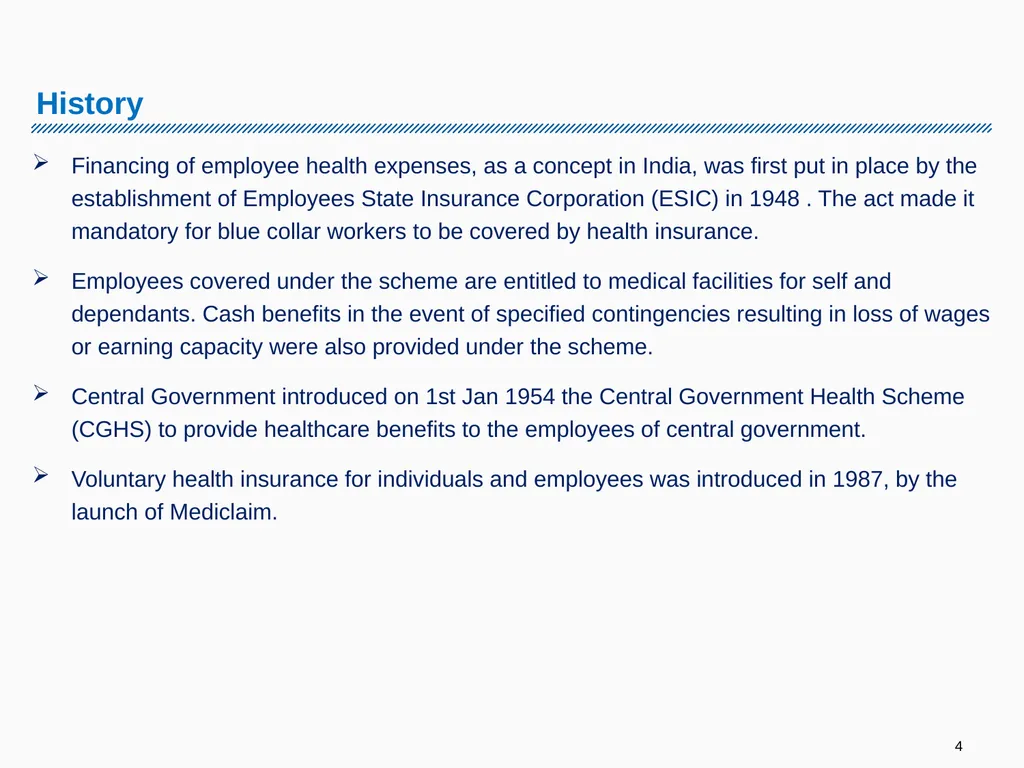
History Financing of employee health expenses, as a concept in India, was first put in place by the establishment of Employees State Insurance Corporation (ESIC) in 1948 . The act made it mandatory for blue collar workers to be covered by health insurance.
Employees covered under the scheme are entitled to medical facilities for self and dependants. Cash benefits in the event of specified contingencies resulting in loss of wages or earning capacity were also provided under the scheme.
Central Government introduced on 1st Jan 1954 the Central Government Health Scheme (CGHS) to provide healthcare benefits to the employees of central government.
Voluntary health insurance for individuals and employees was introduced in 1987, by the launch of Mediclaim. 4<br>
Employees covered under the scheme are entitled to medical facilities for self and dependants. Cash benefits in the event of specified contingencies resulting in loss of wages or earning capacity were also provided under the scheme.
Central Government introduced on 1st Jan 1954 the Central Government Health Scheme (CGHS) to provide healthcare benefits to the employees of central government.
Voluntary health insurance for individuals and employees was introduced in 1987, by the launch of Mediclaim. 4<br>
05
Corporate Health Plan – Product, Pricing & Underwriting 5<br>
06
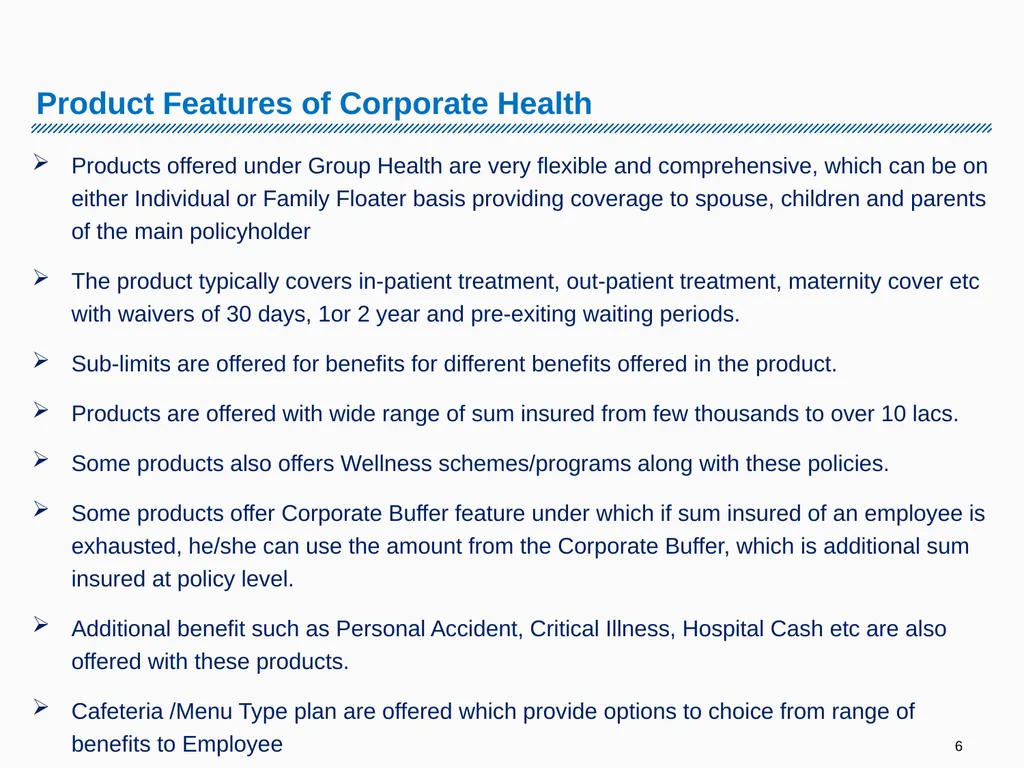
Product Features of Corporate Health Products offered under Group Health are very flexible and comprehensive, which can be on either Individual or Family Floater basis providing coverage to spouse, children and parents of the main policyholder
The product typically covers in-patient treatment, out-patient treatment, maternity cover etc with waivers of 30 days, 1or 2 year and pre-exiting waiting periods.
Sub-limits are offered for benefits for different benefits offered in the product.
Products are offered with wide range of sum insured from few thousands to over 10 lacs.
Some products also offers Wellness schemes/programs along with these policies.
Some products offer Corporate Buffer feature under which if sum insured of an employee is exhausted, he/she can use the amount from the Corporate Buffer, which is additional sum insured at policy level.
Additional benefit such as Personal Accident, Critical Illness, Hospital Cash etc are also offered with these products.
Cafeteria /Menu Type plan are offered which provide options to choice from range of benefits to Employee 6<br>
The product typically covers in-patient treatment, out-patient treatment, maternity cover etc with waivers of 30 days, 1or 2 year and pre-exiting waiting periods.
Sub-limits are offered for benefits for different benefits offered in the product.
Products are offered with wide range of sum insured from few thousands to over 10 lacs.
Some products also offers Wellness schemes/programs along with these policies.
Some products offer Corporate Buffer feature under which if sum insured of an employee is exhausted, he/she can use the amount from the Corporate Buffer, which is additional sum insured at policy level.
Additional benefit such as Personal Accident, Critical Illness, Hospital Cash etc are also offered with these products.
Cafeteria /Menu Type plan are offered which provide options to choice from range of benefits to Employee 6<br>
07
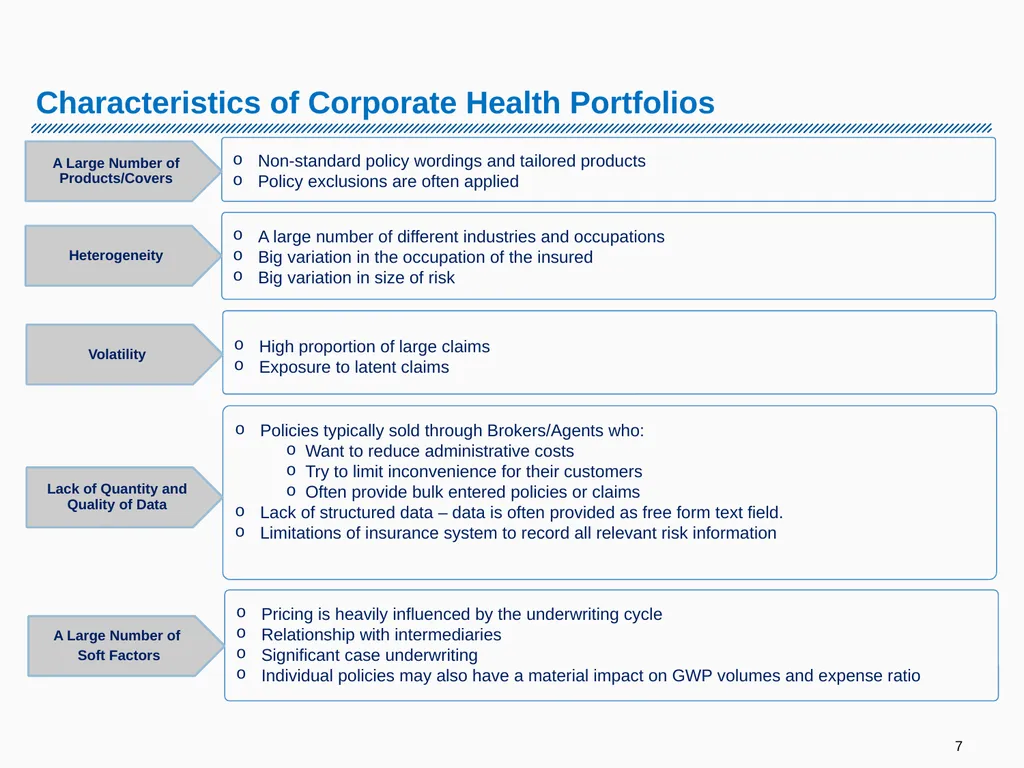
Characteristics of Corporate Health Portfolios A large number of different industries and occupations
Big variation in the occupation of the insured
Big variation in size of risk Heterogeneity High proportion of large claims
Exposure to latent claims Volatility Policies typically sold through Brokers/Agents who:
Want to reduce administrative costs
Try to limit inconvenience for their customers
Often provide bulk entered policies or claims
Lack of structured data – data is often provided as free form text field.
Limitations of insurance system to record all relevant risk information Lack of Quantity and Quality of Data Pricing is heavily influenced by the underwriting cycle
Relationship with intermediaries
Significant case underwriting
Individual policies may also have a material impact on GWP volumes and expense ratio A Large Number of
Soft Factors Non-standard policy wordings and tailored products
Policy exclusions are often applied A Large Number of Products/Covers 7<br>
Big variation in the occupation of the insured
Big variation in size of risk Heterogeneity High proportion of large claims
Exposure to latent claims Volatility Policies typically sold through Brokers/Agents who:
Want to reduce administrative costs
Try to limit inconvenience for their customers
Often provide bulk entered policies or claims
Lack of structured data – data is often provided as free form text field.
Limitations of insurance system to record all relevant risk information Lack of Quantity and Quality of Data Pricing is heavily influenced by the underwriting cycle
Relationship with intermediaries
Significant case underwriting
Individual policies may also have a material impact on GWP volumes and expense ratio A Large Number of
Soft Factors Non-standard policy wordings and tailored products
Policy exclusions are often applied A Large Number of Products/Covers 7<br>
08
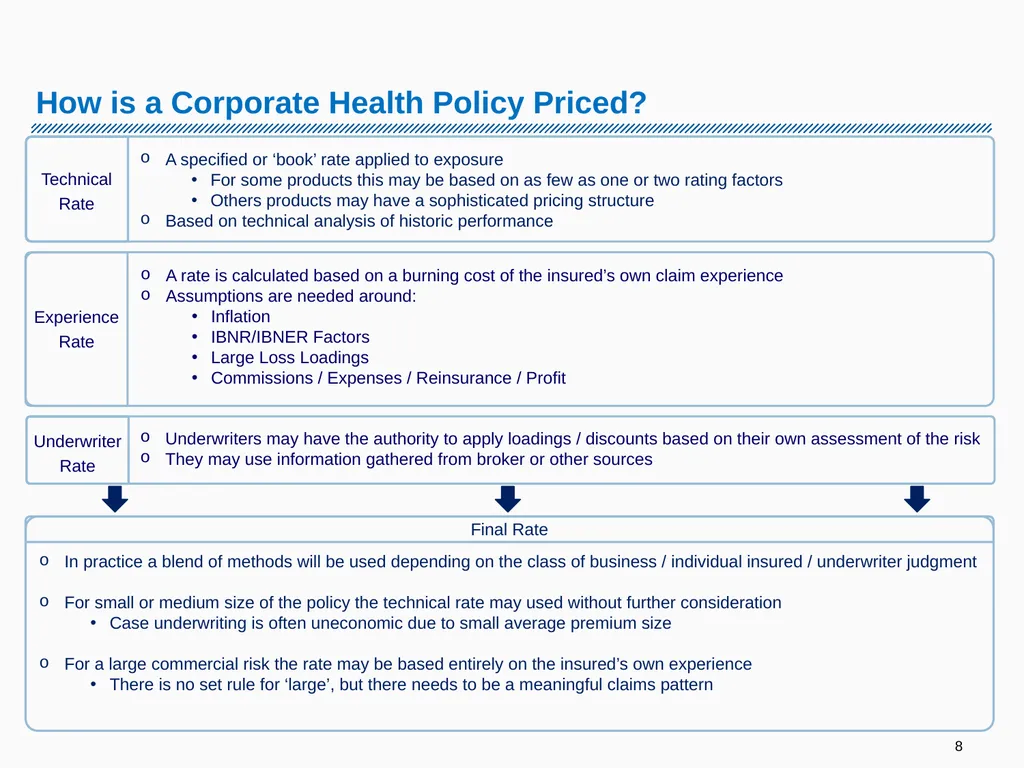
Underwriter Rate How is a Corporate Health Policy Priced? A specified or ‘book’ rate applied to exposure
For some products this may be based on as few as one or two rating factors
Others products may have a sophisticated pricing structure
Based on technical analysis of historic performance In practice a blend of methods will be used depending on the class of business / individual insured / underwriter judgment
For small or medium size of the policy the technical rate may used without further consideration
Case underwriting is often uneconomic due to small average premium size
For a large commercial risk the rate may be based entirely on the insured’s own experience
There is no set rule for ‘large’, but there needs to be a meaningful claims pattern A rate is calculated based on a burning cost of the insured’s own claim experience
Assumptions are needed around:
Inflation
IBNR/IBNER Factors
Large Loss Loadings
Commissions / Expenses / Reinsurance / Profit Experience Rate Technical Rate Underwriters may have the authority to apply loadings / discounts based on their own assessment of the risk
They may use information gathered from broker or other sources Final Rate 8<br>
For some products this may be based on as few as one or two rating factors
Others products may have a sophisticated pricing structure
Based on technical analysis of historic performance In practice a blend of methods will be used depending on the class of business / individual insured / underwriter judgment
For small or medium size of the policy the technical rate may used without further consideration
Case underwriting is often uneconomic due to small average premium size
For a large commercial risk the rate may be based entirely on the insured’s own experience
There is no set rule for ‘large’, but there needs to be a meaningful claims pattern A rate is calculated based on a burning cost of the insured’s own claim experience
Assumptions are needed around:
Inflation
IBNR/IBNER Factors
Large Loss Loadings
Commissions / Expenses / Reinsurance / Profit Experience Rate Technical Rate Underwriters may have the authority to apply loadings / discounts based on their own assessment of the risk
They may use information gathered from broker or other sources Final Rate 8<br>
09
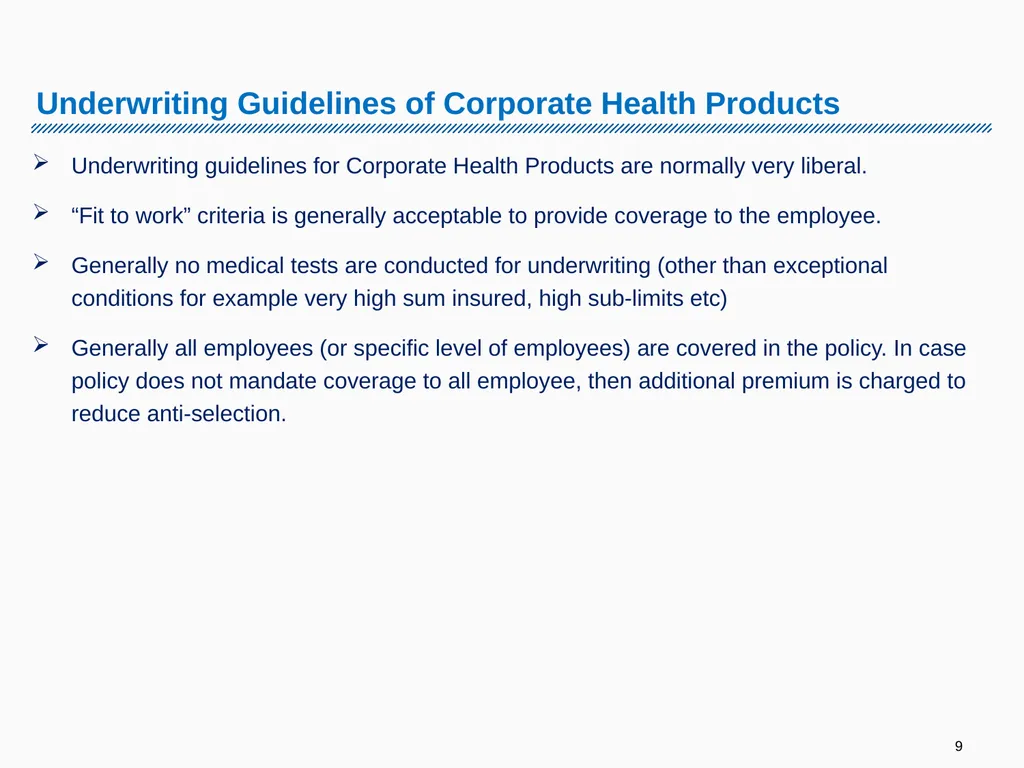
Underwriting Guidelines of Corporate Health Products Underwriting guidelines for Corporate Health Products are normally very liberal.
“Fit to work” criteria is generally acceptable to provide coverage to the employee.
Generally no medical tests are conducted for underwriting (other than exceptional conditions for example very high sum insured, high sub-limits etc)
Generally all employees (or specific level of employees) are covered in the policy. In case policy does not mandate coverage to all employee, then additional premium is charged to reduce anti-selection. 9<br>
“Fit to work” criteria is generally acceptable to provide coverage to the employee.
Generally no medical tests are conducted for underwriting (other than exceptional conditions for example very high sum insured, high sub-limits etc)
Generally all employees (or specific level of employees) are covered in the policy. In case policy does not mandate coverage to all employee, then additional premium is charged to reduce anti-selection. 9<br>
10
Corporate Health – Indian Statistics 10<br>
11
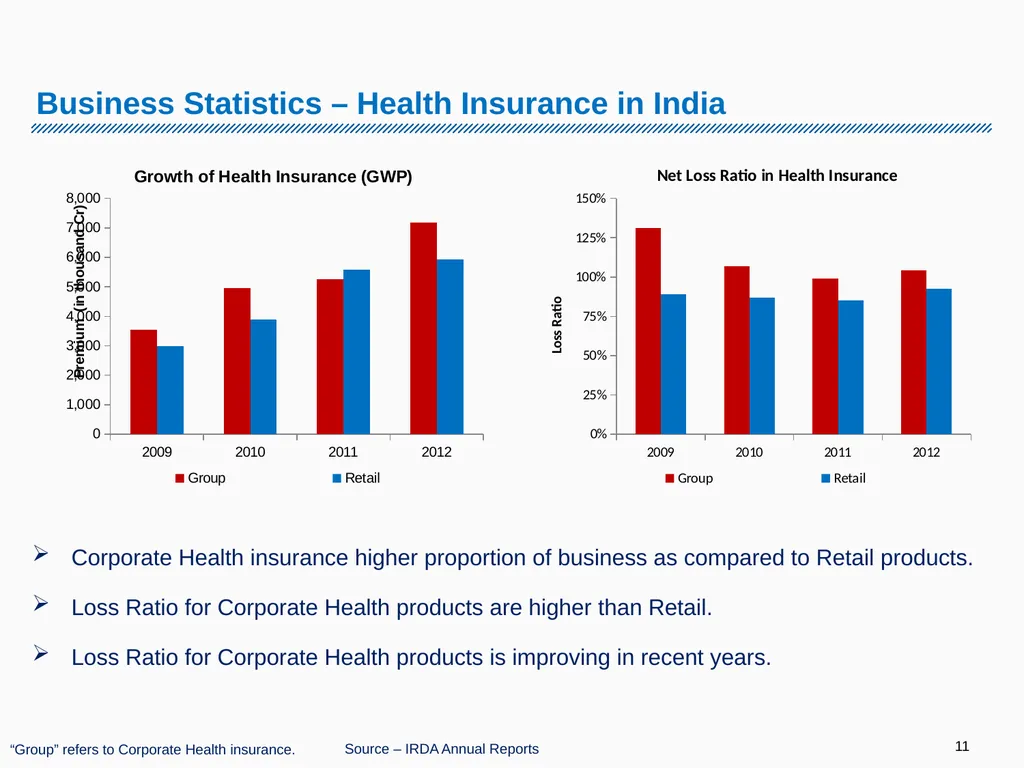
Business Statistics – Health Insurance in India “Group” refers to Corporate Health insurance. Corporate Health insurance higher proportion of business as compared to Retail products.
Loss Ratio for Corporate Health products are higher than Retail.
Loss Ratio for Corporate Health products is improving in recent years. Source – IRDA Annual Reports 11<br>
Loss Ratio for Corporate Health products are higher than Retail.
Loss Ratio for Corporate Health products is improving in recent years. Source – IRDA Annual Reports 11<br>
12
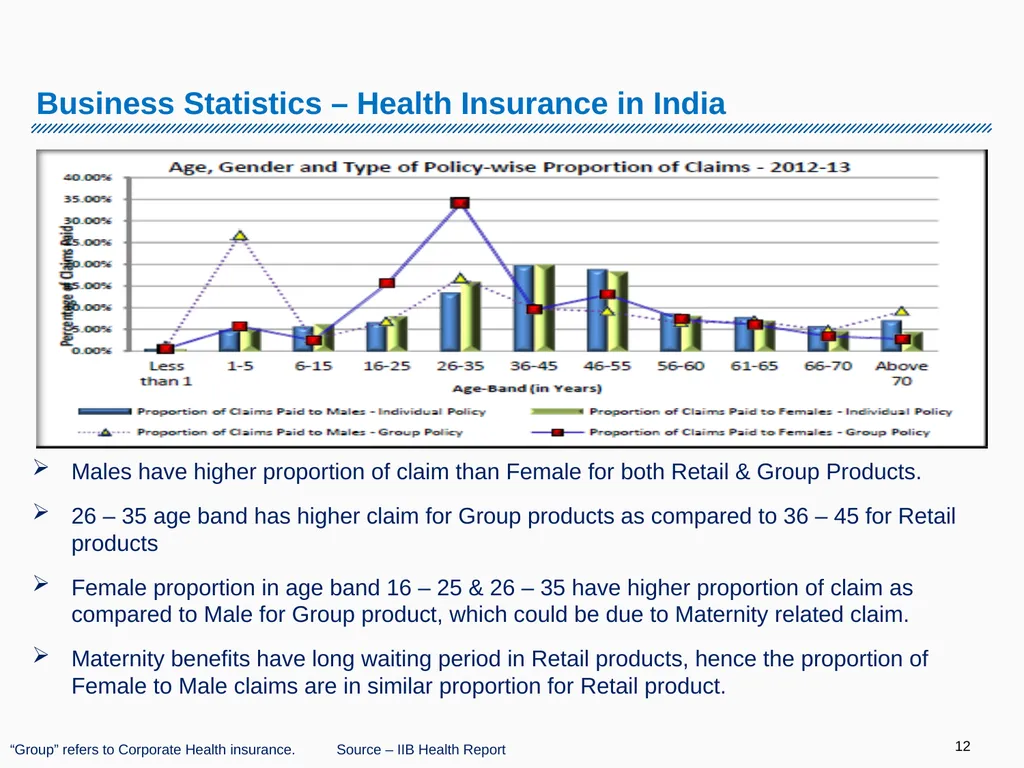
Males have higher proportion of claim than Female for both Retail & Group Products.
26 – 35 age band has higher claim for Group products as compared to 36 – 45 for Retail products
Female proportion in age band 16 – 25 & 26 – 35 have higher proportion of claim as compared to Male for Group product, which could be due to Maternity related claim.
Maternity benefits have long waiting period in Retail products, hence the proportion of Female to Male claims are in similar proportion for Retail product. Business Statistics – Health Insurance in India “Group” refers to Corporate Health insurance. Source – IIB Health Report 12<br>
26 – 35 age band has higher claim for Group products as compared to 36 – 45 for Retail products
Female proportion in age band 16 – 25 & 26 – 35 have higher proportion of claim as compared to Male for Group product, which could be due to Maternity related claim.
Maternity benefits have long waiting period in Retail products, hence the proportion of Female to Male claims are in similar proportion for Retail product. Business Statistics – Health Insurance in India “Group” refers to Corporate Health insurance. Source – IIB Health Report 12<br>
13
Probable Reasons for Adverse Experience 13<br>
14
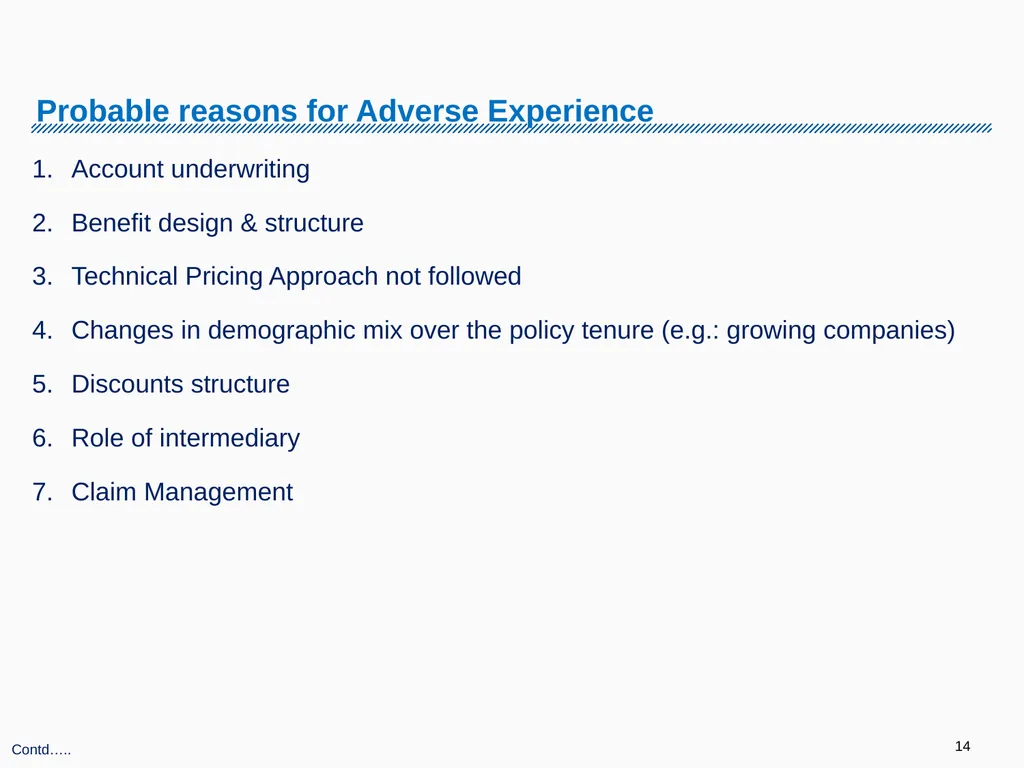
Probable reasons for Adverse Experience Account underwriting
Benefit design & structure
Technical Pricing Approach not followed
Changes in demographic mix over the policy tenure (e.g.: growing companies)
Discounts structure
Role of intermediary
Claim Management Contd….. 14<br>
Benefit design & structure
Technical Pricing Approach not followed
Changes in demographic mix over the policy tenure (e.g.: growing companies)
Discounts structure
Role of intermediary
Claim Management Contd….. 14<br>
15
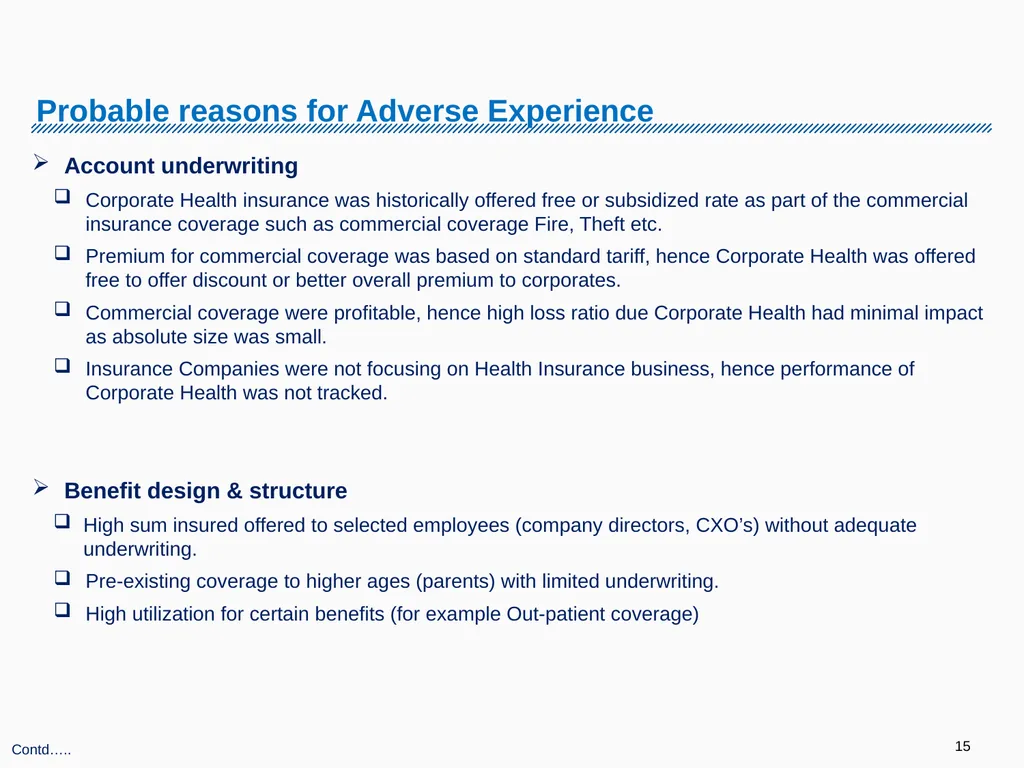
Probable reasons for Adverse Experience Account underwriting
Corporate Health insurance was historically offered free or subsidized rate as part of the commercial insurance coverage such as commercial coverage Fire, Theft etc.
Premium for commercial coverage was based on standard tariff, hence Corporate Health was offered free to offer discount or better overall premium to corporates.
Commercial coverage were profitable, hence high loss ratio due Corporate Health had minimal impact as absolute size was small.
Insurance Companies were not focusing on Health Insurance business, hence performance of Corporate Health was not tracked.
Benefit design & structure
High sum insured offered to selected employees (company directors, CXO’s) without adequate underwriting.
Pre-existing coverage to higher ages (parents) with limited underwriting.
High utilization for certain benefits (for example Out-patient coverage) 15 Contd…..<br>
Corporate Health insurance was historically offered free or subsidized rate as part of the commercial insurance coverage such as commercial coverage Fire, Theft etc.
Premium for commercial coverage was based on standard tariff, hence Corporate Health was offered free to offer discount or better overall premium to corporates.
Commercial coverage were profitable, hence high loss ratio due Corporate Health had minimal impact as absolute size was small.
Insurance Companies were not focusing on Health Insurance business, hence performance of Corporate Health was not tracked.
Benefit design & structure
High sum insured offered to selected employees (company directors, CXO’s) without adequate underwriting.
Pre-existing coverage to higher ages (parents) with limited underwriting.
High utilization for certain benefits (for example Out-patient coverage) 15 Contd…..<br>
16
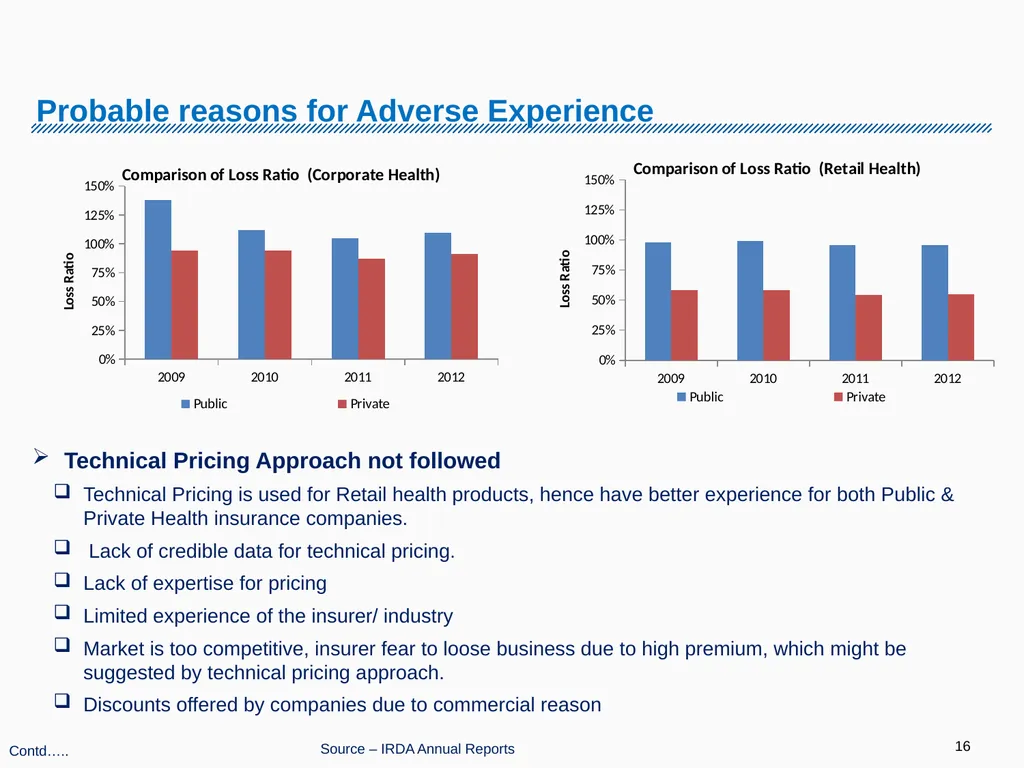
Probable reasons for Adverse Experience Technical Pricing Approach not followed
Technical Pricing is used for Retail health products, hence have better experience for both Public & Private Health insurance companies.
Lack of credible data for technical pricing.
Lack of expertise for pricing
Limited experience of the insurer/ industry
Market is too competitive, insurer fear to loose business due to high premium, which might be suggested by technical pricing approach.
Discounts offered by companies due to commercial reason Source – IRDA Annual Reports Contd….. 16<br>
Technical Pricing is used for Retail health products, hence have better experience for both Public & Private Health insurance companies.
Lack of credible data for technical pricing.
Lack of expertise for pricing
Limited experience of the insurer/ industry
Market is too competitive, insurer fear to loose business due to high premium, which might be suggested by technical pricing approach.
Discounts offered by companies due to commercial reason Source – IRDA Annual Reports Contd….. 16<br>
17
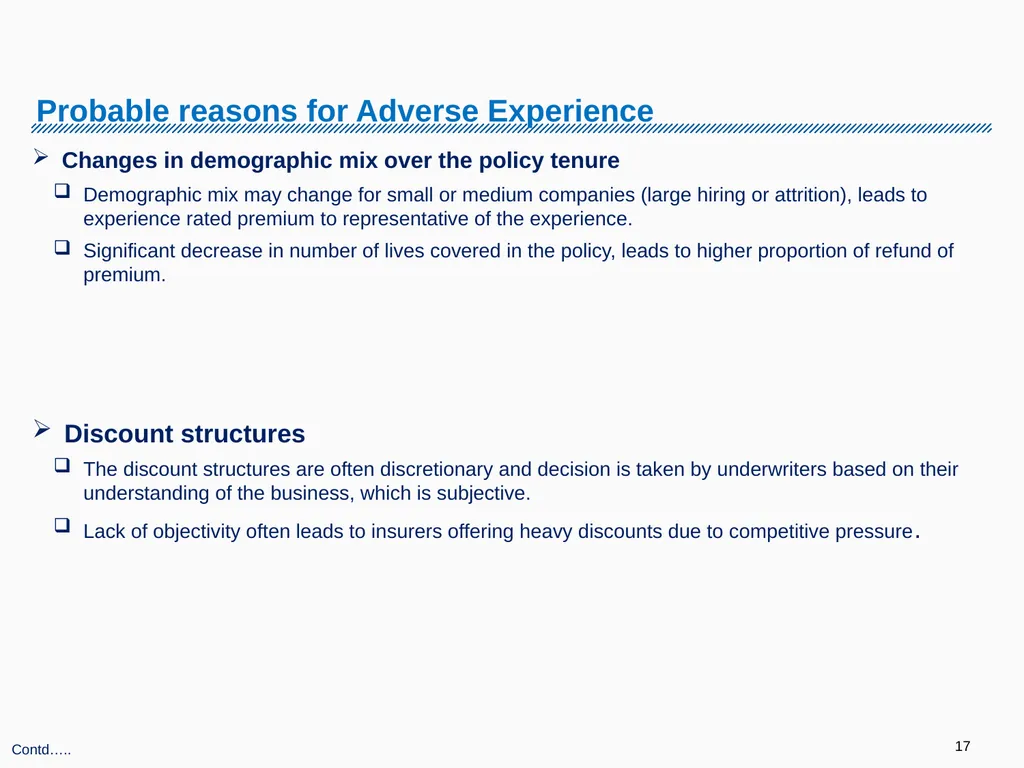
Probable reasons for Adverse Experience Changes in demographic mix over the policy tenure
Demographic mix may change for small or medium companies (large hiring or attrition), leads to experience rated premium to representative of the experience.
Significant decrease in number of lives covered in the policy, leads to higher proportion of refund of premium.
Discount structures
The discount structures are often discretionary and decision is taken by underwriters based on their understanding of the business, which is subjective.
Lack of objectivity often leads to insurers offering heavy discounts due to competitive pressure. 17 Contd…..<br>
Demographic mix may change for small or medium companies (large hiring or attrition), leads to experience rated premium to representative of the experience.
Significant decrease in number of lives covered in the policy, leads to higher proportion of refund of premium.
Discount structures
The discount structures are often discretionary and decision is taken by underwriters based on their understanding of the business, which is subjective.
Lack of objectivity often leads to insurers offering heavy discounts due to competitive pressure. 17 Contd…..<br>
18
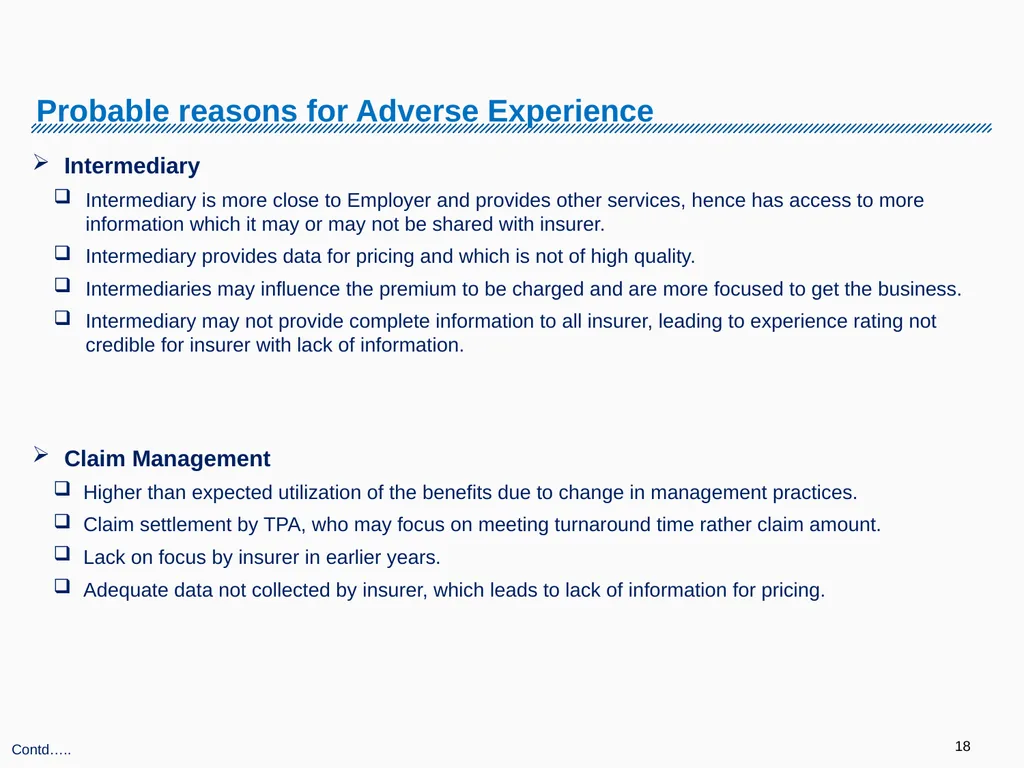
Probable reasons for Adverse Experience Intermediary
Intermediary is more close to Employer and provides other services, hence has access to more information which it may or may not be shared with insurer.
Intermediary provides data for pricing and which is not of high quality.
Intermediaries may influence the premium to be charged and are more focused to get the business.
Intermediary may not provide complete information to all insurer, leading to experience rating not credible for insurer with lack of information.
Claim Management
Higher than expected utilization of the benefits due to change in management practices.
Claim settlement by TPA, who may focus on meeting turnaround time rather claim amount.
Lack on focus by insurer in earlier years.
Adequate data not collected by insurer, which leads to lack of information for pricing. 18 Contd…..<br>
Intermediary is more close to Employer and provides other services, hence has access to more information which it may or may not be shared with insurer.
Intermediary provides data for pricing and which is not of high quality.
Intermediaries may influence the premium to be charged and are more focused to get the business.
Intermediary may not provide complete information to all insurer, leading to experience rating not credible for insurer with lack of information.
Claim Management
Higher than expected utilization of the benefits due to change in management practices.
Claim settlement by TPA, who may focus on meeting turnaround time rather claim amount.
Lack on focus by insurer in earlier years.
Adequate data not collected by insurer, which leads to lack of information for pricing. 18 Contd…..<br>
19
Probable solutions<br>
20
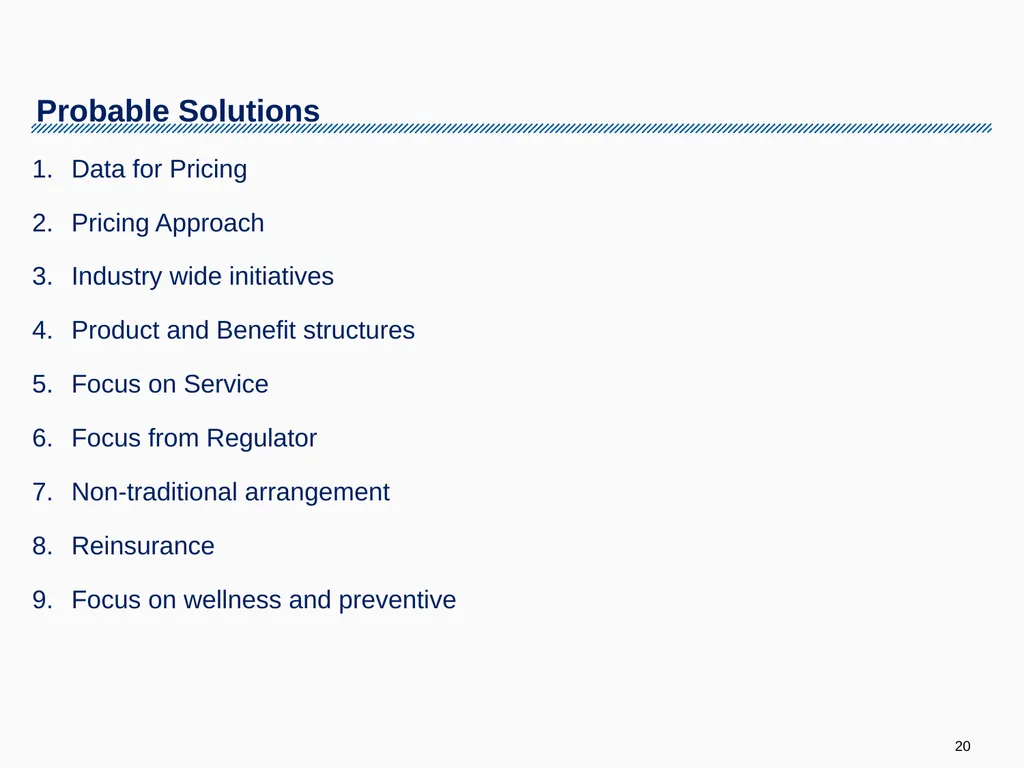
Probable Solutions Data for Pricing
Pricing Approach
Industry wide initiatives
Product and Benefit structures
Focus on Service
Focus from Regulator
Non-traditional arrangement
Reinsurance
Focus on wellness and preventive 20<br>
Pricing Approach
Industry wide initiatives
Product and Benefit structures
Focus on Service
Focus from Regulator
Non-traditional arrangement
Reinsurance
Focus on wellness and preventive 20<br>
21
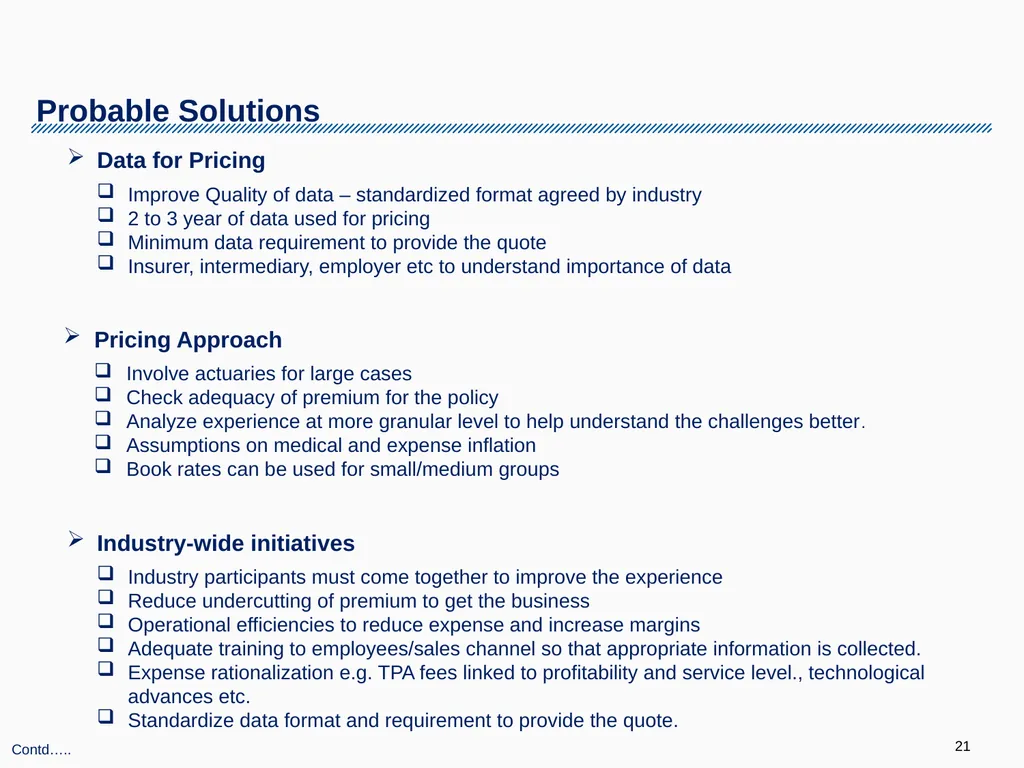
Probable Solutions Data for Pricing
Improve Quality of data – standardized format agreed by industry
2 to 3 year of data used for pricing
Minimum data requirement to provide the quote
Insurer, intermediary, employer etc to understand importance of data
Pricing Approach
Involve actuaries for large cases
Check adequacy of premium for the policy
Analyze experience at more granular level to help understand the challenges better.
Assumptions on medical and expense inflation
Book rates can be used for small/medium groups
Industry-wide initiatives
Industry participants must come together to improve the experience
Reduce undercutting of premium to get the business
Operational efficiencies to reduce expense and increase margins
Adequate training to employees/sales channel so that appropriate information is collected.
Expense rationalization e.g. TPA fees linked to profitability and service level., technological advances etc.
Standardize data format and requirement to provide the quote. 21 Contd…..<br>
Improve Quality of data – standardized format agreed by industry
2 to 3 year of data used for pricing
Minimum data requirement to provide the quote
Insurer, intermediary, employer etc to understand importance of data
Pricing Approach
Involve actuaries for large cases
Check adequacy of premium for the policy
Analyze experience at more granular level to help understand the challenges better.
Assumptions on medical and expense inflation
Book rates can be used for small/medium groups
Industry-wide initiatives
Industry participants must come together to improve the experience
Reduce undercutting of premium to get the business
Operational efficiencies to reduce expense and increase margins
Adequate training to employees/sales channel so that appropriate information is collected.
Expense rationalization e.g. TPA fees linked to profitability and service level., technological advances etc.
Standardize data format and requirement to provide the quote. 21 Contd…..<br>
22
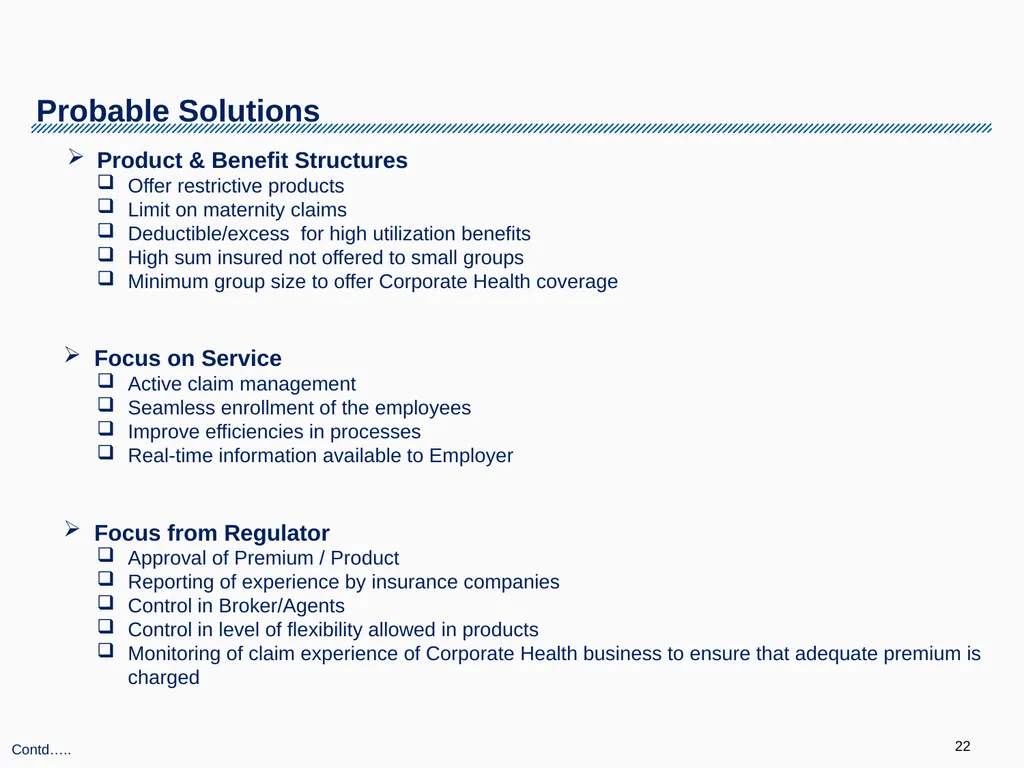
Probable Solutions Product & Benefit Structures
Offer restrictive products
Limit on maternity claims
Deductible/excess for high utilization benefits
High sum insured not offered to small groups
Minimum group size to offer Corporate Health coverage
Focus on Service
Active claim management
Seamless enrollment of the employees
Improve efficiencies in processes
Real-time information available to Employer
Focus from Regulator
Approval of Premium / Product
Reporting of experience by insurance companies
Control in Broker/Agents
Control in level of flexibility allowed in products
Monitoring of claim experience of Corporate Health business to ensure that adequate premium is charged 22 Contd…..<br>
Offer restrictive products
Limit on maternity claims
Deductible/excess for high utilization benefits
High sum insured not offered to small groups
Minimum group size to offer Corporate Health coverage
Focus on Service
Active claim management
Seamless enrollment of the employees
Improve efficiencies in processes
Real-time information available to Employer
Focus from Regulator
Approval of Premium / Product
Reporting of experience by insurance companies
Control in Broker/Agents
Control in level of flexibility allowed in products
Monitoring of claim experience of Corporate Health business to ensure that adequate premium is charged 22 Contd…..<br>
23
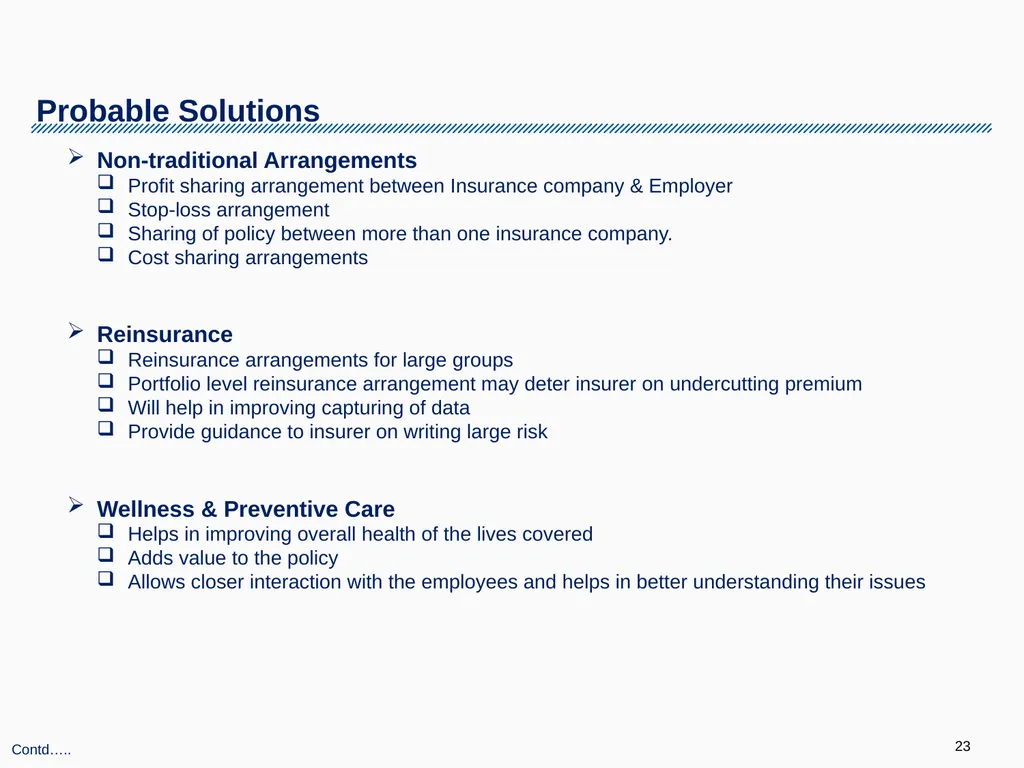
Probable Solutions Non-traditional Arrangements
Profit sharing arrangement between Insurance company & Employer
Stop-loss arrangement
Sharing of policy between more than one insurance company.
Cost sharing arrangements
Reinsurance
Reinsurance arrangements for large groups
Portfolio level reinsurance arrangement may deter insurer on undercutting premium
Will help in improving capturing of data
Provide guidance to insurer on writing large risk
Wellness & Preventive Care
Helps in improving overall health of the lives covered
Adds value to the policy
Allows closer interaction with the employees and helps in better understanding their issues 23 Contd…..<br>
Profit sharing arrangement between Insurance company & Employer
Stop-loss arrangement
Sharing of policy between more than one insurance company.
Cost sharing arrangements
Reinsurance
Reinsurance arrangements for large groups
Portfolio level reinsurance arrangement may deter insurer on undercutting premium
Will help in improving capturing of data
Provide guidance to insurer on writing large risk
Wellness & Preventive Care
Helps in improving overall health of the lives covered
Adds value to the policy
Allows closer interaction with the employees and helps in better understanding their issues 23 Contd…..<br>
24
Conclusion 24<br>
25
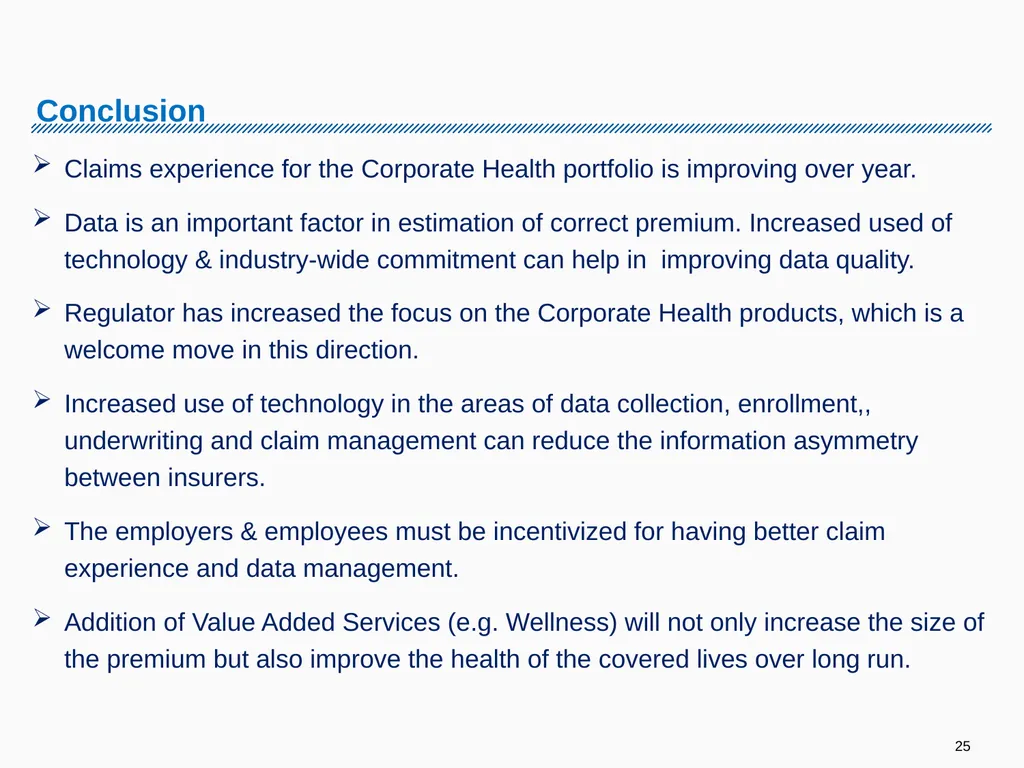
Conclusion Claims experience for the Corporate Health portfolio is improving over year.
Data is an important factor in estimation of correct premium. Increased used of technology & industry-wide commitment can help in improving data quality.
Regulator has increased the focus on the Corporate Health products, which is a welcome move in this direction.
Increased use of technology in the areas of data collection, enrollment,, underwriting and claim management can reduce the information asymmetry between insurers.
The employers & employees must be incentivized for having better claim experience and data management.
Addition of Value Added Services (e.g. Wellness) will not only increase the size of the premium but also improve the health of the covered lives over long run. 25<br>
Data is an important factor in estimation of correct premium. Increased used of technology & industry-wide commitment can help in improving data quality.
Regulator has increased the focus on the Corporate Health products, which is a welcome move in this direction.
Increased use of technology in the areas of data collection, enrollment,, underwriting and claim management can reduce the information asymmetry between insurers.
The employers & employees must be incentivized for having better claim experience and data management.
Addition of Value Added Services (e.g. Wellness) will not only increase the size of the premium but also improve the health of the covered lives over long run. 25<br>
26
Thank you!! 26<br>