
Corporate Training on Hydrogen Energy and
SB
Published · 9 slides · 0 views

1 / 1
Description
Corporate Training on Hydrogen Energy and Electrification for Industry Professionals (VIT-Vellore, India Binghamton University - SSIE, USA) 1 Hydrogen for Sustainable Mobility 2 Course Title: Hydrogen for Sustainable Mobility Course
Related Topics
Share
Embed code
Download this presentation From Below
"Corporate Training on Hydrogen Energy and" is the property of its rightful owner. Permission is granted to download and print the materials on this website for personal, non-commercial use only, and to display it on your personal computer provided you do not modify the materials and that you retain all copyright notices contained in the materials. By downloading content from our website, you accept the terms of this agreement.
Presentation Transcript
01
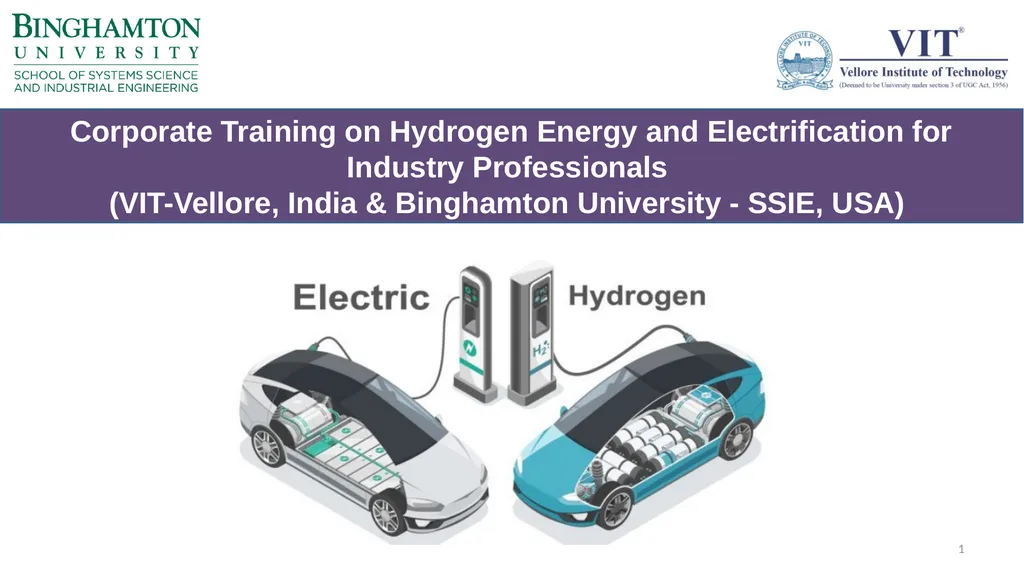
Corporate Training on Hydrogen Energy and Electrification for Industry Professionals
(VIT-Vellore, India & Binghamton University - SSIE, USA) 1<br>
(VIT-Vellore, India & Binghamton University - SSIE, USA) 1<br>
02
Hydrogen for Sustainable Mobility 2 Course Title:
Hydrogen for Sustainable Mobility
Course duration: 45 hours
Course Details:
This course provides engineers with a comprehensive understanding of hydrogen energy, blending core theoretical knowledge with practical skills essential for careers in the rapidly evolving hydrogen industry. It prepares professionals to develop and implement hydrogen as a sustainable alternative to fossil fuels, encompassing both automotive and stationary power applications. Through a balanced curriculum, classroom instruction is directly reinforced by hands-on laboratory experience, ensuring participants gain both the conceptual foundation and the practical expertise required to thrive in this cutting-edge field.<br>
Hydrogen for Sustainable Mobility
Course duration: 45 hours
Course Details:
This course provides engineers with a comprehensive understanding of hydrogen energy, blending core theoretical knowledge with practical skills essential for careers in the rapidly evolving hydrogen industry. It prepares professionals to develop and implement hydrogen as a sustainable alternative to fossil fuels, encompassing both automotive and stationary power applications. Through a balanced curriculum, classroom instruction is directly reinforced by hands-on laboratory experience, ensuring participants gain both the conceptual foundation and the practical expertise required to thrive in this cutting-edge field.<br>
03
Hydrogen for Sustainable Mobility 3 Theory session Part -I:
Overview of hydrogen: Properties, Production and Utilization
Hydrogen Fuel Fundamentals: Explore the essential requirements and properties of hydrogen for engine applications, contrasting them with conventional fuels and their emissions.
Hydrogen Engine Systems: Understand the hydrogen storage, fuel supply systems, safety aspects, and necessary devices specifically designed for hydrogen engines.
Combustion and Engine Modification: Learn about combustion stoichiometry and the modifications required for engines to effectively utilize hydrogen fuel.
System Integration for Hydrogen Engines: Investigate critical factors for engine system modification, including the hydrogen fuel tank, fuel lines, injection requirements, characteristic features, and engine electronic controller.
Life Cycle Assessment (LCA): Provides a robust data-driven evaluation of their environmental performance from a source to sink perspective.<br>
Overview of hydrogen: Properties, Production and Utilization
Hydrogen Fuel Fundamentals: Explore the essential requirements and properties of hydrogen for engine applications, contrasting them with conventional fuels and their emissions.
Hydrogen Engine Systems: Understand the hydrogen storage, fuel supply systems, safety aspects, and necessary devices specifically designed for hydrogen engines.
Combustion and Engine Modification: Learn about combustion stoichiometry and the modifications required for engines to effectively utilize hydrogen fuel.
System Integration for Hydrogen Engines: Investigate critical factors for engine system modification, including the hydrogen fuel tank, fuel lines, injection requirements, characteristic features, and engine electronic controller.
Life Cycle Assessment (LCA): Provides a robust data-driven evaluation of their environmental performance from a source to sink perspective.<br>
04
Hydrogen for Sustainable Mobility 4 Theory session Part -II:
Hydrogen in Automotive Powertrains: From Theory to real time applications
Hydrogen Combustion Strategies: Explore hydrogen utilization in Spark Ignition (SI) and Compression Ignition (CI) engines, including pure hydrogen SI, dual-fuel, and various Low-Temperature Combustion (LTC) modes (HCCI, PCCI, RCCI).
LTC Benefits & Challenges: Understand the benefits, characteristics, and challenges of different LTC strategies and how hydrogen is applied within them.
Engine Performance & Emissions: Analyze the combustion, performance, and emissions attributes of hydrogen-powered engines across various combustion strategies.
Fuel Cell Vehicles: Principles of various fuel cell types (PEMFC, SOFC), their components, electrochemistry, and efficiency. Detailing the integration of fuel cell stacks into vehicle powertrains, refueling infrastructure, safety considerations.
Heavy Vehicle & Off-Road Applications: Investigate the specific applications of hydrogen in heavy commercial vehicles and off-road machinery.
Modeling & Simulation: Acquire the modeling and simulation techniques for hydrogen use in vehicle applications.<br>
Hydrogen in Automotive Powertrains: From Theory to real time applications
Hydrogen Combustion Strategies: Explore hydrogen utilization in Spark Ignition (SI) and Compression Ignition (CI) engines, including pure hydrogen SI, dual-fuel, and various Low-Temperature Combustion (LTC) modes (HCCI, PCCI, RCCI).
LTC Benefits & Challenges: Understand the benefits, characteristics, and challenges of different LTC strategies and how hydrogen is applied within them.
Engine Performance & Emissions: Analyze the combustion, performance, and emissions attributes of hydrogen-powered engines across various combustion strategies.
Fuel Cell Vehicles: Principles of various fuel cell types (PEMFC, SOFC), their components, electrochemistry, and efficiency. Detailing the integration of fuel cell stacks into vehicle powertrains, refueling infrastructure, safety considerations.
Heavy Vehicle & Off-Road Applications: Investigate the specific applications of hydrogen in heavy commercial vehicles and off-road machinery.
Modeling & Simulation: Acquire the modeling and simulation techniques for hydrogen use in vehicle applications.<br>
05
Hydrogen for Sustainable Mobility 5 Gain hands-on experience with following equipment:
Demonstration equipment and instrumentation related to hydrogen production technologies
Hydrogen production through the use of electrolysis process.
On-board hydrogen generation - methanol reformer.
Demonstration of hydrogen engine test rig
Hands-on training using equipment, covering: Safety measures, estimation of combustion and emissions parameters.
Detailed experimental testing using hydrogen will be conducted in engines, with a particular focus on CI engines operating in Low Temperature Combustion (LTC) mode to achieve near-zero NOx emissions.
Other related equipment used for experimental studies
Combustion analyzer
Eddy current dynamometer
Exhaust gas analyzer and Smoke meter
Hydrogen generator<br>
Demonstration equipment and instrumentation related to hydrogen production technologies
Hydrogen production through the use of electrolysis process.
On-board hydrogen generation - methanol reformer.
Demonstration of hydrogen engine test rig
Hands-on training using equipment, covering: Safety measures, estimation of combustion and emissions parameters.
Detailed experimental testing using hydrogen will be conducted in engines, with a particular focus on CI engines operating in Low Temperature Combustion (LTC) mode to achieve near-zero NOx emissions.
Other related equipment used for experimental studies
Combustion analyzer
Eddy current dynamometer
Exhaust gas analyzer and Smoke meter
Hydrogen generator<br>
06
Electrification Training 6 Course Title:
Electrification Training
Course duration: 45 hours
Course Details:
Electrification training equips professionals with the specialized skills needed to work safely and effectively with high-voltage systems, advanced battery technologies, and electric drivetrains, which differ significantly from traditional combustion engines. As the global shift toward sustainable transportation accelerates, trained technicians are in high demand to service, diagnose, and maintain EVs, ensuring optimal performance and safety. This training not only enhances career growth and job security but also supports environmental goals by enabling the efficient operation of zero-emission vehicles.<br>
Electrification Training
Course duration: 45 hours
Course Details:
Electrification training equips professionals with the specialized skills needed to work safely and effectively with high-voltage systems, advanced battery technologies, and electric drivetrains, which differ significantly from traditional combustion engines. As the global shift toward sustainable transportation accelerates, trained technicians are in high demand to service, diagnose, and maintain EVs, ensuring optimal performance and safety. This training not only enhances career growth and job security but also supports environmental goals by enabling the efficient operation of zero-emission vehicles.<br>
07
Electrification Training 7 BEV Overview - Demonstration or walk around - Layout of the vehicles, Connection of the components, EV - HV Safety, Isolation, Actuators, Feedback/Closed loop control system, Driving to have a feel of dynamics, Introduction to fault diagnostics. Basic Laws (Fleming’s right hand rule, left hand rule), Lenz law etc.
Basics of Batteries & specifications and modeling of batteries. selection of battery rating for EV application.
Battery Management Practical - Charging profile, SOC calculation, Degradation, Cell Management, Range calculation/ Power consumption, Charging time calculation. “state observer method”, based on equivalent circuit model, Lueneberg Observer Method (in detail), extended Kalman filter, dual extended Kalman filter (overview). Active and Passive cell balancing.
Welding detection, Isolation monitoring, Hot spot detection (Sensor or model based), Crash reaction monitoring. Basic of sensors, transducers and measurements - Sensor types, characteristics and choice of sensors.
Three laws of Thermodynamics. Energy and exergy analysis, Vapour compression refrigeration system. Exergy analysis of thermal management of battery and motor of electric vehicles. Thermal analysis of different materials.
Basics of component, Design Procedure of inverters, PWM strategies, efficiency calculations Simulation studies of Classical Voltage source inverter and novel boost inverters. SVPWM technique. Device based models.<br>
Battery Management Practical - Charging profile, SOC calculation, Degradation, Cell Management, Range calculation/ Power consumption, Charging time calculation. “state observer method”, based on equivalent circuit model, Lueneberg Observer Method (in detail), extended Kalman filter, dual extended Kalman filter (overview). Active and Passive cell balancing.
Welding detection, Isolation monitoring, Hot spot detection (Sensor or model based), Crash reaction monitoring. Basic of sensors, transducers and measurements - Sensor types, characteristics and choice of sensors.
Three laws of Thermodynamics. Energy and exergy analysis, Vapour compression refrigeration system. Exergy analysis of thermal management of battery and motor of electric vehicles. Thermal analysis of different materials.
Basics of component, Design Procedure of inverters, PWM strategies, efficiency calculations Simulation studies of Classical Voltage source inverter and novel boost inverters. SVPWM technique. Device based models.<br>
08
Electrification Training 8 2-level VSI fed PMSM drive and BLDC. PWM pulse generation techniques. Open loop and Closed loop Speed Control.
Inverters - Waveform measurement, 3-phase, torque control (cold-start, staring on ramp, cruising). Harmonic analysis of inverters.
Construction, Torque Production, Inductance Profile, Rotor position estimation, Magnetization characteristics
PM Motors - Measure performance (torque, speed), Rotor position, Rotor/Stator Temperature, Efficiency/Back EMF. BLDC Control, Syn Motor Basics of switch, converter, Basics of measurements. Converters - Efficiency Calculations, Different topologies, Measurement techniques, converter performance evaluation. Overview of PCB technologies, DC Link, EMC filter, Capacitors<br>
Construction, Torque Production, Inductance Profile, Rotor position estimation, Magnetization characteristics
PM Motors - Measure performance (torque, speed), Rotor position, Rotor/Stator Temperature, Efficiency/Back EMF. BLDC Control, Syn Motor Basics of switch, converter, Basics of measurements. Converters - Efficiency Calculations, Different topologies, Measurement techniques, converter performance evaluation. Overview of PCB technologies, DC Link, EMC filter, Capacitors<br>
09
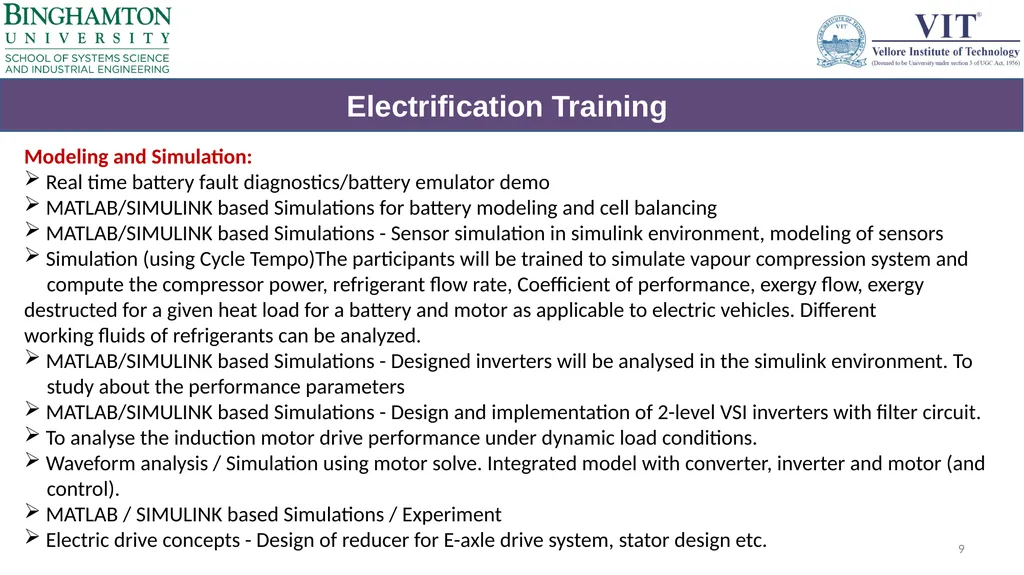
Electrification Training 9 Modeling and Simulation:
Real time battery fault diagnostics/battery emulator demo
MATLAB/SIMULINK based Simulations for battery modeling and cell balancing
MATLAB/SIMULINK based Simulations - Sensor simulation in simulink environment, modeling of sensors
Simulation (using Cycle Tempo)The participants will be trained to simulate vapour compression system and compute the compressor power, refrigerant flow rate, Coefficient of performance, exergy flow, exergy destructed for a given heat load for a battery and motor as applicable to electric vehicles. Different working fluids of refrigerants can be analyzed.
MATLAB/SIMULINK based Simulations - Designed inverters will be analysed in the simulink environment. To study about the performance parameters
MATLAB/SIMULINK based Simulations - Design and implementation of 2-level VSI inverters with filter circuit.
To analyse the induction motor drive performance under dynamic load conditions.
Waveform analysis / Simulation using motor solve. Integrated model with converter, inverter and motor (and control).
MATLAB / SIMULINK based Simulations / Experiment
Electric drive concepts - Design of reducer for E-axle drive system, stator design etc.<br>
Real time battery fault diagnostics/battery emulator demo
MATLAB/SIMULINK based Simulations for battery modeling and cell balancing
MATLAB/SIMULINK based Simulations - Sensor simulation in simulink environment, modeling of sensors
Simulation (using Cycle Tempo)The participants will be trained to simulate vapour compression system and compute the compressor power, refrigerant flow rate, Coefficient of performance, exergy flow, exergy destructed for a given heat load for a battery and motor as applicable to electric vehicles. Different working fluids of refrigerants can be analyzed.
MATLAB/SIMULINK based Simulations - Designed inverters will be analysed in the simulink environment. To study about the performance parameters
MATLAB/SIMULINK based Simulations - Design and implementation of 2-level VSI inverters with filter circuit.
To analyse the induction motor drive performance under dynamic load conditions.
Waveform analysis / Simulation using motor solve. Integrated model with converter, inverter and motor (and control).
MATLAB / SIMULINK based Simulations / Experiment
Electric drive concepts - Design of reducer for E-axle drive system, stator design etc.<br>