
Country, Date, Presenter Module 3a Identifying and
SB
Published · 28 slides · 0 views
1 / 1


Description
Country, Date, Presenter Module 3a Identifying and Prioritising Climate Change Adaptation Measures Objective The objectives of this module are to: learn about adaptation measures and strategies get to know different types of positive side
Related Topics
Share
Embed code
Download this presentation From Below
"Country, Date, Presenter Module 3a Identifying and" is the property of its rightful owner. Permission is granted to download and print the materials on this website for personal, non-commercial use only, and to display it on your personal computer provided you do not modify the materials and that you retain all copyright notices contained in the materials. By downloading content from our website, you accept the terms of this agreement.
Presentation Transcript
01
Country, Date, Presenter Module 3a
Identifying and Prioritising Climate
Change Adaptation Measures<br>
02
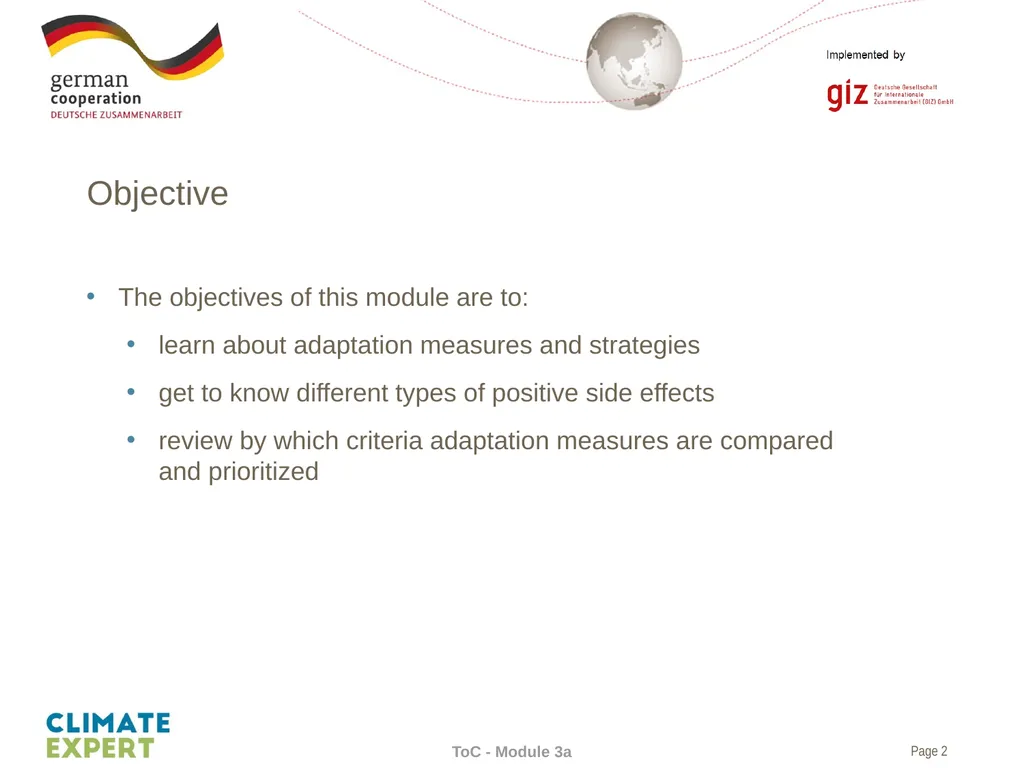
Objective The objectives of this module are to:
learn about adaptation measures and strategies
get to know different types of positive side effects
review by which criteria adaptation measures are compared and prioritized ToC - Module 3a<br>
learn about adaptation measures and strategies
get to know different types of positive side effects
review by which criteria adaptation measures are compared and prioritized ToC - Module 3a<br>
03
Outline / Agenda Adaptation Strategies & Measures
Selection of Adaptation Measures
Positive Side-Effects and Competitive Advantage ToC - Module 3a<br>
Selection of Adaptation Measures
Positive Side-Effects and Competitive Advantage ToC - Module 3a<br>
04
I. Adaptation Strategies & Measures ToC - Module 3a<br>
05
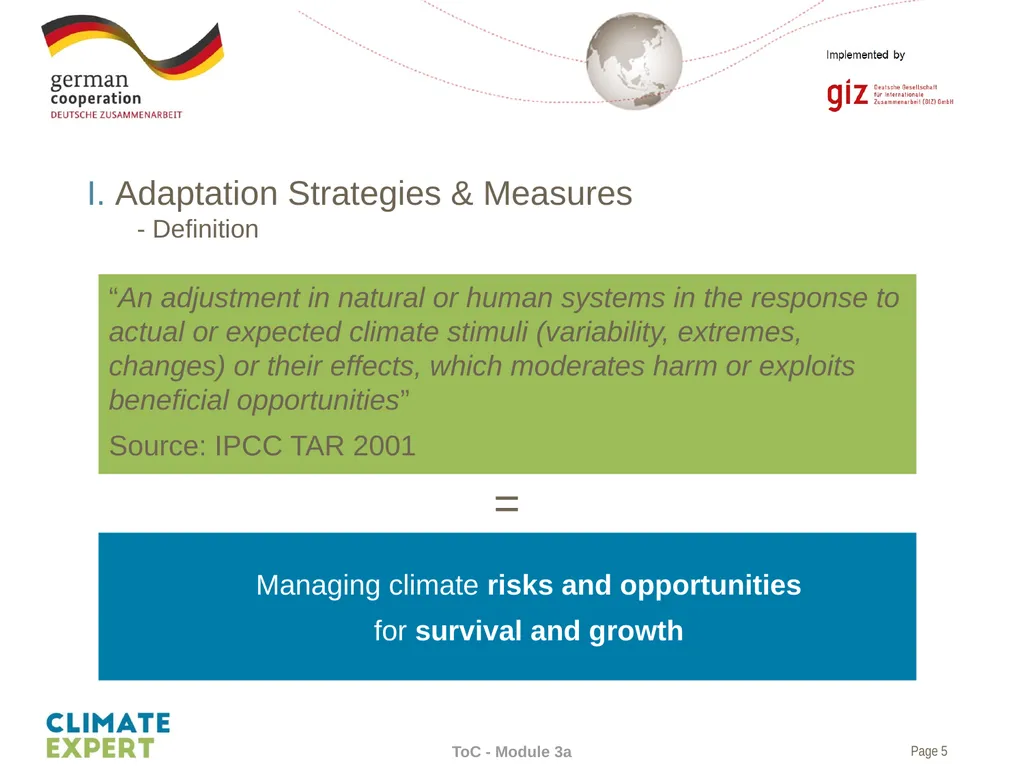
Managing climate risks and opportunities
for survival and growth I. Adaptation Strategies & Measures - Definition “An adjustment in natural or human systems in the response to actual or expected climate stimuli (variability, extremes, changes) or their effects, which moderates harm or exploits beneficial opportunities”
Source: IPCC TAR 2001 = ToC - Module 3a<br>
for survival and growth I. Adaptation Strategies & Measures - Definition “An adjustment in natural or human systems in the response to actual or expected climate stimuli (variability, extremes, changes) or their effects, which moderates harm or exploits beneficial opportunities”
Source: IPCC TAR 2001 = ToC - Module 3a<br>
06
I. Adaptation Strategies & Measures
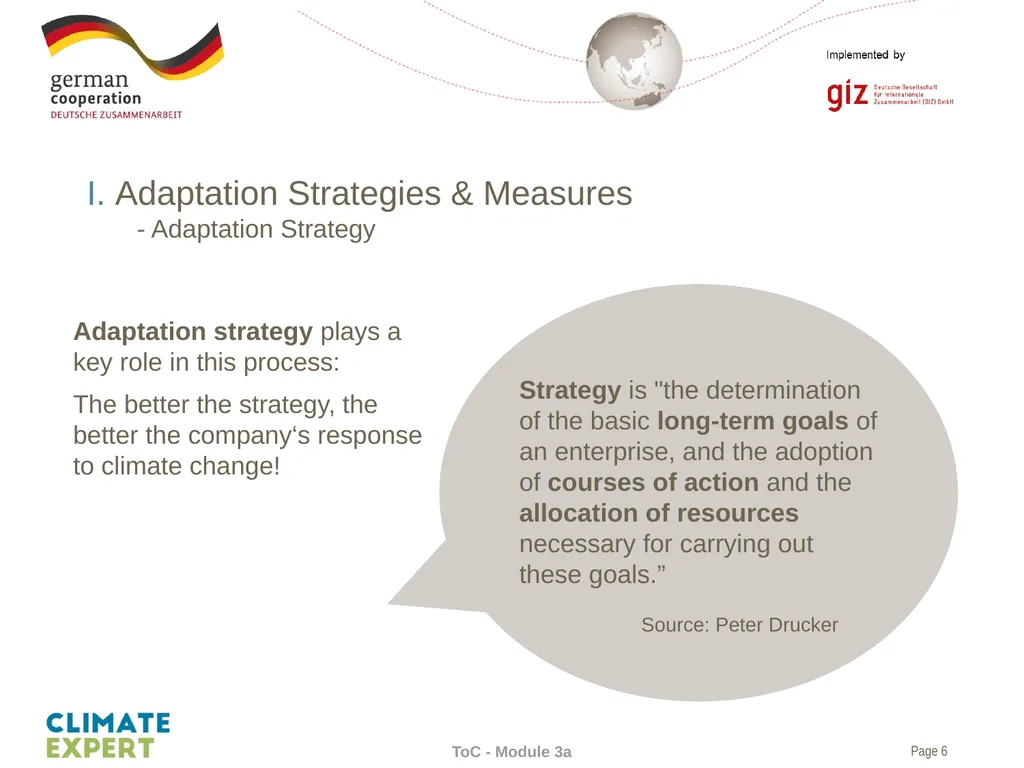
- Adaptation Strategy Strategy is "the determination of the basic long-term goals of an enterprise, and the adoption of courses of action and the allocation of resources necessary for carrying out these goals.”
Source: Peter Drucker Adaptation strategy plays a key role in this process:
The better the strategy, the better the company‘s response to climate change! ToC - Module 3a<br>
Source: Peter Drucker Adaptation strategy plays a key role in this process:
The better the strategy, the better the company‘s response to climate change! ToC - Module 3a<br>
07
I. Adaptation Strategies & Measures
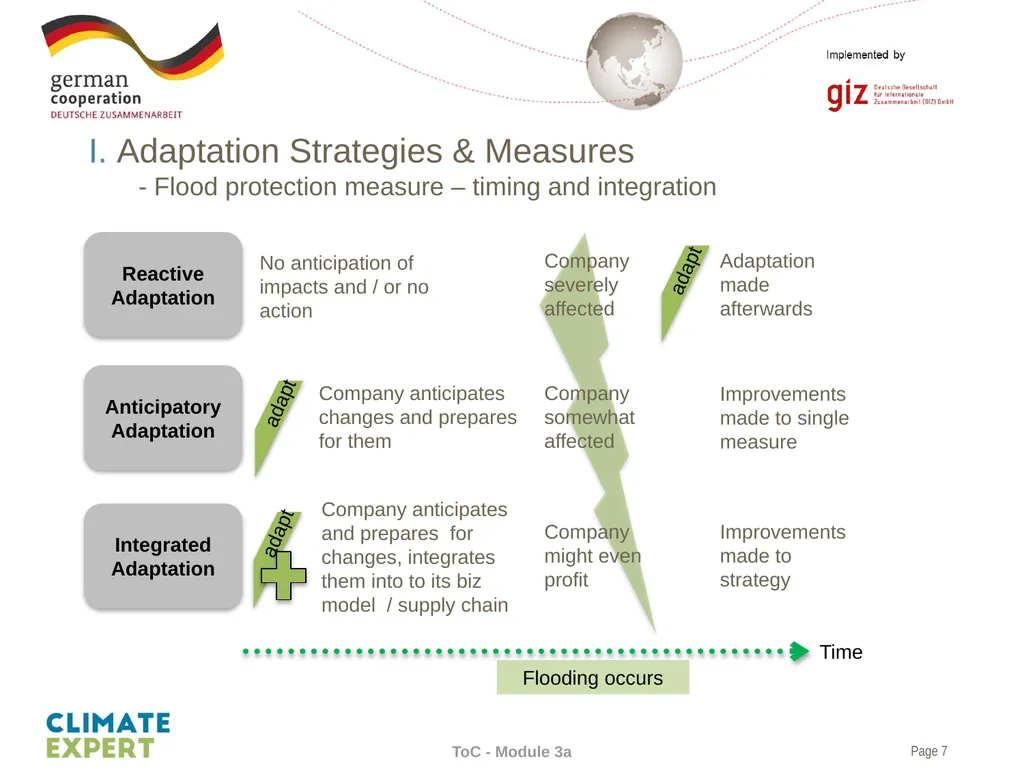
- Flood protection measure – timing and integration ToC - Module 3a<br>
08
I. Adaptation Strategies & Measures
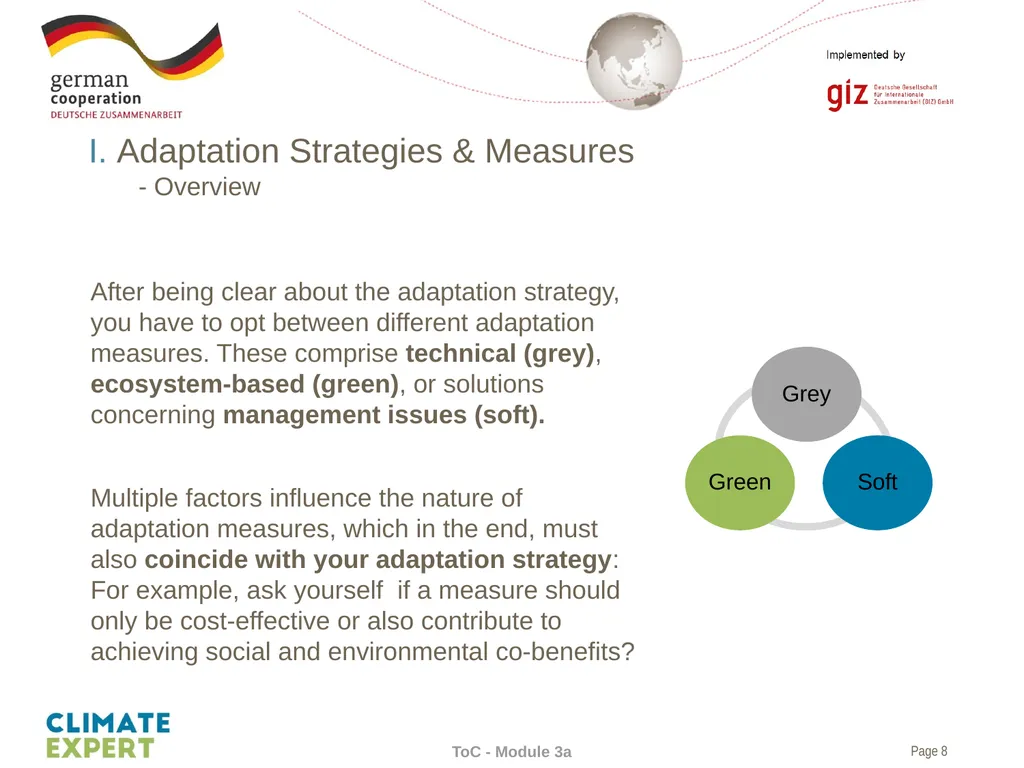
- Overview Grey Green Soft After being clear about the adaptation strategy, you have to opt between different adaptation measures. These comprise technical (grey), ecosystem-based (green), or solutions concerning management issues (soft).
Multiple factors influence the nature of adaptation measures, which in the end, must also coincide with your adaptation strategy: For example, ask yourself if a measure should only be cost-effective or also contribute to achieving social and environmental co-benefits? ToC - Module 3a<br>
Multiple factors influence the nature of adaptation measures, which in the end, must also coincide with your adaptation strategy: For example, ask yourself if a measure should only be cost-effective or also contribute to achieving social and environmental co-benefits? ToC - Module 3a<br>
09
I. Adaptation Strategies & Measures
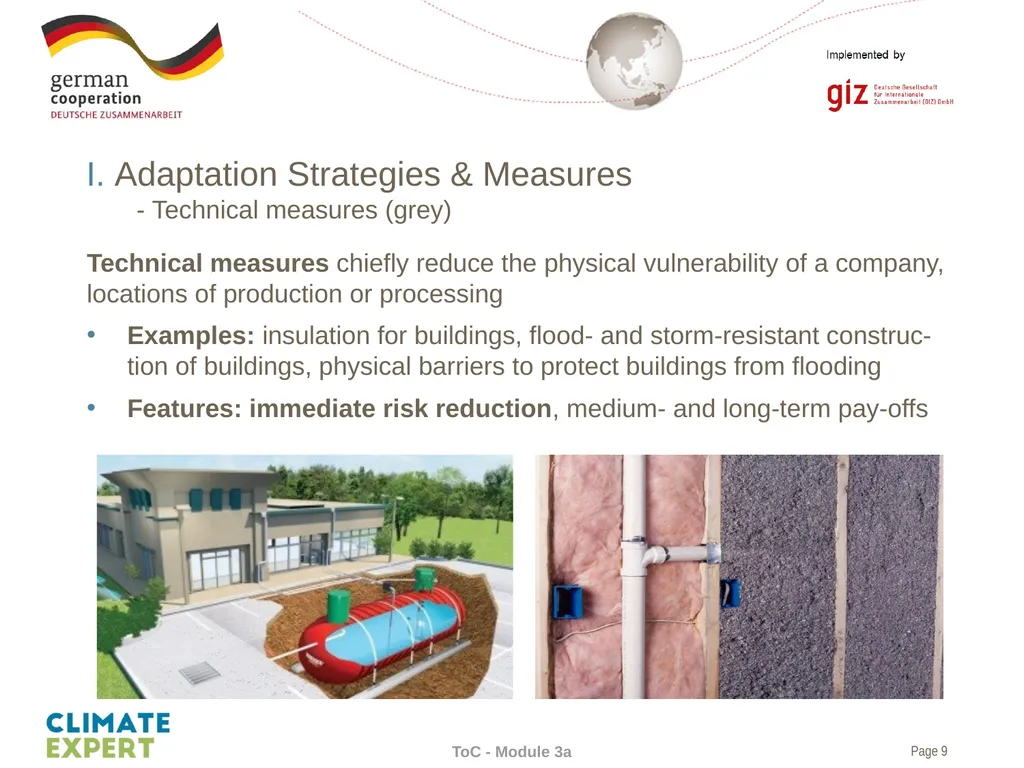
- Technical measures (grey) Technical measures chiefly reduce the physical vulnerability of a company, locations of production or processing
Examples: insulation for buildings, flood- and storm-resistant construc-tion of buildings, physical barriers to protect buildings from flooding
Features: immediate risk reduction, medium- and long-term pay-offs ToC - Module 3a<br>
Examples: insulation for buildings, flood- and storm-resistant construc-tion of buildings, physical barriers to protect buildings from flooding
Features: immediate risk reduction, medium- and long-term pay-offs ToC - Module 3a<br>
10
I. Adaptation Strategies & Measures
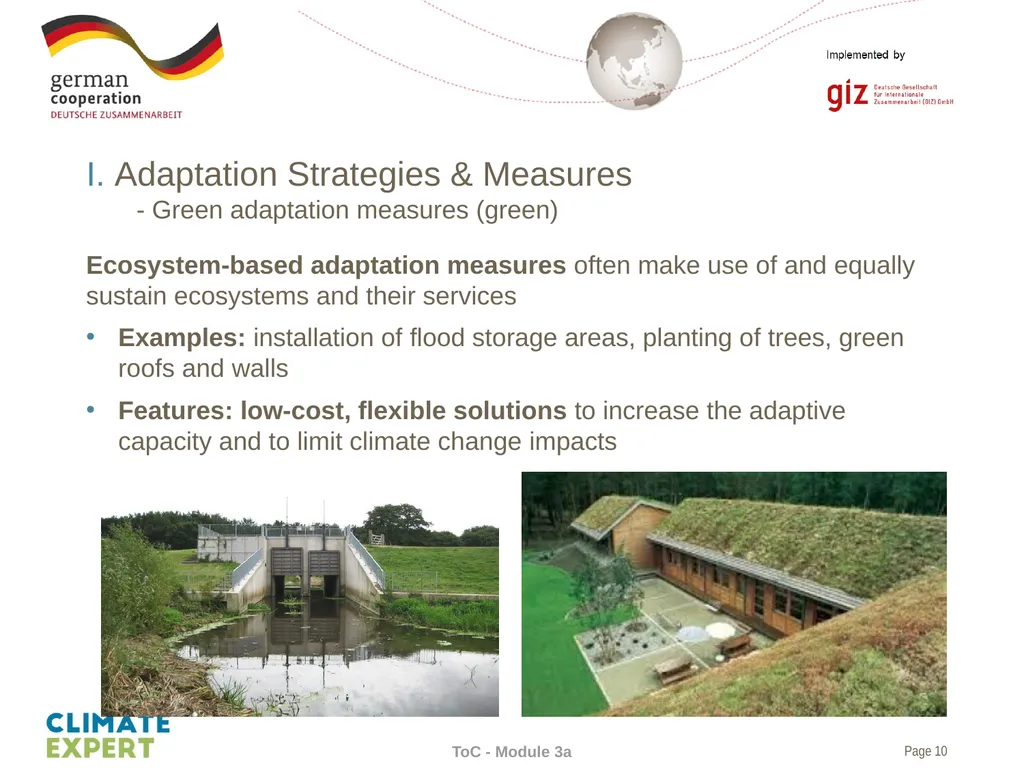
- Green adaptation measures (green) Ecosystem‑based adaptation measures often make use of and equally sustain ecosystems and their services
Examples: installation of flood storage areas, planting of trees, green roofs and walls
Features: low-cost, flexible solutions to increase the adaptive capacity and to limit climate change impacts ToC - Module 3a<br>
Examples: installation of flood storage areas, planting of trees, green roofs and walls
Features: low-cost, flexible solutions to increase the adaptive capacity and to limit climate change impacts ToC - Module 3a<br>
11
I. Adaptation Strategies & Measures
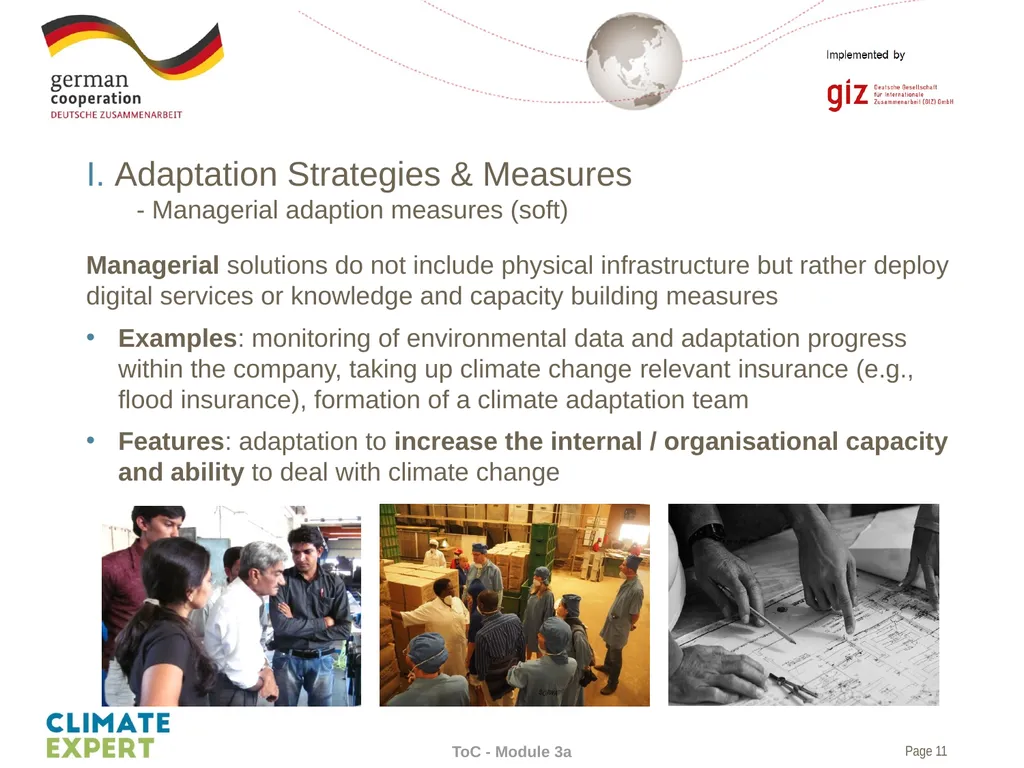
- Managerial adaption measures (soft) Managerial solutions do not include physical infrastructure but rather deploy digital services or knowledge and capacity building measures
Examples: monitoring of environmental data and adaptation progress within the company, taking up climate change relevant insurance (e.g., flood insurance), formation of a climate adaptation team
Features: adaptation to increase the internal / organisational capacity and ability to deal with climate change ToC - Module 3a<br>
Examples: monitoring of environmental data and adaptation progress within the company, taking up climate change relevant insurance (e.g., flood insurance), formation of a climate adaptation team
Features: adaptation to increase the internal / organisational capacity and ability to deal with climate change ToC - Module 3a<br>
12
No-regret actions are cost
-effective under current climate conditions and are consistent with addressing risks of climate change, they possess no hard trade-offs with other policy objectives Low-regret actions
are relatively low cost and provide relatively large benefits under predicted future climates I. Adaptation Strategies & Measures - Adaptation options Adaption measures can be classified according to the benefits they yield. Source: UKCIP & Martin ToC - Module 3a<br>
-effective under current climate conditions and are consistent with addressing risks of climate change, they possess no hard trade-offs with other policy objectives Low-regret actions
are relatively low cost and provide relatively large benefits under predicted future climates I. Adaptation Strategies & Measures - Adaptation options Adaption measures can be classified according to the benefits they yield. Source: UKCIP & Martin ToC - Module 3a<br>
13
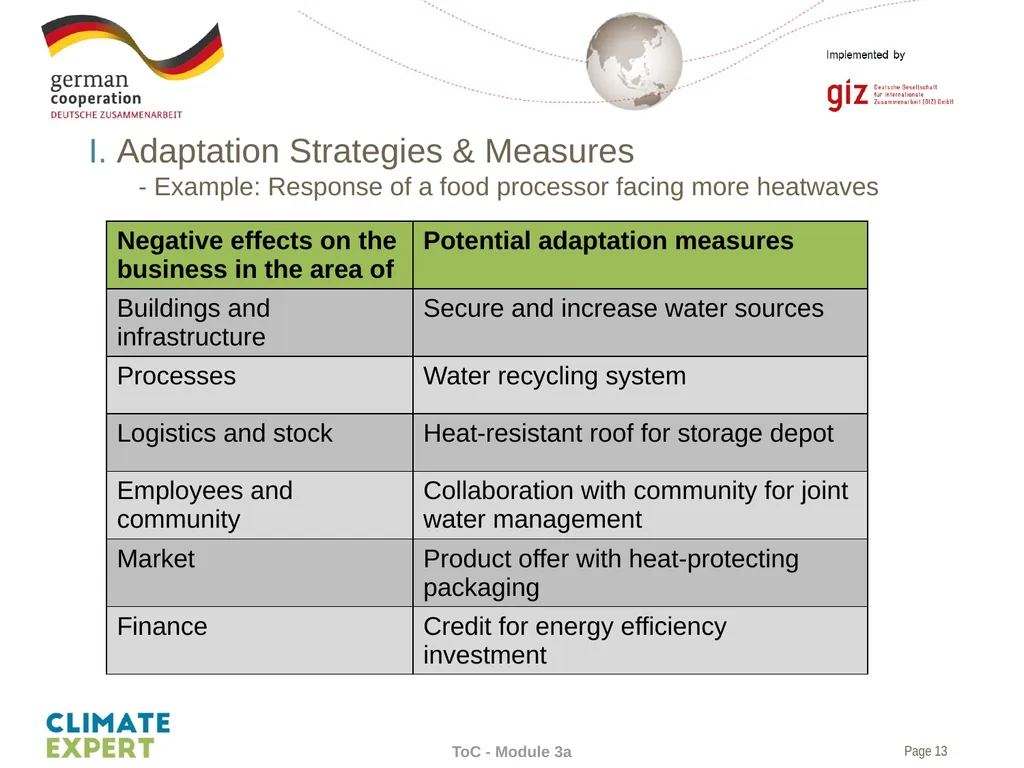
I. Adaptation Strategies & Measures
- Example: Response of a food processor facing more heatwaves ToC - Module 3a<br>
14
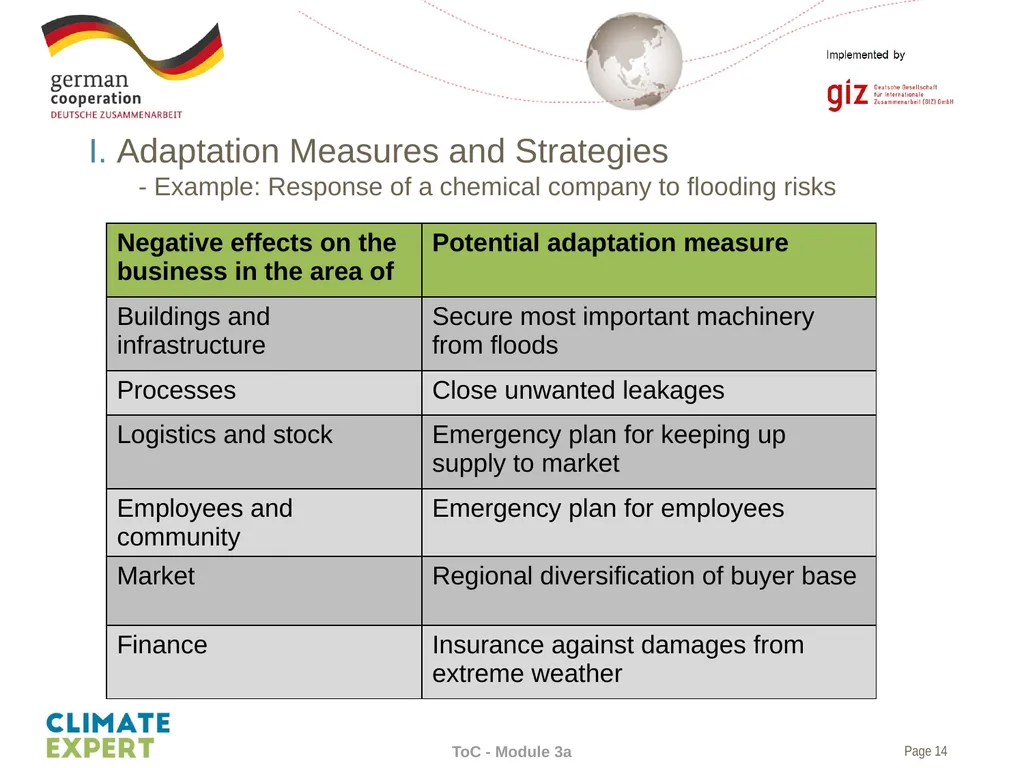
I. Adaptation Measures and Strategies
- Example: Response of a chemical company to flooding risks ToC - Module 3a<br>
15
II. Selection of Adaptation Measures ToC - Module 3a<br>
16
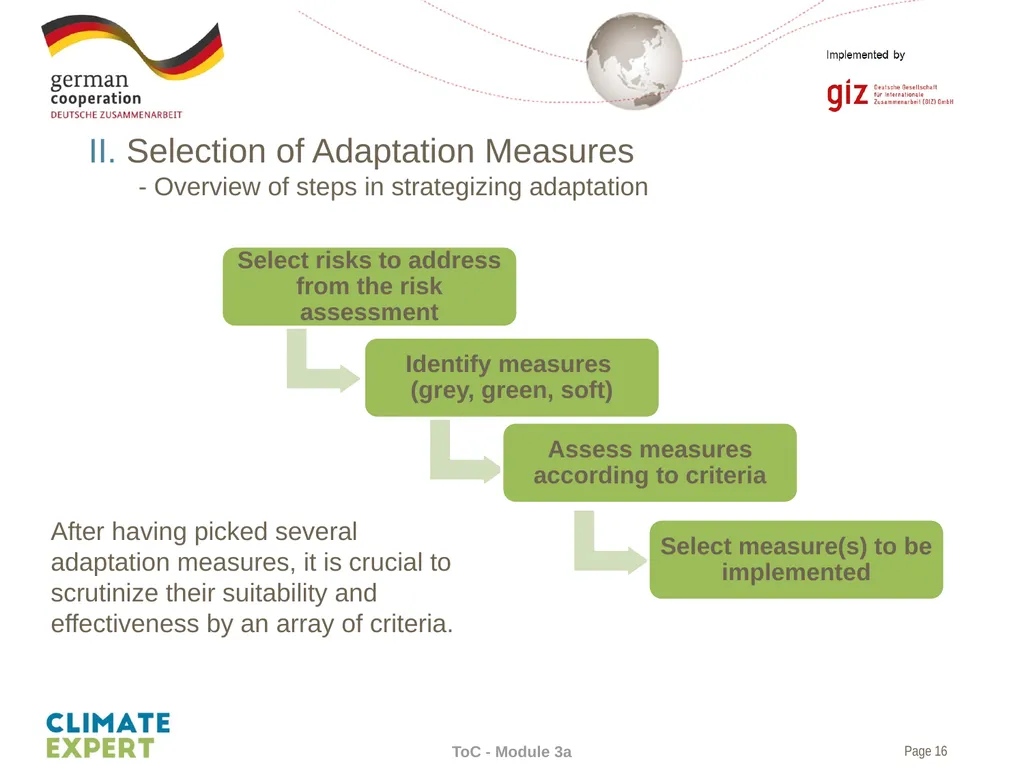
II. Selection of Adaptation Measures
- Overview of steps in strategizing adaptation After having picked several adaptation measures, it is crucial to scrutinize their suitability and effectiveness by an array of criteria. ToC - Module 3a<br>
17
II. Selection of Adaptation Measures
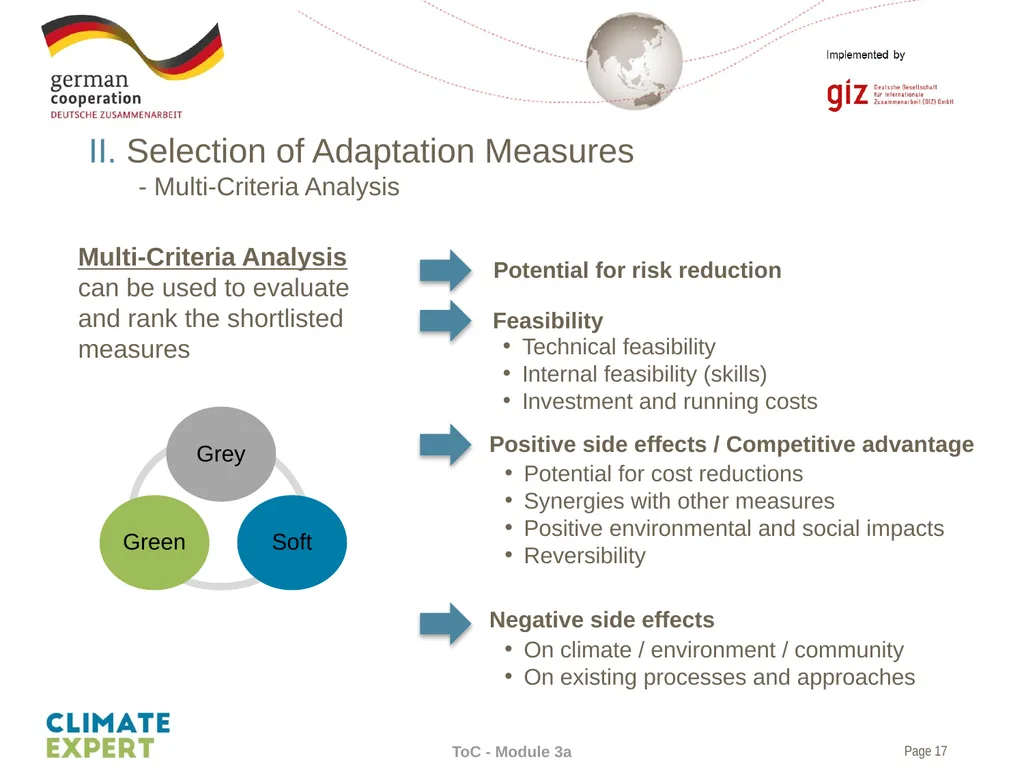
- Multi-Criteria Analysis Feasibility Potential for cost reductions
Synergies with other measures
Positive environmental and social impacts
Reversibility Technical feasibility
Internal feasibility (skills)
Investment and running costs Potential for risk reduction Positive side effects / Competitive advantage Multi-Criteria Analysis can be used to evaluate and rank the shortlisted measures On climate / environment / community
On existing processes and approaches Negative side effects Grey Green Soft ToC - Module 3a<br>
Synergies with other measures
Positive environmental and social impacts
Reversibility Technical feasibility
Internal feasibility (skills)
Investment and running costs Potential for risk reduction Positive side effects / Competitive advantage Multi-Criteria Analysis can be used to evaluate and rank the shortlisted measures On climate / environment / community
On existing processes and approaches Negative side effects Grey Green Soft ToC - Module 3a<br>
18
II. Selection of Adaptation Measures
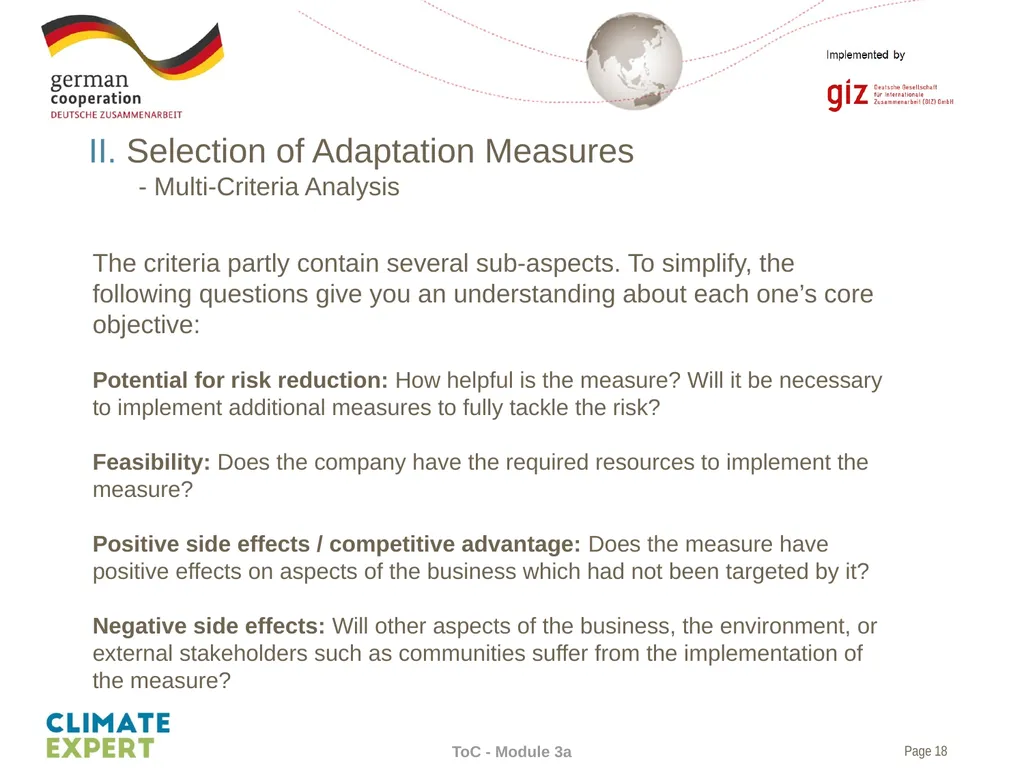
- Multi-Criteria Analysis The criteria partly contain several sub-aspects. To simplify, the following questions give you an understanding about each one’s core objective:
Potential for risk reduction: How helpful is the measure? Will it be necessary to implement additional measures to fully tackle the risk?
Feasibility: Does the company have the required resources to implement the measure?
Positive side effects / competitive advantage: Does the measure have positive effects on aspects of the business which had not been targeted by it?
Negative side effects: Will other aspects of the business, the environment, or external stakeholders such as communities suffer from the implementation of the measure? ToC - Module 3a<br>
Potential for risk reduction: How helpful is the measure? Will it be necessary to implement additional measures to fully tackle the risk?
Feasibility: Does the company have the required resources to implement the measure?
Positive side effects / competitive advantage: Does the measure have positive effects on aspects of the business which had not been targeted by it?
Negative side effects: Will other aspects of the business, the environment, or external stakeholders such as communities suffer from the implementation of the measure? ToC - Module 3a<br>
19
III. Positive Side Effects and
Competitive Advantage ToC - Module 3a<br>
20
III. Positive Side Effects and Competitive Advantage
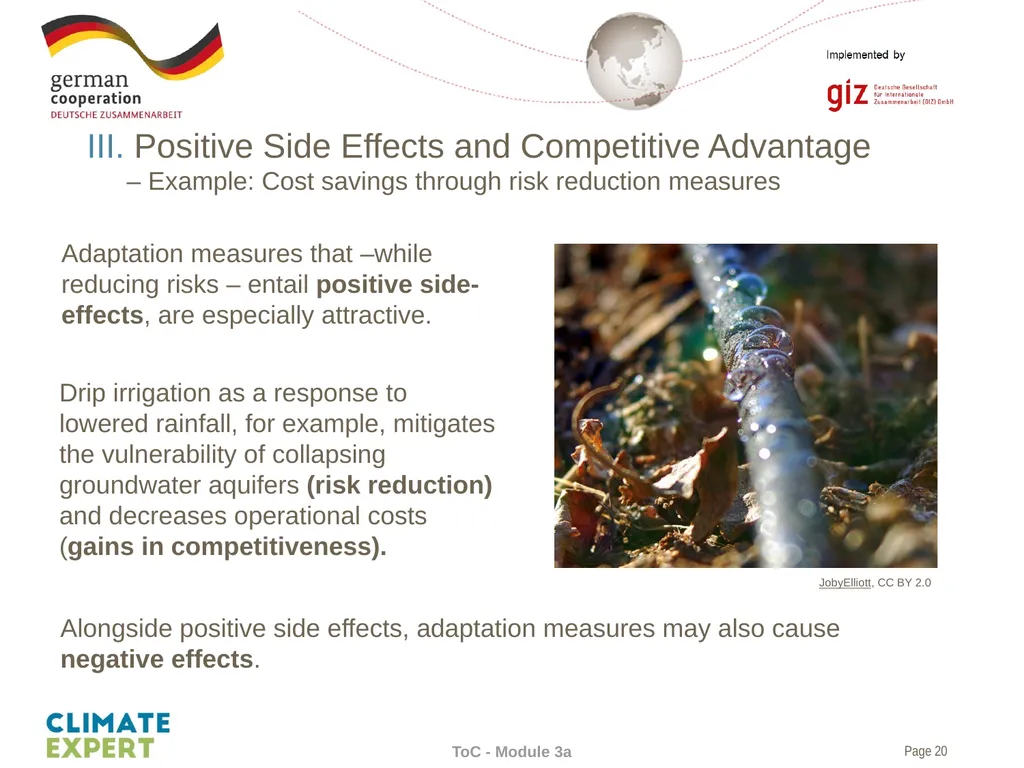
– Example: Cost savings through risk reduction measures Adaptation measures that –while reducing risks – entail positive side-effects, are especially attractive. Drip irrigation as a response to lowered rainfall, for example, mitigates the vulnerability of collapsing groundwater aquifers (risk reduction) and decreases operational costs (gains in competitiveness). JobyElliott, CC BY 2.0 Alongside positive side effects, adaptation measures may also cause negative effects. ToC - Module 3a<br>
21
III. Positive Side Effects and Competitive Advantage
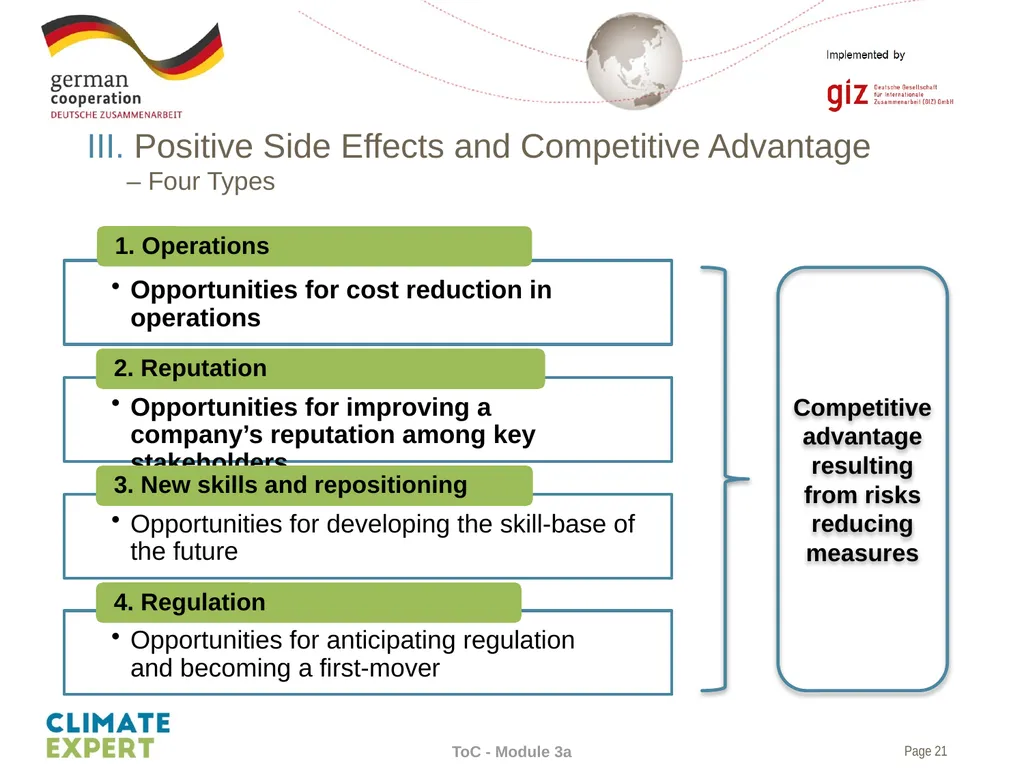
– Four Types Competitive advantage resulting from risks reducing measures ToC - Module 3a<br>
22
III. Positive Side Effects and Competitive Advantage
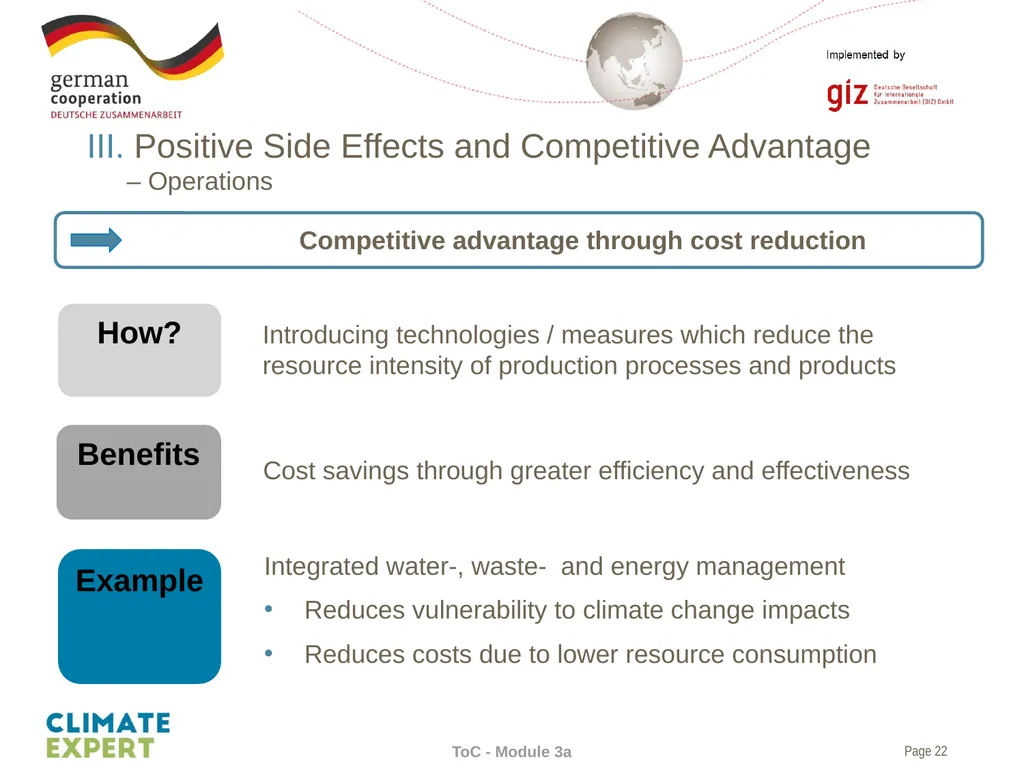
– Operations Introducing technologies / measures which reduce the resource intensity of production processes and products How? Example Benefits Competitive advantage through cost reduction Cost savings through greater efficiency and effectiveness Integrated water-, waste- and energy management
Reduces vulnerability to climate change impacts
Reduces costs due to lower resource consumption ToC - Module 3a<br>
Reduces vulnerability to climate change impacts
Reduces costs due to lower resource consumption ToC - Module 3a<br>
23
III. Positive Side Effects and Competitive Advantage
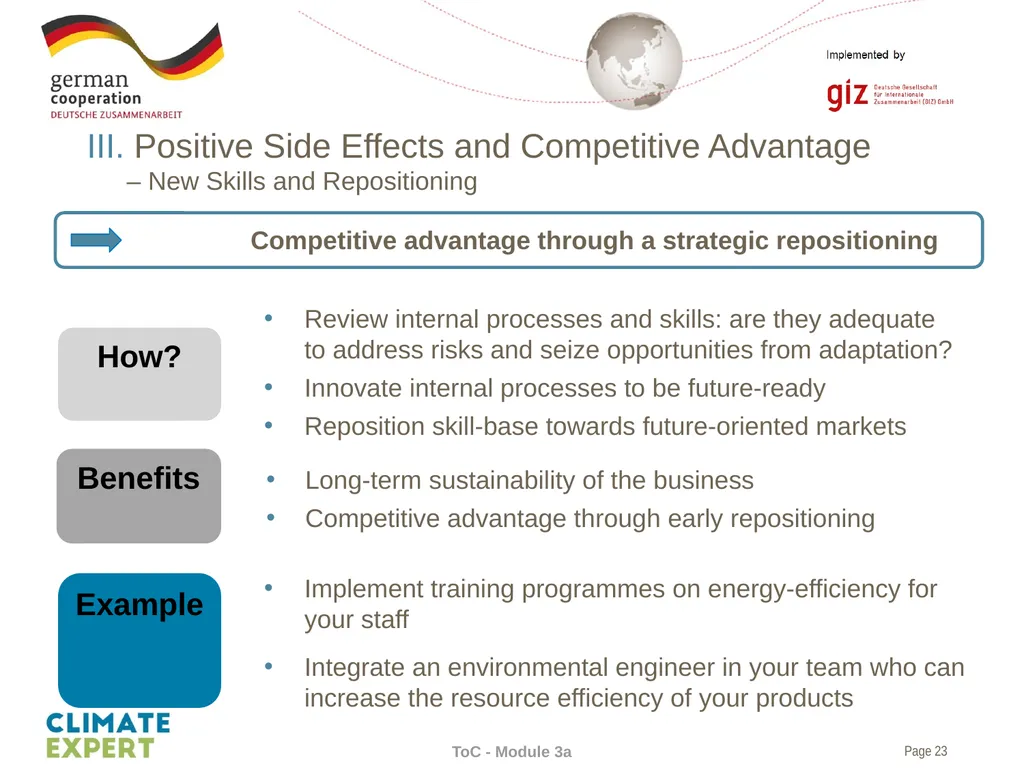
– New Skills and Repositioning Review internal processes and skills: are they adequate to address risks and seize opportunities from adaptation?
Innovate internal processes to be future-ready
Reposition skill-base towards future-oriented markets How? Example Benefits Competitive advantage through a strategic repositioning Implement training programmes on energy-efficiency for your staff
Integrate an environmental engineer in your team who can increase the resource efficiency of your products Long-term sustainability of the business
Competitive advantage through early repositioning ToC - Module 3a<br>
Innovate internal processes to be future-ready
Reposition skill-base towards future-oriented markets How? Example Benefits Competitive advantage through a strategic repositioning Implement training programmes on energy-efficiency for your staff
Integrate an environmental engineer in your team who can increase the resource efficiency of your products Long-term sustainability of the business
Competitive advantage through early repositioning ToC - Module 3a<br>
24
III. Positive Side Effects and Competitive Advantage
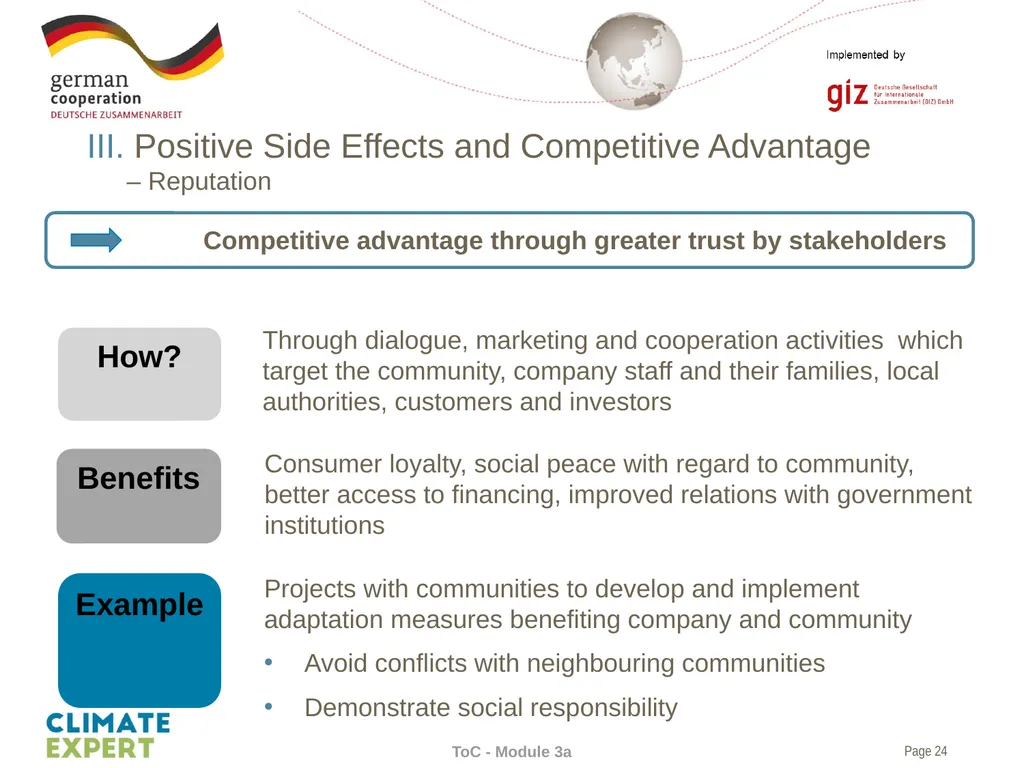
– Reputation Through dialogue, marketing and cooperation activities which target the community, company staff and their families, local authorities, customers and investors How? Example Benefits Competitive advantage through greater trust by stakeholders Consumer loyalty, social peace with regard to community, better access to financing, improved relations with government institutions Projects with communities to develop and implement adaptation measures benefiting company and community
Avoid conflicts with neighbouring communities
Demonstrate social responsibility ToC - Module 3a<br>
Avoid conflicts with neighbouring communities
Demonstrate social responsibility ToC - Module 3a<br>
25
III. Positive Side Effects and Competitive Advantage
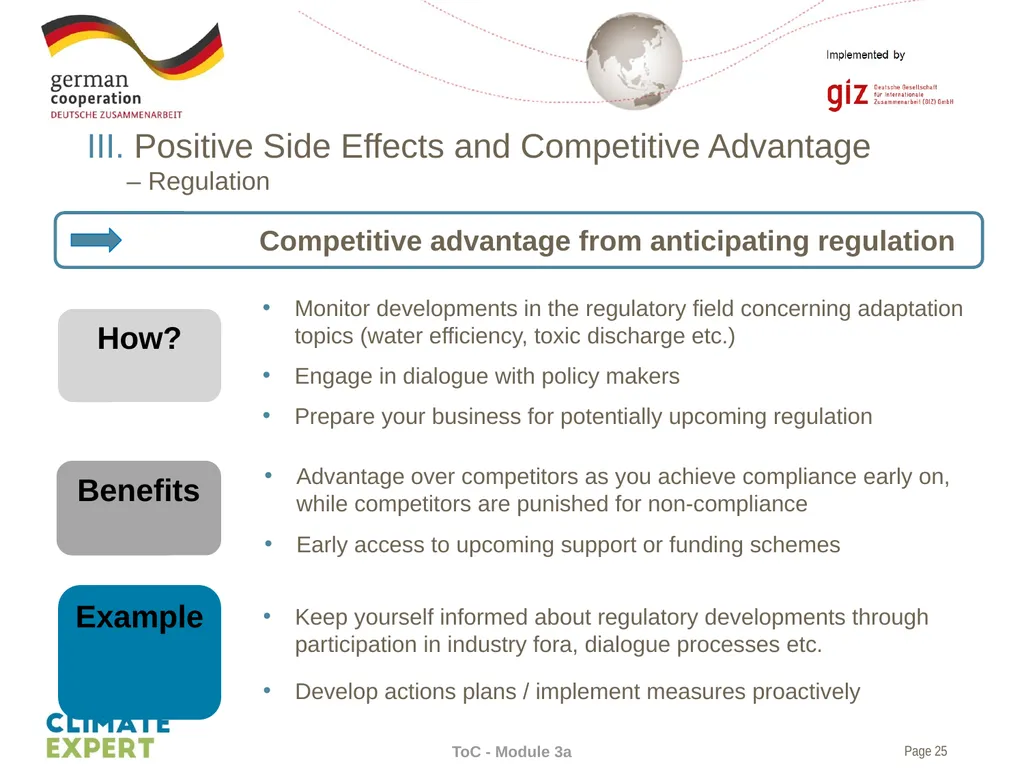
– Regulation Monitor developments in the regulatory field concerning adaptation topics (water efficiency, toxic discharge etc.)
Engage in dialogue with policy makers
Prepare your business for potentially upcoming regulation How? Example Benefits Competitive advantage from anticipating regulation Advantage over competitors as you achieve compliance early on, while competitors are punished for non-compliance
Early access to upcoming support or funding schemes Keep yourself informed about regulatory developments through participation in industry fora, dialogue processes etc.
Develop actions plans / implement measures proactively ToC - Module 3a<br>
Engage in dialogue with policy makers
Prepare your business for potentially upcoming regulation How? Example Benefits Competitive advantage from anticipating regulation Advantage over competitors as you achieve compliance early on, while competitors are punished for non-compliance
Early access to upcoming support or funding schemes Keep yourself informed about regulatory developments through participation in industry fora, dialogue processes etc.
Develop actions plans / implement measures proactively ToC - Module 3a<br>
26
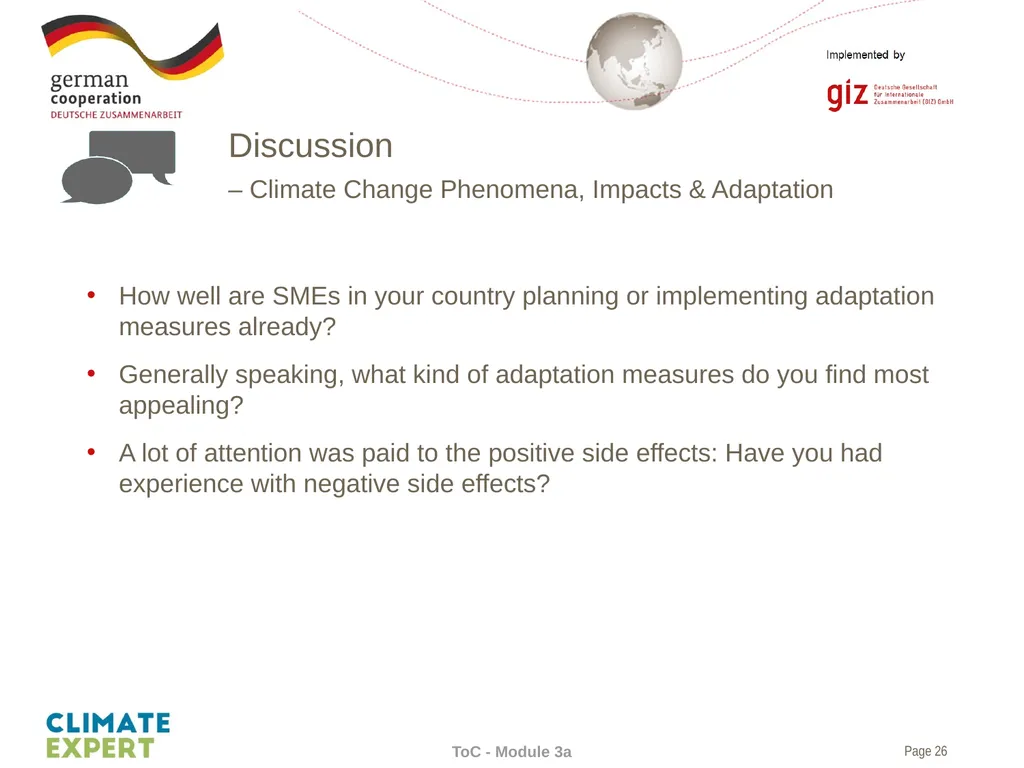
How well are SMEs in your country planning or implementing adaptation measures already?
Generally speaking, what kind of adaptation measures do you find most appealing?
A lot of attention was paid to the positive side effects: Have you had experience with negative side effects? Discussion – Climate Change Phenomena, Impacts & Adaptation ToC - Module 3a<br>
Generally speaking, what kind of adaptation measures do you find most appealing?
A lot of attention was paid to the positive side effects: Have you had experience with negative side effects? Discussion – Climate Change Phenomena, Impacts & Adaptation ToC - Module 3a<br>
27
Company
Trainer 1 Telephone number E-Mail address
Homepage Company
Trainer 2 Telephone number E-Mail address
Homepage Thank you for your attention! Knowledge partner ToC - Module 3a<br>
Trainer 1 Telephone number E-Mail address
Homepage Company
Trainer 2 Telephone number E-Mail address
Homepage Thank you for your attention! Knowledge partner ToC - Module 3a<br>
28
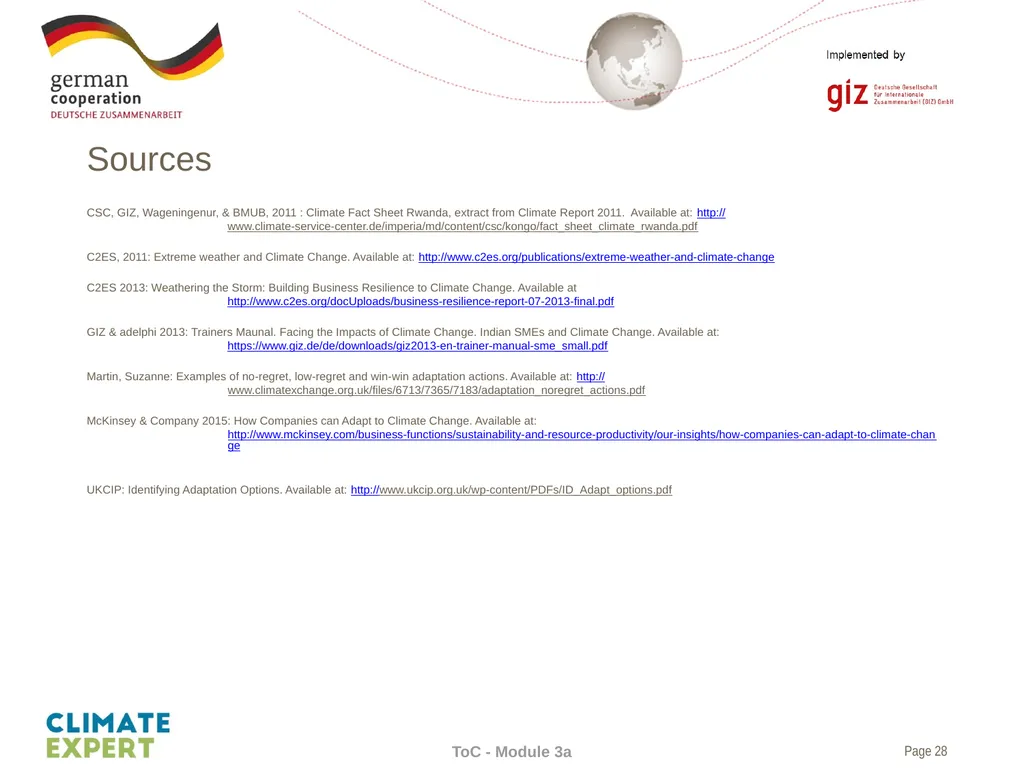
Sources CSC, GIZ, Wageningenur, & BMUB, 2011 : Climate Fact Sheet Rwanda, extract from Climate Report 2011. Available at: http://www.climate-service-center.de/imperia/md/content/csc/kongo/fact_sheet_climate_rwanda.pdf
C2ES, 2011: Extreme weather and Climate Change. Available at: http://www.c2es.org/publications/extreme-weather-and-climate-change
C2ES 2013: Weathering the Storm: Building Business Resilience to Climate Change. Available at http://www.c2es.org/docUploads/business-resilience-report-07-2013-final.pdf
GIZ & adelphi 2013: Trainers Maunal. Facing the Impacts of Climate Change. Indian SMEs and Climate Change. Available at: https://www.giz.de/de/downloads/giz2013-en-trainer-manual-sme_small.pdf
Martin, Suzanne: Examples of no-regret, low-regret and win-win adaptation actions. Available at: http://www.climatexchange.org.uk/files/6713/7365/7183/adaptation_noregret_actions.pdf
McKinsey & Company 2015: How Companies can Adapt to Climate Change. Available at: http://www.mckinsey.com/business-functions/sustainability-and-resource-productivity/our-insights/how-companies-can-adapt-to-climate-change
UKCIP: Identifying Adaptation Options. Available at: http://www.ukcip.org.uk/wp-content/PDFs/ID_Adapt_options.pdf ToC - Module 3a<br>
C2ES, 2011: Extreme weather and Climate Change. Available at: http://www.c2es.org/publications/extreme-weather-and-climate-change
C2ES 2013: Weathering the Storm: Building Business Resilience to Climate Change. Available at http://www.c2es.org/docUploads/business-resilience-report-07-2013-final.pdf
GIZ & adelphi 2013: Trainers Maunal. Facing the Impacts of Climate Change. Indian SMEs and Climate Change. Available at: https://www.giz.de/de/downloads/giz2013-en-trainer-manual-sme_small.pdf
Martin, Suzanne: Examples of no-regret, low-regret and win-win adaptation actions. Available at: http://www.climatexchange.org.uk/files/6713/7365/7183/adaptation_noregret_actions.pdf
McKinsey & Company 2015: How Companies can Adapt to Climate Change. Available at: http://www.mckinsey.com/business-functions/sustainability-and-resource-productivity/our-insights/how-companies-can-adapt-to-climate-change
UKCIP: Identifying Adaptation Options. Available at: http://www.ukcip.org.uk/wp-content/PDFs/ID_Adapt_options.pdf ToC - Module 3a<br>