Course Name- Production Technology for Ornamental Crops, MAP and Landscaping Course Code- 20014400 B.Sc. (Ag.) IV Sem. (Production Technology for Ornamental Crops, MAP and Landscaping) Presented By- Dr. Mahendra Kr. Yadav Identify different
"Course Name- Production Technology for Ornamental" is the property of its rightful owner. Permission is granted to
download and print the materials on this website for personal, non-commercial use only, and to display it
on your personal computer provided you do not modify the materials and that you retain all copyright
notices contained in the materials. By downloading content from our website, you accept the terms of this
agreement.
Presentation Transcript
01
Course Name- Production Technology for Ornamental Crops, MAP and Landscaping
Course Code- 20014400 B.Sc. (Ag.) IV Sem. (Production Technology for Ornamental Crops, MAP and Landscaping) Presented By- Dr. Mahendra Kr. Yadav<br>
02
Identify different types of ornamental and medicinal crops.
Examine various principles of landscaping, uses of landscape trees, shrubs and climbers, production technology of important ornamental crops, etc.
Determine about Demonstrate various Package of practices for loose flowers and their transportation, storage house and required condition for cut and loose flower.
Construct about the various problems with the production technology of medicinal and aromatic plants.
Importance of Processing and value addition in ornamental crops and MAPs produce. Course Objectives B.Sc. (Ag.) IV Sem. (Production Technology for Ornamental Crops, MAP and Landscaping)<br>
03
Production technology of Lemongrass B.Sc. (Ag.) IV Sem. (Production Technology for Ornamental Crops, MAP and Landscaping)<br>
04
B.Sc. (Ag.) IV Sem. (Production Technology for Ornamental Crops, MAP and Landscaping) Botanical Name : Cymbopogon flexuosus and Cymbopogon citrutus
Family : Graminae
Chromosome No. : 2n=40,60
Origin : India Plant Part use –Leaves Production technology of Lemongrass Three types of lemon grasses viz. 1. East Indian lemongrass (C flexuosus): C. flexuosus grown commercially in Kerala and nearby adjacent state, its oil is popularly known as "Cochin oil" as it is shipped mainly through Cochin port. 90% oil is exported.
2. West Indian lemon grass (C. citrates):Origin-Malaysia/ Shrilanka, cultivated in West Indies and
3. Jammu lemongrass (C. pendulus) India is annually producing nearly 1000 MT per year while the world demand is much more. Annually, we are exporting lemon grass oil in a tube of about Rs. 5 crores. Our country is facing a critical competition from Gautemaja in the International market.<br>
05
B.Sc. (Ag.) IV Sem. (Production Technology for Ornamental Crops, MAP and Landscaping) Uses of Lemon Grass:
1. The chief constituent of the oil is the citral. It is the starting material for the preparation of important ionone viz. A – Ionone, used in flavors, cosmetics and perfume and P – Ionone- used in the manufacture of synthetic vitamin A.
2. Oil has bactericidal, insect repellent and medicinal uses.
3. The spent grass is a source of good cattie feed and can be converted into good silage.
4. Spent grasses are also useful for the manufacture of card boards and papers or as fuel.
5. In culinary flavouring in alcoholic & non-alcoholic beverages, frozen dairy dessert, candy, baked foods, gelatins & pudding, meat & meat products
6. Use in preparation of soap and detergent making<br>
06
Soil:
it can be grown from poor soils, in the hill slopes.Sandy loam with abundant organic matter with a pH of 6.0 is found suitable.
Climate:
Tropical plant. The plants are hardy and grow under a variety of conditions. The most ideal conditions are a warm and humid climate with, plenty of sunshine and rainfall of 250-280 cm per annum, uniformly distributed. Day temp. 25-30oC is optimum for good oli production. B.Sc. (Ag.) IV Sem. (Production Technology for Ornamental Crops, MAP and Landscaping) Varieties
OD-19, OD-408, RRL-39, Pragathi, Praman, CKP-25, Krishna and Cauvery are popularly cultivated.<br>
07
Method of Propagation: by seeds, slips. Slip propagation is better in Andhra Pradesh. Seed propagation covers larger area.
a) Seed propagation: Nursery: Seeds are formed in November – December. Seeds are collected in January – February. Seeds are sown at 10 kg per 25 cents nursery per ha. Nursery beds are prepared and sowing is done during April – May. After sowing nursery beds are lightly irrigated.
Seedlings will be ready in 60-75 days when hey attain 5-7 leaf stage and height of 12-15 cm.
b) Slips: Mature clump is divided. Slips are treated for rooting. Rooted slips are used for propagation. B.Sc. (Ag.) IV Sem. (Production Technology for Ornamental Crops, MAP and Landscaping)<br>
08
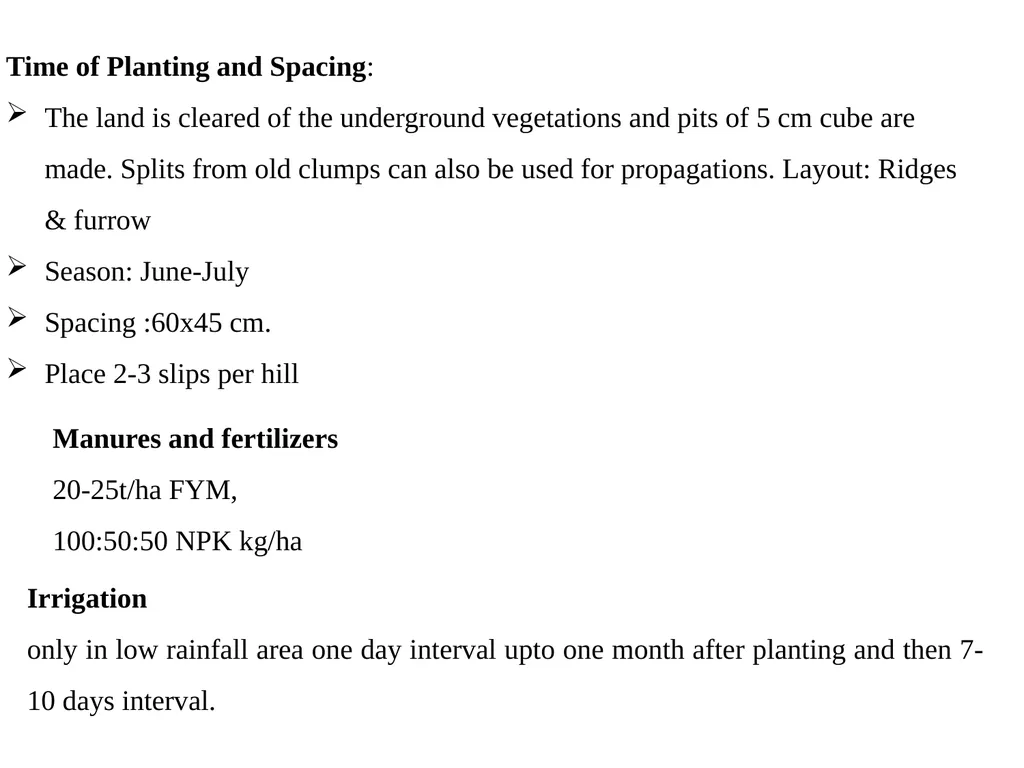
Time of Planting and Spacing:
The land is cleared of the underground vegetations and pits of 5 cm cube are made. Splits from old clumps can also be used for propagations. Layout: Ridges & furrow
Season: June-July
Spacing :60x45 cm.
Place 2-3 slips per hill Manures and fertilizers
20-25t/ha FYM,
100:50:50 NPK kg/ha Irrigation
only in low rainfall area one day interval upto one month after planting and then 7-10 days interval.<br>
09
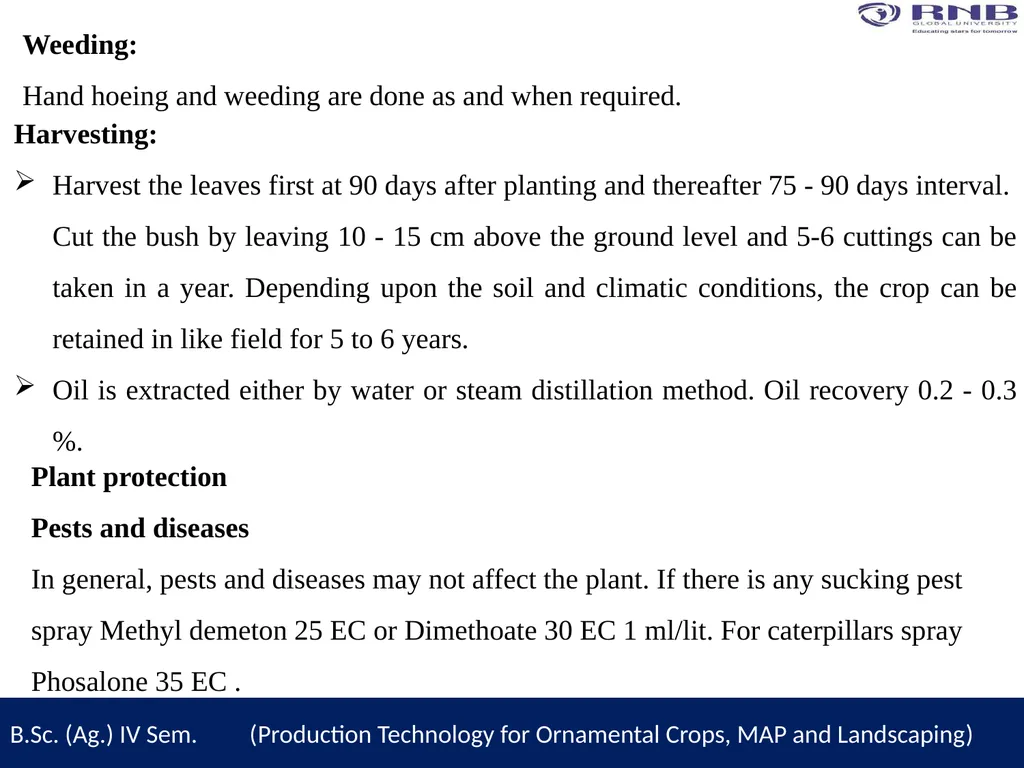
Weeding:
Hand hoeing and weeding are done as and when required. B.Sc. (Ag.) IV Sem. (Production Technology for Ornamental Crops, MAP and Landscaping) Plant protection Pests and diseases In general, pests and diseases may not affect the plant. If there is any sucking pest spray Methyl demeton 25 EC or Dimethoate 30 EC 1 ml/lit. For caterpillars spray Phosalone 35 EC . Harvesting:
Harvest the leaves first at 90 days after planting and thereafter 75 - 90 days interval. Cut the bush by leaving 10 - 15 cm above the ground level and 5-6 cuttings can be taken in a year. Depending upon the soil and climatic conditions, the crop can be retained in like field for 5 to 6 years.
Oil is extracted either by water or steam distillation method. Oil recovery 0.2 - 0.3 %.<br>
10
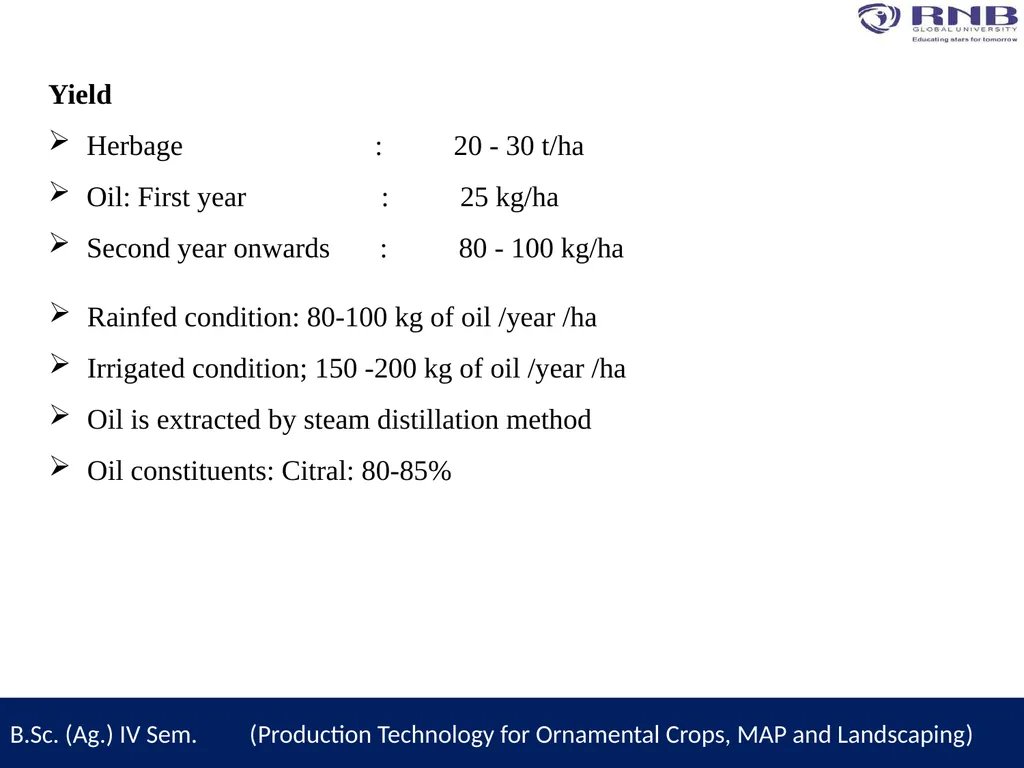
B.Sc. (Ag.) IV Sem. (Production Technology for Ornamental Crops, MAP and Landscaping) Yield
Herbage : 20 - 30 t/ha
Oil: First year : 25 kg/ha
Second year onwards : 80 - 100 kg/ha Rainfed condition: 80-100 kg of oil /year /ha
Irrigated condition; 150 -200 kg of oil /year /ha
Oil is extracted by steam distillation method
Oil constituents: Citral: 80-85%<br>