
Course Name: Rainfed Agriculture & Watershed

Description: Course Name: Rainfed Agriculture Watershed Management (Course Code: 20019300) Delivered by Mr. Anil swami Asst. Professor 1 Rainfed Agriculture Watershed Management Mr. ANIL SWAMI Objective:- Tell the soil and climatic conditions
Related Topics
Download Presentation
"Course Name: Rainfed Agriculture & Watershed" is the property of its rightful owner. Permission is granted to download and print the materials on this website for personal, non-commercial use only, and to display it on your personal computer provided you do not modify the materials and that you retain all copyright notices contained in the materials. By downloading content from our website, you accept the terms of this agreement.
Presentation Transcript
slide1. Course Name:
Rainfed Agriculture & Watershed Management
(Course Code: 20019300) Delivered by
Mr. Anil swami
Asst. Professor 1 Rainfed Agriculture & Watershed Management Mr. ANIL SWAMI<br>
slide2. Objective:-
Tell the soil and climatic conditions prevalent in rainfed areas.
Interpret various water harvesting techniques and their efficient utilization.
Apply contingent crop planning for aberrant weather conditions.
Examine the seasonal rainfall and different types of watershed and its components.
Select soil and water conservation techniques to avoid their losses. 2<br>
slide3. Topics to be covered Rainfed Agriculture
Introduction,
Types and
History of Rainfed Agriculture in India 3 Rainfed Agriculture & Watershed Management Mr. ANIL SWAMI<br>
slide4. 4 Introduction
Even after the utilization of all our water resources for irrigation, about half of the cultivated area will remain rainfed.
As there is hardly any scope for increasing the area under cultivation, it is really a colossal task for meeting the future food needs.
It is against this background that the role of dryland agriculture gained importance.
Agriculture is the single largest livelihood sources in India with nearly two thirds of people depend on it. Rainfed Agriculture & Watershed Management Mr. ANIL SWAMI<br>
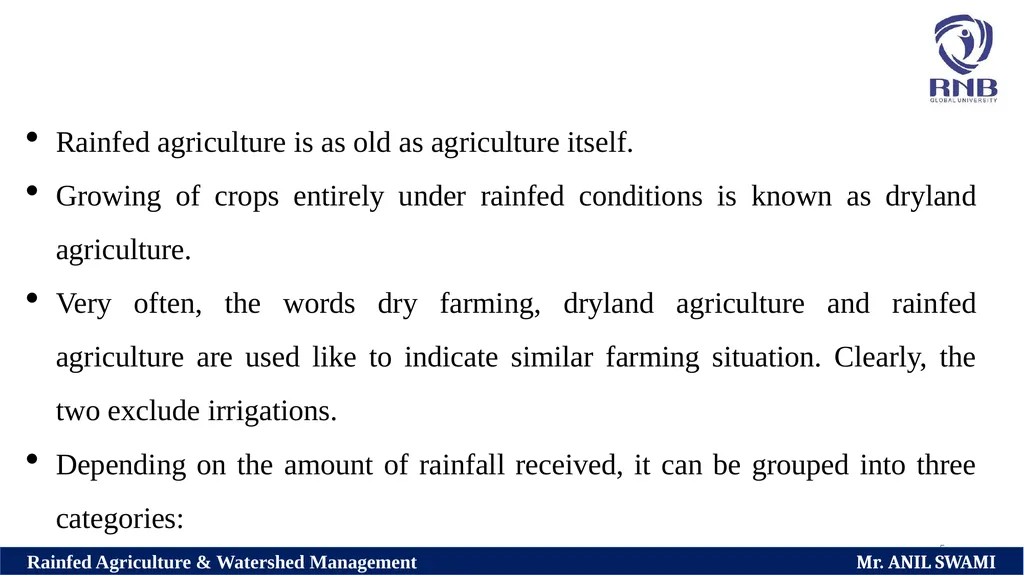
slide5. 5 Rainfed agriculture is as old as agriculture itself.
Growing of crops entirely under rainfed conditions is known as dryland agriculture.
Very often, the words dry farming, dryland agriculture and rainfed agriculture are used like to indicate similar farming situation. Clearly, the two exclude irrigations.
Depending on the amount of rainfall received, it can be grouped into three categories: Rainfed Agriculture & Watershed Management Mr. ANIL SWAMI<br>
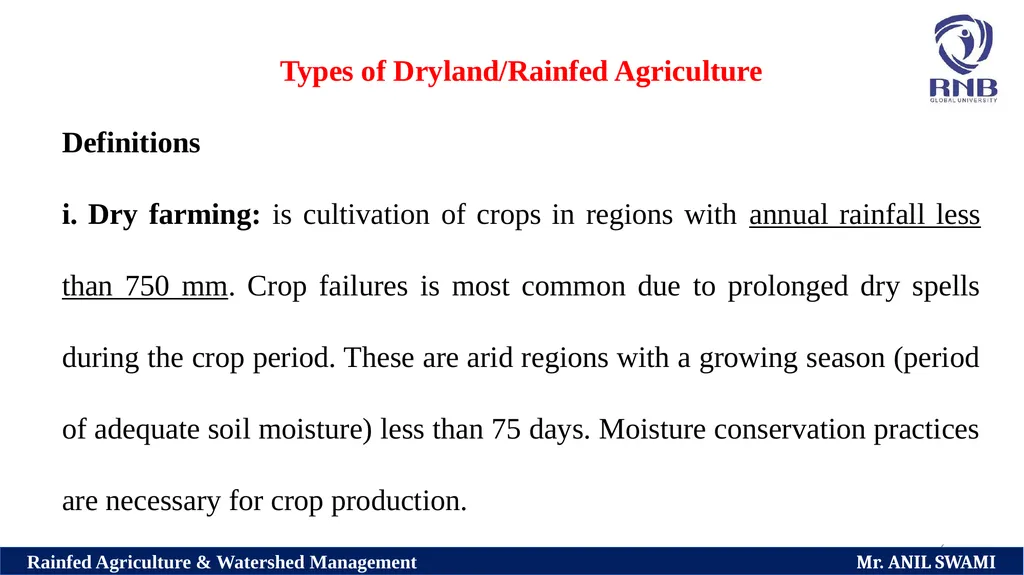
slide6. 6 Types of Dryland/Rainfed Agriculture
Definitions
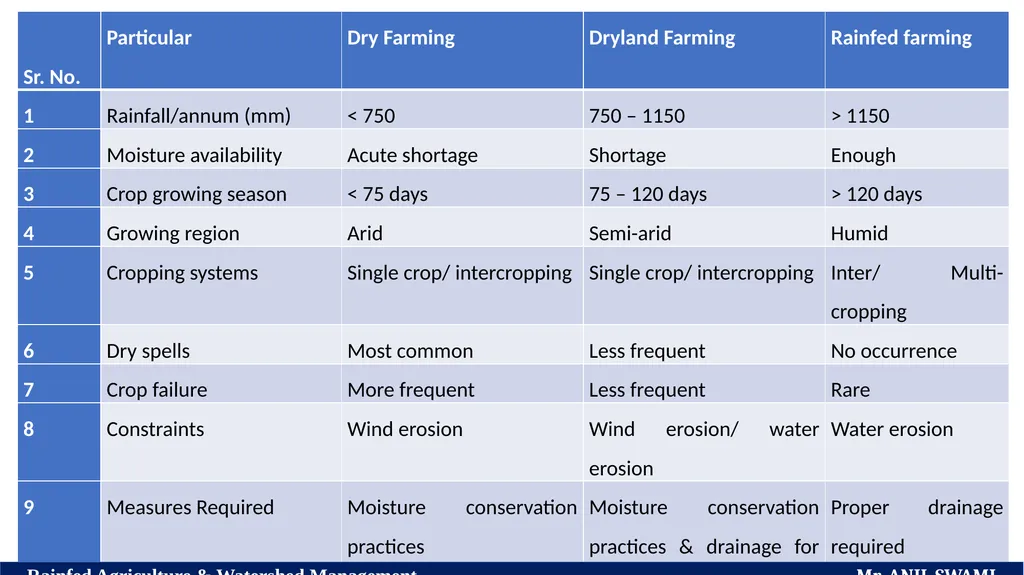
i. Dry farming: is cultivation of crops in regions with annual rainfall less than 750 mm. Crop failures is most common due to prolonged dry spells during the crop period. These are arid regions with a growing season (period of adequate soil moisture) less than 75 days. Moisture conservation practices are necessary for crop production. Rainfed Agriculture & Watershed Management Mr. ANIL SWAMI<br>
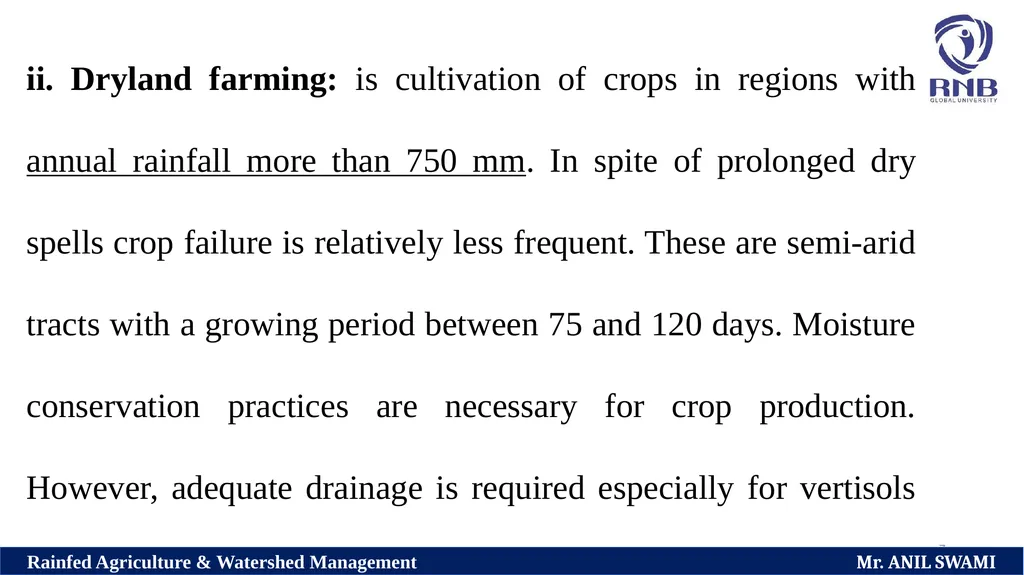
slide7. 7 ii. Dryland farming: is cultivation of crops in regions with annual rainfall more than 750 mm. In spite of prolonged dry spells crop failure is relatively less frequent. These are semi-arid tracts with a growing period between 75 and 120 days. Moisture conservation practices are necessary for crop production. However, adequate drainage is required especially for vertisols or black soils. Rainfed Agriculture & Watershed Management Mr. ANIL SWAMI<br>
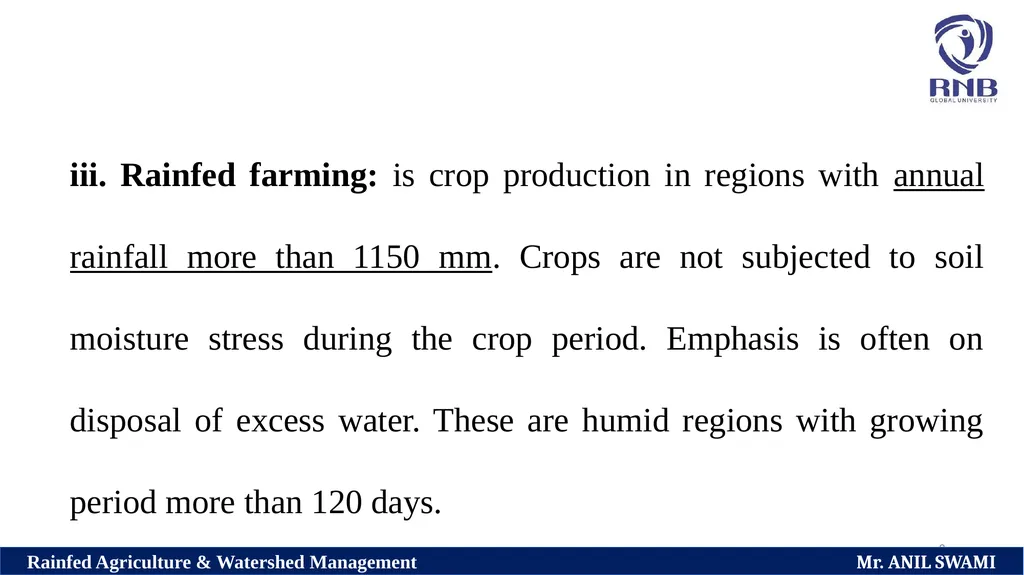
slide8. 8 iii. Rainfed farming: is crop production in regions with annual rainfall more than 1150 mm. Crops are not subjected to soil moisture stress during the crop period. Emphasis is often on disposal of excess water. These are humid regions with growing period more than 120 days. Rainfed Agriculture & Watershed Management Mr. ANIL SWAMI<br>
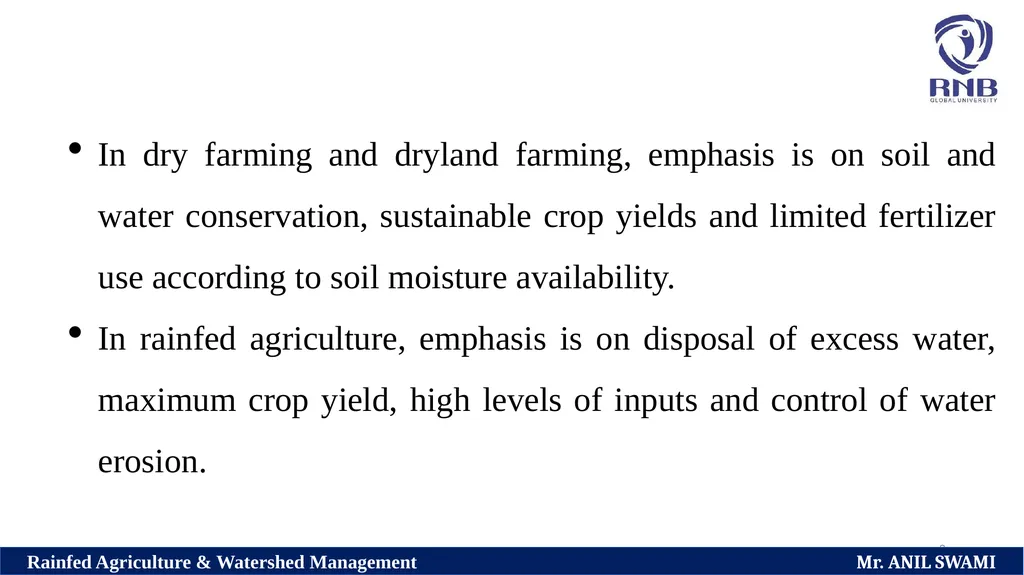
slide9. 9 In dry farming and dryland farming, emphasis is on soil and water conservation, sustainable crop yields and limited fertilizer use according to soil moisture availability.
In rainfed agriculture, emphasis is on disposal of excess water, maximum crop yield, high levels of inputs and control of water erosion. Rainfed Agriculture & Watershed Management Mr. ANIL SWAMI<br>
slide10. 10 Rainfed Agriculture & Watershed Management Mr. ANIL SWAMI<br>
slide11. 11 The Concept:
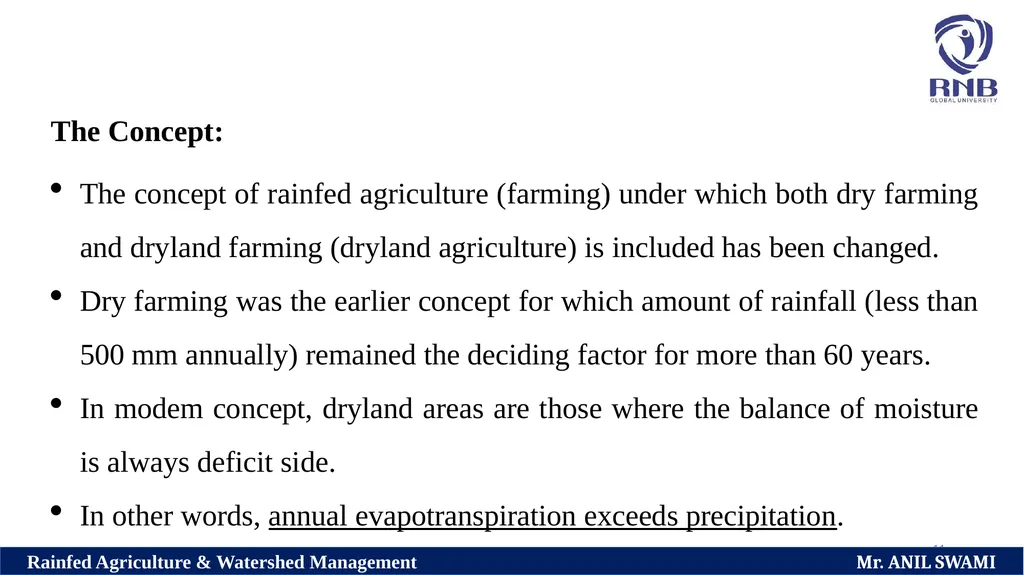
The concept of rainfed agriculture (farming) under which both dry farming and dryland farming (dryland agriculture) is included has been changed.
Dry farming was the earlier concept for which amount of rainfall (less than 500 mm annually) remained the deciding factor for more than 60 years.
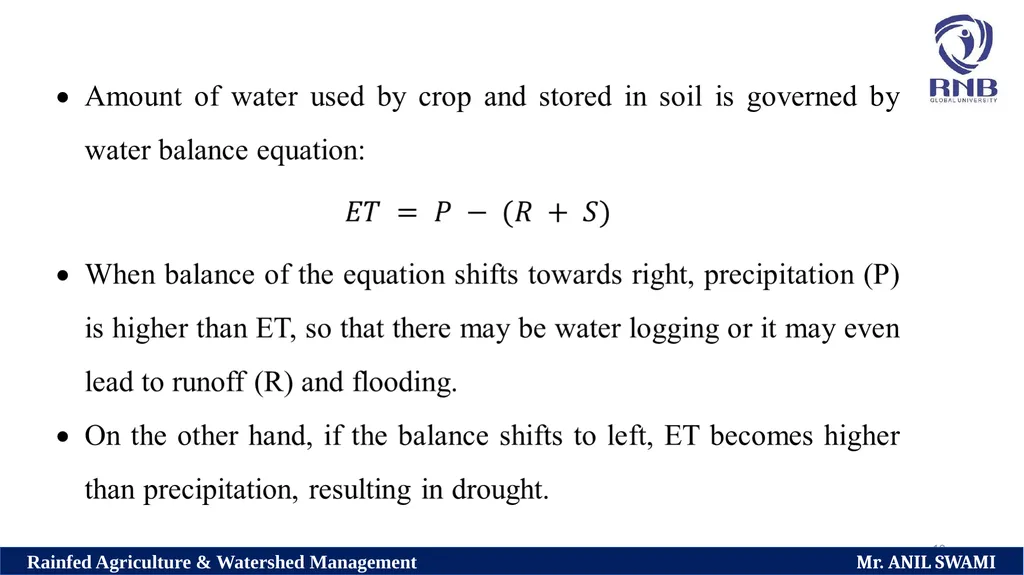
In modem concept, dryland areas are those where the balance of moisture is always deficit side.
In other words, annual evapotranspiration exceeds precipitation. Rainfed Agriculture & Watershed Management Mr. ANIL SWAMI<br>
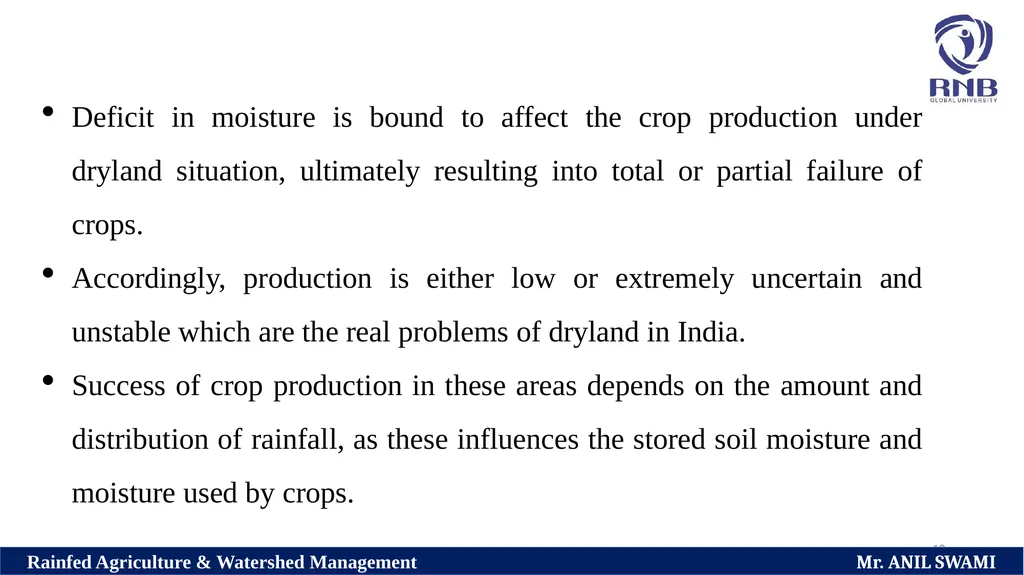
slide12. 12 Deficit in moisture is bound to affect the crop production under dryland situation, ultimately resulting into total or partial failure of crops.
Accordingly, production is either low or extremely uncertain and unstable which are the real problems of dryland in India.
Success of crop production in these areas depends on the amount and distribution of rainfall, as these influences the stored soil moisture and moisture used by crops. Rainfed Agriculture & Watershed Management Mr. ANIL SWAMI<br>
slide13. 13 Rainfed Agriculture & Watershed Management Mr. ANIL SWAMI<br>
slide14. 14 History of Rainfed Agriculture in India
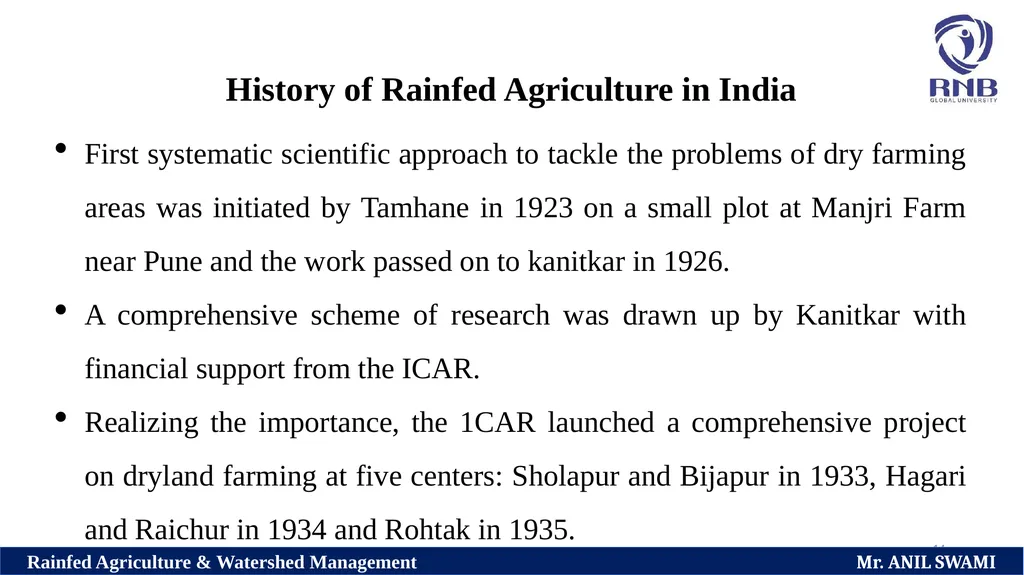
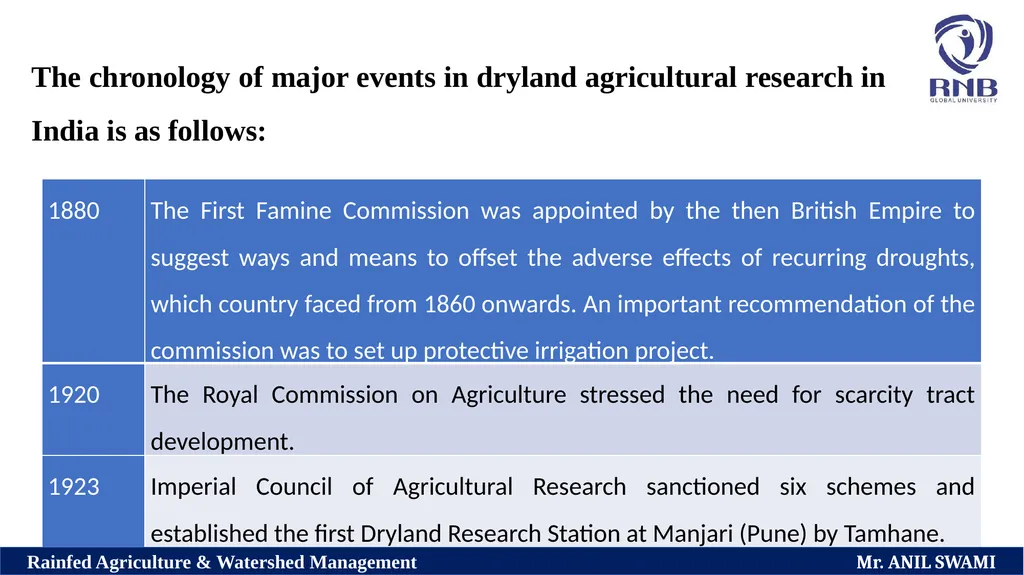
First systematic scientific approach to tackle the problems of dry farming areas was initiated by Tamhane in 1923 on a small plot at Manjri Farm near Pune and the work passed on to kanitkar in 1926.
A comprehensive scheme of research was drawn up by Kanitkar with financial support from the ICAR.
Realizing the importance, the 1CAR launched a comprehensive project on dryland farming at five centers: Sholapur and Bijapur in 1933, Hagari and Raichur in 1934 and Rohtak in 1935. Rainfed Agriculture & Watershed Management Mr. ANIL SWAMI<br>
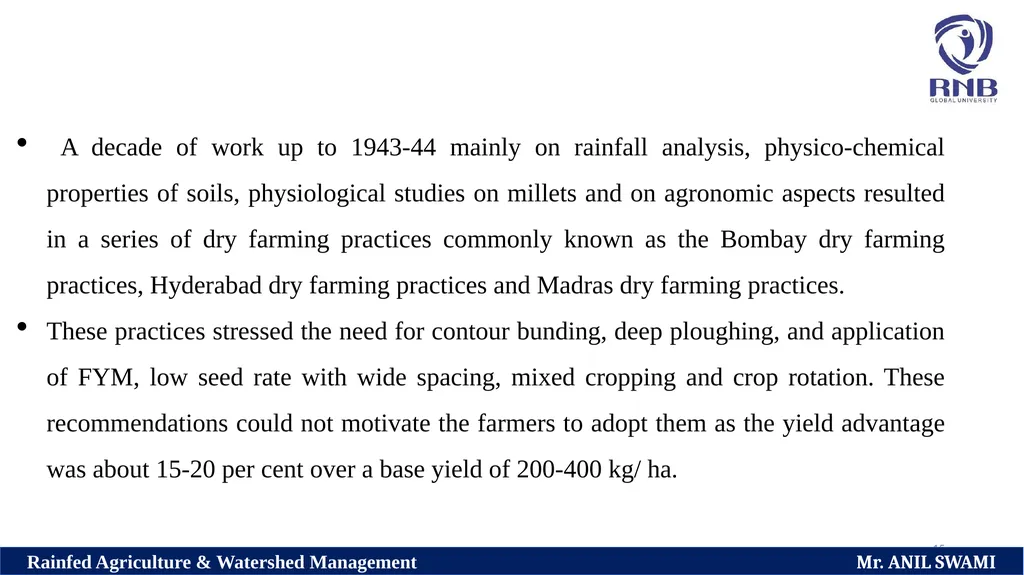
slide15. 15 A decade of work up to 1943-44 mainly on rainfall analysis, physico-chemical properties of soils, physiological studies on millets and on agronomic aspects resulted in a series of dry farming practices commonly known as the Bombay dry farming practices, Hyderabad dry farming practices and Madras dry farming practices.
These practices stressed the need for contour bunding, deep ploughing, and application of FYM, low seed rate with wide spacing, mixed cropping and crop rotation. These recommendations could not motivate the farmers to adopt them as the yield advantage was about 15-20 per cent over a base yield of 200-400 kg/ ha. Rainfed Agriculture & Watershed Management Mr. ANIL SWAMI<br>
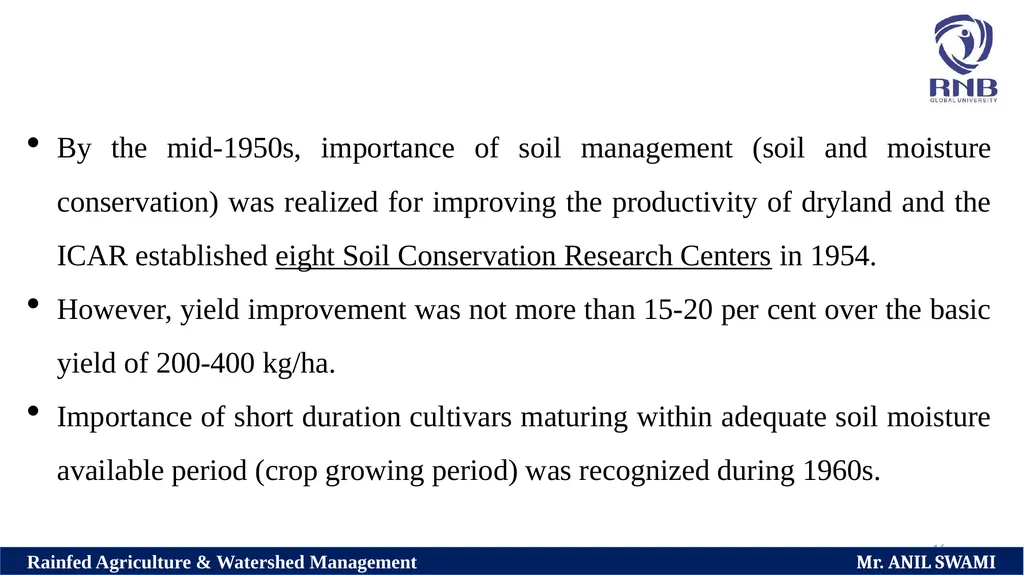
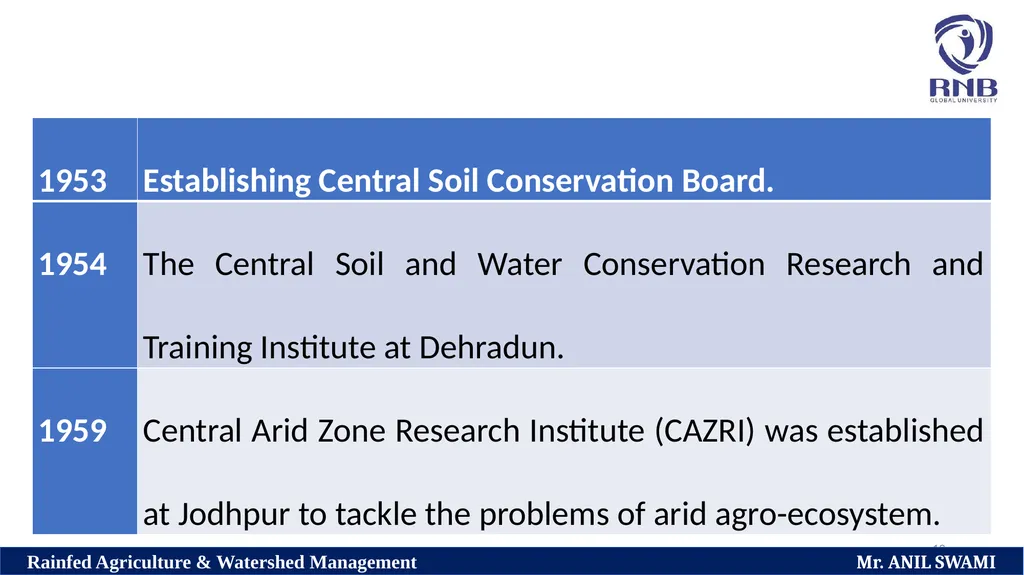
slide16. 16 By the mid-1950s, importance of soil management (soil and moisture conservation) was realized for improving the productivity of dryland and the ICAR established eight Soil Conservation Research Centers in 1954.
However, yield improvement was not more than 15-20 per cent over the basic yield of 200-400 kg/ha.
Importance of short duration cultivars maturing within adequate soil moisture available period (crop growing period) was recognized during 1960s. Rainfed Agriculture & Watershed Management Mr. ANIL SWAMI<br>
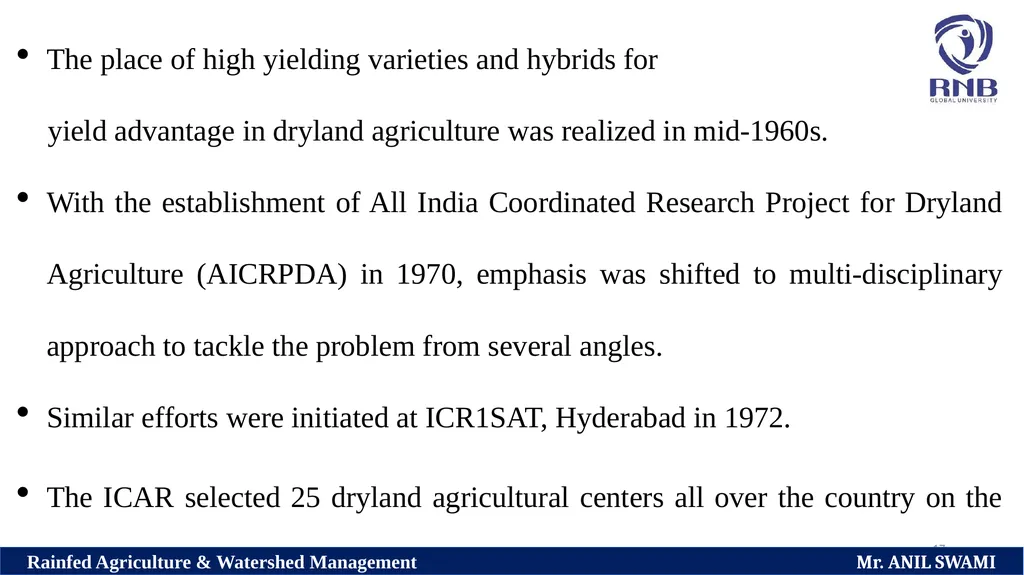
slide17. 17 The place of high yielding varieties and hybrids for
yield advantage in dryland agriculture was realized in mid-1960s.
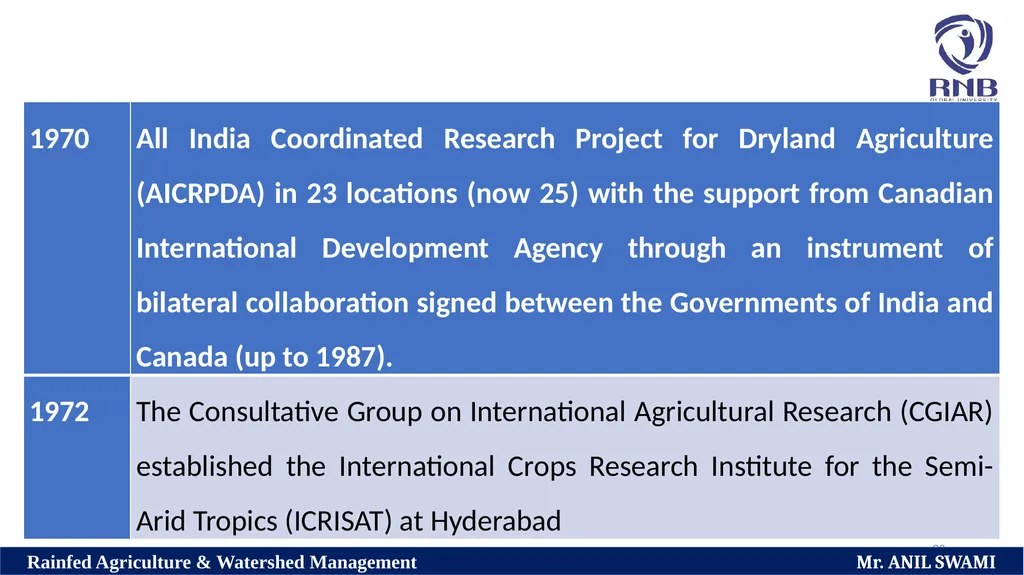
With the establishment of All India Coordinated Research Project for Dryland Agriculture (AICRPDA) in 1970, emphasis was shifted to multi-disciplinary approach to tackle the problem from several angles.
Similar efforts were initiated at ICR1SAT, Hyderabad in 1972.
The ICAR selected 25 dryland agricultural centers all over the country on the basis of the moisture deficit, soil type and rainfall characteristics. Rainfed Agriculture & Watershed Management Mr. ANIL SWAMI<br>
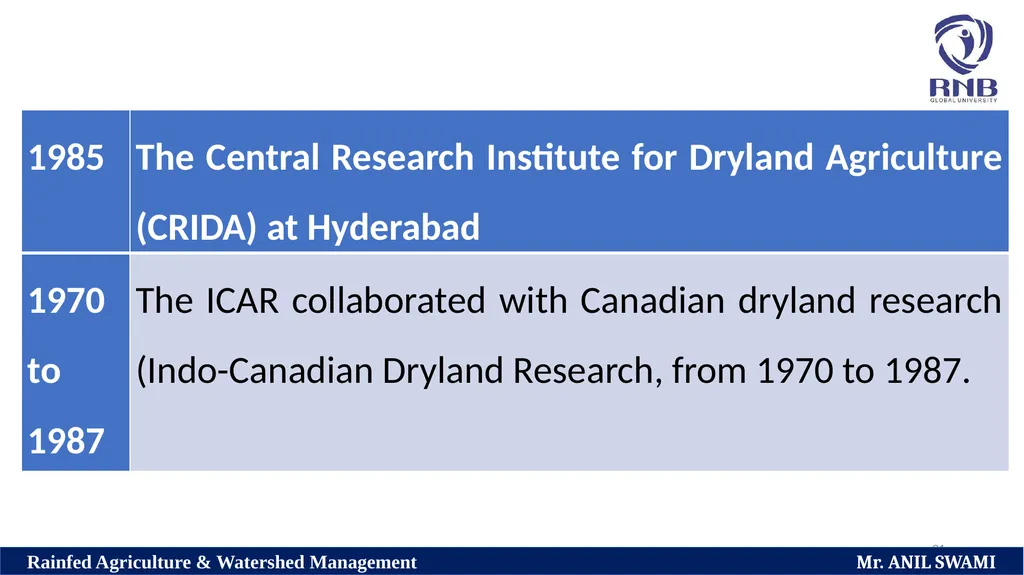
slide18. 18 The chronology of major events in dryland agricultural research in India is as follows: Rainfed Agriculture & Watershed Management Mr. ANIL SWAMI<br>
slide19. 19 Rainfed Agriculture & Watershed Management Mr. ANIL SWAMI<br>
slide20. 20 Rainfed Agriculture & Watershed Management Mr. ANIL SWAMI<br>
slide21. 21 Rainfed Agriculture & Watershed Management Mr. ANIL SWAMI<br>
slide22. Thank You 22 Rainfed Agriculture & Watershed Management Mr. ANIL SWAMI<br>
Mr. Anil swami
Asst. Professor 1 Rainfed Agriculture & Watershed Management Mr. ANIL SWAMI<br>
slide2. Objective:-
Tell the soil and climatic conditions prevalent in rainfed areas.
Interpret various water harvesting techniques and their efficient utilization.
Apply contingent crop planning for aberrant weather conditions.
Examine the seasonal rainfall and different types of watershed and its components.
Select soil and water conservation techniques to avoid their losses. 2<br>
slide3. Topics to be covered Rainfed Agriculture
Introduction,
Types and
History of Rainfed Agriculture in India 3 Rainfed Agriculture & Watershed Management Mr. ANIL SWAMI<br>
slide4. 4 Introduction
Even after the utilization of all our water resources for irrigation, about half of the cultivated area will remain rainfed.
As there is hardly any scope for increasing the area under cultivation, it is really a colossal task for meeting the future food needs.
It is against this background that the role of dryland agriculture gained importance.
Agriculture is the single largest livelihood sources in India with nearly two thirds of people depend on it. Rainfed Agriculture & Watershed Management Mr. ANIL SWAMI<br>
slide5. 5 Rainfed agriculture is as old as agriculture itself.
Growing of crops entirely under rainfed conditions is known as dryland agriculture.
Very often, the words dry farming, dryland agriculture and rainfed agriculture are used like to indicate similar farming situation. Clearly, the two exclude irrigations.
Depending on the amount of rainfall received, it can be grouped into three categories: Rainfed Agriculture & Watershed Management Mr. ANIL SWAMI<br>
slide6. 6 Types of Dryland/Rainfed Agriculture
Definitions
i. Dry farming: is cultivation of crops in regions with annual rainfall less than 750 mm. Crop failures is most common due to prolonged dry spells during the crop period. These are arid regions with a growing season (period of adequate soil moisture) less than 75 days. Moisture conservation practices are necessary for crop production. Rainfed Agriculture & Watershed Management Mr. ANIL SWAMI<br>
slide7. 7 ii. Dryland farming: is cultivation of crops in regions with annual rainfall more than 750 mm. In spite of prolonged dry spells crop failure is relatively less frequent. These are semi-arid tracts with a growing period between 75 and 120 days. Moisture conservation practices are necessary for crop production. However, adequate drainage is required especially for vertisols or black soils. Rainfed Agriculture & Watershed Management Mr. ANIL SWAMI<br>
slide8. 8 iii. Rainfed farming: is crop production in regions with annual rainfall more than 1150 mm. Crops are not subjected to soil moisture stress during the crop period. Emphasis is often on disposal of excess water. These are humid regions with growing period more than 120 days. Rainfed Agriculture & Watershed Management Mr. ANIL SWAMI<br>
slide9. 9 In dry farming and dryland farming, emphasis is on soil and water conservation, sustainable crop yields and limited fertilizer use according to soil moisture availability.
In rainfed agriculture, emphasis is on disposal of excess water, maximum crop yield, high levels of inputs and control of water erosion. Rainfed Agriculture & Watershed Management Mr. ANIL SWAMI<br>
slide10. 10 Rainfed Agriculture & Watershed Management Mr. ANIL SWAMI<br>
slide11. 11 The Concept:
The concept of rainfed agriculture (farming) under which both dry farming and dryland farming (dryland agriculture) is included has been changed.
Dry farming was the earlier concept for which amount of rainfall (less than 500 mm annually) remained the deciding factor for more than 60 years.
In modem concept, dryland areas are those where the balance of moisture is always deficit side.
In other words, annual evapotranspiration exceeds precipitation. Rainfed Agriculture & Watershed Management Mr. ANIL SWAMI<br>
slide12. 12 Deficit in moisture is bound to affect the crop production under dryland situation, ultimately resulting into total or partial failure of crops.
Accordingly, production is either low or extremely uncertain and unstable which are the real problems of dryland in India.
Success of crop production in these areas depends on the amount and distribution of rainfall, as these influences the stored soil moisture and moisture used by crops. Rainfed Agriculture & Watershed Management Mr. ANIL SWAMI<br>
slide13. 13 Rainfed Agriculture & Watershed Management Mr. ANIL SWAMI<br>
slide14. 14 History of Rainfed Agriculture in India
First systematic scientific approach to tackle the problems of dry farming areas was initiated by Tamhane in 1923 on a small plot at Manjri Farm near Pune and the work passed on to kanitkar in 1926.
A comprehensive scheme of research was drawn up by Kanitkar with financial support from the ICAR.
Realizing the importance, the 1CAR launched a comprehensive project on dryland farming at five centers: Sholapur and Bijapur in 1933, Hagari and Raichur in 1934 and Rohtak in 1935. Rainfed Agriculture & Watershed Management Mr. ANIL SWAMI<br>
slide15. 15 A decade of work up to 1943-44 mainly on rainfall analysis, physico-chemical properties of soils, physiological studies on millets and on agronomic aspects resulted in a series of dry farming practices commonly known as the Bombay dry farming practices, Hyderabad dry farming practices and Madras dry farming practices.
These practices stressed the need for contour bunding, deep ploughing, and application of FYM, low seed rate with wide spacing, mixed cropping and crop rotation. These recommendations could not motivate the farmers to adopt them as the yield advantage was about 15-20 per cent over a base yield of 200-400 kg/ ha. Rainfed Agriculture & Watershed Management Mr. ANIL SWAMI<br>
slide16. 16 By the mid-1950s, importance of soil management (soil and moisture conservation) was realized for improving the productivity of dryland and the ICAR established eight Soil Conservation Research Centers in 1954.
However, yield improvement was not more than 15-20 per cent over the basic yield of 200-400 kg/ha.
Importance of short duration cultivars maturing within adequate soil moisture available period (crop growing period) was recognized during 1960s. Rainfed Agriculture & Watershed Management Mr. ANIL SWAMI<br>
slide17. 17 The place of high yielding varieties and hybrids for
yield advantage in dryland agriculture was realized in mid-1960s.
With the establishment of All India Coordinated Research Project for Dryland Agriculture (AICRPDA) in 1970, emphasis was shifted to multi-disciplinary approach to tackle the problem from several angles.
Similar efforts were initiated at ICR1SAT, Hyderabad in 1972.
The ICAR selected 25 dryland agricultural centers all over the country on the basis of the moisture deficit, soil type and rainfall characteristics. Rainfed Agriculture & Watershed Management Mr. ANIL SWAMI<br>
slide18. 18 The chronology of major events in dryland agricultural research in India is as follows: Rainfed Agriculture & Watershed Management Mr. ANIL SWAMI<br>
slide19. 19 Rainfed Agriculture & Watershed Management Mr. ANIL SWAMI<br>
slide20. 20 Rainfed Agriculture & Watershed Management Mr. ANIL SWAMI<br>
slide21. 21 Rainfed Agriculture & Watershed Management Mr. ANIL SWAMI<br>
slide22. Thank You 22 Rainfed Agriculture & Watershed Management Mr. ANIL SWAMI<br>