
COVID-19 & Recent Changes in IBC Framework

Description: COVID-19 Recent Changes in IBC Framework COPYRIGHT Disclaimer The contents of the presentation are intended solely for the use of the client to whom the same is marked by us. No circulation, publication, or unauthorised use of the
Related Topics
Download Presentation
"COVID-19 & Recent Changes in IBC Framework" is the property of its rightful owner. Permission is granted to download and print the materials on this website for personal, non-commercial use only, and to display it on your personal computer provided you do not modify the materials and that you retain all copyright notices contained in the materials. By downloading content from our website, you accept the terms of this agreement.
Presentation Transcript
slide1. COVID-19 & Recent Changes in IBC Framework<br>
slide2. COPYRIGHT & Disclaimer The contents of the presentation are intended solely for the use of the client to whom the same is marked by us.
No circulation, publication, or unauthorised use of the presentation in any form is allowed, except with our prior written permission.
No part of this presentation is intended to be professional advice, or solicitation of professional assignment.<br>
slide3. About Us Vinod Kothari Consultants Private Limited, consultants and advisors
Based out of Kolkata, New Delhi & Mumbai
We are a team of consultants, advisors & qualified professionals having over 30 years of practice. Our Organization’s Credo:
Focus on capabilities; opportunities follow<br>
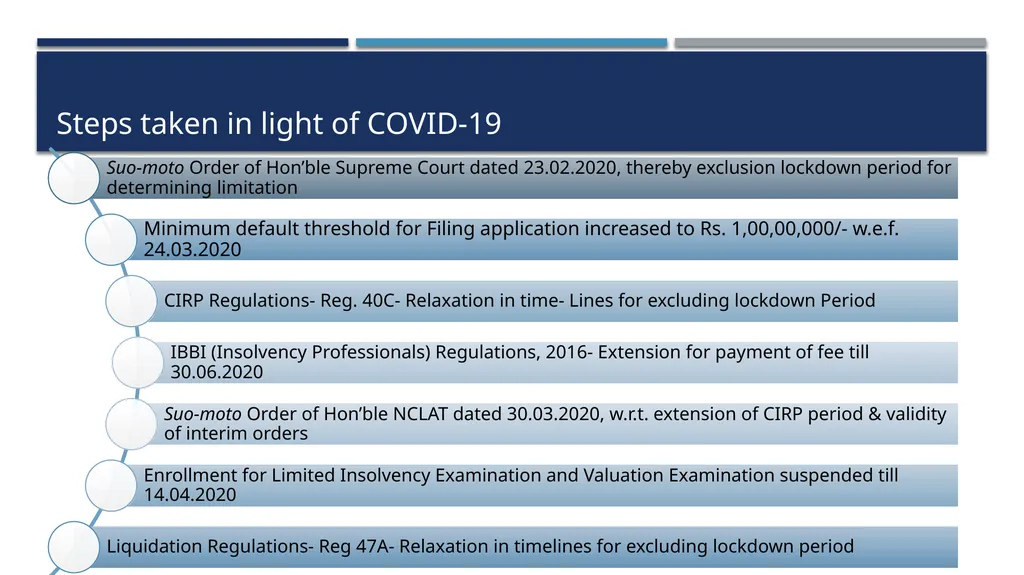
slide4. Steps taken in light of COVID-19<br>
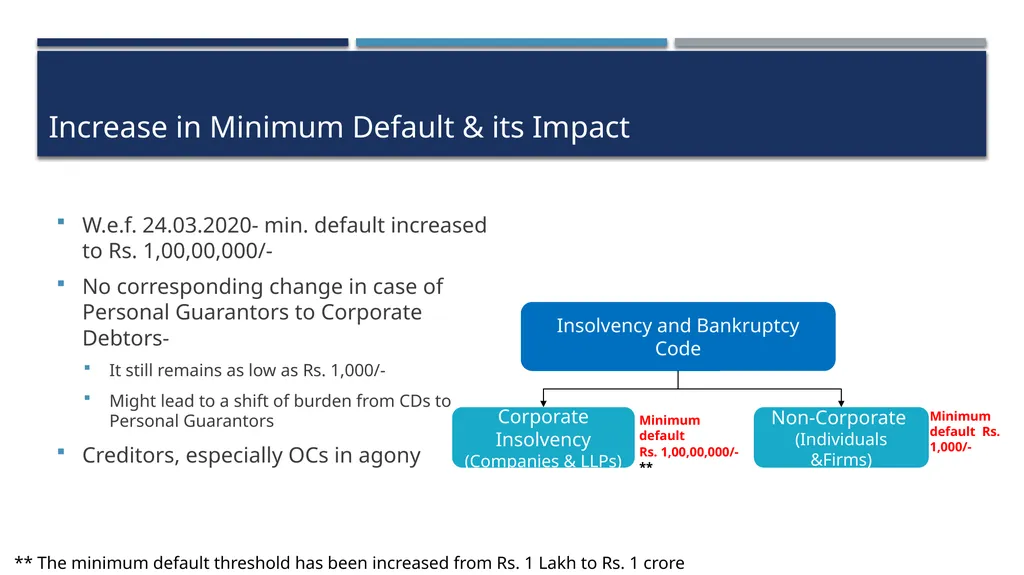
slide5. Increase in Minimum Default & its Impact W.e.f. 24.03.2020- min. default increased to Rs. 1,00,00,000/-
No corresponding change in case of Personal Guarantors to Corporate Debtors-
It still remains as low as Rs. 1,000/-
Might lead to a shift of burden from CDs to Personal Guarantors
Creditors, especially OCs in agony Minimum default Rs. 1,000/- ** The minimum default threshold has been increased from Rs. 1 Lakh to Rs. 1 crore<br>
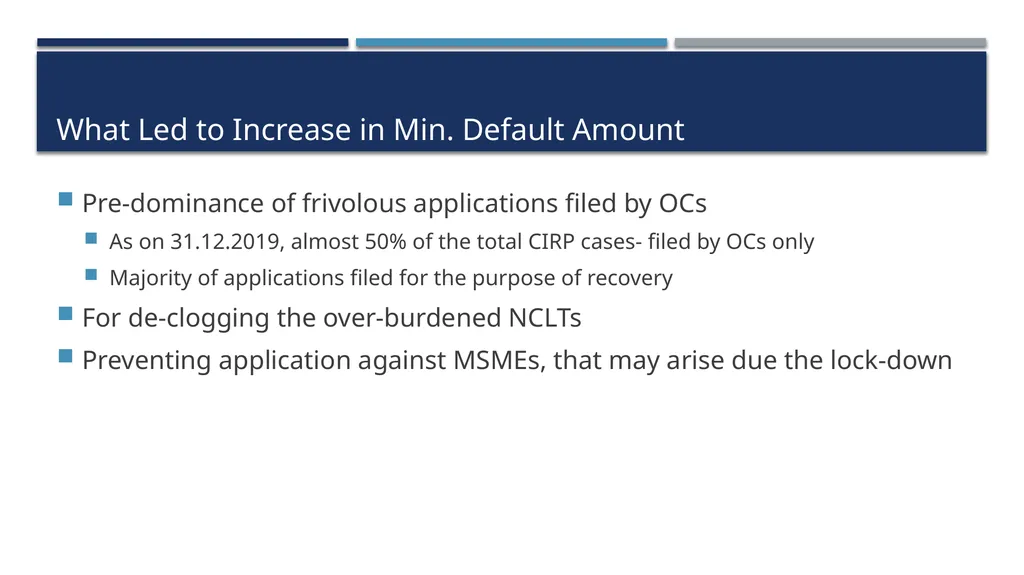
slide6. What Led to Increase in Min. Default Amount Pre-dominance of frivolous applications filed by OCs
As on 31.12.2019, almost 50% of the total CIRP cases- filed by OCs only
Majority of applications filed for the purpose of recovery
For de-clogging the over-burdened NCLTs
Preventing application against MSMEs, that may arise due the lock-down<br>
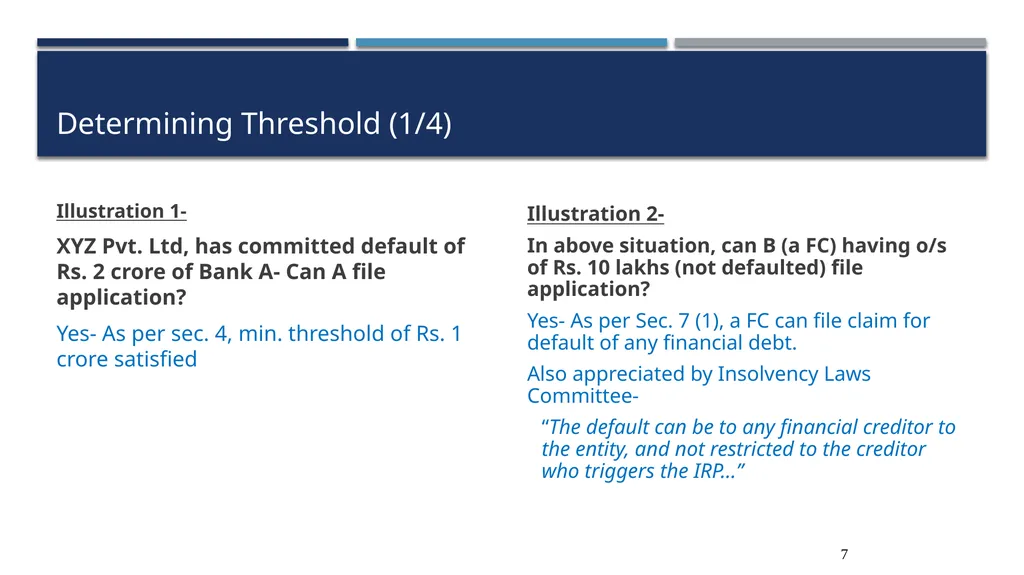
slide7. Determining Threshold (1/4) Illustration 1-
XYZ Pvt. Ltd, has committed default of Rs. 2 crore of Bank A- Can A file application?
Yes- As per sec. 4, min. threshold of Rs. 1 crore satisfied Illustration 2-
In above situation, can B (a FC) having o/s of Rs. 10 lakhs (not defaulted) file application?
Yes- As per Sec. 7 (1), a FC can file claim for default of any financial debt.
Also appreciated by Insolvency Laws Committee-
“The default can be to any financial creditor to the entity, and not restricted to the creditor who triggers the IRP…” 7<br>
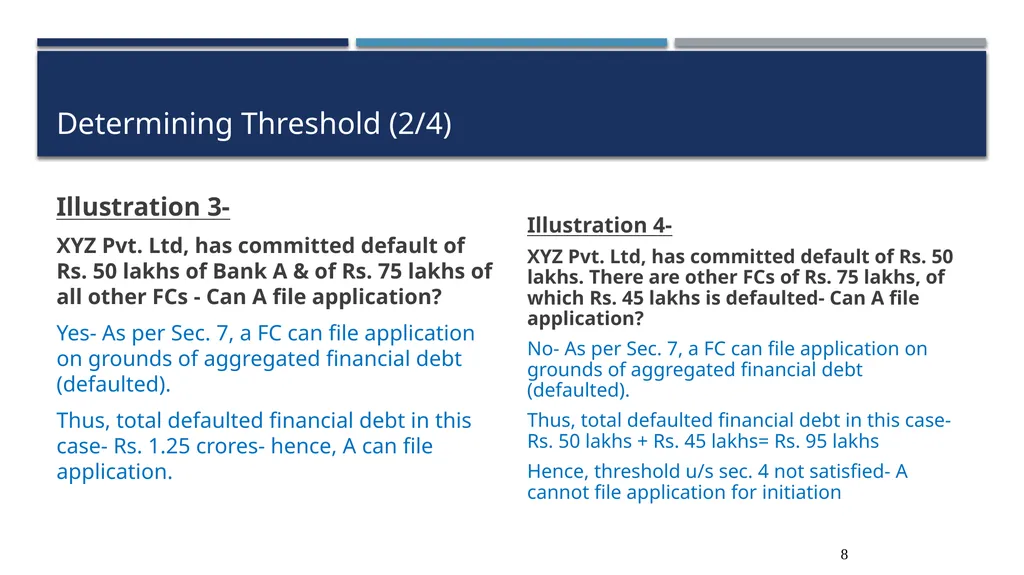
slide8. Determining Threshold (2/4) Illustration 3-
XYZ Pvt. Ltd, has committed default of Rs. 50 lakhs of Bank A & of Rs. 75 lakhs of all other FCs - Can A file application?
Yes- As per Sec. 7, a FC can file application on grounds of aggregated financial debt (defaulted).
Thus, total defaulted financial debt in this case- Rs. 1.25 crores- hence, A can file application. Illustration 4-
XYZ Pvt. Ltd, has committed default of Rs. 50 lakhs. There are other FCs of Rs. 75 lakhs, of which Rs. 45 lakhs is defaulted- Can A file application?
No- As per Sec. 7, a FC can file application on grounds of aggregated financial debt (defaulted).
Thus, total defaulted financial debt in this case- Rs. 50 lakhs + Rs. 45 lakhs= Rs. 95 lakhs
Hence, threshold u/s sec. 4 not satisfied- A cannot file application for initiation 8<br>
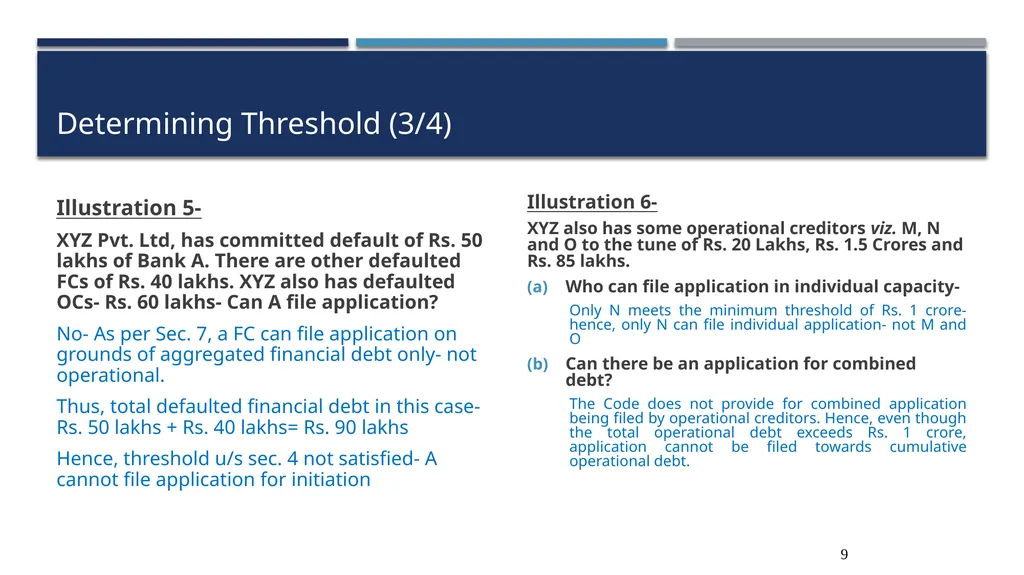
slide9. Determining Threshold (3/4) Illustration 5-
XYZ Pvt. Ltd, has committed default of Rs. 50 lakhs of Bank A. There are other defaulted FCs of Rs. 40 lakhs. XYZ also has defaulted OCs- Rs. 60 lakhs- Can A file application?
No- As per Sec. 7, a FC can file application on grounds of aggregated financial debt only- not operational.
Thus, total defaulted financial debt in this case- Rs. 50 lakhs + Rs. 40 lakhs= Rs. 90 lakhs
Hence, threshold u/s sec. 4 not satisfied- A cannot file application for initiation Illustration 6-
XYZ also has some operational creditors viz. M, N and O to the tune of Rs. 20 Lakhs, Rs. 1.5 Crores and Rs. 85 lakhs.
Who can file application in individual capacity-
Only N meets the minimum threshold of Rs. 1 crore- hence, only N can file individual application- not M and O
Can there be an application for combined debt?
The Code does not provide for combined application being filed by operational creditors. Hence, even though the total operational debt exceeds Rs. 1 crore, application cannot be filed towards cumulative operational debt. 9<br>
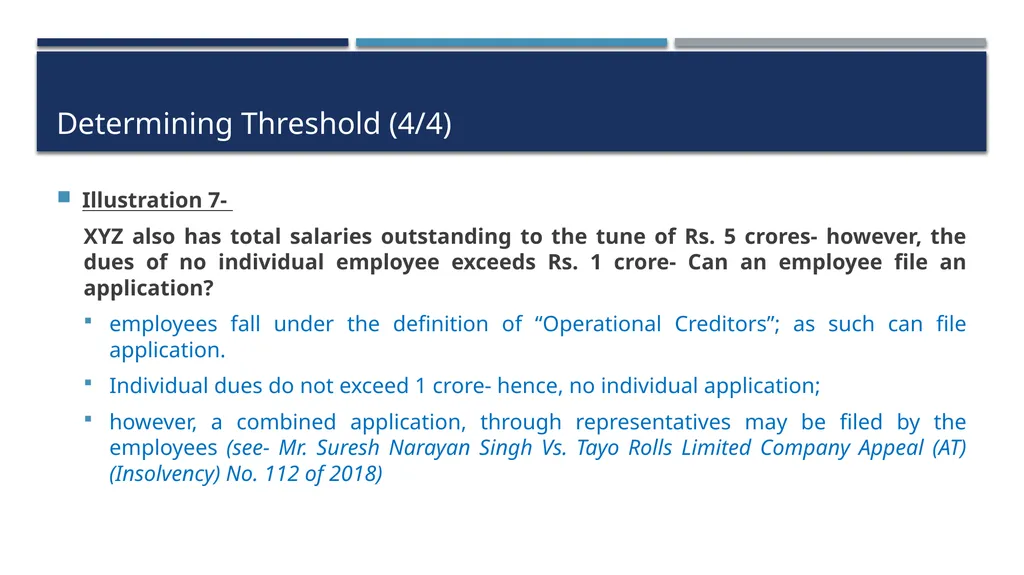
slide10. Determining Threshold (4/4) Illustration 7-
XYZ also has total salaries outstanding to the tune of Rs. 5 crores- however, the dues of no individual employee exceeds Rs. 1 crore- Can an employee file an application?
employees fall under the definition of “Operational Creditors”; as such can file application.
Individual dues do not exceed 1 crore- hence, no individual application;
however, a combined application, through representatives may be filed by the employees (see- Mr. Suresh Narayan Singh Vs. Tayo Rolls Limited Company Appeal (AT) (Insolvency) No. 112 of 2018)<br>
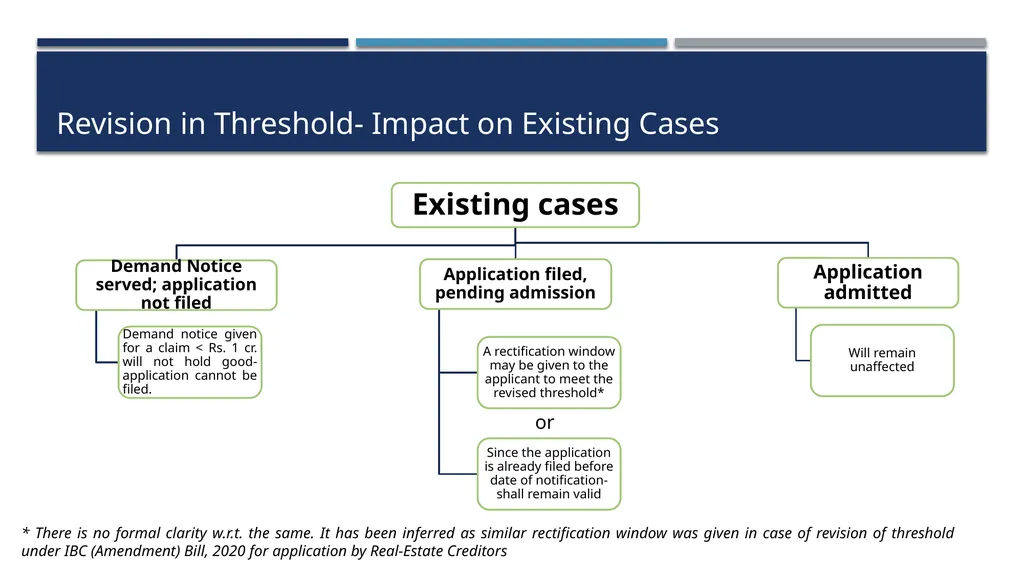
slide11. Revision in Threshold- Impact on Existing Cases * There is no formal clarity w.r.t. the same. It has been inferred as similar rectification window was given in case of revision of threshold under IBC (Amendment) Bill, 2020 for application by Real-Estate Creditors or<br>
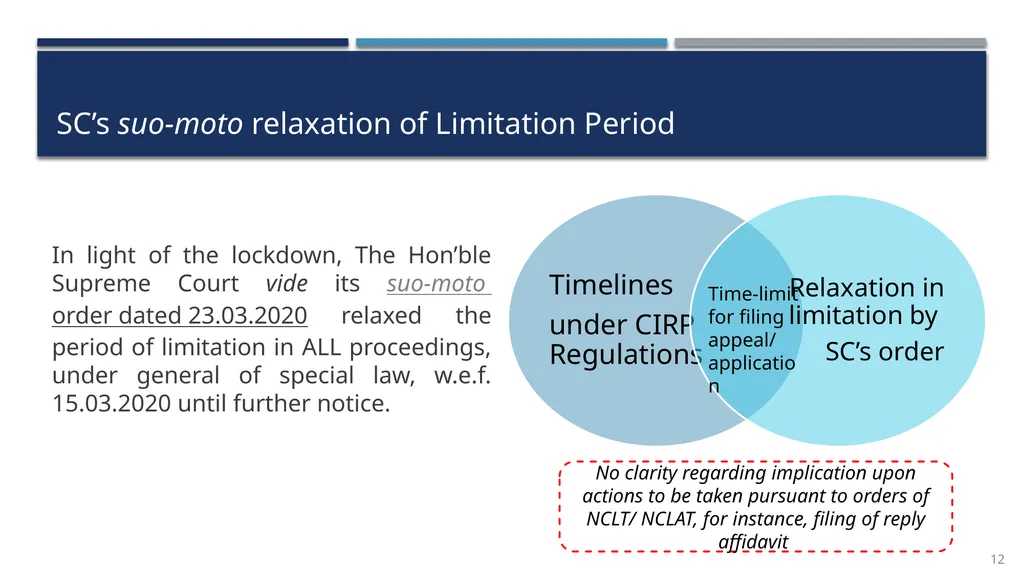
slide12. SC’s suo-moto relaxation of Limitation Period In light of the lockdown, The Hon’ble Supreme Court vide its suo-moto order dated 23.03.2020 relaxed the period of limitation in ALL proceedings, under general of special law, w.e.f. 15.03.2020 until further notice. Time-limit for filing appeal/ application No clarity regarding implication upon actions to be taken pursuant to orders of NCLT/ NCLAT, for instance, filing of reply affidavit 12<br>
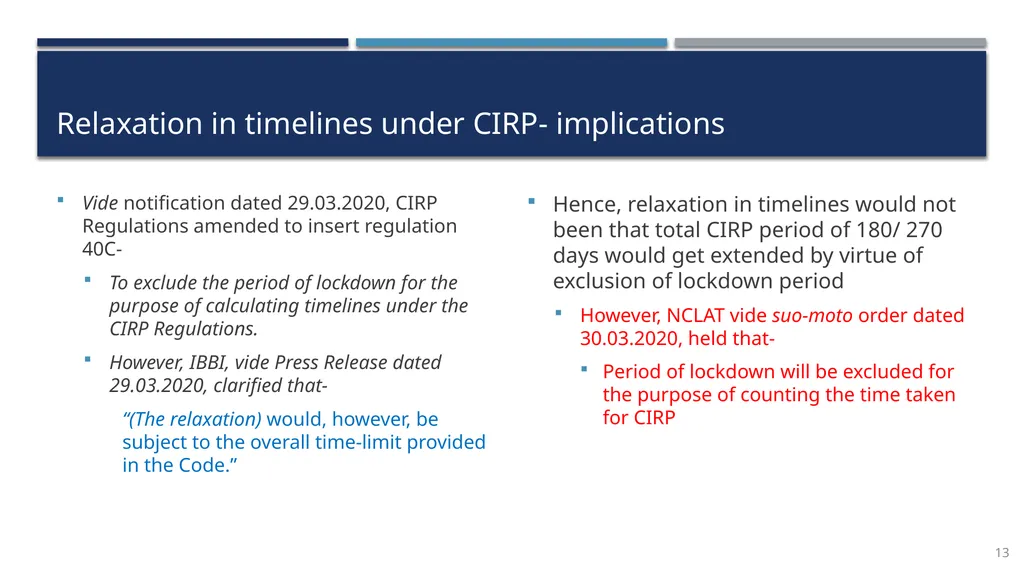
slide13. Relaxation in timelines under CIRP- implications Vide notification dated 29.03.2020, CIRP Regulations amended to insert regulation 40C-
To exclude the period of lockdown for the purpose of calculating timelines under the CIRP Regulations.
However, IBBI, vide Press Release dated 29.03.2020, clarified that-
“(The relaxation) would, however, be subject to the overall time-limit provided in the Code.” Hence, relaxation in timelines would not been that total CIRP period of 180/ 270 days would get extended by virtue of exclusion of lockdown period
However, NCLAT vide suo-moto order dated 30.03.2020, held that-
Period of lockdown will be excluded for the purpose of counting the time taken for CIRP 13<br>
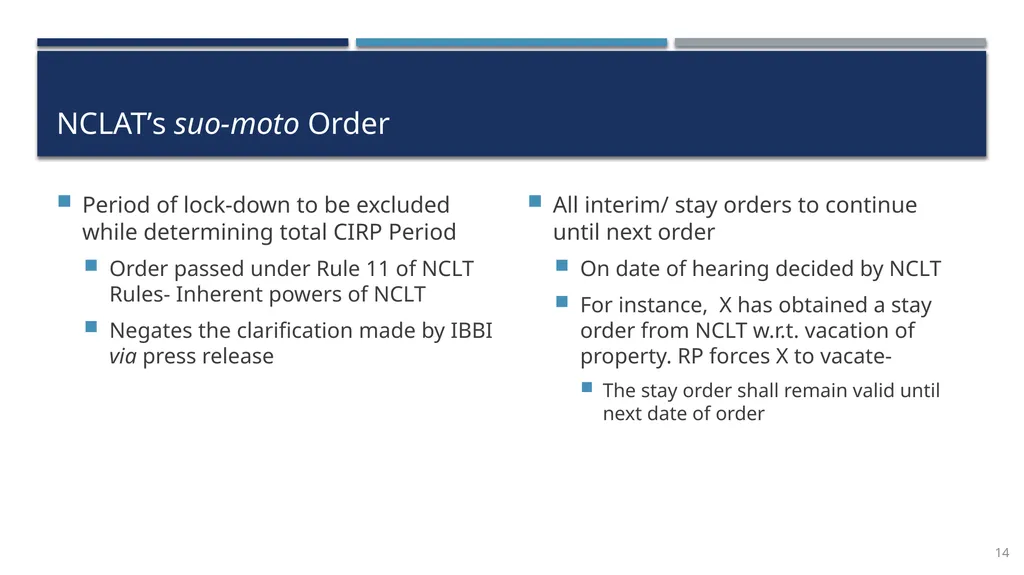
slide14. NCLAT’s suo-moto Order Period of lock-down to be excluded while determining total CIRP Period
Order passed under Rule 11 of NCLT Rules- Inherent powers of NCLT
Negates the clarification made by IBBI via press release All interim/ stay orders to continue until next order
On date of hearing decided by NCLT
For instance, X has obtained a stay order from NCLT w.r.t. vacation of property. RP forces X to vacate-
The stay order shall remain valid until next date of order 14<br>
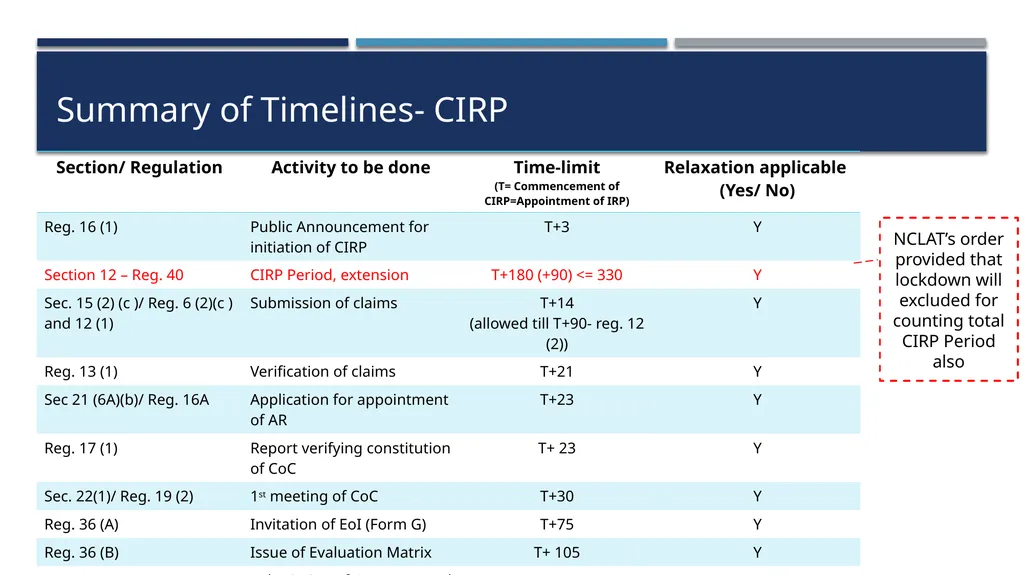
slide15. Summary of Timelines- CIRP NCLAT’s order provided that lockdown will excluded for counting total CIRP Period also<br>
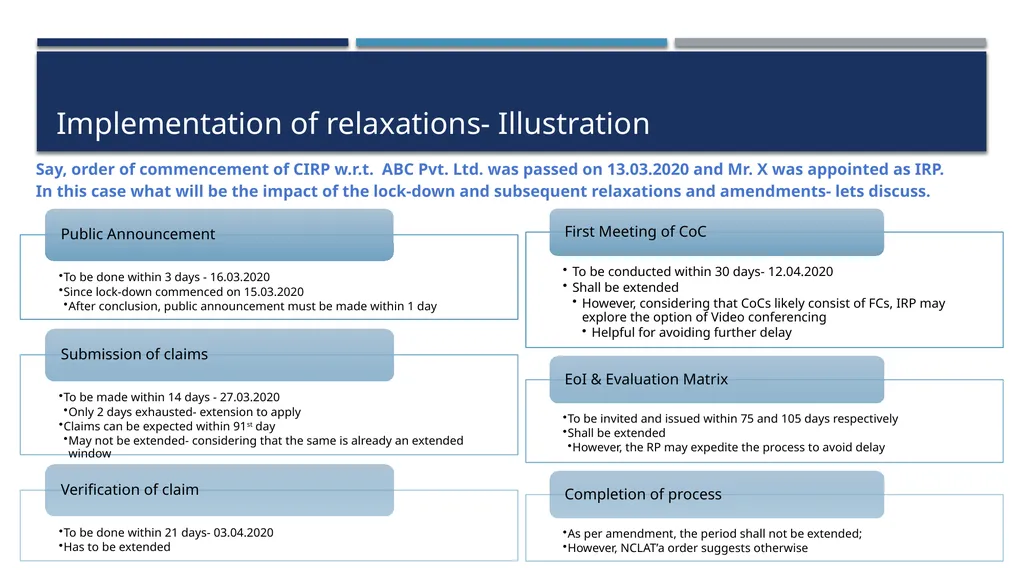
slide16. Implementation of relaxations- Illustration Say, order of commencement of CIRP w.r.t. ABC Pvt. Ltd. was passed on 13.03.2020 and Mr. X was appointed as IRP.
In this case what will be the impact of the lock-down and subsequent relaxations and amendments- lets discuss.<br>
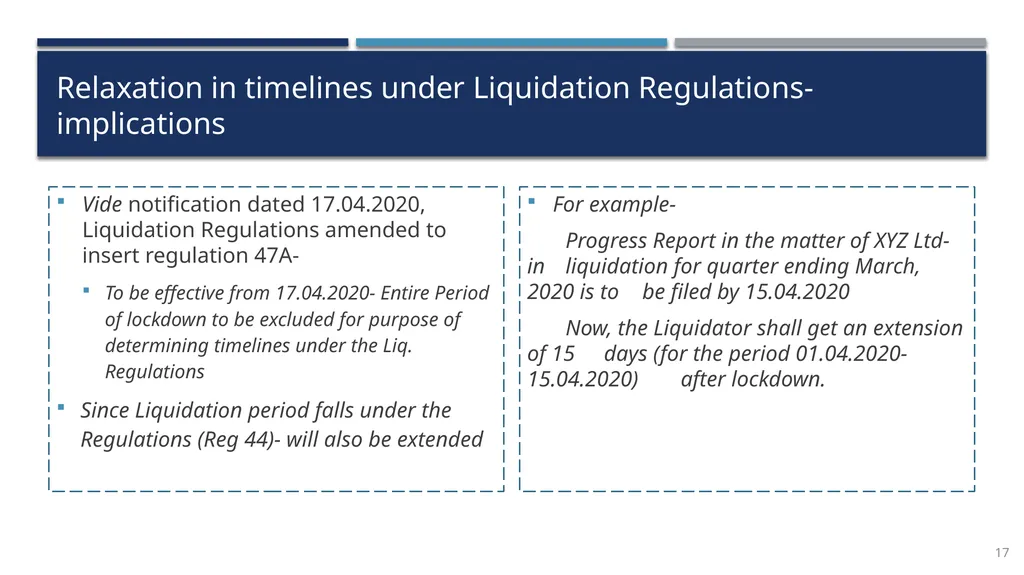
slide17. Relaxation in timelines under Liquidation Regulations- implications Vide notification dated 17.04.2020, Liquidation Regulations amended to insert regulation 47A-
To be effective from 17.04.2020- Entire Period of lockdown to be excluded for purpose of determining timelines under the Liq. Regulations
Since Liquidation period falls under the Regulations (Reg 44)- will also be extended For example-
Progress Report in the matter of XYZ Ltd- in liquidation for quarter ending March, 2020 is to be filed by 15.04.2020
Now, the Liquidator shall get an extension of 15 days (for the period 01.04.2020- 15.04.2020) after lockdown. 17<br>
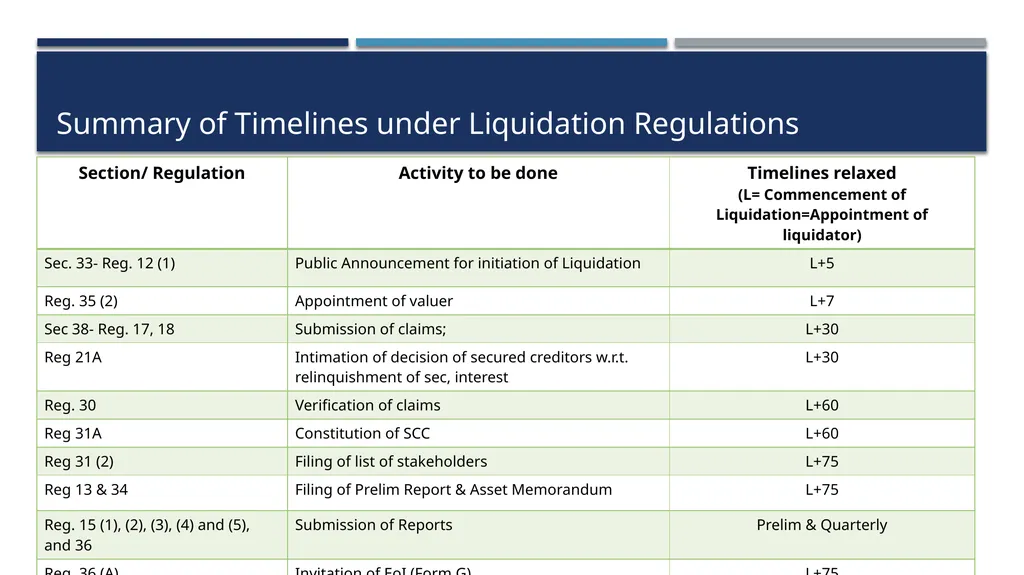
slide18. Summary of Timelines under Liquidation Regulations<br>
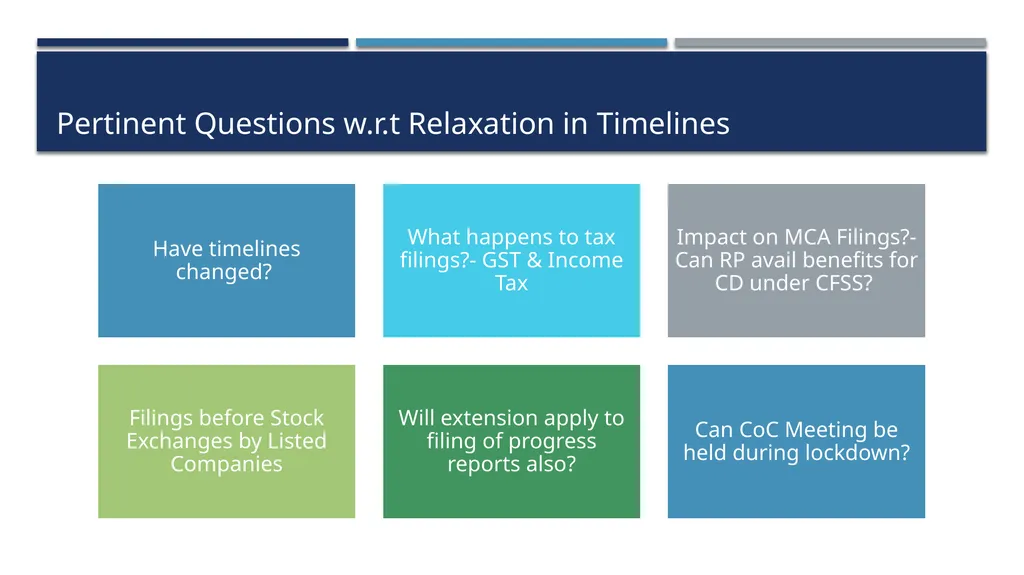
slide19. Pertinent Questions w.r.t Relaxation in Timelines<br>
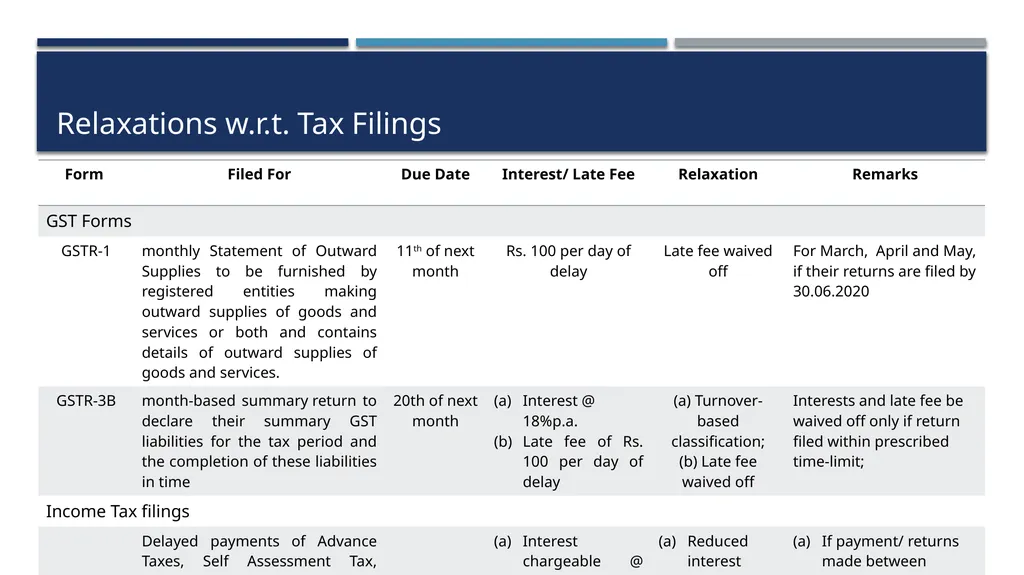
slide20. Relaxations w.r.t. Tax Filings<br>
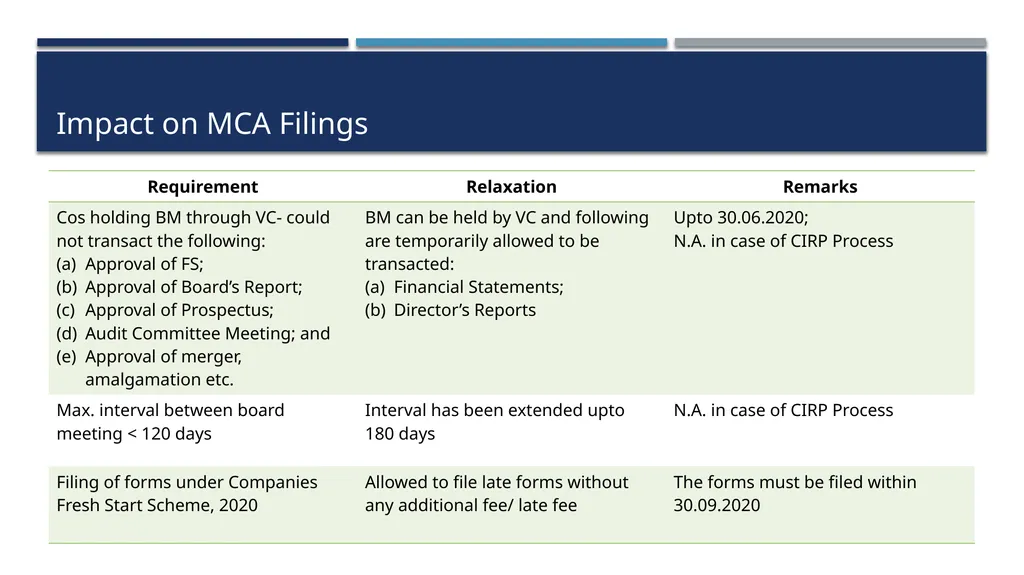
slide21. Impact on MCA Filings<br>
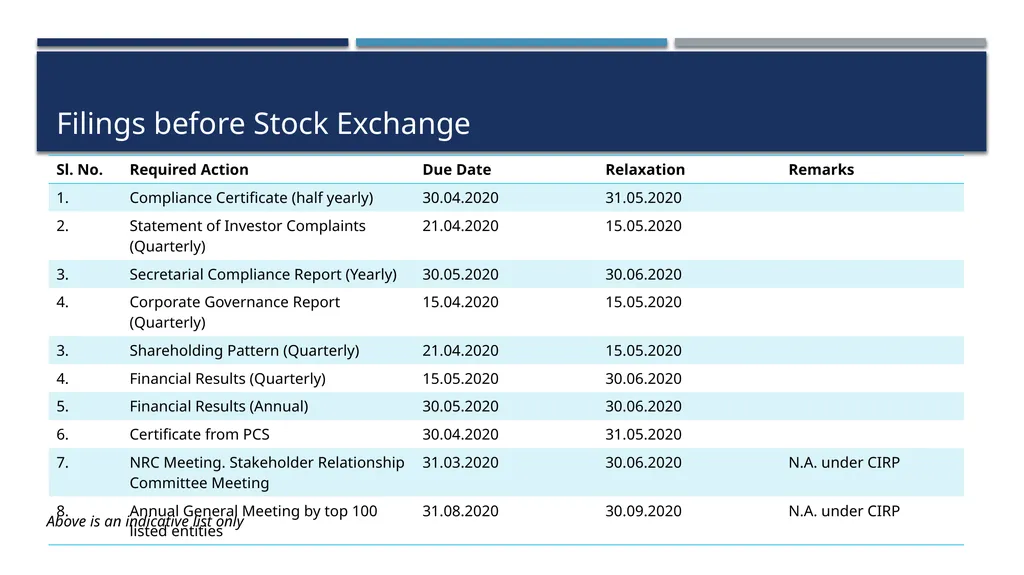
slide22. Filings before Stock Exchange Above is an indicative list only<br>
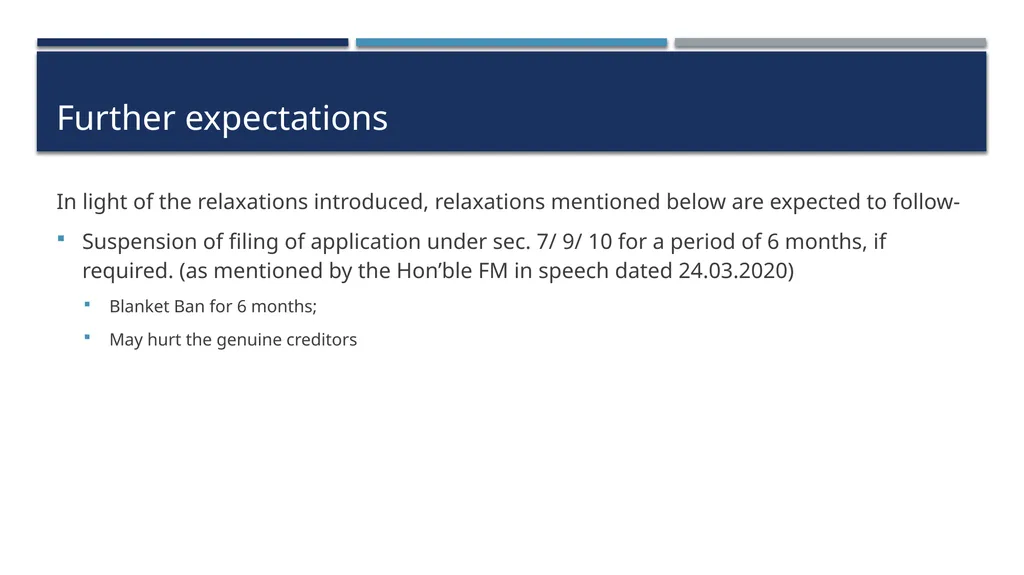
slide23. Further expectations In light of the relaxations introduced, relaxations mentioned below are expected to follow-
Suspension of filing of application under sec. 7/ 9/ 10 for a period of 6 months, if required. (as mentioned by the Hon’ble FM in speech dated 24.03.2020)
Blanket Ban for 6 months;
May hurt the genuine creditors<br>
slide24. contact us<br>
slide2. COPYRIGHT & Disclaimer The contents of the presentation are intended solely for the use of the client to whom the same is marked by us.
No circulation, publication, or unauthorised use of the presentation in any form is allowed, except with our prior written permission.
No part of this presentation is intended to be professional advice, or solicitation of professional assignment.<br>
slide3. About Us Vinod Kothari Consultants Private Limited, consultants and advisors
Based out of Kolkata, New Delhi & Mumbai
We are a team of consultants, advisors & qualified professionals having over 30 years of practice. Our Organization’s Credo:
Focus on capabilities; opportunities follow<br>
slide4. Steps taken in light of COVID-19<br>
slide5. Increase in Minimum Default & its Impact W.e.f. 24.03.2020- min. default increased to Rs. 1,00,00,000/-
No corresponding change in case of Personal Guarantors to Corporate Debtors-
It still remains as low as Rs. 1,000/-
Might lead to a shift of burden from CDs to Personal Guarantors
Creditors, especially OCs in agony Minimum default Rs. 1,000/- ** The minimum default threshold has been increased from Rs. 1 Lakh to Rs. 1 crore<br>
slide6. What Led to Increase in Min. Default Amount Pre-dominance of frivolous applications filed by OCs
As on 31.12.2019, almost 50% of the total CIRP cases- filed by OCs only
Majority of applications filed for the purpose of recovery
For de-clogging the over-burdened NCLTs
Preventing application against MSMEs, that may arise due the lock-down<br>
slide7. Determining Threshold (1/4) Illustration 1-
XYZ Pvt. Ltd, has committed default of Rs. 2 crore of Bank A- Can A file application?
Yes- As per sec. 4, min. threshold of Rs. 1 crore satisfied Illustration 2-
In above situation, can B (a FC) having o/s of Rs. 10 lakhs (not defaulted) file application?
Yes- As per Sec. 7 (1), a FC can file claim for default of any financial debt.
Also appreciated by Insolvency Laws Committee-
“The default can be to any financial creditor to the entity, and not restricted to the creditor who triggers the IRP…” 7<br>
slide8. Determining Threshold (2/4) Illustration 3-
XYZ Pvt. Ltd, has committed default of Rs. 50 lakhs of Bank A & of Rs. 75 lakhs of all other FCs - Can A file application?
Yes- As per Sec. 7, a FC can file application on grounds of aggregated financial debt (defaulted).
Thus, total defaulted financial debt in this case- Rs. 1.25 crores- hence, A can file application. Illustration 4-
XYZ Pvt. Ltd, has committed default of Rs. 50 lakhs. There are other FCs of Rs. 75 lakhs, of which Rs. 45 lakhs is defaulted- Can A file application?
No- As per Sec. 7, a FC can file application on grounds of aggregated financial debt (defaulted).
Thus, total defaulted financial debt in this case- Rs. 50 lakhs + Rs. 45 lakhs= Rs. 95 lakhs
Hence, threshold u/s sec. 4 not satisfied- A cannot file application for initiation 8<br>
slide9. Determining Threshold (3/4) Illustration 5-
XYZ Pvt. Ltd, has committed default of Rs. 50 lakhs of Bank A. There are other defaulted FCs of Rs. 40 lakhs. XYZ also has defaulted OCs- Rs. 60 lakhs- Can A file application?
No- As per Sec. 7, a FC can file application on grounds of aggregated financial debt only- not operational.
Thus, total defaulted financial debt in this case- Rs. 50 lakhs + Rs. 40 lakhs= Rs. 90 lakhs
Hence, threshold u/s sec. 4 not satisfied- A cannot file application for initiation Illustration 6-
XYZ also has some operational creditors viz. M, N and O to the tune of Rs. 20 Lakhs, Rs. 1.5 Crores and Rs. 85 lakhs.
Who can file application in individual capacity-
Only N meets the minimum threshold of Rs. 1 crore- hence, only N can file individual application- not M and O
Can there be an application for combined debt?
The Code does not provide for combined application being filed by operational creditors. Hence, even though the total operational debt exceeds Rs. 1 crore, application cannot be filed towards cumulative operational debt. 9<br>
slide10. Determining Threshold (4/4) Illustration 7-
XYZ also has total salaries outstanding to the tune of Rs. 5 crores- however, the dues of no individual employee exceeds Rs. 1 crore- Can an employee file an application?
employees fall under the definition of “Operational Creditors”; as such can file application.
Individual dues do not exceed 1 crore- hence, no individual application;
however, a combined application, through representatives may be filed by the employees (see- Mr. Suresh Narayan Singh Vs. Tayo Rolls Limited Company Appeal (AT) (Insolvency) No. 112 of 2018)<br>
slide11. Revision in Threshold- Impact on Existing Cases * There is no formal clarity w.r.t. the same. It has been inferred as similar rectification window was given in case of revision of threshold under IBC (Amendment) Bill, 2020 for application by Real-Estate Creditors or<br>
slide12. SC’s suo-moto relaxation of Limitation Period In light of the lockdown, The Hon’ble Supreme Court vide its suo-moto order dated 23.03.2020 relaxed the period of limitation in ALL proceedings, under general of special law, w.e.f. 15.03.2020 until further notice. Time-limit for filing appeal/ application No clarity regarding implication upon actions to be taken pursuant to orders of NCLT/ NCLAT, for instance, filing of reply affidavit 12<br>
slide13. Relaxation in timelines under CIRP- implications Vide notification dated 29.03.2020, CIRP Regulations amended to insert regulation 40C-
To exclude the period of lockdown for the purpose of calculating timelines under the CIRP Regulations.
However, IBBI, vide Press Release dated 29.03.2020, clarified that-
“(The relaxation) would, however, be subject to the overall time-limit provided in the Code.” Hence, relaxation in timelines would not been that total CIRP period of 180/ 270 days would get extended by virtue of exclusion of lockdown period
However, NCLAT vide suo-moto order dated 30.03.2020, held that-
Period of lockdown will be excluded for the purpose of counting the time taken for CIRP 13<br>
slide14. NCLAT’s suo-moto Order Period of lock-down to be excluded while determining total CIRP Period
Order passed under Rule 11 of NCLT Rules- Inherent powers of NCLT
Negates the clarification made by IBBI via press release All interim/ stay orders to continue until next order
On date of hearing decided by NCLT
For instance, X has obtained a stay order from NCLT w.r.t. vacation of property. RP forces X to vacate-
The stay order shall remain valid until next date of order 14<br>
slide15. Summary of Timelines- CIRP NCLAT’s order provided that lockdown will excluded for counting total CIRP Period also<br>
slide16. Implementation of relaxations- Illustration Say, order of commencement of CIRP w.r.t. ABC Pvt. Ltd. was passed on 13.03.2020 and Mr. X was appointed as IRP.
In this case what will be the impact of the lock-down and subsequent relaxations and amendments- lets discuss.<br>
slide17. Relaxation in timelines under Liquidation Regulations- implications Vide notification dated 17.04.2020, Liquidation Regulations amended to insert regulation 47A-
To be effective from 17.04.2020- Entire Period of lockdown to be excluded for purpose of determining timelines under the Liq. Regulations
Since Liquidation period falls under the Regulations (Reg 44)- will also be extended For example-
Progress Report in the matter of XYZ Ltd- in liquidation for quarter ending March, 2020 is to be filed by 15.04.2020
Now, the Liquidator shall get an extension of 15 days (for the period 01.04.2020- 15.04.2020) after lockdown. 17<br>
slide18. Summary of Timelines under Liquidation Regulations<br>
slide19. Pertinent Questions w.r.t Relaxation in Timelines<br>
slide20. Relaxations w.r.t. Tax Filings<br>
slide21. Impact on MCA Filings<br>
slide22. Filings before Stock Exchange Above is an indicative list only<br>
slide23. Further expectations In light of the relaxations introduced, relaxations mentioned below are expected to follow-
Suspension of filing of application under sec. 7/ 9/ 10 for a period of 6 months, if required. (as mentioned by the Hon’ble FM in speech dated 24.03.2020)
Blanket Ban for 6 months;
May hurt the genuine creditors<br>
slide24. contact us<br>