
CPE’s Efforts Addressing Underserved Students A



Description: CPEs Efforts Addressing Underserved Students A Report to the Interim Joint Committee on Education Travis Powell, JD - Senior Vice President and General Counsel Dr. Dawn Offutt - Executive Director for Access, Engagement, Belonging July
Related Topics
Download Presentation
"CPE’s Efforts Addressing Underserved Students A" is the property of its rightful owner. Permission is granted to download and print the materials on this website for personal, non-commercial use only, and to display it on your personal computer provided you do not modify the materials and that you retain all copyright notices contained in the materials. By downloading content from our website, you accept the terms of this agreement.
Presentation Transcript
slide1. CPE’s Efforts Addressing Underserved Students
A Report to the Interim Joint Committee on Education Travis Powell, JD - Senior Vice President and General Counsel
Dr. Dawn Offutt - Executive Director for Access, Engagement, & Belonging
July 16, 2024<br>
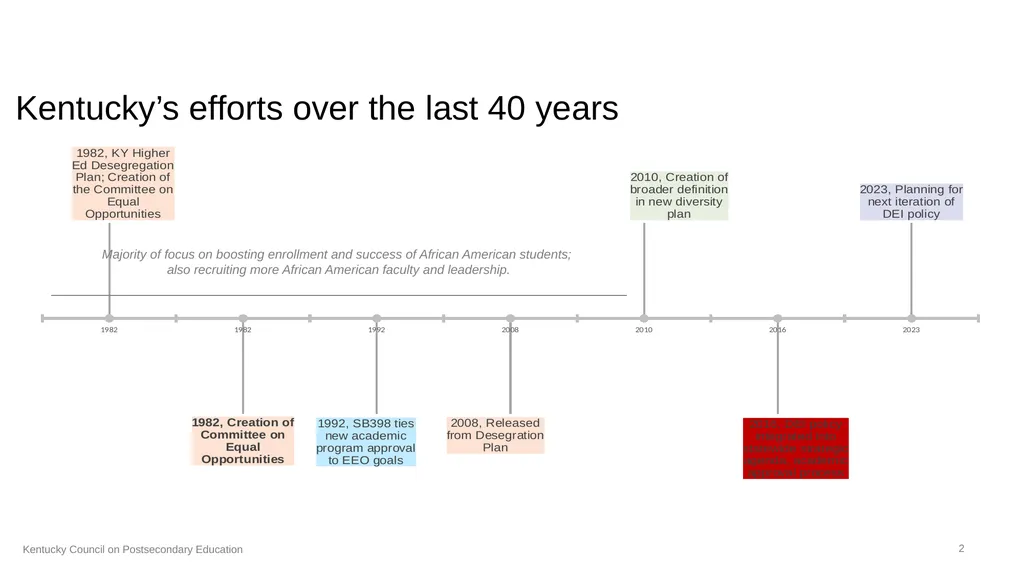
slide2. Kentucky’s efforts over the last 40 years 2 Majority of focus on boosting enrollment and success of African American students; also recruiting more African American faculty and leadership.<br>
slide3. Kentucky’s goal is to have 60% of the population with a postsecondary credential by 2030 3 Source: CPE Data, Research and Advanced Analytics Unit. The state’s goal was set in 2016.
According to our estimates, we still have more work to do to reach the goal within six years.<br>
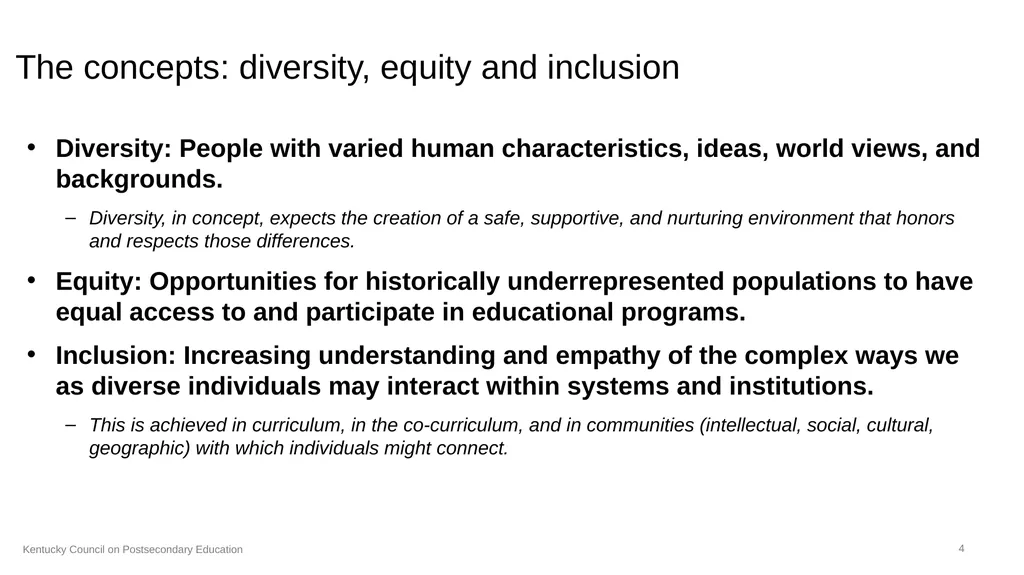
slide4. The concepts: diversity, equity and inclusion 4 Diversity: People with varied human characteristics, ideas, world views, and backgrounds.
Diversity, in concept, expects the creation of a safe, supportive, and nurturing environment that honors and respects those differences.
Equity: Opportunities for historically underrepresented populations to have equal access to and participate in educational programs.
Inclusion: Increasing understanding and empathy of the complex ways we as diverse individuals may interact within systems and institutions.
This is achieved in curriculum, in the co-curriculum, and in communities (intellectual, social, cultural, geographic) with which individuals might connect.<br>
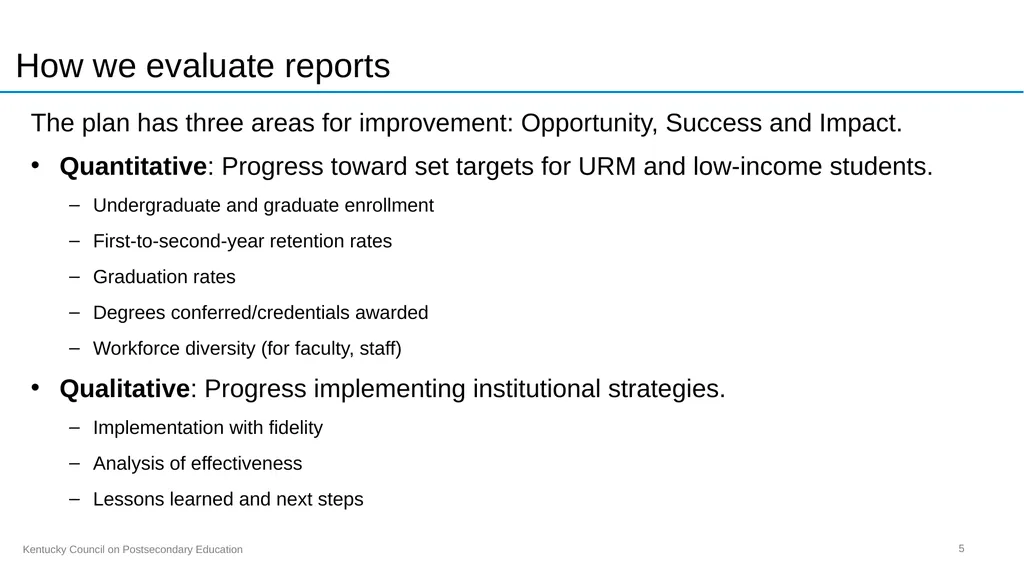
slide5. How we evaluate reports The plan has three areas for improvement: Opportunity, Success and Impact.
Quantitative: Progress toward set targets for URM and low-income students.
Undergraduate and graduate enrollment
First-to-second-year retention rates
Graduation rates
Degrees conferred/credentials awarded
Workforce diversity (for faculty, staff)
Qualitative: Progress implementing institutional strategies.
Implementation with fidelity
Analysis of effectiveness
Lessons learned and next steps 5<br>
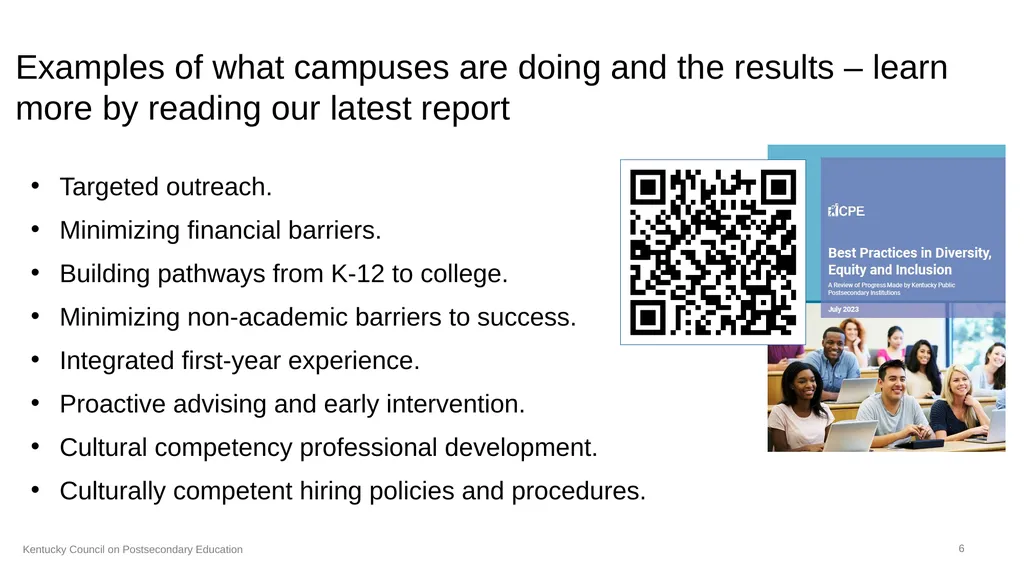
slide6. Examples of what campuses are doing and the results – learn more by reading our latest report Targeted outreach.
Minimizing financial barriers.
Building pathways from K-12 to college.
Minimizing non-academic barriers to success.
Integrated first-year experience.
Proactive advising and early intervention.
Cultural competency professional development.
Culturally competent hiring policies and procedures. 6<br>
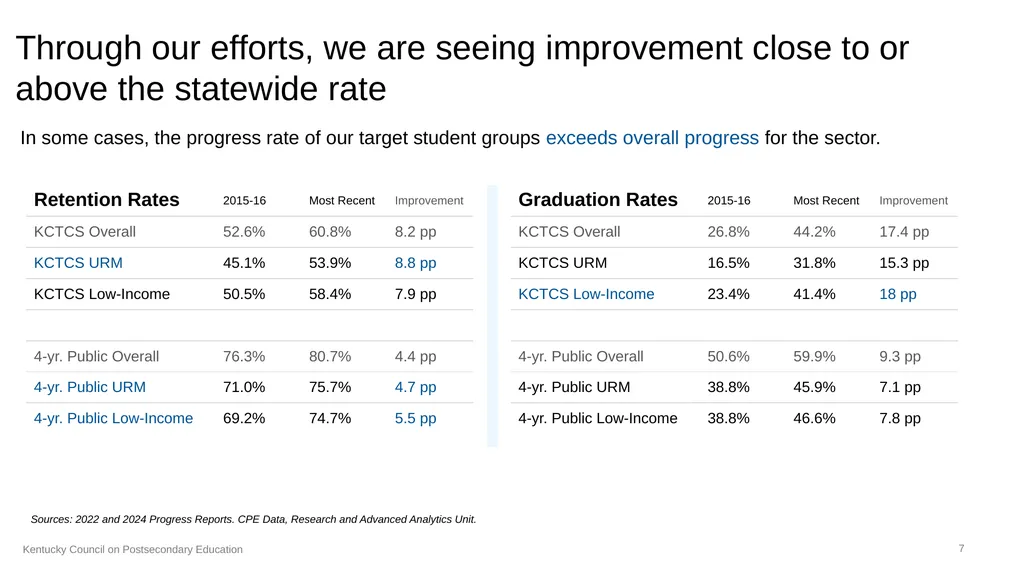
slide7. Through our efforts, we are seeing improvement close to or above the statewide rate 7 Sources: 2022 and 2024 Progress Reports. CPE Data, Research and Advanced Analytics Unit. In some cases, the progress rate of our target student groups exceeds overall progress for the sector.<br>
slide8. CPE initiatives to assist the work of our campuses Academic Leadership Development Institute (ALDI): Year-long professional development focused on early career, faculty and staff from diverse backgrounds who aspire to leadership positions.
Cultural Competency Credential Certification: A statewide certification process that recognizes institutions for their work in cultural competence.
Higher EDquity Symposium: An annual event to discuss best practices for ensuring the success of underserved students. Examples:
Caption It: How to Add Captions to Multiple Platforms and Why You Should
Knitting a Stronger Safety Net for First Year Students
Designing Inclusive Communities: How Accessibility Leads to Belonging 8<br>
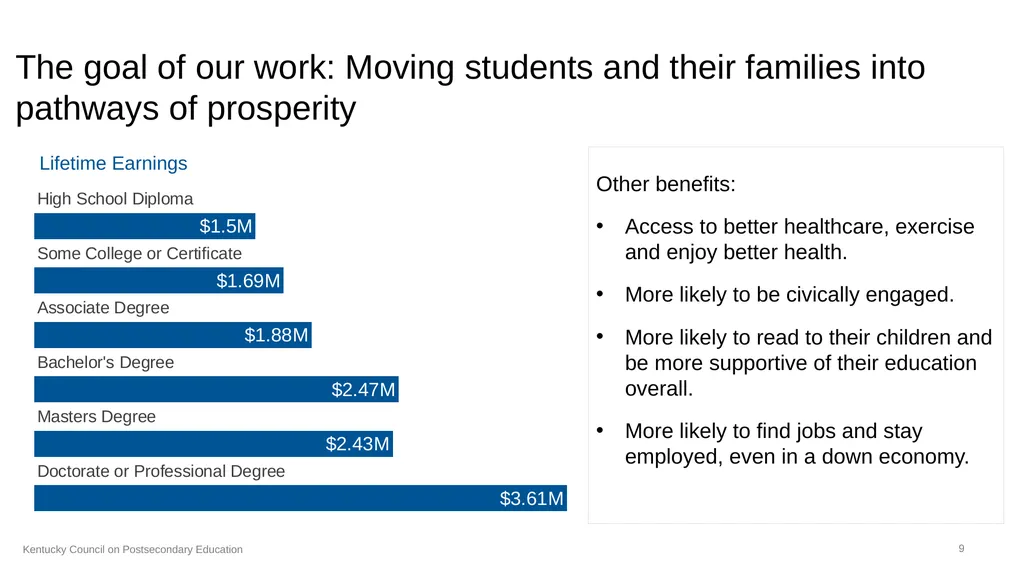
slide9. The goal of our work: Moving students and their families into pathways of prosperity Other benefits:
Access to better healthcare, exercise and enjoy better health.
More likely to be civically engaged.
More likely to read to their children and be more supportive of their education overall.
More likely to find jobs and stay employed, even in a down economy. 9 Lifetime Earnings<br>
slide10. Kentucky’s efforts moving forward Updating the statewide policy.
Adjusting elements of the performance funding model.
Shifting CPE’s work in this area to the P20 unit to better understand student needs. 10<br>
slide11. Questions?<br>
Dr. Dawn Offutt - Executive Director for Access, Engagement, & Belonging
July 16, 2024<br>
slide2. Kentucky’s efforts over the last 40 years 2 Majority of focus on boosting enrollment and success of African American students; also recruiting more African American faculty and leadership.<br>
slide3. Kentucky’s goal is to have 60% of the population with a postsecondary credential by 2030 3 Source: CPE Data, Research and Advanced Analytics Unit. The state’s goal was set in 2016.
According to our estimates, we still have more work to do to reach the goal within six years.<br>
slide4. The concepts: diversity, equity and inclusion 4 Diversity: People with varied human characteristics, ideas, world views, and backgrounds.
Diversity, in concept, expects the creation of a safe, supportive, and nurturing environment that honors and respects those differences.
Equity: Opportunities for historically underrepresented populations to have equal access to and participate in educational programs.
Inclusion: Increasing understanding and empathy of the complex ways we as diverse individuals may interact within systems and institutions.
This is achieved in curriculum, in the co-curriculum, and in communities (intellectual, social, cultural, geographic) with which individuals might connect.<br>
slide5. How we evaluate reports The plan has three areas for improvement: Opportunity, Success and Impact.
Quantitative: Progress toward set targets for URM and low-income students.
Undergraduate and graduate enrollment
First-to-second-year retention rates
Graduation rates
Degrees conferred/credentials awarded
Workforce diversity (for faculty, staff)
Qualitative: Progress implementing institutional strategies.
Implementation with fidelity
Analysis of effectiveness
Lessons learned and next steps 5<br>
slide6. Examples of what campuses are doing and the results – learn more by reading our latest report Targeted outreach.
Minimizing financial barriers.
Building pathways from K-12 to college.
Minimizing non-academic barriers to success.
Integrated first-year experience.
Proactive advising and early intervention.
Cultural competency professional development.
Culturally competent hiring policies and procedures. 6<br>
slide7. Through our efforts, we are seeing improvement close to or above the statewide rate 7 Sources: 2022 and 2024 Progress Reports. CPE Data, Research and Advanced Analytics Unit. In some cases, the progress rate of our target student groups exceeds overall progress for the sector.<br>
slide8. CPE initiatives to assist the work of our campuses Academic Leadership Development Institute (ALDI): Year-long professional development focused on early career, faculty and staff from diverse backgrounds who aspire to leadership positions.
Cultural Competency Credential Certification: A statewide certification process that recognizes institutions for their work in cultural competence.
Higher EDquity Symposium: An annual event to discuss best practices for ensuring the success of underserved students. Examples:
Caption It: How to Add Captions to Multiple Platforms and Why You Should
Knitting a Stronger Safety Net for First Year Students
Designing Inclusive Communities: How Accessibility Leads to Belonging 8<br>
slide9. The goal of our work: Moving students and their families into pathways of prosperity Other benefits:
Access to better healthcare, exercise and enjoy better health.
More likely to be civically engaged.
More likely to read to their children and be more supportive of their education overall.
More likely to find jobs and stay employed, even in a down economy. 9 Lifetime Earnings<br>
slide10. Kentucky’s efforts moving forward Updating the statewide policy.
Adjusting elements of the performance funding model.
Shifting CPE’s work in this area to the P20 unit to better understand student needs. 10<br>
slide11. Questions?<br>