Creating a Revision Timetable What does an effective revision timetable look like and how can we ensure we stay healthy during exam season? Brain Dump! Instead of a Memory Platform, today you will do a Brain Dump challenge! Close your
"Creating a Revision Timetable What does an" is the property of its rightful owner. Permission is granted to
download and print the materials on this website for personal, non-commercial use only, and to display it
on your personal computer provided you do not modify the materials and that you retain all copyright
notices contained in the materials. By downloading content from our website, you accept the terms of this
agreement.
Presentation Transcript
01
Creating a Revision Timetable What does an effective revision timetable look like and how can we ensure we stay healthy during ‘exam season’?<br>
02
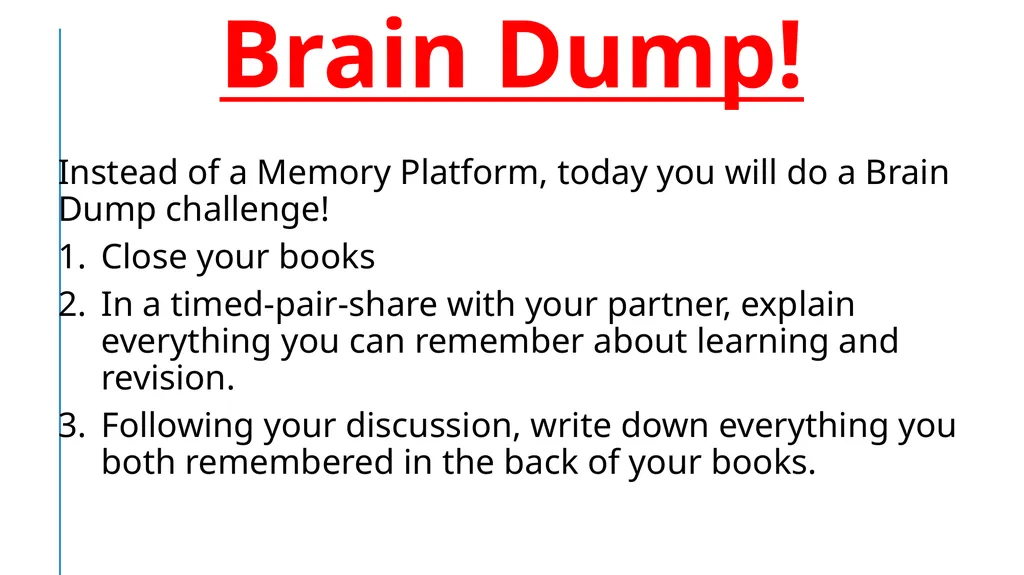
Brain Dump! Instead of a Memory Platform, today you will do a Brain Dump challenge!
Close your books
In a timed-pair-share with your partner, explain everything you can remember about learning and revision.
Following your discussion, write down everything you both remembered in the back of your books.<br>
03
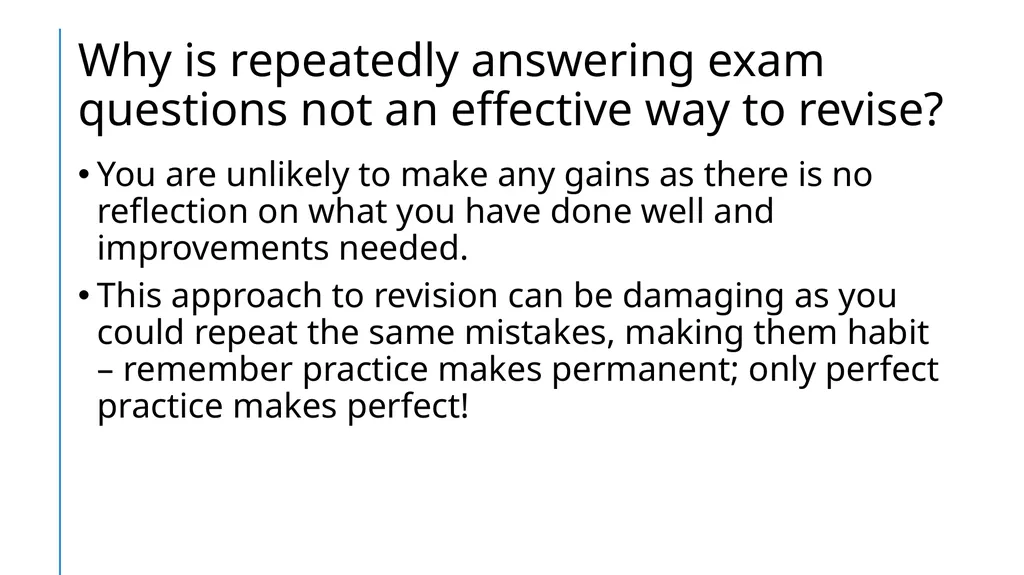
Why is repeatedly answering exam questions not an effective way to revise? You are unlikely to make any gains as there is no reflection on what you have done well and improvements needed.
This approach to revision can be damaging as you could repeat the same mistakes, making them habit – remember practice makes permanent; only perfect practice makes perfect!<br>
04
Principles of an effective revision timetable Things we might take into consideration when designing our revision timetable:
Schema: making links in our learning e.g. revising a theme across texts in literature, revising tyrants from different time periods in history, revising use of BIDMAS in different mathematical questions or papers.
Interleaving: alternating between different topics and/or subject areas.
Spacing: returning to topics after a break.
Metacognition: looking back at areas of weakness from previous study sessions and ensuring we repeatedly return to these, making them the focus of future sessions.<br>
05
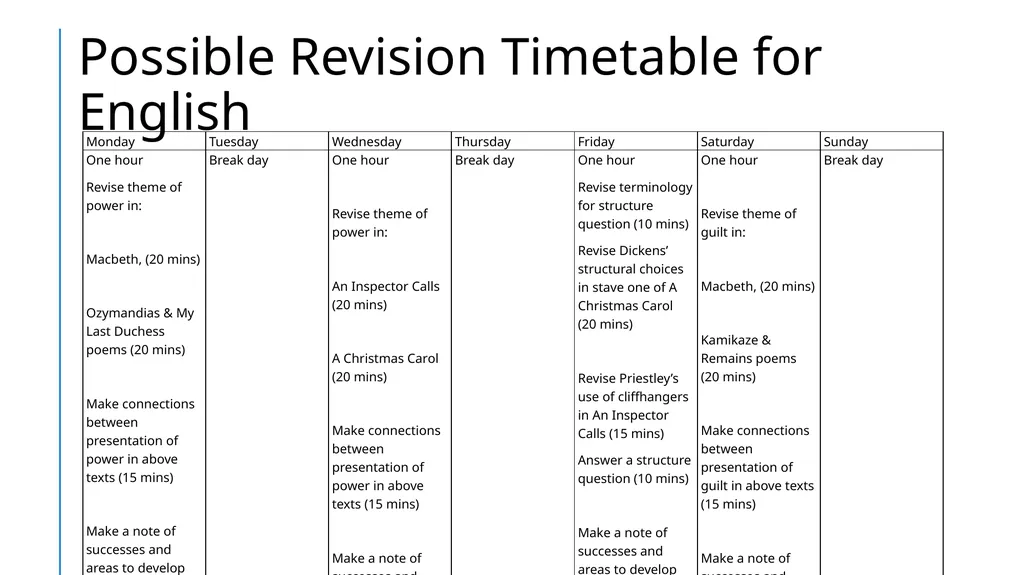
Possible Revision Timetable for English<br>
06
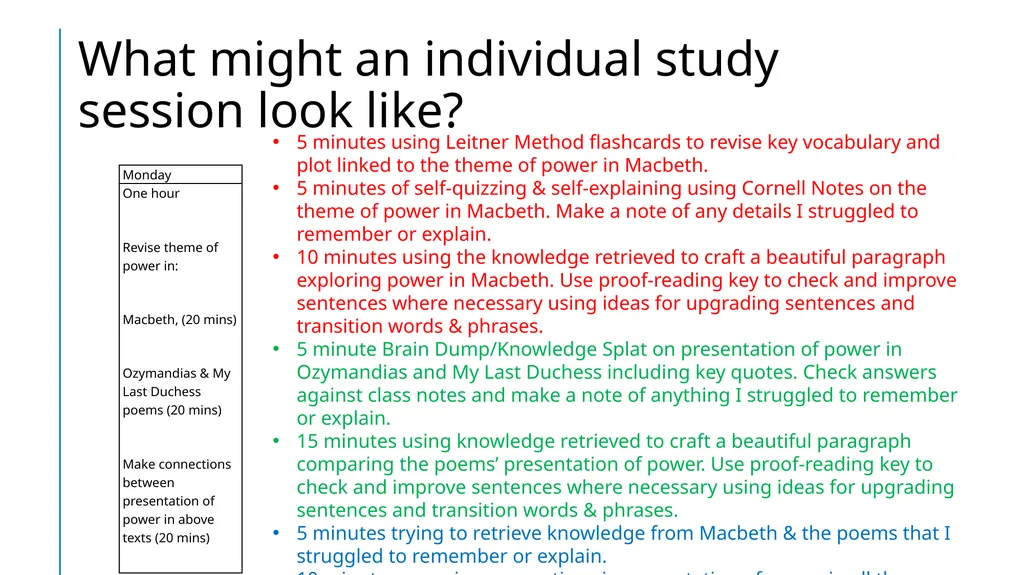
What might an individual study session look like? 5 minutes using Leitner Method flashcards to revise key vocabulary and plot linked to the theme of power in Macbeth.
5 minutes of self-quizzing & self-explaining using Cornell Notes on the theme of power in Macbeth. Make a note of any details I struggled to remember or explain.
10 minutes using the knowledge retrieved to craft a beautiful paragraph exploring power in Macbeth. Use proof-reading key to check and improve sentences where necessary using ideas for upgrading sentences and transition words & phrases.
5 minute Brain Dump/Knowledge Splat on presentation of power in Ozymandias and My Last Duchess including key quotes. Check answers against class notes and make a note of anything I struggled to remember or explain.
15 minutes using knowledge retrieved to craft a beautiful paragraph comparing the poems’ presentation of power. Use proof-reading key to check and improve sentences where necessary using ideas for upgrading sentences and transition words & phrases.
5 minutes trying to retrieve knowledge from Macbeth & the poems that I struggled to remember or explain.
10 minutes mapping connections in presentation of power in all three texts using a Venn Diagram.
5 minutes making a note of successes and areas to develop from today’s study session. Use abbreviations (note-form) where appropriate.<br>
07
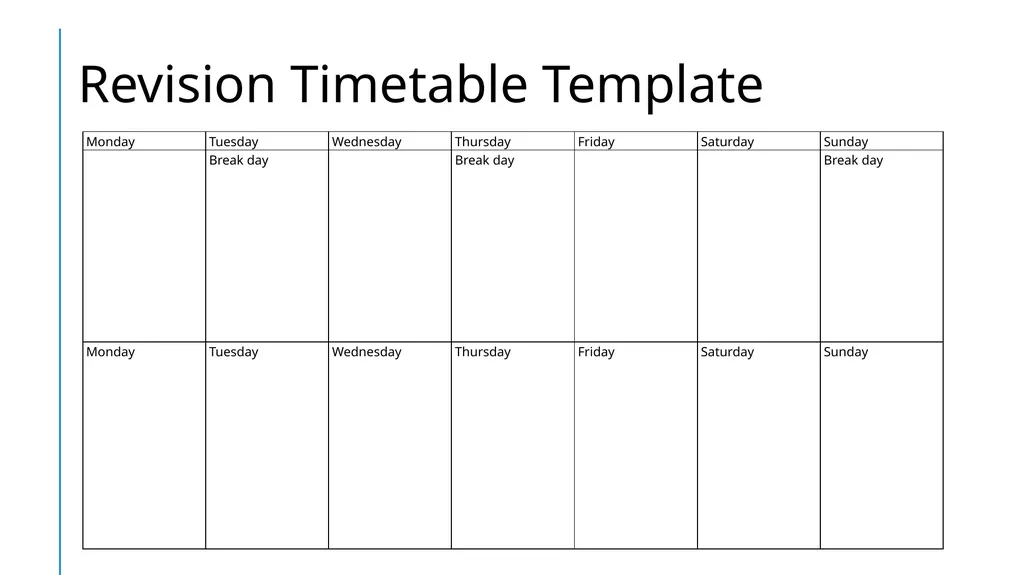
Use the template to create a revision timetable for a subject of your choice. Things we might take into consideration when designing our revision timetable:
Schema: making links in our learning e.g. revising a theme across texts in literature, revising tyrants from different time periods in history, revising use of BIDMAS in different mathematical questions or papers.
Interleaving: alternating between different topics and/or subject areas.
Spacing: returning to topics after a break.
Metacognition: looking back at areas of weakness from previous study sessions and ensuring we repeatedly return to these, making them the focus of future sessions.<br>
08
Revision Timetable Template<br>
09
Now plan what an individual study session will look like… Things to consider:
What retrieval activities will you include? Flashcards? Brain Dump/Knowledge Splat? Some self-quizzing and self-explaining using elaborative interrogation? Teaching? Retrieve-taking?
How will you apply the knowledge retrieved? Through a piece of writing and/or exam answer?
Set aside time at the end (and throughout) to make a note of strengths and targets from your study session. How will you make gains in your next study session?<br>
10
Wellbeing: things to remember Eat: it is very tempting to have sugary snacks and energy drinks to help you through ‘exam season’ (believe me, I know!) but it is incredibly important we look after our diets. Fruit and vegetables are obviously important and this can be as simple as replacing a fizzy drink with a glass of fruit juice.
Sleep: do not fall into the trap of ‘cramming’ by staying up late the night before an exam. This will only make you feel tired. A good night’s sleep is important for your brain and body to feel rested and on top form.
Exercise: some fresh air and exercise will help de-stress during the exam period. You could even plan short runs or scenic walks into your revision timetable.
Relaxation: taking time to relax is just as important as time spent studying. This might be a long bath, watching your favourite TV programme, reading a book or practising some meditation. Even a minute of mindfulness (closing your eyes and focusing on your breathing) can help to declutter our minds.<br>