Creating and Fostering e-communities of Practice
Description: Creating and Fostering e-communities of Practice (e-CoPs): Theory and Practice Thang Siew Ming, UKM thangukm.my What is a community of practice? Abbreviated as CoP refers to the process of social learning that occurs and shared
Related Topics
Download Presentation
"Creating and Fostering e-communities of Practice" is the property of its rightful owner. Permission is granted to download and print the materials on this website for personal, non-commercial use only, and to display it on your personal computer provided you do not modify the materials and that you retain all copyright notices contained in the materials. By downloading content from our website, you accept the terms of this agreement.
Presentation Transcript
slide1. Creating and Fostering e-communities of Practice (e-CoPs): Theory and Practice Thang Siew Ming, UKM
thang@ukm.my<br>
slide2. What is a community of practice? Abbreviated as CoP
refers to the process of social learning that occurs and shared sociocultural practices that emerge and evolve when people who have common goals interact as they strive towards those goals.
Situated Learning(Lave & Wenger, 1991)<br>
slide3. Difference between learning communities and CoPs Learning communities are built around specific learning contexts whereas CoPs are work based communities that focus on organisational learning and are often more open-ended.<br>
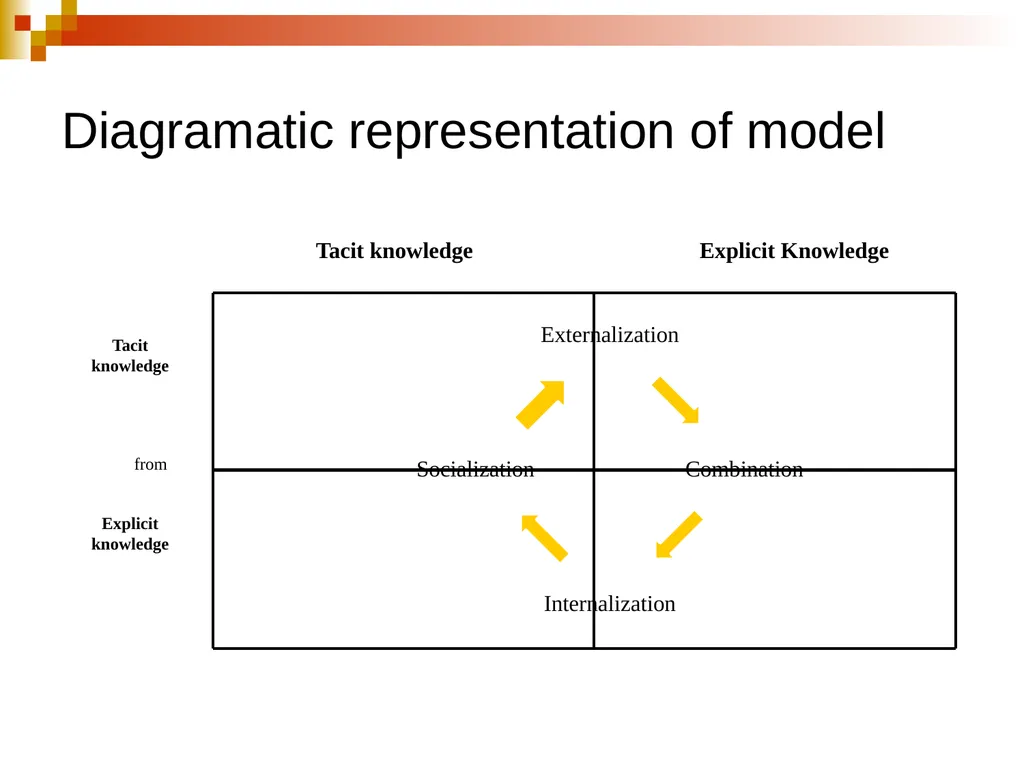
slide4. Nonaka and Takeuchi’s model This model argues that organisational learning is usually accomplished through peers, individuals with similar occupational backgrounds, goals and problems.
They socialise to exchange knowledge, experiences, support and best practices.
Mostly through face to face interactions<br>
slide5. Diagramatic representation of model<br>
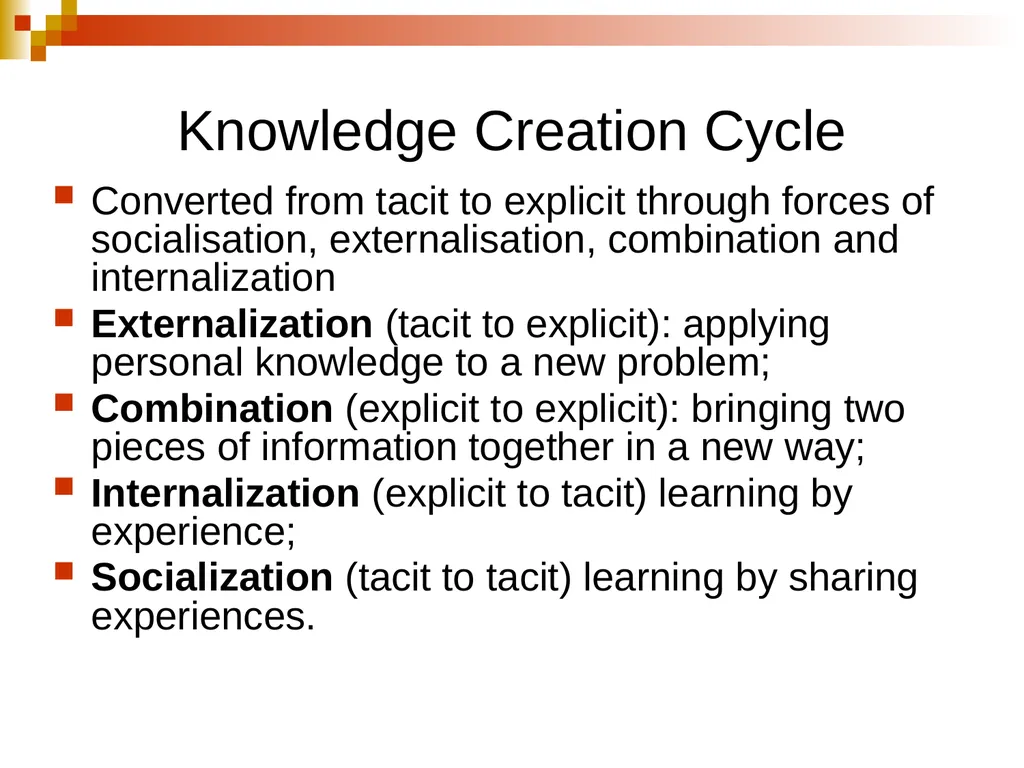
slide6. Knowledge Creation Cycle Converted from tacit to explicit through forces of socialisation, externalisation, combination and internalization
Externalization (tacit to explicit): applying personal knowledge to a new problem;
Combination (explicit to explicit): bringing two pieces of information together in a new way;
Internalization (explicit to tacit) learning by experience;
Socialization (tacit to tacit) learning by sharing experiences.<br>
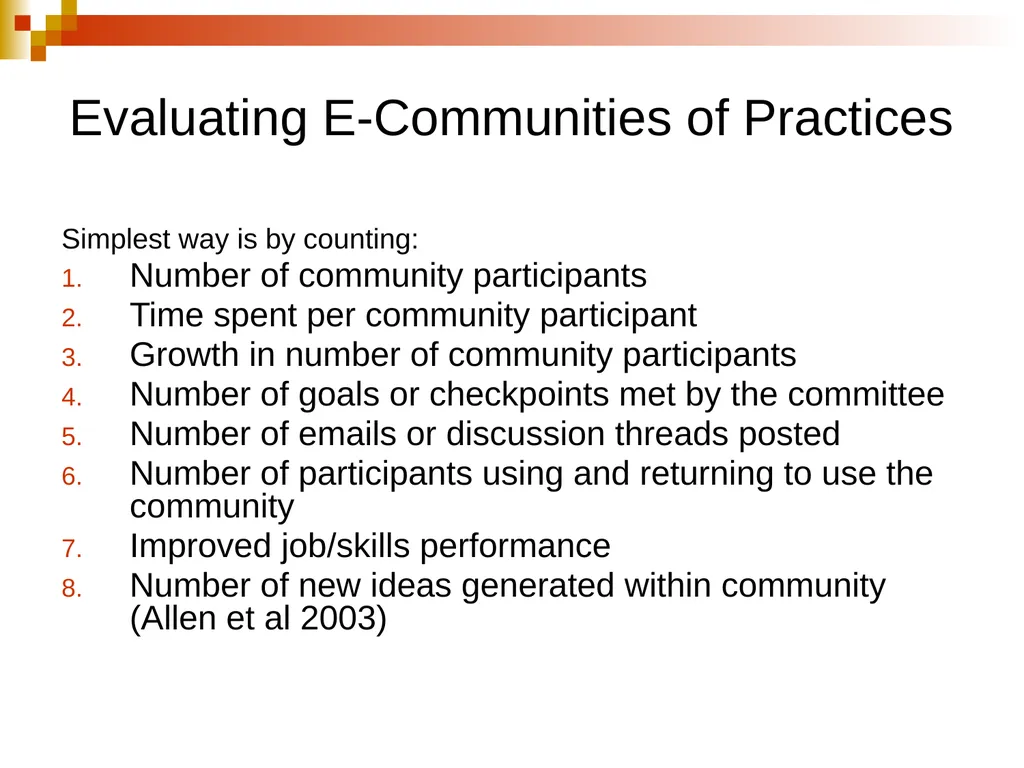
slide7. Evaluating E-Communities of Practices Simplest way is by counting:
Number of community participants
Time spent per community participant
Growth in number of community participants
Number of goals or checkpoints met by the committee
Number of emails or discussion threads posted
Number of participants using and returning to use the community
Improved job/skills performance
Number of new ideas generated within community (Allen et al 2003)<br>
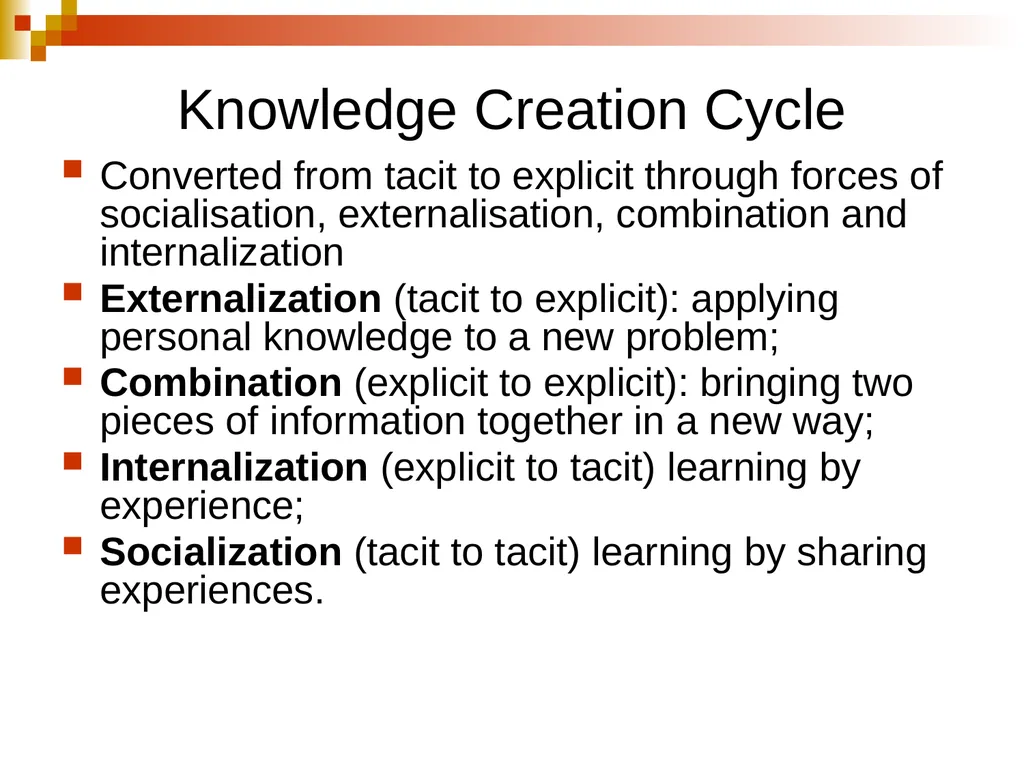
slide8. Knowledge Creation Cycle Converted from tacit to explicit through forces of socialisation, externalisation, combination and internalization
Externalization (tacit to explicit): applying personal knowledge to a new problem;
Combination (explicit to explicit): bringing two pieces of information together in a new way;
Internalization (explicit to tacit) learning by experience;
Socialization (tacit to tacit) learning by sharing experiences.<br>
slide9. Characteristics of Successful of e-CoPs 1. A common goal or purpose
the need to have common, recognised and shared needs
the existence of common practice
the goal to gain new or to improve existing competencies<br>
slide10. Leadership and moderation(organisation, social & intellectual) Having involved leaders/moderators is very important (Bourhis, Dube & Jacob, 2005)
Necessary support from organisations management (Allen et al 2003)
Clearly communicated rules, norms and standard help to reduce anxiety & uncertainty (Archidivili et al 2003)<br>
slide11. Trust and relationship Trust that posted information will not be misused
Trust in reliability and objectivity of information
(Ardichvili, Page, & Wentling, 2003; Al-Alawi, Al-Marzooqi, & Mohammed, 2007)<br>
slide12. Motivation and rewards of community members Motivators for sharing of knowledge more likely to be intrinsic rewards (e.g peer recognition, self esteem boosting, altruistic motives) than extrinsic rewards (e.g. monetary and administrative)
(Ardichvili, Page, & Wentling, 2003<br>
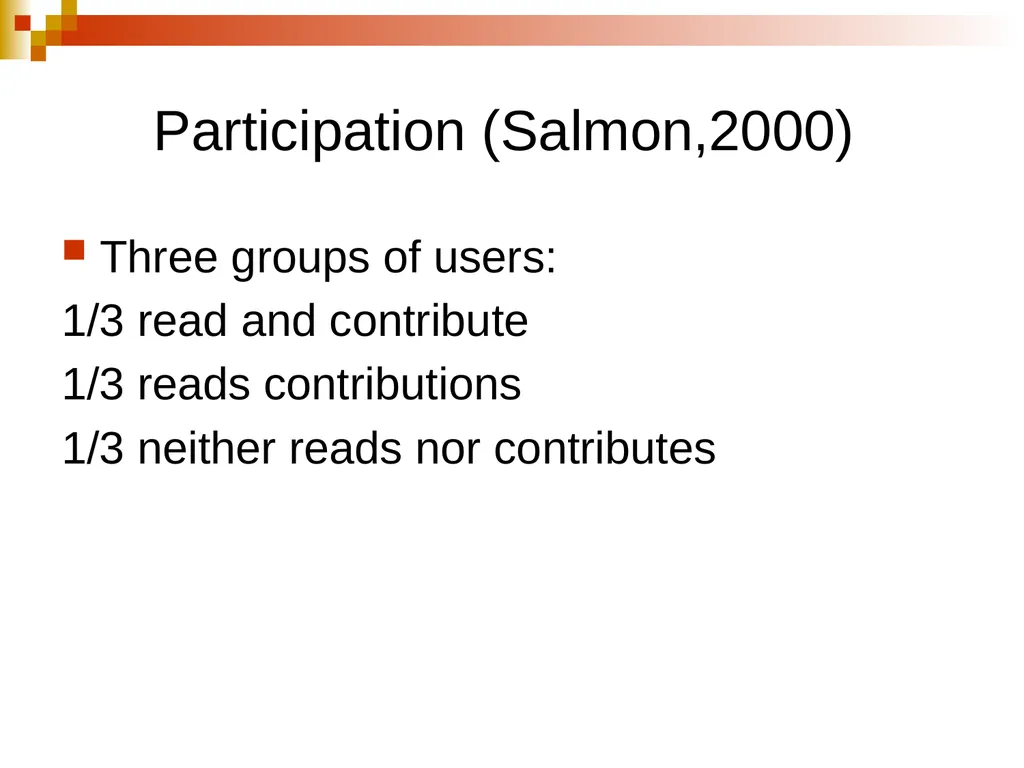
slide13. Participation (Salmon,2000) Three groups of users:
1/3 read and contribute
1/3 reads contributions
1/3 neither reads nor contributes<br>
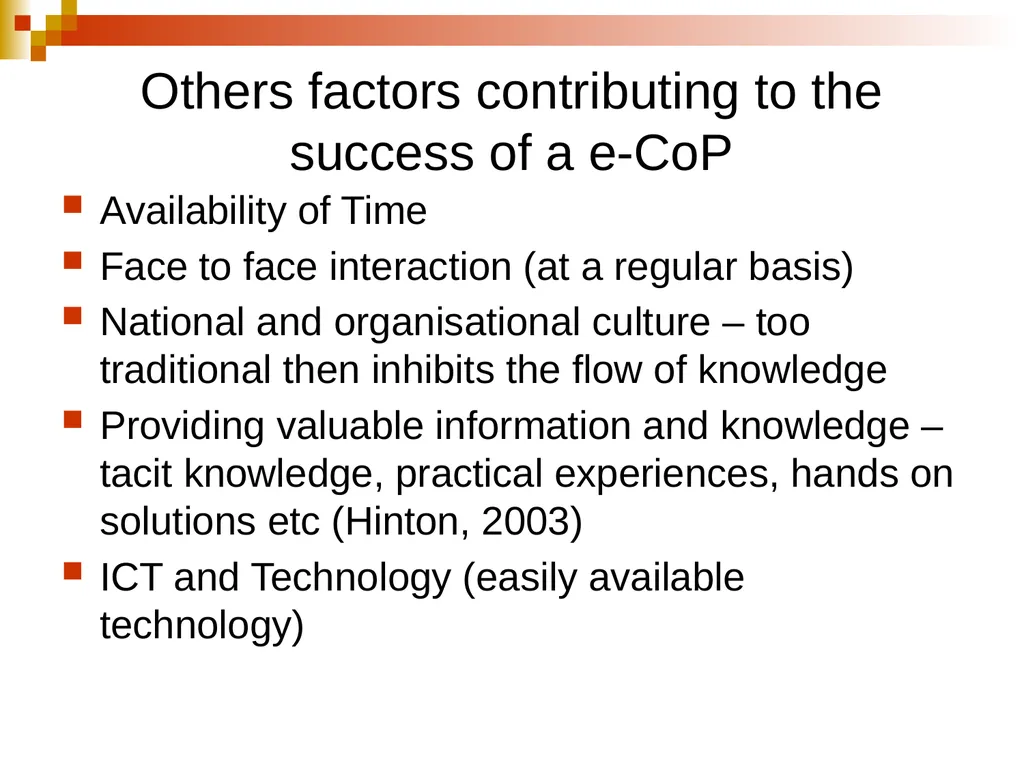
slide14. Others factors contributing to the success of a e-CoP Availability of Time
Face to face interaction (at a regular basis)
National and organisational culture – too traditional then inhibits the flow of knowledge
Providing valuable information and knowledge – tacit knowledge, practical experiences, hands on solutions etc (Hinton, 2003)
ICT and Technology (easily available technology)<br>
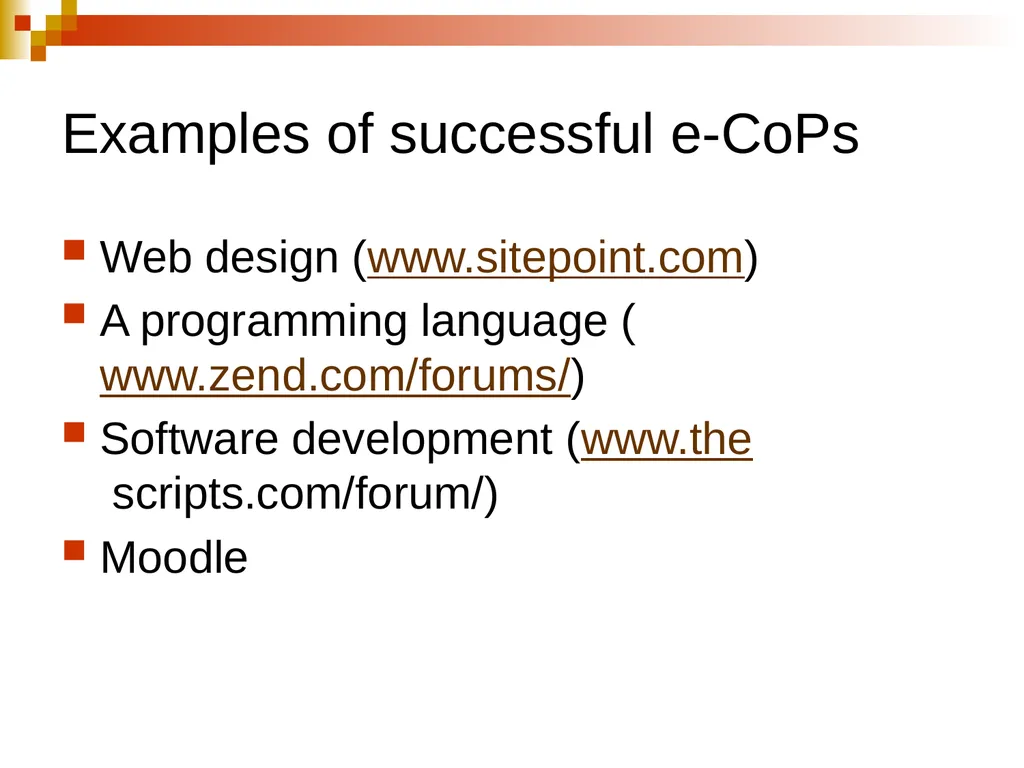
slide15. Examples of successful e-CoPs Web design (www.sitepoint.com)
A programming language (www.zend.com/forums/)
Software development (www.the scripts.com/forum/)
Moodle<br>
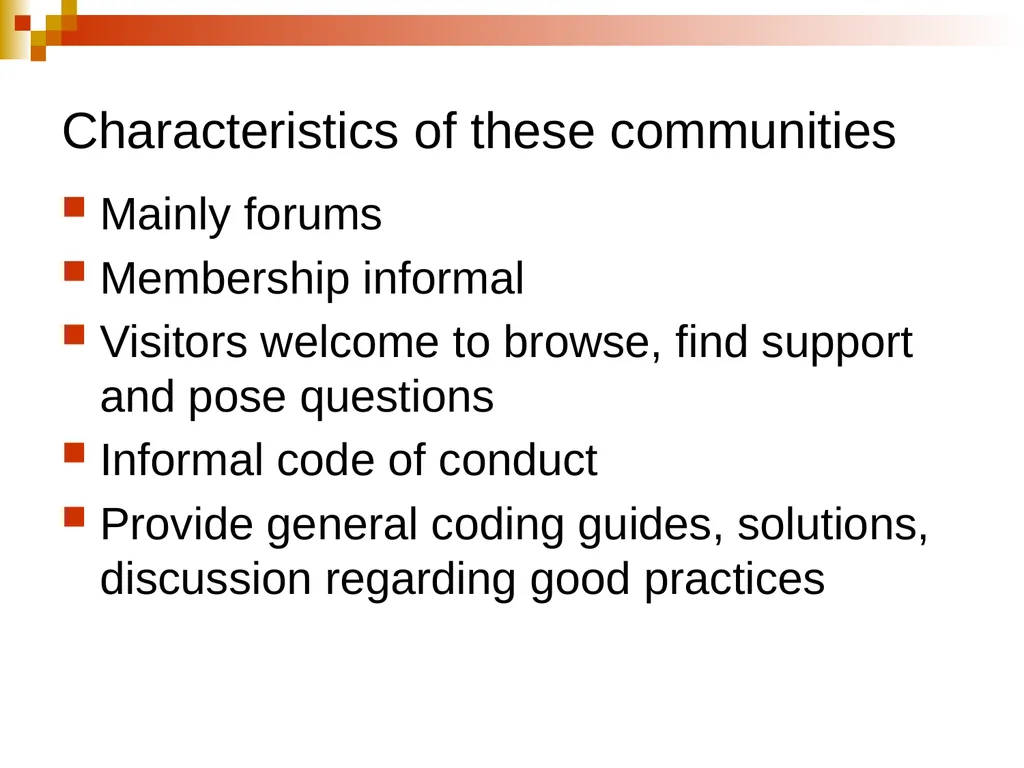
slide16. Characteristics of these communities Mainly forums
Membership informal
Visitors welcome to browse, find support and pose questions
Informal code of conduct
Provide general coding guides, solutions, discussion regarding good practices<br>
slide17. Egs of three controlled e-CoPs(1) Engaging Diversity project in UK A project by the School of Education, University of Wales
aims at delivering effective diversity awareness training in Wales to a large number of people in a short period of time
Training delivered through a series of different modules
Training to addressed these diversity subjects – race, disability, age, religion, beliefs, gender, welsh languages & sexual orientation<br>
slide18. Types of modules Multimedia presentation mixing photos, video, audio, voice-over narration & animations
Supported by an interactive quiz
Modules delivered by 11 partners organisation that includes several councils across Wales & public funded organisations
Training by training coordinators within each organisation who will also be moderators of the e-Cops.<br>
slide19. Findings from interviews Numerous comments indicating the users enjoyed the images & movement, music & the narrative.
Significant increase in awareness
Create attitudinal changes
Feeling part of a bigger community<br>
slide20. (2) Study in a Japanese university Schalow (2009) tried to establish a vibrant online social network at a Japanese university.
Participation was through blogs, video and audio resources, and profile information via the social networking software.
Initially a failure. Students participated in the network, but they were reluctant members
Seemed they believed their mobile telephone networks effectively met all of their information needs.<br>
slide21. Reasons According to him the failure was due what he called the "learning culture" (or actually its lack) created by the Japanese school system.
The American educational system is able to nourish inquisitive minds.
He posits that this is lacking in the Japanese educational system which puts teachers and textbooks as authorities.<br>
slide22. (3) The CPDelt project School Improvement project for Malaysian Smart schools to address problems currently faced by Smart schools.
Lee Kean Wah (2007) pointed out the Smart School CPD succeeded in raising awareness about the innovations but appeared less effective in equipping them with a clear understanding of the practices needed in the classroom level.<br>
slide23. Research framework Based on the Improvement Quality Education for All (IQEA) action research framework extensively used in the UK as a vehicle for school improvement (Hopkins et al., 1996).<br>
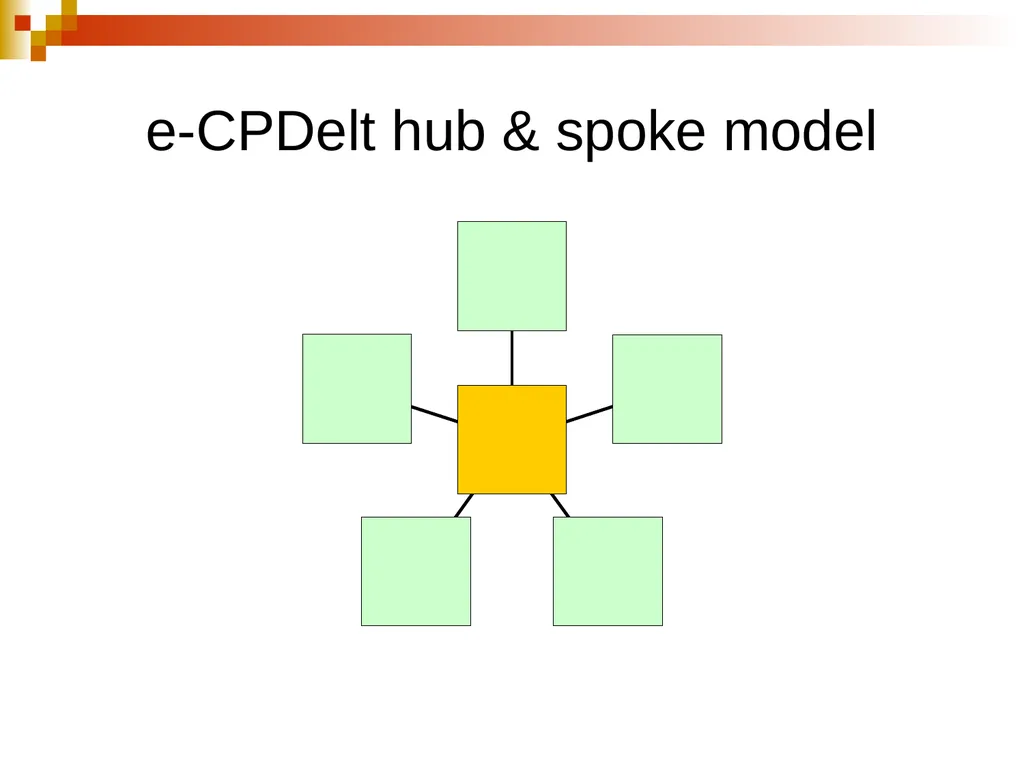
slide24. e-CPDelt hub & spoke model A critical relationship between a number of school-based cadres of change–agents (spokes) and a Higher Education Institutions (HEI)-based research team (hub).
Spokes -- 5 schools with four teachers (of English, Maths & Science) from each school.
Hub – Researchers from three universities: The National University of Malaysia, University Nottingham, UK & University of Sabah, Malaysia<br>
slide25. e-CPDelt hub & spoke model<br>
slide26. Online Communities of practice approach<br>
slide27. Methods of sharing Face to face interaction – workshops
Online blog activities
Online posting of video clips using an Interactive Virtual Platform (ViP) followed by online sharing of best practices and problems<br>
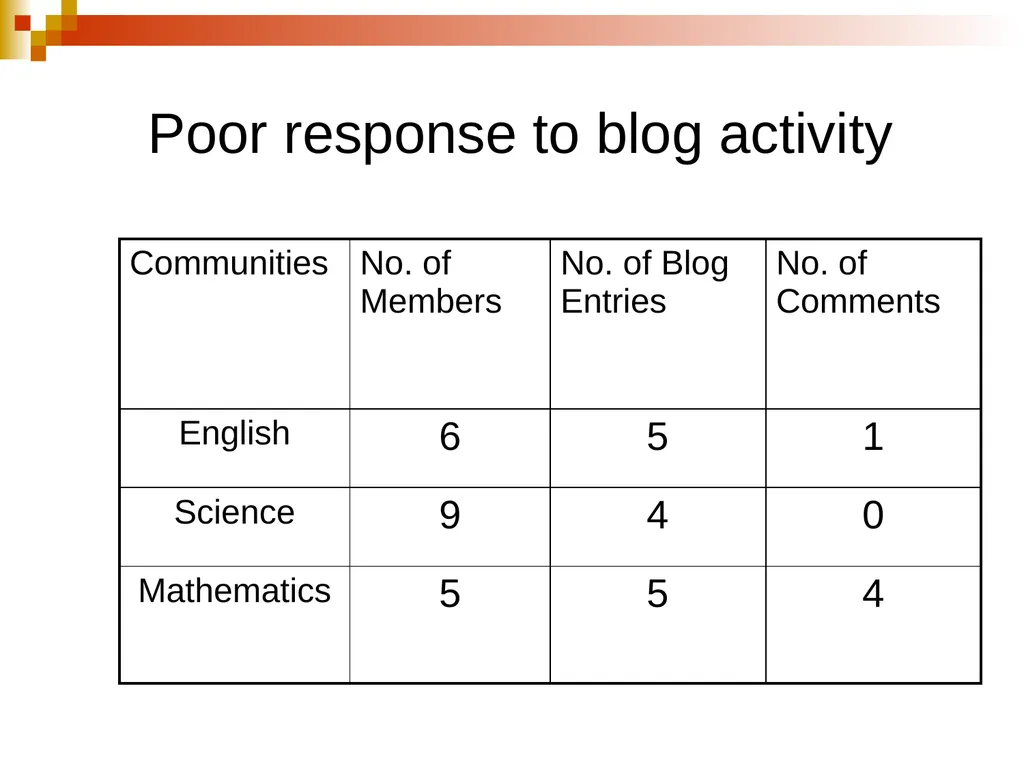
slide28. Poor response to blog activity<br>
slide29. Reasons? Is it a cultural problem as proposed by Schalow?
Participants attributed it to lack of time. Is this the real deterrent factor?
Maybe need more active participants from moderators, Would that help?
More guided activities/modules. Would that ease the transition?<br>
slide30. Remedial steps taken More online support from moderators
Face to face discussion and training session
There seems to be some improvement but still far from satisfactory. So, is it a cultural thing?<br>
slide31. In conclusion Needs to further investigate and experiment to find solutions
The effect of culture on the success of e-CoPs in the Asian context need to be given serious consideration.
Thank you<br>

thang@ukm.my<br>
slide2. What is a community of practice? Abbreviated as CoP
refers to the process of social learning that occurs and shared sociocultural practices that emerge and evolve when people who have common goals interact as they strive towards those goals.
Situated Learning(Lave & Wenger, 1991)<br>
slide3. Difference between learning communities and CoPs Learning communities are built around specific learning contexts whereas CoPs are work based communities that focus on organisational learning and are often more open-ended.<br>
slide4. Nonaka and Takeuchi’s model This model argues that organisational learning is usually accomplished through peers, individuals with similar occupational backgrounds, goals and problems.
They socialise to exchange knowledge, experiences, support and best practices.
Mostly through face to face interactions<br>
slide5. Diagramatic representation of model<br>
slide6. Knowledge Creation Cycle Converted from tacit to explicit through forces of socialisation, externalisation, combination and internalization
Externalization (tacit to explicit): applying personal knowledge to a new problem;
Combination (explicit to explicit): bringing two pieces of information together in a new way;
Internalization (explicit to tacit) learning by experience;
Socialization (tacit to tacit) learning by sharing experiences.<br>
slide7. Evaluating E-Communities of Practices Simplest way is by counting:
Number of community participants
Time spent per community participant
Growth in number of community participants
Number of goals or checkpoints met by the committee
Number of emails or discussion threads posted
Number of participants using and returning to use the community
Improved job/skills performance
Number of new ideas generated within community (Allen et al 2003)<br>
slide8. Knowledge Creation Cycle Converted from tacit to explicit through forces of socialisation, externalisation, combination and internalization
Externalization (tacit to explicit): applying personal knowledge to a new problem;
Combination (explicit to explicit): bringing two pieces of information together in a new way;
Internalization (explicit to tacit) learning by experience;
Socialization (tacit to tacit) learning by sharing experiences.<br>
slide9. Characteristics of Successful of e-CoPs 1. A common goal or purpose
the need to have common, recognised and shared needs
the existence of common practice
the goal to gain new or to improve existing competencies<br>
slide10. Leadership and moderation(organisation, social & intellectual) Having involved leaders/moderators is very important (Bourhis, Dube & Jacob, 2005)
Necessary support from organisations management (Allen et al 2003)
Clearly communicated rules, norms and standard help to reduce anxiety & uncertainty (Archidivili et al 2003)<br>
slide11. Trust and relationship Trust that posted information will not be misused
Trust in reliability and objectivity of information
(Ardichvili, Page, & Wentling, 2003; Al-Alawi, Al-Marzooqi, & Mohammed, 2007)<br>
slide12. Motivation and rewards of community members Motivators for sharing of knowledge more likely to be intrinsic rewards (e.g peer recognition, self esteem boosting, altruistic motives) than extrinsic rewards (e.g. monetary and administrative)
(Ardichvili, Page, & Wentling, 2003<br>
slide13. Participation (Salmon,2000) Three groups of users:
1/3 read and contribute
1/3 reads contributions
1/3 neither reads nor contributes<br>
slide14. Others factors contributing to the success of a e-CoP Availability of Time
Face to face interaction (at a regular basis)
National and organisational culture – too traditional then inhibits the flow of knowledge
Providing valuable information and knowledge – tacit knowledge, practical experiences, hands on solutions etc (Hinton, 2003)
ICT and Technology (easily available technology)<br>
slide15. Examples of successful e-CoPs Web design (www.sitepoint.com)
A programming language (www.zend.com/forums/)
Software development (www.the scripts.com/forum/)
Moodle<br>
slide16. Characteristics of these communities Mainly forums
Membership informal
Visitors welcome to browse, find support and pose questions
Informal code of conduct
Provide general coding guides, solutions, discussion regarding good practices<br>
slide17. Egs of three controlled e-CoPs(1) Engaging Diversity project in UK A project by the School of Education, University of Wales
aims at delivering effective diversity awareness training in Wales to a large number of people in a short period of time
Training delivered through a series of different modules
Training to addressed these diversity subjects – race, disability, age, religion, beliefs, gender, welsh languages & sexual orientation<br>
slide18. Types of modules Multimedia presentation mixing photos, video, audio, voice-over narration & animations
Supported by an interactive quiz
Modules delivered by 11 partners organisation that includes several councils across Wales & public funded organisations
Training by training coordinators within each organisation who will also be moderators of the e-Cops.<br>
slide19. Findings from interviews Numerous comments indicating the users enjoyed the images & movement, music & the narrative.
Significant increase in awareness
Create attitudinal changes
Feeling part of a bigger community<br>
slide20. (2) Study in a Japanese university Schalow (2009) tried to establish a vibrant online social network at a Japanese university.
Participation was through blogs, video and audio resources, and profile information via the social networking software.
Initially a failure. Students participated in the network, but they were reluctant members
Seemed they believed their mobile telephone networks effectively met all of their information needs.<br>
slide21. Reasons According to him the failure was due what he called the "learning culture" (or actually its lack) created by the Japanese school system.
The American educational system is able to nourish inquisitive minds.
He posits that this is lacking in the Japanese educational system which puts teachers and textbooks as authorities.<br>
slide22. (3) The CPDelt project School Improvement project for Malaysian Smart schools to address problems currently faced by Smart schools.
Lee Kean Wah (2007) pointed out the Smart School CPD succeeded in raising awareness about the innovations but appeared less effective in equipping them with a clear understanding of the practices needed in the classroom level.<br>
slide23. Research framework Based on the Improvement Quality Education for All (IQEA) action research framework extensively used in the UK as a vehicle for school improvement (Hopkins et al., 1996).<br>
slide24. e-CPDelt hub & spoke model A critical relationship between a number of school-based cadres of change–agents (spokes) and a Higher Education Institutions (HEI)-based research team (hub).
Spokes -- 5 schools with four teachers (of English, Maths & Science) from each school.
Hub – Researchers from three universities: The National University of Malaysia, University Nottingham, UK & University of Sabah, Malaysia<br>
slide25. e-CPDelt hub & spoke model<br>
slide26. Online Communities of practice approach<br>
slide27. Methods of sharing Face to face interaction – workshops
Online blog activities
Online posting of video clips using an Interactive Virtual Platform (ViP) followed by online sharing of best practices and problems<br>
slide28. Poor response to blog activity<br>
slide29. Reasons? Is it a cultural problem as proposed by Schalow?
Participants attributed it to lack of time. Is this the real deterrent factor?
Maybe need more active participants from moderators, Would that help?
More guided activities/modules. Would that ease the transition?<br>
slide30. Remedial steps taken More online support from moderators
Face to face discussion and training session
There seems to be some improvement but still far from satisfactory. So, is it a cultural thing?<br>
slide31. In conclusion Needs to further investigate and experiment to find solutions
The effect of culture on the success of e-CoPs in the Asian context need to be given serious consideration.
Thank you<br>