
Creativity, Identity, and Mastery in the Visual
Description: Creativity, Identity, and Mastery in the Visual and Media Arts both teachers and students. To teach for mastery, learning should align to the artistic practices and supporting content standards, which require students to grapple with
Related Topics
Download Presentation
"Creativity, Identity, and Mastery in the Visual" is the property of its rightful owner. Permission is granted to download and print the materials on this website for personal, non-commercial use only, and to display it on your personal computer provided you do not modify the materials and that you retain all copyright notices contained in the materials. By downloading content from our website, you accept the terms of this agreement.
Presentation Transcript
slide1. Creativity, Identity, and Mastery in the Visual and Media Arts both teachers and students. To teach for mastery, learning should align to the artistic practices
and supporting content standards, which require students to grapple with rigorous concepts and
skills in order to successfully execute their artistic ideas.
What does a typical day look like in an art program centered on creativity, identity, and mastery?
Since students bring their own lives and unique interests to art class, there is a lot of motivation and engagement is often lively and varied. With teacher support at the start of class, students identify which concepts and skills they must master in order to execute their artistic ideas, ideas that may be generated by examining diverse artwork. The tasks students undertake may require them to investigate multiple approaches to solve artistic problems they encounter. The art teacher circles around asking facilitative questions that require students to think deeply about how to execute their artistic intent. The art teacher may use teachable moments to draw the entire class’ attention to a possible solution, art technique, or concept that will assist students’ work or perseverance through creative blocks. Since student voice and choice is emphasized over teacher direction and are therefore not executions of teacher' artistic intent, student outcomes will include final products with more variability in appearance. These outcomes may showcase the student’s own aesthetic appreciation and artistic development versus an adult-imposed concept of beauty. How to Center… Page 1 Three Important Ways to put the Arts Framework into Practice 1 Creativity:
Let Artistic Intent Drive the Lesson.
Identity:
Reflect Diverse Cultures, Values, & Experiences.*
Mastery:
Develop Artistic Practices. What is Artistic Intent?
Artistic intent is the meaning the artist intended in a work so far as it can be determined from the artist’s statements or cultural context. Artistic intent can refer to a master artist or student artist.
What are Artistic Practices?
Artistic Practices are complex, multi-dimensional processes that are central to the creative process within the arts. The Massachusetts Arts Curriculum Framework has eleven Artistic Practices aligned directly to the National Core Arts Standards (NCAS). Based on the processes presented in the 2014 NCAS, these practices are grouped into four clusters that focus on creating, presenting/performing, responding, and connecting across the five arts disciplines. From the Framework *Guiding Principle 5: An effective arts education provides students with broad and frequent access to great works of art from the past and present, across genres, time periods, and styles, and represents diverse cultures in the United States and from around the world in order to develop an appreciation for the richness of artistic expression, understand the connections between art and history, and cultivate one’s own sense of beauty. How do you organize an art program to serve students’ artistic intent and identity? How does that translate into mastery of content?
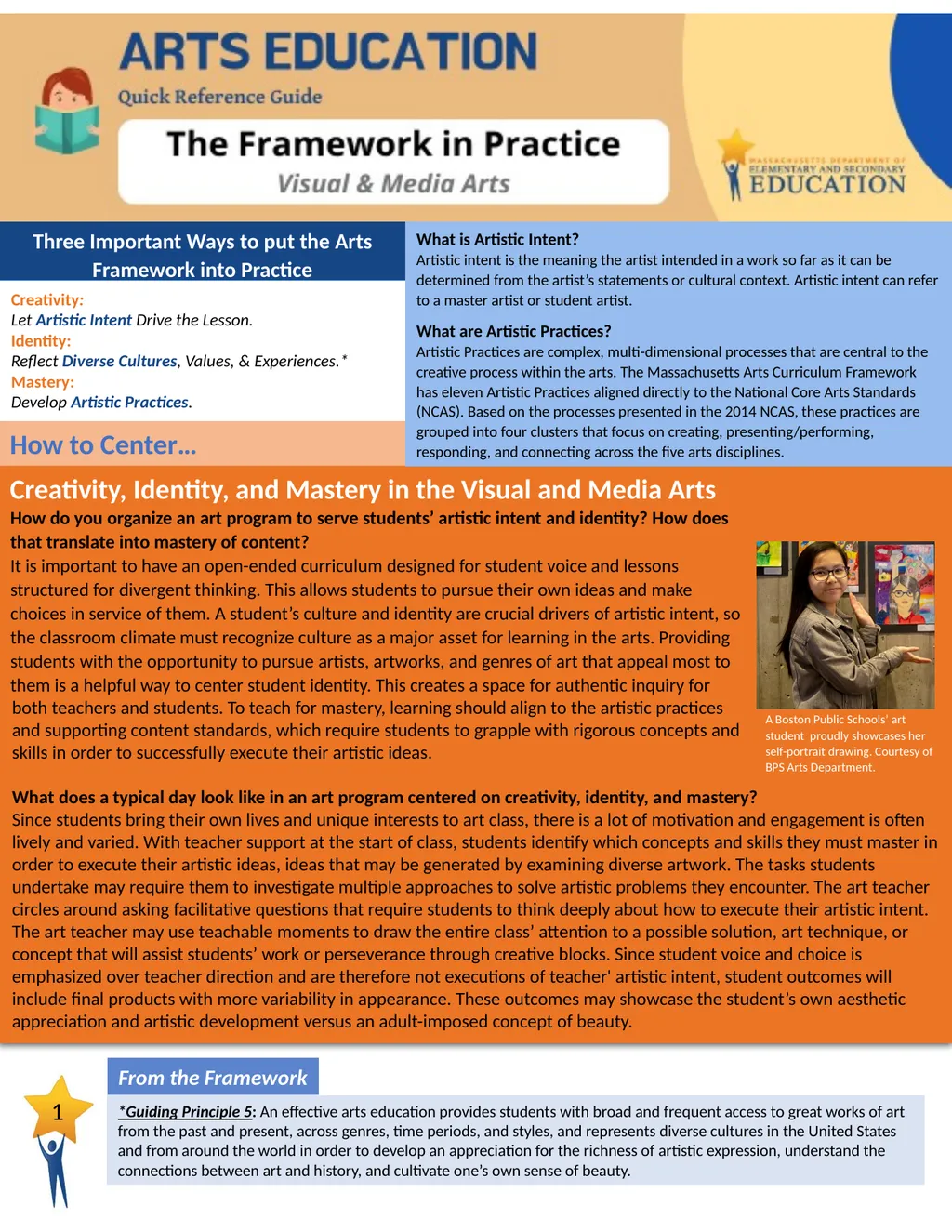
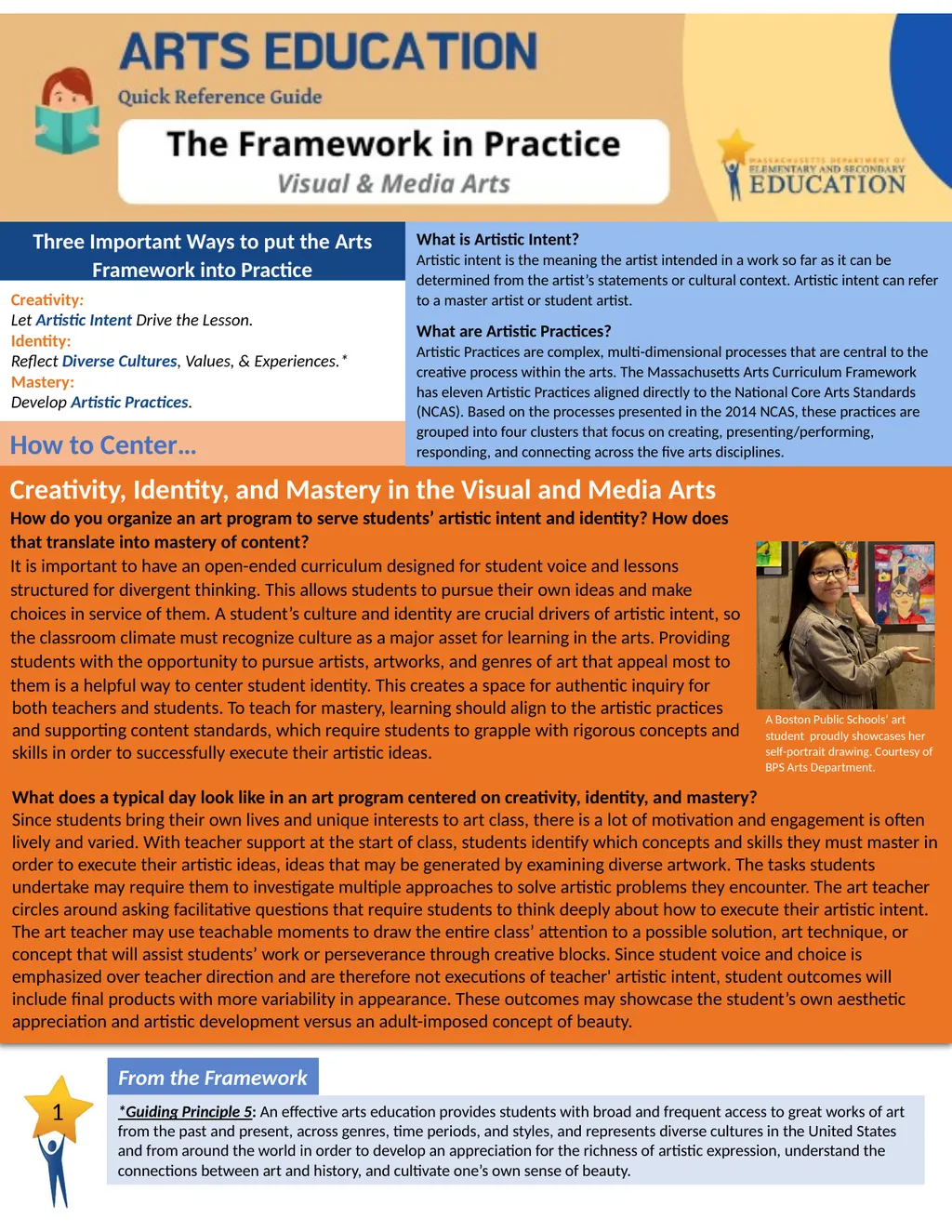
It is important to have an open-ended curriculum designed for student voice and lessons structured for divergent thinking. This allows students to pursue their own ideas and make choices in service of them. A student’s culture and identity are crucial drivers of artistic intent, so the classroom climate must recognize culture as a major asset for learning in the arts. Providing students with the opportunity to pursue artists, artworks, and genres of art that appeal most to them is a helpful way to center student identity. This creates a space for authentic inquiry for A Boston Public Schools’ art student proudly showcases her self-portrait drawing. Courtesy of BPS Arts Department.<br>
slide2. The Academy Award for the ‘Best Animated Short Film’ went to Bao in 2019 and Hair Love in 2020 (Cherry, n.d., para. 9; Pelletiere, 2019, para. 1). Both films depict stories that are not traditionally told in mainstream American media and focus on under-represented racial and cultural identities.
Bao tells the story of “an aging Chinese woman suffering from empty nest syndrome who gets another chance at motherhood when one of her dumplings springs to life as a lively, giggling dumpling boy” (Blancaflor, 2018, para. 3). Bao was written and directed by Domee Shi, a Chinese-born Canadian storyboard artist and director (Yeung, 2019, para. 4).
Hair Love focuses on a young Black girl as she attempts to style her hair. “In absence of a mother figure and with a head full of natural curls, she must resort to YouTube tutorials and the inexperienced hands of her father for help” (Jean-Phillippe, 2020, para. 3). Creator Matthew A. Cherry, a Black Chicago native, became a director after he retired from a football career with the NFL in 2007 (Cherry, n.d. paras. 1-2).
Using Artistic Practice to Examine CREATIVITY and IDENTITY
Planning Question: How does the practice of ‘Creating’ with artistic intent feature within these films?
In response to fighting stereotypes and wanting to represent more of their culture and heritage, Shi and Cherry explain the reason as to why they have created Bao and Hair Love, respectively:
Bao is Shi’s interpretation of a Chinese version of The Little Gingerbread. She states, “I was inspired by classic, food fairy tales like the Gingerbread Man, and I wanted to do a Chinese version of that except with a dumpling that comes to life instead of a cookie.” (Blancaflor, 2018, para. 10). Shi indicates that she was interested in creating a story with images, people, and details from her childhood that she has not seen on screen (Dockterman, 2018).
Cherry states, "A couple years ago I was coming across a lot of viral videos about African American fathers that were doing their daughters hair. It really seemed like it was an anomaly, people were really sharing it because they weren't used to seeing it. I just wanted to normalize it and kind of shine a light cause oftentimes Black men get a bad rap in not being involved in their kids’ lives, and I really wanted to showcase a strong Black family unit and show that dads are present” (Jean-Philippe, 2020, para. 4).
Facilitative Questions
What emotions do you feel while watching the films?
What emotions are the characters depicting during the films? Why?
What is this film about and what are the major themes about family? Why is this important?
Aligning to the Arts Standards to Develop Student MASTERY
Lesson Starter (Aligned to 5th-6th Grade level; Can be modified for all grade levels)
Students discuss the artistic intent of each animated short film and create their own narratives for a video tutorial about participating in a tradition unique to their family and the roles/contributions of each member. Students plan projects by visually demonstrating a sequential timeline on storyboards and create a video or interactive media using the format of their choice.
Media Arts Content Standards
Organize and plan an idea using a variety of self-selected strategies (e.g., storyboards, flowcharts, or prototypes). (5-6.MA.Cr.02)
Refine a media arts idea by making changes in how images, interactivity, or sound are used. (5-6.MA.Cr.03)
Analyze how an artwork's form supports the artist's intention. (5-6.MA.R.07).
Linked Resources
Hair Love Teaching Resource
More About the Creation of Bao References Blancaflor, S. (2018, April 25). In Pixar's 'Bao,' a sentient dumpling explores family, love and food. NBC News. Retrieved December 22, 2020, from
https://www.nbcnews.com/news/asian-america/pixar-s-bao-sentient-dumpling-explores-family-love-food-n868726
Cherry, M.A. (n.d.). About. Retrieved December 18, 2020, from http://www.matthewacherry.com/about
Dockterman, E. (2018, December 26). The story behind Bao, the adorable Pixar Short with Oscar hopes. Time. Retrieved from: https://time.com/5312569/bao- incredibles-2-short/
Jean-Philippe, M. (2020, February 10). Watch Matthew Cherry’s Oscar-winning short film Hair Love. The Oprah Magazine. Retrieved December 22, 2020 from
https://www.oprahmag.com/entertainment/tv-movies/a30755213/matthew-cherry-hair-love-short-film-oscars-2020/
Juri, P. (n.d.). The story behind Hair Love. SFFilms Education. Retrieved December 18, 2020 from https://sffilm.org/wp-
content/uploads/2019/10/SFFILM_EDU_StudyGuide_Hair-Love.pdf
Pelletier, N. (2019, February 25). Oscars 2019: Pixar's 'Bao' wins Oscar for best animated short film. ABC News. Retrieved December 22, 2020, from
https://abcnews.go.com/GMA/Culture/oscars-2019-pixars-bao-wins-oscar-best-animated/story?id=61294573 2 How to use Media Arts exemplars to emphasize
Creativity, Identity, and Mastery
Case Study: Animated Short Films Hair Love and Bao About Hair Love and Bao Main Contributor: Fabiola Decius<br>
and supporting content standards, which require students to grapple with rigorous concepts and
skills in order to successfully execute their artistic ideas.
What does a typical day look like in an art program centered on creativity, identity, and mastery?
Since students bring their own lives and unique interests to art class, there is a lot of motivation and engagement is often lively and varied. With teacher support at the start of class, students identify which concepts and skills they must master in order to execute their artistic ideas, ideas that may be generated by examining diverse artwork. The tasks students undertake may require them to investigate multiple approaches to solve artistic problems they encounter. The art teacher circles around asking facilitative questions that require students to think deeply about how to execute their artistic intent. The art teacher may use teachable moments to draw the entire class’ attention to a possible solution, art technique, or concept that will assist students’ work or perseverance through creative blocks. Since student voice and choice is emphasized over teacher direction and are therefore not executions of teacher' artistic intent, student outcomes will include final products with more variability in appearance. These outcomes may showcase the student’s own aesthetic appreciation and artistic development versus an adult-imposed concept of beauty. How to Center… Page 1 Three Important Ways to put the Arts Framework into Practice 1 Creativity:
Let Artistic Intent Drive the Lesson.
Identity:
Reflect Diverse Cultures, Values, & Experiences.*
Mastery:
Develop Artistic Practices. What is Artistic Intent?
Artistic intent is the meaning the artist intended in a work so far as it can be determined from the artist’s statements or cultural context. Artistic intent can refer to a master artist or student artist.
What are Artistic Practices?
Artistic Practices are complex, multi-dimensional processes that are central to the creative process within the arts. The Massachusetts Arts Curriculum Framework has eleven Artistic Practices aligned directly to the National Core Arts Standards (NCAS). Based on the processes presented in the 2014 NCAS, these practices are grouped into four clusters that focus on creating, presenting/performing, responding, and connecting across the five arts disciplines. From the Framework *Guiding Principle 5: An effective arts education provides students with broad and frequent access to great works of art from the past and present, across genres, time periods, and styles, and represents diverse cultures in the United States and from around the world in order to develop an appreciation for the richness of artistic expression, understand the connections between art and history, and cultivate one’s own sense of beauty. How do you organize an art program to serve students’ artistic intent and identity? How does that translate into mastery of content?
It is important to have an open-ended curriculum designed for student voice and lessons structured for divergent thinking. This allows students to pursue their own ideas and make choices in service of them. A student’s culture and identity are crucial drivers of artistic intent, so the classroom climate must recognize culture as a major asset for learning in the arts. Providing students with the opportunity to pursue artists, artworks, and genres of art that appeal most to them is a helpful way to center student identity. This creates a space for authentic inquiry for A Boston Public Schools’ art student proudly showcases her self-portrait drawing. Courtesy of BPS Arts Department.<br>
slide2. The Academy Award for the ‘Best Animated Short Film’ went to Bao in 2019 and Hair Love in 2020 (Cherry, n.d., para. 9; Pelletiere, 2019, para. 1). Both films depict stories that are not traditionally told in mainstream American media and focus on under-represented racial and cultural identities.
Bao tells the story of “an aging Chinese woman suffering from empty nest syndrome who gets another chance at motherhood when one of her dumplings springs to life as a lively, giggling dumpling boy” (Blancaflor, 2018, para. 3). Bao was written and directed by Domee Shi, a Chinese-born Canadian storyboard artist and director (Yeung, 2019, para. 4).
Hair Love focuses on a young Black girl as she attempts to style her hair. “In absence of a mother figure and with a head full of natural curls, she must resort to YouTube tutorials and the inexperienced hands of her father for help” (Jean-Phillippe, 2020, para. 3). Creator Matthew A. Cherry, a Black Chicago native, became a director after he retired from a football career with the NFL in 2007 (Cherry, n.d. paras. 1-2).
Using Artistic Practice to Examine CREATIVITY and IDENTITY
Planning Question: How does the practice of ‘Creating’ with artistic intent feature within these films?
In response to fighting stereotypes and wanting to represent more of their culture and heritage, Shi and Cherry explain the reason as to why they have created Bao and Hair Love, respectively:
Bao is Shi’s interpretation of a Chinese version of The Little Gingerbread. She states, “I was inspired by classic, food fairy tales like the Gingerbread Man, and I wanted to do a Chinese version of that except with a dumpling that comes to life instead of a cookie.” (Blancaflor, 2018, para. 10). Shi indicates that she was interested in creating a story with images, people, and details from her childhood that she has not seen on screen (Dockterman, 2018).
Cherry states, "A couple years ago I was coming across a lot of viral videos about African American fathers that were doing their daughters hair. It really seemed like it was an anomaly, people were really sharing it because they weren't used to seeing it. I just wanted to normalize it and kind of shine a light cause oftentimes Black men get a bad rap in not being involved in their kids’ lives, and I really wanted to showcase a strong Black family unit and show that dads are present” (Jean-Philippe, 2020, para. 4).
Facilitative Questions
What emotions do you feel while watching the films?
What emotions are the characters depicting during the films? Why?
What is this film about and what are the major themes about family? Why is this important?
Aligning to the Arts Standards to Develop Student MASTERY
Lesson Starter (Aligned to 5th-6th Grade level; Can be modified for all grade levels)
Students discuss the artistic intent of each animated short film and create their own narratives for a video tutorial about participating in a tradition unique to their family and the roles/contributions of each member. Students plan projects by visually demonstrating a sequential timeline on storyboards and create a video or interactive media using the format of their choice.
Media Arts Content Standards
Organize and plan an idea using a variety of self-selected strategies (e.g., storyboards, flowcharts, or prototypes). (5-6.MA.Cr.02)
Refine a media arts idea by making changes in how images, interactivity, or sound are used. (5-6.MA.Cr.03)
Analyze how an artwork's form supports the artist's intention. (5-6.MA.R.07).
Linked Resources
Hair Love Teaching Resource
More About the Creation of Bao References Blancaflor, S. (2018, April 25). In Pixar's 'Bao,' a sentient dumpling explores family, love and food. NBC News. Retrieved December 22, 2020, from
https://www.nbcnews.com/news/asian-america/pixar-s-bao-sentient-dumpling-explores-family-love-food-n868726
Cherry, M.A. (n.d.). About. Retrieved December 18, 2020, from http://www.matthewacherry.com/about
Dockterman, E. (2018, December 26). The story behind Bao, the adorable Pixar Short with Oscar hopes. Time. Retrieved from: https://time.com/5312569/bao- incredibles-2-short/
Jean-Philippe, M. (2020, February 10). Watch Matthew Cherry’s Oscar-winning short film Hair Love. The Oprah Magazine. Retrieved December 22, 2020 from
https://www.oprahmag.com/entertainment/tv-movies/a30755213/matthew-cherry-hair-love-short-film-oscars-2020/
Juri, P. (n.d.). The story behind Hair Love. SFFilms Education. Retrieved December 18, 2020 from https://sffilm.org/wp-
content/uploads/2019/10/SFFILM_EDU_StudyGuide_Hair-Love.pdf
Pelletier, N. (2019, February 25). Oscars 2019: Pixar's 'Bao' wins Oscar for best animated short film. ABC News. Retrieved December 22, 2020, from
https://abcnews.go.com/GMA/Culture/oscars-2019-pixars-bao-wins-oscar-best-animated/story?id=61294573 2 How to use Media Arts exemplars to emphasize
Creativity, Identity, and Mastery
Case Study: Animated Short Films Hair Love and Bao About Hair Love and Bao Main Contributor: Fabiola Decius<br>