
Critical Thinking “The important thing is not to



Description: Critical Thinking The important thing is not to stop questioning. Curiosity has its own reason for existing - Albert Einstein Critical Thinking in Your Life Personal Life What constitutes a healthy diet? Which investment is better for my
Related Topics
Download Presentation
"Critical Thinking “The important thing is not to" is the property of its rightful owner. Permission is granted to download and print the materials on this website for personal, non-commercial use only, and to display it on your personal computer provided you do not modify the materials and that you retain all copyright notices contained in the materials. By downloading content from our website, you accept the terms of this agreement.
Presentation Transcript
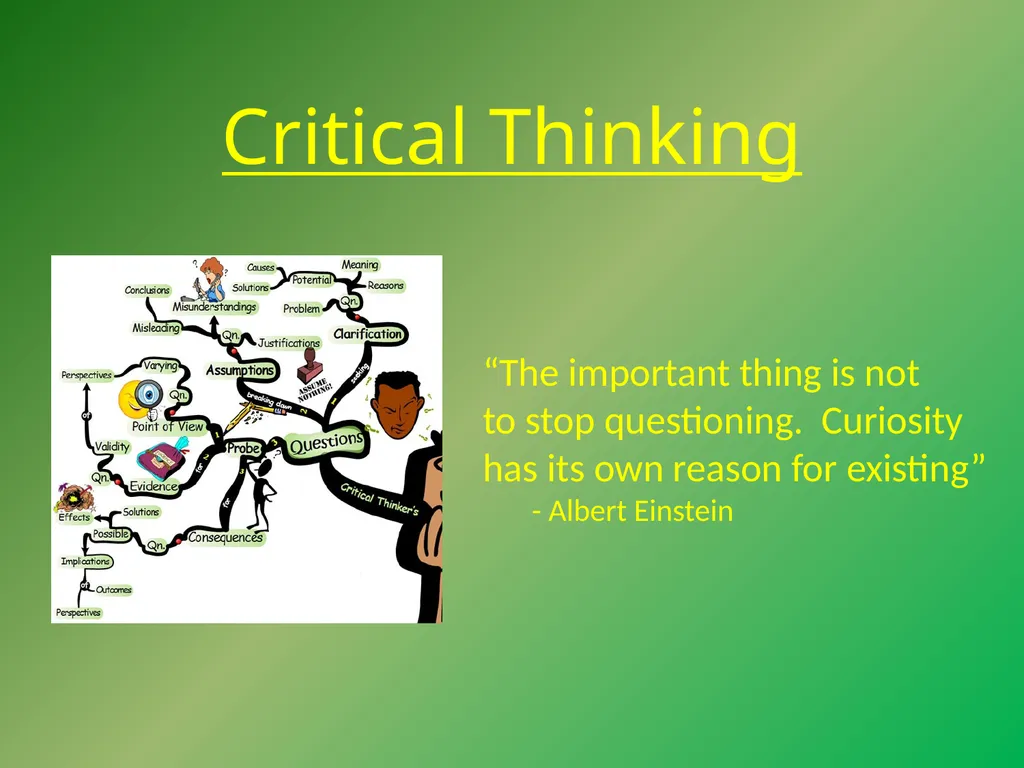
slide1. Critical Thinking “The important thing is not
to stop questioning. Curiosity
has its own reason for existing”
- Albert Einstein<br>
slide2. Critical Thinking in Your Life Personal Life
What constitutes a healthy diet?
Which investment is better for my family? Why?
Professional Life
In what ways can we improve our product?
How do the actions of our company affect others? The environment?
Academic Life
What are the main points of this text?
Which major should I choose…why?
Spiritual Life
How do these teachings apply to my life?
Are there contradictions in what is being said?<br>
slide3. Skills You Should Cultivate Become an active learner
“Chase” answers.
Actively seek out solutions.
Go to the answer, don’t wait for it to come to you.
Become open-minded
Is it possible that there are multiple correct answers?
You might be wrong. Why?
Try and approach problems from a different perspective.
Separate Emotions from Facts
“Thinking” and “feeling” are not the same.
Avoid Logical Fallacies
2 + 2 = 5. Incorrect.<br>
slide4. Active Learning Attend class regularly
Take advantage of extra credit opportunities.
Participate in discussions.
Talk with your professors.
Read textbooks
Take notes and outline information.
Review notes and try to put them in your own words.
Attend Tutoring
It’s free!
www.nmu.edu/tutoring
Take the new information you have gathered, try it out and experiment with it.
Why is it relevant?
What does it mean?
What is the purpose of knowing the information?<br>
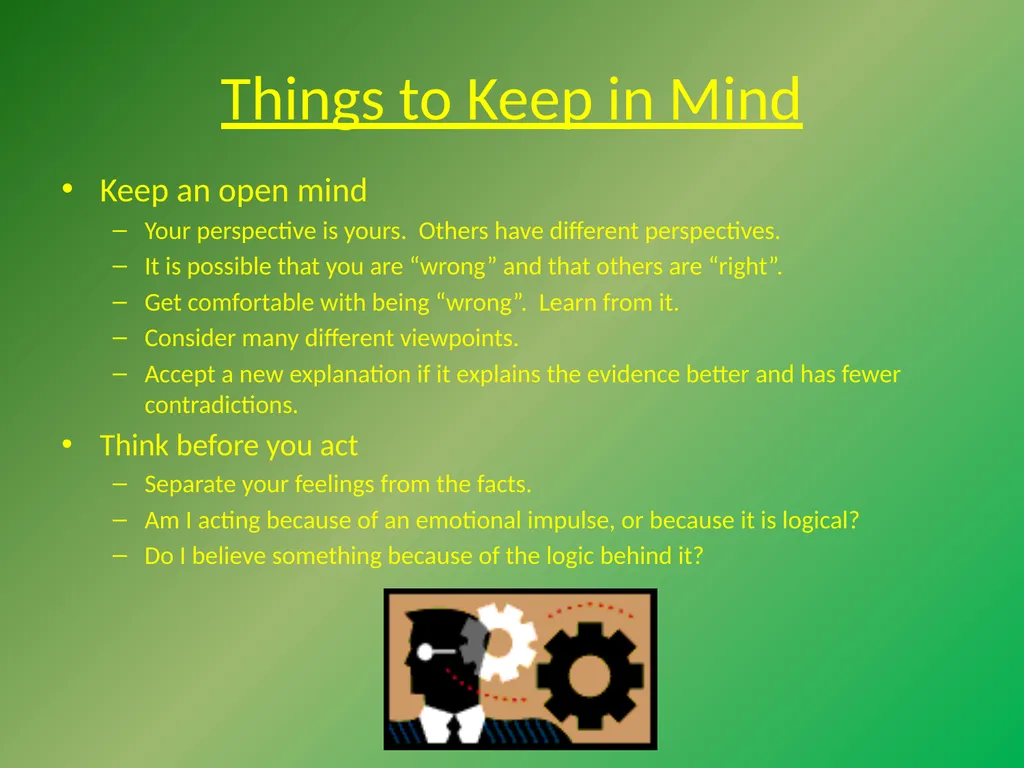
slide5. Things to Keep in Mind Keep an open mind
Your perspective is yours. Others have different perspectives.
It is possible that you are “wrong” and that others are “right”.
Get comfortable with being “wrong”. Learn from it.
Consider many different viewpoints.
Accept a new explanation if it explains the evidence better and has fewer contradictions.
Think before you act
Separate your feelings from the facts.
Am I acting because of an emotional impulse, or because it is logical?
Do I believe something because of the logic behind it?<br>
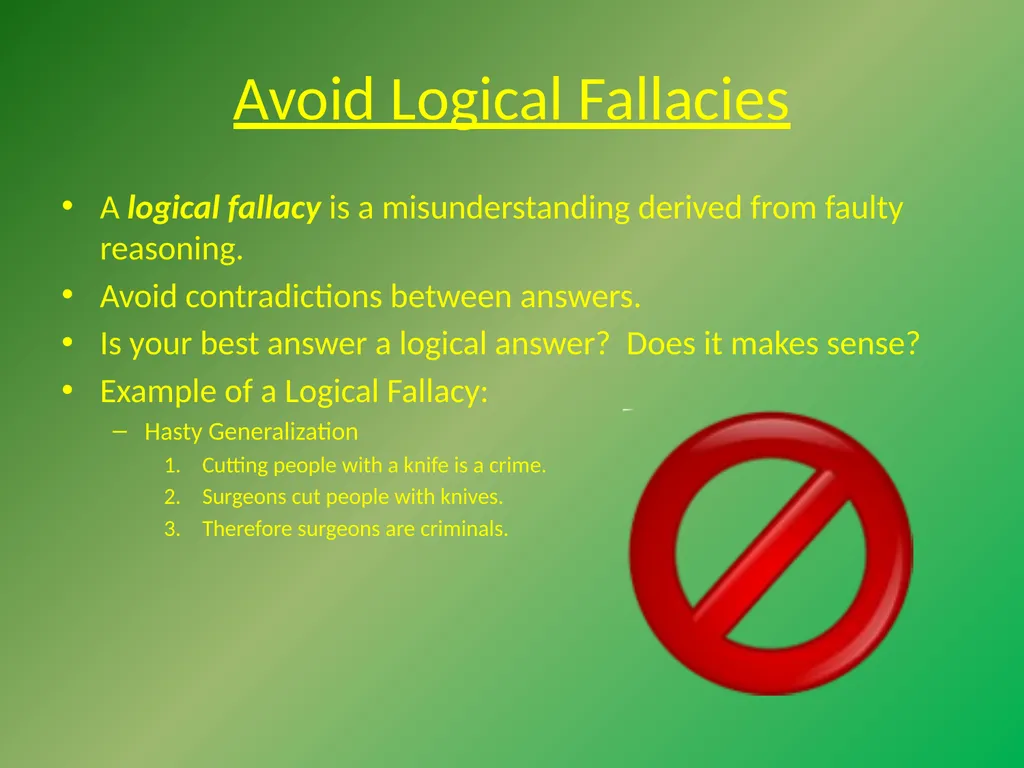
slide6. Avoid Logical Fallacies A logical fallacy is a misunderstanding derived from faulty reasoning.
Avoid contradictions between answers.
Is your best answer a logical answer? Does it makes sense?
Example of a Logical Fallacy:
Hasty Generalization
Cutting people with a knife is a crime.
Surgeons cut people with knives.
Therefore surgeons are criminals.<br>
slide7. You must be
willing to say,
“I don’t know.”
And then be willing to do something to change that.<br>
slide8. Critical Thinking is not
driven by answers;
It is driven by the
questions that you ask.<br>
slide9. Constantly Ask Questions Why?
Why is the population increasing? Is there an abundance of deer to hunt?
What?
What effect is this increase having on the deer population?
Where?
Where is the population increasing? Is it all over the Upper Peninsula, or just in isolated locations?
Who?
Who is affected by the increase in the population of cougars? Are the hunters affected? The wolves?
When?
When did this increase begin occurring? How long will the increase continue?
How?
How can we stabilize the cougar population? For example: Suppose you have just read an article that says that the
cougar population of the Upper Peninsula is increasing.<br>
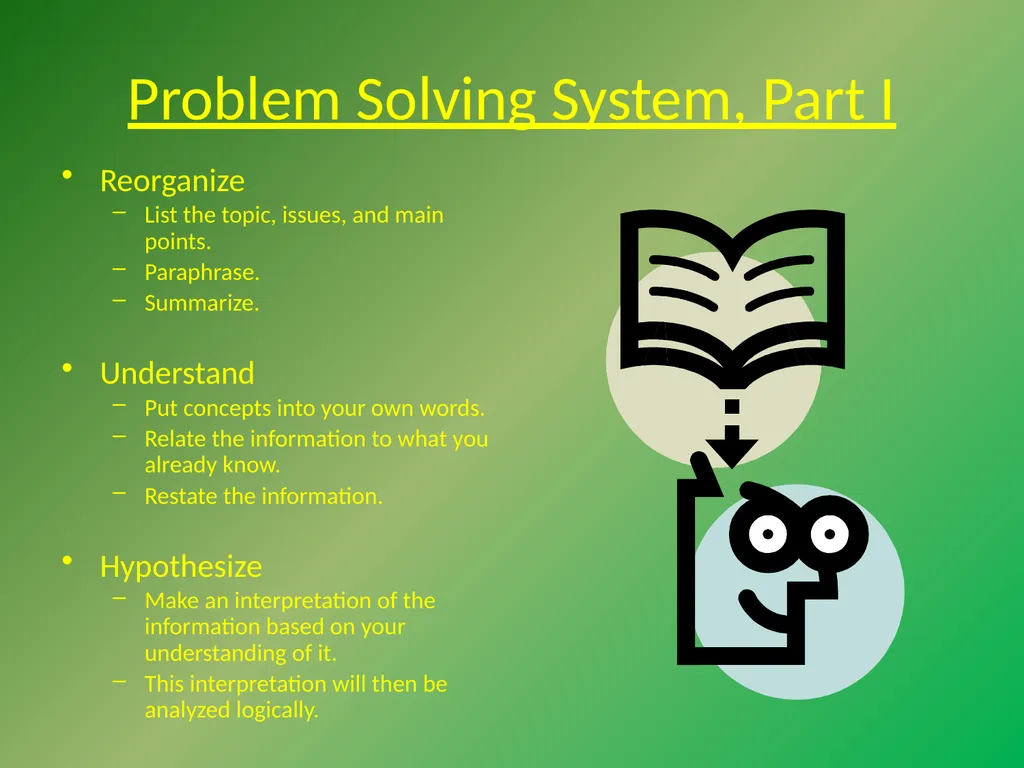
slide10. Problem Solving System, Part I Reorganize
List the topic, issues, and main points.
Paraphrase.
Summarize.
Understand
Put concepts into your own words.
Relate the information to what you already know.
Restate the information.
Hypothesize
Make an interpretation of the information based on your understanding of it.
This interpretation will then be analyzed logically.<br>
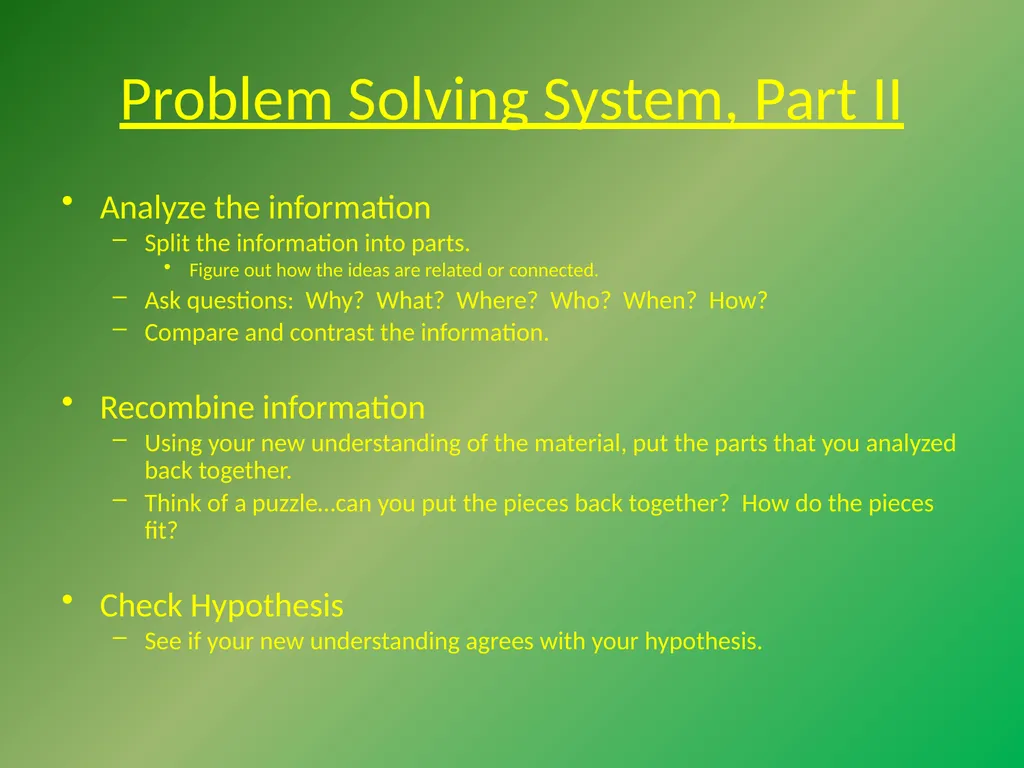
slide11. Problem Solving System, Part II Analyze the information
Split the information into parts.
Figure out how the ideas are related or connected.
Ask questions: Why? What? Where? Who? When? How?
Compare and contrast the information.
Recombine information
Using your new understanding of the material, put the parts that you analyzed back together.
Think of a puzzle…can you put the pieces back together? How do the pieces fit?
Check Hypothesis
See if your new understanding agrees with your hypothesis.<br>
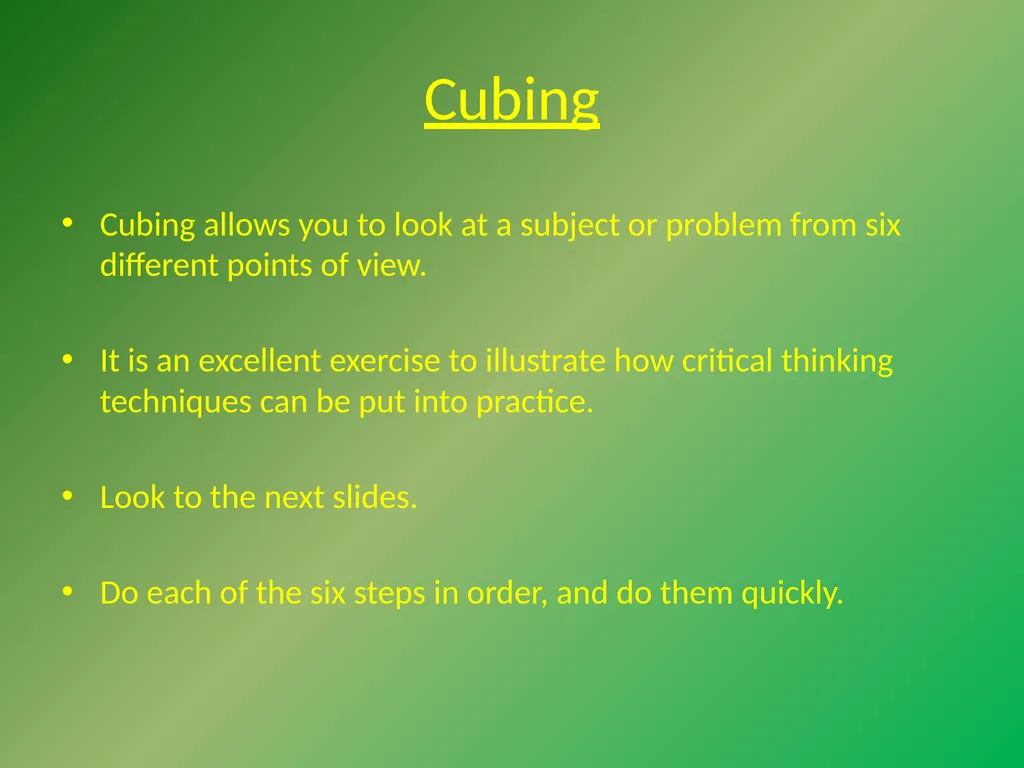
slide12. Cubing Cubing allows you to look at a subject or problem from six different points of view.
It is an excellent exercise to illustrate how critical thinking techniques can be put into practice.
Look to the next slides.
Do each of the six steps in order, and do them quickly.<br>
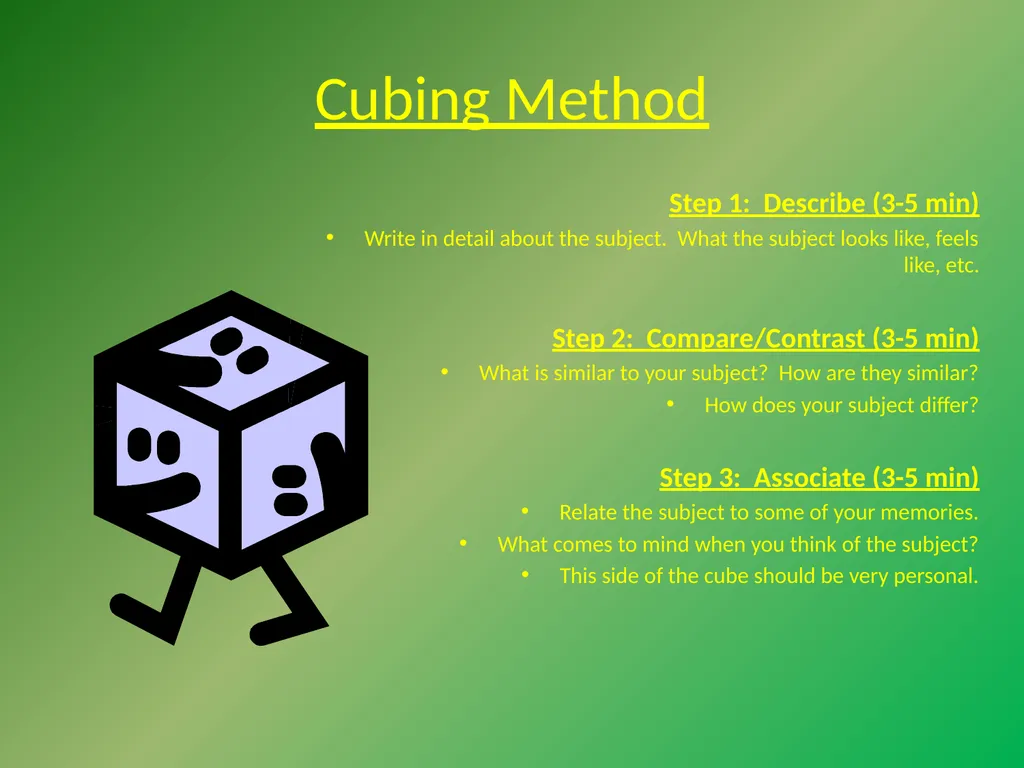
slide13. Cubing Method Step 1: Describe (3-5 min)
Write in detail about the subject. What the subject looks like, feels like, etc.
Step 2: Compare/Contrast (3-5 min)
What is similar to your subject? How are they similar?
How does your subject differ?
Step 3: Associate (3-5 min)
Relate the subject to some of your memories.
What comes to mind when you think of the subject?
This side of the cube should be very personal.<br>
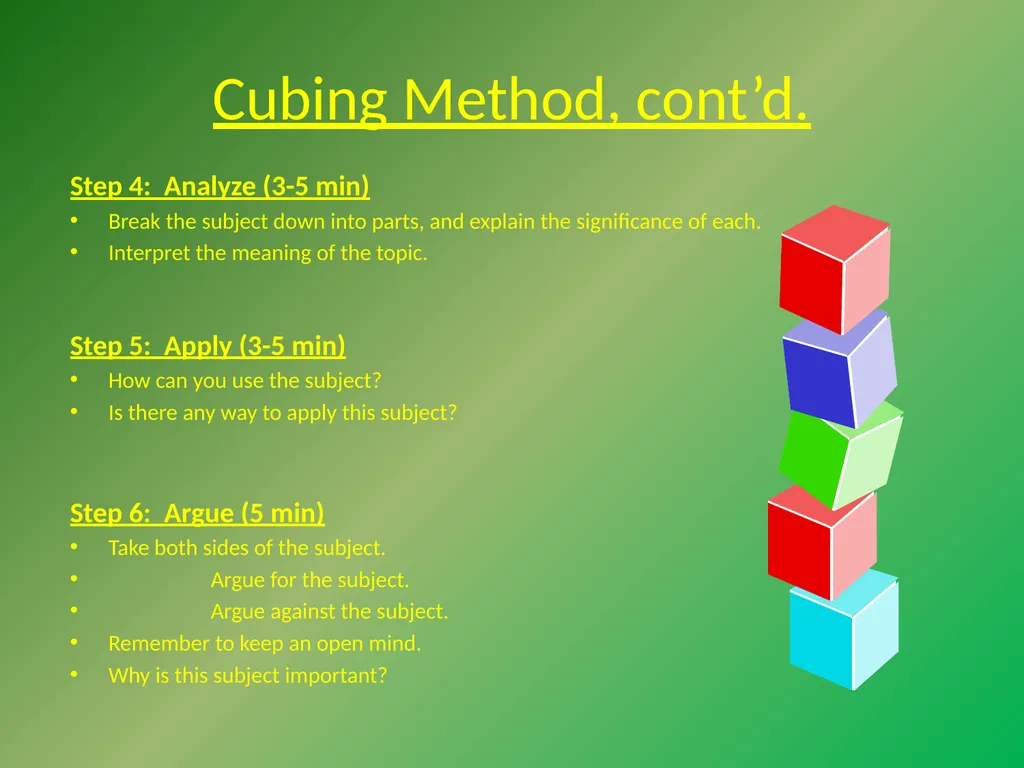
slide14. Cubing Method, cont’d. Step 4: Analyze (3-5 min)
Break the subject down into parts, and explain the significance of each.
Interpret the meaning of the topic.
Step 5: Apply (3-5 min)
How can you use the subject?
Is there any way to apply this subject?
Step 6: Argue (5 min)
Take both sides of the subject.
Argue for the subject.
Argue against the subject.
Remember to keep an open mind.
Why is this subject important?<br>
slide15. Critical Thinking Key Words Discuss
Explain
Compare and Contrast
Critique
Evaluate
Describe
Define
Enumerate
Illustrate Interpret
Identify
Outline
Prove
Justify
Relate
Summarize
Trace Ideally you should always be thinking critically, however,
the following words will identify when critical thinking is required. These types of words require COMPREHENSION AND UNDERSTANDING, not simple MEMORIZATION.<br>
slide16. Use the techniques found in this presentation to develop your own strategies for critical thinking.
Tailor the concepts to fit your needs. There is no “one size fits all” approach, and every technique may not work for each of your courses.
Create the “this size fits you” approach to developing your critical thinking.
How you apply the concepts to your coursework is your decision. Some Final Tips…<br>
slide17. This PowerPoint presentation is the
property of Northern Michigan University’s
Academic & Career Advisement Center. It
may not be reproduced without written
consent.
www.nmu.edu/acac<br>
to stop questioning. Curiosity
has its own reason for existing”
- Albert Einstein<br>
slide2. Critical Thinking in Your Life Personal Life
What constitutes a healthy diet?
Which investment is better for my family? Why?
Professional Life
In what ways can we improve our product?
How do the actions of our company affect others? The environment?
Academic Life
What are the main points of this text?
Which major should I choose…why?
Spiritual Life
How do these teachings apply to my life?
Are there contradictions in what is being said?<br>
slide3. Skills You Should Cultivate Become an active learner
“Chase” answers.
Actively seek out solutions.
Go to the answer, don’t wait for it to come to you.
Become open-minded
Is it possible that there are multiple correct answers?
You might be wrong. Why?
Try and approach problems from a different perspective.
Separate Emotions from Facts
“Thinking” and “feeling” are not the same.
Avoid Logical Fallacies
2 + 2 = 5. Incorrect.<br>
slide4. Active Learning Attend class regularly
Take advantage of extra credit opportunities.
Participate in discussions.
Talk with your professors.
Read textbooks
Take notes and outline information.
Review notes and try to put them in your own words.
Attend Tutoring
It’s free!
www.nmu.edu/tutoring
Take the new information you have gathered, try it out and experiment with it.
Why is it relevant?
What does it mean?
What is the purpose of knowing the information?<br>
slide5. Things to Keep in Mind Keep an open mind
Your perspective is yours. Others have different perspectives.
It is possible that you are “wrong” and that others are “right”.
Get comfortable with being “wrong”. Learn from it.
Consider many different viewpoints.
Accept a new explanation if it explains the evidence better and has fewer contradictions.
Think before you act
Separate your feelings from the facts.
Am I acting because of an emotional impulse, or because it is logical?
Do I believe something because of the logic behind it?<br>
slide6. Avoid Logical Fallacies A logical fallacy is a misunderstanding derived from faulty reasoning.
Avoid contradictions between answers.
Is your best answer a logical answer? Does it makes sense?
Example of a Logical Fallacy:
Hasty Generalization
Cutting people with a knife is a crime.
Surgeons cut people with knives.
Therefore surgeons are criminals.<br>
slide7. You must be
willing to say,
“I don’t know.”
And then be willing to do something to change that.<br>
slide8. Critical Thinking is not
driven by answers;
It is driven by the
questions that you ask.<br>
slide9. Constantly Ask Questions Why?
Why is the population increasing? Is there an abundance of deer to hunt?
What?
What effect is this increase having on the deer population?
Where?
Where is the population increasing? Is it all over the Upper Peninsula, or just in isolated locations?
Who?
Who is affected by the increase in the population of cougars? Are the hunters affected? The wolves?
When?
When did this increase begin occurring? How long will the increase continue?
How?
How can we stabilize the cougar population? For example: Suppose you have just read an article that says that the
cougar population of the Upper Peninsula is increasing.<br>
slide10. Problem Solving System, Part I Reorganize
List the topic, issues, and main points.
Paraphrase.
Summarize.
Understand
Put concepts into your own words.
Relate the information to what you already know.
Restate the information.
Hypothesize
Make an interpretation of the information based on your understanding of it.
This interpretation will then be analyzed logically.<br>
slide11. Problem Solving System, Part II Analyze the information
Split the information into parts.
Figure out how the ideas are related or connected.
Ask questions: Why? What? Where? Who? When? How?
Compare and contrast the information.
Recombine information
Using your new understanding of the material, put the parts that you analyzed back together.
Think of a puzzle…can you put the pieces back together? How do the pieces fit?
Check Hypothesis
See if your new understanding agrees with your hypothesis.<br>
slide12. Cubing Cubing allows you to look at a subject or problem from six different points of view.
It is an excellent exercise to illustrate how critical thinking techniques can be put into practice.
Look to the next slides.
Do each of the six steps in order, and do them quickly.<br>
slide13. Cubing Method Step 1: Describe (3-5 min)
Write in detail about the subject. What the subject looks like, feels like, etc.
Step 2: Compare/Contrast (3-5 min)
What is similar to your subject? How are they similar?
How does your subject differ?
Step 3: Associate (3-5 min)
Relate the subject to some of your memories.
What comes to mind when you think of the subject?
This side of the cube should be very personal.<br>
slide14. Cubing Method, cont’d. Step 4: Analyze (3-5 min)
Break the subject down into parts, and explain the significance of each.
Interpret the meaning of the topic.
Step 5: Apply (3-5 min)
How can you use the subject?
Is there any way to apply this subject?
Step 6: Argue (5 min)
Take both sides of the subject.
Argue for the subject.
Argue against the subject.
Remember to keep an open mind.
Why is this subject important?<br>
slide15. Critical Thinking Key Words Discuss
Explain
Compare and Contrast
Critique
Evaluate
Describe
Define
Enumerate
Illustrate Interpret
Identify
Outline
Prove
Justify
Relate
Summarize
Trace Ideally you should always be thinking critically, however,
the following words will identify when critical thinking is required. These types of words require COMPREHENSION AND UNDERSTANDING, not simple MEMORIZATION.<br>
slide16. Use the techniques found in this presentation to develop your own strategies for critical thinking.
Tailor the concepts to fit your needs. There is no “one size fits all” approach, and every technique may not work for each of your courses.
Create the “this size fits you” approach to developing your critical thinking.
How you apply the concepts to your coursework is your decision. Some Final Tips…<br>
slide17. This PowerPoint presentation is the
property of Northern Michigan University’s
Academic & Career Advisement Center. It
may not be reproduced without written
consent.
www.nmu.edu/acac<br>