
Cryptography and Network Security Sixth Edition by

Description: Cryptography and Network Security Sixth Edition by William Stallings Chapter 7 Pseudorandom Number Generation and Stream Ciphers The comparatively late rise of the theory of probability shows how hard it is to grasp, and the many paradoxes
Related Topics
Download Presentation
"Cryptography and Network Security Sixth Edition by" is the property of its rightful owner. Permission is granted to download and print the materials on this website for personal, non-commercial use only, and to display it on your personal computer provided you do not modify the materials and that you retain all copyright notices contained in the materials. By downloading content from our website, you accept the terms of this agreement.
Presentation Transcript
slide1. Cryptography and Network Security Sixth Edition
by William Stallings<br>
slide2. Chapter 7 Pseudorandom Number Generation and Stream Ciphers<br>
slide3. “The comparatively late rise of the theory of probability shows how hard it is to grasp, and the many paradoxes show clearly that we, as humans, lack a well grounded intuition in this matter.”
“In probability theory there is a great deal of art in setting up the model, in solving the problem, and in applying the results back to the real world actions that will follow.”
— The Art of Probability,
Richard Hamming<br>
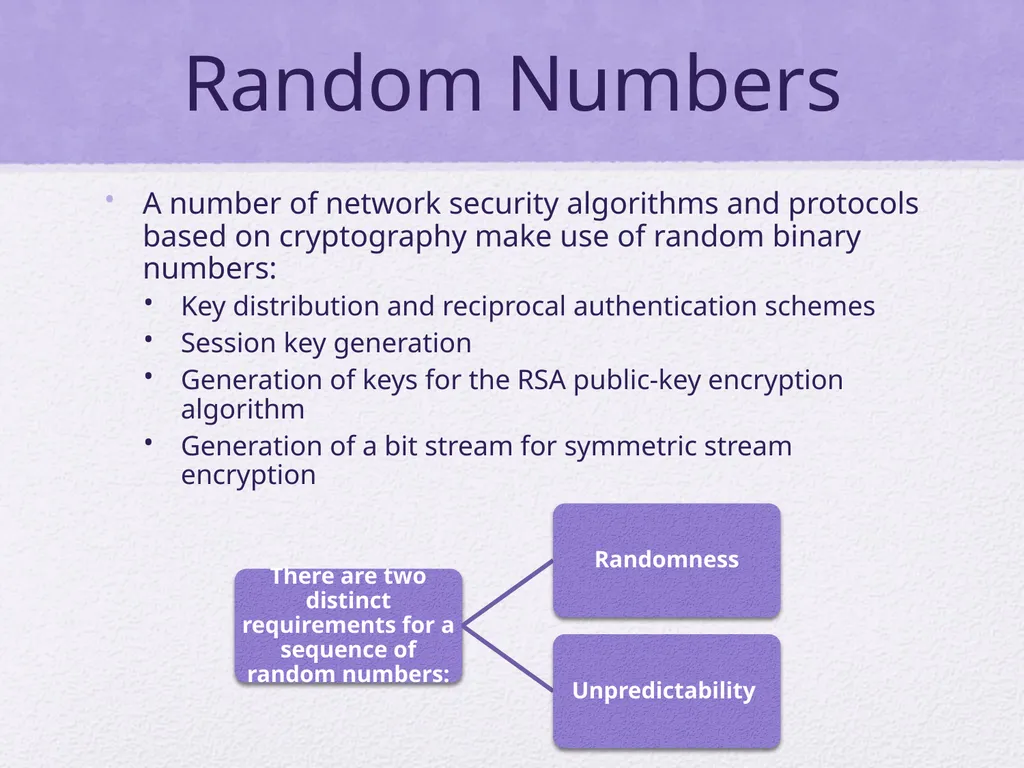
slide4. Random Numbers A number of network security algorithms and protocols based on cryptography make use of random binary numbers:
Key distribution and reciprocal authentication schemes
Session key generation
Generation of keys for the RSA public-key encryption algorithm
Generation of a bit stream for symmetric stream encryption<br>
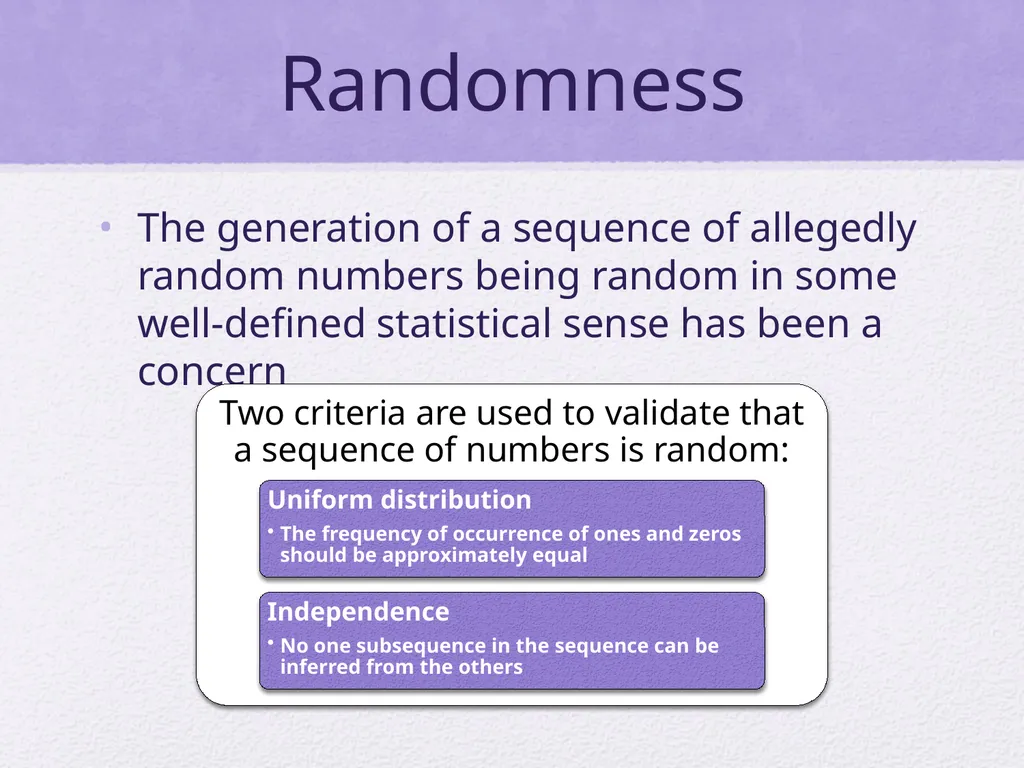
slide5. Randomness The generation of a sequence of allegedly random numbers being random in some well-defined statistical sense has been a concern<br>
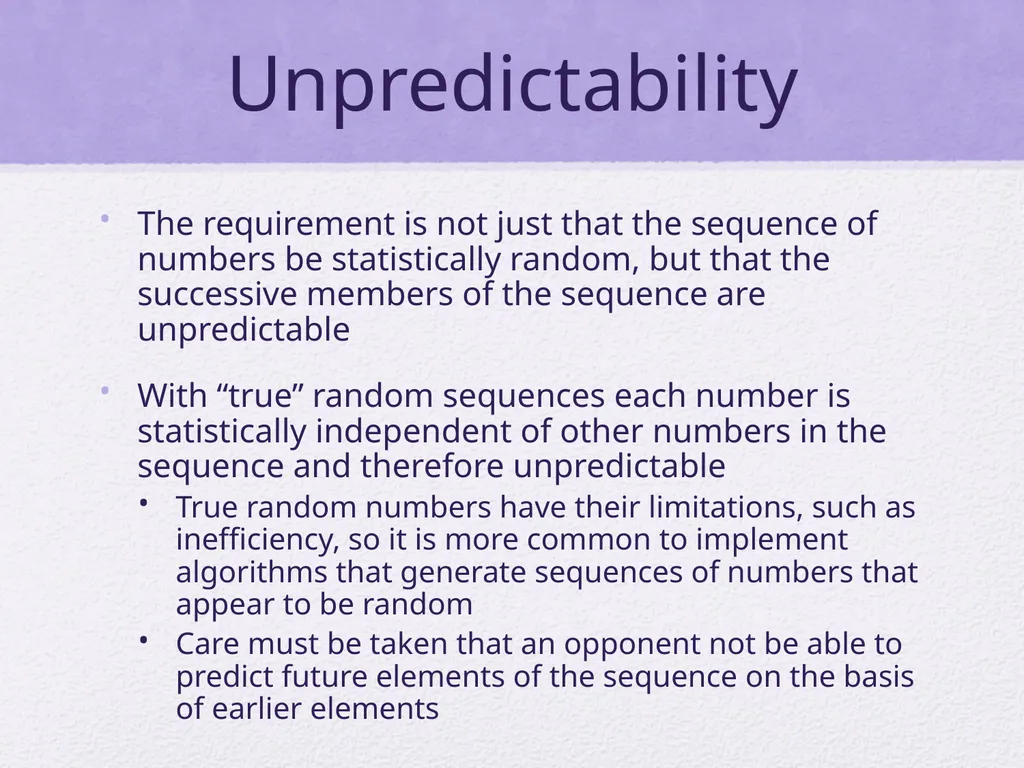
slide6. Unpredictability The requirement is not just that the sequence of numbers be statistically random, but that the successive members of the sequence are unpredictable
With “true” random sequences each number is statistically independent of other numbers in the sequence and therefore unpredictable
True random numbers have their limitations, such as inefficiency, so it is more common to implement algorithms that generate sequences of numbers that appear to be random
Care must be taken that an opponent not be able to predict future elements of the sequence on the basis of earlier elements<br>
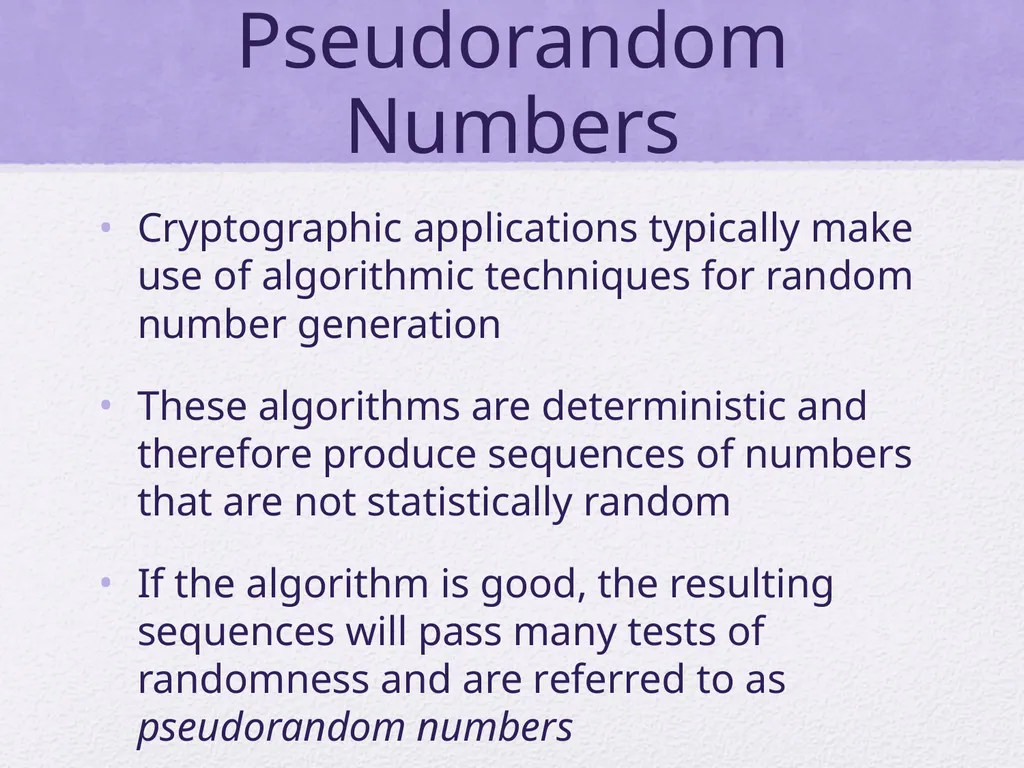
slide7. Pseudorandom Numbers Cryptographic applications typically make use of algorithmic techniques for random number generation
These algorithms are deterministic and therefore produce sequences of numbers that are not statistically random
If the algorithm is good, the resulting sequences will pass many tests of randomness and are referred to as pseudorandom numbers<br>
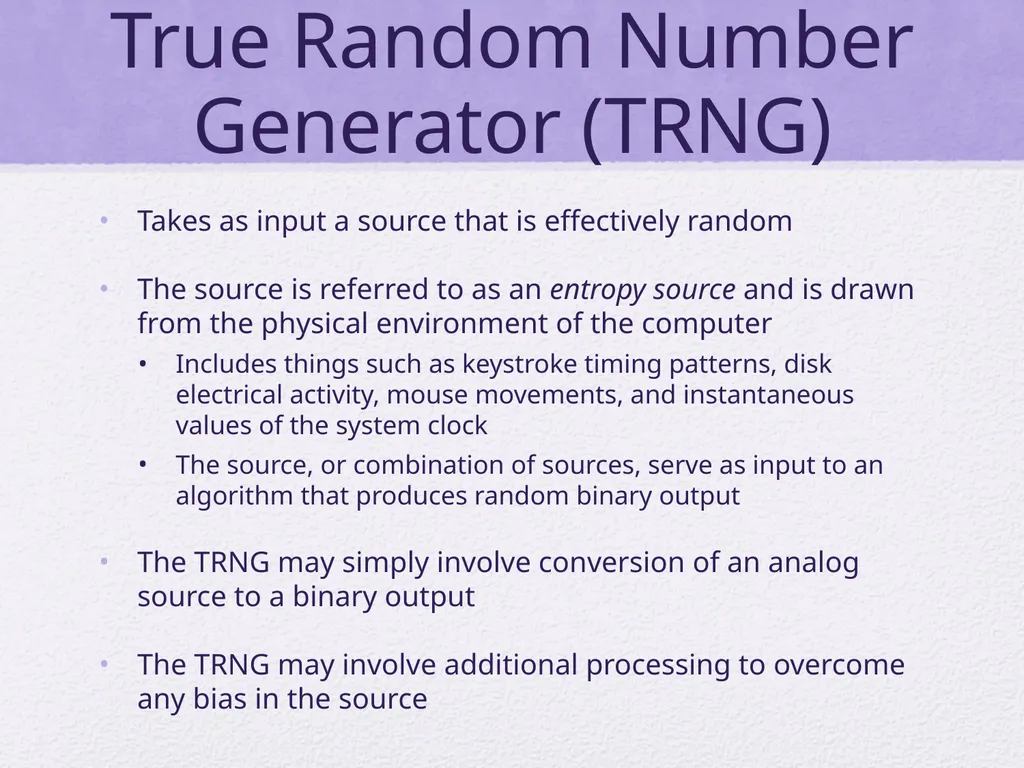
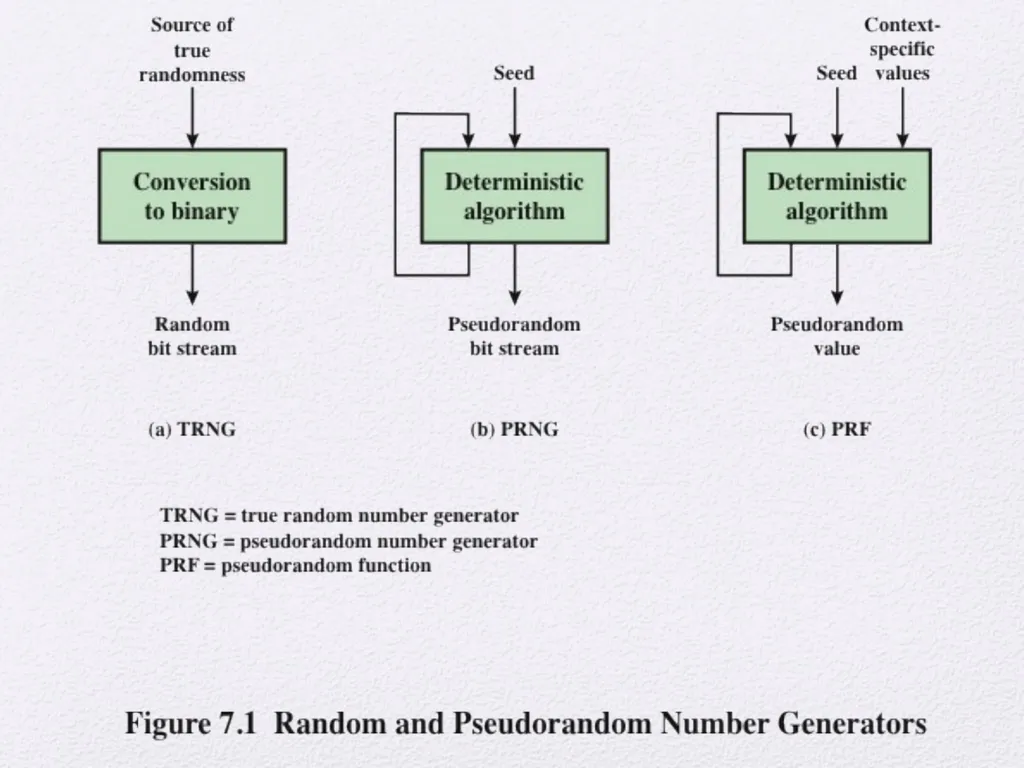
slide8. True Random Number Generator (TRNG) Takes as input a source that is effectively random
The source is referred to as an entropy source and is drawn from the physical environment of the computer
Includes things such as keystroke timing patterns, disk electrical activity, mouse movements, and instantaneous values of the system clock
The source, or combination of sources, serve as input to an algorithm that produces random binary output
The TRNG may simply involve conversion of an analog source to a binary output
The TRNG may involve additional processing to overcome any bias in the source<br>
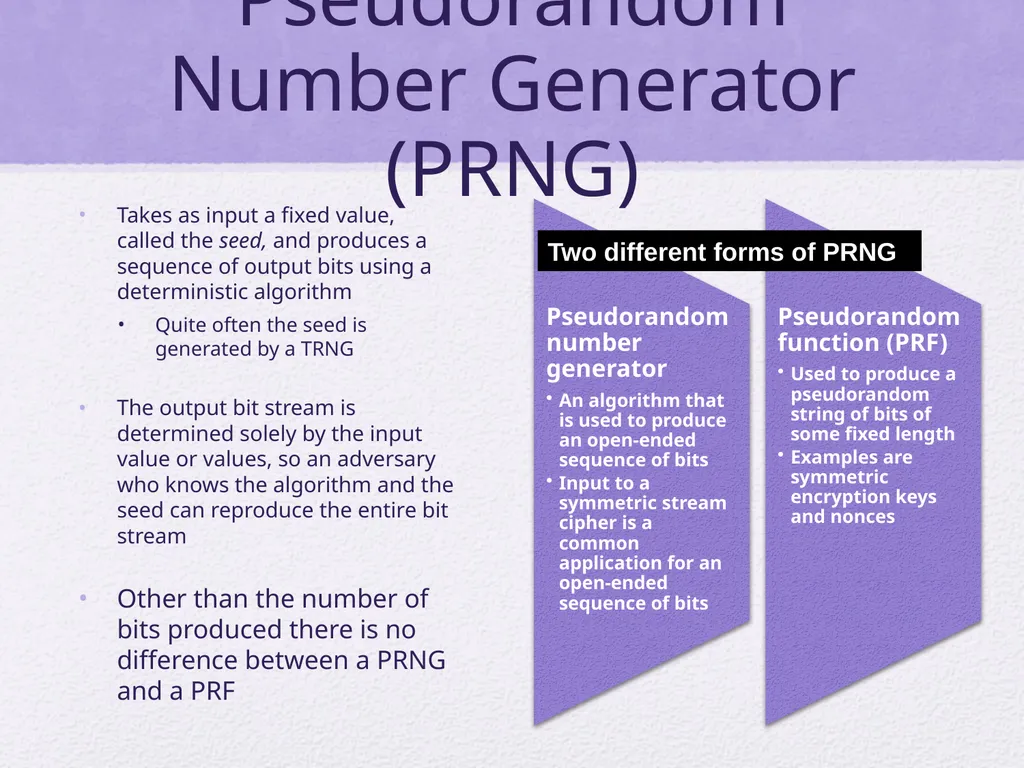
slide9. Pseudorandom Number Generator (PRNG) Takes as input a fixed value, called the seed, and produces a sequence of output bits using a deterministic algorithm
Quite often the seed is generated by a TRNG
The output bit stream is determined solely by the input value or values, so an adversary who knows the algorithm and the seed can reproduce the entire bit stream
Other than the number of bits produced there is no difference between a PRNG and a PRF Two different forms of PRNG<br>
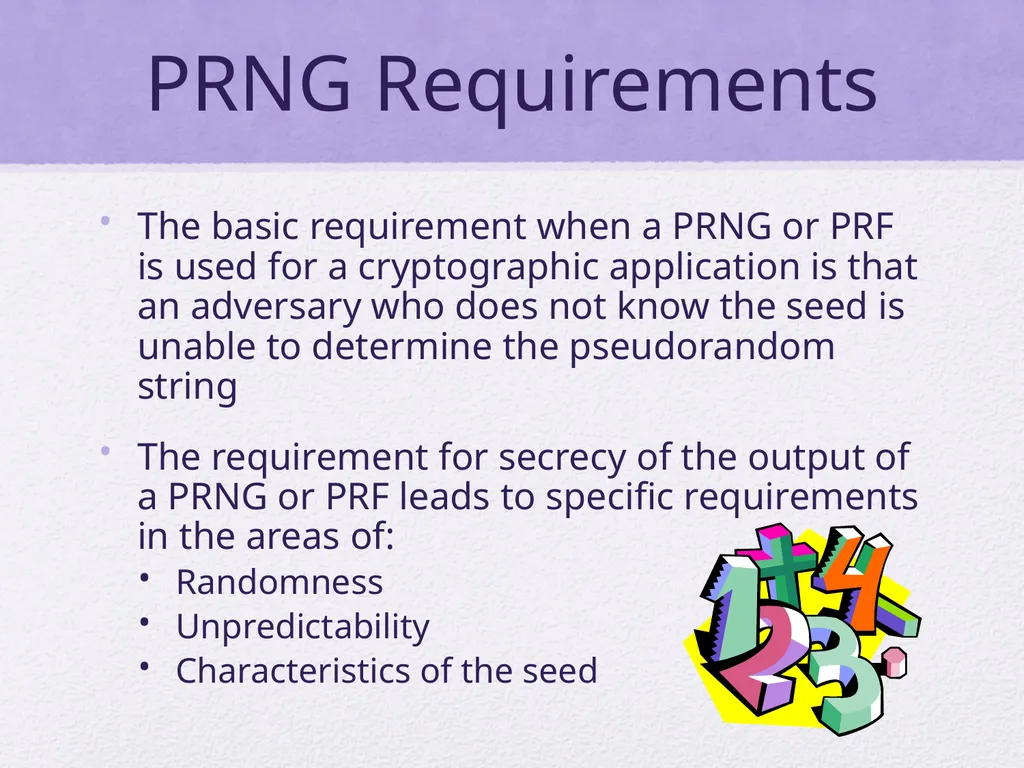
slide11. PRNG Requirements The basic requirement when a PRNG or PRF is used for a cryptographic application is that an adversary who does not know the seed is unable to determine the pseudorandom string
The requirement for secrecy of the output of a PRNG or PRF leads to specific requirements in the areas of:
Randomness
Unpredictability
Characteristics of the seed<br>
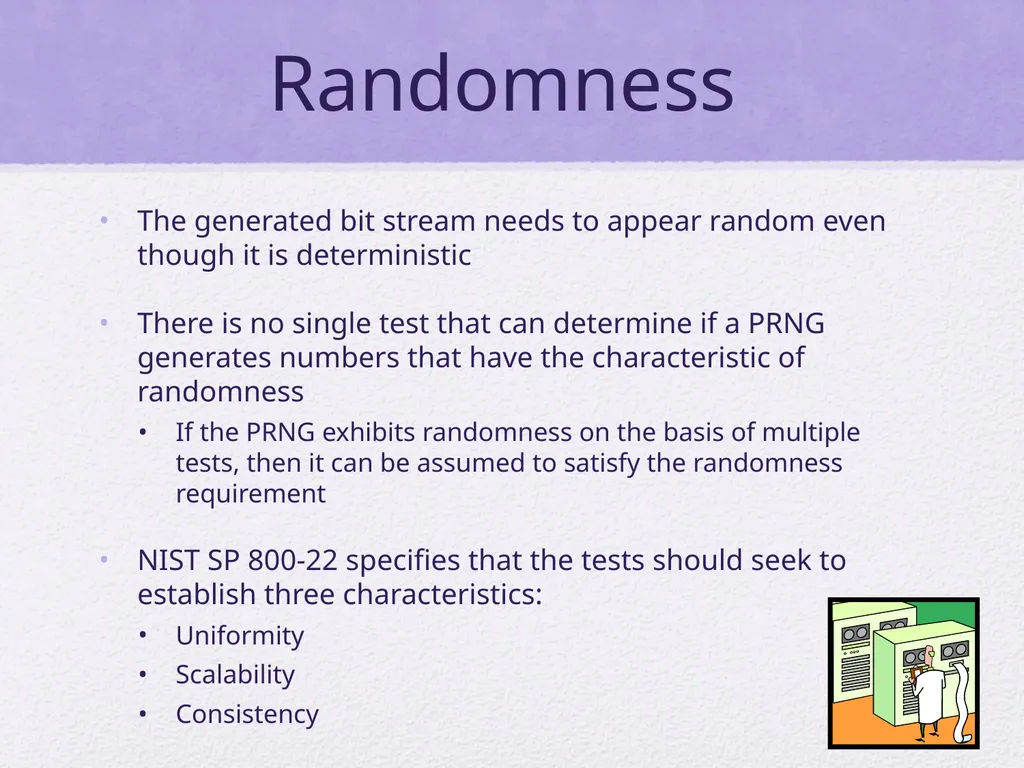
slide12. Randomness The generated bit stream needs to appear random even though it is deterministic
There is no single test that can determine if a PRNG generates numbers that have the characteristic of randomness
If the PRNG exhibits randomness on the basis of multiple tests, then it can be assumed to satisfy the randomness requirement
NIST SP 800-22 specifies that the tests should seek to establish three characteristics:
Uniformity
Scalability
Consistency<br>
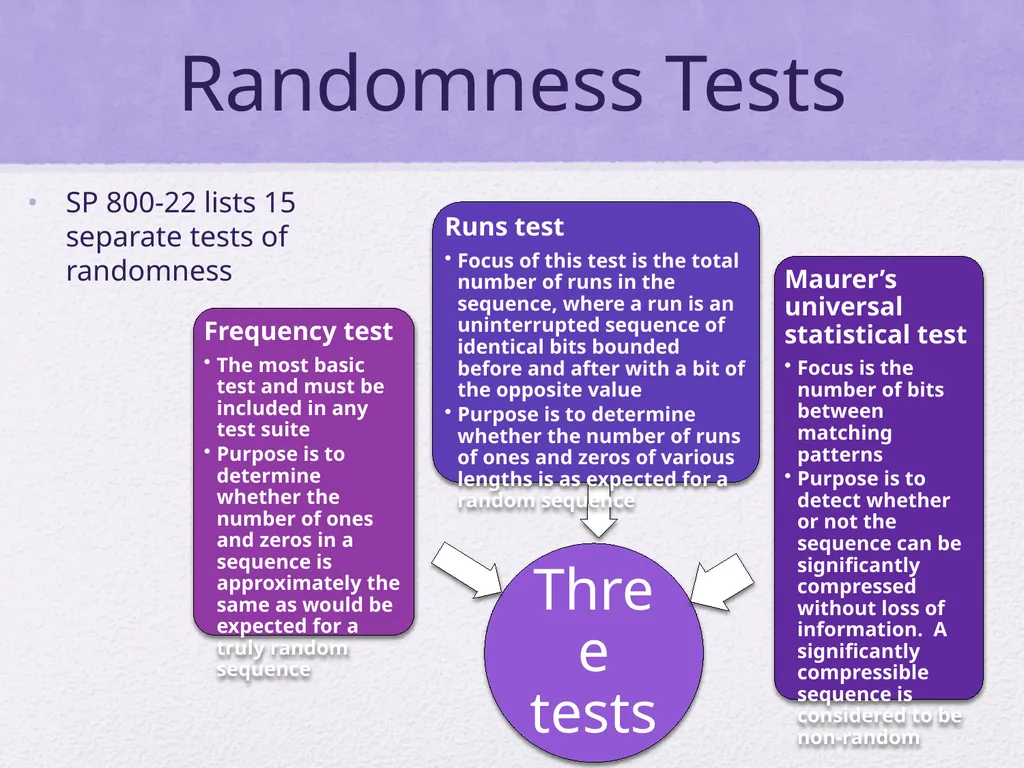
slide13. Randomness Tests SP 800-22 lists 15 separate tests of randomness<br>
slide14. Unpredictability A stream of pseudorandom numbers should exhibit two forms of unpredictability:
Forward unpredictability
If the seed is unknown, the next output bit in the sequence should be unpredictable in spite of any knowledge of previous bits in the sequence
Backward unpredictability
It should not be feasible to determine the seed from knowledge of any generated values. No correlation between a seed and any value generated from that seed should be evident; each element of the sequence should appear to be the outcome of an independent random event whose probability is 1/2
The same set of tests for randomness also provides a test of unpredictability
A random sequence will have no correlation with a fixed value (the seed)<br>
slide15. Seed Requirements The seed that serves as input to the PRNG must be secure and unpredictable
The seed itself must be a random or pseudorandom number
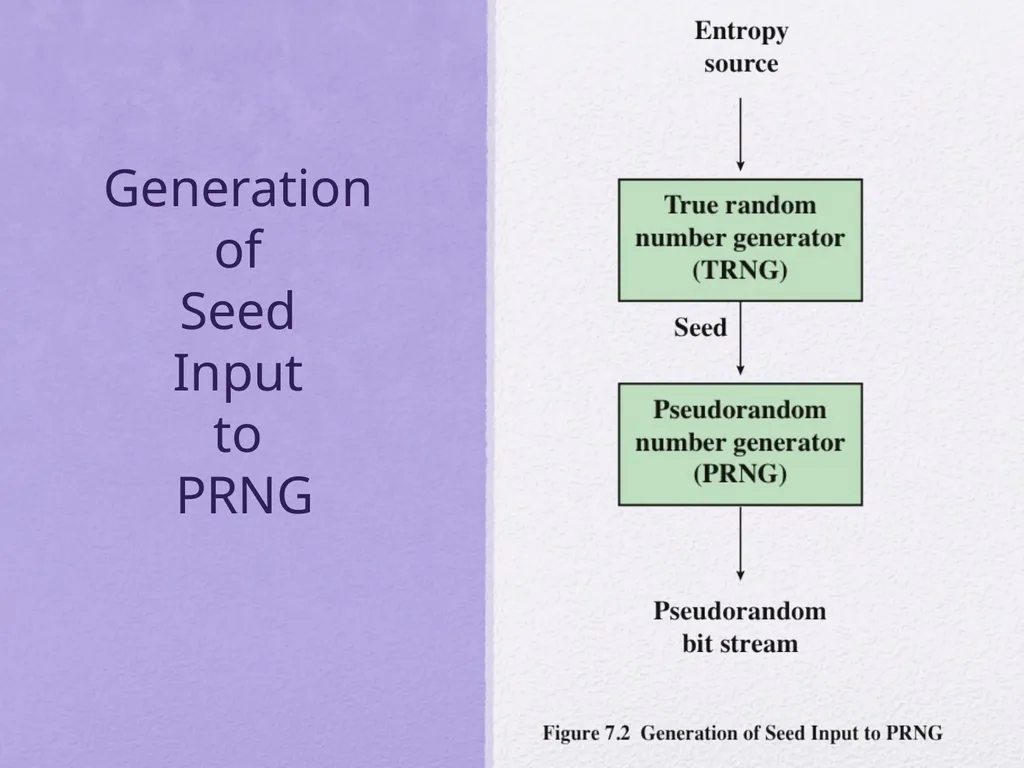
Typically the seed is generated by TRNG<br>
slide16. Generation of Seed Input to PRNG<br>
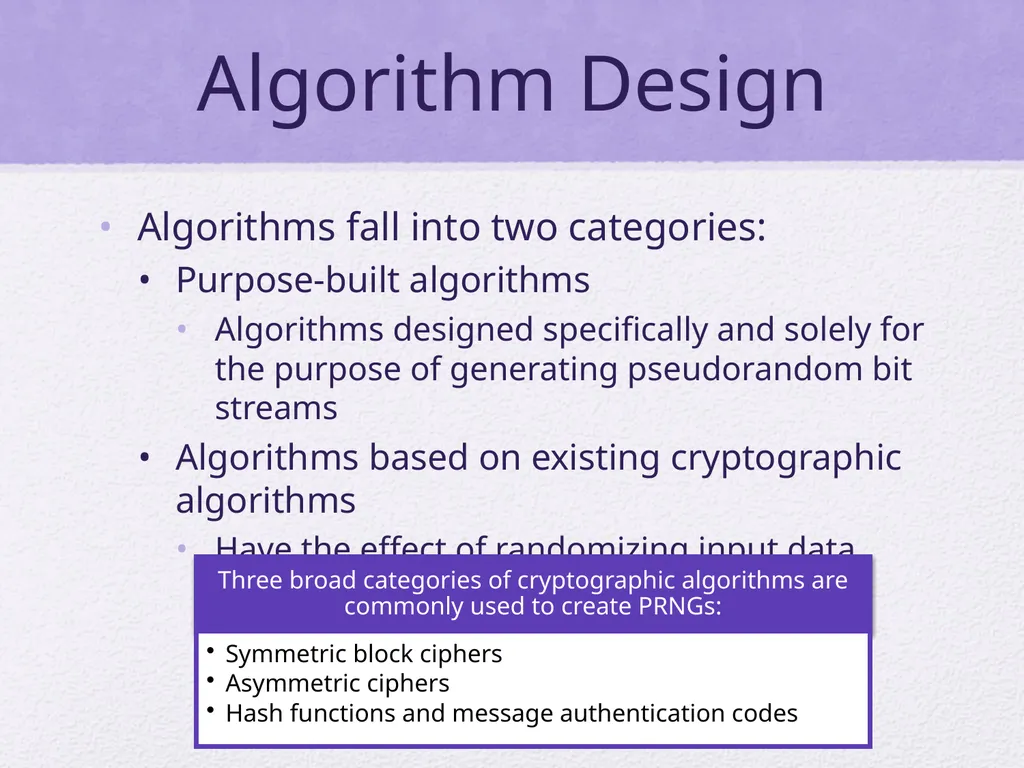
slide17. Algorithm Design Algorithms fall into two categories:
Purpose-built algorithms
Algorithms designed specifically and solely for the purpose of generating pseudorandom bit streams
Algorithms based on existing cryptographic algorithms
Have the effect of randomizing input data<br>
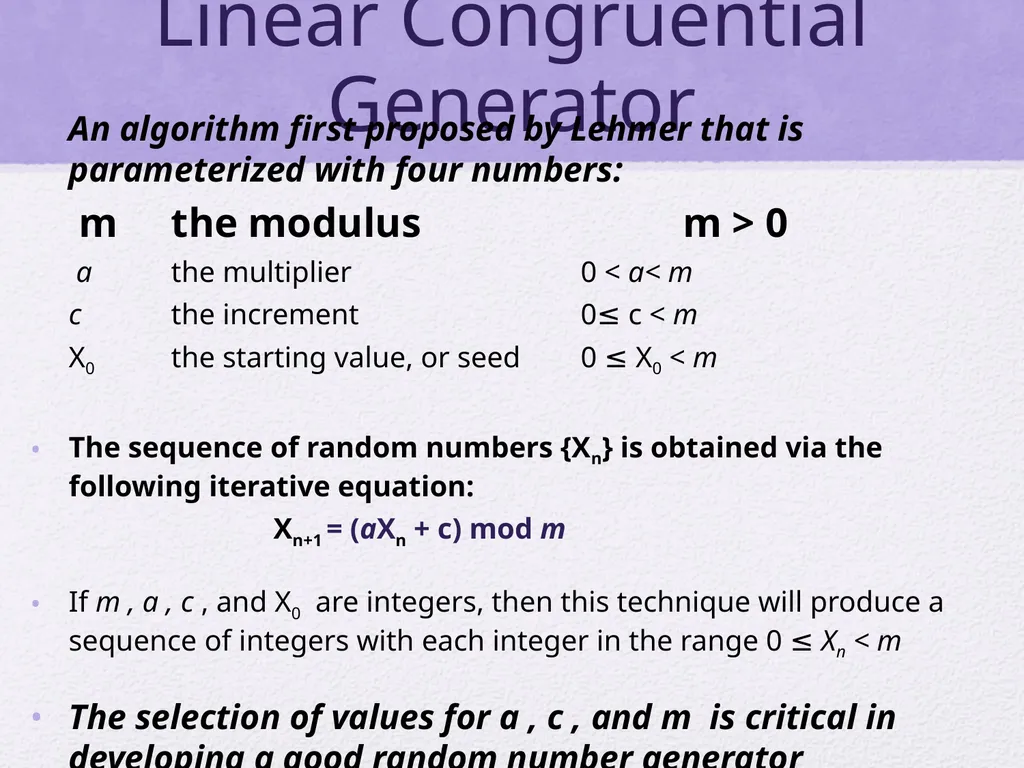
slide18. Linear Congruential Generator An algorithm first proposed by Lehmer that is parameterized with four numbers:
m the modulus m > 0
a the multiplier 0 < a< m
c the increment 0≤ c < m
X0 the starting value, or seed 0 ≤ X0 < m
The sequence of random numbers {Xn} is obtained via the following iterative equation:
Xn+1 = (aXn + c) mod m
If m , a , c , and X0 are integers, then this technique will produce a sequence of integers with each integer in the range 0 ≤ Xn < m
The selection of values for a , c , and m is critical in developing a good random number generator<br>
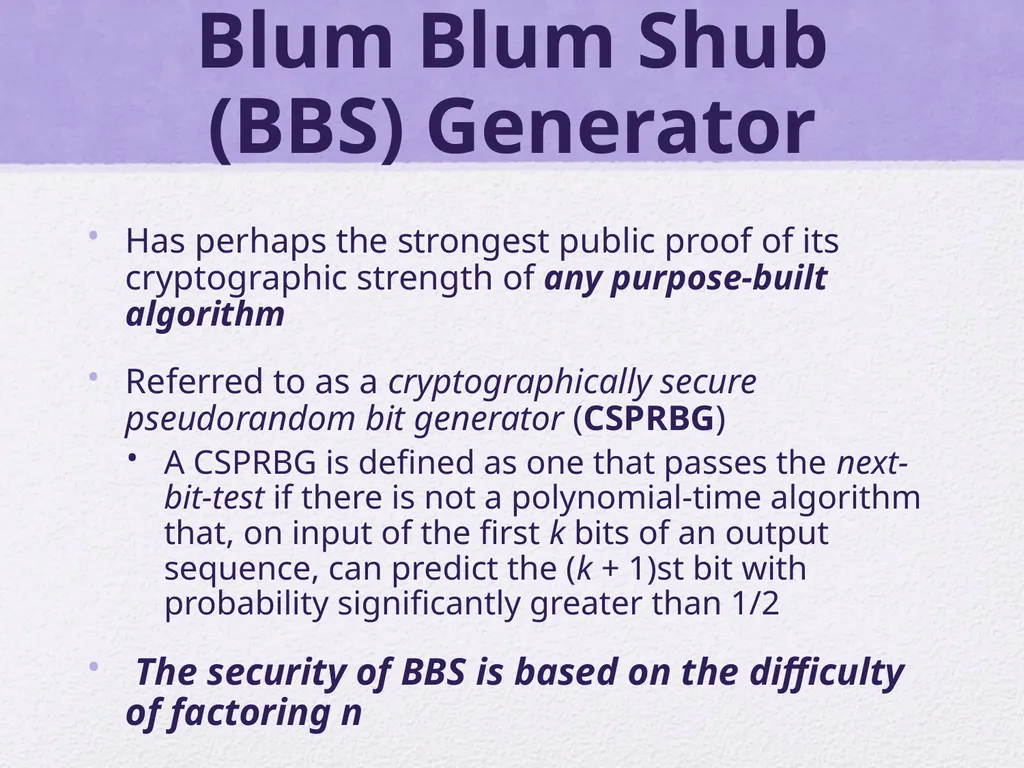
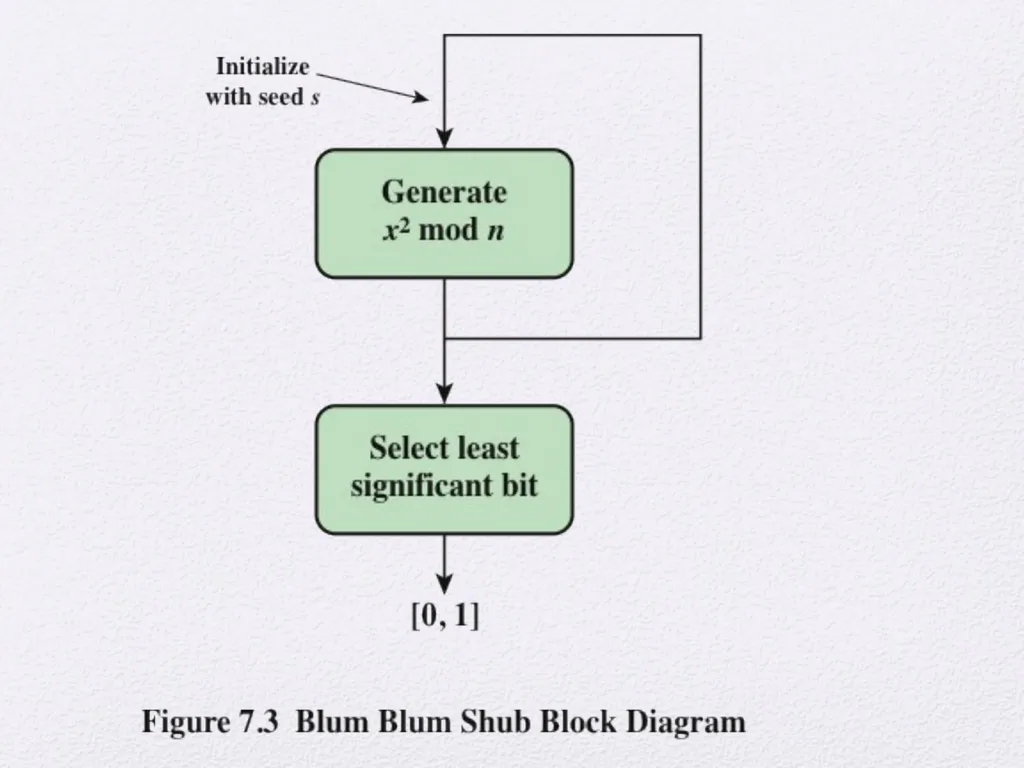
slide19. Blum Blum Shub (BBS) Generator Has perhaps the strongest public proof of its cryptographic strength of any purpose-built algorithm
Referred to as a cryptographically secure pseudorandom bit generator (CSPRBG)
A CSPRBG is defined as one that passes the next-bit-test if there is not a polynomial-time algorithm that, on input of the first k bits of an output sequence, can predict the (k + 1)st bit with probability significantly greater than 1/2
The security of BBS is based on the difficulty of factoring n<br>
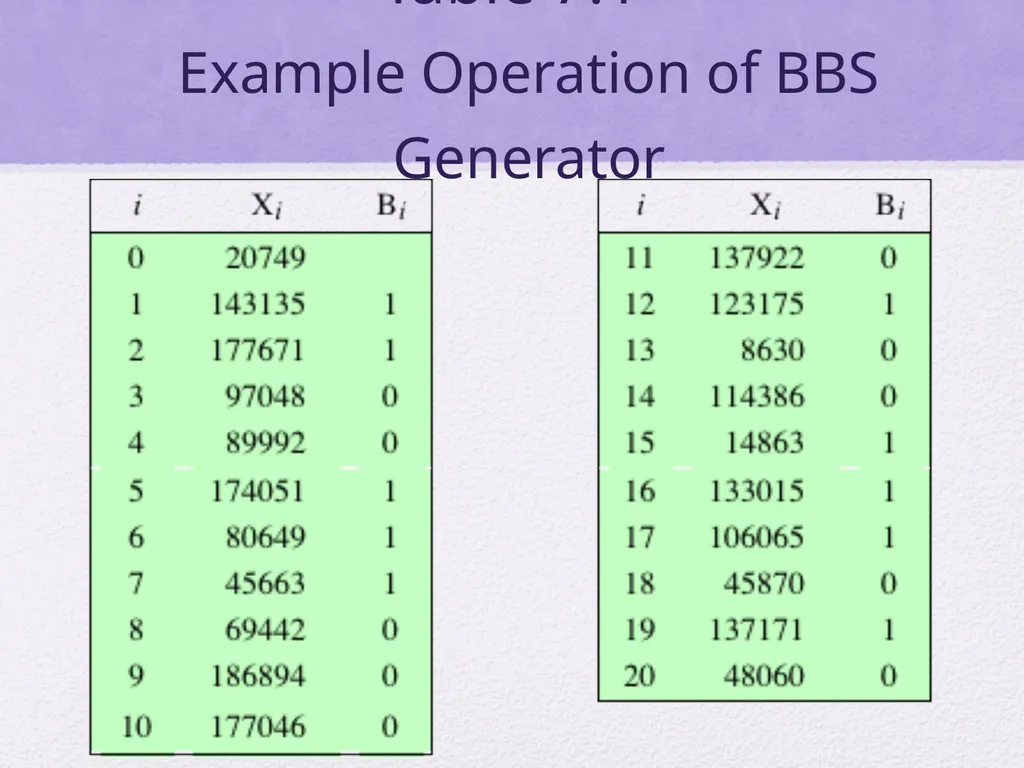
slide21. Table 7.1 Example Operation of BBS Generator<br>
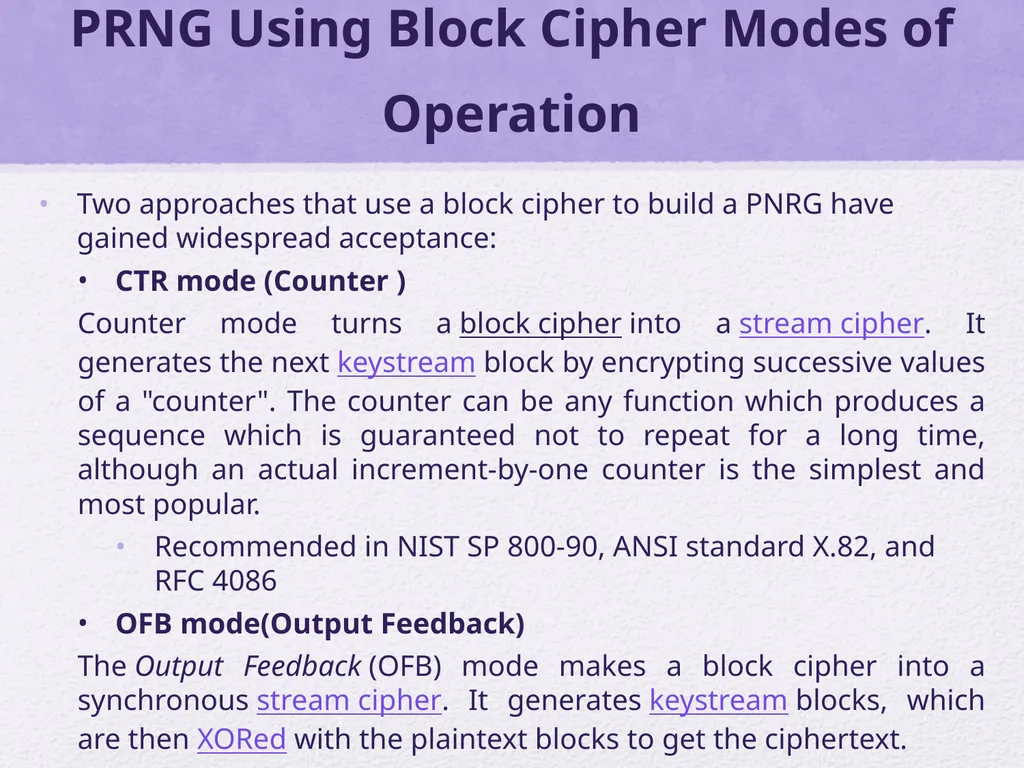
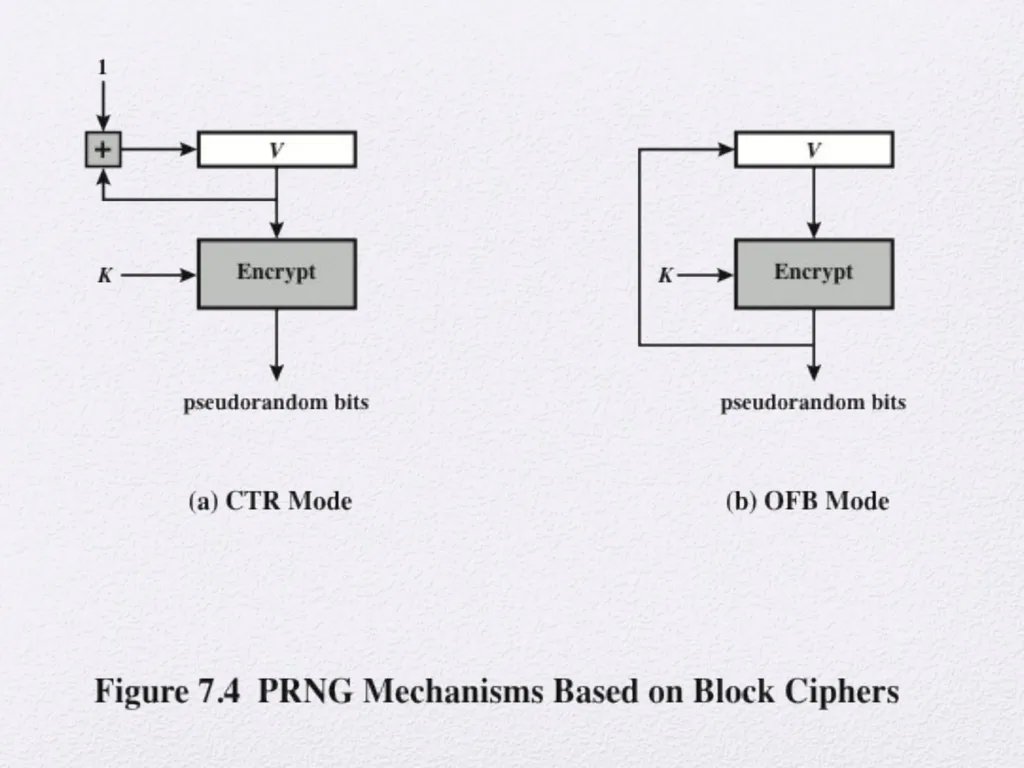
slide22. PRNG Using Block Cipher Modes of Operation Two approaches that use a block cipher to build a PNRG have gained widespread acceptance:
CTR mode (Counter )
Counter mode turns a block cipher into a stream cipher. It generates the next keystream block by encrypting successive values of a "counter". The counter can be any function which produces a sequence which is guaranteed not to repeat for a long time, although an actual increment-by-one counter is the simplest and most popular.
Recommended in NIST SP 800-90, ANSI standard X.82, and RFC 4086
OFB mode(Output Feedback)
The Output Feedback (OFB) mode makes a block cipher into a synchronous stream cipher. It generates keystream blocks, which are then XORed with the plaintext blocks to get the ciphertext.
Recommended in X9.82 and RFC 4086<br>
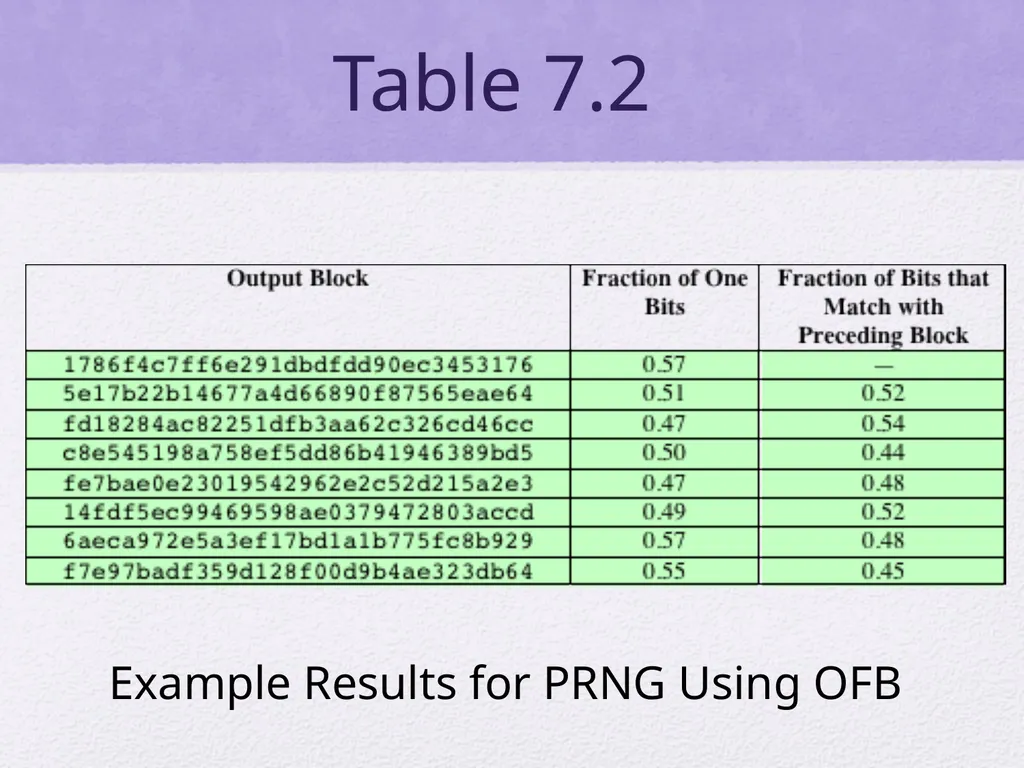
slide24. Table 7.2 Example Results for PRNG Using OFB<br>
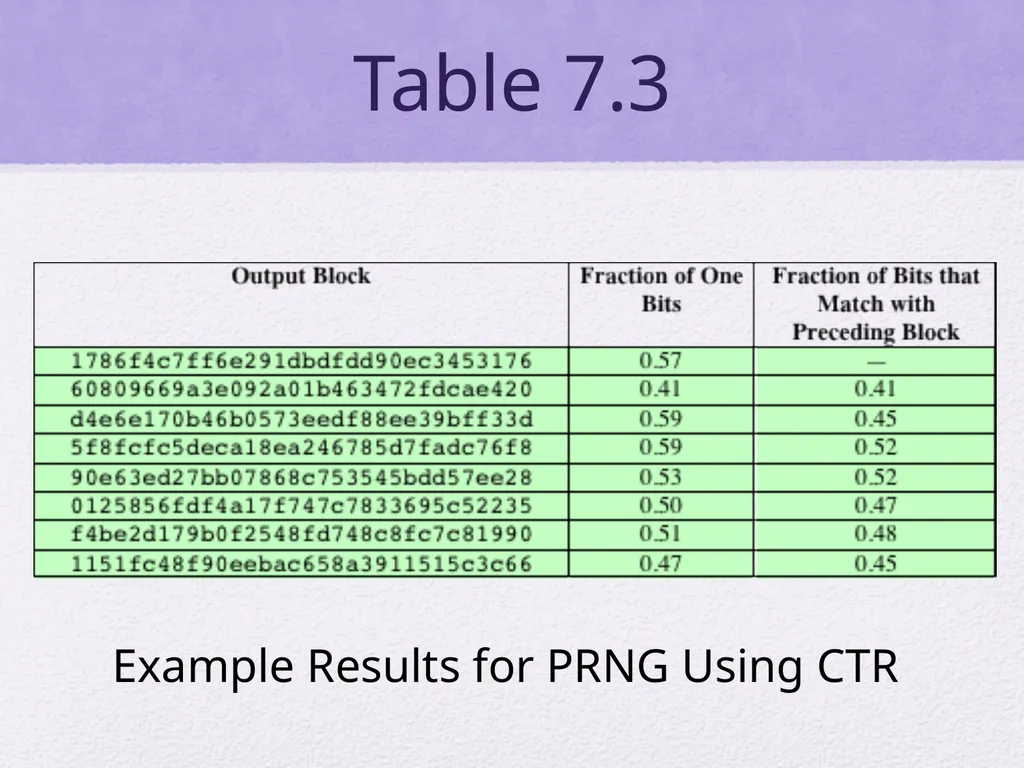
slide25. Table 7.3 Example Results for PRNG Using CTR<br>
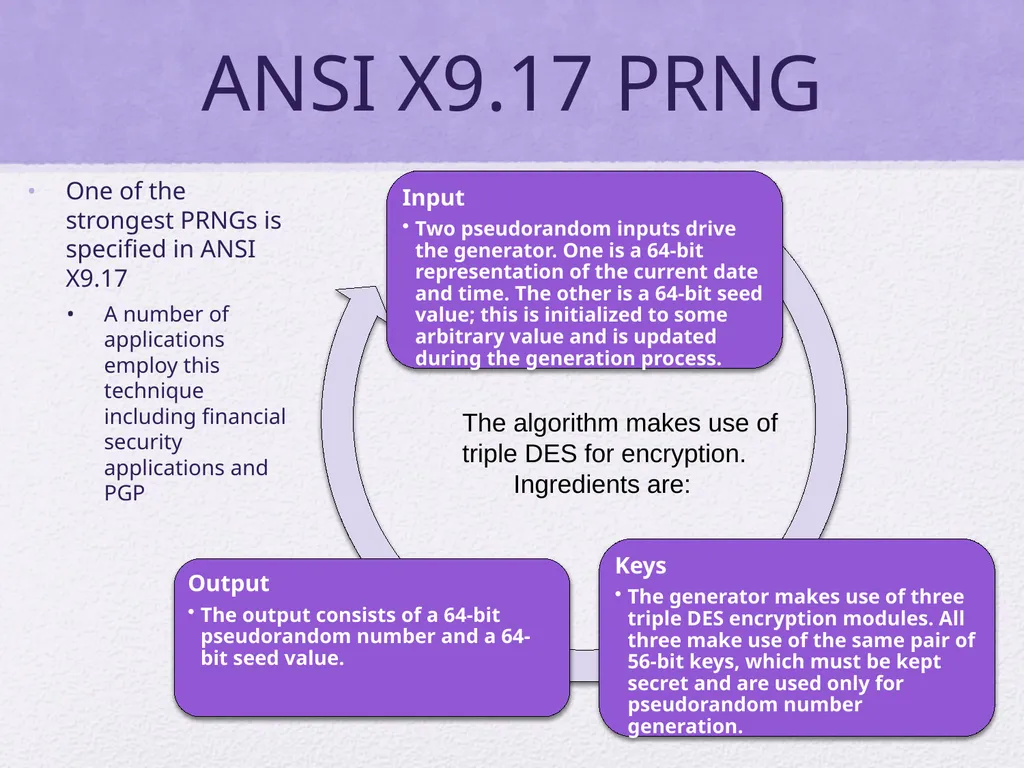
slide26. ANSI X9.17 PRNG One of the strongest PRNGs is specified in ANSI X9.17
A number of applications employ this technique including financial security applications and PGP The algorithm makes use of triple DES for encryption.
Ingredients are:<br>
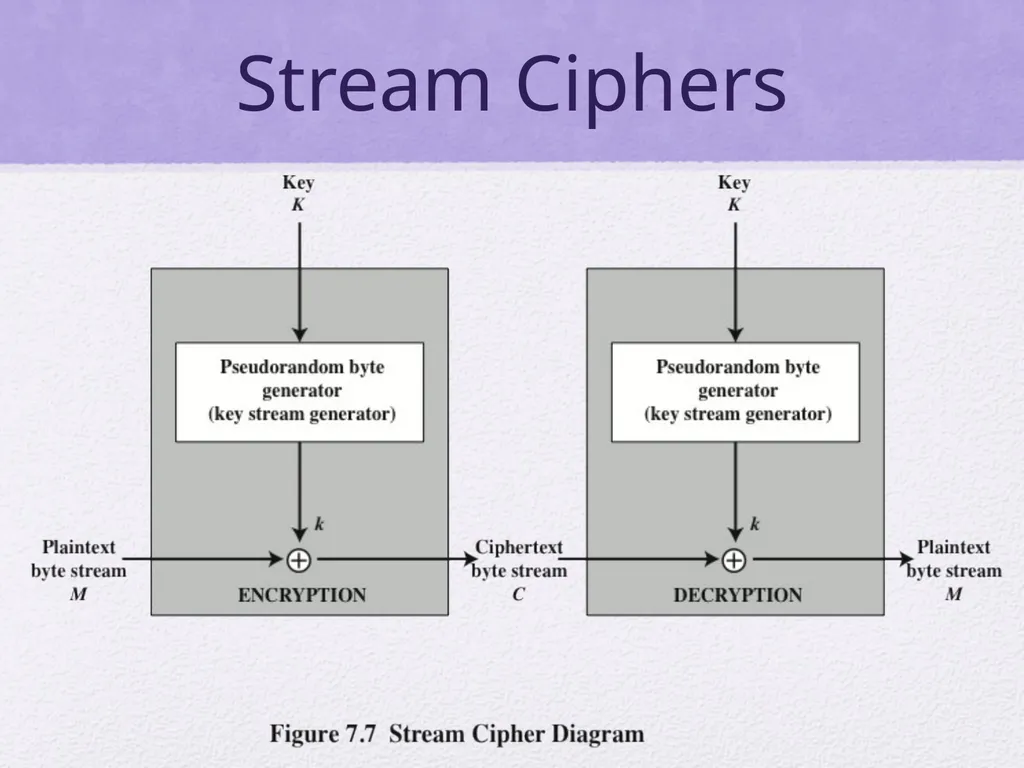
slide27. Stream Ciphers<br>
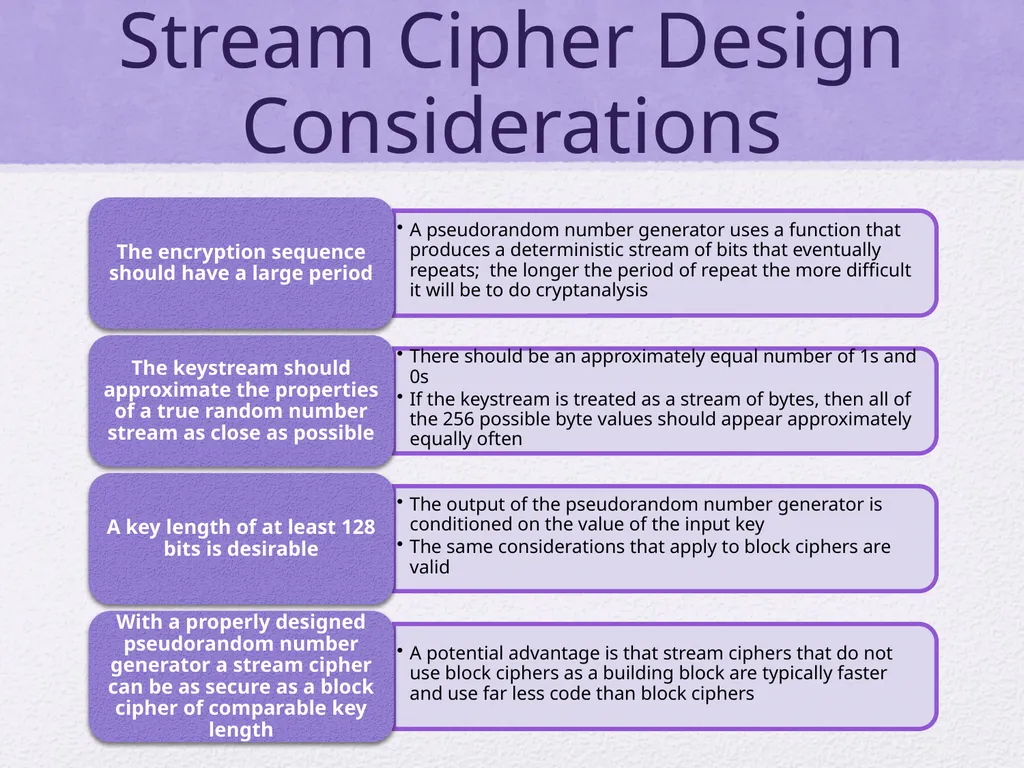
slide28. Stream Cipher Design Considerations<br>
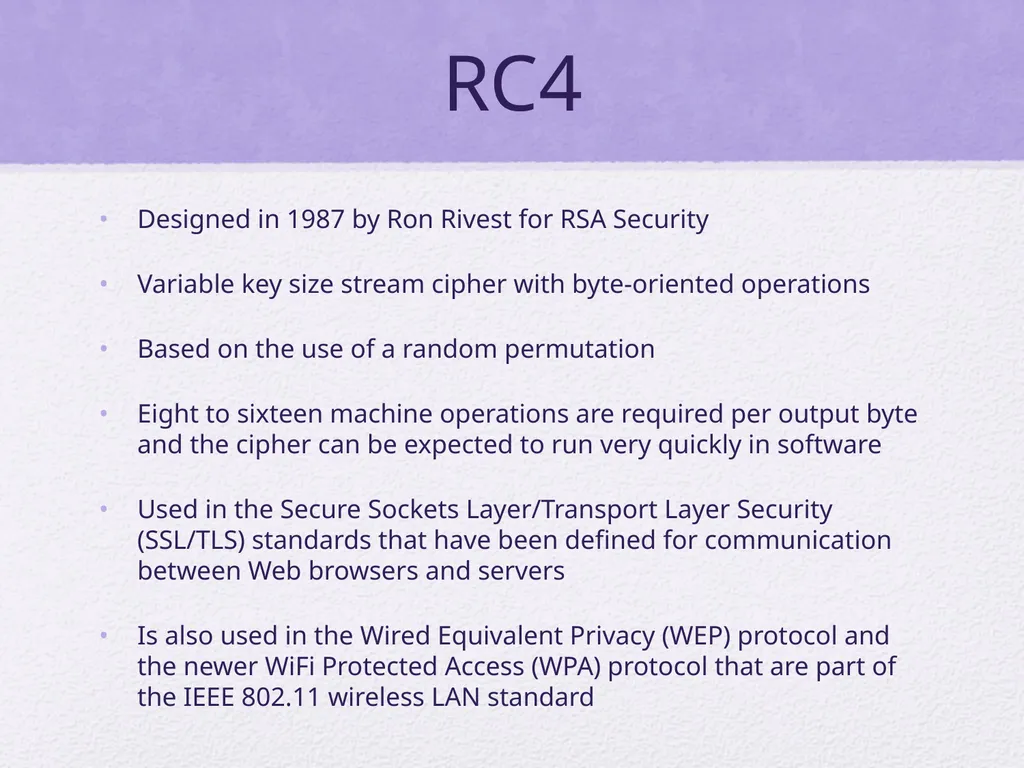
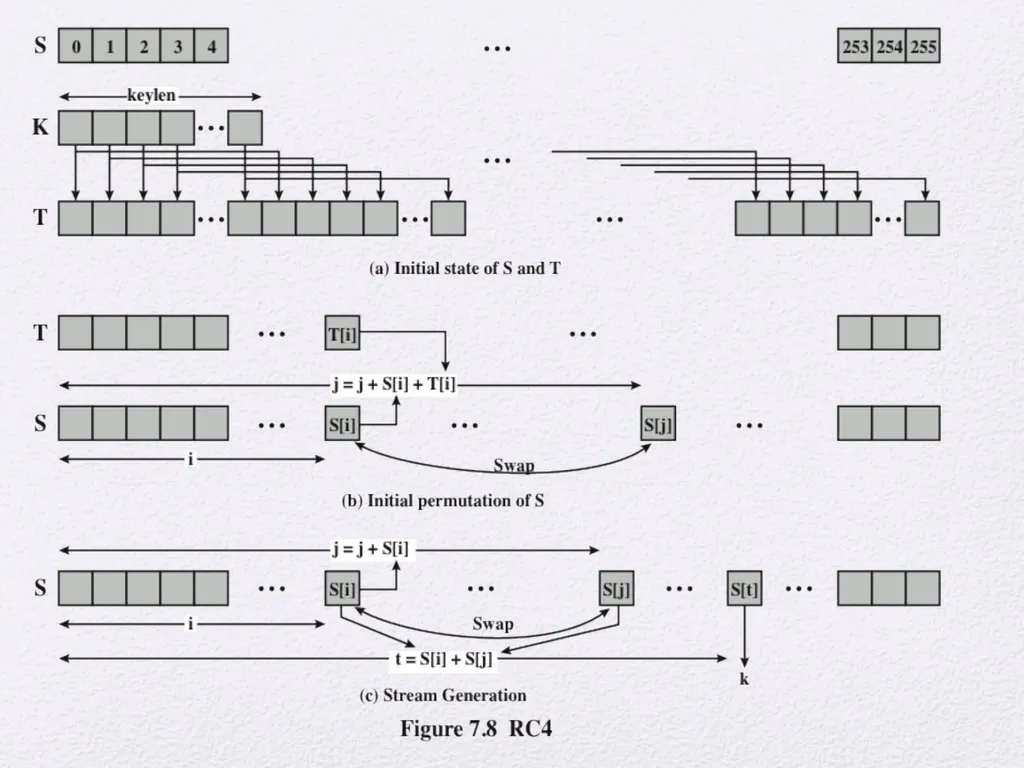
slide29. RC4 Designed in 1987 by Ron Rivest for RSA Security
Variable key size stream cipher with byte-oriented operations
Based on the use of a random permutation
Eight to sixteen machine operations are required per output byte and the cipher can be expected to run very quickly in software
Used in the Secure Sockets Layer/Transport Layer Security (SSL/TLS) standards that have been defined for communication between Web browsers and servers
Is also used in the Wired Equivalent Privacy (WEP) protocol and the newer WiFi Protected Access (WPA) protocol that are part of the IEEE 802.11 wireless LAN standard<br>
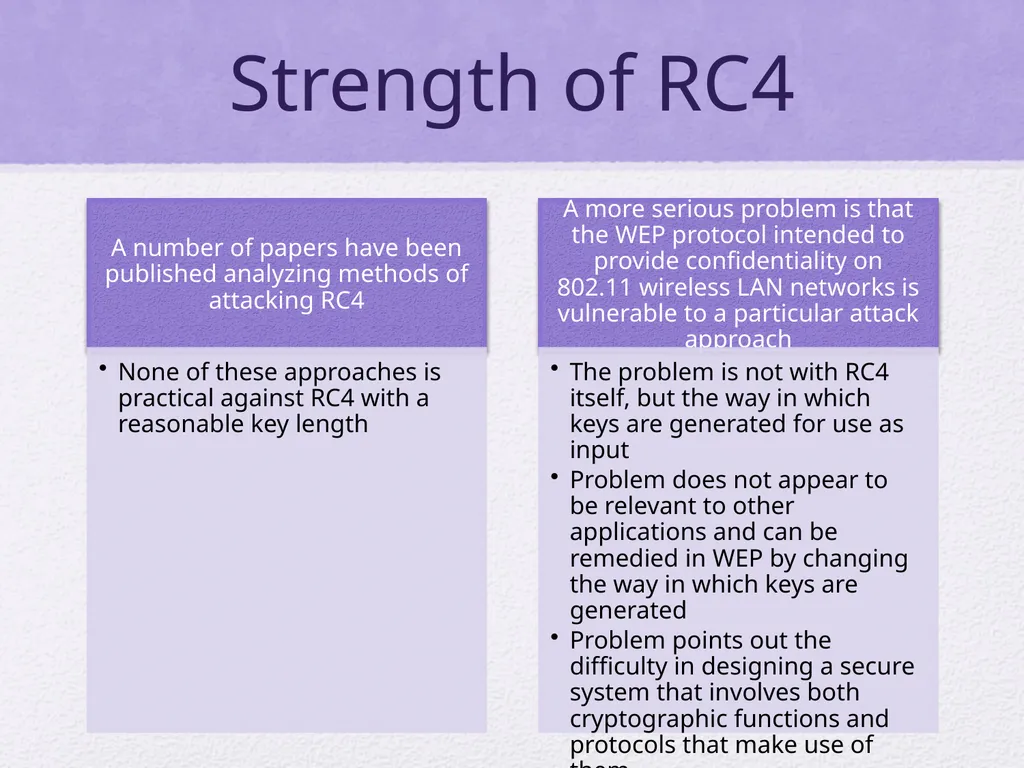
slide31. Strength of RC4<br>
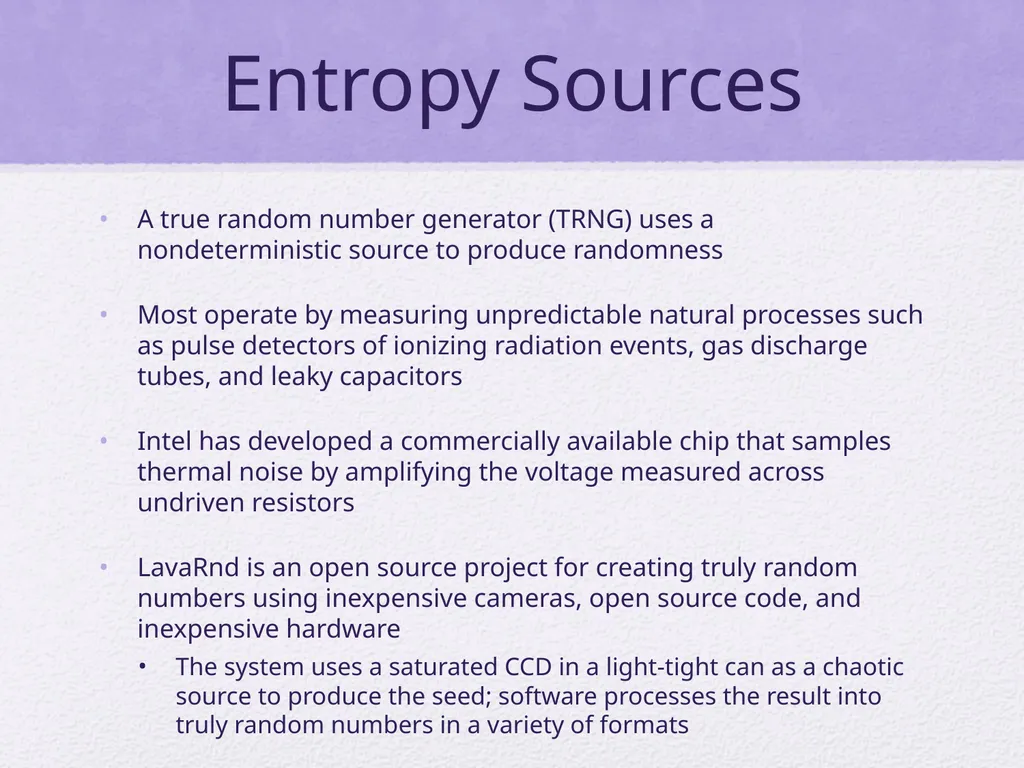
slide32. Entropy Sources A true random number generator (TRNG) uses a nondeterministic source to produce randomness
Most operate by measuring unpredictable natural processes such as pulse detectors of ionizing radiation events, gas discharge tubes, and leaky capacitors
Intel has developed a commercially available chip that samples thermal noise by amplifying the voltage measured across undriven resistors
LavaRnd is an open source project for creating truly random numbers using inexpensive cameras, open source code, and inexpensive hardware
The system uses a saturated CCD in a light-tight can as a chaotic source to produce the seed; software processes the result into truly random numbers in a variety of formats<br>
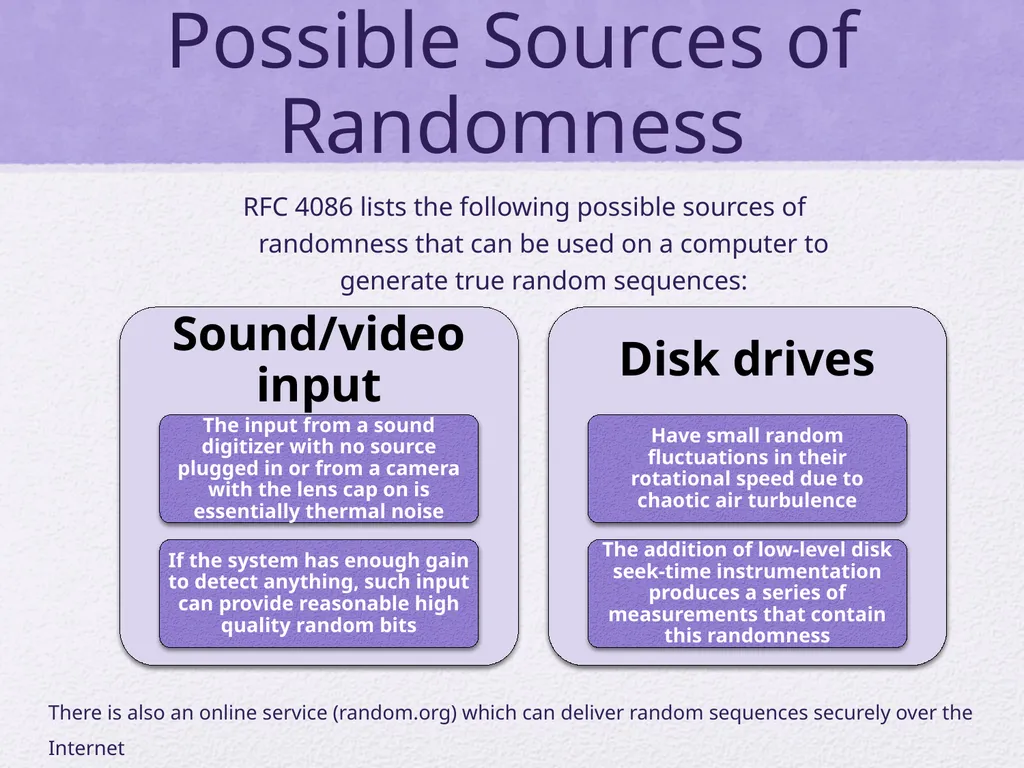
slide33. Possible Sources of Randomness RFC 4086 lists the following possible sources of randomness that can be used on a computer to generate true random sequences: There is also an online service (random.org) which can deliver random sequences securely over the Internet<br>
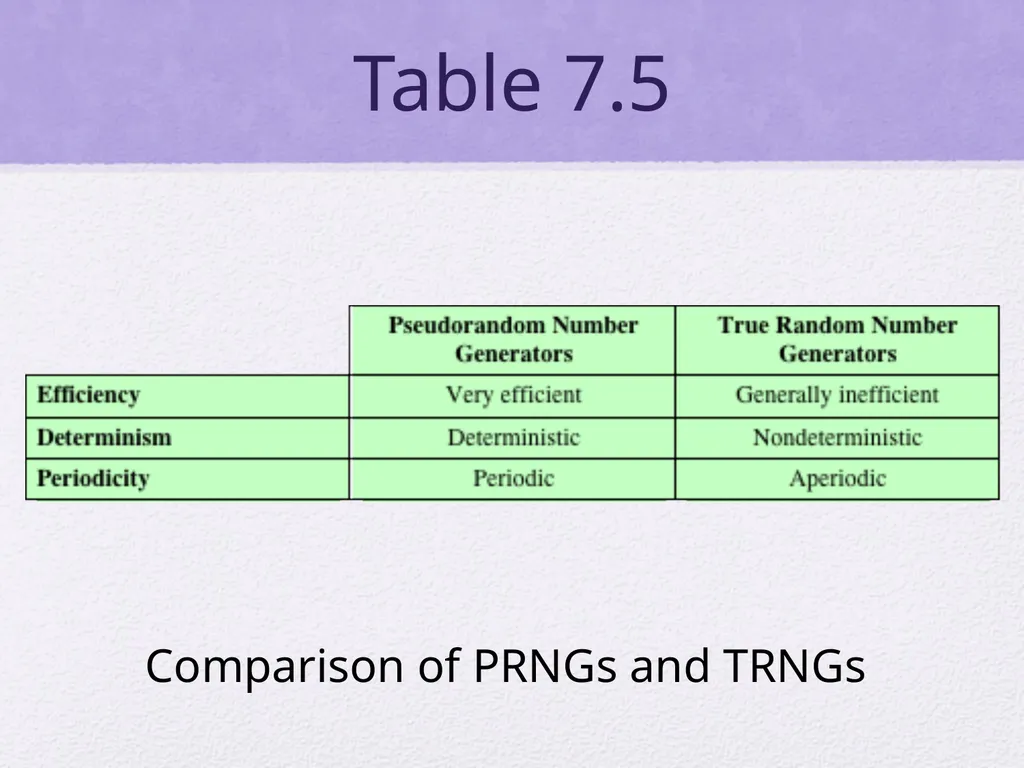
slide34. Table 7.5 Comparison of PRNGs and TRNGs<br>
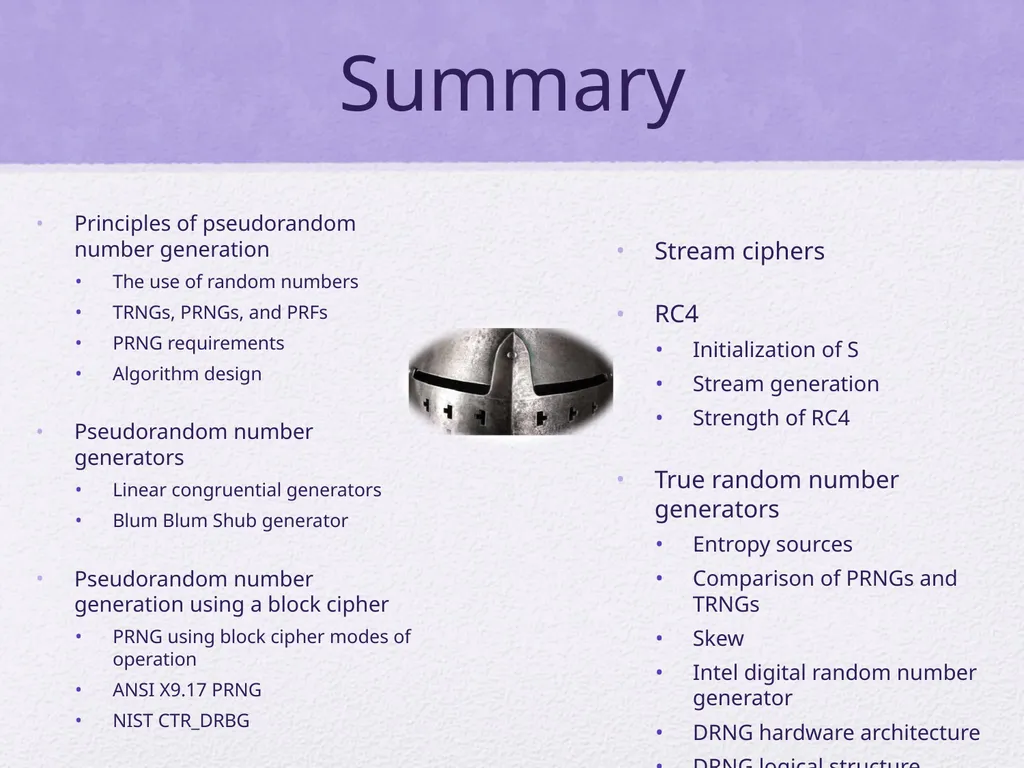
slide35. Summary Principles of pseudorandom number generation
The use of random numbers
TRNGs, PRNGs, and PRFs
PRNG requirements
Algorithm design
Pseudorandom number generators
Linear congruential generators
Blum Blum Shub generator
Pseudorandom number generation using a block cipher
PRNG using block cipher modes of operation
ANSI X9.17 PRNG
NIST CTR_DRBG Stream ciphers
RC4
Initialization of S
Stream generation
Strength of RC4
True random number generators
Entropy sources
Comparison of PRNGs and TRNGs
Skew
Intel digital random number generator
DRNG hardware architecture
DRNG logical structure<br>
by William Stallings<br>
slide2. Chapter 7 Pseudorandom Number Generation and Stream Ciphers<br>
slide3. “The comparatively late rise of the theory of probability shows how hard it is to grasp, and the many paradoxes show clearly that we, as humans, lack a well grounded intuition in this matter.”
“In probability theory there is a great deal of art in setting up the model, in solving the problem, and in applying the results back to the real world actions that will follow.”
— The Art of Probability,
Richard Hamming<br>
slide4. Random Numbers A number of network security algorithms and protocols based on cryptography make use of random binary numbers:
Key distribution and reciprocal authentication schemes
Session key generation
Generation of keys for the RSA public-key encryption algorithm
Generation of a bit stream for symmetric stream encryption<br>
slide5. Randomness The generation of a sequence of allegedly random numbers being random in some well-defined statistical sense has been a concern<br>
slide6. Unpredictability The requirement is not just that the sequence of numbers be statistically random, but that the successive members of the sequence are unpredictable
With “true” random sequences each number is statistically independent of other numbers in the sequence and therefore unpredictable
True random numbers have their limitations, such as inefficiency, so it is more common to implement algorithms that generate sequences of numbers that appear to be random
Care must be taken that an opponent not be able to predict future elements of the sequence on the basis of earlier elements<br>
slide7. Pseudorandom Numbers Cryptographic applications typically make use of algorithmic techniques for random number generation
These algorithms are deterministic and therefore produce sequences of numbers that are not statistically random
If the algorithm is good, the resulting sequences will pass many tests of randomness and are referred to as pseudorandom numbers<br>
slide8. True Random Number Generator (TRNG) Takes as input a source that is effectively random
The source is referred to as an entropy source and is drawn from the physical environment of the computer
Includes things such as keystroke timing patterns, disk electrical activity, mouse movements, and instantaneous values of the system clock
The source, or combination of sources, serve as input to an algorithm that produces random binary output
The TRNG may simply involve conversion of an analog source to a binary output
The TRNG may involve additional processing to overcome any bias in the source<br>
slide9. Pseudorandom Number Generator (PRNG) Takes as input a fixed value, called the seed, and produces a sequence of output bits using a deterministic algorithm
Quite often the seed is generated by a TRNG
The output bit stream is determined solely by the input value or values, so an adversary who knows the algorithm and the seed can reproduce the entire bit stream
Other than the number of bits produced there is no difference between a PRNG and a PRF Two different forms of PRNG<br>
slide11. PRNG Requirements The basic requirement when a PRNG or PRF is used for a cryptographic application is that an adversary who does not know the seed is unable to determine the pseudorandom string
The requirement for secrecy of the output of a PRNG or PRF leads to specific requirements in the areas of:
Randomness
Unpredictability
Characteristics of the seed<br>
slide12. Randomness The generated bit stream needs to appear random even though it is deterministic
There is no single test that can determine if a PRNG generates numbers that have the characteristic of randomness
If the PRNG exhibits randomness on the basis of multiple tests, then it can be assumed to satisfy the randomness requirement
NIST SP 800-22 specifies that the tests should seek to establish three characteristics:
Uniformity
Scalability
Consistency<br>
slide13. Randomness Tests SP 800-22 lists 15 separate tests of randomness<br>
slide14. Unpredictability A stream of pseudorandom numbers should exhibit two forms of unpredictability:
Forward unpredictability
If the seed is unknown, the next output bit in the sequence should be unpredictable in spite of any knowledge of previous bits in the sequence
Backward unpredictability
It should not be feasible to determine the seed from knowledge of any generated values. No correlation between a seed and any value generated from that seed should be evident; each element of the sequence should appear to be the outcome of an independent random event whose probability is 1/2
The same set of tests for randomness also provides a test of unpredictability
A random sequence will have no correlation with a fixed value (the seed)<br>
slide15. Seed Requirements The seed that serves as input to the PRNG must be secure and unpredictable
The seed itself must be a random or pseudorandom number
Typically the seed is generated by TRNG<br>
slide16. Generation of Seed Input to PRNG<br>
slide17. Algorithm Design Algorithms fall into two categories:
Purpose-built algorithms
Algorithms designed specifically and solely for the purpose of generating pseudorandom bit streams
Algorithms based on existing cryptographic algorithms
Have the effect of randomizing input data<br>
slide18. Linear Congruential Generator An algorithm first proposed by Lehmer that is parameterized with four numbers:
m the modulus m > 0
a the multiplier 0 < a< m
c the increment 0≤ c < m
X0 the starting value, or seed 0 ≤ X0 < m
The sequence of random numbers {Xn} is obtained via the following iterative equation:
Xn+1 = (aXn + c) mod m
If m , a , c , and X0 are integers, then this technique will produce a sequence of integers with each integer in the range 0 ≤ Xn < m
The selection of values for a , c , and m is critical in developing a good random number generator<br>
slide19. Blum Blum Shub (BBS) Generator Has perhaps the strongest public proof of its cryptographic strength of any purpose-built algorithm
Referred to as a cryptographically secure pseudorandom bit generator (CSPRBG)
A CSPRBG is defined as one that passes the next-bit-test if there is not a polynomial-time algorithm that, on input of the first k bits of an output sequence, can predict the (k + 1)st bit with probability significantly greater than 1/2
The security of BBS is based on the difficulty of factoring n<br>
slide21. Table 7.1 Example Operation of BBS Generator<br>
slide22. PRNG Using Block Cipher Modes of Operation Two approaches that use a block cipher to build a PNRG have gained widespread acceptance:
CTR mode (Counter )
Counter mode turns a block cipher into a stream cipher. It generates the next keystream block by encrypting successive values of a "counter". The counter can be any function which produces a sequence which is guaranteed not to repeat for a long time, although an actual increment-by-one counter is the simplest and most popular.
Recommended in NIST SP 800-90, ANSI standard X.82, and RFC 4086
OFB mode(Output Feedback)
The Output Feedback (OFB) mode makes a block cipher into a synchronous stream cipher. It generates keystream blocks, which are then XORed with the plaintext blocks to get the ciphertext.
Recommended in X9.82 and RFC 4086<br>
slide24. Table 7.2 Example Results for PRNG Using OFB<br>
slide25. Table 7.3 Example Results for PRNG Using CTR<br>
slide26. ANSI X9.17 PRNG One of the strongest PRNGs is specified in ANSI X9.17
A number of applications employ this technique including financial security applications and PGP The algorithm makes use of triple DES for encryption.
Ingredients are:<br>
slide27. Stream Ciphers<br>
slide28. Stream Cipher Design Considerations<br>
slide29. RC4 Designed in 1987 by Ron Rivest for RSA Security
Variable key size stream cipher with byte-oriented operations
Based on the use of a random permutation
Eight to sixteen machine operations are required per output byte and the cipher can be expected to run very quickly in software
Used in the Secure Sockets Layer/Transport Layer Security (SSL/TLS) standards that have been defined for communication between Web browsers and servers
Is also used in the Wired Equivalent Privacy (WEP) protocol and the newer WiFi Protected Access (WPA) protocol that are part of the IEEE 802.11 wireless LAN standard<br>
slide31. Strength of RC4<br>
slide32. Entropy Sources A true random number generator (TRNG) uses a nondeterministic source to produce randomness
Most operate by measuring unpredictable natural processes such as pulse detectors of ionizing radiation events, gas discharge tubes, and leaky capacitors
Intel has developed a commercially available chip that samples thermal noise by amplifying the voltage measured across undriven resistors
LavaRnd is an open source project for creating truly random numbers using inexpensive cameras, open source code, and inexpensive hardware
The system uses a saturated CCD in a light-tight can as a chaotic source to produce the seed; software processes the result into truly random numbers in a variety of formats<br>
slide33. Possible Sources of Randomness RFC 4086 lists the following possible sources of randomness that can be used on a computer to generate true random sequences: There is also an online service (random.org) which can deliver random sequences securely over the Internet<br>
slide34. Table 7.5 Comparison of PRNGs and TRNGs<br>
slide35. Summary Principles of pseudorandom number generation
The use of random numbers
TRNGs, PRNGs, and PRFs
PRNG requirements
Algorithm design
Pseudorandom number generators
Linear congruential generators
Blum Blum Shub generator
Pseudorandom number generation using a block cipher
PRNG using block cipher modes of operation
ANSI X9.17 PRNG
NIST CTR_DRBG Stream ciphers
RC4
Initialization of S
Stream generation
Strength of RC4
True random number generators
Entropy sources
Comparison of PRNGs and TRNGs
Skew
Intel digital random number generator
DRNG hardware architecture
DRNG logical structure<br>