
CS 886 Deep Learning for Biotechnology Ming Li
A
Published · 43 slides · 0 views

1 / 1
Description
CS 886 Deep Learning for Biotechnology Ming Li Jan. 21, 2022 CONTENT 05. Student presentations begin 03 LECTURE THREE Pretraining: GPT-2 and BERT Avoiding Information bottleneck 03 GPT-2, BERT Last time we introduced transformer 03 GPT-2,
Related Topics
Share
Embed code
Download this presentation From Below
"CS 886 Deep Learning for Biotechnology Ming Li" is the property of its rightful owner. Permission is granted to download and print the materials on this website for personal, non-commercial use only, and to display it on your personal computer provided you do not modify the materials and that you retain all copyright notices contained in the materials. By downloading content from our website, you accept the terms of this agreement.
Presentation Transcript
01
CS 886 Deep Learning for Biotechnology Ming Li Jan. 21, 2022<br>
02
CONTENT 05. Student presentations begin<br>
03
03 LECTURE THREE Pretraining: GPT-2 and BERT<br>
04
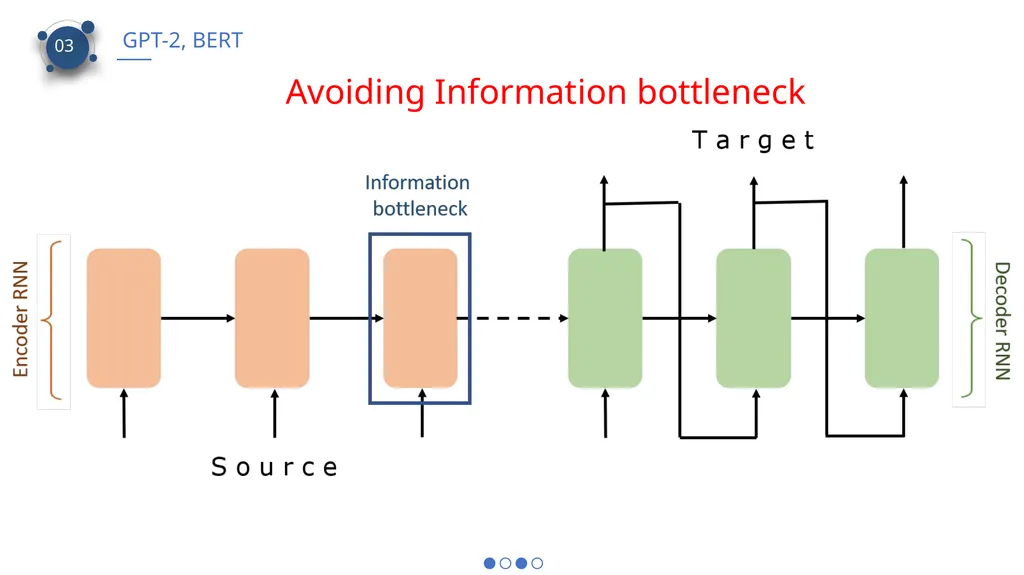
Avoiding Information bottleneck 03 GPT-2, BERT<br>
05
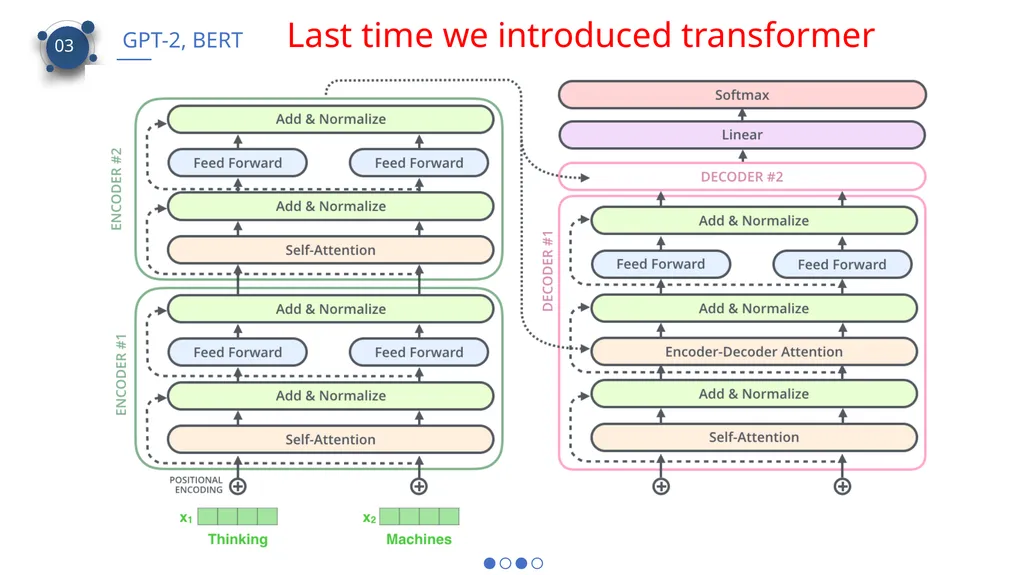
Last time we introduced transformer 03 GPT-2, BERT<br>
06
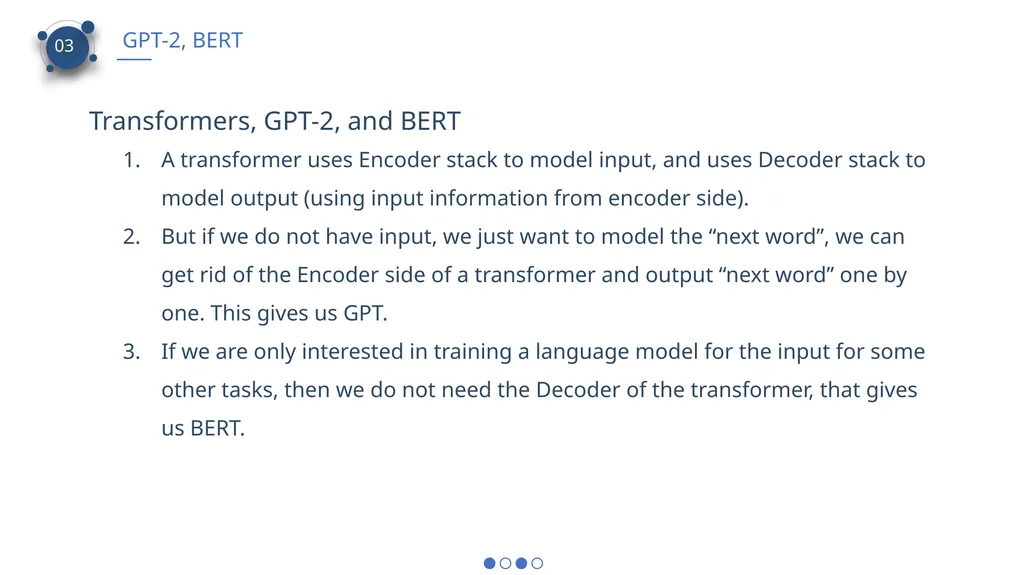
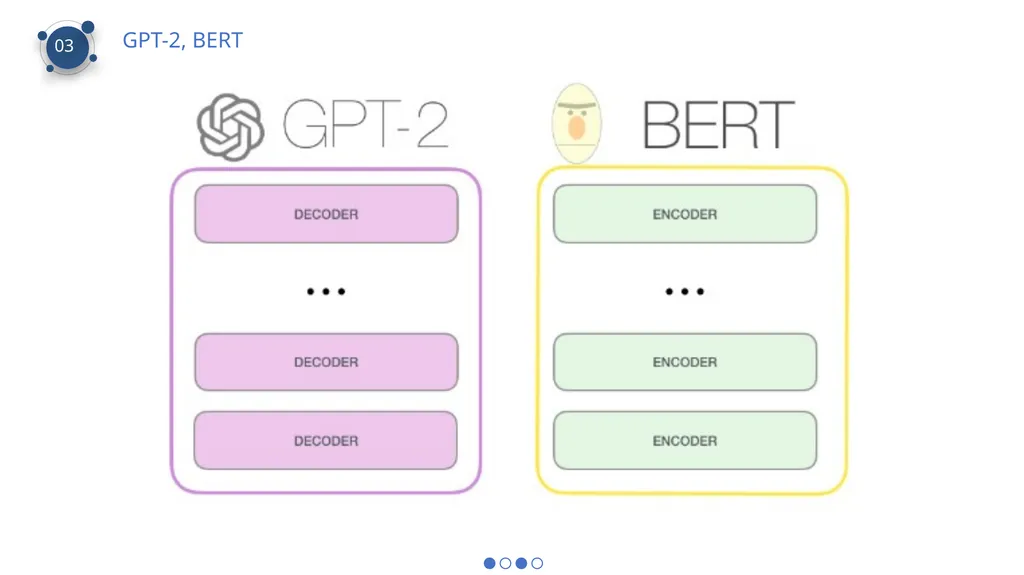
Transformers, GPT-2, and BERT 03 A transformer uses Encoder stack to model input, and uses Decoder stack to model output (using input information from encoder side).
But if we do not have input, we just want to model the “next word”, we can get rid of the Encoder side of a transformer and output “next word” one by one. This gives us GPT.
If we are only interested in training a language model for the input for some other tasks, then we do not need the Decoder of the transformer, that gives us BERT. GPT-2, BERT<br>
But if we do not have input, we just want to model the “next word”, we can get rid of the Encoder side of a transformer and output “next word” one by one. This gives us GPT.
If we are only interested in training a language model for the input for some other tasks, then we do not need the Decoder of the transformer, that gives us BERT. GPT-2, BERT<br>
07
GPT-2, BERT 03<br>
08
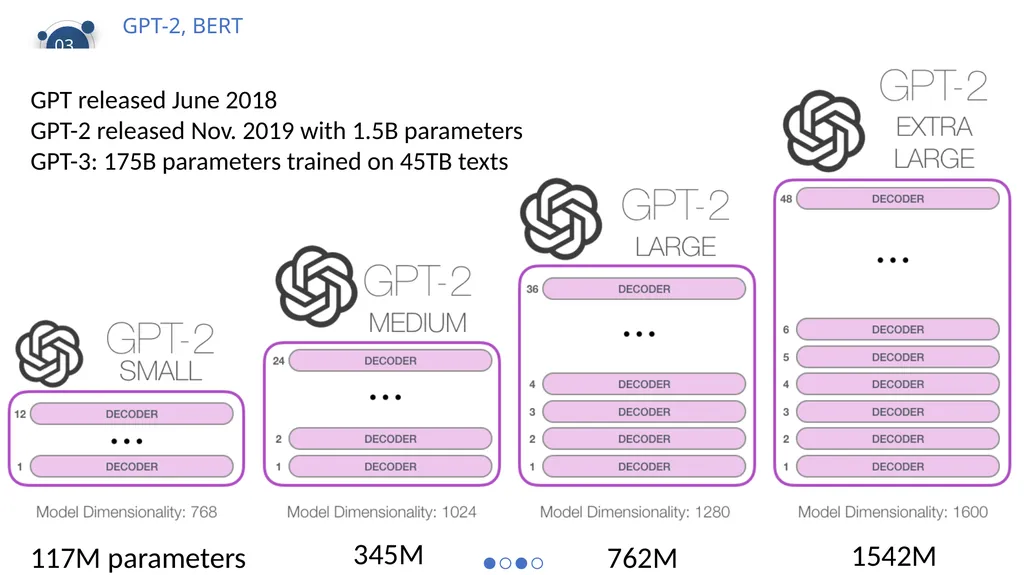
GPT-2, BERT 03 1542M 762M 345M 117M parameters GPT released June 2018
GPT-2 released Nov. 2019 with 1.5B parameters
GPT-3: 175B parameters trained on 45TB texts<br>
GPT-2 released Nov. 2019 with 1.5B parameters
GPT-3: 175B parameters trained on 45TB texts<br>
09
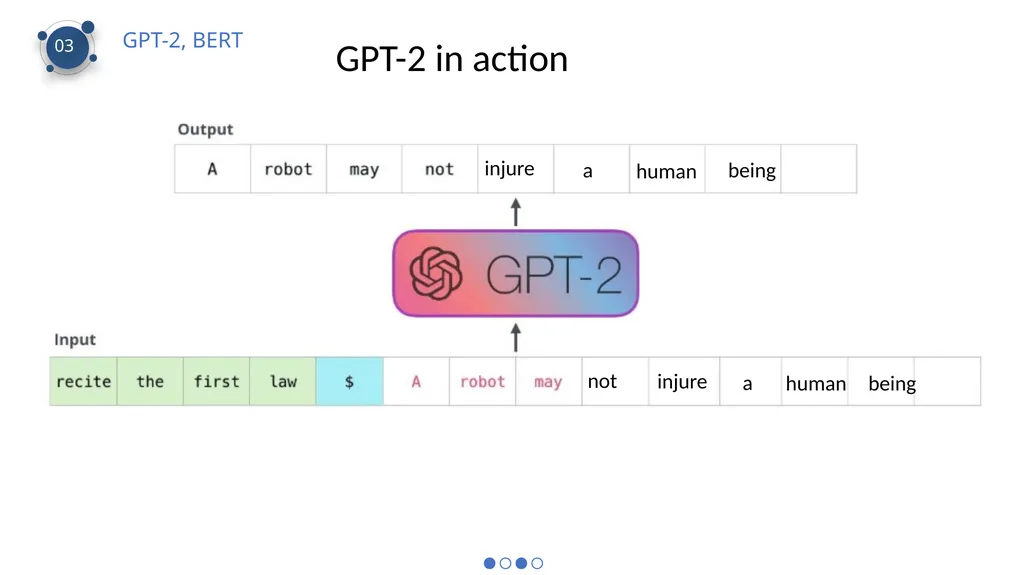
GPT-2 in action GPT-2, BERT 03 not injure injure a a human human being being<br>
10
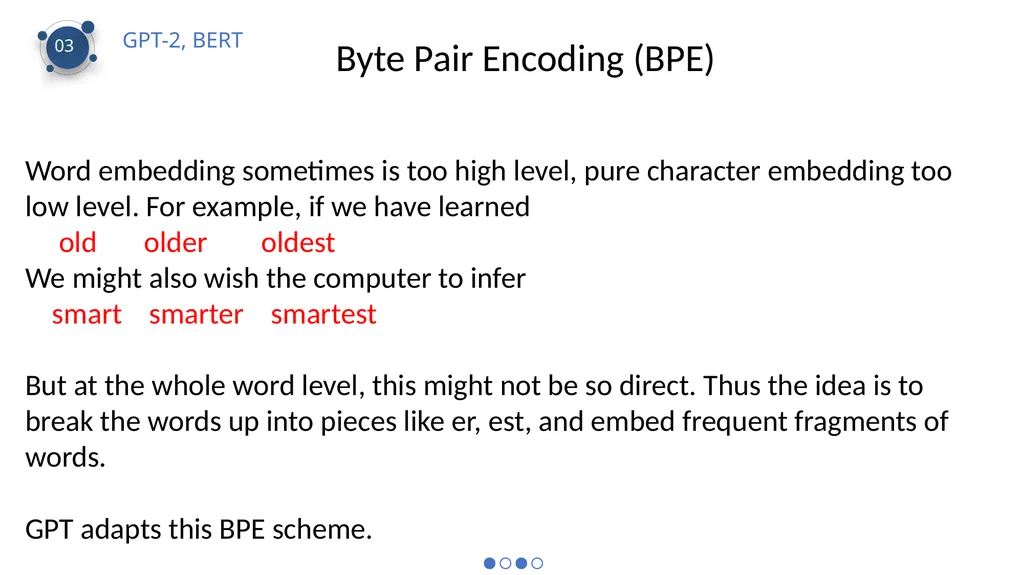
Byte Pair Encoding (BPE) GPT-2, BERT 03 Word embedding sometimes is too high level, pure character embedding too low level. For example, if we have learned
old older oldest
We might also wish the computer to infer
smart smarter smartest
But at the whole word level, this might not be so direct. Thus the idea is to break the words up into pieces like er, est, and embed frequent fragments of words.
GPT adapts this BPE scheme.<br>
old older oldest
We might also wish the computer to infer
smart smarter smartest
But at the whole word level, this might not be so direct. Thus the idea is to break the words up into pieces like er, est, and embed frequent fragments of words.
GPT adapts this BPE scheme.<br>
11
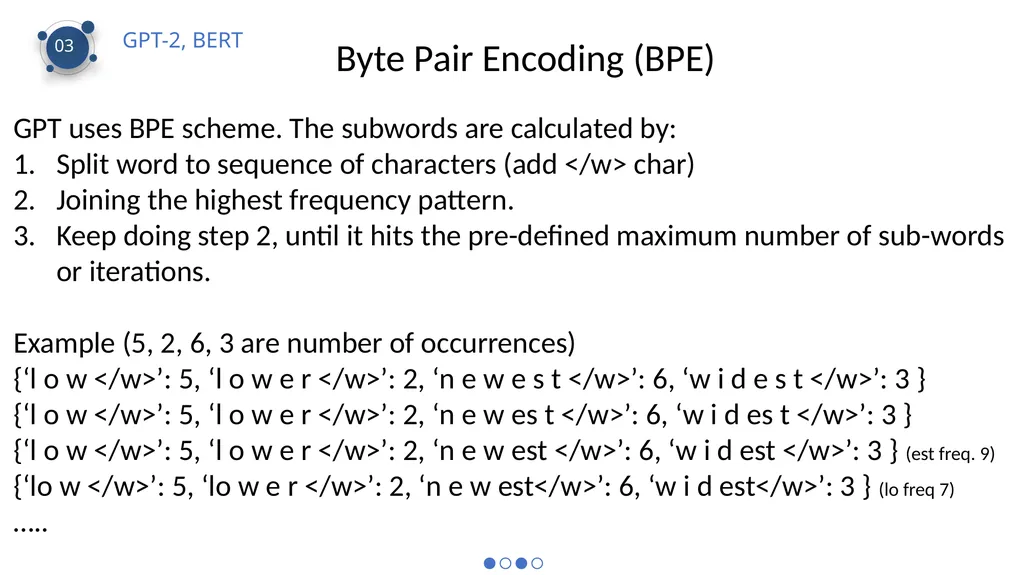
Byte Pair Encoding (BPE) GPT-2, BERT 03 GPT uses BPE scheme. The subwords are calculated by:
Split word to sequence of characters (add </w> char)
Joining the highest frequency pattern.
Keep doing step 2, until it hits the pre-defined maximum number of sub-words or iterations.
Example (5, 2, 6, 3 are number of occurrences)
{‘l o w </w>’: 5, ‘l o w e r </w>’: 2, ‘n e w e s t </w>’: 6, ‘w i d e s t </w>’: 3 }
{‘l o w </w>’: 5, ‘l o w e r </w>’: 2, ‘n e w es t </w>’: 6, ‘w i d es t </w>’: 3 }
{‘l o w </w>’: 5, ‘l o w e r </w>’: 2, ‘n e w est </w>’: 6, ‘w i d est </w>’: 3 } (est freq. 9)
{‘lo w </w>’: 5, ‘lo w e r </w>’: 2, ‘n e w est</w>’: 6, ‘w i d est</w>’: 3 } (lo freq 7)
…..<br>
Split word to sequence of characters (add </w> char)
Joining the highest frequency pattern.
Keep doing step 2, until it hits the pre-defined maximum number of sub-words or iterations.
Example (5, 2, 6, 3 are number of occurrences)
{‘l o w </w>’: 5, ‘l o w e r </w>’: 2, ‘n e w e s t </w>’: 6, ‘w i d e s t </w>’: 3 }
{‘l o w </w>’: 5, ‘l o w e r </w>’: 2, ‘n e w es t </w>’: 6, ‘w i d es t </w>’: 3 }
{‘l o w </w>’: 5, ‘l o w e r </w>’: 2, ‘n e w est </w>’: 6, ‘w i d est </w>’: 3 } (est freq. 9)
{‘lo w </w>’: 5, ‘lo w e r </w>’: 2, ‘n e w est</w>’: 6, ‘w i d est</w>’: 3 } (lo freq 7)
…..<br>
12
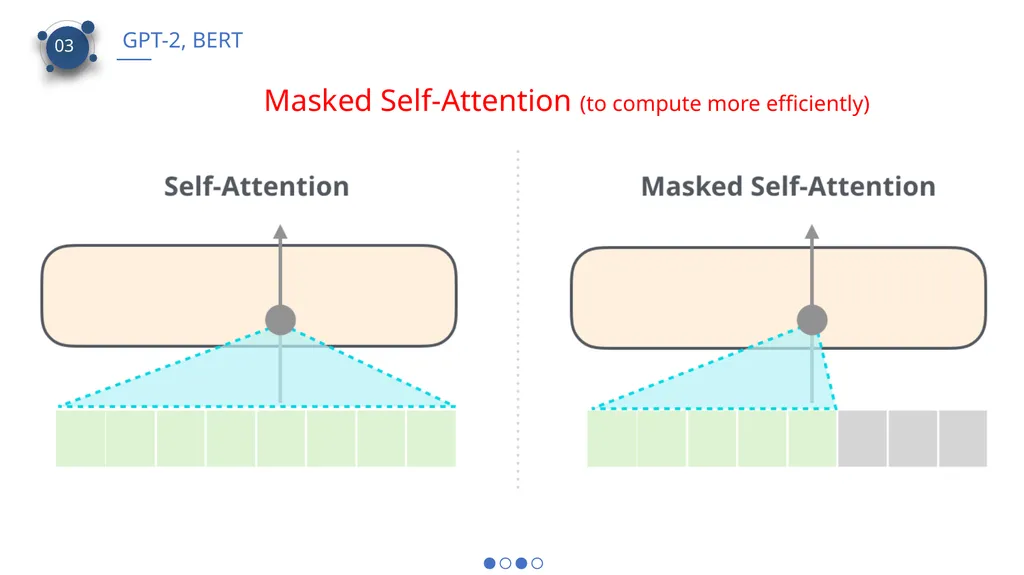
Masked Self-Attention (to compute more efficiently) 03 GPT-2, BERT<br>
13
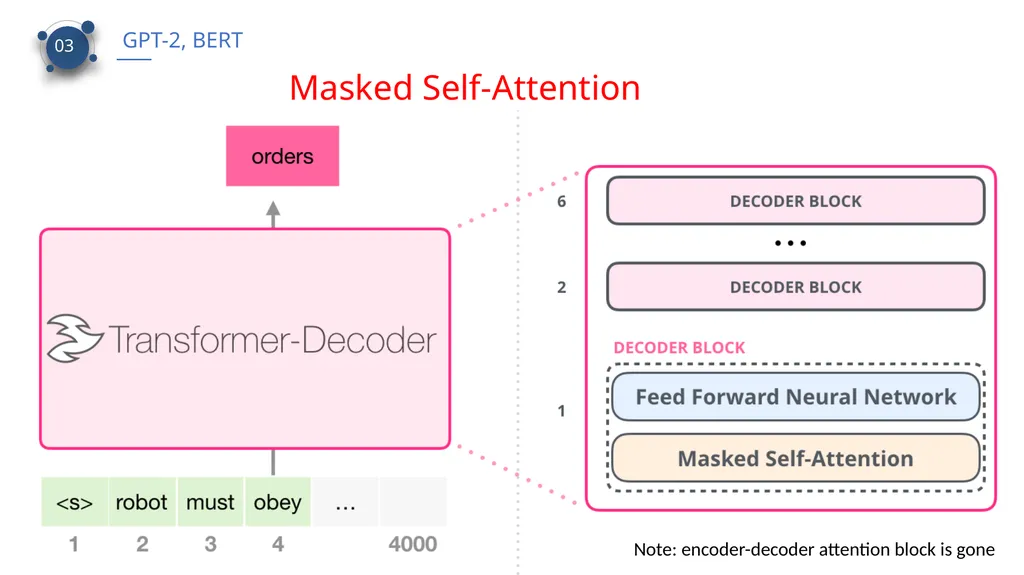
Masked Self-Attention 03 GPT-2, BERT Note: encoder-decoder attention block is gone<br>
14
Masked Self-Attention Calculation 03 GPT-2, BERT Note: encoder-decoder attention block is gone Re-use previous computation results: at any step, only need to results of q, k , v related to the new output word, no need to re-compute the others. Additional computation is linear, instead of quadratic.<br>
15
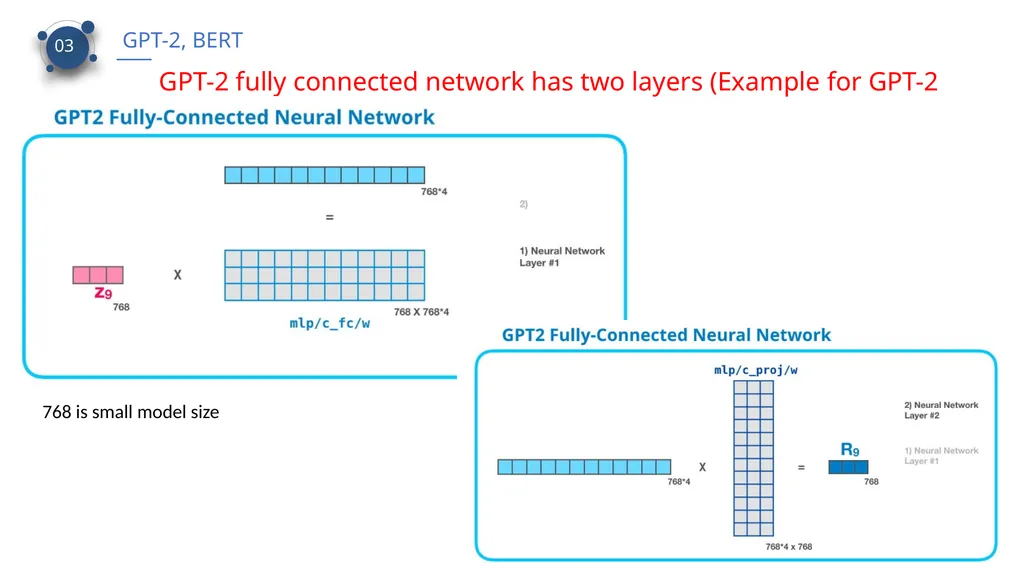
GPT-2 fully connected network has two layers (Example for GPT-2 small) 03 GPT-2, BERT 768 is small model size<br>
16
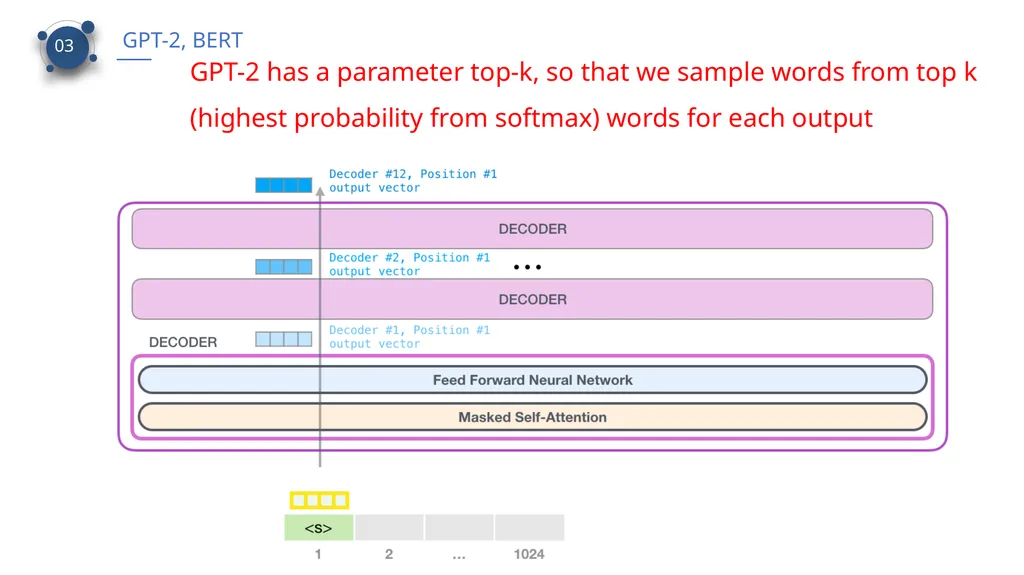
GPT-2 has a parameter top-k, so that we sample words from top k (highest probability from softmax) words for each output 03 GPT-2, BERT<br>
17
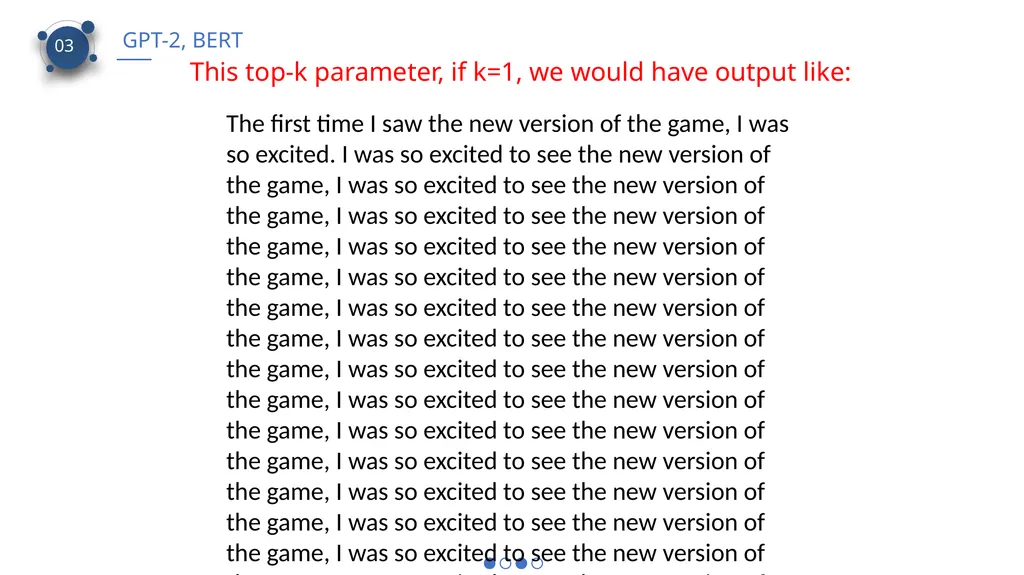
This top-k parameter, if k=1, we would have output like: 03 GPT-2, BERT The first time I saw the new version of the game, I was so excited. I was so excited to see the new version of the game, I was so excited to see the new version of the game, I was so excited to see the new version of the game, I was so excited to see the new version of the game, I was so excited to see the new version of the game, I was so excited to see the new version of the game, I was so excited to see the new version of the game, I was so excited to see the new version of the game, I was so excited to see the new version of the game, I was so excited to see the new version of the game, I was so excited to see the new version of the game, I was so excited to see the new version of the game, I was so excited to see the new version of the game, I was so excited to see the new version of the game, I was so excited to see the new version of the game, I was so excited to see the new version of the game,<br>
18
GPT Training 03 GPT-2, BERT GPT-2 uses unsupervised learning approach to training the language model.
There is no custom training for GPT-2, no separation of pre-training and fine-tuning like BERT.<br>
There is no custom training for GPT-2, no separation of pre-training and fine-tuning like BERT.<br>
19
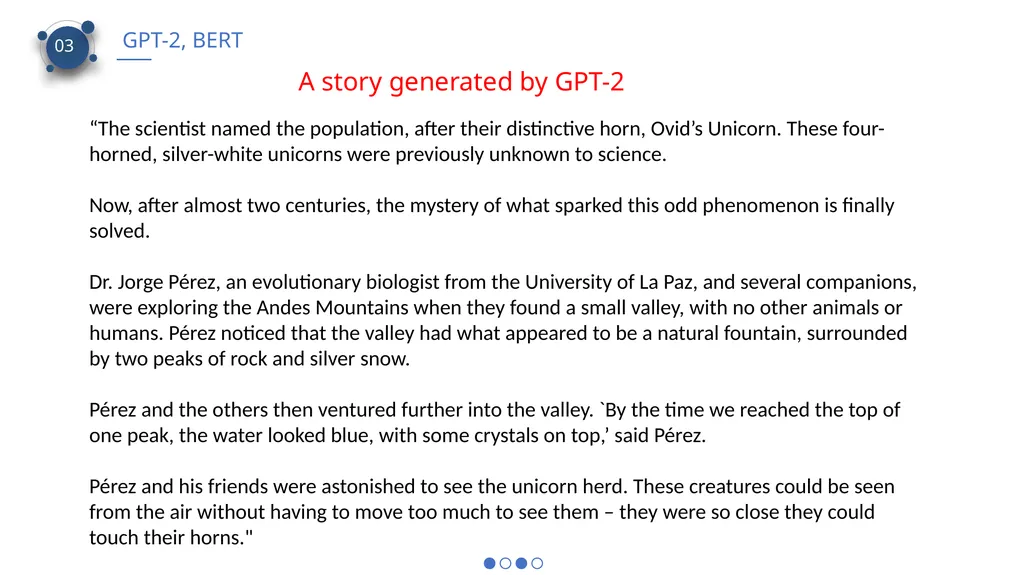
A story generated by GPT-2 03 GPT-2, BERT “The scientist named the population, after their distinctive horn, Ovid’s Unicorn. These four-horned, silver-white unicorns were previously unknown to science.
Now, after almost two centuries, the mystery of what sparked this odd phenomenon is finally solved.
Dr. Jorge Pérez, an evolutionary biologist from the University of La Paz, and several companions, were exploring the Andes Mountains when they found a small valley, with no other animals or humans. Pérez noticed that the valley had what appeared to be a natural fountain, surrounded by two peaks of rock and silver snow.
Pérez and the others then ventured further into the valley. `By the time we reached the top of one peak, the water looked blue, with some crystals on top,’ said Pérez.
Pérez and his friends were astonished to see the unicorn herd. These creatures could be seen from the air without having to move too much to see them – they were so close they could touch their horns."<br>
Now, after almost two centuries, the mystery of what sparked this odd phenomenon is finally solved.
Dr. Jorge Pérez, an evolutionary biologist from the University of La Paz, and several companions, were exploring the Andes Mountains when they found a small valley, with no other animals or humans. Pérez noticed that the valley had what appeared to be a natural fountain, surrounded by two peaks of rock and silver snow.
Pérez and the others then ventured further into the valley. `By the time we reached the top of one peak, the water looked blue, with some crystals on top,’ said Pérez.
Pérez and his friends were astonished to see the unicorn herd. These creatures could be seen from the air without having to move too much to see them – they were so close they could touch their horns."<br>
20
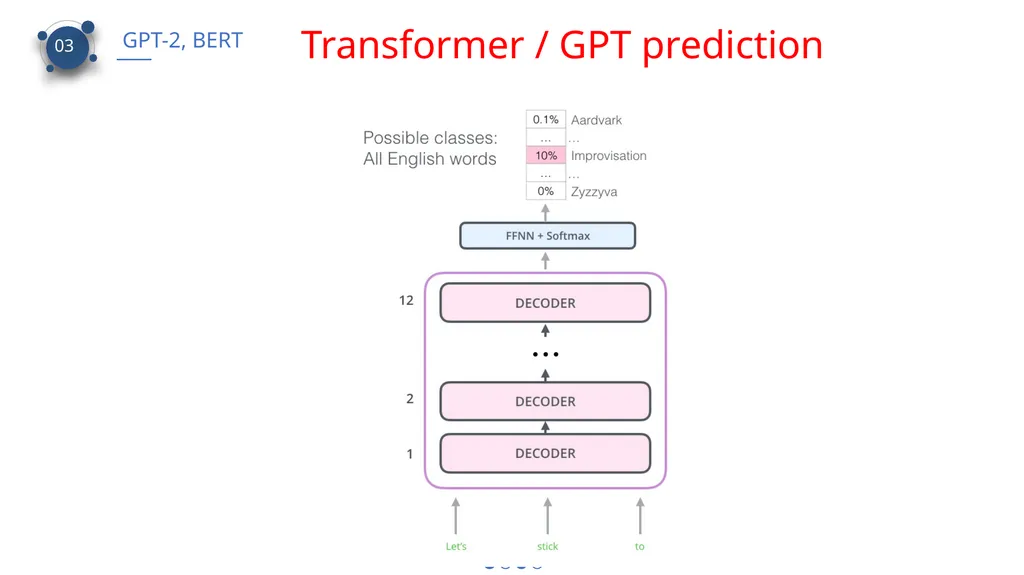
Transformer / GPT prediction 03 GPT-2, BERT<br>
21
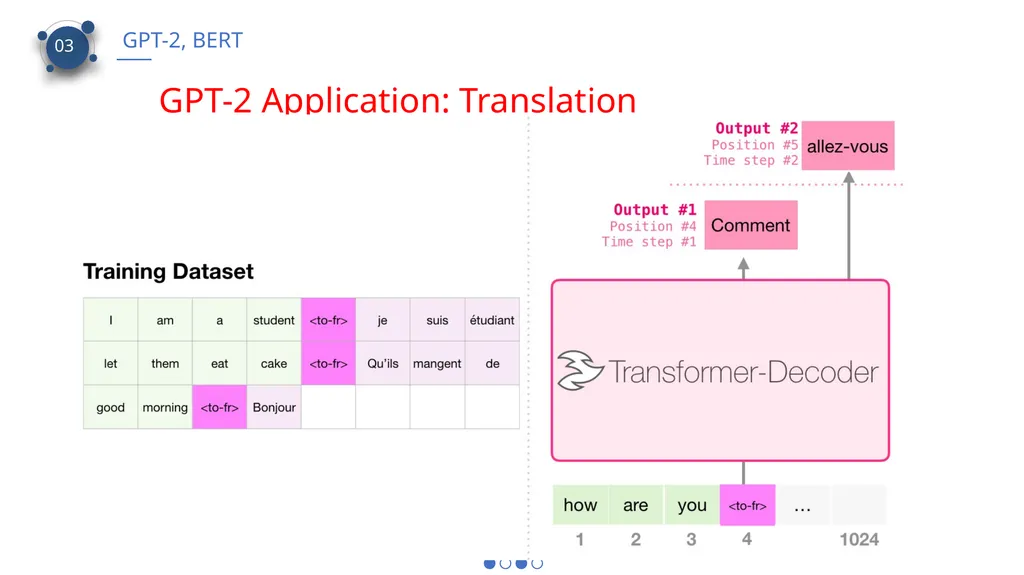
GPT-2 Application: Translation 03 GPT-2, BERT<br>
22
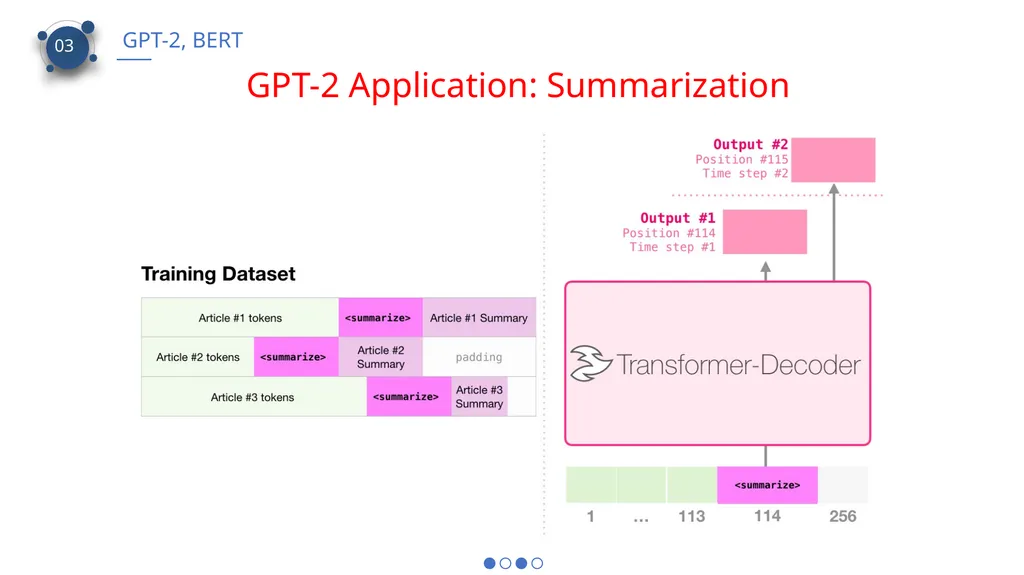
GPT-2 Application: Summarization 03 GPT-2, BERT<br>
23
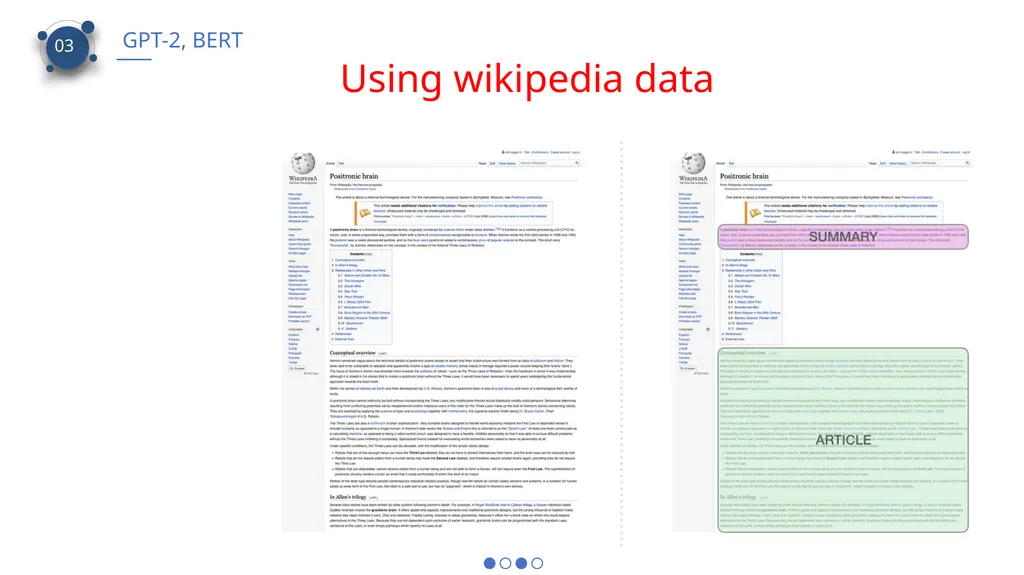
Using wikipedia data 03 GPT-2, BERT<br>
24
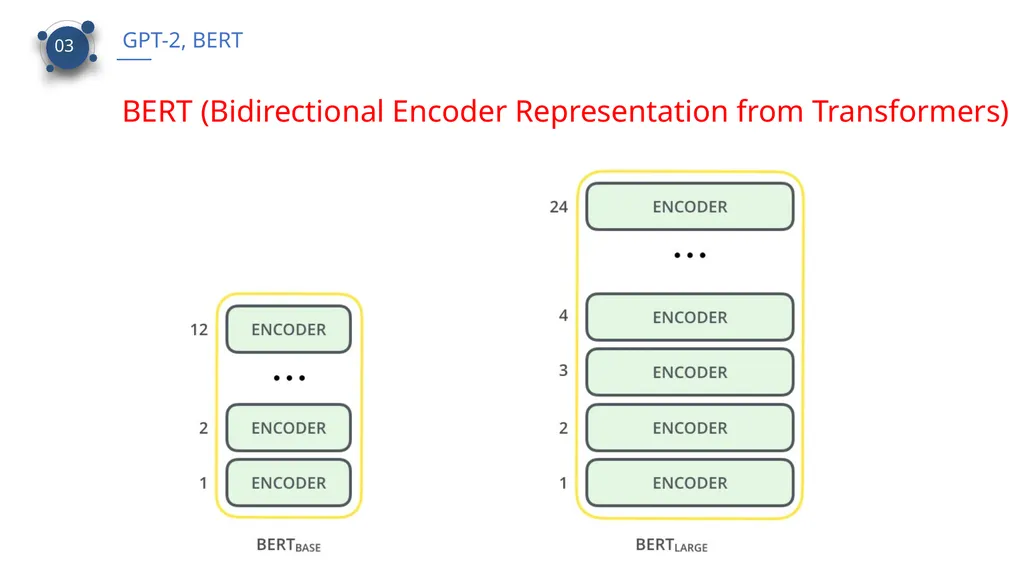
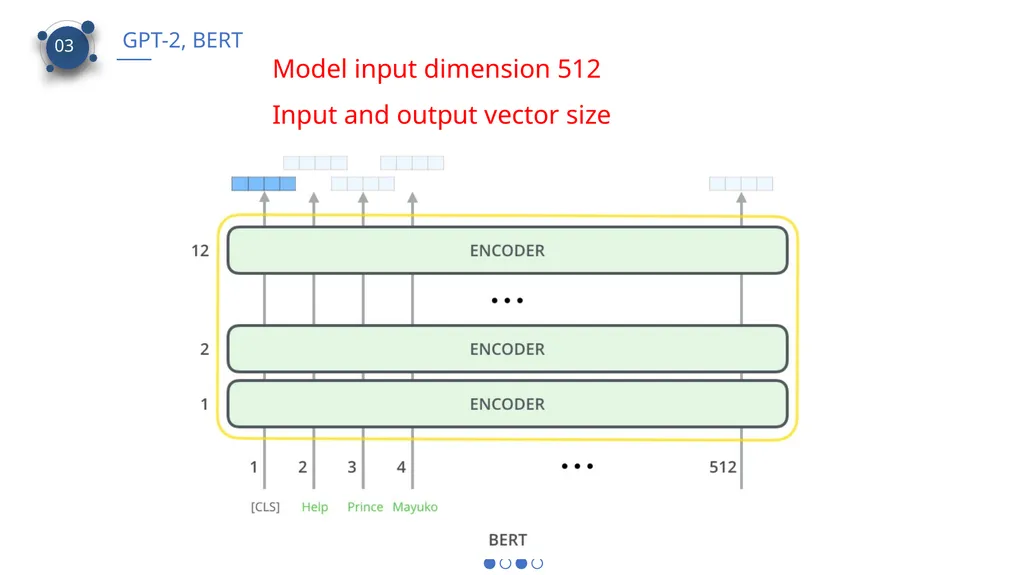
BERT (Bidirectional Encoder Representation from Transformers) 03 GPT-2, BERT<br>
25
Model input dimension 512
Input and output vector size 03 GPT-2, BERT<br>
Input and output vector size 03 GPT-2, BERT<br>
26
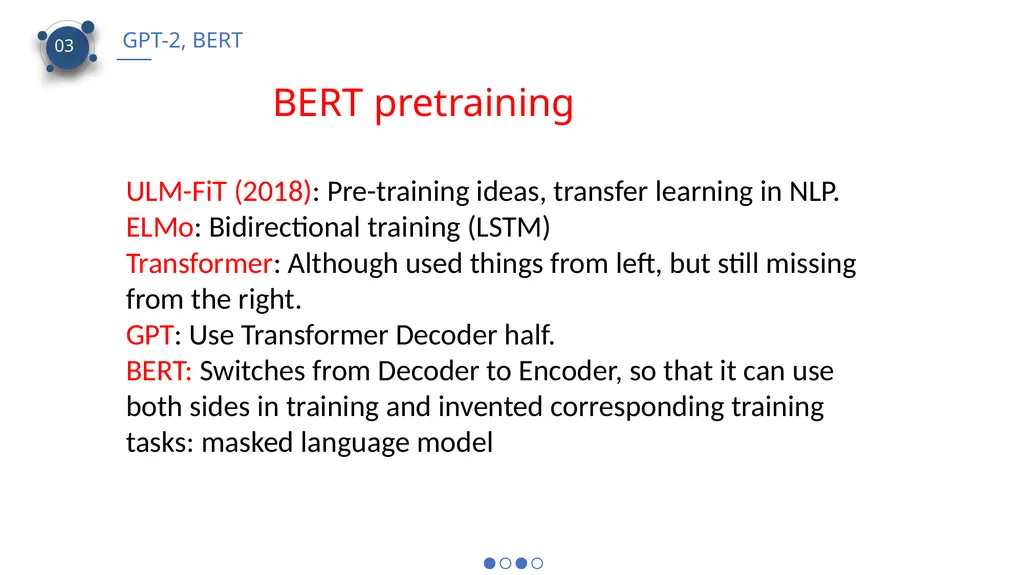
BERT pretraining 03 GPT-2, BERT ULM-FiT (2018): Pre-training ideas, transfer learning in NLP.
ELMo: Bidirectional training (LSTM)
Transformer: Although used things from left, but still missing from the right.
GPT: Use Transformer Decoder half.
BERT: Switches from Decoder to Encoder, so that it can use both sides in training and invented corresponding training tasks: masked language model<br>
ELMo: Bidirectional training (LSTM)
Transformer: Although used things from left, but still missing from the right.
GPT: Use Transformer Decoder half.
BERT: Switches from Decoder to Encoder, so that it can use both sides in training and invented corresponding training tasks: masked language model<br>
27
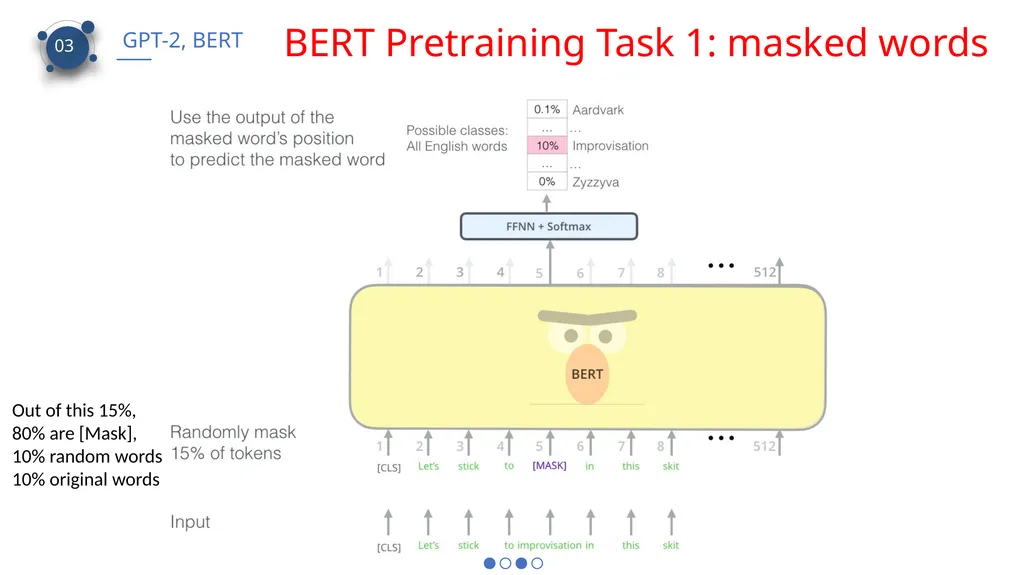
BERT Pretraining Task 1: masked words 03 GPT-2, BERT Out of this 15%,
80% are [Mask],
10% random words
10% original words<br>
80% are [Mask],
10% random words
10% original words<br>
28
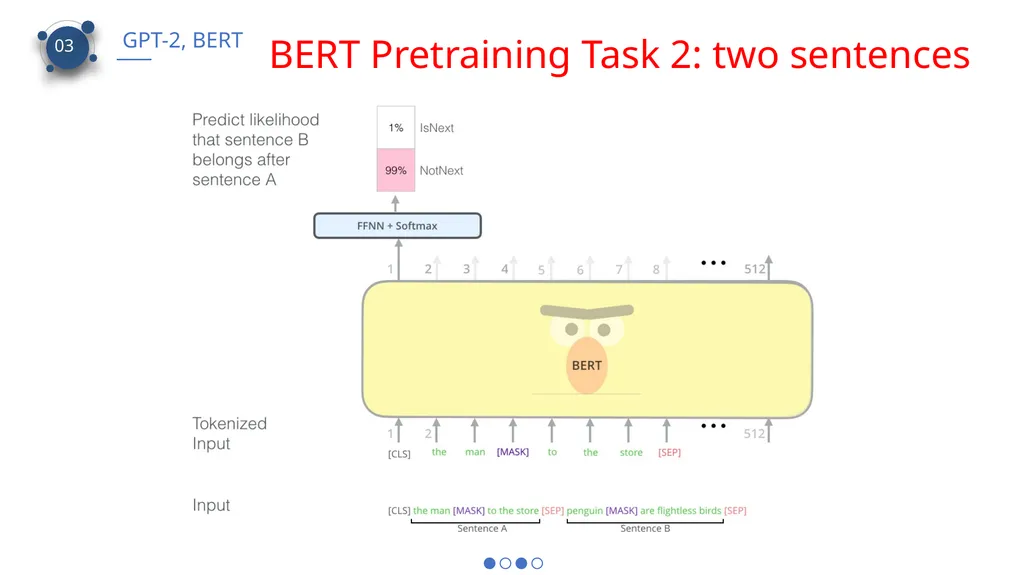
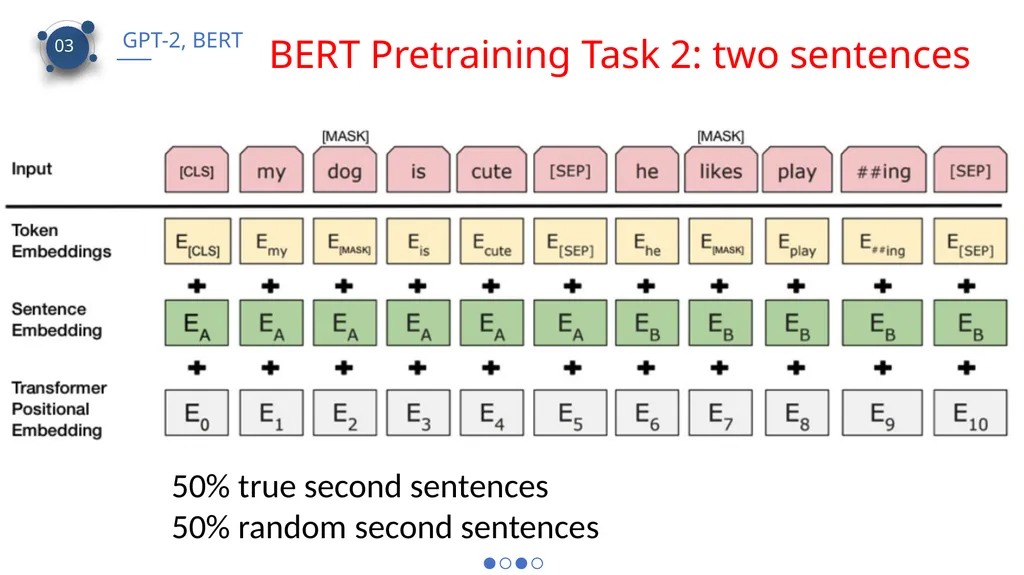
BERT Pretraining Task 2: two sentences 03 GPT-2, BERT<br>
29
BERT Pretraining Task 2: two sentences 03 GPT-2, BERT 50% true second sentences
50% random second sentences<br>
50% random second sentences<br>
30
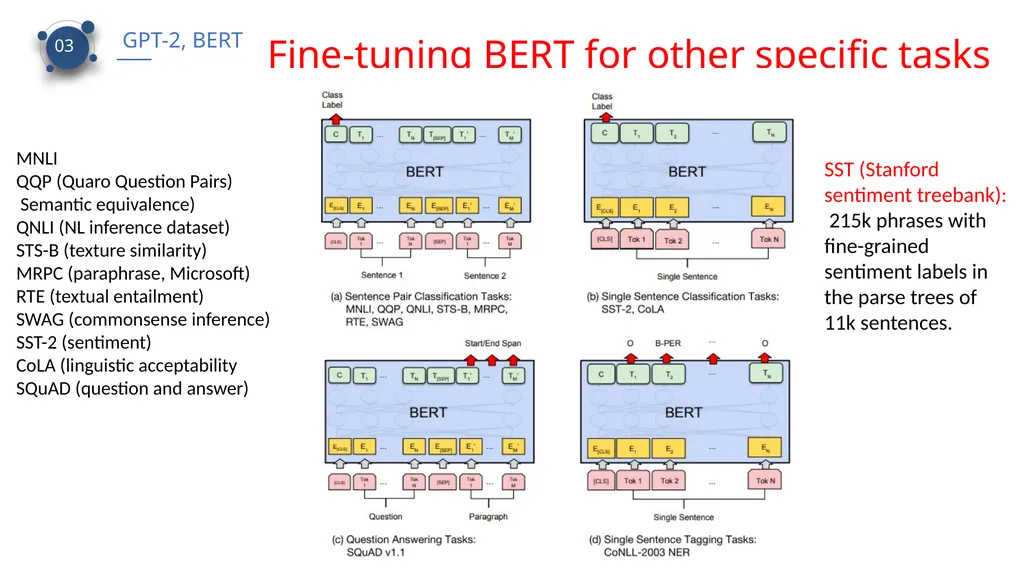
Fine-tuning BERT for other specific tasks 03 GPT-2, BERT SST (Stanford sentiment treebank): 215k phrases with fine-grained sentiment labels in the parse trees of 11k sentences. MNLI
QQP (Quaro Question Pairs)
Semantic equivalence)
QNLI (NL inference dataset)
STS-B (texture similarity)
MRPC (paraphrase, Microsoft)
RTE (textual entailment)
SWAG (commonsense inference)
SST-2 (sentiment)
CoLA (linguistic acceptability
SQuAD (question and answer)<br>
QQP (Quaro Question Pairs)
Semantic equivalence)
QNLI (NL inference dataset)
STS-B (texture similarity)
MRPC (paraphrase, Microsoft)
RTE (textual entailment)
SWAG (commonsense inference)
SST-2 (sentiment)
CoLA (linguistic acceptability
SQuAD (question and answer)<br>
31
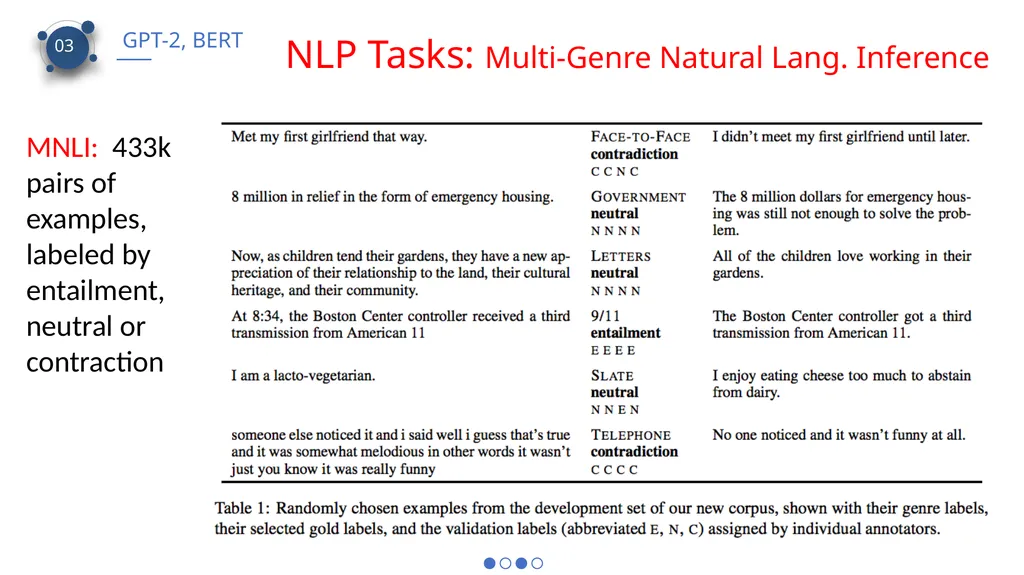
NLP Tasks: Multi-Genre Natural Lang. Inference 03 GPT-2, BERT MNLI: 433k pairs of examples, labeled by entailment, neutral or contraction<br>
32
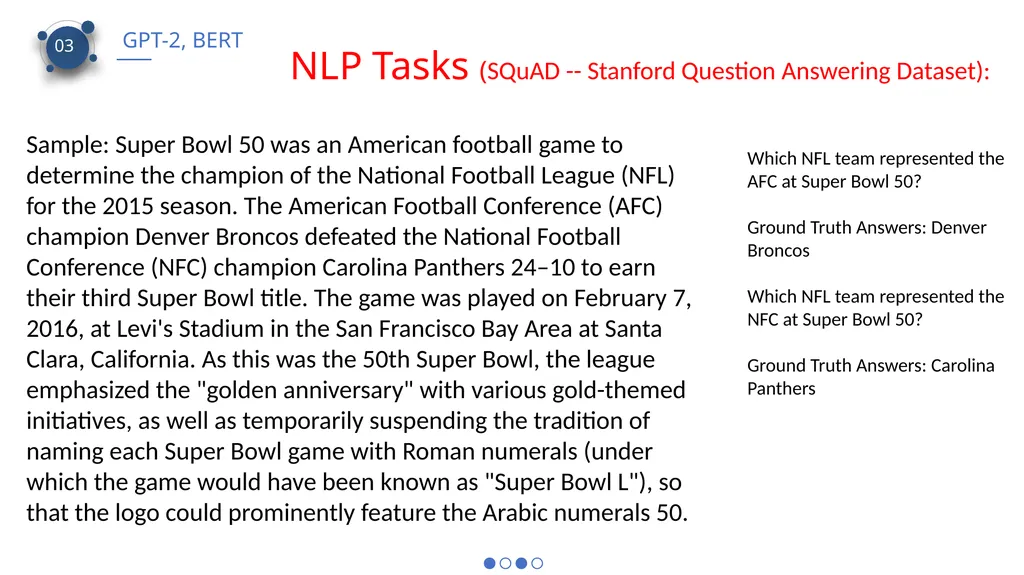
NLP Tasks (SQuAD -- Stanford Question Answering Dataset): 03 GPT-2, BERT Sample: Super Bowl 50 was an American football game to determine the champion of the National Football League (NFL) for the 2015 season. The American Football Conference (AFC) champion Denver Broncos defeated the National Football Conference (NFC) champion Carolina Panthers 24–10 to earn their third Super Bowl title. The game was played on February 7, 2016, at Levi's Stadium in the San Francisco Bay Area at Santa Clara, California. As this was the 50th Super Bowl, the league emphasized the "golden anniversary" with various gold-themed initiatives, as well as temporarily suspending the tradition of naming each Super Bowl game with Roman numerals (under which the game would have been known as "Super Bowl L"), so that the logo could prominently feature the Arabic numerals 50. Which NFL team represented the AFC at Super Bowl 50?
Ground Truth Answers: Denver Broncos
Which NFL team represented the NFC at Super Bowl 50?
Ground Truth Answers: Carolina Panthers<br>
Ground Truth Answers: Denver Broncos
Which NFL team represented the NFC at Super Bowl 50?
Ground Truth Answers: Carolina Panthers<br>
33
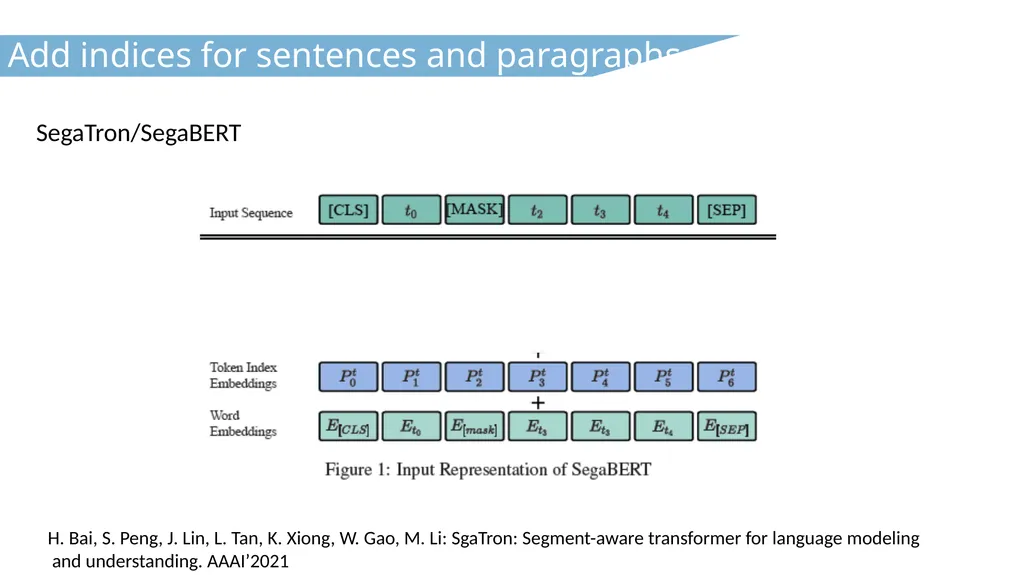
Add indices for sentences and paragraphs SegaTron/SegaBERT H. Bai, S. Peng, J. Lin, L. Tan, K. Xiong, W. Gao, M. Li: SgaTron: Segment-aware transformer for language modeling
and understanding. AAAI’2021<br>
and understanding. AAAI’2021<br>
34
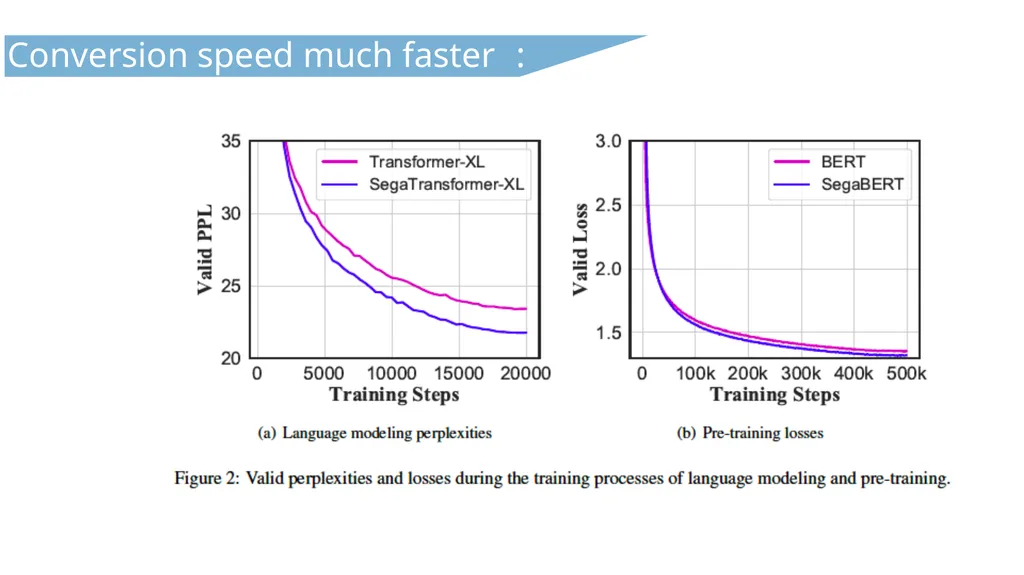
Conversion speed much faster:<br>
35
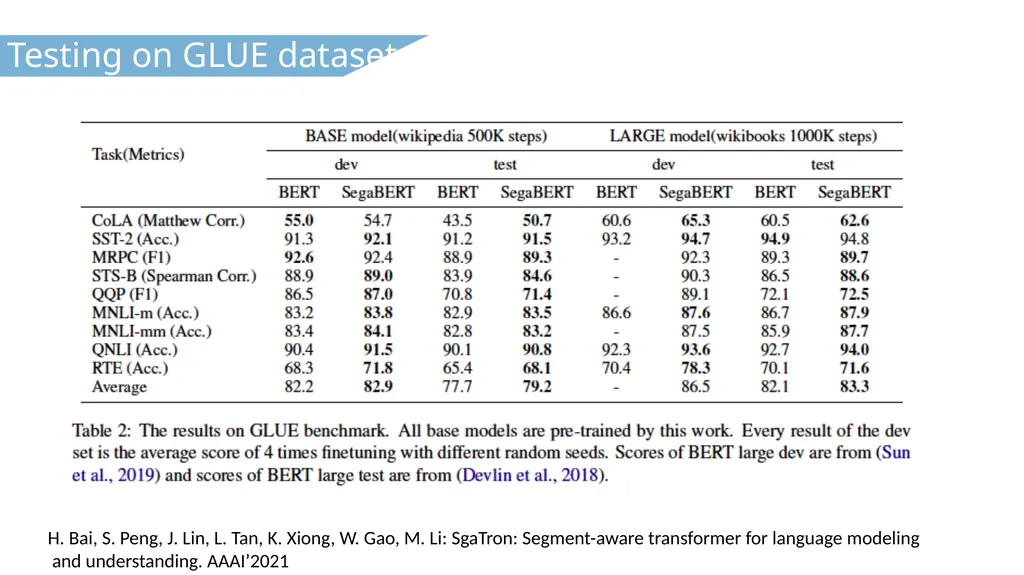
Testing on GLUE dataset H. Bai, S. Peng, J. Lin, L. Tan, K. Xiong, W. Gao, M. Li: SgaTron: Segment-aware transformer for language modeling
and understanding. AAAI’2021<br>
and understanding. AAAI’2021<br>
36
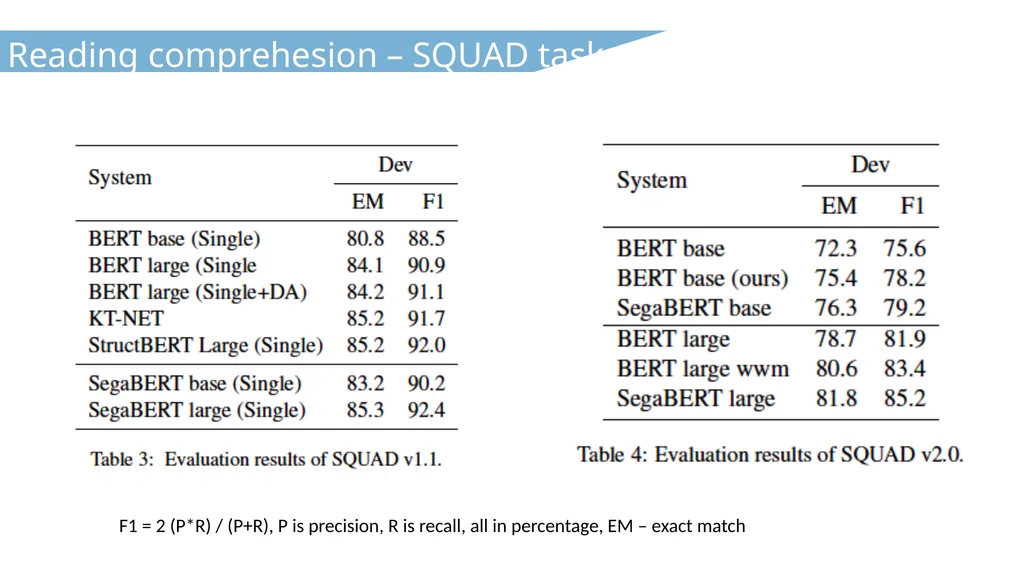
Reading comprehesion – SQUAD tasks F1 = 2 (P*R) / (P+R), P is precision, R is recall, all in percentage, EM – exact match<br>
37
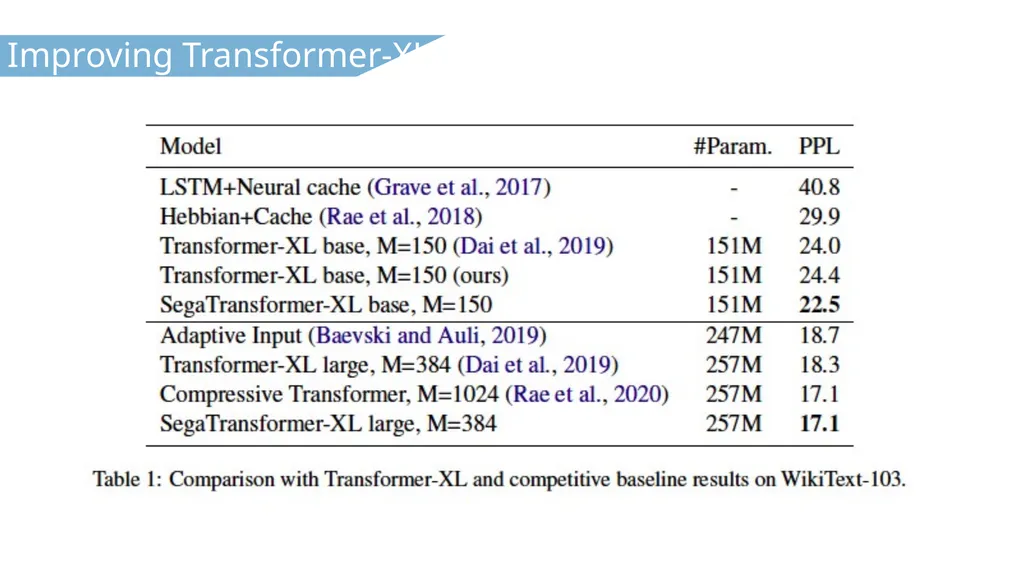
Improving Transformer-XL<br>
38
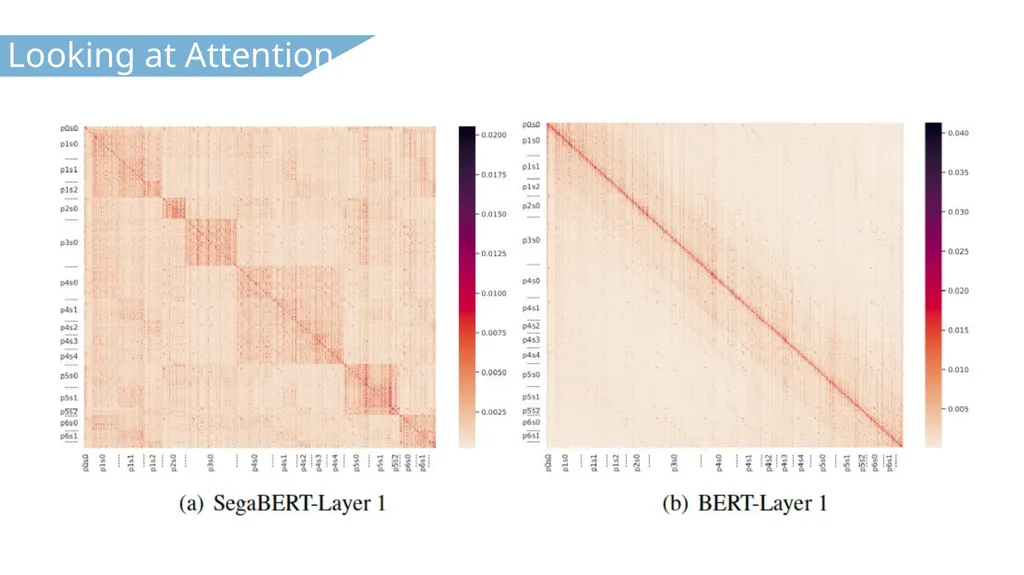
Looking at Attention<br>
39
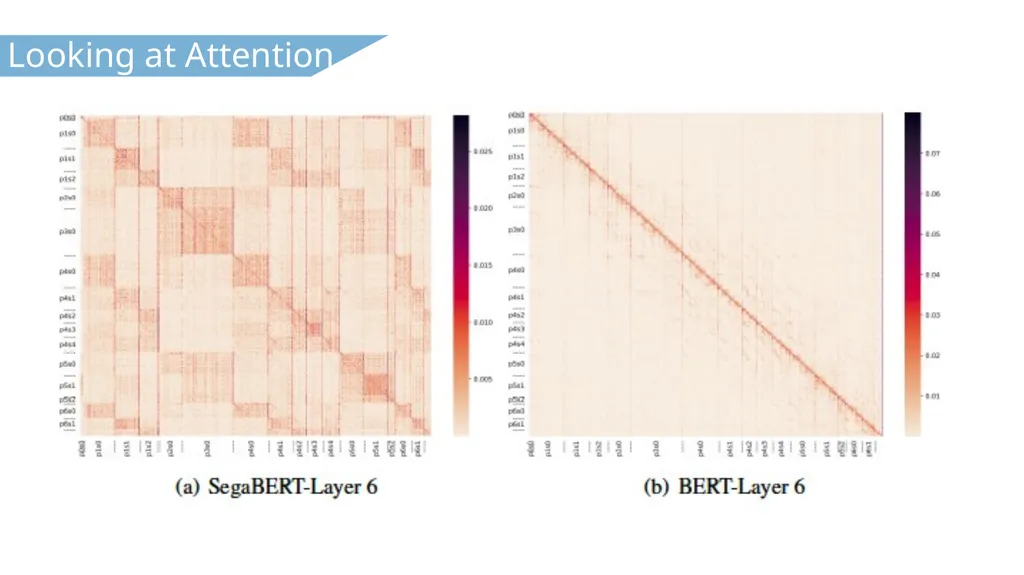
Looking at Attention<br>
40
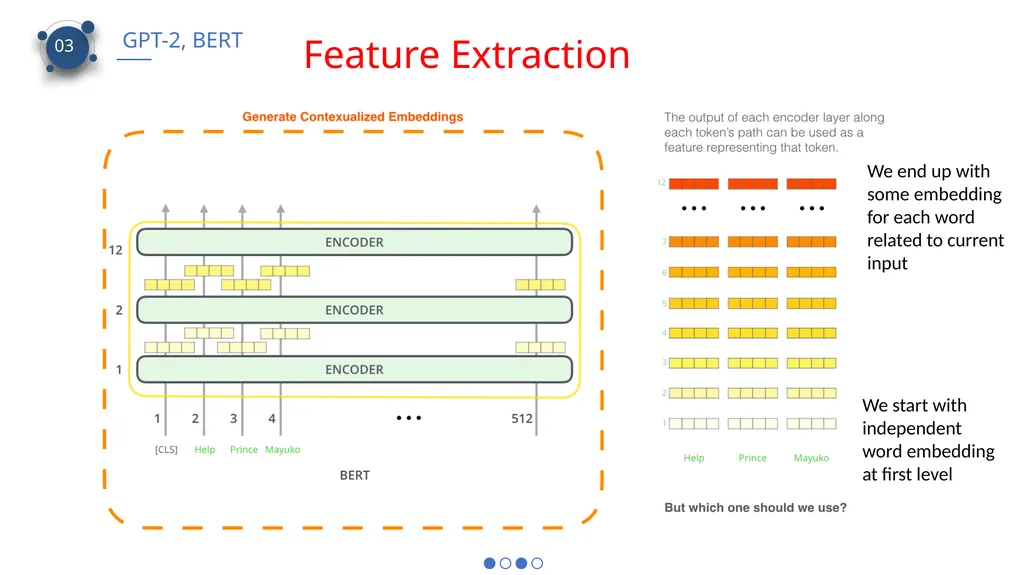
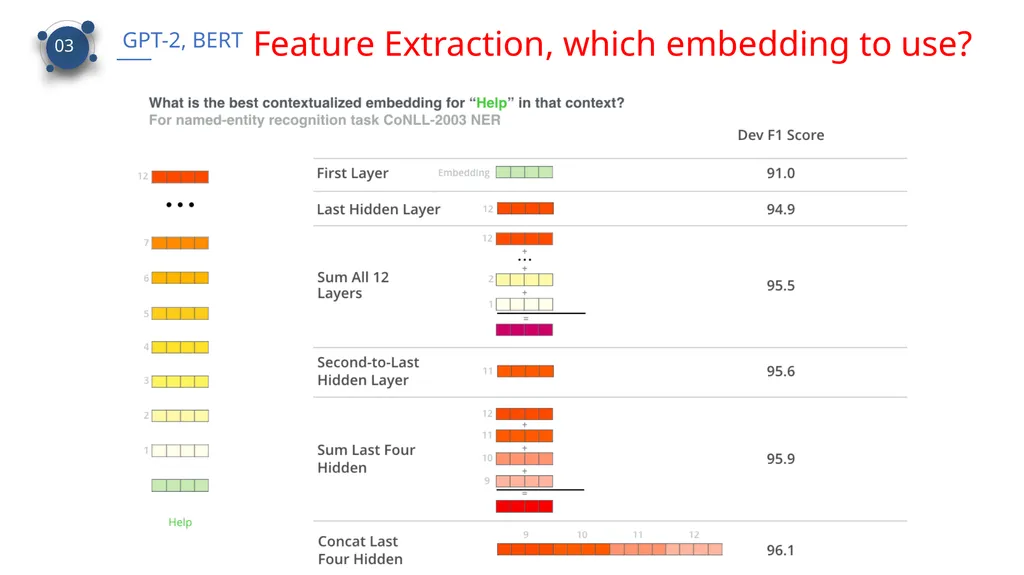
Feature Extraction 03 GPT-2, BERT We start with independent
word embedding
at first level We end up with some embedding for each word related to current input<br>
word embedding
at first level We end up with some embedding for each word related to current input<br>
41
Feature Extraction, which embedding to use? 03 GPT-2, BERT<br>
42
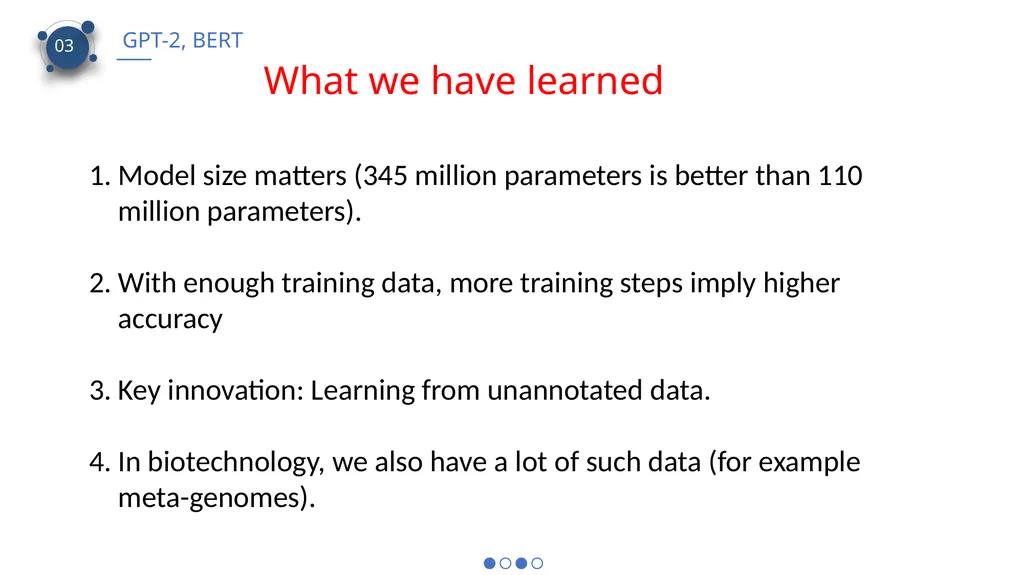
What we have learned 03 GPT-2, BERT Model size matters (345 million parameters is better than 110 million parameters).
With enough training data, more training steps imply higher accuracy
Key innovation: Learning from unannotated data.
In biotechnology, we also have a lot of such data (for example meta-genomes).<br>
With enough training data, more training steps imply higher accuracy
Key innovation: Learning from unannotated data.
In biotechnology, we also have a lot of such data (for example meta-genomes).<br>
43
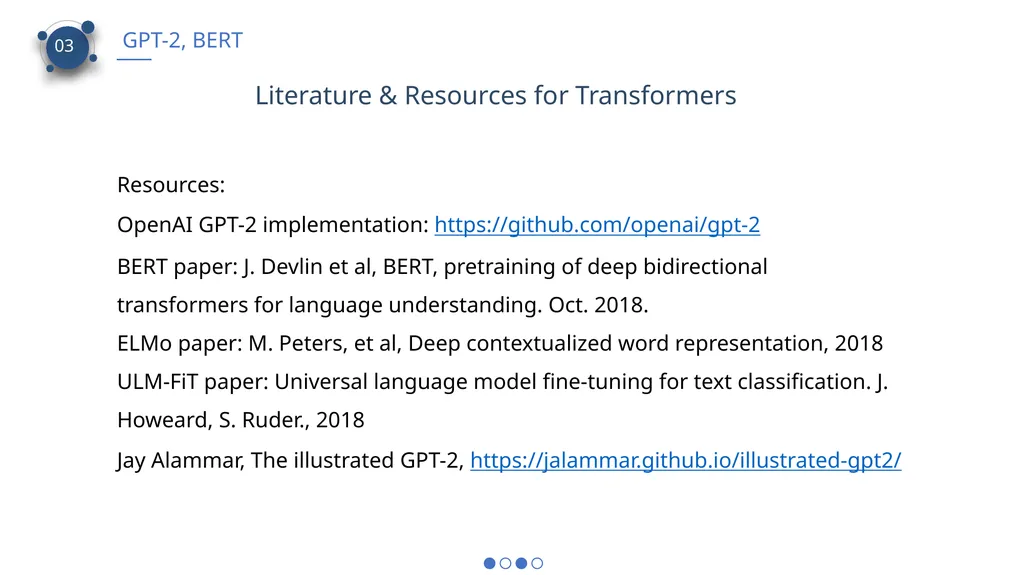
Literature & Resources for Transformers 03 Resources:
OpenAI GPT-2 implementation: https://github.com/openai/gpt-2
BERT paper: J. Devlin et al, BERT, pretraining of deep bidirectional transformers for language understanding. Oct. 2018.
ELMo paper: M. Peters, et al, Deep contextualized word representation, 2018
ULM-FiT paper: Universal language model fine-tuning for text classification. J. Howeard, S. Ruder., 2018
Jay Alammar, The illustrated GPT-2, https://jalammar.github.io/illustrated-gpt2/ GPT-2, BERT<br>
OpenAI GPT-2 implementation: https://github.com/openai/gpt-2
BERT paper: J. Devlin et al, BERT, pretraining of deep bidirectional transformers for language understanding. Oct. 2018.
ELMo paper: M. Peters, et al, Deep contextualized word representation, 2018
ULM-FiT paper: Universal language model fine-tuning for text classification. J. Howeard, S. Ruder., 2018
Jay Alammar, The illustrated GPT-2, https://jalammar.github.io/illustrated-gpt2/ GPT-2, BERT<br>